Category: Mapping

  • Red Hen Systems Offers VMS-HDII Gas Finder for Pipeline Patrol

    Red Hen Systems offers VMS-HDII Gas Finder, a turnkey pipeline patrol service solution. It detects pipeline gas leaks in parts per million (ppm) while capturing their locations on maps and video. This combination of Red Hens’ VMS-333 hardware and Boreal GasFinderAB laser delivers the information decision-makers need in order to quickly respond to problematic cracks or leaks in pipelines, the company said.

    Red Hen Systems President Neil Havermale said the VMS-HDII Gas Finder is easier to use and more cost effective than other pipeline patrol solutions. “Simply put, our process involves gathering customer’s important data, processing their data, and making it available to them whenever and wherever they please.”

    Designed specifically for pipeline corridor patrol and field-tested over the course of many years, this robust system helps enable companies to meet FERC compliance, keep patrol costs down and, detect leaks or defects in rugged and inaccessible terrain. Once leak detection data, video data, and mapping data are collected Red Hen Systems provides anytime, anywhere viewing via Google Earth or ESRI ArcGIS. Video images of the locations of detected gas leaks help companies identify the source, while providing a visual reference to integrity maintenance crews deployed to address the problem. With more than 80 percent of methane leaks occurring within pipeline corridors and related surface equipment, reliable detection and location data is vital.

    The VMS-HDII Gas Finder offers a reliable means for maintaining the integrity of nearby assets and assuring the safety and wellbeing of populations and the environment. Boreal laser technology, which is used in our pipeline patrol service, was tested at the Rocky Mountain Oil Field Testing Center (RMOTC) where it substantially out-performed other gas leak detection devices tested at the facility, the company said. Data is collected during corridor patrol with a video camera, a GPS unit, and a high-definition video recorder. The VMS-HDII simultaneously records several streams of data as one file to be mapped following the operation. The gas detection map is viewable anytime, anywhere on Google Earth or ESRI ArcGIS through Red Hen Systems’ server.

    The map visually indicates where each leak was detected by the Boreal Laser and is paired with the measurement of each leak in parts per million. Red Hen Systems recognizes that not all companies’ needs are the same, allowing the VMS-HDII Gas Finder to be customized to meet individual specifications.

  • Avenza Releases MAPublisher 9.1 for Adobe Illustrator

    New ability to export HTML5 web maps and enhanced MAPublisher LabelPro features.

    Avenza Systems Inc., producers of the PDF Maps app for iOS and geospatial plugins for Adobe Creative Suite, including Geographic Imager for Adobe Photoshop, has released  MAPublisher 9.1 for Adobe Illustrator.  MAP Web Author now has the ability to export HTML5 web maps (in addition to the already available Flash output), which are suitable for mobile devices such as tablets and smartphones. In addition, the MAPublisher LabelPro extension has been updated to include the ability to use label filters and expressions for even more detailed labeling as well as a redesigned and more flexible user interface.

    “MAPublisher 9.1  now supports the export of HTML5 web maps. We’ve seen a growth in online mapping and the upward trend of using HTML5 technology to make websites more interactive and interesting. More importantly, map makers and webdesigners alike can extend their HTML5 web maps to smartphone and tablet browsers without the need for additional plug-ins,” said Ted Florence, President of Avenza. “With this new version, we are seeing increased labeling performance, detail, and flexibility.”

    Enhancements and new features of MAPublisher 9.1: MAP Web Author HTML5 export; MAPublisher LabelPro redesigned interface, new label filters feature, and improved performance; Various user interface and performance enhancements to improve usability

    MAPublisher for Adobe Illustrator is powerful map production software for creating cartographic-quality maps from GIS data. MAPublisher tools leverage the superior graphics design capabilities of Adobe Illustrator to manipulate GIS data and to produce high-quality maps with accuracy and efficiency.

  • Human Geography at GEOINT

    Could the Connecticut Shootings Speed Human Geography Tools?

    By Art Kalinski, GISP

    During the past few days there has been a stream of talking heads offering advice after the tragic shooting in Newtown, Connecticut.  Some want schools to have airport like screening equipment with full time police officers, others want more aggressive psychological counseling, while others want to ban some or all guns.  Just last August, Norwegian mass killer Anders Breivik was sentenced to 21 years after his 2011 killing of 8 with a car bomb and 69 students in a summer camp with semi-automatic weapons.  That, in a country with some of the strictest gun laws in the world.  So what’s the answer?  I’m not sure but I lean toward more conceal and carry permits.  The cause and effect may only be statistical, but the numbers seem to show less crime where conceal carry permits are common.  Most bullies and killers fear someone fighting back so they almost always pick soft targets.

    There is another possible, longer term path that has the potential to be very beneficial and possibly very sinister, Human Geography.  In the early days of GIS I was thrilled to be able to print a simple zip code map with points plotted within the zip code to measure and display demographic data.  In the mid nineties, when I was the GIS manager of the Atlanta Regional Commission, my GIS team was able to help the Atlanta Fire Department catch a serial arsonist by mapping the arson locations and comparing that distribution to home addresses of know past arsonists.  Although not a perfect match, the plots did help identify and ultimately convict the arsonist.

    We are now well beyond points, lines, and polygons GIS.  Today I use my cell phone for navigation, voice directions as well as a street-level imagery of my destination along with photos, video and hundreds of other web based applications.  The same progress has occurred in the intelligence community as maps, imagery, live video, and “other” sources of information have been merged using “Geospatial Multi-INT fusion” to build pattern of life analysis with the potential to anticipate harmful actions.

    One of those “other” sources of data is social media and human geography which had its genesis with Web 2.0.  The term Web 2.0 was coined in 1999 to describe web sites that use technology beyond the static pages of earlier web sites.  It was not a new version of the World Wide Web but referred to the way web sites evolved to allow users to interact and collaborate with each other such as social networking sites, blogs, etc.  Although the US and Europe lead the world in use of social media, Second and Third World countries also have a strong user base of social media.  Most Third World countries never went through the long technology slog we went through laying miles of phone land lines as the technology evolved.  Many of them went direct to cell-phone technology, bypassing the expense and effort of land lines.  As a result, social media plays a surprisingly strong role in countries that still have limited mass media access.

    It’s no surprise that there was an increase in the number of human geography presentations and exhibitors at GEOINT.

    Geoint 2012 panel 

    There was even a pre-conference day devoted exclusively to Human Geography.  The following is a limited snapshot of exhibitors I saw that focused on human geography and social media.  Most of the big players such as Lockheed Martin, Northrop Grumman, BAE, SAIC and others have been doing significant work in these areas but the below are small companies that focus exclusively on human geography.

    Aptima (www.aptima.com/products/lava ) produced LaVATM , a statistical tool for extracting concepts and patterns using natural language processing.  They use online news, social media and blogs to follow the spread of ideas.

    Berico Technologies (www.bericotechnologies.com) demonstrated CLAVIN (Cartographic Location And Vicinity INdexer) which is an open source software package that derives location names from unstructured text and compares them against a gazetteer.  CLAVIN doesn’t just “look up” location names – it uses intelligent logic paths to identify exactly locations based on the context of the text. CLAVIN also uses fuzzy logic to work its way through misspellings or language translations.  There is a USGIF video taken at GEOINT that explains the process (http://geointv.com/archive/geoint-2012-tech-talks-berico-clavin)

    Courage Services, Inc.  (www.courageservices.com)  does research and analysis related to human geography, Socio-cultural dynamics, social media, risk assessment and mitigation.  Their geospatial services include human geography mapping services, imagery and video analysis, mobile and web based applications.  They have focused heavily on humanitarian assistance, disaster relief and development.  Specifically supply chain logistics, situational awareness, critical infrastructure mapping and emergency response support.

    DataCards (www.datacards.org)  indexes data sources that relate to irregular warfare, assessment, or can be used for socio-cultural modeling.  These cards provide a summary description and evaluation of the content, quality, intended purposes, and potentially appropriate uses of each source

    Ergo (www.ergo.net ) delivers ground truth and actionable intelligence from frontline sources.  Unlike other human geography firms they rely on hands-on experience and feet-on-the-ground rather than electronic media.  They have a network of vetted and trusted team members who are locals. They know the political and business environment, understand the customs, and speak the language.  They specialize in “hard cases” – opaque geographies, obscure topics, and sensitive issues that other firms struggle to address with open source media.  They’ve been in business for 7 years and have completed over 400 projects in 90 countries.

    The HumanGeo Group, LLC (www.thehumangeo.com) developed geospatial applications to synthesize, manage, and exploit large data sets, leading-edge non-traditional cyber security and specialized rapid search capabilities. The HumanGeo Group also brings together experienced special operations and intelligence agency veterans to address security and intelligence needs.  HumanGeo also provides business intelligence, geospatial visualization and innovative enterprise search applications that can help reduce risk.

    Recorded Future (www.recordedfuture.com) is in the business of mining “Big Data” to try to have advance knowledge or improved understanding of what might happen in the near future.  They continuously harvests and perform real time analysis of news from more than 40,000 sources on the web, ranging from big media and government web sites to individual blogs and selected twitter streams.  This analysis ties together countless pieces of information that highlight future events.  They can’t predict the future but they can highlight future events based on analysis of millions of events tied to more than 2 billion facts in their database.  This may sound somewhat Orwellian but does point to where things could be headed.

    Fulcrum (www.spatialnetworks.com) is a cloud-based data collection system for iPhone, iPad, and Android devices.  Users can create location-based data collection apps and deploy them to mobile devices within minutes.  It facilitates collaboration so a data collection team can work on the same project collecting data in the field quickly, accurately and with great flexibility.

    fulcrum

    GeoXray (www.terragotech.com) is a web-based software application that allows users to search the internet and social media sites for content relating to a geographic area and filter the results by topic, time and source.  TerraGo, creators of the ubiquitous GeoPDF, demonstrated interoperation by allowing a user to access GeoXray directly from a GeoPDF.  TerraGo’s Michael Bufkin indicated that the next step in this interoperability will be to cache the GeoXray discovered content within the GeoPDF when it is created, thus enabling access to the content directly from the TerraGo Toolbar. Users would then be able to discover GeoXray content even if not connected to the internet while using the same tools that they use for map display and collaboration.

    GeoCOP (www.hmstech.com) is a web-based voice, video, and data overlay service which connects people, applications, and knowledge.  “GEOCOP” stands for “Geospatial Common Operating Picture” and is a Sensitive but Unclassified web-based voice, video, and data overlay technology that instantly connects people, Geospatial Applications, and knowledge.  It was designed by former special agents and law enforcement experts, to provide law enforcement and intelligence agencies with an improved situational awareness tool.  I had a chance to test GeoCOP during a recent exercise where we combined real time earthquake data from USGS with tweets from the affected area verifying the extent of the damage.  I was very impressed with its functionality, broad access to extensive data sets, user friendliness and speed.  GEOCOP users can gather data from multiple online sources, then overlay the results alongside geospatial applications, web video players, live messaging, and other programs.

    geocop

    If your GIS life focuses on points, lines and polygons please look over the cubical wall. There is a silent revolution occurring in the geospatial community that may dwarf traditional GIS.  This has been the most rapidly expanding part of GEOINT as more and more users do a deep dive into all aspects of human geography.  Some of the growing capabilities are quite startling, almost “Big Brother” / “Minority Report” like science fiction.  If I’m still around, it will be interesting to attend GEOINT 2030.  Perhaps we’ll have tools that can use “Big Data” and analysis to anticipate and block damaging events.

    Kalinski photo


    Art Kalinski, GISP

    A career Naval Officer, Art established the Navy’s first GIS.  Completing a post graduate degree in GIS at the University of North Carolina, he joined the Atlanta Regional Commission (ARC) as the GIS Manager from 1993 to 2007.  He pioneered the use of oblique imagery for public safety and Homeland Security.  Art retired early from ARC to join Pictometry International to direct military projects using oblique imagery which led to him joining Soft Power Solutions, LLC.  He also writes a monthly column for GeoSpatial Solutions aimed at federal GIS users.


  • Nokia To Acquire earthmine 3-D Imaging Company

    earthmine, Inc., announced today that it is has entered into an agreement to be acquired by Nokia. earthmine, based in Berkeley, California, is a privately owned company that develops a powerful end-to-end 3D street level imaging solution — from collection hardware to processing workflows, cloud hosting and client software.

    The earthmine team is expected to join the Nokia location and commerce business, and Berkeley will become a key site for the development of 3D reality capture technology. “We are very excited to be joining Nokia, a company with a huge presence and vision in mapping,” said John Ristevski, co-CEO of earthmine Inc. “We could not hope for a better place to fulfill and accelerate our mission of indexing the world in 3D.”

    The transaction is expected to close by the end of 2012. The terms of the transaction are confidential.

    earthmine, Inc., provides 3D street-level imagery, delivering an end-to-end solution including 3D mobile mapping systems, automated data-processing pipelines, cloud-based hosting services and server software, desktop software, client-side developer tools, and direct integration with GIS software. earthmine technology is being used in local search, mobile, mapping, GIS, safety, and security markets in the United States, Mexico, Brazil, Canada, France, Australia, Japan, Malaysia, Singapore, Korea, Saudi Arabia, as well as other countries around the world.

  • GEOINT 2012: Much to Do even with Looming Budget Cuts

    By Art Kalinski

    In a repeat performance, USGIF (United States Geospatial Intelligence Foundation) put on a superb conference that was really informative and well executed. GEOINT has always been a serious conference with very little partying, but this year was more so with the leadership even eliminating the traditional closing night social. The social events never were excessive in the past but no one wanted even a hint of over indulgence. It wasn’t missed, because quite frankly there was too much to see and too much to do to spend time on frivolity.

    As in past years, there were so many noteworthy presentations. With more than 248 exhibitors in the Expo, it was impossible to see and hear it all. So this is just one man’s limited view of a mega conference. Luckily, many of the key presentations are on the USGIF website as daily summaries. See ShowDaily 1-5 and videos clips (make sure select the 2012 clips and not previous years).

    Director of National Intelligence and keynote speaker James Clapper

    The opening keynote was delivered by the director of National Intelligence, The Honorable James Clapper, who directly addressed two elephants in the room — sequestration and his take on the Benghazi attack. First he discussed several issues: the INCITE program to have an enterprise data model in the “cloud” by 2018, which he said was moving along nicely. He tied in the need for multi-int data such as GEOINT, SIGINT, MASINT, etc. and also expressed his concern that improvements were needed to speed up the clearance process. He cited reciprocity, so clearances would carry over from one agency and contract to others as a big issue.

    Then he got to elephant one — sequestration. He said that it would be devastating to the intel community because there is no way to prioritize programs. Important programs would see the same cuts as less critical programs which could prove very dangerous.

    The second elephant was the recent attack at Benghazi and death of four diplomatic staff members including the Ambassador. Director Clapper took a jab at our politicians and quoted a recent article by Paul R. Pillar, a 28-year veteran of the Central Intelligence Agency (CIA) that he said was thoughtful and resonated well with him.

    “Information about lethal incidents is not total and immediate. The normal pattern after such events is for explanations to evolve as more and better information becomes available. We would and should criticize any investigators who settled on a particular explanation early amidst sketchy information and refused to amend that explanation even when more and better information came in. A demand for an explanation that is quick, definite and unchanging reflects a naive expectation — or in the present case, irresponsible politicking.” You can view Director Clapper’s full keynote here.

    NGA Director Letitia Long addresses the opening session crowd
    NGA Director Latisha Long


    Director Clapper was followed by NGA (National Geospatial-Intelligence Agency) Director Letitia Long, who discussed current efforts at NGA. She cited continuous creation of ever more capable applications. One example permitted a single user to locate a hard-to-find feature in imagery that took 10 minutes, which previously would have taken several analysts days to complete. She stated that during the past year NGA had developed more than 150 apps that are currently in their “app store.” Her goal was to have the majority of future apps created by commercial developers. They are even considering an “Apple iPhone like” commercial model that would pay compensation to developers based on the number of downloads and users rather than cumbersome and limited contracts.

    Additionally, she spoke of their work to build a Common Desktop Environment (CDE) for NGA and DIA, which will soon top 2,000 users and is expected to grow to 60,000 users by the end of 2013. She said that through streamlining and redundancy elimination about 40 percent of their geospatial content is available to her users with a goal of 100 percent by next year.

    This conference was an eye opener in that it was surprising how fast topics that were just sidebar discussions last year are moving to the forefront. Topics like human geography, social media, and pattern of life mapping seemed to be part of many presentations and some exhibitors. A few presentations stretched my concept of geospatial technology and tradecraft.

    One of them was by Jeff Jonas, an IBM Fellow and chief scientist for IBM Entity Analytics, who gave a lunchtime keynote explaining work he was doing at IBM to help decipher seemingly duplicate data to cut processing time. He used a puzzle metaphor to explain his work with “big data.”

    “Some of the pieces are missing, some of the pieces have errors, some of the pieces have fabricated lies,” he said, but by merging many different datasets a filtering occurs. He then explained an ultimate filter by using an example of two theoretical twins with the same IDs, same DNA, same accounts, etc. He said that with current technology we can now track the movements of individuals through their smartphones, and that unless the twins are joined at the hip, “Space time movement data is the ultimate biometric” and is one way to differentiate one person from another. This capability is also going test our concepts of privacy.

    The GEOINT Expo

    In the Expo area, there were more than 248 vendors ranging from the big companies such as Lockheed, Boeing, SAIC, and others to small start-ups at the fringe of the exhibit hall. Several were showing human geography / social media tools and numerous data storage and management solutions. I didn’t see much new hardware of note other than Ball Aerospace, who was showing the latest and greatly improved version of its Flash aerial LiDAR that can create 3D models draped with imagery continuously and in real time. This was so impressive that I’m going to learn more and write a column about it in the near future.

    Klee Dienes, president of Hadron Industries and former medical helicopter pilot, demonstrated Hadron’s work developing hand-gesture language to use Oblong computer control equipment to navigate maps. Oblong Industries has developed equipment that permits touch-free control of applications just through the use of hand gestures, very much like in the science-fiction movie Minority Report. Oblong not only has equipment that can follow hand gestures using a special glove, but the technology has progress to tracking hand gestures in free space without special gloves. They also developed a special hand-gesture language called g-Speak. This technology is hard to describe and is best understood viewing video clips at the Oblong site.

    Minority Report’s future tech.
    Oblong Industries’ touch-free technology.

    There were numerous presentations on the growing use of human geography and the growing need for not only geospatial technicians but of all things, social scientists. The only “wet blanket” attendee that voiced a concern during a question-and-answer session was an academic researcher who voiced a concern that social scientists were being used for intel work. He said that the American Anthropological Association (AAA) may have a problem with “weaponizing” social science. The speaker had a good answer in that he asked “How could the AAA have a problem with preventing war and reducing human misery?” My feeling, considering the stellar high-paying job market for social science majors, is why bite the hand that could feed you?

    There was so much to cover in the human geography realm that in next month’s column, I will focus on the human geography aspect of GEOINT.

  • Indoor Location Tests Ahead, Mapping under Scrutiny

    Janice Partyka
    Janice Partyka

    October was a month of shows, rumors and announcements. Testing of competing indoor location positioning technologies is being planned by the FCC; prospects for some companies will ride on the public results. Apple may be turning to TomTom to save it from its mapping inaccuracy issues, dubbed Mapplegate. This month’s CTIA show was flat; attendees were wondering if it was the last chapter of the fall show. Interesting industry tidbits were heard at the MforMobile Location Business Summit. New Google Ad Word rates may be created that are also based on the distance between the handset and advertiser’s location. History can be harsh, remembering an unfortunate calculation by a location industry giant. Marketers continue to be frustrated by the mobile industry’s continued difficulty to completely measure ad results.

    The FCC sees indoor location as a critical safety concern for E911 emergency response. The commission has tasked an advisory committee to evaluate indoor location positioning technologies. TechnoCom has been chosen to conduct the independent testing as a neutral third party. The test bed is in about 20 structures of various types, in locations that range from highly dense urban to sparse landscape. The following companies are submitting technology for the testing: Qualcomm (AGPS/AFLT/Cell ID), NextNav (GPS-like terrestrial beacons), Boeing (LEO satellites using the Iridium constellation), and Polaris (RF fingerprinting). Additional companies submitted technology, but later withdrew. Test results should be made public in March of 2013. A public workshop on this testing is being held at the FCC on October 24 and can be watched online at www.fcc.gov/live.

    Indoor Mapping. At the Location Business Summit, it was clear that the retail and hospitality industries is anxious to start exploring indoor marketing based on real-time location. They seem to expect it will start out working flawlessly. It won’t. In addition to the indoor positioning being early stage, mapping quality is uneven. The gold bar of quality assurance for outdoor mapping is aerial fly-overs and street driving. In some situations crowd sourcing works. For indoor maps, it’s the Wild West. Currently there are no standards for vetting indoor mapping. Maps are being created of greatly varying quality, sometimes by way of rough diagrams found on the Internet that are then shoe-horned into the outlines of buildings.

    TomTom to the Rescue?  Shares in TomTom, maker of personal navigation devices (PNDs) and mapping, jumped to a three-week high on speculation that it may be taken private by its founders with the help of Apple. In turn, Apple could buy TomTom’s maps database to correct its mapping problems. TomTom’s founders own 47 percent of the company, but may be held back by the uptick in share value.

    Paying for Location. Reportedly, Google has location-based AdWords in beta. Advertising rates go up the closer the targeted user is to the venue being promoted. A restaurant ad is more relevant, and more likely to draw a person who is one mile away than 20 miles. Some travelers will park near a string of hotels and use a site like hotels.com to find the most competitively priced room for that evening. An ad for a hotel on the other side of town is of lesser value and would be cheaper.

    Comments Heard at the Location Business Summit by MforMobile this Month:

    “We need to build ambient intelligence into devices. Nobody needs more information, more apps, ads, logins or devices. It isn’t sustainable.”

    “Location data on the consumer side is often junky because phones are trying to conserve battery, and won’t invoke GPS.”

    “You can get better locations from the carrier network, but it is too expensive a proposition for advertisers.”

    “We find that hyper-local ad targeting leaves us with too few people to address.”

    Can I Turn Back the Clock? In an interview for Forbes in 2003, Min Kao, CEO of Garmin, puts a stake in the ground. He says he does not seek to compete in navigation with the mobile phone, the likes of Nokia and Motorola, as that is the kind of commodity business Garmin would like to avoid. The PND vendors continue to be squeezed between the OEM embedded equipment and the smartphone. It is hard to be optimistic about the PND market, commented John Canali of Strategy Analytics at the Location Business Summit. Heavy discounting has led to plummeting revenues. “The PND companies are hardware focused in a market whose foundation is software. It will be very difficult to transform PND companies,” says Canali. “They will struggle.” In 2009, Google announced that all Android phones built on OS 1.6 or higher would have free turn-by-turn directions. Nokia followed shortly after. So it began.

    A Little Slow. CTIA drew more than 5,000 people to attend MobileCon, its fall show with a new brand name. You may remember it as CTIA Enterprise and Applications. This was a significant decline from last year when 10,000 to 15,000 conference-goers attended. Activity was slow and the exhibit floor was smaller. Conference sessions were held on the exhibit floor.

    Still Can’t Close the Loop. The industry continues to be unable to provide advertisers with metrics of how many pizzas a mobile ad sold. Papa John’s Pizza will know if someone has clicked to call or clicked to map, but Papa John’s won’t know if those actions resulted in a purchase. Without this fundamental metric, advertisers complain that it is hard to build a business case for mobile advertising. The click rates that they can track aren’t always representative because of user errors that include fat fingers, fraudulent clicks and pocket dialing.

  • Applanix Introduces POS LV 120 for Improving Land Mobile Mapping Productivity

    Photo: Applanix
    Photo: Applanix

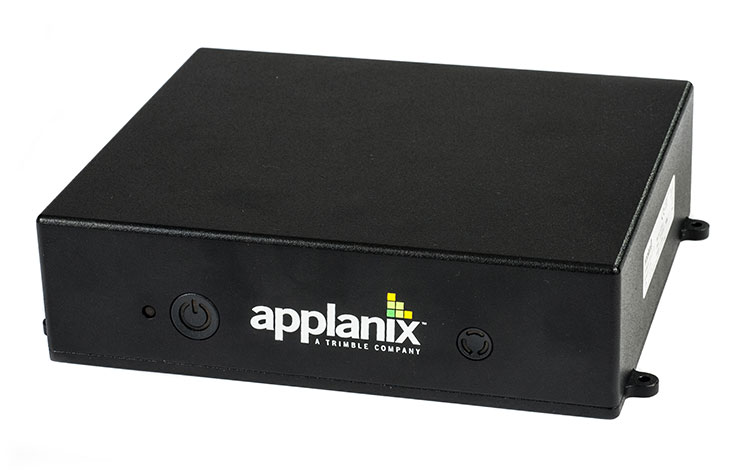
    Applanix has introduced the POS LV 120, the latest version of its positioning and orientation systems for land vehicles. Using commercial Micro-Electro-Mechanical (MEMS) inertial measurement unit (IMU) technology, the Applanix POS LV 120 is a small, lightweight system and provides an economical solution for any continuous positioning and orientation application.

    POS LV 120 is a fully integrated, turnkey position and orientation system, using integrated inertial technology to generate stable, reliable and repeatable positioning solutions for land-based vehicle applications, Applanix said. Redesigned to be smaller and lighter, it maintains identical data interfaces and software compatibility with the established POS LV line of products.

    “With a MEMS IMU and a 220 channel, dual-antenna GNSS receiver integrated into a single enclosure, the POS LV 120 is a cost-effective GNSS-Inertial solution designed to support many types of land-based mobile mapping projects,” said Kevin Andrews, product manager for Land Products at Applanix.  “The integrated system is smaller than the standard POS LV computer system (PCS), making it ideal for use in lightweight applications such as robotics, autonomous vehicles, centerline mapping, asset mapping and short-range direct georeferencing.”

    POS LV 120 is available now through the Applanix sales network.

  • TomTom, Telenav Extend Mapping Partnership

    TomTom, global supplier of location and navigation products and services, is extending its partnership with Telenav. TomTom will provide mapping data for Scout, Telenav’s daily personal navigator. Additionally, TomTom will remain the provider of map content for Telenav-powered Sprint applications.

    Scout, currently available on the iPhone, provides personalized information that includes navigation directions, optimal departure time and things to do at the destination. Together, Telenav and TomTom will provide up-to-date map content to Scout customers. All Sprint customers will also continue to have access to TomTom maps via Scout.

    “We believe the new contract with Telenav is an endorsement of our high quality maps,” said Anders Truelsen of TomTom. “We are pleased that Scout users will be able to experience the added value of our rich map content.”

    “Our goal is to always provide a reliable and easy-to-use service for our customers,” said Hassan Wahla of Telenav. “We are pleased to extend our agreement with TomTom because of its parallel focus and commitment to high-quality map content.”


  • $3.7 Billion Reasons Why GIS Technology is The Future

    Editor’s note: Although GIS adoption is certainly on the rise, it hasn’t reached critical mass for widespread adoption so I think 2012 is too early to be seen as the Year of GIS. When it does, it will be fueled by widespread location apps in smartphones and adoption of mainstream office apps like Maps for Office.


    When technology historians look back on 2012, they might look at this as the GIS year says Dr. Stephen McElroy, GIS program chair at American Sentinel University.

    “2012 is the year of GIS,” says Dr. Stephen McElroy, GIS program chair at American Sentinel University. “The desire to know where everything is located fuels the current trend in location-based services. As GIS is more accessible and consumable on the Web through a variety of mobile devices, the average person is becoming increasingly impacted by the power of GIS. Soon it will become a pervasive technology that is consumed by a wider audience than ever before.”

    The proof is in a new report from Pike Research. Findings indicate that spending on GIS services, software and tools will increase steadily over the next five years, reaching $3.7 billion in 2017.

    This industry momentum toward GIS is what led to K-12 schools in North Carolina to sign a statewide license for unlimited classroom use of Esri’s ArcGIS software.

    According to Dr. McElroy, K-12 educators are increasingly aware that geospatial competencies must now be included among the core proficiencies of reading, writing and arithmetic. He points out that some schools are undertaking initiatives to incorporate geospatial competencies across the curriculum by adding geospatial exercises and experiences into the standard curriculum. The concept of GIS across the curriculum is a trend that is just now beginning to blossom and illustrates the long-term presence of geospatial thinking at the national, state and local levels.

    To demonstrate just how important GIS is to the U.S. government, Esri, the world’s leading provider of GIS software recently released a new book, ‘Mapping the Nation: Government and Technology Making a Difference.’ It includes more than 100 full-color maps produced by 40 government agencies, showing how GIS technology can be used to evaluate and respond to social, economic and environmental concerns at local, regional, national and global levels.

    “Geography is a common denominator in everything the federal government supports,” says Christopher Thomas, director, government markets – federal, state, local at Esri. “The maps in this book attest to the limitless power of geography and GIS technology. They show how government agencies rely on GIS analysis to facilitate initiatives, improve transparency and deliver strong business models.”

    Add this momentum to the fact that new products are released nearly every week, including CHC’s new LT30 series GPS/GIS handheld collector. The LT30 GPS/GIS is a multi-functional solution that includes built-in GPRS phone and data transmission, Bluetooth and Wi-Fi connectivity, a 3.2 megapixel camera with autofocus and a versatile RS232 interface to connect to legacy devices.

    Smart Grids Lead the Charge

    Leading the charge for this GIS enthusiasm is the smart grid.

    According to the Pike report, spatial data underlies everything an electric utility does. An intelligent power grid requires deep situational awareness of power generation, transmission, distribution and customer assets in order to optimize performance and to meet reliability commitments.

    Land-based and street-level data, ownership/real estate, vegetation, network topology, GPS location data, census data, and many other forms of geospatial information are critical to the successful performance of the smart grid.

    GIS is a foundational technology linking every activity of an electric utility – including design and construction, asset management, workforce management, outage management, and increasingly, real-time grid operations.

    “The smart grid has energized electric utilities to think creatively about how to improve the delivery of electrical power and the business and workflow processes that enable it,” says Pike Research vice president Bob Gohn. “As the deployment of intelligent field equipment, particularly advanced metering infrastructure, has surged, the applications leveraging this infrastructure are increasingly dependent on GIS-based data for critical real-time performance.”

    Public and private utility providers will need a comprehensive GIS that they can utilize to make key decisions about system-critical issues such as customer database management, streamlined meter reading and blending of renewable (solar, wind, hydro and geothermal) and non-renewable energy resources from coal and nuclear facilities.

    “These industries are looking for people who understand GIS technology, making it an excellent time to make yourself more marketable and consider an online bachelor’s or master’s degree in GIS technology,” says Dr. McElroy.

    The market for GIS professionals at all skill levels has never been better.

    The Bureau of Labor Statistics indicates that the job outlook (2010-2020) for geographers is growing by 35 percent (much faster than average). For Cartographers and photogrammetrists, the outlook is 22 percent growth (faster than average). For surveying and mapping technicians, the outlook is 16 percent and all of these occupations are expected to grow by 14 percent.

  • USGS Crowdsourcing: Looking at New Ways to Map Structures in Colorado

    The United States Geological Survey (USGS) announced that in light of swiftly changing technical landscapes and increasing uses of social networking, the USGS is exploring a new approach to the volunteer program, and is launching a project to test options for volunteer participation in providing data to The National Map.

    The project involves mapping man-made structures and facilities, such as schools and fire stations, in the state of Colorado. Using an internet mapping application, volunteers can help the USGS update The National Map by correcting or adding information about structures.

    “Even members of the public who can’t tell a sandstone from a rhyolite but have internet access can now help the USGS keep its popular maps up to date through our new experiment in crowd sourcing,” said USGS Director Marcia McNutt. “Correctly locating and identifying fire stations, police stations, schools, and hospitals not only makes USGS maps more useful, but can literally save a life.”

    Over the past two decades, the USGS National Geospatial Program sponsored various forms of volunteer map data collection projects. Volunteers helped the USGS improve its maps during this period, by annotating paper maps, collecting data using GPS units, and submitting data using a web-based tool. However, in 2008, the volunteer mapping program was suspended as new methods for using volunteer data were being studied.

    In recent years, new web- and mobile-based technologies have made it easier to create, combine, and share maps. Recent events have shown how well these technologies support the rapid and relevant production of geographic information.

    If the Colorado pilot project is successful in attracting volunteers and capturing data for use in The National Map, the program may be expanded to other areas in the future.

    This project offers volunteers an opportunity to participate in providing data to The National Map and US Topo map products. For more information, interested Colorado volunteers can visit the National Map Corps website.

  • My Presentation at the 2012 Esri International User Conference

    This is my powerpoint presentation (in pdf format) that I gave at the 2012 Esri International User Conference in San Diego on July 26, 2012.

    Somehow, I was able to deliver this in about 20 minutes (although I did skip over a few slides). However, I really needed about 60+ minutes to go through it.


    Next week, I’m presenting at the Civil GPS Service Interface Committee (CGSIC) Meeting in Seattle, WA.

    This week I intended to post my 2012 Esri UC post-conference summary, but I couldn’t finish it in time. Look for that next week. Being in the geospatial space is pretty exciting these days with so much technology development happening.


    Thanks, and see you next week.
    Follow me on Twitter at http://twitter.com/GPSGIS_Eric
  • On the Edge: Mapping the Delta

    By Tracy Cozzens

     Surveyors install and configure a base and rover for a 13,000-hectare survey of the Plains Kogoni in Mali.
    Surveyors install and configure a base and rover for a 13,000-hectare survey of the Plains Kogoni in Mali.

    In the heart of landlocked Mali, between the Atlantic Ocean 800 miles to the south and the Sahara desert to the north, lays the extraordinary Inner Niger River Delta, also known as the Macina, a 1.8 million hectare oasis of lakes and floodplains with a vast potential for hydro agriculture.

    CIRA, a major West African consulting engineering firm, working on behalf of the Office du Niger, a quasi-governmental Mali company charged with managing more than100,000 hectares of irrigated delta land, has completed surveying an additional 25,000 hectares for hydro-agriculture development.

    map

    Created in 1991, CIRA is an engineering and applied research consulting firm working in transportation, hydraulics, civil engineering and the environment. Based in Bamako, Mali, the firm works in more than 15 African countries, primarily in West Africa, Central Africa and East Africa.

    In the course of two months during the dry season, two CIRA survey teams, each equipped with three Spectra Precision ProMark 500s, a base station, and two rovers connected via UHF, completed the entire 25,000 hectare survey collecting four points in x, y, and z per hectare to produce a digital model. The model enabled the production of rough pre-study with all plans and a detailed pre-project CAD drawings for drainage, irrigation canals, and related infrastructures.

    A very short eight-month contractual time set to complete the different studies meant that the land survey study would have to be completed as quickly as possible. The first thought was to use aerial photography combined with LIDAR, but setting this up would have taken too long, according to a CIRA spokesperson. Instead, CIRCA chose to employ differential GNSS, using base and rovers working in real-time kinematic. CIRA’s experience suggested the firm would achieve reliable results much quicker using only optical total stations. CIRA elected to use Ashtech ProMark 500 GNSS receivers for the project. From experience, they knew the models were easy to set up and use, lightweight, offered long battery life in the field, and field to office data transfer would be easy. Their expectations were met, and the job was completed within two months and on time.

    The ProMark 500 RTK survey system provides short time to fix, long-range RTK and solution reliability. Its BLADE technology provides multi-constellation signal processing with the use of SBAS and GLONASS ranging signals to strenghten the GPS solution.

    Trimble acquired Ashtech in 2011, making it part of Spectra Precision.

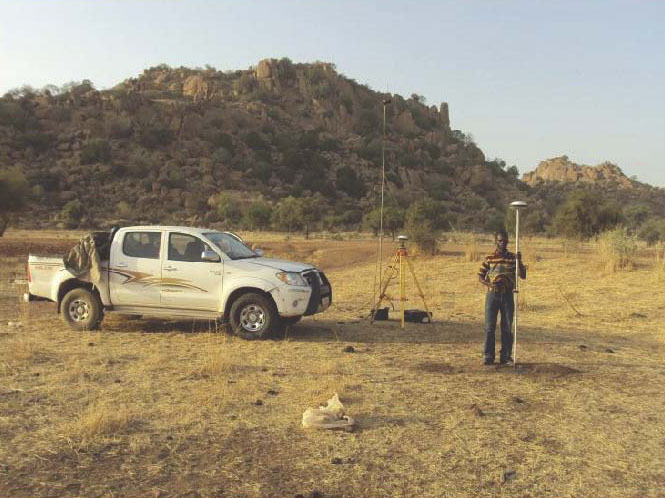
     Setting up bitter points for calibration of satellite images on the corridor Sarh - Abeche in Chad (800km).
    Setting up bitter points for calibration of satellite images on the corridor Sarh – Abeche in Chad (800km).
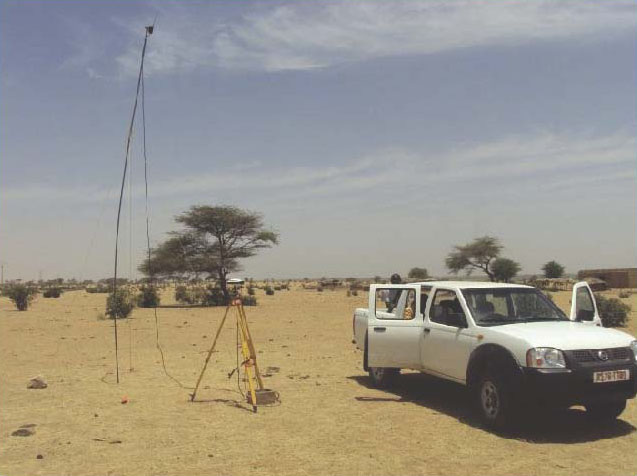
     Reference station during the survey topo Richard Toll road - N Dioum (120 miles) in Senegal.
    Reference station during the survey topo Richard Toll road – N Dioum (120 miles) in Senegal.
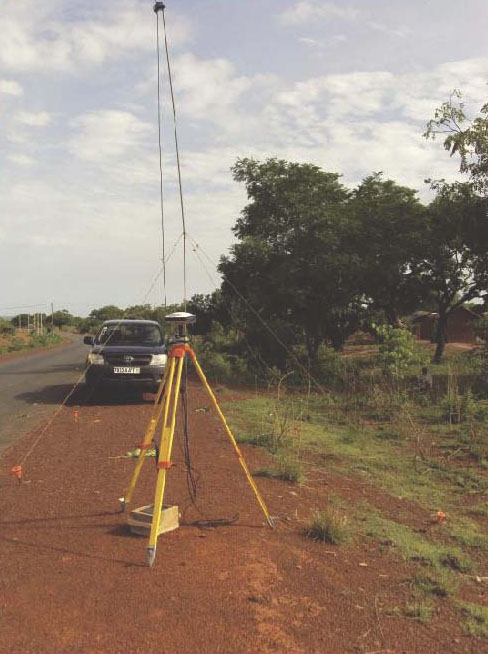
     A reference station during the survey topo Zégoua Sikasso road (95 km) in Mali.
    A reference station during the survey topo Zégoua Sikasso road (95 km) in Mali.