Category: Mapping

  • Mapillary raises $8M Series A to map world through photos

    Mapillary, a community-based photomapping platform, has received an $8 million Series A funding round led by Atomico, with participation from Sequoia, LDV Capital and PlayFair.

    Anyone can contribute photos to the Mapillary platform and mobile app (available on iOS and Android) with a smartphone or action camera. The company’s computer vision software automatically extracts geographic information, blurs license plates and faces, and detects traffic signs from each photo uploaded. Then, the photos are meticulously stitched together on the map alongside other users’ photos, creating a digital representation of each location through the eyes of those who have been there.

    Mapillary’s growing global community has uploaded more than 50 million photos and mapped more than 1.2 million kilometers in over 170 countries to date.

    “Mapillary is reinventing the way we map and navigate our world,” said Niklas Zennström, CEO and founding partner at Atomico. “Their ambition is to transform the way we plan our cities, develop transport networks, and understand all parts of the globe. We’re proud to invest in the next phase of their growth and we look forward to working alongside Jan Erik and his team as they advance their technology and scale the business.”

    Cities, corporations, and nonprofits can access Mapillary’s platform through an extensive API, which holds multiple layers of visual data. Mapillary’s ArcGIS integration — built in partnership with Esri — lets governments, nonprofits and businesses see locations evolve in real-time, arming them with insight into infrastructural problems like inefficient public transportation and changes in road conditions.

    Mapillary partners with several nonprofits to help them improve infrastructure in developing countries around the world. The World Bank trains university students and local community members to use Mapillary in Dar Es Salaam, Tanzania, to create accurate maps of the most flood-prone areas of the city, and the Red Cross has been mapping Haiti so NGOs and individuals can use the data to better respond to crises affecting the area. Mapillary allows nonprofits to allocate resources more efficiently and to empower communities to contribute to the growth and development of their cities and towns.

    From backyards to Antarctica, Mapillary allows anyone to be immersed in places both familiar and unknown. This funding is bringing the company one step closer to accomplishing its goal of creating an open and complete digital representation of the earth to benefit governments, businesses, nonprofit organizations and curious explorers alike.

  • Topcon announces new geodetic antenna

    Topcon Positioning Group announces the release of a new full wave geodetic antenna — the G5-A1.  The portable antenna is designed to provide improved multipath mitigation for use with a mobile base station site or network reference station.

    “When paired with the Topcon NET-G5 receiver, the zero-centered geodetic antenna provides a powerful and cost-effective entry-level solution” said Charles Rihner, vice president of the Topcon GeoPositioning Solutions Group.

    The G5-A1 is optimized for geospatial industries and designed to track all globally available and developing satellite constellations. The antenna weighs approximately 1 pound (.5 kg) and is 7 inches (17.9 cm) wide.

    “With its portability and geodetic level performance, the new G5-A1 antenna provides an excellent choice for mobile base system and economy reference station system,” Rihner said.

  • Synergizing smartphones’ onboard GPS capability with KML files

    By Jay Satalich, P.L.S., GISP

    At Caltrans District 7 in Los Angeles, we use the onboard GPS capability of smartphones to navigate in real time to the locations of proposed aerial targets and National Geodetic Survey (NGS) control stations.

    Keyhole markup language (KML) files are created in the office using desktop GIS, then downloaded to smartphones for use in the field. We create KML files specifically for use by our surveyors during every aerial mapping project within Los Angeles and Ventura counties.

    FIGURE 1. Highway Interchange displayed on a smartphone using Google Earth App for Android, (ground targets in blue, flight information for pilots in red and green). Airborne GPS positioning aids in controlling aerial photography as the pilot navigates from exposure to exposure. A flight management system automatically triggers the camera or sensor once it reaches the exposure station in the air.
    FIGURE 1. Highway Interchange displayed on a smartphone using Google Earth App for Android, (ground targets in blue, flight information for pilots in red and green). Airborne GPS positioning aids in controlling aerial photography as the pilot navigates from exposure to exposure. A flight management system automatically triggers the camera or sensor once it reaches the exposure station in the air.

    KML is an extensive markup language (XML) notation for expressing geographic annotation and visualization within Internet-based, two-dimensional maps and three-dimensional Earth browsers. KML was developed for use with Google Earth — originally named Keyhole Earth Viewer.

    The aerial target layer also shows the proposed locations of stereo model limits on the smartphone. A stereo model is the overlapping portion of two adjacent aerial images. Each typically has a 60 percent overlap with its adjacent image, so it can be viewed and mapped in stereo. The ground control is combined with the airborne GPS to provide the orientation of the individual exposures, and it establishes the coordinate space of that imagery for any subsequent products.

    Having the stereo model limits as a data layer becomes a handy piece of information in the event an aerial target must be relocated because of unfavorable field conditions. The heads-up capabilities of GPS aboard the smartphones and KML files can also show the easiest path to reach either target location or control stations. The NGS control station layer hyperlinks to the NGS website, so the field surveyor always has the recovery note available in an electronic format.

    The field surveyors are also given hardcopy maps of the target locations and control stations, but those are now only used as a backup to the KML files loaded onto the smartphones.

    FIGURE 2. Phone Screen with station description from NGS database (above).
    FIGURE 2. Phone Screen with station description from NGS database (above).
    FIGURE 3. The user arrives here via a hyperlink from another screen (FIGURE 2).
    FIGURE 3. The user arrives here via a hyperlink from another screen (FIGURE 2).

    We have found that leveraging the onboard GPS capability of smartphones with GIS-based data layers in the field has increased production. Using smartphones provides the surveyors with information more concisely and clearly. This information enables surveyors to make better decisions in the field.

    One example is identifying inaccessible areas. If the field surveyor sees that an aerial target can be moved to a different location that provides easier access, it can save time and guesswork.

    This information is also valuable in rugged areas because the field surveyor may need to identify the location of hiking trails or while surveying in the desert, or identify the location of aerial targets in areas that are either lightly inhabited or have few landmarks. The project surveyor can tailor datasets specifically to project needed by the field surveyors.

    Once the aerial targets have been placed and the NGS control stations recovered, the field surveyors then position the aerial targets and control stations using carrier-phase GNSS. This gives us the centimeter-level accuracy needed to control the aerial photography during our mapping projects.

  • NASA helps maintain International Terrestrial Reference Frame with GNSS

    News courtesy of NASA / Goddard Space Flight Center

    The surface of Earth is constantly being reshaped by earthquakes, volcanic eruptions, landslides, floods, changes in sea levels and ice sheets and other processes. Since some of these changes amount to only millimeters per year, scientists must make very precise measurements of the landscape and ocean in space and time in order to study their evolution and help mitigate their impacts.

    The foundation for these precision measurements is the terrestrial reference frame, which serves the same purpose as landmarks along a trail. Earth-orbiting satellites and ground-based instruments make use of this reference system to pinpoint their own locations and, in turn, those of the features they are tracking. It is also the hidden framework relied upon by aircraft to determine their locations and by mobile phone apps that provide maps and driving directions. And it is a fundamental reference for interplanetary navigation of spacecraft.

    NASA helps maintain the worldwide standard called the International Terrestrial Reference Frame, or ITRF, and recently contributed to an update issued by the International Earth Rotation and Reference Systems Service’s International Terrestrial Reference System Product Center at the Institut National de l’Information Géographique et Forestière (IGN) in Paris.

    “The new release lays the groundwork for more detailed studies than ever before of global changes in Earth’s ocean, ice sheets, land and atmosphere,” said Stephen Merkowitz, manager of NASA’s Space Geodesy Project at the Goddard Space Flight Center in Greenbelt, Md.

    Earth-observing satellites — such as the Jason 3 spacecraft, launched in January through a U.S.-European partnership, and the upcoming ICESat-2 mission — will be among the beneficiaries of the new standard.

    Officially called ITRF2014, the update released in late January is the ninth ITRF issued since 1992. More than a thousand observing stations run by NASA and other scientific institutions worldwide contributed to it, collecting data through 2014.

    Global in nearly every sense of the word, the ITRF is made up of specific geographic positions around the world, along with information about how each one drifts over time. This is important because the positions move relative to each other, with some drifting more rapidly than others. The reference frame includes details about how quickly and in which directions the positions are expected to move.

    Some of the drift happens because of the motion of Earth’s tectonic plates, which is well understood. Drift motions may also include the gradual rebounding of land that was covered by ice sheets during the last ice age, as well as land subsiding due to climatic effects or human activity, such as withdrawal of groundwater. Less predictable are changes due to earthquakes. Large quakes will cause a sudden shift in position and also may alter the drift rate or direction at that location. Recent versions of the reference frame have started to include these effects.

    “An important feature of the latest International Terrestrial Reference Frame is that the model has a more sophisticated way of incorporating the effects of earthquakes,” said Chopo Ma, a geophysicist at Goddard who was involved in producing and analyzing data for the latest reference frame.

    Helping to improve the ITRF is one of the primary goals of NASA’s Space Geodesy Project. Four measurement techniques are used by stations worldwide to collect data for the reference frame.

    In Satellite Laser Ranging, or SLR, precise measurements are made by sending short laser pulses from ground stations to Earth-orbiting satellites equipped with suitable reflectors. The distance is calculated from the time it takes for the pulse to complete the round trip back to the ground station.

    The second method is called Very Long Baseline Interferometry, or VLBI. Ground stations spread across the globe observe dozens of quasars, which are distant enough to serve as stable reference points. By carefully timing when the signals from the quasars are recorded by each station, the precise geometry of the antenna network can be deduced, and Earth’s orientation in space and its rotation rate can be measured.

    The technique known as Doppler Orbitography and Radiopositioning Integrated by Satellite, or DORIS, takes advantage of the Doppler effect, which is what we hear when an ambulance’s siren changes pitch as it drives toward or away from us. The frequency of a radio signal from a DORIS beacon experiences the same effect while traveling from Earth to an orbiting satellite. By measuring the frequency change, it’s possible to work backward to figure out the distance from the beacon to the satellite.

    The final method makes use of the Global Navigation Satellite System, known as GNSS — a network that includes GPS and other navigation satellites. Radio signals are broadcast by GNSS satellites and received at many locations worldwide.

    “The big advantage of GNSS is the dense network of stations distributed around the world,” said Richard Gross, who manages the Terrestrial Reference Frame combination center at NASA’s Jet Propulsion Laboratory (JPL) in Pasadena, Calif. “For the reference frame, on the order of a thousand GNSS stations contribute position measurements.”

    Because there are GNSS receivers at the stations that perform the other three measurement techniques, GNSS also provides a method for tying together all four approaches. And when scientists worldwide want to measure how the ground is moving, they access the reference frame by using GNSS to determine their positions.

    In preparation for the new reference frame, research teams worldwide carried out data analysis, looking at between 20 and 30 years of data for each method. Scientists at Goddard and the University of Maryland, Baltimore County, coordinated the data analysis for VLBI, SLR and DORIS, and JPL contributed GNSS data. All of the geodetic data for the reference frame have been archived at the NASA Crustal Dynamics Data Information System, located at Goddard, and distributed to users worldwide.

    Looking forward, NASA is upgrading the stations in its Space Geodetic Network. The Space Geodesy Project at Goddard is managing these upgrades, and work is already under way at stations in Hawaii and Texas. The upgraded stations will help fill in geographic gaps in the global system, helping to improve future versions of the reference frame.

    In addition, scientists are looking at other possible approaches for combining the four data types to produce an improved reference frame. Research on advancing the ITRF is conducted not only at IGN, but also at JPL’s Terrestrial Reference Frame combination center and at a similar center at the Deutsches Geodätisches Forschungsinstitut in Munich. Each center produces its own independent solution, which scientists will compare to see what they can learn from different approaches.

    “We renew the International Terrestrial Reference Frame every few years because it’s more than a set of geographical positions,” said Frank Lemoine, a Goddard scientist involved in producing and analyzing data for the new standard. “It’s a projection about what will happen to those positions in the future, and our ability to extend the reference frame into the future gets better and better over time.”

    — By Karen C. Fox, NASA Goddard Space Flight Center

  • CartoDB unveils tech to extract Deep Insights from location data

    deep-insights-demo4

    CartoDB, a world leading company for location intelligence, data analysis, and visualization, has launched Deep Insights, a technology layer that enables the visualization, dynamic filtering, and exploration of large location datasets at unprecedented scale and scope.

    With CartoDB’s Deep Insights technology, datasets can be enriched or augmented by existing geospatial data from various sources with a diverse number of fields, such as census information or administrative boundaries. Once data is processed by Deep Insights, users can further filter, pan, zoom and granularly narrow in on data to view trends and patterns that, in traditional reports, would otherwise go unnoticed.

    Deep Insights is also equipped with a suite of interactive widgets and command controls so users can tailor the interface for the best experience. It can be implemented to stand-alone or configured and integrated with users’ own application workflow.

    “The launch of Deep Insights involves a redefinition of the role of geospatial data visualization and analysis in maps, empowering the way people analyze and interact with massive amounts of existing data. For CartoDB it was the next logical step to follow,” said Sergio Álvarez Leiva, CPO, CartoDB. “The creation of a new visualization technology capable of identifying trends and patterns with big data, literally making the invisible visible.”

    CartoDB is launching Deep Insights at Mobile World Congress, being held Feb. 22-25 in Barcelona, Spain. The company is demonstrating the technology in partnership with Mobile World Capital, an organization dedicated to bringing mobile transformation to the city of Barcelona. Deep Insights will be used to analyze the influx of tourism in Barcelona and identify opportunities for increased revenue through tourism per location. The collaborative project will leverage three sets of data, including data on key touristic spots, social media activity, and payments from BBVA bank.

    Deep Insights is made available through a single, user-friendly interface that allows users to explore location-related insights visually on a map. It has a fixed pricing structure to allow for unlimited scale with no cap on usage, starting at $100 for 1GB in memory data.

  • Sokkia’s SHC500 field controller designed for surveying

    Sokkia has introduced its new SHC500 field controller for construction and surveying applications. It is designed to provide operators a compact handheld option with numerous features and benefits, including a 4.3-inch touchscreen display and optional 5 MP camera with built-in LED flash.

    The SHC500 is designed for the professional operating MAGNET Field, Site and Layout software. The data controller works with all Sokkia GNSS receivers and total stations, and meets or exceeds all field application requirements.

    “With a sunlight-readable screen, even in bright conditions the controller is perfect for modern project sites,” said Ray Kerwin, director of global surveying products. “It is built rugged — waterproof up to one meter with an IP68 rating — securing the unit and optional built-in LED flash camera and 8GB flash storage.

    “The SHC500’s optional internal cellular modem allows operators to send and receive data through the MAGNET suite of software solutions. Field crews can easily communicate when projects need to be changed or if important data is required back in the office,” Kerwin said.

    Additional features include standard Bluetooth and Wi-Fi connectivity, 23 control buttons with numeric input, and a capacitive-touch interface.

  • Launchpad: Mapping book, anti-drone system

    Launchpad: Mapping book, anti-drone system

    OEM

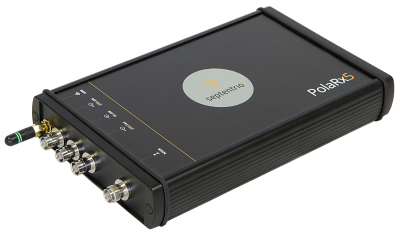
    The Septentrio PolaRx5 GNSS receiver.
    The Septentrio PolaRx5 GNSS receiver.

    GNSS receiver

    Next generation for precise scientific and geodetic applications

    The PolaRx5 offers 544 hardware channels for robust and high-quality GNSS tracking. The receiver supports all major satellite signals including GPS, GLONASS, Galileo and BeiDou, as well as regional satellite systems including QZSS and IRSS. Septentrio’s Advanced Interference Mitigation (AIM+) technology enables it to filter out both intentional and unintentional sources of radio interference, from narrowband signals over high-powered pulsed signals to chirp jammers and Iridium interferers. Septentrio’s APME+ multipath mitigation technology eliminates short delay multipath without introduction of bias and guarantees superior measurement quality. The user can deactivate APME+ to obtain unmodified measurements.

    Septentrio, www.septentrio.com


    Bentoni_2_antenna_patterns-W

    Flexible antennas

    Folding design for plug-and-play integration

    Bentoni is a positioning antenna for all of the global public satellite constellations: GPS, GLONASS, BeiDou and Galileo. It is designed to be used in trackers, portable devices, network components, drones and wearable electronics. It offers high performance and maintains good isolation in situ within a device. Bentoni is a flexible FPC antenna in Antenova’s flexiiANT product range. They are supplied with an I-PEX MHF connector and a 1.13 mm RF cable in a choice of three lengths. They can be folded to save space in operation within a device, with the aim being plug-and-play simplicity. The antennas are self-adhesive mounted so that they can easily be fixed inside an electronic device.

    Antenova, www.antenova-m2m.com


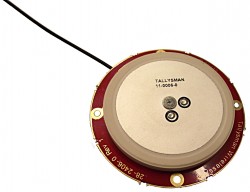
    The Tallysman TW2926.
    The Tallysman TW2926.

    L-Band antenna

    OEM antenna can be custom-tuned

    The Tallysman TW2926 antenna is an unhoused OEM version of the TW2920, designed for simultaneous reception of L-band correction signals and all of the upper band GNSS signals, including GPS L1, GLONASS G1, Galileo E1 and BeiDou B1. The TW2926 is 56 millimeters in diameter and has four drilled plated holes for secure mounting within customers’ products. It can be custom tuned to ensure optimal performance within an enclosure. The 1-dB bandwidth of both the TW2920 and TW2926 covers 1525–1559 MHz for the L-band downlink and 1559–1610 MHz for the upper-band GNSS. The LNA provides 28-dB of gain. The antennas employ Tallysman’s Accutenna technology, which provides strong cross-polarization rejection for greatly improved multipath rejection, low axial ratio and tight phase center variation.

    Tallysman, www.tallysman.com


    Marvell-NFC

    NFC controller

    Enables tiny antennas for mobile, IoT, wearables

    The Near Field Communication (NFC) 88NF100 controller with active load modulation (ALM) is desgined to support the smallest antenna sizes critical to mobile, the Internet of Things (IoT), wearable and automotive applications. Adhering to NFC Controller Interface (NCI) Technical Specification version 1.1, the 88NF100 provides an extended operating range and is extremely energy efficient to enable extended battery life for power-critical applications. ALM technology supports the smallest antenna sizes to enable OEMs to implement NFC capabilities into small form-factor designs. The controller has extremely low power operation in polling mode to provide increased battery life for power critical applications and three single-wire protocol (SWP) interfaces to secure element (eSE) devices for secure payments. The two-pin antenna interface supports a maximum distance of two meters between the chip and antenna.

    Marvell, www.marvell.com


    Survey & Mapping

     mapping design bookIntroduction to Mapping Techniques

    Available as print or ebook

    Designing Better Maps: A Guide for GIS Users, second edition, is an updated and comprehensive guide to creating maps that communicate effectively. Cartographer Cynthia A. Brewer covers the basics of good cartography, including layout design, scales, projections, color selection, font choices and symbol placement; she also describes her ColorBrewer application, an online color selection tool. The second edition includes a new chapter on map publishing. One reviewer wrote, “It is also worth a look by experienced cartographers who seek a refresher and a few new tips.” Brewer is a professor and chair of the Department of Geography at Pennsylvania State University and map and atlas design consultant.

    Esri, esripress.esri.com


    Arrow-Eos-android-v2-W

    RTK NTRIP Android app

    Eos Pro Tools is tightly integrated with google map

    Eos Pro Tools is a comprehensive RTK NTRIP app for Android that works with its Arrow line of RTK GNSS receivers. An Arrow GNSS receiver combined with the NTRIP app turns an Android smartphone or tablet into a powerful data collector capable of recording 1-centimeter accurate GIS data in real-time. The app, named Eos Tools Pro, has user-configurable audible and visual alarms to alert the user of high PDOP, lost RTK correction, unacceptable correction age and several other important metrics. It supports all current and future constellations (GPS, GLONASS, Galileo and Beidou). Detailed satellite information such as a skyplot that plots each visible satellite, whether it’s being used or not, and signal strength bar graphs from each constellation are also displayed. Finally, a terminal screen displays the NMEA data flowing and allows the user to send commands to the receiver.

    Eos Positioning Systems, www.eos-gnss.com


    ALGIZ-RT7-rugged-tablet-Android-jobsite-construction-O

    Rugged field tablet

    Lightweight, ergonomic design for the mobile workforce

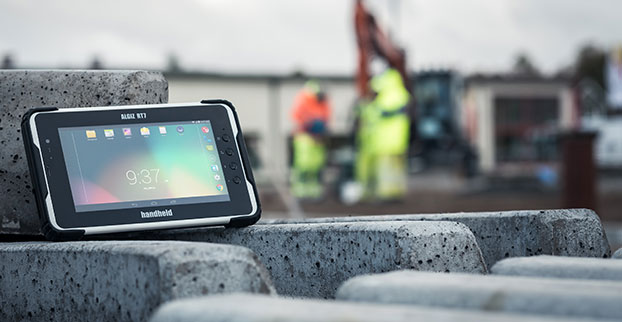
    The 7-inch Algiz RT7 Android tablet is fully rugged, meeting stringent MIL-STD-810G U.S. military standards for protection against drops, vibrations and extreme temperatures. Its IP65 rating means that it’s waterproof as well as fully sealed against sand and dust. The tablet comes with a built-in accelerometer, gyroscope and e-compass as well as a stand-alone u-blox EA-7M GPS receiver for navigation, along with built-in Qualcomm IZat location services.

    Handheld Group, www.handheldgroup.com


    i80-gnss-receiver-CHC-navigation

    Receiver with open OS

    Over-the-air updates enable future functionality

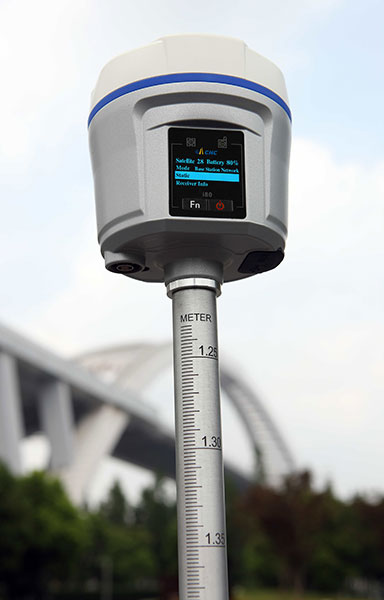
    The i80 GNSS receiver computes a true triple-frequency real-time kinematic (RTK) tilted pole solution using all four worldwide and multiple regional constellations, providing a future-proof sub-centimeter RTK solution to surveyors and contractors. Without the need of a data collector or computer, the i80’s LCD graphic user interface allows for common workflow operations, such as static logging, autobase, autorover and UHF channel selection, to be easily performed. The CHC i80 incorporates dual hot-swappable batteries, allowing for days of uninterrupted work. While small and lightweight, it is packed with a full array of sensors and modules: multiple micro-electrical-mechanical (MEMS), internal Tx/Rx UHF, multiband cellular modem, Wi-Fi, Bluetooth, serial and USB.

    CHC Navigation, www.chcnav.com


    The SXPro by Geneq.
    The SXPro by Geneq.

    Data collector

    All-in-one GPS, GNSS and RTK Data Collector Series

    The SXPro series is built for mobile survey and GIS users for applications such as water, electric and gas utilities; transportation; mining; agriculture; and forestry. The professional-grade rugged handheld receivers include a battery life of more than 10 hours on a charge as well as a large outdoor-viewable touchscreen. The handhelds are rated IP65 for protection against water and dust, and equipped with a 5-megapixel autofocus camera and Microsoft utilities. The SXPro RTK (real-time kinematic) model offers 220 multi-constellation channels for centimeter accuracy with RTK networks. The SXPro GNSS offers 372 multi-constellation channels for sub-meter accuracy with SBAS corrections.

    Geneq, www.geneq.com


    ENVI-5.3-Harris-W

    LIDAR analysis software

    New point cloud analysis and visualization capabilities

    The latest release of ENVI software adds lidar point cloud analysis and visualization capabilities that previously were only available in the ENVI lidar software package. ENVI 5.3 offers users a single software interface to work with hyper-spectral, multi-spectral, panchromatic and lidar data. The out-of-the-box functionality includes 3D point-cloud visualization, derived terrain product generation (such as digital elevation models) and lidar analytics such as viewshed line-of-sight calculation. For users who need point-cloud or terrain products in an area where collecting lidar is not feasible or is too expensive, the ENVI Photogrammetry Module is able to generate synthetic 3D point clouds from stereo optical imagery to take advantage of existing imagery archives. The dimension of time can be critical for a thorough geospatial analysis of an area, and the new ENVI release has added enhancements to the Spatio-Temporal analysis toolset. Spatio-Temporal analysis visualizes change and derives statistics from data over time, enabling users to observe past events to better predict upcoming activities.

    Harris Corporation, www.exelisvis.com


    UAV

    DJI-ag-drone-2

    Precision agriculture

    Smart crop-spraying drone

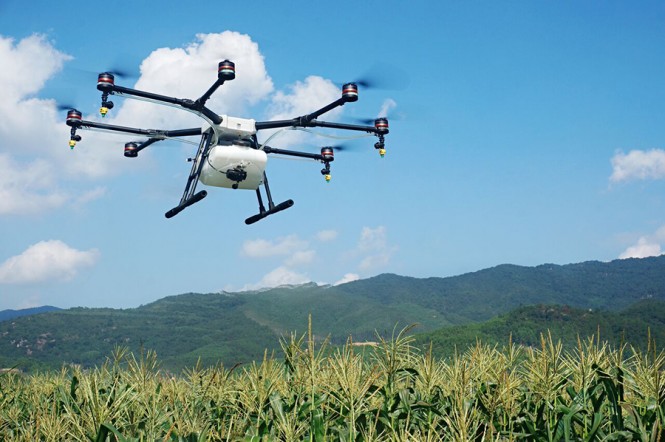
    The eight-rotor DJI Agras MG-1 UAV can load more than 10 kilograms of liquid for crop-spraying and can cover between seven and 10 acres per hour — more than 40 times more efficient than manual spraying. It can fly up to eight meters per second and adjusts spraying intensity to flying speed to ensure even coverage. It is dustproof, water-resistant and made of anti-corrosive materials. It features DJI’s flight-control system and microwave radar to ensure centimeter-level accuracy. During flight, the drone scans the terrain below in real time, automatically maintaining its height and distance from plants to ensure application of an optimal amount of liquid. The drone’s intelligent-memory function means after the Agras MG-1 is brought back to base for refill or recharge, it will return to its last memory point to pick up spraying where it left off.

    DJI, www.dji.com


    drone-net-W

    Anti-drone system

    One drone nets another

    The EXCIPIO is an anti-drone system that uses a drone to shoot out a net to capture another drone.The EXCIPIO Aerial Netting System is comprised of a UAS equipped with a first-person view camera and a net-firing gun. When the EXCIPIO has reached the threat target, it fires a net, then can either release the net with the target ensnared or keep the net tethered. Though the initial system concept was focused on intercepting and neutralizing an airborne UAV, the conceptual applications have expanded to include manned aircraft, ground vehicles, people and animals (whether airborne or on the ground).

    Theiss UAV Solutions, www.theissuav.com

  • GM, Volkswagen to use Mobileye auto mapping technology

    Mobileye, a developer of vision and data analysis for Advanced Driver Assistance Systems (ADAS) and autonomous driving, has introduced a new mapping technology development called Road Experience Management (REM).

    REM enables crowd-sourced real-time data for precise localization and high-definition lane data that forms an important layer of information to support fully autonomous driving.

    Mobileye is engaged with General Motors to integrate REM into existing program launches in an expedited timeframe, as part of GM’s heightened partnership with Mobileye. In addition, on Jan. 5, Mobileye signed a Memorandum of Understanding with Volkswagen and announced a strategic partnership to explore and integrate REM into Volkswagen’s fleet.

    The technology is based on software running on Mobileye’s EyeQ processing platforms that extracts landmarks and roadway information at extremely low bandwidths, approximately 10 kb per kilometer of driving. Additionally, backend software running on the cloud integrates the segments of data sent by all vehicles with the on-board software into a global map.

    “We leveraged advanced artificial intelligence, used for creating environmental models from camera input, in order to create maps based on local coordinate systems while requiring very low bandwidth,” said Prof. Amnon Shashua, co-founder, chairman and Chief Technology Officer of Mobileye. “The low bandwidth of the model, and the fact that it requires only a camera, which is already available in most new car models as part of the trend towards growing driver assistance deployment, enables the map creation and update to be managed by a cooperative crowd sourcing mechanism.”

    A third OEM customer of comparable size is expected to be announced later this year.

    Shashua discussed the future of autonomous driving and road mapping at the Consumer Electronics Show in Las Vegas in January.

  • Epson unveils new Pro G-Series large venue projector

    Epson--Pro-G7000-Series-ProjectorEpson recently announced in a news release the launch of its Pro G7000-Series large venue projectors for simulators, mapping, digital signage and command centers.

    New features include increased brightness and motorized lenses, uncompromising image quality, low total cost of ownership and $199 replacement lamps, Epson says. Eight models deliver up to 8,000 lumens of color brightness and 8,000 lumens of white brightness.

    The series also features the world’s first zero-offset ultra short-throw lens with 0.35 throw ratio for space constrained venues and digital signage applications. The Pro G-Series will be on display at ISE 2016 in Amsterdam from Feb. 9–12 at Epson’s booth, No. 1-H90.

    “The Epson Pro G-Series offers bright, brilliant images combined with advanced features, making them our best-selling large venue projectors,” said Phong Phanel, product manager of large venue projectors, Epson America Inc. “The new Pro G7000-Series raises the bar with higher brightness, 4K Enhancement resolution, new motorized lenses and advanced technology to captivate any audience, underscoring our commitment to delivering a broad portfolio of solutions to the large venue projector market.”

    Epson projectors offer three times higher color brightness than competitive 1-chip DLP models to ensure vivid colorful images. The Pro G Series 3-chip 3LCD projectors are ideal for large venues, including events staging, auditoriums and sanctuaries.

    The Epson Pro G7000-Series will be available in May starting at $3,799 MSRP. The projectors come with a three-year limited warranty with next business day replacement, including free shipping both ways7, and a 90-day limited lamp warranty.

    The color brightness specification — measuring red, green and blue — published by the Society for Information Display (SID) allows consumers to compare projector color performance without conducting a side-by-side shootout.

  • MAPPS presents excellence awards, bestows highest honor to Teledyne Optech

    From left to right: John Palatiello, MAPPS executive Director; Jim Green; Mike Sitar and Michel Stanier of Optech Teledyne.
    From (L to R) John Palatiello, MAPPS executive Director; Jim Green; Mike Sitar and Michel Stanier of Optech Teledyne.

    Teledyne Optech‘s ALTM Titan lidar sensor earned the 2015 Grand Award in the ninth annual MAPPS Geospatial Products and Services Excellence Awards, MAPPS recently announced in a news release. The awards ceremony was held Feb. 2 at the Green Valley Ranch in Henderson, Nev.

    Teledyne was also presented with an award in the Technology Innovation category.

    The company said in a news release that Titan is easy to handle in complex scenarios, such as acquiring three wavelengths simultaneously; incorporating a metric camera imbedded in the system; creating a sensor that fits in a 16-inch gyro-stabilized mount; and increasing the depth penetration of the bathymetric sensor. To achieve this, Vaughan, Ontario-based Teledyne Optech had to develop new fiber lasers and a triple wavelength receiver which allowed for the collection of bathymetric lidar, topographic lidar and multispectral lidar in one single sensor.

    “Teledyne Optech’s ALTM Titan is a marvel in lidar engineering,” said Robert Burtch PS, CP, professor emeritus at Ferris State University in Big Rapids, Mich., and chairman of the panel of judges. “This development allows the collection of bathymetric lidar, topographic lidar and multispectral lidar in one single sensor.”

    The MAPPS awards competition recognizes the professionalism, value, integrity and achievement that member firms have demonstrated in their projects and technology developments over the previous year.


    MAPPS also honored winners in six technical categories.

    Woolpert of Dayton, Ohio, was selected in the Photogrammetry/Elevation Data Generation category with the Little Bighorn Battlefield National Monument Headstone Mapping Project that utilized lidar to locate and map 4,320 headstones and 280 battlefield markers.

    The winning project in the Remote Sensing category was by Aerial Services Inc. of Cedar Falls, Iowa, for The Race for Now: Maximizing Crop Yields Using Innovations in Remote Sensing project, which acquired imagery using multiple sensors during the critical growing phases to produce a web-based precision agriculture service in the State of Iowa.

    In the GIS/IT category, Merrick & Company of Greenwood Village, Colo., was selected for GIS Models Visualize Ancient Flooding Problems in the country of Columbia. As project manager, Merrick provided technology transfer and GIS data and training, and introduced a new methodology, “monotonicity,” which guarantees that acoustic bathymetry, lidar and breaklines are correctly integrated.

    The winner in the Surveying/Field Data Collection category was the Baltimore, Md., office of AECOM for its Protocol for Determining Grass Channel Credits project. Using GIS, lidar and aerial imagery, AECOM worked with the Maryland State Highway Administration to identify roadway ditches to assure compliance with the Department of the Environment grass channel treatment criteria.

    TerraSond of Palmer, Ark., earned the award in the Small Projects category for the Bradley Lake Hydro Power project. TerraSond teamed to perform an inspection of a diversion tunnel to a dam and power tunnel inlet in Homer, Alaska to identify the quantity of debris that was covering the inlet screen by comparing the debris profile with the as-built drawings to determine the amount of debris that needed to be removed.

    Titan, Teledyne Optech’s multi-spectral lidar sensor, also won in the Technology Innovation category.

    A panel of independent judges evaluated projects submitted by MAPPS members for the awards program.

  • First responder UAS video: Affordable geolocation and spatial indexing

    When I entered the civilian part of my GIS career as the GIS manager for the Atlanta Regional Commission, I tried to get first responders interested in GIS. Of course, in the early ’90s we were happy to be able to accurately draw points, lines and polygons on a piece of paper. Soon we had the luxury of ortho imagery as a backdrop for our GIS data, but I still couldn’t build a lot of enthusiasm among those first responders.

    That changed completely when we started using metric oblique imagery provided by Pictometry. I realized that since we live in an oblique/3D world many non-GIS users had real difficulty visualizing objects or locations using two-dimension visualizations such as drawings, blueprints, maps or even ortho imagery.

    By contrast, oblique views made visualization much easier for the vast majority of non-GIS users, and use of oblique imagery coupled with GIS tools exploded. Since then, many of us have been searching for faster, easier and cheaper ways to collect oblique imagery and video, and build 3D models.

    For more than a decade, major defense contractors developed leading-edge systems to capture and exploit aerial imagery and video. Although effective, as one would expect of new custom technology, the systems were very expensive and out of reach for most local government agencies. Remote GeoSystems seems to have developed a system that leverages current technology to provide capabilities that may address some of those needs at a reasonable price.

    Remote GeoSystems is in the business of capturing, displaying and managing “georeferenced” video and imagery. The company has designed and built high-end geospatial video recording systems for full motion video (FMV) and GIS mapping software primarily aimed at regulatory compliance of energy corridors, grids and critical infrastructure inspection applications.

    Fortunately, my UAV is a DJI Inspire 1. I chose the Inspire because of its reputation, and because it seems to be the best combination of features needed for first-responder work at a prosumer price (about $3,500). The Inspire can record up to 4K video/12-mp stills, has a 94-degree field of view so there is no wide angle “fish-eye” distortion typical of an action camera, and has “Lightbridge” technology that permits positive control up to 3 miles and the ability to stream live 720p video (now 1080p) back to the ground controller.

    The controller can feed large-screen video for command center group viewing via an HDMI output. Most important, the Inspire records GPS position data and altitude along with the video/imagery stream. (The DJI Phantom 3 Pro is a cheaper alternative that also records telemetry data, but if one upgrades to a 4K camera and the Lightbridge transmitter/receiver, the price approaches the integrated Inspire 1 price.)

    An .srt file.
    An .srt file.

    Since I’m always leery of marketing pieces and company demos, I wanted to try the system myself, and Remote Geo was happy to oblige. My first hands-on test was very satisfying. The LineVision software downloaded, unpacked and loaded quickly with no problems. I then recorded some aerial video of our condo building on Lake Guntersville near Huntsville, Alabama. I chose this building because it was convenient, safe to fly and a multi-story building in the open.

    In addition to recording the video, one needs to turn on the DJI Inspire metadata recording to generate the .srt file. This is done in the DJI application “General Settings/Camera” by toggling “Video Caption” on. The .srt file was initially designed to provide altitude and location data as on-screen captions, but the data can be used as needed for other purposes.

    When done with the flight and recording, transfer the video file and .srt file to your computer. Make sure the video file .mov/.mp4 and .srt file are in the same folder. Open LineVision and you will see an ArcGIS window. From the pull-down menu, load the video and you will instantly see the video play in a separate window with red position dots on the ArcMap view. As the video plays, the dot associated with the location of the UAV will turn yellow. If you click on any dot, the video will jump to that location/position on the video.

    Here are screen captures of LineVision showing the ArcGIS view of an ortho image with red dots illustrating the path of the UAV:

    LineVision 1
    LiveVision screen capture.
    LineVision 2
    Another LineVision screen capture.
    LineVision 2 Zoom
    Closeup showing the UAV track detail.

    One advantage of LineVision for first responders is that it is a complete package with ArcGIS embedded, all for a price well below $1,500. There is no need for a separate ArcMap license. Additionally, although LineVision Esri ArcGIS can display GIS data from online sources, if you have GIS data for your location loaded on your computer the system will operate in a disconnected remote environment. These sample screengrabs don’t do the system and video justice, since I recorded at 1080p rather than 4K. My laptop, this website and the reader’s playback equipment limit accurate playback of 4K content, so I did my work at 1080p.

    I can envision a disaster-response scenario where the response team arrives on site, launches a UAV, and starts recording the scene. The captured video could then be loaded, viewed, indexed and cataloged with GIS data overlays on a laptop all in a matter of minutes, even in a disconnected environment. Hours, days or months later, finding the right video clip for analysis or forensics should be significantly easier and faster.

    With the explosion of UAV hardware and software, it’s going to be an exciting year as new smaller, cheaper and more capable systems hit the market. Remote GeoSystems is working with UAV manufacturers to make LineVision capability available for many of the newcomers.

    Leveraging UAV and LineVision capability, Skyline has worked with Remote GeoSystems to bring yet another capability: rapid 3D model creation. Taking appropriate geo-located frames of the video, Skyline uses its PhotoMesh software to build fully metric 3D models in short order. The full capability of this system and its 3D viewer TerraExplorer is so extensive that I will cover it in a future column, after this month’s ESRI Federal Users’ Conference. If you see me at the UC Feb. 24-25, please stop me and say hello.

    Media: Remote GeoSystems

  • ArcGIS Earth: Google Earth, GIS style

    For most GIS professionals, Esri’s new ArcGIS Earth will replace the soon-to-be-discontinued Google Earth Enterprise. I take a tour through the new software, which is much like Google Earth with a few added features. Plus: Q&A from our December UAV webinar.

    In early 2015, Google announced that Google Earth Enterprise is being deprecated. In the software world, deprecated means the software is heading towards obsolescence and the vendor isn’t going to develop it further.

    Google’s announcement stated that Google Earth Enterprise was being deprecated as of March 20, 2015, but will be supported through March 22, 2017. According to Esri, Google will continue to provide map and location services APIs as well as content.

    Here comes Esri, introducing ArcGIS Earth.

    At the Esri User Conference last summer, Jack Dangermond announced Esri is working on ArcGIS Earth. Last week, Esri announced the introduction of ArcGIS Earth 1.0. You can download ArcGIS Earth for free.

    GSS-Jan-1

    The opening screen looks a lot like Google Earth, but clearly with an Esri touch via the toolbar in the upper left corner.

    GSS-Jan-2

    You can connect to ArcGIS Online and access its library of data, or import SHP and KML data (no TIF/TFW import, though).

    GSS-Jan-3

    Here are the convenient editing and querying tools (measure).

    GSS-Jan-4

    I imported a KML file containing an orthophoto I created from a UAV flight. Sorry for the orthophoto offset (darned horizontal datum thing).

    GSS-Jan-5

    As it stands now, ArcGIS Earth 1.0 is much like Google Earth with a few added features. However, based on what I perceive Jack Dangermond’s mantra to be, ArcGIS Earth is going to evolve into a powerful mapping tool and platform for consumerizing feature-rich GIS data, much like Google Earth did in the past 10 years, but in a much more GIS way. I look forward to that.

    December’s UAV webinar

    Speaking of imagery, Google Earth and UAVs, in December I participated in a webinar entitled “Introduction to Using UAVs for Mapping” along with my colleagues from Applanix and C-ASTRAL. If you missed the webinar, you can still view it by signing up here.

    It was a solid, 60-minute discussion about the basics of mapping using UAVs. We had a few questions that we didn’t have time to address during the webinar, so I provide answers below. Also, I added some questions that may have been answered, but deserve mention again.

    How significant is the quality of GNSS sensors for UAV mapping performance?

    In my experience so far, you need precision GNSS measurements either in the air or on the ground if you want high-accuracy results. If you want to use a consumer UAV that has a consumer GNSS receiver in it, you’ll need to use more ground-control points that are mapped with high-precision GNSS receivers. On a wide-open 150-acre site (think agriculture field), that means setting 10-15 ground-control targets. On the other hand, if your UAV has an RTK GNSS receiver in it, you can get by with very few ground-control points. The type of topography also has a significant impact. For example, heavy tree cover, water bodies and other homogenous terrain (such as snow) make it more difficult for image-processing software to process the images.

    How accurate can volumes be obtained on stockpiles?

    I plan on running some tests and compare volumes computed using terrestrial measurement techniques vs. volumes computed by low-cost UAV images. Based on my experience, I’m willing to wager that the results will be very close.

    What are the reasonable accuracies achievable with UAV mapping these days?

    With a low-cost UAV (12MP camera), I’m collecting images with a 2-cm/pixel resolution. Horizontal accuracy (with RTK ground control points) is 30 cm or better. Thirty centimeter (30 cm) elevation contours are achievable, and possibly better than that. I’m still exploring how far we can push low-cost UAVs.

    Can we use a UAV with our own GPS-RTK base station?

    The best use of your GPS-RTK base station is to use it to set RTK ground control for image processing. It’s likely not feasible that you can send corrections from your GPS-RTK base to the UAV unless the UAV is specifically designed to accept those corrections.

    Can you tell us the benefits of fixed wing vs. rotary UAVs for mapping work (such as considerations of weather conditions and the benefits of a gimbal-based camera versus a non-gimbal camera typical in fixed-wing UAVs)?

    A fixed-wing UAV can cover a much greater area per battery than a rotary UAV, but if you’re located in the U.S., you are restricted to line-of-sight operations. That severely limits the value of a fixed-wing UAV. Fixed-wing UAVs also require a much larger landing area and are trickier to land. It takes much more training to land a fixed-wing UAV than a rotary UAV. I can’t answer your question about gimbal vs. non-gimbal, except that the rotary UAV that I operate has a gimbal for dampening the effects of vibration. With it, vibration doesn’t seem to be an issue.

    In forestry, one of the real challenges is stitching the photos together. Did I hear right that RTK will ensure stitching will be greatly improved?

    In my limited experience with flying over heavy tree canopy, the best way to handle this scenario is to fly with a heavy overlap (such as 90 percent) or fly at a higher elevation. Since most commercial authorizations in the U.S. limit flight elevation to 200 feet, there’s not a choice to fly higher, so you must fly with a higher overlap.

    Eric, could you change the camera to a near infrared camera?

    Mine is a consumer UAV, so there’s little support for customization unless I want to really tear it apart myself. There is some after-market support for NDVI and NIR sensors on consumer UAVs, but I’m not knowledgeable about the quality of those. I think that after-market and manufacturer support of various sensors (cameras, NIR, NDVI, lidar) will become more popular on higher-end consumer UAVs.

    Eric, the contours seem to capture the curbs in the upper right. Is that correct?

    Correct, it’s pretty impressive for a consumer UAV. Granted, I set a dozen or so RTK ground-control points on a 5-acre site, but I’m pretty sure I could cut that in half and achieve the same result. By the way, I should smooth the elevation contours next time.

    UAV-GE-Contours1-W

    What software was used to create DEM?

    I used Agisoft PhotoScan Pro.

    Currently, the use of UAVs seems to be limited to a relatively small project area and required line of sight. Within the natural resource sector, what is the critical barrier at this point to expanding the project size and thus the range of flight — is it technology or air traffic regulations?

    In the U.S., the limitation is a regulatory one. The FAA requires visual line-of-sight at all times when operating the UAV. The FAA is testing beyond visual line-of-sight (BVLOS), and we hope that someday BVLOS rules will be issued for commercial operators. For now, you are correct in that UAVs are limited to relatively small areas.

    How do the new FAA drone registration rules affect commercial mapping?

    According to the FAA, you need to apply for a Section 333 Exemption and CoA (Certificate of Authorization or Waiver) from the FAA to fly UAVs for commercial purposes. This applies even if you want to fly above your own land or even if you don’t charge for flying. If you fly for any other purpose than as a hobby, it gets complicated very quickly.

    Look for more content on UAVs in the near future. I’m pushing consumer UAVs to the maximum to see what we can reliably expect from them.

    See you next month.

    Follow me on Twitter.