It’s not what you look at, it’s what you see. (Thoreau)
GEOINT is “the” conference of the year for geospatial intelligence professionals. This year’s attendance was even stronger than last year, with more than 3,3000 attendees and 225 exhibitors.
Originally scheduled for Nashville, the significant flooding of May third caused severe damage to the Gaylord Opryland Conference Center. The damage was so extensive that the facility will not reopen until late November, too late for the originally scheduled GEOINT 2010. The nimble USGIF staff did a rapid about-face and rebooked GEOINT at the Earnest N. Morial Convention Center in New Orleans. The conference and all related activities went off without a hitch, a testament to the hard work of the folks at USGIF.
GEOINT Awards Ceremony.
There is no way to cover the entire conference in this column, but there is extensive coverage available online from USGIF. One of the useful features of GEOINT was the publication of a timely and professional-looking show daily that was authored by KMI and USGIF during the day/evening, printed overnight, and slipped under hotel room doors of attendees each morning. The daily laid out the schedule and highlights for the day as well as summaries of key speakers the day before. Reading the show daily publication online is a good way to review the conference for those of you that weren’t able to attend. Following are links to the show daily.
USGIF also produced a daily video show that played on hotel room TVs. This was yet another way to view topics that may have been missed due to conflicting schedules. I always found it frustrating to attend large conferences with competing exhibits and multiple-track break-out sessions. The combination of video shows, daily news, and online information helped mitigate this frustration. You can view the GEOINT TV presentations by clicking here.
USGIF videographer.
Describing the conference title, GEOINT 3.0 in the opening session, K. Stuart Shea, CEO of USGIF paraphrased a definition of geography that I first heard from Dr. Jerry Ingalls of UNCC. He stated that old geography merely focused on locating features, but with analytic tools such as statistics and GIS, new geography had evolved into a broad definition simply stated as “why what is where.” And knowing that, one could then perhaps predict “where the next what would be.”
That summed up my general take on the conference. GEOINT is rapidly evolving to meet the needs of warfighters. Without going into detail, you could “smell” the difference in just one year. There was a greater emphasis on integrating GIS, imagery, multispectral, FMV (full motion video), SIGINT (signals intelligence), HUMINT (human intelligence), human terrain, and crowd-sourced and open-source information into a cohesive temporal picture that could be quickly and easily visualized and understood by troops in the field.
There was a sense of urgency, as explained by General Koziol who heads up the ISR Task Force. He spoke of the rapid evolution of enemy tactics driving the need for faster response to ISR requirements. He detailed needs for software with deliveries in less than 30 days and hardware deliveries in less than one year. Any longer means that the solutions will be obsolete by the time they get implemented.
One example that demonstrated the rapid intel environment was explained in a FMV breakout session. One of the indicators of a potential suicide bomber was the observation that frequently two vehicles were involved, a lead vehicle carrying the explosives with a suicide bomber and a trailing vehicle with a remote detonator. Seems like many of the suicide bombers are not volunteers that will self detonate, so the trail vehicle makes sure the act is carried out. If the driver “chickens out,” the vehicle is detonated anyway, and the driver’s family receives no reward money, just shame. You can easily see how time-critical identifying a similar event and acting on it can be.
There was a general consensus among the speakers that sharing data rapidly with our coalition partners was critical to success. Our tendency to over-classify and restrict our data makes the perishable data less useful. However, that opinion was tempered at this conference with the yellow flags sent up by WikiLeaks.
General Clapper, the director of National Intelligence, was the opening keynote speaker. Having held every key position in the intelligence community including NIMA director during 9/11, he showed a keen understanding of geospatial technology. He indicated that GEOINT was the most integrative environment to visualize and understand the complex data sources we have. He also felt that GEOINT would be equally valuable in the emerging cyber threat arena by mapping the virtual environment coincident with real physical locations and acting as a visualization tool to understand and combat the threat.
General Clapper seems to have a wry sense of humor with little patience for games. During his interview with the president, he stated that with “one foot in assisted living” he didn’t have the time nor desire for a lot of “Oval Office carpet time.” This must have been quite off-putting for most politicos within earshot. General Clapper also indicated that the SECDEF efficiency review was going to affect all defense communities with the possibility of seeing similar cuts that we saw in the early 90’s, in the range of 20%. He further elaborated that “What I’d look to do is profit from what happened to us in the 1990s, and lay out a strategy for this and absorb the pain smartly.”
The new National Geospatial-Intelligence Agency director, Letitia A. Long, shared her vision for NGA. She stated that “I want to put the power of GEOINT directly in the hands of our users.” She wants to change the user experience by providing online, on-demand access to GEOINT data. She also wants to expand the analytic capabilities by providing contextual analysis of geographic features and imagery enhanced with temporal and human terrain geography.
The expo was quite extensive, with elaborate booths by all the major players. The show daily did a good job highlighting new products and capabilities of the majors firms. One thing I like to do at conferences is look at the small booths on the fringes of the exhibit hall. There is always a gem or two to be found with these small emerging companies. One example at GEOINT 2010 was GCS research with TerraEchos. This company was demonstrating a simple underground sensor that was covert, sensitive, and could accurately detect sounds, foot, or vehicle traffic while mapping the location on a GIS. The device, based on early U.S. Navy passive sonar work, consists of a ¼-inch rubber cable housing a thin fiber-optic line fed with a laser. The cable is buried 6 to 18 inches below ground, could be thousands of feet long, and displays the vibrations though micro distortion of the laser-illuminated fiber optic line.
GCS Research Display.GCS Research Display.
USGIF also announced and presented a well-deserved Lifetime Achievement Award to Esri’s Jack Dangermond. The only surprise was that it didn’t happen sooner.
In several years of attending GEOINT, the environment is clearly getting more complex and “squishy” with the integration of many different intel sources in a rapidly changing world and a greater need for speed. Intelligence and the need to understand and act rapidly is paramount. A quote by Henry David Thoreau used by one speaker was spot on describing what the GEOINT community is tasked with accomplishing: “It’s not what you look at that matters, it’s what you see.”
Engineers are an eager lot, by and large. They like talking about their work, openly showing information and results, testing their work against data and alternate hypotheses, getting feedback and even critique from colleagues near and far. They value an iterative, elaborative, collaborative process.
Politicians and business managers, on the other hand, tend to the dour. They would rather not show their hand, nor do they care to hear what you think of their organization’s work, citing intellectual property or national security reasons.
This is not just about last month’s abrupt withdrawal of a session’s worth of Galileo papers from the showcase rank of the European Navigation Conference (see story, page 14). It extends across governance of all GNSS, and ultimately affects the frontiers of knowledge everywhere. GLONASS has never been particularly forthcoming with technical details, while Compass has taken reticence to new heights. Or depths.
The socialist countries have not taken much heat for this practice, perhaps because it is assumed to be part of their political culture. Europe, on the other hand, surprises us a bit. It may be a sign of the changing of the times, the tightening of the GNSS space race. Once Galileo held unquestioned second place as the GNSS of choice to combine with GPS. No longer. GLONASS revives itself on practically a daily basis, and Compass goes about launching satellites with quiet regularity — although without much useful information on signal structure.
The GPS Wing of the U.S. Air Force deserves commendation for the frankness with which it has discussed recent problems. Even the Europeans admitted, “ION was a little better this year. The Americans talked about the failures they had, the problems with their ground stations and satellites.” At least one prominent U.S. government contractor, however, has moved in the opposite direction.
European system managers have grown cautious, and stress the importance of protecting intellectual property. “We were too open before.” The case of the behavior of atomic clocks, for example, comes up in discussion. “You take sx months to find a solution, and then give it away in one session. Knowledge, what you find out by trial and error, or even by accident, this is the most critical thing.”
From another quarter came this opinion: “Detailed information on tests is a clear transfer of technology. It’s not a matter of security, it’s business.”
Ironically, the Europeans have run into a stone wall of their own, after granting the level playing field that U.S. industry agitated for, in terms of access by foreign companies to Galileo contracts. A European satellite builder visited a U.S. company, on U.S. soil, prepared to solicit a bid. But the U.S. company’s compliance officer — charged with keeping all operations in line with government rules and regulations — repeatedly stood up in the meetings and told colleagues, “Stop talking about how you are doing it and just talk about what it does.”
Unable to obtain sufficient technical context to prepare a request for proposal, the European company walked away, thinking “They don’t want our business.”
In 2009, a Government Accountability Office (GAO) report claimed that the GPS constellation was extremely vulnerable to failure, and a recent September 2010 GAO follow-up continues to make that assertion. In this article, we present the technical data to contradict some of the GAO report conclusions.
Fifty-nine GPS space vehicles (SVs) have been put into orbit since 1978. From 1997 to 2009, 13 IIR and eight IIR-M SVs were launched to replenish the GPS constellation, and eight Block II SVs and four Block IIA SVs were deactivated. Three other SVs were put into spare status, meaning that the navigation signal is not currently in use, it has no pseudo-random number (PRN) assigned, but some future capability may still remain if that SV is required. This has led to a robustly populated, but increasingly old, GPS constellation.
A robust constellation is important in many ways. An increased number of SVs provides higher likelihood of an available signal for the user. The greater the number of available satellites visible in the sky at a particular time reduces the measure called dilution of precision (DOP). DOP feeds directly into the accuracy equation such that accuracy improves (reduces) as DOP is reduced with better SV availability and sky geometry. Since Full Operational Capability (FOC) in 1995, the constellation size has grown from the minimum required 24 SVs to a very full constellation of 31 SVs plus a few spares.
GAO Report
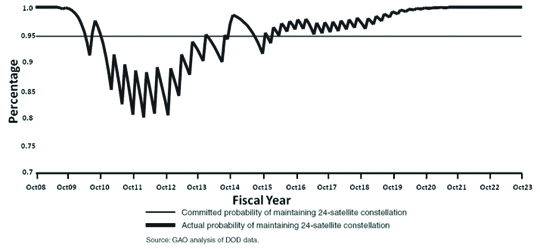
The April 2009 GAO report focused on the most conservative (that is, pessimistic) predictions, including the so-called cliff of multiple, nearly simultaneous SV failures. Figure 1 shows the most pessimistic curve of likelihood of GPS constellation outages, 2010–2013. The report states “[I]n 2010, as old satellites begin to fail, the overall GPS constellation will fall below the number of satellites required to provide the level of GPS service that the U.S. government commits to.” The analysis in the body of the report clarifies that this refers to fiscal year 2010, ending in September 2010. In fact, as this magazine goes to press, there is virtually no likelihood of a sudden collapse of GPS service. There will not be an end-of-the-world loss of 10 SVs in a single year.
Figure 1. GAO failure analysis: “Probability of Maintaining a constellation of at least 24 GPS satellites” — an overly pessimistic view.
The warnings of the GAO report are not new to the United States Air Force. The USAF, in particular, Air Force Space Command (AFSPC), has been concerned with constellation sustainment and has managed this issue for many years. AFSPC acknowledged the potential for an availability gap years ago. This was part of the reason for changing Block IIR SVs from launch-on-schedule to launch-on-demand back when they were first being launched. This led to a 13-year launch span for IIR instead of just five years.
Causes of Satellite Failure
The primary reasons for final failure of GPS satellites have varied widely. An early cause on a few Block Is was failure of the last of three atomic frequency standards (AFS). Indeed, the older designs of the rubidium AFS on GPS Block I, Block II, and Block IIA SVs have had a noticeably shorter life span (1–4 years) compared to the cesium AFS added to later Block I SVs, which became the clocks of choice on Block II and IIA.
The myth persists today that GPS SVs, regardless of block number, ultimately fail due to the on-board clock. The facts show that only nine of 24 older SVs experienced final failure due to AFS failure. It may be the most common single cause of final failure to date, but it applies to less than half of the SVs. It is not likely that clock failure will be so prominent for newer SV blocks.
Thus, a culture change was required once Lockheed Martin and its navigation payload subcontractor, ITT, were unable to find a space-qualified cesium AFS for Block IIR and chose to have just three next-generation Rubidium Atomic Frequency Standards (RAFS) on each SV. It was feared that the IIR SVs would only operate for a few years, but it turns out that many on-orbit IIR RAFS will remain unused, as they evidence an extremely long and accurate life.
Solar array failure was the final failure mode on only three Block I SVs and no other GPS SVs to date. Solar arrays in medium-Earth orbit degrade in a substantially different manner than those placed in low orbit or geosynchronous altitudes. This may be from contamination, or from the severe radiation environment. Several degradation models have been developed for the GPS orbit. This has led to strengthened specifications to assure adequate power on later-model GPS satellites. In fact, both IIR and IIR-M show no SV life limitations to date due to solar array degradation. Power limitations due to degraded solar array performance have forced a change in SV operations for a few older Block II and IIA SVs, but they have maintained the navigation mission.
Thus, the GAO report states the issue incorrectly: “[E]xcluding random failures, the operational life of a GPS satellite tends to be limited by the amount of power that its solar arrays can produce.” The evidence concludes just the opposite.
Reaction wheels (used to gently control SV pointing attitude) have been the cause of eight of 24 final failures. Early reaction-wheel designs on older GPS SVs contained inadequate lubricant for the pre-launch storage and on-orbit life of the SV. This led to premature failure of one or more of the four wheels. Several SVs had to be monitored closely for several years in three-wheel or even two-wheel mode. Two Block I and six Block II SVs were deactivated due to wheel failure. Again, newer SVs have applied lessons learned to ensure robust wheel life.
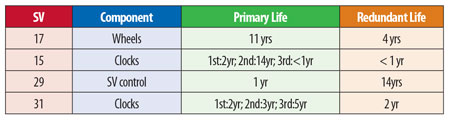
“One component [away] from total failure,” a commonly cited cause for concern, primarily indicates that the designed redundancy on the SV is being employed. Many SVs operate for many years on the redundant component. It does not signify the navigation mission will fail tomorrow. See Table 1.
Table 1. Years on primary versus redundant component.
The list is not comprehensive, but shows a few examples of primary component and redundant component life at the time of final failure of that redundant component. Sometimes the redundant components show significant life when taking over for the primary components, sometimes they do not. In fact, SVN-24 has been single-string for more than 10 years. It has been on the watch list for replacement for almost that long. Though no longer in a primary slot, it continues to provide a valued navigation signal to the users.
Mean Mission Duration
Mean mission duration (MMD) specifies and measures the longevity of an SV in on-orbit operation. The strict definition of MMD is the area under the probability of success curve (the reliability curve), integrating from time zero (launch) up to the contractual design life (also called mission durat
ion). It is the initial pre-launch estimate of how long the SV is expected to survive, given that it fails completely at its design life. MMD is usually imposed as a requirement on the SV design, guiding parts selection, systems design, SV assembly, and pre-launch test to ensure that the SV is robust and will provide service for many years.
Once the SVs for that build are all launched, MMD has less value. Over time, the MMD requirement must be shown to have been met on-orbit, but it is not a good number to estimate how long a specific SV will actually last. Several years ago, Aerospace realized that the MMD was too conservative to use as an on-orbit lifetime estimate. In recent years, another measure called the Mean Life Estimate (MLE) has attempted to better define the SV longevity that can be expected.
Mean Life Estimate. MLE attempts to incorporate the actual projected end-of-life into the reliability calculations, where end-of-life is based on consumables and/or component wearout, such as solar array power degradation. On GPS III, assemblies that potentially have a life limit must be life tested to 2X design life. This almost guarantees that they will live beyond design life. MLE was proposed as a method of improving the estimate of how long the SV will survive. These calculations typically use a normal (Gaussian) distribution with a mean and sigma to predict when individual assemblies wear out. A Monte Carlo simulation then calculates the life of each assembly and the probabilistic loss of the same component due to random failure. The shortest of these times represents the failure time for the assembly for that specific simulated mission. The average of all these runs produces the composite curve for the vehicle that considers real wearout limits for each assembly.
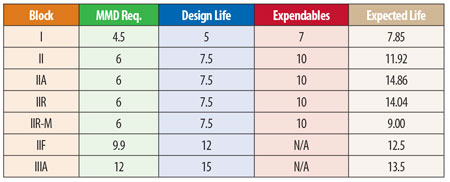
Thus, MMD estimates should be limited to prelaunch estimates that are based on the contractual design life. After launch, any adjustments to lifetime limits or wearout life should employ MLE. Table 2 lists the MMD requirement, design life, and current life estimate (MLE, when available) for all GPS versions to date.
Table 2. GPS SV life requirements and prediction.
II and IIR Lifetime
GPS Block II SVs have exceeded all MMD and lifetime requirements with one exception. With several SVs still on-orbit, GPS Block IIA SVs have already exceeded all MMD and lifetime requirements, with one exception.
All 13 Block IIR SVs have been launched. To date, no on-orbit IIR SVs have been disposed due to final failure. The oldest Block IIR SV, SVN-43, is now more than 13 years old. The youngest, SVN61, is almost six years old.
The lifetime prediction of the IIR SVs has been examined, incorporating component failures into the reliability prediction. The original MMD requirement was specified at six years, with a design life of 7.5 years and an expendables life of 10 years. Analysis suggests that the GPS Block IIR SVs will exceed all MMD and lifetime requirements.
When analyzed for an expected 15-year lifetime, the current IIR MLE exceeds 14 years. This incorporates all the on-orbit failures experienced to date. As of this writing, there have only been a few failures resulting in components being reconfigured to the redundant sides. Only one of these has been for a RAFS. Thus, 35 RAFS clocks remain on 12 IIR SVs. This bodes well for IIR lifetime: clocks will not be a life-limiting item.
So far, only two IIR SVs have experienced reaction-wheel assembly (RWA) problems. These issues were of an electrical nature as opposed to the lubrication issues on earlier vehicles. The wheels stuck when transitioning through null regions while reversing spin direction. Subsequently, these wheels have been revived through a software modification. A patch to the bus computer software enabled recovery of the stuck RWAs. Thus, there was no loss of reaction wheel redundancy on these SVs.
For IIR, excluding random failures, current evidence suggests the most likely life-limiting item will be battery capacity, or the combination of battery capacity and solar-array output power. This limitation of IIR SV life will not occur any time soon. During eclipse seasons — twice per year with the GPS orbit — solar arrays must support normal vehicle power requirements, in addition to fully recharging the batteries prior to entering the next eclipse. Though estimating future battery performance is difficult, recent studies conclude an expected battery life of up to 18.5 years for IIR and 12 years for IIR-M.
The IIR robust lifetime comes from following military standards, employing tight limits on parts selection, and executing a thorough testing program.
IIR-M Lifetime
All eight Block IIR-M SVs have been launched. To date, no IIR-M SVs have been disposed due to final failure. The oldest is SVN-53 at just over five years of age; the youngest is the recently launched SVN-50 at just over one year. SVN-49, on orbit, awaits being set healthy to users. Optimism remains that it will eventually have a long successful life serving the user community.
IIR-M MMD, design life, and expendables requirements are the same as for IIR SVs. However, the life longevity is expected to be shorter than IIR due to the higher transmitter power requirements on IIR-M for the new modernized signals and the associated higher electrical power demands and thermal profile. Analysis (summarized in the next section) suggests that the GPS Block IIR-M SVs will exceed all MMD and lifetime requirements. The IIR-M expected life (MLE) exceeds nine years when analyzed for a 10-year lifetime.
IIR Special Study Results
Three recent studies have shown increased lifetime prediction for Block IIR: the Limited Life Components Analysis (LLCA) study, conducted with the Aerospace Corporation, the Power Consumption study, and the updated IIR Reliability analysis.
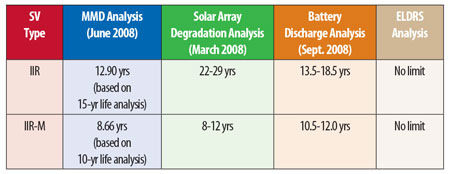
The 2007–2008 LLCA sought to determine possible areas that might limit the maximum life of the vehicle. It analyzed solar array degradation, battery charging capacity degradation, orbital environment degradation of certain transistors in the RAFS units, and the general reliability analysis of the IIR and IIR-M as expressed in the MLE. Table 3 summarizes study results.
Table 3. LLCA study results.
There was no issue with environmental radiation due to the shielding on select transistors within the RAFS. The solar-array degradation model tracks well, with the trend showing adequate power supply for 15–20 years, and battery capacity still exceeds the expected SV reliability.
Enhanced Low-Dose Radiation Sensitivity (ELDRS) is a concern for the degradation of certain types of transistors when held in an unpowered state on-orbit. This situation has been suspected for GPS Block IIA AFS units when they are not powered on for many years in the severe radiation of the MEO environment. Redundant AFS (2–3 per GPS SV) are kept in an unpowered condition until required to replace the primary unit. The ELDRS analysis performed in this study showed no vulnerability of the IIR RAFS to this degradation due to the presence
of adequate radiation shielding in the unit.
Another limiting factor examined during the LLCA study focused on battery degradation. The study developed a degradation model showing adequate battery performance margin for the SV life. But it is acknowledged that the IIR low-level trickle charge rate employed during the non-eclipse portion of the year may heat the battery cells somewhat more than optimal. It would be preferred to cut the trickle charge rate in half. The battery degradation model, developed by the Aerospace Corporation, suggests that this reduction in charge rate would add two years of life to each IIR and IIR-M SV, except the few oldest. A study is currently underway to demonstrate the feasibility of this change.
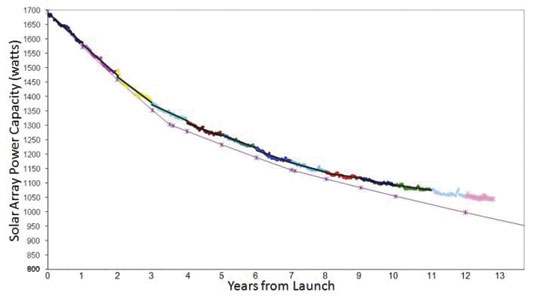
The updated solar array degradation model developed during the study suggests that the power production will be more than adequate over the predicted lifetime of both the IIR and IIR-M SVs. On-orbit solar array capability tests on several SVs has begun, with results confirming the predictive analysis. It is expected that this on-orbit capability test will eventually be expanded to all IIR SVs as part of normal on-orbit monitoring. See Figure 2 for a plot of the solar array power capacity trend for SVN-43 over 13 years. The power capacity degradation per year decreases as the arrays age.
Figure 2. IIR solar array power capacity trend.
The Power Consumption Study tracked actual on-orbit box-level power use on several SVs, in order to advance from the designed power consumption predictions to actual on-orbit values. This was compared with the solar-array degradation seen on-orbit to update the possible life limitation due to solar array capacity.
Finally, the on-board fuel budget shows more than adequate margin to fully meet mission needs for all SVs, including station-keeping maintenance and disposal operations. Thus, component failure — failure of a final redundant box — is still the primary concern for IIR and IIR-M final failure. Random component failures represent the most likely cause of IIR and IIR-M SV loss.
IIF Lifetime Requirement
The first IIF SV was launched in May 2010. Eleven others will be launched in the next four years. The Block IIF will primarily replace well-used and over-age IIA SVs. For each new IIF launched, a PRN must be taken away from an on-orbit asset. The old SV may be disposed due to final failure, or it may be maintained in its GPS orbit as a spare, should it have capability remaining.
The IIF SV has MMD and design life requirements of 9.9 and 12 years, respectively. This is several years beyond that required of all earlier GPS SVs. Obviously, the new IIF SV has no track record yet, but analysis by the contractor and USAF suggests that the GPS Block IIF SVs will exceed all MMD and lifetime requirements.
IIIA Lifetime Requirement
The GPS IIIA contract was awarded in May 2008, and the Critical Design Review was completed in August 2010, two months ahead of schedule. Long lead part acquisition and subsystem build have started. The first launch is still targeted for May 2014. Analysis presented at the GPS IIIA SV CDR currently predicts that the GPS IIIA SVs will exceed all MMD and design life requirements of 12 and 15 years.
The GPS IIIA System Design Review occurred in March 2007, just prior to the expected release of the final RFP. The delay of the final RFP release until July and contract award decision postponement until May 2008 were two final delays which directly affect the tight schedule for first launch. The IIIA schedule suffered from these delays on top of the extended proposal activity from 2002–2008.
Despite these delays, IIIA benefits now from the numerous risk reduction and systems engineering efforts performed in the interim. Also, the IIIA design leverages significant design maturity from the A2100 satellite bus, the IIR-M SV heritage, and the fact that Lockheed Martin’s navigation payload subcontractor, ITT, has provided navigation payload components on every GPS SV to date.
Since the GPS III production looks to be on schedule, the worst thing that could happen would be an acquisition delay or reduction of the SVs necessary to keep the constellation robust. This could well bring the GAO report’s worst-case predictions to pass in a few years.
Another primary GAO conclusion was that “[the GPS IIIA development] schedule is optimistic, given the program’s late start, past trends in space acquisitions, and challenges facing the new contractor.” But Lockheed Martin and ITT built 21 IIR and IIR-M SVs and bring significant GPS experience to the GPS III design and development — a major benefit to keeping the program on schedule.
Constellation Sustainment
The 20 IIR SVs will form the backbone of the constellation for many years to come. But GPS constellation sustainment will depend on all GPS SV types operating together. The 12 IIF SVs will generally replace the older IIA SVs, and the new GPS IIIA SVs will begin launching in 2014 to initially replace older IIR SVs and eventually supplement the constellation beyond 32 SVs. GPS IIIA SVs will be able to broadcast on PRNs as high as 63, though there may be some delay before the Control Segment (CS) can monitor these modernized capabilities and before users are equipped to use them.
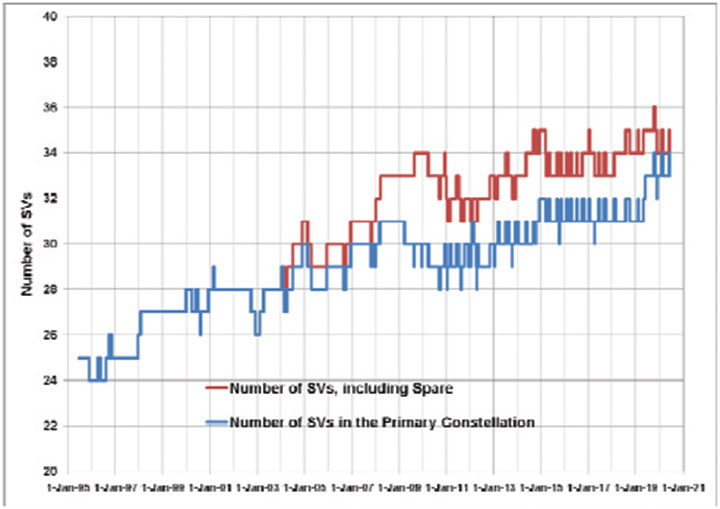
Figure 3 shows a projection of GPS constellation size over the next decade as Block IIR provides the foundation, while IIF and IIIA replace older SVs or add to the size. This figure gives a prediction of constellation health over the next 10 years, considering IIA failures, IIF life, IIR failures, and III life. It suggests a busy operations tempo of disposing of at least one old SV to free up a PRN in time for the launch of a new SV, to maintain constellation strength while reducing the number of extremely old SVs. Moving an SV to spare status slightly relaxes this tempo. Should GPS III SVs be unavailable or significantly delayed (for example, due to boosters), the constellation health will definitely suffer.
Figure 3. GPS constellation size projection.
In addition to the general long-life predictions, on-orbit SVs can have their operational life extended through employment of various options. Power management is available to extend SV useful life for the navigation and timing community. On Block IIA and Block IIR SVs, this is limited to turning off non-navigation boxes. This is always an option if the available solar array power or battery capacity threatens limiting the legacy signal capabilities. This has been employed on Block IIA SVs with the benefit of extending the SV life by several years. It is expected that this technique will be used periodically on all SV versions in the future.
On Block IIR-M SVs, reducing the L-band broadcast power (that is, turning off the modernized signals) is an option. Analysis in a recent MMD report shows that this would add several years (2–4) to IIR-M SV life. This would probably be the first step of several available to extended IIR-M life.
Current Operations
Regular IIR and IIR-M operati
ons start with the normal daily navigation data uploads, routine telemetry collection, and memory dumps as for all GPS SVs. Other on-orbit support for IIR and IIR-M SVs consists of a variety of periodic operations from orbital repositioning and minor hardware reconfiguring, to data and computer program updates of the on-board processors. When necessary, anomaly investigation support is provided for any issue or event with causes or could potentially cause an SV outage.
To maintain proper constellation coverage and proper relative spacing of the SVs, orbital repositioning maneuvers are performed regularly on almost all SVs to counteract the effects of the normal orbital perturbations and natural in-plane acceleration. Occasionally, rephasing maneuvers are performed to move an SV to a new orbital location. Approximately 15 orbital maneuvers are performed per year for the 20-SV IIR/IIR-M subconstellation.
The SV communication mode for command and telemetry is occasionally modified temporarily to avoid communication conflicts with nearby SVs. Also, certain heaters must be enabled during a portion of the year to avoid excessive cooling.
The bus and the navigation processors on the IIR/IIR-M SVs are both reprogrammable on-orbit. This includes program updates and data changes. Flight computer maintenance has required an update every year or so. The bus computer has seen eight sets of patch updates to date. The navigation computer has been reprogrammed approximately every two years (patches are not used here). These updates have provided adjustments to current capability, including accommodating degraded hardware component performance, allowing them to perform nominally. Other updates have enabled enhanced capabilities on the SVs.
The navigation computer program was updated for a number of items including time-keeping system (TKS) loop stability and data collection for offline performance analysis. This has avoided numerous outages due to clock jumps. RAFS frequency drift adjustments must be performed occasionally. All clocks are monitored and uploaded as required.
Data parameter updates to the bus computer occur occasionally to accommodate Earth/lunar eclipse pair issues and other purposes. Backup ephemeris data uploads are performed on every IIR/IIR-M SV every 10 months. Occasional events caused by the space weather environment must be tracked and addressed using data provided by on-board data monitors. Memory dumps and buffer dumps are performed daily on every SV.
The bus computer processing was enhanced by adding a rolling buffer for telemetry data collection when out of contact with the CS. This high-fidelity data collection recently has been used to collect battery performance information during an investigation into battery performance degradation.
The IIR-M SV provides legacy signals just like a IIR SV, and many of the operations are similar, but modernized signals require unique operations for
IIR-M. To date, these capabilities have been accomplished on the non-modernized CS by using work-arounds. Full modernized capability and signal monitoring will come online with the GPS Advanced Control Segment (OCX).
The new M-code signal has only been used to date for MUE development and test, but L2C-capable civilian receivers have been sold on the market since before the first IIR-M SV launch in 2005. Users equipped with such recievers now have seven IIR-M and one IIF SV to provide half of the ionospheric correction from tracking the new signal. The remainder of the correction may not be available until the OCX deployment, when regular inter-signal correction (ISC) data gets modulated on the L2C signal.
Users generally do not think much about GPS SV operations unless it affects the performance they experience. Block IIR and IIR-M SVs have shown significant performance improvement to users in accuracy and availability over the years, indicating that longer IIR life will benefit users by providing good-performing SVs which will last a long time.
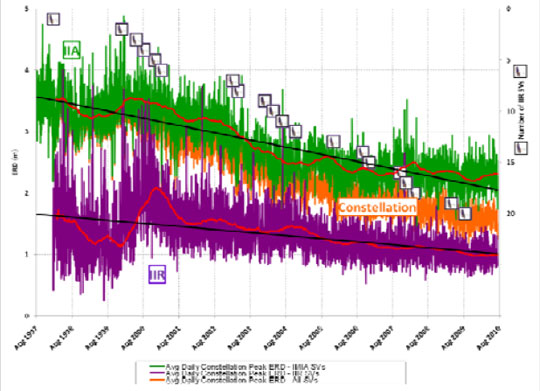
Figure 4 shows GPS accuracy over 13 years, tracking the daily peak estimated range deviation (ERD) trend. The trend has improved partly due to system improvements (both CS and Space Segment), partly due to more IIR RAFS and fewer older AFS, and partly due to RAFS maturation (the guess is that this is due to physics package stabilization within the RAFS). The full constellation accuracy has also improved from using additional National Geospatial-Intelligence Agency (NGA) monitor stations, and other Accuracy Improvement Initiative (AII) improvements to the CS.
Figure 4. IIR, IIA, and full constellation average ERD trend.
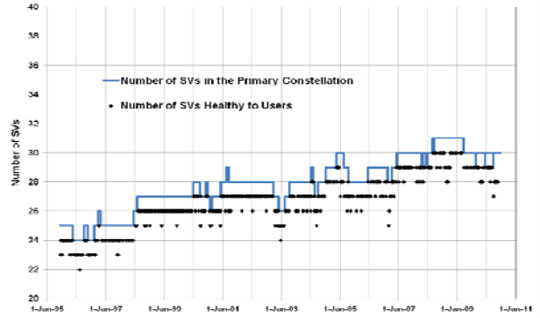
Concerning SV availability, General Kehler, commander, AFSPC, stated at the congressional hearing on the GAO report, “[S]ince we declared Full Operational Capability in 1995, the Air Force has maintained the constellation above the required 24 GPS satellites on orbit at 95 percent.” Figure 5, a plot of the number of SVs from 1995 FOC to present day, shows this claim is accurate.
Figure 5. GPS constellation availability, 1995 to present.
There have been no occasions when the constellation size dipped below 24 SVs, and there were only a few times in the mid-1990s with a few SVs briefly set unhealthy due to maintenance or anomalies when there were fewer than 24 available SVs. Very rarely has it been as low as 25 SVs. Only once since late 2006 has the number of available SVs dropped as low as 27. This doesn’t take into account the spare SVs that may still have some life left, if required.
Future Operations
Consideration of options for future operations include assistance for aging IIR SVs and any CS changes that could help the older SVs. Ideas have been explored, such as crosslinking clock timing data from other SVs if all clocks fail on a particular SV.
It is expected that the past flight software update pace will need to continue into the future, both for the bus computer and for the navigation computer. This will likely be necessary to address SV hardware issues, CS updates (Architecture Evolution Plan [AEP] and the OCX), as well as compatibility with other future SVs (IIF and III). The OCX will bring to the IIR-M SVs command of the full modernized capabilities. This includes modulation of modernized data on the new signals, full employment of the new signal structure, and signal monitoring of the new signals at the USAF monitor stations. It is expected that most IIR-M SVs will be around for this.
As has been seen with earlier SV blocks, future IIR and IIR-M availability may degrade somewhat as the SVs age, but the quality support from the Second Space Operations Squadron (2SOPS) and the flexibility of the SVs should minimize any significant outage periods.
Having Block IIR SVs last longer will potentially allow for more SVs on-orbit providing greater coverage. More SVs will also allow for additional lower elevation SVs to be masked by the user equipment and thus avoid local obstructions.
Conclusion
The data and analysis presented here show no single point of vulnerability for the existing IIR and IIR-M on-orbit SVs. Lessons learned from older SVs have been applied to make later
blocks more robust. IIR SVs have been studied thoroughly with no obvious life-limiting mode identified at this point. Robust and flexible SV design suggests long life for these SVs.
Based on this analysis and performance, it is expected that IIR and IIR-M SVs will meet and exceed MMD and design life requirements, with some SVs lasting more than 20 years. This will form the backbone of the constellation well into the next decade and mesh well with GPS III.
While the dire forecast of the GAO report will not come to pass, it is important to follow the guidance of the new National Space Policy of June 2010 to maintain U.S. preeminence in space: “The United States must maintain its leadership in the service, provision, and use of global navigation satellite systems (GNSS).” This can be accomplished by maintaining the steady course which has proven so fruitful to date. If more SVs are wanted, then there might be the option to build the simplified GPS III, the “IIIS,” as recommended by Brad Parkinson.
Acknowledgments
The authors thank Pete Barrell, Jim Martens, Joe Trench, Don Edsall, Kim Kruis, Amanda Keith, Wayne Rasmussen, Mark Merwin, Sam Bryant, Jeff Holt, and Chris Krier all of Lockheed Martin, Jeff Harvey of ITT, and Mike O’Brine of Aerospace for their contributions and comments on this work. A longer version of this article was presented at the ION-GNSS 2010 conference.
WILLARD MARQUIS is a senior staff systems engineer with Lockheed Martin’s GPS IIR and GPS III Flight Operations Group. He has a masters degree in aeronautics and astronautics from the Massachusetts Institute of Technology.
J. DAVID RIGGS is a staff systems engineer with Lockheed Martin Space Systems GPS IIR Flight Operations Group. He has an M. S. in electrical engineering from Colorado Technical University.
There’s something I’ve been wanting to write about since the ION-GNSS conference a few weeks ago. However, a nasty cold, a 10-day trip to Europe (INTERGEO conference), and some jet lag have kept me from it until now.
Here goes.
First of all, most of the presentations from the CGSIC meeting are available on the USCG Navigation Center website. You can view them by clicking here. There’s some very good reading and most of it is pretty light-weight and in PDF format.
One of the presentations at the CGSIC (Civil GPS Service Interface Committee) meeting during the ION-GNSS conference was “Integrating NDGPS and SBAS —
An Optimal Real-time GPS Mapping Solution,” presented by Jean-Yves Lauture of Geneq, Inc.
I’m publishing two of the slides from his presentation in order to:
Show the accuracy potential of WAAS and NDGPS given a high performance L1 receiver.
Discuss the statistical names/values used to express GPS accuracy.
First of all, each of the slides below are at the same scale. Each ellipse is 20 cm with the outside limit (radius) being one meter.
I’ve known for quite sometime that SBAS (WAAS in this case) is capable of sub-meter precision with a single-frequency GPS receiver. These results are a bit better than what I’ve seen personally, and keep in mind it’s a limited data set of 1,800 continuous epochs, but impressive none the less. Also, keep in mind that the WAAS Performance Analysis Report published quarterly by the FAA’s National Satellite Test Bed shows the 95% horizontal accuracy value for Denver, Colorado, (near where this data was collected) being .547 meters for the quarter ending June 30, 2010 (7,856,354 samples collected over three months).
30 minutes of WAAS-corrected data (each ellipse represents 20cm)
The results I didn’t expect were the slide below, which shows NDGPS-corrected results using the same receiver/antenna. Keep in mind this is a GPS L1 receiver using phase-smoothed pseudorange measurements, not a GPS L1/L2 receiver using a carrier-phase float solution. If you look closely, you’ll see it states the baseline distance is 200 km. Granted, this is a limited data set, and I’ll be interested in seeing further results. If this was a dataset presented by a manufacturer or other party with some sort of interest, I wouldn’t publish it, but this is data collected by an objective entity (a credible U.S. government agency) so that earns, in my mind, a level of credibility.
The results are pretty impressive. All data points fall within ~20 cm.
30 minutes of NDGPS-corrected data (each ellipse represents 20cm)
Keep in mind that this data was collected recently, and we are currently in a period of low ionospheric activity. In other words, data was collected under near-ideal conditions. At the end of the day, my point is that GPS L1 accuracy using SBAS and NDGPS has gotten pretty darned good.
Accuracy Statistics
The second reason I’m publishing the slides is to discuss accuracy statistics.
Look at the small box inside each slide showing 99%, 95%, 68%, and 50% accuracies.
If you look at the data points, it might not be immediately apparent how those values were arrived at. For example, how could a group of data points all within ~20 cm have a 95% confidence of 37 cm?
To explain this, there was a good article published in GPS World in 2007 titled “GNSS Accuracy: Lies, Damn Lies, and Statistics” by Frank van Diggelen. It does a good job explaining statistical expressions (RMS, 2DRMS, etc.).
Keep in mind that most manufacturers express horizontal GPS accuracy specifications based on 68% confidence. When the specification sheet states “sub-meter” HRMS (horizontal RMS) precision, that means 68% of the time; the horizontal accuracy will be less than a meter. In reality, that “sub-meter” receiver won’t consistently deliver sub-meter precision. If you convert the 68% HRMS value and express it with 95% confidence (2D HRMS), the actual horizontal precision for that same receiver will be well over one meter. That’s the precision you can expect from the receiver, not the 68% confidence value.
This week, I’ve been attending the INTERGEO 2010 conference in Cologne, Germany. It’s a gathering of ~16,500 people interested in geodesy, geoinformation, and land management. It’s the largest event of its kind in the world.
Although there’s a lot of GIS activity, it’s just as much a surveying/geodesy trade show. I borrowed a little of the following from my Geospatial Weekly newsletter because I think it’s relevant in this newsletter, too. Let me just say that if you’re a land surveyor/engineer/construction contractor/GIS’r, you won’t find a trade show anywhere in the world like this one. To me, two things differentiate it from all other conferences I’ve attended that are related to surveying, engineering, construction, or GIS.
The sheer size. 16,500 people buzzing around attracting 504 exhibitors. You can find a solution to any sort of challenge you have regarding surveying, geodesy, construction or GIS. The major GNSS manufacturers (such as Trimble/Spectra, Topcon/Sokkia, Leica, Javad) have enormous exhibit booths that rival the Consumer Electronics Show (CES) held every year in Las Vegas. You don’t see these companies spending this much money to exhibit at conferences in North America.
Unlike many of the conferences I attend, the focus at INTERGEO is on the trade show exhibit area. The technical sessions are few and most are in German, so that leaves the vast majority of the attendees to flock to the exhibit area. We’re currently in Day Two of the three-day conference, and the exhibit area attendance seems just as strong as the first day, which is not typical. On top of focusing on the trade show area, INTERGEO makes it inexpensive to attend. A one-day pass to the exhibit area is only EUR 20 (~US$26) and a three-day pass to the same is EUR 48.50 (~US$63). It’s even cheaper if you buy it online in advance.
The few technical sessions held were presented by University Professors and various Ph.D.s, so although I submitted an abstract to present a paper, I knew there was no chance I’d be presenting in the formal technical sessions. The closest I am to a Ph.D. is my father’s, which he earned 40+ years ago. Anyway, INTERGEO has a stage in the exhibit area called the Trend and Media Forum. It’s sort of an infomercial stage for companies to show their products and services. They scheduled me to present on that stage, which I did earlier today (Wednesday). The title of my presentation was “GNSS is Changing a Lot — the Future of GNSS Mapping and Surveying.” The audience was sparse, but the good thing is that INTERGEO records the presentations and later posts them on their www.intergeo-tv.de site. My presentation is not on the TV site yet, but should be by Thursday. Please don’t laugh when I nearly fall down after stepping off the stage while I’m talking :-). Click on the following image to view my presentation.
Following are some pictures I took of the conference exhibit area, with captions:
There were many new product announcements in the past day. I saw one that caught my particular interest. I’ve written before that for years I relied on stand-alone satellite mission planning software. The problem that most folks have is maintaining the software as they change computers or update operating systems. There’s also the pain of having to update the almanac every month or so.
I’ve become a fan of online satellite mission planning. I’ve mentioned the NavCom Technology website a few times in this column. However, it has a few shortfalls, namely no control over the elevation mask used and no support for GLONASS or SBAS.
I’m happy to report that today at INTERGEO, Ashtech released an online satellite mission planning tool, and it seems to fit the bill. Among other things, it allows you to adjust the elevation mask, and choose to include GLONASS and SBAS satellites. Of course, since it’s an online tool, you don’t have to worry ab
out updating the almanac.
Following are a couple of screenshots from the program.
Select GPS and/or GLONASS and/or SBAS satellite
Give it a try for yourself by clicking here. There’s a really cool plot that’s generated as a 3D visualization in Google Earth, showing each satellite (green = GPS, red= GLONASS and blue = SBAS).
The new European Positioning, Navigation, and Timing (PNT) Industry Council (EPIC) will be a forum for organizations with an interest in all PNT systems including Global Navigation Satellite Systems (GNSS). EPIC shall serve as an information and distribution portal between all stakeholders in the PNT community. Its mandate includes all GNSS constellations and related augmentation systems worldwide, both operational and in development/modernization.
EPIC will undertake to serve the interests of all stakeholders within Europe, and on behalf of Europe on the global stage, recognizing that understanding and cooperation between the world’s stakeholders is key to the successful deployment of new and improved GNSS applications. We also envision that EPIC will become a thriving forum for the exchange of new ideas and best practices, as well as becoming a knowledge center hosting working groups and task forces focusing on specific GNSS issues. EPIC would thus not only serve as a gateway but actually assist stakeholders in developing common solutions to common problems in-house.
Representation
GNSS has applications in many commercial and non-commercial fields: academia, agriculture, airline operators, civil aviation authorities, air navigation service providers, emergency services, energy suppliers, logistics, manufacturing, maritime, communications, petrochemical, rail, surveyors, and more. Therefore, EPIC will work on behalf of all GNSS stakeholders regardless of their application or business model and represents the whole community, integral to the ongoing success of GNSS. In addition it will represent the needs of users and developers of downstream applications.
International
EPIC stands with sister organizations in North America and Asia:
United States GPS Industry Council
Japan GPS Council
Korean GNSS Technology Council
EPIC will maintain close ties to these organizations and will profit from shared practices and knowledge when mutually beneficial. Joint representation with these organizations to government GNSS authorities will be a key coordination activity.
Communication
EPIC will encourage communication and cooperation among its membership to develop new associations and partnerships to create new applications or share ideas and expertise. It will organize regional meetings, workshops, focus groups and social gatherings.
The organization will update members on the latest developments within GNSS and work to ensure that information is made available in a sensible, secure manner and shared as publicly as possible. We intend to keep EPIC a dynamic organization, reflecting the world of GNSS, responsive and adaptable to the needs of its members. Therefore, active involvement from the membership of EPIC will be crucial to its success in both setting the agenda and then realizing it. It is no accident that EPIC is intended as a forum — not just a place for debate but literally a marketplace of ideas where real transformative change can take place.
To get the ball rolling, EPIC will conduct a market survey over the next few months with potential members to clarify their requirements and ensure that EPIC starts with the issues and people that matter.
John Wilde has great experience in the GNSS field, specializing most recently in aviation requirements. He is the founder of EPIC. See also his February 2008 interview on the same subject.
As today’s handsets and consumer devices become more sophisticated, manufacturers continue to incorporate more and more functionality into a small and sleek form factor. Today’s range of smartphones incorporate voice and data transceivers, GPS, Bluetooth, Wi-Fi, cameras, music, touchscreen interfaces, compasses, motion sensors, cameras, storage cards, and many other technologies. Free turn-by-turn navigation services, such as offered on Google Android phones and iPhones, have created a compelling reason for many of us to own a GPS-equipped smartphone.
The pressure on manufacturers to integrate so many functions into one small printed circuit board has fueled a race among semiconductor suppliers to offer new solutions combining GPS and wireless connectivity. Phones that are small and comfortable to hold mean less and less space available for the internal electronics. Large screen sizes and the trend to thinner and thinner devices means smaller, less efficient antennas, placing pressure on chip designers to improve integrated circuit (IC) performance to make up for antenna constraints.
Finally, cost competition in these markets is intense, as operators compete to bring more users online.
These forces have shaped several changes in the wireless semiconductors found in new smartphones. Three important enabling technologies are:
reduced-geometry semiconductor technologies,
wafer-scale packaging, and
combo chip integration.
Let’s look at the trends in each area.
Semiconductor transistor sizes have been shrinking for decades. GPS processors in the market today use transistor geometries with gate widths of 0.18 micrometers, 0.13 micrometers, 90 nanometers (nm), and 65 nm, the latter showing up in the newest handsets on the market. 40-nm-based ICs have been announced as well, and will find their way into the market in the next year or two.
Each generation of technology offers a 50–100 percent increase in density for pure digital circuits. This so-called shrink has allowed designers to both reduce the size of chips and to pack in more performance — in GPS chips this usually means more tracking channels and more correlators for faster signal search. The area for non-digital circuits such as the radio receiver in a GPS has not been shrinking as fast as the digital portion. This had led to changes in architecture, with more and more functions going digital. Examples include digital band-shaping filters, digital gain adjustment, and sigma-delta analog- to-digital converters.
Wafer-scale packaging has moved into the mainstream for GPS and other wireless ICs. Traditional ball-grid array (BGA) packaging requires placing a semiconductor die on a substrate. The substrate carries the balls (pins) and some interconnects, and the semiconductor die is connected to the substrate via wire bonds. For small ICs the overall package size may be 50 percent larger than the die itself, because of overhead of the space needed for wire bonds.
By contrast, wafer-level ball grid array (WLBGA) packaging yields a finished packaged part with the same dimensions as the underlying die. Wire bonds are not used; a redistribution layer (RDL) is bonded to the silicon wafers and carries interconnections from the silicon to the balls. This type of packaging yields the smallest possible board footprint. It also places strict limitations on the number of package pins, since the pins must all fit under the chip and cannot be spaced too closely, due to board manufacturing constraints. Often designers struggle to provide the features customers seek while abiding by package pin-count limitations. Pins are shared or multiplexed to preserve flexibility.
Combo-chip integration offers the ultimate solution for small size. A single IC with multiple functions will almost always be considerably smaller than several ICs on a printed board. The last two years have seen the introduction of several combo ICs containing GPS, including the Broadcom’s BCM2075 Bluetooth-FM-GPS combo IC. Combo ICs like this allow manufacturers to build cellular handsets that would be difficult or impossible to create using discrete chip sets. Since GPS, FM, and Bluetooth have become standard features across many product lines, manufacturers not only benefit from small size but also economies of scale, designing a single part into dozens of devices.
The benefits of combo ICs are easy to understand, but making these devices brings unique challenges. First and foremost, these ICs are wireless devices containing multiple sensitive radios, where every fraction of a decibel of performance counts. With few exceptions, handset manufacturers and their wireless operator customers are not willing to sacrifice radio performance in their quest for miniaturization and cost reduction. Each function on the wireless combo IC must perform as well as its counterpart function in a stand-alone IC.
However, in a combo IC the radios are at most a few millimeters apart from each other. Designing for this type of integration requires engineering attention at multiple stages of the design. Up front, during the system engineering phase, component specifications must be set that minimize interference between radio subsystems, considering not just the radios on the combo IC but the influence of other radios in a handset as well. For example, in setting the specification for the second-order intercept point of the GPS receiver, system engineers must consider the fact that transmissions in 825 MHz cellular band can mix with Bluetooth transmissions at 2400 MHz to yield an intermodulation product at 1575 MHz, right in the middle of the GPS receive band. Designers also choose clock frequencies to avoid interference; for example, a GPS baseband processor that clocks at 100 MHz might be changed to 75 MHz to avoid the FM receive band. These are just a couple of examples of the many scenarios and considerations that must be examined early in the design process.
Once the system engineer has done his or her job, the next level of interference mitigation falls on the analog designers. They choose where to place circuits, how to structure the semiconductor layers, how to drive and load interconnects, and how to properly filter supply voltages to avoid undesired interactions. Keeping spurious products off local oscillator signals is a key challenge. GPS receivers have 100 dB or more of gain to amplify very weak GPS signals to a usable level. Due to this high gain, even a tiny spurious product on a local oscillator can have the effect of tuning in an undesired cellular transmitter. For example, a spurious product offset 135 MHz will tune a cellular transmitter at 1710 MHz down to 1575 MHz, again right in the middle of the GPS band. Avoiding these interactions requires experienced designers who can anticipate complex issues. Mistakes can be costly, with each mask for each IC iteration going into seven figures.
As the challenges of combo ICs are overcome, it’s likely the future will bring even more in the way of wireless technology integration. This in turn will provide even more opportunities for GPS to penetrate a broader set of handsets and cellular devices, making this exciting technology available to more consumers every day.
CHARLES ABRAHAM is senior director of engineering for the GPS Business Unit at Broadcom, which he joined via acquisition of Global Locate, a company he co-founded in 2000. Previously, he worked at Ashtech, Magellan, Trimble, and Hughes Electronics.
Michibiki has more Twitter followers than you and me put together. All of you, and all of me with my 17 followers. Michibiki hit 16,284 when I signed on just now, and she (he?) has not yet even emerged upon the global stage. Perhaps by the time you read this, if the September 11 launch date holds true, s/he will be an orbiting, broadcasting entity.
Michibiki
Why follow a satellite? One might well ask why follow anything or anyone these days. For utterings momentous or vacuous, leavened in lucky moments by a bit of gossip, or an even rarer bit of news. It’s a good bet that Michibiki’s scriptwriters will display more intelligence than the mass of online mouths. Right now it’s hard to tell; they communicate in Japanese, which comes through my browser as so many question marks.
For intelligence is what the Michibiki anthropomorphizing — from the creation of a friendly, pettable caricature to the establishment of a Twitter voice — is all about. Savvy marketing by purposeful people to an audience that they have studied and know well. This goes beyond the cute that large segments of Japan have a fondness for. It has the goal of buliding a solid, sustained client core for location-based services, powered by QZSS signals.
Other places where LBS have failed to take hold — and this means everywhere — despite their vast potential utility, would do well to watch and learn.
As cell-phone text-message readers and e-mail users (could there be a broader market segment, other than people who eat and breathe?) become accustomed to receiving messages from Michibiki, they will subtly but increasingly think of this 4,000-kilogram, 40,000-kilometer high hunk of orbiting metal and circuitry as a personality, and even, a friend. They will be open to suggestions, impressionable and cute-prone teens and twenty-somethings, especially so. This is the next generation of satnav users. Or I should say, this is the Now Generation of satnav users.
Young men and women with places to go and friends to see will remember Michibiki, and call upon her/him often. “My guide will tell me how to get there. With added services, my guide will also track my friends right now, and tell me where they are. My guide can do many more wonderful things for me: here is a list of them.”
By no means do I suggest that the U.S. GPS Industry Council or the Galileo Supervisory Authority or Roscosmos rush out and commission a cartoon character based on their respective space vehicles. Different markets require different approaches, and careful study.
The Now Generation of satnav users is coming through, to supplant current users, and uses. They’ll soon rattle your windows and shake down your walls. If your time to you is worth saving, I do suggest that you pick up on social media. That is the message my own marketing staff keeps drumming into this obdurate old head.
I wish to second Jim Spilker’s comments in his recent letter to the editor regarding the two wonderful GPS history articles by Brad Parkinson. My endorsement of his comments also includes those about the origins of the L5 signal with reference to the 1999 paper by Spilker and Van Dierendonck, “Proposed New Civil GPS Signal at 1176.45 MHz.” Jim commented in the letter that “. . . . the work I did in designing the GPS L5 signal was performed as a gift to the U.S. Air Force, Federal Aviation Administration, and our country, . . .” It was a generous contribution, and I applaud it.
However, this leads me to comment on other very important but underreported gifts to L5 and subsequent signal developments. A small indication of the L5 contributions is given in the brief acknowledgement at the end of the referenced paper, “The authors wish to acknowledge the contributions of Dr. C.R. Cahn and Thomas Stansell in the selection of this signal.” It also is important to recognize that the L5 signal structure was formulated within an RTCA committee of mostly volunteers. Among other key participants, in addition to A.J., was Dr. Chris Hegarty.
The L5 signal design included several innovations which influenced subsequent development of modernized GPS signals and of signals for other GNSS. My ranking of the most important L5 innovations is:
Center frequency of 1176.45 MHz in an ARNS band
Two signal components, one with a data message and the other without (pilot signal)
Forward error correction (FEC) (first GPS use, borrowed from WAAS)
Overlay code to frame symbols and eliminate need for bit synchronization
CNAV message structure for better accuracy and more flexibility
The list doesn’t include the 10.23 MHz code clock rates or having two signals in phase quadrature, which were included in the first GPS satellite launched in 1978. The new center frequency was recommended by Karl Kovach (then with ARINC and now with Aerospace) and adopted before the signal design began, but it was central to the L5 purpose of having a civil signal in an ARNS band. This same center frequency also will be provided by Galileo and Compass, so it was a vital innovation. Although forward error correction had been adopted for WAAS, the first use on GPS was the L5 design. In one form or another, it too will be used on most if not all other GNSS signals.
The second and fourth innovations in the list above were contributed by Dr. Charlie Cahn with help and encouragement from Richard (Rich) Keegan and myself. Having a dataless or pilot signal provides a significant boost to performance and has been adopted for almost every subsequent GNSS signal. The problematic C/A bit synchronization process has been eliminated by the data symbol overlay code (or equivalent) in all subsequent signals. The CNAV message format was principally developed by Karl Kovach with significant help from Art Dorsey of Lockheed Martin.
In summary, Brad Parkinson helped memorialize many of the early “GPS Heroes” who made GPS what it is today. Other heroes have contributed to GPS modernization, and credit should be given where credit is due. Brad mentioned Charlie Cahn, one of my real heroes, who helped shape the 621B and early GPS signals and has continued to contribute in many ways. In addition to the very significant innovations mentioned above, Charlie was key to similar improvements made in the subsequent L2C, M-code, and L1C signal designs.
— Tom Stansell
Kauai, Hawaii
An Advisor Bids Farewell
Paul Cross
Many thanks for the kind invitation to GPS World’s Leadership Dinner. I have to decline as I won’t attend ION-GNSS this year. I will retire from University College London at the end of September. I don’t plan to remain active in the world of GNSS after my retirement so this would be a good time for me to step down from the Editorial Board. I’ve very much enjoyed my association with GPS World and have benefited enormously from it.
I wish you and the magazine continued success. You have come a long way over the past twenty years or so and you are now, and have been for some time, the premier source of news (and very useful gossip!) relating to GNSS worldwide. I don’t know anyone of any significance who doesn’t read GPS World every month. Your highly accessible technical articles have been of enormous help to many cohorts of students here at UCL, and all over the world.
Earlier today (August 31), I conducted a webinar entitled “Solar Activity, SBAS and 24+3 GPS Constellation Updates.” Considering we only announced the webinar three weeks ago, we had a fantastic registration numbers, with more than 570 registered. Thank you for attending if you did. If you weren’t able to you’ll be able to download the presentation by registering here. After registering, you’ll be notified when it’s available for download (usually a couple of days after the webinar).
I had a lot of questions before and during the webinar. As customary, I’d like to address some of those as well as present the poll results here. First, the poll questions and results with accompanying pie charts to illustrate the results.
Poll #1: How concerned are you about solar activity affecting your GNSS operations?
Total votes: 157
Gakstatter comment: These numbers don’t surprise me. Personally, I probably fall in the “Somewhat” category, but my GPS/GNSS field work is pretty flexible so I can easily adjust without much inconvenience. However, if I had several crews using GPS/GNSS on a daily or near-daily basis or I had equipment relying on GPS/GNSS, I think I’d be in the “Very” category because the $$ impact would be much higher.
Poll #2: If it was available, would you be interested in receiving alerts/warnings of solar activity that may affect GNSS operations?
Total votes: 176
Gakstatter comment: I’m not surprised at these results either. When I initially considered this poll, I was thinking about asking which type of platform you would prefer to receive alerts/warnings with the choices being Droid app, iPhone app, Blackberry app, text message, e-mail, etc. If you have a preference on that, fire off a quick e-mail to me. Secondly, a few of you pointed out that NASA has an app for this, but keep in mind that the system I’m considering is focused specifically on high-performance/precision GPS/GNSS users, which would eliminate a lot of the baggage of the alert/warning systems available today. Poll #3: Do any of your GPS receivers use SBAS (WAAS/EGNOS/MSAS) as a primary source of corrections?
Total votes: 115
Gakstatter comment: Not much to say here except that a substantial number of commercial GPS users are relying on SBAS. This has definitely been the trend over the past five years.
Poll #4: Do you expect that the GPS 24+3 configuration will improve your GPS productivity?
Total votes: 172
Gakstatter comment: Like most of you, I have great expectations for the 24+3 configuration. While launching more satellites with L5 would be nice, that’s a long-term effort, whereas the 24+3 configuration is something we will benefit from in a few months and are seeing some marginal benefit now. In January 2011, once all the satellites have arrived at their destination slots, I’ll plot new visibility charts and see where we stand.
Following are some of the questions that were posed by the audience during the webinar: Question #1: The blueline ends in late 2009. Any information on up-to-date activity?
Gakstatter comment: This question was in reference to the Solar Cycle 24 prediction chart I displayed. The chart was probably small and difficult to read when displayed on your computer. Here’s a larger version of it. This was a chart released by the NOAA Space Weather Prediction Center in May 2009. Although sunspots don’t directly affect GPS operations, there is some relationship between sunspots and geomagnetic storms. Below it is an updated chart with actual values through the end of July 2010.
Question #2: What tools/online sites can be used to see if there is a TEC anomaly at a specified time, including “today”?
Gakstatter comment: There is a cool real-time chart of the U.S. on NOAA’s Space Weather Prediction Center website. There are other interesting charts on SWPC’s website like the 10-day trend chart. The JPL had a website that displayed a real-time TEC, but I just checked it and it hasn’t been updated since June. Another website to check is the National Satellite Test Bed that displays a real-time plot of the WAAS ionospheric grid points. Click here to view a global real-time (updated every 60 minutes) TEC chart of the world published by the Australian Space Weather Agency.
Question #3: What is better for a receiver, Differential GPS or dual frequency? Any references on this?
Gakstatter comment: With respect to performance during periods of heightened solar activity, definitely dual-frequency receivers. Although I don’t have a specific cite for you right now, there has been plenty written on this subject. Single frequency DGPS receivers are the most vulnerable during periods of heightened solar activity.
Question #4: Is the disruption in the sub-meter scale, single-digit meters, or tens of meters?
Gakstatter comment: It depends on the severity of the geomagnetic storm. During the worst times of the Oct. 2003 event, it was up to 25 meters. That order of magnitude would be rare. Remember, those events occurred in about four days over the 11-year cycle. I have some figures that relate TEC to position error, but I’ll withhold those until I’ve got a better understanding of how practical they are.
Question #5: Is there some type of notification system for GNSS users of major solar events? E-mail alerts? Twitter tweets?
Gakstatter comment: Following are instructions for signing up for the NOAA alerts/warnings. This is a good start. Stay tuned for my alert/warning system later this fall. Follow me on Twitter at http://twitter.com/GPSGIS_Eric
Following are detailed instructions for signing up for alerts:
-Click on Email products (under the Support Services menu on the left)
-Create an account if you don’t have one already (it’s free).
-Click on Subscribe
You don’t want to subscribe to everything. Here are the ones specific for GPS operations:
-Advisories/Space Weather Bulletin
-Geomagnetic Storm Products/(sign up for both Alerts and Warnings for K6, K7, K8, K9 events.
-For high latitude (55 degrees and higher) users, als
o sign up for Alerts and Warnings for K4 and K5 events.
Question #6: There is already an iPhone/iPod application that gives alerts of solar activity.
Gakstatter comment: Yes, I’m aware of the NASA app and there maybe others, but in my opinion they are too broad for high-performance/high-precision GPS/GNSS users. Personally, I don’t need to know about new sunspots and where they are located on the sun (although it’s cool to see in that app). I need to know when geomagnetic events are occurring that may interrupt or affect my GPS/GNSS fieldwork.
Question #7: Ouch, we’re at 59 degrees north, and 134 west. Seems like these problems are “picking” on Juneau.
Gakstatter comment: The good news for you is that Alaska has the most dense concentration of WAAS Reference Stations in the entire WAAS coverage area. Well, maybe not Juneau, but certainly “mainland” Alaska :-). Seriously, parts of Alaska produce the best WAAS accuracy due to the high density of WAAS reference stations.
Question #8: Will parts of BC, Canada, be affected by the SBAS outage?
Gakstatter comment: Not really, except that you’ll have one less WAAS GEO satellite in view for a month or so until PRN 133 is operational in November. I don’t think you’ll notice any change in performance. The exception would be if your receiver uses SBAS ranging. In that case, you’d be tracking one less satellite between the time that PRN 135 becomes unusable and the time PRN 133 becomes operational.
Following is an elevation plot of the current WAAS GEO satellites (PRN 135 and PRN 138):
Following is an elevation plot of only PRN 138. This is a possible scenario after PRN 135 is unusable in October 2010 and before PRN 133 is placed into service in November 2010.
Following is an elevation plot of PRN 138 and the new PRN 133 GEO which is expected to be placed into service sometime in November 2010.
Question #9: With the 24+3 configuration, is it that some sats were flying almost in tandem and they are spreading them out more?
Gakstatter comment: Yes, that is essentially what is happening. Some believe, including me, that a 24+6 configuration would be even better! But, one step at a time. I feel good that the U.S. Air Force is listening and responding.
I addressed many of the questions from the webinar. Some will take a little research on my side to answer properly. I should be able to address those in the mid-September newsletter. Thanks again to those who registered for the webinar. Feel free to send me an e-mail any time with comments, suggestions or questions.
I’m happy that last week’s article titled “Are You a Professional?” evoked responses from readers. I thought I’d share a couple of the responses I received. Also, I’ve included a good piece on using GIS for commercial real estate market research.
"Are You a Professional?" letter to the editor from an independent GIS consultant:
A comment on your piece on professional. I have generally thought of professional as a simple English word that contrasts with unprofessional, and that’s what I think you were saying, too. Only when I started working with people who have to be registered and licensed did I come to understand that some people associate being professional with being registered and/or licensed.
Part of the confusion may be the English language: the words profession and professional sound very related. I grew up with the idea that a profession is something requiring special education and training, and the examples were always doctors and lawyers and teachers and ministers. By this definition, house painting could be a profession for someone who applies effort to learning about all of the different products and their uses and when they will fail and so on.
Wikipedia gives this: "A profession is a vocation founded upon specialised educational training, the purpose of which is to supply disinterested counsel and service to others, for a direct and definite compensation, wholly apart from expectation of other business gain."
That part about disinterested counsel could be an important piece of the confusion/distinction/pride?
"Are You a Professional?" letter to the editor from a state government GIS Specialist:
In response to your article "Are You a Professional?" I would like to note that I work in state government. In civil service we have "professional" working titles and "secretarial" working titles. So, by default, I am considered a professional because of my particular title — which is a GIS Specialist. But personally, I feel that there is a difference between conducting oneself as "professional", and actually being a "professional." If you conduct yourself as a professional, using the word as an adverb, you could be considered as such, in any job you hold. There is a professional manner of dress and conduct required to elicit respect from both your colleagues, and your clientele. However, when using the word as a noun, a professional used to imply, though perhaps not by official definition, that a person had an advanced education, or extensive experience, to some degree. They may not hold a PhD, but they would probably hold some type of degree, or possess extensive years of service in a particular field. I have both a degree in Graphic Design and almost 20 years of experience in the mapping industry, so I feel I am a professional for a multitude of reasons (none of which involve salary, as that is really negligible at best).
Also, I can completely understand where Gretchen Peterson is coming from in terms of her issues with map design, because I have had similar moments of exasperation at the poor design aspects in maps containing very complex datasets. Having experience in both the design and the analytical aspects of mapping, I have a better understanding of both areas. And although I consider myself a professional, I would not consider myself an expert of either. I have created maps since the days of scribe coat and Leroy lettering guides. I have remained in the field through the various computerized incarnations of digital mapping, including command line driven Sun Microstations, to the current Windows driven applications we have today. One thing that did remain consistent through it all, was the aspect of map composition and design, which is very often overlooked. I feel some type of graphic design courses should be part of a required curriculum for a Cartography, or GIS major, at any university. Or, at the very least, as an elective listed along with the course of study. Another frustration I have with the industry is the lack of understanding, of both the technology and map design, on the part of the clients that require the work. There are those that only worry about the "eye candy" factors without understanding the work involved in the actual data. And there are those that don’t care if a map is almost illegible, because their main concern is the content of the data, as opposed to its visual interpretation. A person working in this industry should really be able to wear a variety of hats in order to completely convey their intentions to an audience with any type of data. It is necessary to understand both your medium, and your audience, to achieve the most understandable and artistically rendered presentation of such scientific information. It’s a true mix of science and art, and quite often grossly misunderstood.
Following is a short piece from Esri writer Karen Richardson. I first met Karen at Esri’s Redlands office in the mid-90’s. When discussing the issue of position accuracy with land surveyors, I often use the commercial real estate example to illustrate how GIS can be a powerful tool even if the spatial accuracy is not within a centimeter, or even a meter, or even five meters.
Using GIS to Improve Market Research in Commercial Real Estate
Edens & Avant owns, operates, and develops community-oriented shopping centers in primary markets throughout the East Coast. More than 130 centers in 14 states make up its portfolio. The company’s clients include regional and national retailers such as Fresh Market, Whole Foods, Publix, Starbucks, and Target. The success of the company’s shopping centers is based on generating the best mix of retailers and creating high-profile developments that are optimally aligned with neighborhood need and market opportunity. Edens & Avant is headquartered in Columbia, South Carolina, and has regional headquarters in Boston, Massachusetts; Washington, D.C.; Atlanta, Georgia; and Miami, Florida.
Seeing a Place through Data
Edens & Avant required a system to research markets and locations as well as a platform to quickly market that information to prospective retailers. Whether a retailer is looking to open a new store, add a second store, or move from across town, the company has to be ready with a strong case for the retailer to move into an existing shopping center or a new development. Purchasing one-off reports to research each shopping center becomes inefficient when dealing with hundreds of locations that have rapidly changing information like demographic data.
In addition, instead of banking on the promise of growth driven by the housing boom—the standard model a few years ago—developers must now develop projections based on less robust growth and more conservative economic projections. "Healthy shopping centers are the ones that are located in markets with a diverse workforce and good balance of daytime-to-household population," says David Beitz, director of geographic information systems (GIS), Edens & Avant. As a result, the company needs to analyze, aggregate, and display accurate demographic information on a daily basis.
Use the Find Similar feature to identify new markets
that are similar to markets in which retailers are already successfully operating
Better Decisions through Mapping
Edens & Avant uses Esri Business Analyst software on the desktop and online to help its clients make the most informed decisions. Clients can see and understand all information available for each shopping center location, including address, major roads, competition, population density, and growth. Business Analyst Online (BAO) is used to generate a customized six-page report annually for each shopping center that is then used by investment leasing and development group agents so they can better visualize and understand their markets. The software helps identify new markets that are similar to those in which the retailers are already successfully operating. If staff members need customized reports or maps, they can request them from the GIS group.
Integration with Bing Maps provides monthly updates to aerial, road, and hybrid (aerial with labels) maps. "Using Business Analyst and Bing Maps, we are able to find locations fast," says Beitz. "Being able to view aerial images allows us to give a better context to our clients about location. This is particularly helpful when looking at larger areas."
The company looks carefully at optimizing its shopping center portfolio by selling properties in secondary and tertiary markets and buying properties in primary markets with dense populations in core-based statistical areas (CBSAs). Business Analyst is used to look at daytime population, income changes, and population changes, among other information. "It is very important to know the demographics in order to find areas that will perform best in this new economic climate," says Beitz.
Imagery combined with GIS software and other data make it easier to find the best store placement for retailers
Combining city data with updated demographic data ensures Edens & Avant has the most current information for their clients
Results
Edens & Avant can now serve its clients’ needs internally without outsourcing to third parties. They can research markets and assist in quickly leasing space by providing spatial information via maps and reports that uniquely characterize neighborhoods and are specific to each retailer. The ability to combine city building permit data ensures that Edens & Avant has the most current information for its clients. As a result, two planned grocery-anchored shopping centers are going forward in areas where population doubled even though residential construction recently slowed down. Being able to find and track this growth with Business Analyst allowed the company to minimize the carry time of the land and provide the shopping center sites based on the retailers’ timelines. Concludes Beitz, "Without the information to support these decisions and an accurate and appropriate way to communicate it, these projects wouldn’t have been as successful."
Karen Richardson of Redlands, California, is a writer for Esri.
This month, GPS World is excited to welcome our new Professional OEM editor, Tony Murfin.
Tony Murfin
When Alan Cameron first asked me a year ago to write for GPS World, I was delighted to think that an old crow such as myself could be considered as a potential contributor to this dynamic publication. At the time I had to decline, but as circumstances change — and change they certainly have for me — I now have the opportunity to say something which may from time to time appear to be partially intelligent to you, the readership.
People may know me as a VP at NovAtel, where I spent the large part of the last 15 years creating and sustaining a business around Wide Area Augmentation System (WAAS) ground-network reference receivers. This was a delightful company to work for as it grew from a small group of GPS engineering fanatics back in 1992, through an entrepreneurial express train which fed on innovation and success after success, to the respected GPS worldwide presence it has now become.
I really enjoyed that ride. It took basic engineering all the way through commercial introduction and acceptance with a small, specialized market base, out into the real world and captured huge programs, partnered with major companies, and fielded thousands of GPS receivers in multiple applications — applications we would never have dreamed of in 1992.
My relationship with NovAtel changed in July last year, when I transitioned into a part-time business consultant working in Canada and the United States, largely driven by my desire to avoid any more harsh Calgary winters and take up part-time residence in Florida. I parted ways with NovAtel this year as we successfully completed transition of a large number of activities to the very capable NovAtel team now executing this business.
But my GPS experience didn’t start with NovAtel; I first grew into GPS at CMC Electronics (previously Canadian Marconi Company) in Montreal. Before GPS, there were other ground-based navigation systems, and I began work at CMC as a software engineer on Omega. This system was based on low-frequency signals from eight worldwide ground beacons, and provided around one-mile accuracy for airborne users. Just as GPS today is used to aid inertial systems, integrated Omega and INS enabled international, over-water flights through the 1970s,’80s, and ’90s before GPS became fully operational.
CMC was one of the very first companies to develop and certify GPS for civil airline use. A long-term relationship between Honeywell and CMC has seen several generations of certified GPS receivers integrated into Honeywell civil aircraft avionics, as well as a host of non-related retrofits that have enabled a multitude of civil aircraft to benefit from GPS en-route navigation. CMC has now developed, certified, and fielded WAAS-capable GPS landing/approach sensors, and also GPS sensors which are the core sensor in GPS ground-landing systems (GPS Ground-Based Augmentation Systems (GBAS), better known in the United States as Local Area Augmentation System (LAAS)).
You’ll notice I keep stressing “certified” as a descriptor of these GPS receivers. Developing and qualifying receivers for use on passenger-carrying civil aircraft requires stringent development and test processes. It’s a difficult undertaking that involved proving compliance with a host of safety standards to certification authorities in a number of countries. This is a science unto itself, which CMC has mastered. I can claim some credit for their capabilities as I was also the software manager at CMC who introduced and coached the organization into initial compliance processes with these software standards in the 1980s and ’90s.
CMC also spun off a commercial low-cost OEM receiver family from its airborne receiver technology, and I was the first product manager who oversaw initial development and took this receiver to market.
Coincidentally, this product line was later purchased by NovAtel, and was the basis from which the current lower-end single-frequency NovAtel OEM receiver family has been derived.
While my consulting business may now take me into other aerospace technologies and products and systems, I’m still firmly grounded in GPS and GNSS. I expect future articles will deal with novel helicopter applications of GPS, news on Galileo and the other developing international satellite navigation systems, and how people are using these systems, both in the civil and military worlds.