Category: Opinions

  • GPS, GLONASS, and SBAS Webinar Follow-up

    Normally, my column following a webinar is dedicated to Q&A follow-up from the webinar. However, immediately following the April 22 webinar, I traveled to Phoenix, Arizona, to attend the ACSM/GITA conference, which I wrote about earlier this month.

    This column is dedicated to answering questions I didn’t address during the webinar. Also, I always find the results from the polls I conduct during the webinar very interesting.

    Poll #1: Have you or your work crews had to stop or alter your work pattern due to the lack of GPS satellites?

    Total votes: 128, Yes: 73%, No: 27%

    Gakstatter comment: This is consistent with other polls I’ve conducted regarding GPS satellite availability. The new GPS 24+3 configuration will help mitigate this problem. Read more about the new GPS 24+3 configuration in a three-part series I wrote earlier this year.


    Poll #2: How often do you upgrade your GPS equipment?

    Total votes: 113

    Gakstatter comment: There’s no clear pattern here except to say that 46% of the users wait until at least 3 years before they consider upgrading their GPS equipment. That makes sense to me.


    Poll #3: Does any of your GNSS equipment utilize GLONASS?

    Total votes: 115, Yes: 39%, No: 61%

    Gakstatter comment: When considering the result of this poll, keep in mind that there are very few “mapping-grade” receivers that are designed to utilize GLONASS. For example, there are very few, if any, sub-meter receivers that utilize GLONASS, primarily due to the lack of correction sources. SBAS doesn’t support GLONASS, DGPS (radiobeacon) doesn’t support GLONASS, and most CORS do not support GLONASS. Only recently did OmniSTAR begin supporting GLONASS. I think this trend will continue, although I doubt that SBAS or DGPS (radiobeacon) will support GLONASS in the foreseeable future.

    Poll #4: Does any of your GNSS equipment utilize SBAS (WAAS/EGNOS/MSAS) as a primary source of corrections?

    Total votes: 111, Yes: 60.5%, No: 39.5%

    Gakstatter comment: This poll result doesn’t surprise me. Given that SBAS corrections are widely available, free of charge, reasonably accurate, and require no action by the user, it makes a lot of sense they are being used.

    Following are some of the questions that were posed by the audience during the webinar:

    Question #1: I am not sure, but when you say you’re “pushing” something out to us, it sounds like your trying to “push” something on us. Just a comment.

    Gakstatter: I’m sorry about the webinar-speak. When I say “pushing the next slide,” that means I’m changing slides. I may change the way I say this. Thanks for your comment.

    Question #2: Can you correct GLONASS signals with WAAS or other real-time technologies?

    Gakstatter: WAAS (or any SBAS) doesn’t support GLONASS. Neither does DGPS (radiobeacon). This doesn’t mean that GLONASS measurement can’t be used, but you’ll be using uncorrected measurements to augment SBAS-corrected measurements. A case where it may be useful is when you’re mapping in an environment where there are a lot of trees. You might only have four GPS satellites visible that are being corrected via SBAS. In that scenario, there might be value in utilizing measurements from GLONASS satellites just to improve the PDOP, even though the GLONASS measurements are uncorrected.

    Question #3: Do you feel manufacturers will begin to release lower-end mapping-grade GPS receivers with L2C and L5 functionality in the future?

    Gakstatter: Yes, I do, but it will be a few years before there are enough satellites broadcasting an L5 signal. I think what you’ll end up seeing are inexpensive L1/L5 receivers (Galileo doesn’t support L2). They will not only be able to provide mapping-grade sub-meter, decimeter) but also RTK accuracies (cm-level). Since L2C and L5 are open civil signals, you won’t see the patent blocks that restrict competition for L1/L2 receivers like you do today.

    I’m not saying L2C will not be supported at all. I think there will be L1/L2C/L5 receivers, but I think you’ll see L1/L5 on lower-end receivers.

    Question #4: There is apparently some degradation of accuracy when using GPS and GLONASS for RTK. Have there been any rigorous studies quantifying this that you are aware of?

    Gakstatter: I’m not sure I’d say I believe there is degradation in accuracy, but I wouldn’t count on GLONASS to improve accuracy. The value of GLONASS is improving productivity. Since it adds several satellite signals to the solution, it effectively eliminates GPS “brown-out” periods so RTK can be used 24/7. There was a rigorous study released by The Survey Association in the UK. The report focused on network RTK. They tested both GPS and GPS+GLONASS. You can download a copy of the report here.

    Question #5: Does using GLONASS-capable receivers shorten the observation time required for fast-static points?

    Gakstatter: My first thought is yes since generally more observables equates to shorter occupation time, but I would check with the manufacturer and follow their recommendations. Honestly, I’ve only used fast-static with GPS-only receivers so I don’t have any personal experience with your scenario.

    Question #6: When is GLONASS-K launch scheduled? When can we receiver a valid CDMA signal?

    Gakstatter: The first GLONASS-K satellite is scheduled for launch later this year. I haven’t seen a launch schedule beyond that. A representative from the Russian Space Agency is scheduled to present at the Institute of Navigation (ION) GNSS conference in September, so I’ll probably learn more at that point. However, it’s a lengthy process. It’s not just a matter of launching satellites. There are many other variables and unknowns such as the control segment and user equipment compatibility. I think it’s safe to say that we are a few years away from having a minimal GLONASS satellite constellation broadcasting CDMA.

    Question #7: The visibility plots show one extra satellite in the “after” plots. Was that intentional? I would have expected there to be an improved number of satellites visible when one more was added to the plotted constellation.

    Gakstatter: Good catch. In the “after” scenario, I set SVN-49 healthy, which it is currently not. The reason I did this was because SVN-49 is in an important slot in the 24+3 configuration. The status of SVN-49 is still undecided, but if they decide to not set it healthy they will move another satellite to take its place in the 24+3 configuration. If I would have kept it unhealthy in the “after” scenario, it would have only s
    hown a 24+2 configuration. Clear as mud?

    Question #8: Is 24+3 the solution to the blackout problem from now to 2014 stated by the GAO Report from last year?

    Gakstatter: The definition of the 24+3 configuration had been around before the GAO Report. Personally, I don’t think the GAO Report had anything to do with 24+3. The 24+3 configuration just helps optimize the current satellites in orbit, whereas the GAO Report addresses the attrition of GPS satellites outpacing the addition of GPS satellites.

    Question #9: Cellphone question: Is the move to 24+3 likely to degrade indoor GPS coverage – fewer peak sats => lower probability of seeing 4+ sats indoors?

    Gakstatter: Interesting question. My first thought is probably so, although I think it would be a temporary problem. Assuming Galileo keeps pushing forward, that would be a big help for cellphone users, both indoors and outdoors.

    Question #10: GPS Satellites are getting beyond the design life…is the USA behind schedule in satellite updates?

    Gakstatter: GPS satellites have been unbelievably reliable. PRN-24, the oldest operational satellite, has been in operation since August 30, 1991. Since they have been so reliable, there hasn’t been as much pressure to launch GPS satellites. Prior to the 24+3 initiative, the minimum guaranteed constellation was 24 satellites. It costs $50-60 million to build each GPS satellite and another $150-200 million to launch it. With the GPS constellation hovering around 30 satellites these past few years, and government budgets tightening, I think it’s clear that the pressure to save money has resulted in a more relaxed launch schedule.

    The delay in the Block IIF satellite (the first one being launched this week) was not a result of the above, but rather technical and program management mis-steps. The GAO Report was particularly critical of the IIF development.

    Question #11: Do you see any future for ground-based free systems such as those broadcasting corrections in LF/MF radio, like the Coast Guard broadcasts?

    Gakstatter:
    There is an interesting debate between DGPS (what you mention) and SBAS. The DGPS infrastructure has been in place and working reliably for mariners for better than a decade. Funding for DGPS seems solid for marine navigation, but less stable for inland-based applications (like the U.S. NDGPS system). I think the future of DGPS for mariners is solid for the next 10 years. Once there is a full constellation of satellites broadcasting GPS L5, the value of DGPS will be questioned.

    Question #12: Will WAAS, EGNOS, etc. be needed after L1/L5 receivers can measure the iono effects themselves?

    Gakstatter: I think it comes down to integrity. If the L1/L5 combo can deliver integrity that safety-of-life applications require (such as aviation), then one has to question the value of SBAS. My gut feeling is that the L1/L5 combo can’t and that some sort of augmentation will be needed to attain the integrity level required.

    Question #13: What are your thoughts concerning Compass? Do you feel this will eventually be applicable for public use as part of a functioning GNSS?

    Gakstatter: Compass is the GNSS wildcard. Since the Chinese aren’t particularly forthcoming with their plans, it’s hard to say. But I’m not sure that matters. With a full constellation of GPS, GLONASS (CDMA), and Galileo satellites in the future, that’s around an average of 25+ satellites in view at any one time during the day. If China doesn’t play well with others in a timely fashion, the user community won’t care what Compass brings to the table.

    Question #14: If my current GPS receiver is not ready for L2C and L5, do I have to buy a new GPS or I can upgrade software/firmware later so that I can still use it?

    Gakstatter: You’ll have to trade-in. Some might be upgradable to L2C, but L5 is a different story. It’s a completely different frequency. That affects the receiver as well as the antenna.

    I wasn’t able to address all of the questions here, so look for more in the next newsletter. Particularly I’ll cover some discussion about reference frames, SBAS and L5.

    Look for announcements in the next day or so about the Block IIF GPS satellite launch. It’s scheduled for Friday, May 21. It’s a new era with the first GPS satellite to broadcast an operational L5 signal.

    Thanks, and see you next time.

    Follow me on Twitter at http://twitter.com/GPSGIS_Eric
  • ACSM/GITA Conference Coverage

    The annual ACSM (American Congress on Surveying and Mapping) isn’t what it used to be. Attendance was way down and the number of exhibitors is way down. The technical content, however, was still pretty good. In fact, I’ve included links to several videos I recorded at the ACSM/GITA conference.

    This year, the ACSM conference was co-located with the GITA (Geospatial Infrastructure & Technology Association) annual conference. This made the trip worthwhile. By themselves, both conferences are becoming too small for most attendees (and therefore, exhibitors) to attend.

    GITA is a GIS conference targeted at the global geospatial community, but in reality it attracts infrastructure geospatial users such as electric/gas/water utilities and local government.

    This mix of ACSM and GITA is interesting and was a great opportunity for surveyors. While the economy is starving surveyors who are in the typical boundary and land development markets, the GITA crowd, in my estimation, are in dire need of a GIS-versed land surveyor.

    There are many topics that were interesting and I thoroughly enjoyed most of the ones I attended, but there are two points I want to address about this conference:

    1. Surveying/GIS collaboration discussion
    2. Surveying Body of Knowledge discussion

    If I can write fast enough, there is a third I’d like to tackle regarding the Driven By Data discussion. If not in this column, I’m sure I will touch on it in a future column or maybe in my Geospatial Solutions Weekly column.

    Surveying/GIS Collaboration

    One of the major benefits of co-locating the ACSM and GITA conferences is that it gives attendees a chance to mix it up with the “other side.” History has consistently demonstrated that it’s always easier to view the “other side” with a certain level of antipathy from afar. However, when one learns more intimately about the adversary’s intentions and struggles, that antipathy eventually turns towards empathy and appreciation. I recall listening to a US Veteran of World War II talking about fighting the enemy. I’m paraphrasing, but it went something like this:

    “I believed in what we were doing and fighting the enemy was just doing my job. In those circumstances, we were enemies. Under peaceful circumstances, however, we may have been neighbors and we may have even been good friends.”

    Land surveyors and GIS folks should be good friends. They both have a lot to gain from a positive relationship and a lot to lose with an adversarial relationship, with the former standing to lose the most.

    Rudy Stricklin presented a very good session entitled “Professional Land Surveyors and Geospatial Professionals Building Bridges in Arizona.” In the presentation, he describes the process surveyors and GIS folks went through in Arizona to collaborate and find a common ground to work from. I’m not saying I necessarily agree with everything that was presented or enacted in Arizona, but Rudy’s consistent and often used terms like “collaboration” and “inclusive” certainly conveyed the team-building spirit and positive attitude needed to build a long-term relationship. The bridge-building process presented by Rudy is a model that would be difficult to go wrong with in a similar endeavor by another state, province or local/regional government.

    I recorded the presentation in its entirety. It’s in five parts with each being about 10 minutes in length. I suggest listening to the first segment as he paints the broad picture. However, the entire presentation is well worth your time.

    Part 1 – Professional Land Surveyors and Geospatial Professionals Building Bridges in Arizona (9:10 minutes)

    Part 2 – Professional Land Surveyors and Geospatial Professionals Building Bridges in Arizona (9:23 minutes)

    Part 3 – Professional Land Surveyors and Geospatial Professionals Building Bridges in Arizona (9:39 minutes)

    Part 4 – Professional Land Surveyors and Geospatial Professionals Building Bridges in Arizona (9:12 minutes)

    Part 5 – Professional Land Surveyors and Geospatial Professionals Building Bridges in Arizona (9:59 minutes)

    There was also a discussion panel entitled “GIS/Surveying Geospatial Collaboration.” On the panel was Gene Trobia, Arizona State Cartographer, Jack Avis, PLS, and Bill Coleman, PLS. Jack and Bill are both land surveyors who offer GIS services.

    Gene has some great stories about the early ESRI years and GIS challenges. He recalled there were 37 people at the first ESRI User Conference he attended.

    Watch this 85 second description by Gene of the challenge faced by GIS managers explaining why some are myopic.

    I posed a couple of questions to the panel.

    The first was the subject of a National Parcel Database with references to the First American parcel database.

    Part 1 – National Parcel Database discussion (2:26 minutes)

    Part 2 – National Parcel Database discussion (8:36 minutes)

    The second question I posed was how can a small surveying firm that is focused on boundary and mortgage surveys (and is starving) can transition to offering GIS services.

    How Can a Small Surveying Firm Transition to Offering GIS Services (9:55 minutes)


    Surveying Body of Knowledge (BoK) discussion

    • Josh Greenfeld, Ph.D., PLS
    • Earl Burkholder, PLS, PE (New Mexico State Univ)
    • Wendy Lathrop, PLS (Private practice)
    • Joe Paiva, Ph.D., PLS (Geomatics consultant)

    The focus of this presentation/discussion was to define the role (Body of Knowledge) of professional surveyors in the 21st century.

    Why develop a Surveying Body of Knowledge (BoK)?

    According to the committee (the folks above plus Bob Burton, PLS, PE and Bob Dahn, PLS), the Surveying BoK was developed to:

    1. Formulate a scope of the surveying profession.
    2. Promote recognition for the need for college education.
    3. To help surveyors in business development.
    4. To develop a surveying scholarship
    5. To help promote the surveying profession.
    6. To define the distinctiveness of the surveying profession.

    The Surveying BoK Committee has defined the surveying profession to encompass the following disciplines:

    • Positioning
    • Imaging
    • GIS
    • Law
    • Land development

    The discussion was led by Josh Greenfeld with Earl and Joe presenting on Positioning, Josh presenting for Robert Burtch on Imaging, Wendy presenting on Law, Josh presenting on GIS, and Wendy presenting on Land Development.

    Often referred to as the world’s second-oldest profession, it’s ironic that land surveyors are trying to redefine themselves after thousands of years. But, technology has forced them to face reality. I can’t say I wouldn’t do the same thing. I would say, however, that it’s late in the game for this. Of course, hindsight is 20-20, but this effort really should have begun 10 years ago. Someone dropped the ball.

    Regardless, I think they’ve got the right idea. The BoK committee consists of pe
    ople who are highly respected in the surveying profession. The BoK document is not perfect (and they recognize that and are looking for input), but it’s a step in defining the future of the surveying professional.
    I think expanding the horizons of the land surveyor to include the five disciplines (positioning, imaging, GIS, law and land development) is a great idea. This would expand the profession significantly as it would paint a much more current and accurate picture of the knowledge and skillset a student could strive to achieve if they chose surveying as a profession to pursue. A Surveying Body of Knowledge (BoK) doesn’t exist today so it’s difficult to paint a picture and describe the knowledge and skillset much beyond that of boundary surveyor.

    Kudos to the committee for devoting the time and energy to assemble the BoK document. Although I don’t have a link to the detailed Surveying BoK that was handed out at the presentation, click here to view a Surveying BoK paper that Dr. Greenfeld presented at the FIG (International Federation of Surveyors) conference about one month ago.

    However, I want to make what I feel is a very important point

    I mentioned this during the discussion and I’ll write it here. If one of the purposes of this document is to take it and run to the state legislature to have it legally define the land surveyor’s domain (and therefore eliminate others from operating in that space), I would vehemently oppose it. Honestly, I got that weird feeling when Dr. Greenfeld made a comment early in his presentation that one of the Surveying BoK purposes was to be used “to define the distinctiveness of the profession against those who are trying to encroach on our profession [because] there are a lot of cases like this.” In other words, he’d like positioning, imaging, GIS, law (as related to surveying) and land development to be the exclusive domain of the land surveyor. That would be a mistake, a HUGE mistake. After the discussion group, I asked Dr. Greenfeld about this remark. He dismissed the premise with the thought that laws can be changed and that a larger group with more resources could overturn such a law if there was enough dissent.

    The reason I think it would be a huge mistake is because it limits competition. It’s common knowledge that competition breeds innovation. Henry Ford said “you can have any color (automobile) you want, as long as it’s black.” Without competition, you may still be driving a black automobile without air conditioning. Of course, all-out competition is not the answer either. Just like in politics, the right answer is not at either extreme, but somewhere in the middle.

    As a side note, here is a short clip from the audience regarding the importance of communication skills in the education of land surveyors.

    The importance of land surveyor communication skills (4:36 minutes)


    To give you a flavor of the rest of the conference content, following is a partial list of technical presentations at both conferences.

    ACSM:

    • The Surveyor’s Role in the FEMA Flood Insurance Program
    • Hydrographic Surveying
    • Understanding the Statistics Used in GPS Surveying
    • Development, Implementation, and Future of the National Spatial Reference System
    • The Surveying Body of Knowledge
    • The Surveyor’s Role in Boundary Conflict Resolution
    • Introduction to GIS for Surveyors
    • GIS, Geodesy, and the Ghost in the Machine: A Workshop for Surveyors and GIS Professionals
    • Professional Land Surveyors and Geospatial Professionals Building Bridges in Arizona
    • Panel Discussion: Driven by Data: Who Pays? Who Plays?
    • GNSS Technology Update (presented by Yours Truly)
    • The Truth about an RTK Localization/Calibration

    GITA:

    • How the Evolution of GPS is Transforming Surveying and Mapping (presented by Yours Truly along with Pam Fromhertz of NGS)
    • Geospatial Solutions to Address Aging Infrastructure
    • GIS/Surveying Geospatial Collaboration
    • Geospatial Solutions for Preparing and Responding to Natural Disasters
    • Spatial Analysis in a CAD-driven GIS
    • Geodata Creation and Sharing
    • Location, OGC, and the Smart Grid
    • Spatial Law and Policy
    • Building a Facilities Information Infrastructure to Support Public Safety
    • Offshore Wind Energy GIS Development for the Gulf of Maine
    • Haiti, Open Source Mapping, and the Collaborative Environment
    • Phoenix Sky Harbor Airport Enterprise GIS – Managing Signage Infrastructure and Content
    • Streamlined Methods to Collect and Maintain GPS and Attribute Information for Utility Assets


    Lastly, if you’re interested, here’s a link to my “GNSS Technology Update” presentation I made at the ACSM Technical Session.

    GNSS Technology Update

    Thanks and see you next time.


    Follow me on Twitter at http://twitter.com/GPSGIS_Eric
     

  • Expert Advice: Quasi-Coherent Delay Lock Loop Tracking and Generalized Binary Coded Symbols in Multipath

    James Spilker
    James Spilker

    By James J. Spilker, Jr.

    The original GPS signals, and indeed most GPS signals including L5, utilize conventional pseudonoise (PN) signal code division multiple access (CDMA), some with both in-phase and quadrature-phase modulation. In the late 1990s, I generalized Manchester PN symbol-spreading by defining split-spectrum binary square wave symbol-spreading, in a series of limited-distribution papers for the Air Force GPS Independent Review Team (IRT). These split-spectrum signals have been developed and analyzed much more fully by many others, and they are now termed binary offset carrier (BOC) modulation. The BOC codes can provide a noise-error advantage by placing more of their spectral energy at an offset frequency, thereby increasing the Gabor bandwidth. They can also provide spectral separation from other GNSS signals in the same frequency band, for example, L1.

    Efficient GPS/GNSS satellite power amplification dictates constant envelope signaling. After power amplification, however, signals are generally filtered by a cavity or other filter before broadcast through the antenna. In some instances, the cavity filter has an RF bandwidth of 24 MHz or 30 MHz. Receiver filtering removes out-of-band noise interference and permits signal-sampling rate reduction.

    Objectives

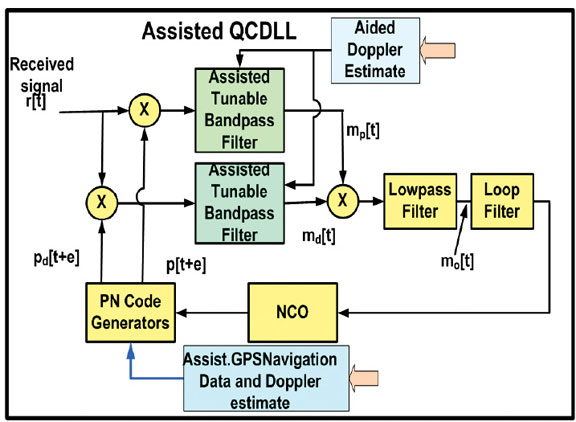
    Our first objective is to analyze performance of an assisted quasi-coherent delay-lock loop (QCDLL), a differentially coherent tracking receiver that employs the same discriminator channel as the optimal coherent DLL for noise and multipath performance advantages.

    The second objective is to generalize the BOC symbol-spreading codes by employing other families of well-known finite-length codes and spreading techniques, and to compute some measures of their multipath and noise performance and spectral-shaping capabilities. We focus on general filtered binary coded symbol (BCS) signals using time-multiplexed Walsh codes that have potential advantages for multipath performance, along with more general spectral control. They may have applications for future GNSS signals and pseudolite transmitters where multipath is a serious concern. Time- or other multiplexed versions can perhaps be useful in permitting legacy signals to operate while upgrading to new signals with perhaps different and longer PN sequences.

    QCDLL

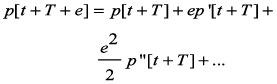
    Optimal digital communications signal processing in Gaussian noise employs a matched filter or correlator where the reference is the waveform itself. In contrast, for optimal tracking of small changes in signal time-delay, key information content is carried, not by the waveform itself, but by the changes in the waveform with time, that is, the time derivative. Focus on the changes in the waveform is consistent with my original 1961 paper on the delay lock loop (DLL), which showed that the optimum tracking estimator uses a delay discriminator reference signal that is the differentiated signal. The derivation of the maximum likelihood estimator of delay for small delay error in Gaussian noise is not repeated here, but we note that the Taylor’s series expansion of a differentiable baseband signal p[t] received with delay T+e delay for sufficiently small e after acquisition at estimate T is

    EA-E1

    We track various PN and BCS PN carrier modulated signals using an aided QCDLL. The QCDLL operates on a PN or other coherently modulated carrier. The QCDLL has two channels.

    The upper channel in Figure 1 is the punctual autocorrelation carrier channel, where the received signal is correlated with the reference waveform, p[t+e], the PN waveform itself with delay error e. The punctual channel is also used for initial acquisition and data recovery. It provides both a reference carrier, data, and autocorrelation weighting for the lower discriminator channel. If there is no data modulation, the bandpass filters can be made more narrow. Also note that the QCDLL can operate on multiple I/Q or other multiplexed BCS signal by using composite reference codes.

    FIGURE 1. Simplified quasi-coherent delay-lock loop (QCDLL) block diagram. The number-controlled oscillator (NCO) generates a continuous phase sine wave.
    FIGURE 1. Simplified quasi-coherent delay-lock loop (QCDLL) block diagram. The number-controlled oscillator (NCO) generates a continuous phase sine wave.

    The lower channel is the delay error discriminator carrier channel where the reference, p’[t1e], is the time derivative of the PN signal p with the same delay error e. The filters in both channels have matched group delay and assisted digital tunable narrow-band filters for noise and Doppler removal. Thus, this QCDLL is a special type of assisted-GPS receiver that receives Doppler information from an external communications link. Both channels can also be assisted by an inertial measurement unit (IMU), for example a MEMS device, to estimate velocities (Doppler offset) and further reduce the tracking-filter bandwidth. The filtered product of the two carrier channels is termed the discriminator output, and it provides an estimate of the delay error. By multiplying the discriminator channel with the punctual channel, the discriminator output versus time error is narrowed in width while maintaining the sharp slope versus delay error, as well as removing carrier and data.

    The QCDLL is the generalization of the Costas loop, just as the DLL is the generalization of the phase lock loop (PLL); for example, if p is a sine wave, then p’ is a cosine wave. For a trapezoidal signal waveform, the QCDLL has been shown to produce a similar but not identical output to a non-coherent DLL.

    In Figure 1, the upper bandpass filter recovers the punctual channel, and the lower channel is the discriminator channel. The product of the two removes the carrier and data, and provides a delay error cross-correlation-autocorrelation product, the discriminator output.

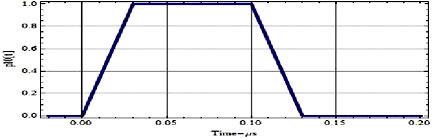
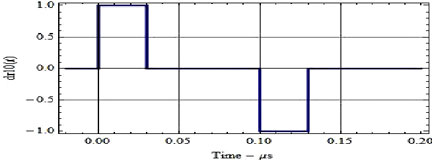
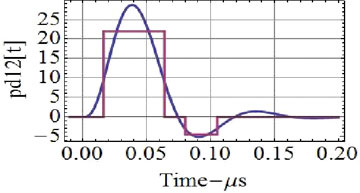
    Figure 2 shows an example PN trapezoidal waveform and its derivative as a simple example of a filtered PN pulse punctual channel reference and the differentiated filtered pulse as the discriminator channel reference. It can easily be shown that the discriminator channel (not the discriminator output) is equivalent to an early-late DLL with a early-late separation equal to the rise time of the trapezoidal pulse. Figure 3 shows the discriminator channel and output.

    EA-2A

    EA-2BFIGURE 2. Trapezoidal PN (1 Mcps) waveform pulse and its time derivative with a 0.1-microsecond rise time.

    FIGURE 2. Trapezoidal PN (1 Mcps) waveform pulse and its time derivative with a 0.1-microsecond rise time.

    FIGURE 3. Discriminator channel, d[e], and (bottom) discriminator output, R[e] Rd[e], for the 1.0 Mcps PN with the optimum 0.1-microsecond reference and the 0.1-microsecond rise-time trapezoidal waveform.
    FIGURE 3. Discriminator channel, d[e], and (bottom) discriminator output, R[e] Rd[e], for the 1.0 Mcps PN with the optimum 0.1-microsecond reference and the 0.1-microsecond rise-time trapezoidal waveform.
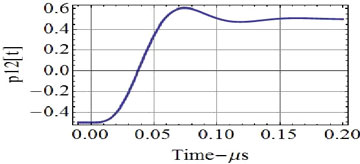
    For comparison, Figure 4 shows the step response of a 4-pole Butterworth filter with a 12-MHz bandwidth and its derivative. We also show a two-step approximation to this analog step response, which can be used to optimize a weighted multiple early-late DLL or multiple correlator approximation to the QCDLL.

    EA-4A

    EA-4B

    FIGURE 4. Step amplitude response and slope for a 4-pole Butterworth filter with a 3-dB bandwidth of 12 MHz (one-sided). The time derivative of this step response is shown on the lower plot along with a rectangular approximation.

    Although not proven, the QCDLL appears to have several advantages in both noise and multipath performance as compared to the more conventional early-late gate (that I first presented in 1963):

    The QCDLL discriminator channel reference is the differentiated pulse. Although for the trapezoidal pulse waveform, the conventional early-late DLL can in effect use the same discrimiantor reference if the early-late separation is set equal to the rise-time, for more general filtered waveforms, the early-late DLL can only approximate the optimal reference. Properly weighted multiple early-late DLLs offer a better approximation as shown in Figure 4, but still only an approximation.

    The QCDLL discriminator output of Figure 3 is the product of the correlator channel and the discriminator channel. When tracking precisely, the correlator channel output is at its peak correlation. In contrast, a noncoherent early-late DLL only produces correlator outputs that are by definition early and late. Thus neither of these is at their peak, and the noise performance suffers accordingly. By the same token, the noncoherent early-late DLL discriminator output must be wider than that of the QCDLL, and the QCDLL multipath performance is improved in the same manner.

    From a computational point of view, the early-late DLL is computing the small difference between two large numbers, namely the small difference between the ealy and late correlator channels. In contrast, the QCDLL is only computing the correlation of the received waveform with the narrow differentiated waveform used as the discriminator reference. For the simple example of the trapezoidal PN waveform, this reference is simply a narrrow time gate of width equal to the rise time.

    Generalized BCS Techniques

    My 2010 ION ITM paper, upon which this article is based, discusses a number of generalized symbol coding techniques including Neuman-Hofman, Barker, and Generalized Multiphase Barker, each of which provides minimal autocorrelation sidelobes. Various chirp-coded symbols with linear variation in chip-rate with time are analyzed and provide reduced sidelobes and spectral shaping. Rademacher and Walsh codes, time-multiplexed and properly weighted, form further generalizations. These can be time- or IQ-multiplexed, and the time-multiplexing can in turn be pseudorandomly permuted. In the limited space of this article we only discuss time-multiplexed (TM) Walsh Code symbols.

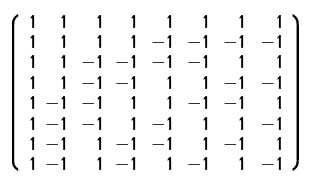
    TM Walsh Codes. Walsh functions form a complete orthonormal set of binary functions of dimension 2n. Walsh codes are generated as products of Rademacher codes. There are 2n Walsh function of 2n binary elements. Thus a weighted sum of Walsh functions can approximate any discrete-time, time-limited waveform. Each PN symbol is coded with a Walsh code. Then time-multiplex two or more different Walsh-coded symbols in a sequential or time-weighted manner. We can then tailor the autocorrelation function and its sidelobes and spectra by using selected members of this set and appropriate weighting. The resulting combined autocorrelation function is then the sum or weighted sum of the individual autocorrelation functions, since we assume independence of the PN chips. The 8-dimensional binary Walsh codes (Walsh order) are the rows in the matrix:

    The 8-dimensional binary Walsh codes (Walsh order) are the rows in the matrix:

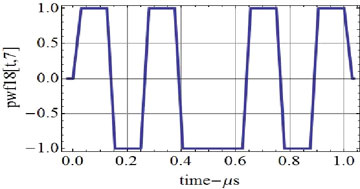
    Figure 5 shows the trapezoidal filtered version of Walsh 7 for the dimension-8 Walsh functions.

    FIGURE 5. Finite rise time trapezoidal Walsh coded symbol for Walsh code 7 with rise-time 0.03 microseconds and 1 Mcps.
    FIGURE 5. Finite rise time trapezoidal Walsh coded symbol for Walsh code 7 with rise-time 0.03 microseconds and 1 Mcps.

    Each Walsh sequence time multiplex modulates a separate and independent pseudorandom PN chip in sets of PN chips beginning from a PN epoch time; for example, the defined beginning of the PN sequence. Note that the equally weighted sum of all 8 Walsh functions is the vector {8,0,0,0,0,0,0,0}, which is equivalent to a single high-amplitude pulse of narrow width. Thus if we sum all of the Walsh functions, we obtain the equivalent of a single narrowband pulse where the autocorrelation sidelobes disappear. Even with filtering of the spreading waveform, the sidelobes can still be small. Likewise, the equally weighted sum of codes 5,6,7,8 is {4,4,0,0,0,0,0,0}, the Manchester code.

    Since the Walsh functions form a complete orthonormal set, a weighted sum of Walsh functions can approximate any finite-duration signal of the same dimension, just as the Fourier series can approximate any periodic function. Thus a weighted sum of the Walsh functions in TM fashion can tailor the signal power spectral densities and autocorrelation functions to closely match a desired realizable function. Weighted TM BOC signals and Rademacher codes can also create useful approximations, but are not as general since they are not a complete orthonormal set.

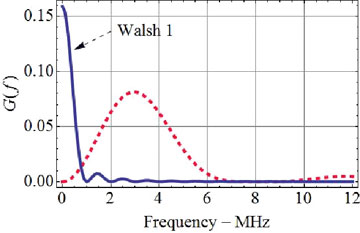
    The spectrum and autocorrelation functions of the individual Walsh functions vary markedly from one another. Figure 6 shows two different selections of Walsh functions to illustrate an example of spectral separation. The wider-frequency spectra signal is a TM of Walsh codes 5, 6, 7, 8 and has improved autocorrelation with lower sidelobes compared to a single BOC signal. The lower-frequency spectrum represents the 0 Walsh, which is conventional PN.

    FIGURE 6. Shaped power spectra for two TM trapezoidal Walsh signals.Blue solid curve Walsh 1, dashed curve TM Wash 5,6,7,8.
    FIGURE 6. Shaped power spectra for two TM trapezoidal Walsh signals.Blue solid curve Walsh 1, dashed curve TM Wash 5,6,7,8.

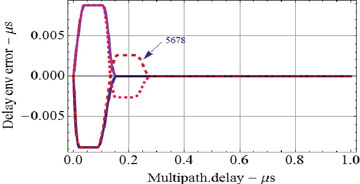
    Figure 7 shows the multipath error envelope of the TM Walsh spreading waveform for TM of all 8 codes in comparison, with TM of 5,6,7,8 in the presence of multipath amplitude 0.5 versus multipath delay. These results for TM of all 8 Walsh correspond closely to that of PN waveform of 8 Mcps and rise time of 0.03 ❍s as expected.

    FIGURE 7. Envelope of the multipath delay error when using the Walsh spreading function of dimension 8 and a trapezoidal signal rise time of 0.03 microseconds.
    FIGURE 7. Envelope of the multipath delay error when using the Walsh spreading function of dimension 8 and a trapezoidal signal rise time of 0.03 microseconds.

    The envelope of the error increases as one would expect, to approximately 0.03-microsecond multipath delay. The solid blue curve is the result where all TM 8 Walsh codes are used. The dashed curve is for the TM 5,6,7,8 used to generate the spectral separation shown in Figure 6.

    We can permute TM of Walsh functions and transmit each of these permutations in a pseudorandom sequence. There are 8! 5 40,320 different permutations of 8 Walsh functions. Thus we can use a different arrangement of the 40,320 patterns every 8 PN chips and do so with a different PN sequence to prevent a jammer from time-synchronizing the jammer spectrum to the Walsh multiplexing spectra with time. Weighted time-multiplexing can also be augmented with I/Q multiplexing. Pseudorandom permutation of the Walsh codes can also diminish spectral lines of the basic PN sequence if the two PN sequences are relatively prime.

    Conclusions

    This discussion first examines the QCDLL and its performance for conventional PN signals, and then generalizes the family of symbol coding/spreading techniques. The BOC signal, first called the split-spectrum signal, has a limited but important ability to shape the spectrum. It also increases its Gabor bandwidth and corresponding noise performance as indicated by the Cramer-Rao bound. However, the BOC signal has large autocorrelation sidelobes that when operating on both sidelobes simultaneously can cause limitations. There are BOC receivers which avoid that issue by operating separately on upper and lower frequency components. However, our focus is on more
    general symbol-coding techniques that reduce autocorrelation sidelobes and provide good multipath performance.

    The assisted QCDLL may improve performance as compared to the more conventional early-late non-coherent DLL in at least these respects:

    • The non-coherent early-late DLL autocorrelation is by definition offset by D/2 in the early–late DLL when locked rather than a perfect punctual channel.
    • The conventional early-late reference is not equal to the differentiated signal except for a trapezoidal signal with rise time of D/2.
    • The QCDLL uses an optimal reference for the discriminator channel.
    • The discriminator output of the QCDLL is the product of the punctual channel correlator with the discriminator channel, and thus has a narrower width than that of an early-late DLL and c better multipath performance.
    • The early-late DLL computes the small difference between two large correlator outputs, whereas the QCDLL computes that difference directly.

    QCDLL performance in multipath is not claimed optimum; I and others have shown other techniques for reducing multipath by estimating and subtracting multipath components to reduce bias error on the direct signal. The results shown here with the trapezoidal wave-shapes may approximate the best performance possible, since the trapezoid has no precursor/tail that would be removed by a multipath-estimating receiver.

    The optimal discriminator channel reference waveforms (the differentiated pulse waveform) defined for the QCDLL for any filtered received signal can be approximated by a sequence of pulses. These sequences of pulses define a quasi-optimal set of weighted conventional early-late DLL or multi-correlator tracking receiver configuration that approximate the optimal reference, the differentiated signal.

    More general symbol coding techniques include: NH, Barker, generalized Barker, chirp, and TM Rademacher and Walsh codes. Barker, Generalized Barker, and NH codes have greatly reduced autocorrelation sidelobes and excellent multipath performance. These can also be time and I/Q multiplexed. Variants of chirp and TM Rademacher, Walsh can provide both spectral shaping and improved multipath performance. Weighted TM Walsh-coded symbols can be designed to synthesize any discrete-time, time-limited realizable function. Ordinary legacy PN can be time-multiplexed with any of these BCS symbols, with perhaps another longer PN sequence to generate a composite signal where a tracking receiver can operate on both simultaneously and yet leave legacy receivers still operational. Although we have only shown equal weighting in the TM multiplexing, clearly the weighting can be varied by changing the duty factor.

    Acknowledgments

    I wish to acknowledge the suggestions of Chris Hegarty of MITRE, J.K. Holmes, Aerospace Corporation, and Per Enge and Grace Gao, Stanford University. I give special recognition to Hegarty, Betz, and Saidi for their generalized BCS work on NH and Barker codes, and the thesis of J. A. A. Rodriguez, University FAF Munich, also on generalized BCS. The detailed version of this article appears in the 2010 ION International Technical Meeting Proceedings, and contains about 50 references.

    James Spilker is a consulting professor in electrical engineering, aeronautics, and astronautics at Stanford, and co-author of Global Positioning System: Theory and Applications, Volumes I, II.

  • SBAS Crashing

    It’s been a tough couple of weeks for SBAS (Satellite-Based Augmentation System), namely the USA’s WAAS program and India’s GAGAN program. WAAS and GAGAN have taken big hits recently that threaten the integrity of the programs. Both events were totally unexpected and are causing disruptions of GPS correction services.


    Let’s Start with WAAS

    First of all, consider the following infrastructure graphic describing WAAS.

    WAAS Infrastructure (note: GEO satellites positioning not geographically correct in graphic)

    At the moment, WAAS uses two geostationary satellites (referred to as GEOs) to broadcast GPS corrections throughout the WAAS service area, which covers the U.S., Mexico, and most of Canada. The user’s GPS receiver must be able to “see” at least one of the WAAS GEOs in order to receive the GPS corrections. Currently, one WAAS GEO (PRN 135) is located at 133°W longitude and one (PRN 138) is located at 107°W longitude. They are positioned, for the most part, to provide “dual coverage” in case one fails as the following graphic illustrates. The solid line represents the visibility above the horizon of PRN 138 (107°W). The dashed line represents the visibility above the horizon of PRN 135 (133°W). In New York, for example, PRN 138 is visible at 30°+ above the horizon while PRN 135 is visible at ~15° above the horizon.

    WAAS GEO Footprint Coverage (Dashed = PRN 135, Solid = PRN 138)

    The Federal Aviation Administration (FAA) is the WAAS steward. WAAS (and SBAS) was designed for aviation use and paid for by the FAA. The fact that surveying and mapping users benefit from WAAS is a by-product. The FAA owns and controls most of the WAAS infrastructure, such as the 38 WAAS reference stations located throughout the U.S., Canada, and Mexico. About the only thing they don’t own are the WAAS GEO satellites, and this has been the source of most of the problems with WAAS in the past few years.

    Lease vs. Buy

    It would be prohibitively expensive for the FAA to own GEO satellites that were exclusively used by WAAS. Instead, the agency leases bandwidth from owners of commercial satellites. These are the same commercial satellite owners who lease bandwidth to media (e.g., television) customers. It’s not unlike a utility pole you see along the road with many different wires and devices attached to the pole from different companies who pay to lease space on the pole, except it’s a very expensive pole orbiting in space.

    If you’ve been using WAAS for a number of years, you’ll remember back in 2006 there was a hiccup with the WAAS GEOs at that time. The FAA was leasing space on two Inmarsat satellites (AOR-W and POR). They began transitioning to the current WAAS GEOs but before the transition was complete, Inmarsat began moving AOR-W. This was a headache for some WAAS users and really showed the vulnerability of WAAS.

    Losing Control

    The vulnerability reared its ugly head again last week when one of the commercial satellite operators (Intelsat) that the FAA leases space from announced it had lost contact with its Galaxy 15 (G-15) satellite, which is the GEO that WAAS PRN 135 is broadcast from. Intelsat reported it had lost the ability to send commands to G-15. Without the ability to control the satellite, it will slowly drift out of orbit until it becomes unusable. The FAA estimates this will occur in one to three weeks.

    Solutions?

    Intelsat’s answer was to bring in an older generation backup satellite (G-12), which was in a backup orbit at 122°W. It arrived at 133°W around April 14. Intelsat said that G-12 has virtually an identical C-band package as the G-15 and they could transfer C-band customers to the G-12. The problem is that there is no L-band package (which WAAS needs) on the G-12, so the FAA was out of luck.

    Since Intelsat’s G-12 backup won’t help WAAS, the FAA is looking at other alternatives:

    1. Contract with Inmarsat to bring back POR (178°E). The FAA says that will take 12-18 months. Personally, I don’t think it’s a good solution. It’s too far to the east to help much at all. Its coverage footprint barely covers the western U.S.
    2. Speed up the testing on the new PRN 133 (98°W) and bring it into service more quickly than the original December 2010 schedule. The FAA says it can accelerate testing by one to two months. This is good and I see the benefit, but it still doesn’t help Alaskan users.
    3. The replacement backup satellite being moved to 122°W to backup G-12 may be a solution. It will be a few weeks before it is known what is possible. That would be the best scenario from a coverage footprint standpoint. The question is how long it would take to bring it into service.

    On another note, the FAA stated that with the money they are saving with G-15 going out of service, they will be able to accelerate the acquisition of another WAAS GEO. I have no doubt that this has put a new level of fear into the FAA folks, and they have to realize that they can’t be running thin on WAAS GEOs. If you weren’t aware, the future of aviation navigation is based on GPS, WAAS, LAAS, etc. These sorts of hiccups would be an absolute nightmare if the National Airspace System (NAS) was already dependent on GPS.

    GAGAN

    GAGAN (GPS-Aided Geo Augmentation Navigation) is India’s SBAS. It has been under development for many years and is quite far along in development. It is funded through implementation by the Airport Authority of India with the Indian Space Research Organization. In 2008, GAGAN was broadcasting a test signal from an Inmarsat GEO with reasonable results.

    India’s intent was to launch its new GSAT-4 communication satellite with part of its purpose being a GAGAN GEO satellite. GSAT-4 was to be India’s first rocket with an Indian-designed and built cryogenic-fueled third stage. Apparently it is a very difficult technology to master as it reportedly took India 16 years to develop.

    Last week, after much anticipation, the rocket with GSAT-4 onboard was brought to the launch pad. Liftoff was reportedly flawless. At 8:25 minutes into flight, the rocket failed and the entire rocket, GSAT-4 and all, ended up splashing into the Bay of Bengal. It’s a crushing blow to India’s GAGAN SBAS program, which has suffered a number of delays.

    P.S. Veeraraghavan, director of the Vikram Sarabhai Space Centre in Thiruvananthapuram, said “Our target is to fly a GSLV with our indigenous cryogenic engine within one year. But it will be tough.”

    Following is a video report from an India news organization describing the event:


    Webinar Tomorrow

    If you don’t receive this too late (or you can access the archive if you do miss it), you might want to catch my 60-minute webinar “GPS, GLONASS and SBAS Constellation Updates.” It’s free and full of the latest information. I’ll also be answering a number of questions from people who registered. I hope to see you there!


    GITA and ACSM Conferences Next Week

    Next week, I’ll be blogging and such from the Geospatial Infrastructure Technology Association (GITA) annual conference and American Congress on Surveying and Mapping (ACSM) annual conference in Phoenix, Arizona. In addition to presenting at both conferences, I’ve got a number of interviews scheduled with interesting people. Follow my blog on the Geospatial Solution’s website Live Event Blog area.


    Thanks, and see you next week.

    Follow me on Twitter at

    http://twitter.com/GPSGIS_Eric
  • World Domination: The Sequel

    Perhaps we should call this The Interquel rather than The Sequel, as the latter will take place September 23 in Portland, Oregon, during the ION GNSS 2010 Conference.

    In January, 12 brave individuals joined me in San Diego to see if this thing would work at all.  It did!  The exercise revealed many adjustments needed to the game, but overall, a successful role-playing, negotiation game grounded in the workings of GNSS.

    The rules are briefly recounted in an earlier blog, and to large extent, they will remain unchanged for the full-on game, to be played by 12 teams of 9 people each in Portland. It’s mostly the metrics that need some tinkering, a few of the quantities that govern exchange, and renewal of each team’s resources at the end of each quarter.

    Here are each team’s goals over three quarters of play, and the points that they actually racked up. User communities could purchase receivers for as many signals as were “on the air,” from any national satellite system.  Interoperability rules!

    GPS System Operator     Goals: 40 satellites, 3 global signals     Achieved: 45 satellites, 3 global (civil) signals
    U.S. GPS/GNSS Industry     Goals:$750 million     Achieved:$1.55 billion
    U.S. User Community     Goals 100 million 3-frequency receivers, 100 million 4-frequency receivers      Achieved: 50 million 3-frequency receivers, 100 million 4-frequency receivers

    Galileo System Operator     Goals:30 satellites, 2 global signals     Achieved:35 satellites, 2 global civil signals
    European GNSS Industry    Goals: $750 million     Achieved: $1.25 billion
    European User Community    Goals:100 million 3-frequency receivers, 100 million 4-frequency receivers     Achieved:100 million 3-frequency receivers, 200 million 4-frequency receivers

    GLONASS System Operator     Goals:35 satellites, 2 global signals      Achieved: 25 satellites, 1 global sigal
    Russian GLONASS/GNSS Industry      Goals: $500 million     Achieved: $1.325 billion
    Russian User Community     Goals: 50 million 3-frequency receivers, 50 million 4-frequency receivers    Achieved: 300 million 3-frequency receivers

    Compass System Operator      Goals: 30 satellites, 2 global signals     Achieved: 45 satellites, 3 global civil signals
    Chinese GNSS Industry     Goals: $1 billion      Achieved: $1.3 billion
    Chinese User Community     Goals: 50 million 4-frequency receivers, 200 million 3-frequency receivers      Achieved: 150 million 3-frequency receivers

    As you can see, those performing strongest relative to their goals, or outperforming their goals (in other words, the gamemaster’s expectations) were all industries, across nations (making out like bandits), and the Compass system operator.

    Auguries for the future?

    Those performing less well, relative to goals, were the Russian system operator, and the Chinese user community.

    Again, auguries anyone?

    Those playing the respective parts above were: Frank van Diggelen, John Betz, Chris Hegarty, Dorotoa Grejner-Brzezinska with Kathleen Bosely, Sam Pullen, Ron Hatch, Matt Harris, Sasha Mitelman, Maarten Ujit de Haag, Tim Murphy, Thomas Pany, and Jade Morton.

    Here is some of the feedback gathered at the scene:

    have smaller-denomination bills in the mix;
    at the same time, multiply all cost amounts by factor 5 to make them more realistic;
    have a banker available on the side during play;
    all deals/transactions must complete in the quarter when negotiated; no carryover;
    increase the number of receivers;
    create moment(s) of randomness with a wheel of fortune or change cards;
    use a laptop to quickly compute each quarter’s new payouts for each team;
    satellites that reach end-of-life should do so during a quarter, rather than once it ends.

    All will be fine-tuned and trotted out again in Portland. Thanks to all players for participating.

    Sleep was what I wanted, you know what I got.  Wide awake, staying up late, wishing I was not.

  • Solar Activity and RFID Technology

    Updated: Friday, April 9 11:00am US Pacific. I added more specific information regarding signing up for Space Weather Prediction Center email alerts. See below.


    It’s time to touch on the solar activity subject again, as there was an event earlier this week and rumors began to fly. The mainstream press jumped on a story back in January when the first solar flare of Solar Cycle 24 occurred. Of course, journalists were writing about worst-case scenarios in the event of extreme solar events that could cause power grids to fail, GPS to stop working, etc.

    While that is true, it’s a real stretch and the typical “sky is falling” reporting. In reality, the solar flare back in January had no effect on GPS operations. In fact, it would take an event 10-20 times stronger than last January’s to begin to notice any effect on GPS operations. Earlier this week (Monday 0800 GMT), the first geomagnetic storm of Solar Cycle 24 occurred.

    Geomagnetic storms are the ones that will give GPS users problems, although this one didn’t because it was relatively minor. The last geomagnetic storm strong enough to noticeably affect GPS users occurred in December 2006. During such an event, it might interrupt your GPS receiver for 10-15 minutes. Most users would not notice or they might attribute it to a local system malfunction. By the time they investigate and reset the system, the event would have passed and the user is back in operation. It would be barely noticeable, if at all.

    According to Joe Kunches of the NOAA Space Weather Prediction Center, a geomagnetic storm is a global event (as opposed to a regional event) that is caused by a highly energized solar wind that is fast and embedded with a strong magnetic field. In the following chart, you can see how this week’s event illustrates this.

    Source: NOAA Space Weather Prediction Center

    In the above chart, the top panel illustrates how the magnetic field becomes much more turbulent starting at 0700 GMT. The fourth panel on the chart denotes the solar wind speed, which ramped up to approximately 2,000,000 mph (3,218,688 kph) at its peak.


    Extreme geomagnetic storms = Dynamic TEC = GPS interruptions

    There needs to be very turbulent solar wind that disturbs the Earth’s geomagnetic field in order for GPS operations to be affected. For those of you who are familiar with the Total Electron Count (TEC), a dynamic TEC density in the ionosphere is what really messes up GPS operations. If the TEC is stable, the ionospheric models work fine and we get really good GPS performance like we’ve seen in the past few years in between solar cycles.

    GPS L1 users are affected most by a dynamic TEC density in the ionosphere. These are users of WAAS, DGPS, and commercial L1 correction services like OmniSTAR VBS (not their XP or HP service). During the extreme geomagnetic event in October 2003, published simulations (Yousuf, Skone, Coster, University of Calgary, ION NTM 2005) that illustrated the WAAS maximum horizontal error (95th percentile) blew out to 25 meters while single baseline DGPS maximum horizontal error (95th percentile) blew out to 18 meters. This extreme event lasted for several days.

    This doesn’t mean you’re going to have major problems in the future if you are using WAAS (or another SBAS) or DGPS, but just that high-performance GPS L1 receivers are the most susceptible to extreme solar events. In the case of the December 2006 event, SBAS and DGPS users might have experienced 10-15 minutes of unusual behavior depending on their locations. According to Kunches, high latitude geographic regions (60+ degrees latitude) and the region within 10 degrees of the geomagnetic equator (as opposed to the geographic equator) are affected the most by geomagnetic storms.

    GPS L1/L2 receivers are less susceptible to extreme solar events because they can actively model the affects of the ionosphere, but they are not immune. Extreme events such as in October 2003 can cause a loss of phase lock, especially on L2 with GPS receivers that utilize codeless/semicodeless techniques, which are virtually all of the dual-frequency GPS receivers on the market today. The L2 signal-to-noise (SNR) ratio on L2 is quite a bit lower due to the codeless/semicodeless technique so it is more susceptible.

    GPS L1/L2 receivers using L2C will be less affected (assuming a sufficient number of GPS satellites are broadcasting L2C) due to a stronger SNR.


    Not the time to panic

    The reason I wrote this article is to share what I’ve learned about the effects of solar storms on GPS operations from speaking with a number of different scientists. This isn’t meant to be a warning of impending doom for GPS users or anything or that sort. Extreme events typically occur near the solar peak and then again during the decline of the cycle. The peak is estimated to occur around May 2013, so the typical extreme events affecting GPS would likely occur in 2013, 2014, and 2015. It’s too early to start worrying much about it now.

    However, as Solar Cycle 24 ramps up, we’ll see more and more geomagnetic storm activity. If you’re a high-performance GPS user (meter or sub-meter level GPS L1 and GPS L1/L2), I think it’s a good idea to monitor space weather now. Fortunately, the NOAA Space Weather Prediction Center (where Kunches works) provides a service that will notify you of unusual space weather by e-mail. You can sign up to receive e-mail alerts at http://www.swpc.noaa.gov

    Following are detailed instructions for signing up for alerts:

    -Goto the Space Weather Prediction Center website.

    -Click on Email products (under the Support Services menu on the left)

    -Create an account if you don’t have one already (it’s free).

    -Click on Subscribe

    You don’t want to subscribe to everything. Here are the ones specific for GPS operations:

    -Advisories/Space Weather Bulletin

    -Geomagnetic Storm Products/(sign up for both Alerts and Warnings for K6, K7, K8, K9 events.

    -For high latitude (55 degrees and higher) users, also sign up for Alerts and Warnings for K4 and K5 events.


    Following are some good reference links regarding the Solar Cycle and TEC:

    GPS World article in January 2010 (scroll to end of article)

    GPS World article in October 2009 (follow-up to other October 2009 article)

    GPS World article in October 2009

    GPS World article in May 2003

    Latest NOAA prediction on Solar Cycle 24

    Solar Cycle 24 page

    Real-time TEC plot from the Jet Propulsion Lab

    Wikipedia description of the Ionosphere

    Wikipedia description of the Total Electron Content (TEC)


    RF ID (Radio frequency Identification) in Survey Monuments

    If you haven’t been followi
    ng my Geospatial Solutions Weekly newsletter (sign up here for free), you might want to sign up and read the article I wrote on how RF ID is going to be a technology very much used by surveyors in the future. You can read the article by clicking here.


    Webinar later this month (April 22, 10 a.m. Pacific time, 6 p.m. GMT): GPS, GLONASS, and SBAS Constellation Updates

    There’s been a lot of infrastructure changes with GPS, GLONASS, and SBAS in the past six months. We’ve already got several hundred people registered for this webinar. It’s going to be a good one. Here are some of the questions I’ve received already and will be addressing:

    1. When and where will the new FAA WAAS GPS Satellite cover?
    2. Will the accuracy of hand-held units be increased with these latest changes?
    3. What developments will make GPS & GLONASS work better together? In terms of RTK accuracy.

    There have been some questions as to whether you can receive continuing education credit (PDH, CEUs, etc.) by attending the webinar. Please e-mail me directly with these requests and I will do my best to accomodate.


    See you next time.

    Follow me on Twitter at http://twitter.com/GPSGIS_Eric


  • Out in Front: What’s in a Number?

    Computers killed a trusty companion of my teenage years. That is, after those proto-computers known as pocket calculators knocked him out and left him unconscious on the cooling floor.

    But I come to praise my slide rule, not to bury him.

    I marveled at the way he worked. You had a tactile relationship with numbers on a slide rule. You could see — and feel — how a small adjustment here effected a big change over there. With computers, it’s just numbers in, numbers out.

    Maybe that high-tech approach led both the GPS Wing and the Government Accountability Office into trouble with constellation gaps. GPS satellites have proven themselves very hardy in space, outlasting their predicted lifetimes. The GPS Wing has grown to lean on those longer lives a bit, and what with Congress and the Administration booting budgets a year or two to the right with addictive regularity, the Air Force has saved money by replenishing upon need. And need has been not all that great, so replenishment, and the contract awards and manufacturing that feed the replenishing line, have been allowed to relax.

    But not the mathematical models that someone has held to more conservative standards. Those models use the shorter predicted satellite lifetimes. When those models were projected against the real-world timelines for IIF and Block III — whoa GAO! Some black gaps suddenly yawned.

    Now we learn that GAO and the Wing will re-undertake this exercise, factoring instead the longer lifetimes that the satellites have proved capable of. Tinker a small adjustment here, see a big change out there.

    Speaking of numbers, I’ve grown fond of 20, and lately enamored of 200. The former being the number of years we have published this magazine, the latter the new world record for GNSS technical articles, attained by one Richard B. Langley.

    With characteristic Canadian unbravura, Langley fidgets and frets that we have made too much of him on this magazine’s cover and page 42. It looks too braggy for him and he feels uncomfortable with it. But I have prevailed upon him to swallow his humility, to take one for the team. We bask in his reflected glory.

    Quick, what’s the difference between 160 and 144.5? Not in absolute terms, but in tactical advantage. If I add a metric, east longitude, geosynchronous orbit, does that help? I’m puzzling out why Compass would move its G1 satellite from one location to another after only ten days in space. Better ground control might be the answer. But more mystifying, why China’s spokespersons at the Munich Summit would proffer the first location, when they must know very well — in fact, they so admitted when I confronted them with it — that the second is actually the case.

    Numbers don’t obfuscate. People do.

  • Research and Other Hard Things

    Once again, I reach into the mail bag to pull out this gem, from someone both high up and deep down in administrative matters relating to GPS and other technologies. Herewith:


    Two quotes — with Some Accompanying Thoughts

    “If we knew what we were doing, it wouldn’t be called research, would it?”
    —Albert Einstein
    Too often these days we seem driven to produce, forgetting the purpose and value of research and development.  R&D allows us to assess alternatives, identify and mitigate risks, and develop practicable plans to achieve results.  It promotes an iterative process that moves us steadily towards our goals.  It understands both of the 80/20 rules: First, that achieving 80% of the solution usually takes only  20% of allocated resources, and second, that for  any normal program, things will go wrong 20% of the time, so plan accordingly.

    The fact is that we simply do not do enough real research and development.  We have forgotten that the development of products or systems or solutions does not proceed on a single path point-to-point.  It is a continuum that has many ideas going in, a reasonable number that survive intermediate vetting processes, and a manageable field of candidate solutions coming out, from which to pick “the best” alternative.

    We are not comfortable planning for sufficient small failures to ensure that we will not end up with one big one.  We limit the potential value of our successes by not supporting  wild and crazy ideas — even though such ideas may hold the key to real and sustained improvements.  We are too risk adverse.  We are too “results – NOW!” oriented.  We are afraid of failures – even small ones.  We are scared to dream.

    “We choose to go to the moon in this decade and do the other things, not because they are easy, but because they are hard, because that goal will serve to organize and measure the best of our energies and skills, because that challenge is one that we are willing to accept, one we are unwilling to postpone, and one which we intend to win…”
    —John F. Kennedy

    Sadly, we have lost what made us great in the past: our willingness to take risks, fight for ideals, vigorously debate technical and operational alternatives, and move forward as one — either towards a celebration of a successful conclusion or, if nothing else, a celebration of a significant learning experience from which we can dust ourselves off and do better next time.   We have abandoned our can-do attitude for lists of excuses of why we cannot.  We over-think and over analyze and over-control everything — at every level.  Most seriously of all, we have given up seeing ourselves as one team with one goal.  Everyone’s looking out for themselves — with more time spent looking back in fear than forging new pathways forward.

    The question is not “Where have all the leaders gone?” but rather “As leaders, what can each of us do to re-build and re-energize our risk taking leadership structure, our can-do team culture, our engineering inquisitiveness, our research and development mentality?

    As with all things, the solution starts with the true recognition of the problem.

    Therapy, anyone?

    Sleep was what I wanted, you know what I got.  Wide awake, staying up late, wishing I was not.

  • Expert Advice: Jamming: A Clear and Present Danger

    SallyBasker_120By Sallie Basker

    A packed audience attended the National Physical Laboratory in the United Kingdom for a February 23 meeting titled, “GPS Jamming and Interference: A Clear and Present Danger,” organized by the Digital Systems Knowledge Transfer Network.

    In his keynote address, David Last described a dark, silent and dangerous world without GPS. He regaled attendees with tales from his experience as a GPS forensic expert, assisting the police who beat a path to his door bearing interesting boxes that turned out to be all sorts of jammers: of GNSS, of mobile phones, and of other radio systems. Last pointed to the near future when he believes that spoofers will undoubtedly make an appearance. The defences are limited: detection, prosecution, and the use of alternative sources of positioning, navigation, and timing information, perhaps eLoran.

    His final insight was this: “Navigation is no longer about how to measure where you are accurately. That’s easy. Now it’s how to do so reliably, safely, robustly.”

    Jim Doherty, from the U.S. Institute of Defense Analyses, discussed the use of existing resources for time and frequency backup. Drawing on his experience, Doherty delivered three overarching thoughts:

    • use all available means;
    • re-use existing systems where possible; and
    • produce integrated time and navigation.

    He advised the audience to be conservative with their designs and not to go too close to the boundary conditions. He also noted that there is an important trade-off between independence and cost when considering complementary systems. Finally, he identified a potential need for eLoran to support synchronisation in aviation’s multi-lateration systems.

    Moving on, Alan Grant of the UK General Lighthouse Authorities (GLA) described recent GPS jamming trials. He demonstrated that GPS jamming has wildly different effects, ranging from total denial to hazardously misleading information (HMI). HMI was particularly problematic: it caused the ship’s GPS receivers to report a realistic course and speed well away from the truth that was provided by the GLA’s eLoran system. He noted that the impact depends on the ship’s bridge design.

    Professor and consultant Martyn Thomas spoke on an ongoing Royal Academy of Engineering study on GPS vulnerability, which brings together experts from across the UK and will report in early June.

    This was followed by three presentations on coverage prediction by Robert Watson of Bath University, on interference detection using the U.S. National Geospatial Intelligence Agency’s GPS Jammer Location (JLOC) system by Alison Brown of NavSys Corporation, and on the GNSS Availability, Accuracy, Reliability anD Integrity Assessment for Timing and Navigation (GAARDIAN) interference detection system by Charles Curry of Chronos Technology.

    The conference audience learned that any system can be jammed, that JLOC detects thousands of jammers on a daily basis — nearly all of them unintentional — and that the GAARDIAN system has integrated GPS, eLoran, and clocks for interference detection and mitigation.

    Tom Willems from Septentrio and Peter McIlroy from Raytheon gave a good overview of what can be done with receivers and antennas. Willems focused on pulse blanking and adaptive notch filtering. He saw a clear trend towards hybridization, and confirmed that manufacturers recognise that GNSS is not a golden bullet — they can mitigate some interference but not all.

    Peter McIlroy told listeners to “defeat interference and jamming before you detect it.” This included hybridization with inertial systems, putting some form of barrier between the antenna and the jammer, and the use of controlled pattern-reception antennas. He suggested that controlled pattern-reception antennas might become available for civil use.

    Finally, Paul Groves from the University College London gave a very useful overview on positioning without GNSS. He addressed radio and non-radio systems and presented a fascinating chart that related the various radio systems in terms of range and lifecycle (Figure 1). The message was very timely given the need for complementary systems expressed by all speakers.


    FIGURE 1. Range and lifecycles of current radio systems (courtesy Paul Groves).


    I then chaired a lively panel discussion with David Last, Martyn Thomas, Charles Curry, Jim Doherty, and Tom Willems. I led off by focusing the discussion on resilient PNT, referring to the UK Center for the Protection of National Infrastructure’s definition for resilience: the equipment and architecture used are inherently reliable, secured against obvious external threats, and capable of withstanding some degree of damage.

    The panel agreed on the need for hybrid solutions with multiple technologies. It expressed concerns that cheap GPS receivers are components in many systems, and it is too easy to overlook them. Martyn Thomas brought insight from the computing world and noted that we need to avoid single points of failure and to demonstrate independence.

    Do our governments understand and should they do more? The panel thought that different governments are at different points on a journey, and that very few policymakers understand how a loss of GPS impacts critical national infrastructure. It was suggested that the European Union lags behind, due to the focus on Galileo.

    This led to an interesting discussion about economics and funding. Martyn Thomas said that GPS vulnerabilities have grown, and that GPS competitors have disappeared for economic reasons, leaving us dependent on GPS. He pointed out that there are limited mechanisms for sharing funding and questioned whether there are many (any) organisations that are prepared to take the risk.

    If you have limited funding, should it be used for detection or mitigation? The panel agreed that both were needed, but the prevailing view was that mitigation is more important, and that this needs to be supported by human factors activity.

    In Summary. GNSS interference is a real and present danger. It is probably more widespread than generally assumed, and it is here to stay. We can harden our GNSS systems with improved receiver and antenna design, but this will mitigate only some interference, not all. The problem is cost. Cheap — and vulnerable — GNSS receivers will inevitably find their way, unseen, to the heart of our critical infrastructure. We need resilient positioning, navigation, and timing based on independent and complementary systems and sensors. Demonstrating independence is vital but not necessarily straightforward, and true independence costs money. The greatest challenge is helping policymakers understand the risks of relying on vulnerable systems and the need for resilience.

    Finally, I return to Jim Doherty’s overarching thoughts: use all available means; re-use existing systems where possible; and produce integrated time and navigation.

    eLoran, anyone?


    SALLY BASKER is director of research and radionavigation for the General Lighthouse Authorities of the United Kingdom and Ireland.
  • Wide Awake Bridging the Gap

    I gave this talk at the Munich Satellite Navigation Summit, in a concluding session titled “Bridging the Gap: A Journalistic View on Progress and Problems of GNSS.”

    __________
    Before telling you what I came here to say today, I should really attempt to answer the question posed by our moderator:Is the world ready for new GNSS applications and services?

    If by that we mean system modernization and newly envisioned applications, the  cutting edge, I say: No. What the world has a crying need for are older GNSS applications and services, ones that we in this room may take for granted, perhaps even view as somewhat passé.  But the vast majority of the world knows nothing of them, and has yet to experience their benefits.

    Giving a journalist’s perspective could be difficult because journalists aren’t supposed to have perspective. Our task is to report the news, just the facts.

    In satellite navigation, governed by physics and radio frequency, one might expect facts to prevail.

    Not always.

    Of course in the technical articles at the core of the magazine, facts rule.

    But in the news that I write, The System, in effect GNSS Quo Vadis — in the news, facts may be in short supply.

    This news is filled with projections, timelines, trends, expectations, a triumph or two, some disappointments, budgets, negotiations, market readiness. Facts come in a distant second.

    Because I cover new developments in constellations on orbit, in ground control and monitoring, in plans and policies and rivalries. All these are created by people.

    By you, in fact. You and your colleagues.  The global navigation community — living and working within the global community.

    These maps, courtesy of Todd Walter and his colleagues at Stanford, show aircraft landing capability and its development over time. You saw them twice yesterday, maybe three times, if you read the magazine in your bag.

    But I use them here to illustrate availability and benefits of high-precision PNT of all kinds.

    Global positioning is available globally, everywhere. Pull out a receiver in the middle of the Sahara, you’ll get a position. What good does that do you, you and your nomad band, if you live in the Sahara?  Not much good, if you don’t have a map, or a frame of reference of some kind.

    If you are a small industry, a local government, a market economy, any manifestation of a society, you need a reference network to get an advantage from your position, no matter how precise.

    And in this white expanse, by and large, no such networks exist. The people living in these white areas are beyond the pale, outside the realm of the marvelous benefits of global positioning.

    Patricia Doherty writes in this magazine, “The leading problems that continue to cripple much of Africa include hunger, extreme poverty, erosion of natural resources, and natural disasters. GNSS can help address these problems.  GNSS applications can increase food security, manage natural resources, provide efficient emergency location services, improve surveying and mapping, and provide greater precision and safety in land, water, and air navigation.”

    This holds true not just for Africa, but across the Southern Hemisphere and swathes of the northern: often known as the Second and Third Worlds – coincidentally, all the white space on this map.

    Why should we, the GNSS community living happily in our First World, the color on the map, care about this? I put it to you that it is in our own best self-interest to do so.

    We’re very busy using GNSS to solve our problems of dense air traffic, and road congestion, hazardous material transport, extracting more from agriculture, finding our way in urban canyons, finding our friends, finding coffee, rescuing people.

    Yes, we have problems.  They may be a higher quality of problem than the rest of the world experiences.

    The rest of the world has poverty, hunger, disease, disaster.  When I hear “Bridging the Gap,” the title of our session – this is the gap that jumps immediately to mind.

    From these problems global conflict arises: terrorism and persistent war in troubling regions.  Violent ideologies are born and nurtured in impoverished circumstances. Our prosperous societies will not know lasting peace until all the world shares some kind of equity in terms of quality of life. There will always be differences. But as long as abject poverty and hunger and unaided disaster exist, as long as a wide, deep gap persists, there will never be peace, lasting peace, or tranquility.

    GNSS can help solve these problems.  But it’s moving awfully slow. These charts don’t have dates, but they imply that by 2018 or 2025 or perhaps later, an aircraft can land with precision in central Africa. The charts don’t offer anything for the people living there at that time.

    How can we ensure that the spread of this marvelous capability applies not only to pilots and passengers, but to all people?

    One way, one suggestion, is to inform our governments and legislators, to insist that every foreign aid program, every school-building project, every hospital or roadbuilding project, shipment of foodstuffs and medical aid, must be accompanied by the hardware for a reference frame, for a regional or portable RTK network, and by the training to install it and maintain it.

    We know that GNSS leverages other technologies. It is a multiplier.

    These regions lack infrastructure. GNSS can provide the infra inside that infrastructure.  A road network, regional development plan, transportation plan to foster local markets and economic development, exploration and extraction of natural resources — these things go better with GNSS.

    For more background on what I’ve discussed, see env-gpsworld-integration.kinsta.cloud/Africa, env-gpsworld-integration.kinsta.cloud/afref, and env-gpsworld-integration.kinsta.cloud/chile.

    Put the power of GNSS where it can do the most good – for everyone.  Let’s remember — and honor — Ivan Getting, the visionary who launched the very first GNSS. His vision: “lighthouses in the sky, for the benefit of all mankind.”

    I’m a journalist. That’s my perspective.
    Thank you.


    Sleep was what I wanted, you know what I got.  Wide awake, staying up late, wishing I was not.

  • Letters to the Editor: The Other Shoe

    The Other Shoe

    I read Don Jewell’s column in the March Defense PNT newsletter (see env-gpsworld-integration.kinsta.cloud/othershoe), on the troubling concern about GPS dependency, with considerable interest. I thought he made some excellent points, and, in my capacity as a member of GPS World’s Editorial Advisory Board, I would like to present some further thoughts for consideration.

    I thought Don was pretty fair with General Schwartz’ comments, including the thinly veiled reference to underlying Air Force (AF) motives toward a smaller GPS constellation. However, in addition to focusing on the comments of one senior individual, you might also give some thought to the actions and motives of many in both the civil and military communities who have not only failed to embrace but have also resisted the advancement of a National Positioning, Navigation and Timing (PNT) Architecture and the holistic management framework necessary to implement it.

    After 2-plus years of work by 30-plus government agencies (military and civil), an enterprise-level view of the PNT Architecture was presented to the public at the ION conference in Savannah in 2008. Since that time, discussions regarding its implementation have proceeded very slowly within the government. The Architecture contains all the elements you identify as contributing to the “Perfect Handheld GPS,” though, at the enterprise level, many have not technologically matured to the necessary system-of-systems level that would permit acquisition decisions under government rules. As you know, that will take focused technical analysis and trade studies, as well as further development in some cases to bring promising technologies along. Commercial industry does it faster, but its solutions are in most cases unique and proprietary, and not necessarily applicable for use by government agencies, particularly the military.

    You also advocate for more tightly integrated GPS capability, “resulting in impregnable GPS for all users.” That thought pervades the enterprise PNT Architecture, beginning with its foundational recommendation (that GPS remain the cornerstone) and extending through many of the 18 other recommendations which follow. In the Architecture, however, we put a slightly different twist on the objective of GPS integration.

    We recognize that, while GPS service can be improved by increases in signal power, possible additional signal frequencies, and a larger constellation, GPS itself can never become “impregnable.” Rather, by integrating GPS with augmentations and complements of several different types, our objective is to create continuously available PNT of high precision and fidelity from a variety of sources without regard to which particular source(s) is/are contributing to the solution at any particular point. I like to refer to that as “cloud PNT” with a bow to the recent advancements in “cloud computing.”

    Finally, with regard to eLoran, the PNT Architecture envisioned a place in 2025 for an evolved eLoran-type capability, recognizing the possible value of frequency diversity, higher power, signal penetration, carrying 2D position and precise time, all in a relatively low-cost government-provided LF/MF service. Of course, it would have had to compete with other technology alternatives, but that potential course now seems foreclosed. You make the point that the basis for eLoran is, of course, the Loran-C system whose operation was recently terminated by the Obama Administration.

    The most troubling aspect of that termination was the statement in the Federal Register announcement that the DHS would continue an assessment to determine if a single, domestic system is needed as a GPS backup for critical infrastructure applications at the same time it determined that the continued operation of the viable backup represented by Loran was not necessary.

    Go figure.

    — Jules McNeff
Editorial Advisory Board (since 1990), GPS World

    The Spy

    A prescient reader wrote a comment on the webpage of a recent story about the demise of Loran. See env-gpsworld-integration.kinsta.cloud/rtcm and scroll all the way down. It begins:

     Tso had just installed the last of a series of innocuous-looking boxes in a field some miles to the west of New York City. . . . It, and the other 299 units like it, had a single purpose. It was so simple, and it had been handed like a gift to him by the U.S. government itself. . . . .

    The Other Spy

    I loved your blog, “The Spy Who Loved Me” (see env-gpsworld-integration.kinsta.cloud/wideawake).Please make sure to keep us updated if there is any follow-up from him!

    — Brett Buyan, Santa Barbara, California