Category: Opinions

  • Out in Front: An SVN up for Grabs

    Wednesday evening, September 23, Savannah, Georgia, 5:30 to 7:00 p.m., Session P2b — a date that will live in GPS history. The 400 to 600 of us who were there to witness it will never forget it. The SVN-49 Review Panel.

    Unprecedented puts it mildly.

    The ION program read: “SVN49 (GPS IIR-M 20) was launched in March of 2009 to support GPS constellation sustainment as well as to bring into use the new third civil signal, the L5. During the early orbit check out of this satellite, out-of-family measurements were observed impacting the legacy GPS L1 and L2 signals. The panel will review the background, current status, issues, and options moving forward with SVN49.”

    Col. David Goldstein, chief engineer, GPS Wing, gave a frank and open history and description of the situation. The panelists explained the options under consideration for partial fixes — a complete fix and eradication of the pseudorange error is not possible — and added a few remarks, but were mostly there to answer questions and provide perspective in response to opinions from the floor.

    It reminded me — now this is a leap — of a climb I led in days of yore up Mt. Kilimanjaro. Or escorted, really; the Swahili-speaking Tanzanian porters did all the leading. About two days in and a third of the way up, we realized that because of a schedule change we had made earlier for longer safari in the Selous, we didn’t have quite enough time to climb the mountain in the accepted manner and still make it back down for the once-weekly flight out. So over muesli and mangos the next morning in the A-frame hut, I just threw it open to everyone and said, “It’s your trip. What do you want to do?”

    Folks said later that in decades of group travel, they’d never seen the like.

    Basically, that’s what Col. Goldstein, Col. Madden, and the GPS Wing did. Just threw it open. “It’s your signal. What do you want to do?”

    The most likely solution may involve a partial adjustment to the signal, and then setting it useable with the caveat that it will not perform to the same degree of accuracy as other satellites, nor uniformly for all receivers.

    Javad Ashjaee of JAVAD GNSS had an interesting suggestion, which basically amounted to what my teenagers sometimes tell me: “Deal.” That is, just turn it on, and away we go. Use the anomaly to study multipath phenomena. Of course, he is in the enviable postion of having, or producing, receivers that can separate out the so-called defined multipath element.

    However it pans out, I commend the GPS Wing for taking such an open, public, and when you come right down to it, honest approach. I  heard a bit of grumbling behind the scenes that some protocols were not adhered to in going so public. But you know what? That’s how things get done, as opposed to bogging down under cover.

    And that Kili thing. We did make it up the mountain. Some of us. Sick as all getout from the altitude. Glad to come down. But we made it. Same’s gonna happen with this SVN.

  • GPS Constellation Management: Playing Not to Lose

    In sports, there is a phenomenon that sometimes occurs when a team is leading towards the end of a game. It’s called “playing not to lose”.

    For example, there’s five minutes left in a basketball game and a team is leading by ten points. The leading team wants to run the clock down as much as possible and still maintain their lead. There are two basic strategies the leading team can take. One is to continue being aggressive and using the strategy that put them in a winning position to begin with. The other strategy is to try to “play it safe” until the time clock expires. The problem with the latter strategy is that the other team can sense the change in mentality and feed off of it. It’s called “playing not to lose” instead of “playing to win”. I’ve seen it happen over and over again in team sports and in business. Once an organization has achieved a level of success, they lose the edge that brought them their success.

    The reason you are seeing high HDOP warnings from the NAVCEN and GPS “brownouts” during the day when RTK (GPS-only) isn’t working is because the GPS satellite constellation is sub-optimal. The current design of the GPS constellation is not focused on “playing to win”, but rather “playing not to lose”.

    Even the original GPS Program Manager, Dr. Brad Parkinson, has voiced his concern about GPS brownouts and discussed possible solutions. You can read one of his presentations here. In 2006, noted GNSS consultant John W. Lavrakas published a GPS World article entitled Managing the GPS Constellation for Today’s Needs discussing the disparity between the professional user community needs and GPS constellation management.

    Today, there are 28 operational satellites. There were 30, but PRN08 is offline for maintenance and PRN24 was placed in active reserve after an “unusual failure”. The 31st one, PRN01/SVN49, never has been declared operational since its launch last March due to the issues discussed here before. The current GPS ground control infrastructure can only handle 30 or 31 satellites.

    Given these limitations, GPS looks grim for the GPS-only RTK user, right?

    Not necessarily.

    The GPS constellation is optimized for 24 satellites. When there are more than 24 satellites in orbit, like there has been for many years, the extras are not positioned to benefit the users but rather to be in a position to replace satellite failures. They are sometimes referred to as “paired orbits”. Simply put, the active spares are orbiting very near other satellites that are most likely to fail. This does very little for the user community.

    The current discussion is not whether to launch more satellites, but rather how to reconfigure the satellites that are in orbit. Launching more satellites is a complicated issue. It’s not just an US Air Force (the GPS stewards) technical issue, but a political one because it’s expensive (~$150M per GPS satellite launch). That leaves the Air Force with the option of adjusting the GPS constellation to benefit the user community. Doing this is not completely void of political implications I’m sure, but certainly not near the risk of launching a new satellite and certainly a better bang for your buck to the user community.

    For many years in the GPS scientific community, there have been open discussions in the past of GPS constellations designed for 27 or 30 satellites. The good news is that this is an active discussion within the US Air Force today. It’s quite an important discussion because GPS-only RTK users are increasingly being shut down during the day due to the lack of GPS satellite signals and/or high PDOP. Even a constellation designed for 27 satellites would be a significant gain for GPS-only RTK users.

    During my webinar a month ago, I submitted to the audience the following question:

    “Do you or your crews experience GPS “brownouts” where you have to wait for the GPS constellation to change before you can continue using your GPS system?”


    The following results speak for themselves:


    Email me your experiences so I can continue to raise awareness of the impact the current GPS constellation is having on GPS-only RTK users. Tell me about your productivity loses, extra mission planning and other time spent dealing with the GPS “brown outs”.

    I’m doing my best to make the Air Force aware of that the current constellation is causing GPS-only RTK users a significant loss in productivity. I have a feeling that the Air Force looks at the millions of consumer GPS users who are happy with their Garmins, TomToms, Magellans, etc. because those folks are able to navigate from Point A to Point B with few difficulties given the current constellation. What the Air Force doesn’t realize are that the GPS demands from the professional user community are much higher. We are the infrastructure people. Without our accurate measurements, the consumer GPS community wouldn’t enjoy the benefits they have.

    RTK users need at least six satellites above 12 degrees and a PDOP below 3.0 for a robust solution. Furthermore, we have to deal with obstructions such as trees, buildings and terrain that will take out, on average, a couple of those. I think the Air Force plugs in a five degree elevation mask back in the office, looks at the sat visibility graph and says “hey, what are these guys complaining about?” The reality is that satellite signals low on the horizon don’t work as well because the data is noisier and many times rejected by the receiver. Secondly, we don’t work in parking lots where we have an unobstructed view of the horizon. We have to deal with trees, buildings and terrain that block satellite signals.

    And the answer is…

    At this point, there is only one solution for RTK users who need better productivity…GLONASS. As much as the Russians have taken a beating in the past for having an unreliable constellation, they hold the key for RTK productivity at this point as the GPS constellation continues to deliver “brownouts” that hamper productivity. It could turn out to be a boon for RTK receiver manufacturers. Although a few include GLONASS as a standard, most RTK receiver manufacturers charge an upgrade fee of several thousand dollars to utilize GLONASS. Even worse for some RTK users, their receiver isn’t upgradeable to utilize GLONASS so they would need to purchase a new receiver(s).

    On a final note, I just spoke to a user in the field who was using a GPS/GLONASS RTK receiver. I asked him to recite to me how many GPS and GLONASS satellites he was tracking. I suppose I shouldn’t be surprised, but it did saddened me a bit. He was tracking more GLONASS satellites (6) than GPS satellites (5). Sigh…


  • Intelligence on Demand (IOD)

    Oblique Imagery Online a Significant Game Changer for Federal Agencies

    By Art Kalinski, GISP

    A new technology service has just been initiated that may affect almost every federal employee who needs to view high resolution oblique imagery in the United States and key locations around the world. This service is a joint effort between Pictometry International and defense partners.

    First, in full disclosure, I’m a consultant for Pictometry. I debated if I should write this article, have someone else write it or leave it alone. Discussing it with my editor we decided that it was too timely and important not to cover and I was clearly the best person to do the article because of my first hand experience and knowledge of the topic. I’ll try my best not to sound like a commercial but I will present you with the facts as I know them.

    To put this article in context I want to share by background with those of you not familiar with it. I learned about GIS in the mid eighties when I was tasked to do a base closure study for the Navy including the desire to close 10-20 percent of the Naval Reserve Centers nation-wide. The reserve centers were the most challenging because each required a detailed analysis of reservist assignment, travel and per diem costs for centers that were closed. Congressional pressure to not close facilities in local districts was a significant issue. Time was very tight and traditional paper map analysis would have been impossible until I learned about GIS. GIS permitted me to do ring studies of over 100 reserve centers involving 30,000 reservists very quickly and very accurately.

    GIS proved to be such a powerful technology that I earned a Masters degree in GIS upon retirement from the Navy. I then joined the Atlanta Regional Commission as its GIS Manager for over 14 years. During my tenure we set up an ESRI ArcView Learning Center and taught over 1000 students during the 8 years of operation. One disappointment over those years is that even though we would occasionally get a police officer or firefighter through the class I never felt that GIS gained any strong traction with first responders. I got the feeling that it was just too hard and no one got proficient enough to use it in emergency situations.

    Then everything changed. In 2006 we were exposed to a new technology that provided high resolution oblique imagery that was geo-referenced and very accurately measurable. It was extremely easy to use, could be overlaid with our GIS data and provided a visual operational picture that was not matched by even high resolution ortho imagery. (See my GSS column “The Whys of Oblique Imagery” April 8, 2008 for a scientific explanation why oblique imagery has proved to be so effective compared to using only ortho imagery.)

    Police and firefighters took to it instantly. The technology was such an improvement over traditional GIS data with ortho imagery that we were seeing measureable improvements in the effectiveness of firefighters and other first responders.

    The technology was being used by firefighters to preplan their action on the way to fires. The common operational picture permitted them to view and measure all aspects of their attack on a fire including access to the site, measuring the lengths of needed fire hoses and even measuring the heights of buildings to determine the lengths of ladders that would be needed. It was so effective and easy to use that over the past two years of keeping statistics one large county determined that they have reduced the attack time on a typical fire by 60-90 seconds. Police SWAT teams and 911 Call Centers also experienced similar success and believe that they have saved lives in the process.

    The technology took root and soon most counties in the region were using it. It had an unprecedented impact on GIS. Most counties experienced a 10 to 20 fold increase in GIS usage in the more user friendly and understandable oblique environment.

    After two years of hands-on experience with Pictometry, I was approached by them to promote and manage military projects. I was surprised the technology was not already used by the military and jumped at the chance to help. The opportunity to put the technology in the hands of the military and first responders means much more to me than just a job. While I was still on active duty I had the painful task of presenting the Flag on three separate occasions to family members of sailors lost in the line of duty. I can tell you first hand that presenting the flag to parents or young family members is one of those life changing moments that you never forget. So when Pictometry presented me with the opportunity to perhaps in some small way minimize the potential loss of yet another service member I was thankful for the opportunity. I jumped at the opportunity and feel privileged to be able to contribute and help those that may be in harms way.

    What I soon learned is that the technology was very difficult for federal agencies to acquire. This difficulty stemmed from the business model used by Pictometry, flying and selling counties. In the early days, Pictometry would fly and sell imagery county by county. This worked extremely well for local governments, even those with limited budgets. The imagery was very cost effective and was a significant boon to tax assessors and first responders. So effective was this effort that their customer base includes 90% of the US Urban Areas. Overseas users have been equally impressed with partners operating in 137 countries and territories. Overseas users have been equally impressed with major cities in over 142 countries imaged.

    This business model had a serious limitation for state and federal customers since it was very difficult to scale up to state and federal levels. No one had budgets to buy hundreds of counties let alone the entire country. I remember an early visit to a national bureau that clearly highlighted the problem. Most agencies don’t have budgets to buy imagery of the entire country. They can never predict where the next security event or emergency will occur and have to respond anywhere instantly. What they needed was access to all the imagery on an as-needed basis. This is what IOD (Intelligence-on-Demand) provides.

    IOD is a service based on the successful online commercial service that Pictometry has been providing to the civilian sector for over a year, called Pictometry Online (POL). The POL service provides a variety of solutions, from real estate to engineering to golf. Large insurance companies use it as well as hundreds of roofing companies that can view and measure roofs and provide estimates to customers during their initial phone request.

    Below is an example of how the Pictometry imagery differs from other imagery sites that only show ortho imagery. Although the straight down view shows Big Ben, it’s really difficult to make it out in this “ortho view.” The IOD image shows a very recognizable oblique view of Big Ben and the users can view it from five directions, north, south, east, west and straight down. Additionally since all historic imagery is also on file many locations will have several years of imagery that can be selected to show changes over time.

    Big Ben ortho Big Ben oblique

    But these are not just “pretty pictures.” As the name Pictometry implies the images are metric – each pixel is fully geo-referenced. Users can easily overlay GIS data and perform rapid on-screen measurements of objects in the image with little to no training. Measurements such as length, area, ground elevation, lat/long, bearing, and locations can be made with the simple click of a mouse. And unique to oblique imagery, the height of objects can also be measured without the need to do stereo analysis – just click on the base of the object and drag upward to measure the height.

    Wisconsin Image Wisconsin-2

    Note that even thin vertical features such as whip antennas, guy wires, stanchions and even signal flag halyards are visible in this sample image of the USS Wisconsin on historic display in Norfolk, Virginia.

    The natural question is how IOD differs from the commercial access imagery sites. First, Bing Maps (previously Microsoft Virtual Earth), which uses Pictometry images, only has viewing capability — users cannot make measurements nor can they overlay GIS data layers or export annotated images. There are also limitations of image quality and coverage. Additionally, this system is accessed over non-secure HTML connections at a commercial site, meaning it is easy for a third party to view where a federal user may be paying special attention – a big issue for many federal customers.

    IOD was set up to address many of these limitations. The IOD team has installed 2-petabytes worth of secure server storage to provide the entire Pictometry image library to federal users via a trusted cloud through secure but unclassified (SBU) access. And since the data center is being built in a SCIF, it is possible to provide higher classification access via SIPRnet or JWICS, should a customer require it. The additional advantage of operating in a secure environment is that a federal customer could initiate a sensitive or secure image collection and make it available through the same system as all of the commercial data.

    The secure sites permit users to view all the imagery, overlay GIS data, perform accurate measurements, annotate images and export those annotated images to other users. This will be especially important in responding to natural disasters such as hurricanes since the Pictometry capture and processing technology is so rapid that Pictometry was able to provide geo-referenced imagery to FEMA a day after Hurricane Ike hit Galveston, Texas.

    galveston galveston after ike

    Pictometry is now testing a real time capability to download the geo-referenced imagery from aircraft directed from the ground.

    Another service that can be ordered online is the automated generation of reflective surface 3D models. These models have been used to help determine volume of debris fields to more sophisticated flight simulator databases that are not only photo-realistic but measurable and photo-accurate. This is an especially important factor for use in tactical planning and mission rehearsal.

    But the key decision factor is cost. This is where IOD solves several cost issues by charging an unusually low monthly per seat license. As a secure web service IOD answers several issues that have been important to many federal agencies including NGA. Since the secure servers house the imagery with remote back up, agencies eliminate the need for additional hardware and software. All users need is a URL. This imagery also satisfies the congressional mandate to save money by taking advantage of commercial off-the-shelf products (COP).

    Most important to me is that this entire effort has led to testing of Pictometry cameras in military aircraft. Hopefully this will put the technology in the hands of people who need it the most, troupes in-theater, domestic security planners and first responders. As the image libraries expand and are updated they will be instantly available to all designated federal users.

    The grand unveiling of IOD will be this month at GEOINT 2009 in San Antonio. To learn more see the Pictometry booth or contact Pictometry. My experience with this technology in the Atlanta region was an eye opener. Since it was very easy to use GIS usage jumped 10-20 fold and the most dramatic beneficiaries were first responders. If my Atlanta experience is any indicator, this technology will be a “game changer” for many Federal agencies. Most important, I know this service and technology is going to save lives.

  • “What Can GLONASS, GPS L2C, and GPS L5 Do for You?” Webinar Q&A Follow-up

    I hope you’ve enjoyed and benefited from the webinar series as much as I have. I think that given the limited travel budgets in this economy, they are one of the most powerful tools for collaborating. I consider it collaboration because I learn also. Your questions and comments make me think about topics I might not normally consider.

    I also have to give credit to our marketing folks in spreading the word about our webinars. I’ve spoken to others who conduct webinars and I don’t hear of anyone attract the attendance numbers that ours are do (if I may be so bold as to toot our horn). I didn’t see the final attendance numbers on the last webinar, but I think we had over 600 registered. By early next year, I think the number should reach 1,000 for each of the survey/construction/GIS webinars. Hopefully, in the next few months we’ll also start up a webinar series for GeoSpatial Solutions, which I started working on earlier this month.

    As I’ve been accustomed to doing, this newsletter addresses the questions you submitted during the Sept. 15 webinar entitled “What Can GLONASS, GPS L2C, and GPS L5 Do for You?”.

    There were some great questions during the webinar, and a lot of them. There were so many, in fact, that I’m going to break them up into a couple of different newsletter issues. Also, I need to update you on my trip to ION GNSS a couple of weeks ago. I might mix up the next newsletter with more Q&A as well as the ION GNSS update.

    Lastly, don’t feel the need to wait until the next webinar to send me your comments/questions. I can guarantee you that many others have the same questions that you do.


    Question #1: Recent Statement: GLONASS satellite signals are not used nearly as much as the GPS satellite signals (domestically) — is this true? If so, what is the percentage of GPS usage vs. GLONASS in the states?

    Gakstatter: The general statement is true. GLONASS is used predominately in high-precision RTK (real-time kinematic) applications that require centimeter-level accuracy. Even in that segment, I think only a minority of the existing survey receivers utilize GLONASS. But that’s considering legacy receivers that have been in operation for many years. You should remember that GLONASS only became a widely adopted technology in the last few years and it’s still an option on most survey receivers unless you purchase the top-of-the-line model. As recent as five years ago, several mainstream manufacturers still didn’t support GLONASS.

    Also, consider that the popular entry-level GPS L1 survey receivers such as the Magellan ProMark 3 line don’t support GLONASS at all.

    On the GIS front, GLONASS is just starting to make its way into mapping-grade receivers such as the Trimble GeoXH and Topcon GMS-2 Pro. But realize that correctors for GLONASS aren’t supported by real-time correction systems such as WAAS/EGNOS/MSAS or DGPS/NDGPS or OmniSTAR. GLONASS isn’t supported by OPUS or other online post-processing services either.

    But make no mistake about it, GLONASS usage is increasing substantially. This is mainly due to GPS “brownout” periods where there aren’t enough GPS satellites throughout the day to be productive. It’s simply too expensive for work crews to sit idle while waiting for the GPS constellation to improve during parts of the day.

    Lastly, next year the Russians are introducing a significant change with their new generation GLONASS-K satellites. They are going to begin supporting CDMA (vs. FDMA they support now). You can think of this like VHS vs. Beta VCRs of 20 years ago. Today, a GPS/GLONASS receiver is basically two receivers in one box, just like a VCR player that would support VHS and Beta formats. This makes a GPS/GLONASS receiver difficult to design, power hungry and generally inefficient. This is the reason you do not find GPS/GLONASS receivers in the consumer GPS market and rarely in GIS/GPS receivers. However, this is going to begin changing next year as Russia will begin to support CDMA signal structure. This will be the start of a new era in simplifying the design of GPS/GLONASS receivers. I believe it will mark the beginning of the wide-spread adoption of GLONASS. However, this is not an overnight process. It will be many, many years before enough operational GLONASS-K satellites are in orbit to support a CDMA GPS/GLONASS receiver. Of course, it’s also critical that the Russian space program stay focused (politically and financially) in order to achieve this.

    Question #2: Will current GLONASS receivers work with the new (GLONASS) “K” satellites?

    Gakstatter: It is my understanding that the GLONASS-K satellite will support legacy signals and signal structures. Essentially, they would be broadcasting FDMA and CDMA signals. So, the answer is yes. I will report back to you if I hear anything different as this is a critical issue given the large number of GPS/GLONASS receivers in use today.

    Question #3: What does the “k” stand for in RTK?

    Gakstatter: I apologize for “flinging around” acronyms so loosely.

    RTK is an acronym for Real-Time Kinematic. Essentially, it’s a GNSS technology that’s capable of providing centimeter-level positioning in real time while it is moving. RTK utilizes the message carrier (carrier phase) rather than the message itself.

    Question #4: Why will traditional GPS L1/L2 receivers become obsolete after Dec 31, 2020?

    Gakstatter: It’s probably best for you to read the article I wrote about this last year. I also conducted a webinar on the subject you can listen to here.

    It’s important to note that the Dec 31, 2020 date is not a date in which your legacy receiver will stop working. After that date, the US Department of Defense says they won’t guarantee support of semicodeless techniques. In other words, it may work and it may not. The risk is with the user.

    Question #5: What about the accuracy of L2C code? Is it like C/A or P code?

    Gakstatter: L2C provides a pilot carrier for L2. Before L2C, the architects of the original GPS never intended for the civil community to be able to utilize L2. But some very smart engineer/entrepreneurs figured out a way to track the L2 carrier in a “round-about” way via the semicodeless technique mentioned above. With L2C, the semicodeless technique isn’t required any longer so the L2C signal-to-noise (SNR) value is stronger.

    However, there aren’t enough satellites (only 7) in orbit broadcasting L2C at this point to make a significant difference.

    Secondly, L2C has a code similar to C/A code broadcast on L1, but much improved. However, this isn’t being broadcast on L2C at this point due to the ground control segment of GPS not being ready yet. Last indication I received was that it was about two years away from being ready.

    Question #6: If there is a black out in GPS in a GPS/GLONASS receiver, how will it affect? No Black out in GLONASS.

    Gakstatter: I’m assuming you are referring to a total black out of GPS signals. GLONASS isn’t at the point where you can rely on it as a stand-alone system. It lacks a sufficient number of satellites (17) and the quality/reliability of the measurements isn’t nearly as good as GPS.

    Question #7: Are certain frequencies more stable/reliable than others.

    Gakstatter: GPS sign
    als/frequencies (L1 C/A and L2C) are very stable and reliable. They are the most reliable satellite navigation signals in the world. I wouldn’t say that a single GPS signal or frequency is more stable or reliable than another. However, there are a limited number of satellites (seven) that broadcast L2C so it’s not as available as it will be when a full constellation of satellites will be broadcasting L2C (several years from now).

    Many users have GPS/GLONASS receivers. GLONASS, and Russia is very open about this, is not as stable or reliable as GPS yet. While not useful yet as a stand-alone system, GLONASS has proven to be very useful as an augmentation to GPS. This is the reason that GPS/GLONASS receivers have become so popular in recent years in high precision RTK systems.

    Russia has stated that their goal is to match GPS performance in the future.

    Question #8: How will the autonomous accuracy improve with L5 or L2C?

    Gakstatter: Multiple frequencies allow the receiver to directly mitigate the effects of the atmosphere which is the major source error in GPS positioning.

    I’ve heard it been discussed quite widely that decimeter accuracy without correction will be possible with a dual frequency receiver (L1/L5). Furthermore, since both L1 and L5 (and L2C) are open signals (unlike legacy L2), multiple frequency receivers will be widely available and a fraction of the cost of today’s dual frequency receivers.

    Question #9: Will any abilities of the L1/L2 w/ L2C be downgraded when semicodeless is disabled?

    Gakstatter: This is a very good question. The difference I can think of may be the number of satellites broadcasting L2C at that time. If there are still a number of legacy satellites that aren’t broadcasting L2C, one may lose the ability to utilize those satellites.

    Also, it’s important to understand that semicodeless isn’t necessarily going to stop working after December 31, 2020. The DoD merely states that they won’t guarantee it will work after that date. In other words, the DoD might choose to test or utilize a feature that might disrupt semicodeless receivers and they aren’t obligated to inform the civilian community that they are doing so.

    Looking into the future, I’m guessing that receiver manufacturers will create firmware in the receivers (L1 C/A, L2, L2C) that might be capable of detecting this scenario and react accordingly.

    Question #10: If you have a receiver supporting L1/L2/L2c/ glonass where you are tracking 16+ satellites has there been any though on a weighting system for satellites in your solution?

    Gakstatter: Another good question. I’m not sure how the receivers handle this. I will ask a couple of receiver designers I know. I am familiar with some receivers (mapping-grade receivers using code phase) that utilize signals from satellites for which there are no corrections available in order to improve the PDOP. For example, some satellites may not be visible by more than one SBAS reference station and therefore no correction would be issued for that satellite by the SBAS…but the range data from that satellite may still be used to improve the PDOP and position.

    Question #11: Are the ground stations shown in the WAAS slide (SBAS(2) I believe) all operational today?

    Gakstatter: Yes. There are currently 38 WAAS reference stations and all of them are operational today. Twelve were added in the last couple of years (red dots on the map below).

    Four were added in central/eastern Canada, four were added in Alaska and five were added in Mexico. This extended the WAAS service area significantly to the north and south into Canada and Mexico and significantly improved WAAS performance in Alaska.


    Question #12: What is the expected accuracy of WAAS in North America and can WAAS be received under canopy (forested) areas?

    Gakstatter: Well, like all questions about GPS accuracy, the answer is “it depends”.

    There are two major factors when considering the accuracy of WAAS.

    The first is the WAAS itself. Looking at the WAAS Performance Report published quarterly by the National Satellite Test Bed, WAAS accuracy throughout North America is well under a meter (horizontal).

    Secondly is the quality of the GPS receiver one is using. A standard consumer-grade GPS receiver using a SiRF (or other) GPS chipset or a GPS-enabled mobile phone is not going to deliver submeter accuracy. Those receivers simply weren’t designed with accuracy as a primary design criterion. On the other hand, there are several GPS receivers available that were designed with professional users in mind that are able to optimize WAAS accuracy and achieve submeter accuracy.

    Operation under tree canopy is even a trickier subject. Among GPS receivers designed for professional users, there is a subset that has been optimized to operate under tree canopy. First, let me be clear that GPS accuracy degrades under tree canopy for all GPS receivers. It’s just a matter of how much it degrades.

    There are two primary issues when operating GPS receivers under tree canopy: accuracy and tracking. Great accuracy is not worth anything if the receiver can’t track satellites. On the other hand, great satellite tracking does little for the professional user if the accuracy is horrible.

    Utilizing WAAS under tree canopy has the additional challenge of the GPS receiver needing to track one of the two WAAS broadcasting satellites (GEOs). Their signal is affected by trees just like GPS satellites. Some companies have developed technology that allows their GPS receivers to temporarily lose track on the WAAS GEO satellite for up to 30 minutes and still maintain WAAS accuracy (or close to it).

    Question #13: Is there a live web page that is good for survey planning, based on GPS satellite positions?

    Gakstatter: There are several GPS satellite planning software packages available as free downloads. Trimble, Topcon, and Leica Geosystems offer them. These require the user to install the software on their computer and update the almanac frequently.

    There is one on-line GPS satellite planning tool from NavCom Tech that’s very convenient for two reasons. First, you don’t have to install any software on your computer. Secondly, it updates the almanac automatically. It has a couple of drawbacks. The major one is that it doesn’t consider GLONASS or SBAS satellites. Secondly, one can’t adjust the elevation mask. Hopefully, NavCom will consider adding those features in the future.

    I wrote an article on this subject recently. You can view it here.

    Thanks and see you next time!

  • Expert Advice: GPS Forensics, Crime, and Jamming

    Professor Emeritus David Last.
    Professor Emeritus David Last.

    By David Last

    The most widely used of all GPS devices are in-car navigators. When vehicles carrying navigators are used for criminal purposes, records contained in the devices may be examined. Such investigations rely on newly developed forensic techniques that employ a combination of computer expertise and navigation knowledge, yielding valuable data for crime investigators.

    Evidence from GPS-based tracking systems now fitted to a wide range of vehicles can be of even greater value. These installations, many of them covert, provide a history of vehicle movements. Forensic analysis of such records can provide evidence of considerable value in crime detection.

    Whilst the principal purpose of vehicle-tracking systems is generally to provide real-time information for efficient fleet control, they also serve an important security function. By continuously displaying up-to-date location information and identifying vehicles that deviate from planned routes or cross specific boundaries, they help protect assets that include the vehicles themselves and their high-value contents. Vehicle-tracking systems now constitute one of the most important GPS applications for our society.

    The recent appearance of readily available, low-cost GPS jamming devices presents a real and immediate threat to all such tracking and security systems. Criminals now employ jammers that can block both GPS reception and GSM in Europe, and U.S. and other mobile phone systems throughout the world, rendering vulnerable the use of GPS in critical security applications. Other global satellite navigation systems (GNSS) in development will likely share that vulnerability. While not yet deployed for criminal purposes, spoofers that mimic GNSS signals will pose an even greater threat to vehicle security than jammers.

    Alternative technologies, including enhanced Loran (eLoran), for vehicle navigation and tracking are not vulnerable to these threats, and promise a degree of protection to vehicle-tracking and recovery systems. These solutions will likely play an increasing role as GNSS jamming and spoofing activity increases.

    Vehicle Navigators

    Vehicle navigators often contain large numbers of records created by their users. These may show where they have been, how they got there, and a great deal more of value to investigators.

    The destinations stored in car navigators can be extracted, listed, and plotted. It is now possible to do this for virtually all makes and models of device, whether after-market installations or built in by the manufacturer. Such examinations must be conducted with great care, to maintain high forensic standards so the evidence will stand up in court. It is also essential to preserve that evidence. This requires screening receivers from incoming satellite signals during the examination; this can be very difficult to achieve given the exceptionally high sensitivity of current GPS receivers!

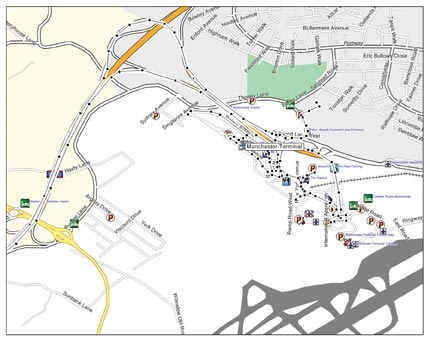
    Some car navigators disclose a great deal of information: who owns them; multiple addresses; a home address plus favorite addresses; destinations visited most frequently or most recently; the language spoken by the user, and other preferences; whether the user travels abroad; and occasionally telephone calls made and received. Some units even contain a detailed record of journeys stretching back over months, each point timed and dated (see Figure 1). These can provide compelling evidence of criminal activity.

    Figure 1. Detailed tracks of routes travelled by a vehicle, each point dated and timed.
    Figure 1. Detailed tracks of routes travelled by a vehicle, each point dated and timed.

     Tracking systems

    Probably the most impressive forensic evidence involving GPS comes from the tracking systems now fitted to increasing numbers of trucks, trailers, delivery vans, and rental cars. Each vehicle carries a receiver that records its location and sends it at intervals to a tracking center via mobile phone data services. The tracking center may store, process, and display the data on a map, and raise an alarm if a high-value cargo deviates from its planned route or if a rental car is about to be exported illegally. Many of these tracking installations are covert and very difficult to discover.

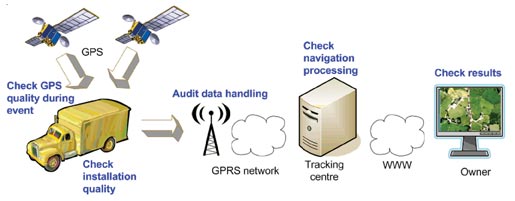
    When the police seize a tracking record, a forensic expert must audit the data in various ways, shown in blue in Figure 2. These focus on the many parts of the system the tracking company does not control. Tracking companies generally do not check the quality and accuracy of GPS at the time, and in the place, of a crime. A navigation professional, accustomed to dealing with high-integrity safety-of-life systems, can bring valuable experience to examining tracking records.

    Figure 2. Vehicle tracking system with checks (in blue) to establish quality of evidence.
    Figure 2. Vehicle tracking system with checks (in blue) to establish quality of evidence.

    It is also often necessary to estimate the accuracy of GPS fixes. Doing so may require analysis of complex situations. An example would be the GPS receiver in a covert tracking system, with its antenna hidden deep inside the vehicle, perhaps behind the dashboard. The vehicle itself might be surrounded by tall buildings that block and reflect satellite signals. This is a novel and fascinating area where navigation and forensic science meet!

    GPS Jamming

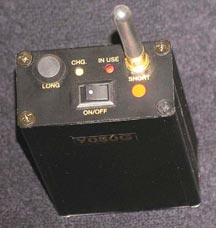
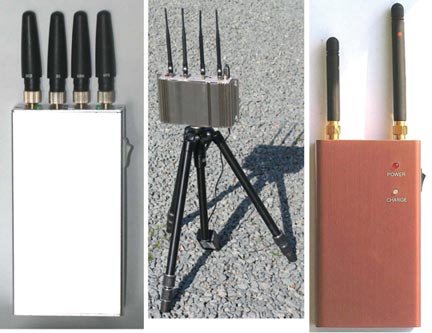
    The use of GPS jammers, long foreseen in navigation circles, has become a reality as criminals employ them to overcome tracking systems and steal vehicles. These low-powered transmitters (see photo), readily available over the Internet for as little as $150, can block GPS reception in a vehicle’s vicinity.

    GNSS satellites transmit no more power than a car headlight, yet must illuminate nearly half the Earth’s surface from 20,000 kilometers above it. Signals reaching a receiver are easily swamped by even a thousandth of a watt of jamming signal radiated near by.

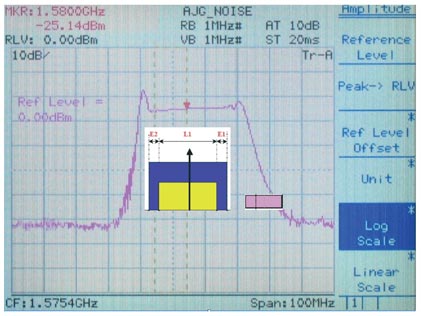
    Figure 3 shows the spectrum of the signal radiated by the low-power jammer in the photo above it, plotted across a 100 MHz frequency range centred on the GPS L1 frequency at 1575.42 MHz. The total power this jammer radiates is only about one tenth of a milliwatt, yet that is sufficient to block commercial GPS receivers over a few meters range — all the criminals need.

    Low-power GPS jammer.
    Low-power GPS jammer.
    Figure 3. Signal spectrum radiated by low-power jammer.
    Figure 3. Signal spectrum radiated by low-power jammer.

    GPS/Phone Jammers

    If a vehicle is to be completely screened from electronic tracking, not only must GPS be disabled in its vicinity, so must mobile phones as well. If not, they can be used to call for assistance; they can also be tracked using cell-site analysis methods. To prevent that, a jammer (see adjacent PHOTO) can block not only GPS reception but also that of all the mobile phone bands used in the area. The spectra of the jamming signals radiated by this device are designed to cover the frequency bands in which European 900 MHz, 1800 MHz, and 3G base stations transmit, so preventing mobiles from receiving them and establishing communications.

    Recently, much more powerful jammers have appeared on the market (see adjacent photo). These radiate approximately two watts on each frequency, a power level some 20,000 times greater than the low-power jammer — and more powerful than the transmitter employed recently in official UK tests of effects on shipping of jamming GPS over a sector of the North Sea up to 30 kilometers from the jammer. A two-watt jammer could interfere over a substantial area.

    Other GNSS

    The spectrum in Figure 3 of the jamming signal of the simple low-power device extends from approximately 1563 MHz to 1600 MHz. Towards the center of this band is the civil GPS signal, approximately 2 MHz wide. The jammer also covers the 20-MHz-wide military P/Y signal, the yellow block. The slightly wider blue block represents L1 signals planned for Galileo, so this device would serve as a Galileo jammer, too. Its spectrum covers only the low end of the (purple) GLONASS bands, but other similar devices on the market jam that as well.

    It is often argued that, since Galileo will use more than one frequency band, simply jamming L1 would not prevent Galileo reception. However, the bottom photo shows a jammer that has recently come onto the market, with two transmissions: one covering L1; the other, at a higher power, covering the L2 band. Adding L5 would be trivial. These are the frequency bands in which present and planned GNSS operate.

    The jammers presented here are relatively simple and crude, but highly effective in preventing the operation of civil GPS receivers. They are readily available and are certainly being sold and being used. They render our GNSS-based security systems vulnerable to attack.

    More seriously, I believe that it is now technically feasible, though apparently not yet within the capabilities of criminals, to spoof GPS. When that happens, it will allow criminals to hi-jack and divert a vehicle whilst the tracking system shows it still following its planned route — no alarm will be raised. Vehicles will also be able to avoid purely GNSS-based road-user pricing systems.

    Last-Pics
    From left: Jammer for GPS, GSM (900MHz), DCS (1800MHz), and 3G mobile bands; high-power jammer for GPS and mobile phone bands; L1 and L2 jammer.

    Mitigation

    All is not lost! In many countries, vehicle-tracking systems such as Datatrak are deployed that do not depend on GNSS. There are also vehicle recovery systems such as Tracker with its LoJack technology installed in police cars and helicopters. These systems are immune to GNSS jamming and spoofing. Of course, like all radio systems, they can be jammed. But they are orders of magnitude less vulnerable than GNSS, and jammers that targeted them would be easier to detect.

    Dead-reckoning can also mitigate GNSS jamming. Many cars with built-in navigators carry heading sensors and wheel-rotation counters to cope with loss of GPS in tunnels and urban canyons. They are immune to jamming, at least for short periods and distances. But they would not necessarily be immune to GNSS spoofing.
    Enhanced Loran, or eLoran, offers a complete alternative navigation technology. Built into a GNSS receiver, it can take over seamlessly when GNSS is jammed, and replace precise GPS timing that currently keeps most of our telecommunications systems and the Internet running. There is great interest in this cost-effective insurance policy worldwide.

    Conclusions

    Legal and forensic aspects of GNSS grow ever more important, and their role more vital and successful in reducing crime. We must plan our responses to the vulnerability of our current and future GNSS-based security systems, which are now under attack. We must recognize these threats and encourage open and full discussion of them and of solutions to the dangers they pose.


    DAVID LAST is the immediate past-president of the Royal Institute of Navigation, a consultant and expert witness on radio-navigation and communications systems to companies, governmental and international organizations, and criminal investigators.
  • ION GNSS/CGSIC annual conference

    I realize the GIS world doesn’t revolve around GPS but I’m going to spend some space on it this month. Currently, I’m in Savannah, Georgia at the annual ION GNSS/CGSIC conference.

    This is where one can peer into the future of where GPS technology (and positioning technology in general) is heading. This is where all of the GPS and GNSS brainpower get together every year. There are a lot of military folks here. The GPS Chief Engineer (Col. David Goldstein), GPS Wing Commander (Col. David Madden), Boeing scientists (GPS satellite builders), Lockheed Martin scientists (GPS satellite builders) and all companies and organizations involved in designing and building GPS infrastructure are here. These are the true rocket scientists. I bet the average IQ would be a pretty good bowling score.

    The way this conference works is that the CGSIC meetings take place on Monday and Tuesday. The ION GNSS meetings take place on Wednesday through Friday.

    CGSIC is an acronym for the Civil GPS Service Interface Committee. CGSIC is coordinated by the US Coast Guard. According to its website, it’s the “recognized worldwide forum for effective interaction between all civil GPS users and the U.S. GPS authorities. It was established and chartered to identify civil GPS user needs (e.g. navigation, timing, and positioning) in support of the Department of Transportation’s (DOT) program to exchange information concerning GPS with the civil user community as part of the GPS “outreach” program. In fulfilling this responsibility, the CGSIC reports its activities to the National Space-Based Positioning, Navigation, and Timing (PNT) Executive Committee and the Office of the Assistant Secretary for Transportation”.

    The CGSIC meetings on Monday and Tuesday consist of briefings from government officials on the status of GPS and various related programs like NDGPS, WAAS, OPUS/CORS and many more. You can view the CGSIC meeting agenda here. There are also many user presentations from various government and commercial entities discussing how they are using GPS/GNSS in their work.

    I’ve been blogging about the meetings while I’ve been in Savannah. You can read my blog here. Of particular interest was the focus on RTK Networks in the Surveying, Mapping and Geosciences Session. RTK is an acronym for Real-Time Kinematic. Essentially, it’s real-time positioning at the centimeter level.

    With respect to GIS and infrastructure mapping, RTK Networks are one of the most significant advancements in GPS you will encounter over the next few years in the Geospatial business. They have the potential to significantly transform the accuracy of infrastructure data that is collected. If you want to learn more about them, you can read some of what I’ve written before about RTK Networks as well as the webinar I conducted on the subject.

    RTK Networks: The Wild, Wild West

    What RTK Users Want; Prospects for Network RTK (Rob Lorimer)

    Webinar – RTK Networks: What, Where, Why

    Here were the subjects discussed regarding RTK Networks at CGSIC:

    PANEL SESSION: Guidelines for Real Time GNSS Networks (RTN)
    A. Site Considerations – Dan Martin, NOAA’s National Geodetic Survey
    B. Planning & Design – Gavin Schrock, Washington State Reference Network
    C. Administration – Gary Thompson, North Carolina Geodetic Survey
    D. Best Methods for Users – Bill Henning, NOAA’s National Geodetic Survey
    Question & Answer Session with Speakers

    Interactive Sessions within Small Discussion Groups
    Group 1. CORS/OPUS
    Group 2. RTN Site Considerations and RTN Planning & Design
    Group 3. RTN Administration and RTN Best Practices for Users
    As I wrote in my blog, this was the place to be if one is interested in Real-Time Networks, from the user perspective to the administrator perspective. There’s a tremendous amount of interest and activity on the RTN space right now.

    While the CGSIC meetings are all about what’s happening now, the ION GNSS meetings are all about what’s going to happen in the future. At ION GNSS, researchers present the results of their hard work. The result of some of this research will be the technology we are using tomorrow.

    Be sure to check my ION GNSS blog. There will be some lag time, but it should all be up by early next week.

    Thanks and see you next week.

  • A Little Catch-up on New GPS/GNSS Products

    It’s been awhile since I covered new GPS/GNSS products on the market. Following are some recent introductions. Please note I’ve only included major features. Click on the links to view the datasheets of the products for detailed specifications and features.

    Navcom Technology introduces the SF-3050. Supports GPS L1, GPS L2C, planned GPS L5, GLONASS, planned Galileo and SBAS. Basic receiver is GPS L1. Customer can add signals/constellations as they need.

    JAVAD GNSS introduces the GISmore. Standard configuration supports GPS L1 and GLONASS L1. Customer can add Galileo E1, update rates to 100Hz, internal memory, Advanced Multipath Rejection, SBAS, RTK.

    Topcon Positioning Systems introduces the GRS-1. Standard configuration supports GPS L1, SBAS, 2MP camera, and magnetic compass. Customer can add GPS L2, GPS L5, GLONASS and update rates to 100Hz.

    Geneq introduces the SXBlue II-L GPS. Standard configuration supports GPS L1, SBAS and OmniSTAR VBS. Customer can add RTK and update rates to 20Hz.

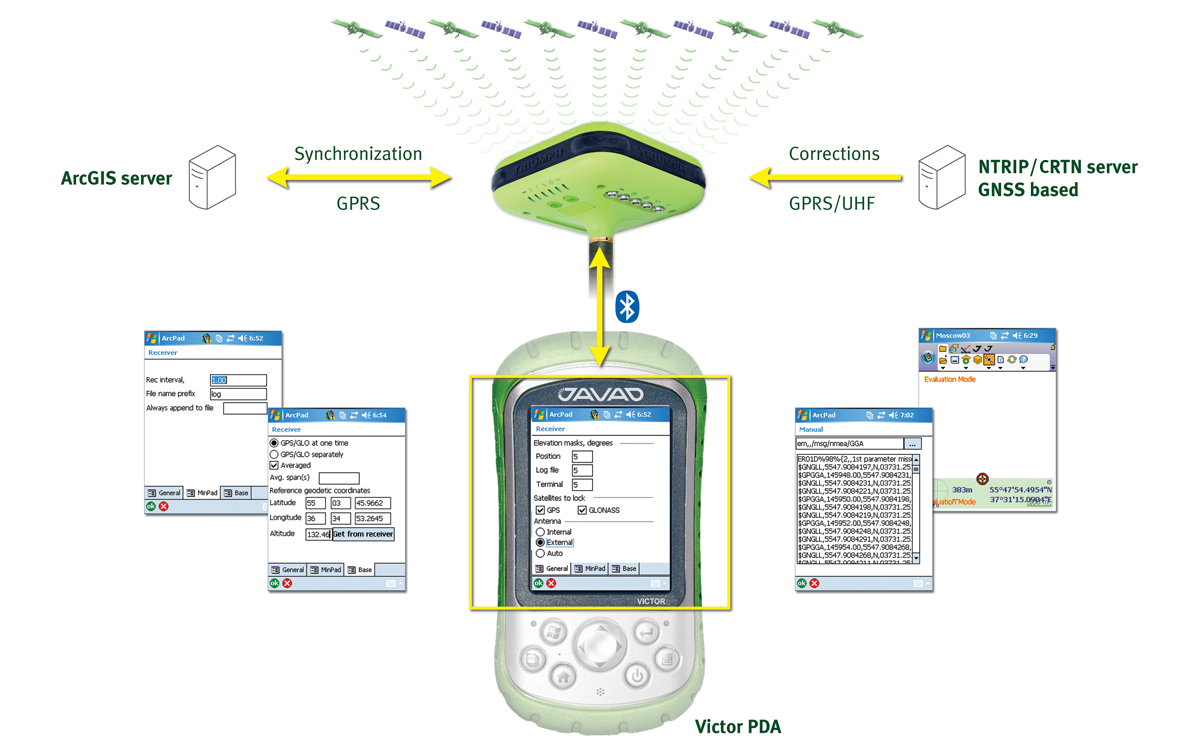
    Javad GNSS introduces Javad ArcPad Extension. JAVAD ArcPad Extension controls the GNSS receiver to manage the surveying process. Synchronizes ArcPad with ESRI’s GIS server by utilizing integrated wireless communication technology.

    NovAtel introduces the SMART-AG. Standard configuration supports GPS L1, GLONASS L1, and SBAS. Customer can add update rates to 20Hz.

    Magellan Professional introduces the ProFlex 500. Standard configuration supports GPS L1, GPS L2, and SBAS. Customer can add GPS L2C, planned GPS L5, planned Galileo and updates rates to 20Hz.

    Hemisphere GPS introduces the XF-101 for Juniper Systems Archer. Standard configuration supports GPS L1 and SBAS.

    Pacific Crest introduces the Advanced Data Link (ADL) UHF radio. Standard configuration supports a 0.1 -4.0 Watt programmable transceiver, a 40 MHz frequency range and support for both 12.5 and 25 kHz channel bandwidth. It is compatible with existing products from Pacific Crest.

    Topcon Positioning Systems introduces the Net-G3A. Standard configuration supports GPS L1, GPS L2C, GLONASS, planned GPS L5, planned Galileo, SBAS and updates rates to 100Hz.

    Just a reminder that next week is the annual ION (Institute of Navigation) GNSS conference in Savannah, Georgia, as well as the annual CGSIC (Civil GPS Service Interface Committee) meetings. We’ll be blogging daily from CGSIC and ION. Keep your browser pointed at the GPS World website all week and hit the refresh button occasionally to see what’s going on at the conference.

  • Navigating the World of GNSS

    Editor’s note: This article was orginally written in April 2006. Although the basic premise of the article stands, some of the information is dated. We plan on updating it in the next couple of months.

    The world of satellite positioning is changing . . . a lot. Global Navigation Satellite System (GNSS) is slowly but most certainly replacing GPS as the acronym used when discussing satellite navigation. The annual ION (Institute of Navigation) GPS conference is now known as the ION GNSS conference. The International GPS Service is now called the International GNSS Service. For the time being, GPS is still the only game in town. However, a revamped Russian GLONASS (GLObal NAvigation Satellite System) program and the European Galileo program will change the landscape of satellite positioning forever. What’s more, GPS itself is undergoing significant enhancements over the coming decades that will improve the integrity and accuracy of the data it produces.

    With respect to surveying and mapping, these new systems and enhancements raise many questions about accuracy, tracking performance, cost, upgrades, and other issues: “Should I wait for a full L2C constellation before upgrading my receivers? Should I wait for Galileo to be operational before making my next major GPS equipment purchase decision?”

    Predicting the Future

    First of all, Galileo, GPS L5 and GPS III (L1C) are still several years away from having constellations substantial enough to make a difference. A lot can happen with receiver technology before then, so placing any significant weight on the “L5/Galileo-ready” feature of a receiver today may not make much sense. In fact, they are sort of “vaporware” because no L5 signal exists yet to test with and the Galileo folks have been reluctant to even release the signal specification to developers.

    Additionally, the competitive landscape could change dramatically. L2C opens the market for other companies to design dual-frequency receivers without having to develop the L2 semicodeless techniques used today (techniques that are technically challenging and filled with a minefield of patent blocks). Granted, it’s not just receiver hardware that makes a GPS survey solution, but L2C certainly eliminates
    a major roadblock for companies interested in competing in the survey market space.

    Whereas the survey-grade GPS equipment manufacturers have been quick to announce products that are L2C/Galileo/GLONASS-capable, it’s interesting to note that very few mapping-grade (meter-level differential GPS) and no consumer-grade (autonomous) equipment companies have given GNSS the same attention. Why? Because today’s GPS is good enough for consumers. They can live with intermittent GPS coverage and still navigate from Point A to Point B. Survey-grade GNSS doesn’t work that way. It’s a satellite-hungry technology.

    For mapping-grade product lines, there is technical value in using the GPS, GLONASS and WAAS, such as being able to work more productively under trees and around buildings. As I wrote in the original 2006 article, mapping-grade receivers will eventually exploit GNSS and that has started. Manufacturers have introduced GPS+GLONASS mapping-grade receivers in the past year. But remember that there are limited sources of differential correction data for GLONASS data. WAAS doesn’t support it. OPUS doesn’t support it yet. NDGPS doesn’t support it. There are a few CORS stations that support GLONASS and the National Geodetic Survey (NGS) said it’s going to offer GLONASS orbits by the end of 2009. But, essentially, one would have to setup their own reference station in order to post-process GLONASS data, or use an RTK Network that is broadcasting GPS+GLONASS corrections.

    The killer app for GNSS — and what has driven companies to buy GNSS equipment now — is centimeter-level, real-time positioning (or RTK, RealTime Kinematic, as it’s commonly referred to). GPS/GLONASS receivers have existed in the survey and precise-positioning market space for many years, and they have finally proven their value after years of GLONASS uncertainty. Using only GPS, RTK still has “brownout” times during the day, especially in tough GPS environments in which satellite visibility is limited. Simply put, there are not enough operational
    GPS satellites to fully meet the demands of real-time, centimeter-level positioning in many cases.

    A System Primer

    The following will discuss the different GNSS implementation benefits and rough schedules.

    GLONASS: The RTK Partner. GLONASS is Russia’s version of GPS. It may surprise you to know that the first GLONASS satellite was launched more than 25 years ago (1982), but due to political and economic issues in Russia, the system never reached maturity as a standalone system. In recent years, however, GLONASS has earned consumer confidence and has proven to be a useful augmentation to GPS for applications using RTK.

    Outside of RTK applications, GLONASS hasn’t been shown to add value to GPS. Markets such as survey-grade postprocessing,  mapping-grade GIS don’t have the cost–benefit payoff for GLONASS that RTK does. Therefore, very few GPS/GLONASS receivers are sold outside of the RTK market space.

    For a long time, GLONASS was stagnant in terms of market acceptance. Without going into too much history, credit the increased popularity of GLONASS in RTK applications to the marketing of Javad Positioning Systems’ technology by Topcon Positioning Systems beginning early this decade. Javad and Topcon have since split (2004) but enough GPS/GLONASS systems had been fielded by then that the GPS/GLONASS RTK solution had proven to be effective and reliable. Today, nearly all major GPS manufacturers offer a GPS+GLONASS RTK system.

    There are currently 17 operational GLONASS satellites and six more are scheduled for launch by the end of 2009. A full 24-satellite GLONASS constellation is scheduled to be in orbit by the end of 2010. The legacy and unreliable GLONASS satellites have been retired. The current GLONASS-M satellites have a design life of seven years. GLONASS-K satellites, with a design life of 10 years and sporting a new CDMA design for close compatibility with GPS, is due to launch at the end of 2010.

    Since the 2006 article, Russia made an historic announcement that they will begin including CDMA signal structure on their next generation GLONASS-K satellites that are scheduled to begin launching at the end of 2010. This is a very significant development that will ease the complexity of designing GPS+GLONASS receivers. It will also result in newer


    There is one serious technical consideration regarding GLONASS. Unlike GPS and Galileo, which use CDMA (Code Division Multiple Access) signal structure, GLONASS uses FDMA (Frequency Division Multiple Access) signal structure. With GPS and Galileo providing 57 satellites using CDMA, will the additional receiver complexity required to process GLONASS data motivate manufacturers to ignore GLONASS in the future? It’s a valid question.

    Galileo Gets Started. Galileo is the European counterpart to GPS. Unlike GPS and GLONASS, which are financed and controlled by their countries’ respective military organizations, Galileo is controlled by civilians; the majority of the system development and all of the system maintenance are funded with commercial capital. It is a GNSS that has been targeted at commercial applications since its inception. It’s
    designed to have a 30-satellite constellation (27 plus three spares), as well as a complement of groundstation equipment. The satellites orbit at slightly higher altitudes than GPS, but the operating principles are the same. The proposed constellation is designed so at least eight satellites are in view at all times.

  • ION GNSS Conference Peers into the Future of Surveying

    The Institute of Navigation’s Global Navigation Satellite Systems (ION GNSS) conference is one of my two favorite industry events of the year; the other being the ESRI conference. At ESRI, I mix it up with GPS technology users, listen to what they are doing and what they want to do with the technology. At ION, I listen to GNSS designers and researchers.

    ION GNSS is where these heady folks come together to share ideas and show the fruits of their labor. It’s also a place where GNSS policy-makers and administrators meet and share ideas. As with GNSS engineers, the administrators and policy-makers are an important part of the future of GPS technology. If a budget gets whacked on a certain GNSS program (say, for example, NDGPS), do you think companies will continue to spend R&D dollars on that technology? If you want to know the future of GNSS and how it will affect surveying, look at R&D today.

    What’s so fun for me about ION GNSS is seeing where engineers spend their money and time. The research they present today will be in products you can use tomorrow.

    But first, be sure to sign up for my free webinar to be held on September 15. I’ll be talking about modernized GPS signals (L2C, L5) and GLONASS. Do they (or in the case of L5, will it) really make a difference? Let’s talk. I’ll take your questions online after making a presentation.

    I hope I’ve made this clear in the past and if not, here goes. I’m not a GNSS scientist. Not even close. Yes, I’ve managed product development where we integrated GPS technology and software to create surveying and mapping products. Yes, I managed the software and hardware engineers who made those products come to life. But if you asked me to write a line of C code or design a circuit, my 17 year old could finish it before I could start. I’m a block diagram sort of person that sees the big picture and communicates my vision reasonably well. And I listen to people, a lot.

    Look at some of the ION GNSS presentation tracks below. Keep in mind that each one of these tracks has six to a dozen research papers within it — and these are only 11 of the more than 40 tracks at the conference. A full list of panel descriptions and speakers is available.

    • Multi-sensor Navigation
    • Urban & Indoor Navigation Technology I
    • Surveying & Geodesy
    • GNSS Space-Based Augmentation Systems (SBAS)
    • Multipath Effects and Mitigation
    • Next-Generation GNSS Integrity
    • PPP and Network-based RTK
    • Software Receivers
    • Atmospheric Effects and Modeling
    • GNSS Inertial Navigation Systems
    • GLONASS Modernization, QZSS & other GNSS

    Just as a sampling, here are a few abbreviated abstracts from the above sessions:

    Development and Field Testing of a DSP-Based Dual-Frequency Software GPS Receiver
    B.W. O´Hanlon, Cornell University; T.E. Humphreys, University of Texas at Austin; M.L. Psiaki, P.M. Kintner, Jr., Cornell University
    A real-time software GPS receiver for the L1 C/A and L2 C codes has been implemented on a Digital Signal Processor (DSP) and tested in a scintillation environment. This receiver is being developed as a low-cost space weather instrument with improved tracking robustness in comparison to a traditional semi-codeless dual-frequency receiver and with flexibility in its choices of signal tracking algorithms and data outputs. The receiver is capable of tracking 12 L1 C/A and 12 L2 C channels while also calculating receiver position and velocity and total electron content (TEC). The current work is a direct continuation of the work presented in Ref. 1. This work discusses several modifications to the software developed earlier, challenges addressed in updating the receiver to be easily adapted to new GNSS signals (e.g., L2C), and lessons learned from operation during ionospheric scintillation.

    Improving Real-Time Kinematic PPP with Instantaneous Cycle-Slip Correction
    S. Banville, R.B. Langley, University of New Brunswick, Canada
    Over the last decade, precise point positioning (PPP) proved to be a powerful processing strategy. It vastly spread in several fields of applications such as atmospheric sciences, geodynamics, surveying in remote regions, processing of large networks, etc. On the other hand, the success of this technique in kinematic mode (with a moving receiver) is still muted due to a rather long convergence period required to obtain a centimetre level of precision. Several efforts were mounted to overcome this limitation, which led to the possibility of fixing carrier phase ambiguities to integers, which is the key to reducing the convergence period. In our approach, both carrier-phase and pseudorange measurements are included in the processing which allows estimating, not only receiver position change and receiver clock offset variation, but also cycle-slip parameters. Since time-differencing over short time spans is used, the assumption that instrumental biases cancel out seems reasonable. Hence, the cycle-slip parameters estimated are integers and conventional ambiguity search methods can be used to statistically determine the optimal cycle-slip (ambiguity) combination. Once the correct combination of integer cycle slips has been determined, their effects can be removed from the carrier-phase measurements, and the PPP processing can be executed without having to introduce new ambiguity parameters in the estimation filter. The benefit of this additional step is that a continuous time series can be obtained for the receiver coordinates, without the need for a new undesirable convergence period.

    Augmenting Low-cost GPS/INS with Ultra-wideband Transceivers for Multi-platform Relative Navigation
    A. Vydhyanathan, H. Luinge, M. Tanigawa, F. Dijkstra, Xsens Technologies B.V., The Netherlands; M.S. Braasch, M. Uijt de Haag, Ohio University, USA
    This paper explores the use of impulse radio based Ultra-wideband transceivers to augment the low-cost GPS/INS navigation estimates in GPS-challenged/denied environments for multi-platform relative navigation. Such low-cost GPS/INS systems are increasingly being used in automobile, aerospace and marine applications for vehicle dynamics analysis, performance testing, Unmanned Aerial Vehicles (UAV) and Unmanned Ground Vehicles (UGV), autonomous attitude and navigation control and camera/LADAR stabilization and correction. The architecture and algorithm developed in this paper has independent ´loosely-coupled´ GPS/INS EKF´s running on each platform. A separate filter then takes the independent filter outputs and combines them with the ranges derived from the Ultra-wideband broadcasts to output relative navigation estimates.

    The Benefits of Multi-constellation GNSS: Reaching up Even to Single Constellation GNSS users
    B. Bonet, I. Alcantarilla, GMV, Spain; D. Flament, C. Rodriguez, EGNOS Project Office, ESA, France; N. Zarraoa, GMV, Spain
    Europe has launched, under the European Space Agency’s (ESA’s) European GNSS Evolution Programme, the MRS initiative. MRS standing for Multi-constellation/multi-frequency Regional System, the initiative is putting different teams of experts into the exciting goal of defining the paths for the most successful GNSS usage on a future of multiple choices.  ESA has prepared a detailed experimentation plan aimed to proof the benefits that the multi-constellation approach can provide to today´s GNSS users. This plan covers a wide range of objectives covering different user domains (aeronautical, land mobile, maritime) eq
    uipped with different types of receivers. This set of experimentations will rely on the deployment of several Test Beds combining multi constellation multi-frequency processing and several broadcast channels (GEO, MEO, terrestrial). Among the first experimentations planned, there are some devoted to experiment and validate the performance benefits for SBAS users (GPS L1 only first then GPS/GLONASS or GPS/Galileo — dual-frequency SBAS users). This paper presents the outcome of the first step of this experimentation campaign, which has been performed based on the magicSBAS tool, a flexible SBAS processing platform, able to acquire single and dual frequency GLONASS data, in addition to GPS, to compute and provide both standards SBAS corrections and integrity, as well as augmentation to GLONASS.

    From studying the track titles and abstracts, one can read between the lines and take a peek into the future of GNSS products. It’s clear to see that software receivers, SBAS, other GNSS, other sensor technology, PPP, atmospheric modeling and mitigation, and more reliable positioning all are active R&D topics that will mold the products in our future…some now and some a few years out.

    I really enjoy this “look into the future” and will do my best to communicate the highlights to you. Our GPS World team will be at the ION GNSS conference in full force. Daily blogs will be written by several editors including myself. The GPS World website will be updated daily so be sure to check in throughout the week (September 21-25.)

    The ION GNSS conference doesn’t actually start until Wednesday (kick-off is the plenary Tuesday evening) of that week. The Civil GPS Service Interface Committee (CGSIC) schedules their annual meeting on the two days prior to the ION GNSS conference. If you aren’t familiar with the CGSIC, I wrote an article about it a couple of years ago. Briefly, CGSIC is the body through which the civil GPS community can communicate with GPS authorities.

    The two days of CGSIC meetings are chocked full of fantastic presentations from the status of GPS/GLONASS/Galileo/SBAS/NDGPS programs to presentation by users of GNSS. Normally I see the agenda posted on the CGSIC website, but I haven’t seen it there ye but check back in a day or two and I bet it will. Typically, the first day are program status briefings (GPS, GLONASS, QZSS, Galileo, SBAS, NDGPS, etc.). The second day contains breakouts sessions from the different subcommittees (US States and Localities, Survey Mapping & Geosciences, International and Timing). I’ll be giving a briefing on RTK Networks Tuesday at the US States and Localities subcommittee breakout session.

    The guy who kicks my butt all over the landscape when I don’t file this column on time, GPS World editor Alan Cameron, also presents at CGSIC on Monday afternoon, with the topic “User Concerns.” For a preview of his presentation, see the latest installment in his Wide Awake blog, Wide Awake on the Midnight Train to Georgia [[http://stage.globalpositioningnews.com/gnss-system/wide-awake/wide-awake-midnight-train-georgia-8807]], in which he plays back results from a magazine survey of readers who answered the question, “Where is society going with GPS/GNSS use, and how will that change the GPS/GNSS industry?”

    We’ll be blogging on the CGSIC meetings as well. Cameron and I will both have digital video recorders in our traveling bags, and we’ll post footage of highlights during the week. That’s another great way for you to get a bit closer to this goldmine of a conference.

    In other notes, only 10 days after it was launched, the latest and last Block IIR-M GPS satellite was declared healthy and ready for service on August 28. Your receiver should be already tracking it and using it. It is identified as PRN05.

    Meanwhile, the status of PRN01 (SVN49) that was launched back in March is still unhealthy and not usable. There’s been no significant news since the flurry of reports detailing its flaw a month ago. I suspect the Air Force will make some sort of announcement at the ION GNSS conference later this month with an update and/or plan to deal with the sick bird.

    And again lastly, be sure to sign up for my free webinar to be held on September 15. I’ll be talking about modernized GPS signals (L2C, L5) and GLONASS. Do they (or in the case of L5, will it) really make a difference? Let’s talk about it. Sign up here.

  • Letters to the Editor

    You Go Too Far, Too Far, to Be Honest

    Reaction to August’s editorial, “Fair Play to Those Who Dream,” concerning the as-yet unreleased Galileo signal specification, came swift — and mixed — from both sides of the Atlantic. Correspondents were unanimous, however, in wishing their names kept off the record.

    From Europe:
    “I really think you go too far, too far to be honest.”

    “I truly appreciate your open words. They come right out of my heart. I’m not sure, though, whether they are loud enough to make the European Space Agency and European Union wake up at last.”

    From the United States:
    “. . . ranting sensationalism . . .”

    “Nice job. I think you will get some kudos for this.”

    Interference Counter-Effort Gets Cart Before Pony

    Your May 2009 editorial bemoaned the fact that, despite rhetoric to the contrary, blessed little had been accomplished in our ability to identify and localize sources of GPS interference. Some of my colleagues might describe me as a bit obsessed with this issue, but I think it a healthy obsession.

    The most recent attempt I’ve seen that addresses this issue is a program sponsored by the Department of Homeland Security (DHS). Based on a briefing of this effort that’s available on the Internet, I seriously doubt that this program, as presently structured, has much chance of yielding a useful product. Why? Because I believe the approach to be thoughtless rather than thoughtful. And I mean “thoughtless” in the literal, not pejorative, sense. Those involved in the program, as listed in the briefing, are among the brightest talents available to address this issue.

    My past dissatisfaction with the way the government has treated this issue — at least from the early 1980s — stems from what I call its planning-to-plan mode. An agency would lay out an elaborate plan, replete with words like “coordinate” and “support,” but include few if any specific action items such as “Agency A should develop specific capability B.” So no one was on the line to deliver.

    Preparatory to writing this letter, I thought I would do a few searches to see if there were any new initiatives underway. I was rather pleasantly surprised to see that DHS had produced, and briefed, a study titled “GPS Interference Detection and Mitigation.” That is, until I read it.

    The DHS briefing is a 25-slide presentation. To its credit, it doesn’t plan-to-plan. The brief lays out a procedure to address the issue. But once we eliminate the boilerplate describing the non-specific tasking and coordination, we wind up with roughly seven slides devoted to a detailed description of the central data repository and the logging of data. Excluding a page that vaguely describes potential sources of data without describing how they could contribute to the tasking, there are zero pages devoted to the sensors! But these sensors are the heart of the system, and will dictate the types of data that the central facility must process.

    The problem is compounded since, according to the briefing, the only aspect of the program assigned funding is the central data repository. So we’re putting the seed money into some generic repository? A classic case of buying the cart before the (as yet) undefined pony.
    What’s the problem? I think there are several.

    • First (and I’m guessing here), someone was given a mandate to do something. And with insufficient time to do the necessary thinking. Which primarily requires a few folks closing the door, putting their feet on the table, and actually thinking about the problem.
    • This, in turn, produced a description of a processing/repository center that had to be generic, since without defining the sensors one can’t define the data types, formats, and quantity that the sensor arrays would provide. So how does one spend the repository funding indicated by the DHS study?
    • And, it’s a hard problem. You can’t solve it by just brute force.

    Let me end by suggesting how I would contrast a thoughtful approach from a thoughtless approach to the issue. The thoughtless approach would be to develop a one-size-fits-all solution, by which all data sources will filter through the distribution chain to the repository.

    The thoughtful approach is for one of the guys/girls to eventually take his/her feet off the table, and suggest, “Hey, our major heartburn at this time is fratricide! Rather than spend a lot of time and money reporting this interference, why not adopt procedures for preventing it? And, given we provide a training program in place on potential problem sources and corrective procedures, we might spend a few dollars on the type of jam meter (see Phil Ward’s paper in Inside GNSS, Sept/Oct 2007) to show that violations will be monitored.”

    Under this scenario, with a bit of luck, a potential San Diego (2006) or Rome AFB (1997–1998) event never gets to the reporting stage.

    Is the above the ultimate solution? Of course not. Countering the intentional jamming of GPS will be the larger challenge. But a bit of forethought appears preferable to blindly funding the cart,
    before knowing how the pony behaves.

    — Terry McGurn, Reston, Virginia

    Military Handhelds

    I just wanted to say how much I enjoyed Don Jewell’s column, “The Warfighter and Rorschach Shock.” It is a sad fact that the DoD has not woken up to the potential of a market-driven procurement process for products like handheld GPS. I’m of the opinion that if tamper-resistant SAASM OEM chips or boards were available to the Garmins of the industry, and the military user had his choice of units, we’d see a much superior offering to the warfighter at a lower net cost. Companies like Garmin are not GPS receiver builders, they buy their receivers from companies like SiRF and Broadcom. Their expertise is as systems integrators and they do a superb job of it. Obviously, the warfighter values this expertise and wants to use it — so why don’t we give them what they want?

    — Logan Scott, Breckinridge, Colorado

    Time for GPS 101

    Ijust read Don Jewell’s article “Time for GPS 101.” I too am appalled by the ignorance of the public and, more importantly, of our political decision-makers, not just about GPS (critical enough in isolation) but about a myriad of national and global safety and security issues. As a 30-year member of the aerospace engineering community, I am fearful of the future of our country and society because of bad decisions made by ignorant decision-makers, sometimes supported by technical “experts” who provide bad information and advice, usually from their own ignorance but often cynically from a hidden agenda.

    — Name Withheld

    I truly enjoy Don Jewell’s editorials!

    After reading the GPS 101 column, I wondered: Why is there nothing presenting this technology to children? (If there is, I have yet to find it.) Before their minds turn to mush, I believe if we start them with the basics, coupled with the present technology evolving as fast as it is, imagine what they could be doing with GPS when they graduate from high school! I understand that the teenagers have the iPhone with the hip applications and such, but wouldn’t it be neat to see a seven-year-old with a handheld scouring a park looking for his/her first geocache?

    — John Pollard, Southeastern, Electric Cooperative, Sioux Falls, SD

    I enjoyed your “Time for GPS 101” article. Your point was driven home last night as I watched the National Geographic Channel program, Known Universe: “The Fastest,” when they used GPS in their discussion of the relativistic effects of velocity. To my horror, they described how the GPS receiver sends signals to the satellites which are used to determine your time and space coordinates. The ignorance of the unwashed masses may be excused, but when a channel dedicated to science gets it so wrong, I really worry.

    — John Zander, St. Inigoes, Maryland
     

  • ESRI Conference and SVN-49 Troubles

    I had a great visit at the ESRI User Conference earlier this month. If you recall last year, I wrote:

    “As much as surveyors, engineers, and constructors may not appreciate geographic information systems (GIS) technology, at some point everyone should attend at least the ESRI Survey/Engineering Summit and the first couple of days of the ESRI User Conference held every summer in San Diego, California. This is not a GIS sales pitch. It’s a networking sales pitch. When other conferences are struggling to maintain attendance levels, the ESRI conferences seemingly never fail to grow in attendance. This year, it attracted some 15,000 people from 120 countries. That means gobs of GIS people, and also gobs of surveyors and engineers.”

    The statement rang true this year too. Even in today’s economy where conferences are severely impacted or even cancelled due to travel budget cuts, the ESRI User conference still attracted ~11,000 people this month.

    On another note, I think conference organizers are getting the message. People just can’t justify attending so many conferences. Next Spring, the ACSM (American Congress for Surveying & Mapping) is combining with the GITA (Geospatial Information & Technology Association) conference in Phoenix, AZ. Instead of 1,000-1,500 for each conference, it’s a larger event at 2,000-3,000. Even more interesting is talk in the rumor mill about a joint conference including ACSM and the ESRI Survey Summit in 2011. Include the GITA conference with those and that makes a lot of sense to me.
    As usual, there were many things happening at this year’s ESRI UC conference and I attended many briefings. I’ll try to stay focused on the highly GPS/GNSS-related subjects:
    Javad GNSS. One of the bigger news items on the GPS front was the joint Javad/ESRI effort in developing an ArcPad extension for Javad’s line of receivers. The demonstration was very cool. We loaded up a local map (San Diego) from their server located in Moscow (Russia) then took a Javad RTK receiver outside with the data collector (running ArcPad w/Javad’s extension). I collected data on a few points. The data was sent off to Moscow from the data collector (via GPRS while we were outside) to update the map. After we walked back into the convention center, the demonstrator clicked the workstation “refresh” button and viola, the map was updated with the points I collected at the cm-level.
    According to the JAVAD engineer, “we make it look easy.” I agree. There’s a lot of heavy-lifting going on in the background to make this happen. With the heavy-lifting done, it still needs a bit of tweaking. There weren’t any quality control indicators (RMS values) on the data collector for the operator to reference and also ArcPad doesn’t recognize GLONASS satellites so while the GNSS receiver was utilizing GPS and GLONASS, ArcPad only reported GPS satellites. The operator really does need to know what’s going on before tapping on the STORE button. But, 95% of the work is done and the heavy lifting is complete so I don’t doubt they will finish off the last 5% in short order.
    Topcon Positioning Systems. I’ve had a few questions from readers on Topcon’s new GRS-1 receiver. Is it single frequency? Is it dual frequency? Is it for GIS? Is it for survey?
    The answers are Yes, Yes, Yes and Yes.
    The entry-level GRS-1 is a single-frequency hand-held GIS data collector. That’s about US$5,000.

    Add US$4,000 and you get a 5cm high accuracy GIS receiver.

    Add another US$2,500 and you have a full-blown, cm-level RTK rover.

    There are other options beyond this (eg. GLONASS), but I think you get the picture as I did. It’s a full L1/L2 GPS and GLONASS receiver. You pay to have features activated (plus some added hardware/software).

    I haven’t tried one yet so I couldn’t tell you how it performs, but it’s worth a look.

    Juniper Systems. Although they don’t design GPS receivers, their Archer hand-held is starting to show up in a lot of places. Hemisphere GPS has designed the XF-101 receiver as a plug-in for the Archer as well as having a similar model for the Trimble/TDS Recon and Nomad hand-helds. Javad was also offering the Archer with their systems. IkeGPS also introduced a new hand-held mapping system named the Ike1000 that is based on the Archer.

    Geneq. Their flagship product, the SXBlue GPS, seems to be gaining momentum in the GIS marketplace. They have introduced a new model that utilizes the OmniSTAR correction service called the SXBlue II-L GPS. Their use of WAAS (via Hemisphere GPS Coast technology) and performance under tree canopy has created some buzz.

    Trimble Navigation. It’s hard to leave Trimble out of the conversation, but nothing really new in the GPS product area. However, they continue their run of acquiring companies with the latest being Farm Works Software in the precision agriculture industry. In 2009, they’ve acquired four niche-market companies.

    Magellan Professional. Introduced an upgrade to support ArcPad 8.0 for post-processing on their Mobile Mapper 6 hand-held for sub-meter accuracy. FYI: Magellan consumer GPS products is no longer part of Magellan Professional. Rumor has it that Magellan Professional will revert back to the Ashtech brand name of the1990’s.

    Leica Geosystems. Where were they?

    SVN-49 Troubles, Solar Cycle 24, GAO Report

    I gave a presentation at the ESRI UC on Tuesday morning as part of the Survey (SUR) track. I focused on three core issues listed above. You can view my presentation here.

    I’ll stick to the highlights…

    <
    p>SVN-49 troubles. It’s broke and will never be as good as the other Block IIR-M satellites. Don’t expect it to be declared healthy in the immediate future. Even if a patch is developed and it’s declared healthy, it’s likely that pseudorange-based safety-of-life applications like SBAS (WAAS, EGNOS, MSAS) and NDGPS will not incorporate it into their solutions. Although more study is necessary, it appears that carrier-phase applications (cm-level real-time and post-processing) will be able to utilize SVN-49.

    Solar Cycle 24. NOAA reports that the number of sunspots during the next solar cycle (2009-2020) will be the fewest since the 1920’s. That doesn’t mean the next solar cycle will be any easier on GPS than the last one. On the contrary, it could be worse for GPS. No one knows at this point. High performance GPS L1 receivers are the most exposed. Those utilizing NDGPS, WAAS and OmniSTAR’s VBS service need to be watchful. You can sign up to receive alerts from NOAA giving a three-day forecast of activity. NOAA predicts the peak of the next solar cycle will be in May 2013. Note that typically the geomagnetic activity that most affects GPS occurs after the peak. Links and more details are in the presentation.

    GAO Report. I wrote an article on this subject back in June as it relates to medium and high precision users. You can read it here. High precision users will be affected more than other users because high precision GPS receivers perform better with a lot of observables. A loss of 2-3 GPS satellites can be significant and require users to begin using GPS mission planning software again to optimize the use of field time. Survey receivers using GPS and GLONASS will be less affected. The presentation references a report from the University of New Brunswick that takes a look at how GLONASS can compensate for a loss of GPS satellites.


  • IGI&S 2009: Getting Back to Basics and Our Roots

    Earlier this month I attended the Defense Installation GeoSpatial Information and Services (IGI&S) conference in Dallas. Although not a large conference, it is tightly focused and aimed directly at the GIS community that supports military installations. The conferences were initially started by the Air Force, but attendance by other branches has grown since they all have common issues and many have joint chains of command. The first keynote speaker was Lora Muchmore, director of Business Enterprise Integration, Office of the Deputy Undersecretary of Defense for Installations and Environment. She addressed the historic difficulty that DOD had keeping track of buildings, equipment, and personnel. The problem was exacerbated because each branch had their own inventory systems that were not interoperable with systems of other branches. Mrs. Muchmore concluded by emphasizing the increasingly important role that IGI&S is playing to improve the Department’s real property inventory, literally transforming the way resource and management decisions are made at the highest levels.

    David LaBranche, the Defense Installation Spatial Data Infrastucture (DISDI) program manager, addressed how DISDI is working with the National GeoSpatial Intelligence Agency (NGA) to put IGI&S data and systems in place that are complimentary but of course different from intelligence community needs. They are working toward interoperability between the joint services and encouraging greater use of unclassified, shared, off-the-shelf products to build “installation situational awareness” without the expense of custom products and services.

    The complexity of joint bases, base realignments and closures (BRAC), environmental issues, and interrelated activities with other federal agencies such as Department of Homeland Security (DHS), DEA, CDC and others highlighted the need for interoperability and shared spatial data. However, the opposite has occurred as systems grew in size and complexity. So the overarching theme of the conference was getting back to basics with standards and consistent base-to-base data and systems.

    This concept of snapping back to where we started reminded me of a dysfunctional ship that I was assigned to early in my Navy career. The ship was a mess with poor morale, poor performance, and a very unhappy crew. A new CO arrived who made no immediate changes but instead carefully studied the ship for two months. He then called us officers together in the wardroom and gave us a very simple order. He told everyone to get a copy of the ship’s SORM, read it and put each division and department back in line with it. The SORM stands for Standard Organization and Regulations of the U.S. Navy. The long standing but continuously updated Navy manual is a guide that clearly identifies how a Navy ship should be organized and operated. It was created through decades of lessons learned and practical experience. Our new CO explained how any organization will morph over time away from it roots. Sometimes the changes grow out of operational necessity and some changes are driven by the personalities and talents of crew members. Regardless of the source, these changes can ultimately twist the organization into dysfunction.

    As a junior officer, I was somewhat skeptical that this would have any major effect but I was wrong. Within three months the ship was functioning like a fine watch and there was actually harmony in the wardroom and among the crew. Of course this wasn’t the only change; the CO was a very gifted and uplifting leader with a superb memory. In that same three month period, through his “management by walking around” he learned the name, home town and family situation of every member of the 300 man crew. The CO became so respected and admired that eventually any crewmember would walk off a cliff for him. Getting back to the SORM roots certainly helped.

    Many of the conference sessions addressed the same themes of interoperability and cleaning up the basics. The Marine Corps GeoFidelis program was highlighted by David LaBranche as a model, built with a focus on interoperability while also addressing the institutional issues of data handling and organization. Frances Railey, the GeoFidelis GIO, explained the details of the Marine Corps system and how it was designed to meet customer needs including a very detailed Data Access & Release Guide. Peter Len, the Gi&S manager for the Naval Facilities Engineering Command (NAVFAC) Pacific, explained the unique challenges he faces with facilities scattered across the Pacific including Guam and the Marianas. He discussed how GIS was used for encroachment planning and other base management issues.

    The conference also included 22 vendors who demonstrated new products and services that also addressed the conference themes of interoperability. AutoDesk, which is one of the leaders in BIM modeling, had personnel demonstrating new tools that bridge the gap between CAD and GIS into the BIM environment. Bentley, another leader in BIM modeling, demonstrated BIM solutions that addressed life cycle facility management including energy and lighting. Their OGC compliant systems work with many different BIM model formats. NGA staffers demonstrated Palanterra, a Google-like online system used by emergency management people such as DHS for special event planning and response.

    Woolpert demonstrated a new capability that can quickly create 3D building interior models from video clips taken from different view angles. I’ve seen this done with laser point clouds but this was the first time I saw video used to build 3D models. Kaya explained their GIS services including web engineering applications for facility and installation management as well as tools to build real property master plans. Pictometry demonstrated a new image service that will be launched this summer. Through the web service federal users will be able to view or download all Pictometry imagery, both ortho and oblique views, through secure portals. The service will be very affordable because imagery is accessed only when and where needed. This should be a boon for emergency responders.

    ERDAS demonstrated web services that reduce a series of complex image/spatial analysis functions to simple and intuitive user tools and products. This screen capture below is an example intended for use by a tank commander. In one operation this service combines slope data, image analysis vegetation data, and feature data to build “drive/no drive” zones. This is very similar to work many of you have done using ESRI’s Model Builder with Spatial Analyst, but the ERDAS system is faster and takes full advantage of their 30 years experience in image analysis. “Wiping” the image shows the drive/no drive areas over a topo map.

    ERDAS Apollo – WPS in Action.
    ERDAS Apollo – WPS in Action.

    The one nagging concern I had that seemed to need more attention was emergency preparedness. When I addressed the topic with attendees and presenters they talked about how their IT people had remote backup systems for installation data and how backups occurred regularly. I have this little gut twitch that occurs when I hear that IT people are backing up my data. Please take this first hand experience from someone who almost lost 10 years of GIS data because of an administrative error.

    In a previous assignment our agency had a catastrophic server farm failure that resulted in the total loss of our entire SDE database. Backup? There was no backup. Some IT personnel view GIS data, especially imagery, as a huge data set that doesn’t need to be backed up often, if at all. They don’t see GIS data in the same light as financial data and may treat it differently so, through a misunderstanding, the IT people were not backing up the SDE database.

    Luckily, a year before the loss, we placed all our GIS data and imagery on portable hard drives as part of our portable emergency GIS we set up in support of regional disaster preparedness and mutual aid. One set of those hard drives was in our emergency GIS locker in our office; the other set was 25 miles away in a secure location (see my January 2008 Geointelligence Insider column, What Can You Do for Your Country). At the risk of sounding like a broken record, or for those of you born in the post-vinyl period, “a continuously looping file,” I say what many others have said: “back up your data.”

    Stepping down from my soap box, I can say that this conference was an exceptional conference that was rich in information and not overwhelming like some of our mega-conferences. For the vendors many good leads were generated and for the participants a lot of useful information was presented.