Category: Opinions

  • Expert Advice: Cause Identified for Pseudorange Error from New GPS Satellite SVN-49

    By Richard Langleuy, with an additional note by Oliver Montenbruck

    The GPS Wing and its contractors have traced the cause of pseudorange errors on L1 and L2 broadcast by the newest GPS satellite, SVN-49, to the manner in which the L5 signal demonstration payload was added to the satellite. Signal leakage between the two input ports of the antenna coupler network for the satellite’s array of 12 helical antenna elements, reflected from the L5 filter and then transmitted, creates a second signal with a delay of approximately 30 nanoseconds, and the appearance of a multipath component.

    While testing an adjustment to the signal-in-space to minimize the effect of the problem on receiver navigation solutions on Earth, the GPS Wing is interested in hearing from manufacturers and the user community concerning the different impacts of SVN-49 signals on the wide range products and applications in operation, before reaching a final decision on what to do with the satellite prior to setting it healthy.


    The seventh modernized GPS Block IIR satellite was launched on March 24, 2009. Called SVN-49, its sequence number in the long line of GPS satellites, or PRN01, after its pseudorandom noise code identifier, this satellite is special. In addition to the equipment required to transmit the legacy GPS C/A-code and P(Y)-code signals and the new civil L2C-code and military M-code signals on the standard L1 (1575.42 MHz) and L2 (1227.6 MHz) frequencies, SVN-49 carries an L5 demonstration payload. L5 is the new civil signal to be transmitted on 1176.45 MHz by Block IIF and succeeding generations of GPS satellites.

    The demo payload was included to claim the frequency, which was allocated by the International Telecommunication Union before the August 26, 2009, deadline. The deadline had been imposed seven years earlier when the GPS Joint Program Office (the forerunner of the GPS Wing) applied for the frequency. The Block IIF program schedule had slipped a bit and as a safeguard (and one which eventually saved the day), the demo payload was developed and assigned to SVN-49.

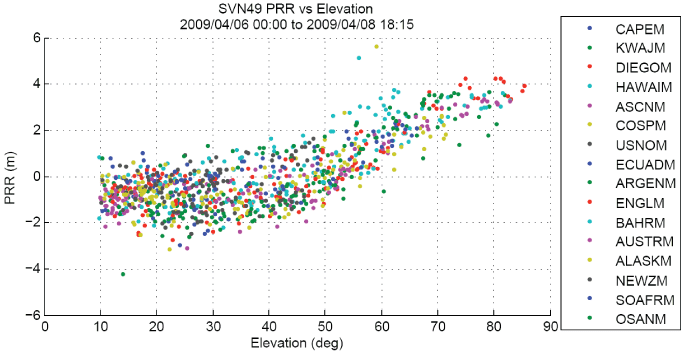
    Shortly after the L1/L2 system on SVN-49 was activated on March 28, it became clear that the satellite had a small problem. The pseudorange data obtained by U.S. Air Force Space Command’s 2nd Space Operations Squadron (2 SOPS) monitor stations had larger than normal errors. Typically, the errors have a random characteristic, with a mean of zero and a peak-to-peak variation of two meters or so. But the SVN-49 ionosphere-corrected errors reached a level of about four meters and when they were plotted against the elevation angle of the satellite as viewed at each monitor station, a clear trend emerged (see Figure 1).

    FIGURE 1. Ionospheric-refraction-corrected SVN4-9 pseudorange residuals from data collected at 2 SOPS monitor stations (courtesy GPS Wing).
    FIGURE 1. Ionospheric-refraction-corrected SVN4-9 pseudorange residuals from data collected at 2 SOPS monitor stations (courtesy GPS Wing).

    Although larger than normal, the errors still fell within the accuracy tolerances specified for GPS signals. Nevertheless, the anomalous behavior of SVN-49’s signals was a cause of concern, and the GPS Wing and its contractors mounted efforts to find the cause.

    Payload Source. They traced the source of the problem to the manner in which the L5 demo payload was added to the satellite. To understand the problem, we need to examine how the L1 and L2 signals are transmitted by a GPS satellite.

    A primary and defining characteristic of GPS signals is that the received signal power should be approximately the same at any location on the Earth’s surface within view of the satellite. In other words, we should receive about the same signal power when a GPS satellite is overhead (and closer to us) as when it is low on the horizon (and further away). Any major variation in signal level seen by a receiver is typically due to the gain pattern of the receiver’s antenna.

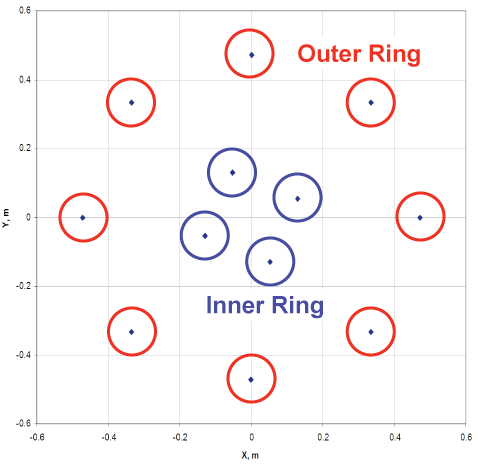
    To achieve a uniform power density at the Earth’s surface, a GPS satellite uses an array of 12 helical antenna elements, with an inner ring of four elements and an outer ring of eight, fed by an antenna coupler network (see Figure 2). The L1 and L2 signals are fed into the coupler through one of its two input ports: port J1. The inner ring of elements transmits most of the L1 and L2 power from J1 with a broad pattern, while the outer ring transmits a sharper pattern but with a weaker signal and a different phase. The net effect of this arrangement is to reduce the radiated power from the inner ring as seen at high elevation angles and boost it for lower elevation angles thereby achieving an almost uniform power density.

    FIGURE 2. L-band antenna element locations (courtesy GPS Wing).
    FIGURE 2. L-band antenna element locations (courtesy GPS Wing).

    The antenna coupler’s other input port, J2, is used on SVN-49 to feed the L5 signal to the antenna array after first passing through a filter and a 162-inch (411-centimeter) cable. Most of the power from J2 goes to the outer ring, with less going to the inner ring — the inverse of the power distribution from J1. This is why initial reports of L5 signal acquisition noted its high directivity with much weaker signals at low elevation angles compared with the L1 and L2 signals. But this behavior was expected.

    Not expected was the effect of the L5 filter and its associated cable run on the L1 and L2 signals. It turns out that some of the L1 and L2 signal from J1 exits the J2 port, is reflected from the L5 filter, and then is transmitted from the J2 port with a delay of approximately 30 nanoseconds. With hindsight, the J1 to J2 signal leakage and reflection from the L5 filter should have been prevented.

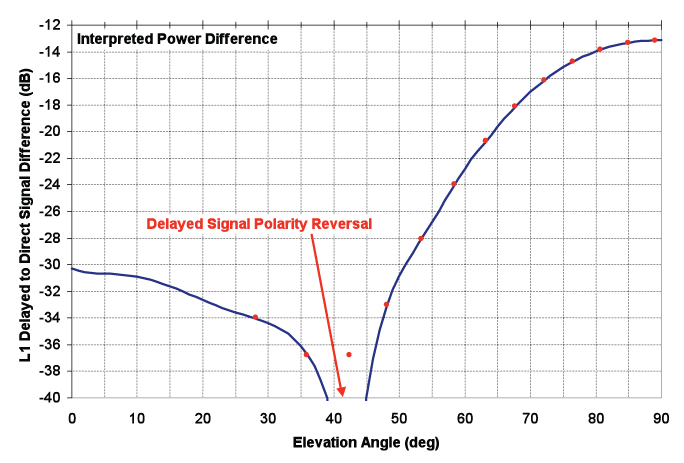
    On the ground, a receiver sees both the direct signal and the weaker reflected signal, which looks like a multipath component. The GPS Wing and its contractors have attempted to model the effect of the reflected signal on GPS receiver measurements. According to their models, if the direct and reflected L1 signals are in phase at the zenith, then a standard code-correlating receiver will measure a C/A-code pseudorange that is 1.62 meters too long. The error becomes smaller as the elevation angle drops, due to the drop in power level of the reflected signal, reaching zero at an elevation angle of about 42 degrees, corresponding to a null in the antenna pattern and then rising slightly as the elevation angle drops to zero (see Figure 3).

    FIGURE 3. Model of the differences between the SVN-49 L1 delayed (multipath) and direct signals (courtesy GPS Wing).
    FIGURE 3. Model of the differences between the SVN-49 L1 delayed (multipath) and direct signals (courtesy GPS Wing).

    P(Y), L2, and L2C. The same error behavior is expected for L1 P(Y)-code pseudoranges. Maximum L2 P(Y)-code pseudorange errors are modeled to be zero if the direct and reflected L2 signals are in quadrature, or to have maximum values of about plus 0.95 meters if the direct and reflected signals have the same phase, and minus 1.1 meters if they have the opposite phase. Ground tests should confirm which of the three possibilities describes the actual signals. The L2C signal is expected to behave in a similar manner to the L2 P(Y) signal.

    If ionosphere-free pseudoranges are computed from the L1 and L2 pseudoranges, the maximum errors are predicted to be 4.14, 2.66, and 5.84 meters for the quadrature, in-phase, and opposite-phase L2 direct and reflected signal possibilities.

    The models also predict an effect on carrier-phase measurements, but these are very much smaller: a maximum error of 6.8 millimeters on L1 and 4.8 millimeters on L2.

    It is not possible to fully fix the problem. The GPS Wing and its contractors are looking at ways to minimize the effect of the problem on receiver navigation solutions. One
    experiment under assessment is to adjust the broadcast navigation message ephemeris of the satellite by placing the antenna phase center about 152 meters above the actual position of the satellite, while compensating with a satellite clock offset. Such navigation message adjustments reduce the peak-to-peak variation of the error by about a half; they do not eliminate it.

    Status Quo? Another possibility is to broadcast the signal as is, without attempts to compensate for the error. It would then be up to the user to determine how best to use the signals. Initial indications show that certain receivers with advanced multipath mitigation correlators can essentially filter out much of the multipath component (see Narrow Correlators Screen Error section below). Receivers with standard correlators could use the SNV-49 signals but assign a higher uncertainty to the measurements when they are combined with those from other satellites.

    The GPS Wing is interested in hearing from manufacturers and the user community concerning the impact of SVN-49 signals on products and applications before coming to a final decision on what to do with the satellite before setting it healthy, and a briefing and interview process has begun to obtain that information. The decision is expect by mid-September.


    — Richard B. Langley, University of New Brunswick


    Narrow Correlators Screen Error

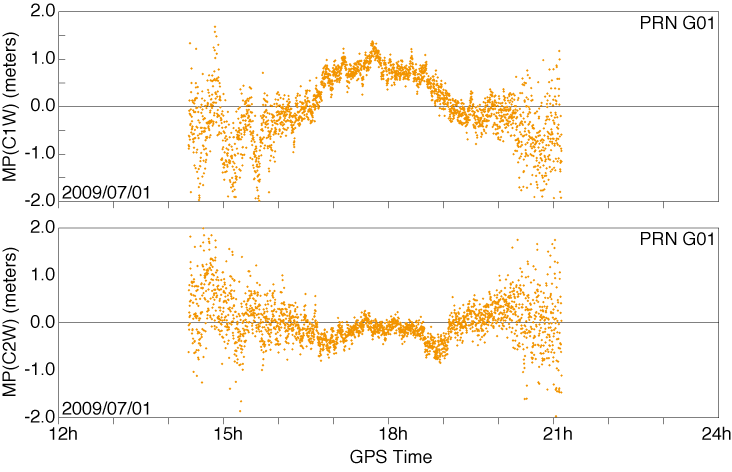
    The typical variation of SVN-49 multipath errors over time is illustrated in Figure 4 for semi-codeless P(Y)-code measurements on the L1 and L2 frequency from a commercial test receiver near Munich, Germany. SVN-49 was visible for roughly 6 hours at this site and reached a peak elevation angle of 80 degrees. The errors are most pronounced on L1 where they vary between –0.5 meters near the horizon and +1 meter near the center of the pass. L2, in contrast, is notably less affected. Here, multipath errors caused by signal reflections in the satellite are well below 0.5 meters in amplitude and cannot be clearly distinguished from local multipath at the receiver site.

    FIGURE 4. Typical SNV-49 multipath errors for semi-codeless P(Y)-code tracking on L1 (top) and L2 (bottom) from a conventional correlator (using JAVAD GNSS Triumph receivers.)
    FIGURE 4. Typical SNV-49 multipath errors for semi-codeless P(Y)-code tracking on L1 (top) and L2 (bottom) from a conventional correlator (using JAVAD GNSS Triumph receivers.)

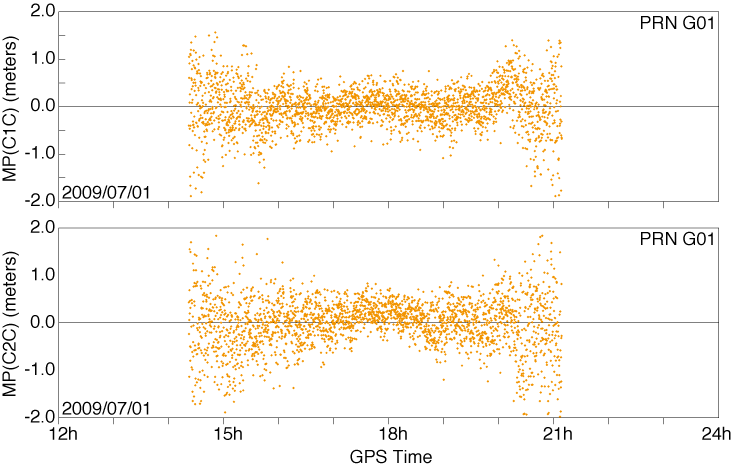
    While the example shown in Figure 4 is representative for many receivers currently tracking the new GPS satellite, a few receivers are able to filter out the satellite multipath component due to the use of special multipath-mitigation techniques. While implementation details are mostly proprietary, it is commonly known that strobe or double-delta correlators can effectively counteract short-range multipath when using an extremely narrow correlator spacing. The effectiveness of such techniques is shown in Figure 5 for C/A-code and L2C-code tracking by the same test receiver. Obviously, multipath errors are well below the thermal noise in this case and the measurement errors can hardly be distinguished from those of other GPS satellites.

    FIGURE 5. SVN49 multipath errors for C/A-code (top) and L2C-code (bottom) tracking using special multipath-mitigation techniques with 20-nanosecond correlator spacing (using JAVAD GNSS Triumph receivers.)
    FIGURE 5. SVN49 multipath errors for C/A-code (top) and L2C-code (bottom) tracking using special multipath-mitigation techniques with 20-nanosecond correlator spacing (using JAVAD GNSS Triumph receivers.)

    From a practical point of view, users will probably have to decide on their own whether to employ receivers with advanced multipath-mitigation capabilities, whether to apply elevation-angle-dependent measurement corrections (primarily for L1 code measurements), or whether to simply accept the moderate degradation of the SVN-49 measurements. In view of the wide variety of receivers in use and considering their varied applications, a unique solution to the SVN-49 problem is probably not feasible, and care should be taken before applying a priori “corrections” that might cause more harm than good.

    (Editor’s Note: The data used to track the anomalies of SVN-49 were gathered using JAVAD GNSS Triumph receivers.)

    — Oliver Montenbruck, German Aerospace Center


  • Expert Advice: All Rise, GPS Entering the Court

    LenJacobsen-OBy Len Jacobson

    In the litigious society that we have become, it is not surprising to see GPS as a regular fixture in many civil and criminal proceedings in our nation’s courts. A new and growing outlet for the legal profession, it has also engaged many of the older GPS pioneers who, instead of just retiring, have found a relatively lucrative way to spend their free time. They now form the cadre of GPS expert witnesses, without whom many of the cases involving positioning could not be settled equitably.

    These brave individuals must of necessity remain nameless, because all have signed non-disclosure orders regarding the details of any case they may be or have been working on. Even the public record of adjudicated cases affords but a small peek into the activities of these unheralded witnesses. Most civil cases are settled before trial, often with confidential terms, and many criminal cases plead out, so there is little to find in a search of public records for cases involving significant aspects of GPS.

    Civil matters usually fall into one of the following categories:

    • misuse or misappropriation of intellectual property (IP), for example, patent infringement;
    • liability for accidents; or
    • product liability for latent defects.

    Criminal matters involve some sort of tracking of suspects or felons, or use of GPS for evidence of an alleged perpetrator’s location at the time of the crime. The use of GPS in these instances comes smack up against the public’s right to privacy. In some states, many of these cases are thrown out for lack of warrants allowing use of GPS tracking, while in other states warrants are not required. In 2007, the 7th Circuit U.S. Court of Appeals held that no warrant was required, as did a court in Wisconsin. But the New York State Court of Appeals found the opposite on a 4–3 vote. It is likely that the U.S. Supreme Court will have to determine if such warrantless tracking of suspects violates the Fourth Amendment to the Constitution.

    Patents. Most IP cases involve patent disputes wherein the patent in question in some way uses GPS or is itself a GPS component. An application relating to mapping in a car or the way differential GPS is performed provide examples of the former, while a method for improved receiver signal-processing would be of the latter type. These lawsuits are very contentious because experts from each side will disagree on what to others might seem to be obvious. These experts must opine on the meaning of the claims in the patent, the validity of the patent, and the likelihood that the device in question actually infringes on the patent. The cases are expensive to litigate and take a long time to come to an end. Many are settled just before going to trial.

    During the pre-trial process, the expert witness must conduct research, provide reports, and testify in depositions. Early on, the expert will testify before a federal judge at proceeding called a Markman hearing, wherein each side presents his interpretation of the words in the patent claims that are in dispute. It is up to the judge to decide what the words mean. Lawyers refer to this as claim construction and how the claims are “construed.” If the case does go to trial, the experts testify in open court, usually before a jury.

    Navy versus Air Force. A civil case well known to me involved whether or not GPS receivers would perform during and after the week-number rollover (WNRO) that occurred in the summer of 1999. This case came about as an adjunct to the hysteria involving Y2K. But it was a real concern to the tracking company and its customers, who had deployed thousands of GPS receivers, some in high-risk areas. They had valuable cargo and people at risk if their GPS failed.

    The tracking company asked the receiver manufacturer if the units would operate through and after WNRO. The receiver company really didn’t know and delayed answering long enough that the exasperated tracking company commissioned a U.S. Navy test facility to experiment with a GPS simulator and the receivers in question to see what would happen. In the meantime, the receiver company told the tracking company that the Air Force expected everything to go ahead normally, that is the uploads performed at the Master Control Station in Colorado would continue on the same routine during WNRO as it had in the past, namely at least daily uploads. The Air Force would not guarantee that it would happen that way because its specification allowed for uploads plus or minus three days from the end of the week. As such, the receiver company told the tracking company it couldn’t guarantee the upload would be timely, but not to worry.

    The tests by the Navy showed that if the uploads was early or late, there would be adverse consequences. One version of the receiver would stop operating for several days after the upload, and another version would stop operating and never recover. As a result of these tests, the tracking company purchased replacements and then sued the receiver company for the costs, claiming a latent defect in their products. The jury ruled for the tracking company and ordered the receiver company to pay for the replacement receivers.

    Crash Course. Another case involved a fatal accident caused by the crash of an automobile company’s test van into an open-structured, desert racing car. The test van had GPS onboard as it was performing experiments. The data showed the speed and location of the van up to the time of the collision, and that was enough to cause a settlement.

    GPS has figured in countless cases of property incursions where GPS survey data has been used to prove exactly where one property begins and another ends.

    Probably the most celebrated and precedent-setting cases occurred in 2001, when a driver sued a rental-car company because it levied a $450 surcharge when a concealed GPS unit indicated he was speeding while driving the rental car. The judge threw out the case because the rental company failed to disclose that it had hidden GPS unit in the car, and that it had no right to collect a fine for speeding as only a government entity could do so.

    Several ongoing cases involve patent disputes about GPS applications and receiver designs, but all are subject to non-disclosure restrictions.

    Suspect Tracking. In the criminal arena, a large number of cases involve GPS use to track suspects. That sort of data was used to help convict Laci Peterson’s husband of murder in a recent and celebrated California trial. Today, courts all over America are pondering whether the covert use of GPS tracking is an invasion of privacy and should require a warrant before police can use it.
    Authorities use GPS quite openly to keep track of felons, child molesters, parolees, indicted suspects out on bail, people sentenced to home restraint, and so on. Supposedly, in these cases the person has already broken the law so their rights are abrogated. Or, they may have signed an agreement giving consent to such tracking in exchange for their conditional release.

    In one instance, a paroled sex offender in Florida was rearrested when the tracking company informed the sheriff that he was not where he was supposed to be. After an examination of the data and with help from Google maps, it was determined that if the tracking company’s data was correct, the parolee had to be traveling at 90 miles per hour across a field where there was no road. He was released forthwith.

    Law enforcement routinely uses GPS to locate stolen cars equipped with services such as OnStar.

    In Malibu, California, two fishermen were stopped by fish and game deputies and charged with illegal taking of lobsters. The officers had photos and onboard GPS fixes to present in court. Unfortunately for the district attorney,
    the wily defense claimed that since magnetic north had moved more than 100 meters since the maps that Fish and Game relied on were made, the maps were not accurate, and therefore the GPS data was inaccurate. The jury did not seem interested in science, the law, or the facts, and it acquitted the lead defendant. His partner chose to plead to a lesser charge and was fined, while the boat owner went free.

    Market Outlook. It is highly likely that litigation regarding IP will grow as more companies profit from GPS technology, in many instances not knowing that someone holds a patent on which they could possibly be infringing. Criminal proceedings will increase as well, now that GPS tracking is relatively inexpensive for law enforcement to deploy. Meanwhile legislatures and high courts ponder how to deal with potential violations of privacy and the need for warrants.


    LEN JACOBSON is a consultant to the GPS industry and has participated as an expert witness in many cases involving GPS. He is the author of the book GNSS Markets and Applications, published in 2007.


  • Letters to the Editor

    DAGR Remarks

    In the April edition, an article titled “DAGR Extended” covered news from the Space & Missiles Center regarding the GPS Wing awarding a follow-on contract to Rockwell Collins to provide Defense Advanced GPS Receivers (DAGR).

    At the end of the article appeared an “Unofficial Word,” which made derogatory and inaccurate remarks about the use of the DAGR.

    We are disappointed that the staff of GPS World did not contact us for a response to the accusations made in the article. Had you contacted us, our response would have been the following:

    The DAGR provides the only means for dismounted soldiers or special operators to obtain location information of sufficient accuracy, reliability, and integrity for targeting purposes. Our warfighters use the DAGR to call in close air support missions, which the DAGR delivers GPS-guided munitions with pinpoint accuracy through its Advanced Laser Range Finder and Fire Support functions. The DAGR also provides unique Gun Laying Azimuth Determination applications.

    Use of a commercial GPS in these circumstances would entail significant risk that would be totally unacceptable. No other handheld GPS is authorized, nor should it be authorized, for use in military targeting operations.

    In the combat theater, our soldiers and special operators are working in extremely difficult conditions — environmental conditions where the DAGR functions consistently and provides warfighters with the information they vitally need.

    On April 30, we celebrated the delivery of the 300,000th DAGR, which is proven testimony to the utility and reliability of the product.

    In the future, we’d appreciate an opportunity to respond firsthand.

    — Robert Haag
    Senior Director, Soldier Solutions
    Rockwell Collins

    Don Jewell, Military & Government Editor, replies:

    I could not agree with you more. At the same time, I totally disagree with your comment that our remarks were “derogatory and inaccurate … about the use of the DAGR.”

    The conclusions drawn in that “Unofficial Word” (not, by the way, written by me) came directly from several industry and government warfighter panels (many of them attended by Rockwell Collins), face-to-face interviews, letters, and a plethora of personal e-mails from warfighters over the last 24 months. The results were unanimous: the DAGR, according to our warfighters who have opted not to use it, is too big, too heavy, has limited battery life, a black-and-white screen, is basically obsolete, and has a very difficult, definitely not user-friendly interface. Our interviews and correspondence show that the DAGR, as a standalone device, has been replaced by various GPS handheld or wrist-mounted units, Garmin and Trimble primarily.

    How can I then agree with your comments? Because your letter very carefully only defends the use of the DAGR as an embedded device. Indeed it has been our experience that the only warfighters that consistently give the DAGR high marks are the soldiers using the DAGR as an embedded device: those responsible for directing fire — bombs or artillery on target. In a recent interview session with more than 40 soldiers, only the soldier responsible for directing fire said that he used the DAGR in any capacity. He stated, “For directing fire I use my DAGR because it has the necessary interface for laser designators and communications to direct fire. Other than that, I depend on my Garmin, as does everyone else I know, for a personal GPS unit. The Captain uses the DAGR as an input to the Blue Force Tracking (BFT) system that stays in the Humvee or Stryker vehicle.”

    As I, and many others, in many articles, have said all along, the DAGR as an embedded piece of equipment, with dual frequencies, encryption, and approved government interfaces, serves a necessary and critical function: supplying BFT information and directing fire. As you correctly point out, it is the only approved government PNT source for directing fire. That is a good thing; all information and interfaces needed for the direct-fire mission have been worked out and do not need to be duplicated. Warfighters directing fire use the DAGR because there is no alternative, but for every other purpose for which they rely upon handheld GPS equipment, the DAGR is found seriously wanting. Suffice it to say the design is more than 14 years old, and the unit was dated when first released.

    I have spoken to several Rockwell Collins representatives about my concerns and those of the warfighters over the years, and usually they do not dispute the DAGRs’ shortcomings. However, recently I was shown a picture, by a senior Rockwell Collins representative, of a new Rockwell Collins government GPS unit that impressed me as much as a simple picture of a GPS unit can. I asked for more information and a unit to review and I am still waiting. My problem, and I say this in all sincerity, is not with Rockwell Collins, as I know you built the DAGR to outdated government specifications that were generated in the early 1990s; by Moore’s law that is more than seven generations old by today’s standards. My primary concern is the safety and welfare of our warfighters. I know you can do much better, but the antiquated and non-responsive government acquisition system has prevented you from making changes and updating the poorly designed user interface. Rockwell Collins makes tremendous radios and avionics, which I used successfully throughout my 30-year military career, except for PLGR and DAGR units, which I consistently found to be inferior.

    I consider myself a sophisticated GPS user and have tested more than 80 individual GPS units from manufacturers around the globe, yet I find your equipment and interface totally confusing. So please help me. Send me the new proposed government equipment with the color screen, the new interface, and hopefully new capabilities, and I will gladly review it in the magazine.

    Several of my articles have helped gain waivers from the U.S. government for official use of thousands of commercial and civilian GPS handheld units in theater, mostly military-hardened Trimble units. If you have a great new handheld unit, then please send me an example to review and I will do that. Maybe we can get official waivers to use it in theater. I sincerely hope that is the case.
    The soldiers, sailors, and airmen of the U.S. military have voted by purchasing their own units or by obtaining waivers. Even the newest recruits, whose low salary qualifies them for state assistance and food stamps, spend their money on commercial GPS units. As a very distinguished friend and world-renowned GPS expert said recently in a public forum, “You may not know it, but there has been an unofficial competition among military users for GPS handheld units, and Garmin won.” You have delivered 300,000 DAGRs, but how many of those units are actually in use today as stand-alone devices?

    GAO Report

    In my opinion the “GAO Questions GPS Health” article in the June issue focuses too much on the IIF as the potential problem. The May 14–15 National Space-Based PNT Advisory Board meeting heard a presentation from the DoD on GPS issues and challenges. During the briefing, Brigadier General Hyten acknowleged (as asserted in the GAO report) that there are three somewhat equally scary risks: delay of IIF, delay of OCX contract award, and delay of GPS IIIA. In the GAO report, the real doomsday scenario (in the 2015–2017 time frame) was from a two-year slide on the GPS IIIA program. You should also be aware that the graphs in the GAO report don’t account for two mitigation tools the DoD has in reserve: retired satellite still in space that could be revived (there are three at the moment), and power management as a means to extend satellite life.

    I’m less worried about the first graph in the report that shows a dip in the 2010 time frame than I am about the catastrophic dip in the second chart around the 2015 time frame. I think we have a good chance of having fired our silver bullets by that time and will be much more constrained with respect to available mitigations. It is good you are writing about this as it raises awareness of the issue which could aid in the development of a more robust risk mitigation plan before this becomes a crisis.

    I have been somewhat troubled by the anti-IIF program bias in the overall dialog on the subject. I don’t have full visibility or historical knowledge of what all went wrong there; what I do know indicates there was plenty of culpability to go around between the contractor and the government. I am concerned that too much focus on publicly spanking IIF will detract from fixing the root causes of the dilemma we are in: the requirements development processes and acquisition programs applied to GPS are broken. That is exacerbated by a lack of stable policy with respect to the long-term strategy for GPS development and sustainment. There are definitely lessons to learn from the IIF experience. But the difficulties associated with that program should be seen for what they are: symptoms rather than the root cause.

    — Name Withheld

  • GPS Receivers for GIS Data Collection

    In my last issue, I proclaimed the start of GPS/GIS month, with a focus on the subject in three of my newsletters. This is the second in that series. The first column can be read here. Also, I’m hosting a webinar June 30 to discuss using GPS receivers and technology for GIS data collection. In my last newsletter I discussed the use of consumer GPS receivers for GIS data collection. Remember the analogy I used…a Volkswagen Beetle wasn’t designed to run in a Formula One race? This column is going to focus on the Formula One cars, not the Volkswagen Beetles. In other words, it will focus on the GPS receivers on the market that are designed for GIS data collection. I will refer to them as GPS/GIS receivers.

    What differentiates a GPS/GIS receiver from any other GPS receiver?

    The number-one differentiator is that GPS/GIS receivers are designed do a better job of optimizing tracking and accuracy in areas where GIS data collection is performed. The operative term is “are designed.” Specifically, engineers who designed GPS/GIS receivers do so with different design criteria than engineers who design consumer GPS receivers and even survey GPS receivers. For example, a GPS/GIS receiver must be designed to operate where GIS data is collected and with reasonable accuracy. On the other hand, consumer GPS receivers are designed to track in tough conditions, but at the expense of accuracy. Furthermore, survey GPS receivers hold accuracy as the number-one priority so they sacrifice the ability to track in many environments.

    The following matrix illustrates my point (1 = Highest priority design consideration, 5 = Lowest priority design consideration):

    There are thousands of designers of consumer GPS receivers (Garmin, TomTom, Magellan, etc.) and probably only 10 designers of GPS receivers for surveying (Trimble, Leica/NovAtel, Topcon, Magellan Professional, Septentrio, JAVAD GNSS, NavCom, etc.). There are even fewer designers of GPS/GIS receivers — less than 10 (Trimble, Magellan Professional, Topcon, Geneq, Sokkia, Hemisphere, JAVAD GNSS, ViaSat).

    The market for GPS/GIS receivers is a complicated one. That’s the primary reason why there are only a few manufacturers. Here are some of the reasons why it is complex:

    • Users require a GPS receiver that will work effectively in many different and challenging environments such as under trees, in mountainous areas and near buildings. There is not one product on the market that will meet every user’s requirements.
    • Users have various needs for the type of GIS data collected. For example, some only need two or three attributes for a utility pole and others may need to collect dynamic line segments such as speed zones and road lane types.
    • There is not an effective way for manufacturers to distribute such products. The traditional survey instrument dealers (not all) are not typically trained or experienced in GPS/GIS technology. Since there is not an effective distribution channel, the alternative is to create a grass-roots distribution channel, which is very time-consuming.

    There are many factors to consider when attempting to determine what sort of GPS/GIS data collection system best fits a user’s requirements. Here are some in order of priority:

    1. Budget. One could argue that data collection requirements should be #1. Maybe, but that depends on what stage of planning you’re in. If you are in the budget planning phase and are able to influence it, then I agree that user requirements should be the first priority. However, the vast majority of people I encounter are given an established budget to work within. In that case, budget should be #1 because it’s a waste of time to consider solutions outside of the budget constraint.
    2. Accuracy. When I ask a potential GPS/GIS user what their accuracy requirement is, the typical answer is “as accurate as I can get”. Of course, you can imagine the ensuing conversation…Me: Well, Ok, you can achieve results around a centimeter.
      Them: That’s great. A centimeter is perfect.
      Me: Ok, here are the cost and training requirements.
      Them: Wow, why is it so expensive???????
      Me: There is a direct relationship between accuracy and cost. The more accurate you want, the more expensive it’s going to be.
      Them: Well, Ok, we reeeeally only need to be within about three feet.
      Me: Do you need elevation values within three feet?
      Them (now leery of the response to their answers): Will those cost more?
      Me: Yes, probably quite a bit more.
      Them: No, we don’t need elevations.
    3. Data collection requirements. Essentially, consumer GPS receivers and survey GPS systems “think” in terms of points. More specifically, consumer GPS receivers operate in terms of waypoints and survey GPS systems operate in terms of point averaging.
      Some of the more sophisticated survey GPS systems offer Field-to-Finish (F2F) capability whereas points are automatically connected to form a line back in the office such as with curbs and property lines.GIS data collection systems are different. GIS “sees” the world in one of three ways; points, lines (or polylines) and areas (or polygons). All have some level of database information attached. For example, a fire hydrant is a point on a map but there is also information in the GIS about that fire hydrant such as condition, last inspection date, etc. A parcel is a polygon on a map but there is also information in the GIS about that parcel such as ownership, tax id, etc.
      Additionally, there are several methods to record all three.For example, a wetland biologist may be mapping the perimeter of a wetland area but wants to “take points” on certain habitat nests he/she sees while walking the perimeter. Some of the more powerful GIS data collection software is built so the biologist can temporarily suspend mapping the perimeter and be allowed to map the next site and resume mapping the perimeter when point recording is finished.

      Using the proper data collection software that matches the user requirements can save a significant amount of time and energy.


    4. Data collection conditions. This is the biggest “gotcha” for GPS/GIS receivers. A certain GPS receiver designed for GIS data collection may perform flawlessly in the open-sky and works perfectly well for uses such as agriculture or other open-sky environments. However, most uses consist of some or all work done in “less-than-ideal” GPS conditions. Tree canopy is the biggest culprit. In that scenario, receiver performance can differ significantly. Some won’t track at all in those environments and some will track very well, but accept excessively noisy satellite measurements (which significantly degrades accuracy). The best ones are designed with a keen balance of satellite tracking and accuracy – with settings the user can change depending on the environment.

    Why are GPS/GIS receivers so much more expensive than consumer GPS receivers?

    Part of the reason that consumer GPS receivers are adapted to GPS/GIS data collection is the significant difference in cost. A consumer GPS receive
    r can be purchased for well under US$200. The entry level price for a GPS receiver with comparable accuracy, but with GIS data collection features is four times that. Furthermore, the entry level price for a GPS/GIS receiver capable of sub-meter accuracy is about $2,000.

    There are several specific and justifiable reasons for the price difference, but suffice to say that significantly more design engineering, technical support and sales effort is involved with GPS/GIS receivers. Furthermore, the volume of GPS/GIS receivers is miniscule compared to consumer receivers. If there were tens of millions of GPS/GIS receivers manufactured and sold every year, the price would be under US$200 each. But the GIS market just isn’t that large. Therefore, GPS/GIS manufacturers have to charge more per unit to account for engineering, technical support and sales overhead.

    Lastly, as mentioned above, there are not very many manufacturers of GPS/GIS receivers. Lack of competition usually results in higher prices to the end user.

    What sources of GPS corrections are available?

    Autonomous (no differential correction applied) GPS is pretty accurate these days…on the order of a few meters. For this reason, consumer GPS receiver manufacturers tend to leave out information on GPS corrections in their specifications. Their rationale is that consumers don’t really care as long as they can navigate effectively.

    However, the GPS/GIS receiver market is much more concerned with accuracy. Therefore, some sort of GPS correction source is highly recommended and necessary to achieve the desired accuracy.

    There are essentially two types of GPS corrections: real-time and post-processing.

    Throughout the 1980s and 1990s, post-processing was the dominant method of correcting GPS data. Even then, 2-5 meter accuracy was the norm for GPS/GIS receivers after post-processing was applied. Sub-meter GPS technology (using GPS/GIS receivers) only became possible towards the end of the 1990’s. Users were accustomed to going through the post-processing exercise (downloading base station data, QAing post-processed data, etc.). At that time, the only option for using real-time corrections were commercial services such as OmniSTAR.

    In the mid-1990s, the U.S. Coast Guard (USCG) established the DGPS system that broadcast real-time GPS corrections free of charge along the US coastlines and major waterways. The user only needed to purchase equipment (beacon receiver) to receive the signal. The success of that program lead to the U.S. Department of Transportation (DOT) to expand the program to cover inland regions that were out of the USCG domain. That was the GPS/GIS user’s first taste of free DGPS corrections…and they liked it because it eliminated the time-consuming (and sometimes painful) process of post-processing.

    The break-out milestone for real-time corrections came in 2003 when the Federal Aviation Administration (FAA) declared the Wide Area Augmentation System (WAAS) operational. WAAS took real-time GPS corrections to another level of simplicity. Not only is WAAS free of charge to users, but unlike the USCG DGPS and commercial DGPS services, it’s broadcast on the same frequency as GPS. This means that no extra antenna or receiver is required to utilize the signal. Furthermore, it’s broadcast nation-wide in the US where ever the WAAS satellites are visible to the user. Due to the success of WAAS, several other regions in the world have deployed similar systems; EGNOS in Western Europe, MSAS in Japan/Korea and GAGAN in India.

    Finally, in the early part of this decade, local networks of reference stations began springing up. These are called RTK Networks. While built primarily for users of survey GPS receivers who require cm-level accuracy, there is a growing population of GPS/GIS users who are connecting their GPS/GIS receivers to these networks to obtain GPS corrections. However, the costs can be expensive. Some network operators charge a fee to access their network and the user must also have a data subscription with a wireless provider (GSM or CDMA) which has a monthly fee associated with it — similar to a mobile phone.

    The Future is Clear

    The trend is clearly towards using real-time GPS corrections no matter which source is used. The time consumed by post-processing and the expense of maintaining software and training requirements adds too much overhead in most applications for organizations to consider it.Although not the dominate correction technology any longer, post-processing in the GPS/GIS segment still has a niche – the so-called “sub-foot” niche. While the majority of GIS applications are satisfied with “sub-meter” (or even 1-3 meter) accuracy, there are certain applications where “sub-foot” accuracy is required. With these receivers, the users must post-process against several reference stations or tie into an RTK Network.

    Integrated “All-in-one” GPS/GIS receiver or separate stand-alone receiver?

    In the GPS/GIS receiver market, there are clearly two types of systems. The “All-in-one” receivers have the GPS receiver, antenna and data collector built into a hand-held format. These are products such as the Trimble GeoXT/XH, Magellan Mobile Mapper CX/6 and Topcon GMS-2.

    The “stand-alone” receivers are a “black box” which houses only the GPS receiver, GPS antenna and optionally a battery. Other devices such as PDAs, tablet computers and notebook computers receive GPS data from these stand-alone receivers typically via Bluetooth interface or cable connection. These are products such as the Trimble ProXT/XH, Geneq SX Blue, Sokkia GIR1600, Hemisphere A100 and Javad GISMore.

    There are advantages and disadvantages to both.

    “All-in-one” receivers house everything one needs in a single hand-held unit. The advantage is that the data collector, GPS receiver, antenna, battery system, etc. are all designed by one company to work together. On the other hand, designing all of these components into a single hand-held can make for a somewhat heavier unit. Also, PDA technology is evolving rapidly. “All-in-one” receivers aren’t updated nearly as fast as PDA technology so an “All-in-one” unit may have an out-dated operating system and/or processor if the design is a few years old.

    “Stand-alone” receivers are separate receivers that send GPS data to a PDA, tablet computer or notebook computer via wireless Bluetooth or cable connectio
    n. The advantage of these systems is flexibility. On one project, they can be interfaced to a PDA. On the next project, they can be interfaced to a notebook computer running different mapping software. They aren’t affected by the advancement of PDA, operating system or computer processor technology.

    The Final Analysis — GPS/GIS Receivers for GIS Data Collection

    There a myriad of GPS receiver technologies being used for GIS data collection. It’s a complex industry. Some receivers being used are purpose-built and others have been adapted from other industries like consumer GPS.

    There is no magic formula to determine which GPS receiver will work best because it really depends on the user’s requirements and in GIS, the user requirement vary greatly. “Try before you buy” is the best advice to follow when going through the equipment/software selection process.


    If you have time, I’m conducting a GPS/GIS receiver webinar on June 30 (next Tuesday) at 10:00 a.m. Pacific time. I will continue the discussion of GPS/GIS receiver selection. Register for the webinar here.


  • Consumer-Grade GPS Receivers for GIS Data Collection

    Consumer-Grade GPS Receivers for GIS Data Collection

    I hereby proclaim June GPS/GIS month (at least for me). I’m dedicating the next three newsletter columns (early June, mid-June, and early July) and a webinar (June 30) to discussing using GPS receivers and technology for GIS (geographic information systems) data collection. Why, you may ask?

    First of all, I realize my domain is typically the high-precision survey/construction arena, but the boundary isn’t so clear cut any longer. Many surveyors, engineers and construction crews use less accurate GPS receivers for activities such as GIS data collection, recon, and navigating — so the topic is relevant.

    Secondly, ’tis the season. The ESRI User Conference is in mid-July this year — about six weeks from now. Although high-precision GPS has a firm place there and is growing, the ESRI UC is the largest conference in the world where non-survey GPS is near center stage. It is one of the primary data-gathering tools that fuels a GIS.

    There have been some really significant changes in the last 10 years. GPS data-collection tools for GIS have expanded. At that time, consumer receivers couldn’t be used because Selective Availability (SA), the intentional degradation of GPS accuracy by the Department of Defense, was still active. Also, “submeter” GPS mapping systems were backpack-based, contained a “rat’s nest” of cables, required camcorder batteries to run, and were generally bulky. Data collectors were based on DOS instead of Windows. Lastly, users were primarily using post-processing to differentially correct their GPS data or using Marine DGPS/NDGPS in select locations or commercial DGPS services like OmniSTAR for real-time DGPS.

    Fast forward to today. Three categories of GPS are being used to populate GIS databases: consumer-grade receivers, GPS receivers designed specifically for GIS data collection, and survey receivers used for GIS data collection. In this column, I’ll discuss using consumer-grade receivers for GIS data collection. In my mid-June column, I’ll discuss the class of GPS receivers designed specifically for GIS data collection.

    Consumer-Grade Receivers

    Overnight, when SA was turned off in May 2000, consumer-grade GPS receivers became a viable option for GIS data collection where accuracy is not of the highest priority. Today, due to improvements to the GPS itself as well as GPS receiver technology and along with the maturation of WAAS/SBAS, consumer-grade GPS accuracy is even better.

    Thousands, maybe tens of thousands, of consumer-grade GPS receivers are being used to collect data used for GIS. They are easy to use and the price is attractive.

    Understanding the accuracy of a consumer-grade GPS receiver is not a simple task. In fact, if you’re not careful, you can be easily misled. For example, take a receiver out to the parking lot and wait for it to obtain enough satellites and a WAAS/SBAS correction. You may be impressed with its precision as it might be within a couple of meters or even better. There are two issues with this:

    • Repeatability…accuracy vs. precision. Precision is a group of points that are tightly clustered but not in the right place. For example, you may have a cluster of 10 points all within two meters of each other, but they are five meters from the true location. This is not necessarily desirable, but quite typical for consumer-grade GPS receivers. Some receivers offer an “EPE” (Estimated Positional Error) value on the display to provide you and indication of accuracy. Absolutely do not rely on this value in an attempt to estimate the position accuracy of the receiver. It is a rough guess at best.
    • Performance in less-than-desirable GPS conditions. Surprisingly, or not, users assume that performance in a grove of trees is going to be similar to performance in a parking lot with a wide open view of the sky. This is not the case.

    I’ll give you a real case study. Several years ago I was helping a company setup a GPS system to map utility poles. Their required accuracy was +/- 3 meters. A local survey equipment salesperson suggested they use a consumer-grade Compact Flash (CF) GPS receiver plugged into the top of a ruggedized PDA. The salesperson demonstrated the receiver in the client’s parking lot. The performance, in the client’s eyes, seemed like it would meet the +/- 3 meter requirement. The price was right at $250 per receiver and they need upwards of 15 receivers. There were a couple of alternative proposals that cost significantly higher per receiver ($2,000-$4,500 each). The price difference was too great for the client not to be tempted to try the $250 receiver so they purchased six of them. They ended up using them for only 60 days. The bottom line was that the receiver performed very poorly in the field in two areas. First, many of the utility poles were located in areas where there were many trees. The client found that the CF GPS receiver performed very poorly in that environment. Some positions were off by more than 50 meters. Secondly, the client found that the CF GPS receiver had a difficult time maintaining lock on the WAAS satellites used for corrections even in relatively wide open areas where this shouldn’t have been a problem.

    In this case, the lesson is to try the receiver in an environment where you will be using it. All GPS receivers will perform worse under tree canopy as compared to their performance in an open area. This is the Achilles heel of GPS. That being said, some GPS receivers perform better under tree canopy than others. The ones that do perform better under trees were designed to do so. Using a consumer-grade GPS in that environment is sort of like trying to compete in a Formula One race with a Volkswagen Beetle. The design criteria of the Beetle was fuel economy and low cost, not acceleration and cornering. The same applies to consumer GPS receivers. Accuracy is not one of the top criteria for consumer GPS receiver designers. They are much more concerned with low cost, low power consumption, small antenna size and fast satellite acquisition, as they should be. My wife, for example, really doesn’t care if it’s accurate to 15 meters vs. 1 meter as long as she arrives at the destination she plugs into the system. On the other hand, high-performance GPS receivers designed for GIS data collection sacrifice some features such as power consumption, antenna size, and small size in order to optimize accuracy.

    This is not to say that consumer GPS receivers have no place in GIS mapping. On the contrary, they have a very important place. My point is that your expectations should match reality when evaluating receivers to use for your project. The accuracy specifications on consumer GPS receiver datasheets are essentially meaningless. The only way to truly understand the performance of a particular receiver is to try it yourself.

    One final note on this. Many commercial (typically survey equipment dealers) and academic entities have published accuracy comparisons of different consumer GPS receivers. You really have to take these reports with a grain of salt. Sometimes the reports are intentionally biased and other times they are biased due to lack of knowledge or experience. They are also based on an environment that may not be similar to yours. “Heavy” tree canopy is a subjective term. Tree canopy in Oregon is different than tree canopy in Alberta and is different from tree canopy in Austria.

    The Final Analysis

    Upside:

    • Low cost
    • low power
    • user-friendly
    • small

    Downside:

    • Poor accuracy in challenging GPS conditions
    •  inconsistent accuracy in non-challenging GPS conditions
    • unable to post-process (with a few exceptions)
    • no on-board GIS data collection functionality


  • The Mortgage Crisis and GIS

    Was the FGDC Mortgage Crisis Meeting a Silver Lining on a Huge Cloud?

    By Art Kalinski, GISP

    On May 7, I attended a special meeting addressing the mortgage crisis hosted by the Federal Geographic Data Committee (FGDC) and the International Association of Assessing Officers (IAAO). The purpose of the day long meeting was to discuss the use of land parcel data in managing mortgage related issues. The meeting focused on how GIS can monitor and manage these issues and to get feedback from leaders on which specific data elements are important to the mortgage industry and its financial oversight. The meeting was held at the American Institute of Architects Building in Washington, D.C.

    The participants included representatives from banking, finance, credit, and mortgage firms as well as members of federal regulatory agencies. Also present were GIS professionals, private sector solution providers, and land parcel data producers. The meeting was opened by Dr. David Moyer, the meeting facilitator; Mike Howell, OMB and vice chair of the FGDC Steering Committee; Bob Ader, co-chair of the FGDC Cadastral Committee; and Dr. Josephine Lim, president of the IAAO.

    Key presenters in the morning sessions were Anne Hale Miglarese of Booz Allen Hamilton, the chair of the National Geospatial Advisory Committee (NGAC); Dr. Dave Cowen, a leading GIS educator; and Dr. Nancy von Meyer who has worked on cadastral issues for over 20 years, including her current work for the U.S. Bureau of Land Management (BLM).

    According to the presenters, some analysts and GIS professionals saw the mortgage crisis coming but there was also a lot of “whistling past the grave yard,” as people hoped that the trend would not turn into a crisis. The rise in distressed mortgages, foreclosures, and decreasing real estate values were visible long before the crisis became a crisis. Key to monitoring the issues was good parcel level data. Unfortunately, even though we have high tech tools such as GIS, there are institutional barriers that limited the effectiveness of those tools. There was a lack of consistency and interoperability of key datasets at a national level.

    I personally experienced two such frustrations related to the post office and to the census. When I first joined the Atlanta Regional Commission (ARC) as the GIS Manager in 1993, I learned that ARC published zip code maps as a service to the regions’ economic development offices. My response was “why don’t they get them from the post office?” After all, during my graduate work at the University of North Carolina we constantly used zip code marketing data for site selection and trade area analysis. I assumed that the zip code polygons came from the source, the U.S. Postal Service. I was wrong.

    In the pre-GIS age, when zip codes were created, the purpose was to build delivery routes not defined polygons. As a result, the zip code boundary files we use are very fuzzy and the polygons only approximate boundaries. I was so incredulous, that I personally drove up one major road in Cobb County to conduct my own survey. What I saw were businesses in one long block on the same side of the street that had alternating zip codes as one progressed up the street. I was told that this happened because the business where given a choice of having a Marietta city address or a Kennesaw city address. This, of course, is one example of one street in one county, but my understanding is that this is a system wide issue. Even today the Postal Service doesn’t publish zip code maps but instead refers users to commercial vendors who create zip code maps. Of course these commercial maps come with disclaimers regarding the validity and positional accuracy of the data.

    The second frustration was helping with the U.S. Census 2000 Local Update of Street Addresses (LUCA). Under this census program, local talent was used to update TIGER street data and addresses. The key limitation was that we all had to sign confidentiality agreements that any data collected and any data sets that were enhanced with this collection effort would also be confidential. That meant that if I sent staff to a new neighborhood and identified new streets and news addresses, not even houses, just address locations, that information was confidential and if I used the information to update our massive ARC street centerline database that file also became confidential.

    I could then send the same people out on a different day to the same location to collect the same data but if the data collection was not in the name of LUCA, it was not confidential and we could use it. Yes, I fully appreciate privacy but the mere existence of a street address tells you nothing about the parcel or the building, if there is one, or even the inhabitants, if there are any. In fact, most of this data in even greater detail is already available from commercial sources. These are just two examples that hurt data collection and interoperability, but there are more when it comes to parcel level data. Now I’m about as conservative as one gets, but this silliness in the name of privacy defies common sense and is an example of how we twist ourselves into knots to our own detriment.

    The afternoon sessions were facilitated by David Stage of the FGDC Cadastral Subcommittee, Susan Marlow of Smart Data Strategies, and Roger Clark of IAAO. The meeting focused on obtaining feedback from users in the mortgage industry as to specific data they need to do their job effectively. The list of data elements included factors that one would expect. There was a large list related to the property descriptions, such as lot and building size, construction — several attendees highlighted the need for street level or oblique imagery of each property, and annotation of the condition of improvements. George Donattelo of IAAO indicated that these were especially needed if IAAO AVM and Mass Appraisal Standards are used. Financial factors included the type of mortgage, equity, and terms of the mortgage. Geospatial factors such as nearness to water, flood plains, neighborhood comparable appraisals, demographics, and regional economic factors such as employment levels added even more complexity to the analysis.

    The discussions all pointed to the need for timely analysis using comprehensive data. We know that spatial analysis of all factors, perhaps with regression analysis, could help with future forecasting, but analysts need data that is detailed, accurate, and most importantly, consistent. There was a general consensus that just a small portion of the rescue funds should be devoted to creation of comprehensive data collection efforts. All agreed that this should be the message from this meeting to our leaders.

    I’m hoping that this economic crisis will open everyone’s eyes to the need for consistent and comprehensive data if government is going to insert itself into the market. Homer Simpson one stated: “Beer, the cause of and solution to life’s problems.” … Dare I substitute “government” for “beer?” Maybe with superb data and competent analysis we can look back on this crisis with open eyes and not repeat our mistakes. Perhaps the realization that we need good data and GIS analysis will be the silver lining.

    For additional information, please contact Don Buhler, Department of Interior, Bureau of Land Management, [email protected], (202) 452-7781. The meeting details are posted on the Cadastral Subcommittee’s website at www.nationalcad.org.

  • Block IIF: Follow-on, or Failure?

    A few short weeks ago, the U.S. GPS program had its posterior firmly planted in the catbird seat. Government spokespeople in international fora looked on benignly as European, Chinese, and Russian GNSS programs struggled to resolve their issues and meet their heady challenges. All was well with the world. A new GPS satellite launched, a segment of radio-frequency spectrum secured for a promising new signal, a next-gen satellite shipped to the Cape, and the next-next-gen program nearing successful preliminary design review (since completed).

    In the blink of an eye, the world is turning.

    A progression of seemingly unrelated events began to affect GPS outlook.

    • While successfully broadcasting the new L5 signal, IIR-M (20) also began generating “out of family” measurements on L1 and L2 at low elevations.
    • The long-withheld Independent Assessment Team (IAT) report on eLoran appeared, unanimously recommending that “the U.S. government complete the eLoran upgrade and commit to eLoran as the national backup to GPS for 20 years.” While in itself this is good news — that is, if you believe in backing up critical systems — it does not augur well that a two-year Freedom of Information Act fight had to be waged to pry the report loose from know-nothings in the Department of Homeland Security, and that the vaunted Obama administration, heralded as a breath of change, had earlier come down on the same-old same-old government side of taking Loran out.
    • Then, the motherlode. The U.S. Government Accountability Office (GAO) issued a report on the future of GPS, characterizing the constellation as susceptible to falling below full operational capability between 2010 and 2018.
    • It turns out that while a IIF payload did travel to Cape Canaveral on May 7, this was solely for the purpose of preliminary launch-system compatibility testing. The satellite itself is not ready to operate in space, and in fact the IIF currently at the Cape is just a placeholder. Or, to use press-release verbiage, to “serve as a risk-reduction pathfinder for SV1 processing later this year.” The real satellite, the IIF that may, repeat may, go into orbit at the end of this year or early next year, continues in critical payload testing at the contractor facility.
    • Here’s a bright spot, at long last. Brad Parkinson, the first GPS Program Office Director, chief architect and advocate for GPS, has a plan for mitigating possible GPS brownouts — the gaps in service that may occur if the constellation should fall below quorum. Parkinson states that “It is possible that the constellation will be at a level of less than 24 satellites. I would like to focus on the options that would help reduce this risk.”

    Parkinson cites two principal causes for the current at-risk status of GPS service. “The first is that the generation of replacement satellites called IIF has been greatly delayed.  A substantial part of the reason for this is that the contract for IIF satellites was placed during a period when DOD imposed a grand experiment in contracting.  In addition there were some changes to the satellite to modernize its design, but the bottom line is the satellite has been on contract since 1996 and will not be launched until 2010. The design is quite old, and the capability of the satellites does not meet the latest requirements.”

    The second cause is protracted delays by the decision-making and budgeting processes in getting Block IIIA going. These issues have now been resolved, and Parkinson points out that both reasons “are now a matter of history. The current issue, that should concern us all, is: what options should we pursue to substantially reduce the risks of brownout.”

    Parkinson makes three recommendations in his personal presentation to the PNT Advisory Board meeting; the same presentation was also submitted as written testimony to the Congressional hearing following on the GAO report. Download the full Powerpoint file, with written details.

    “In my view, there are three major options for mitigating brownouts. Fortunately, these  options could be done together. These are:

    1. To reactivate the previously retired GPS satellites that are still operating in normal GPS orbits.
    2. To speed up the GPS IIIA development space (expedite the milestone approvals).
    3. To develop a simplified GPS IIIA based design, Spartan satellite (IIIS) that would not include the extra payloads, and, once designed, could be built quickly and launched into space with two satellites on a booster. This would be done in parallel with the current program.”

    Dr. Parkinson adds that “There is a fourth option, which may have been offered by some. This is to restart or expand the GPS IIF production line. The apparent advantage of this is that the GPS IIF is close to its first launch. Some might think major advantage would have been the fact that it is already designed. Weighing against this advantage is the fact that the design and the parts are obsolete. Virtually all the boxes and components would have to undergo a major redesign. Furthermore, the design is still untried, and was developed during an era of flawed procurements.”

    Counterpoint. Boeing says its engineers are working “very closely with the Air force and its team” and that the company has taken “aggressive steps to resolve the technical issues on IIF with a strong emphasis on mission assurance.” It maintains that it is on track to deliver the first IIF satellite, ready for launch, later this year.

    “Boeing’s GPS IIF satellites,” the press release continues, “will deliver more capability and improved mission performance to military and civilian users. . . . Design changes were required to ensure performance over the satellite design life and these have caused schedule delays, but these changes are in the final phase of implementation and a fully integrated satellite (SV1) has already successfully completed the thermal-vacuum test program — the most stressing system level test. SV2 was shipped to the Cape (Canaveral) on May 6 to perform system-level compatibility tests and serve as a risk reduction pathfinder for SV1 processing later this year.”

    The Department of Defense also made a presentation to the May 14–15 National Space-Based PNT Advisory Board meeting, and in it highlighted three risks: delay of IIF, delay of the ground control segment (OCX) contract award, and delay of GPS IIIA.

    Some in the GNSS community feel that the GAO-generated furor focuses too much on Block IIF and not enough on these other unknowns. They foresee a strong likelihood that the IIF satellites will get aloft on time, suitably “following on,” as they have been named. The real scary part will come later, in the 2015-2017 timeframe when GPS IIIA doesn’t get into orbit in sufficiently quick
    numbers.

    Further, the GAO report did not account for two mitigation tools that the DoD has in reserve: three retired satellites still in space that could be brought back into operation, and power-shedding as a means to extend satellite life.

    Back to the Mitigation Talk.Coming up are some of the strongest words Parkinson employed in the PNT Advisory Board presentation: further congenital defects.

    “While the Air Force has undertaken a very rigorous test program,” read the presentation notes, “it is still conceivable that we will find further congenital defects. The IIF satellite lacks the powerful military signal that will be extremely helpful against potential hostile jammers. In addition, it does not broadcast the new international signal L1C. Because of the extensive redesign it seems probable that the satellite would have to be re-competed. Finally, this would be a major near-term budget hit in a period when the IIF satellite is still over running its budget.”

    Not Even Half the Picture. GPS program planners have one of the most complex tasks going. They must consider many other issues in addition to keeping an integer number of satellites flying. Dual handling of the space and ground segments while both undergo modernization so that they remain in phase with each other, further synchronization with military user equipment on its own track of development, operating under a leadership and decision-making structure that lacks unity at the top, structuring future interoperability with other GNSS neither aloft nor complete in their signal-structure design — and then the various PR issues involved with servicing a worldwide, multinational, multi-industry, multi-requirement customer base.

    Personally, I feel much more comfortable here in my armchair.

    And despite all the grim news this month, I remain confident that GPS will continue to lead the field of GNSS, providing exemplary service round the clock, round the world.

  • Survey Perspectives: RTK Networks Webinar Q&A Follow-Up


    I really enjoy doing webinars and the RTK Network webinar on April 21 was no exception. One of the reasons I really enjoy them are the questions and comments I receive because it gives me some feedback as to what the user community is thinking and wondering about. Clearly, RTK networks are a hot topic these days. The registration for the RTK Networks webinar was one of the highest in history for GPS World.

    If you missed the webinar, you can still download the file and listen to it.

    Now without further ado, following are questions that listeners sent in and my comments from the RTK Networks webinar.

    Question #1: Can you say anything about the proposed National Geodetic Survey Real-Time Networking (NGS RTN) guidelines?

    Gakstatter: The NGS is still in the early stages of developing the RTN guidelines so the agency would prefer public comment be withheld at the moment. It’s are working on guidelines to cover four areas: site considerations; planning and design; administration; and users. The agency has assembled quite a team of government and industry people to develop these guidelines. The team hopes to have draft versions ready by September 30, 2009.

    However, the NGS Real-Time User Guidelines (Ver. 2.0.4) is available to the public. Though these guidelines are targeted at classical RTK users (non-RTK network), it contains some solid procedures.

    Also, an interesting study was published recently by Newcastle University Civil Engineering and Geosciences specific to network RTK. Stakeholders in the report include The Survey Association (UK), Ordnance Survey (UK), Leica Geosystems, Trimble, and Royal Institute of Chartered Surveyors. They did some extensive testing and generated basic guidelines:

    1. Configure the rover according to manufacturer guidelines. According to the report, significant deviations from recommended settings can introduce unacceptable errors.
    2. Consider lowering the GDOP (PDOP) mask to 3 instead of 5. Generally, in a clear-sky environment, you’re going to get this anyway and it will increase the robustness of solutions in challenging areas.
    3. Pay close attention to quality indicators on the rover (for example, RMS values). They generally reflect actual performance of the rover. An RMS value more than 10 centimeters generally indicates there is a problem such as loss of ambiguity resolution or other satellite loss of lock. Those positions should not be used. However, in challenging environments (such as obstructed satellite visibility and multipath) quality indicators (especially vertical) maybe be “overly optimistic” by a factor of 3 to 5.
    4. The report commented on occupation times, which I’ve written about in a previous article. Using a 5-second average on topographic will reduce the effect of individual epoch variations.When vertical is important (as in establishing secondary control), two different sessions of at least 180 seconds should be recorded. The report indicated that a time separation between sessions of 20 minutes will yield an accuracy improvement of 10 to 20 percent. A time separation of 45 minutes will yield an accuracy improvement of 15 to 30 percent. A time separation of greater than 45 minutes did not provide “appreciable further improvement. This was very interesting to me as most guidelines I’ve read (including NGS guidelines) dictate a four-hour separation between sessions.
    5. GLONASS improves satellite visibility (thus increasing productivity), but doesn’t necessarily improve accuracy. *
      This conclusion doesn’t surprise me, but I think there needs to be an asterisk here since there are significantly more GLONASS satellites available now than there were a year ago. In a scenario where there are only five GPS satellites and four GLONASS satellites, my guess is that at least the robustness of the solution will be better, and generally the accuracy as well, due to the improved geometry (PDOP).

    Their recommendations make a lot of sense to me. Probably the most controversial is the separation time (45 minutes versus four hours) between sessions. This is against most standard practice that I’ve read, but then again I don’t have empirical data to support it either way, whereas the report does. It is clearly an area that needs a closer look. The time savings in the field could be reduced considerably for setting secondary control if this practice was adopted.

    Question #2: What manufacturers for RTK-network implementation would you recommend?

    Gakstatter: Well, there aren’t many choices. The market is dominated by Trimble and Leica Geosystems, with Topcon on the fringe.

    I don’t know if anyone can say with confidence which one is better from a technology standpoint. I’ve used rovers on all three networks and all seemed to behave as expected.

    Both Trimble and Leica networks have been implemented in large geographic areas (state-wide, country-wide) so they’ve experienced the growing pains and presumably have worked out any major issues.

    There are many issues other than which network software vendor you select. A big one is the information technology (IT) component. Without support from your IT department (or control over IT with a competent IT project manager), getting a network to run smoothly will be a really rough road. I don’t pretend to have gone through the process of setting one up, but I’ve talked to enough people to know this is a common theme among them.

    Trimble VRS

    Leica Spider

    Topcon TopNet

    Question #3: How different is the RTK processing for network versus cluster?

    Gakstatter: A cluster is essentially a group of reference stations set up in a geographic area. The user selects which reference station to use (usually the closest one) and receives corrections just like a user would from a reference station he set up himself. Communications from reference station to user is generally accomplished via UHF/VHF/spread spectrum radio or wireless network (GSM, CDMA).

    With a network, data is collected by all reference stations and sent to a central server where the data is processed; corrections are generated and sent to the user. Sophisticated atmospheric modeling is done and incorporated into the corrections. In theory, this eliminates distance-dependent errors within the network.

    Question #5: Does anyone know of any other published RTN user guidelines?

    Gakstatter: See answer to #1. The Newcastle University report is available here.

    Question #6: Could you talk a little about post-processing?

    Gakstatter: Well, it’s a subject worthy of more space than can be accommodated here, but it certainly has its place in setting primary survey/geodetic control and is the preferred method.

    Also, single-frequency GPS units are still the price leaders for entry-level GPS surveying. Even today, many people use GPS L1 units with post-processing for collecting topo survey data.

    Question #7: We are in Philadelphia and we use the Trimble VRS Network. We download and import a .dc file into Trimble Office. I don’t feel as confident using this network as I did when we got an OPUS solution and adjusted the base station. Procedure-wise, do you have any advice on how to capture the data? We are doing a morning session and an afternoon session and averaging the results.

    Gakstatter: I deferred to Bill Henning who is the RTK network specialist with the National Geodetic Survey. NGS has developed RTK user guidelines. Here is Bill’s opinion:

    “RTK will give you coordinate information and not much else. You can set the data collector to keep covariance records, which will allow you to dump the data in the office program and actually perform a tweaking of the coordinate positions if you have redundancy in some form (another location on the point of interest). I would never use just one RTK location for any significant point — there are too many variables. Any point that you will reuse or that is important in itself to the job should be located redundantly (see the summary table in Section V. of the single base guidelines).  Also, any point whose elevation is important to less than 3 centimeters should be leveled (or produced from a total station shot from a known point, and so on). In another vein, typical RTK accuracies (say 0.03′ horizontal, 0.05′ vertical) can be achieved through a localization to known and trusted passive monuments surrounding the project.

    My recommendation for a project site without existing trusted control would be:

    • Perform two OPUS-RS set-ups on the site control points. These would be 15-minute sessions staggered by 4 hours. Even better (but not usually in the cards), perform the second session on a different day and/or with different weather (still staggered by 4 hours, though). Site control should form a rectangle around the project with additional internal control for large sites.
    • Use the RTN to check values on the OPUS-derived coordinates. This is where the datums and epochs of the RTN come into play! If the RTN is using coordinates aligned to the NSRS within a couple of centimeters, all should be well (to that accuracy). Search for outliers. Evaluate these for the error source (user, OPUS, RTN) and correct or discard.
    • Perform a site “localization” to the site control from the RTN. This will let the user now use the RTN for internal work based on the site control as the “truth.” This is most important for the verticals. All features that require an elevation accuracy RMS less than 0.05′ (say 1.5 cm), should be done redundantly or better, by more precise means such as leveling or total stations.
    • Make sure of the integrity of the site control for future work. Points should be outside of the disturbance area with good stability.

    Question #8: How do you feel about the appropriateness of RTK for “boundary” locations? What QA/QC can be done in the field?

    Gakstatter: Many surveyors I know use RTK for setting boundaries. Some even use single-baseline RTK for this task, which is essentially just a radial survey (no redundancy). I’d say that almost all who I know that are doing this have used their RTK systems enough to understand the limitations. In fact, I think most have run RTK and total stations side-by-side on jobs to gain confidence and understand RTK in the field.

    I’m sure I’ll get blasted by some folks for not downplaying RTK for determining boundary locations, but I don’t think it serves any purpose to ignore what’s actually happening in the field. There is so much pressure, especially in these economic times, to reduce field time and increase efficiency that RTK ends up filling that need.

    At a minimum, I would occupy each point at least twice with the base station set up on two different monuments. If you’re using corrections from an RTK network, I’d occupy twice with a 4-hour separation between occupations (for example, once in the morning and once in the afternoon). I’d even dump the antenna a couple of times with each occupation to get two or three “fresh” measurements.

    The above assumes that you have a clear view of the sky (no blockage by trees or buildings), are tracking at least six GPS satellites, and have a PDOP of 3 or less. If you’re up against a tree line, tracking five satellites, and the PDOP is 5, I wouldn’t accept it even if the RMS indicators looked good.

    I’ll leave at that for now, as I could write a column just on this subject. I certainly would not support someone new to RTK to cut their teeth on boundary locations. I’d suggest building confidence and experience with RTK on applications where there is more wiggle room.

    Question #9: Could you address the ability of the RTK network or cluster to adequately service dynamic surveys verses static?

    Gakstatter: Dynamic is really the issue here. In my experience, there are at least a couple of issues to be aware of.

    1. There’s generally a “lag time” between when you press the button on the data collector and when the measurement is taken. I don’t have any empirical data on this, but it’s something I’ve experienced and I’ve seen that some make and models of equipment do better than others. If you’re moving at 8 mph on a 4-wheeler and the lag time between pressing the data collector button and the actual measurement is 1 second, you will travel approximately 12 feet before the measurement is recorded.
    2. A few years ago, a client of mine wanted to measure the acceleration of a vehicle after it was impacted by another vehicle. We determined that recording data at 1 Hz (one measurement per second) wouldn’t provide sufficient resolution. Nearly all RTK systems come preset to record at 1 Hz. However, most RTK equipment is able to record faster than 1 Hz. We ended up recording at 10 Hz (10 measurements per second).

    Question #10: It is possible to use a single-frequency receiver as a rover in the RTK technique, or it is a limitation?

    Gakstatter: I’ve got just a little experience in attempting to use L1 RTK on an RTK network. It didn’t work very well for me for centimeter-level accuracy, but worked OK for sub-foot accuracy.

    L1 RTK systems generally have some specific needs in order for them to work optimally. For example, some are able to utilize SBAS satellites as observables. RTK networks don’t support this type of observable (at least the ones I know of), so optimal performance from L1 RTK is achieved when the user operates his or her own reference station instead of using an RTK network.

    Question #11: You should discuss the advantages of using PPP if a reference survey monument is not available when setting up/initializing RTK.


    lign=”left”>Gakstatter: PPP (precise pointing positioning) is a very interesting subject and I intend to dedicate a column to it in a few months. In the meantime, GPS World Contributing Editor Dr. Richard Langley provided a column on PPP in the April 2009 issue of GPS World.

    Question #12: For the states out west, any challenges you are aware of in collaborating with the PBO on upgrading stations to real time and receiving the raw data?

    Gakstatter: Plate Boundary Observatory (PBO) has a tremendous number of reference stations in the Western United States, I think more than 800. I’ve spoken to a few different RTK network administrators in the Western U.S. who have incorporated PBO reference stations into their RTK networks. The general consensus is that PBO site communications is the major challenge. RTK networks require that the data stream travels from each reference station to the network server and then to the user within two seconds, so reliable communications is very important. PBO sites weren’t designed for this sort of communications in mind so that portion has to be upgraded in order for it to serve in an RTK network.

    For new PBO sites, I’ve talked to an RTK network operator who has collaborated with PBO successfully in building the site and including “RTK-network compatible” communications facilities during site construction.

    Question #13: Do you foresee penetration of GNSS RTK network technology in mass-market applications such as location-based services (LBS)?

    Gakstatter: Not in the near future. LBS are not yet as much about accuracy as they are about applications — mostly navigation, family tracking, and social networking applications but many more are to come. None of these applications require the high degree of accuracy that RTK networks are built for.

    Question #14: What is the estimated number of users in America? Say this year and three years later.

    Gakstatter: I don’t have specific numbers, but I would say that this is one of the fastest growing areas in GNSS. It crosses many different industries such as survey engineering, construction, mining, and agriculture. Also, machine control is expected to grow worldwide at a CAGR of 23%-28% in the next five years and real-time positioning is a critical component for this.

    Question #15: Does latency in cell signals affect accuracy in clusters or networks?

    Gakstatter: Yes, very much so. The industry standard latency ceiling seems to be two seconds from the time the data leaves the reference station, travels back to the server, is processed, then is received by the user. Any hiccup in the communications process will affect accuracy.

    Question #16: Our network recently performed a readjustment. This shifted the H by .08′ and the V by .10′. If you are using the network for real property boundaries, do you want to stay on a current epoch? Or have your property move with the crust, thus forcing recalibration on every readjustment?

    Gakstatter: Again, I deferred to Bill Henning who is the RTK network specialist with the National Geodetic Survey. NGS is developing user and administrator guidelines for RTK networks. Here is Bill’s opinion:

    “What has happened is either the RTN needed to be readjusted to be more accurate — due to new data, perhaps — or the RTN adopted a new realization [say NAD 83(NSRS2007) from NAD 83 (HARN)], or due to significant movement of the stations it was felt the coordinates should be maintained as current rather than at a prior epoch. For whatever reasons, you can see that the metadata on the RTN stations would be critical to consistent positioning. Because as the NGS CORS network is referenced to a particular epoch of time (ITRF 2000 realization of the ITRS at epoch 1997.0 transformed to NAD 83 realized at CORS adjustment 1996 at epoch 2002.0), with velocities supplied in both datums, the user can position from these stations to his epoch of survey by applying the shifts in coordinates produced by applying the velocities. All RTN should do the same.

    “We have been spoiled in most of the U.S.A. by having a datum that moves with us and therefore has little residual movement relative to our position. NGS is now moving towards adopting a true geocentric datum aligned either to a certain epoch of a certain ITRF realization and fixed on a stable North American tectonic plate, or one that will adopt the worldwide velocities referenced in the ITRS datum. To be consistent, surveyors (and all geospatial professionals) should be sure to provide the proper metadata on their work, which will state the coordinate datum basis, source of coordinates, epoch date of the coordinates, estimated velocities as published, and whether the distances reference grid or ground coordinates. They can opt to provide coordinates based on the epoch date of the RTN or they can provide them for the date of survey, but they must provide the metadata for those following afterwards — including planners, designers, engineers, GIS, and future boundary retracers.

    Question #16: Will network RTK win (render obsolete) or improve SBAS?

    Gakstatter:  I don’t think so. SBAS (WAAS, EGNOS, MSAS) was designed and built to serve the aviation community. That is a separate and distinct system that will be stand-alone. Aviation navigation system infrastructure won’t (and shouldn’t) share resources like we do in the commercial sector. Aviation navigation infrastructure needs to be a stand-alone system under full control of the governing aviation authority (for example, in the United States, it’s the Federal Aviation Administration).

    Question #17: Are RTK clusters/networks providing services for users that were once only available through the National Differential GPS stations?

    Gakstatter: Not really. NDGPS is one source of DGPS corrections. WAAS is another source, and there are also commercial DGPS correction providers such as OmniSTAR. RTK networks are one more that can be added to the list.

    Although RTK networks were created to provide centimeter-level accuracy. They are also able to provide DGPS corrections (sub-meter accuracy) like NDGPS, WAAS, and OmniSTAR. But unlike NDGPS and WAAS (which are free), it costs money to utilize an RTK network. Even if a subscription to an RTK network is free, the user still must pay for access to the GSM/CDMA network.

  • Duty, Honor, Country — and GIS

    The U.S. Military Academy at West Point was born of unique geography; more than 200 years later, it’s teaching modern mapping methods.

    By Art Kalinksi, GISP

    Last week, I had the privilege of meeting with members of the GIS Program of the U.S. Military Academy at West Point. The security guards at the gate greet visitors with the academy motto, “Duty, Honor, Country,” which permeates all endeavors at West Point. The Academy has produced distinguished graduates for more than 200 years, and is known for its extremely rigorous academic and military training program. The cadets may get a free education, but it requires dedication and a full-time commitment, as well as eight years of service as a commissioned Army officer upon graduation.

    The oldest engineering school and military academy in the United States got its start during the Revolutionary War, thanks to the unique geography of West Point. General George Washington was concerned that the Hudson River could provide dangerously easy access to areas north of New York and New Jersey, where the British could group to split the colonies. However, a narrowing and S-curve in the Hudson at West Point made British ships vulnerable, forcing them to drop their sails as they slowly maneuvered the tight passage. Thus were born the fortifications at West Point, and ultimately, the U.S. Military Academy.

    Today, West Point relies on GIS, which is focused in two Academy organizations: the Geospatial Information Science Program within the Department of Geography and Environmental Engineering, and the Geospatial and Environmental Services Division within the Department of Housing and Public Works. The operational GIS division is headed up by Kris Brown working through Essex, a Northrop Grumman business unit. Kris and his staff support significant public works projects, security, and emergency services. They also provide support for the military training ranges, as well as environmental and archeological efforts.

    Tools and Training

    The primary software environments used at the Academy include Autodesk CAD software and the ESRI suite of GIS applications. Pictometry oblique imagery and software seem to be the dominant choice for public works estimators, base police, and firefighters. The police frequently use of the oblique imagery for incident reporting, but only as simple annotated images. They don’t yet use the heads-up digitizing and shapefile creation ability, but are content to provide that information to the GIS staff for inclusion in the database.

    The Geospatial Information Science Program uses many of the same GIS resources, but for a different goal — the education and training of Army officers and future leaders. The program is led by Dr. John Brockhaus, and includes Colonels Michael Hendricks and Steven Fleming, both of whom have earned their PhDs and have extensive field experience. In addition, the program includes three rotating military faculty members with master’s degrees, and this year includes Michael Tischler, who is on loan from the Army’s Topographic Engineering Center (TEC, recently renamed the Army Geospatial Center [AGC]). Michael also has an extensive education and strong hands-on experience.

    All Academy attendees are exposed to GIS, but based on their major, some cadets expand their GIS education. Students learn GIS theory, but also have to complete hands-on projects that demonstrate their ability to accomplish tasks with the data and software. The program includes the traditional vector-based GIS of points, lines, and polygons, as well as grid/raster-based GIS with work in projections, topology, geodatabases, DEMs, LIDAR, and other topics. Since almost all graduates will be producers or consumers of intelligence products, there is a heavy emphasis on integration of remote sensing, CIR, radar, and imagery, both ortho and oblique. Although computer-based GIS forms the core of the program, cadets must also demonstrate the ability to use traditional paper maps, and even a compass.

    The West Point GIS Lab.
    The West Point GIS Lab.

    The program includes training in GIS software and applications from vendors such as ESRI, ERDAS, TerraGo, Pictometry, LizardTech, Trimble, Google, Microsoft, Oracle, Adobe, and many others. In addition, training in cartography and the use of experimental equipment is offered, including 360-degree video capture systems, LIDAR point cloud analysis systems, and integrative survey collection tools and techniques (such as ike-504 and NOMAD).

    Efficiency in Education

    To be selected for West Point, a cadet must be among the top one percent in terms of academics, drive, and motivation. But the clock and calendar are the real limiting factors of the program. Not only do cadets carry a very heavy academic load, they also have extensive military, sports, and leadership duties. The program is so tight that almost every hour is planned, with each minute important and accounted for. The bottom line is that no one can afford to waste time. Even the dining hall is an example of efficiency; 4,400 cadets are fed during one 30-minute seating.

    This highly disciplined use of time is apparent in the classroom as well. I sat in on a class Colonel Hendricks was teaching — what an eye-opener! In just one class, he covered three topics normally covered in three or more sessions at other schools: Boolean logic related to intersections, joins, and unions; SQL database selections; and grid cell input/output layer selections (map algebra). Covering this much material in one class is a challenge, but the handouts and the clear progression of the classroom session showed a thoroughness and forethought that I have rarely seen.

     Led by Colonel Hendricks, cadets learn about the details of GIS operations.
    Led by Colonel Hendricks, cadets learn about the details of GIS operations.

    Most of us have suffered through classes taught by inexperienced graduate assistants, and many PhD college professors, although knowledgeable, are not very good instructors. That’s not good enough for the tight timelines at West Point — delivery of clear and concise classes that maximize learning is mandatory. It was evident that a lot of planning and thought went into each aspect of this robust GIS program.

    Colonel Fleming explained unique training elements that are part of the West Point curriculum, but not found in typical GIS programs. They include exposure to services and resources available to the military from sources like NGA, USGS, ACE, TEC (AGC), including tools such as GeoPDFs, BAE Systems’ SOCET SET, and others.

    GIS Enables Future Combat Systems

    The Army has always relied heavily on maps, and that has not changed. What has changed is the form those maps are taking, and the speed of communication needed to coordinate modern operations. So where is all this heading? Future Combat Systems (FCS). (For those of you unfamiliar with FCS, there are several compelling YouTube videos that show the concept; search for the phrase “FCS Vanguards.”)

    The impact of FCS is apparent in the curriculum. Just as the Navy moved to Aegis systems that link every ship, aircraft, sensor, and weapons system into an integrated fighting machine, the Army is making each piece of battlefield equipment — and every soldier — a data collector and data user. FCS ties everything together, and GIS is the spatial data integration environment. For you old Star Trek fans, think of the Borg. The big difference is that although cadets are taught to work as well-coordinated teams, they are also taught to think for themselves and show leadership.

    For more than two centuries, West Point has trained our military leaders. During that time, mapping and other technologies have changed significantly, and they continue to evolve rapidly. What hasn’t changed is the West Point commitment to excellence, and to “Duty, Honor, Country.”


  • Survey Perspectives: RTK Networks: The Wild, Wild West

    What can you say about RTK Networks, except wow! They have popped up everywhere and continue on a path of rapid growth. In the last five years, I’d say it’s clear that two GNSS technologies have changed the survey/construction industry more than any others; machine control and RTK networks.

    As a follow-on to our GNSS Precise Positioning Market Report, Rob Lorimer and I have produced another market research report entitled GNSS Augmentation and Infrastructure. In addition to CORS, SBAS, and other infrastructure, it includes quite a bit of information about RTK networks, growth projections, and technology trends. You can download an abstract here. RTK networks is a very complex subject. A full discussion would much more space than this newsletter can accommodate. In that light, I’m going to keep it as simple as I can make it while touching on the hot points I’ve heard about and experienced.

    RTK Clusters vs. RTK Networks

    RTK clusters are a set of strategically spaced GNSS reference stations set up and operated by an entity within a specific geographic region. They were first conceived for the survey engineering industry as a solution to the headache of operating a reference station. RTK clusters provide single-baseline RTK correctors within that region. It’s worth emphasizing that it is a single-baseline solution similar to when a user operates his own reference station. By single baseline, I’m referring to the rover receiving correctors from the closest reference station in the cluster. If the user moves significantly within the cluster region, he must manually select another reference station. RTK performance in RTK clusters is the same as traditional base-rover RTK configurations, in that position accuracy is subject to degradation (“ppm error”) as the user moves further from the reference station being utilized.

    RTK networks are also a set of strategically spaced GNSS reference stations within a specific geographic region. The advantage of an RTK network over an RTK cluster is that the RTK network utilizes all of the reference stations, included in the network. Unlike RTK clusters, RTK networks are driven by a sophisticated suite of network software (such as VRS, SpiderNET/SmartNet, or TopNET). The network software significantly reduces “ppm error” that is introduced by the ionosphere, troposphere, and satellite orbits the further one travels from a reference station. In essence, if you are working within an RTK network coverage area, the distance from the nearest reference station becomes somewhat of a moot point, certainly much less of an issue than when discussing traditional RTK and RTK clusters.

    The graphic below illustrates a simple RTK network. Data is collected by the reference stations and sent to a central processing server where it is compiled, and correctors are sent to all of the rovers that are subscribed to and logged onto the service. The number of users using the service at any one time can be several hundred or more. In an RTK cluster, the graphic would look similar to below but without the central processing server. The data link to the user wouldn’t be from a central processing server but rather directly from one of the reference stations.


    Source: Trimble Navigation Ltd.

    The National Geodetic Survey published its latest versions of “User Guidelines For Classical Real-Time GNSS Positioning” in September 2008. It’s good reading for anyone using RTK and RTK networks. Appendix A of the document discusses RTK and RTK network testing done by the Vermont Transportation Department in 2006/2007.

    Another notable report that is worthwhile to read was published by The Survey Association (UK) and University of New Castle. It was conducted in 2008. It contains empirical data collected and analysis of RTK network performance. One particular point of interest in the report stated that using GLONASS observations do not improve RTK accuracy. I’ve always subscribed to the notion of “the more observables, the better” for RTK, because it improves productivity (field work is not shut down from lack of satellites). With respect to the accuracy, I think you have to take the above conclusion with a grain of salt. I’m not claiming GLONASS will improve accuracy, but I think we have to be careful using such a statement categorically. For example, would I rather use a five-satellite GPS-only solution up against a tree line vs. a five satellite GPS and three satellite GLONASS solution in the same location? I would choose the latter. Which would fare better with respect to accuracy? Well, satellite positioning accuracy is all about confidence and I’d have much more confidence in an eight-satellite RTK position than a five-satellite RTK position…especially when working up against a tree line.

    Evolution

    Before RTK networks/clusters were developed, all survey/construction RTK users had to manage their own reference stations (setup, manage, protect, etc.). Once this became accepted as mainstream technology, survey/construction managers began to understand the time investment, potential blunders, and risks associated with each crew operating their own reference station. The next logical step was for survey/construction managers to establish permanently (or semi-permanently) mounted reference stations in offices or temporary trailers with the antennas tied to the desired reference datum and a reliable power supply so one could merely “flip the switch” and be broadcasting RTK correctors within minutes. Risk of having a reference station stolen and risk of a blunder in the setup was greatly reduced.

    Permanently and semi-permanently mounted reference stations managed by smaller organizations for their specific application soon morphed into departments of Transportation and other organizations setting up a number of permanently mounted reference stations in highly populated areas that covered entire cities. These were the first RTK clusters. They broadcast RTK correctors similar to the way that traditional base-rover RTK users do…mostly UHF and VHF data radios which have a limited broadcast range. Also, these systems were still subject to “ppm errors” described above. These two factors meant that the permanently mounted reference stations needed to be located a relatively close distance from each other to ensure full coverage of the areas.

    Two technology developments enabled the transition from RTK clusters to RTK networks.

    First of all, mobile phone networks have experienced explosive growth in the past five years. This was critical in overcoming the distance limitations of UHF/VHF radios. Using a mobile phone network, I can log onto an RTK network 1,000 miles away. Granted, the positioning would be useless (way outside of the network) but my point is that it was a huge step forward in RTK communications technology. It’s true that mobile phone networks still don’t provide coverage everywhere that survey/construction people want to work, but they do cover a significant portion of it and, where they don’t, other communication technologies such as RTK bridges are being developed.

    Second, manufacturers such as Trimble, Leica, and Topcon began developing highly sophisticated RTK network software to optimize accuracy and reliability of positioning within the network coverage area regardless (for the most part) of distance to the nearest reference station.

    Who Runs the Networks an Clusters?

    Worldwide there are literally hundreds (maybe more than a thousand) RTK networks/clusters. The growth rate is astounding.

    Today, I would venture to state that all RTK systems setup by survey/engineering-based organizations are RTK networks. For example, departments of Transportation, survey equipment dealers, cooperatives, and even GNSS manufacturers set up and operate RTK networks.

    Here are some examples of RTK networks:

    Ordnance Survey (UK)

    Can-Net (Canada)

    ORGN (USA)

    Geotop (Italy)


    RTK clusters still exist. In fact, they are proliferating in the precision agriculture market. There are huge RTK clusters being run by agriculture equipment dealers and agricultural cooperatives. Cost is a major issue why RTK networks have rarely been installed for precision agriculture. RTK network systems are significantly more expensive and technically complex to install and manage than RTK clusters. Farmers are less apt to pay the higher subscription rates charged by RTK network service providers.

    Here are some examples of RTK clusters:

    Tri-State RTK (USA)

    South Plains Precision Ag (USA)


    Largely, precision agriculture and survey engineering/construction RTK systems are operated separately and independently. It seems odd that given the significant cost of the infrastructure that this wouldn’t be a shared resource. In many cases, RTK clusters and RTK networks overlap themselves.

    In rare cases, the RTK network owner/operator services both the survey engineering/construction and precision agriculture markets. Here is an example:

    eGPS Solutions (USA)

    Subscription Costs

    What are the costs of subscriptions to RTK networks and RTK clusters?

    The answer to this question varies widely. If the RTK network used public funding, many times there is no cost to subscribe to the network. However, the user must obtain a wireless network (mobile phone) data plan to access the network.

    If the RTK network is operated by a survey equipment dealer, there is a subscription cost that varies with each service provider that can run as much as US $500 per month per receiver.

    Subscription fees to RTK clusters are generally lower than RTK Nnetworks…on the order of US$1,500 per year.

    Where Are We Heading?

    This technology is developing and deploying rapidly and on a worldwide basis. Entire countries such as Croatia and Turkey have invested in nationwide RTK networks.

    I think it’s clear that RTK networks are the foundation of real-time precise positioning in the future. They will replace RTK clusters…or RTK clusters will be upgraded to RTK networks. There are just too many benefits for that not to happen.

    It will be interesting to see how the subscription rates are settled, as well as the competition between public and private networks.

    As I wrote in the beginning, this is a complex subject worthy of words way beyond what is written here. I only hoped to provide a broad view. For those of you who are interested, I’m conducting a webinar on the subject later this month, April 21. You can register here.

    Eric

  • Touched by a Multi-Touch World

    2009 ESRI Federal Users’ Conference – Washington DC

    By Art Kalinski, GISP

    The ESRI Federal User Conference, held February 18-20 this year, was a good forum for GIS practitioners and vendors to share new information — and to commiserate. Since the event took place in Washington, D.C., it was no surprise that the economy worked its way into most informal discussions.

    Many attendees that I talked with indicated mixed experiences: although some budgets are shrinking, putting certain projects on hold, the proposed massive federal spending on infrastructure bodes well for GIS usage. Overall, the prognosis was positive; the current economic situation promises a slight silver lining for GIS. The example of hardware stores doing well in a good economy, and even better in a poor economy, seems an appropriate analogy.

    Although there were no significant new “tools” in the “hardware store,” there were many refinements of existing software on display. ESRI and other spatial application builders continue the path toward integration, with GIS being a desktop, server, mobile device, or Web application.

    Both Google and Microsoft had expo booths demonstrating applications that integrate with ESRI products, bringing the best of both worlds together. The ESRI/Microsoft Silverlight integration of Virtual Earth was especially compelling. The result is GIS functionality in a much more graphically engaging environment. The big release of this integration will take place later this month, at the ESRI Developer Summit.

    What’s in Store for ArcGIS

    Dangermond and his staff demonstrated some of the new features and performance improvements in ArcGIS 9.3.1, which is planned for the second quarter of this year. They also discussed version 9.4, scheduled for release within a year.

    An especially interesting new capability that is currently available through the Web but will be part of version 9.4 is the Layer Package, which I’d describe as a GeoPDF “slice.” By that I mean that a user can create a map layer in ArcGIS and then export that layer as a complete package, including the data, the layer, and the symbology and cartography. So just as MAPublisher or GeoPDFs preserve the cartography, Layer Packages do the same, but for only one layer. This should be a great help to those that are cartographically challenged. Users will be able to e-mail the Layer Packages as well as publish them on CDs, or through ArcGIS Online for mash-up applications.

    Other aspects of version 9.4 include cartographic templates (another crutch for the cartographically challenged), CAD integration, better image integration, and 3D analytics to compete in the BIM world. There’s also something called “sketching” — a geographic design tool to display not what is, but what could or should be.

    The Magic Touch

    It looks like the multi-touch-screen environment will become commonplace, especially with the upcoming release of Windows 7. ESRI already has preliminary applications being tested for that environment. Is multi-touch just gee-whiz technology, or will it actually help people “raise the bar”? I don’t know; the jury is still out. I had the same uncertainty about oblique imagery, until I saw the significant positive impact it had on non-GIS professionals.

    DiamondTouch Table being operated by two users.
    DiamondTouch Table being operated by two users.

    One impressive device I saw in the expo that fits this new multi-touch environment was the DiamondTouch table from Circle Twelve. I’ve seen many similar devices, including the first-generation touch tables from Northrop Grumman, numerous other tables, touch-screen computers, a huge touch wall from Lockheed Martin, and even the iPhone. What separated the DiamondTouch table from most others was its price — it was in the $10,000 range, compared to the six-figure prices of earlier tables — and that it’s very intuitive.

    The DiamondTouch is able to keep track not only of multiple touches, but also multiple users. The upshot of that is that a group of people can gather around the table to collaborate on a project. Each member of the group can work on the table, which is able to distinguish the different users. But it doesn’t end there; these tables can be networked so the collaboration and identification of users can be maintained in remote locations. This would be a tremendous tool for emergency command centers, and since the operation is so intuitive, the technology could improve communication rather than interfere with it.

    Annotations are shown in different colors, depending on which user made them.
    Annotations are shown in different colors, depending on which user made them.

    Adam Bogue, the president of Circle Twelve, explained that the table was successful because of the ability to accommodate multiple users and because users had very fine and precise control when working on the table. The touch can be as precise as a mouse-click. Note the data in the picture below, which is normally not visible to the table’s users. It shows how precisely the table “sees” each user and interprets their inputs. Perception of the touches is very sensitive: a fine finger movement is interpreted differently from a fist or palm swipe.

     Touch, as the table sees it. Note the fine increments that define the touch.
    Touch, as the table sees it. Note the fine increments that define the touch.

    Bogue explained how a command center set up two tables, one horizontal and one vertical, as a visualization and collaboration tool. Ortho imagery was placed on the horizontal table, while oblique imagery was placed on the vertical. The ability to look down on the ortho and then up at the oblique felt very natural and speeded the perception of the common operational picture. Bogue also indicated that Circle Twelve’s software is designed to integrate with ArcGIS so multiple users could each create annotations, which are automatically saved as separate Shapefiles. He also indicated how useful the tables are for WebEx conferences. This is one of those technologies that is really quite helpful when done right, and Circle Twelve nailed it.

    Looking Forward — and Back

    Although there were more presentations than any one individual could attend due to the multiple tracks, this conference still seemed more digestible than ESRI’s annual mega-event: the International User Conference. There were only 3,000 attendees in D.C., compared to the 13,000 who will be in San Diego this summer. Despite the crowds, I will be there, and I’ll be sure to report on what I learn.

    One note from last month’s column on voxels: I was properly taken to the woodshed (or Bosun’s Locker, for us Navy people) by one of my readers last month regarding voxels. Robert Meyer of NASA’s Jet Propulsion Laboratory in Pasadena, California, pointed my attention to a 1995 paper by Alvy Ray Smith titled, “A Pixel Is Not a Little Square! (And a Voxel Is Not a Little Cube)” The full screed can be downloaded from ftp://ftp.alvyray.com/Acrobat/6_Pixel.pdf.

    In his paper, Smith correctly states that although we display our data as little grid squares or phosphorous rectangles, these are representations of a sample point — and a point, as any GISP should know, is not a polygon. And by extension, a point is also not a cube. I feel chastised, but somewhat honored and relieved that I was corrected by no one less than a rocket scientist. Thank you, Robert — the beers are on me next time I’m in Southern California.


  • Survey Perspectives: Follow up on the GPS/GNSS Buyer’s Guide Webinar

    Thanks to those who attended my webinar last month entitled A Buyer’s Guide to GPS/GNSS Survey Equipment. I received many questions during the webinar and answered a few during the event. As with my webinar last October , I’ll post the questions and my comments here.

    Question #1: When using GPS/GLONASS I understand you need at least two GLONASS SVs in order to gain any benefit from the GLONASS SVs, because one SV is required to compute the time difference between GLONASS and GPS time. However, I have heard that if you have an L2C-enabled receiver, then only one GLONASS SV is required as the L2C message has facility for the time difference. Can you (or any of the members) confirm this?

    I just checked with (a colleague) who is an electrical engineer. We quickly Googled GGTO (I think) which is a message format contained within the new L2C signal, and it turns out that what I have suggested is true! I wish I had a good reference for you (and me). So if you have an L2C-enabled Rx and you are tracking at least one GPS L2C signal, then the time-offset message should be there and only one extra GLONASS satellite would contribute to the solution. Of course, this time offset would drift, but given that we are talking about atomic time standards, the time offset should be valid for at least a few hours, probably more. This is a pretty complicated reason for getting an L2C-capable receiver for now, but will become increasingly advantageous in the future as more L2C SVs go up.

    Gakstatter: Craig actually asked this question right before the webinar (and also during the webinar) and we swapped a few e-mails. I have to check further into this but I don’t think it’s the case at this point because there are no L2C codes (messages) being broadcast now. The benefit of L2C now is the just pilot carrier. Last time I checked with the GPS Wing, they weren’t going to begin broadcasting the code on L2C until 2011 or so.

    Question #2: 1) If you use OPUS and one receiver on site, how do you get redundancy between the on-site control points? 2) What software is available to convert epoch dates that actually works?

    Gakstatter: Well, I consulted with my geodesist friend Michael Dennis, an Arizona PLS. He was presenting at the Alaska Surveying & Mapping Conference as well.

    My first inclination was to suggest to use OPUS (assuming you have a L1/L2 GPS receiver) to establish the on-site control. Then, all of your control will be tied to the same reference frame…albeit no active baselines between the on-site control points.

    I would occupy each monument twice at different times of the day. This should be sufficient to flush out blunders. If two of the sessions differ surprisingly or if the quality indicators on one are poor, I’d occupy a third time.

    I ran my suggestion by Michael and he added some valuable insight and details that I glossed over (or downright omitted):

    “I agree with your answer that a minimum of two occupations (of sufficient duration) be used to provide redundancy (but more occupations are, of course, better).  “Sufficient duration” depends on whether OPUS Static (S) or Rapid Static (RS) was used. I usually work in areas far from CORS, so I cannot make reliable use of OPUS-RS, and so I typically want at least three hours (for OPUS-S).  But for either type of OPUS, I recommend that the maximum peak-to-peak errors be less than the desired accuracies for the project.  The peak-to-peak errors can also be used to compute a weighted mean final OPUS position.  Waiting the ~two weeks for final IGS orbits is also recommended, if possible, but be sure to wait at least for the rapid orbits, which are supposed to be available in 17 hours. If three OPUS occupations are made, a sufficiently motivated individual could actually calculate the horizontal error ellipse and height error (scaled, of course, to 95% confidence).”

    Michael had great comments on OPUS-S vs. OPUS-RS. If you’ve got gobs of CORS near you, then OPUS-RS might work, but I’d prefer to use 2+-hour (Michael suggests 3-hour) occupation times and run it through OPUS-S.

    Some details on orbits. There are three grades of orbits used by OPUS.

    1. Broadcast orbits (available immediately).
    2. IGS rapid orbits (available the day after collection).
    3. IGS precise orbits (available 10-14 days after collection).

    Which orbits to use is a bit of a challenge due to the time lag. Two weeks can be a long time to wait for a solution depending on the reason for setting the control. Submitting your data from the job site wouldn’t be the best move for a couple of reasons. The first is that you’d be using the least precise orbits, but more importantly data from many CORS aren’t posted until the next day. If you attempt to process the immediately after the data collection session, the selection of available CORS data might be limited. If you really require processing the data immediately, you should also process a day later and then again two weeks later to benefit from improved orbits.

    Michael had a further comment about the lack of on-site ties in the example above.

    “Having said all that, I must confess I’m not completely comfortable with the idea of using OPUS alone for establishing control.  Maybe I’m being old-fashioned, but I would much prefer to have ties between all the stations on the project.  Despite that, I must admit that OPUS has always given me good results (as long as I paid attention to the peak errors and minimum 3 hour occupation times for OPUS-S).”

    Regarding software that converts epoch dates, I’d refer you to HTDP (Horizontal Time Dependent Positioning) offered by the National Geodetic Survey (NGS). You can use it to convert between reference frames and epoch dates. I think some manufacturers may have incorporated this into their software, but I would still do a spot check to make sure they both provide the same answer.

    Question #3: Please comment on the limitations of GPS survey in challenging environments (canopy, terrain, etc).

    Gakstatter: GPS will always be challenged by tree canopy and terrain due to the nature of the technology. Terrain is easier to deal with than tree canopy. With terrain, it’s just a matter of tracking enough satellites. You either track them or you don’t. An open-pit mine is a good example of that. Even when combined with GLONASS satellites, an open-pit mine of sufficient depth and steep enough slopes will prevent a receiver from tracking a sufficient number of satellites for a good-quality position. This environment is one of the reasons why pseudolite technology was developed. However, over time this will change as more GLONASS and other satellite systems (such as Galileo and Compass) are deployed. A fully populated dual constellation (GPS, GLONASS) will result in an average of ~20 satellites in view as opposed to half that (or less) with only GPS. If you add a fully populated Galileo constellation into the mix, now you have 90 satellites to choose from.

    Tree canopy is a different story because it’s not a &ldq
    uo;hit or miss” proposition.

    The receiver will pick-up and drop a satellite dynamically when tracking under tree canopy. For centimeter-level positioning, your receiver needs to consistently track the satellites it is using in order to provide a reliable position. The temptation is to push a receiver into an environment where it can’t provide a reliable solution to “just get the last shot.” The risk is that the receiver will report good quality indicators (fixed solution with low RMS values) but record a poor position. Even worse are the scenarios where the position is reasonably close to the actual position (within a few feet), but it’s not easy to detect the blunder since the quality indicators are good. You’d rather the position be grossly incorrect so the blunder is obvious.

    I think the long-term solution to precise positioning in that environment is the integration of several technologies like GNSS, inertial navigation, laser rangefinding, and other technologies. All of these technologies exist today, but they aren’t integrated into a small enough and user-friendly enough package at reasonable enough prices. That problem will be solved with time.

    One thing I believe for sure is that GPS/GNSS will not solve that problem completely even with the modernized GPS signals (L2C, L5, L1C) and the addition of other satellites from systems like GLONASS, Galileo, and Compass. Yes, there will be a marked improvement in that environment, but not completely solved.

    Question #4: Is the survey GPS industry responding to the challenges of the oncoming solar maximum event? If so, how are they responding?

    Gakstatter: I think you’ve got to define which GPS technology is most venerable. That would be the users who are trying to optimize the accuracy of single-frequency GPS (L1) by modeling the Total Electron Count (TEC) — particularly, real-time correction systems like DGPS, SBAS (WAAS, EGNOS, MSAS, GAGAN), and commercial DGPS services. Dual-frequency receivers, although not immune to the effects of an extreme event, are much better equipped to deal with dynamically changing TEC within the ionosphere due to the known frequency dependence of the delay.

    This subject is worthy of another article by itself (I published one last fall), so I won’t go into much detail here but rather save most of the detail for another day.

    The GPS industry isn’t doing anything at this point except keeping an eye on sunspot activity. Keep in mind that extreme solar events typically happen on the downside of the solar cycle, which is 11 years long. The first four years of the solar cycle are the ramp up. We are starting the ramp up so the solar maximum will be in the 2012 timeframe. The last extreme solar events occurred about two years after the solar maximum, so if we use similar timing, the extreme events of the next cycle will occur five to seven years from now. There’s much debate though. Some experts are suggesting that maybe this cycle will be a dud, and so far it has been tame.

    Everyone seems to be in monitoring mode, and experts don’t even agree on how severe this cycle will be. The National Geodetic Survey says, “We’ll know when we get there.” In essence, nothing is being done to prepare and I’m not sure there is anything to do.

    In the October 2003 extreme event, DGPS accuracy blew out to 15-20 meters and WAAS accuracy blew out to 25 meters. Commercial DGPS users complained about accuracy blowouts also. WAAS is the only system that actually monitors and warns users of the accuracy blowouts (if the receiver is designed to utilize the warning that WAAS provides).

    The good news is that this should be the last solar cycle where we have to worry about this as much as we are. By the time the next solar events might happen (2025), we will have all the GPS modernized signals deployed to mitigate it (primarily L5 and L1C).

    Question #5: I’m a surveying engineer from Romania. What can you tell us about VRS?  Recommendations?

    Gakstatter: Briefly, RTK networks are experiencing explosive growth around the world. It’s a topic one cannot avoid when discussing GPS/GNSS today.

    I’ve used various GPS/GNSS equipment on networks operated by Trimble, Topcon, and Leica software and receivers. They are very, very convenient.

    It’s a complex subject. Look forward to my next column that will delve into RTK networks.

    Question #6: Do you know of any studies of real time accuracy obtained using CORS base-station networks (with the cell-phone data link)?

    Gakstatter: I assume you are referring to RTK networks. I’ll write more about this next month, but I’ll say a little here.

    Like I mentioned above, I’ve used several different receivers on several different RTK networks. My general feeling is that traditional base/rover configuration gives you better control over accuracy (especially vertical) than RTK networks, primarily due to control over the baseline distance. Of course, if you are using a traditional base/rover configuration and start roving 10-12 km from your base, you’ll run into the same problem. The idea is that you have control over the baseline when you operate your own base station and you don’t when you’re tied into an RTK network.

    But one can’t dismiss the robustness of the RTK network solution using many reference stations versus the vulnerability of a single baseline base/rover configuration. More later on this…

    Question #7: I’ve read somewhere L1 receivers will not be usable after 2020. Is this true?

    Gakstatter: Not at all. I’ve written quite a bit about the Department of Defense’s intent to discontinue supporting semicodeless techniques after December 31, 2020.

    It only affects L1/L2 receivers that use semicodeless techniques (about 300,000 of them). If your receiver can utilize L2C, then it is fine.

    L1 receivers will not be affected at all.

    Question #8: Is cycle slip a problem when trying to use an L1 RTK system in a real-time application?

    Gakstatter: My experience with L1 RTK says that it’s a useful tool for clear-sky environments when there are enough satellites available and you use a base/rover configuration of the same brand. It performs especially well when you have SBAS satellites (WAAS, EGNOS, MSAS) within view because it uses them like another GPS observable.

    When used in the environment it was designed for (as described above), cycle slips aren’t an issue in my opinion.

    Question #9: Are you guys planning any webinars on using RTK networks? That would be a good topic!

    Gakstatter: In fact, my next webinar (in April) will cover this very topic.

    Question #10: When do you plan to retire your Ashtech system?

    Gakstatter: When it stops working J. I think no one will be able to fix it when it does.
    Interestingly enough, I’ve been able to utilize it as a base station with the new Magellan PM-500 (without GLONASS).

    Question #11: What are typical price ranges of each class of receivers?

    Gakstatter: Here are my guesstimates based on U.S. prices. My prices are the entry level for the category:

    • GPS L1: US$7,000 and up for a pair of receivers and post-processing software. L1 survey units really work together the best in pairs due to l
      imited baseline distance.
    • GPS L1 RTK: US$12,000 and up for a pair of receivers, spread-spectrum radios, and data collector.
    • GPS L1/L2: US$8,000 for a single receiver with internal memory and without post-processing software. The assumption is that the user would utilize an online positioning service such as OPUS, PPP, or AUSPOS.
    • GPS L1/L2 RTK: US$19,000 and up for a pair of receivers, narrow-band radios, and data collector.
    • GPS/GNSS L1/L2/GLONASS RTK: US$27,000 and up for a pair of receivers, narrow-band radios, and data collector. US$15,000 and up for a single receiver and data collector configured for RTK network operations.

    Question #12: If they are semi-codeless and will not work after the sunset, does this mean that the modulation scheme will be changing for L2?

    Gakstatter: First of all, the GPS Wing has made it clear that the sunset isn’t a hard date, so receivers may work after that date. They just won’t guarantee it.

    My understanding is that there will be no change to the modulation scheme for L2. The GPS Wing recommends that civilian receivers utilize the new L2C signal.

    Question #13: L5 will improve the precision of positioning in high covered areas? Thank you!

    Gakstatter: I sort of covered this in Question #3. L5 will really benefit the civilian high-precision user in a few ways:

    • mitigatingthe effects of the ionosphere.
    • four times more power than L2C.
    • enhanced code structure for more robust positioning.
    • resides in the highly protected aeronautical frequency band (1176.45 MHz).

    I wouldn’t expect that just because the broadcast power is four times greater than L2C that one can expect L5 to “punch through the trees,” although it will help contribute to a more robust position solution.

    Question #14: Any thoughts about L1 GPS/GLONASS/WAAS RTK receivers? The product can do L1 RTK, support network RTK, use online free positioning service, and utilize wireless service for base/rover communication, price is 1/3 to 1/2 of those of GPS L1/L2 RTK systems.

    Gakstatter: Honestly, I don’t have any experience with that type of receiver. I’ve used L1/WAAS RTK in a base/rover configuration and on a network. The base/rover configuration worked well within its limits. The RTK network configuration wasn’t so good. I think most of the problem was due to the baseline distance. The nearest reference station in the network was nearly 20 km away.

    However, I can only assume that if L1/WAAS RTK works well within its specifications, that L1/WAAS/GLONASS RTK would work that much better with the additional observables in a base/configuration.

    Lastly, my experience is that most networks (if not all) don’t support broadcasting SBAS data and some do not even support GLONASS. Maybe this will change in the future.

    Question #15: Why do GPS users still think that LI RTK is “high-precision GIS”? A centimeter in a surveying app is still a centimeter in a GIS app. Do you agree that most GIS users expect more than 0.5-meter results?

    Gakstatter: Well, I hope I didn’t lead people to think that is the only use for it. I think L1 RTK can be applied to construction staking and topography surveys similar to L1/L2 RTK as long as it’s operated within its stated limits.

    I think the value proposition of L1 RTK puts it in a price range that GIS users can afford RTK where they couldn’t before. Just think that 10 years ago, the price tag of a sub-meter GIS receiver was about US$10,000.

    Question #16: How soon do you think inertial navigation will be a marketable solution?

    Gakstatter: There are some out there now, but not at the right packaging/integration/price-point level. I think we’ll start to see mainstream products in the 3- to 5-year timeframe.

    Question #17: Is it worth it to pay more at this time for an L1/L2 RTK GPS system capable of receiving signals that will be available only after 2 or 3 years?

    Gakstatter: If you buy a GPS L1/L2 receiver (no L2C) today, there is only one system you need to consider and that is the semicodeless sunset date of December 31, 2020…12 years from now. GPS L1/L2 RTK systems are getting cheaper and cheaper.

    Just because new signals are being broadcast in the future (L5 and L1C), it doesn’t mean that your GPS L1/L2 system won’t work any longer.

    Question #18: A recent article in Geomatics World (Jan/Feb 2009) suggested that the inclusion of GLONASS signals marginally worsens an RTK position in areas of variable sky view (robust intercomparisons were undertaken it was carried out in the football stadium of Old Trafford in England).

    Gakstatter: I haven’t read the article. I would be interested in reading the details.

    To me, users select GLONASS to work in environments where using only GPS lacks sufficient satellites. It’s all about productivity and not as much about accuracy. Of course, one would prefer it not to degrade accuracy. This is a good subject to look at in more detail. My experience with GLONASS hasn’t demonstrated this, but I can’t say that I took a scientific approach in comparing the two. It was on a couple of projects where using only GPS was cutting into my efficiency due to GPS “brownouts” because of the terrain. I ended up using a GPS/GLONASS receiver and was pleased with the productivity. There wasn’t a noticeable degradation in accuracy either.

    Question #19: What do you know about the quality of Altus receivers?

    Gakstatter: I haven’t used the Altus product, although I’ve spoken with them and I know some of the guys who started the company…very experienced GPS people who used to work at Leica and Magnavox. They use a Septentrio OEM receiver. Septentrio has developed a reputation for very good receiver technology.

    Question #20: I hear rumors about how different manufacturers of GLONASS receivers process the data differently. I understand that some process, or “handle,” the data significantly differently, and that some don’t handle the data very well. Can you talk about this a little?

    Gakstatter: I have some experience with GPS/GLONASS receivers from a couple of different manufacturers. In my experience, the receivers performed in accordance with the product specifications inasmuch as I was using them for RTK.

    I wouldn’t doubt that manufacturers are handling GLONASS differently, but it’s difficult to determine who is doing it “better” than other manufacturers.

    I think the best way to make the determination is to try it yourself in your environment remembering that the benefit of GLONASS is to increase productivity, not increase accuracy. When there are plenty of GPS satellites in view (6+ with a low PDOP), there is no need to use GLONASS.

    Question #21 Considering cost/performance, L1 is the most expensive. What do you think? If a fully loaded state-of-the-art receiver costs $5K more than a simple L1, what is the economic impact over the lifetime of the receiver (5 years) considering all other expenses of a survey company?

    Gakstatter: I understand your point. I think it depends on what kind of projects a survey company is participating in. If they are doing large scale topo and construction staking work, then I would agree that they should seri
    ously consider a state-of-the-art RTK receiver. In that environment, an L1 receiver would hinder productivity.

    However, if it’s a small, low-overhead shop performing residential lot surveys, then an L1 receiver might deliver the maximum efficiency. It’s simple to operate and simple to maintain.


    Keep the dialogue going on these comments. I think it’s a great discussion and I’m open for comments and criticisms.

    Story filed from 65o 3’ 11’’ north latitude, 146 o 3’ 20’’ west longitude. This is the furthest north I’ve been in North America.


    Also in the March newsletter: About Alaska