Category: Opinions

  • GEOINT Transitions to the Future

    By Art Kalinski, GISP

    Attending the GEOINT 2008 conference was like drinking from a fire hose: too many superb sessions by top leaders in the field, and more than 120 exhibitors on the show floor. In a short amount of time, this community has transformed itself. Just three years ago there were many contractors offering data and imagery, but very little in the way of integration and analysis tools. This year almost all efforts were pointed toward integration, with fast evaluation and response.

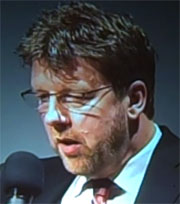
    Keynote speaker Retired Air Force Lt .Gen. James R. Clapper, Jr.
    Keynote speaker Retired Air Force Lt .Gen. James R. Clapper, Jr.

    The opening session keynote speaker was the current Undersecretary of Defense for Intelligence, retired Air Force Lt .Gen. James R. Clapper, Jr. He addressed the need for integration of intel sources and explained how difficult it is to achieve, because of security concerns about sharing data among agencies and coalition forces. He expressed apprehension about managing the flood of data — how will we sort out meaningful information from the torrent? Clapper discussed the growing uneasiness over our vulnerability to cyber attacks, and noted that new developments in biometrics make identification of terrorists easier, but complicate the ability of our forces to infiltrate hostile groups.

    General Clapper then compared the Cold War, which presented us with an enemy that was static and predictable, with the irregular warfare of today. Gone is the old environment that permitted the intel community to take days to identify and evaluate threats; now we must identify threats in mere hours by observing patterns of life and individual behavior. Clapper stated that we have become very good at precise attacks, but we still have a long way to go to prevent attacks.

    Integration on Display

    In the exhibit hall there were countless examples of improvements to existing technology, with many efforts toward data integration. There were also a few new developments on display.

    Image_003
    BAE Systems created a significant buzz — including strong mention by another keynote speaker, Maj. Gen. John M. Custer — with its new SOCET GXP system. The system grew out of SOCET SET and breaks down the wall between image analysis and geospatial analysis to an environment that the company calls Extreme Analysis. It combines imagery, geo data, metadata, attributes, and analysis tools into one unified package.

    Image_004Lockheed Martin demonstrated a very interesting capability. Starting with 3D models created by PLW with Pictometry imagery, Lockheed transforms the models with complex algorithms to reflect night-time views or varying weather conditions, with very realistic results.

    Speaking of Lockheed, the aerospace company used the conference to announce that it has signed an agreement to collaborate with Pictometry. The two companies will develop next-generation visualization tools for both domestic applications and in-theater, near-real time oblique imaging and 3D model creation using manned and unmanned aircraft.

    FortiusOne demonstrated its Web-based service that bridges GIS and GeoWeb services with very user-friendly tools that access a huge global database of coverage designed for non-GIS-trained users. The Web service not only permits the viewing of maps and data, it also allows viewers to add their own data. One example was flood maps that could be enhanced with local data and then saved as printed documents or PDFs.

    I also saw a demonstration of Zebra Technologies’ holographic video table, which displays full-motion video as a 3D hologram similar to the still holograms that Zebra has previously developed. While viewing the holodeck-style platform, I half-expected to see Princess Leia appear and ask for help. The technology is still a long way from prime time, but it was amazing to see full-motion video as a hologram.

    Getting Results

    The most impressive keynote session was given by Maj. Gen. John M. Custer, Commander of the U.S. Army Intelligence Center at Ft. Huachuca. He was probably the most passionate speaker, and clearly had a sense of urgency about his mission. He heads the intel training efforts for the U.S. Army, and described how they transformed training of intel people to be as realistic as possible so that soldiers leaving the training can hit the ground running.

    General Custer addresses the crowd during his keynote speech.

    That’s one thing about military training that impressed me early in my career: they have to get results. You can’t pretend to get a ship under way, you have to actually do it on schedule. You can’t philosophize about getting rounds on target, you have to actually do it. Having an education background, I was completely dumbfounded when I joined the Navy and saw 19-year-old kids do more effective teaching than I had experienced in high school and college. There is no better example than the work done at Ft. Huachuca.

    General Custer played a very fast-paced video showing the results; it depicted intel specialists in the field supporting their own unit under fire. They were receiving intel from many sources — satellite imagery, database from interrogations, intercepted communications, aerial imagery, down-linked video, and video from field robots in hostile fire locations — all of which were integrated and analyzed into actionable intelligence that saves lives and accomplishes the mission.

    Getting there was not easy, and the General had to overcome many hurdles, including getting live data feeds so the soldiers could train on current, real-life data. Custer’s goal was to have a training environment that was absolutely indistinguishable from the actual combat environment. He indicated that all tools are moving from thick clients to thin clients and that UAVs are playing and increasing roll in the battlefield. Brigades will be working with up to 32 UAVs, with 18 of them in the air. As a result, their data centers will be dealing with petabytes of data. Custer cited an interesting statistic he developed. He observed that in each war cycle since WWII the number of troops was only 10 percent of the previous war, but the needed data bandwidth increased 100-fold.

    The video was powerful, and Custer shared how he had personally presented the flag at over 25 military funerals to grieving widows and parents — a life-changing event. I can tell you from personal experience that he is absolutely correct. It’s one thing to attend a funeral of someone that has lived a long and fulfilling life. It’s totally different to see very young children standing in front of the boots and helmet, knowing that they will never know their dad who died for his brothers and to keep the rest of us safe. General Custer received the longest, strongest standing ovation that I’ve seen in years.

    As I looked around at the crowd I reminded myself that these are the people that have been instrumental in preventing another major attack on this county. I was reminded of the Irish Republican Army after a thwarted bombing of 10 Downing Street. The spokesman was quoted saying that Scotland Yard was lucky this time, but the Yard will have to be lucky every time — and the IRA will only have to be lucky once. I’m hoping that with everyone’s hard work we will make our own luck.

  • Puzzling Over PDFs

    By Art Kalinski, GISP

    GeoPDFs have become a very valuable tool for the GIS community, but it has been a slow evolution. My first exposure to GeoPDFs came about five years ago, when I saw a new GIS map-publishing medium offered by Layton Graphics. The local Atlanta firm started out as a microfilm copy specialist, then slowly moved into digital media. While I was in the GIS shop at the Atlanta Regional Commission (ARC), I would occasionally get a visit from one of their salespeople, but they really didn’t have anything we needed.

    As time progressed, Layton Graphics evolved further into digital publishing, and eventually into the Adobe Acrobat format. I continued to get an occasional visit, and I always gave them 10 minutes of my time. As the years progressed, however, I grew in age and my patience shrunk proportionately, so when I received a visit from them again in 2003 I barely gave them three minutes.

    But to quote my uncle, “Eventually even a blind pig will find an acorn.” The sales rep showed me a new Layton Graphics product based on Adobe technology — and it fit a real need perfectly. For the first time, my perfunctory meeting grew into two hours as I invited more and more ARC staff members to sit in on this new product demo.

    What Layton Graphics — now known as TerraGo Technologies — had created was the GeoPDF format, plus tools that manipulated the files in Adobe Reader. It was a brilliant new geospatial publishing medium. For those of you who are not familiar with TerraGo, let me explain the features that caught my attention.

    For years, we published our ARC GIS data on CDs (primarily as Shapefiles) and included a copy of ArcExplorer for those users who didn’t have a GIS. The problem with providing raw GIS data to inexperienced users is that it typically resulted in cartographically poor maps, many of which were truly terrible.

    ESRI’s Map Publisher partially solved that problem by permitting the creation of a GIS-based map as an MDF, which retained the original cartography of the publisher. The only problem was that the user had to download Map Reader, the MDF, and all the GIS data layers. Additionally, if there was a problem with Map Reader pointing to any of the data, the map would not print. Some of those problems were solved in later versions, but it is still not as elegant a solution as TerraGo’s: a single file viewable in Adobe Reader.

    In ESRI’s ArcGIS, users create maps using the data layers, colors, and symbology of their choice. When the GeoPDF is created using TerraGo Publisher (previously known as Map2PDF), the desired “look” will be maintained, but it won’t be a dumb map; the file is actually a self-contained GIS viewing environment. Users can zoom in and out, pan, and — using the table of contents to the left of the map view — turn layers on and off. There is even a query tool that permits the display of attributes as users click on the geographic features. The map layers can be GIS vector data or background ortho imagery. All these manipulations can be performed using the ubiquitous, free Acrobat Reader from Adobe.

    The thing that makes the GeoPDF so remarkable is that the GIS map layout, and all GIS data, travels as one single file: no lost or mis-pointed data! It’s foolproof for the receiver, and is very intuitive even for users not trained in GIS.

    But it doesn’t end there if the receiver is willing to download TerraGo Desktop, a free collection of even more sophisticated tools. The solution, which until recently was known as the GeoPDF Toolbar, offers users the ability to publish and collaborate on the same GeoPDF file via the Internet (annotations created on the map are viewable by all linked viewers). They can also measure distance, area, and direction, and view vehicle locations if GPS tracking data is available.

    This interactive collaboration capability really got my attention for homeland security and first-responder applications, especially in mutual aid situations. Just imagine creating a compact GIS project of a disaster location, then quickly sending the single GeoPDF to anyone responding, even those who are unfamiliar with the area or with GIS software. The annotations can be saved as Shapefiles, which makes the GeoPDF an ideal data collection environment.

    TerraGo designed the GeoPDF format with an extensive capability to store and catalog large and complex datasets. That’s one reason why the Army Corps of Engineers has published its entire collection of world maps as GeoPDF files. The National Geospatial-Intelligence Agency is another federal user taking advantage of the format.

    Discerning Differences

    There has been a Kabuki dance going on between TerraGo, ESRI, and Adobe as they try not to step on each other’s intellectual-property toes. TerraGo and Adobe worked together to get GeoPDF support in Adobe Reader. Adobe and ESRI partnered to extend the ISO 3200 specifications for PDFs to include geospatial. In the meantime, TerraGo is creating GeoPDFs from ArcMap and ESRI is creating PDFs with the proposed geospatial extension to ISO 32000.

    Now that TerraGo isn’t the only option anymore, the question for many of us is, What’s the difference between TerraGo’s GeoPDFs and geospatial PDFs created by ESRI software? For simple map creation, the answer is: not much. The Adobe solution and the TerraGo solution are very similar now that TerraGo has signed an alliance agreement with Adobe.

    By opening the door, TerraGo hopes to reach many more users to promote the added functionality of their Desktop tools. Specifically, the added functionality enables users to perform the following tasks:

    • Use drawing tools to mark up maps and collaborate between users in remote locations. The remote users don’t need GIS software or special training.
    • Convert the mark-up graphics to GIS data. This makes a GeoPDF a very simple, low-cost field GIS data collection tool. There’s no need for additional GIS licenses to do simple field data collection. This same capability permits the export of the data as Shapefiles or KML files.
    • Create complex linked collections of maps as map books, or combine many maps into a large mosaic.
    • Retain and enable hyperlinks to other documents, files, and HTML sites.
    • Display AVL (automatic vehicle locator) GPS data to show the movement of vehicles on the GeoPDF map.

    In addition, according to users of both types of files, many of the common capabilities seem to be more robust and work better in the TerraGo environment. For example, there are more problems selecting attributes in an Acrobat map than in a TerraGo GeoPDF. TerraGo has had years of experience to refine its solution and create more robust, reliable tools.

    The simple conclusion is that both options perform the key job of creating cartographically sound maps in a GIS viewing environment. Both are georeferenced. Both provide attribute query. Both provide the ability to turn layers on and off, pan, zoom, measure distances, and obtain coordinates. The subtle differences only become noticeable as you use both solutions. Whether you require the additional capabilities of a TerraGo GeoPDF — such as the collaboration and Shapefile creation — will ultimately depend on your needs.

  • Survey & Construction Newsletter, Late October 2008

    Well, if the economy is going to tank …

    … at least our industry outlook is pretty good for the next five years. Hmmm … I guess I should clarify, because the survey/construction business is clearly slowing here in the United States (I probably don’t need to tell you that). But, if you want to look at a bright spot through all of the gloom and doom of today’s global economy, the GNSS industry is looking really good for the next five years.

    Ok, I first need to apologize in advance for the shameless self-promotion, kind of. I co-authored a market research report on high precision GNSS which we just completed. The report covers the period 2008-2012 and discusses market growth, technology, trends, etc. for only high-precision (10cm or less) GNSS. Not just receivers themselves, but associated services such as augmentation (RTK Networks), distribution (dealers) and others.

    Just in the course of writing this column twice a month, I often find myself humbled when writing about GNSS issues. The “more I learn, the more I learn how little I know” cliché really applies here. Authoring the report was no different and perhaps even more challenging because of its 214-page length and breadth of topics covered. It really opens one’s eyes as to how far GNSS has weaved its way into our lives and, even more enlightening, how far it still has to go.

    Another thought: I just received an email from the people upstairs asking for bullet points to take to the budget meetings in hammering out the 2009 GPS World magazine budget. I really started thinking to myself; GNSS is one of the few industries I can think of that, even in a horrible global economy, is still going to experience growth over the next five years. We are fortunate indeed. Seriously, think of the executive running Starbucks. Imagine their forecasts for 2009? The first place people will look is to save is that $4 per day.

    Looking at the hard numbers, the global value of GNSS goods and services in 2008 will end up being approximately $3 billion (all figures are in U.S. dollars). It’s predicted that it will grow to $6 billion to $8 billion by 2012. $6 billion is realistic growth, assuming a global economic downturn and softening of some commodity prices, which is already happening. A particularly bright spot is the robust agriculture market, where there is renewed growth in precision agriculture for GNSS, primarily in high-end RTK applications.

    Looking at the above graphic, the compound annual growth rate (CAGR) in a realistic or expected scenario is 19 percent, while the optimistic CAGR is 23 percent. A significant portion of that growth is driven by widespread adoption of GNSS as a productivity tool. GNSS is transforming from a niche tool used in niche industries to an essential productivity tool in global industry sectors such as mining, agriculture and construction.

    Breaking the growth down further, the traditional GNSS markets you are familiar with will experience the slowest growth: 16 percent to 21 percent CAGR. That’s to be expected given the steady adoption rate over the last twenty years.

    Machine control applications will experience a growth of 23 percent to 28 percent CAGR. This isn’t a big surprise, as you’ve probably experienced the adoption of this technology in your daily work if you haven’t been involved with it yourself.

    The highest growth area will be precision GNSS data services with a CAGR of 33 percent to 38 percent. This includes the GNSS reference station infrastructure and wireless communications needed to deliver data services over a region, such as with RTK networks and RTK clusters. Technology innovation and development will enable precise positioning with less complexity and lower cost, thus encouraging adoption and stimulating growth.

    The steady shift in user demographics, continued evolution of space-based systems and precise positioning techniques combined with the growth of dedicated precision GNSS infrastructure and associated services are a recipe for a dynamic and rapidly changing business environment.

    So, if you’re looking for a bright light in the darkness of global financial instability, GNSS is one to talk about – and you’re right in the middle of it.

    If you want to read more about the report, there’s a 20-page abstract you can download from GPS World’s site by clicking here. You’ll have to fill out a short form in order to download the PDF, but the price is right, as in free.

    Back to the Subject of Solar Activity

    This is one of the more humbling subjects I’ve written about. As I mention above, as much as I write and try to stay on top of subjects, I seem to be a step behind at times. Fortunately, readers offer their help in times of need.

    John Sumption from Colorado commented on my last column regarding solar activity. He opined:

    It’s well worth noting that Solar Cycle 24 has not lived up to any of its advanced billing. In fact, so far, it’s been quite a dud.

    A maximum in 2011 is now virtually impossible. A maximum in 2012 is unlikely. The 11-year solar cycle usually comprises four years of rise time to maximum, and seven years of fall time to minimum. Solar Cycle 23 maximum was in 2000. It has already been eight years of fall time, and Solar Cycle 24 has so far been anemic at best. Yesterday and today a couple very small sunspecks appeared, too small and insignificant to be officially counted, and they have already faded to invisibility.

    There is active discussion across the blogosphere about Solar Cycles 23 and 24 and the possible implications. The official NOAA/NASA panel predictions you mention are expected to be “updated annually” as they say on the website. In conjunction with a Space Weather Workshop in May, the panel simply reiterated its predictions, there being insufficient data on which to base a significant change.

    As you know the panel originally issued a split decision; six of the panelists predicting larger than normal, six predicting smaller. The lack of Solar Cycle 24 activity continues to outpace the official predictions, and so far, even the six low-side forecasters seem to have overestimated Cycle 24.

    An updated prediction from this group should not be expected before Spring 2009. However, theirs is not the only forecast. IPS, the Australian Space Weather Agency, recently acknowledged the lack of activity and pushed their forecast another six months down the road.

    Jan Janssens maintains a table which contains most of the published predictions. Note that this table has not been updated in the past 12 months, as Solar Cycle 24 continues to behave unexpectedly, and forecasters have little or no additional insight on which to base new predictions.

    You’ll see in the table, no. 8, by Maris et al, reasons that Solar Cycle 24 will be small, because of the loss of energy through intense solar flares during the declining phase of Cycle 23.

    One of the most highly-experienced solar forecasters, Ken Schatten, has been wondering if the energy lost to the solar wind through low-latitude coronal holes – which are unusual at solar minimum – has left the sun with too little energy to produce more energetic spots.

    Finally, an unpublished paper (but you can find it on the web) by Livingston and Penn of the Kitt Peak Observatory notes the trend of decreased contrast between sunspots and the sun, and that if the trend continues, sunspots would vanish entirely by 2015.

    Now, you can choose to agree or disagree,  but I think John’s correct in that, so far, Solar Cycle 24 is not gearing up to be what pessimists (or optimists, depending on your attitude) that it might be. Further, he adds:

    I also should have mentioned this – from a NASA media teleconference last week about the Ulysses solar probe mission. I think the results would tend to support Schatten’s idea of the sun having an energy “leak” somewhere.

    Thanks for the insight and links, John.

  • Expert Advice: Turning from Challenge to GNSS Opportunity

    Paul Verhoef
    Paul Verhoef

    Presented here is a lightly abridged version of the plenary address by the European Commission’s Head of Unit for Galileo, Paul Verhoef, at the ION GNSS conference in Savannah, Georgia, September 16.

    After a brief Galileo snapshot of current status, I will proceed as requested with predictions of life in a multiple-GNSS world. We have secured an additional budget of €3.4 billion mainly for developing and launching the Galileo constellation, with the key objective of a full operational capability in 2013.

    Here let me talk about our second test satellite, GIOVE-B, launched on April 27. This bird is healthy and flying according to its specifications, although I hear there was a small problem that caused the satellite to go into safe mode. The engineers are currently testing the signals and using the flight and mission data to fine-tune the last parameters for the manufacturing of the 30 satellites of the constellation.

    In July the European Space Agency (ESA) launched the procurement for the Full Operational Capability (FOC). As of last week, we have a shortlist of eligible bidders for sector primes, and ESA will now start the second phase. The list will be published in the next few days. I would like to add that we have opened up this procurement internationally in accordance with the European Union’s (EU’s) World Trade Organization commitments, and with some exceptions for areas of the system that contain classified technologies. The net results will be that EU prime contractors will be able to ask for authority to use non-EU suppliers and subcontractors.

    We foresee Galileo to become operational in 2013. In the mean time, the European Geostationary Navigation Overlay Service (EGNOS) will make up the first element of the European GNSS. Just to recall, EGNOS is the augmentation system improving the accuracy of GPS and warning users of possible outages. EGNOS currently covers Europe, but extensions are being considered.

    EGNOS is in its final qualification stage. Its performance is excellent, within 100 percent availability recorded over about nine months now. The European Commission intends to contract a private operator to operate and maintain the system starting next spring. In parallel, certification for aviation use is under way with the target of end of 2009.Let me now turn to market issues that take us through the issue of a multi-constellation world.

    In Europe the emphasis has been redirected from focusing on direct revenues for the potential operator toward the possibilities to boost business, research, and the markets for GNSS applications both in Europe and worldwide.

    IP and Applications. With this new direction in mind, we are now working on two sectors: intellectual property and application issues.

    Intellectual property policy is high on our work plan for later this year and next year, and an analysis advancing on impact of various options in this context. We seek a solution balancing in a fair manner three objectives:

    • fair treatment of industries, EU or non-EU,
    • reasonable return to taxpayers’ money, and
    • ensuring the timely and sufficient availability of Galileo user receivers and downstream services at FOC.

    Against the results of a recent stakeholder consultation, we are pursuing a second closely market-related initiative, an Action Plan which spells out Europe’s objectives and plans to develop applications for GNSS.

    This will not be a marketing strategy for the European GNSS, but a list of actions that the public sector should take to support the development. For example, promote interoperability of road tolling systems in the EU and facilitate receiver development.In one word, European satellite navigation programs are on track, and we are excited that we have left behind the stormy times, and we hope that we are going to sail in calmer waters in the future.

    Spacescape Evolution

    This brings me to the GNSS fortune-telling part, as requested.

    There will be at least four global systems and at least a half a dozen regional systems in Europe, the Americas, and Asia.

    How will this affect GNSS?

    The end users have everything to gain. I like to believe those that say that Galileo — even at the paper stage eight years ago — was one of the catalysts for innovation in this sector. We will soon have four for the price of one in your next multi-constellation receiver.

    The obvious effect is that new applications will emerge as ever-more robust PNT (positioning, navigation, and timing) data penetrates service packages ranging from logistics to law enforcement.

    One cellphone maker summarized the situation for the manufacturers and end users as something between fantastic and awesome. The downstream industries are possibly the big winners, at least in the medium term, until the market reaches a saturation point and consolidation picks up pace.

    What about us GNSS providers? What’s in it for us other than footing the bill?

    Tougher Customer Requirements. We GNSS providers will need to think hard about things such as backward compatibility, trade-off management of conflicting requirements, manufacturer friendliness and, not least, listening to the users.

    We should reduce the time-to-market for new products and ensure a comprehensive and global customer support. At some point soon we need to seriously address the issue of third-party liability.

    Regulatory Work. GNSS providers believe that limited and carefully targeted regulation in satellite navigation is actually useful. Examples speak for themselves: public authorities in all four global GNSS nations have taken or plan to take regulatory measures affecting the use of GNSS. Examples: E-911 in the United States, E-112 and livestock transport in Europe, government use in China, and so on.

    Competition. Let’s face it: however governmentally, non-commercially, or multilaterally we run our systems, I do believe in the human desire for fame and reward. Each of us will want to be at least that little bit ahead of our neighbor, whatever parameters are used.  In that situation the customer will be the king and can shop around — at least if competition is not distorted with system-specific mandates, cartels, or the like.

    Trade Policy. From international competition there is usually a short way to trade policy and disputes. While trade discussions are useful, I hope we can stay clear of disputes as much as possible, as they divert resources from “the main thing.” So far that has worked quite well, yet we may need to put more efforts into verifying whether the current trade regime is sufficient and the playing field is actually level.

    Spectrum. Linked to all these developments are the various aspects of radio spectrum, some mentioned earlier today already.

    There is the increasing compatibility challenge caused by scarce spectrum, shortcomings of the International Telecommunications Union (ITU) mechanism for GNSS, and the desirability of common center frequencies, wider bandwidth, and so on. In short, a lot of work ahead of us.

    Cooperation. As you heard in my words, international cooperation will need to underpin this environment in order to ensure proper functioning of the systems.

    Evolution of Policies

    While the European Commission may be Programme Manager, it is the transport departments of the EU and its 27 member states that actually are behind Galileo. They have done this for specific purposes: they want to use it.

    Our research, space, foreign policy, and, believe it or not, finance colleagues tend to push this cart with us — usually in the same direction. As Galileo gets closer to the operational capability, the interest of the other departments, institutions, and stakeholders in Galileo and GNSS in general is likely to increase.

    It is here in the United States where you have accumulated the longest experiences in this field. As we have heard, transport and other non-military policies have started to weigh more in the management of GPS over the years.

    GLONASS is also diversifying with a higher civilian content. Our colleagues in Asia are moving forward with civil applications of higher density.

    I foresee two trends:

    • First, whatever the policy mix behind the various systems, we can observe today an element of GNSS patriotism, alive and kicking. We all want our own systems and for quite legitimate reasons. That trend is likely to continue for some time still in the form of states or groups of states deciding to build their own regional or even global systems or integrity networks. In this business, added security or sovereignty qualifies as return on investment just as well as service quality, new jobs, or straight cash.
    • This is not the only trend in town. And yes, there is a counter-current hatching in the United Nations International GNSS Committee (IGC). Already the conception years of this new forum have created somewhat the “we are in the same boat” atmosphere among GNSS providers.

    The point is that the IGC is becoming the place for all the providers and users to discuss GNSS coordination issues across several sectors (the ITU, International Maritimie Organization [IMO], and International Civil Aviation Organization [ICAO] are sector- or issue-specific).  We have already seen signs of reaching the limits of bilateral coordination, for example, regarding compatibility and interoperability in a multi-constellation world. Deliverables from the IGC so far are encouraging, and the forum helps in communication and transparency between the participants.

    I would expect to see cooperation emerging among the providers in constellation and ground-segment management from a pure cost point of view. It is like owning a sports car; as the mileage accrues over the years, the talk shifts from tuning options to maintenance bills.

    Conclusions

    The evolution of GNSS is bound to foster new applications; the quantum leap in available satellites and services will give end users and manufacturers sizeable benefits. The GNSS providers will need to adapt to this new reality and volatility and have a vision of what it is we actually want to achieve. Considerable investments in security will be needed at different levels of the systems.

    That said, where policies are concerned, we will probably be witnessing two conflicting trends: GNSS patriotism and multilateral action through the IGC.

    In the GNSS provider states, the mix and evolution of the national policies guiding GNSS development varies considerably. The tendency is towards enlarging, however, the group of stakeholders (government or other) involved in policy-making towards more and more user sectors.

    In any case, in Europe we finally believe that satellite navigation is facing a fabulous future: technology trends such as personal computing, mobile communications, and the Internet come to mind.

    We need to turn this challenge into an opportunity. There are many global issues to which satellite navigation can bring a small but important contribution such as climate change, reduction of CO2, reduction of fuel consumption, search and rescue, and much more. Ladies and gentlemen, I would like to thank again our hosts for giving me the opportunity to present our intentions with this conference, and I thank you for your attention.

  • Survey & Construction Newsletter, Early October 2008

    Solar Activity: Is There Aspirin for This GNSS Headache?

    Like the hurricane/cyclone/typhoon seasons that occur every year around the globe, one fact of life about GNSS is space weather and the solar cycle. For professionals who use GNSS on a regular basis, it’s easy to forget about it since it’s not an annual event. In fact, those of you who have been using GNSS for only the past five years haven’t experienced it at all. Why? It’s an 11 year cycle, and it’s starting to heat up.

    How does Solar Activity affect GNSS?

    There are many, many papers on this subject that can offer you a lot of depth on this subject; just google “solar cycle GPS.” In my Eric Gakstatterish sort of way, I’ll write a brief description of how it affects GNSS.

    The effect on GPS signals as they pass through the ionosphere is the largest single source of error that we see in GNSS today. Essentially, free electrons contained in the ionosphere affect the propagation of the signal as it passes through. Since the signals are traveling at the speed of light and GNSS is based on nanosecond timing, it doesn’t take much interference to introduce error.

    For a graphic and more detailed information on the ionosphere, click here.

    Modeling the Total Electron Content (TEC) of the ionosphere is something you may have heard of when reading about GNSS. TEC is directly affected by solar activity, and thus the solar cycle.

    The solar cycle is an 11-year cycle of solar activity. Following is a nice graphic from the U.S. National Oceanic and Atmospheric Administration (NOAA) that’s on their Solar Cycle 24 web page. Solar Cycle 24 is the name of the solar cycle we are entering into.

    From the graphic above, you can see the height of the next solar cycle will occur in the 2011-2012 timeframe. That’s when the TEC will be the most dynamic and the most difficult to model. You might also note that there are two prediction curves (along with their uncertainties); this is because even the experts can’t agree on just how big the next cycle will be.


    Which GNSS users will it affect the most?

    GPS L1 (single frequency) users will be affected the most. GPS uses a rough model, often referred to as Klobuchar (a scientist’s name), in an attempt to the model the ionosphere and minimize the effect for single frequency users. When the model closely resembles the actual TEC, then the TEC has minimal effect on single frequency accuracy and you are a happy user. When the actual TEC is much different than the Klobuchar estimate, that’s when the problem occurs. It’s sort of like that moment when you figure out you estimated 200 man-hours on a project that will take 500 man-hours … oops.

    During the low point of the solar cycle is when the TEC is easiest to predict. Looking at the chart above, we are currently at the low point and really have been in a nice place since about 2004. Over the next two or three years, it’s going to change dramatically as the character of the cycle is such that it rises sharply in the beginning.

    Autonomous GPS (using no correction source) accuracy has been very good these past couple of years (2-3 meters under ideal conditions). Because it’s been so good, some of you are relying on it for mapping. The increase in solar activity will affect you the most.

    You will see some really funky data.

    For those of you professional single-frequency GPS receivers who have built up confidence in your sub-meter mapping receivers, you need to be particularly aware. It would not be out of the ordinary for your DGPS-corrected position to have an error of more than 10 meters. That includes WAAS, DGPS beacon, commercial DGPS services, and post-processed solutions. In theory, if the accuracy of DGPS corrections (SBAS, DGPS) deteriorates sufficiently, you should be forewarned. However, how your particular piece of equipment handles that warning is up to each manufacturer.

    Practically speaking, those errors aren’t going to occur on a daily basis. That would only occur during extreme solar storms. In fact, that order of magnitude will probably be quite rare, but certainly additional error in the 0.5-meter or 1-meter range will be more common than what you see now. The fantastic performance we are seeing today from autonomous GPS as well as SBAS isn’t just because of improved technology; it’s also due to the fact that we are in low point in the solar cycle.

    Users of dual-frequency GPS receivers and multiple-frequency GNSS receivers will be affected less, but still affected. Ambiguity resolution will take longer (or not be achievable at all) during periods of heightened solar activity. However, these systems will fare better than their single-frequency brethren as multiple frequencies and shorter baseline distances typical of multiple-frequency users make it much easier to model the TEC.

    Interestingly enough, this solar cycle ,with its effects diminishing after about 2016, should be the last one where we will have such concern. Think about it: it will be 2023 or so before Solar Cycle 25 starts to crank up. At that time, L2C, L5 and GPSIII will be in full bloom, not to mention Galileo and GLONASS, so the ability of our GNSS equipment to model and mitigate the effects of TEC will be much more advanced than it is today.

    What can you do about it in the meantime?

    First of all, educate yourself and understand your equipment’s exposure to solar activity. Here are some great links.

    GPS World article from May 2003

    NOAA Solar Cycle 24 Prediction issued April 2007

    NASA feature article on the beginning of Solar Cycle 24

    www.spaceweather.com

    My esteemed GPS World colleague Richard Langley from the University of New Brunswick has also tackled this subject; he can provide you with the Richard Langleyish, scientific perspective.

    Next, towards the end of 2009, make it a point to start checking up on solar activity. A great place for Europeans to do this is at the Royal Meteorological Institute of Belgium’s website. The U.S. National Weather Service also operates the Space Weather Prediction Center. Also, note that for those users along the equator, your area is more susceptible to dynamic TEC changes.

    There is no doubt you will hear more and more about the impending solar cycle as it ramps up: more research, more data collection, and more analysis. Some space weather experts say this cycle will be worse than the last, some say it won’t. However, there’s one thing they all agree on: we won’t know until it’s here.

  • Survey & Construction Newsletter, Late September 2008

    ION GNSS Conference – Not This Year

    Well, it wasn’t meant to be. Hurricane Ike made sure of that.

    I travel quite a bit and I never fly Continental Airlines, but there aren’t a lot of choices when flying to Savannah, Georgia from Portland, Oregon. So a couple of months ago, I booked my flight to Savannah on Continental with a connection in Houston, Texas.

    Hurricanes and Houston don’t mix well this time of year. Anyway, Hurricane Ike wreaked havoc on southeast Texas. Houston’s airports were closed for the weekend (my flight was supposed to depart last Sunday). Continental, being a small airline with limited routes, couldn’t get me to Savannah until Wednesday night at the earliest. Other airlines were jammed up trying to reroute people around the Hurricane-affected airports.

    So be it … no ION conference for me this year. Too bad, it’s my favorite conference of the year because I get to see where companies and organizations are putting their research effort which, in turn, gives me a good idea where GNSS technology for surveying/construction is heading.

    At ION, one of the things I was scheduled to do was give a presentation at the Civil GPS Service Interface Committee (CGSIC) meeting on Monday. This year is the first time the CGSIC is allocating GPS World a slot on the agenda. The topic of my presentation was entitled “WAAS for Mapping: It Works Where You Work.” So, instead of presenting it at ION this year, here you go.

    First of all, let me tell you that even though the applications featured are focused on WAAS, this is really about SBAS (satellite-based augmentation systems) in general. That includes MSAS (Japan), EGNOS (Europe) and soon, GAGAN (India).

    Trends in GPS mapping

    The user community expects GNSS technology products to become smaller, cheaper, simpler, and higher performance.

    For the most part, we have seen that trend develop in the past decade. GPS mapping products have migrated from heavy, backpack-based systems with a medium-sized dome antenna, DOS-based data collector, VHS recorder batteries, antenna cable, data collector cable, and power cable to the small handheld devices and small receiver boxes of today. Likewise, prices have fallen considerably. The market prices for a sub-meter mapping system are 50 percent to 60 percent 60 less than a decade ago.

    The GPS mapping user community is moving away from post-process differential correction and towards real-time correction.

    The reason is quite simple: simplicity and cost. Post-processing is a pain and it’s expensive. It’s not just the cost of the software and software maintenance contracts, it’s the personnel training to stay current on the software, it’s the cost of time to post-process and it’s the cost of not having real-time data in the field. Yes, there is a cost of not having timely data.

    One of the arguments for post-processing is that it’s more accurate. From a pure scientific standpoint, that’s a correct statement, but it’s crazy to make that sort of general statement. I could show you data that shows that statement is correct and also incorrect. Like most answers to GPS accuracy questions, the answer is, it depends: it depends on the receiver, it depends on the application, it depends on your personnel qualifications, etc.

    SBAS makes real-time GPS correction simple and cheap, as in free. WAAS has matured over the last five years since it was declared operational from providing 1 meter to 3 meter accuracy to where it is today, providing accuracies of well under a meter in the continental United States, Alaska, Mexico, and most parts of Canada. The simplicity and low-cost of SBAS makes sub-meter mapping attainable by a larger percentage of the user community.

    All WAAS (SBAS)-Enabled Receivers Aren’t Created Equal

    One of the common experiences with WAAS (SBAS) in mapping applications is that the user will attempt to use a consumer-grade GPS unit (eg. Garmin) and, predictably, the performance will be poor. Consumer-grade GPS units aren’t designed for accuracy. They are designed for fast satellite acquisition, low-power consumption, low-cost, and easy user interface.

    I don’t know if you’ve been paying attention, but the newer consumer-grade GPS units don’t mention SBAS like they used to. It’s because the difference between autonomous positioning and WAAS-corrected positioning isn’t a significant issue with respect to the average GPS consumer who is navigating from point A to point B. Go look at the mapping Handhelds section on the Garmin website. There is no mention of WAAS in the specs. The reason? Garmin doesn’t care about WAAS for the ground user.

    If the GPS manufacturer does care about WAAS for ground users, there is a lot they can do to optimize the use of WAAS (SBAS) so it can perform in environments where a standard WAAS-enabled receiver couldn’t dream of working. One technical paper on this subject was published by Stanford University and presented at the ION conference in 2006. Euiho Kim, Todd Walter, and David Powell from Stanford presented a paper entitled Optimizing WAAS Accuracy/Stability for a Single Frequency Receiver.

    Some manufacturers have done this and more to exploit WAAS so it can be used in environments where a receiver implementing the traditional use of WAAS couldn’t. I can write about this until I’m blue in the face, but the proof is how the user community is using WAAS with high-performance receivers in applications where many people say WAAS can’t be used. I know of a few of them around North America and have provided a short synopsis of each to give you an idea.

    Applications of WAAS in North America

    Company: J.D. Irving Ltd.
    Employees: 15,000
    Industry: Forest products
    Location: Eastern Canada
    Application: harvesting timber
    User Statement: “The general misconception is that WAAS doesn’t work under forest canopy. (For us) It’s proven to be a false assumption if the right receiver is used.”

    Company: American Forest Management, Inc.
    Employees: 250
    Industry: Forest management
    Location: Virginia to Texas, Maine to Michigan
    Application: Area calculations, forest road work, land owner mapping
    User Statement: “Our field efficiency has drastically increased due to reliable reception and ease of use … office productivity also increased because of real-time correction.”


    Company: Portland General Electric
    Employees: 2,600
    Industry: utility
    Location: Oregon
    Application: utility pole mapping
    User Statement: “Four years ago, we started out using low-end WAAS receivers, but switched to mapping-grade WAAS receivers after 60 days due to accuracy problems. 225,000 poles and four years later, we are still using the same WAAS receivers.”

    Company: State of Minnesota
    Employees: a bunch
    Industry: state government
    Location: Minnesota
    Application: mapping abandoned chemical facilities
    User Statement: “Approximately 500 facilities were mapped using a Bluetooth, sub-meter WAAS GPS and a Windows Mobile data collector. Wireless technology eliminated connectivity problems and the receivers had COAST technology, consistently giving us submeter, real-time results, even in areas that had poor visibility.”

    Company: U.S. National Park Service
    Industry: federal government
    Location: sub-arctic Alaska
    Application: map archaeological sites
    User statement: “Many mapping grade GPS users still do not feel good about relying on WAAS. You can always post-process, but after reading these numbers, some may ask why bother?”

    Other Related Trends in Real-Time GPS Mapping

    Not only is WAAS (SBAS) being exploited by some manufacturers of sub-meter GPS mapping equipment, some manufacturers have introduced survey receivers that also exploit WAAS, but use another satellite observable for centimeter-level positioning rather than using the WAAS correction itself.

    In optimal scenarios, this potentially adds another two observables when resolving ambiguities for RTK positioning.When manufacturers start designing products around a technology, it speaks highly of the future of that technology.

    RTK networks (RTN) are experiencing explosive growth around the world.

    It’s a relatively new technology that will add to the proliferation of real-time users for both RTK and sub-meter mapping systems. RTN’s primarily cover metro areas at this time, but some countries have recently announced the implementation of country-wide RTNs. Look for more editorial coverage on this in the future.

    Commercial DGPS services have shifted from offering L1 sub-meter DGPS products to decimeter L1/L2 products in certain regions in the world.

    DGPS signal providers have recognized that WAAS/SBAS fills the requirement for sub-meter corrections where it’s available. They haven’t stopped offering L1 sub-meter DGPS corrections, but certainly have shifted their focus to the GPS L1/L2 market.

    On The Not-So-Positive Side of Things

    We’ve enjoyed many years of relatively quiet ionospheric activity. In a sense, we’ve taken for granted the awesome increase of GPS accuracy (both autonomous and DGPS). This is going to change as the next solar cycle cranks up. It’s an 11 year cycle that began early this year and will reach its high point in 2011 or 2012.

    What’s so bad about solar activity?

    For GPS users, errors induced by significant ionospheric activity can be measured in meters or even tens of meters even if you are using a DGPS correction source such as WAAS, beacon or RTN. Some experts say the next solar cycle will be worse than average. Some say not. All of them say “we won’t know until it’s here.”

    Read more about Solar Cycle 24 here. The subject is worthy of an entire article; which I will write in the coming months.

    Be sure to watch the live coverage that my fellow editors will be providing from the ION GNSS conference in Savannah this week.

  • Seeking Synergy

    By Art Kalinksi, GISP

    Three weeks ago, I attended the Second Annual Synergy Conference and Expo in southern Florida. The operations and intelligence conference was organized by Nancy Wheeler and Brigadier General Billy Bingham, USAF (Ret). Although both are retired from intel, they continue to work in the community through their support of the Government Emerging Technology Alliance and the conference co-sponsor, the United States Strategic Command (USSTRATCOM).

    The conference was very well organized and was a superb opportunity for civilians, contractors, and all ranks of military personnel to interact freely. Junior enlisted personnel, such as Air Force Sergeant Barrett and Senior Airman Roach, who had hands-on Predator image analysis experience, were given as much attention as their senior counterparts.

    I’m writing this column not as a knowledgeable intel guy, but rather as an intel outsider with a GIS focus. Although I served 20 years in the Navy, my experience with the Navy intel community was very limited. The “spooks,” as we called them, were usually cloistered behind cipher-lock security doors in rooms that were impervious to electronic spying, where disruptive background music thwarted any eavesdropping. Occasionally, someone reminiscent of the Wizard of Oz door guard would open a security window and pass us a scrap of classified paper telling us to do something or sharing some very limited information. We “ops pukes” would then act on the intelligence, sometimes blindly depending on the source. At the time, that was the model common to all branches of the military, with its origins going back to Napoleon’s army.

    At Synergy, I learned that the old Napoleonic model is changing dramatically; the conference title confirmed the evolution in thinking and action. Synergy refers to the merging of Operations and Intelligence divisions, and is spurred by changing operational needs — specifically, the increasing need for speed. According to General Bingham, gone is the time when operational forces reacted to intelligence within days. Now, even a reaction time of hours is not good enough; instead, it must be measured in minutes. Additionally, many of the operational forces are also major intelligence collectors.

    In the old days, the need for security trumped the need for fast response. Information was secured through multiple layers of security and compartmentalization. Even if there was a bad apple who leaked information, very few individuals possessed enough information to cause serious damage.

    Today, that model is changing because of the rapid changes to the operational situation. However, much of our satellite imagery, sources, and methods are still carefully protected, with limited access by our operational forces. That’s the key reason I joined my current employer: to get very high-resolution, but unclassified, oblique imagery into the hands of our operational ground troops quickly. (In fact, I attended the conference because Pictometry will be an exhibitor next year, partnering with Lockheed Martin to install oblique imagery cameras on the Predator and perhaps the Osprey.)

    The keynote speaker, Lt. General Mark Owen of USSTRATCOM, discussed the evolution of the command’s mission. Historically, USSTRATCOM was primarily involved in strategic nuclear deterrence, but its mission has been extended to cover all WMDs, space warfare, and cyberspace.

    Colonel Stuart Maberry, USAF, addressed the problems associated with irregular warfare. His presentation reminded me of a visionary Naval War College Review article written back in 1989 by CDR Steven Rose that described the array of threats we would face, including chemical weapons, biological attacks, and even nano-technology. Rose mused that one day we might long for the “good old days” when all we had to worry about were nuclear weapons. I can relate to that, having served in sensitive weapons assignments. Nuclear weapons require significant technical skill and ongoing maintenance if one hopes to achieve nuclear yields, as opposed to just a dirty bomb. The other dubious upside of a nuclear attack is that you know that you’ve been attacked, as well as when and where. This information may then point to the attacker.

    That may not be the case with cyber, chemical, and biological attacks that could seem like accidents or natural outbreaks. Add to that the relative simplicity of creation and delivery, and the fact that some of our enemies have no concern for collateral damage — or even their own lives — and the problem gets very serious. The only effective defense seems to be very good intelligence and constant vigilance.

    Major General Michael Ennis USMC of the CIA discussed current intelligence efforts, with a focus on human intelligence collection. It was interesting to note how valuable he considered open-source information as a way of confirming intel collected from other sources. He indicated that Internet blogs and Web sites, because of their numbers, are sometimes a superior source of information. He also expressed concern over the chasm between the ops and intel groups, and the walls that still exist between domestic and overseas collection, as well as the cultural differences between military and homeland agencies (such as the ATF and FBI).

    The vendor expo section had a strong focus on data management and data mining; countless products addressed the complexity of managing a flood of data. I observed numerous products and services that were not easily understandable. In many cases I couldn’t tell if I was looking at vaporware or I just wasn’t smart enough to understand that I was looking at a marvelous new development. After talking to some attendees, I suspect that it was a little of both.

    Of course homeland security agencies, all the military branches, and the intelligence community are big users of GIS technology, so one would expect ESRI to be an exhibitor. Indeed, ESRI had a booth demonstrating ArcGIS and ArcGIS-related products, including custom applications, but I didn’t see anything new other than some statistical analysis packages and discussions about Image Server. Spatial Analyst seems to be more important to the intel community than to most other GIS users I’ve seen, who are more involved in cataloging than analysis.

    ERDAS demonstrated its wide array of GIS data and image processing software, including the universal data translator TITAN. Adobe demonstrated its geo-referenced PDF maps, as well as publishing and collaboration tools. In the coming weeks I’m going to learn about (and report on) the differences between PDFs and the capabilities of TerraGo Technologies’ GeoPDFs.

    Zebra Imaging showed examples of its 3D holograms of buildings and neighborhoods. Although they looked very impressive, it was difficult to assess the benefit holograms offer over other visualization tools. I believe that we are still early in the life cycle of this promising technology, and I look forward to seeing how it will evolve.

    In one of the closing plenary sessions, LTC Casey Carey discussed the Sons of Iraq program, which (along with the surge) changed the entire dynamic in that country. By enhancing community relations and bringing Iraqis into the fold, intelligence gathering and the effectiveness of all coalition forces was greatly improved. This was a complex effort that required imaginative thinking. Life was simple when all we asked the military to do was kill people and break stuff. Now they also have to be military tacticians, spies, intelligence analysts, public works engineers, economic developers, diplomats, and even social workers. As if that isn’t enough, most of them are very young, without the benefit of college degrees or years of experience.

    As part of a panel discussion on mega-trends, Bob Gourley of Crucial Point, LLC, talked about the convergence of PCs and cell phones; there will be more than 6 billion G3-type phones in use worldwide by 2014. Add to that the changing rules governing domestic origins of calls, and we have a very daunting surveillance task. The panel also discussed In-Q-Tel, the nonprofit incubator for CIA support companies. One of In-Q-Tel’s success stories was the creation of Keyhole, which was later acquired by Google as Google Earth.

    There are three themes of the conference that I can’t overemphasize. First of all, GIS and related image processing software, along with data mining software, are growing in importance as the environment of the intelligence community grows increasingly sophisticated and complex. Second, there are many more people, military and civilian, involved in this work than the average person would imagine. Third, if you know any new graduates with GIS or computer science backgrounds, let them know that there are some very interesting career opportunities in the intel communities — the work is serious and significantly more interesting than printing road maps or maintaining a parcel tax map.

    My hat is off to the legions of military and civilian workers that are currently operating to keep us safe. They need all the support we can provide, and I hope our leaders keep politics out of these profoundly important issues. My overarching impression is that we have a lot of very smart military and civilian people spending countless hours to protect our interests. It’s very hard work in a constantly changing environment of one-upmanship. The classic Mad Magazine Spy vs. Spy cartoon serves as a good analogy, and I saw the cartoon included in several presentations. The difference is that the stakes are very high, and the results of failure not funny.

  • Survey & Construction Newsletter, Early September 2008

    Civil P(Y) follow-up and ION GNSS

    I figure it’s about time for a follow-up newsletter on the Civil P(Y) sunset proposal by the GPS Wing.

    In June, I wrote a very important column about the GPS Wing proposing to discontinue supporting P(Y) on L1/L2 for civilian users after December 31, 2020. Essentially it would mean that many dual frequency receivers of today will be rendered obsolete after that date.

    The U.S. Department of Commerce attempted to solicit comments from the public regarding the proposal. You can view the responses here. I was somewhat surprised at how few responses were submitted.

    It is predictable that equipment manufacturers are in favor of the proposal. There is significant upside for them in terms of new equipment sales and little downside, if any at all. The objections again, predictably, are from the users in the trenches who have invested a significant amount of their own capital into high precision GPS equipment.

    I can see a several reasons for the lack of responses:

    • Users aren’t aware of that impact this may have on their operations.
    • It’s too far in the future for users to be concerned.
    • It’s far enough in the future that users feel technology will change and render this a non-issue.

    Of course, I think it’s a little bit of all three. The first is the one that concerns me the most. That’s why I supported an extension to the comment period (30 days). I strongly believe there is a general lack of awareness of the subject at all, not to mention the impact it will have. If surveyors/technicians around the world haven’t been keeping up with the trade publications these past three months, they have no clue what’s in store for them.

    The second and third assume the user is educated on the issue and has made conscious decision not to be concerned.

    A few of you asked for a list of specific model numbers which will be affected. I’m working on one, but I don’t think it will ever be comprehensive enough to be 100 percent complete. What I tell people is that if the receiver isn’t able to utilize at least L2C (preferably L5 also), then it’s considered a legacy receiver and will be affected by the GPS Wing’s proposal. If you have any question as to whether your receiver can utilize L2C, you should contact the manufacturer of the equipment. Keep in mind that most companies begin to phase out support for older products (so called EOL or end of life models) after a few years, and some manufacturers may no longer exist at all.

    If you confirm your receiver uses legacy technology, I wouldn’t be in a panic to take action now. I have a feeling that manufacturers will offer some sort of trade-in program at some point. It may not be for another 7 to 10 years from now, but I think they will. The exception would be that if prices for high precision GNSS receivers drop dramatically (looking out 7 to 10 years from now) because of fierce competition, they will be so low that manufacturers won’t be able to afford it. But then you probably won’t care as much anyway.

    As I mentioned in the last newsletter (about the ESRI conference), I spoke briefly with Col. Madden, Commander of the GPS Wing, about the Civil P(Y) sunset proposal. Quite a straight-forward guy if I can say so. He says that maintaining backward compatibility in GPS is becoming increasingly expensive and that they have to draw the line somewhere.

    “Whether it’s 10 or 20 years, we don’t care,” said Madden. “But we need to put a marker down.” He said it currently costs $2.5 million per day to maintain GPS. In 2009, he said that cost will rise to $3.5 million to $4 million per day.

    The December 31, 2020 date is not final yet, but all indications are that it will indeed be the date. I should learn more at the Institute of Navigation (ION) GNSS conference held in Savannah, Georgia in a couple of weeks.

    I’m at ION

    Speaking of the ION GNSS conference, I’m on the agenda for the CGSIC meeting prior to the conference. The DOT has been pushing their NDGPS agenda pretty hard this past year to try to save the program. That’s fine, but I get a little ticked off every time I hear them tell people that WAAS isn’t a valid technology for mapping. Hey, if you think NDGPS is the way to go for you, then talk about NDGPS and stop trying to bring down other programs to further your cause.

    So anyway, I think a little equal time is in order. I’ll be presenting on how WAAS is being used for mapping. I picked out a half a dozen or so organizations around North America that are using WAAS with high performance GPS receivers. There are some neat examples of where WAAS is being used in places you might not think possible, and also how WAAS is being used by centimeter-level GPS equipment to speed up initialization times.

    I’m sorry I can’t include examples of EGNOS (Europe) and MSAS (Japan) users in the presentation, but I’ve only got 15 to 20 minutes. But I’ll be sure to mention EGNOS, MSAS, and GAGAN as well. I know you are all alive and well.

    Be sure to follow the live coverage that I and my fellow editors will be providing from Savannah the week of Sept. 15-19.

  • Survey & Construction Newsletter, Late August 2008

    Attending the Annual ESRI Networking Conference

    As much as surveyors, engineers and constructors may not appreciate geographic information systems (GIS) technology, at some point everyone should attend at least the ESRI Survey/Engineering Summit and the first couple of days of the ESRI User Conference held every summer in San Diego, California. This is not a GIS sales pitch. It’s a networking sales pitch. When other conferences are struggling to maintain attendance levels, the ESRI conferences seemingly never fail to grow in attendance. This year, it attracted some 15,000 people from 120 countries. That means gobs of GIS people, and also gobs of surveyors and engineers.

    The Survey/Engineering Summit is a much smaller subset with some 500 attendees, and takes place the weekend before the User Conference. This year, it was the first weekend in August. Although relatively small in size, the conference is significant enough to attract someone the caliber of Col. Dave Madden as a keynote speaker. Col. Madden is the U.S. Air Force GPS Wing Commander, and as such he’s in charge of GPS. With a fiscal 2009 budget of $1.5B, it is the fourth largest budget in the U.S. Air Force. That means he has some clout, and that’s the quality of speaker that the ESRI conferences have the ability to attract.

    It’s All About Networking

    Most times, I’m like you: worried about the day-to-day stuff of running a business or department, or just getting stuff done on time and on budget. CEUs are hard enough to keep up with, not to mention taking a few days off during prime outdoor season (and spending a chunk of change) to attend a GIS conference.

    But I tell you what; this is the place to mix it up with all kinds of people beyond your local association chapter. Not that there’s anything wrong with that, but I guarantee that networking with 15,000 people will open your eyes a lot wider than networking with 25 people. If you’re looking to expand your business, whether it’s GIS-related or not, you will probably meet someone in San Diego who is doing it already.

    Take, for example, Michael Dennis of Geodetic Analysis LLC. Have a question about geodesy? Here’s a guy who gave a presentation entitled “GPS, Geodesy and the Ghost in the Machine.” Part of his presentation included dissecting National Geodetic Survey (NGS) Datasheets. Mind you, there’s a half dozen NGS people in the crowd! Sort of like giving a presentation on Windows to Bill Gates, isn’t it? That’s the kind of expertise walking around at this conference.

    While I’m on the subject of NGS, they had a whole pack of people there. Soon-to-retire director Dave Zilkowski gave a lunch-time presentation to approximately 200 attendees. Want to talk to the manager for CORS at NGS? He was there. Want to talk to someone at NGS about network RTK? Bill Henning was there. Want to talk to someone at NGS about OPUS? Yep, there too.

    What other opportunity do you have to sit down and have some face time with this caliber of people?

    Back to Col. Madden

    The theme of his presentation was about how the GPS Wing needs to improve on executing their strategy. A big part of what he was alluding to was keeping the schedule on target for the different programs. For example, there’s no navigation message on L2C and he said there won’t be until 2011, when the control segment (OCS) systems are upgraded. There won’t be a navigation message for L5 either until 2011, even though the first Block IIF (L5) satellite will be launched next year. It’s a good example of the space segment (satellites) and control segment (ground infrastructure) not being in sync. The L2C pilot carrier is available now, so carrier phase users (centimeter-level) are still able to use L2C carrier while utilizing the navigation message from L1.

    When he was on the subject of keeping schedules, I asked Col. Madden about launch schedules — more specifically, keeping the schedule that they set. He said two things.

    First of all, they need to do a better job of giving realistic launch dates. They move a lot. The seventh Block IIR-M satellite was due to launch last June and has been pushed out until October. The eighth, and last, Block IIR-M satellite was pushed out until December. Also, the first Block IIF satellite, in which an early 2009 date has been floated for quite some time, doesn’t look like it will be put into orbit until August 2009 or later.

    Secondly, and most importantly, he said it’s all about the $$. Launching satellites is an expensive business. He said “it takes $60 to 70 million to build a GPS satellite and its $200 million for the launch vehicle.”

    As successful as GPS is, Col. Madden is fighting for budget dollars like other program managers. As I mentioned above, he’s got the fourth largest budget in the US Air Force. When Congress looks at areas to save money, it’s easy for someone to say “Just cut 10 percent from GPS and we’ll save $150 million!” Also, it doesn’t help that there are now 31 operational satellites, way more than the guaranteed minimum constellation of 24. The problem is that, as high precision users, we need every one of those 31 operational satellites. We need to continue to raise our hand from the back of the room and be counted.

    I know it’s hard, but plan for the ESRI conference next July. I know, I know, it’s prime field season. But, give it a chance and you can take a lot from it. Like I wrote above, don’t look at it as a GIS conference, but rather a networking conference. It may change your business model or even your career path. You’ll have the opportunity to talk to more people than you have in years.

  • BIM, Son of CAD and GIS

    By Art Kalinski, GISP

    For those of you who haven’t been looking over the cubicle wall, there is a quiet revolution occurring in the CAD world that is affecting the GIS community. That revolution is BIM (building information modeling). BIM was developed in the mid-90s by the American Institute of Architects (AIA) to bring building design into the 21st century, but BIM is much more than just a building design model. Very simply put, it combines the best capabilities of CAD software with the best capabilities of GIS in a 3D environment.

    For years, many designers understood that the primary limitation of CAD software is that CAD drawings consist of points, lines, and polygons, with no topology and no link to a database — just object ID numbers. CAD traditionally focused on the quality and detail of the drawing, with a strong focus on 3D visualizations.

    Conversely, GIS is a topological model of points, lines, and polygons that’s linked to a database. Because of topology, a GIS understands relationships and can perform analyses such as what object is next to another, what object is within another, and what object intersects another, and display the results graphically or within the linked database.

    CAD drawings can look very good, because the software was designed to that end. GIS also draws points, lines, and polygons, but the tools were not designed to do sophisticated renderings. The best analogy I can think of is Microsoft Office. You could draft a letter in Excel, but it would be awkward and probably not look as good as one prepared in Word. Likewise, you could create a spreadsheet-style document in Word, but it wouldn’t have all the mathematical functionality of an Excel spreadsheet.

    Family Factions

    The CAD and GIS communities have, for the most part, lived separate lives, even in my own family. For years, while I was the GIS manager of the Atlanta Regional Commission (ARC), I taught ArcView classes. I offered to teach my son and daughter this entry-level GIS so they would have one more tool to put on their resume, but neither was interested in “that GIS stuff.” My son Alex was an electrical engineering major, and he learned CAD software as part of his program. Two years ago he received an internship with CH2MHILL doing CAD work. After he graduated, CH2MHILL grabbed him full-time, and he continued working on electrical design projects.

    Six months ago I was chatting with Alex about his new job and budding career. He was excited, explaining that he was now doing much more sophisticated work. He described a new software program that permitted him to link the elements of CAD drawings with a database that could then be searched spatially or through the database. With a tilt of my head I asked, “Do you realize that you’ve just perfectly described a GIS?” He said, with a look of revelation, “Is that what you’ve been doing all these years!” We both laughed, realizing that — unknowingly — the apple didn’t fall too far from the tree.

    My son “gets it” and understands the broad capability of BIM, but he’s in the minority. If you read some of the CAD blogs regarding BIM, most CAD people don’t get it yet. Many still view BIM as just a new kind of 3D model and miss the entire concept of topology and linked databases. This presents a huge opportunity for GIS professionals, since you already understand and have been performing spatial analysis in this topological environment.

    BIM of a Pantex Plant during initial design phase. Note building components, conduit, piping. Images courtesy of CH2MHILL.
    BIM of a Pantex Plant during initial design phase. Note building components, conduit, piping. Image courtesy of CH2MHILL.
    Images courtesy of CH2MHILL.
    Images courtesy of CH2MHILL.
    BIM showing complex system of piping, ventilation, electrical and other building and equipment components. Courtesy of CH2MHILL, Atlanta, GA.
    BIM showing complex system of piping, ventilation, electrical and other building and equipment components. Courtesy of CH2MHILL, Atlanta, GA.

    John Przybyla of Woolpert, who has worked in both disciplines for years, cautions us GIS people not to underestimate or downplay CAD projects. He used a simple wall as an example. In a GIS a wall may be represented as one or two lines, but the detailed CAD drawing could contain more than six layers of data: paint, drywall, framing, blocking, fire stops, insulation, etc. So there will be a learning process on both sides as we evolve. On the other hand, Przybyla wishes that GIS had more robust 3D modeling.

    Putting BIM to Work

    The 500-pound gorilla in BIM software is Autodesk’s Revit. Bentley BIM and Oracle are big players, and ESRI is working hard to be a contender in the BIM environment too. At the ESRI International User Conference, the plenary session included a demo of work being done at M.I.T. Michael Parkin demonstrated a 3D GIS model of the Cambridge campus that he created. Using the model, he was able to spatially identify by horizontal and vertical location each laboratory that was sensitive to noise and vibration. Parkin then created an intersecting 3D sphere of influence that would result from a planned construction project. This would help campus officials minimize the interference by changing schedules, or even moving some labs.

    Parkin also mapped, in 3D space, the location of campus parking spots and of the offices of assigned users. This helped the school assign spots closer to the users’ workplaces — something of a 3D trade area analysis for parking garage customers. Also at the conference were numerous presentations on building models and facility management (FM), even though most were not using the term BIM. ESRI has a team of people dedicated to all aspects of BIM, headed by Matt Davis of the Boston regional office and John Young of the Charlotte office. Both are good points of contact regarding BIM and GIS.

    We must all understand that BIM is much bigger than just building models. The AIA designed BIM as a full life cycle management tool that captures and uses the continuous stream of data, from construction to day-to-day operations to ultimate demolition. It’s the in-between area that will affect so many more users than just architects and builders. That wealth of data will be a boon to new users who will also add to the database.

    David Fouche of CH2MHILL worked on the development of early BIM software such as Bentley MicroStation and TriForma, as well as the more current Bentley BIM. He indicated that there is still much confusion and jockeying for position. He stated that use of BIM in design work is a given, but there is still much discussion as to where BIM will fit into the big picture of building life cycle management. Fouche indicated that when one considers the total cost of a facility, roughly 0.5 percent goes into design, 10 percent goes into construction, and the remaining cost is in life cycle management. Obviously there is a huge potential for efficiency and savings with the proper application of BIM tools.

    Fouche also mentioned that complex facilities such as oil refineries and other processing plants have been using BIM-like models for years, combining CAD and GIS tools to manage the facilities in a 3D model. GIS software such as Network Analyst is a natural for this kind of work. I remember seeing a poster at an ESRI User Conference years ago that showed the human circulatory system built with ArcView and Network Analyst. This was an eye opener, and I thought to myself, “Of course — a network is a network whether it’s a highway, oil pipes, or the blood supply system.”

    I remember that when ARC moved into a new facility in 2000, we took the building CAD drawings and brought them into ArcView 3.3. We then attached attributes to each room, including the occupant, furniture, computers, phone/data ports, etc. We then used ArcView to manage our facility, including the allocation of square footage to each department.

    One Step Forward, Two Steps Back

    Large FM companies like ARCHIBUS, Woolpert, and Penobscot Bay Media “get it,” and have a foot in both the CAD and GIS communities. All were exhibitors and heavy participants at the ESRI User Conference this year. They see where the world is evolving and plan on being there.

    But all is not rosy. On the federal side, the Army Corps of Engineers (ACE) is involved with BIM in a big way, but has changed the name of its CADD/GIS Technology Center to the CAD/BIM Technology Center. (Some of us GIS people look at that as one step forward and two steps back.) Looking at the ACE CAD/BIM Web site, I was surprised by how little attention is devoted to GIS and spatial analysis tools. The majority of material seems focused on BIM and CAD drawings, with little or no mention of GIS and spatial analysis. (We GISPs have a lot of educating to do.)

    ACE is working with all DOD agencies to establish standards and common data formats for BIM. A recent posting by ACE staff indicates that many military construction projects will require BIM models as a project deliverable. Most believe that BIM will become a nationwide federal requirement soon.

    Keep in mind that BIM models are spatially searchable or database-searchable 3D models, not just pretty 3D renderings. Again, think of CAD drawings combined with GIS spatial capability in a 3D model. As one considers the potential uses, including links to traditional GIS tasks and even temporal models, the list grows significantly. Some are already using BIM models with traditional GIS for energy management based on interior usage and building loading, measurement of water runoff and impermeable surfaces, and even links to transportation demand models and visualizations.

    An example of lifecycle management using GIS and BIMs. This shows Carbon Monoxide concentrations in one floor of a building. Courtesy of Penobscot Bay Media, New York.
    An example of lifecycle management using GIS and BIMs. This shows Carbon Monoxide concentrations in one floor of a building. Courtesy of Penobscot Bay Media, New York.

    The application of BIM models that could be especially critical is their potential use by first responders. Currently most fire departments maintain pre-plan data in the form of building blueprints and large paper ledgers that list hazardous materials, fire hose connections, etc. Imagine firefighters accessing BIM models that were created when a building was designed and updated throughout the life of a building. Additionally, picture how quickly they could view the complex systems as interactive 3D models, especially if they were presented as oblique views.

    A map of hazardous materials inside a building, including both location and description for emergency responders. Image courtesy of George MacBeth and Brad Peterson of ARCHIBUS, Inc.
    A map of hazardous materials inside a building, including both location and description for emergency responders. Image courtesy of George MacBeth and Brad Peterson of ARCHIBUS, Inc.

    It was interesting to note that CH2MHILL also used 3D PDFs as a quick way of sharing the models with many staff members. This proved to be a valuable collaboration tool and way to get input from many designers involved in the project. Some users are even enhancing the BIM models with photo-accurate surfaces or photo-accurate 3D models.

     A photo-accurate Precision Light Works 3D model using Pictometry oblique imagery. Image courtesy of Precision Light Works and Pictometry International.
    A photo-accurate Precision Light Works 3D model using Pictometry oblique imagery. Image courtesy of Precision Light Works and Pictometry International.

    The playing field is still very unsettled, with many groups pushing their own data standards, approaches, and naming conventions. The names BIM, CAD, and GIS could evolve, but the basic functionality will still be there and smell just as sweet. BIM is here to stay, along with its parents CAD and GIS. Look for BIM to become a requirement — and a huge opportunity — in your future work.

  • Survey & Construction Newsletter, Early August 2008

    The Latest from Moscow and JAVAD GNSS

    It seems every industry has at least one person’s first name that, when spoken, sparks recognition from anyone who has a reasonable amount of experience in that field. In the computer database industry, everyone knows that “Larry” is Larry Ellison of Oracle fame. In GNSS, Charlie Trimble has a street named after him, not to mention a company bearing his name. But no person’s first name carries as much recognition in the industry as Javad.

    I attended the First Annual JAVAD GNSS User Conference in Moscow a couple of weeks ago. The company is putting together a serious effort in order to compete in the survey/construction/engineering industries.

    Javad is a name synonymous with high-quality, high-precision GNSS receivers — and with some amount of controversy. No matter what you think of the history and circumstances, you have to appreciate the fine GNSS technology produced under the guidance of Dr. Javad Ashjaee.

    JAVAD GNSS is, perhaps, his most ambitious endeavor since he started Ashtech some 21 years ago.

    The reason I believe it’s his most ambitious effort since Ashtech is because although Javad’s companies have a proven history of providing high quality, state-of-the-art GNSS receivers to the world, everyone in the survey/construction industry knows that while a solid GNSS receiver is important, the software makes the solution. Solid data-collection software and PC processing software is a “must-have” in order to compete with the Trimbles, Leicas, Topcons, and Magellans of today.  A big reason Ashtech always played second fiddle to Trimble wasn’t due to the quality of the receivers themselves. In fact, many viewed Ashtech receivers as superior to Trimble’s in that era. But Trimble’s heavy emphasis and investment in developing a complete software solution and a powerful distribution channel are key reasons that Trimble is valued at ~$4 billion today.

    While you can debate whether Javad GNSS will ever achieve the same success as Trimble, you can’t argue about the effort that Dr. Ashjaee is putting forth. He doesn’t need to work and probably has enough money to last a couple of lifetimes, but I think he’s a competitor and he wants to win.

    First Annual JAVAD GNSS Conference

    The new Javad receiver design appears very nice from an ergonomic standpoint. The RTK communications antenna appears to be missing, but it’s actually integrated inside the rangepole. Last year, Javad bought ArWest Communications Corp., a maker of narrow-band and spread-spectrum radios, so JAVAD GNSS has the flexibility to integrate RTK communications in creative ways. Also, with a Bluetooth interface to the data collector, no external cables are required.

    In true Javad style, the Triumph series has 216 channels capable of tracking all existing signals and is prepared to track new signals as they come online, such as GPS L5 and Galileo E1/E5.

    From listening and talking with other attendees, there appear to be four areas they see where Javad is trying to set himself apart from the rest of the manufacturers:

    1. Pricing. Javad’s innovative pricing scheme. You can look for yourself at http://www.javad.com, although you might be somewhat confused with all of the options. The bottom line is that the system will be pretty competitive. Something unique, though, is that pricing is the same for every country in the world.
    1. “Instantaneous” RTK initialization. It’s hard to buy into this one at face value until I (or you) have tried it in true field conditions. Many other systems have pretty quick RTK initializations. “Instantaneous” re-initializations after loss in tree canopy or next to buildings would be very nice, and if it performs true to specs, would be an advantage.
    1. In Band Interference Rejection (IBIR). The claim is that RTK users experience times during the day when RTK doesn’t work, due to local RF (radio frequency) interference. In my experience, the most common RTK problem, by far, is the communications link between the base and rover, whether that link be UHF, VHF, spread spectrum, or GSM/CDMA. What Javad is referring to is jamming or harmonic interference at the GNSS frequencies that prevent your GNSS receiver from processing the signals from the satellites. Personally, I’ve never experienced this type of interference, that I’ve been aware of. Any time I’ve had a problem with RTK, I’ve always been able to trace it back to the RTK communications link. So, I’m not sure there is measurable upside to this claim.
    1. Superior use of GLONASS. You can read the explanation that JAVAD GNSS lays out in the company’s advertisement in GPS World. I can see that they are in a great position to capitalize on GLONASS given the long history that Javad has in Moscow. But the proof lies in how it performs in the field, so the jury is out on this one. I’ve used several GPS/GLONASS system in the field, and all performed superior to my GPS-only system. Whether Javad’s GPS/GLONASS technology is superior to other GPS/GLONASS receivers on the market is something we need more data on before that conclusion can be drawn. However, it is clear there is some wiggle room here, especially when it comes to resolving biases when the rover GNSS unit is of a different manufacturer than the manufacturer of the RTK network infrastructure receiver. Each manufacturer handles this differently and perhaps JAVAD GNSS has found a novel method.

    I haven’t mentioned the “antenna umbrella” that many of you have seen in advertisements or read about. First of all, this isn’t required in order to use JAVAD GNSS equipment. The Triumph-1 pictured earlier is the standard configuration. The “antenna umbrella” you’ve seen is used with the Triumph-4 (not released yet) so the user can benefit from multi-baseline redundancy and integrity with one GNSS receiver.

    The Triumph-4 includes four GNSS receivers, three accelerometers, and three gyros to allow positioning in adverse conditions. I really like the idea of the accelerometers and gyros to augment the GNSS measurements. I think this is the wave of the future. But I don’t think the antenna umbrella concept is going to fly, at least for mobile production work like topo surveys, construction staking, and high-precision GIS. I could maybe envision it for geodetic control, deformation monitoring, and machine control, given the right type of packaging.

    A Word about GLONASS

    Sergey Revnivykh from the Russian Federal Space Agency gave the audience an update on GLONASS. He reasserted the Russian government’s commitment to GLONASS and its intent to support CDMA to ensure “compatibility and interoperability with other GNSS and augmentations.”

    GLONASS currently has 12 operational satellites. Only one of those twelve is a legacy satellite that will probably fail in the next year. The other eleven are GLONASS-M satellites with a “guaranteed” life of seven years. Revnivykh says Russia expects to launch six more GLONASS satellites this year. Finally, it looks like we are moving beyond the GLONASS constellation vacillating between nine and fourteen satellites. We should have seventeen solid GLONASS satellites to with work in 2009. Another six GLONASS satellites are planned for launch in 2009, so by December 2009, the number of operational GLONASS could reach twenty-three.

    Post-conference Social Event

    A Saturday party took place at a lakehouse (the traditional Russian dacha, with modern accoutrements) about 90 minutes from Moscow. A tour bus ferried conference attendees and JAVAD employees to the catered event with activities ranging from miniature golfing to boat rides on the lake. Entertainment was provided by a Brazilian dance troupe and capped off by a trio of opera performers. It was a very well put-together family-oriented event.


    Javad Ashjaee in middle,
    wearing cap


  • Survey Perspectives – Late July 2008

    Software Receivers May Hold the Key to Multi GNSS

    It’s not often that I read a technical paper that really catches my attention to the point that I read and reread it, then write the authors to probe further. That happened to me last week.

    I’m on the IGS (International GNSS Service, formerly International GPS Service) email distribution list. IGS is a consortium of 200 world-wide agencies that combine resources and share GPS/GLONASS data in order to generate precise GPS and GLONASS products. According to the IGS website, you can think of the organization as the highest precision international civilian GPS community.


    The IGS GNSS Tracking Network

    If you’re signed up, IGS will occasionally send out informative emails about current GNSS events. To subscribe to IGSMAIL send an email to [email protected] with a line in the body following this format (substituting your own email address):
    subscribe igsmail [email protected].

    Last week, I received IGSMAIL-5791. It was a notice that a paper was posted from the IGS 2008 Workshop held in Miami, Florida last month. The paper was entitled Considerations for Future IGS Receivers. It was authored by Todd Humphreys of Cornell University, Larry Young at NASA’s Jet Propulsion Lab (JPL), and Thomas Pany with University FAF Munich, Germany.

    It’s a great paper to read if you are interested in the future of high-precision GNSS receivers. It touches on a lot of the subjects (GPS modernization, Galileo, GLONASS, etc.) that I’ve been writing about for awhile and also an interesting subject that I haven’t written about: GNSS software receivers.

    IGS is interested in being the gold standard of GNSS data: orbits, clocks, reference frame positions, and ionosphere/troposphere maps. A noble goal for sure, but most of the commercial GNSS applications don’t require the sort of accuracy the IGS is chasing after. Nonetheless, the paper discusses many of the issues that face the commercial GNSS industry, and even takes into account the very recent proposal by the Department of Defense to cease support of L1/L2 P(Y) semicodeless. Also, IGS isn’t heavily involved in real-time kinematic (RTK) applications, which have become very prevalent in the commercial GNSS industry.

    After reading the paper, I formulated a few questions and sent them to the authors. They promptly answered and I thought it would be insightful to include them in this column.

    Eric Gakstatter (EG): You touch on GLONASS and Galileo a bit, but don’t delve into current constellations, launch schedules, etc. This leads the reader to believe that you value GPS modernization over an increased number of observables from other GNSS (GLONASS, Galileo). Is that a correct assumption? The “more signals from the same number of space vehicles (SVs) vs. today’s signals on more SVs” debate is a hot one right now. Which do you value more?

    Larry Young: (LY) More satellites with at least two-frequency signals definitely trumps more signals per satellite. For ground uses I believe the limited number of satellites currently reduces our ability to estimate, for example, a spacially and temporally varying tropospheric delay.

    We concentrated on GPS because:

    1. We have excluded the current FDMA GLONASS signals as less accurate for high-accuracy science applications, but look forward to including possible future CDMA signals from GLONASS.
    2. We expect the Galileo signals will be very useful, but there are as of yet only two prototype Galileo satellites in orbit. Actually, we went to some length to describe benefits from the Galileo signal structure. I think any launch schedule for Galileo is even less certain than the schedule for GPS replenishment.


    (Editor’s Note: Larry’s reference to FDMA GLONASS accuracy (the current GLONASS architecture) doesn’t mean that GPS/GLONASS receivers sold today are less accurate than GPS-only receivers sold today for real-time kindematic RTK/machine control applications. Companies that design GPS/GLONASS receivers have developed methods to mitigate the internal biases that exist in the GLONASS broadcast signals.)

    EG: How did you determine 16 as the minimum requirement for the number of L2C SVs in orbit?

    Todd Humphreys (TH): We tried to temper the pressure to modernize the IGS network with an understanding that the IGS is a volunteer federation with enormous inertia, and so can’t be expected to respond to drastic requirements upheavals. The presence of 16 L2C-capable SVs (which implies 8 L5-capable SVs) on orbit is what triggers Event 2 in the minimum requirements schedule. The primary changes brought on by Event 2 are:

    1. newly incorporated IGS receivers must be L5-capable
    2. newly incorporated receivers are no longer required to track L2 P(Y).

    Change 1. keeps the IGS current by beginning to measure and characterize the L5 signal. Change 2. is meant to begin the inevitable conversion to a network that does not use P(Y)-code tracking. Change 2. also reduces the barrier to entry into the IGS network. By not requiring L2 P(Y) tracking, we open the IGS network to receivers without semicodeless tracking capability, such as some software receivers. It’s also a recognition that commercial receivers capable of P(Y) tracking will likely be more rare and more expensive after Event 2, given that semicodeless P(Y) tracking is slated for obsolescence.

    EG: Given the intention of the U.S. Department of Defense (DoD) regarding semicodeless access, do you think it will halt all development of GNSS software receivers in that area, and that they will focus purely on L1 C/A, L2C and L5 (and L1C)?

    TH: The paper mentions that software receiver developers are not as keen on codeless/semicodeless techniques as they are on standard coded tracking for two reasons:

    1. Software receiver designers want to get the most performance they can from their limited computational resources and so it makes sense to concentrate on coded tracking.
    2. The restrictions on use of proprietary codeless/semicodeless tracking techniques makes these techniques less attractive than standard coded tracking.

    Add to this that the DoD plans to discontinue semicodeless access by around 2020, and you can see why semicodeless tracking hasn’t been on the forefront of most software receiver developers’ minds.

    On the other hand, the IGS minimum receiver requirements schedule proposed in the paper would require semicodeless-capable receivers until 8 IIF SVs are in orbit (making a total of 16 L2C-capable SVs on orbit). Hence, if software receiver developers want to see their products used as stand-alone receivers in the IGS before then, they’ll have to provide semicodeless tracking.

    Thomas Pany (TP): Semicodeless access is an interesting topic on its own and software receiver research will continue on it (at UniFAF we got funding for it).

    LY: JPL needs to track P-codes in its software receiver in order to get the best accuracy for surface-reflection experiments. When this is done with post-processing, we are able – and others should be able – to obtain the actual Y-code chip sequences that had been used. We also implement semi-codeless processing into software receivers. Sometimes it’s just handy to have both the L2C and P2 signals, for example, to investigate effects of long-delay multipath.

    What is a GNSS software receiver?

    I think a real interesting part of this paper, and one I haven’t touched on yet, is the discussion of software GNSS receivers. A friend of mine has been putting the software receiver bug in my ear for some time. I’ve been dismissing it for the most part because he and I have been speaking in terms of the consumer GPS market. I hadn’t really thought of it with respect to the market for high precision commercial GNSS receivers, especially those that are in fixed installations like CORS.

    First of all, one of the reasons today’s complex GNSS receivers are so small is because there is a high level of electronics integration. What that means is that engineers design many different processing functions into one or two custom integrated chips. These chips are called application specific integrated circuits (ASICs). Using ASICs help reduce the size, cost and power consumption of complex electronic products such as GNSS receivers.


    The Cornell University GRID GNSS software receiver based on DSP technology.

    But an ASIC is not required to build a GNSS receiver. Granted, without an ASIC or two it might be larger and more power hungry, but you can build one nonetheless. A GNSS software receiver doesn’t mean you get a GNSS receiver delivered on a $2 DVD either. No sir, there are still plenty of electronic components involved. The core difference is that instead of one or two ASICs, there would be a series of off-the-shelf discrete components. There are essentially two different approaches in designing a GNSS software receiver; one uses a digital signal processor (DSP) and the other uses a field programmable gate array (FPGA). Sometimes both a DSP and FPGA are used in a design. The GNSS software is loaded in the DSP and/or FPGA and this is how the GNSS software receiver gets its name.

    Essentially, a GNSS software receiver is a design where all signal processing that comes after the analog radio frequency front-end is completely software re-configurable.

    Why use a GNSS software receiver?

    Higher power consumption, larger size and higher chip count doesn’t seem like a good argument in favor of GNSS software receivers. So what is? I posed that question to the paper’s authors.

    EG: What is the major attraction of GNSS software receivers? Cost? Flexibility?

    TH: From the point of view of the IGS, the major attractions are flexibility and transparency. The IGS’s goal is to deliver gold standard GNSS orbits, clocks, reference frame positions (and thereby contribute to gold standard Earth orientation parameters), and iono/tropo maps. For this, we need transparency into receiver operation so that we can better model the statistics of the receiver products that we use. Better yet, we’d like to implement our own specialized tracking loops and other specialized receiver features. Software receivers offer us this transparency and flexibility.

    Although it probably takes a back seat to transparency and flexibility, price is certainly an attraction. For example, the ASTRA software receiver mentioned in the paper is planned to be offered for around $1,200 (hardware) plus $200 or so per receiver for a software maintenance contract. This is about 10 times less expensive than the traditional receivers that the IGS buys. If ASTRA and others can really deliver at such reduced prices, you may see an exciting densification of IGS sub-networks for tropospheric and ionospheric study.

    EG: Do you think there is a strong possibility that GNSS software receivers are technically able to replace traditional GNSS receivers in fixed GNSS infrastructure environments (eg. CORS, IGS, JPL, SoPAC, etc.)?

    TH: Absolutely. The JPL BlackJack receiver is arguably the best-performing GPS receiver on the planet today, and it’s essentially a software receiver with an FPGA-based correlation engine (see the Montenbruck reference in the paper for a comparison of the BlackJack against other receivers). I suspect that the reference-frame receivers sold by some traditional vendors are, in fact, software receivers in the mold of the BlackJack. I predict a market-wide convergence toward FPGA/DSP-based software GNSS receivers over the next decade as the FPGS/DSP price per transistor count continues to fall.

    The real question is what kind of access the IGS will have to the software of these receivers. The traditional model is that the IGS has no control over their receiver’s software aside from setting a few parameters and downloading the occasional vendor-provided firmware update. Suppose vendors instead license their source code to the IGS, or provide “plug-ins” for IGS-specific routines. Such transparency and flexibility is just what the IGS needs to carry out its demanding mission.

    EG (following-up on Humphreys’ comment on a market-wide convergence toward GNSS software receivers over the next decade): If a vendor can sustain its business by licensing their source code, then it will happen. The alternative is a Linux-type approach where the development is a shared effort. The commercial demand will be great enough that I think one of these models will materialize.

    TP: If an open-source software receiver emerges in the near future, it has to overcome the following difficulties, which are not easy to solve (at least this is our experience at the University FAF Munich).

    1. The front-end development has to be done and drivers have to be developed.
    2. The software requires assembler programming skills including multi-threading.
    3. The software needs to have a high stability to run 24 hours per day with basically no failure. This all applies for FPGA, DSP or general-purpose based receivers, and are eventually most easily solved on the general-purpose processor.
    4. Last but not least, you have to implement competitive signal processing algorithms to achieve results similar to commercial receivers. So if one succeeds with all this stuff, it’s questionable, if the software will be free of charge.

    EG: I guess network RTK users would see some upside (to a densified reference station infrastructure)? How about static post-processing users? Maybe longer baselines?

    TH: Accurate estimates of SV clocks and orbits don’t depend strongly on dense networks. By extension, network RTK users or static post-processing users won’t see marked improvement just because the surrounding network is denser. What improvements come from denser networks will be due to a better characterization of the troposphere and its gradients. Such improvements will indeed allow longer baseline carrier-phase-differential techniques. One could imagine a dense regional network making possible carrier-phase-differential techniques with millimeter-level accuracy on baselines of up to 100 km. Whether this will be of great commercial interest, I can’t say. As a researcher, I’m interested!

    If the user has a single-frequency receiver, then dense networks help to mitigate both ionospheric and tropospheric errors in his RTK or static-post-processing solution.  If the user has a dual-frequency receiver, then he won’t see much reduction in his ionospheric errors, but will still benefit from reduced tropospheric errors.

    EG: Can you tell me a little bit about the computing platform required for a GNSS L1/L2/L5 receiver?

    TP: I strongly believe that a modern standard PC (four cores) has all the required processing power to do all-in-view L2P(Y) tracking at least with cross-correlation in addition to track the civil signals on L1/L2, but to which extent the computational resources can be exploited strongly depends on the developers’ capabilities. It’s my experience that PhD candidates who typically have a background in geodesy or communications are normally not experts in assembler language. For this type of work an experienced game programmer would eventually be more qualified.

    TH: Right now, a full L1/L2/L5 receiver requires either a multiple-core approach (see the description of the University FAF Munich receiver in the paper) or an FPGA. The wide bandwidth L5 signal drives this requirement. Tracking L5 requires 10 times more computational power than narrow-band tracking of L1 and L2C.

    EG: Do you have a schedule in place to perform the testing described in item 6. A. (from the paper)? Compare the performance of a software GNSS receiver with a traditional ASIC-based receiver?

    TP: A University FAF Munich software receiver will be installed at a EUREF site in Germany in September or October this year. I expect that the data will be available to IGS.

    TH: A dual-frequency version of the Cornell GRID receiver will be tested against traditional dual-frequency receivers in November of this year. It will be deployed to Brazil for ionospheric scintillation study in December of this year.

    Imagine All the Signals, Living in Harmony

    Imagine if you had a GNSS software receiver and a new signal such as L5 comes online. You wouldn’t need to change your receiver hardware (except the antenna), no boxes to unpack, no new hardware to figure out, only load new GNSS processing software into the DSP/FPGA.

    But I think low cost, rather than flexibility; might drive the GNSS software receiver into the commercial markets eventually. Not necessarily on the user equipment side of things such as machine control or portable applications, but rather on the infrastructure side of the business, such as CORS and other regional as well as world-wide networks where power and size can be traded for cost. Like Humphreys said, being 1/10th the cost of traditional GNSS receivers makes it feasible to create very dense networks of reference stations.