Category: Opinions

  • Esri introduces high-precision GNSS mobile GIS software

    In its 47-year history, Esri has never before built a high-precision GNSS mobile GIS software . Sure, one could connect a high-precision GNSS receiver to ArcGIS Mobile or even ArcGIS desktop running on a tablet, but in those cases and all others, there’s no direct support for high-precision GNSS receivers.

    By support, I mean the software features that one needs to automatically collect reliable, verifiable and defensible high-precision GNSS coordinates and associated metadata, like real-time estimated accuracy, correction age and other metadata that can be referenced months or years later to understand the quality of the data collected.

    Until now…

    Collector for ArcGIS is a cross-platform mobile GIS app that’s available for iOS, Windows 10 and Android. Until now, Collector did not differentiate between low-precision GNSS data (for instance, a smartphone’s internal GNSS receiver) and RTK GNSS (centimeter-accuracy) receivers, so it was difficult to know what sort of accuracy one was achieving even when a centimeter-accurate receiver was connected to it.

    Esri is on its way to solving this problem.

    Earlier this month, Esri introduced a beta version of the new Collector for ArcGIS mobile GIS software that incorporates features for high-precision GNSS data collection. While Collector has been around for a few years, it has not allowed the user to differentiate between low-precision GNSS data (such as a smartphone internal GNSS receiver) and RTK GNSS (centimeter-accuracy) receivers. To circumvent that limitation, high-precision GNSS receiver vendors offered companion apps that run concurrently with Collector to display metadata. However, that’s not a fun solution because if the user wants to records GNSS metadata, he would have to tab between apps and hand-enter the GNSS metadata into attribute fields in Collector.

    Another nagging problem for high-precision GNSS users with Collector is the lack of an on-the-fly datum transformation feature. Sources of high-precision GNSS receiver corrections come in different datum flavors (ITRF08, NAD83/2011, NAD83/CSRS, etc.). Those datum flavors don’t necessarily match a user’s GIS database, sometimes introducing a meter or more of error.

    Historically, Collector didn’t give the user an opportunity to apply an on-the-fly datum transformation to reconcile datum differences between the high-precision GNSS receiver datum and the geodatabase datum. Yeah, you could fix it later by applying a datum shift after the fact, but it’s a tedious and laborious task to do so, and sort of defeats the purpose of having an efficient real-time GNSS data collection workflow.

    I was using the beta version of iOS Collector for ArcGIS this week with a survey-grade  RTK GNSS receiver that, according to GPS World’s 2016 Receiver Survey, delivers 1-centimeter RTK accuracy. Setting up the GNSS correction profile is a bit tricky. There are three settings you need to select. Following is a screen capture of the profile settings I used for RTK in Collector when the RTK base was referenced to NAD83/2011:

    MOBILE-GIS-3

    When setting up a GNSS receiver profile to use WAAS/SBAS as a source of corrections in Collector, you’ll need to select GCS ITRF 2008 instead of GCS NAD 1983 2011.

    Once I got the proper datum transformations dialed in, RTK GNSS accuracy was where it should be when compared to a survey mark (3.7mm):

    MeasurementPostCollection-W

    Another tricky area with Collector is the GNSS metadata. It’s great that Collector supports automated GNSS metadata recording, but in order for Collector to record GNSS metadata, you’ll need to follow the Esri data model for GNSS metadata. Essentially, add fields to your database that will be populated. Here’s a link to the supported GNSS metadata fields.  http://arcg.is/22h41yR. Note that you’ll need to log in using your Esri account credentials to view the link.

    I didn’t add the GNSS metadata fields to the database to try it because this iOS beta version doesn’t support GNSS metadata (Esri says it will be supported on the next beta release), I did collect a bit of data. Here’s what the Collector screen looks like:

    MOBILE-GIS-1

    Some of the fields on the iPad Mini were cut off (I’ll report that to Esri), but you can see that it is entirely possible for Collector (iOS) to accept and record data from an iPad using an RTK GNSS receiver (note accuracy value at the bottom left corner of the screen.

    So, to Esri’s credit, they’ve appeared to address the GNSS metadata and datum transformation problems in the beta release of Collector, making it the first Esri mobile GIS that supports high-precision GNSS. The iOS and Windows 10 beta versions are available now to users who register for Esri’s Collector beta program. For support and answers to questions, you can visit Geonet.

    Before you get too excited, even with the new features Collector is still a light-weight mobile GIS and likely always will be, as long as it’s a free app (although not always free to use). But this is certainly a move in the right direction for high-precision GNSS receiver users who want to live in the Esri ArcGIS Online/Portal/Server ecosystem and rid themselves of shp files.

    Some of you may beg to differ that Collector is Esri’s first high-precision GNSS mobile GIS data collection software. I know ArcPad has been around for years and has supported high-precision GNSS receivers for many years. In fact, if you install the GeoBullsEye plug-in, ArcPad becomes the only 3D, high-precision GNSS data collection software that works real time in the Esri AGOL/Portal/Server ecosystem. But, it wasn’t built by Esri :-). An Australian company named Maptel built ArcPad, and then Esri acquired the company a few years ago.

    While the beta versions of Collector for Windows 10 and iOS are available now, Esri reports that the beta version of Collector for Android should be available next week.

    Thanks, and see you next month.
    Follow me on Twitter at GPSGIS_Eric

  • AUVSI showcases Xponential growth of UAV market

    AUVSI showcases Xponential growth of UAV market

    AUVSI's newly christened "Xponential" show drew together hundreds of commercial UAV products and services. (Photo: Joelle Harms, GPS World)
    AUVSI’s newly christened “Xponential” show drew together hundreds of commercial UAV products and services. (Photo: Joelle Harms, GPS World)

    The Association for Unmanned Vehicle Systems International (AUVSI) hosted another big UAV show this month. Renamed Xponential, to denote the rapid growth in unmanned systems, the May 2-5 gathering in New Orleans was up to its billing — with 8,000 attendees from 55 countries, and 650 exhibitors.

    The morning plenary sessions notably included a pitch from Amazon for a low-level, high-speed transit zone for delivery drones and associated tight operational controls. FAA Administrator Michael Huerta announced the formation of an industry advisory group to speed up integration of drones into the National Airspace and relaxation of rules to allow students to operate UAS for educational and research purposes.

    However, there was much corridor discussion of the FAA’s intransigence as the introduction of regulations for drones continue to be delayed. The feeling seemed to be that other nations are already adapting quickly to accommodate drone applications in their airspace, while the FAA is felt to be holding back the development of a multi-billion-dollar industry in the U.S.

    The Ernest N. Morial Convention Center is huge, with several large exhibit halls, and the AUVSI show floor used every bit of the space, filling it with booths and exhibits. Almost every company had something to announce about their growing business in unmanned aircraft systems (UAS), or in unmanned ground or water vehicles.

    Global Hawk advancements

    I’ve always been interested in Global Hawk and its ups and downs as it progressed through U.S. and European start-and-stop programs, so I was delighted when I got an invitation to talk with the Northrop-Grumman team at their booth.

    Global Hawk (Photo: USAF)
    Global Hawk (Photo: USAF)

    With a declared operational ceiling of 50,000 feet and various payloads, Global Hawk is an ideal high-altitude reconnaissance platform. While the 2011–12 U.S. budget cuts threw a wrench into their programs with the U.S. military, Global Hawk found other places to demonstrate its capability — like over Japan’s crippled Fukushima Daiichi nuclear plant and with NASA flying into heavy weather.

    X-47B UCAS
    X-47B UCAS

    Things are now much better, with many systems in U.S. inventory, several operational bases around the world and with at least one Global Hawk airborne 24/7. With 34-hour endurance, store and forward capability and a huge 1,200-pound payload option, this UAS program is now really airborne. And anyone into UASs must have seen clips of the X-47B UCAS carrier landings and aerial refueling — hopefully this program will also soon extend past the demonstration phase.

    UAS equipment suppliers

    There were plenty of UAS equipment suppliers at the show. Here’s just a sample:

    • Embention has developed its UAS autopilot (Veronte Autopilot) so that it is certifiable to aviation hardware and software standards, anticipating equipment regulations similar to those for manned aircraft. It is Do178 and Do254 compliant.
    • Epiq Solutions has a large number of wireless solutions from cellular to 6 GHz.
    • VectorNav introduced the MEMS-based Tactical Series, including the VN-110inertial measurement unit and attitude heading reference system (IMU/AHRS), the VN-210 GPS-aided INS (GPS/INS), and the VN-310 dual-antenna GPS/INS.
    • Spectracom brought its new VersaSyn all-in-one time-and-frequency GPS master clock ND network time server to the show, for UAS on-board payload sync solutions. In addition, all the latest in GNSS simulation tools were on display at the Spectracom booth.
    • Freewave displayed a range of wireless solutions, including a long-range 900-MHz control and data link for UAS.
    • The Sensonor iMAR iNAT-M200.
      The Sensonor iMAR iNAT-M200.

      Amimon again presented its “zero-latency” HD video-link system. Its Connex product is apparently becoming the standard for movie-making using drones, as well as for high-definition inspection applications.

    • FLIR announced the Vue Pro R thermal-imaging camera series for commercial drones.
    • Gladiator Technologies (LKD Aerospace) showed its extensive range of gyro, inertial and GPS/INS products.
    • Sensonor announced the integration of its STIM300 IMU within the iMAR iNAT-M200 inertial navigation system and for the iATTHEMO-C high-precision heading, attitude, position and velocity reference product.
    • KVH has partnered with Geodetics to provide high-performance positioning and navigation products for commercial applications requiring high levels of precision for unmanned platforms and ground navigation. The KVH 1750 IMU that Geodetics is integrating provides highly accurate six-degrees-of-freedom angular rate and acceleration data, contributing to a high-performance commercial off-the-shelf (COTS) solution.
    • Geodetics is integrating the KVH 1750 IMU into both a GPS-aided inertial navigation system (Geo-iNAV Advanced) and a high-accuracy relative navigation, positioning and orientation system (Geo-RelNAV). These COTS products are available for commercial applications such as manned and unmanned platforms for land, air and sea — surface or subsea — mobile mapping systems, photogrammetry and terrestrial navigation. Also featured at Exponential was Geodetics’ Geo-MMS Lidar Mobile Mapping System, which can achieve 10-25 centimeter point-cloud georeferencing when using real-time kinematic positioning.

    Videos from the Xponential show floor


    Three major GNSS OEM companies were also at the show:

    • Septentrio is apparently avoiding the need for ground control points for surveying. The ReProcessed Kinematic (RPK) GeoTagZ solution on the AsteRx-m UAS OEM board eliminates the need for a real-time fixed station datalink while still guaranteeing RTK centimeter-level accuracy. This simplifies set-up, reduces the power drain from the on-board radio, and eliminates the loss of data due to unreliable radio links — things that often plague UAV operations. GeoTagZ software uses GNSS data recorded by the receiver and combines it with the base station reference file to calculate centimeter-level RTK positions for georeferencing photographs taken by the UAV.
    • NovAtel came to AUVSI Exponential to meet the company’s many customers in the UAS business — a large number of different UAS applications integrate NovAtel OEM receivers on-board. With a great first quarter in the bag, NovAtel is also building a new, bigger facility not too far from its existing location in Calgary, Alberta, Canada. Its UAS business is holding steady, despite some cutbacks on existing military programs. NovAtel also announced its latest correction-service offering for Terrastar C (4 centimeter) and Terrastar A (40 centimeter).
    • Trimble introduced the MB-Two GNSS module, which delivers highly accurate GNSS-based heading plus pitch or roll in an advanced industry-standard form factor for system integrators. The MB-Two features an enhanced dual-core GNSS engine with 240 channels capable of tracking L1/L2 frequencies from the GPS, GLONASS, Galileo and BeiDou constellations. The GNSS engine supports Trimble RTX correction services, including CenterPoint RTX and RangePoint RTX, delivered worldwide via L-band satellite. The MB-Two is designed for a wide variety of applications such as unmanned vehicles, agriculture, automotive, marine and military systems.

    UAV teams form, expand

    PrecisionHawk announced teaming arrangements at AUVSI Xponential with Harris Corporation, Insitu and DJI. PrecisionHawk is in the business of providing highly accurate geospatial data to its customers for a number of different applications. Its software packages process aerial data into 2D or 3D products, include a library of on-demand analysis tools, and enable sharing and collaborating.

    DJI has teamed up with PrecisionHawk to offer a complete agricultural analytics solution by linking DJI’s commercial-grade drone hardware to PrecisionHawk’s drone software platform, DataMapper.

    The ADS-B tower with the Xtend antenna. (Photo: Harris Corp.)
    The ADS-B tower with the Xtend antenna. (Photo: Harris Corp.)

    At the same time, Harris and PrecisionHawk have expanded their existing relationship to provide the UAS industry with tools that will enhance operational and situational awareness for drone pilots. The two companies are also moving toward the deployment of a UAS airspace management system using technologies like PrecisionHawk’s LATAS platform.

    Harris’ real-time surveillance database of manned and unmanned traffic is being built into the LATAS platform to give drone pilots a clear picture of their surroundings, while Harris is also integrating LATAS into its systems to provide visibility of drones that may be sharing the airspace to customers such as UAS test ranges and airports, and potentially to manned aircraft pilots.

    Announcements from Insitu

    Insitu announced a strategic alliance with PrecisionHawk to offer expanded aerial technology services across commercial and enterprise markets. The two industry leaders will offer small and large-scale services by integrating hardware and software platforms to deliver more comprehensive data capability to customers.

    The companies will also leverage their participation in the FAA’s Pathfinder Program to collaborate on the research and test of new technologies to enable safe drone flight for extended and beyond-visual-line-of-sight (BVLOS) operations.

    Insitu's Flying Launch and Recovery System (FLARES).
    Insitu’s Flying Launch and Recovery System (FLARES).

    Insitu made a number of other announcements at the Xponential show. Its FLARES launch and recovery system is an innovative solution for both launch and capture of the Insitu ScanEagle UAS. The huge quadcopter with a ScanEagle UAV hung underneath climbs to a few hundred feet, begins forward flight and the UAV is released and initiates independent powered flight.

    For recovery, a cable attached to the ground is carried aloft by FLARES and tensioned by the hovering octocopter. ScanEagle then flies into the cable and is captured by a hook on the leading edge, and the UAS is recovered by ground operators. FLARES is designed to overcome use of the bulky ground catapult, which is normally used to launch ScanEagle.

    Insitu also announced the formation of a separate business unit through which it will address the commercial market. The commercial unit will leverage the company’s 20-plus years of experience in unmanned systems to deliver value to the emerging unmanned commercial aerial data-collection market.

    Insitu also recapped earlier activities off Alaska with Conoco-Philips in 2013 researching ice-flow and whale movements, and operations over the Paradise Fire in Washington’s Olympic National Park in September 2015. Flying in Olympic National Park, ScanEagle delivered more than 37 hours of real-time infrared video to fire incident personnel, which enabled them to pinpoint the fire’s perimeter and areas of intense heat. ScanEagle also assisted helicopter assets to evaluate water-drop locations.

    Insitu is heavily involved with the FAA Pathfinder program and has been developing techniques for UAS beyond visual line of sight operations with BNSF Railway for track inspection. In its first day of operations, ScanEagle provided real-time video covering 64 miles of the 132-mile stretch of track that BNSF has designated for the exercise. ScanEagle is capable of flying for up to 24 hours at speeds of up to 80 knots.

    In summary, Xponential 2016 was a huge conference with a large number of exhibitors representing a good cross-section of the UAS industry, including lots of suppliers from the navigation and guidance sector — actually, just too many to mention everyone. The exhibitors included start-up drone manufacturers and veterans alike, all seemingly motivated by the movement toward opening up airspace to commercial operations. This is an exploding industry in the U.S., but its still waiting for rules from the FAA under which to operate on a regular basis, while other countries are already soaking up market share of the emerging commercial drone business.

    Tony Murfin
    GNSS Aerospace

  • Is reliance on GPS making us lose our mapping minds?

    cozzens_tracy_4_130By Tracy Cozzens
    Managing Editor

    I love maps. As a child, I was my family’s designated navigator on car trips (or my parents indulged me!).

    I studied our roadmaps, searching out each legend icon on the map and finding icons to look up on the legend. I would use the map’s indicators to determine the distance between points and interesting landmarks. I was such a map fanatic, that I spent time one summer recreating in a large size a map of the Ancient Roman Empire. My father asked why. I had no real answer, except that I love history and maps.

    Today, some experts are warning that our ability to read and interpret maps might be in jeopardy because of our reliance on GPS devices. Some GPS-reliant drivers make massive blunders, such as a Syrian truck driver who ended up in Gibraltar Point, England, rather than Gibraltar on the south coast of Spain.

    Former president of the Royal Institute of Navigation Roger McKinlay told Vox reporter Brad Plumer that our reliance on GPS might be causing our innate navigational capabilities to atrophy over time, which is a problem when our smartphones will only ever be as “smart” as the humans using them.

    “Neuroscientists have discovered that our brains have two different specialized systems for navigation,” Plumer writes. “In one system, located in our hippocampus, we create spatial maps of the world around us, understanding how different streets and routes fit together. In the second, located in the caudate nucleus, we make a mental list of the different landmarks we encounter every day.”

    By not figuring out routes using maps, and relying solely on turn-by-turn directions, our ability to work out spatial maps and determine our place in the natural world seems to worsen.

    “McKinlay argues that schools should teach students map-reading and navigation as a critical life skill,” writes Plumer. “He also suggests that researchers start looking at whether there are ways to design GPS systems so that they help us learn about our environment rather than making us unaware of the world around us. (It’s unclear what exactly this would look like, but what if, as a default, these systems always walked us through the spatial map of where we were going?)”

    This map lover is all for it.

  • In defense of PNT: Multi-GNSS to the rescue

    In defense of PNT: Multi-GNSS to the rescue

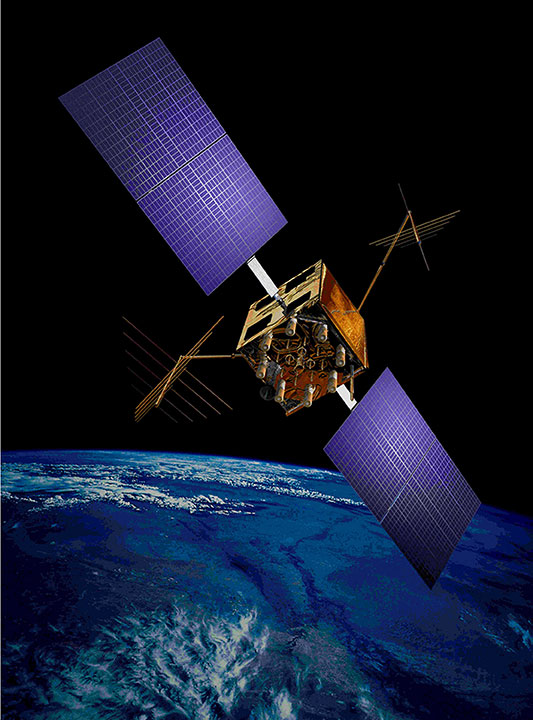
    An artist's concept of a GPS IIR-M satellite in orbit (courtesy of Lockheed Martin).
    An artist’s concept of a GPS IIR-M satellite in orbit (courtesy of Lockheed Martin).

    For more than 41 years, many of us who were there in the beginning have been discussing the attributes, capabilities, enabling features and shortcomings of GPS and other space-based PNT (position, navigation and timing) systems. You have likely heard most of them; historically they go something like this:

    • The signal is weak.
    • The signal is easily jammed.
    • The signal can be spoofed.
    • The signal is subject to atmospheric perturbations.
    • The signal doesn’t penetrate buildings.
    • The signal doesn’t penetrate dense canopies (urban or natural).

    I am sure you have heard most of these. Now, allow me to update the situation with some of the developments enabled by modern signals, new techniques, and multi-frequency, multi-GNSS (Global Navigation Satellite System) “all-in-view” receivers. All of the above bulleted statements are still true, but to a lesser extent, virtually each day. As some well-known pop musicians once sang, “It’s getting better all the time.”

    • Today,  multi-GNSS signals in a fully modern multi-GNSS receiver can to some degree resist interference — intentional (jamming) or unintentional — and  spoofing. It is extremely difficult for a jammer or spoofer to disrupt GPS, GLONASS, Galileo and BeiDou all at the same time. And more help is on the way.
    • Today, multi-GNSS signal corrections remove a large amount of error due to atmospheric perturbations and can sometimes deliver centimeter and millimeter accuracy in real time (in the case of short-baseline real-time kinematic (RTK) using only L1 carrier-phase as data, and/or in some other special situations.)
    • Today, multi-GNSS signals and augmentation signals show some improvement in penetrating dense canopies and canyons by virtue of their multiplied numbers and dispersed geometry.
    • Today, new ground-based technologies show promise at penetrating buildings to provide indoor location. When combined with GPS/GNSS, this is starting to get us closer to the Holy Grail, the ubiquitous PNT solution.

    Debate

    The future looks bright for PNT solutions, ground and space-based. I know it all sounds like a debating society, and you may have heard some of these arguments before. My point, my premise if you will, or bottom-line-upfront in military parlance, being: the GPS (space-based) limitations of the past are gradually giving way to the improved multi-GNSS capabilities of today and the combined ground-based and space-based PNT technologies of the present and rapidly arriving future.

    Unfortunately, there are many uninformed so-called PNT pundits who love to posture for the press — and who are living in the past. The future is right in front of them, or in many cases in their hands, and they cannot or will not acknowledge its existence.

    It’s all in the numbers

    Current estimates are that more than 4 billion users depend on PNT daily for position, navigation and timing, or the multitude of services each of these resources enables. More than half of that number is attributable to smartphone users, which means, at a minimum, more than 2 million PNT users have a two-way communications device incorporated into their PNT receiver/sensor.

    Let’s look at current high-end smartphones as examples of commercial multi-frequency, multi-GNSS “all signals available” devices. The user has a true multi-GNSS device incorporating:

    • GPS — Global Positioning System, United States government
    • GLONASS — Globalnaya Navigazionnaya Sputnikovaya Sistema, the Russian space-based PNT system
    • BeiDou — the Chinese BeiDou Navigation Satellite System, a regional system now, soon to be global (2020 the advertised date).

    with augmentations such as

    • WAAS — U.S. Wide Area Augmentation System
    • EGNOS — European Geostationary Navigation Overlay Service
    • Other SBAS — additional Satellite-Based Augmentation System signals by region
    • Wi-Fi — Signals compatible with a set of broadband wireless networking standards.

    The latest high-end smartphones incorporate an inertial system, a digital compass, a rate gyro, and a pressure sensor integrated with pedometer software that keep track of position, heading and velocity when  external signals are lost. Add cellular tower and network-enabled positioning and timing technology, and you have a two-way communications and PNT-based multi-GNSS sensor that, as long as it has power, is never lost.

    Atomic numbers

    The rubidium-based (atomic-reference system) timing signals from GPS satellite vehicles (SV) are among the most stable timing frequencies ever broadcast from space. The true accuracy of the signal in space is classified, but approaches an accuracy 10 times better than what was once thought to be adequate for our warfighters.

    The best clocks in any current GNSS system are the passive hydrogen masers of Galileo. Thus a PNT set-up that adds Galileo to GPS improves in more ways than one.

    Ephemeris numbers

    Twenty-five years ago, the U.S. military kept track of GPS satellite orbit locations (known as the ephemeris of the satellite) using actual GPS measurements at the control segment tracking stations. The GPS satellite ephemeris was known to a much lesser degree of accuracy than now. At the time, that accuracy was  considered good enough.

    Today, the ephemeris is known much more precisely, and this can be on the order of some centimeters. This has to do with not only the location of the satellite’s center of mass (c.o.m.), but the actual location from which the signal is broadcast. The position of the satellite’s broadcast antenna is known reasonably well most of the time, by very high-end users, after correcting for the arm lever between the c.o.m. and the antenna phase center. The c.o.m. itself can vary by some centimeters over time because of depletion of onboard expendables, but here we are getting into very high-order minutiae.

    Suffice it to say that certain multi-GNSS scientific high-precision receivers today are used to measure tectonic movements on the order of centimeters over the course of a full year.

    Number of signals

    Just recently, with the addition of certain QZSS signals (the Japanese Quasi-Zenith Satellite System) along with the Indian (GAGAN) and Russian (SDCM) equivalents of WAAS and EGNOS, the number of multi-GNSS PNT signals available to a truly international multi-GNSS receiver exceeds 200. For example, one set of global commercial receivers routinely receive and process more than 190 PNT signals in a six-hour period. The receivers are both static and dynamic, and they are networked. The static receivers know their actual location to within millimeters, and use this location as a truth set from which all other signal data is compared.

    Accuracy numbers

    For our example (and all parameters are software-defined and user-programmable), the location parameter may be set at 10 centimeters, meaning that any position derived from PNT signals or augmentations that differ by more than 10 centimeters from the “truth set” are immediately rejected, and that data is broadcast on the systems network, which keeps the dynamic receivers in sync as well.

    The individual receivers each contribute to their own and a networked website with metadata usable by Kalman filters to which other users may choose to subscribe. This makes the multi-GNSS receivers not only receivers, but system and PNT monitors and sensors that can detect  jamming, interference and spoofing attempts, which are reported.

    This monitoring and tracking system is constantly evolving and incorporating new technologies while becoming more secure everyday. This is not a totally new concept, as the core system is a mature enterprise system that has been in operation and commercially viable for more than seven years.

    This should be comforting information for those of you who stay up at night worrying about the safety of autonomous vehicles on land, sea and in the air.

    Don’t let me give you the impression that GPS is just waiting around for other GNSS to come to its aid. GPS is aggressively modernizing itself. In Air Force parlance, “GPS III space vehicles will introduce new capabilities to meet higher demands of both military and civilian users.” As stated by GPS III contractor Lockheed Martin, the modernized system will:

    • Deliver signals three times more accurate than current GPS spacecraft.
    • Provide military users up to eight times improved anti-jamming capabilities.

    Augmentations and improvements

    The bottom line is that a greatly increased number of space-based PNT platforms — along with quantum improvements in computing power, cheap non-volatile memory and software-defined capabilities — have produced a multi-GNSS PNT capability that increases availability via sheer numbers, with more security and reliability on the way.

    A pair of LocataLite transmit antennas overlook a section of the White Sands Missile Range blanketed by the Locata high-precision ground-based positioning system.
    A pair of LocataLite transmit antennas overlook a section of the White Sands Missile Range blanketed by the Locata high-precision ground-based positioning system.

    We are rapidly developing a PNT system that goes far in countering the naysayers. It takes advantage of augmentations and complimentary systems such as newer versions of Loran, (Long-Range Navigation System) and local PNT implementations such as Locata, just to name a couple of examples.

    These ground-based systems are critical to the future of PNT, and have very strong signals. For instance, eLoran is extremely difficult to jam, if not actually unjammable. If a monstrous sunspot were to temporarily knock out the majority of space-based systems, the ground-based systems would more than likely still be available, if — big if here — they are fully developed. At the moment, this is not a sure thing. It is a work in progress.

    Ground-based augmentations and complimentary/backup systems can in the future add a level of security for GPS and other space-based PNT systems: Why bother trying to knock out these space-based systems when there is a suitable and readily available ground-based system as a backup?

    The U.S. government maintains a number of monitor stations around the globe. However, it has not historically taken advantage of the incredible capabilities of multi-GNSS receivers and sensor technology. Although NASA and other U.S. non-military agencies have been involved with multi-GNSS — specifically the Russian GLONASS — for the past 20 years or so, the use has not been widespread. Fortunately, recent changes now permit multi-GNSS receivers for government users, including the military, in certain non-targeting activities, and the government would do well to take advantage of the changes. The good news is that the majority of the capability is in the receiver design, a capability on which the current director of the GPS Directorate at the Space and Missile Systems Center (SMC) “made his bones.”

    To all those critics who take every opportunity to denigrate space-based PNT, both inside and outside the government, I say: Pay attention to multi-GNSS. Stop your diatribes, because the future is arriving. Secure space-based PNT systems are here to stay.

    They continue to improve and become more secure as they incorporate space- and ground-based augmentations, new PNT technologies, software-defined capabilities, multi-GNSS signals, and enhanced computing.  “It’s getting better all the time.”

    Allow me to repeat myself all over again. Space-based PNT is here to stay.

    Until next time, happy navigating, and remember: GPS is brought to you free of charge by the United States Air Force.

  • Expert Opinions: What will help regulators, public accept autonomous vehicles on the road?

    Q: What advance — or, overcoming what challenge — will most enable acceptance of autonomous vehicles on the road with regulators and the public?

    Ganesh Pattabiraman Co-founder, CEO Nextnav
    Ganesh
    Pattabiraman
    Co-founder, CEO
    Nextnav

    A: Similar to airplanes with an autopilot feature, the key issues that must be addressed in autonomous vehicles are redundancy and reliability of systems and appropriate, timely signals to the operator. One key area where this is required is the location of the vehicle. Autonomous location systems have to take into account areas where GPS works fine — but may suffer from an outage — and where GPS does not work, such as in urban canyons.


    Jane Macfarlane Chief Scientist, Head of Research HERE
    Jane
    Macfarlane
    Chief Scientist,
    Head of Research
    HERE

    A: Autonomous vehicles face two key challenges. The first is enabling the vehicle to see beyond its sensors. Autonomous vehicles are composed of two functions: sensing the local environment and controlling the vehicle to operate in the sensed environment. This model must be extended to include the larger environment using cloud-delivered map information informed by a connected vehicle fleet. The second is building intelligence that allows autonomous vehicles to share the road safely with human drivers.


    Kevin Dennehy Contributing Editor, GPS World; Director, Driverless Conference
    Kevin
    Dennehy
    Contributing Editor, GPS World; Director,
    Driverless Conference

    A: The development of autonomous vehicle sensors, artificial intelligence and software is advancing rapidly. Technology is being tested in open-road environments — and in bad weather. Component costs are falling as technology companies and automakers eye specific rollout dates. What could slow this developing industry is bad press, and the resulting government regulation, from a high-profile cyber security breach or an incident like a partially autonomous car getting into a fatal crash.

  • Amsterdam declaration advances Europe in autonomous driving

    red-ferrari
    Photo: sippakorn/Shutterstock.com

    Europe has leapt forward in the ragged advance toward autonomous road travel. The Declaration of Amsterdam, “Cooperation in the field of connected and automated driving,” signed April 14 by the 28 transport ministers of the European Union member states, lays out a strong vision of road future. The language shows some pretty steely resolve to see a driverless ground transport infrastructure materialize, and soon.

    Overall, the ministers and the considerable might of assembled European government foresee “the development of mobility as a service.” Not as something that individuals undertake for themselves, but something that society (or corporations in society’s service) provides. Whether paid for by use or by taxes, travel may soon resemble healthcare.

    All the usual compelling reasons are cited — safety, efficiency, reduced congestion — but the declaration offers a few more that aren’t heard as frequently:

    • The transition towards a zero-emissions society and the circular economy.
    • Benefit to the aging population (something everyone can relate to since we’re all headed that direction).
    • Improved mobility in rural areas.

    The ministers acknowledge that ahead lie challenges aplenty, and not just the technological sort. “There are important questions to be answered regarding security, social inclusion, use of data, privacy, liability, ethics, public support and” — here’s the thorniest of all, in my view — “the co-existence of connected and automated vehicles with manually controlled vehicles.”

    Three thoughts lifted from conversation with Jane Macfarlane, chief scientist at HERE:

    The ecosystem hasn’t formed yet and nobody exactly knows what it looks like.

    The map is critical to that vision. We have to go much deeper into the representation of sensor data and the environment. GNSS is at the absolute core of that.
    Trust is key in a vehicle that’s controlling itself.

    Whatever the new ecosystem turns out to be, this little red number may be an endangered species there. Alternately, networks or reserves for private driving may develop, much like civil aviation in the shadow of modern airline transport.

    Down the road a piece, a brave new world awaits us.

  • Predictive analytics: A helping hand for first responders

    Last month I raised my anxiety level by writing about a revenant threat from terrorist-initiated biological attacks.

    The same concerns were also cited by Director of National Intelligence James Clapper during recent Congressional testimony. These “poor man’s nukes” could potentially be more devastating than 9/11 and reach into every community and even our own homes. Additionally, the threats are not easy to ferret out and just as difficult to stop in our very complex and interconnected world.

    From bioterrorism to natural disaster emergency management, predictive analytics used with geospatial tools and big data is proving to be a powerful new intelligence tool that may help counter global threats.

    TransVoyant Predictions

    TransVoyant CEO Dennis Groseclose.
    TransVoyant CEO Dennis Groseclose.

    Last year there was a lot of buzz at GEOINT surrounding a relatively new company in this field called TransVoyant. Several weeks ago, I visited TransVoyant’s Alexandria, Virginia, headquarters to learn more about their capabilities first hand. I was fortunate to be able to speak with TransVoyant CEO Dennis Groseclose, an Air Force Academy graduate who, with Tim Fleischer, a Naval Academy graduate and successful entrepreneur (Radian, PD Systems), co-founded TransVoyant.

    Previously, Dennis led industrial base optimization restructure for the $37 billion dollar unmanned space launch program for the U.S. Air Force; directed and implemented Worldwide Supply Chain Optimization for IBM; and served as vice president at Lockheed Martin. These experiences built his expertise to solve complex supply chain and global risk management problems using advanced analytical intelligence. In 2011, Dennis and Tim put their collective experience together to form TransVoyant, a company that specializes in creating live and predictive insights from real-time big data.

    The Internet of Things (IoT) has been a key component of their operation. In the mid-80s, connected remote sensors numbered in the thousands. In 2016 that number is expected to reach 6 billion connected “things” worldwide with estimates of 30 billion by 2020.

    TransVoyant collects, cleanses and analyzes over 200,000 external events around the world every minute (such as severe weather, natural disasters, labor strikes, inventory locations, news, terrorism incidents, disease outbreaks and energy prices) from real-time IoT data sources such as sensors, radar, GPS, satellites, smartphones and meters. It then continuously applies advanced data scientist-crafted analytics to these data streams to assess important current and future behaviors, impacts, correlations, patterns and exceptions that deliver live and predictive insights ranging from forecasts of port disruptions and precise shipment arrival times to forecasts of economic flows to real-time and predicted threats to people and assets. The resulting insights — provided via cloud services, system API connections, email and mobile applications — improve mission-critical decision making.

    The geospatial grid connection

    This was all sounding like science fiction and black magic until an “aha moment” for me, as Dennis explained how they use a “multi-dimensional grid cell mathematics” based data structure to apply complex algorithms to real-world data and events. This put the very complex process of continuous real-time machine analysis that “understands” normal and abnormal behavior, both current and future, into something that was familiar to me.

    Decades ago, I used the first release of ArcINFO GRID, now called ArcGIS Spatial Analyst, to complete my master’s thesis. For those of you that haven’t used a grid-cell-based GIS, let me highlight the differences between that and traditional GIS software.

    Traditional GIS software describes our world as points, lines or polygons with topology describing the mathematical spatial relationship between each geographic element and its linked record in a database. This topological model is somewhat cumbersome and slow because the shapes and topological relationships are complex.

    Grid: David Kidner, Mark Dorey & Derek Smith, University of Glamorgan, Wales, U.K. CF37 1DL
    Grid: David Kidner, Mark Dorey & Derek Smith, University of Glamorgan, Wales, U.K. CF37 1DL

    The other kind of GIS is a grid cell or raster-based GIS. The data model is significantly simpler because — unlike a traditional GIS of points, lines and polygons — the grid-based GIS world is broken up into simple uniform grid cells.

    The big advantage is that the data structure and tools lend themselves to very fast processing. Almost any mathematical formula can be used to operate on the individual or collective grid cells. Most grid-based systems use predefined mathematical operations such as shortest path analysis, interpolation including Kriging or very complex formulas using map algebra.

    So, very similar to the famous Napoleon Hill quote, “Whatever the mind can conceive… it can achieve.” With a grid cell GIS, if an analyst can think of a way to describe an analytical process and predictive results as a mathematic expression or formula, it can be done very quickly in the grid cell environment. (See two previous columns for more in-depth information — “GRID Cell Modeling” and “Topology is not Topography”.)

    So what does grid cell GIS look like in action?

    Evacuations during a flood.
    Evacuations during a flood.

    Proactive Emergency Response

    In my discussions with Dennis, a TransVoyant customer segment that caught my attention was support of first responders. Emergency responders are using TransVoyant to help with very early disaster response. One specific example is evacuation of invalid patients before a flooding disaster becomes life threatening.

    A hospital evacuation.
    A hospital evacuation.

    Using TransVoyant’s analytics on an extensive network of satellite imagery, 911 and 311 calls, water-stage sensors, street closures, weather forecasts, registries and more, responders can predict areas that are at high risk for flooding hours before flood waters rise. Among other essential emergency management actions, these early warnings provide emergency responders with the ability to identify specific neighborhoods and homes that have disabled residents who can be easily evacuated, increasing the safety and efficiency of their operations.

    Here is a screen capture of TransVoyant Continuous Decision Intelligence (CDI) predicting a flood event.

    TransVoyant Continuous Decision Intelligence (CDI) predicts a flood.
    TransVoyant Continuous Decision Intelligence (CDI) predicts a flood.

    Other Clients

    TransVoyant’s live and predictive insight solutions have attracted customers ranging from large multinational corporations to National Security and Intelligence agencies.

    I know that one hears echoes of Minority Report when reviewing the tools and capabilities of TransVoyant. However, given the serious threat we face for a situation far worse than 9/11, I have no reservations about using open-source data aggregation and brilliant analytics that correlate and uncover patterns of life and global anomalies to divine a threat.

    So, will predictive analytics be the tool that stops a bio terrorist or saves lives in critical emergency situations? I don’t know, but the potential threat is too grave not try every tool, including continuous precognition, in our collective toolbox.

    TransVoyant will be an exhibitor at GEOINT 2016 this month, so stop by and learn more.

    Since we are approaching Mother’s Day and Memorial Day, I’d like to call your attention to my May 2014 column. It’s the best column I ever wrote.

  • GNSS and the real-time network: The surveyor’s best friend

    A lot of talk is being made about UAVs these days and how this technology is going to revolutionize many industries, with surveying being one of the biggest users.

    I won’t deny the impact this new tool is going to have on our profession (as written in my last column). But I don’t think it will compare to the use of GNSS technology and how it modernized measuring methods for the surveyor.

    Gammon-reelI’m often asked by young surveyors what I think is the biggest improvement experienced by the surveying profession. Ironically, I asked that same question to my teachers when I was a new survey technician. My mentors will talk of the electronic distance meter, the theodolite or the total station. (Some old timers even told me the best improvement was the gammon reel for their plumb bob or the reel for a steel “chain”!)

    While these were good advancements, for me the biggest improvement was the introduction of GPS into surveying, followed by the advancement to real-time network capability. Now, coupled with modern communication methods of radio or cellular transmission to permanent base stations, the GNSS rover has become one of the most valuable tools in the surveyor’s toolbox.

    To understand the importance of GNSS technology and its use by the surveying community, first take a look at the history of the profession and method/devices used for measuring. Land surveyors have been measuring boundaries of parcels for centuries, dating back to Egyptian times and workers known as “rope stretchers.” Their use of rope with knots tied at specific intervals was the measuring stick of the time period.

    As centuries passed and measuring units were developed, surveyors used these dimensional tools for measuring and describing land parcels. By the time the early settlers of America began traveling westward, surveyors were using a 66-foot-long Gunter’s chain made with 100 links, each almost eight inches long. Over time the links would stretch until the surveyor’s measurements were not accurate for land surveys.

    By the early 1900s, tapes made from low-expansion steel became more widely used and much more accurate for surveying. The early 1960s brought new technology with measurement systems using laser light beams with the ability to travel several miles with sufficient accuracy.

    A total station.
    A total station.

    The electronic distance meter (EDM) allowed the surveyor to cover longer distances in much less time than the conventional method of the steel tape, leading to more productive field time. This technology was further refined to be installed inside of traditional theodolites to create the modern total station instrument — still used today for basic measuring of angles and distance. Almost all surveying projects can be completed using a total station, but the invention of a remotely available measuring device would be a welcome tool in the surveyor’s toolbox.

    Enter the 1980s and the adaptation of the military’s satellite measuring system for civilian use. While early users and developers needed a Ph.D. in mathematics to configure its use, GPS measurement revolutionized long-distance measurement for the surveying profession. Static GPS measurement took many hours of data collection and even longer processing time, but with terrific results and with tremendous accuracy.

    Further refinements with hardware and software configurations brought more affordable and user-friendly systems that gave surveying community another resource for accurate measurement. While the use of real-time kinematicc (RTK) expanded greatly in the late 1990s and 2000s, the big difference in the past 10+ years has been the introduction of real-time networks and permanent base stations. This advancement helps by eliminating the need for a base receiver and radio with an amplified repeater, and thus another employee guarding the idle base station equipment.

    Depending on the surveyor’s location, real-time networks are readily available by paid subscription or through publicly funded transportation department. These systems are very reliable and don’t require a six-figure investment in equipment.

    All survey data-collection methods, no matter the measuring procedure used and positional accuracy required for the project, needs to follow a strict quality-control procedure for verification of its content and position. The old adage “Measure twice, cut once” works well here, too, so let’s discuss what is involved with good measuring procedures.

    Measuring procedures

    Prior to any field measurements are taken, it is good practice to verify satellite availability during your planned measuring period. The U.S. GPS currently consists of 31 active and healthy units orbiting the planet and crisscrossing the sky 24/7. The geometry created by radio signals received from these satellites constantly vary in size and strength. By using mission-planning software, the user can accurately predict the best times of the day to collect positional locations with the highest accuracy and repeatability. Low numbers of satellites or strength of constellational geometry can lead to inaccurate locations and incorrect measurements between points.

    The introduction and allowance of other satellite systems into our data collection system (GLONASS, Galileo, BeiDou, IRNSS) will enhance the availability and strength of constellation geometry throughout the data-collection process.

    Another potential problem for GNSS data collection is solar storms, sunspots and other radio interruptions. Most manufacturers will notify the user of major atmospheric radiation events, but check the NOAA Space Weather Prediction Center (SWPC) website for updates on potential events. The key here is to plan your field collection prior to execution, in order to reduce errors in measurement or even interruptions to completing the work in a timely manner.

    Survey results are only as good as the measurements, and following strict guidelines is very important. When using survey-grade GNSS equipment in a real-time function, many items need to be monitored while collecting data to ensure good quality positions. Here are items as listed by the National Geodetic Survey (NGS) in the “User Guidelines for Single Base Real-Time GNSS Positioning” manual on the NGS website:

    • Accuracy versus precision
      • Accuracy is how your collected data compares to the defined standard.
      • Precision is how often the solution is repeated.
      • Achieving both provides necessary confidence in field measurements.
    • Redundancy
      • The ability to collect similar measurements at different times, satellite constellation geometry and atmospheric conditions.
    • Multipath
      • Minimizing opportunities for measurement to be affected by reflected or misdirected signals.
    • Position dilution of precision (PDOP)
      • Higher readings usually achieved when measuring during periods of weak satellite constellation geometry.
    • Root-mean-square (RMS)
      • Statistical measurement of precision notifying the user of the positional quality of the measurement based upon quality of satellite signals.
    • Site localizations/calibrations
      • Basing the strength of survey network on the location of the base station and the accuracy of the monument it is located upon.
      • Typically used when real-time network connectivity is not achievable.
    • Latency
      • The delay of the received satellite signal data and correction information at the base, sent to the rover for computing correction values.
    • Signal-to-noise ratio (S/N)
      • Ratio in which burdening noise is measured versus the actual signal from the satellite.
    • Float and fixed solutions
      • Floating solutions occur when precision for survey-grade measurements is not met due to noise, lack of satellites, weak satellite geometry and latency.
    • Elevation mask
      • This setting is a filter to eliminate signals from satellites below the user-defined angle, thus eliminating opportunities for weak constellation geometry and noise interference.
    • Geoid model
      • Correction model used to improve vertical measurement with GNSS data collection by incorporating previously determined elevations across a wide area.

    While all of these components are necessary for quality data collection, one of the most critical steps is horizontal and vertical verification on published or previously established control points or monuments. By checking into a known point before every data-collection session, you can eliminate errors in rod/antenna height and/or coordinate system setup. Checking a known point can also help determine if the correction signal is providing accurate information, either from the RTK base station or as part of a subscription service via cellphone or radio. It will also help discover poor PDOP or RMS due to weak satellite configurations. Also, if the rover unit takes longer than usual to initialize, a potential data-collection issue may occur to bad conditions.

    The biggest complaint I get (and see) is field crews not checking the accuracy of the GNSS unit during the course of a survey. Hopping out of the vehicle, firing up the data collector, and taking a measurement multiple times without redundant measurements or verifying existing control points/monuments is a recipe for disaster.

    Here are my keys to successful data collection with GNSS technology:

    1. Keep the equipment is good working order: batteries charged, receivers and collectors in travel cases when not in use, poles kept in safe places and regularly checked for plumb.
    2. Utilize a checklist for project startup.
      a. Horizontal coordinate system to be used.
      b. Vertical datum to be used.
      c. List of multiple published or previously established control points for datum verification.
    3. Once receiver has a fixed solution, verify horizontal and vertical position on known point.
    4. Minimize loss of fixed solution times, recheck when establishing new fixed positions.
    5. If possible, recheck main control points at various time throughout the day to establish redundancy.
    6. Reverify at the end of the session and at the end of the day.

    While GNSS has greatly decreased field time for covering large areas quickly, it must still be used correctly in order to provide accurate positional locations. The accuracy of these positions are what the measurements of the surveyor relies upon, and they must meet a high standard of confidence. Our profession prides itself on being called upon as the “expert measurer,” so our methods of measurement must be up to those standards.

    While it took a little time to get the cost-effectiveness, reliability and user friendliness to a level of affordability for the surveyor, GNSS has become one of the best tools in our toolboxes. GNSS has revolutionized modern surveying, and I, for one, appreciate its ability to help me offer my services as an expert measurer.

  • GNSS has bad days, too

    GNSS has bad days, too

    (courtesy Ursanav)
    (courtesy UrsaNav)

    “Even the best technology has a bad day,” Charles Schue told the New York Stock Exchange (NYSE), which relies very heavily on the best technology to keep the world’s financial edifice afloat. Vulnerabilities in the stock market were pointed up during a demonstration on April 19, showcasing how one positioning, navigation and timing (PNT) system can cover the chinks in another. Respectively, eLoran and GPS in this case.

    Schue is CEO of UrsaNav, a company that has been developing complementary PNT solutions, specifically the high-power, low-frequency (LF), ground-wave technology that is eLoran, which UrsaNav calls “the most reliable, scalable, and future-proof available.” Schue spoke at the NYSE along with representatives from the Department of Homeland Security (DHS), the U.S. Coast Guard, Juniper Networks and Harris Corporation.

    “2014 was a very bad year for GNSS,” Schue continued, citing the GLONASS full-system outage for 11 hours and Galileo’s wrong-orbit launch of two satellites. “This year, GPS, the gold standard, had an ‘oops’ and slipped from gold to silver, when one satellite kind of wigged out, a 13.7 microsecond error that contaminated 15 other satellites.” He ran a simulation that showed how, at one point, six GPS satellites were communicating bad timing to the Eastern seaboard, where the NYSE is located.

    2016 has also seen renewed GPS jamming from North Korea.

    The stock exchange, along with other global financial markets, relies on microsecond timing to properly execute all transactions. The U.S. air traffic management system likewise relies on high-precision aspects of GPS that are vulnerable to interference, jamming, and even occasional system failure. Many other industries, telecommunications principally among them, are also building infrastructures and applications that rely on GPS for precise timing, thus making them vulnerable as well.

    One Back-Up Transmitter in Place

    An eLoran transmitter in Wildwood, New Jersey, relies on three primary reference standards, three atomic clocks, just as each GPS satellite carries three or four atomic clocks. “The signals coming from space, the signals coming from ground, they’re very similar.” ELoran also has monitoring and control sites on the ground, just like the satellite system; it has differential reference stations, and of course eLoran receivers, playing the same role as GPS receivers.

    Schue asserted that the cost of launching one GPS satellite into space would fund an eLoran system for the continental United States for 20 years. Also, that a lot of industries in addition to the financial community are building infrastructures and applications that rely on GPS for precise timing, and so are equally vulnerable.

    The eLoran demonstration showed how the Wildwood station sent a timing signal 130 miles to the NYSE, deep within several urban canyons and enveloped in several layers of concrete, steel and glass. A GPS receiver in the room did not pick up anything. The eLoran receiver showed precise time, to the standard of NYSE requirements.

    Equipment utilized included a Spectracom SecureSync providing time to the network, once it received it from eLoran.

    On a screen display showing plus or minus 500 nanoseconds relative to Coordinated Universal Time, “that red line is us receiving eLoran timing at that antenna, 130 miles away, through the urban canyons, inside this building, right now at minus 14 nanoseconds.” The eLoran equipment transmitted and received two signals, with a data channel on one of the signals. “We could put the data channel on both signals, and we could put multiple data channels on both on there as well.”

    Photo: UrsaNav Photo: UrsaNav

    Schue said another demo inside a downtown Boston hotel, 305 miles from the New Jersey transmitter, obtained 83-nanosecond accuracy. A 2015 test to an outdoor receiver in Bangor, Maine, 500 miles from the transmitter, logged 68-nanosecond accuracy.

    Plus or minus 100 nanoseconds is the typical GPS performance. “We can do far better, and GPS often does far better than that.”

    Initial operating capability for a wide-area eLoran service providing precise time for the continental United States would require four transmitter sites across the middle of the country. The corporate and government partners hope to use some repurposed Loran-C assets and turn them into eLoran stations. Wildwood is transmitting at 360 kilowatts; if transmitting at 1 million watts, or 1 megawatt, the signal could penetrate even further inside buildings. The cost difference between the two powers of transmitter is not significant.

    Bringing six more continental eLoran transmitter sites online, for a total of ten, would add a back-up positioning capability in addition to timing. “This is very important, because with positioning, you get mobile time — a co-primary solution for position, navigation, and timing.”

    Using a differential receiver would yield even better local-area accuracy for about 35 miles around a selected site, for high-priority locations. Such a higher-precision system for the nation’s top 50 metropolitan areas, top 50 airports, and top 50 harbors could be accomplished with 71 differential sites.

    Concurrence from Government and Other Industry Partners

    Spokespersons from the DHS, Coast Guard, Juniper Networks and Harris Corporation preceded Schue at the NYSE presentation, all giving similar perspectives on U.S. vulnerability in many aspects, due to reliance on GPS as a sole, unsupported source of precision PNT.  “Of the 16 critical infrastructure / key resource sectors in the United States, 15 use GPS for timing. GPS timing is deemed essential for 11 of these sectors,” stressed DHS.

  • FAA makes progress accommodating commercial UAS operations

    The sensefly eXom UAV in flight.
    The sensefly eXom UAV in flight.

    The Federal Aviation Administration (FAA) took a major step forward in expanding commercial UAS/UAV operations in the U.S. airspace. It’s chief said April 19 that the FAA is preparing to take another major step forward in further opening up commercial UAS/UAV operations by eliminating the need for a 333 Exemption for operating small UAS/UAV.

    On March 29, the FAA announced it was doubling the altitude for blanket nationwide CoAs (Certificates of Waiver or Authorization) to 400 feet above ground level (AGL). The FAA has typically issued a blanket nationwide CoA with each 333 Exemption it has granted.

    Before the announcement, the maximum altitude allowed for commercial operations under the blanket CoA was 200 feet AGL. Now, it is 400 feet AGL. At the stroke of a pen, the 3,000+ 333 Exemption holders with blanket CoAs are now authorized to fly to 400 feet. This is significant because UAS operators can now fly higher and cover more area more efficiently, and still meet the precision and accuracy requirements of most clients.

    Another announcement, perhaps even more important, was made by FAA Administrator Michael Huerta, who spoke at the 2016 FAA UAS Symposium held April 19-20 in Daytona Beach, Florida. Huerta announced that the FAA is close to finalizing the FAA rules for small UAS.

    “In late spring we plan to finalize our small UAS rule to eliminate the need for most 333 exemptions,” Huerta said. He was referring to the Small UAS Notice of Proposed Rulemaking (NPRM) that was announced Feb. 15, 2015, and opened for public comment through April 24, 2015. There were 4,650 public comments made. You can read the comments about the proposed rule here.

    The proposed small UAS rule differs significantly from the current FAA requirements for operating UAS in the United States for commercial purposes. One of the major differences is that there will be a “UAS operator’s certificate” created so that commercial UAS pilots will no longer be required to have a FAA Pilot Certificate. Currently, the FAA requires commercial UAS pilots to have at least an FAA Sport Pilot certificate, which requires a substantial investment in money and time to achieve.

    To summarize, the general proposed small UAS rules are:

    UAS pilot

    • Must be at least 17 years old.
    • Must pass an aeronautical test at FAA-approved testing center, and renewed every 24 months.
    • Must be vetted by the Transportation Security Administration (TSA).
    • Must obtain an unmanned aircraft operator certificate with a small UAS rating

    UAS operation

    • UASmust weigh less than 55 pounds.
    • Pilot in Command or Visual Observer must maintain visual line of sight (VLOS).
    • Can’t operate over people who are not part of the UAS operation.
    • Daylight operations only.
    • Yield to manned aircraft.
    • May use Visual Observer (VO), but not required.
    • First-person view camera cannot satisfy “see-and-avoid” requirement but can be used as long as requirement is satisfied in other ways.
    • Maximum airspeed of 100 mph.
    • Maximum altitude of 500 feet AGL (above ground level).
    • Minimum weather visibility of 3 miles from control station.
    • Can’t operate more than one UAS at a time.
    • No careless or reckless operations.
    • Operations in Class B, C, D and E airspace are allowed with the required ATC permission.
    • Operations in Class G airspace are allowed without ATC permission.

    With these rules, neither a 333 Exemption nor a CoA is required, which would significantly ease the requirements for a surveying or geospatial company to begin offering UAS services.

    Phantom-4-Action-4-O
    The DJI Phantom 4 UAV.

    In addition, the small UAS rule includes a framework to adapt future rules such as Micro UAS (0.55 pounds and under) rules that are being actively discussed within the FAA as well as a discussion about commercial operation of UAS over people.

    In the meantime, consumer UAS are becoming more powerful with each new product introduction. DJI, the world’s largest UAS manufacturer (by far) introduced the Phantom 4. It’s a huge step forward due to one new feature: automatic collision avoidance. This feature will help operators avoid trees, buildings and potentially other UAS. I’m pretty sure this feature will eventually be included in all commercial UAS.

    Intel CEO Brian Krzanich demonstrated the broad capabilities UAV technology during his keynote presentation at the 2016 Consumer Electronics Show Jan. 5, in Las Vegas. Krzanich showcased the Yuneec Typhoon H with Intel RealSense Technology. (Photo: Intel)
    Intel CEO Brian Krzanich gives his keynote presentation at the 2016 Consumer Electronics Show Jan. 5, in Las Vegas, where he also announced the acquisition of Ascending Technologies for drone collision avoidance. (Photo: Intel)

    Automatic collision avoidance is such a hot subject that in January, Intel acquired Ascending Technologies, a UAS manufacturer that has incorporated automatic sense and avoid technology in their UAS. According to the announcement, Intel sees “incredible opportunity for innovation across a multitude of industries. As a result, Intel is positioning itself at the forefront of this opportunity to increasingly integrate the computing, communications, sensor and cloud technology required to make drones smarter and more connected.”

    Thanks, and see you next month.

    Follow me on Twitter at GPSGIS_Eric

  • Drones: Registration and regulation move forward amid near misses

    As the popularity of drones for personal use continues to increase, most of the people who have bought them are sensible folks who have registered their vehicles with the FAA (in the U.S.) and other authorities elsewhere. They respect the rules that have been laid down for them to operate — fly below 400 feet (recently increased by the FAA from 200 feet), don’t fly over populated areas or people, and especially stay away from airports and the departure and approach paths for regular aircraft.

    So it’s especially troublesome for these law-abiding drone owners when a wildcat operator gets into the approach path at an airport — and it’s really bad if that airport happens to be one of the busiest in the U.S.

    Unfortunately there are several examples. For instance, a Lufthansa A380 pilot recently reported that a drone passed approximately 200 feet above the huge A-380 aircraft he was flying while it was at 5,000 feet altitude on approach into LAX (Los Angeles airport). The FAA immediately got on the phone to the Los Angeles Police Department responsible for air support.


    Just last week, an unmanned aerial vehicle (UAV) was reported to have struck a British Airways Airbus as it descended into London’s Heathrow Airport.

    The increase in drones might be compared to an increase in the bird population, and a recent study concluded that the risk to the airspace caused by single, light-weight drones is probably quite low. The figures also seem to say that the probability of bird-strikes is very low — but tell that to Captain Sullenberger who landed a smaller A-320 in the Hudson River when both engines quit after ingesting geese just after take-off.

    It seems that good airmanship and eyesight have so far avoided any drones being sucked into commercial aircraft engines — no thanks to a small number of irresponsible drone flyers who are tempting fate by intruding into “no-go” airspace.

    Let’s get the FAA small UAV regulations published and give everyone clear rules by which even these people are required to fly their drones. So far, individual section 333 waivers have been granted by the FAA to known characters who apparently want to do things properly. Rules also presumably come with penalties, so we might have some deterrence and more control over wildcat operators.

    Along the same lines, the FAA is researching a new approach which could detect drones and find their operators who fly near airports. The FAA has implemented a number of programs and tools to educate drone operators and make them aware of the dangers of encroaching on controlled airport airspace, but even so, such incidents continue to occur.

    CACI International has therefore been awarded a Pathfinder contract by FAA to investigate technology that will allow the FAA to “identify rogue unmanned aircraft systems” near airports. The CACI solution aims to provide a proven way to passively detect, identify and track UAS/drones and locate their ground-based operators. So, hopefully we may soon have regulations along with a detection system for rule breakers, and we’ll then need an approach to administer penalties. Much better! But let’s pray in the meantime that we don’t have any drone/Sullenberger incidents.

    The FAA has recently predicted sales of commercial UAS will increase from 600,000 in 2016 to 2.7 million by 2020, so we better get a handle on this soon. It’s even forecast that there could be a jump to 2.5 million commercial UAS sold in 2017 should the FAA get its small UAV regulations out and implemented this year, as the agency has announced.

    Meanwhile, the FAA has turned to an industry/agency committee to ask if they could relax the FAA’s own rules for very small drones and under certain conditions allow them to fly over people. The committee — known as the Micro Unmanned Aircraft Systems (UAS) Aviation Rulemaking Committee (the “ARC”) — met and quickly published a report that came up with four categories of small UAV, Category 1 being less than 250 grams and requiring virtually no additional regulation. Basically, a 250 gram drone falling on a person is considered unlikely to hurt anyone. The other categories do need more restrictions, and manufacturers will need to do significant testing to qualify their drones to satisfy the new requirements.

    amazon-prime-drone-4
    The latest version of the Amazon delivery drone.

    Amazon is also trying to do its part to warn people that a drone might be close overhead. The company recently filed a patent for propellers on drones that could emit warning noises in certain phases of flight. As Amazon progresses toward its plan to deliver parcels to homes, it’s looking to enhance the safety of its future drone-based delivery system.

    The object of the patent is to have drone propellers alert people on the ground of the drone’s presence, possibly by broadcasting audible phrases such as “watch out.” Maybe a couple of holes in a propeller might even result in a whistling sound that people would begin to associate with an incoming drone?

    DJI

    Meanwhile, DJI in China remains one of the companies enjoying stratospheric growth as a result of this growing demand. DJI only really surfaced as a drone supplier in the last few years after the release of the Phantom quadcopter, but DJI has actually been around for 10 years. The founder studied in Hong Kong and became interested in flight control systems, which DJI went on to develop. The company started with 20 people based in Shenzhen where there is good access to high-tech talent, but they have now exceeded 5,000 employees. With R&D engineering centers in Asia, Europe and the U.S., DJI now claims to have captured 70 percent of the commercial drone market.

    The DJI Phantom 4.
    The DJI Phantom 4.

    DJI’s focus is to provide drones that are easy to fly, with a great user interface, and then hang high-quality cameras and other sensors on these really maneuverable platforms. Their approach seems to be working — sales are currently growing by around 3-5 times a year, and they also claim to have a valuation of at least $10 billion US!

    DJI tells us that its customers have taken 70 million photos, flown 125 million miles, and operated for 3.9 million hours, with applications including agriculture, search and rescue, sports and news broadcasting, real estate, tourism, wildlife monitoring, archaeology, surveying and mapping, education and dozens of others. DJI is also one of the first manufacturers to introduce geofencing using GPS to ensure operation only in areas that are permitted.

    With a product range that not only has drones for commercial and industrial applications, but also includes flight control systems, still and video cameras and stabilized gimbals for airborne and handheld camera applications, DJI is very well placed to maintain its strong market position.

    AUVSI Convention

    Early next month, the Association for Unmanned Vehicle Systems International (AUVSI) holds its major annual convention in New Orleans, and GPS World will have a contingent of inquisitive people scouring the show floor for news items. So we will have lots more drone stories to tell.

    Tony Murfin
    GNSS Aerospace

  • Don Jewell reports from 32nd annual Space Symposium

    Don Jewell reports from 32nd annual Space Symposium

    Opening Day, April 11

    It never fails. Invite 11,000-plus of your closest acquaintances for a week in the Rocky Mountains in April, and you have one — make that several — weather related events.

    I have attended 30 of the 32 Space Symposiums and it always rains buckets, snows a blizzard, hails in biblical amounts or is a combination of all three interspersed with incredible mountain vistas and bright sunshine.

    To those of us who live here it is part of the charm of the Rocky Mountains, but to visitors… fortunately it seems not to matter at all, as 11,000 or more people show every year. And thank goodness they do, as this is indeed the premier space event of the year, every year, bar none.

    This year the Space Foundations’ 32nd Space Symposium kicks off on Monday, April 11, and runs through Thursday evening at the Lockheed Martin Exhibition Center at the Five Star Broadmoor Resort. There are several post-symposium-events scheduled for Friday and through the weekend as well, not to mention all the ski trips starting on Friday in Breckenridge, Vail, Keystone (which has night skiing) and Aspen. The party and business ventures continue on the slopes.

    Space Symposium and Cyber 1.6

    Commander AFSPC – Gen. John Hyten (Courtesy of the USAF)
    Commander AFSPC – Gen. John Hyten (Courtesy of the USAF)

    In conjunction with the Space Symposium is Cyber 1.6, or the 7th annual Cyber symposium, which is happening today at a highly classified level. This super-secret meeting brings together the “who’s who” of the cyber world. Due to classification levels, that’s about all I can say about that.

    I have attended five of the seven cyber symposiums, and I can tell you it is a tremendously productive meeting that just gets better and — more importantly — more relevant every year. If cyber is your thing, and of course it affects us all, make plans now (if you have a SECRET clearance that is) to attend Cyber 1.7 next year.

    International Event

    The Space Symposium is truly an international event, featuring ambassadors, governors, congressmen, generals, agency directors (including the NASA administrator) and many more —too many to name, of course — from around the world.

    Jeff Bezos, founder and CEO of Amazon, will be a keynote speaker, as will Gen. John Hyten, who will speak at both the Cyber and Space Events as the commander of U.S. Air Force Space Command.

    Jeff Bezos, founder and CEO of Amazon and Blue Origin.
    Jeff Bezos, founder and CEO of Amazon and Blue Origin.

    Back to Jeff Bezos for a moment. In addition to being Amazon’s Founder and CEO, Jeff has a real interest in space. He is also the founder of aerospace company Blue Origin, which is working to lower the cost and increase the safety of spaceflight so that humans can better continue exploring the solar system.

    Jeff says his interest in space began long before he graduated summa cum laude, Phi Beta Kappa, in electrical engineering and computer science from Princeton University in 1986, and was named Time magazine’s Person of the Year in 1999. I can’t wait to hear what plans Jeff has for Blue Origin and space in general. Amazon already ships to m0re than 190 countries. Can space be far behind?

    The Blue Origin logo.
    The Blue Origin logo.

    Trivia Alert: I wonder if any astronauts have ever ordered from Amazon while on orbit on the International Space Station; they do have Internet, after all. Why not? Maybe we will find out. And yes, I realize it is one thing to order from Amazon while on the International Space Station and quite another for Amazon to deliver there, but from what I hear, Jeff is working on that problem as well. Will that make the Space Symposium an Intergalactic event?

    Exhibitors

    This year there are more than 160 exhibitors in the Lockheed Martin Exhibit Center and the Exhibit Center Pavilion. It’s more than you can visit in just four days, but I try every year to at least spend a minute or two at every exhibit. If you do nothing else but visit the exhibits, it is an experience.

    Activities

    Tonight, the 32nd Space Symposium kicks off with a welcome address from Colorado Governor John Hickenlooper, several key industry awards and the opening of the exhibit hall with food and drink. About five hours later, the evening’s festivities end with a huge fireworks display over the lake of the Broadmoor. The symposium offers something for everyone, and we will keep you up to speed right here on GPSWorld.com.

    Note: Trimble kindly sent me its latest GPS/PNT-enabled 10.1-inch Windows 10 based rugged tablet named the Kenai to help commemorate the event. I will be utilizing this incredible tool all during the Space Symposium to take pictures, record events, type my short articles and transmit them all on the fly to GPS World. I’ll let you know how it fares. Hint: Thank goodness it is a rugged tablet — someone has already knocked it out of my hands and onto a hard floor, with no ill effects.

    Stay tuned. We are expecting significant announcements concerning OCX, GPS III, GPS Next, MGUE and all sorts of international input from GLONASS, Galileo, Beidou and QZSS, just to name a few.

    Until next time, happy navigating.