Category: Opinions

  • USAF FY16 Budget Plus $10B More, Please!

    The long-anticipated 2016 President’s Budget (PB) was submitted to Congress in early February. The PB is the spark that ignites the lengthy and often contentious congressional budget process, including: adopting a budget resolution framework, developing numerous discretionary spending bills, reconciling legislation between the House and Senate, approving continuing resolution stop-gap measures and finally, hopefully, appropriating funds for various programs — including the Global Positioning System (GPS) as part of the Department of Defense’s (DoD’s) U.S. Air Force (USAF) budget request.

    For FY (Fiscal Year 1 Oct – 30 Sep) 2016, the U.S. Air Force requested a topline budget of $122.2 billion in Air Force controlled funding that exceeds funding levels recommended by the OMB (Office of Management and Budget) and laid out in the Budget Control Act by almost $10 billion. Several well-meaning friends still in high places in the government immediately sent me copies of the USAF budget while it was still warm, so to speak, and thought that I would be “properly incensed” — proffered one old friend — over the so-called $10B overdraft. I hate to disappoint my friends, but in the spirit of the USAF policy of putting the Bottom Line Up Front, I applaud the Air Force action and personally think it may be too little, too late. The supplemental request or overdraft should probably have been more on the order of $20B, not $10B.

    Hollow Force

    This is not an emotional reaction, but a reasoned statement by a seasoned veteran airman of 30 years in the USAF, yours truly, who served through at least two periods of a “hollow force” that were devastating not only to the USAF as an institution, but to the DoD as a whole and to all the personnel who served during these austere and dangerous times. And, yes, I am equating a hollow force with a dangerous force. Indeed, the term “hollow force” officially refers to military and government forces that certainly, on the surface, appear to be “mission ready,” but upon close examination suffer from moderate to severe shortages of personnel and equipment as well as deficiencies, to varying degrees, in training.

    Gen Mark A Welsh III, Chief of Staff, USAF, testifying before the Senate Armed Services Committee 201 (Photo courtesy of USAF - SSG Sean K. Harp).
    Gen Mark A Welsh III, Chief of Staff, USAF, testifying before the Senate Armed Services Committee 201 (Photo courtesy of USAF – SSG Sean K. Harp).

    In recent testimony before the Senate Armed Services Committee, along with his fellow service chiefs, General Mark A. Welsh III, chief of staff of the United States Air Force, laid out the dangers inherent in the hollow force when he stated:

    “Last year, our readiness levels reached an all-time low. As we struggle to recover, we don’t have enough units ready to respond immediately to a major contingency, and we’re not always able to provide fully mission-ready units to meet our combatant commanders’ routine rotational requirements.

    “The Air Force’s modernization forecasts also are bleak. About 20 percent of [our] aircraft flying today were built in the 1950s and 1960s, and more than half of the rest are 25 years old or older.

    “And now, due to sequestration, we’ve cut about 50 percent of our currently planned modernization programs.”

    To someone who lived through the hollow force in the past, this is a scary description and prospect for our airmen. In describing the results of budget cuts and difficult decisions regarding program terminations that result in a hollow force, General Welsh put it this way:

    Without these tough calls, the Air Force ‘will be neither ready to fight today, nor viable against the threats of tomorrow’.” 

    Indeed, a hollow force puts every ones lives in danger. During the post-Vietnam hollow force created by the peanut farmer, there were times when there were B52 aircraft sitting alert just for the spy satellite photo ops that did not have engines in the nacelles nor certified crews to fly them. Aircrews were lucky if they were able to fly four hours per month, and believe me, that made us all less than proficient. I remember one incident specifically. My oxygen (O2) mask had failed on a previous flight and I needed a new one. In the high-performance aircraft in which we flew, regulations required an O2 mask be attached to our helmet and actually in place with crewmembers in the cockpit breathing pure (100%) O2 above a certain altitude. Because of budget cuts, I was issued a waiver, a piece of paper that said I was legal to fly without a fully functioning O2 mask. Fortunately I never was forced to fly without a fully functioning O2 mask, but what if I had been? What if I had passed out from O2 deprivation? What about the other members of the crew? What purpose did the piece of paper serve, other than mollifying a paper pusher’s conscience? Would the Air Force crash investigators have found it in the wreckage and said, “Oh, it’s OK, he had a waiver!” These are the types of things that can happen with a “hollow force.” We don’t need to go there again, and if nothing else, the extra $10B may be just the ticket to keep the aircrews proficient and equipment maintained.

    The Color of Money

    I know that budgeting and spending other people’s money seems like a simple issue, but with the government, nothing is ever simple. Consequently, the DoD has established an entire university system, known as the Defense Acquisition University (DAU), to train acquisition, program and financial officials in handling government acquisition funds, along with other procurement activities. Under the Budget Control Act guidelines and the Congressional cost-cutting exercise known as Seques-castration, 2016 is another cost-cutting year. That is significant when you understand that the USAF and all of DoD are still reeling from more than ten years of war, on more than one front, along with previously mandated significant budget and manpower cuts that seriously impacted the ability of the USAF to accomplish its multitude of missions.

    Consider that budget cuts have a lingering, insidious and costly effect in equipment not maintained or replaced, training not accomplished, R&D not conducted, new technologies not developed, and inevitably the inability to accomplish the mission. A lot of the complexity in these budget-cutting moves relates to what the government refers to as the color of money. For example budgetary funds are appropriated and obligated for the USAF, and most other services, according to the following formula:

    • O&M – Operations and Maintenance – Obligated for 1 year
    • MILPERS – Military Personnel – Obligated for 1 year
    • RDT&E – Res Dev Test & Eval – Obligated for 2 years
    • PROC – Procurement – Obligated for 3 years
    • MILCON – Military Construction – Obligated for 5 years

    As you can see, all funds are not obligated for just one year and then the money expires. Indeed, there are several colors of money, and failing to fund an RDT&E effort can have catastrophic results on the future of that program and associated programs that might benefit from the technology not developed. At any one time, the USAF is juggling budgets stretching across years and programs and moving money or robbing Peter to pay Paul.

    FM (Financial Management) or financial and program management gurus at any one time are managing funds that originated as many as five years previously, plus the current year’s budget, while planning on how to use funds that might carry over to next year. They have just submitted the FY16 budget, which also means they are now hard at work on the FY17 budget without knowing what will be obligated for FY16. Across all those budget years, they have to deal with the arcane rules concerning the color of money. Yes, they are professionals (I’ve been married to one of the best for 35+ years), and they do a great job, but face it — sometimes they are just taking a well-educated guess and hoping for supplemental funding just to meet basic requirements.

    Seriously, FM’ers live for the fairytale that one day a combatant commander will say, “Hey, your mission is more important than mine, so I will ‘MIPR’ (a one-time financial move) my funding to your budget line for your project.” Let’s see — a pig is not aerodynamically designed to fly…

    Space    

    Funding for all space programs is especially critical, as the entire space arena is known as a force multiplier, in that satellites and space platforms provide and enable capabilities that increase the effectiveness and reach of all military and government personnel. Therefore, when space programs are not funded, delayed or are cut, the impact ripples across the entire DOD. This is especially true of GPS and PNT (Position, Navigation and Timing) systems which have become so ubiquitous, they are considered a must-have utility for billions of users around the globe, not just the U.S. government. In fact, military and government users may be the smallest segment of users for GPS and PNT services today, which is ironic when you consider that, as General John Hyten (USAF), commander of Air Force Space Command, loves to remind us, “GPS is provided to the world, and over three billion plus users, free of charge 24/7, by the United States Air Force.”

    OCX – Next-Generation Space Control Segment

    Unfortunately, a couple of major GPS-related programs are in trouble. For OCX, the Next-Generation Control Segment for GPS, my sources tell me, and 2016 budget documents clearly show, that current costs attributable to the prime contractor greatly exceed the contract award specification of ~$886M by a factor of 100% ,with a delivery date still far out on the horizon — somewhere around 2020 with a total program costs of $3.6B. That’s the bad news; the good news is there are definitely sound alternatives, and my sources tell me they are being belatedly explored.

    Sometimes the behemoth primes are just that: too big and too expensive. Oftentimes the real subject matter experts (SMEs) reside in the smaller, boutique, more agile companies that can do the job in 24 months for $200M, which is a price that was quoted to me recently by a company with skin in the game, since their software products are responsible for launching and controlling all of the GPS satellites launched in the last eight years without a single failure. Plus, sources inside the company tell me that they have already developed a complete launch and initial checkout system for GPS III, which the OCX prime contractor is still struggling to construct.

    This is where the USAF and OSD must step back and assess the OCX program for all its merits versus costs. GPS is not that complicated a satellite system, and yet we are on course to spend $3.6B for a ground C2 (Command and Control) system that will still have significant shortcomings. If it were the perfect C2 system in the end, that would be one consideration, but in fact, as the prime has admitted, it will be far from what was initially envisioned, and the total program costs will have grown by almost 400%.

    This scenario begs the question: As the GPS acquisition authority, which product would you trust, a known product derived from a proven government and commercial satellite launch and C2 capability in operation today from a reliable company that has a flawless track record of GPS launches for the last eight years? Or a brand-new unproven product costing billions of dollars from a company that is clearly struggling technically and financially and has, at the end of the day, never launched or controlled a single GPS satellite? The answer seems clear to me. Obviously, there are valid alternatives, and in this budget environment the USAF needs to take a look at replacements, alternatives, supplements and backups, however you choose to phrase it, to OCX.

    As we were going to press, we learned that Mr. Kendall has given the OCX Program a green light, but with several caveats indicating the program will be closely watched in the future. Mr. Kendall confirmed that while the OCX costs had indeed doubled, he was going to stay the course for now.

    Major General Roger Teague, director of space programs for the Air Force acquisition chief, said a review by chief arms buyer Frank Kendall went well, but program officials and the contractor got “tough marching orders” to stick to schedule and cost targets. That is well and good, but history shows us that it has never happened in the past with the OCX program, and so some tough changes are going to have to be made if they are going to stay on track. We wish them well.

    GPS III – Next Generation Space Segment

    On the satellite or hardware side of the house, the GPS III — or next-generation GPS satellite — is also having problems, but in this case it centers on development and delivery issues with a subcontractor having serious technical issues and who has failed to deliver on cost or schedule. That subcontractor was just last week bought by a bigger prime, so we will have to wait and see what happens. In this case, however, the whole satellite program is not failing just a component, albeit an important one, the Mission Data Unit or MDU. Although again the answer seems simple, there are bigger forces at play, and one of them is wrapped up in a new government initiative known as Better Buying Power 3.0.

    Better Buying Power 3.0 

    The current GPS III+ budget input states: “In an effort to implement Better Buying Power 3.0 (BBP 3.0) to control production costs, the [U.S.] Air Force intends to create a competitive environment. Options for the GPS III competition continue to be explored by USD (AT&L) [Under Secretary of Defense for Acquisition, Technology and Logistics], Mr. Frank Kendall.

    Frank Kendall, under secretary of Defense for Acquisition, Technology and Logistics; the Under Secretary flag.
    Frank Kendall, under secretary of Defense for Acquisition, Technology and Logistics; the Under Secretary flag.

    The Under Secretary of Defense for Acquisition, Technology and Logistics, or USD (AT&L), is a senior civilian official in the Office of the Secretary of Defense within the Department of Defense. USD (AT&L) is the principal staff assistant and advisor to the Secretary of Defense and the Deputy Secretary of Defense for all matters concerning departmental acquisitions and the general management of the department as a whole, which means he is a significant decision-maker where DoD acquisitions are concerned, and he has something to say about the plans for those acquisitions. Obviously, those plans need to make sense, financially, operationally and hopefully logically. Mr. Kendall, who has been in his current position for almost four years, has brought a much needed common-sense approach to government acquisition, and we can only hope he continues to make judicious, practical and logical decisions.

    For GPS III+, the U.S. Air Force’s published notional plan is for a two-phased competition process. Phase one is a Production Readiness competition for up to three firm-fixed price contracts to mature competitors’ production designs for a competition in Phase two. Phase two will be a full and open competition for up to 22 GPS III Production SVs [satellite vehicles] with an expected award in FY17/18. The [U.S.] Air Force GPS Directorate received USD (AT&L) approval to purchase GPS III SV09-10 from the incumbent Lockheed Martin (LMCO) at the December 2014 Defense Acquisition Board (DAB), in order to sustain the GPS constellation while competitive options are pursued.” [Bold added for emphasis.] See the budget document here.

    The “government speak” sounds great if you need an entirely new GPS III system, which consists of, at a minimum, a new payload, satellite, launcher and ground C2 system (remember OCX is only designed to work with current and planned GPS SVs, and it doesn’t even do that today). But, in fact, the U.S. government only needs an MDU, which is a critical part of the payload. Indeed, failure to produce the MDU on time has delayed the entire GPS III program by about 18 months to date.

    Even more troubling to me is the seemingly innocuous phrases from the government plan that states “create a competitive environment…firm-fixed price contracts to mature [up to three] competitors’ production designs,” which is nothing more than government speak for “We are going to pay competitors to mature their technology so they can compete against the current prime (LMCO), who is currently building the first 10 GPS III satellites.” In effect, the government is saying the competitors on their own cannot compete against LMCO so we, the government, are going to give them contracts and lots of money to help them get to a point where they can compete, and then we are going to have a recompetition. Of course, this is going to take at least three years and cost hundreds of millions of dollars, and LMCO may well win again in the end, but at least we will have conducted a competition. Does this approach make sense? Does it pass the financial, operational, and logic tests? Does it pass the Washington Post test? I guess we will have to wait and see if Frank Kendall agrees.

    BBP 3.0

    So, what exactly is the initiative known as Better Buying Power 3.0? It’s DoD’s mandate to “do more with less”:

    “DoD’s Mandate To Do More Without More

    “Better Buying Power (BBP) is the implementation of best practices to hopefully strengthen the Defense Department’s buying power, improve industry productivity, and provide an affordable, value-added military capability for the warfighter and government user. Launched in 2010, BBP encompasses a set of fundamental acquisition principles to achieve greater efficiencies through affordability, cost control, elimination of unproductive processes and bureaucracy, and promotion of competition. BBP initiatives also incentivize productivity and innovation in industry and Government, and improve tradecraft in the acquisition of services.”

    Sounds great, doesn’t it? Now for the rest of the story.

    We can all agree that defense budgets are tight, so it will be interesting to see how BBP 3.0 plays out in the arena for GPS SVs. Will the U.S. Air Force initiate a competition to acquire an entirely new GPS III SV, or fix the problem with the current GPS III program, the MDU? Recall my previous column concerning the GPS III Sources Sought, in which the GPS III MDU was compared to an aircraft engine and the GPS III satellite was compared to an aircraft. In this analogy, the Air Force didn’t ask for companies/competitors to produce a new aircraft just because it needed an alternate engine. It simply contracted for another engine supplier — the most cost-effective competition that adheres to the principles of BBP 3.0. However, from the GPS Directorate budget language quoted earlier, it appears as if the Air Force is looking to pursue an entirely new GPS III system to include SVs, rather than just procure an alternate MDU.

    In my humble opinion, stringently applying BBP 3.0 to GPS III issues means simply to employ competition at the correct level (i.e., for the engine rather than the entire aircraft). An interesting feature and significant added cost to the GPS budget, which I briefly mentioned earlier, concerns the need for a new ground C2 system if the total new systems approach is taken. For, indeed, if preliminary elements of the GPS space segment are developed without cross-checking the impact to the GPS control segment, the technical, operational, budgetary and schedule impacts will be significant. For example, the already troubled next-generation GPS ground control system, OCX, budget likely has not considered the integration costs of a newly developed, yet-to-be-procured “production ready” GPS III+ SV. Indeed, OCX today is geared for the GPS III already contracted for and it is failing to meet that challenge in a spectacular and expensive way. So it is possible, even probable, that OCX integration costs for yet another new model of GPS III family of satellites would increase the OCX budget significantly…unless of course one assumes that the U.S. Air Force acquires a perfectly matched, new GPS III satellite that integrates seamlessly with OCX. In other words, an entirely new GPS III SV would need to be perfectly matched to the current GPS III SV — and what are the chances of that, and why would you spend hundreds of millions of scarce acquisition dollars to procure an exact and more expensive replica?

    Budget constraints are tight and getting tighter. BBP 3.0 mandates the Air Force “do more with less” in every context. For GPS III SVs, this means developing an alternate MDU rather than buying a new block of GPS SVs.

    Until next time, Happy Navigating, and remember: GPS is brought to you free of charge by the United States Air Force.


  • what3words: A new way to identify any 3-meter location gains traction

    what3words

    what3words (w3w) is such a simple concept that I’m kicking myself for not think of it first. Developed in 2013, what3words is gaining traction with many non-GIS users as a more user-friendly way of identifying locations. It’s a system of 3-meter grid cells covering the Earth’s surface, with each cell identified with a unique three-word group.

    The three words don’t mean anything, but like the phonetic alphabet (Alpha, Bravo, Charlie, Delta…) used in radio communications, the words make it easy to communicate and easy to remember. By contrast, a long string of lat long degrees, minutes and seconds, or MGRS characters are tedious to copy, hard to remember and easy to screw up.

    Additionally, because the w3w cells are small, communicating an exact location is easy. So, if I wanted to meet someone at a large sporting event in the parking lot or particular gate, the unique 3-meter cell puts me face-to-face with my colleague. Since the words follow no particular hierarchy or grouping, an error in one word would be very obvious or show zero return.

    See the video at the what3words website for a full explanation. My guess is that very soon your business card will not only list your address, but the three word location of the right door to enter your building and perhaps even your cubical location, once indoor location technology is perfected.

    My column is short for now because I’ll be attending the Esri Federal GIS Conference in Washington next week.  I’ll be posting video clips from the conference and expo, so watch this space Monday and Tuesday for highlights.

  • What exactly is GPS NMEA data?

    What exactly is GPS NMEA data?

    You may have heard about “NMEA data” with respect to GPS.

    NMEA is an acronym for the National Marine Electronics Association. NMEA existed well before GPS was invented. According to the NMEA website, the association was formed in 1957 by a group of electronic dealers to create better communications with manufacturers. Today in the world of GPS, NMEA is a standard data format supported by all GPS manufacturers, much like ASCII is the standard for digital computer characters in the computer world.

    The purpose of NMEA is to give equipment users the ability to mix and match hardware and software. NMEA-formatted GPS data also makes life easier for software developers to write software for a wide variety of GPS receivers instead of having to write a custom interface for each GPS receiver. For example, VisualGPS software (free), accepts NMEA-formatted data from any GPS receiver and graphically displays it. Without a standard such as NMEA, it would be time-consuming and expensive to write and maintain such software.

    What makes NMEA a bit confusing is that there are quite a few “NMEA” messages, not just one. So, just like there are all kinds of GPS receivers with different capabilities, there are many different types of NMEA messages with different capabilities. Furthermore, NMEA data can be transmitted via different types of communications interfaces such as RS-232, USB, Bluetooth, Wi-Fi, UHF and many others.

    NMEA Message Structure

    To understand the NMEA message structure, let’s examine the popular $GPGGA message. This particular message was output from an RTK GPS receiver:

    $GPGGA,181908.00,3404.7041778,N,07044.3966270,
    W,4,13,1.00,495.144,M,29.200,M,0.10,0000*40

    All NMEA messages start with the $ character, and each data field is separated by a comma.

    GP represent that it is a GPS position (GL would denote GLONASS).

    181908.00 is the time stamp: UTC time in hours, minutes and seconds.

    3404.7041778 is the latitude in the DDMM.MMMMM format. Decimal places are variable.

    N denotes north latitude.

    07044.3966270 is the longitude in the DDDMM.MMMMM format. Decimal places are variable.

    W denotes west longitude.

    4 denotes the Quality Indicator:

    1 = Uncorrected coordinate

    2 = Differentially correct coordinate (e.g., WAAS, DGPS)

    4 = RTK Fix coordinate (centimeter precision)

    5 = RTK Float (decimeter precision

    13 denotes number of satellites used in the coordinate

    1.0 denotes the HDOP (horizontal dilution of precision)

    495.144 denotes altitude of the antenna

    M denotes units of altitude (eg. meters or feet)

    29.200 denotes the geoidal separation (subtract this from the altitude of the antenna to arrive at the Height Above Ellipsoid (HAE).

    M denotes the units used by the geoidal separation

    1.0 denotes the age of the correction (if any)

    0000 denotes the correction station ID (if any)

    *40 denotes the checksum

    The $GPGGA is a basic GPS NMEA message. There are alternative and companion NMEA messages that provide similar or additional information.

    Here are a couple of popular NMEA messages similar to the $GPGGA message with GPS coordinates in them (these can possibly be used as an alternative to the $GPGGA message):

    $GPGLL, $GPRMC

    In addition to NMEA messages that contain a GPS coordinate, several companion NMEA messages offer additional information besides the GPS coordinate. Following are some of the common ones:

    $GPGSA – Detailed GPS DOP and detailed satellite tracking information (eg. individual satellite numbers). $GNGSA for GNSS receivers.

    $GPGSV – Detailed GPS satellite information such as azimuth and elevation of each satellite being tracked. $GNGSV for GNSS receivers.

    $GPVTG – Speed over ground and tracking offset.

    $GPGST – Estimated horizontal and vertical precision. $GNGST for GNSS receivers.

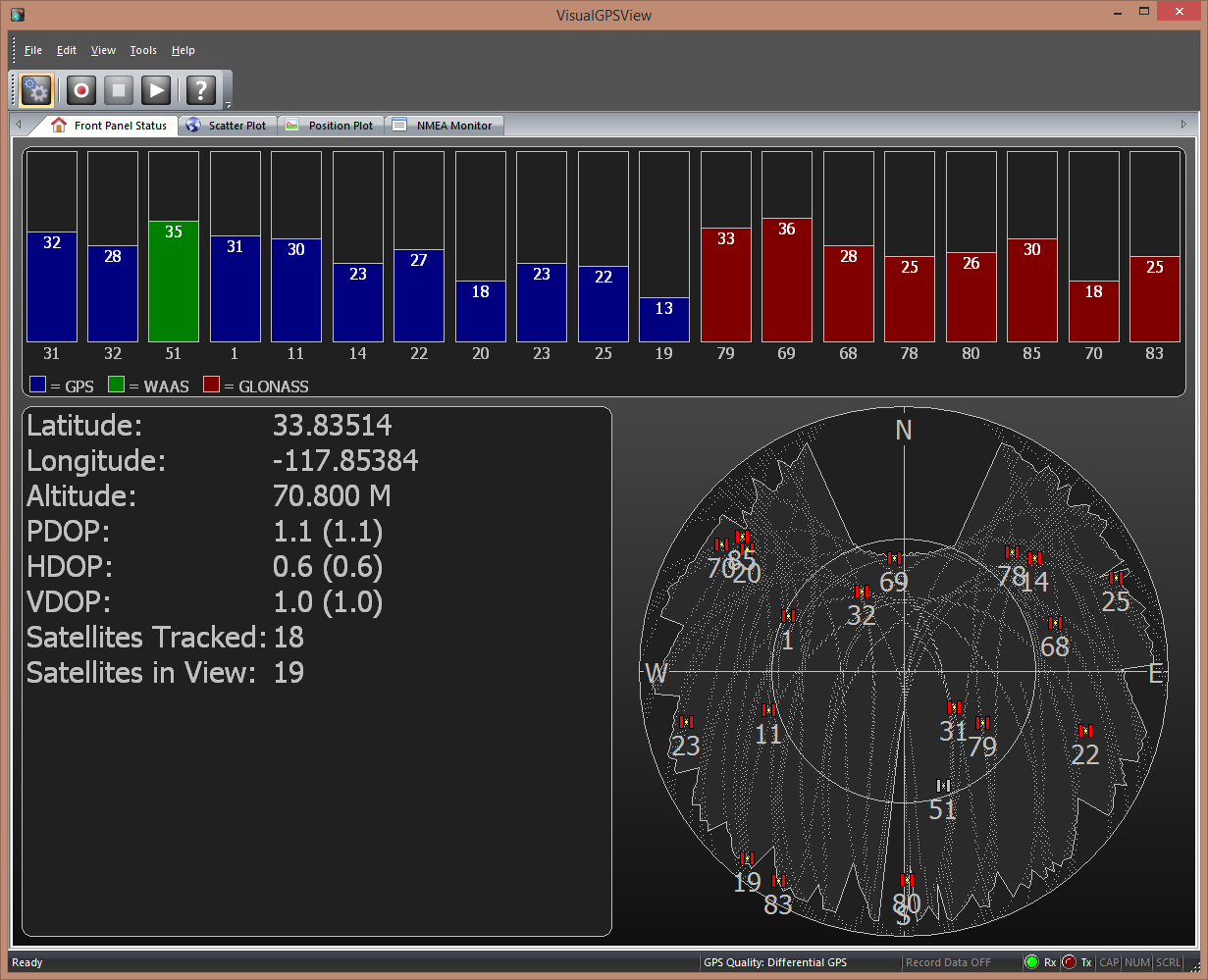
    Rarely does the $GPGGA message have enough information by itself. For example, the following screen requires: $GPGGA, $GPGSA, $GPGSV.

    VisualGPSView screenshot. (Photo: VisualGPC LLC.)
    VisualGPSView screenshot. (Photo: VisualGPC LLC)

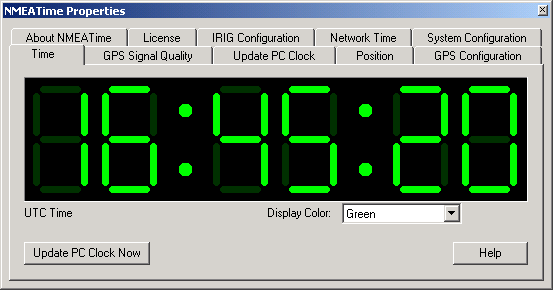
    The following screen, focused on the time capabilities of GPS, requires a slightly different set of NMEA messages: $GPGGA or $GPRMC or $GPZDA, $GPGSA, $GPGSV.

    NMEATime. (Photo: VisualGPC LLC)
    NMEATime. (Photo: VisualGPC LLC)

    The above screenshot examples are useful for the general GPS user. The $GPGST message is particularly useful for high-precision GPS mapping and surveying. In fact, I would say it’s a requirement for high-precision users. The reason is that GPS metadata is very important for the high-precision user as a method of assisting in determining the quality of a particular GPS coordinate. Typical GPS real-time metadata used in understanding the quality of the GPS coordinate include: PDOP, number of satellites tracked, correction method and horizontal/vertical standard deviation values. If a GPS receiver user has the ability to see this information in the field during data collection, they have a level of confidence in the precision of the GPS data they are collecting. If you’ve used RTK before, you probably recall the familiar horizontal RMS (HRMS) and vertical RMS (VRMS) values displayed on your data collection device. The $GPGST message generates those values.

    DD.MMMMMMM, DDMM.MMMMM, or DDMMSS.SSSSS

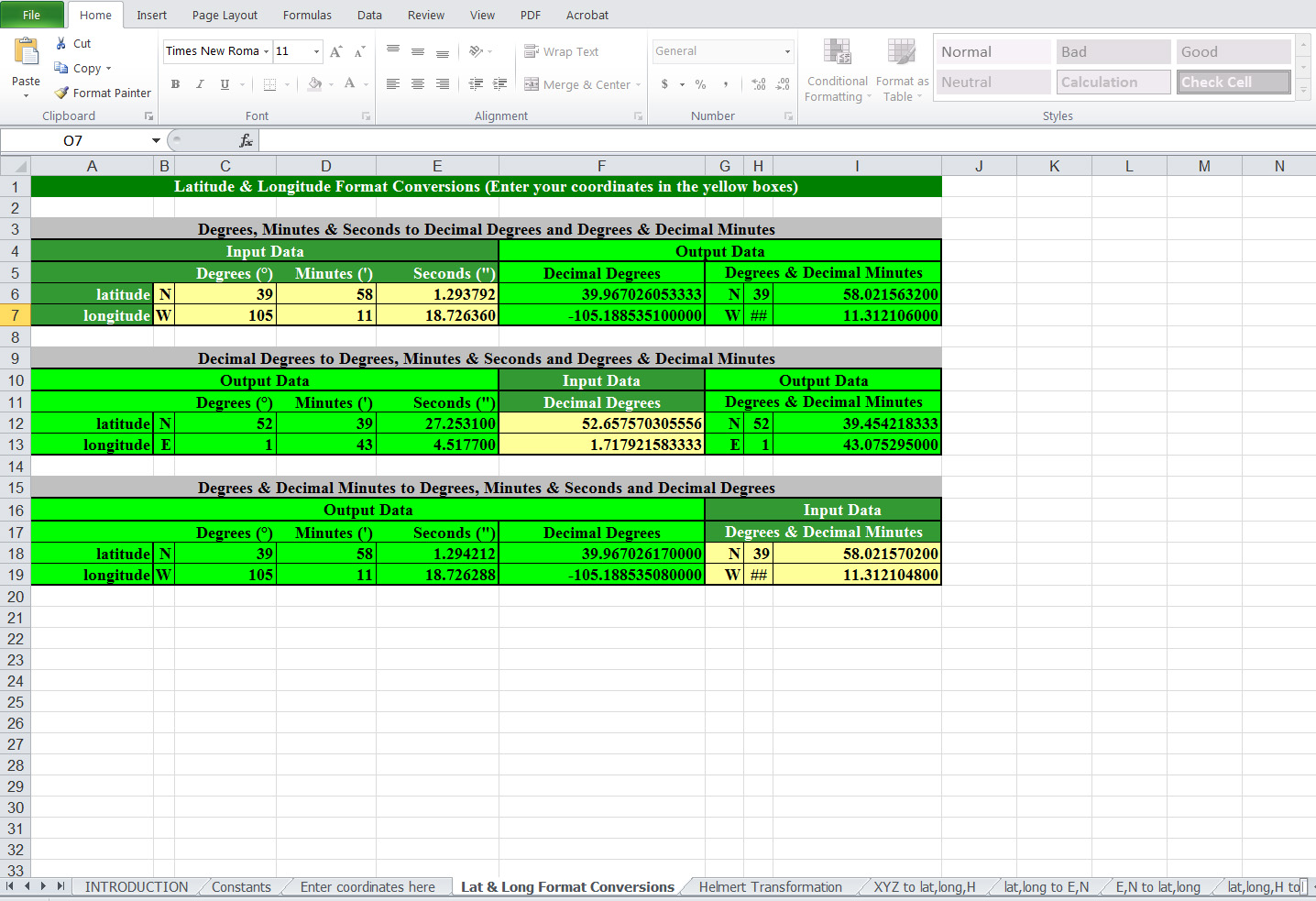
    One of the challenges in dealing with raw NMEA data (data not using a software like VisualGPS to decode it for you) is the format of the GPS coordinate. It’s not user-friendly. It’s expressed in DDMM.MMMMM; degrees, minutes and decimal minutes. To display the coordinate in a different format, there’s a useful Excel spreadsheet published by the UK Ordnance Survey.

    UK Ordnance Survey Coordinate Calculator
    UK Ordnance Survey Coordinate Calculator

    To use the spreadsheet, simply enter the GPS coordinate in the format you have, and the spreadsheet will calculate and display the GPS coordinate in the other two formats.

    Click here to download the UK Ordnance Survey Excel spreadsheet coordinate calculator.

    Thanks, and see you next time.


    Follow me on Twitter at https://twitter.com/GPSGIS_Eric

  • Out in Front: Yes, We Have No Bananas

    What if the U.S. government stepped in and confiscated all your bananas? Grown foreignly, they lack proper accreditation to enter this country. That they have done so for years is no excuse. They are illegal. Those who consume said bananas engage in unlawful activity. Those who facilitate such consumption — you, in this case, whom we imagine to be a vendor of shakes, smoothies, and fruit juices — are aiding and abetting, colluding, conspiring, something like that.

    Bananas are no more above the law than anyone or anything else. They must fill out the proper forms.

    And the same goes for all you other tropical fruits out there! If you spring from foreign soil, and if you pack exotic flavors unfamiliar and most important, unapproved, in the land of apple pie.

    Today’s bananas are GLONASS signals, and the other fruits, those from other international GNSS. The PNT user community within the United States who use such multi-GNSS signals, other than GPS, technically do so illegally.

    These revelations come via the U.S. Federal Communications Commission (FCC) and the National Telecommunications and Information Administration (NTIA). Some in the industry-user community have been aware of this technicality, and have been patiently awaiting a blanket waiver that would take care of the matter. The waiver will appear, we have been told, any day now.

    We are waiting. Sitting, and waiting. Like good citizens of the republic.

    A spokesperson for the the GPS Innovation Alliance (formerly the U.S. GPS Industry Council) stated that it, too, is very patiently waiting. “The process for securing a waiver of FCC regulations requiring authorization to receive international RNSS satellite signals was identified in an FCC Public Notice released in 2011. This process is initiated by National RNSS System providers, which have the satellite information needed to secure a waiver. GPSIA members remain fully committed to producing  multi-GNSS signal user equipment consistent with U.S. policy, and to working with the FCC and NTIA in considering these requests.”

    To review the FCC/NTIA briefing: “Radio Regulator Spectrum Management Perspectives & Priorities: Emerging Trends in Spectrum-Efficient Technologies,” see www.gps.gov/governance/advisory/meetings/2014-12/.

    The NTIA and FCC perform these functions on our behalf:

    • Allocate spectrum, while promoting new technologies and services.
    • Develop service rules: share spectrum while minimizing interference risks.
    • Assign frequencies, for interference protection among authorized stations.
    • Enforce rules.

    Some of the frequencies used by GLONASS, Galileo, and other foreign PNT systems are not authorized for use in the United States, as they may interfere with other signals. Since they are not authorized or certified, they have no guarantee of protection in the United States. The NTIA and FCC protect users from unauthorized foreign PNT signals.

    The European Union and Galileo have formally asked for a waiver and are completing the necessary paperwork.

    Let’s hope that common sense prevails soon over international gamesmanship, a waiver is granted, and this all goes away. Such a waiver reportedly sits on the desk of the appropriate person. Sits and has sat.

    To our mantra of location, location, location, we must add a corollary.

    Education, education, education.

  • 2, 4, 6, 8 — Who Do We Appreciate?

    Galileo, that’s who! For dogged determination and persistent pushing-forwardness in the face of adversity, obstacles, and the occasional technical difficulty. That there may be occasional confusion, as well, or mixed messages as to just what the future may bring, is certainly understandable. In fact, it is to be expected, given the circumstances.

    Let’s review the math.

    Two

    Two for the two launch vehicles that Galileo may use in the near future, Soyuz Fregat and Ariane 5. The Soyuz rocket can lift two satellites of the Galileo punching weight. The Ariane 5 rocket can carry four into space.

    Soyuz Fregat has a losing record so far with Galileo, being responsible for the August 2014 loosening of the first two full-operational capability (FOC) satellites into the dangerous Van Allen Belt. The first of these satellites has been successfully repositioned by the European Space Agency (ESA) into a mostly-but-not-totally useable orbit, and the second is currently en route to a similar spot.

    We do not wish to say we told you so, but we will. Back on March 26, 2014, we wrote on these virtual pages, “ESA’s year-end plan calls for two more dual-satellite launches in October and December on Russian Soyuz rockets — new partners to the Galileo dance, bringing perhaps new technical connectivity issues.”

    “Rockets are tricky,” said Tesla/SpaceX CEO Elon Musk, after his Falcon 9 Reusable rocket exploded over Texas at roughly the same time that Soyuz Fregat mis-delivered two Galileo satellites into wrong orbits.

    Musk meant tricky in actual operation, but we may also add, tricky in scheduling, in getting a cargo aboard a spacebound vehicle. Arianespace’s calendar is particularly filled with telecomm satellites impatient to be put aloft, with Ariane 5 being the preferred launcher of many. Soyuz availability, understandably, is somewhat more open.

    Four

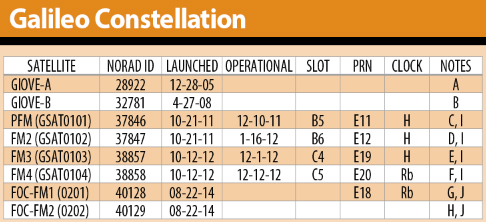
    Four for the total of four Galileo satellites now orbiting and broadcasting useable signals at all times for all users. These four come from the in-orbit validation (IOV) generation.

    Galileo-chart-Jan2015

    The two added FOC satellites, no longer in a bad orbit, now in a sort-of-pretty-good orbit, should be useable at some times, for some purposes, by some people. Peter Steigenberger and André Hauschild, researchers at the German Aerospace Center (DLR) / German Space Operations Center, wrote in this magazine in January that:

    “Despite the orbit injection error, the new Galileo FOC satellite has now been successfully activated and added to the Galileo constellation. Unfortunately, the current orbit is incompatible with the standard Galileo almanac format, which may cause restrictions for some commercial receiver types.

    “Nevertheless, the satellite can already be tracked by a wide range of geodetic receivers with existing firmware versions and it will, in fact, be possible to use the new satellite for diverse applications in surveying, precise positioning, and geodesy, as well as in general multi-GNSS studies. We now look forward to the activation of the second FOC satellite, which can be expected in early 2015 and will, for the first time, offer multi-frequency signals from a total of five Galileo satellites.”

    If you have four fully useable satellites and two partially useable satellites, what do you have? Does six = five functionally in this case? Or perhaps 5.5?

    Six

    Six for the oncoming new Galileo FOC satellites to be launched in 2015, according to some schedules and some official announcements.

    On a year-opening preview of operations given on Jan. 19, Thomas Reiter, Head of the European Space Operations Centre (ESOC) in Darmstadt, Germany, outlined the launch schedule for Galileo in 2015. Six new FOC satellites in total:

    • Galileo L4 with two on March 26
    • Galileo L5 with two in September
    • Galileo L6 with two in December.


    Now, six satellites divided by three launch dates gives two satellites per launch. Seeming to indicate a Soyuz rocket for all three dates. Reiter did not mention any rocket by name, but this would be the inference.

    That’s putting a brave face on the situation. Back in May, Russia suffered its fifth rocket launch crash in the past four years, raising serious concerns about the reliability of Russian rockets and launch procedures. Subsequently, the August Galileo launch that went so wrong was controlled by Arianespace, but it did use the Russian equipment.

    It strains credulity that an omission or oversight in the system thermal analysis  during stage design of a million-dollar rocket, designed to carry million-plus-dollar satellites in a 21st-century endeavor, could permit the creation of a thermal bridge between two feed lines, causing one of them to freeze during a crucial phase of space operations — but that is what apparently happened at some point at NPO Lavochkin in Russia, and that is what ultimately caused Galileo such misfortune. All parties concerned swear that this problem has been corrected in every other Soyuz Fregat, but who knows what other anomalies lie undiscovered therein?

    So putting all your 2015 money aboard Soyuzes is really rolling the marbles. Even if, as Elżbieta Bienkowska, Member of the EC in charge of Internal Market, Industry, Entrepreneurship and SMEs stated at this week’s 7th European Space Conference: EU Space Policy Confronted With the Rising Demand for Services and Applications, “We agreed to contract insurance for the next launches.”

    Eight

    Eight for the oncoming new Galileo FOC satellites to be launched in 2015, according to other schedules and other official announcements.

    “2015 will be a crucial year for the European space industry. We have big plans,” said Maros Sefcoviv, vice-president of the EC in charge of Energy Union, earlier at the very same 7th European Space conference, EU Space Policy Confronted With the Rising Demand for Services and Applications.

    “On the biggest one, we are planning five launches, which will bring up to space 10 satellites: eight for our Galileo constellation, and two for Copernicus. This is something that will put these programs over, I would say, over the edge, in a way, to be able to offer early services from Galileo, and to develop the program of Copernicus. It would prove the resilience and competitiveness of the European space industry, and its ability to serve the businesses, and what I think is most important, to offer new kinds of services to the citizens.”

    “For our flagship programs like Galileo and EGNOS, our priority must be to deliver services as soon as possible. That is why the satellites have to be delivered and operations must be ready as soon as possible.”

    Now, if you have eight satellites to go up in three launches, that would mean one of them has to go with four aboard. Thus, an Ariane 5 Galileo launch this year after all? Or possibly four Soyuz launches, although one more launch date could just just as hard to come by as a launch vehicle.

    Hard to tell. Very hard to tell. Extremely hard to tell, from the outside.

    Those who do not study history are condemned to repeat it, goes the dictum. Those who do study GNSS history, in this case, are likely only to repeat past pronouncements without any perceptible advance in clarity.

    Way, way back in March 2013, an EC program manager told GPS World, “Then, in 2014 [after four FOC satellites were to rise in 2013, which did not happen] we will see three Soyuz launches of two satellites each. We do not have the precise launch dates yet, but they are likely to be in April, June, and September. In December 2014, we expect to have the first launch using the Ariane 5 launcher, which is capable of deploying four satellites in one go. This means that by the end of 2014 Galileo will have deployed 18 satellites in orbit.”

    Now, the target has moved several times since then, and the schedule has slid accordingly.

    “In 2015, there will be two Ariane 5 launches, one in the middle of the year, one at the end, each carrying four satellites.”

    Six or Eight?

    Either number this year, we would surely appreciate. To return to Ms. Bienkowska, she left a little fudge room in her presentation: “We aim to launch at least six satellites this year.”

    Well, at least we are all moving forward. Resolutely.

    ——————————–

    I am indebted to Tim Reynolds, GPS World’s Brussels-based European correspondent, and to Peter de Selding, Paris bureau chief of SpaceNews, for their assistance in gathering diverse intelligence on this topic. Tim Reynolds will have an up-to-date view of this and other Galileo developments when we publish the next issue of the EAGER* newsletter at the end of March. Subscribe for free.

    * The European GNSS and Earth Observation Report

  • Self-Driving Cars Find Their Way at CES

    This year’s CES featured the usual big TV screens, loudspeakers, wearables, 3D printers, drones and connected vehicles surrounded by 150,000 attendees over several Las Vegas meeting venues. What was interesting was the continued rise of autonomous, or self-driving, vehicles and platforms. Lost in all of the noise was a small, but important, location-based services enclave that consisted of GPS-enabled wearables and indoor positioning.

    LAS VEGAS—A big chunk of the estimated 30 billion worldwide connected devices will be those linked to vehicles, say industry experts at the International Consumer Electronics Show here. Nearly all automakers had a presence at CES — all with a long-term connected vehicle strategy.

    No matter how big and exhausting CES is, with long taxi lines and 150,000 attendees, there is good reason to come a day before the giant conference, as the Consumer Telematics Show and AT&T Developer’s Conference feature many industry executives and new developments. At the Consumer Telematics Show, speakers explained how and why connected vehicles are transitioning to autonomous capability.

    The connected car industry has matured to the point where technology and market points are coming together, said Thilo Koslowski, Gartner vice president and practice leader, automotive vehicle ICT mobility, at CTS. “The opportunity of connected vehicles are becoming the center of mobile and [Internet of Things] innovations. It has come from, in 1997, a pure telematics safety and security device to vehicle integration, digital lifestyle convergence and Internet of cars,” he said. “At the end of the year, there will be 25 million connected vehicles in the world, but most in mature markets. That might not look like a lot, but only in five more years, I think that number is going to 150 million vehicles.”

    In some cases, the newer outfitted vehicles will have only safety and security features, Koslowski said, but most will have two-way data communication, part of the 30 billion devices connected by 2020. He predicted last year that most automakers would have shifted general mobile applications to vehicle and customer-specific services.

    Koslowski says the top connected car features that consumers have asked for include automated map updates, real-time weather and news, parking spot finder and driving assessment and coaching. “Consumers don’t want application downloads directly into the car. In addition, in-vehicle media purchases are not there yet, as are in-vehicle social networking updates,” he said. “I predicted in 2013 that 25 percent of the automakers would monetize mobile commerce transactions in their connected vehicle offerings such as parking, buying gas, etc.,” he said.

    Self-Aware Vehicle Emergence

    Imagine sleeping, or reading, in your car during the morning commute. It may be a reality, but major technical, cultural and legal issues need to be resolved before fully autonomous vehicles hit the road. “There is going to be trouble if [automakers] don’t get consumers involved early on. Or allow governments and insurance companies telling people when to hit the button (to drive),” Koslowski said. “You press the [drive yourself] button and you pay 30 percent more in insurance. About 39 percent of those we surveyed are interested in some sort of self-driving car — that doesn’t mean fully autonomous vehicles. But 61 percent say they are not ready.”

    Koslowski says there is a lot of education that includes basic acceptance of the technology and trust that it really works. “There usually is a 30-second rule. The first 30 seconds is ‘holy moly, this thing drives itself’,” he said. “The second 30 seconds is ‘is this beneficial?’ There are real benefits such as reducing the cost of accidents, which amount to $900 per U.S. citizen.”

    In terms of cyber security and privacy, Koslowski said it’s a big deal for autonomous vehicles. “A couple of breaches will be a big deal. Still, consumers are not that paranoid. They are willing to share information, especially if there is a monetary or societal function,” he said.

    Cost is still big factor that will drive the adoption of autonomous vehicles. Koslowski says that consumers polled will only pay an additional $1,404 for autonomous capability. The cost of a test vehicle, right now, is about $85,000. “The good news is that number is coming down. It is shrinking to less than $6,595,” he said.

    At the Transportation Research Board meeting a week after CES in Washington, Chris Urmson, who heads Google’s self-driving vehicle program, said the Kentucky Fried Chicken bucket-looking gizmo on top of their car cost $70,000 alone.

    Cost aside, by 2016, three automakers will have concrete plans for upcoming autonomous vehicle launches, Koslowski said. “This is happening a lot faster from a technology standpoint than experts thought it would,” he said.

    Overall, Koslowski said that big IT companies need to step up to make autonomous vehicles work. “Governments are a little behind. The slowness of automotive companies also make them vulnerable to technology companies to step in and take over the industry,” he said.

    Indoor Positioning and Other Location Markets at CES

    Such companies as CSR were at CES and said the show was good for indoor location providers. “CES was good for us. We had good interest in our live demo of indoor location where customers were free to walk around testing the performance of our (solution). We also saw a lot of interest from the automotive market for an indoor/outdoor navigation (product), such as being able to find your way back to the car in a complex shopping mall and the best place to park for access to your indoor destination,” said Dave Huntingford, CSR’s director of product line for location.

    In 2015, the company believes that one of the key drivers for indoor location will be the ubiquity of maps for public locations, Huntingford said. “The availability of indoor maps for malls, airports and retail chains will help drive indoor location awareness with consumers for both utility value (not getting lost) and retail marketing applications,” he said. “We also expect to see a variety of social networking applications supporting indoor location, reflecting the fact that we spend the vast majority of time indoors.”

    Huntingford believes a key limitation of many indoor technologies is the requirement to have dedicated, or upgraded, infrastructure such as BT Smart beacons or updated Wi-Fi access points with new location capabilities, and a dedicated manual survey of the building to measure indoor Wi-Fi signatures.

    At CES, Magellan rolled out its line of 5-inch RoadMate Auto GPS Devices with 3D buildings and landmarks. “The units retail from $169 to $229. “We are surprised at the interest our PNDs are having in the market, particularly with back-up video,” said William Strand, Magellan associate director, product marketing. “The dash camera is a small market, but catching on to block insurance fraud.”

    In other CES news:

    • Audi pulled off a coup when it invited journalists to drive with its autonomous vehicle from San Francisco to Las Vegas.
    • Most location companies have wearables product lines that are making retail chains take notice.

    Transportation Research Board Meeting Becoming Big Autonomous Show

    WASHINGTON—The Transportation Research Board Annual Meeting here has grown to be one of the bigger autonomous vehicle meetings, with 12,000 mainly government execs and academics meeting.

    About 300 people showed up for a panel headlined by Chris Urmson, who heads up Google’s autonomous vehicle program. All was well and good hearing about Google’s self-driving vehicle technology except TRB had 100 chairs for 300 attendees…a lot of people left. But that is the level of interest autonomous vehicle is having in the government and academic community.

    “We are planning to find out how our car does with red lights flashing in front of it. The software will figure out, along with GPS and insertional and high-resolution maps,” Urmson said. “The world isn’t empty. Our vehicle has to know about the pick-up making a lane change, the bicyclist pedaling next to it.”

    Urmson said there are no sensors on the market that power the car — Google makes them in-house.

    In other TRB news, TomTom announced it is partnering with the I-95 Corridor Coalition. The company is using one of three main real-time traffic products in its portfolio, said Nick Cohn, TomTom senior business developer. “It is all about our TomTom Traffic Flow product, which provides speed information for individual road segments every minute, based on our mix of probe data sources,” he said. “This is one of three main real-time traffic products we have. TomTom Traffic provides one-minute updates of locations and delays of traffic jams and other traffic incidents. The third product is a set of APIs for providing, for example, travel times that can be displayed on variable message signs along roadways to inform drivers about delays.”

    The government market is a steady business for TomTom, which has seen traffic management success mainly in European cities such as Berlin, Rome and London, Cohn said.


  • Automakers No Longer the Neanderthals of Tech

    Automakers No Longer the Neanderthals of Tech

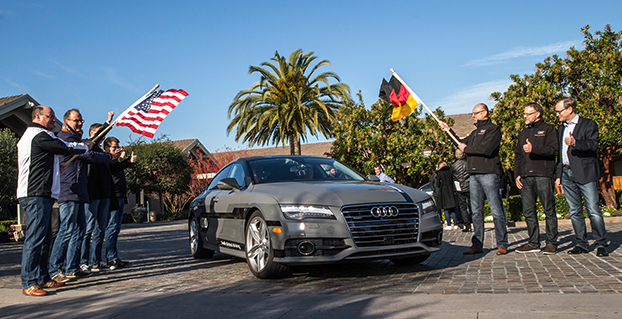
    Start of the 550 mile piloted drive from Silicon Valley to Las Vegas: Ricky Hudi, Executive Vice President Electric/Electronic Development, (left) and Ewald Gössmann, Excecutive Director Electronic Research Lab California (ERL), (third from right) drop the flag for the Audi A7 piloted driving concept car.  Photo: Audi
    Start of the 550 mile piloted drive from Silicon Valley to Las Vegas: Ricky Hudi, Executive Vice President Electric/Electronic Development, (left) and Ewald Gössmann, Excecutive Director Electronic Research Lab California (ERL), (third from right) drop the flag for the Audi A7 piloted driving concept car. Photo: Audi

    In the wake of CES and the North American International Auto Show in Detroit, it’s clear that times are a-changing. Self-driving concept cars filled three football-field-sized areas to show off what lies ahead. Verizon and Ford did a cosmic switcheroo, with Verizon morphing into the auto space and Ford starting a transformation into a mobility company. Automated reality/augmented reality isn’t as big as would be expected, and is suffering from a lack of content. Wearables continue to do remarkable things, notably in the health and fitness sector, and smart watches will become more exciting with interaction to vehicles and home.

    Janice Partyka
    Janice Partyka

    When Mark Field, current CEO of Ford, announced the Ford Sync from the CES stage in 2007, attendees found the presence of an auto company at CES to be out of place. The auto industry was considered Neanderthals of tech. Today, the most exciting mobile technology is vehicle related, and more exciting developments from the auto industry were seen in Las Vegas, rather than Detroit.

    Field was back at CES with a visionary perspective that Ford isn’t going to be just about cars and trucks. He is broadening Ford’s focus to mobility in preparation of the changes in transportation that will occur in response to global megatrends of urbanization, growth of the middle class, air-quality issues and evolving consumer attitudes. To test out new ideas of flexible user-ship and collaborative transportation, Ford is operating 25 experiments around the world to test out solutions for specific mobility challenges. Ford is looking to be a leader and enabler of a market where people may be sharing or swapping vehicles or relying on crowd-based transportation. It is refreshing to see out-of-the-box thinking from Detroit.

    Ford Mobility Experiment in London — driving-on-demand with Ford fleet. Photo: Ford
    Ford Mobility Experiment in London — driving-on-demand with Ford fleet. Photo: Ford

    Far from its beginnings in 2007, Ford announced SYNC 3, an updated version of its in-vehicle communication and information system. SYNC technology is already in 10 million vehicles on the road. SYNC 3 will be released in new car models this year and will include more conversational speech recognition, a more smartphone-like experience with a touch screen and easier-to-read graphics. In addition, AppLink 3.0 will roll out and give drivers the ability to access their navigation app — much as they do on a smartphone — on in-vehicle touch screens.

    Ford SYNC 3. Photo: Ford
    SYNC 3 has been designed to keep the drivers eyes on the road and hands on the wheel, even when controlling their favorite phone apps. Photo: Ford

    You may recall that GM had announced OnStar would be dropping Verizon for AT&T communications staring in 2015. The announcement of Verizon Vehicle, a new connected vehicle service that duplicates some of the features of OnStar, must be the impetus. The subscription-based service will be compatible with all vehicle models sold in the U.S. since 1996. The service will include GPS-directed roadside assistance, crash notification, emergency assistance with a live agent, a hotline to connect with mechanics on vehicle issues, maintenance alerts, and stolen vehicle location assistance. Notably, the offering doesn’t include navigation, a mainstay of OnStar, but readily available on smartphones. The service uses an OBD II dongle and a head unit that can attach to a visor and contains a Bluetooth speaker and call buttons.

    Mercedes-Benz, Audi and BMW all showed advances in self-driving vehicles. Mercedes-Benz demoed the F015 Luxury in Motion concept car, which is fully autonomous and completely powered by a battery and fuel cell. Audi impressed by having its own concept vehicle drive itself from Palo Alto, California, to Las Vegas. BMW offered demonstrations of its i3 electric car, with ActiveAssist technology, able to prevent collisions at speeds up to 15 mph.

    Delphi and Valeo technology suggest that current adaptive cruise-control systems may soon add self-steering. Drivers could allow the car to take over in stop-and-go traffic and on long highway segments. Although unlikely to see production in the short term, Delphi showed the full capabilities of its self-driving technology in an urban environment.

    The next big feature to be commercialized during our wait for automated driving is self-parking. As demonstrated by BMW, the driver arrives at a parking garage entrance, gets out of the car, and sends it to find a parking place. When ready to depart, the driver summons the car, which drives itself to a special pickup zone in front of a parking garage. BMW says it will be offering self-parking cars in one to two years.

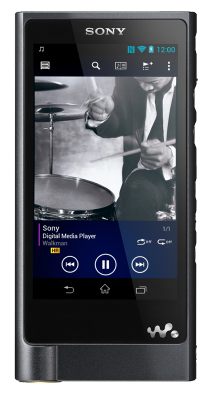
    The Sony Walkman, now $1,100. Photo: Sony
    The Sony Walkman, now $1,100. Photo: Sony

    Unfortunately, augmented reality hasn’t quite lived up to the hype, but Hyundai is showcasing a production-ready augmented reality heads-up display concept. It’s an easy-to-understand system with animated information and warnings to describe road conditions ahead. For instance, it provides warnings when another car is about to unexpectedly enter the car’s lane, and shows arrows leading to exit ramps, highlighted street signs and one-way street markings. Hyundai has linked the augmented heads-up display to a wearable band that will vibrate with warnings. The band includes a heart-rate monitor that can notify 911 if a driver’s heart rate changes rapidly.

    I don’t want to neglect the things in life that don’t change. It is comforting to know that Palm Pilots, record players and Walkmans are back at CES. The new Sony Walkman will set you back $1,100. So things do change.

  • FAA Issues More UAS Exemptions

    The Trimble UX5.
    The Trimble UX5.

    In December, I wrote about the five new commercial UAS (Unmanned Aerial System) exemptions issued by the Federal Aviation Administration (FAA), with one commercial exemption being issued to Trimble Navigation for its UX5 mapping UAS. The precedent was a major step towards integrating commercial UAS operations into the United States airspace. This month, the FAA issued two more commercial UAS exemptions, one of them opening a new world of commercial UAS operations.

    Speaking of exemptions, there’s a pile of commercial UAS exemption requests awaiting review by the FAA. From Amazon.com, who garnered lots of UAS attention when television news magazine 60 Minutes interviewed Amazon CEO Jeff Bezos about its drone delivery concept, to Agribusiness giant Wilbur-Ellis Co. If you’d like to view the list of requestors as well as read their submissions, click here. How much time does it take from submission to a exemption approval? The FAA doesn’t provide that estimate, but I’ve spoken to several organizations that have been granted exemptions and Certificates of Waiver or Authorization (COA). The quickest timeline I’ve heard is three months.

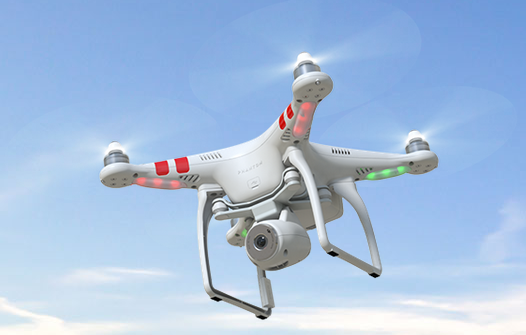
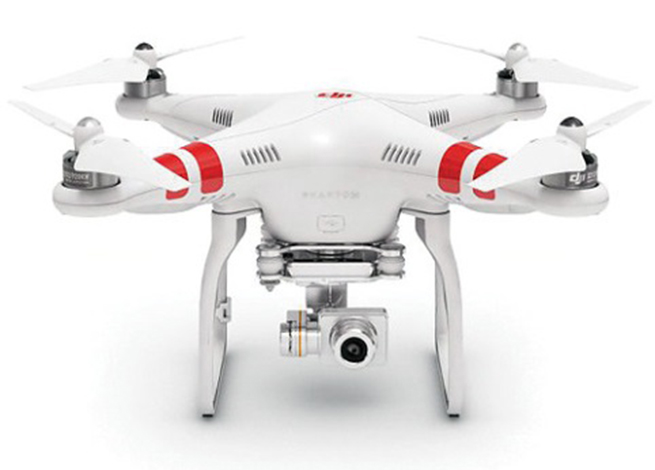
    The Phantom 2 Vision+ UAS
    The Phantom 2 Vision+ UAS

    As I mentioned above, two new commercial UAS exemptions were issued earlier this month. One went to Advanced Aviation Solutions LLC, who was granted an exemption to fly the Swiss-made eBee Ag UAS for precision agriculture. At US$25,000 each, the eBee Ag is for the serious drone connoisseur.

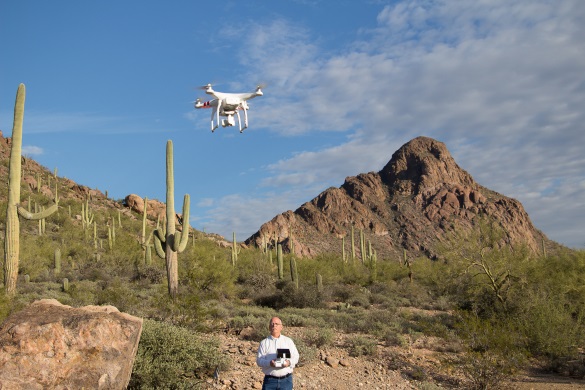
    The other commercial UAS exemption was issued to a realtor in Tucson, Arizona. This exemption is interesting because it’s the first one issued that makes use of the DJI Phantom II Vision+ quad copter UAS. The Phantom II Vision + sells for well under US$2,000 and is generally considered a consumer UAS rather than one purpose-built for commercial users. However, it clearly has the capability of being used by realtors, and thanks to support by Pix4D, a Swiss-based commercial UAS imagery software maker, it can be used for capturing imagery for mapping and generating 3D models.


    At well under $2,000, the DJI Phantom II Vision+ price point is affordable for even the most basic commercial UAS application. The cost is relatively insignificant compared to the cost of image processing software from PIX4D, which at US$7,500 is more than five times the cost of the Phantom.

    No matter which model UAS is being approved in the exemptions, the FAA expects all operators to adhere to many rules in common. One is that the Pilot in Command (PIC) must possess at least an FAA Private Pilot certificate. What does it take to qualify for an FAA Private Pilot Certificate? It’s not a small or inexpensive undertaking. Generally speaking, you need to:

    1. Pass a written knowledge test after completing ground school.
    2. Accumulate 40 hours of flight instruction and solo flight time.
    3. Possess an FAA third-class medical certificate.
    4. Pass a flight test administered by an FAA examiner.

    In terms of cost, a typical small aircraft (Cessna 152) suitable for training will cost you upwards of $90/hour to rent (including fuel). Add all the other costs in and you’re looking at spending more than $10,000. This doesn’t include the time you will spend studying, and there’s a lot to study, from weather phenomena to instruments to aircraft performance to maps.

    Now, the FAA exemptions don’t specify that the exemption holder must have a Private Pilot certificate. If you possess such an exemption, you can hire a Private Pilot to act as Pilot in Command (PIC) of the UAS, but costs start adding up quickly if you have to hire a PIC and also have a Visual Observer (VO) present, which the exemptions are requiring.

    Things are certainly heating up in the commercial UAS world. I have to commend the FAA for stepping up to the plate and taking action to allow commercial UAS operations (however limited) well before the U.S. Congress-imposed deadline of September 2015 for releasing rules for integrating commercial UAS into the United States airspace.

    Thanks, and see you next month.

    Follow me on Twitter at https://twitter.com/GPSGIS_Eric

  • Geospatial Technology 2015: One Man’s View of Life’s Swinging Pendulum

    Navy OCS Newport. (Photo by Photographer's Mate Second Class Mark A. Ebert)
    Navy OCS Newport. (Photo by Photographer’s Mate Second Class Mark A. Ebert)

    In 1971, I was traveling from Navy boot camp to OCS at Newport, Rhode Island.  While walking through Logan Airport, I passed some Vietnam protesters. A young hippie girl came up to me from the group and looked at my red National Defense service ribbon (a generic ribbon given to everyone for merely being in the service). Flicking the ribbon she scowled and asked “How many babies did you kill to get that medal?” Taken aback by her question, I answered the only way I could to someone so naive and clueless. I said, “To be honest with you, I lost count.”

    Fortunately, the public-perception pendulum swung back, reaching a high point after Desert Storm and more so after 9/11. Everyone remembers what they were doing when the Twin Towers were hit. I was in the middle of teaching an ArcView II class at the Atlanta Regional Commission. That week, I made three predictions to my colleagues.

    1. We are going to war. We did.
    2. We are going to take a 10% economic hit. We did, although later than I thought.
    3. Although almost everyone, including Rosie O’Donnell, was waving the flag, wearing NYPD caps, and extolling the virtues of our first responders and the military, I predicted that within 7-10 years they would forget the horror and be calling us baby killers again. The recent dissing of the NSA, CIA and, most recently, the police, is putting us on track for that prediction.

    Although real statistics show that life continues to get better for everyone despite the doom and gloom media, I do believe that we will see setbacks as the world faces numerous asymmetrical threats. So what does all this have to do with our geospatial community? A lot. No matter where the pendulum is, our country has to use every intel tool at our disposal to maintain vigilance. Killing bad guys with drones and taking no prisoners certainly doesn’t help our HUMINT (human intelligence) efforts, so more has to be accomplished by other means, with geospatial technology playing a key role. In 20 years we’ve seen significant changes in geospatial technology, and 2015 should be no exception.

    Oblique Imagery and 3D Models

    I believe that 2015 will see an explosion of oblique imagery and 3D models. Moore’s Law proves valid as hardware speed and capabilities expand. There are numerous overhead and ground-capture systems, manned and unmanned, that are driving costs down and resolution up, with significantly more imagery available. Countless programmers are working night and day to develop the preeminent tool to build 3D models. 3D navigation and exploitation tools should also continue to improve.

    I’ve written on how many people have difficulty orienting themselves with abstract maps or even ortho imagery. By contrast, oblique imagery and 3D models help non-GIS personnel with rapid perception of an operational picture. Some ask why bother with the expense and effort needed to create 3D models when four-way obliques are almost as good? The key reason is police, military and first responders frequently need to be able to measure angles, distance, lines of sight and visibility within a 3D environment, such as one rooftop to another. That’s difficult to do without a metric geo-referenced 3D model. Additionally, if UAVs, micro UAVs, and even nano UAVs see expanded use, interior navigation will be critical. Perhaps someone will finally develop a reliable interior-location tracking system with LiDAR data, BIM Models or accurate 3D models as the navigation map.

    For over a decade, Pictometry International has been the key provider of georeferenced metric oblique imagery, but the Pictometry patents have expired and many new players are entering the market with both aerial and ground-capture systems, plus 3D model creation. Here is a partial list of oblique and 3D model players to watch in 2015:

    • Acute3D. This French company offers software that produces high-resolution 3D models from simple photographs, without any human intervention.
    • AEgis Technologies Group, Inc. Builders of detailed 3D models for military and major security applications.
    • Agisoft LLC. A Russian company that created Agisoft PhotoScan, a photogrammetric software for 3D reconstruction, visualization, surveying and mapping.
    • Ball Aerospace & Technologies Corp. This Denver-based office developed a new technology that creates real-time 3D models by shooting and merging a co-bore-sighted LiDAR and optical image to create real-time 3D models.
    • BlomOBLIQUE. A former Pictometry partner now on its own, primarily in Europe.
    • CyberCity 3D, Inc. CyberCity 3D specializes in 3D GIS buildings focused on urban planning and analysis, visualization, real estate, solar, rainwater, and sustainability.
    • CycloMedia Technology, Inc. A Dutch-based U.S. firm doing ground-level metric oblique imagery. I wrote about them in February.
    • Euclideon Geoverse. An Australian firm that developed tools that permit almost instant access to massive point cloud or imagery data. Watch the video.

      • Fugro. Fugro’s PanoramiX imagery and PX Mapper software look promising.
      • GEOSPAN, Corp. This firm is capturing imagery of Cook County Illinois and planning to release automated 3D modeling software this year.
      • ICAROS. This well-established mapping firm has expanded into metric oblique imagery. Watch the video.

    • IDAN Computers Ltd. An Israeli company that developed the tools to capture metric oblique imagery almost at the same time as Pictometry, but were only a few months behind Pictometry in filing a patent. IDAN’s Oblivision technology has seen extensive use overseas, and its IMPS (IDAN Mission Planning System) was used in real-world homeland security and military actions in the Middle East. IDAN was recently awarded a U.S. patent for automatic generation of 3D models of structures using real facade textures obtained from its geo-referenced oblique images. Watch the video.

    • MosaicMill, Ltd. This geospatial technology company in Finland was established in 2009. The company is the developer of the EnsoMOSAIC aerial survey system and EnsoMOSAIC photogrammetric software designed for UAV captured data.
    • NearMap. This Australian firm has been doing very high refresh rate ortho imagery focused on construction, but is now getting into the oblique market. Read more here.
    • Pix4D. This company has generated a lot of buzz related to its Pix4Dmapper, which automatically creates 3D models from imagery captured by any type of camera or platform, including small UAVs.
    PLW Modelworks 3D model of San Francisco.
    PLW Modelworks 3D model of San Francisco.
    • PLW Modelworks. In my opinion, PLW Modelworks 3D models are still the gold standard of 3D models. Although not quick or cheap, nothing comes close to these photo-realistic and photo-accurate 3D models. Note their key role in Birdly, discussed below.
    • Raytheon. I wrote about Raytheon’s automated system to build 3D models from satellite imagery in August.
    • Sanborn. Founded in 1866, the Sanborn Map Company is expanding significantly into oblique imagery and 3D models.

    The Cloud

    No discussion of 2015 would be complete without mention of “The Cloud.” I wrote about one cloud-based application last year. We still have a long way to go to achieve the grand vision, but the Carbon Project may come closer to the dream than any application I’ve seen so far.

    The Carbon Project is building a unified cloud-based system for the State of North Carolina that will roll out this spring. The project addresses two key issues that have been a problem for years — data disparity from multiple sources and loss of connectivity. The system will continuously ingest geospatial data from all NC counties and seamlessly correct formats and data labels to one standard without changing the original data. Additionally, for those of us who have experienced paralysis during critical events due to loss of connectivity, the Carbon Project can automatically cache data locally once an area of interest is defined.

    Note this example using Carbon Project technology to test an Electronic Flight Bag for the FAA. Some pilots no longer have to lug around a 40-pound case of paper charts and manuals, just a tablet.
    Note this example using Carbon Project technology to test an Electronic Flight Bag for the FAA. Some pilots no longer have to lug around a 40-pound case of paper charts and manuals, just a tablet.

    Social Media / Cyber Warfare

    Initially, it seemed like “location” wouldn’t be a factor in the cyber world other than to monitor threats to our infrastructure such as the power grid, but we’ve all learned differently. There is a growing capability and need to map networks, nodes and server locations. Additionally, many tools have been developed that can identify location components within the content of social media, and the technology will continue to improve and grow in importance, especially for the intel community as HUMINT dries up.

    A seemingly small improvement comes from ClearTerra with its product LocateXT. LocateXT rapidly scans unstructured textual documents searching for location information such as geo-coordinates or place names, then automatically creates formatted geospatial files such as Shapefiles and KMLs. On first glance, this doesn’t seem like that big of a deal, until one realizes the man-hours that manual searches and conversion would take on thousands of documents, including massive social-media files.

    birdly2Augmented / Virtual Reality

    So, what is this young lady doing? She is flying through a virtual but real-life 3D model. See what happens when you merge GIS, ortho/oblique imagery, PLW Modelworks 3D models, Occulus Rift 3D goggles, UAVs, GPS and virtual reality. By the way, don’t put this in the same category as a video game. Gamers use a lot of cloning and textures, so they don’t have to handle real-life data files. Birdly, a bird-flight simulator, uses photo accurate geo-referenced imagery and models. Perhaps Birdly is the future of UAV control and remote data capture. Learn more about Birdly:

    With this column, I felt like one of the blind men trying to describe an elephant, since my view of the geospatial community is limited. Most likely you have a different view based on your position and experience. Please share your predictions for 2015 in the comments section based on your view of our community.

    Hopefully, the public perception pendulum will start swinging back this year.

  • GNSS: The New GPS

    GNSS: The New GPS

    First of all, on behalf of all of us here at GPS World magazine, allow me to welcome you to 2015. We wish you a healthy and prosperous new year!

    I’d like to start out the new year stating the obvious for some of you, maybe most of you…perhaps all of you: GNSS is the new GPS.

    In the high-precision GNSS community, I think this is already our mindset, and has been for quite some time. The benefit of using signals from as many satellite navigation systems to the high-precision user is obvious. We saw this with the adoption of GLONASS more than a decade ago. It’s to the point now that even many consumer receivers (such as my Samsung Galaxy S5) utilize both GPS and GLONASS satellites.

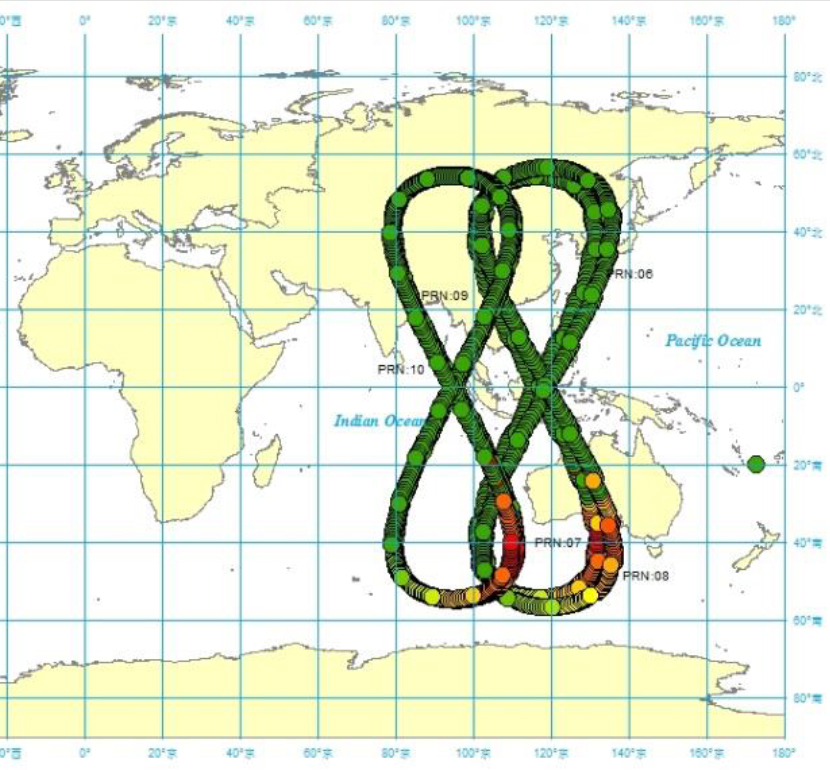
    I think it’s pretty obvious we’ll see the same phenomenon with Galileo (Europe) and BDS (China’s BeiDou system). It’s exciting to think about what high-precision GNSS positioning is going to look like just 2-3 years from now. Think about how much better RTK positioning will be with 30+ satellites in view. By the way, that’s already a reality in China where BDS has 14 regional satellites in addition to GPS and GLONASS. It’s the best place in the world for RTK positioning due to the number of satellites in view at any one time, and it might be the reason that China consumes more RTK receivers than the rest of the world combined.

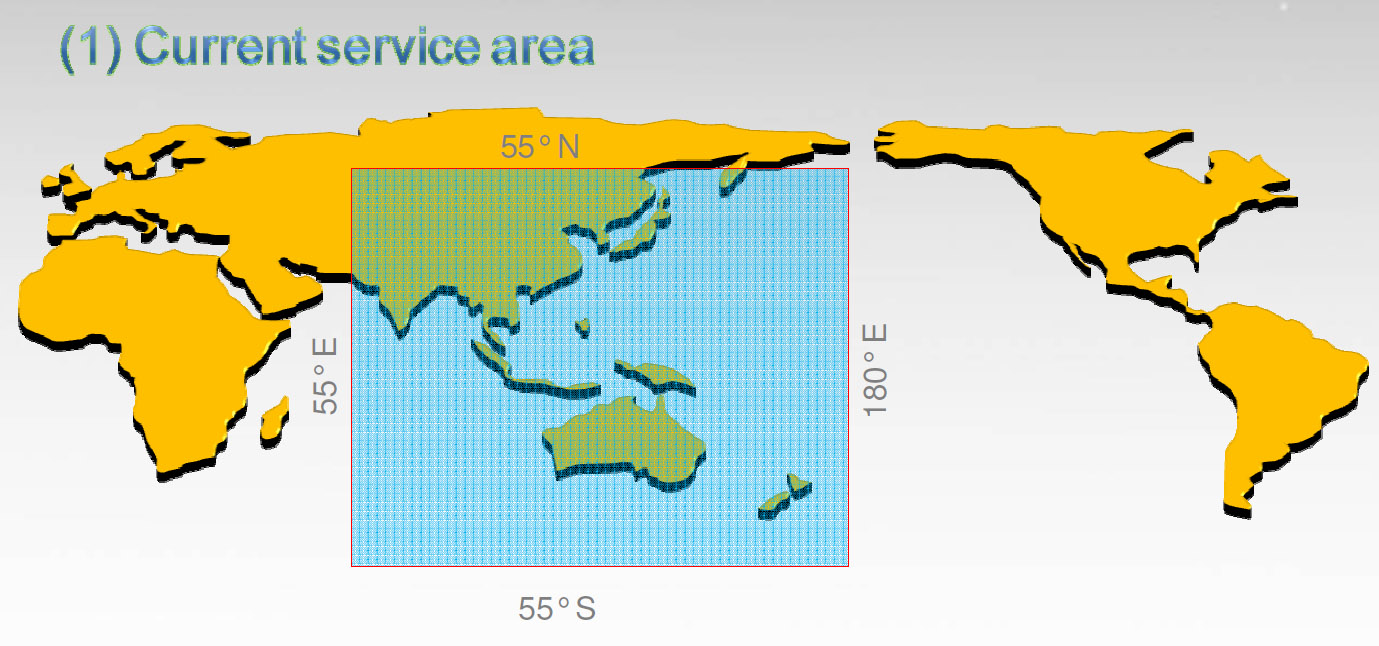
    BDS coverage area
    BDS coverage area.


    BDS satellite orbit map
    BDS satellite orbit map.

    I certainly look forward to the deployment of Galileo and BDS. It will only make us more productive in accomplishing our work. Yet I’m reminded frequently when reading mainstream news headlines that Galileo, BDS, and GLONASS compete with GPS. Even some of those who hold GPS dear to their hearts, such as those who were involved in the development, promotion and deployment of GPS, view the other satellite systems as competition.

    Maybe that’s not a bad thing because competitors push each other to perform better. However, where it might hurt is when it comes to support, such as funding. Galileo, in particular, because it’s funded with civil funds instead of defense funds like GPS and GLONASS, has been criticized as a wasteful use of resources because GPS already exists. What more can it add, they ask? The mainstream media doesn’t have a clue that the satellite navigation systems are complementary rather than competitive. You and I know that more satellites generally equates to increased productivity no matter who owns/operates the satellite that is sending the signal. I cringe when I read these headlines:

    News Headlines

    GPS and its Three Main Competitors: Galileo, Beidou, GLONASS

    GPS vs. Galileo; Where Are They Headed?

    China Spreads Alternative To U.S. GPS System

    China’s Beidou Navigation Satellite System More Precise than GPS in Certain Areas

    GPS vs GLONASS: Which Is Best for Tracking Applications?

    Generally, I dismiss the mainstream media in the GNSS arena, but these misleading articles can have an impact on funding of the various GNSS, such as Galileo. Politicians and various purse-string holders can be influenced by these stories.

    Galileo Moving Forward

    The Europeans are pushing forward after the recent hiccup when the first two Full Operation Capability (FOC) Galileo satellites were inserted in the incorrect orbits due to an improper fuel line installation on the rocket launcher resulting in the satellites being inserted in an orbit far below its intended orbit (an elliptical orbit, 49.8 degrees at 26,200 km, vs. the intended circular orbit, 55 degrees at 29,900 km).

    In October 2014, shortly after the faulty launch, the outlook for the two satellites was bleak. The consensus was that there was no feasible method to move the satellites to their intended orbits. The good news was that besides the fact that they were in New York instead of Los Angeles :-), they checked out healthy, were properly oriented to the sun, and were “thermally stable.” Would they join GPS SVN-49 in being demoted to permanent test mode status, never being allowed to join the operational constellation, further delaying the deployment of Galileo? Not so.

    In late October, flight engineers used a series of fuel burns, using more than 75 percent of its fuel payload, to boost the satellite 3,500 km further into space, into a more circular orbit. While the original, incorrect orbit “prevented their use for navigation services because they were too low during part of their orbit to sense the horizon and correctly determine their own position,” the new orbit, not quite the intended orbit, seems sufficient to allow the satellite to perform most of its intended duties, including being incorporated into Galileo’s operational constellation.

    The first live test was completed on December 9, 2014, when the satellite was one of four Galileo satellites that delivered a position fix of better than two meters. Furthermore, in a January 1 article published on GPS World’s website, Peter Steigenberger and André Hauschild of the German Aerospace Center wrote that the rogue Galileo FOC satellites can likely be used by commercial, multi-frequency, high-precision GNSS receivers for carrier-phase positioning. One drawback is that because the satellite’s orbit doesn’t fall within the limits of the standard Galileo almanac, it may take receivers longer to begin tracking the satellite.

    Flight engineers are now working on maneuvering the second rogue Galileo satellite in the same manner, hoping for the same result.

    All in all, this is about as good of a result that could possibly be expected. My hat’s off to the folks who made this happen.

    Meanwhile, the next four Galileo FOC satellites are moving through the production process. Originally slated for a December launch, I suspect last year’s launch anomaly had the Galileo folks double-triple-quadruple checking, dotting i’s and crossing T’s, so make sure the next launch has the best chance of success. They haven’t announced a new launch schedule yet, but I would guess it’s likely in the next six months, with quarterly launches resuming if things goes smoothly. If all goes well, we could be benefiting from 10 healthy Galileo satellites by the end of the year.

    Thanks, and see you next time.

    Follow me on Twitter at https://twitter.com/GPSGIS_Eric