Category: Opinions

  • Expert Advice: Loose Coupling — And What’s Wrong With It

    James L. Farrell
    James L. Farrell

    By James L. Farrell

    Concerns raised about cascaded Kalman filters for loose coupling and/or usage of input data “massaged” in unknown ways are not new, but are routinely excused by requirements to use coordinates from receivers not providing measurement outputs. Often, however, a receiver’s internal 8-state extended Kalman filter (EKF) is not fed with precise carrier phase data — and even when it is, its velocity outputs (being both filtered and unaided) have limited ability to follow high dynamics. Velocity pseudomeasurements under those conditions interfere with IMU aiding.

    The extent of reduction in capability of course depends upon the equipment (widely varying and beyond reach of the user) and upon the scenario. Not only flight paths but any trajectory with sharp changes in speed or direction are affected. Twisting, jerking, and winding motions actually experienced can be reported as having reduced severity, and attitude history will suffer further inaccuracy. A demand to accommodate loose coupling is then best satisfied by pseudomeasurements in position only.

    This is not an attempt to coax an entire industry into abandoning a very popular choice for satnav/inertial measurement unit (IMU) integration. By “what’s wrong with it” I mean how it’s often done. Believe it or not, there’s a fundamental self-defeating trait in current practice.

    Admittedly, I gave short-shrift to loose coupling in my 2007 book GNSS Aided Navigation & Tracking; all flight data processing results in it were for tight coupling with carrier phase (actually, 1-second changes in phase) included. Some years ago, though, I reran segments from that flight, including takeoff and another segment containing a 180-degree turn, with only latitude/longitude/altitude (LLH) pseudomeasurements and no carrier-phase information. Not surprisingly, it provided accuracy commensurate with quality of the LLH input (how could it not?). With heading info added, the velocity errors (peak transients of a few meters/second near start and end of the turn; otherwise smaller) and leveling accuracies (a few mrad) were likewise commensurate with input quality.

    I never bothered to publish that; the world doesn’t need more testimony for ability to convey data obtained from a receiver with satellite visibility favorable throughout.

    I avoided, however, using pseudomeasurements of velocity. Precisely therein lies the target of this critique: velocity from a receiver’s internal 8-state EKF, fed only from position-dependent measurements in the form of pseudoranges. More broadly, this focuses attention on receivers wherein carrier-based information is either unused (immediately below), imprecise (for example, by using deltarange or cutting corners in other ways), or filtered (thus correcting with averaged past, rather than near-instantaneous, derivative data).

    First, velocity observables derived exclusively from the same inputs providing position create a glaring violation of independence — but there’s also a bigger issue: Velocity pseudomeasurements with that scheme constitute a basic contradiction of inertial aiding. A main purpose of the IMU is to reveal dynamics with promptness that data derived from pseudorange histories can’t match. Allow me to review some fundamentals here.

    At UCLA more than a half-century ago, I taught undergraduate lab experiments. One illustrated under-/over-/critically damped response, a concept so familiar that no math is needed to explain it. Any application will suffice; that experiment involved control of a motor shaft position. A simple transfer function applied to the position feedback signal determined the damping. With all feedback derived from position, either critical or slight underdamping was de rigeur.

    Addition of rate aiding (for that experiment, a tachometer) dramatically improved response without degrading accuracy. The obvious reason: it was no longer a choice between responsiveness versus accuracy. Both are available when an independent rate sensor accompanies the position indicator.

    Now, consider redesigning that controller’s rate portion of the feedback signal, giving dominance to sequential changes in position. Unless both highly precise and independent, that would curtail the benefit (that is, improved response to dynamic change) of adding measured rate. Degradation would also arise from giving dominance to a more crudely approximate and/or heavily filtered indication of rate.

    There are differences between that example and satnav/IMU integration (for example, estimation versus control; time-varying versus constant gains; and so on) but the principle remains applicable. When derived rate from that 8-state Kalman filter is used to correct (thus overrule) the velocity history, the responsiveness to dynamics offered by the IMU is being undermined by a process that’s beyond reach. The system’s position and velocity then draws nearer to the output of an unaided (standalone) receiver.

    The practice raises various questions:

    • Is that an integrated approach worthy of the name? Or doesn’t the IMU just derive attitude adjustments by riding piggy-back — thereby taking (velocity history from an unaided receiver) without giving (unimpeded improvements in response to dynamics, as expected from inertial aiding)?
    • How good is that system’s accuracy (not in position; in velocity and in leveling — and not from simulation; from flight data with dynamics)?
    • If LLH data were replaced by pseudoranges for tight integration, would velocity pseudomeasurements still be used, to give coupling tight for position but loose for velocity?
      (I hope not.)
    • Since velocity pseudomeasurements are unnecessary in tight integration without carrier phase data, then why use them with LLH?

    I’ll turn that last item into a recommendation for satnav/IMU suppliers hoping to compete successfully: If you must include a loosely coupled mode to accommodate LLH-cum-velocity data from a receiver’s 8-state EKF, don’t use receiver velocities as observables. Your system outputs will evolve without them.

    Appropriate design is required (you’ll have to do more than just disconnect the velocity inputs) but, given that, all information will be extracted from the IMU and LLH data — with inertial aiding in high dynamics unobstructed by superfluous (8-state-derived) velocity data. Accuracy will improve in not only velocity but also attitude — from simpler software.

    An objection might be raised, noting fair performance when exploiting the full 8-state information if dynamics are always mild. To that I would answer: Is there no limit to how much performance will be sacrificed just to accommodate expediency? Loose coupling already forfeits robustness. Let’s not compound that by surrendering dynamics as well. All of us realize the large, and growing, array of obstacles disrupting successful operation. Why design only for benign conditions? Approaches taking advantage of advances beyond exploiting separate pseudoranges (usage of precise carrier phase, ultratight coupling, FFT-based deep integration) remain ever more in the minority, despite myriad threats to GNSS.

    This discussion has concentrated on unnecessary limitations of loosely coupled GNSS/INS integration performance as commonly practiced. Similar problems in systems with tighter integration are less prevalent but still not uncommon (for example, inertial instrument error modeling is still not widely understood, and attitude accuracy reported from many sources doesn’t reach achievable levels. Those familiar with my writings are aware of various changes I would advocate, not limited to inertial or satellite navigation. Those and other issues will be left to another time.


    James L. Farrell worked for 31 years at Westinghouse in design, simulation, and validation of navigation and tracking programs. He teaches and consults for private industry, the Department of Defense, and university research through Vigil, Inc.
  • Out in Front: All-Day, Everywhere for All

    We appear incompletely before you this month. A funny thing happened on the way to the presses: we discovered that we had more content than pages in which to squeeze it. “All the news that fits to print,” the motto of the New York Times, can in this instance not be ours. All the news just won’t fit!

    First to feel the axe, lamentably, was Innovation, an article on the Python receiver; you will see it in February. Also pushed to the near future is reporting on the recent Stanford PNT Symposium; it appears in the December GNSS Design & Test e-newsletter, see the website if you don’t yet subscribe. Herewith, an ultra-brief account of a presentation by Greg Turetzky, Intel. The reporters identified this paper and one on BeiDou as “harbingers of change in the industry.”

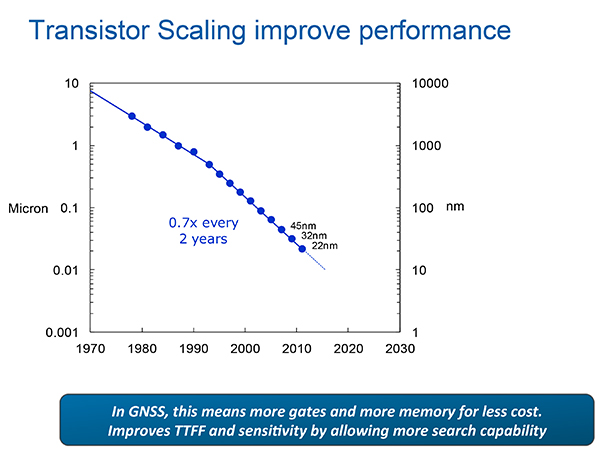
    The Turetzky paper, “Ubiquitous Location: Challenges and Opportunities of  Enabling All-day, Everywhere Location for All Mobile Platforms,” laid out the phenomenal growth of location-based services and the implications for design requirements in GNSS-wireless at the user device and silicon levels. The compound annual growth rate of GNSS devices will continue, from its current 22 percent level to a robust 9 percent for the years 2016–2022, and heading for seven billion installed units by 2022.

    From Greg Turetzky’s Ubiquitous Location paper, presented at Stanford PNT Symposium.
    From Greg Turetzky’s Ubiquitous Location paper, presented at Stanford PNT Symposium.

    Cutting to the chase, the design challenges for GNSS are to:

    • Take advantage of smaller geometries to achieve higher clock speeds, more memory, lower active power and smaller size, while reducing standby power from leakage;
    • Incorporate new methodologies in chip and system design; integrate multiple radios on a single die to reduce cost and size;
    • Integrate multiple radio sources into a single location solution;
    • Bring together a disparate value chain.

    The technology roadmaps embrace most modalities of positioning: GNSS, Bluetooth, Wi-Fi, cellular, and SBAS, and cross most platforms, including wearables. “We think that another, unemphasized challenge,” reporters Litton and Langenstein note, “is in the increasing density of these units with the current specifications on out-of-band emissions and the spectrum sharing and spectrum management factors in the ubiquity of the devices.”


    Tune in to our free webinar Receiver Design for the Future, with Greg Turetzky of Stanford speaking on Ubiquitous Location, scheduled for Jan. 15 (1 p.m. EST/ 10 a.m. PST/ 6 p.m. GMT). Register today!

  • An Early Gift from — and for — Galileo

    They said it wasn’t possible — well to be frank, I said it wasn’t possible – but one of the two “misplaced” Galileo satellites, plucky Doresa, has delivered an early Christmas present to the European GNSS community by providing a first fix on Tuesday, December 9. The signal was received at the European Space Agency’s (ESA’s) technical centre in Noordwijk, the Netherlands and at the Galileo In-Orbit-Validation (IOV) test station at Redu in Belgium. Doresa teamed with the remaining three functioning Galileo IOV satellites to provide a Galileo positioning data first fix with horizontal accuracy better than two metres.

    Since then fixes have also been performed using Galileo’s Public Regulated Service (PRS), the civilian encrypted highest-precision signal and one of the constellation’s unique selling points.

    The satellite had transmitted its first navigation signal in space on November 29, following its attainment of a safer, more stable, and more circular orbit with the perigee some 3,500 kilometres higher than its original placement.

    Doresa’s salvage has been a slow and steady journey since it was placed, with sister satellite Melina, into a fairly useless orbit in August following a launch anomaly. The original orbit, with a 26,000-kilometer apogee and a 13,800-kilometer perigee, prevented their use for navigation services because they were too low during part of their orbit to sense the horizon and correctly determine their own position. They were also getting a daily dose of radiation from the Van Allen belts.

    Elevation

    The elevation of the satellite started in late October and involved 11 firings of Doresa’s on-board thrusters. The craft now has only 15 kilos left from its original 65 kilo fuel payload but, given the fact that normally Galileo satellites are not required to make regular orbital manoeuvres, ESA engineers estimate this should be enough for a good 12 years of operation in the new orbit.

    The next stage will be to repeat this manoeuvre with the second Full Operational Capability (FOC) satellite, Melina, according to a plan to get that into a similar orbit by the New Year. Pending tests of their positioning, navigation, and timing payloads, the two spacecraft are then likely to be able to contribute to the future Galileo navigation constellation. This was confirmed by Didier Faivre, ESA’s director for navigation, during the agency’s ministerial council meeting on December 2 in Luxembourg.

    This end result is the best possible scenario given where the satellites were left after launch and is a considerable triumph for ESA’s mission control teams and flight engineers. Doresa is now able to use its Earth sensor continuously and keep its antennae orientated towards the Earth. Despite more than a month’s exposure to the Van Allen radiation, testing so far has shown no ill effects.

    “The very good geometry of the satellites in the sky relative to the receivers helped us to achieve this result, plus the signal strength of the fifth satellite,” explained Gustavo Lopez Risueno, coordinating the receiver team at the Navigation Laboratory in ESA’s ESTEC technical centre.

    The satellite signals should be usable immediately, in combination with additional navigation message information provided through ground networks, with mass market receivers. In fact the ESTEC Navigation Laboratory, working in conjunction with the European Commission and the European GNSS Agency (GSA), have already performed position fixes with both Galileo and GPS satellites using only navigation-assistance information.

    With some adjustments to the Galileo network’s ground infrastructure, it looks like Doresa and Melina will be able to carry out most of the roles they were originally designed to do. They are the first of 22 Galileo FOC satellites to be built by OHB and launched by ESA over the next few years.

    Toasted antennae

    More good news. The problem with Galileo’s fourth IOV satellite, named Sif, that took it out of action at the end of May seems to have been characterised and — again — indicates that the satellite is not a complete loss to the constellation. While Sif’s E5 and E6 frequency bands are definitively blown, the satellite’s E1 Open Service band should be capable of broadcast.

    The problem appears to have been a defective antennae. The four IOV satellites utilise one antennae design, while the FOC satellites have a different design. Fortunately there is no sign of a similar issue with the three other IOV craft, but they have been operating on reduced power as a precaution while the root cause of Sif’s failure is determined. ESA is currently fail-testing an example of the culprit antennae in the laboratory to see if the failure mode can be characterised.

    “One of the possible root causes links the problem with the power emitted by the antenna. When we know more we’ll decide what to do with the other three. Since this event occurred in May and June, no more issues have arisen,” Faivre said.

    Agreement

    This is all a remarkable turnaround and good news for the wider European GNSS community and those stakeholders who have invested in the Galileo programme and its burgeoning application industry. Let’s hope the good fortune continues through 2015.

    The administrative side of things is certainly moving on with the signing in October of an agreement which delegates a range of exploitation tasks for Galileo from the European Commission to the GSA, providing a framework and budget for the development of services and operations through to 2021.The signing of the agreement is an initial step towards the full Galileo Exploitation Phase. Current planning calls for this exploitation phase to be progressively rolled out from 2015, with full operability scheduled for 2020.

    “With Galileo, we aim to provide a tangible service to European citizens, and this Delegation Agreement ensures we have the tools and funding necessary to achieve this,” said GSA Executive Director Carlo des Dorides. The agreement was signed by Daniel Calleja Crespo of the European Commission and des Dorides. The document specifically sets the actions to be implemented, the amount of funding provided, and the conditions for the overall management.

    Innovation

    In the same month, the First Satellite Masters Conference took place in Berlin on October 23 and 24. The conference encompassed the 2014 edition of the European Satellite Navigation Competition (ESNC). The event was a great showcase for the innovation, skill, and passion of the entrepreneurs, usually young, who are building the satellite application market in Europe.

    For example, the winner of the GSA special prize at ESNC 2014 is developing Galileo modules for the Google Ara modular smartphone concept, a potential game-changer for positioning in the mobile-phone market. Ara uses interchangeable modules to deliver a smartphone that can be whatever a user wants it to be, complete with first- and third-party components including sensors, cameras, radio antennas, and more. Consumers will be able to order them as of January 2015.
    Google developers believe an Ara smartphone will last multiple years, much longer than current hardware, since it won’t be obsolete nearly as quickly. Further, Ara could open the smartphone market to billions of new users across the globe.

    I spoke with Giovanni Vecchione of Deimos Space, who received the € 40 000 GSA/ESNC prize during the awards ceremony at Deutsche Telekom’s magnificent headquarters in the German capital.

    “With a traditional chip structure, all of a smartphone’s functions are currently combined into a single component, which makes it difficult to add or change a function,” explained Giovanni. “With a modular structure, you have the option to simply switch out a component, meaning a smartphone’s capabilities can be easily enhanced.”

    Vecchione’s innovation is to use another of Galileo’s unique selling points: the E5 broadband signal. While mass market smartphones will use the E1 signal, the availability of high-end phones offering enhanced accuracy through the use of the E5 signal will appeal to many users. A second module will implement an external antenna interface. Together these developments could deliver an ARA phone offering high precision (centimetre-level accuracy) positioning and multipath-resistant solutions.

    Wishing you all a very peaceful and prosperous New Year and hoping Santa has your coordinates accurately entered in his sleigh satnav!

    A bientôt, as they say in these parts.

  • 2014: Big Move to Retail Indoor Location Market

    Macy's plans to add Shopkick indoor location beacons in preparation for holiday shopping. (Photo by Nicholas Eckhart is licensed under CC BY 2.0.)
    Macy’s added Shopkick indoor location beacons in preparation for holiday shopping. (Photo by Nicholas Eckhart is licensed under CC BY 2.0.)

    This year was filled with hope and some success for the location industry. In what was probably the biggest deal, Qualcomm bought United Kingdom-based CSR for $2.5 billion — at the same time, spinning off its own location beacon company, Gimbal. While the connected car continued to get a lot of press at the biggest trade shows, indoor location technology matured to a point that many retailers are believing it’s a way to get consumers back into the stores — and away from their computers.

    As we come to the end of 2014, many industry observers view indoor technology and markets to be like where outdoor location was in the early 1990s: many technologies and providers all pushing different solutions. However, the gap between the beneficiaries of the market, the retailers and brands, and the indoor location technology providers is narrowing as tests become more prevalent.

    Such retailers as Walgreens, Home Depot, Lowe’s, Macy’s and CVS have rolled out, or planning to launch, tests that include indoor mapping and a product locator.

    iBeacons and other beacons proved to be the fastest location-proximity technologies that are being deployed full scale by Macy’s, CVS and other retailers for a first quarter 2015 rollout,” said Kris Kolodziej, an indoor location-based services advisor. “I see more acquisitions like the one of Groupon acquiring Swarm Mobile, a beacon platform for smaller tier-two retailers and businesses. In addition, we will see more partnerships like the one between Gimbal and Urban Airship to provide a holistic outdoor-indoor solution for geofencing and engagement platforms.”

    Location companies paid attention to mobile carriers’ focus on launching and advancing their LTE services in 2014, said Keith Bhatia, TeleCommunication Systems vice president, business development.

    “2014 has been the year of transitioning location-based services from 2G to 3G to complete 2G-3G-4G platforms,” he said. “The other significant location market event for TCS during 2014 has been growth of user plane services by (over-the-top) apps. The operators who have chosen to compete with OTT players have seen location requests exponentially expand.”

    TCS believes that the location market, in the next five years, will evolve to a machine-to-machine and Internet of Things (IoT) concepts that will expand into consumers’ everyday lives, Bhatia said. “From the connected car to telemedicine, health devices, connected home and smart cities, all mobile connected devices will benefit from location-based services,” he said. “We believe that location services will continue its rapid growth for years to come.”

    Selling retails on the promise of indoor positioning and proximity marketing has been tough in the past few years — and some providers have focused on the wrong message, Bhatia said. “As mobile device adoption continues to surge, indoor positioning and proximity marketing will become an important tool for many retailers. A significant barrier so far has been too much focus on coupon delivery,” he said. “We believe the retailers will find real benefits in terms of understanding layout, traffic and congregation of users. Combining this location information with their retail data will provide early insights into trends and early indications of potential challenges.”

    Dave Hutingford, CSR director of product line for location, believes the big selling point for retailers is striking the balance between what benefits they obtain from the app versus what benefits the consumer gets — what he calls the equity balance.

    “Too many irrelevant notifications while walking around the shop will result in people not wanting to run the app, and can potentially harm consumer acceptance of retail applications. The interest is already there from the retailers’ side as the benefits are somewhat obvious, but the question is what do you give back to an increasingly technology-smart consumer?” he said.

    Overall, the indoor location market is attracting major interest from retailers — which is refreshing to many industry observers after seeing online sales cut into brick-and-mortar stores’ profits.

    “Removing the need for dedicated infrastructure to run indoor location was a big hurdle removed from the ecosystem. Certainly we expect to see good pick-up of the solution over the next few months for a wide variety of location services, and being handset-agnostic is a big benefit for any developer,” Hutingford said. “However, if you are looking for accuracy down in the meter range, you will need to add infrastructure to supplement the location calculation, which can come in many forms.”

    Connected-Car Market Made Headlines in 2014

    If an industry executive attended any of the bigger trade shows this year — CES, CTIA in Las Vegas, or the Mobile World Congress in Spain, it was the same thing — connected vehicles are the big story. Adoption by automotive manufacturers, as a number of analysts have pointed out this year, was the most important news story for the connected-car industry in 2014, said John Horn, Kore Telematics executive vice president and chief strategy officer.

    “Essentially every vehicle that rolls off the assembly line in 2015 will have an element of connectivity built into it. To keep up with the level of demand, we are starting to see scale and scope really start to matter to the companies that power this type of connectivity,” he said. “2015 will prove to be another huge year for industry consolidation, which will be necessary to keep up with the global demand for connected-car technologies.”

    The biggest trend in 2014 connected-car technology was the emergence of infotainment content for connected cars, said Scott Frank, Airbiquity vice president, marketing. “Before 2014, the most an average consumer would expect out of a high-end vehicle head unit were features like navigation, basic cell-phone connectivity, and hands-free calling,” he said. “Today, drivers are able to get a wide-variety of apps in their vehicles to do things like stream music and keep up with their social media channels. User experience advancements were also made to provide a seamless transition for digitally oriented drivers as they moved from office, to car, to home, and back again. For example, with the NissanConnect Mobile Apps system, someone listening to a streaming music app like Pandora on their PC in the office can put it on hold, get into their car for the drive home, and pick up the song right where they left off — as well as see their favorite playlists, album selections, and cover art.”

    However, as with any industry that experiences quick growth, there will be growing pains, Horn said. “The automotive world has already started to experience some of those pains as connected technologies continue to advance at a rapid pace. We saw how the analog shutdown left many OnStar customers stranded with obsolete hardware,” he said. “We’ll likely see similarities as 2G, 3G, and 4G networks are eventually turned down in favor of more advanced technologies. I’ve been saying this for years, but now is really the time for the removable module. Connected technologies will turn over much faster than cars, and the only way I can see to future-proof against this is through the removable module.”

    Airbiquity’s Frank said that there are definitely consumer acceptance and technology barriers for the automotive industry going forward related to connected car as we know it today and autonomous car as its being forecast going forward.

    Like waves of technology that have come before, functional consumer awareness and adoption will follow the technology adoption curve, Frank said. “Certain generations and user types will be early adopters and more likely to accept new and evolving connected-car technology and features — and the user experiences and value that come with it — the minute it’s made available,” he said. “While others will be either blissfully unaware of the technology built into their car — and the value it could bring them — or are simply satisfied with traditional technology like basic AM-FM and satellite radio. One thing for sure is there’s a correlation between early adopters of technology like smartphones and early adopters of connected-car technology and related features.”

    Frank quoted a recent Parks Associates study that found 48 percent of vehicle owners that own smartphones are very interested in the ability to view maps — or receive directions in their cars. This compares to 37 percent of vehicle owners that own/don’t own smartphones. “Like flip-phone users that transitioned to smartphones after understanding the end benefits, consumers will increasingly become aware of and use their connected-car systems,” he said. “We’re seeing evidence of the connected-car adoption curve in the increasing activation rates and time of usage for our customer’s connected-car programs.”

    Horn, who headed RacoWireless, which was acquired by Kore for an undisclosed amount this year, said in 2015 industry will start to see the connected car become much more easily monetized. “We’ve seen this first hand, as we have just rolled out some new features with AT&T and Audi. Now, your Audi Connect subscription can be part of your AT&T Mobile Share plan and treated just like another line,” he said. “It is going to be easier than ever to consume in-vehicle connectivity and the business model will advance to the point that makes it appealing for both the consumer and the solution provider.”

    In 2015, driving-centric apps and services will begin to appear and eventually become as important as infotainment content in the consumer purchasing process, Frank said. “The current automotive manufacturers’ focus on providing infotainment delivery reflects their desire to meet the expectations of digital lifestyle consumers who are heavy users of smartphones and want to use their favorite apps and services inside their cars,” he said. “This is a logical first step, but these savvy consumers will increasingly value apps that are truly useful and relative to the driving experience. An example is an app that proactively and dynamically recommends modifications to a driver’s high-frequency routes to help them optimize fuel consumption, lower CO2 emissions, minimize engine wear, and avoid road hazards. As a result, apps that don’t add to the consumer experience relative to driving will eventually die off from lack of use, and automotive manufacturers will replace them with more and more driving-centric apps to satisfy their customers and differentiate themselves from competitors.”

    The rise of autonomous vehicles, a derivative from connected-car technology, will keep automakers, carriers, suppliers and government agencies busy for decades.

    “When it comes to autonomous vehicles, we expect the adoption curve to be more extended than what we’ll see for the connected car, given the increased consumer concerns about safety and adapting to the new fangled idea of riding in a car without a human driver,” Frank said. “Consumers will not only want to know what this fancy new technology is and how it works, they will also need to feel confident that it will run perfectly and not put themselves, their passengers, or other people and property in harm’s way. Consumers will also have concerns about who will be legally and financially liable if an accident occurs.”

    In other location news:

    • Two Trimble companies, PeopleNet and ALK, recently provided real-time tracking of the 2014 Capitol Christmas Tree’s cross-country journey from the Chippewa National Forest in Minnesota to the front lawn of the U.S. Capitol Building in Washington. The companies used enterprise products for routing, mileage, mapping and visualization to track the tree.
    • LBS Insider’s Kevin Dennehy will be attending the 2015 Consumer Electronics Show in Las Vegas next month. Please contact him at [email protected] with your story ideas.
  • Industry Battles Indoor Location Rules

    Janice Partyka
    Janice Partyka

    The FCC will soon make a ruling on indoor location rules for 911 calls. If you worked in the location industry in the late 1990s, you may remember when the FCC ruled that wireless carriers would have to automatically locate a mobile phone that dialed 911 from the outdoors. From a seat on the E9-1-1 Institute’s board, a non-profit organization that supported Congress on 911 public safety issues, I watched the wireless carriers fight meaningful 911 location accuracy standards and monitoring.

    With the large number of calls to 911 from the indoors today, the FCC is about to require carriers to automatically provide emergency dispatchers with indoor location information on calls. In the short term, the FCC is proposing indoor location that would provide sufficient information to identify a building, with more granular accuracy in the long term at the room or office suite level. In addition to horizontal locations, the FCC proposes adding vertical location, a critical metric for multi-storied buildings.

    The comment period for the FCC’s proposal just ended and it is now up to the agency to act. During the comment period, carriers, public safety entities and vendors fought over accuracy rules and monitoring. NENA and APCO, leading public safety organizations, negotiated a consensus agreement on indoor location rules that many other prominent public safety agencies have decried as objectionable. It is surprising that NENA and APCO would sign on to such a watered-down version of the FCC proposal.

    On a better note, indoor location for commercial applications is an industry bright spot. Hyper-location is king and is moving beyond retail to enterprise, personal asset tracking (please find my keys) and the connected home. “Over the past 12 months there has been a considerable change in deployments as companies have moved from a handful of deployments to getting into the hundreds and thousands of stores,” said Patrick Connolly of ABI Research.

    In 2015, Connolly also expects to see camera analytics companies like Shoppertrak, Irisys and Brickstream have an increasing presence as they expand their offerings into BLE, Wi-Fi and in-store analytics. LED lights for location positioning within retail outlets and large public venues are on Connolly’s list for market growth in the coming year. The lights enable communication with the cameras on customers’ smartphones to determine their locations. Retailers can send information, redemptions, maps and services to customers via their mobile device at precise locations within the store.

    I’d like to close the year with a “departure.” In Los Angeles, a proposed cemetery on the tony bluffs of Malibu would forego headstones, raised or flat, and depend on the grieved using GPS to find the burial spots of loved ones. A small disc on the plot would verify the coordinates. GPS as we didn’t imagine it.

  • Five New FAA Commercial UAV Exemptions — What Do They Mean?

    Aeryon SkyRanger
    The Aeryon SkyRanger.

    UPDATE: 1 p.m. US Pacific Time, Dec. 12. See statement from Trimble Navigation below.

    In a major step towards allowing unmanned aerial systems (UAS, UAV, drones) to be used for commercial purposes in the United States, the Federal Aviation Administration (FAA) granted five exemptions to four companies this week, allowing commercial UAS operation with an extensive list of conditions and limitations.

    If you recall from previous articles such as this one, the FAA says it’s illegal to operate a UAS for commercial purposes in the United States.

    But, take a look at this article: FAA Says Commercial Drone Operations Are Illegal… Public Says So What?

    Then, when the FAA attempted an enforcement action against a person (Pirker) using a UAS for commercial purposes, an NTSB (National Transportation Safety Board) administrative law judge sided with the person, not the FAA.

    Clear as mud?

    Of course, the FAA appealed the NTSB opinion v. Pirker, and won. Click here to see the documents explaining the decision. Essentially, the NTSB ruled that a UAS is considered close enough to a manned aircraft that UAS fall under similar rules, and that the FAA is within its rights to apply the rules of careless or reckless operations to UAS as it does with manned aircraft.

    So, after some legal wrangling, the rules seem to be as the FAA has stated: no commercial UAS operations. However, under order from the Obama Administration, the FAA is working on developing rules to allow commercial UAS operation in the U.S. The deadline for those rules to be released is September 2015, but there is much speculation that this deadline will not be met.

    That said, the FAA is not waiting until September 2015.

    Airbotix-T

    In June 2014, the FAA issued the first UAS commercial use CoA (Certificate of Waiver or Authorization) to BP (British Petroleum) to allow commercial use of a particular UAS for surveying roads, pipelines and equipment in Alaska.

    Then, in September 2014, the FAA issued CoAs to six aerial photo and video production companies in the film and television industry.

    It should be noted that each CoA includes an extensive list of conditions and limitations, which are not necessarily the same, but similar (more on that below).

    That brings us to yesterday, December 10, 2014. On that day, the FAA announced it has issued exemptions to four companies for commercial UAS operations: Trimble Navigation, VDOS Global LLC, Clayco, and Woolpert.

    Looking at these four companies, it’s interesting that three of them are service providers and one is a manufacturer of UAS: Trimble. One might assume that, since Trimble is a manufacturer of UAS, the FAA exemption might carry over to its customers. After checking in with several people on this, the exemption appears to be only for Trimble owned-and-operated UAS, not customers. However, it doesn’t appear that the operator must be a Trimble employee (as opposed to a contractor). In that case, Trimble, as a manufacturer, could potentially deploy UAS under this exemption and have contract pilots operating Trimble-owned UAS.


    Following is a statement from Todd Steiner, Trimble’s marketing director for geospatial imaging solutions:

    “In the near term, Trimble will use this exemption to begin conducting research activities, sales demonstrations, and flight training with our partners and customers within the U.S. We will also initiate commercial activity as we pursue follow on steps with the FAA.

    “In addition, we are working to determine how this exemption might be further leveraged to help our partners and customers. With Trimble’s authorization in place, we can directly support their needs where that is appropriate. Our customers and partners will also be able to apply for authorization to operate our UAS under the conditions of our exemption.

    “We believe that these authorizations will be available on a more streamlined basis now that Trimble has received its exemption. We will communicate to our partners and customers as more information is available.”


    The exemptions are valid until December 31, 2016, unless rescinded or superceded.

    Conditions and Limitations

    For each FAA exemption granted, there’s a long list of conditions and limitations for each grantee. You can read the detailed list of these at the bottom of each document issued to the specific company.

    Trimble

    VDOS Global LLC

    Clayco

    Woolpert #1, Woolpert #2

    Although the conditions and limitations vary with each exemption issued, there are some common to all:

    • UAS must operate below 400 feet above ground level.
    • UAS must obey the speed limit (varies by UAS).
    • UAS must be within VLOS (visual line of sight) at all times by pilot in command.
    • All operations must have a second person, a VO (visual observer).
    • Pilot in command must possess at least an FAA private pilot certificate (some exemptions require a commercial certificate) and a third-class airman medical certificate.

    There are many more conditions and limitations, but this gives you an idea of what is required. The Trimble exemption contains 35 such items, so before you get too excited, take a look at the complete list of conditions and limitations. It’s not a simple endeavor.

    On a positive note, the FAA is making an effort and making progress. For an agency that has a reputation of moving very slowly and methodically, this is near lightning speed.

    Thanks, and see you next month.

    Happy Holidays!

    Follow me on Twitter at https://twitter.com/GPSGIS_Eric

  • Reflections and Hope for GNSS

    For me, 2014 marks 40 years of my long association with the positioning, navigation and timing (PNT) gold standard we call the global positioning system (GPS), and I find it only prudent and natural to reflect on what has, for many, been a tumultuous 12 months.

    In this regard, I find that I am not alone. Many seasoned veterans (who, unfortunately, by necessity must remain anonymous) have taken the opportunity to take pen in hand and jot down a few of their thoughts for my perusal and cogitation. Not to digress, but I find that many of us of a certain age, when we wish to convey our considered thoughts privately to a trusted colleague, more often than not accomplish said task with a fountain pen and luxurious heavy linen writing stock or in a private conversation, versus email and quick messages on social media.

    In putting the following thoughts together, I have availed myself of those thoughtfully scribed missives from trusted colleagues. The following conveys some thoughts to contemplate on current tactical and strategic PNT matters.

    Political SMEs

    Without a doubt, the most troubling, or certainly discussed, topics this year have revolved around the spurious thoughts, rhetoric and unfortunate resulting public statements by PNT neophytes in positions of power whom, not being from the most lucid generation, seem to believe that GPS or GNSS are vulnerable and should be replaced — end of discussion — no further thought given to the problem other than surely something will come along to replace it — and preferably overnight, at that. Obviously, I am incredulous and find the statements to be nothing more than political hype purveyed by luddites that are essentially technically hapless and clueless. Alas, some are in positions of power where they are frequently and regrettably quoted in the press. Lamentably, the technically clueless parameter rarely keeps them from speaking their — if you will pardon the over-generous appellation — mind.

    Rather than merely complain about political appointees and their hapless, uninformed ramblings, as it is after all a national pastime, I will follow the edict and sage advice of a fellow thinker, mentor and Eminence Grise, General Pete Piotrowski (USAF, Ret.) who pontificated to a young executive officer over four decades ago, “Never come to me with a problem, as problems are nothing more than opportunities waiting to be recognized — so come to me with opportunities and implementation plans that are actionable.”

    Applying that astute and long-remembered advice to our GNSS opportunity leaves us with an essentially technical and actionable way ahead. There can be no question that GPS or GNSS should remain as the baseline bedrock for all PNT solutions while technology provides ample opportunities for enhancements, augmentations and verifications, not merely inadequate substitutions. As one of my colleagues at the Royal Institute of Navigation stated recently, “Truly robust position, navigation and timing will always require a combination of dissimilar PNT technologies.” The top three that come to mind are:

    1. eLoran
    2. Inertial systems
    3. All signals available

    At the risk of belaboring the obvious for my regular, informed readers, let’s take a brief look at each supporting opportunity.

    eLoran

    eLoran in many forms has been around for decades longer than many users realize, and was just months away from being fully implemented in 2010 (more than 80% complete) when it was unceremoniously, all politics aside, abruptly curtailed by those technical luminaries in the OMB (Office of Management and Budget) and the current administration. Since that time companies and countries around the globe, except for the United States of course, have charted their own course for eLORAN both as an independent PNT system and as an augmentation, enhancement and backup to GNSS with accuracies and availability (essentially not capable of being jammed) that rival and exceed most any other non-GNSS PNT system available today.

    In Rotterdam earlier this year, I saw firsthand and wrote about an eDLoran or differential eLORAN system,that, “with modern monitoring can result in consistent horizontal accuracies approaching five meters on a moving platform.” eLORAN has shown the capability to broadcast continuously with several thousand watts of low frequency signal power and provide a PNT system that is reliable and accurate, while essentially making it ludicrous to try and jam or intentionally interfere with GNSS signals. The two systems utilized jointly, GNSS and eLORAN, are an unbeatable combination.

    I am currently contractually embargoed, but hope to write more about some amazing new eLoran receivers in the New Year. However, I can legally say now that I have recently been made aware of two separate multi-GNSS-eLoran receivers that are both affordable and portable. More than that I cannot say, but just think about what that means when you consider there are fully operational eLoran transmitters literally scattered around the globe today, except for the United States, of course. An embarrassing situation that hopefully our Congress will remedy soon.

    Some exceptional multi-PNT devices, which I am allowed to mention, are the UrsaNav UN-155 Resilient PNT receivers from Chuck Shue and company. These innovative new products utilize PNT information from multiple sources including GNSS, eLoran, and maritime medium-frequency beacon systems. The UN-155 contains an embedded computer for easy updating of software and algorithms for resilient PNT, and provides a robust navigation and timing output. While this is not yet a portable unit, miniaturization is all the rage.

    Inertial Systems

    Which is a great segue to our next opportunity, MEMS (micro-electro-mechanical sensors) inertial devices. These are routinely and historically described as devices capable of providing tightly coupled integration of GPS precise point positioning (PPP) and MEMS-based inertial systems. While the tightly coupled descriptor essentially involves Kalman filters and shared positioning data descriptors and fields, there have recently been cogent arguments for an independent non-tightly coupled MEMS inertial device as well, perhaps even both types of devices coupled to a multi-GNSS device with eLORAN.

    Think about it only momentarily and the advantages become obvious for both approaches, and even more so for a combined approach. Again, I am prohibited from providing too many details, due to upcoming press releases and device announcements from major players in the field, but 2015 appears to be promising for new and innovative inertial integration technologies. Suffice it to say, the U.S. Army is enamored with this approach, as well they should be, with the key for the U.S. military being a sustainable low-cost MEMS-inertial . . . and there my tale of new advancements must end — for now.

    For your edification and to help me better understand the new MEMS gyros and inertial units, a well-known GPS-savvy Stanford University professor emeritus recently stated, “Don, think of it this way, the rotation of a MEMS gyro component exerts perpendicular coriolis force on a resonating proof mass and the displacement is measured capacitively and converted to algorithmic terms for inputs to a Kalman filter or to an independent display for the user as required. Our desire is that, in the near future, both operations will transpire simultaneously and independently. Simple, right?”

    Of course it’s not simple or we would all have them in our iPhones, I thought. Then it hit me, we do have accelerometers in our iPhones, as well as basic gyroscopic functions. There are applications today that make use of these devices as highly evolved pedometers capable of correcting and tracking our position inside GPS-denied environments, such as underground, in dense urban environments and deep inside buildings. Not to be flippant, but it appears there is an “app for that,” and 2015 holds the promise for even better technology for PNT device integration. Stay tuned.

    All Signals Available

    Which brings us to one of my favorite topics — all signals available. As simple as this concept seems to be, as in “are you smarter than a fifth grader?”, I was briefed earlier this year along with several of my fellow technical SME (subject-matter expert) journalists by one of those interim pseudo-technical political appointees that wants to replace GPS/GNSS. Be assured it was a very serious briefing and venue, no clown costumes in sight. The appointee briefed — with a straight face, no less — that current government PNT receivers would have a difficult time with GEO (Geostationary Earth Orbit) versus MEO (Medium Earth Orbit) PNT signals simply because of the physics involved. To which, channeling John Belushi in Continental Divide, I very ungraciously and forthrightly replied, “Difficult physics such as the physics employed daily in my iPhone 6+, which is a multi-GNSS device, utilizing MEO and GEO GNSS signals globally, which are integrated with inputs from ground transmitters and onboard accelerometers. You mean those difficult physics?” Can you picture speechless?

    Consider that the iPhone 6+ today incorporates multi-GNSS signals (GPS and GLONASS) plus WAAS and EGNOS, which are GEO PNT transmitters — bent pipes, if you will. The iPhone utilizes and fully integrates PNT signals from space, terrestrial signals from cellular towers, and Wi-Fi computer networks, as well as onboard accelerometers in an area of real estate roughly the size of a quarter.

    Trimble navigation has a fixed commercial PNT unit today, about the size of a softball, that does all this and much more while parsing 129 separate GNSS signals globally, which allow it to determine its position to the centimeter and reject all signals that try to deviate from the known truth set. Plus, it transmits all known positioning parameters, utilized and automatically rejected, to a website. So I submit that our opportunities for PNT today are not restrained by technology, but by atrocious limitations imposed by politicians masquerading as subject-matter experts. Someday I may deign to tell you how I really feel. Allow me to caveat my remarks by saying there are some wonderfully competent government technologists that I have the pleasure to work with on a regular basis, and I applaud their acumen, dedication and hard work.

    Fight Back

    The question remains: How do we fight back against the pseudo-technical pols and their pronouncements concerning the future of PNT? The solution is simple. Educate yourself concerning the art of the possible. Read a book on the subject. I have recommended many fine references over the years. By all means, for the most up-to-date information, read fine publications like GPS World, and of course, I humbly commend my column to you, if you are so inclined. Education may not be the only panacea, but historically, the more we know about a subject, the less likely we are to fall for the falderal and spin routinely spewed forth by the technically clueless with a political agenda.

    To paraphrase Winston Churchill, who once said, when he was encouraging his neophyte code breakers at Bletchley Park to be more well read, “Read a single book on any single subject and you will know more about that subject than most of the world.” I would add a single caveat from Harry Potter’s creator:

    Books are like mirrors: if a fool looks in, you cannot expect a genius to look out.

    —J.K. Rowling

    Stay with me, and we will explore all these opportunities and more in the coming New Year. Fortunately, hope springs eternal.

    Until next time, Merry Christmas, Happy New Year, happy navigating and remember: GPS is brought to you courtesy of the United States Air Force.


  • What Happened to Piksi, the $995 RTK GNSS Receiver on Kickstarter?

    What Happened to Piksi, the $995 RTK GNSS Receiver on Kickstarter?

    Piksi
    Photo: Piksi

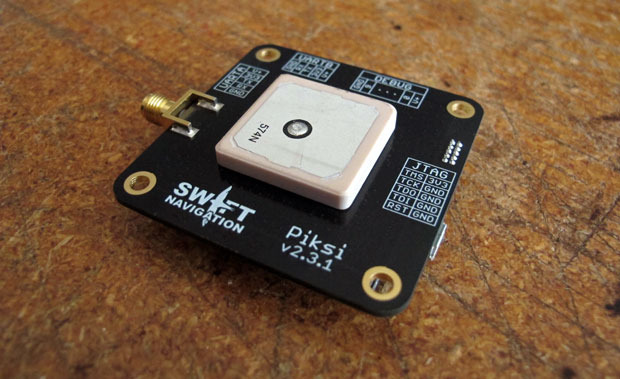
    A little more than a year ago, Swift Navigation started a Kickstarter campaign for a $995 RTK GNSS receiver named Piksi. The goal was to raise $14,000 for the project. By the time the Kickstarter campaign was ended, Swift raised $166,097 from 303 backers.

    I wrote an article about the Swift’s Kickstarter campaign in September 2013, a few days before the fundraising period ended. Following is a two-minute Kickstarter promotional video describing Piksi.

    At the time, the $995 price for the Piksi raised a lot of eyebrows and generated conversations in the high-precision GNSS user community about inexpensive RTK technology.

    This week, I took the opportunity to catch up with Swift to see how the project is going and where the company is headed.

    I spoke with Tim Harris, CEO of Swift, and Fergus Noble, chief technology officer. Tim said they delivered most systems to their backers in April (2014) as well as issuing “very few” refunds, which is not unusual for Kickstarter projects. As of today, Tim said there are about 1,000 units in the field among 350+ users. He said they still consider the Piksi to be in beta testing phase and expect production units to start shipping next year.

    “We are in RTK reliability mode now” — Fergus Noble

    Fergus said that the hardware design is stable and hasn’t changed since they shipped Piksi last spring. He said the focus has been on refining the RTK firmware to make it robust and reliable for professional use. He admits that “covering all corners” has been a challenge and, according to Swift’s blog, “The RTK software has been a tougher nut to crack than we originally anticipated.” This is especially ambitious, since Swift said they developed the RTK firmware based on published academic technical papers, combined with their own techniques (preparing patent applications) to run on a low-power hardware platform. Basically, they started from scratch, and without any RTK veterans on their team. You gotta love their guts.

    Apparently, the venture capital world liked what they saw. A few months ago, Swift, based in San Francisco, secured $2.6m in seed funding from Fall Line Capital, Felicis Ventures, Kal Vepuri, Lemnos Labs, Qualcomm Ventures and VegasTechFund. With the additional funding, Swift has increased its headcount from 4 to 9.5.

    The Devil Is in the Details

    Swift Navigation Lodestar
    Swift Navigation Lodestar. Photo: Swift Navigation

    Start-ups like these are a cool story, but at some point the rubber has to hit the road. Piksi is a long way from being an RTK product that you and I use for GIS and surveying, and Tim/Fergus are humble enough to admit this. The founders see the Unmanned Aerial Systems (UAS) market as their key customer base due to Piksi’s micro-size and low cost. They say this is reflected in their current customer base, which is comprised largely of UAS users, then surveying and agriculture, with the remaining 20 percent being a variety of apps like augmented reality. I agree that UAS is the right segment for them to focus on. At this point, the limitations for general surveying and GIS use are too great:

    • Must use a Piksi RTK base due to the proprietary protocol. In other words, not compatible with existing RTK base stations or networks.
    • Baseline length (distance between the RTK base and rover) must be very short. They haven’t done much testing even with a one-mile baseline.
    • RTK initialization is spec’d at 15 minutes, although Fergus said it’s typically 7-10 minutes.

    Since Piksi is only a single-frequency receiver (L1), it has the same limitations as other L1 RTK systems we’ve seen marketed over the past few years — short baselines and long initialization times compared to dual-frequency receivers. While these limitations are significant for surveying and GIS users, they aren’t as significant for UAS users, since UAS users require line of sight to the aircraft at all times and UAS are operated in a clear-sky environment.

    Communications

    If you’ve used RTK, you are aware of the importance of data communications between the base and rover. As part of its kit, Swift supplies license-free, 915MHz frequency-hopping radios to facilitate communications between the base and rover for testing. However, the founderse make it clear that they aren’t in the data radio business. They expect that most Piksi users will incorporate their own communications technology. Swift is discussing incorporating GSM (mobile phone) modem capabilities in the future.

    Future

    In 2015, Swift plans to roll out the Piksi in production quantities, so Fergus said their focus is on creating a robust and professional RTK system. Of course, the burning question is if/when Swift will incorporate a second GPS frequency into its receiver to take advantage of the faster RTK initialization and longer baseline distances that a dual-frequency receiver offers. Swift isn’t willing to talk about that right now. Said Tim, “We’re holding our plans close to our chest.”

    Thanks, and see you next month.

    Follow me on Twitter at https://twitter.com/GPSGIS_Eric

  • Directions 2015: BeiDou Belongs to China, and to the World

    GPS-directions-WangBy Li Wang, Director of the International Cooperation Center, China Satellite Navigation Office

    By adhering to the principles of independence, openness, compatibility, and gradualness, China is steadily accelerating the construction and development of the BeiDou Navigation Satellite System.

    The BeiDou System already provides continuous and reliable Full Operational Services to most parts of the Asia-Pacific region. Its positioning, navigation, and timing performance keeps improving, while the deployment for a global constellation is also making progress. The BeiDou System and its products, which are compatible with other navigation satellite systems, have been gradually applied in many sectors and industries related to the national economy and to entering the mass market.

    As one of the four core GNSS service providers, BeiDou has always made unswerving efforts to exchange, coordinate, and cooperate with other organizations, system providers, and users.

    BeiDou has been actively engaged in international affairs on the platform of the United Nations, such as participation in related activities held by the International Committee on Global Navigation Satellite Systems (ICG), and coordinated affairs under the framework of the International Telecommunication Union (ITU). It has also pushed forward the integrated applications of BeiDou and other navigation satellite systems in the fields of civil aviation, maritime traffic, mobile communication, and so on.

    In order to provide better services for global users, the BeiDou system has carried out exchanges and coordination with the other navigation satellite systems. It has established cooperative mechanisms with GPS and GLONASS, and respectively signed the Joint Statement of U.S.-China Civil Global Navigation Satellite Systems (GNSS) Cooperation, as well as the Memorandum of Understanding between China and Russia on Cooperation in the Field of Satellite Navigation. Furthermore, the cooperation between the BeiDou and Galileo systems has also been included into the China-EU 2020 Strategic Agenda for Cooperation.

    Potential areas for cooperation may include compatibility and interoperability, GNSS applications, policies and standards, international GNSS service performance monitoring and assessment, and so on.

    Meanwhile, the BeiDou System continues carrying out the BeiDou/GNSS Application Demonstration & Experience Campaign (BADEC) and has negotiated with related countries to jointly establish BeiDou/GNSS Centers. Those centers will implement BeiDou/GNSS popularization, exhibition, application demonstration, and user experience activities, as well as system performance testing and assessment, academic exchanges, training, and R&D, to jointly promote the compatibility and interoperability among the multiple navigation satellite systems, boost the spread of technologies, and improve satellite navigation applications and industrial development..

    In 2015, China will continue this effort, launching four to five next-generation BeiDou Navigation Satellites (MEO and IGSO) for testing and verification of new technologies. The BeiDou System with global coverage will completely be established by around 2020. This will enable provision of continuous, stable, and reliable satellite navigation services for global users.

    Global navigation satellite systems and related industries are going through an unprecedented revolution. Under such an environment, compatibility and interoperability among systems, and integration of multiple industries, will be the tendencies of future, which will definitely promote wide applications of GNSS in broadening fields. During such a process, the BeiDou System with distinctive characteristics will abide by the objective of “serve the world and benefit mankind,” undertaking the responsibility and obligation to work together with other systems to provide better services for global users.


    Li Wang is the director of the International Cooperation Center, China Satellite Navigation Office.

  • Directions 2015: Galileo Looks Ahead to Early Services

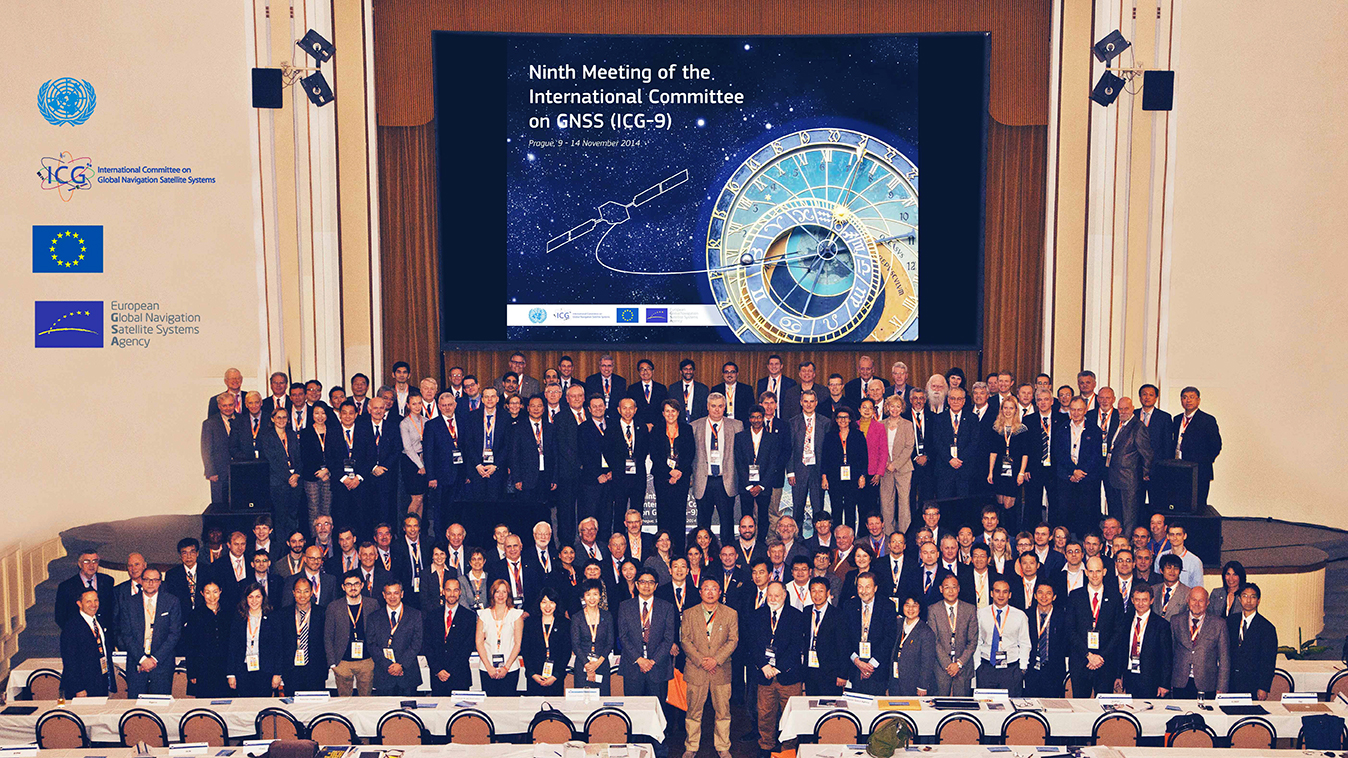
    GPS-directions-GalileoThe European GNSS Agency (GSA) hosted the ninth meeting of the International Committee on Global Navigation Satellite Systems (ICG) in November at its headquarters in Prague, Czech Republic. The event is an opportunity for GNSS providers to present the status and future plans for their systems, and an opportunity for ICG members, associate members, and observers to provide updates on recent developments with regard to GNSS services and applications.

    Representatives from the world’s leading global and regional GNSS programs were invited to provide the assembly with a “state of play” for their respective systems. Joining GPS, GLONASS, BeiDou, IRNSS/GAGAN, and QZSS was Galileo, represented by Christian Siebert, Head of Unit, Galileo and EGNOS: Applications, Security and International Cooperation, DG Enterprise and Industry, European Commission.

    A Secure Foundation

    The key message coming from Prague was that, despite the launch anomaly in August, the Galileo program has a secure foundation for moving forward. For instance, it has been given a stable seven-year perspective, a substantial budget, and a new exploitation-driven governance scheme. In terms of budget, the European Commission has allocated €1.930 billion for deployment and €3 billion for exploitation — with an additional €1.580 billion allocation for European Geostationary Navigation Overlay Service (EGNOS) exploitation.

    The new governance scheme is based on a recently announced agreement between the European Commission and the GSA; the agreement delegates a range of exploitation tasks for Galileo to the GSA. Serving as an initial step towards the full Galileo Exploitation Phase, the GSA’s responsibilities now include:

    • provision and marketing of the services;
    • management, maintenance, continuous improvement, evolution and protection of the space and ground infrastructure;
    • research and development of receiver platforms with innovative features in different application domains;
    • development of future generations of the system;
    • cooperation with other GNSS;
    • all other required activities to ensure the development and smooth running of the system.

    This new budget and governance structure ensures the Galileo program’s stability for the next seven years, according to a GSA press release. The agency will progressively manage exploitation activities as delegated by the European Commission, which serves as the program’s supervisor.

    At the same time, the European Space Agency (ESA) will continue its role for system design and development.

    A Range of Successes

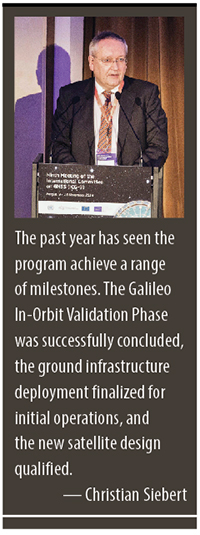
    “The past year has seen the program achieve a range of milestones,” said Siebert. “The Galileo In-Orbit Validation Phase was successfully concluded, the ground infrastructure deployment finalized for initial operations, and the new satellite design qualified.”

    Even with the satellite launch anomaly that left two satellites in the wrong orbit, the ESA just announced that one of these satellites will soon make a series of maneuvers as a prelude to its health being confirmed. The aim is to raise the lowest point of its orbit — its perigee — to reduce the radiation exposure from the Van Allen radiation belts surrounding Earth, as well as put it into a more useful orbit for navigation purposes. If the operation is successful, the second satellite will follow suit.

    As to the cause of the anomaly itself, Siebert said Arianespace has established an inquiry board to investigate, and the European Commission and ESA continue to analyze the best options for recovering the initial mission to the best possible extent. A new launch sequence will be confirmed in the near future.

    That being said, the deployment plan for the Galileo constellation is secured, with 26 satellites ordered (four IOV and 22 FOC) and launcher service contracts for the full constellation signed with Arianespace. As to the new satellite design, production proceeds at a good pace, with full operational capability (FOC) satellites being built by OHB Systems and navigation payloads provided by Surrey Satellite Technology Ltd.

    In terms of services, the Search and Rescue Forward Link Alert Service successfully tested the networked ground segment last April, and positioning accuracy exceeds expectations.

    As to the Commercial Services Demonstrator, the main objective of the demonstrator was to test and characterize the high accuracy and authentication performance obtainable with the Galileo Commercial Service. The first results are extremely promising, with high accuracy already demonstrated through PPP information transmitted via E6B and used to enhance both Galileo and GPS. 

    Siebert noted that the ongoing Receiver Test Campaign supports manufacturers to ensure that Galileo is well implemented in chipsets and receivers. To accomplish this, the program continues to develop dialogs with the user/receiver segment to understand the market situation and follow up adoption of Galileo.

    Looking Ahead

    With this secure foundation, looking towards 2015 and beyond, Galileo is set to deliver a reliable, high-quality service to the world, according to EC and ESA spokespersons presenting at the ICG. “With its substantial budget and exploitation-focused governance scheme, it will continue to evolve and introduce innovative features,” Siebert affirmed.

    Next steps for the program include a gradual introduction of the early phase of service delivery, which will rely heavily on interaction with users. Early services will be run with continued infrastructure deployments. The program will soon conduct a service validation campaign, along with finalizing the Commercial Service definition and developing a long-term service plan. 

    “This service plan will be aligned with the trend of most user communities moving towards service levels based on a multi-constellation approach,” concluded Siebert. “Knowing this, it is crucial to continue to improve signal compatibility and interoperability of the Galileo service with other providers and cooperate on building multi-constellation programs.”

    Group-ICG-2014
    Photo: Galileo
  • Directions 2015: What It Takes to Make a Gold Standard

    Directions 2015: What It Takes to Make a Gold Standard

    GPS-directions-CooleyBy Colonel William T. “Bill” Cooley, U.S. Air Force, Director, Global Positioning System

    Last year in my “Directions” article, I emphasized the commitment made by the U.S. government to ensure GPS signals are available to all users, and I shared some of our excitement in the GPS Directorate regarding the modernized capabilities we are developing and fielding. This year I’d like to share with you progress we’ve made in the past 12 months, provide an update on the modernization initiatives, and challenge civil users and receiver companies to innovate and accelerate these modernized capabilities for users worldwide.

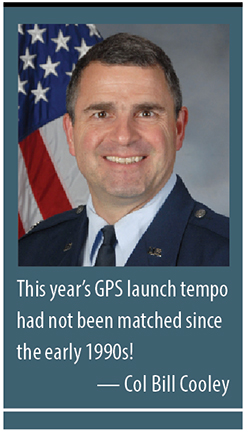
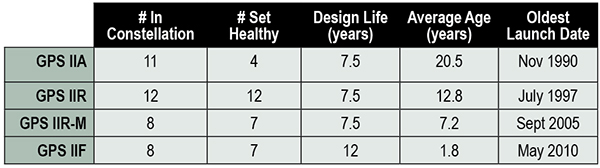
    This past year has been productive for the GPS program. The most visible progress was the addition of four new Boeing-built GPS IIF satellites to the GPS constellation, bringing the total number of available satellites from 36 to 39 (SVN-33 was safely disposed in October 2014, or the number would be 40). These additions also reduced the average age of the satellites on orbit from 11.1 to 10.3 years. This year’s GPS launch tempo had not been matched since the early 1990s! Table 1 lists the current satellites in the constellation by block.

    GPS-table-Directions
    TABLE 1. GPS constellation as of October 31, 2014.

    Perhaps the most exciting aspect of the GPS satellite constellation is the ever-improving performance. As I mentioned last year, the 2008 Standard Positioning Service (SPS) Performance Standard, issued by the Office of the Secretary of Defense, codifies our commitment to civil users. Among other attributes that make GPS the “gold standard” for positioning, navigation, and timing (PNT), the SPS requires a signal-in-space (SIS) user range error (URE) of 4.0 meters or less for every healthy satellite. The SIS URE is the difference between a GPS satellite’s navigation message (for example, ephemeris data and satellite clock correction data) versus the truth (for example, satellite transmit antenna location and satellite clock offset from GPS time). While the commitment of the U.S. government is four meters or less, the actual average performance over the past year has been 0.68 meters and in the past quarter has been an impressive 0.63 meters!

    While this is admirable, continued modernization efforts will allow us even better performance. A significant contributor to the errors experienced by GPS receivers are ionospheric delays that can be eliminated only with knowing the characteristics of the ionosphere (free electron density in the region roughly 100-1,000 kilometers above the Earth’s surface) or by using two signals at different known frequencies. While systems like Federal Aviation Administration Wide Area Augmentation System (WAAS) and the U.S. Coast Guard National Differential GPS (NDGPS) provide a modeled approximation of the ionosphere, the new L2C and L5 civil signals on the GPS IIR-M, GPS IIF, and soon-to-launch GPS III satellites enable GPS receivers to directly measure and eliminate the ionospheric delays altogether — thereby delivering on the GPS modernization program first announced in 1999. These new signals began pre-operational Civil Navigation (CNAV) message broadcast on 28 April 2014 (with the L2C signal set “healthy” and L5 set “unhealthy” until sufficient monitoring capability is established).

    With CNAV now on the air, civil users should take advantage of it. My challenge to commercial receiver companies and innovators is to incorporate the modernized signals in future receivers and continue to improve user experience and GPS performance. Currently 14 L2C-broadcasting satellites are in the constellation, and by early 2016 we expect to have 19 on-orbit and transmitting L2C (7 GPS IIR-Ms and 12 GPS IIFs). GPS modernization is well on its way from a signal-in-space perspective; receiver manufacturers and innovators must bring new, improved products and solutions to users.

    Less visible but real progress modernizing the GPS Enterprise is underway with the next generation of GPS satellites, ground control, and user equipment segments. The first GPS III satellite and the newly developed navigation payload have been delayed approximately two years from the original planned delivery of the completed GPS III satellite of October 2014. But in September of this year, the GPS III navigation payload was shipped from Exelis (the payload subcontractor) in Clifton, New Jersey, to Lockheed Martin’s (GPS III prime contractor) facility in Waterton, Colorado. There, it completed the payload-level thermal vacuum testing at the end of October, a key step toward payload and eventually satellite vehicle delivery. The first GPS III satellite is now 87% complete and the program is making solid progress.

    The GPS Next-Generation Operational Control System (OCX), with Raytheon as the prime contractor, experienced significant challenges in development but can also claim measurable progress this year. Complex cyber-security requirements and their implementation drove a significant number of these challenges, but are essential to provide civil and military GPS users with a secure and resilient command and control system. These and other challenges resulted in significant cost and schedule overruns and a two-year delay to the program, which drove an update to the development plan. The revised OCX plan reflects the complexity of implementing these unique cyber requirements and accounts for planned improvements to Raytheon’s systems engineering and software development approach. The plan establishes a schedule meeting GPS III’s projected first-launch date.

    Despite its challenges, OCX development completed four end-to-end space-to-ground launch readiness exercises with GPS III, as well as entered the formal integration and test phase. The new monitoring station receivers are entering qualification test, and the first production receiver is on track to be delivered in spring of 2015. OCX is on track to provide robust PNT services, improvements in URE accuracy, enable access to new military and civil signals, and provide cyber security for the GPS ground control.

    Our development of Military GPS User Equipment (MGUE) is another area where we have made important strides this past year. We started the year by developing a commercial market-based acquisition approach that will accelerate delivery of MGUE systems by years. In this effort, we want to establish a race to a certified marketplace where the U.S. government serves as the race official while our industry partners set their own pace to deliver capability. Our goal is to increase speed of delivery to the warfighter while capitalizing on industry’s ability to innovate.

    Our MGUE team of government and industry partners (Rockwell Collins, Raytheon, and L3) successfully completed major system design reviews demonstrating a readiness to define the process of security and compatibility certification. Additionally, the team participated in the GYPSY Juliett multi-service, multi-nation PNT demonstration hosted by the U.S. Strategic Command this past summer. While we battled the elements through two hurricanes, the team successfully demonstrated the capability of M-Code receiver cards in an operational demonstration. Our goal is to enable full operational testing with four lead platforms in summer 2016.

    While many risks and challenges to GPS modernization still lie ahead of us, the persistent effort by the GPS team has produced important progress in 2014 across the space, ground, and user equipment segments.

    A civilian GPS user recently thanked me for providing the incredibly useful utility free to everyone around the globe. Although my impulsive response was to say simply, “You’re welcome,” I’d like to provide a more thoughtful and thorough reply that recognizes those responsible for GPS.

    There are two key groups to thank for GPS: the first is the men and women across the United States government and industry who develop, field, and operate the GPS Enterprise. Among this group are satellite factory technicians, software engineers improving the ground segment, receiver designers, program office engineers, and satellite operators continuously monitoring the constellation, updating each GPS satellite’s clock correction and ephemeris data 24/7. This team works with an unwavering passion for this mission that inspires me every day.

    The second group responsible for GPS is the American taxpayer who, through Congress, funds the GPS Enterprise every year.  The U.S. financial commitment to GPS is not just for U.S. security or the well documented positive impact GPS has on the American economy, but for the benefit of the entire world as a global utility. GPS is the gold standard for PNT because American taxpayers continuously provide fiscal support so the GPS Enterprise’s men and women can design, produce, field, and maintain the global utility that we all have come to depend on. 

    Thank you for supporting this enterprise, and know that the GPS team works hard to ensure those resources are spent wisely to provide continuously improving, predictable, and dependable performance from the Global Positioning System.


    Colonel William T. Cooley is director, Global Positioning Systems (GPS) Directorate, Space and Missile Systems Center, Air Force Space Command, Los Angeles Air Force Base, California.