Category: Survey

  • Locata, A New Constellation: ICD and Live Demos at ION-GNSS 2011

    “GPS can no longer evolve fast enough. Satellite-based systems cannot maintain the speed of development now required for the hyper-fast evolutionary pace of modern applications and devices. For positioning for the future, it has become exceedingly clear that GPS now needs a terrestrial component.” — from a Locata Corporation prospectus

    A large number of companies and engineers have thrown billions of dollars at trying to improve GPS in urban and indoor applications,” states Locata Corporation co-founder Nunzio Gambale. “From a technological perspective, Locata has created something completely new: the capability to autonomously create a GPS-style system on the ground.”

    Members of the GNSS community can see for themselves at Locata’s coming-out party at ION-GNSS 2011, including release of a Locata signal interface control document (ICD). GPS World took an advance look at the technology in a June trial of the demo that all ION attendees can see. This article presents these reports, after an outline of the technology.

    The key to Locata’s positioning system is the signal generated by the Locata transceiver, or LocataLite, to synchronize its time to other LocataLites in a network. Locata creates a network that, according to the company, “is in almost perfect synchronization” without using atomic clocks. Each transmitter dynamically synchronizes with other Locata transmitters using a patented method called Time-Loc. Gambale says that a Locata network currently locks to about 2 nanoseconds.

    Each LocataLite base station has an uninterrupted range of approximately 10 kilometers, with indoor signal penetration similar to that of a mobile phone tower.

    The company emphasizes that its transceivers are not pseudolites, but devices that create TimeLoc synchronization, and thereby enable an autonomous synchronized network that, locally, looks like GPS. The local constellation is under local control, and can therefore be designed for deployment at any power, any frequency, or any density required by an application.

    The networks can scale easily. The term “local” can mean a room or warehouse (100s of m2), a campus or open-cut mine (10s of km2), an airport terminal area with approach and landing routes (100s of km2), or a wide area, range, or city (1,000s of km2)

    Gambale sees markets for Locata’s technology in defense, mining, emergency services, construction, and security. Locata is designed to integrate with existing GPS technology, as simply another constellation. This means an approprieate GPS-Locata receiver can use the satellite signal when outside the range of a Locata network. To a combined GPS-Locata chip, the LocataLite will appear as another satellite.

    The company sold its first Locata network in July 2005. Locata has signed partnership agreements of various kinds with Leica Geosystems and Newmont Corporation (mining), the U.S. Air Force, the Advanced Navigation Technology Center of the Air Force Institute of Technology, and several other firms under non-disclosure terms. There was an initial test deployment at Holloman Air Force Base in May 2008, as a truth reference system spanning a test area of about 52 by 15 kilometers.

    For high-multipath environments such as indoors and warehousing, the company’s latest development is a new antenna called a TimeTenna, which it will demonstrate at ION-GNSS.

    Future research and development will focus on the miniaturization of the Locata receiver. Work has begun on a combined GPS-GLONASS-Locata chip that can be integrated initially into professional and industrial devices, and eventually into consumer devices such as mobile phones.

    Locata plans to work with integrators only, not with end users, making the technology available to qualified partners developing receivers and applications. The ICD is the first step in Locata’s technology rollout.

    #2
    LocataLites awaiting boards. Each LocataLite transmits four PRN signals.

    A Long Time Coming

    Eric Gakstatter, Survey editor

    You may have heard the Locata name pop up over the past several years. It would be in the news, then back underground into stealth mode. About five years ago, I heard some interesting rumors about its technology but I decided not to take them seriously until I saw some real products.

    Two years ago, I sat down with Nunzio Gambale, Locata CEO, at the ION-GNSS conference. At last year’s ION, I talked with him again. At that point, I understood the potential impact of Locata’s technology — if it worked as advertised. I again told myself that before I spent more time on it, I wanted to see a product introduced to the market based on Locata technology. In January of this year, it happened.

    Leica Geosystems introduced its terrestrial GPS Augmentation Network for the mining industry, based on Locata technology. To me, that was a pivotal point. Leica is a reputable company and wouldn’t introduce a product without a thorough vetting.

    I contacted Nunzio and we had further discussions. I wanted to see the technology in action — hard to do since Locata is based in Australia, I’m in Portland, Oregon, and an early installation occurred in South Africa. Fortunately, the company’s need to do a real run-through of its demo on site, prior to ION, meant that I got what I wanted to see, right on my doorstep: a Locata preview at the Oregon Convention Center in June.

    The Technology

    Essentially, Locata has developed a system that is very much GPS-like in that one has a network of reference stations (LocataLites) that interface to an unlimited number of rovers. One major difference is that there is no space segment. It doesn’t need or use satellites. Essentially, each reference station behaves like a satellite on the ground, with the rover moving around inside the polygon formed by the reference stations. The rover position is accurate to the centimeter level.

    The value of the Locata receivers is that they don’t need a clear view of the sky to operate like a GPS receiver does. Yes, that means centimeter-level positioning indoors, where RTK GPS doesn’t work due to satellite visibility constraints, as well as outdoors.

    Sound cool? It is. I saw it working indoors at the Oregon Convention Center. Locata staff set up a large room with Locata reference stations around the perimeter. They had two different rovers: one mounted on a small push cart and the other on a golf cart. We were able to move the rovers around the room freely and view the updated coordinates at 1 Hz intervals (although it’s capable of much faster update rates).

    The Challenges

    The new TimeTenna (see facing page) is large. Today that form factor is required to handle the high-multipath indoor environment. Locata is working on a scaled-down version, although it’s not unreasonable to envision the current model being mounted on a forklift or other vehicle if it was mechanically hardened. The antenna for Locata’s outdoor systems (for mining and other less hostile environments) is much lower profile and similar to a standard GPS antenna.

    The Locata system requires that you manage a network of Locata reference stations. Similar to an RTK network, the Locata system is based on a network of reference stations around the project area. The baseline distances can be quite long (tens of miles), but nevertheless, one must install and manage the network much as one would a GPS RTK network, albeit with much less IT department involvement than a GPS RTK network.

    Lastly, Nunzio Gambale wholeheartedly agrees that Locata’s technology is still developing. He likens it
    to where GPS was in 1990. I tend to agree. The antenna technology needs to reduce in size and the system architecture needs to be vetted for reliability in production environments. But keep in mind that Leica and the U.S. Air Force’s 746 Test Squadron have already bought into Locata’s technology in a big way.

    Although I don’t pretend to have the technical understanding that some of the others in the room possessed during the June demo, I did hear one of the sharper engineers exclaim “genius” at one point, referring to the design.

    It’s certainly worth a close look as Locata’s technology continues to develop and be deployed. I think the day isn’t far away when we will see a system from Locata that will allow a user to transition seamlessly from centimeter-level positioning outdoors using RTK GPS to centimeter-level positioning indoors without breaking a step.

    Now I’m a Believer

    Tony Murfin, Professional OEM editor

    I was invited to Portland in late June to preview an operational system which promises to help GPS in tough signal situations and work well indoors. While Europe, China, India, Japan, and of course Russia are all working to get more operational satellites in space, Locata in Australia has quietly been perfecting its terrestrial navigation system. I say perfecting because skeptics and naysayers have criticized Locata and what was seen as a pseudolite system with a rather lengthy development cycle. But nothing speaks as loudly as an operational system adopted and fielded by Leica Geosystems or a contract with the U.S. Air Force to get people’s attention back in the right place, even though Locata would claim it is only just getting started.

    As I walked into the Portland Convention Center I was certainly apprehensive as to how any GPS-like system could function well within the massive concrete and steel building. When I found the smiling Locata group tucked away in one of the side ballrooms, it didn’t take long before I became a believer. Those wall dividers that allow the Convention Center to reconfigure rooms are apparently referred to as Acousti-Seal 931 Steel Operable Wall panels — yep, perfect multipath reflectors. So to see totally repeatable few centimeter positions in this cavern was not what I was anticipating.

    The ballroom’s carpeted floor had been carefully laser-surveyed with a matrix of 5-meter squares, with a high-precision dot marking each grid intersection. LocataLite stations were set up at each corner and one in the middle at the far end, each with three antennas. A master station at the left corner of the entry wall originated the TimeLoc signal, and on each station one antenna pointed to an adjacent station, over which TimeLoc synchronization was cascaded around the network. This is a key feature of the ground network, allowing it to become fully synchronized and also to be extended or reconfigured at will.

    Of course, when you run your own ground network it helps to be able to run at power levels significantly higher than GPS, so it’s easy for each station to communicate with another, provided they roughly have line-of-sight of each other — kind of like having to actually see a GPS satellite to get it into your GPS position solution. If you have some buildings or bushes or trees to contend with, having higher power available makes things easier, especially if you want an RTK carrier solution.

    The secret to working indoors appears to be the TimeTenna phased-array antenna that Locata demonstrated in the steel-clad ballroom. With this top-hat-like antenna mounted on a wheeled cart along with a receiver and laptop, and positioned over one of those surveyed locations on the carpet, we could easily see that positions within less than 5 centimeters were consistent and solid. As a truth system, the company also had a motorized laser scanner pumping out centimeter-level positions on a parallel measurement system, and it was clear that there was excellent centimeter-level correlation.

    But don’t take my word for it. Come to Portland for the ION-GNSS conference, September 20–23, and see the Locata demo for yourself — you’ll be impressed too!

    Then there is the sole-source U.S. Air Force contract that has Locata updating an existing network to provide independent reference positions over 2,500 square miles of the White Sands Missile Range in New Mexico. The Air Force apparently needs to know how its navigation systems work when it turns on localized GPS jamming. The Locata system is designed to give the Air Force better than the specified <18-centimeter position accuracy in GPS-denied environments.

    In August, Locata cleared the final USAF critical design review milestone for the wide-area White Sands Missile Range deployment. This is clearly a good sign that Air Force wants to continue with the next-generation Locata system. With GPS denied on this range, test vehicles will likely be constrained to inertial-only navigation, but with a LocataLite receiver onboard pumping out high-accuracy position measurements, the Air Force will no doubt have plenty of location data to track dynamic performance under GPS jamming conditions.

    Another application that Locata has been investigating involves airborne trials in Australia, where initial results indicate position accuracy of less than 3 meters at up to 50 kilometers. The trials have involved a ground network with six base stations spread over a roughly square area of 1,500 square kilometers.

    A University of New South Wales test aircraft equipped with precision GPS, inertial reference system, and laser scanner for truth reference use flew to within 3 to 49 kilometers of the reference stations at around 7,000 feet, producing the reported <3-meter code solution. Trials data is still being analyzed to produce a higher accuracy carrier solution, and Locata expects to issue these results at ION.

    Airborne Reference Equipment

    Leica has apparently been working with Locata for some time. The proof-of-concept installation at a 300-foot deep diamond mine in South Africa and a production set-up at a gold mine in Western Australia are going strong.

    The gold-mine installation has now been extended to two pit sites using 15 LocataLite transmitters in total. LocataLite receivers are mounted on vehicles, atop drills and shovels, and all run off the multi-pit Locata network. The mobile units not only carry LocataLite receivers, but also precision Leica GNSS receivers running off side-by-side antennas. As time progresses, the ultimate solution will use integrated multi-constellation/LocataLite receivers: the Locata signals integrated into a combined satellite+terrestrial receiver position solution, using a single integrated antenna.

    It’s easy to envisage such an integrated receiver and antenna where the Locata ground-network signals are used as just another local constellation. The investment to get to such a receiver would of course have to be justified by a whole proliferation of Locata networks. This would seem to be on the way, given the significant progress that Locata has now unveiled.

    Will It Fly — Literally?

    William Shears, aviation engineer

    If you are an aviation satellite navigation enthusiast, you probably noticed this hasn’t been an auspicious year for aviation GNSS or for GNSS applied to any other user segment that needs highly reliable GNSS service. Between personal privacy jammers, instances of accidental interference, and the big chill sent through the community by the LightSquared debacle, many are asking if GNSS is now or ever will be reliable enough to be a sole means of position and time for safety-of-life applications.

    A few years ago, the very idea that ordinary people would want to own GPS jamming devices and that they would be easily obtainable on the Internet would have been considered absurd. Similarly, the idea that the U.S. government would not vigorously protect GPS from interference was just not credible. But here we are in mid-2011 and the vulnerability of GNSS to interference has come home to roost, in several very big ways. This new awareness of the weaknesses of GNSS has led the U.S. Federal Aviation Administration (FAA) and civil aviation authorities of other countries to start rethinking their long-term strategies with respect to satellite navigation.

    Even well before LightSquared crept into the consciousness of the GPS community and then burst forth as the apocalyptic specter that threatens to virtually end the utility of GPS in North America, the FAA had begun a study to consider the need for an alternate positioning, navigation, and timing (APNT) system to support critical aviation needs. The idea being that as the U.S. air traffic management system transitions to become increasingly dependent on management of traffic via four-dimensional trajectories, reversion to a non-trajectory based mode (for example, controllers vectoring aircraft as they do today) would become unfeasible. Hence, airplanes will need a very reliable source of 4D positioning and outages for any extended period of time due to interference, or anything else will be unacceptable. The FAA set about studying what level of performance would be required for a system intended to back up GNSS in the future. Other countries began to follow suit, and whereas the concept of an APNT was obscure a year and a half ago, it has become a significant point of discussion at the International Civil Aviation Administration (ICAO) as well as within various countries, including the United States, Australia, and several in Europe.

    At first blush, the Locata system would seem to be a ready-made solution poised to fulfill aviation’s need for a GNSS backup system. In fact, acting as an independent backup (and/or an augmentation to) GNSS is one of the main motivations in Locata’s development. The technology seems to have promise in meeting the aviation community’s needs for an APNT. Locata is relatively mature technology that has demonstrated accuracies well in excess of what is required of an APNT meant to back up GNSS for enroute, terminal, and non-precision approach operations. Perhaps even precision approach and landing could be supported. Also, the system is very flexible, which suggests that service coverage could be tailored as needed around important airports. The system has significant redundancies built in, including multiple frequencies, multiple antennas for path diversity, and the ability for the network to reconfigure which LocataLite uses which other LocataLite for time synchronization.

    Given this flexibility and redundancy, it should be possible to configure a system that provides highly reliable service where it is needed. Another major advantage of the Locata technology for aviation is the higher signal power level that comes from using terrestrial signals rather than signals from space. In theory, a Locata system would be more robust to interference than space-based GNSS signals.

    Some people are indeed thinking about Locata for aviation use. Locata has conducted flight trials in Australia using a prototype demonstration network of six LocataLites covering an area of more than 1,500 square kilometers around Cooma airport in Australia. Locata has reported code positioning solutions of better than 3 meters at ranges up to 50 kilometers, and will present higher accuracy carrier-phase solutions at ION. The U.S. Air Force is also preparing to use Locata in an aviation environment as an independent truth reference.

    At the ICAO Navigation Systems Panel (NSP) meeting in May 2011, the Australian panel member presented a paper outlining the general need for an APNT. The paper included a description of Locata as an example of what an APNT solution might look like. However, it is interesting that the paper fell short of proposing that the panel pursue Locata as the solution or to suggest that any standardization of a solution for APNT begin immediately. In spite of all the potential advantages discussed above, the Locata system faces a major obstacle before it can practically be used in aviation applications: standardization.

    The first aspect of standardization that is likely to be a huge impediment for Locata (or any other APNT proposal, for that matter) is spectrum. The Locata systems implemented to date have been designed to operate in the 2.4 GHz unlicensed industrial applications band. For Locata to support safety-of-life applications, national aviation authorities will require that an APNT system use spectrum that is properly allocated for use in a safety-critical aeronautical navigation system, that is, spectrum allocated for Aeronautical Route Navigation Services (ARNS). Spectrum allocated as ARNS is afforded special protection from interference. Coordination of services in or near ARNS spectrum is often difficult, time-consuming, and expensive. For example, coordination between civil aviation use of the 108–118 MHz band (used for instrument landing systems, or ILS, and VHF omnidirectional range, or VOR) and FM broadcasting in the 88.1–107.9 MHz band produces real costs and restrictions to be borne by the FM broadcasters. Consequently, any proposal to convert non-ARNS allocated spectrum to ARNS is likely to be met with significant opposition.

    Spectrum is a finite resource, and virtually all spectrum is already in use by someone. So, the reality is that a future APNT will likely have to be implemented in some existing ARNS spectrum, since a new global allocation of spectrum for ARNS is an unlikely proposition.

    The current allocations for ARNS include:

    • 108–118 MHz (ILS/VOR),
    • 960–1215 MHz (DME/Mode-S/ADS-B/SSR/JTIDS/MIDS),
    • 1556–1626 MHz, and
    •  5.1–5.25 GHz.

    All indications are that a Locata system could be could be operated at these frequencies. However, services that already exist in those bands will continue for the foreseeable future. So, to be viable, a Locata system would have to coexist in one of these bands with other existing systems, that is, not interfere with the operation of those other systems. Such coexistence has yet to be demonstrated either by analysis or test.

    After suitable spectrum has been identified, the next major hurdle for Locata is standardization of the signal-in-space to the degree that supports interoperability of equipment produced by different manufacturers in different countries. The Locata ICD released at ION-GNSS 2011 is a good step in the right direction. But for an aviation application, a great deal more would need to be specified, including details about the waveform (spectral mask, out-of-band emissions, and so on), the protocols for producing the signals, and the standard protocols for the application of data to derive a position solution. A clear allocation of responsibility between the ground processing and airborne processing will need to be defined so that system integrity can be analyzed and assured.

    At the international level, such standardization activities can take a decade or more. The length of time required depends on the maturity of the system that is proposed for standardization. The existence of a similar standard, with perhaps a significant user base and operational experience also helps (for example, an IEEE standard or RTCM standards). So, again, the ICD is a good start.

    Beyond the technical aspects of standardization, there are political and institutional aspects that can often be more formidable barriers. Issues with spectrum have already been mentioned. Beyond that, there are issues with intellectual property. Creating aviation standards based on proprietary technology is unpopular although not unprecedented. Proposals for standardization are more likely to be successful the fewer strings, such as licensing agreements or fees, that are attached. This is a challenge since companies that have worked hard to develop cool new technology are often reticent to give away their intellectual property in the name of standardization.

    Given all the barriers, how does new technology ever get implemented in civil aviation? Typically, applications begin in one of two ways:

    • in support of war.
    • in support non-safety related industrial applications.

    The military has historically pioneered many technologies (radar, DME/TACAN, GPS) that would probably not have been developed otherwise. Even after the initial military experience, there is typically a period of time when the new technology is used in a non-safety-critical capacity to support some commercial objective. In the case of Locata, some potential applications would be flight-test position-reference systems, high-precision photogrammetry, high-precision positioning for crop dusting, and any other applications that require a highly robust, high-accuracy position solution in a well-defined region where interoperability and certification are not issues. Those are relatively small niche applications, which may provide some valuable operational experience.

    However, serious movement towards adopting Locata as a standard for APNT is unlikely to happen without the support of at least a couple of large countries. Even a large user base with equipage does not guarantee that countries will adopt the technology or that air navigation service providers will authorize the use of the technology for safety-critical applications. For example, many carriers are equipping with broadband Internet equipment to provide service to the passenger cabin. Yet, there is no serious discussion of using that datalink capability for safety-related communications. Similarly, a very large number of aircraft are equipped with Aircraft Condition and Reporting System (ACARS) datalink, yet use of that system is largely limited to non-essential Airline Operational Communication (AOC) applications.

    So will Locata fly? I believe that is entirely up to Locata and other companies that work with Locata to address the initial military and niche airborne positing markets. Operational experience gained by such early adopters will be critical in laying the groundwork for the support that will be needed from large states like the United States, Australia, China, and those in Europe, if Locata is to be a player in the longer-term international standardization of APNT.

    In the near term, Locata is already serving the aviation community by demonstrating the art of the possible relative to what a ground-based navigation system based on modern technology could be.

  • LightSquared: The Ball is in the FCC’s Court

    The FCC’s public comment period regarding the LightSquared/GPS interference issue has ended and the reply comment period is over as well. To date, more than 3,300 comments (not including the 15,000+ that were submitted by the Boat Owners Association of the United States) were entered that the FCC must sift through and arrive at some sort of conclusion. Following are my last comments filed with the FCC as well as my best guess at where this is heading.

    I decided to file a “reply comment” submission on August 15 to the FCC based on an August 11 filing by LightSquared where LightSquared Executive Vice President Jeffrey Carlisle stated “had the GPS industry complied with the DoD’s recommended filtering standards for GPS receivers, there would be no issue with LightSquared’s operations in the lower portion of its downlink band.” It’s a blatantly false statement, so I couldn’t let it pass without a rebuttal. Following is what I submitted to the FCC:


    August 15, 2011

    Eric Gakstatter
    Editor – GPS World magazine Survey Scene enewsletter
    Editor – Geospatial Solutions
    High-precision GPS Consultant
    PO Box 663
    West Linn, OR 97068
    Marlene H. Dortch, Secretary
    Federal Communications Commission
    445 12th Street SW
    Washington, DC  20554
    Re: IB Docket No. 11-109


    Dear Ms. Dortch,

    In addition to my comments posted on July 28, 2011, I’d like to reply to comments submitted by LightSquared in their letter dated August 11, 2011.

    Again, by way of background, as a Contributing Editor to GPS World magazine, my specialty is high-precision GPS receivers of which I’ve been involved with for more than 20 years as a product developer, power user and consultant. I’m in touch with tens of thousands of high-precision GPS users from around the world through my newsletter articles (bi-weekly), webinars and my attendance at technical conferences. I consider myself and I’m considered by others to be an advocate for the high-precision GPS community.

    In Jeffrey Carlisle’s (LightSquared Executive Vice President) comments to the FCC dated August 11, 2011, he stated that “had the GPS industry complied with the DoD’s recommended filtering standards for GPS receivers, there would be no issue with LightSquared’s operations in the lower portion of its downlink band.”

    This is a false statement, and to make matters worse, he knows it’s a false statement. Here’s why…

    LightSquared sells high-precision satellite data communications services to the GPS industry. Before LightSquared was formed in 2010, its predecessors (Skyterra, MSV) sold the same services to the GPS industry for many, many years.  In the course of business over many, many years, LightSquared and its predecessors have encouraged GPS receiver manufacturers to design receivers that look into the MSS band (1525-1559MHz) in order to access LightSquared’s satellite data communication services. This service has generated tens of millions of dollars in revenue for LightSquared and its predecessors over many years and continues to be a revenue source for LightSquared today.

    If LightSquared chooses to stop supplying satellite data communications services to the GPS industry, that’s their choice, but they should not fabricate a statement claiming that only the reason for interference in the “lower portion of its downlink band” is due to filtering technology. It’s just not true. Tens of thousands, if not hundreds of thousands, of expensive high-precision GPS receivers were specifically designed to access LightSquared’s and Inmarsat’s satellite data communications services that they sell to the GPS industry.

    LightSquared may state they will continue to offer these services to the GPS industry in the upper portion of its downlink band (1545-1559MHz) to create separation from the lower portion of the downlink band (1526-1536MHz). It’s too late for that. Billions of dollars of expensive, high-precision GPS receivers are already in the market that were designed to look in the entire MSS L-band (1525-1559MHz) for services provided by LightSquared and Inmarsat. Had the GPS user community been given sufficient notice, tens of thousands of high-precision GPS equipment owners could have planned for transitioning their GPS receivers over many years with a manageable financial impact. Unfortunately, that’s not the case. The GPS user community was blindsided by LightSquared’s application in November 2010 and the FCC’s waiver granted to LightSquared in January 2011.

    LightSquared and the FCC failed to adequately notify the GPS user community of their intentions. As I’ve submitted before, the precedent has already been set on how to effectively notify the GPS user community about an action that would render several hundred thousand high-precision GPS receivers obsolete. In 2008, the U.S. Air Force proposed to discontinue supporting the semicodeless technique that is used by virtually every civilian L1/L2 high-precision GPS receiver in existence. It was the first time in history that an action would render several hundred thousand high-precision GPS receivers obsolete, a scale which is very similar to the impact of the LightSquared system.

    There was no industry coalition formed to engage the Air Force. There was no industry outcry. A public/private technical working group was not formed to test the effects on receivers if semicodeless was not supported. Why is that?

    The answer is very simple. The U.S. Air Force, to its credit, did a fantastic job of communicating directly with the GPS user community along with the Department of Commerce. It issued public statements describing the impact the action would have on high-precision GPS receivers.

    The U.S. Air Force did its homework. At the end of the day, it set a sunset date of December 31, 2020 to discontinue supporting the semicodeless technique. It correctly determined that 12 years is about the amount of time that would allow a smooth transition with a manageable financial impact to the high-precision GPS user community.

    Imagine if the U.S. Air Force had set a period of one year to transition away from using the semicodeless technique. That action would have destroyed the high-precision GPS user community resulting in billions of dollars in losses and widespread small business closure. Fortunately, they did their homework, understood the impact, and made the correct decision.

    LightSquared, on the other hand, either didn’t do its homework or intentionally kept quiet in order to fly under the radar and push its initiative through before the GPS user community (and others) knew what was happening. In either case, the GPS user community shouldn’t be held accountable in paying for the FCC’s and LightSquared’s lack of communication/notification.

    LightSquared and the FCC incorrectly assumed that communicating/negotiating with the U.S. GPS Industry Council (USGIC) was the equivalent of communicating/negotiating with the GPS user community. That is a false assumption. The USGIC does not communicate directly with the GPS user community and never has. That’s not their role. I’ve been perso
    nally involved in the high-precision GPS industry for 20+ years and writing a monthly newsletter on high-precision GPS technology for GPS World magazine for more than five years. I attend almost every major GPS conference and high-precision GPS market segment conference in the U.S. and some abroad. The first I’d heard about the LightSquared interference issue was November 2010.

    Even if LightSquared only uses the lower portion of the downlink band (1526-1536MHz) as they’ve proposed, the number of high-precision receivers affected would be at least 200,000 at an estimated replacement cost of $10,000 per unit which equates to a total equipment replacement cost of $2 billion dollars. That does not include the cost of removal/installation, lost productivity, required software upgrades, and training. Do LightSquared and the FCC expect the GPS user community to bear that cost? Hopefully, you can see by the overwhelming number of public comments from small businesses and local government agencies, such an action would be devastating to the U.S. economy.

    Lastly, please do not forget about the potential devastating impact of LightSquared mobile devices (uplink band 1626.5-1660.5MHz) on GPS and GNSS receivers. I’m afraid this is being lost in all the discussion about the downlink band.  The uplink band could have a worse affect on GPS and GNSS receivers than the downlink band.

    LightSquared mobile devices are potentially portable GPS/GNSS jammers. The FCC needs to seriously investigate the interference impact of LightSquared mobile devices (1626.5-1660.5Mhz) on GPS receivers. It is already known that Inmarsat (1626.5-1660.5MHz) devices and Iridium (1616-1626.5MHz) devices interfere with each other, but Iridium devices are only used in remote areas so it’s not a widespread problem. It is also known that these devices interfere with the GLONASS L1 signal (1597-1605MHz). We don’t know the extent of the effect that LightSquared mobile devices will have on GLONASS L1, GPS L1, Galileo L1, or Compass L1 signals. The problem is that no LightSquared mobile devices are available to test. Yes, lab simulations can be performed, but LightSquared devices will be made in Asia, among other places, where the designers won’t care one bit about GPS/GLONASS interference. There is not an acceptable design margin, if any, to allow for sloppy LightSquared device designs.

    Thank you for your attention. If you feel that further testimony is needed, I’m more than happy to oblige.

    Sincerely,

    /S/ Eric Gakstatter

    Eric Gakstatter
    Principal – Discovery Management Group LLC
    Editor – GPS World Magazine Survey Scene enewsletter
    Editor – Geospatial Solutions
    PO Box 663
    West Linn, OR 97068

    I think that three things are batting against LightSquared at this point:

    1. As much as they say they gave fair warning, LightSquared and the FCC didn’t communicate with the GPS user community at all on this issue. The U.S. GPS Industry Council (USGIC) doesn’t count. They don’t represent the GPS user community nor communicate with the GPS user community at all. So, the GPS user community was blindsided by this in Nov 2010.

    This was either intentional or sloppy, but it doesn’t matter either way. The bottom line is that you can’t give nine months notice on obsoleting 200,000+ very expensive GPS receivers that are installed and used in critical infrastructure applications. It would take many years to transition to new equipment. The U.S. Air Force and Dept of Commerce have already been through this drill already and they determined that 12 years was about the right timeframe needed to transition high-precision civilian GPS equipment to new technology. If LightSquared and the FCC really understood this market, they would know it’s not a four-year exercise.

    2. Even with LightSquared using only the lower spectrum (1526-1536Mhz), it still interferes with $2+ billion dollars worth of high-precision GPS receivers. Who’s going to pay that bill? The GPS user community that was given no advanced notice?

    They can argue all they want about who’s fault it is, new filter technology, DoD standards, etc., but at the end of the day, obsoleting 200,000+ expensive high-precision GPS receivers valued at  $2+ billion dollars would be devastating to American small businesses and Fed/State/Local gov’t.

    3. LightSquared sells high-precision satellite data communications services to the high-precision GPS industry. Before LightSquared was formed in 2010, its predecessors (Skyterra, MSV) sold the same services to the GPS industry for many, many years. In the course of business over many, many years, LightSquared and its predecessors have encouraged GPS receiver manufacturers to design receivers that look into the MSS band (1525-1559MHz) in order to access LightSquareds satellite data communication services. This service has generated tens of millions of dollars in revenue for LightSquared and its predecessors over many years and continues to be a revenue source for LightSquared today.

    If LightSquared chooses to stop supplying satellite data communications services to the GPS industry, thats their choice, but they should not fabricate a statement claiming that only the reason for interference in the lower portion of its downlink band is due to filtering technology. Its just not true. Tens of thousands, if not hundreds of thousands, of expensive high-precision GPS receivers were specifically designed to access LightSquareds and Inmarsats satellite data communications services that they sell to the GPS industry.

    LightSquared may state they will continue to offer these services to the GPS industry in the upper portion of its downlink band (1545-1559MHz) to create separation from the lower portion of the downlink band (1526-1536MHz). Its too late for that. Billions of dollars of expensive, high-precision GPS receivers are already in the market that were designed to look in the entire MSS L-band (1525-1559MHz) for services provided by LightSquared and Inmarsat. Had the GPS user community been given sufficient notice, tens of thousands of high-precision GPS equipment owners could have planned for transitioning their GPS receivers over many years with a manageable financial impact. Unfortunately, thats not the case. The GPS user community was blindsided by LightSquareds application in November 2010 and the FCCs waiver granted to LightSquared in January 2011.

    Of course, I didn’t mention aviation, maritime, military and other safety-of-life applications of GPS. That’s a whole other story…

    Does that mean the FCC is going to tell LightSquared to go home?

    Maybe, but I doubt it.

    In a letter dated August 10, 2011, the FCC Office of Engineering and Technology Chief Julius Knapp requested more data from LightSquared and the U.S. GPS Industry Council (USGIC). Following is an important excerpt from the letter:

    “It is unclear to what extent the GPS receivers and devices tested are current production models, into what market  segments those receivers and devices are most commonly sold, what fraction of a given market segment those devices represent, and their design lifetimes and typical owner-use lifetimes.This information is important in assessing the likely impact, if any, of interference on various use cases over time. We therefore request production and U.S. sales information for each of the devices tested, including (1) the dates of production, (2) the market segment(s) to which the device is targeted or sold,  (3) total annual sales volume and annual sales volume by market segment or estimates thereof, (4) the date on which full support of the device by th
    e manufacturer ceased (or will cease), (5) estimated time period after which the device owner would likely replace or discontinue use of the device”.


    The letter also requests updated information from LightSquared based on their proposal to use only the lower spectrum (1526-1536MHz). The timeframe to provide the requested information is very aggressive, with all information to be supplied on or before August 22, 2011.

    I think this is good news in general. It is the FCC’s first solid attempt to understand the GPS receiver markets in which the proposed LightSquared system will cause interference problems, including high-precision.

    The bad news is that the FCC is only requesting market information on GPS receivers that were tested. If you recall in one of my earlier articles, I listed the GPS receivers being tested by the high-precision team. Obviously, if the FCC only used market data from these GPS receivers, the numbers will be underestimated by a large double-digit value and maybe orders of magnitude because many receiver models weren’t included in the test. Also, many CORS in operation are legacy GPS receivers that are out of production. Based on their questions, I have a feeling the FCC will discount those to little or no value, when they actually still provide economic benefit. However, the CORS owner can’t or aren’t in a position to replace them, resulting in a net loss.

    No matter which way this goes, I’m pretty confident the FCC is going to use this opportunity to rattle the GPS industry’s cage. Spectrum is a finite resource and the FCC is going to look at ways to allocate spectrum as efficiently as possible, as they should. Is the MSS L-band (1525-1559MHz) being used in the most efficient manner? Probably not. I bet the FCC orders changes in that area, or at least the FCC sets the wheels in motion towards change. I’m ok with that as long as it doesn’t come at the unreasonable expense of the GPS user community, be it high-precision, aviation, military, etc.

    All of this bruha is really about timing. Given enough time, GPS receiver manufacturers and component manufacturers have a chance to develop new technologies that use the MSS spectrum more efficiently, if at all. Actually, if the FCC pushes forward like they seem to want, it really isn’t MSS (Mobile Satellite Service) spectrum any longer, it would become a Mobile Terrestrial Service. But developing new technologies, designing/testing products and then allowing the GPS user community enough time to adopt the new technology with a reasonable financial impact takes years, a lot of years, not four or five. It takes more years than what LightSquared has to give no matter which part of the MSS spectrum (low or high) one is discussing.

    I think in the short-term the FCC is going to order more testing in order to understand the impact on GPS receivers of LightSquared using only the lower end of the MSS spectrum (1526-1536MHz). We already know it’s going to hammer most high-precision GPS receivers valued collectively at $2+ billion dollars. I don’t have a good grip on how it will affect aviation, military and other receivers in critical apps. We’ll see.

    Actually, I agree with what Jeff Kagan of E-commerce Times writes. LightSquared is playing the public relations game the wrong way and they’re getting their nose punched every time they turn around. They should be spending their energy on talking about how wireless communications will be enhanced by their service instead of scraping up obscure DoD specifications they claim that commercial GPS receivers are supposed to adhere to. I still don’t understand what they bring to the table that Sprint, Verizon, AT&T, etc. don’t. Yes, I get that they are a wholesaler and can bring 4G LTE to small service providers. I’m talking about technology. What technology do they bring to the table? If they are just a new distributor in the mix, there’s not much to talk about and maybe that’s why they are fighting the public relations game the way they are. Interesting enough, earlier this week LightSquared announced they hired a new Senior Vice President for Public Relations and Communications, presumably to attempt to resolve the GPS interference fiasco.

    Dish Network Announces Plan for 4G LTE Network and Applies for FCC Waiver Similar to LightSquared

    Dish Network is trying something eerily similar to LightSquared, but it will have no effect on GPS receivers since their spectrum is far away from GPS (2+ GHz). Dish bought two bankrupt companies last year, Terrestar and DBSD, and have 40MHz of spectrum to play with in 4G LTE. It will be interesting to watch how the FCC deals with this, especially if the Dish waiver is pushed through as LightSquared’s was. With no GPS interference concerns, Dish might be able to field a 4G LTE system before LightSquared can.

    As Phil Goldstein from GPS World’s sister publication, Fierce Wireless, comments:

    “One of they issues that has come to the fore in the wake of the FCC’s decision to grant a similar conditional waiver to LightSquared is that LightSquared’s L-Band spectrum sits adjacent to GPS spectrum, and that terrestrial transmissions from LightSquared’s proposed wholesale LTE network in the upper portion of its spectrum is causing GPS interference. Pointedly, in its filing, Dish said its 2 GHz S-Band spectrum “will not raise the technical issues that have hampered the use of the MSS L-Band, such as the interleaving of the operators’ assignments and the severe interference claimed by systems operating in adjacent spectrum.”
     
    In return for the waiver, Dish said it will commit to a “substantial terrestrial network deployment” of a branded retail service intended to increase wireless broadband competition, including in rural areas, using LTE-Advanced network technology. Dish said it is prepared to work with the FCC “to develop a reasonable, attainable buildout schedule keyed to commercial availability of the LTE-Advanced standard,” and that it is committed to developing a buildout schedule “consistent with FCC precedent and based on the buildout principles established” in Sprint Nextel’s (NYSE:S) combination of its spectrum assets with Clearwire (NASDAQ:CLWR).


    Read the full article by clicking here.

    America’s Web Radio Guest Appearance

    Last week, I was a guest on the American Congress on Surveying and Mapping’s (ACSM) weekly, one-hour America’s Web Radio program. Web radio is actually a very creative idea. You can listen to the live program on your internet-connected computer (11am U.S. Eastern time every Monday) or you can download the recorded program in MP3 format and listen to it using your iPod or other MP3 player. Click here if you’d like to listen to last week’s program when I was the guest.

    Thanks, and see you next time.
    Follow me on Twitter at http://twitter.com/GPSGIS_Eric


  • Last Week’s Solar Storm and the Final LightSquared Push

    You may not have noticed it, but last Friday we experienced the first serious geomagnetic storm in this solar cycle (Solar Cycle 24), which began in 2009. Not all types of solar activity (sun spots, solar flares, solar burst, and solar radiation) affect GPS receiver operations. Geomagnetic storms are the ones that can cause problems for GPS receivers if those storms are powerful enough.

    Last Thursday, I received e-mail from Joe Kunches at NOAA (National Oceanic and Atmospheric Administration).

    “The Sun has been erupting and looks like a storm — say G3 level — could be on for Friday, August 5.”

    Joe was right, it hit about a day later, on Friday, August 5, as he predicted.

    The good news is that Joe says we generally have at least a 24-hour warning before a geomagnetic storm starts disturbing the ionosphere.

    That’s what it comes down to, the ionosphere.

    GPS signals being delayed as they pass through the ionosphere end up being the largest source of error in GPS positioning. The signals must pass through the ionosphere, which is full of free electrons. The density of these electrons in the ionosphere affects the speed at which GPS signals travel. If the density of the electrons in the ionosphere was consistent, then it would be straight-forward to create a model and largely mitigate its effects. However, that’s not always the case. The ionosphere has been relatively benign since the last solar cycle, and that’s one of the reasons that GPS accuracy has been so good, especially GPS L1 SBAS systems like WAAS/EGNOS/MSAS, which rely on modeling the ionosphere.

    The problem is geomagnetic storms. They wreak havoc on the free electrons in the ionosphere, making it difficult to accurately determine how much the GPS signals have been delayed.

    The NOAA Space Weather Prediction Center (SWPC) is one of the foremost agencies that monitors the Total Electron Count (TEC) in the ionosphere. With Joe’s help, I was able to obtain dynamic plots of the TEC from last Friday so I could illustrate to you what happened. I was also able to obtain plots from Gavin Schrock at the Washington State Reference Network (WSRN) showing how it impacted the WSRN. I compiled the plots, added some text, and produced the following Youtube video.


    As I wrote in the Youtube video, to get the most updated solar activity information that’s related to high-precision GPS users, you should follow me on Twitter at GPSGIS_Eric.

    If you’re looking for a good backgrounder on how the ionosphere affects GPS, you might want to read this April 1991 GPS World column. Although it’s dated in some respects, the fundamental concepts are solid.

    Last Push on LightSquared

    There’s been some confusion on the FCC comment period regarding the LightSquared/GPS interference issue. The comment period was not extended. The public comment period was July 1 to July 30, 2011. The reply comment period is from August 1 to August 15, 2011. However, it appears the FCC is still logging new comments even after the July 30 cut-off date. Either way, do not hesitate to submit your comments before August 15; just mark it (dropdown menu) as a reply to comments.

    This is your last chance to speak out and let your government know how important GPS is to your orgnization.

    To date, there have been more than 2,900 individual comments electronically filed as well as more than 15,000 submitted in writing to the FCC (15,000 alone from the Boat Owners Association of the United States). The vast majority of the comments support GPS.

    Some good news. On Tuesday, August 9, the FCC held an invitation-only press conference. Click here to read PC World’s summary.

    To read the 2,900+ comments submitted to date, click here; type in proceeding # 11-109 and search.

    Thanks, and see you next time.

    Follow me on Twitter at http://twitter.com/GPSGIS_Eric


  • LightSquared: Comments I Submitted to the FCC

    Okay, folks, this is where the rubber meets the road. The FCC public comment period ends this Saturday (July 30). If you use GPS at all, it would be very wise to submit your comments today. Don’t expect the FCC to make a rational decision. There’s a lot of money and political influence in LightSquared’s camp and those can dwarf engineering/technical arguments even if they are overwhleming. The best weapon the GPS user community has is sheer numbers, but we aren’t showing up!

    To date (July 27), only 1,896 comments have been submitted. That’s not even close to being enough to get the FCC’s attention, and many of those are aviation and geocaching. Also, you see the politically connected comments (chiefs of police, mayors, state legislators, etc.) are largely in support of LightSquared. That’s because LightSquared is mobilizing its political influence machine.

    Submitting your comments to the FCC only takes five minutes. You don’t need to write an essay. Here’s what you need to make the FCC aware of:

    1. What you (or the organization you work for) use GPS for.
    2. How much (approximately) your organization has invested in GPS equipment/software.
    3. How much your organization (business or public entity) depends on GPS.
    4. How it would affect your organization (business or public entity) if GPS was interfered with.

    If you are worried about not getting approval in time from your department, etc, just keep your comments generic and don’t mention your organization name. The value is the story you tell about how important GPS is to you and your organization, not the specific names.

    I suggest composing your comments in a word processor (Word, WordPad, Notepad, etc.) first, then copy/paste to the FCC form so you don’t lose your work in case something goes sideways with the FCC website while you are typing.

    Here are simple instructions to submit your comments:

    1. Go to the FCC comment submission website by clicking here.
    2. Type in the following information:
    • Proceeding Number: 11-109
    • Name of Filer: Enter your name
    • Address Line 1: Enter your street address
    • City: Enter your city
    • State: Enter your state
    • Zip: Enter your zip code
    • Type in or paste your brief comments: Copy/paste your comments

    That’s it. Five minutes and you’re done.

    DO NOT assume the Department of Defense, Department of Transportation, the National Telecommunications and Information Administration (NITA) or other organizations that have submitted comments will save the day. They are interested in only protecting their own turf, not yours. I still hear people saying, “The FCC will never let this happen because the Department of Defense or DOT will stop them.” If that was the case, this would have stopped months ago. The further along this goes, the more the following statement rings true (that I wrote back in May):

    “The military is going to be accommodated in the name of national security. The aviation industry is going to be accommodated in the name of safety-of-life. The auto navigation industry is going to be accommodated because they are high-profile. The high-precision user is going to be thrown under the bus because we are the most difficult to accommodate (technically) and don’t have a high profile nor are perceived as significant enough to accommodate.”


    LightSquared’s latest proposal is to begin using its lower frequency spectrum (1526-1536MHz) first. The departments of Defense, Transportation, and NTIA may bite on this as a compromise for LightSquared’s “good faith effort.” LightSquared says this new plan will accomodate all but 0.5% of GPS receivers. To the FCC, it appears like LightSquared is bending over backwards because they’ve accommodated 99.5% of all GPS receivers. If you didn’t know any better, you’d be impressed, too! The problem for you is that the remaining 0.5% of the GPS receivers are your RTK and high-precision GPS receivers that you’ve spent tens of thousands of your money to purchase! LightSquared’s solution is to have you purchase new equipment.

    If you’re interested in reading my comments to the FCC, the following is what I’m submitting to the FCC today. Feel free to copy/paste parts you agree with and incorporate them into your comments if you choose.


    July 27, 2011

    Eric Gakstatter
    Editor – GPS World magazine Survey Scene enewsletter
    Editor – Geospatial Solutions
    High-precision GPS Consultant
    PO Box 663
    West Linn, OR 97068


    Marlene H. Dortch, Secretary
    Federal Communications Commission
    445 12th Street SW
    Washington, DC  20554
    Re: IB Docket No. 11-109


    Dear Ms. Dortch,

    I have serious concerns about LightSquared’s proposal for a nationwide 4G LTE system. I’m afraid that neither LightSquared nor the FCC fully understand the impact of LightSquared’s proposed system on GPS receivers, America’s small businesses, and America’s economy.

    As a Contributing Editor to GPS World magazine, my specialty is high-precision GPS receivers, of which I’ve been involved with for more than 20 years as a product developer, power user, and consultant. I’m in touch with tens of thousands of high-precision GPS users from around the world through my newsletter articles (bi-weekly), webinars, and my attendance at technical conferences. I consider myself and I’m considered by others to be an advocate for the high-precision GPS community.

    Hundreds of thousands of high-precision GPS receivers in the U.S. are used across many market segments including civil/environmental engineering, construction, land surveying, Geographic Information Systems (GIS), agriculture, forestry, road/rail/airport, hydrography, environmental, water/gas/electric/oil/telecom utilities, mining, bridge/dam monitoring, emergency management, defense & intelligence, higher education, and all levels of Fed/State/Local government.

    To illustrate, allow me to describe some examples of how high-precision GPS is being used.

    In road construction, high-precision GPS offers a 5-to-1 efficiency advantage over legacy construction equipment. Can you imagine the delays if road construction projects took five times longer to complete? California’s Department of Transportation (CALTRANS) currently has 846 construction projects ongoing with construction costs of ~$10.5 billion. High-precision GPS receivers are a critical component of these projects. Projects such as the widening project pictured below, are completed way ahead of schedule. For this reason, CALTRANS has invested in 250 high-precision GPS receivers valued at ~$5 million (~$20,000 per receiver).

    CALTRANS Highway 101 project widened the route from four to six lanes to extend the carpool lane for two and a half miles and upgrade a congested interchange in Santa Rosa, six months ahead of schedule


    It’s not just large, high-precision GPS receiver deployments that matter. GPS also keeps the public safe.

    In Florida, the 5.5 mile Sunshine Skyway Bridge spanning Tampa Bay has five high-precision GPS
    receivers permanently mounted on it so engineers can monitor the health of the structure. On an annual basis, more than 18 million vehicles travel over the bridge. High-precision GPS is a core technology that ensures the safety of those 18 million vehicles.

    The structural integrity of the Sunshine Skyway Bridge over Tampa Bay is continuously monitored by high-precision GPS receivers, ensuring the safety of more than 18 million vehicles per year

    It’s not just thousands of public entities that are invested in high-precision GPS technology. Tens of thousands of U.S. small businesses rely on high-precision GPS technology in their daily operations.

    A small land surveying firm owner in Virginia says:

    “I have relied on GPS for survey grade data for at least 15 years. We use GPS every day for all projects. If GPS becomes unavailable or unreliable it will just about put us out of business. Our $500,000 investment would become worthless.”


    A four-person agricultural drainage firm owner states:

    “I am president of a small business that relies solely on high accuracy GPS. We do GPS Ag drainage (I and three other employees) we set a base on site all over the state because close proximity RTK correction is the only way to get the vertical accuracy required to do what we do.  Any GPS interference immediately closes my business and puts four people out of work.”


    Another small land surveying firm says:

    “High-precision GPS allows us to obtain measurements between monuments which are miles apart to control land boundaries … in a couple of hours that 20 years ago would required 20 to 30 hours of field crew time. The change in technology comes with our investment of approximately $100,000 which is very significant for a small firm like ours. If we are to wake up here in the next year and find our equipment useless for high-precision GPS, the effects would be devastating to us and our clients in both private development and public infrastructure.”


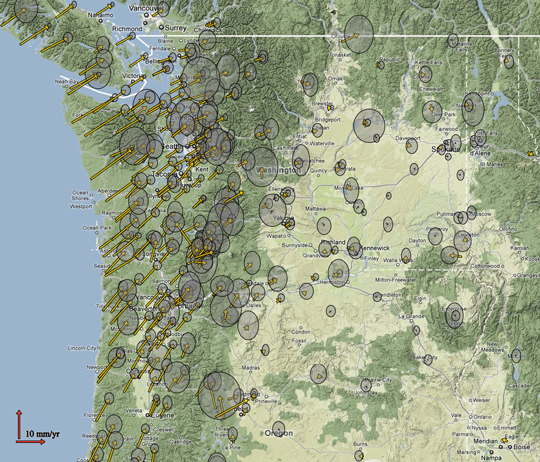
    Finally, high-precision GPS users rely on a complex infrastructure of 7,000+ high-precision, fixed-mount GPS base stations deployed nationwide. The infrastructure began with a few receivers in the early 1990s and has been built upon over the past 18 years by the GPS user community volunteering time, money, equipment, and expertise. It would be impossible to replace all of these receivers since the ownership is so disparate. Many are publicly owned and the rest are commercially owned by businesses and used by people in all the market segments I listed above. To illustrate, one such network consisting of more than 875 high-precision GPS receivers is located in the western United States managed by UNAVCO, a university-governed consortium which is sponsored by the National Science Foundation (NSF), National Aeronautics and Space Administration (NASA), U.S. Geological Survey (USGS), and National Oceanographic and Atmospheric Administration (NOAA).

    UNAVCO uses this massive network of high-precision GPS receivers to, among other things, monitor the earth’s crustal plate movement (think earthquake montoring).

    Each dot represents a permanently-mounted high-precision GPS receiver that continuously monitors the Earth’s crustal plate movement


    Another type of high-precision GPS network is called an RTK network. It delivers real-time, high-precision corrections to engineers, surveyors, Geographic Information Systems (GIS) specialists, construction specialists, and others. This particular network, owned by Keystone Precision Instruments, consists of 178 fixed-mount, high-precision GPS receivers and delivers high-precision GPS corrections to users in New York, Pennsylvania, Maryland, Virginia, Delaware, New Jersey, Connecticut, Vermont, Massachusetts, Rhode Island, New Hampshire, and Maine.

    Like the UNAVCO network, the Keystone Precision Instrument RTK Network is a multi-million dollar investment in high-precision GPS infrastructure.

     
    Keystone Precision Instruments’ RTK Network diagram showing 178 fixed-mount, high-precision GPS receivers that provide high-precision GPS corrections to high-precision GPS users in the northeastern U.S.


    Recommendations

    I’m grateful for this 30-day public comment period as I think it will give the FCC and LightSquared a new perspective on the impact that disrupting high-precision GPS receivers would have on the GPS user community and America’s economy.

    Although I’m in favor of a nationwide 4G LTE system, I’m opposed to LightSquared’s proposed plan for the following reasons:

    1. The GPS user community knew this was coming and chose to do nothing. This is false. Contrary to what LightSquared asserts, the GPS user community did not know anything about this potential interference until November 2010. LightSquared and the FCC incorrectly assumed that communicating/negotiating with the U.S. GPS Industry Council (USGIC) was the equivalent of communicating/negotiating with the GPS user community. That is a false assumption. The USGIC does not communicate directly with the GPS user community and never has. That’s not its role. I’ve been personally involved in the high-precision GPS industry for 20+ years and writing a monthly newsletter on high-precision GPS technology for GPS World magazine for the past five years. I attend almost every major GPS conference and high-precision GPS market segment conference in the U.S. and some abroad. The first I’d heard about the LightSquared interference issue was November 2010.

    Furthermore, there is a clear precedent already set that demonstrates how to handle a case very similar to the current LightSquared situation. In 2008, the U.S. Air Force proposed to discontinue supporting the semicodeless technique that is used by virtually every civilian L1/L2 high-precision GPS receiver in existence. It was the first time in history that an action would render several hundred thousand high-precision GPS receivers obsolete, a scale which is very similar to the impact of the LightSquared system.

    There was no industry coalition formed to engage the Air Force. There was no industry outcry. A public/private technical working group was not formed to test the effects on receivers if semicodeless was not supported. Why is that?

    The answer is very simple. The U.S. Air Force, to its credit, did a fantastic job of communicating directly with the GPS user community along with the Department of Commerce. It issued public statements describing the impact the action would have on high-precision GPS receivers.

    The U.S. Air Force did its homework. At the end of the day, it set a sunset date of December 31, 2020, to discontinue supporting the semicodeless technique. It correctly determined that 12 years is about the amount of time that would allow a smooth transition with a manageable financial impact to the high-precision GPS user community.

    Imagine if the U.S. Air Force had set a period of one year to transition away from using the semicodeless technique. That action would have destroyed the high-precision GPS user community resulting in billions of dollars in losses and widespread small business closure
    . Fortunately, they did their homework, understood the impact, and made the correct decision.

    LightSquared, on the other hand, either didn’t do its homework or intentionally kept quiet in order to fly under the radar and push its initiative through before the GPS user community (and others) knew what was happening. In either case, the GPS user community shouldn’t be held accountable in paying for the FCC’s and LightSquared’s lack of communication/notification.

    2. The FCC needs to consider future GPS signals as well as satellite signals from other satellite navigation systems. The FCC needs to investigate the effect of the LightSquared system on the future GPS L1C signal as well as GLONASS L1 (Russia), Galileo L1 (Europe), and Compass L1 (Chinese) to understand the effect on receivers of today and of the future. GPS L1C, Galileo L1, and Compass L1 all use wider bandwidth than today’s GPS L1, which makes them even more susceptible to interference from LightSquared’s system.

    L1 and L5 are the GPS, GLONASS, Galileo, and Compass signals of the future. Those signals will drive hundreds of billions of dollars in revenue because they will bring high-precision accuracy to our everyday lives, which is something only available on very expensive GPS receivers today.

    Again, precedence has been set. Look at what happened to GPS navigation after Selective Availability (SA) was turned off in May 2000. Overnight, GPS accuracy improved from 100 meters to 10 meters, and subsequently the multi-billion dollar market for GPS automobile navigation devices was launched. Companies like TomTom grew from zero revenue to multi-billion dollar corporations.

    The same is expected to happen again when mainstream GPS accuracy improves from 10 meters to well under a meter using the L1 and L5 signals, but that will only occur if the GPS L1, GLONASS L1, Galileo L1, and Compass L1 signals are protected. Some say that L2 can be used instead of L1 in the future. While that’s true for GPS, L1 and L5 have become the international standard while L2 is not supported by the international community.

    3. LightSquared mobile devices are potentially portable GPS jammers. The FCC needs to seriously investigate the interference impact of LightSquared mobile handsets (1626.5-1660.5 Mhz) on GPS receivers. It is already known that Inmarsat (1626.5-1660.5 MHz) devices and Iridium (1616-1626.5 MHz) devices interfere with each other, but Iridium devices are only used in remote areas so it’s not a widespread problem. It is also known that these devices interfere with the GLONASS L1 signal (1597-1605 MHz). We don’t know the extent of the effect that LightSquared mobile devices will have on GLONASS L1, GPS L1, Galileo L1, or Compass L1 signals. The problem is that no LightSquared mobile phones are available to test. Yes, lab simulations can be performed, but LightSquared devices will be made in Asia, among other places, where the designers won’t care one bit about GPS interference. There is not an acceptable design margin, if any, to allow for sloppy LightSquared device designs.

    The consequence of LightSquared mobile devices interfering with GPS L1, GLONASS L1, Galileo L1, and Compass L1 is hard to imagine and might be worse than interference from the 40,000 LightSquared towers. Although the LightSquared mobile devices are much lower power (2-3 watts vs. 1,500 watts), LightSquared has announced they intend to deploy more than 250 million mobile devices, which could behave like portable GPS jammers.

    Please pay attention this important technical issue that many have chose to ignore.

    4. LightSquared needs to permanently abandon using the upper frequency spectrum (1545-1555 MHz) for terrestrial broadcasting. The idea of LightSquared using its licensed upper frequency spectrum (1545-1555 MHz) for terrestrial purpose needs to be permanently abandoned. It’s clear from the test results that this causes widespread GPS interference no matter which class of GPS is used.

    Finally, I would like to emphasize that the GPS user community should bear no cost as a result of any interference from LightSquared’s system. The GPS user community was blindsided in November 2010. While you can debate whether about the communication between the FCC, MSV/Skyterra/LightSquared, and the U.S. GPS Industry Council, no case can be made that the GPS user community knew of MSV/Skyterra/LightSquared’s intentions earlier than late last year, yet the FCC and LightSquared expect the GPS user community to bear the cost of interference caused by LightSquared’s system?

    Furthermore, far too little testing has been completed in order to fully understand the impact of LightSquared’s system on GPS receivers. Yes, we have a rough idea of the scale of interference from the test reports submitted in June 2011, but the devil is in the details.

    Even if LightSquared only uses the licensed lower spectrum (1526-1536 MHz), as it has proposed as an alternative, the number of high-precision receivers affected would be at least 200,000 at an estimated replacement cost of $10,000 per unit which equates to a total equipment replacement cost of $2 billion dollars. That does not include the cost of removal/installation, lost productivity, required software upgrades, and training. Does the FCC expect the GPS user community to bear that cost?

    For the above reasons, I recommend that the FCC deny LightSquared’s request to proceed and encourage them to use spectrum outside of the MSS band. The resources expended by federal/state/local governments and private corporations to vet LightSquared’s proposal to use the MSS band has run into the tens of millions of dollars, if not more than a one hundred million dollars. I’m afraid the cost of further vetting will double or triple the expenditure as well as result in tremendous opportunity cost as significant resources are expended by public and commercial entities to continue this debate.

    Thank you for your attention. If you feel that further testimony is needed, I’m more than happy to oblige.

    Sincerely,

    /S/ Eric Gakstatter

    Eric Gakstatter
    Principal – Discovery Management Group LLC
    Editor – GPS World Magazine Survey Scene enewsletter
    Editor – Geospatial Solutions
    PO Box 663
    West Linn, OR 97068
    Thanks, and see you next time.
    Follow me on Twitter at http://twitter.com/GPSGIS_Eric
  • LightSquared: 1, High-Precision GPS: 0

    At stake is the high-precision GPS industry as we know it. If LightSquared’s current proposal is approved by the FCC, it will render tens of thousands, and possibly hundreds of thousands of GPS receivers obsolete starting as early as next year. The FCC is accepting public comments until July 30 and replies to those comments until August 15. After the public comment period is closed, the FCC can render a decision at any time. Last weekend, I spoke alongside LightSquared and the Coalition to Save Our GPS in a two-hour panel discussion at the Esri Survey Summit in San Diego. Here’s my report.


    Last weekend, I attended the Esri Survey Summit in San Diego. This year was different in that it was combined with the ACSM (American Congress on Surveying and Mapping) annual conference. Part of the conference Plenary on Saturday were 30-minute presentations by LightSquared and the Coalition to Save Our GPS. The following morning (Sunday), there was a two-hour discussion panel on the LightSquared/GPS interference issue, in which I participated.

    At stake is the high-precision GPS industry as we know it. If LightSquared’s current proposal is approved by the FCC, it will render tens of thousands, and possibly hundreds of thousands of GPS receivers obsolete starting as early as next year. The FCC is accepting public comments until July 30 (see also instructions at the bottom of this column) and replies to those comments until August 15, 2011. After the public comment period is closed, the FCC can render a decision at any time.

    The FCC is clearly biased on the LightSquared/GPS issue favoring LightSquared. There’s a lot of pressure to push the U.S. National Broadband Plan, which includes improving Americans’ accessibility to high-speed wireless connectivity to the Internet. After only 2 ½ weeks on the job, FCC Wireless Telecommunications Bureau Chief Rick Kaplan stated earlier this month that “We need to make sure we aren’t locking out valuable spectrum because of inefficient transmission,” obviously referring to the LightSquared/GPS interference issue.

    The LightSquared propaganda machine has been effective in bending the ear of technically-challenged policymakers into believing GPS receivers are using LightSquared’s spectrum without permission, and that GPS receiver designers have known this issue was coming since as early as 1995. Both statements, of course, are not true as I’ve written before, as has GPS World editor Alan Cameron (see LightSquared, FCC Rebuttals Distort Record), and as published on the Coalition to Save Our GPS website.

    Last weekend’s Survey Summit was perhaps the best opportunity to date for land surveyors and other high-precision GPS users to speak out and let LightSquared and our policymakers know how crucial high-precision GPS/GNSS receivers are to their operations. The discussion content was very good and our industry clearly made its points, but it was all for naught.

    Esri got LightSquared Executive Vice President Jeffrey Carlisle to fly in from Washington D.C. to speak at the plenary and then participate in the discussion panel along with myself, moderator John Matonich (NSPS), Dr. Javad Ashjaee (JAVAD GNSS), Dr. Joe Paiva (consultant), Curt Sumner (ACSM), and Peter Large (Coalition to Save Our GPS). However, it was a lost opportunity. Only fifty or so people attended the discussion panel, and I’m sure Mr. Carlisle flew back to Washington D.C. to report that the high-precision GPS users just rolled over, and they are not nearly the roadblock that might have been anticipated.

    LightSquared: 1, High-Precision GPS Users: 0

    A few key points from the discussion panel I think are worth noting:

    It’s a joke, but LightSquared is probably going to win the argument that the “GPS industry knew this was coming.” It is going to win not because it is correct, but because Jeff Carlisle was an FCC employee for several years and knows which buttons to push at the FCC, where to find documents that are publicly available — but not reasonably accessible to the general public, in my opinion — and how to misrepresent them.

    Who is the “GPS industry” that LightSquared and the FCC refer to?

    When LightSquared and the FCC refer to the “GPS industry,” they certainly are not referring to the GPS user community (you and I), which is expected to bear a huge financial burden (you and I will need to buy new GPS equipment) if the LightSquared proposal is approved.

    In nearly all of its documents, LightSquared refers to discussions and agreements with the U.S. GPS Industry Council (USGIC). I have a problem with this, and so should you. The USGIC is a sort of chamber of commerce for GPS manufacturers. If you perform a Google search for the U.S. GPS Industry Council, you won’t find a website, you won’t find a listing of council members, nor will you find much other information about it.

    The USGIC, in other words, does not maintain a high public profile.  To be fair, it is an industry council, not a user council.

    To be further fair, the Industry Council did negotiate an agreement several years ago with a former version of LightSquared (under different ownership then) and with the FCC, along certain business terms and technical parameters. That agreement did not harm GPS users in any way; in fact, it contained some inherent protections for GPS users. The current version of LightSquared has completely changed both its business plan and those technical parameters — turned them on their heads, as a matter of fact — but blithely continues to claim that this was all worked out and agreed to previously.

    Nevertheless, how has it come about that the USGIC was the negotiator with LightSquared and its predecessors for you and I regarding your GPS equipment when you’ve never met a USGIC representative, and never had a chance to provide comments before negotiations with LightSquared and its predecessors on such a critical issue?

    When I made a statement about this during our discussion panel, Jeff Carlisle called me a “fear-monger,” if I recall correctly, and he referred to my assertion that the USGIC is a chamber of commerce as “ridiculous.” I think he needs a little education.

    The analogy I used was that when Walmart wants to build a store in your town, it does not negotiate with the Chamber of Commerce, because the Chamber of Commerce does not represent the citizens. Walmart negotiates with the City Planning Department and City Planning Commission, which is comprised of citizens of the community, who are directly impacted and must bear the consequence of the development.

    The reason LightSquared is in this controversial and expensive predicament today is because it chose the incorrect organization to negotiate with.  Perhaps on purpose, so it could maintain later that it had negotiated with someone.

    This is not virgin territory. There is a clear precedent on this subject. Do you remember back in 2008 when the U.S. Air Force (GPS stewards) wanted to discontinue supporting the semicodeless technique that is used by virtually every civilian dual frequency GPS receiver in existence? It was the first time in GPS history that an action would render several hundred thousand high-precision GPS receivers obsolete, a scale which is very similar to the effect that the LightSquared system would have on high-precision GPS receivers today.

    Do you recall an industry coalition being formed to fight it? Do you recall an industry outcry? Do you recall a technical working group being formed to test the effects on receivers if semicodeless was not supported?

    The answer is no.

    Why is that
    ?

    The answer is very simple. The U.S. Air Force, to its credit, did a fantastic job of communicating with the GPS user community along with the Department of Commerce. It issued public statements describing the impact the action would have on GPS receivers. It held a public comment period. The following statement from its website succinctly summarizes its approach:

    “The Office of Space Commercialization worked hard to raise awareness of the size and significance of the high-end GPS user community, which was poorly understood within the government. The Office collected industry information to quantify the installed base of codeless/semi-codeless GPS equipment, estimate its economic value, and determine an acceptable time frame for its replacement. The Office also issued a request for public comments to receive broad stakeholder feedback.”

    In other words, it did its homework. At the end of the day, the U.S. Air Force set a date of December 31, 2020 to discontinue supporting the semicodeless technique. It correctly determined that 12 years is about the correct amount of time that would allow a smooth transition with a manageable financial impact to the GPS user community. Users would naturally upgrade their equipment during that period.

    Imagine if the U.S. Air Force had set a period of one year to transition away from using the semicodeless technique. That action would have destroyed the high-precision GPS user community, and the continued adoption of high-precision GPS technology would have been set back for years. Fortunately, it did its homework.

    LightSquared, on the other hand, either didn’t do its homework or intentionally kept quiet in order to fly under the radar and push its initiative through before the GPS user community (and others) knew what was happening.

    During the discussion panel, I wanted to (and I think I did) make three points very clear:

    1. The high-precision GPS user community did not know this was coming, period.
    2. There was a precedent already set that clearly illustrated how to successfully communicate to the high-precision GPS user community when an action is proposed that would effectively render hundreds of thousands of high-precision GPS receivers obsolete.
    3. The high-precision GPS user community should not bear any cost related to LightSquared implementing its system.

    That said, I’m not saying “no” to LightSquared.

    I get the 4G wireless broadband argument that LightSquared and the U.S. National Broadband Plan make. I want high-speed internet on my smartphone too. I want my phone to work in elevators and elevator-like environments that LightSquared promises. I think this might be a boost to the economy.

    While I’m not saying “no” to LightSquared, I’m saying “no” to LightSquared’s proposal at this moment. There are still waaaaay too many unknown issues to be understood and resolved.

    A few of them are:

    • Even using the lower frequency spectrum in its new proposal (1526-1536MHz), at least tens (maybe hundreds) of thousands of your high-precision receivers will need to be replaced. Who will bear that cost?
    • More testing is needed to understand exactly what the effect of using only the lower frequency spectrum will have on all types of GPS receivers. That was not LightSquared’s original roll-out plan and therefore wasn’t tested extensively to determine its affect on GPS receivers.
    • The idea of using the upper frequency (1545-1555MHz) for high-powered terrestrial broadcast needs to be permanently abandoned.
    • The effect on GLONASS L1, Galileo L1, Compass L1, and GPS L1C need to be extensively tested to understand the effect on GNSS receivers of today and of the future. Galileo L1, Compass L1 and GPS L1C all use wider bandwidth than today’s GPS L1 C/A, which makes them even more susceptible to interference from LightSquared’s system.
    • A serious effort needs to be made to understand the effect of LightSquared’s mobile devices on GPS/GNSS receivers. LightSquared’s mobile devices will operate in the 1626.5-1660.5MHz frequency spectrum, above the GPS L1 spectrum and GLONASS L1 (~1597-1605MHz). It’s been reported that Inmarsat devices (using LightSquared’s 1626.5-1660.5MHz mobile device spectrum) do not fare well around Iridium phones (1616-1626.5MHz), which is very close to GLONASS L1.

    We have to be very careful and test these scenarios because once the plug is pulled, you can’t suck the water back out of the drain. There’s no turning back. Also, the FCC doesn’t have a solid history of making good decisions in the wireless arena. In the words of noted wireless industry guru Andrew Seybold (BlackBerry, HP, AT&T, Motorola):

    “The history of wireless is littered with examples where the FCC acted on a request by a vendor, approved the deployment of a system, and later learned that the new system created interference to other services.”

    In fact, Mr. Seybold writes that LightSquared shouldn’t be permitted to move forward at all. On July 6, 2011, he published the following:

    “Okay, I admit it. I don’t believe LightSquared should be permitted to use what was supposed to be satellite spectrum for a terrestrial broadband network. Not only that, I don’t believe LightSquared has a sound business plan. Building more than 40,000 cell sites, maintaining them, and reselling the bandwidth to others who want to sell it to its customers, does not pencil out in my book. The margins will be too slim, especially given the fact that prices for both voice and broadband services keep falling in the United States so margins will continue to be squeezed. But apart from a faulty business plan, the main reason I am opposed to LightSquared’s plan to build this network is that if there is the slightest chance it will interfere with GPS receivers, it simply should not be permitted to be built.”


    To file comments with the FCC: Comments may be filed electronically using the Internet by accessing the ECFS: http://fjallfoss.fcc.gov/ecfs2/. Filers should follow the instructions provided on the website for submitting comments. In completing the transmittal screen, ECFS filers should include their full name, U.S. Postal Service mailing address, and IB Docket No. 11-109.


    Thanks, and see you next time.
    Follow me on Twitter at http://twitter.com/GPSGIS_Eric


  • Septentrio and Altus Announce Expansion of Strategic Relationship

    Septentrio Satellite Navigation NV and Altus Positioning Systems today announced that the two companies are expanding their strategic relationship to pursue growth opportunities in the high-precision satellite-based surveying sector.

    Septentrio is a manufacturer of high-end Global Navigation Satellite System (GNSS) receivers for professional navigation, positioning, and timing applications. Altus is an international supplier of GNSS equipment for survey applications. Both are privately held companies.

    Under the agreement, Septentrio is making a substantial investment in Altus through its U.S. subsidiary, Septentrio Inc., which is jointly owned by Septentrio Satellite Navigation NV, and by the Belgische Maatschappij voor Internationale Investering – Société Belge d’Investissement International (BMI-SBI) / Participatiemaatschappij Vlaanderen (PMV), a Belgium-based investment consortium.

    “The investment in Altus is an exciting new step in the life of Septentrio,” said Peter Grognard, founder and CEO of Septentrio. “Surveying has traditionally been the largest segment of the professional GNSS industry. Both in traditional and emerging markets, the survey segment has continued to enjoy double-digit growth rates in recent years, and our investment in Altus will further accelerate our growth and expand our global presence in this key industry sector.

    “Since the surveying community demands the highest-possible performance in precise measurements, it is a very important driver for GNSS technology,” Grognard said. “Our expanded relationship with Altus will help us refine and improve our products to meet these exacting standards, which will benefit other markets as well, and will create a closer bond between the technology and the marketplace.”

  • The System: LightSquared Interference with GPS

    And the Beat Goes on

    Developments in the LightSquared saga came fast and furious in June; highlights are listed below and briefly recapped in the adjacent news story. It will be dated by the time you receive this issue, as it went to press three weeks prior.

    For current events, see Top Story and Latest News, and the full versions of stories abridged here. The Navigate, Survey Scene, and GNSS Design & Test e-newsletters, free at env-gpsworld-integration.kinsta.cloud/subscribe, will keep you up to date.

    In chronological order, from late May to late June:

    • LightSquared Las Vegas Test Towers Flawed, FCC Filing Shows
    • House Bill Ensures FCC Takes No Action that Would Harm Military Use of GPS
    • Test Data Shows LightSquared Slams Medium, High-Precision GPS Receivers
    • PNT Advisory Board Finds Interference, Says Move It
    • LightSquared, FCC Rebuttals Distort Record
    • NPEF Report on Military Receivers Calls for FCC Recision
    • LightSquared Asks for, Receives Extension on Final Interference Report
    • Claims of LightSquared Solution Discounted
    • Air Transport Association Tells Congress to Protect GPS
    • Interference with GPS Poses Major Threat to U.S. Economy
    • LightSquared Applies to International Telecommunications Union for Global Signal

    Flawed Test Towers

    Results from a key round of field tests conducted near Las Vegas, Nevada, may show overly optimistic results regarding the effects of the LightSquared terrestrial signal on GPS receivers. According to a LightSquared addendum filed with the Federal Communications Commission (FCC) a week after the May 16 Working Group report, the company’s equipment broadcast during the tests at lower-than-planned levels for its eventual deployment across the United States. Further, LightSquared may not currently be prepared or equipped to broadcast according to the terms of its business plan or its conditional waiver.

    LightSquared does not appear to have developed the full software suite nor possess the full equipment to implement the plan the company says has been in preparation for many years. Critical testing was conducted under conditions that do not truly replicate what may be the case should the FCC allow the plan to go forward.

    House Bills Target the Waiver

    On May 27, the U.S. House of Representatives passed a bill stating that the FCC shall not provide final authorization for LightSquared operations until Defense Department concerns about GPS interference have been resolved. The bill then went to the U.S. Senate for its action.

    On June 23, the House Appropriations Committee approved action that would stop the FCC from expending any funds related to the LightSquared conditional waiver until all concerns have been resolved about interference with GPS. The amendment passed in a unanimous voice vote by the full committee, underscoring growing congressional concern about harm to GPS.

    The House actions and a letter to the FCC signed by 32 U.S. senators may presage a showdown over the issue between Congress and the president, who has promised increased broadband access. A 4G wireless network providing this access could be facilitated by LightSquared sales of service via its tower transmitters to wireless carriers. LightSquared has already signed a $20 billion, 15-year deal with Sprint.

    Tests Slam High-Precision Receivers

    Data from Las Vegas field tests show that wide-bandwidth, high-precision GPS receivers started feeling the effects of the LightSquared transmission about 1,800 meters from the tower. Medium-bandwidth high-precision GPS receivers started feeling the effects of the LightSquared transmission at about 1,200 meters from the tower. In each case, there was about a 200-meter buffer from when the GPS receivers started to feel the effects of the LightSquared transmission to the GPS receiver being jammed, at 1,600 meters and 1,000 meters respectively.

    GPS World has received further details of the tests but has not been authorized to publish them yet.

    Deere & Company, a major provider of precision agriculture equipment and services, notified the FCC on May 26 of substantial interference with its GPS receivers by the LightSquared signal. Deere receivers registered impact of and interference by the LightSquared signal as far away as 22 miles from a transmitter. Further, the company has found no practicable technical solution to the problem.

    PNT Advisory Board: Move ATC

    At its June 9–10 meeting, the National Space-Based Positioning, Navigation and Timing (PNT) Advisory Board found that GPS services cannot be assured if the LightSquared plan is approved, and that the only viable option for continued availability of GPS as well as new wireless broadband is to find another spectrum for LightSquared not adjacent to the GPS frequency.

    The formal recommendation reads: “The provision of GPS services cannot be assured if the LightSquared proposal for satellite and terrestrial broadband provision using the MSS L-Band receives final approval.

    “The only reasonable and viable option to continue ubiquitous availability of GPS and the provision of a new 4G wireless broadband capability would be for the FCC to assign an alternate frequency spectrum to LightSquared that has little or no probability of affecting the delivery or utilization of GPS/GNSS services.”

    During the discussion, one advisory board member, a former goveronor of the state of Wyoming, told presenter Jeff Carlisle of LightSquared, “Your definition of mitigation seems more tied to a legal argument than a common-sense argument.”

    Rebuttals Distort Record

    Claims by LightSquared’s Carlisle and FCC chair Julius Genachowski, that the GPS industry knew long ago about LightSquared’s plan for powerful terrestrial transmitters, contradict the truth. Examination of FCC filings show that the GPS industry knew about and agreed to a plan by a previous ownership of the company, for a different purpose, with a different business concept, and employing a completely different technological approach, one that would not have harmed GPS transmissions and disabled GPS users the way the current LightSquared plan does.

    The terrestrial broadband operations first unveiled in November 2010 cannot be described as ancillary to the purpose for which Lightsquared predecessors Motient, MSV, and SkyTerra received their spectrum and licenses — that is, to provide a service that was primarily a mobile satellite service. The November letter to the FCC described a new business model that turns the original concept on its head. LightSquared for the first time revealed plans to build a “nationwide network of 40,000 terrestrial base stations,” and stated that “the capacity of its fully deployed terrestrial network across all base stations will be tens of thousands of times the capacity of either of [its] satellites.”

    The deviations from established policy required to accommodate LightSquared’s new business model are not technicalities. They represent a fundamental change to a complex and interrelated set of rules that were carefully designed to protect GPS users from interference.

    The predecessor companies had to protect their own primary satellite operations from interference. The protection that their own satellite operations required was also sufficient — at that time — to protect GPS receivers. The terrestrial network and powerful signal LightSquared now proposes bear no resemblance to the operations the FCC authorized in 2003.

    Military Report Calls for FCC Retreat

    The National PNT Engineering Forum concluded after testing classified and GPS receivers under LightSquared terrestrial transmission conditions: “Significant concerns remain that operation of an ATC integrated service as originally envisioned by the FCC cannot successfully coexist with GPS.”

    The NPEF report calls for rescinding the FCC waiver for LightSquared terrestrial transmissions, conducting more thorough studies on impacts, and revisiting the 2003–2010 authorizations. The group tested a variety of military receivers under classified categorization, also known as “government receivers.”

    Final Report Withheld

    At the last minute of a June 15 deadline for the final Working Group report on interference, LightSquared asked for a two-week extension. Federal regulators granted the request, and the final report is now due on July 1.

    A spokesperson for the Coalition to Save Our GPS revealed that “The Working Group results show devastating interference to GPS and no proven method of mitigation. Delay will not change these results. These results are the same results the FCC had had before it granted the waiver.”

    Some Solution. Three days after requesting the delay, LightSquared announced it had solved the problem, by proposing to broadcast only from the lower end of its permitted spectrum band. GPS experts countered that this would still disable the functioning of high-precision receivers.

    Air Transport Opposes Waiver

    The Air Transport Association and the Aircraft Owners & Pilots Association told Congress that the only acceptable mitigation is for LightSquared’s operations to be moved outside of the L-band and away from GPS. “With so much of the early evidence showing that LightSquared’s proposed network would potentially endanger nearly every flight operating in U.S. airspace, it seems evident that no further development of this system can be allowed.”

    Going Global

    LightSquared has filed documents relative to the International Telecommunications Union, signaling intent to use its entire band at the full authorized power. The company’s goal appears to be to work internationally, circumventing U.S. regulation, to obtain permits to broadcast a terrestrial signal globally.

  • On the Edge: Tracking Slips and Creeps: Earthquake Monitoring Gets Substantial Boost from GPS

    By Tracy Cozzens

    The Earth’s surface is constantly shifting, being deformed as earthquake faults accumulate strain, and slip or slowly creep over time. Not long ago, scientists relied solely on seismometers to monitor the earth’s movements. Today, GPS has taken prominence as an indispensible tool.

    PANGA, the monitoring network covering the Pacific Northwest, uses GPS to monitor this movement by measuring the precise position (within 5 millimeters or less) of stations near active faults relative to each other. By determining how the stations have moved, ground deformation can be determined.

    If the plates near the coast or the Cascade Mountains move even a few centimeters, the scientists at PANGA know within seconds. The network is still being built, but eventually it’s expected that PANGA will be able to sense earthquakes faster and more accurately than traditional seismometers, and issue alerts to warn citizens of impending activity.

    “GPS is helpful in distinguishing magnitude 8 from M9 earthquakes quickly,” explained Rex Flake, PANGA. “By design, seismometers only record high-frequency energy that becomes saturated during strong ground motion. Moreover, seismic data ‘clip’ at high magnitudes whereas GPS become more accurate. Seismographs are mainly intended to detect very small to moderately large earthquakes. GPS gives actual ground motions that in theory could be incorporated very quickly into tsunami models and warning systems. That is one of the things we are working on now.”

    Volcano Watch. “A more speculative application is that some (not all by any measure) large earthquakes are preceded by slow creep events,” said Andrew Miner, PANGA. “While not really good enough to predict an earthquake, I think if we saw a very large transient creep event it would at least ring alarm bells. Unfortunately though, earthquakes are by their nature just not very predictable, at least to the level of a day or week that people could reasonably act on. On the bright side, volcanoes are reasonably predictable, and GPS is also an important tool in monitoring them. We work with the Cascade Volcano Observatory on several monitoring projects.”

    PANGA is one of a series of earthquake monitoring networks stretching along the West Coast. The Pacific Northwest Geodetic Array is run by the PANGA Geodesy Laboratory at Central Washington University (CWU) in Ellensburg, and  includes 300 continuously operating, high-precision GPS receivers located throughout the Pacific Northwest. Sixty more stations are expected to be installed this year. Trimble, Leica, Topcon, and Javad are the main receivers used in the region.

    Data from these receivers is continuously downloaded, analyzed, archived, and disseminated. About one third of PANGA’s GPS stations are telemetered in real-time back to CWU, where the data are processed using NASA’s Jet Propulsion Laboratory’s GIPSY/OASIS II software for high-precision data analysis, and Trimble’s RTKNet Integrity Manager software for real-time analysis. The data provide relative positioning of several millimeters across the Cascadia subduction zone and its metropolitan regions. These real-time data are used to monitor and mitigate natural hazards arising from earthquakes, volcanic eruptions, landslides, and coastal sea-level hazards.

    Sagging Bridges. The data are also used to monitor man-made structures such as Seattle’s sagging Alaska Way Viaduct, the State Route 520 and Interstate 90 floating bridges, and dams throughout the Cascadia subduction zone, including those along the Columbia River. For instance, for the S.R. 520 bridge, PANGA teamed up with Washington State Department of Transportation (WSDOT) to monitor movement of the 520 bridges during wind storms and seismic events.

    The receivers continuously monitor and record structural deformation with about a millimeter precision. Raw GNSS satellite phase and pseudorange estimates are acquired and processed continuously into receiver positions estimated every 5 seconds and delivered with 10 and 30-second latencies. Daily-averaged receiver positions computed with predicted and post-processed satellite orbit and clock corrections are provided with 1-6 day latencies.

    GPS_Monument-W
    Seattle’s aging Alaska Way viaduct is one of several major man-made structures being monitored by PANGA’s GPS Network. (photos courtesty of CWU Geodesy Lab.)

    Tremor Slips. The Northwest is at the forefront of earthquake-related GPS research, in large part because the area provides a lot to learn from GPS monitoring, Flake said. “For example, when we started it was strongly suspected but not definitely known that the Cascadia subduction zone was locked over parts of its surface and a major earthquake threat. Thanks to GPS monitoring we now have a pretty good idea not only exactly where it is locked, but also when parts of it do slip or creep.

    “One important discovery made with GPS data, along this line, was that of the Episodic Tremor Slip (ETS) events that occur here in the Northwest U.S.,” Flake said. “Since the time duration of ETS motion takes place on the scale of days to weeks, these earthquake events were unrealized by traditional seismic detection methods.”

    GPS data shed light on this peculiarly predictable earthquake phenomenon. “With these GPS data we can measure strain accumulation within the continental crust (where people live) and calculate the residual that can be expected to rebound in a large subduction zone earthquake,” Flake said.

    “Even more detailed than that, we can use GPS data from past ETS events to constrain the locked zone of the subducting crustal plate by inferring the amount of slip at depth that best reproduces the observed GPS recordings — important in determining possible magnitude and location of the megathrust earthquakes (Mw = 8 to 9) that will someday occur. This is of obvious concern to society and is a major reason that we lead the geodetic applications of GPS research.”

    Data Online. PANGA maintains a website that integrates daily GPS measurements from about 1,500 stations along the Pacific/North American plate boundary, ranging from Alaska to the U.S-Mexico border. Cleaned, network solutions from several arrays are merged and grouped into regional clusters.

    Arrow on a Velocity Field Map of Oregon and Washington represent ground motion as measured by GPS at each particular location. The grey circles are 2 sigma error ellipses (click to enlarge.)
    Arrow on a Velocity Field Map of Oregon and Washington represent ground motion as measured by GPS at each particular location. The grey circles are 2 sigma error ellipses (click to enlarge.) (photos courtesty of CWU Geodesy Lab.)
     The panga team constructs a bedrock drill-brace geodetic monument at Howard Hanson Dam east of Auburn, Washington.
    The PANGA team constructs a bedrock drill-brace geodetic monument at Howard Hanson Dam east of Auburn, Washington. (photos courtesty of CWU Geodesy Lab.)
  • On-Site Geo-Referencing of 3D Static Terrestrial Laser Scans

    By Jens-André Paffenholz

    This blog presents an efficient procedure for directly geo-referencing static 3D laser scans. This is a worthwhile way to obtain the required transformation parameters from the local sensor-defined coordinate system to a global system. Therefore, a multi-sensor systems (MSS) is designed with a phase-measuring laser scanner and 3D positional sensors (see Figure 1). By means of at least one eccentrically mounted GNSS antenna on top of the rotating laser scanner one gets a 3D trajectory of the antenna reference point (ARP). The analysis of the resulting trajectory within a recursive state-space filtering approach (e.g., Kalman filter) yields the transformation parameters (position and orientation) and their full variance-covariance matrix. Apart from the geo-referencing of single laser scans the propagation of the transformation parameter variances to the point clouds is possible. Moreover, an improvement of the obtained direct geo-referencing results by means of matching algorithms (like, e.g., Iterative Closest Point (ICP) algorithm) with consideration of the stochastic point cloud information of each single 3D point is feasible.


    Figure 1. Sketch of the MSS (at the Geodetic Institute of the Leibniz Universität Hannover) composed of a phase-measuring laser scanner, GNSS equipment and two single-axis inclinometers.


    Overview about the enlisted sensors, their specifications and the algorithm for the transformation parameter estimation

    The main characteristic of the terrestrial laser scanning (TLS) technique for engineering geodesy is the immediate data acquisition in 3D space. This is realised with a high spatial resolution (a few millimetres for mean distances of approx. 25 m), as well as with a very high frequency (up to 50 profiles per second) in a relative or local sensor-defined coordinate system. The TLS technique can be used in a static or a kinematic mode. Static scanning is characterised by one single fixed translation and orientation of the laser scanner in relation to an absolute or global coordinate system. For kinematic scanning, where the data acquisition is commonly reduced to 2D profiles, the translations and orientations are time-dependent. Hence, the transformation parameters for each profile are different in relation to each other as well as to an absolute or global coordinate system. When a combination of several static scans from different stations into one coordinate system (registration) is required, the transformation parameters for each scan have to be determined. For an additional link to an absolute or global coordinate system (geo-referencing), typically control points in a known geodetic datum are necessary. By the direct observation of the required transformation parameters by means of GNSS equipment and arbitrary navigation sensors, one can solve the registration and geo-referencing in one single step without the need of additional control points.

    At the present developmental stage of the MSS (at the Geodetic Institute of the Leibniz Universität Hannover), it is composed of a phase-measuring laser scanner, one eccentrically mounted GNSS antenna and two inclinometers on top of the rotating laser scanner (cf. Figure 1). Hereby, the horizontal rotation of the laser scanner of at least 360 degrees is suitable to derive the position as well as the azimuthal orientation of the laser scanner.

    Currently, the GNSS data processing is done in post processing. In general, real-time processing is possible within the purposed geo-referencing procedure. The practicability within the direct geo-referencing procedure due to expected higher variances for the trajectory points of the ARP has to be investigated in the future. However, the short high frequent trajectory of the ARP makes the GNSS analysis a challenging problem which has to be overcome. The overall duration is about 15 min with up to 20 hz data rate. In this approach the alternating antenna orientation with respect to an earth-centred earth-fixed coordinate system will contribute to the error budget due to the right-hand circular polarisation of the satellite signals and the azimuthally varying phase centre corrections (PCC). In addition, near-field effects caused by the antenna adaption (made from aluminium) on the laser scanner, or possibly multipath from the vicinity surrounding the scanner may contribute to the error budget. Investigations of these GNSS related errors yield to no significant impact of the used antenna adaption within a double difference analysis in the observation domain. As expected, the rotated PCC against the original PCC has an effect of up to 5 mm in the observation domain which corresponds to the horizontal offset components of the used GNSS antenna. The analysis in the coordinate domain also indicates an effect of up to 5 mm. The analysis shows that the PCC effect is dominated by the phase centre offset components. One can conclude that within the currently applied epoch-wise GNSS analysis the effect of rotated PCC has no significant impact on the transformation parameters in the geo-referencing procedure. For further details about these investigations please refer to Paffenholz et al. (2011).

    The analysis of the 3D ARP trajectory (cf. Figure 2) is performed within an adaptive extended Kalman filter (aEKF). This yields the transformation parameters (position and orientation) alongside their full variance-covariance matrix. The benefits of using a closed form algorithm on the basis of a Kalman filter (KF) are the following: Firstly, the KF allows real-time data processing, and secondly, the parameter estimation will be less sensitive to outliers. To deal with non-linearities in the system and measurement equations, an extended KF (EKF) is used to estimate the transformation parameters of the MSS. Another promising approach for a non-linear state estimation is the combination of Sequential Monte Carlo filtering (also known as particle filter) and an EKF, which was proposed by Alkhatib et al. (2011). The main benefit of the proposed approach is the better performance in case of high-nonlinear state-space equations. An improvement of the dynamic model of the EKF can be achieved by augmenting the EKF with adaptive parameters. These parameters are time invariant and system-specific with well-known initial values. For further details please refer to Paffenholz et al. (2010).


    Figure 2. Sample ARP trajectory of a 360 degree rotation of the laser scanner around its vertical axis. Red indicates the original10 hz measurements with a Javad GNSS receiver Delta with Javad GrAnt-G3T antenna. Blue and green indicate the predicted and filtered trajectory within the aEKF approach, respectively.


    Performing the direct geo-referencing by applying the transformation parameters and calculation of the uncertainty measures of the 3D point cloud

    The final step of the purposed direct geo-referencing procedure is to apply the transformation parameters (translation vector as well as at least the azimuthal orientation) to the 3D point cloud. The three spatial rotation parameters can be reduced to the azimuthal orientation in case of a sufficient sensor orientation to the direction of gravity. The left part of Figure 3 shows the transformation result from the local sensor-defined to an absolute coordinate system in the case of two 3D point clouds, each from a different static scanner station (red and blue). The radial distance between the scanner and the object is 15 m and 20 m, respectively. It is obvious, that the two geo-referenced point clouds have a slight misalignment of a few centimetres. Due to the known absolute coordinates of the pillar on the roof of the building (middle part of the figure), one can conclude that the geo-referencing of the blue point cloud is inaccurate. Moreover, the variances for the transformation parameters from the blue station are higher than the variances for the red station. This leads to the conclusion that the estimated transformation parameters for the blue station are not reliable. Nevertheless, this direct geo-referencing can be used as adequate pre-registration for matching algorithms.

    To overcome this misalignment the application of matching algorithms, like the ICP algorithm, is worthwhile. As input for the ICP algorithm the pre-registered 3D point clouds are used. The a-priori alignment (within a few centimetres) of the two point clouds is sufficient for the application of the ICP algorithm to find an adequate amount of corresponding points for a reliable estimation of the transformation parameters. The ICP result is shown in the right part of Figure 3. One can clearly see that the matching of the two point clouds was successful. The recent topic of the ongoing research is the consideration of the uncertainties of each point cloud within the ICP algorithm for a further improvement of the matching results.
       
    Figure 3. Left: Applied transformation parameters to two scans from different stations (red and blue). Right: Result after running the ICP algorithm on the pre-registered 3D point clouds (shown in the left part of this figure).


    In the current research work uncertainties for each single point cloud are calculated by variance propagation: Combining the uncertainties of the scanner measurements (e.g., manufacturer values for the angle and range measurement accuracy), and the uncertainties of the direct geo-referencing procedure (variance-covariance matrix of the transformation parameters obtained within the aEKF). As mentioned before, these uncertainties should be considered in the ICP algorithm in the ongoing work for a further improvement of the matching results. Bae et al. (2009) already stated that the consideration of positional uncertainties in the point cloud matching will be a worthwhile approach to improve the matching, as well as the interpretation of 3D point clouds. An example for the result of the variance propagation of the scanner and direct geo-referencing uncertainties is illustrated in Figure 4. The figure depicts a stochastic point cloud of the red station (similar 3D point cloud as shown in Figure 3). As measure for the uncertainty the mean of the coordinate uncertainty in a range of 5 mm up to 30 mm is shown.

    Figure 4. Stochastic point cloud of red station resulting from variance propagation for the uncertainties of the scanner measurements and the direct geo-referencing procedure. Depicted is the mean of the coordinate uncertainty.


    Conclusions and Future Work

    This article describes an on-site direct geo-referencing of 3D static laser scans by means of tracking the circular motion of the laser scanner around its vertical axis with 3D positioning sensors. The required transformation parameters from the local to an absolute coordinate system are estimated within a Kalman filter approach. The results show a misalignment for two different static laser scanner stations in a range of a few centimetres. Nevertheless, this is an adequate pre-registration for matching algorithms. Besides the geo-referencing, the uncertainties of the 3D point clouds are calculated by variance propagation. The future work is focused on the consideration of the stochastic point cloud information within matching algorithms (like, e.g., ICP) for an optimal fusion of different (pre-) registered point clouds into one optimal solution.

    References

    Alkhatib, Hamza; Paffenholz, Jens-André; Kutterer, Hansjörg (2011): Sequential Monte Carlo Filtering for nonlinear GNSS trajectories. In: Sneeuw; Novák; Crespi and Sansò (Eds.): Proceedings of the VII Hotine-Marussi Symposium on Mathematical Geodesy, Rome, 6-10 June 2009. International Association of Geodesy (IAG). 1st Edition. Berlin, Heidelberg: Springer, (in press).

    Bae, Kwang-Ho; Belton, David; Lichti, Derek D. (2009): A Closed-Form Expression of the Positional Uncertainty for 3D Point Clouds. In IEEE Trans. Pattern Analysis and Machine Intelligence 31 (4), pp. 577–590.

    Paffenholz, Jens-André; Kersten, Tobias; Schön, Steffen; Kutterer, Hansjörg (2011): Analysis of the Impact of Rotating GNSS Antennae in Kinematic Terrestrial Applications. In: Proceedings of the FIG Working Week 2011. FIG. Marrakech, published on CD only / also available via www.fig.net.

    Paffenholz, Jens-André; Alkhatib, Hamza; Kutterer, Hansjörg (2010): Direct geo-referencing of a static terrestrial laser scanner. In JAG 4 (3), 115–126.


    Jens-André Paffenholz received his Dipl.-Ing. in Geodesy and Geoinformatics at the Leibniz Universität Hannover. Since 2006 he has been research assistant and since 2008 also PhD candidate at the Geodetic Institute at the Leibniz Universität Hannover, respectively. His current interests are: terrestrial laser scanning, industrial measurement systems, and process automation of measurement systems. The present research focus is: precise direct geo-referencing in terrestrial laser scanning applications.

  • LightSquared: High-Precision Receivers Are Collateral Damage

    Originally, the LightSquared/GPS Technical Working Group’s (TWG) report was due to the FCC on June 15, 2011. LightSquared requested from the FCC, and received, a two-week extension to submit their report. Three days later, LightSquared announced it found a solution to the GPS interference problem. Its new proposed solution is not good news for the high-precision GPS user community. Instead, it’s a threat directed squarely at high-precision GPS users like you and me. Do you recall what I wrote a month ago? It’s ringing true with the latest LightSquared proposal.

    “I’m going to keep this simple. You, the high-precision GPS user, are likely going to be considered collateral damage.


    The military is going to be accommodated in the name of national security. The aviation industry is going to be accommodated in the name of safety-of-life. The auto navigation industry is going to be accommodated because they are high-profile. The high-precision user is going to be thrown under the bus because we are the most difficult to accommodate (technically) and don’t have a high profile nor are perceived as significant enough to accommodate.”


    If you recall, the TWG consists of LightSquared and GPS industry representatives tasked with testing the effect that LightSquared’s proposed system may have on GPS. Four of the five sub-teams were ready to file their final report with the FCC on June 15. LightSquared’s sub-team, according to the Coalition to Save Our GPS webinar on Thursday June 16, was only sub-team not ready to file its report.

    Ok, so after the FCC granted LightSquared the two-week extension, I’m thinking we have a two-week hiatus from the LightSquared discussion as LightSquared compiles and prepares their July 1 submission.


    Nope, not a chance.

    On Monday, a mere three business days after they requested a two-week extension from the FCC,  LightSquared announced they’ve found a solution to the GPS interference problem and issued a statement titled “LightSquared Solution to GPS Issue Will Clear Way for Nationwide 4G Network.”

    LightSquared’s solution is to temporarily abandon the upper frequency they originally planned to roll out (1550-1555 MHz) and rollout its service using the lower spectrum I refer to as “modified” (1526-1536 MHz) in Figure 1.

    It’s important to remember that the lines separating frequency spectrums are not “brick walls.” There is signal “roll off” that results in a gray area between spectrums. That’s the reason the LightSquared upper frequency at 1550-1555 MHz was slamming GPS. Even though it is apparently separated from GPS L1, the sheer power of the LightSquared signal at 1,500 watts significantly bled into the red RNSS zone (1559-1610 MHz) in Figure 1.


                                                  Figure 1: FCC Spectrum Dashboard

    Using only the lower frequency spectrum (1526-1536 MHz), LightSquared claims that they are “largely free of interference issues with the exception of a limited number of high-precision GPS receivers that are specifically designed to rely on LightSquared’s spectrum.” LightSquared’s CEO said that this solution will accommodate 99.5% of the GPS receivers.

    Uh oh, guess who the remaining .5% are? Yes, your high-precision GPS receiver. One half of one percent is about the percentage of high-precision GPS receivers with respect to the total GPS market size in the U.S.

    I’m pretty confident that LightSquared isn’t weighting the receivers, so that means a $2 GPS chip inside a mobile phone carries the same weight as your $15,000 RTK receiver. But obviously the impact on our infrastructure and economy differs by orders of magnitude between the two.

    Remember last month when I wrote that high-precision GPS receivers might be thrown under the bus and considered collateral damage (LightSquared: It’s Worse than You Think)? The latest LightSquared proposal is what I was referring to. High-precision GPS receivers are the most difficult to accommodate, and LightSquared is thinking that if they tell the FCC (and the world) that they’ve taken care of 99.5% of the GPS receivers in the U.S., the other .5% can deal with it.

    It’s not yet clear how LightSquared broadcasting on 10L (1526-1536 MHz) will affect high-precision receivers. We should see some of those details at the end of the month when all reports are filed with the FCC.

    But either way, it’s clear that LightSquared broadcasting in the 1526-1536 Mhz spectrum would slam OmniSTAR and Deere & Co. Starfire users as you can see in Figure 1.

    Not so fast, say GNSS engineers. What about GLONASS, Galileo, and Compass?

    Russia’s GLONASS satellites are increasingly being used by high-precision receivers. In fact, it’s safe to say that all major manufacturers sell GPS/GLONASS receivers, which is an expensive option on most receivers. However, it’s relatively easy to justify the additional expense due to the productivity gains from the additional GLONASS satellites. Generally speaking, more satellites equals less down-time.

    The problem is that the U.S. government has no vested interest in protecting the GLONASS spectrum.

    The FAA doesn’t care about it. The U.S. military doesn’t care about it. The first-responders don’t care about it. Although GLONASS is starting to show up in consumer GPS chips, it’s not being used in those markets like it is in the high-precision markets such as surveying, engineering, construction, agriculture, GIS, and various machine control applications. Therefore, no GLONASS testing was performed at the Maryland test site (simulator not configured to output GLONASS) and little or no testing was done using GLONASS at the New Mexico or Las Vegas sites unless individual companies took it on themselves.

    Some say that GLONASS will get hammered by LightSquared mobile phones.

    To this point, most of the talk has been about GPS interference from LightSquared transmitters in the 1525-1559 MHz spectrum. We also need to be aware of LightSquared mobile phones, of which they intend to field 250 million — 100 million by the end of 2012. While LightSquared has control over the filtering on their transmitters, it have no control over the filtering used in mobile phones designed to use their system.

    I’ve heard there is some mention of LightSquared mobile phones in the reports that are to be filed with the FCC, but not made public yet. However, no LightSquared mobile phones exist today so it’s only possible to simulate them in a lab environment using a lot of design assumptions.

    The uplink frequency used by LightSquared mobile phones (to talk to the nearest tower) is in the range 1626.5-1660.5 MHz. That frequency is getting close to the top end of GPS and really close to GLONASS L1 which has a range of ~1598-1605.4MHz.

    According to one RF engineer I’ve spoken to, “We already know that Iridium (1616-1626.5 Mhz) and Inmarsat cannot co-exist in the upper band and seeing that the LightSquared handset transmit frequency is in that same spectrum, I think GLONASS in the U.S. is toast.”

    The future of GNSS receivers is definitely trending towards integrating GPS, GLONASS, Galileo, Compass, etc. signal
    s. A section of the NPEF report (mentioned above) succinctly describes the interference issue with GNSS receivers.

    Another approach examined involves limiting the LightSquared transmissions to the lower 5 or 10 MHz channel of their planned deployment. However, while this approach would protect a limited number of GPS applications other applications would still be susceptible to interference. Using this approach it may be possible to protect classes of GPS receivers, primarily those with greater receiver selectivity. However, some classes of GPS receivers would still not be protected under this mitigation technique. Receivers having wider RF front-end characteristics, such as those used for scientific and commercial uses requiring high-precision measurements, and some receivers capable of receiving multiple signals from different GNSS systems (e.g., GLONASS) would remain susceptible. Additionally, the use of only the lower LightSquared channel would provide only a temporary solution to the existing interference problems as 4G LTE levels of service may not be possible. Thus, even if allowed, the FCC’s objectives and service conditions on the LightSquared license would not be met.

    Finally and on a slightly different note, the future GPS L1C signal and L1 signals proposed by Galileo and Compass are a wider band than the current GPS L1 CA, which means they are likely more subject to interference from the LightSquared system.


    FCC Chairman Julius Genachowski: “As I have stated previously to Congress, the commission will not permit LightSquared to begin commercial service without first resolving the commission’s concerns about potential widespread harmful interference to GPS devices. Under no circumstances would I put at risk our nation’s national defense or public safety.”

    The FCC has stated on numerous occasions that LightSquared won’t be allowed to begin commercial service until GPS interference issues are resolved, but what does that really mean?

    Chairman Genachowski has also stated that “It should come as no surprise to anyone involved in the LightSquared matter that the company was planning for some time to deploy a major terrestrial network in the spectrum”. He’s implying that all parties involved should have prepared for this moment, and if the GPS industry didn’t, it should bear some of the burden. This is bad news indeed.

    Bottom line: The FCC is not looking out for your interests. The National Broadband Plan is heavy on their minds. I can clearly see the FCC thinking “in the interest of the bigger picture, the high-precision GPS user community can deal with it since its only .5% of the total GPS market.”

    We need to squash this new proposal by LightSquared in a hurry. It’s a threat directed squarely at the high-precision GPS user community.


    LightSquared Consultant claim: in the GPS industry’s “insatiable thirst for precision,” it made poor engineering decisions that made GPS receivers more vulnerable to interference from neighboring bands.

    Although it appears the statement is from an independent consulting firm, PRTM consultant Dan Hays is a Harbinger crony so don’t let it fool you into thinking it’s anything but another piece of LightSquared propaganda.

    But, let’s visit the subject for a minute to clarify because LightSquared has also claimed that high-precision GPS receivers are somehow at fault because they “are looking in our spectrum”.

    Jim Kirkland, VP and General Counsel for Trimble Navigation, said it well when I presented Mr. Hays’ statement during the Coalition to Save Our GPS webinar last Thursday. Mr. Kirkland responded:

    “… we’ve engineered our products to use services that are available for payment to LightSquared’s predecessors. That’s a critical point…these precision receivers are designed to receive MSS signals to make the services better and they pay for those services to Skyterra (owned by LightSquared) and Inmarsat (LightSquared vendor). So if that’s a bad design decision that we decided to design our receivers so that our customers could pay money to Skyterra (LightSquared), that’s one of the more absurd things I’ve heard in this whole debate.”


    What he’s talking about is that OmniSTAR pays SkyTerra (LightSquared) to lease bandwidth on their satellite to deliver corrections to high-precision GPS users on the ground. Yes, if you pay OmniSTAR for their VBS, HP, or XP service, then a portion of what you pay goes to LightSquared. The irony is as thick as molasses. Furthermore, Deere & Co/Navcom offer a similar service called Starfire in which they lease satellite bandwidth from Inmarsat. LightSquared and Inmarsat are connected. Based on an original agreement signed in December 2007 between LightSquared’s predecessor and Inmarsat, Inmarsat is to receive hundreds of millions of dollars from LightSquared towards “the re-banding and efficient reuse of L-band radio spectrum covering North America.”

    Essentially, what LightSquared is doing is selling the GPS industry their satellite-to-earth wireless services (a la OmniSTAR), but they are complaining that the GPS industry has designed GPS receivers to utilize services in which LightSquared gets paid. Is that a “poorly designed GPS receiver”?

    I’ve even heard, through the grapevine, that some legislators are regurgitating this nonsense of “poorly designed GPS receivers.” Maybe there’s no ill-intent, but it’s either that or a fair amount of ignorance.

    Logically, many of today’s high-precision GPS receivers have OmniSTAR/Starfire capability built into their antennas and RF front-ends to look into the 1525-1559 Mhz spectrum for the OmniSTAR/Starfire signals. They don’t focus on particular frequencies in that band because the frequencies change periodically as OmniSTAR users can attest. Also, even if you have the OmniSTAR/Starfire capability turned off in your receiver, the antenna is still designed to look into that band so there’s no way around it.

    Like I mentioned earlier, even if your receiver isn’t designed to utilize OmniSTAR/Starfire, no one knows yet if it might be affected by the LightSquared 5L/10L signal.


    Where do we go from here?

    There’s a lot more to talk about on this issue. It’s as critical as it’s ever been that you make you concerns known to your state senators and representatives as well as the FCC. Scroll to the bottom of this article for web links and contact information.


    Free Webinar – Thursday, June 23. LightSquared: What it means to the GPS Surveying/Mapping User Community

    Thursday, June 23, I will conduct a webinar to discuss the LightSquared issue as it relates specifically to the GPS Surveying/Mapping community (high-precision users). Joining me will be Dr. Mike Whitehead, VP of Technology at Hemisphere GPS. He’s a leading GNSS design engineer and can speak clearly about the technical ramifications of LightSquared interference on high-precision GPS receivers. Click here to sign up for the webinar. Sign up even if you can’t attend the live webinar on Thursday because you’ll be sent an email on how to view the archived presentation that you can listen/view at your convenience.


    Light
    Squared coverage at the Esri Survey Summit (July 7-12, San Diego, CA)

    Esri has coordinated comprehensive coverage of the LightSquared issue at this years Survey Summit. Remember, this year the Survey Summit is combined with the ACSM (American Congress on Surveying and Mapping) annual conference so the turnout should be very good.

    On Friday, July 8th @ 2pm at the Survey Summit, I’ll be giving a 60 minute presentation entitled “GPS/GNSS Technology Update” focused on covering the latest developments in GPS/GNSS. I will cover the latest LightSquared news as well as other recent GPS/GNSS technology developments.

    On Saturday, July 9th @ 3:30p and 4:00p respectively, Jeffrey Carlisle from LightSquared and Peter Large from Trimble Navigation will give 30 minute presentations on the GPS/LightSquared interference issue.

    On Sunday, July 10th @ 8:00a-10:00a there will be a GPS/LightSquared discussion panel consisting of myself, Peter Large, Jeff Carlisle, Curt Sumner (ACSM), John Matonich (NSPS), and Dr. Javad Ashjaee. The panel discussion will be moderated by Joe Paiva. This will be the first panel discussion in the industry focused on the high-precision GPS/LightSquared interference issue.

    Following the discussion panel, at 10:30am-Noon,  there will be a strategy session designed to plan actions that surveyors (high-precision users) can take to avoid becoming collateral damage.

    ———————–

    Take Action Now
    The Coalition to Save Our GPS has posted guidance on its website as to how to submit your comments. They are:
    Voice your concerns directly to Congressional Representatives
    To voice your concerns about GPS interference, you can send letters, emails, faxes, call or visit your Congressional representatives’ office in person to explain how you use GPS as a local business and what the impacts of interference would be to the local economy.
    Contact Your Local Senator
    Ask your Senator to support and co-sign the letter from Senators Roberts (R-KS), Nelson (D-NE) and nearly a third of the U.S. Senate: explain how you use GPS in your state and what impact interference or any compromise of the GPS service would have on you and the local economy.
    Write Your Representative
    The Washngton Wire reported this week that “A bipartisan group of 66 House members asked the FCC Tuesday to protect global positioning systems from interference from wireless broadband start-up LightSquared…”
    Please include: “Coalition to Save Our GPS and FCC File No. SAT-MOD-20101118-00239” in your correspondence.
    Send your comments directly to the Federal Communications Commission (FCC)
    Email the FCC: [email protected]
    For your ready reference, below are the actions the Coalition is seeking from the FCC:
    1. The FCC must make clear, and the NTIA must ensure, that LightSquared’s license modification is contingent on the outcome of the mandated study unequivocally demonstrating that there is no interference to GPS. The study must be comprehensive, objective, and based on correct assumptions about existing GPS uses rather than theoretical possibilities. Given the substantial pre-existing investment in GPS systems and infrastructure, and the critical nature of GPS applications, the results of studies must conclusively demonstrate that there is no risk of interference. If there is conflicting evidence, doubts must be resolved against the LightSquared terrestrial system. The views of LightSquared, as an interested party, are entitled to no special weight in this process.
    2. The FCC should make clear that LightSquared and its investors are proceeding at their own risk in advance of the FCC’s assessment of the working group’s analysis. While this is the FCC’s established policy, the Commission’s International Bureau failed to make this explicit in its order.
    3. Resolution of interference has to be the obligation of LightSquared, not the extensive GPS user community of millions of citizens. LightSquared must bear the costs of preventing interference emanating from their devices, and if there is no way to prevent interference, it should not be permitted to operate. GPS users or providers should not have to bear any of the consequences of LightSquared’s actions.
    4. This is a matter of critical national interest. There must be a reasonable opportunity for public comment of at least 45 days on the report produced by the working group and further FCC actions on the LightSquared modification order should take place with the approval of a majority of the commissioners, not at the bureau level.
    Thanks, and see you next time.
    Follow me on Twitter at http://twitter.com/GPSGIS_Eric
  • LightSquared: It’s Worse than You Think

    Tired of hearing about LightSquared? Think it’s a bunch of panicking journalists hungry for something to write about? Listen, it usually takes a lot to get the hairs standing up on the back of my neck. On the LightSquared issue, they are at full attention.

    Why?

    The GPS receivers that would likely be affected the most aren’t military, automobile, aviation, mobile phones, etc. The GPS receivers that would be affected the most are the ones you use, the high-precision GPS receiver!

    This means any receiver designed to produce accuracies at meter-level or better (submeter, decimeter, centimeter receivers). This means surveying, engineering, construction, bridge/dam/structure/seismic monitoring, GIS, precision agriculture, mining, utilities/telecom, transportation, environmental, disaster management, and all sorts of machine control across a vast number of industries.

    Do the Math

    LightSquared is planning to construct 40,000 ground-based transmitters broadcasting 1,500W each across the U.S. These are targeted at metropolitan areas with high-density population. The will pop-up like mobile phone towers. What do you think a map looks like with 40,000 LightSquared transmitters overlaid on the current infrastructure of CORS (1,500+ GPS receivers in the U.S.) and RTK networks (100+ consisting of several thousands of receivers in the U.S.)?

    Do you use OPUS? Do you use CORS? Do you use an RTK network? Do you use WAAS corrections? Do you use OmniSTAR? Do you use StarFire? Do you operate your own high-precision base station (real-time or post-processing)? I do not know one high-precision user who does not use one of the aforementioned technologies in their GPS operations. All of the above technologies are in jeopardy.

    I’m going to keep this simple. You, the high-precision GPS user, are likely going to be considered collateral damage.

    The military is going to be accommodated in the name of national security. The aviation industry is going to be accommodated in the name of safety-of-life. The auto navigation industry is going to be accommodated because they are high-profile. The high-precision user is going to be thrown under the bus because we are the most difficult to accommodate (technically) and don’t have a high profile nor are perceived as significant enough to accommodate.

    In other words, the high-precision user will be told to “deal with it.”

    What Does “Deal with It” Mean?

    It’s not clear at this point, but without any hardware modification, your receiver performance will likely be degraded (weakened or lost signal) in metropolitan areas, and to a lesser extent in rural areas. That totally depends on where LightSquared decides to place its towers. Very soon, with the final Working Group report due to the FCC (June 15), we will see how serious the interference will be.

    GPS receiver manufacturers would likely offer some sort of hardware upgrade, if possible. You can bet that they won’t support upgrading older hardware and it’s possible some newer hardware won’t be retrofittable, so the upgrade turns into a “trade-in” with a hefty price tag. But beware that a hardware upgrade doesn’t mean it will solve the problem, but rather minimize it.

    In order to have a chance of not being forgotten or dismissed as collateral damage, you need to jump loudly and with resolution to raise awareness with your congressperson and the FCC about the importance of GPS to your operations. If you’re an international user, write the FCC.

    You can view the list of submissions made to the FCC by clicking here. Deere & Co. as well as Fugro and many others provided very clear and concise comments.

    The Coalition to Save Our GPS has posted guidance on its website as to how to submit your comments. They are:


    Voice your concerns directly to Congressional Representatives

    To voice your concerns about GPS interference, you can send letters, emails, faxes, call or visit your Congressional representatives’ office in person to explain how you use GPS as a local business and what the impacts of interference would be to the local economy.

    Contact Your Local Senator

    Ask your Senator to support and co-sign the attached letter from Senators Roberts (R-KS) and Nelson (D-NE): explain how you use GPS in your state and what impact interference or any compromise of the GPS service would have on you and the local economy.

    United States Senate Letter from Pat Roberts (R-KS) and Ben Nelson (D-NE)

    Find Your Local Senator

    Write Your Representative

    Find Your U.S. House of Representatives

    Please include: “Coalition to Save Our GPS and FCC File No. SAT-MOD-20101118-00239” in your correspondence.

    Send your comments directly to the Federal Communications Commission (FCC)

    Email the FCC: [email protected]

    For your ready reference, below are the actions the Coalition is seeking from the FCC:

    1. The FCC must make clear, and the NTIA must ensure, that LightSquared’s license modification is contingent on the outcome of the mandated study unequivocally demonstrating that there is no interference to GPS. The study must be comprehensive, objective, and based on correct assumptions about existing GPS uses rather than theoretical possibilities. Given the substantial pre-existing investment in GPS systems and infrastructure, and the critical nature of GPS applications, the results of studies must conclusively demonstrate that there is no risk of interference. If there is conflicting evidence, doubts must be resolved against the LightSquared terrestrial system. The views of LightSquared, as an interested party, are entitled to no special weight in this process.
    2. The FCC should make clear that LightSquared and its investors are proceeding at their own risk in advance of the FCC’s assessment of the working group’s analysis. While this is the FCC’s established policy, the Commission’s International Bureau failed to make this explicit in its order.
    3. Resolution of interference has to be the obligation of LightSquared, not the extensive GPS user community of millions of citizens. LightSquared must bear the costs of preventing interference emanating from their devices, and if there is no way to prevent interference, it should not be permitted to operate. GPS users or providers should not have to bear any of the consequences of LightSquared’s actions.
    4. This is a matter of critical national interest. There must be a reasonable opportunity for public comment of at least 45 days on the report produced by the working group and further FCC actions on the LightSquared modification order should take place with the approval of a majority of the commissioners, not at the bureau level.


    Lastly, following is the list of high-precision GPS receivers that the Working Group (consisting of US GPS Industry Council representatives and LightSquared representatives) have chosen to test:

    Hemisphere R320 (with A52 antenna)
    Hemisphere A320 (with Integral antenna)
    Deere iTC (with Integral antenna)
    Deere SF‐3000 (with Integral antenna)
    Deere SF‐3050 (with Aero antenn
    a)
    Trimble MS990
    Trimble MS992
    Trimble AgGPS 252
    Trimble AgGPS 262
    Trimble AgGPS 442
    Trimble AgGPS EZguide 500
    Trimble CFX 750
    Trimble FMX
    Trimble GeoExplorer 3000 series GeoXH
    Trimble GeoExplorer 3000 series GeoXT
    Trimble GeoExplorer 6000 series GeoXH
    Trimble GeoExplorer 6000 series GeoXT
    Trimble Juno SB
    Trimble NetR9 (with Zephyr 1 antenna)
    Trimble NetR9 (with Zephyr 2 antenna)
    Trimble R8 GNSS (with Integral antenna)
    Trimble 5800 (with Integral antenna)
    Trimble NetR5 (with Zephyr 1 antenna)
    Trimble NetR5 (with Zephyr 2 antenna)
    Leica SR530 (with AT502 antenna)
    Leica GX1200 Classic (with AX1202 antenna)
    Leica GX1230GG (with AX1202GG antenna)
    Leica GR10 (with AR10 antenna)
    Leica Uno (with GS05 antenna)
    Leica GS15 (with Intergral antenna)
    Topcon HiPer Ga
    Topcon HiPer II
    Topcon GR‐3 (with Integral (5/8) antenna)
    Topcon GR‐5 (with Integral (5/8) antenna)
    Topcon MC‐R3 (with MC‐A3/cabled (5/8) antenna)
    Topcon NET‐G3A (with CR‐G3/cabled (5/8) antenna)
    Topcon TruPath/AGI‐3 (with Integral (special mount) antenna)
    NovAtel PROPAK‐G2‐Plus (with GPS‐702/GPS‐701 antenna)
    NovAtel FLEXG2‐STAR (with GPS‐701GGL/GPS‐701 antenna)
    NovAtel FLEXPAK‐G2‐V1 (with GPS‐701GGL/GPS‐702 antenna)
    NovAtel FLEXPAK‐G2‐V2 (with GPS‐702GGL/GPS‐702 antenna)
    NovAtel PROPAK‐V3 (with GPS‐702GGL/GPS‐702 antenna)
    NovAtel DL‐V3
    NovAtel FLEXPAK6 (with GPS‐702GGL/GPS‐702 antenna)
    Septentri PolaRx3e (with PolaNt GG antenna)
    Septentrio AsteRx3 (with PolaNt G antenna)


    Thanks, and see you next time.

    Follow me on Twitter at http://twitter.com/GPSGIS_Eric


  • Q&A from L5 and LightSquared Webinars

    In late March, I conducted a webinar titled “A Closer Look at L5: The Future of High-Precision GNSS,” in which I discussed the impact that the new GPS L5 signal/frequency may have on high-precision users. Then, in April I was part of a discussion panel-format webinar titled “LightSquared: Our Story So Far.” Many questions and comments arose from both webinars, and I’ll attempt to address those in this column.

    First of all, the day after the March 17 webinar, I published a summary with some links and illustrations. If you want to review it to refresh your memory or get a quick overview if you didn’t attend the webinar, click here.

    During the March 17 webinar, I conducted several polls. Following are the poll questions with accompanying pie charts to illustrate the results. I think polls are a great tool to gain a better understanding of what your colleagues are thinking.

    Poll #1: Does your organization use dual frequency GPS (L1/L2) receivers?

    Gakstatter comment: Nothing earth-shattering, but good to know most of the audience members polled are high-precision users.

    Poll #2: When do you plan on upgrading your GPS receivers to take advantage of the new L2C and L5 signals?

    Gakstatter comment: I think the large number of “I don’t know” answers is due to two major variables. #1 is the economy. If the economy was healthy, I think folks would be more inclined to take the risk upgrade to the latest technology. #2 is the unclear status of GPS and Galileo (and other GNSS). If there was a launch schedule that people knew they could count on and plan for, I think users would be more inclined to upgrade sooner rather than later.
    Poll #3: Do you believe that GPS and Galileo will meet their projected deployment dates of 2014/2015?
    Gakstatter comment: I understand the skepticism about GPS and Galileo staying on schedule. I don’t think the GPS schedule can push out too far because the FAA requires a full constellation of GPS satellites broadcasting L5 by 2019. The Galileo program is under a lot of pressure to deliver something to the user community. A very important milestone this year is the scheduled September launch of the first two operational Galileo satellites, followed by the launch of a second pair the first quarter of next year. This is an opportunity for the Galileo program to set a new tone and sense of urgency with the user community.
    Poll #4: How concerned are you that LightSquared’s initiative might interfere with your GPS operations?
    Gakstatter comment: Since the March 17 webinar, there’s been much more information released and published about LightSquared’s potential effect on GPS. In April, I participated in a webinar about LightSquared’s potential effect on GPS with my portion of the webinar specifically addressing high-precision users. I will discuss this later in this article. But, suffice to say that this is a serious issue for the U.S. high-precision GPS user community. LightSquared isn’t going to walk away from this without putting up a big fight, and they have enough of an argument that I could see the FCC (Federal Communications Commission) folding or trying to negotiate a compromise. However, any compromise is likely to have a negative effect on the high-precision GPS user community. Best case scenario, there would be a hit in signal strength. Worst case, you’ll need a hardware upgrade.
    As I normally do, a number of questions were raised during the webinar and I will address them here to the best of my ability. I’ll start with the L5 questions and then address some of the questions regarding LightSquared that were asked from both the March and April webinar.

    On to the Questions

    Question #1: What impact will L5 have on RTK networks?

    Gakstatter comment: Great question. There’s only upside in having another GPS frequency to work with. Since the premise behind RTK Networks relies heavily on atmospheric modeling, L5 is going to help. It’s further separated, with respect to frequency, from L1 than L2 and the signal is much stronger than L2. L5 will go a long way in mitigating the effects of the atmosphere on high-precision GPS positioning.

    They logistics of implementing L5, by the manufacturers, into RTK Networks may not be so easy. I’m not sure that L5 has been defined well enough in the RTCM specifications and even if it was, I’m not sure how fast manufacturers would implement it. Take, for example, L2C. Even though there are eight satellites broadcasting L2C, I’m not sure there are any RTK Networks taking advantage of it and transparency between different rover manufacturers. However, my gut tells me that manufacturers will be more willing to jump on the L5 bandwagon with a sense of urgency due to the potential significant increase in receiver performance.

    Question #2: What could be a better frequency combination in terms of acheiving higher sensitivities: L2C/L5 or L1/L5?

    Gakstatter comment: This is another great question. Technically speaking, I’m guessing that L2C/L5 would be a higher-performing combination due to the significantly-improved code structure of L2C (longer code and improved error-correcting methods), which allows
    the signal to be acquired and tracked better in tough GPS conditions such as under tree foliage.

    Question #3: If I toggle on L2C in my current Trimble GNSS; that would give me an extra 8 SV broadcasting

    Gakstatter comment: Good, creative thinking, but it doesn’t work that way. You are already using those eight satellites with L1 C/A and L2P. If you utilize L2C from those satellites, you’ll get some marginal gain in performance (assuming the reference station is broadcasting L2C info), but nothing like adding eight additional satellites.
    Question #4: What accuracy can be expected from single frequency L5?

    Gakstatter comment: It’s going to be better than L1 C/A due to the stronger signal strength (4 x more powerful than L2C) and much longer code structure (than even L2C). With SBAS corrections, we’re seeing about 60cm now with L1 C/A. It will probably be slightly better than that and definitely more robust positioning in marginal GPS conditions.

    Question #5: What sort of base line distances can we expect to get with L5?

    Gakstatter comment: Using L5 will definitely help with longer baselines, but baselines are already pretty long. Look at the distance between reference stations in RTK Networks today. Some are pushing 70-80km. Will they go longer than 100km? I’m not sure. That would be cool, lowering infrastructure costs of setting up and operating RTK Networks.

    Question #6: Using RTK corrections the bandwidth requirements will increase with all these extra satellites will there be more efficient correction broadcast techniques like CMRx?

    Gakstatter comment: I agree. I think there will need to be an efficient way of getting the data from reference network to rover. That either means using up more bandwidth on your mobile phone data plan (if you aren’t using UHF/VHF/Spread spectrum radios) or manufacturer’s inventing more efficient formats. 

    Questions Regarding LightSquared


    LS Question #1: LightSquared is going to filter their signal heavily until it will not interfere. They have too much invested to fail.

    Gakstatter comment: I agree that LightSquared is not going to walk away from their huge investment. But even if they heavily filter the base transmitters (40,000 of them), I still think there will be some interference. The nature of high-precision GNSS receivers is that they have a wideband RF front-end to take into account better code tracking and accomodate other signals such as OmniSTAR and Starfire. 
    Also, since LightSquared can’t control the design/production of the mobile phones that will use their system, each of the mobile phones can potentially be a “mobile GPS jammer”. It’s one thing to know the fixed location of each of the 40,000 transmitters, but how about the tens of thousand, hundreds of thousands or millions of mobile phones using the LightSquared infrastructure.

    LS Question #2: What do you see as the future for OmniSTAR?

    Gakstatter comment: Obviously, OmniSTAR and Starfire people must have major concerns since they are well within the LightSquared frequency spectrum. Ironically, OmniSTAR currently leases satellite bandwidth from LightSquared to broadcast their corrections.

    I’m sure they are working on a solution, but I’m not privy to what the options they are considering.

    Another option is another delivery method such as NTRIP over mobile phone networks.

    LS Question #3: If the signal effects high precision users, it will also effect casual users(hunters, fishermen, and also field technicians – forestry inventory and utility asset mapping – will w ALL need to change the GPS devises currently used today?

    Gakstatter comment: It won’t affect casual users as much as high-precision users due to the inherent design of the receivers. But, you’re right about forest inventory, utility mapping, etc. which typically use high-precision receivers. If LightSquared is allowed to continue on their desired path, it’s possible that each high-precision receiver would need to be upgraded (or traded in). That’s the worst-case scenario.

    LS Question #4: Would better filters on the GPS receiver front-ends improve the concerns?

    Gakstatter comment: Yes, but it’s not clear if high-precision receivers would perform as well with such filters designed into the receiver.


    LS Question #5: Is the transmitter the cell phone or Lightsquare base station?

    Gakstatter comment: This is a bit outside of my area, but both are transmitters. The LightSquared base stations are designed to broadcast at 1,500 watts while the mobile phone’s highest transmission power is probably 1-3 watts while it’s first connecting to the network. The base stations are transmitting at the band adjacent to GPS on the lower end while the mobile phones transmit in the adjacent band above the GPS. I look forward to reviewing the data in the next working group report to the FCC which includes interference testing from both base station transmitters as well as mobile phones.

    LS Quest
    ion #6: 
    How does LightSquared affect L2C, if at all?

    Gakstatter comment: From what I know and have read, I don’t think it would have any direct affect on L2 since L2 is at 1227MHz, far from LightSquared’s frequency spectrum of 1525MHz to 1559MHz. Indirectly, it would have an affect on L2P as L1/L2 receivers need L1 to utilize L2P. That’s not the case with L2C, but remember there are only eight satellites broadcasting L2C at this time.

    Obviously, there is more to discuss. I didn’t touch on the affect on GLONASS receivers (yes, there is a potential problem too). The feedback I received from the LightSquared webinar is that many of you would like to have a webinar that is focused on LightSquared as it relates to the high-precision user (surveying, mapping, engineering, GIS, etc.). I plan to conduct such a webinar in early June. Stayed tuned for the announcement. Hopefully, I’ll have some interesting new data to present from the report due to the FCC on May 15.

    Lastly, I attended NOAA’s Space Weather Workshop last week in Boulder, Colorado. I plan on a more comprehensive write-up, but in the mean-time you can check out my Geospatial Solutions Weekly newsletter with some info on my visit there. I’m still working on a GPS space weather notification system I wrote about last summer. I’m getting closer to having something for you.

    Thanks, and see you next time.

    Follow me on Twitter at http://twitter.com/GPSGIS_Eric