Category: Uncategorized

  • Spirent presented with RIN award for technical achievement

    Spirent Communications plc’s Positioning Technology Unit, a company that provides solutions for improving positioning, navigation and timing (PNT) system performance, was yesterday presented with the Royal Institute of Navigation (RIN) Duke of Edinburgh Navigation Award for Technical Achievement.

    The award was presented at the Institute’s Annual Meeting, held at the Royal Geographical Society in London Jul.y 21, by the Institute’s Patron, His Royal Highness The Duke of Edinburgh. It was received by Eric Hutchinson, Spirent’s chief executive officer.

    Eric Hutchinson, Spirent CEO, (left) receives the RIN Duke of Edinburgh Navigation Award for Technical Achievement from the Institute’s Patron, His Royal Highness The Duke of Edinburgh (right). Looking on is the President of the RIN, Captain James Taylor.
    Eric Hutchinson, Spirent CEO, (left) receives the RIN Duke of Edinburgh Navigation Award for Technical Achievement from the Institute’s Patron, His Royal Highness The Duke of Edinburgh (right). Looking on is the President of the RIN, Captain James Taylor.

    Spirent was selected for this year’s award to recognize its leading role in the evolution of global navigation satellite systems (GNSS) since 1985, and joins the European Space Agency, the UK National Air Traffic Services (NATS), the Russian GLONASS system, and others who have previously received the award.

    “We are extremely honoured to have been recognized by the Institute in this way,” said Martin Foulger, general manager of Spirent’s Positioning Technology Unit. “Spirent has been at the forefront of GPS and other GNSS development for 30 years, so to join the other winners of this award is a great acknowledgement of the technical innovation and commercial success driven by the Spirent team in Paignton.”

    His Royal Highness The Duke of Edinburgh (right) congratulates Eric Hutchinson, Spirent’s Chief Executive Officer (left), after receiving the Royal Institute of Navigation (RIN) Duke of Edinburgh Navigation Award for Technical Achievement.
    Peter Chapman-Andrews, Director of the Royal Institute of Navigation, commented: “Spirent is a well-known and well-respected leader in PNT testing. This wholly-deserved award is the Institute’s way of recognizing Spirent’s significant contribution over many years towards helping the world evaluate and improve performance of navigation and timing receivers, systems and applications.”

    Spirent delivers navigation and positioning test equipment and services to governmental agencies, major manufacturers, integrators, test facilities and space agencies worldwide. Spirent’s portfolio has recently been updated with new technology that includes innovations not seen elsewhere, including the most flexible simulation systems covering the full range of GNSS signals and the world’s smallest hi-fidelity, portable PNT record and playback system. Spirent has recently opened three services labs, in UK, USA and China, to further support positioning and timing development and innovation.

  • Take part in our rewarding State of the Industry Survey

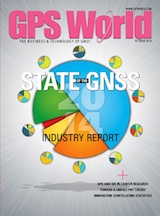
    October2014_cover_enewsWhat are your challenges this year? How are you driving business in today’s economy? What issues are you concerned about? How much accuracy do you require?

    We want to know, and so does the rest of the industry.

    GPS World is asking PNT professionals about the state of their business, the economic climate for GNSS products and services, driving market factors, the effects of jamming, the Issue of the Year — and more! Please take the 2016 State of the Industry SurveyIt should take approximately 10 minutes, and your responses are confidential.

    A handful of lucky participants drawn at random will win:

    • TWO $100 gift cards good (virtually) anywhere;
    • a pair of tickets to GPS World’s 2016 Leadership Dinner held during ION GNSS+ (or a voucher for a comparable dinner in your hometown).

    Complete the survey by August 17 — not much time! Then look for a complete report of our findings in the September issue of GPS World. If you have any questions, please don’t hesitate to contact me.  

    Thank you for taking the time to share your feedback and help us improve our magazine content, industry awareness — and your own business! 

    Please click here to begin the survey.

  • Into the cold zone: UAV platform flies high in Antarctica

    Into the cold zone: UAV platform flies high in Antarctica

    In February, mechatronics lead Kevin Bass of Intuitive Machines and contracted pilot Mike Laible successfully flew multiple runs with an unmanned aerial vehicle platform, Tiburon Jr., on the coast of Antarctica.

    The long-range Tiburon Jr. takes Antarctic ice sheet studies to new heights.
    The long-range Tiburon Jr. takes Antarctic ice sheet studies to new heights.

    From Wilkins Aerodrome in the southeast, the team launched Tiburon Jr. and collected valuable testing and environmental data. Battling harsh weather and constantly changing conditions, the team flew the UAV several times, allowing tests of all aspects of its platform.

    “These flights provided us with valuable insights into cold-weather flight characteristics,” Bass said. “We successfully demonstrated that our onboard flight system is hardened the proper amount for the harsh environment.”

    The onboard software also proved to be robust as it dealt with sensors whose response to the extreme conditions was not previously known.

    With an 80-knot cruise speed and a 15-minute assembly, deploying a Tiburon Jr. UAV saved time and is significantly safer than manned flights in hazardous environments such as Antarctica, Bass explained.

    Tiburon Jr. can be assembled in 15 minutes, an important feature in extreme environments.
    Tiburon Jr. can be assembled in 15 minutes, an important feature in extreme environments.

    The carbon-fiber Tiburon Jr. has a swappable nose cone, enabling a modular ISR sensor pod including visible, infrared and multispectral options. A remote ground station can accompany the ground transportation trailer for a portable stand-alone solution. Aircraft operations can be fully autonomous or man-in-the-loop.

    The flight was conducted in cooperation with the University of Texas Institute for Geophysics and ICECAP (Investigating the Cryospheric Evolution of the Central Antarctic Plate).

    For its climate change studies, ICECAP currently uses an upgraded World War II era DC-3 with a suite of geophysical instruments to map the thickness of the ice sheet and measure the texture, composition, density and topography of rocks below the ice.

    Beginning in summer 2017–18, Tiburon Junior’s big brother, Tiburon, will join the survey team.


  • Through the looking glass: New perspectives on GNSS

    Three recent publications offer a range of perspectives on GNSS technology, the accompanying industry and its effects on the world we live in. They are rather like surveying the topic through three types of looking glass: a mirror, a microscope and a telescope. I recommend them all.

    From the first listed below (Misra), you may not learn much new about GPS or GNSS, but you’ll experience something like looking at your reflection or reading an encyclopedia entry about yourself. You’ll get a view of of the GPS ecology in this case, as a broad and curious public might. And that is in itself a learning experience. “O wad some Power the giftie gie us / To see oursels as ithers see us!” — Robert Burns. Read it yourself before giving it to someone you know, of almost any age but probably high school or older, who is curious but not necessarily scientific.

    The second book, by Greg Milner, examines the technology and its impact much more closely and at much greater length. With a few dashes of history and generous helpings of current events, it makes the point that GPS is not only changing our lives, but our minds. That can be a scary thought. The book lays out a very rich and fascinating tapestry of interwoven trends, personalities, anecdotes and conjectures. Again, read it yourself before giving it to anyone who …

    The third publication cited here, a white paper by Rolls Royce and colleague companies, is an online resource showing just where the world is headed. It treats only one realm, marine shipping, but it lays out a convincing vision of a future shaped and directed by PNT that can easily be overlaid onto many other forms of transportation and commerce. U.S. Transportation Secretary Anthony Foxx said it recently: autonomous vehicles are coming, whether the world is “ready or not.”

    GPS for Everyone: You Are Here
    by Pratap Misra
    Ganga-Jamuna Press (available on Amazon)

    GPSforEveryone 1By the co-author of one of the core technical references on GPS and a graduate-level engineering text (Global Positioning System: Signals, Measurements, and Performance, ), this large-format, large-print volume takes a beginner’s view. Although Misra says at two junctures, “we learned to solve [such] equations in high school algebra” and “you may remember from calculus,” no math is necessary to take in the overall view and basic facts of satellite navigation concepts.  As the author states, the only prerequisite for this book is curiosity.

    With chapters on Nuts and Bolts, Signals, Math, Relativity, a Tool of Science, Smart Bombs and more, this primer gives a comprehensive overview of just about everything the general user could well afford to know about GPS. The one shortcoming from a public information point of view is that many of the wide-ranging applications and market sectors are given short shrift.  The importance of precise timing and GPS’ role in critical infrastructure get two paragraphs.  A somewhat pejorative chapter on other GNSS labels them all “wannabes” and makes the surprising assertion that “when Putin goes, so could GLONASS.”

    Pinpoint: How GPS Is Changing Technology, Culture, and Our Minds
    by Greg Milner
    W.W. Norton & Co.

    Pinpoint2GPS marks yet another rite of passage with the publication of Pinpoint: a full-length journalistic investigation of its development, personalities, and societal impact, with a diverting assortment of side stories and philosophical illuminations. A technology can be said to have arrived when it receives this manner of broad-market, though rigorous, intelligent, probing treatment. Never mind that every such technology truly arrived long before their books were written.

    This is not a book to give to friends and relations who ask you “How the heck does GPS work?” (For that, see Pratap Misra’s book.) It does spend a bit of time on that subject, a very little bit. Neither is it a history of GPS. Author Greg Milner spends a bit more time on that topic, and his direct sources are impeccable. The major portion of the book is devoted to “contemporary history,” if there is such a thing: the sprawling tentacle-like growth of GPS into many industries and aspects of modern life.

    Milner does not chronicle every one or even a plurality of these diverse fields. One gets the feeling he pretty much followed his journalistic nose into whatever interested him. Sections explore early receiver development, electrical power, financial markets, tracking (both personal and fleet), agriculture with a focus on the sugar beet, auto navigation,   and a few more. Throughout, Milner pushes forward anecdotes — personal recollection of many, many diverse contributors and benefitees, or in a few cases, victims. One chapter bears the title “Death by GPS.”

    He takes long, looping sidetrips that are always interesting, far though they may wander. The most notable case is that of Polynesian cross-Pacific navigation, a mental construct called etak, which takes up, at length, the first chapter of the book. We become aware that possibly what interests Milner most is navigation as a state of mind. He attempts to tie it all together at the end; it doesn’t quite work, but the many questions he raises along the way are certainly worth pondering.

    Two examples, only pages apart. In an investigation of the legality and Constitutional issues of tracking and surveillance by law enforcement, he states: “GPS provides the possibility of omniscience, unlike any previous technology. There is nothing ‘natural’ about using GPS to keep a continuous inventory of the world’s moving parts. It reflects a choice, a conscious application of a neutral technology . . . GPS itself is a blank slate onto which we project our desires.”

    And in a section on marketing: “Stickiness, a term online marketers apply to websites that encourage repeat visits, could also describe how GPS lets us ‘build situational contexts around things and people to create new meanings, associations and stickiness of disparate data. The simplest example is when we use a program like Google Maps to learn about our location, a sticky query that draws in satellite mapping, ground-level photography, and business information.”

    Remote and Autonomous Ships: The Next Steps
    Available online from Rolls Royce and the AAWAAAWA

    The Advanced Autonomous Waterborne Applications Initiative (AAWA) published a white paper in June as part of presentations at the Autonomous Ship Technology Symposium 2016 in Amsterdam. The white paper outlines the Project’s vision of how remote and autonomous shipping will become a reality.

    Oskar Levander, Rolls-Royce Vice President of Innovation – Marine, said “This is happening. It’s not if, it’s when. The technologies needed to make remote and autonomous ships a reality exist. The AAWA project is testing sensor arrays in a range of operating and climatic conditions in Finland and has created a simulated autonomous ship control system which allows the behaviour of the complete communication system to be explored. We will see a remote controlled ship in commercial use by the end of the decade.”

    The AAWA white paper explores the research carried out to date on the business case for autonomous applications, the safety and security implications of designing and operating remotely operated ships, the legal and regulatory dimensions and the existence and readiness of a supplier network to deliver commercially applicable products in the short to medium term.

    Positioning Technologies. The proposed system draws on a range of sensors (see Figure 1) including GPS, inertial, lidar, cameras, short-range radars, and electronic charts. “When combined witha global or local positioning reference such as GNSS, and with wind sensors and inertial measurement units, the ship is able to keep its position even in rough weather conditions,” states the report. “The main question is therefore not whether the implementation of autonomous ship navigation is technically possible, but what is the combination of technologies and methods that provides the level of performance and reliability that is required for practical operation of large vessels, and at a reasonable cost.”

    ProposedMarine

    The white paper draws on a wide range of expertise from academic researchers at some of Finland’s leading universities. Industry input has been provided by leading members of the maritime cluster including Rolls-Royce, Brighthouse NAPA, Deltamarin, DNV GL and Inmarsat.

    The project also has the support of shipowners and operators. The tests of sensor arrays are being carried out aboard Finferries 65-metre double ended ferry, the Stella, which operates between Korpo and Houtskär. ESL Shipping Ltd is helping explore the implications of remote and autonomous ships for the short sea cargo sector.

  • KCS TraceME upgrades TM-178 with LoRa technology

    KCS TraceME upgrades TM-178 with LoRa technology

    KCS BV has upgraded its successful TraceME module TM-178, targeted for tracing and controlling vehicles and other powered equipment.

    TM-178_R9H7-KVS-TraceMeThe TM-178/R9H7 module has been upgraded with optional LoRa, Wi-Fi, Bluetooth Smart (BLE), ANT/ANT+ and proprietary RF, which enables easy integration with existing wireless networks and specific custom mobile apps on smartphones and tablets.

    The LoRa technology offers a communication range up to 60 kilometers line of sight. The module offers an advanced indoor and outdoor location-based positioning solution, which covers a variety of Internet of Things (IoT)-applications and enables stolen object and vehicle recovery.

    The TM-178 is equipped with external power and battery backup connection, basic I/O-connectivity and multiple onboard sensors. The unit contains multiple integrated antennas for GPS/GLONASS, GSM (2G/3G) and RF functionality. The functionality of the module can be remotely programmed to fit any job, from basic/general functionality to advanced/low-level application-specific detailed functionality.

    With a compact size of 91 x 40 millimeters, weight of 30 grams, and a battery lifespan of more than 10 years, the module offers endless OEM integration possibilities. Optionally, the module can be ordered in a robust IP67 housing.

  • ComNav releases Quantum algorithm for its OEM boards

    ComNav releases Quantum algorithm for its OEM boards

    ComNav Technologies has released its new generation Quantum algorithm to international market. The Quantum algorithm can be easily achieved through a firmware upgrade (version 2.5.2 and above), and suits all ComNav OEM boards and OEM-based receivers.

    An upgrade to ComNav’s Quan algorithm, the Quantum algorithm dramatically improves  the stability and reliability of RTK positioning in complex environments, as well as providing a DP-filter enhancement for the ComNav GNSS products.

    Single-point positioning: version 2.30 (left) compared to the new version 2.5.2.
    Single-point positioning: version 2.30 (left) compared to the new version 2.5.2.

    Applications such agricultural guidance and fleet management, where pass-to-pass accuracy is important, will benefit from the advanced smoothing filter in standalone mode. The company’s testing shows smoother and consistent performance, reaching 20-cm pass-to-pass accuracy.

    Moreover, the Quantum algorithm provides better CORS compatibility, which means that users can acquire and keep high-accurate solutions even if the CORS network exhibits a poor geometry distribution.

    A white paper is available on the Quantum algorithm. Also, see the video below.

  • Harxon releases mini modem suitable for UAVs

    Harxon releases mini modem suitable for UAVs

    Harxon has released a 900-megahertz modem designed for unmanned aerial vehicle (UAV) customers.

    The HX-DU1018D is a miniature high-performance OEM 900-megahertz multi-frequency modem with advanced data-processing architecture, which can offer customer selectable ISM 900-megahertz or licensed 400-megahertz modes in the same module.

    The HX-DU1018 features an extremely small footprint for tight integration and design flexibility.

    The modem supports a transmission rate of 200 kilobits per second over narrow channel bands using digital signal processing technology. It comes with a development kit, which the company says makes it easy to install and operate.

    Key applications

    • Automatic vehicle location.
    • 
Traffic monitoring and control.
    • Differential GPS navigation.
    • Water and wastewater management.
    • Irrigation control.
    • Oil and gas field monitoring.
    • Security system management.
    • UAV market.

    Features

    • Supports 400 megahertz or 900 megahertz bands.
    • Transmission rate: 200 kilobits per second.
    • Point to point, point to multipoint.
    • Frequency-hopping spread spectrum.
    • Low cost, high performance and high reliability.
    • Longer transmission distance over 50 kilometers in open air.
    • Adjustable transmit power 100 milliwatts to 1 watt.
    • High interference rejection.
    • Industrial temperature: negative 50 degrees Celsius to 80 degrees.
  • OriginGPS and TDK collaborate on antenna integration for wearables

    TDK, a manufacturer of electronic components, and OriginGPS, a manufacturer of miniature GNSS modules, are collaborating to maximize GNSS performance in small devices such as wearables.

    As part of the collaboration, customers using OriginGPS Spider modules will receive increased support to integrate TDK antennas into their designs, including existing reference designs coupled with TDK’s extensive electromagnetic simulation capabilities on GNSS performance.

    “TDK is one of the most well-respected names in the RF industry, so it goes without saying that we’re very excited to be working with them to provide best-in-class location modules to their customers,” said Gal Jacobi, CEO of OriginGPS. “By joining designs of our products with TDK’s small form-factor chip antennas, customers will be able to get a firsthand understanding of how our GNSS solutions pack the world’s smallest footprint and add functionality to a wide range of wearables and other Internet of Things devices that require low-profile miniaturized chip antennas.”

    The collaboration pairs OriginGPS’ smallest GNSS receiver modules, including the recently unveiled Multi Micro Spider, with the tiny chip antennas by TDK to deliver a “mini + mighty” solution for wearables that combines TDK’s specialized RF simulation capabilities with OriginGPS’ GNSS expertise and support.

    The collaboration also benefits OriginGPS customers, the companies said. Those who purchase Spider product line modules for their wearables can now use them in conjunction with TDK antennas to meet specific requirements while minimizing design time, and receive TDK’s support for antenna matching and simulations.

    “The combination of TDK’s small chip antennas along with OriginGPS’ GNSS receiver modules provides customers the best solution to miniaturize their products,” said Tuomo Katajamaki, Product Manager, RF Components of TDK. “Now customers can effectively see for themselves the advanced location capabilities that are possible by pairing OriginGPS’ GNSS modules with our omni-directional antennas, creating a unique solution for wearable applications that balances efficiency with our small form factor.”

  • Mobile GIS: What’s the New Normal? Windows, Android, iOS, Open Source?

    Sponsored by: Hemisphere GPS
    Broadcast Date:
    June 21, 2012
    Moderator: Eric Gakstatter,GPS World contributing editor for Survey & GIS
    Speaker: Craig Greenwald, GeoMobile Innovations. Craig Greenwald is the technical director at GeoMobile Innovations and a Mobile Technology Specialist. He has worked in the Mobile GIS industry for over 10 years, including seven years for GIS software leader at Esri. He is a highly experienced software developer (C++, C#, JavaScript, VB, and VBScript), consultant, and trainer, specializing in Mobile GIS and field data collection applications and technology. Craig is well known for his work on the ESRI ArcPad team.
    Summary: The market for mobile devices; smartphones, handhelds, and tablets is exploding. When Microsoft Windows Mobile used to be the dominant operating system on mobile devices, purchasing apps didn’t require a second thought. However, that isn’t the case any longer. Google’s Android and Apple’s iOS operating systems are now the dominate operating systems on mobile devices. This is a challenge because virtually all high-precision GPS/GIS/Surveying data collection apps are still written for Windows Mobile. Will vendors port their apps to Android and/or iOS? Will they use a cross-platform software environment like Java or HTML5?

  • Indoor Navigation

    Broadcast Date: Thursday, December 13, 2012
    Moderator: Alan Cameron, publisher for GPS World
    Speakers: J. Blake Bullock (Samsung), Manikantan Parameswaran (Spirent), Chris Gates (NextNav), Dave Huntingford (CSR)
    Summary: The senior product manager responsible for a new chip that fuses input from several sensors, using the best combination at any given time to maximize coverage and accuracy while keeping power draw to a minimum, joins us to describe the new frontiers in indoor navigation. He’ll be joined by other experts in the field, where difficult challenges meet user requirements for continuous position availability.

  • All About GNSS Interferences: How to Defend, Monitor, and Report

    Sponsored by: JAVAD GNSS
    Broadcast Date: Thursday, January 31, 2013
    Moderator: Alan Cameron, publisher and editor-in-chief for GPS World
    Speaker: Javad Ashjaee, President and CEO, JAVAD GNSS
    Summary: Highway Patrols monitor highways and catch those who violate speed limits. There is no serious monitoring of GNSS bands. GNSS bands are routinely intentionally or un-intentionally violated. This webinar focuses on GNSS interference awareness and how to defend, monitor, and report such interferences.

  • Precision Timekeeping with Chip-Scale Atomic Clocks

    Sponsored by: Symmetricom
    Broadcast Date: Thursday, March 7, 2013
    Speaker: Steve Fossi, Director of New Business Development, Symmetricom
    Panelist: Ravi Pragasam, Marketing Manager, Embedded Solutions, Symmetricom
    Summary: Atomic clocks have enabled a world where ultra-precise timekeeping is now mandatory for communications, navigation, signal processing and many other applications critical to a modern functioning society. Symmetricom has utilized leading-edge technology and multiple innovations in various disciplines such as semiconductor laser technology, silicon processing, vacuum-packaging and firmware algorithms to deliver the Quantum SA.45c CSAC (Chip Scale Atomic Clock). Attend this webinar and learn how the CSAC can address your requirements for a precise clock without consuming excessive power or taking up too much space in your application.