Category: Uncategorized

  • 2017 Simulator Buyers Guide

    Cast Navigation iP-Solutions Racelogic Skydel Spectracom
    Spirent Federal Systems Syntony-GNSS Talen-x

    Cast-5000 GPS wavefront generator

    CRPA and Attitude Determination Receiver Testing

    5000layeredwhite-castnavThe CAST-5000 produces a single coherent wavefront of GPS RF signals to provide repeatable testing in the laboratory environment or anechoic chamber. The basic system generates four independent, coherent simulations that reference a single point and is upgradeable to support seven elements for CRPA testing. With an intercard carrier- phase error of less than 1 centimeter, the CAST-5000 is extremely accurate.

    The system generates a wavefront of GPS when its GPS RF generator cards are operated in a ganged configuration. Each generator card provides a set of GPS satellites coherent with the overall configuration. Several RF generator cards may be utilized together, ensuring phase coherence among the bank of signal generator cards.

    The CAST-5000 Controlled Reception Pattern Antenna (CRPA) tester allows a full end-to-end test of the antenna system. The CRPA antenna, antenna electronics and the GPS receiver can be tested as a unit with or without radiating signals.

    Features

    • Generates single coherent wavefront of GPS.
    • 6-DOF motion generation capability.
    • Complete SV constellation editing.
    • Post-mission processing via ICD-GPS-150/153.
    • Differential/relative navigation.
    • Antenna pattern modeling.
    • Waypoint navigation.
    • RAIM events.
    • Multipath modeling.
    • Spoofer simulation.
    • Satellite clock errors.
    • External trajectory input.
    • External ephemeris and almanac.
    • Several iono and tropo models.
    • Modifiable navigation message.
    • Modeled selective availability.
    • Time-tagged satellite events.
    • Selectable host vehicle parameters.

    www.castnav.com
    phone: 978 858-0130
    email: [email protected]

    iP-Solutions, Zero-C Seven Inc.

    Simceiver, Replicator, ReGen

    iP-Solutions brings its 10-year development for designated users — including the Japan Aerospace Exploration Agency (JAXA) COSMODE ionospheric scintillation monitor — to general users worldwide.

    MFR1iP-Solutions users have a complete GNSS lab at their disposal. They can simulate, record and process signals in real-time with the company’s receiver, and playback almost any GNSS signal.

    Moreover, users have complete control over the simulated signals in real-time and with high fidelity.

    iP-Solutions provides mid-level and high-end simulation solutions with the same level of accuracy and fidelity.

    Mid-Level Solution
    iP-Solutions’ mid-level Simceiver simulator allows multi-frequency simulation of various GNSS signals with all essential models. The additional ANSI C API allows users to modify existing models or introduce their own.

    iP-Solutions’ mid-level solution range even includes a comprehensive interference and spoofing laboratory.

    The Simceiver is controlled usign the comprehensive ReGen software, providing the user with great freedom to create any desired signal.

    High-End Solution
    ninja-hresiP-Solutions’ high-end Ninja simulator allows for multi-antenna controlled radiation pattern antenna (CRPA) and local-area augmentation system (LAAS) simulation.

    Academia
    iP-Solutions’ educational packages for academia combine hardware at a special academic price with academic versions of all the software and two textbooks authored by iP-Solutions’ lead engineer Ivan Petrovski and JAXA lead scientist Toshiaki Tsujii (published by Cambridge University Press).

    www.ip-solutions.jp
    phone: +81-3-3560-7747
    e-mail: [email protected] (Japan)
    [email protected] (Nth. America)
    [email protected] (International)

    Racelogic

    LabSat 3 Wideband
    LabSat is a cost-effective and intuitive GNSS simulator.

    Labsat_Lid-OffNew to the LabSat range of GNSS record and replay devices is LabSat 3 Wideband, which continues with the established reliability, cost-effectiveness, and simplicity of operation that are the benchmarks of the LabSat system.

    A recording bandwidth of 56 MHz allows for the capture of a very wide range of live-sky satellite signals:

    • GPS: L1 / L2 / L5
    • GLONASS: L1 / L2 / L3
    • BeiDou: B1 / B2 / B3
    • QZSS: L1 / L2 / L5
    • Galileo: E1 / E1a / E5a / E5b / E6
    • IRNSS: L5
    • SBAS: WAAS / EGNOS / GAGAN / MSAS / SDCM

    Depending on the desired bandwidth, recording resolution can be set to 2, 4, or 6 bit. Check out the GNSS frequency guide on the LabSat website — labsat.co.uk — to see exactly which signals can be recorded and at which resolution.

    Even with this greatly increased capacity over the original LabSat 3, the new simulator remains extremely easy to use: one-touch recording, no connection to PC required, battery powered for up to two hours, and with a removable 1-TB solid-state hard drive that can be replaced in no time, the LabSat 3 Wideband is convenient to use. It measures a compact 167 x 128 x 46 millimeters and weighs 1.2 kilograms.

    SatGen Wideband
    For product future-proofing, the soon-to-be-launched SatGen Wideband will allow for testing with signals not yet fully available, such as GPS L2C and L5 — further increasing the power and versatility of the new LabSat 3 Wideband.
    www.labsat.co.uk
    phone: +44 (0)1280 823803

    Skydel

    SDX: Software-Defined GNSS Simulator

    skydel-sdxSDX uses GPU-accelerated computing and software-defined radios (SDR) to create an advanced and fully-featured GNSS simulator. SDX is available as complete turnkey systems or software only.

    The software-defined approach offers many benefits:

    • COTS hardware offers economy of scale and eliminates dependency over dedicated hardware platforms.
    • Generic hardware allow users to repurpose their equipment for different projects.
    • Configurable output to test receiver at various entry point with RF, IF or IQ data.
    • Uncompromised performance with high dynamics and accuracy.
    • Record user interactions and export them to scripts to automate complex use cases intuitively. The export feature reduces the learning curve for advanced concepts.
    • Advanced signal customization (signal signature, private encryption, etc.)

    SDX Key Features

    • Multi-constellation (GPS, GLONASS, Galileo, BeiDou), multi-frequency (upper and lower L-band).
    • Selectable RF, IF frequency and IQ file data.
    • GPS encrypted codes.
    • Fully integrated jammers (static or moving) with over 120-dB jamming-to-signal ratio.
    • Multipath.
    • Additive pseudorange (PSR) ramps.
    • Message modification and corruption.
    • 1000-Hz update rate and high dynamics.
    • Space (LEO-GEO), air and ground vehicle with 6DoF trajectories.
    • Hardware-in-the-loop (HIL) integration.
    • Street maps integration.
    • Raw data logging.
    • Real-time receiver deviation analysis.
    • Powerful and simple API.
    • On-the-fly reconfiguration.
    • Windows and Linux compatible.

    SDX is ideal for design and validation of GNSS receivers, complex integration, academic research, NAVWAR and test engineering.

    Skydel engineering and research teams offer direct support to clients to ensure prompt deployment and integration, or review advanced customization requirements.

    www.skydelsolutions.com
    [email protected]

    Spectracom

    For mission-critical PNT applications

    Spectracom_GSG_highres_smallThe Spectracom GSG series of GPS/GNSS simulators are an essential tool to evaluate risk to jamming, spoofing or any other threat. Spectracom GSG-5/6 series simulators are easy-to-use, feature-rich and affordable, offering high value for hardening GPS-based systems compared to the limitations of testing from live-sky signals. The Spectracom platform approach allows users to buy what they need today and upgrade later. The adaptability of the GNSS RF generation platform can extend to applications for intelligent repeating and meaconing.

    Test Solutions

    • Position accuracy and dynamic range/sensitivity.
    • Simulate movements/trajectories anywhere on or above Earth.
    • Sensitivity to GPS impairments: loss of satellites, multipath, atmospheric conditions, interference, jamming and spoofing.
    • Conducted or over-the-air RF.
    • GPS time-transfer accuracy.
    • Effect of leap-second transition.
    • Multi-constellation testing.
    • Modernization signals/frequencies.
    • Keyless military SAASM, dual-frequency and survey-grade receiver testing.
    • Application packages for, RTK, CRPA (controlled radiation pattern antennas).
    • Hardware-in-the-loop (HIL) integration.
    • Test solutions for eCall and ERA-GLONASS Infrastructure Possibilities.
    • Zone-based indoor location (intelligent repeating).
    • seudolite applications.

    GSG-6 Series 64-channel, multi-frequency, advanced GNSS simulator is powerful enough for any cutting-edge test program. GPS, GLONASS, Galileo, Beidou, QZSS and IRNSS signals are available across multiple frequencies. The GSG-6 is designed for military, research and professional applications.

    GSG-5 Series 16-channel multi-constellation L1-band GNSS Simulator is designed for commercial development/integration programs. If the user is developing commercial products with GNSS capability, the GSG-5 will shorten test programs with confidence.

    GSG-51 single channel signal generator is designed for one purpose — fast, simple Go/No-Go manufacturing test and validation, ensuring the manufacturing line is operating at full capacity with confidence in quality.

    spectracom.com
    email: [email protected]
    phone: +1-585-321-5800

    Spirent Federal Systems

    GSS9000, CRPA Test System, GSS6450 RPS, GSS200D
    Spirent Federal provides simulators that cover all applications, including research and development, integration/verification and production testing.

    GSS9000GSS9000. The Spirent GSS9000 Multi-Frequency, Multi-GNSS RF Constellation Simulator can simulate signals from all GNSS and regional navigation. The GSS9000 offers a four-fold increase in RF signal iteration rate (SIR) over Spirent’s GSS8000 simulator. The GSS9000 SIR is 1000 Hz (1ms), enabling higher dynamic simulations with more accuracy and fidelity. It includes support for restricted and classified signals from the GPS and Galileo systems as well as advanced capabilities for ultra-high dynamics. It can evaluate resilience of navigation systems to interference and spoofing attacks, and has the flexibility to reconfigure constellations, channels and frequencies between test runs or test cases.

    CRPA Test System. Spirent’s Controlled Reception Pattern Antenna (CRPA) Test System generates both GNSS and interference signals. Users can control multiple antenna elements. Null-steering and space/time adaptive CRPA testing are both supported by this comprehensive approach.

    GSS6450. The GSS6450 RF Record Playback System (RPS) takes RF recording and playback systems to a whole new level of performance and flexibility, while being housed in a small (8.5 x 7.8 x 3 inch) portable case. The GSS6450 can record any GNSS signals currently available with bit depths up to 16 bits (I&Q) and bandwidths of up to 50 MHz. The flexible product structure allows the system complexity to grow with the user’s testing needs.

    GSS200D. A truly end-to-end solution that builds up a complete picture of interference activity at site of interest. It continuously monitors the GNSS frequency bands for interference, then captures and analyzes them. The GSS200D is a detection system that operates simultaneously on multi-frequency.

    Spirent Federal Systems
    1402 W. State Rd.
    Pleasant Grove, UT 84062
    www.spirentfederal.com
    [email protected]
    phone: 801-785-1448
    fax: 801-785-1294

    Key contacts: Jeff Martin, VP of Business Development and Sales
    Kalani Needham, Sales West
    Tyson Gurney, Sales East

    Syntony-GNSS

    Montage-gui-constellatorConstellator is Syntony’s cost-effective full soft multi-constellation GNSS simulator. Designed to test receivers against current and future signals, Constellator matches top-end processing performance and RF quality and offers utmost flexibility in simulation control.
    Constellator

    • performs fair-weather tests, but also is designed to subject receivers to suboptimal conditions, extreme situations and combinations of errors difficult to access in real-world tests — all of it finely controlled and indefinitely repeatable.
    • is compatible with other best-in-class test solutions providing GNSS component end-to-end system tests, including hardware in the loop.
    • core is software, ensuring that all future constellations, satellites and codes can be handled. Most functional upgrades will then be software-only.
    • is used in aerospace and defense (among others) for: multi-antenna receiver testing for spacecraft launcher, satellite onboard receiver testing (telecom and observation) and defense UAV receiver testing.


    Main Features

    • 128 channels (extensible) delivering high-quality satellite signals on six distinct frequencies (L and S band)
    • Hardware-in-the-loop testing at 10- to 100-Hz refresh rates
    • Extensive simulation options:
      • • Full-time and location control
      • Receiver trajectories with extreme dynamics
      • Background noise, interference and jamming/spoofing (two units)
      • Atmospheric propagation errors
      • Satellite errors
      • Multipath and obscuration
      • On-the-fly scenario modifications
      • Receiver attitude control
      • Very accurate spaceborne trajectories

    Main Simulation and Modeling Capabilities

    Receiver trajectories: Includes four spatial reference frames and trajectory editors for ground, marine, aerial and spatial motion and import facility.

    Hardware-in-the-loop:
    Receives receiver’s position updates from test-rig in real time and generates corresponding GNSS signals and messages.

    Atmospheric errors: Propagation issues can be simulated at individual signal level with different models provided for ionosphere and troposphere.

    Satellite error modeling options include orbital errors, onboard clock errors, satellite electronics (front-end) defects, satellite dysfunctions and signal fade, disappearance and “evil waveform” incidents.

    www.syntony-gnss.com
    [email protected]
    phone :+33(0) 581 319 919

    Talen-x

    BroadSim: The NAVWAR Simulator
    BSim_stacked-forward-facing_reflectionBroadSim was developed to simplify advanced jamming and spoofing scenarios with Navigation Warfare (NAVWAR) testing in mind. Powered by Skydel SDX, a 1000-Hz GNSS simulator engine, BroadSim is able to simulate multiple vehicles, constellations, and code types (military and civil). BroadSim is ideal for supporting real-world field tests, NAVWAR testing and jamming.

    Field Testing. Field testing GPS receivers to determine their performance and vulnerabilities in degraded or competing environments is becoming standard practice. BroadSim has proven to excel in field testing events due to its integrated GPS receiver allowing for built-in live-sky synchronization, four independent RF outputs, and a wide dynamic range with up to 0 dBm transmit power. A typical configuration for a live-sky field test would have BroadSim time synchronized to live sky, transmitting C/A, P, Y and M on L1 while simultaneously transmitting P, Y and M on L2 all at 0 dBm.

    NAVWAR. BroadSim is great for NAVWAR testing because of how easy it is to use and configure multiple vehicles. Talen-X has carefully designed the simulator such that users can easily create true signals using two RF outputs and spoofed signals using the other two RF outputs. BroadSim’s graphical user interface (GUI) is intuitive and designed to meet the demand of NAVWAR testing.

    Advanced Jamming. An innovative feature that has been added to BroadSim is the ability to generate jamming signals without any additional hardware. Using a simple interface, users can specify the jammer location, power level, waveform type and antenna pattern. BroadSim uses its 1000-Hz engine to compute the I/Q data incident on the user antenna for both the GNSS and jammer signals. This new paradigm of jamming simulation makes it easy to simulate complex jamming environments.

    www.talen-x.com
    phone: +1-319-382-5369
    email: [email protected]

  • Black Swift summits extreme altitude mapping test with small UAV

    Crisp orthophotos map 300 acres with sUAS flying over 14,000 feet

    Overcoming the challenges of mapping terrain in difficult conditions at altitudes exceeding 14,000 feet using a small unmanned aircraft system (sUAS), Black Swift Technologies demonstrated that a sUAS can successfully be deployed at extreme altitudes.

    Black Swift Technologies (BST), a specialized engineering firm based in Boulder, Colorado, was able to obtain geo-referenced digital aerial images with detailed actionable information, obtained cost-effectively without concern for a surveyor’s well being or equipment malfunctions.

    Using BST’s SwiftTrainer, a turnkey sUAS flight system designed specifically for GIS mapping applications, BST captured millions of data points in a fully autonomous flight over Colorado’s Mount Evans. The geotagged images were easily integrated into processing software, resulting in an accurate 3D orthomosaic (a highly detailed map in true scale).

    “Surveyors have been using sUAS in place of more expensive manned aerial missions for quite some time now,” said Jack Elston, Ph.D., CEO of Black Swift Technologies. “Being able to demonstrate that a sUAS can be an effective and accurate mapping platform in areas inaccessible to vehicles or at extreme altitudes solidifies the added value surveyors can offer their clients.”

    Using BST’s own Mission Planning Software, surveyors can program the SwiftTrainer in minutes to calculate the area under review and then begin collecting data for immediate analysis and decision making. Leveraging an intuitive tab-driven interface, flight planning is simple and easy to accomplish. Mission monitoring and mapping is all done from a handheld Android Tablet loaded with BST’s SwiftTab software. Intuitive gesture-based controls enable users to confidently deploy their SwiftTrainer with minimal training while being able to collect data over geography that is topically diverse with confidence.

    Unlike other sUAS offerings that cobble together hardware and software from a variety of sources to assemble their solutions, BST’s aerospace and software engineers designed the hardware, flight management system, and essential software from the ground up. This unified, fully integrated approach ensures that users have the right airframe and sensor suite to address their specific application requirements without compromise.

  • Canadian UAVs inspecting beyond line of sight

    Canadian UAVs inspecting beyond line of sight

    Canadian UAVs and Lockheed Martin CDL Systems have completed their first Beyond Visual Line Of Sight (BVLOS) inspections for pipelines, well sites and power lines using unmanned aerial vehicles (UAVs).

    The inspections were completed using the Transport Canada Compliant Lockheed Martin Indago 2 at the Foremost Testing Range.

    Wellhead inspected Beyond Visual Line of Sight. (Photo: CNW Group/Canadian UAVs)
    Wellhead inspected Beyond Visual Line of Sight. (Photo: CNW Group/Canadian UAVs)

    Canadian UAVs seeks to provide its customers with innovative technology to ensure safe and economic data acquisition for oil and gas and other industrial assets.

    At the UAV Testing Facility in Foremost, Alberta, Canadian UAVs successfully performed multiple BVLOS operations to inspect several pipelines, wellheads and powerlines. This demonstration leverages Canadian UAVs’ solutions to provide BVLOS operations for its customers while maintaining strict manned aviation safety best practices.

    “It’s a milestone our team has been working towards for years,” said Sean Greenwood, president of Canadian UAVs Inc. “Going BVLOS has technically been solved for some time with regards to powerful communications links and autopilot hardware. Canadian UAVs has been focused on creating an end-to-end paradigm in coordination with Transport Canada to conduct these operations outside of Restricted Military Airspace where our customers have a substantial regulatory and logistical needs to acquire actionable data. Due to our in-house combined military and commercial, manned and unmanned aviation backgrounds, the most advanced Lockheed Martin unmanned aircraft systems and a constant drive to evolve our aerial solutions, we have been able to demonstrate today the most logical operating structure for BVLOS on the market.”

    Indago 2 UAV from Lockheed Martin.
    Indago 2 UAV from Lockheed Martin.

    “We are pleased that Canadian UAVs has selected our Indago 2 aircraft system with mobile ground control station as a solution for their commercial enterprise,” said John Molberg, business development lead for Lockheed Martin CDL Systems. “Our systems routinely fly beyond line of sight for our military customers, and that has allowed us to gain compliance status with Transport Canada for use in commercial airspace.

    “This flight achievement is a bellwether for Canadian UAVs, Lockheed Martin and Foremost Test Range, while also showcasing the leadership provided by Unmanned Systems Canada and Transport Canada for the safe use of unmanned systems in Canadian airspace,” Molberg said.

    “The ability to use BVLOS for UAV inspection and survey purposes would considerably increase safety, economic, and environmental considerations,” saidBeau Chaitan, environmental and regulatory engineer at MEG Energy. “As many of the assets and areas we are interested in surveying are located in regions of dense muskeg and access is significantly limited. Using traditional techniques on the ground for performing integrity inspections on remote sites or conducting reclamation monitoring would require the construction of either winter ice roads, or extensive summer access.

    Wellhead inspected Beyond Visual Line of Sight. (Photo: CNW Group/Canadian UAVs)
    Wellhead inspected Beyond Visual Line of Sight. (Photo: CNW Group/Canadian UAVs)

    “This is not only an expensive exercise, but it’s also environmentally disruptive, as it creates numerous linear disturbances that potentially affect wildlife. BVLOS with a UAV is an improvement over performing inspections and monitoring with a manned helicopter, as it is safer from a worker exposure point-of-view.

    “Additionally, helicopter use has been known to scare off wildlife, which is counterproductive to the activity of conducting wildlife monitoring in remote areas. As oil sands operators continue to collaborate on regional initiatives, the ability to employ BLVOS with a UAV further enhances the possibilities to cooperate on environmental and regulatory activities.”

    For more information, visit our website: canadianuavs.ca.

  • OriginGPS launches ultra-compact GNSS module

    OriginGPS launches ultra-compact GNSS module

    OriginGPS has released its new ORG 4500 series, which is a fully-integrated product that supports ultra-compact applications for both GPS and GLONASS.

    The ORG 4500, kin to the ORG 4400 series introduced in 2016, addresses the increasing demand for high precision with the smallest possible footprint, and takes the company’s ultra-small form factor to a new level.

    OriginGPS ORG 4500 is designed for ultra-compact IoT applications such as wearables, smartwatches, clothes and pet trackers, drones, connected cars, and health testing and tracking devices.
    OriginGPS ORG 4500 is designed for ultra-compact IoT applications such as wearables, smartwatches, clothes and pet trackers, drones, connected cars, and health testing and tracking devices.

    “The newest GNSS product perfects the industry’s most comprehensive GNSS/GPS family of solutions,” said Haim Goldberger, CEO of OriginGPS. “Our modules readily resolve the industry’s acute pain points of unreliability and sensitivity in the commercial, engineering and defense sectors, enhancing the quality of experience and helping our customers remain competitive.”

    OriginGPS offers a range of fully-integrated GNSS/GPS and antenna solutions, encompassing a wide gamut of standard and essential tools for navigation. The small form factor and high sensitivity of OriginGPS’s modules enable new business models, like “machine as a service,” and are suited for a variety of applications, such as wearables, like smart watches and pet tracking, as well as smart cities and drones.

    OriginGPS modules are deployed around the globe in key sectors, such as transportation, civil engineering, precision agriculture and time reference.

    Narrowband IOT platform. Ramping up the race to offer the best Narrowband IoT (NB-IoT) products, OriginGPS continues to expand its presence in the global navigation market with a steady stream of new IoT-enabled solutions, such as its recently released IoT platform (ORG 2100).

    A key theme again at this year’s Mobile World Congress was the Internet of Things, with an additional focus on the challenges of ensuring interoperability of home and industrial applications. OriginGPS’s IoT Platform effectively removes usability challenges with a plethora of customizable sensors, such as temperature, pressure, accelerometer, light and humidity.

    OriginGPS will showcase its range of mini + mighty GNSS/GPS modules at Embedded World 2017, Germany, March 14-17, hall 3, booth 121.

  • Antenova reveals chip antennas for new NB-IoT standard

    Antenova reveals chip antennas for new NB-IoT standard

    Antenova's new NB-IoT antenna "Latona."
    Antenova’s new NB-IoT antenna “Latona.”

    Antenova Ltd., manufacturer of antennas and RF antenna modules for machine-to-machine and the Internet of Things (IoT), has developed a new antenna for the new narrow-band IoT (NB-IoT) standard that was ratified in 2016. The company showcased the antenna at Embedded World in Nuremberg in March.

    The antenna is small, measuring 20 x 11 x 1.6 mm, and is built to a novel design that allows it to perform well within a device while being easy to integrate onto a small printed circuit board (PCB).

    The new chip antenna in the company’s lamiiANT antenna family is named Latona (part no. SR4C033)

    Narrow-band IoT is the latest mobile broadband standard. It uses the 3GPP licensed network spectrum, which is secure and free from interference, and offers the combined advantages of low power, long range and the ability to penetrate walls and metal barriers.

    “Narrow Band IoT will be good for connecting devices in locations where the signal distance is in kilometers and for locations in basements and underground.” explains Antenova’s CEO, Colin Newman. “It could be the enabler for some of the IoT applications that are emerging that are not suited to the established telecoms networks, where the data throughput is quite low and infrequent. We see these antennas being used for smart metering, agricultural technologies, building automation and smart city applications with lighting, waste bins and parking spaces.”

    As with all of Antenova’s embedded antennas, the NB-IoT antennas are designed for quick and easy integration onto a host PCB.

    Samples of Latona areavailable to order. Antenova provides full design, testing and tuning services for customers who are adding wireless capabilities to their IoT devices and other electronic products.

  • Sensor role reversal: How lidar can replace GNSS for navigation

    Airborne lidar/INS/GNSS: Algorithm Uses Fuzzy Controlled Scale Invariant Feature Transform

    Sensor role reversal: Lidar with its superior performance can replace GNSS in the integration solution by providing fixes for the drifting inertial measurement unit (IMU). Tests show its potential for terrain-referenced navigation due to its high accuracy, resolution, update rate and anti-jamming abilities. A novel algorithm uses scanning lidar ranging data and a reference database to calculate the navigation solution of the platform and then further fuse with the inertial navigation system (INS) output data.

    Recent rapid advances in laser-based remote sensing technologies, including pulsed linear, array and flash lidar systems, have fostered the development of integrated navigation algorithms for lidar and inertial sensors. In particular, trajectory recovery based on lidar point-cloud matching can provide valuable input to the navigation filter. Lidar/INS integrated navigation systems may provide continuous and fairly accurate navigation solutions in GNSS-challenged environments, on a variety of platforms, such as unmanned ground vehicles, mobile robot navigation and autonomous driving.

    In the case of airborne lidar/INS applications, the free inertial navigation solution is used to create the point clouds, which are subsequently matched to a digital terrain elevation model (DEM). The results are fed back to the platform navigation filter, providing corrections to the free navigation solution. This solution may be used to recreate the point cloud to obtain better surface data.

    However, depending on the lidar data acquisition parameters, INS drift during the time between the two epochs when point clouds are acquired could be significant. Besides the shift in platform position, the drift in attitude angles could more severely impact point-cloud generation, producing a less accurate point cloud and subsequently poor matching performance.

    This article describes a new lidar positioning approach, where the scale-invariant feature transform (SIFT)-based lidar positioning algorithm is used to match between the lidar measured point cloud and the reference DEM. The matching process is aided with fuzzy control: SIFT-based lidar positioning algorithm with Fuzzy logic (SLPF), where the threshold for SIFT is adaptively controlled by the fuzzy logic system.

    Based on the geometric distribution and the range difference variance of the matched point clouds, fuzzy logic is applied to calculate the threshold for the SIFT algorithm to extract feature points; thus the optimal matched point cloud is extracted in several iterations. When there are enough matched points in the final output of the SLPF, the platform position is calculated by using the least squares method (LSM). Next, for trajectory estimation, when applying the SLPF algorithm, frequent lidar updates can be used to correct small cumulative errors from the INS sensor measurements. A Kalman filter fuses the results of the SLPF algorithm with the INS system.

    This integrated algorithm can handle situations when there are less than three matched feature points being extracted by the SLPF algorithm, and yet they could still contribute to obtain a better navigation solution. Simulation results show that, compared to the existing algorithms, the proposed lidar/INS integrated navigation algorithm not only improves the position, speed and attitude-determination accuracy, it also makes the lidar less dependent on INS, which makes the navigation system work longer without exceeding a particular drift threshold.

    LIDAR ALGORITHM

    To eliminate the influence of INS error on the lidar positioning system, instead of creating a measured DEM based on INS ortho-rectification, we directly map the range data measured by lidar to the local stored DEM data. If a successfully matched feature point can be obtained, it means that we can get a point with absolute position and relative range towards the platform, which is similar to the satellite in GNSS positioning. After scanning of one area by lidar, when three or more such matched feature points, if not on a line, can be obtained, then we are able to form a full rank equation with the unknown variables of the platform position x, y and z.

    However, due to the effect of affine transformation, the standardized range dataset collected by lidar is significantly different from the elevation dataset belonging to the same area. Figure 1 shows an example of the large difference between the two datasets from the same area when the pitch angle of the platform is equal to 5° and the flying height is 2,000 m. In this situation, the traditional flooding algorithm or constellation feature point matching algorithm is incapable of extracting matched feature points from such different datasets.

    Figure 1. Comparison between SR and DEM data from the same area.
    Figure 1. Comparison between SR and DEM data from the same area.

    In response, we introduce the SIFT algorithm to the elevation map-matching procedure. Designed for image matching, the SIFT algorithm is invariant to scale, rotation and translation, and it is robust to affine transformation and three-dimensional projection transformation to a certain extent. Although SIFT is often used in image matching, each pixel from the image is a numerical point, which, in fact, has no difference with elevation data point. Before applying the SIFT, some processing on the lidar measured range data must be done.

    LIDAR RANGE DATA

    The scanning information of the lidar measured points are (α, β, r), where α is the angle between the laser beam and the negative Z-axis of the platform body frame, β is the angle from the laser beam to the plane of axis and Z-axis in body frame, r is the range between the laser head and the measured target, as shown in the opening figure.

    Due to the terrain relief, the lidar range data are irregularly spaced. Therefore, it is necessary to interpolate the collected data. Here we apply the Natural Neighbor Interpolation method.

    SIFT Algorithm, Fuzzy Control. For the lidar positioning algorithm, which is based on the absolute position and relative range of the ground-matched feature points, a point cloud with sufficient number of points of good geometric distribution is needed. In practice, however, the terrain undulation and the attitude of the airplane will affect the quality of the point cloud and the accuracy in the matching process. In addition, the selected threshold in the SIFT algorithm plays an important role on the quality of the matched point cloud.

    A Monte Carlo simulation, shown in FIGURE 2, illustrates the impact of the threshold on the number of successful matched points (normalized) and mismatched rate. For obtaining better matched point clouds, we have introduced a SIFT terrain matching algorithm assisted by fuzzy control, as shown in FIGURE 3.

    Figure 2. Relationship effect of threshold on the number of successful matched point (normalized) and error matched rate.
    Figure 2. Relationship effect of threshold on the number of successful matched point (normalized) and error matched rate.
    Figure 3. Working principal diagram of SIFT terrain matching algorithm based on fuzzy control.
    Figure 3. Working principal diagram of SIFT terrain matching algorithm based on fuzzy control.

    The algorithm mainly consists of two fuzzy logic controllers. Controller 1 calculates the initial threshold for the SIFT algorithm according to the gridded SR data terrain undulation degree λ, and the angle Θ between Z-axis in body-frame and Z-axis in navigation frame.

    Controller 2, which is responsible to adaptively changing the threshold at each epoch, has two inputs. The first one is the Normalized Points Area (NPA), which represent the geometric condition of the matched point cloud. The other one is the Relative Range Difference Variance, which indicates if a mismatch has happened. When the final matched feature point cloud is obtained, and the number of points is greater than or equal to 3, then the LSM is used to calculate the position of the platform.

    INS/LIDAR NAVIGATION

    Loosely and tightly coupled integration are the most common methods in navigation systems. Given the characteristics of the proposed positioning algorithm, the classical integrated navigation algorithm needs to be modified. In the loosely coupled approach, the lidar is unable to aid INS when flying through a flat region and/or flying with a large tilt angle, because the proposed lidar positioning method may have difficulty in extracting enough matched points to calculate a position.

    In the tightly coupled method, as the output frequency of matched point cloud is low and the geometry of the matched feature points is relatively poor, the integrated system may be extremely unstable. Here we propose a combined loosely and tightly (CLT) integrated navigation algorithm that when the lidar positioning algorithm can extract enough matched points for a navigation solution, the lidar-calculated navigation solution is used as the main observation.

    However, when the matched points are not sufficient to obtain a navigation solution, the baseline vector of the matched point that is closer to the projection of the platform center to the surface will be utilized as the observation. In this solution, lidar can still provide a certain degree of aid to the INS, once extracting matched feature points, even if less than 3.

    SIMULATION ANALYSIS

    In the simulation experiment, the 3D DEM data of 0.5-meter resolution is obtained from an open source named EOWEB. Then the DEM data is resampled to a higher resolution of 0.1 meter, which is used to generate the simulated, irregularly spaced, measured range data. On the basis of the original DEM (0.5 meter resolution), the proposed lidar positioning algorithm and lidar/INS integrated navigation algorithm are verified and compared with the traditional methods.

    Simulation of Lidar Algorithm. As shown above, the successfully matched points rate is very important for positioning, as once a mismatched point occurs, it may lead to a faulty navigation solution. In the simulation, the proposed SLPF is simulated under the condition of different aircraft tilt angle ϴ, from 0° to 10° with a step of 1° , at 5,000 different positions, which is the same simulation condition as in Figure 2. Comparison is made with the traditional constellation feature matching based lidar positioning algorithm (CLP) and the SIFT based lidar positioning algorithm without fuzzy control (SLP). The successfully matched points rate and the NPA value are shown in Figure 4.

    Figure 4. Successful points matched rate and the NPA value results under different aircraft attitude condition from three different algorithms.
    Figure 4. Successful points matched rate and the NPA value results under different aircraft attitude condition from three different algorithms.

    As can be seen from the figure, along with the increasing platform attitude angle, the successfully matched points rate of all the three algorithms has declined. However, compared to the CLP, both SIFT-based algorithms have a higher success matching rate due to the more stringent feature-point extraction approach. And due to the adjustable threshold mechanism, the SLPF could remove some of the mismatched points by raising the threshold; thus it is superior to the common SIFT algorithm in performance. The NPA values of the extracted point cloud from the three algorithms are shown in Figure 4(b). With the increased attitude angle, the NPA value of the matching feature point cloud decreases in all three algorithms. The CLP algorithm, however, is more sensitive to the projected range data, which makes the number of successful matching points drop sharply, and further affect geometric distribution of the point cloud. The gap between the SLPF and SLP shows that the fuzzy control module can help improve the geometric structure of the feature point cloud.

    Figure 5 shows the positioning error when applying the three different matching algorithms at 5,000 different areas. The SLPF algorithm is better than the other two algorithms in all directions. When the platform’s attitude angle reaches about 10 degrees, the north and east positioning accuracy of SLPF algorithm is still about 8 meters, and the height positioning accuracy is about 0.2 meters. The reason that the height positioning error is far less than the north and east positioning error is because of the matching point cloud distribution. Due to the airborne lidar scanning mechanism, the matched point cloud is all located in a relative small area at the bottom of the platform, resulting in the great component value in the height direction of each matched feature point baseline vector in the G matrix, and then affect the final positioning accuracy.

    Figure 5. Positioning accuracy under different aircraft attitude conditions with different algorithms.
    Figure 5. Positioning accuracy under different aircraft attitude conditions with different algorithms.

    Table 1 shows some detailed information as average number of matched points (ANMP) and matched points position error (MPPE) using the three methods. The MPPE is calculated in 3D space. It can be seen that when the tilt attitude is small, comparing to the CLP method, although the number of matched points extracted by SLPF is less, the matched points position accuracy is still much better, leading to a better localization result. Moreover, with the increasing platform tilt attitude, CLP and SLP have more difficulty in maintaining the number and accuracy of the matched points.

    Lidar/INS Algorithm. To validate the feasibility of the proposed integrated navigation algorithm, firstly, the motion trajectory of the platform must be simulated. As shown in Figure 6, the red line is the simulated platform true trajectory, which lasts for 1,400 seconds. During the trajectory, the platform undertakes the different motion states as acceleration, deceleration, climbing, turning and descent. Then the INS output data based on the true trajectory with the frequency of 100 Hz is generated. To verify the calibration performance on the INS in the integrated navigation algorithm, accelerometer and gyroscope drift noise is added to the INS output data. The green line shown in Figure 6 is the INS output data trajectory solution. At the end of simulation, the error to the east direction reaches 500 meters, and the north direction error reaches to more than 2,200 meters.

    Figure 6. Comparison between True trajectory and INS calculated trajectory.
    Figure 6. Comparison between True trajectory and INS calculated trajectory.

    At the same time of the INS outputting navigation solution, lidar also scans and calculates the position of the platform with 1-Hz frequency. Note that the speed of the aircraft is from 70 m/s to 100 m/s, and the maximum lidar scanning angle αmax is 20°. Figure 7 and Figure 8 show the number of matched points and the positioning error for each scanned terrain using SLFP. When the platform maintains smooth flying, the number of matched points can reach an average of 10, and the positioning accuracy is relatively high, less than 3 meters. Note, during the period, only in a few epochs are the number of matched points less than five. However, when the platform is climbing or changing flight direction, the number of matched points is obviously decreased due to the large tilt angle of the platform, and so does the number of successful positioning times. In this case, the position error is also increased dramatically, reaching about 10 meters error in east and north, and 0.2 meters error in height. Especially in the course of changing the direction of the flight, shown in Figure 7, during the periods of 720s–800s and 920s–1,000s, due to the larger roll angle, the SLPF could hardly be able to calculate the position through the LSM. During this period the lidar would occasionally output 1 or 2 matched feature points.

    During the simulation, the CLT and LC methods are used for data fusion and trajectory estimation comparisons. TC method is not added to the comparison because of slow convergence. The data fusion results are shown in Figure 9. It illustrates that the LC method and the CLT method have close positioning accuracy in the case of sufficient matched feature points. As can be seen in conjunction with Figure 8, when lacking matched points, the CLT method is superior to LC on positioning accuracy, especially in the height direction. In addition, the CLT integrated algorithm shows some improvement on the accuracy of estimating speed and attitude.

    Figure 10 shows the position error distribution when using four different lidar/INS integrated navigation methods for data fusion under the condition of different simulation trajectories. In the simulation, 50 1,400-second-long different trajectories, with flat areas, are generated with different platform attitude, velocity or acceleration. As can be seen from the figure, compared to other integrated navigation methods, the CLT method greatly improves the accuracy of navigation.

    Figure 10. Position error distribution when using four different lidar/INS integrated navigation method.
    Figure 10. Position error distribution when using four different
    lidar/INS integrated navigation method.

    During 84.26% of the simulation period, CLT could maintain the position error less than 3 meters; the rate with error that is larger than 15 meters is 1.2%. For the TC method, due to the frequent divergence of the data fusion filter, most of the position estimates are not available. In addition, after flying above a flat area, the voting-based constellation integrated method has poor matched point accuracy and successfully matched rate due to large INS drift error, which makes lidar unable to calibrate the INS. When using the constellation-based method, during only 32.35% of the simulation period, the error is maintained in 3 meters and most of the period, 54.9%, the position error is between 3 to 15 meters.

    CONCLUSION

    We propose a new lidar matching algorithm based on SIFT, which does not rely on the INS output data to generate measured DEM data, and can adaptively change the threshold of the SIFT algorithm to generate optimal matching between the point cloud and the DEM. Through verification of simulation, the algorithm is compared with traditional lidar/INS integrated navigation methods based on comparing achieved accuracies in estimating position, speed and attitude. Simulation results show that the SLPF algorithm has better reliability for feature points matching and robustness against the platform attitude than the traditional algorithms. The CLT method improves trajectory estimation accuracy, especially when flying over moderately undulating terrain or flying with large roll or pitch angles.

    ACKNOWLEDGMENT

    This article is based on a paper presented at the ION International Technical Meeting, January 2017. This research used an open-source GNSS/INS simulator based on Matlab, developed by Gongmin Yan of Northwestern Polytechnical University, China.


    Haowei Xu is a Ph.D. student at Northwestern Polytechnical University, where he received an M.Sc in Information and Communication Engineering. He is a visiting scholar at The Ohio State University.

    Baowang Lian is a professor at Northwestern Polytechnical University where he is also director of the Texas Instruments DSPs Laboratory.

    Charles K. Toth is a senior research scientist at the Ohio State University Center for Mapping. He received a Ph.D. in electrical engineering and geo-information sciences from the Technical University of Budapest, Hungary.

    Dorota A. Brzezinska is a professor in geodetic science, and director of the Satellite Positioning and Inertial Navigation (SPIN) Laboratory at The Ohio State University.

  • Spirent helps to improve search-and-rescue operations at sea

    Spirent helps to improve search-and-rescue operations at sea

    Test solutions by Spirent Communications plc have been used to improve maritime safety.

    Working with the Radio Technical Committee for Maritime Services (RTCM), Spirent has created test scenarios that simulate realistic satellite reception conditions at sea so that GPS distress beacon performance can be improved, allowing users to be rescued faster by search and rescue organizations.

    One of the first customers to use these scenarios to test its locator beacons is ACR Electronics Inc., a manufacturer of emergency lifesaving equipment. Its latest ACR and ARTEX products have been tested using a Spirent signal simulator, and have been certified as meeting the RTCM standards for cold-start time-to-first-fix, which specifies the time taken by a device when it is turned on to capture GPS signals and determine its location.

    ACR-Spirent-W
    Photo: Spirent

    The U.S. Federal Communications Commission (FCC) has now mandated that in future, any new products in the related categories must be tested using a GNSS simulator and the scenarios in the RTCM standards, which were developed by Spirent.

    “We are able to test the performance of our dual-frequency GPS/Galileo receivers using a Spirent simulator that can accurately simulate signals from different constellations to enhance the performance of our Emergency Position Indicating Radio beacons (EPIRBs, PLBs and ELTs),” said Bill Cox, Director of Engineering at ACR. “Our customers will soon be able to take advantage of a new confirmation system that will let them know that their call for help was heard.”

    “We are very pleased to have worked with RTCM and ACR to improve maritime safety”, said Martin Foulger, General Manager of Spirent’s Positioning Business Unit. “This project shows the importance of testing in realistic conditions to give better end-user experience, which in this case could be a matter of life or death. This will make lifesaving equipment more reliable both for maritime users and search and rescue agencies.”

    ACR-Spirent-resqlinkplus-W
    Photo: Spirent

    The RCTM discovered that Cospas-Sarsat 406MHz beacons with integral GPS receivers suffered from poor cold start performance, causing delays in providing accurate location information to Search and Rescue (SAR) authorities. It later discovered that this was because beacons tended to be tested on land in benign conditions, rather than in real-world oceanic conditions.

    It has addressed the issue by specifying a set of performance standards for Emergency Position Indicating Beacons (EPIRBs), Personal Locator Beacons (PLBs), Hand-held VHF Radios with integral GPS Receivers, Manoverboard (MOB) devices and Satellite Emergency Notification Devices (SENDs).

    Spirent was asked to develop a set of custom test scenarios that enable manufacturers to simulate realistic satellite reception conditions at sea in laboratory environments. Use of these scenarios enables manufacturers to better assess the performance of their products in the real world.

    Details of the FCC mandate can be found in the Federal Register, Vol. 81, No. 241, Dec. 15, 2016, Page 90739, FCC 47 CFR Parts 1, 25, 80 and 95.

  • Sentinel-2B satellite launched for Europe’s Copernicus program

    Artist's rendering of Sentinel-2B.
    Artist’s rendering of Sentinel-2B.

    The Sentinel-2B satellite was launched for the European Commission on Monday, March 6, at 10:49 p.m. local time from the Guiana Space Center (CSG), Europe’s Spaceport in Kourou, French Guiana.

    Following the successful launches of Sentinel-1A, Sentinel-2A and Sentinel-1B, the mission with Sentinel-2B marks the fourth satellite in the European Commission’s Copernicus Earth observation program to be orbited by Arianespace from the Guiana Space Center, within the scope of a contract with the European Space Agency (ESA).

    The Sentinel-2B Earth observation satellite mainly focuses on monitoring land masses and coastal zones around the world. It will be positioned in an orbit opposite that of Sentinel-2A to ensure optimum coverage and data delivery. The pair of Sentinel-2 satellites will cover the Earth’s entire surface in five days. This high frequency means they will capture brand-new views of the Earth, driving considerable progress in monitoring and predicting changes in vegetation and aquatic pollution.

    Sentinel-2B combines a multispectral, wide-swath, very-high-resolution optical imaging instrument with a dedicated platform developed by Airbus, a long-standing partner to Arianespace. It is the 61st Earth observation satellite to be launched by Arianespace.

    ESA’s Sentinel program includes six families of satellites:

    • Sentinel-1 will ensure data continuity with the ERS and Envisat radar satellites.
    • Sentinel-2 and Sentinel-3 are designed to help provide a better understanding of how climate change impacts our daily lives.
    • Sentinel-4 and Sentinel-5 are dedicated to meteorology and climatology, with a special focus on studying the composition of the Earth’s atmosphere.
    • Sentinel-6 will measure ocean topography, mainly for operational oceanography and climatology.

    This was the third launch of the year for Arianespace and the first in 2017 with the Vega light launcher. It also marked the ninth successful launch in a row for Vega, which made its debut at the Guiana Space Center in 2012.

  • Microdrone to the Rescue: UAVs bring flotation to drowning swimmers


    Microdrones collaborated last summer with the DLRG Horneburg/Altes Land e.V. (German Lifeguard Association) to simulate a mission to rescue a drowning swimmer, demonstrating the life-saving potential of UAVs.

    Crowds watched from the banks of the Elbe River as a UAV flew to the person in distress and dropped a compact rescue device called RESTUBE, which automatically inflated. The swimmer was able to grab onto the RESTUBE and float until he could be reached by a lifeguard and brought to safety.

    The UAV used in the rescue was the microdrones md4-1000. The quadcopter drone features specially developed motors, carbon fiber housing, efficient batteries, and an integrated GPS system that allow the UAV to fly and stay in position in strong winds over the water.

    For the simulation, the md4-1000 was equipped with an imaging camera that streamed live to the specially trained lifeguard operating the drone, allowing him to easily see the precise location to drop the RESTUBE flotation device.

    “An adult drowns in approximately 60 seconds and a child in only 30,” said Christopher Fuhrhop, founder and CEO of RESTUBE. “By combining UAVs and RESTUBE flotation devices, we arE able to buy the drowning person valuable time that could very well mean the difference between life and death.”

    Other safety possibilities for quadcopters include locating people using thermal imaging cameras and collecting data on the condition of leaking and burst banks on hard-to-reach embankments.

  • GTOP launches Titan X1 multi-interface GNSS patch antenna module

    The Titan X1 GNSS antenna.
    The Titan X1 GNSS antenna.

    GlobalTop Technology, maker of positioning modules with embedded antennas, has launched the Titan X1, a compact multi-GNSS patch module for applications where small footprint, ease of integration and flexible interface options are essential in addition to robust positioning performance.

    At 12.5 x 12.5 mm, Titan X1 is one of the smallest embedded patch antenna GNSS modules based on Mediatek’s MT3333 chipset. It features a specially tuned (12 x 12 mm) GPS+GLONASS patch antenna that offers excellent performance for a module so small.

    Titan X1 offers a fully integrated design as standard, with a complete set of components including TCXO, RTC Crystal, SMPS, SAW filter and an additional LNA, all of which are considered vital for optimum performance.

    Titan X1’s introduces multi-interface support (UART, I2C and SPI), and includes external antenna detection circuit with interface so users don’t have to choose between compact size and advanced features.

    “We understand the growing need for ultra-small positioning modules, especially those with embedded antennas,” said Sam Khan, vice CEO of GlobalTop Technology. “But we don’t believe in compromising essential components and functions for the sake of a smaller size. With Titan X1 we show our commitment to making ultra-compact modules that lack nothing in terms of interfaces and functions compared to their larger counterparts. IOT devices are getting smaller but more complex with most devices featuring a wide array of sensors and connectivity modules. Being just a receiver radio, we believe that integrating a positioning module to an IOT device should be the easiest part of the development and Titan X1 is perfect for that.”

    Samples of Titan X1 are available now, with mass production starting March 30.

  • PNT Roundup: Scaling down GPS-reliant devices

    By Ramki Ramakrishnan

    In many respects, the story of innovation in electronics has been about miniaturization: designers pack more features, functionality and performance into electronics that are smaller, lighter and more power-efficient. However, this has traditionally been applied only to a limited extent to atomic clocks, which electronic devices employ to maintain correct time if their GPS signal is lost.

    Atomic clocks have significant limitations in terms of scalability and portability, so until recently the best designers could use were ovenized crystal oscillators (OCXOs), which were smaller, lighter and consumed less power than atomic clocks.

    However, they were also less accurate and precise. Now, micro-atomic clocks enable addressing an entirely new range of use cases. A miniature atomic clock (MAC) is not the same clock made smaller; it’s a different clock.

    Timing Quality Measurements. A clock is accurate if its time agrees with a standard such as cesium reference or GPS. A clock is precise if its interval between ticks — its frequency of oscillation — is the same as a reference clock’s interval, even if the reference clock is inaccurate.

    A stern measure of precision is syntonicity, which is a measure of consistency in the occurrence of ticks within the environment. Radar requires syntonicity. To obtain a clear image of a scanned object, the receiver of the signal bounced off the object needs to know the exact instant the associated pulse was sent from the transmitter.

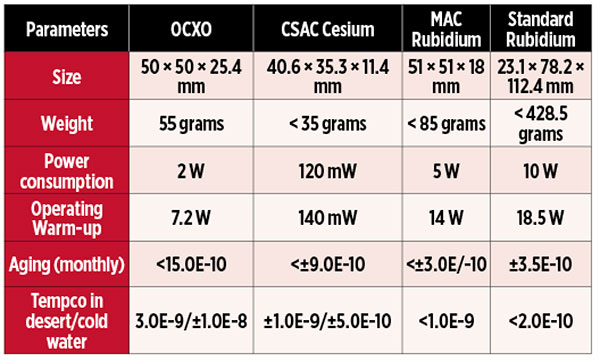
    It’s All About SWaP. One challenge of any timing miniaturization is whether the clock’s size, weight and power (SWaP) meet the needs of a given application. For example, a cesium chip-scale atomic clock (CSAC) is the smallest sized atomic clock in the current market; see the table below. By contrast, the rubidium MAChas the lowest power consumption after the CSAC (that is, 40 times more than CSAC). Before the introduction of the MAC, the standard rubidium clock was the clock with the lowest power consumption and with similar performance.

    Performance metrics of clock technologies.

    Benefits of small SWaP values are easily seen. Devices that required an external power source can now operate on batteries, without a heat sink. A person or a drone can now carry devices that were stationary or required a truck.

    Improvements in SWaP only matters if application requirements for accuracy and precision are also met. What happens if an application’s GPS access is lost? All clocks tend to drift once they no longer reference an external time source. This is known as aging. A key factor that affects aging is temperature. While operating in extreme environments (such as, deserts, high altitudes or under sea), the rate of timing error increases due to temperature variation; the amount of temperature-related error is called tempco.

    The availability of clocks with tight specifications signifies that designers can now employ accurate and precise timing in many ways and places. However, one must specify, analyze and select the clock carefully to meet the requirements of the application. For example, replacing the OCXO with a standard rubidium clock is typically not an option because the standard rubidium clock does not fit in to the OCXO form factor. Designers may consider replacing an OCXO with a CSAC or MAC if greater portabiity and better timing accuracy and precision are the key requirements.

    The choice often comes to one between the CSAC’s lower power consumption and weight versus the MAC’s superior aging performance in the event of GPS loss. The difference between the two clocks lies in how gas atoms trapped into resonance by a microwave synthesizer are excited and then interrogated, a concept known as coherent population trapping.

    Applications suitable for rubidium atomic clocks (MAC) include the following.

    Cellular Base Stations. Rubidium atomic clocks can meet the tight timing requirements for 4G-/LTE-base stations up to 24 hours (even longer for 3G and 4G). Moreover, rubidium’s superior aging ensures longer holdover, meaning the network can remain operational for longer even if the sync reference is lost. The MAC’s lower power consumption compared to a standard rubidium clock also contributes to a lower power and heat density overall, potentially reducing the need for external cooling while increasing the electronic reliability and reducing its size. Low tempco is also critical, considering the environments in which these stations often operate.

    Radar Base Stations. Radars require highly precise synchronization between transmitter and receiver signals. MACs are increasingly replace OCXO in these applications, which also benefit from the technology’s lower power.

    Applications suitable for CSACs include these.

    IED Jammers. Low-power consumption is critical in dismounted intelligent electronic devices (IED) jammers, which must be small, light and battery-powered. Yet they must be precise enough to tightly synchronize and allow pre-defined time slots in the signals (known as look windows) to allow friendly communications through.

    Dismounted Military Radios. Portability and precise synchronization are critical, especially given the higher bandwidth waveforms required to handle encoded video and other data-rich signals.

    Tactical Unmanned Aerial Vehicles (UAVs). In addition to relying on GPS (or clock holdover) for navigation, unmanned aircraft drones also require precise timing for their encoded data-rich and video communications. They also present challenges in terms of the size, weight and power consumption of payloads.

    Undersea Seismic Sensing. Differences in time measurements of acoustic pulses across sensor nodes are used to map subterranean formations such as oil deposits. In the absence of GPS under water, precise synchronization and very good aging performance are critical to harvesting reliable data during the duration of a survey deep under the ocean.

    More innovation lies ahead! Low-powered SWaP-friendly atomic clocks are revolutionizing the world without compromising clock performance, enabling many mission-critical applications.


    RAMKI RAMAKRISHNAN is director of product line management and business development, Clocks Business Unit, Microsemi Corporation.

  • Unmanned ground vehicle market worth $2.63B by 2021

    Unmanned ground vehicle market worth $2.63B by 2021

    The unmanned ground vehicle market (UGV) is estimated to be valued at $1.49 billion in 2016 and is projected to reach $2.63 billion by 2021 with a CAGR of 12.14 percent during the forecast period, according to a new market report.

    The report, published by MarketsandMarkets, examines the unmanned ground vehicle market (UGV). The base year considered for the study is 2015, and the forecast period is 2016 to 2021.

    The title of the report is “Unmanned Ground Vehicle Market by Application (Defense-ISR, EOD, Crew Integration, Commercial-Agriculture, Field, Domestic, Transportation), Mobility (Wheeled, Tracked), Size, Component, Modes of Operation, Payload & Region — Global Forecast to 2021.” The 193-report includes an in-depth table of contents, 86 market data tables and 64 figures.

    The increasing demand for UGVs in the commercial and defense sectors and technological innovations that have created a demand for UGVs to perform complex operations with minimal human intervention and better safety are the major factors driving the UGV market, according to the company’s analysts.

    A PDF brochure about the report is available here.

    Commercial segment to dominate

    Based on application, the UGV market has been segmented into commercial and defense. The commercial segment of the UGV market is projected to grow at the highest CAGR till 2021. This growth is driven by the increasing demand for domestic and industrial UGVs.

    Based on size, the unmanned ground vehicle market has been segmented into micro UGVs, small UGVs, medium UGVs, and large UGVs. The small UGV segment of the unmanned ground vehicle market is projected to grow at the highest CAGR during the forecast period. The demand for small UGVs from both the commercial and defense sectors for their capabilities has enhanced the growth of this segment.

    Wheeled UGV and tracked UGV have been considered under the mobility segment of the unmanned ground vehicle market wherein the tracked UGV segment is projected to grow at the highest growth rate. Tracked UGVs are more versatile than wheeled UGVs as they can be operated on difficult terrains and can carry higher amounts of loads, thus leading to its higher demand.

    Autonomous mode

    In 2012, a second unmanned MTVR was built to evaluate multiple UGVs supervised by a single operator.
    In 2012, a second unmanned MTVR was built to evaluate multiple UGVs supervised by a single operator.

    The unmanned ground vehicle market is segmented into tethered, tele operated, semi- autonomous and autonomous, based on mode of operation. The autonomous segment is estimated to have the largest share with the highest CAGR in this segment during the forecast period due to their capability of operating without any human intervention.

    The software component segment is estimated to grow at the highest CAGR during the forecast period compared to the hardware segment as the customers are looking for sophisticated UGVs, which require advanced software systems.

    The UGV market Asia-Pacific is projected to grow at the highest growth rate during the forecast period. The rapid growth of the Asia-Pacific market can be attributed to the increasing investments to develop UGVs for defense as well as commercial applications. The investments are mainly driven by the developments in China, India, Japan and South Korea, which are among the fastest-emerging economies in the world.

    Major players

    The major players in this market have been identified to be QinetiQ Group Plc. (U.K.), iRobot (U.S.), Northrop Grumman (U.S.), Oshkosh Corporation (U.S.) and Lockheed Martin (U.S.), among others.

    The report segments and analyzes the unmanned ground vehicle market on the basis of mode of operations (tethered, tele-operated, semi-autonomous and autonomous), mobility (wheeled and tracked), size (micro, small, medium and large), payload (sensors, lasers, camera, radars and others), application (defense and commercial), and component (hardware and software) and maps these segments and sub-segments across the major regions of the world, namely, North America, Europe, Asia-Pacific, the Middle East and the rest of the world (comprising Latin America and Africa). Brief information on the research methodology for the report can be found in the report description provided on website.

    Related Reports

    Military Robots Market by Platform (Airborne, Naval, Land-based), Application (Warfield, Pick ‘n’ Place, Firefighting, Voice-controlled Robotic Vehicle, Metal Detector Robotic Vehicle, Others), & Region — Global Forecast to 2020”

    Unmanned Aerial Vehicle (UAV) Market by Application, Class (Mini, Micro, Nano, Tactical, MALE, HALE, UCAV), SubSystem (GCS, Data Link, Software), Energy Source, Material Type, Payload and Region — Global Forecast to 2022”