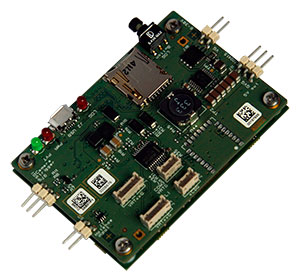
Septentrio’s low-power AsteRx-m OEM GNSS board has been selected by Xeos Technologies for use in its new Resolute reference receivers. Designed for high-precision monitoring in low-power applications, the Resolute systems are aimed at structural monitoring and geodetic research in remote locations.
Smaller than a standard credit card, the AsteRx-m board provides centimeter-level dual-frequency L1/L2 GNSS positioning while consuming less than 0.6 W. It incorporates Septentrio’s proprietary tracking and positioning algorithms, providing high accuracy and robust performance in difficult environments.
The Xeos Resolute GNSS receiver is designed for applications such as critical infrastructure monitoring, subsidence monitoring and GPS geodesy in extreme polar environments. The small, lightweight and low-power monitoring station is suitable for solar-powered remote autonomous installations.
In addition to the Septentrio AsteRx-m GNSS board, the Resolute system features dual SD card storage of GNSS data and multiple telemetry options such as Iridium, cellular, Wi-Fi and wireless mesh networks for monitoring, control and data transmission. The Xeos Resolute also features multiple interfaces including USB, RS-232, RS-485, CANBUS and SDI-12.
“Field tests of the prototype Resolute stations have demonstrated reliable RTK centimeter-level performance for remote deformation monitoring,” said Paul Passmore, Xeos Technologies. “We look forward to presenting our test results at the American Geophysical Union Fall Meeting in San Francisco this week.”
“Xeos Technologies’ Resolute autonomous polar monitoring system is an ideal application for the AsteRx-m technology,” said Neil Vancans, vice president of Septentrio Americas. “The compact AsteRx-m delivers reliable centimeter-level L1/L2 RTK at under 0.6 W in extreme climatic conditions.”
“Building upon our polar Iridium telemetry products, we are teaming with Septentrio to offer a new line of high-performance, low-power GNSS products for remote applications” said Derek Inglis, president of Xeos Technologies.
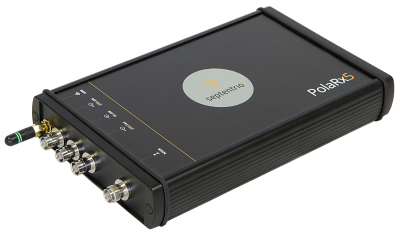
Septentrio has released version 5.1.0 firmware for the PolaRx5 product line of GNSS reference receivers. The 5.1.0 firmware brings new features for file management, usability, security and seismic monitoring.
Septentrio’s PolaRx5 product line of GNSS reference receivers includes the PolaRx5 for CORS and network operations, the PolaRx5TR for time and frequency transfer and the PolaRx5S for space weather applications.
Improvements in precise point positioning (PPP) have opened the door on seismic monitoring using GNSS technology. As well as allowing precise measurement of long-term slow surface displacement, PolaRx5 now allows real-time recording of the high-frequency vibrations typically accompanying earthquakes. Firmware 5.1.0 introduces the support for on-board PPP and dynamic response tuned for seismic applications.
The 5.1.0 firmware release brings greater logging efficiency to the PolaRx5 users. Storage integrity is crucial for many applications. Retransmitting data can be an expensive business, especially when using Iridium telemetry. To improve archival functionality, Septentrio has developed a storage integrity feature to retransmit only the data which has been lost in the initial transmission. This avoids the common and unnecessary overhead of retransmitting complete files.
Preventing unauthorized access is a crucial aspect of cyber security. PolaRx5 product line is now equipped with firewall and IP filtering, SFTP and ssh keys. This complements and strengthens the user management and access level protection of the PolaRx5 product line.
Various independent tests have shown PolaRx5 consistently ranks highest among GNSS receivers in many areas of measurement quality, including lowest measurement noise and fewest number of cycle slips, and this at the lowest power consumption on the market. The PolaRx5 products offer robust and high-quality GNSS tracking of GPS, GLONASS, Galileo and BeiDou as well as regional satellite systems including QZSS and IRNSS.
Some of those who have recently deployed the PolaRx5 include the Oregon Department of Transport (DOT), UNAVCO, the Jet Propulsion Laboratory (JPL) and the SAPOS CORS network in Germany.
“The 5.1.0 PolaRx5 firmware continues Septentrio’s commitment to its customers.” stated Francesca Clemente, PolaRx Product Manager. She continued: “The new features of the 5.1.0 firmware complement existing standard features of the PolaRx5 GNSS receivers such as Advanced Interference Mitigation technology (AIM+) and the web UI offering full user control and status to make PolaRx5 the most complete GNSS reference station on the market today.”
The GPS World 2016 Leadership Awards were presented during a special ceremony and dinner at ION-GNSS+ 2016 in Portland in September.
The awards recognize significant recent achievement in the fields of position, navigation and timing: satellites, signals, services and products.
The Leadership Dinner was sponsored by Harris, Rockwell Collins and Honeywell.
Remarks by Alan Cameron, editor and publisher of GPS World
Welcome to the 2016 GPS World Leadership dinner, sponsored by Harris, Rockwell Collins and Honeywell.
We’re at an historic turning point for this dinner, and I’d like to acknowledge three people who are responsible for all of us being here.
We’re honored to have Brad Parkinson and his wife Ginny join us tonight. Brad led the team that made GPS happen in the first place.
Phil Ward is here. He developed the first GPS receiver for the commercial market in 1982.
That’s the Space Segment, the User Segment, and with Lt. Col. Andrew Zinn of the GPS Directorate, we have the Control Segment as well.
Alan Cameron, GPS World
Further, we have guests tonight from the U.S. State Department, representing GPS and GNSS interests at the highest levels of the U.S. government. We have officials from the European Space Agency, the European Commission, from BeiDou, and — had it not been for airline scheduling — we would have had GLONASS as well.
The global industry is well represented here, by our sponsors:
Harris, with over 750 years of cumulative on-orbit GPS operations, and building tomorrow’s GPS III satellite constellation today;
Rockwell Collins, making generations of devices providing pinpoint accuracy for every airborne and surface mission worldwide;
Honeywell, embedding GPS and inertial navigation for challenging military requirements, along with civil interoperability capabilities.
Also, we are joined and by other veteran GNSS such as Lockheed Martin, NavCom, NovAtel, Septentrio, Racelogic and IFEN, by experienced developers like u-blox and Spectracom and many others, and by newer companies entering the market in recent years like ComNav, CHC, Geneq, Skydel, IP-Solutions and Unicore.
We go beyond GNSS as well this year, and this also reflects market expansion. Last year at about this time GPS World, led by North Coast Media president Kevin Stoltman, was completing a conscious repositioning from a GNSS focus to thoroughly covering all aspects and technologies of positioning, navigation and timing — PNT. You’ve seen cover stories on inertial, Wi-Fi and other positioning technologies. That wider mission is reflected by the presence here tonight of companies like Systron Donner, Sensonor and Locata.
We go beyond PNT, too. Or rather, new companies are coming into PNT. In the room tonight are Intel, Apple and Google — maybe right at your table. This industry is changing, and it’s getting exciting.
It’s always been exciting. Each year it gets more so in new, different ways.
The person responsible for getting all these companies into the pages of the magazine, and into attendance here tonight — ladies and gentlemen, I’d like to acknowledge my close colleague, Michelle Mitchell, international account manager for the magazine, website, newsletters, webinars and more.
Our gathering this evening comprises two parts:
The Leadership Awards ceremony recognizing significant recent accomplishment in the fields of Satellites, Signals, Services and Products.
After the awards, over dessert and coffee we will experience Murder, Mystery and Mayhem at the GNSS Mansion, a group exercise in high-tech deduction. Murder suspects are now seated among you. Enjoy!
Services, Special Award
Presented to: The Institute of Navigation
For bringing us all together, presenting the latest research and fostering open dialogue toward our common goal: ever-improving standards in position, navigation and timing — for 30 years!
Remarks by John Raquet, Executive Vice President, Institute of Navigation
John Raquet, Institute of Navigation
The Institute of Navigation is honored to be receiving the Special Services award.
As I thought about the relationship between the navigation community sitting here tonight and the Institute of Navigation, I found myself wondering whether it was the ION that created this community, or the community that created the ION?
The reality is that both are true. The ION has certainly played a big role in developing a forum for this community to interact, but without this community, the ION would cease to exist!
As most of you know, this year’s ION/GNSS conference is celebrating its 30th anniversary. It is my desire that, 30 years from now, we (actually, the people who have followed up after us after we’ve retired!) will continue to be meeting together and enjoying a similarly wonderful dinner to the one that we’ve experienced tonight!
Satellites Award
Presented to: Didier Faivre, Former Director of Navigation, Euroean Space Agency
He led the Galileo Program under not-always-easy conditions, as the constellation grew and the first results of importance to the user community became visible, such as the first Galileo-based PVT.
Sponsored by
A GNSS Dream Realized
Remarks by Marco Falcone, Galileo System Manager ESA, on behalf of Didier Faivre
Distinguished guests, dear colleagues and friends of the GNSS community,
On behalf of Didier Faivre, I would like to thank GPS World and the GNSS Community.
Didier Faivre, European Space Agency
Didier asked me to present his apologies for not being able to attend this prestigious event, he recently joined the French space agency to become the director of the Guyanese Space Centre and is today in Kourou the European Spaceport where a launch is planned today in the coming hours.
The European Space Agency and more generally the European GNSS Community are very proud and honored to receive this award, which is a mark of recognition of the quality of our European programs.
This award goes first of all to Europe as a whole for having had the dream to become one of the providers of a GNSS service open to the world. It was not so evident to have this dream. So many wise advisors told us that this was not necessary because others do it; this is not reasonable because it is so expensive; this is not feasible with the complex European public system; and it is too late. And it was not so easy to make it a reality. This dream is now a reality thanks to the perseverance of the political leaders and institutions in Europe, the efforts and support of the European citizens and the technical skills of European industry, institutes and agencies after almost 15 years of work. The award today marks this achievement.
After the opening of the full service of EGNOS and the soon to be open Galileo services, Europe is now a full member of the prestigious club of GNSS providers and is determined to maintain its role and improve permanently the quality and the performance of its EGNOS and Galileo systems and services.
Initial steps are already taken to ensure the replenishment of the constellation after 2020 and to deploy a multi-frequency, multi-constellation new generation of EGNOS.
With Europe and other new entrants providing high quality GNSS services, new perspectives of multilateral cooperation at the global level are emerging, in particular in the field of civil aviation where the cooperation of various SBAS system may offer a worldwide service. I am certain that Europe is ready and eager to contribute to this effort.
Again, I would like to thank you for recognizing the efforts of our teams at ESA and in industry. This award gives us even more energy and focus to continuously support the European GNSS programme and prepare for the future of EGNOS and Galileo.
Marco Falcone (center) accepting the Satellites Award for Didier Faivre, with ESA colleagues (from left) Gustavo Lopez Risueno, Jose Angel Avila Rodriguez and Miguel Manteiga Bautista. (Photo: GPS World staff)
Leadership Through Challenges
Remarks by Al Simon, Business Development, Navigation Products, Rockwell Collins
Rockwell Collins is honored to present the 2016 Satellite award this evening.
Over 10 years ago Europe launched its first navigation satellite. A decade later, Galileo is close to being operational.
Al Simon, Rockwell Collins
As it stands today (September 2016), four more Galileo satellites are in French Guiana awaiting a shared launch in November.
The 14 Galileo satellites already in orbit have been launched two at a time. Having 18 satellites in orbit could enable initial
Galileo operational services to begin.
One can only imagine the challenges the program successfully overcame during this time. You name it: technical, programmatic, funding, political, on and on.
And through these challenges someone had to lead.
With that, Rockwell Collins is pleased to present the Satellites Leadership Award to Didier Faivre, former director of Navigation, European Space Agency.
This year Didier was appointed as a director reporting to the CNES (France’s National Centre for Space Studies) President. Specifically, Didier will assume responsibility for the Guiana Space Center in October — the very place he began his career in 1983.
In Didier’s absence, Marco Falcone of ESA will accept the Award on his behalf. Ironically, Marco was the winner of the 2015 Leadership Award for Satellites, although he in turn was unable to attend that dinner and accept in person.
Signals Award
Presented to: Clark Cohen, Founder and CEO, PNT Holdings
For developing an advanced waveform concept for potential use aboard low-Earth orbit communication satellites: a method for adding high-accuracy ranging capability by modifying the transmitted signal structure of an already flying constellation.
Sponsored by
Testing a Modified Signal from On-Irbit Satellites
Remarks by Clark Cohen
Clark Cohen, PNT Holdings, and Ellen Mitchell, Harris Corporation
Thank you, GPS World, industry sponsors, and colleagues who engaged in the selection process. I appreciate the honor.
The Advanced Waveform was the second and most ambitious broadcast that we developed for the DoD-sponsored iGPS program. It is a wide-bandwidth (10 MHz maximum spectrum allocation), near-white, high-power broadcast with independently resolvable code and carrier capable of illuminating regions of the world at any time. Yet Iridium was never designed for navigation.
I am grateful to the Naval Research Lab, the Office of the Secretary of Defense, Boeing, and Iridium for their support. Also, many capable people comprised our team. Completeness is impossible, but I’ll highlight the efforts of Dick Cervisi, Kamran Ghassemi, Ann Stevens, Robert Scholl, Tom Guffey, Bernie McCormick, and Mark Psiaki.
The commercial Iridium constellation is built on billions of dollars of private capital. Meanwhile, the iGPS overlay required Congressional appropriation. But if the technical part weren’t challenging enough, the politics were, in my view, a bit too hard.
My topic is the future of public-private partnerships. Such partnerships include the GPS space and ground segments and most other government projects. Our broken, inflexible Congress is not helping. My answer here for the family dinner table is not political — it’s structural, non-partisan, systems engineering.
We can do better than handicapped innovation, winner-take-all procurements, Nunn-McCurdy triggers, continuing resolutions, debt-limit brinksmanship, and government shut-downs. This is not to judge people. Good people are operating under imperfect rules.
House elections now resemble a stuck, one-bit, analog-to-digital converter. Hundreds of individual races, cumulate the equivalent of input noise and bias, rendering the House largely unresponsive to voters. Consent of the governed demands a healthy, moderating feedback loop from people to representatives to laws and back. Cutting this loop spells trouble.
A major root cause of dysfunction is winner-take-all, single-member districts. Geographical voting made sense in the 18th century. But in an increasingly complex, connected world, where you live is no longer a stand-in for what you think.
We need to start dissolving district boundaries themselves. An elegant approach is aggregating adjacent single-member districts into larger multi-winner “super districts” with three to five members each. A refinement called ranked choice voting eliminates spoiler hazard and incentivizes positive campaigns. No change to the Constitution is needed — only passing a law.
We should reset our expectations. Congress should be able to pass the nation’s budget on time every time. We don’t need drama around GPS modernization, backup terrestrial navigation, and spectrum protection. And America should boldly pioneer aspirational, cathedral-and-moonshot-scale, public-private initiatives.
Working hard and playing by the rules implies a value-added, positive-sum relationship with society. But to the extent that the rules are imperfect, don’t vestiges of zero-sum exchange imply collateral damage somewhere in society? Voters are rebelling by the millions. We should pay attention. America’s defining Revolutionary War was fought over taxation without representation.
Whether applied to sword or plowshare, precision feedback from GPS provides guidance to help minimize collateral damage.
Updated voting rules will do the same for the nation. Everyone benefits from more efficient and effective execution. Yet perhaps our greatest harvest — should we choose to claim it for ourselves and our children — will follow from sowing new seeds of discovery and innovation through public-private partnerships on a vast and visionary scale.
Editor’s Note: The iGPS Advanced Waveform concept attempted to leverage carrier-phase signals from an already flying low-Earth orbit (LEO) communications satellite network, in order to aid GPS positioning. In 2013, the iGPS Advanced Waveform reached a test and evaluation phase but encountered technical issues which were not resolved, and the technology has not matured further.
Meanwhile, a separate initiative using a different, code-phase approach to signals from the same LEO constellation successfully completed rigorous testing and has been deployed worldwide. Its commercial launch was announced in mid-December 2016, and its technical and market details will be explored in GPS World magazine in 2017.
Every Signal Payload Since GPS Began — And Now Onboard GPS III
Remarks by Ellen Mitchell, Harris Corporation
It’s an honor to present the Signals award on behalf of the Harris Corporation. It is particularly fitting that Harris has the honor of presenting this award. As the GPS navigation payload provider, we create and deliver the GPS signal. Our technology has been on every GPS satellite launched since the program began — and we’re providing the payload for the next-generation GPS III satellite. Furthermore, our products help our customers better utilize the GPS signal and detect and prevent jamming.
So, perhaps you understand why it’s my special pleasure tonight to present the Leadership Award for significant recent achievement in the area of Signals to Clark Cohen.
Thank you for this opportunity and congratulations to all the award recipients.
Products Award
Presented to: Daniel Ammann, Executive Director and Co-Founder, u-blox
For achieving a leading company position with GNSS chips and modules for automotive, M2M and IoT applications as well as a recently announced mass-market L1 RTK in a single-package solution.
Sponsored by
Daniel Ammann, u-blox
L1 RTK Presages More Change
Remarks by Daniel Ammann
I wish to express my gratitude to GPS World magazine and the whole GNSS community for this recognition. I take this not as a recognition of my own work, but as a recognition of the fantastic team behind me, back home in Finland, England and Switzerland. Those are the ones who made this possible over the last years, and I happily accept this award on their behalf.
Alan asked me to not only say thank you, but give an outlook on things we believe are relevant as the industry goes forward.
The availability of highly integrated L1 RTK modules, such as the NEO-M8P we announced earlier this year, is only the beginning of something we believe is bringing a much bigger change to this industry.
We can foresee that multi-band L1/L2 receiver will become reality to serve the mass markets. And at attractive price points, an order of magnitude away from where today’s products are sold. We are not far away from high-volume availability of such GNSS receivers. The main market driver here though is not existing high-precision markets like agriculture or survey, but newly evolving markets in the autonomous vehicle space — both land vehicles and airborne, such as autonomous cars or UAVs. Here what is needed is high accuracy combined with unprecedented integrity even in challenging environments. And this at cost points allowing volume deployments.
A much bigger challenge though is the availability of a correction service suitable for mass-market high-precision applications. As a industry, we have a problem to solve here. Currently available systems are closed and proprietary. Market growth is limited due to per-receiver/per-year type business models, and this simply won’t scale easily for large installations, as there is no path to collect money from the end user. Further, standardization for broadcast-type SSR corrections is pretty slow. And you could ask the question, why it is a maritime standardization committee that is shaping standards for things that either drive on land, or fly in the air?
Therefore, at u-blox, we believe that an independent entity, possibly in the form of a industry consortium, is needed. A entity which offers broadcast-capable SSR services on a global basis, and with scalable business models, for example with a flat fee.
At the same time, this entity should not be tied to a receiver manufacturer like us, but serve the whole industry at the same time. This entity should be using open standards — which also must be developed, and in time. This is something which we at u-blox together with you from the industry would like to solve in the form of such a consortium, and I’d like to invite you to talk to us if you share that same vision.
Again, many thanks for this award. We feel very honored.
Services Award
Presented to: Steve Malkos, Technical Program Manager, Google
For driving Android’s location APIs to enable a new range of applications, bringing raw GNSS measurement capability, including carrier phase to Android location APIs and Android Emergency Location Service, providing Google’s enhanced location for emergency phone calls.
Steve Malkos, Google
Android: Raw GNSS Data Available
Remarks by Steve Malkos
I’m honored to have received this award and would like to thank GPS World and the GNSS community for this recognition!
At work, I’m surrounded by the best engineers (some of them sitting here right with me), and if it weren’t for them, I wouldn’t be up here today.
So, thank you! Taking Android Emergency Service from my 20-percent project in Google to production has been one of my proudest achievements. This life-saving service provides Google’s location data to emergency responders during an emergency phone call.
For example, if you are indoors with no GPS coverage, our Fused Location Provider can produce accurate indoor locations from other signals and send that to emergency responders, giving us greater accuracies over cell ID positioning. This is where we are headed with Indoor E911 for the US, but it’s already a reality in the UK and Estonia, where this service first rolled out.
I’m also excited to announce raw GNSS measurements available in Android. This was a multi-year effort with many complexities on getting this far. Android’s foundation is open-source software and the open-source community. So, it was a natural development step for us to provide these raw measurements to the community. We have a new paradigm of businesses, and most of them rely on location and context as one of their key elements.
Imagine what more we can do with enhancing location in new ways with the use of raw GNSS measurements. This gets me really excited, and I’m looking forward to the future. Thanks again for this recognition and the efforts from our team!
The U.S. Department of Transportation is seeking feedback on the potential use by the federal government of one or more positioning, navigation and timing (PNT) technologies to back up GPS signals and ensure resiliency of PNT for critical infrastructure (CI).
A Federal Register notice was published Nov. 30, with a deadline for comments of Jan. 30, 2017.
The Transportation Department also said it is interested in “leveraging PNT service technology initiatives under consideration or currently undertaken by industry.”
“The federal government is presently documenting civil requirements for PNT capabilities to serve as the basis for potential future acquisition activity. The initial objective is to support sustainment of domestic CI timing continuity with the capability to extend service(s) in the future to provide positioning/navigation continuity as well.”
The “Presidential Policy Directive on Critical Infrastructure Security and Resilience” (PPD-21; Feb. 12, 2013) designates 16 CI sectors: Chemical; Commercial Facilities; Communications; Critical Manufacturing; Dams; Defense Industrial Base; Emergency Services; Energy; Financial Services; Food and Agriculture; Government Facilities; Healthcare and Public Health; Information Technology; Nuclear Reactors, Materials, and Waste; Transportation Systems; and Water and Wastewater Systems. To support the initial objective, CI sectors need access to timing information for both nationwide applications and, in some cases, for more stringent regional and local applications.
DigitalGlobe has released the first image from its new WorldView-4 satellite.
Captured on Nov. 26, the first image shows the Yoyogi National Gymnasium in Shibuya, Tokyo, and can be downloaded from the WorldView-4 microsite. The site hosted events during the 1964 Olympic Games and will again host international competition when the games return to Tokyo in 2020.
The successful launch of WorldView-4 on Nov. 11 marked the culmination of months of planning, including unforeseen delays caused by the nearby Canyon Fire that impacted Vandenberg Air Force Base in California.
WorldView-4 is the fifth and most advanced satellite in DigitalGlobe’s active, industry-leading constellation, and will more than double the company’s capacity to collect the world’s highest resolution commercial satellite images for its customers.
The SpaceView 110 camera aboard WorldView-4, and the satellite’s primary payload, was developed by Melbourne, Florida-based Harris Corporation. From an altitude of 617 kilometers, SpaceView is capable of collecting imagery with a panchromatic resolution of 31 centimeters and 1.24 meter multispectral resolution, meaning it will be able to distinguish data points just a foot apart.
U-blox is introducing a new module designed to speed time to market for system developers of GNSS applications who have limited experience in RF and antenna design.
The SAM-M8Q GNSS receiver with integrated antenna is housed in a tiny 15.5 by 15.5 by 6.3 millimeter package. It can be easily embedded in small devices that require location information, such as asset tracking and telematics systems, and generic automotive after-market applications, u-blox said.
By using the latest u-blox M8 multi-GNSS receiver technology, the module is able to offer simultaneous reception of GPS, GLONASS, and Galileo satellite signals.
Ultra-compact SAM-M8Q module.
The combination of an integrated wide-band antenna along with the module’s SAW filter and low-noise amplifier (LNA)architecture ensures that the SAM-M8Q receiver delivers robust performance in the presence of high frequency signals from other electronic equipment, such as cellular modems, which can cause interference.
“The SAM-M8Q is intended for customers who don’t have much experience in RF and antenna design,” said Kim Kaisti, Director, Product Management, Product Center Positioning. He added, “It is aimed at applications that require an embedded antenna and where the surface mount package allows for easier assembly and installation in the end-equipment.”
Samples of the SAM-M8Q will be available in mid-January 2017. The modules will be in full production in mid-February 2017.
Jackson Labs Technologies Inc. (JLT) has entered the GNSS simulation and synthesis market with the small size, weight and power (SWAP) CLAW GPS/GNSS simulator. The CLAW is only slightly larger than a standard deck of cards.
CLAW targets applications that require small, low-power and low-cost GNSS synthesis with repeatable and highly accurate GNSS RF signals such as production testing of GNSS receivers, simulating GNSS anomalies such as leap-second events, 1023 GPS Week roll-overs, simulated operation in inaccessible locations around the world, real-time transcoding of different GNSS systems, and testing using dynamically user-configured RF signal levels.
With nanosecond-accurate encoding, CLAW is particularly suited to allow easy stress-testing of GPSDO Frequency and Timing Reference products such as JLT’s GNSDOs under various different mission scenarios, the company said.
The CLAW GNSS simulator is a no-frills solution that contains real-time processing hardware to simulate GPS constellations without the need to connect any external equipment other than a USB power source or power supply.
Providing a real-time computed RF output signal rather than an offline file-playback differentiates CLAW from competitive solutions that are only capable of recording and playback operation in non-real-time, or require offline computation of data files using external computers that are played back on the simulation device.
CLAW is a completely self-contained, ruggedized, miniature, real-time hardware GPS simulator.
Navigation coordinates and 1PPS timing pulses can be provided in real-time through the NMEA and SCPI compatible USB interface or via the built-in RS-232 interface, and are encoded in the CLAW into RF GPS signals in real-time with nanosecond-level accuracy and minimal delay.
Position, velocity and timing (PVT) information may be provided as a simple NMEA stream from an external source such as an inertial navigation system (INS), Galileo/GLONASS/BeiDou/SAASM GNSS receiver, and CLAW will encode this PVT data into standard L1 C/A GPS RF signals in real-time with minimal phase/position shifts. This allows real-time GNSS transcoding of any other GNSS standard simply by connecting an external GNSS receiver, INS system or PVT source to the RS-232 inputs of the CLAW, allowing retrofit of existing legacy equipment with the latest GNSS systems.
CLAW includes glueless drivers for Rockwell Collins Remote Secure Receiver (RSR Puck) among others, allowing transcoding of assured, secure L2 P(Y) code into legacy L1 C/A code in real time to retrofit commercial receivers with military P(Y) capability. CLAW also allows user-entry of ephemeris and almanac information, providing a means to simulate any past or future GPS constellation and time/date event.
CLAW was designed with a particular emphasis to encoding the optional externally-provided 1PPS GPS system time with nanosecond-level accuracy targets, allowing accuracy testing of GPS timing and frequency devices on top of simply providing a positioning/velocity reference. CLAW initially will support GPS L1 C/A code encoding with up to 12 satellites, and later versions will support additional GNSS systems such as L2 GPS, GLONASS, BeiDou and Galileo.
A comprehensive cost-free optional user application for Windows will be offered that allows control and monitoring of the unit, creation of simulation scenarios using Google Earth and manual waypoint entry, among other options. The unit also can be controlled via simple serial terminal commands, or various other available public-domain freeware programs.
Once position information is stored in the units’ NVRAM, the unit will generate GPS RF constellations within seconds upon power-up and thus does not require any user interaction other than plugging in the power supply.
CLAW contains a highly accurate and stable internal 10-MHz reference oscillator that may optionally be synchronized by an external 1PPS reference, 10-MHz reference, or both. CLAW supports a user-selectable RF signal attenuation range of 63 dB in 0.5-dB steps, allowing a wide range of RF signal levels to be generated with high accuracy and power-level resolution. Antenna DC power consumption also can be controlled via software command.
CLAW can be powered by its USB interface, or by a 6.5V to 28V DC power feed, and consumes less than 1.7W allowing extended operation of 24 hours or more from low-cost ubiquitous USB consumer battery packs.
CLAW pre-production GPS simulator evaluation units are shipping to select customers, and are priced at $2,995 each.
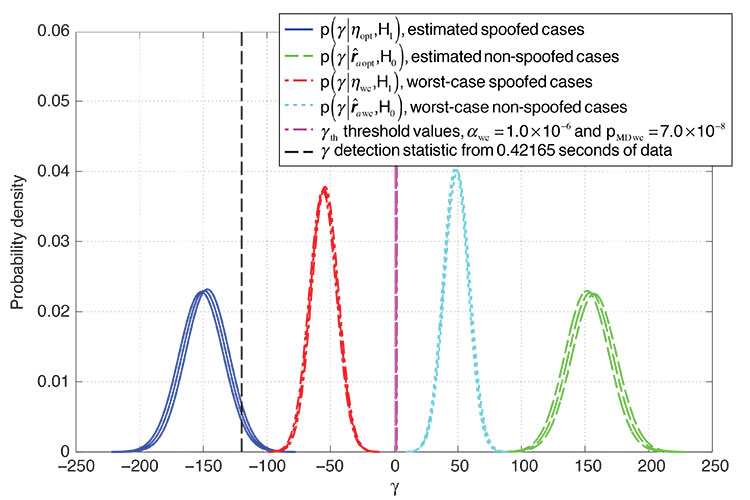
As manufacturers convert machines and appliances into remotely controllable objects (the Internet of Things), the potential for spoofing expands, perhaps exponentially. Hackers could interfere with the data supplied to autonomous cars or tracks, remotely forcing them to crash.
Although the dangers of GPS spoofing have been pointedly discussed in may technical papers and articles in GPS World since the early 2000s, manufacturers have not devoted much attention to them because there weren’t many devices making use of location-based technologies, according to associate professor Dinesh Manandhar of the University of Tokyo.
With the proliferation of GPS-capable smartphones and other networked devices, “anyone can become a target of the attack,” Manandhar told the Japan Times in a recent interview.
“Too many things today use GPS as a reliable source of location information,” Manandhar said. “People trust the location information from GPS satellites like God. When PCs became common for many people, the sudden outbreak of computer viruses became an issue around the world, and anti-virus software become an essential tool for everyone to protect their data,” he added. “The same thing is now happening around GPS. We need a system to fight back against the risk.”
Manandhar cited some possible examples of spoofing, both by consumers — “You can falsify your smartphone’s information and make it look like you are going back and forth between Tokyo and Hawaii within just three minutes,” and by sophisticated criminals. “Let’s say I were a top manager of a major bank. I could access all the information while sitting at my desk, but I wouldn’t be able to access it from the room next to it. But people could get access to such information if they disguised the location information received by computer.”
Manandhar and many other researchers around the world are developing and testing anti-spoofing techniques, but it is a long step from demonstrated results to integration into products reaching market. “The products we are designing today are ones that we will use five years later. So we must assume the possible risks and prepare for the threats that might jeopardize our society in the future.”
Testing took place both day and night under severe cold-weather and snow conditions. (Image: NIAS)
The Counter Unmanned Aerial Systems — cUAS — industry is gaining momentum. This month, the Federal Aviation Administration (FAA) and the Nevada Institute for Autonomous Systems (NIAS) — managers of the FAA-designated Nevada UAS Test Site — teamed with Northern Plains UAS Test Site to test counter-UAS (unmanned aerial systems) technology at the Denver International Airport.
UAS that enter the protected airspace around airports can pose a serious threat to manned aviation safety. The FAA and its partners are working to evaluate new technologies for detecting unmanned aircraft near airports, and the Denver airport test represented a milestone in developing minimum operational performance standards for drone detection at major airport and critical infrastructure locations.
“With the FAA UAS Test Site designation, Nevada was given an incredible opportunity to lead in the research and development of a commercial drone industry,” said Tom Wilczek, Aerospace and Defense Industry Specialist for the Governor’s Office of Economic Development. “This latest test proves that safety and privacy remain paramount concerns in developing a thriving unmanned aerial systems industry, and Nevada is grateful and excited to be a lead participant in these groundbreaking efforts.”
“We flew over a half dozen fixed-wing and multi-rotor drones during the ground detection system testing in Denver,” said Chris Walach, director of the Nevada UAS Test Site. “As the FAA-designated Air Mission Lead for both UAS Test Sites, our mission was to fly the scenarios per the FAA test cards under every imaginable flight profile that an airport would see [drones] intruding in their airspace. During the main FAA Pathfinder demonstration on Nov. 16, the flight crews experienced high winds with gust over 20-25 knots and winds at the maximum for the smaller drones; however, despite the high winds, all Nevada flight teams executed their test cards with precision and a high-degree of safety.
“This was a first: two UAS Test Sites jointly executing a very high profile FAA Pathfinder mission in Class B Airspace,”Walach continued. “The Nevada Team did exactly what a World Series UAS Team could have done in any high-profile scenario —achieving the first to fly in the Class B National Airspace which occurred day and night through multi-aircraft operations under severe cold-weather and snow conditions. Simply put, these tests mark a big step forward in developing a Counter Unmanned Systems industry.”
The Nevada Team included Nevada-based Eye in the Sky UASUSA, Colorado-based UAS, North Dakota-based ISight RPV Services and the Nevada UAS Test Site flight team.
Eye In The Sky UAS flew the first series of rotary-wing UAS in Class B airspace, as part of the FAA’s Pathfinder Program for UAS Detection at Airports and Critical Infrastructure. Selected by the Nevada UAS Test Site, the Eye In The Sky flight team flew the various test cards using the InstantEye Gen3 and DJI Advanced platforms at the Denver airport.
“This is a major milestone for the Unmanned Aerial Systems Industry and for safely integrating UAS into the National Airspace System,” said Rinaldo F. Brown, director of UAS Operations for Eye In The Sky.
“This project was an exciting chance for us to help advance the UAS industry, while also expanding our own technical capabilities. That combination made it a valuable and rewarding project for our team,” said Adam Overvold, chief pilot, ISight RPV Services.
Nevada’s Silver Springs Airport participated as the primary training location for all flight crews.
Boundless has introduced an open GIS “ecosystem” to unlock the business intelligence of location-based data.
In response to market demand for more open and scalable GIS solutions, the company extended its proven GIS platform with Boundless Connect, a subscription service to the most comprehensive repository of GIS data, and Boundless Desktop, a full-featured, professional desktop GIS, bringing a powerful ecosystem of geospatial knowledge, tools and resources to the enterprise.
“With the launch of Boundless Connect and Boundless Desktop, we have taken a major step forward in delivering the most complete, commercially supported open GIS platform,” said Andy Dearing, CEO of Boundless. “As the need for an alternative to costly, closed GIS systems grows, Boundless is proud to partner with the open source community to provide new tools and open solutions that foster growth of the largest repository of the world’s geospatial knowledge and resources.”
Boundless offers an open GIS ecosystem through a combination of technology, products and experts that gives enterprises deeper intelligence and insights using location-based data. The Boundless platform is built upon open source technology and open APIs that generate actionable location intelligence across third-party apps, content services and plugins for enterprise applications.
Eighty percent of today’s data includes a location component. Unlike proprietary, licensed solutions that are prohibitively expensive for the growing volume of geospatial data, Boundless wants to make the world of geospatial data available to any user. Boundless is open by design, immediately scalable and license-free, making it easy for developers, GIS and business analysts to access location-based data in a cloud-based GIS platform.
Key features and benefits of the Boundless open GIS platform include:
The most comprehensive product line of commercially supported open GIS products including Desktop, Suite and Exchange.
Boundless Connect delivers an ecosystem of geospatial tools, content and services to the open source community.
Boundless combines 14 years of open source expertise with GIS resources including consulting, training and support.
Boundless is operational in government and commercial environments, with customers including National Oceanic and Atmospheric Administration (NOAA), Port of Seattle, Louisiana Department of Health and Hospitals and TriMet, among others.
HiScene, Inuitive and Heptagon have teamed up to take augmented reality (AR) another step forward with HiAR Glasses, HiScene’s next generation of AR glasses.
The companies worked together to develop a complete solution for advanced 3D depth sensing and AR/VR applications that delivers excellent performance even in changing light conditions and outdoors.
HiAR Glasses incorporate Inuitive’s NU3000 Computer Vision Processor and Heptagon’s advanced illumination. The combined technologies provide a superior and seamless user experience, marking a new standard in the current market.
The glasses’ AR operating system provides stereoscopic interactivity, 3D gesture perception, intelligent speech recognition, natural image recognition and inertial measurement unit (IMU) displayed with an improved 3D graphical user interface.
“We are committed to providing the best possible user experience to our customers, and for this reason we have partnered with Inuitive and Heptagon to create the most intelligent AR glasses available on the market,” said Chris Liao, CEO of HiScene. “The technologies implemented provide a seamless experience in a robust and compact format, without compromising on battery life.”
Inuitive’s NU3000 serves AR glasses by providing 3D depth sensing and computer vision capabilities. The solution acts also as a smart sensors hub to accurately time-stamp and synchronize multiple sensors in a manner that off-loads the application processor and shortens the development time.
“Inuitive’s solution allows Hiscene to provide the reliability, latency and performance its customers expect,” said Shlomo Gadot, CEO of Inuitive. “With Inuitive technology, AR products and applications can now be used outdoors without the sunlight interfering or damaging their efficacy thanks to cameras featuring depth perception.”
Heptagon provides infrared pattern illuminators, which were chosen to handle changing light conditions and plain surfaces. In addition, the range and field of illumination features of Heptagon’s LIMA stereo pattern projector ensure superior lighting and added texture for higher-quality images.
“Our wide field of illumination provides better gesture recognition, and our miniaturization technologies enable ultra-small, high-performance, low-power components for 3D AR/VR applications,” said Erik H. Volkerink, Heptagon’s chief business officer.
DJI has updated the capabilities of its largest drone series by introducing the Matrice 600 Pro, which offers improved flight performance, a more powerful battery charging system and better loading capacity for industrial equipment, cinema cameras and other professional aerial applications.
The M600 Pro’s A3 Pro flight controller comes with triple modular redundancy and diagnostic algorithms that compare sensor data from three sets of GNSS units, which enhances precision control while improving overall safety. Vibration damping balls have been added to the flight controller’s redundant IMU module and main controller, absorbing more shake and reducing more noise.
The compatibility with D-RTK GNSS makes the A3 Pro withstand magnetic interference and provides centimeter-level accuracy, which makes it suitable for industrial applications.
“The M600 Pro is DJI’s most advanced platform for aerial cinematographers and commercial users. With its simple and easy setup system, triple redundancy and improved stability, the platform offers an unparalleled experience for professional users,” said Aaron Zhao, Senior Product Manager at DJI.
DJI’s E2000 Pro dust-proof propulsion system simplifies maintenance and its active cooling motors ensure that operation is reliable for extended periods of time.
The M600 Pro is compatible with DJI’s Zenmuse camera series, the Ronin-MX gimbal and DJI Focus. It supports a payload of 6 kilograms, meaning it can carry a range of cameras from Micro Four Thirds systems to the RED EPIC.
The M600 Pro has been optimized for transportation and comes with pre-installed arms and antennas. When folded, the platform is smaller than the standard M600. The M600 Pro comes with an updated battery charging hub, enabling users to charge the six intelligent batteries at the same time and thereby reducing overall charging time.