Tag: Android

  • New Rugged Handhelds, Tablets Hit the Market

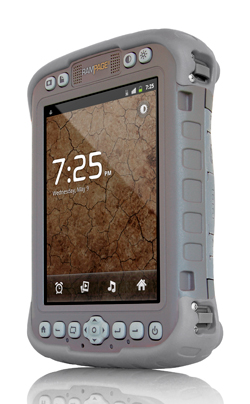
    Photo: Juniper Systems Several new rugged GPS-enabled devices were announced this week.

    Juniper Systems has partnered with Pennsylvania-based SDG Systems to market the Mesa Rugged Notepad with Android (AOSP) 2.3 operating system, a rugged handheld computer known as the RAMPAGE 6 and distributed through SDG Systems. Availability of the RAMPAGE 6 is scheduled for the third quarter of 2012 and its first public presentation will be at the Esri International User Conference in San Diego, July 23–27, 2012.

    The Android (AOSP) 2.3 operating system on the RAMPAGE 6 offers many advantages for data collection, including easy multi-tasking, a modern user interface, rich programming environment, multi-platform development, abundant application data storage, open source flexibility, and the opportunity for a custom Android interface developed by SDG Systems, according to Juniper Systems. Additionally, its optional kiosk mode allows only certain applications to be accessible by the user, creating a single-purpose device without distractions, Juniper Systems said.

    The RAMPAGE 6 will have the same features as the Mesa Rugged Notepad, including a large 5.7-inch viewing display, IP67 ingress protection rating for water and dust, integrated 2–5 meter GPS receiver, optional integration of a 1D/2D barcode scanner, and optional Class I, Division 2 certification for use in hazardous locations.

    Meanwhile, DRS Technologies, Inc., announced today that its Tactical Systems division has expanded its product portfolio with three new ARMOR rugged tablets. The ARMOR X7et and the ARMOR X7ad are thin, lightweight tablets based on customers requesting even more portable computers from ARMOR, the company said. “The 7-inch multi-touch tablets shatter the perception of bulky, rugged computing, and offer field service workforces the ability to choose between the fast-growing Android OS and the enterprise-friendly Microsoft Windows platform,” The company said. Additionally, DRS is now offering a new light convertible tablet, the ARMOR X12kb, that meets MIL-STD-810G. All three follow introduction of the ARMOR X7 compact rugged tablet launched in 2011.

    The ARMOR X7et is a Windows-based tablet that weighs less than 1.5 pounds and provides six hours of battery life. It features an Intel Atom Z670 processor and runs Microsoft Windows 7 Professional. Its Android counterpart, the ARMOR X7ad, weighs 1.3 pounds and operates for up to eight hours. It features a NVIDIA Tegra 2, 1.0-Ghz dual-core processor, and operates on Android v3.2. Both lightweight tablets feature a 7-inch outdoor-readable multi-touch screen display. They are certified to MIL-STD 810G for extremes in temperature, vibration, shock, and four-foot drops and have an IP65 rating for ingress protection, which means they are fully protected against dust and can withstand low pressure jets of water from all directions.

    Weighing 5.5 pounds, the ARMOR X12kb features a 12.1-inch sunlight-readable swivel touchscreen that incorporates polarized LCD glass and anti-reflective technology. The ARMOR X12kb offers the Intel Core i5-560UMCPU processor and runs Microsoft Windows 7 Professional. It has a long battery life, operating for up to eight hours, as well as a spill-proof keyboard and touchpad. Additionally, the one-click stealth mode operation disables all emitting light and sounds, a feature designed for the unique applications of covert operations.

    The three new ARMOR mobile computers include connectivity options including Gobi Wireless Broadband, integrated GPS, 802.11 b/g/n Wi-Fi, and Bluetooth wireless. They are designed to make it easier for workers to use mobile computing in rugged environments, as this product video shows:

  • Esri Releases Free Business Analyst Online Mobile App for Android Smartphones

    Esri announced the release of a free Business Analyst Android app for retail and commercial real estate professionals, allowing them to access demographic data anywhere with the Esri Business Analyst Online (BAO) application. The application is designed for anyone who needs access to population and consumer marketing data on the go.

    According to the announcement, the BAO application enables users to access up-to-date facts on demographics, lifestyle, and consumer spending for any region in the United States. With it, users can compare any address with another or with the county, state, or United States and analyze an area within one mile of a prospective location. Unlike traditional market research, users can quickly compare and contrast regional information with the regional average and show that data to clients in the field. Reports created in the mobile BAO application can also be e-mailed to share with a broader audience. More extensive data, capabilities, and reports are available through the application with a subscription to the BAO web application.

    The BAO application is free and can be downloaded directly from Android Marketplace.

    To learn more, visit esri.com/BAOapp.

  • Tablet Users Will Help Shape Future Mobile App Market

    Between 2010 and 2011 the global installed base of app consumers increased by 104%, according to a report released by  mobile research specialists Research2guidance. While the installed base of smartphones increased by nearly 274 million, tablets were the fastest growing segment. The number of new tablet app consumers increased by 58 million. As a result, tablet owners now constitute 8.6% of the installed app consumer base.

    Based on Q2 projections for tablet shipments in 2012, the installed base of tablet users is set to increase more than 150% by 2013.  As tablet users become a larger and larger app downloading segment, their app behavior and preferences will have an increasing influence on the app market – illustrated already in the growth in the number of apps and stores devoted to them.

    Installed base of tablet users to increase more than 150% by 2013

    During 2011, apps in the Apple App Store for iPad grew 180% to more than 140,000 apps by the end of Q4 2011. While this cannot be easily quantified for Android as tablet apps are not separated out, the growth of niche stores and niche store categories focusing on Android tablets reflects their growing presence. For example, Archos Appslib focuses completely on Android tablet apps, while other stores like Android Tapp has a dedicated category.

    Several studies have shown that tablet users exhibit different behaviour towards app downloading/usage and mobile browsing than smartphone users.  Based on the breadth of use cases for gaming, ecommerce, digital publishing and the enterprise – tablet user growth is likely to have a marked effect on consumption in these areas.

    Tablet apps for the enterprise market

    In the enterprise, for example, tablets have already been largely implemented at upper levels of management and are quickly working their way throughout organizations – according to Apple’s CEO Tim Cook in 2012, 92% of Fortune 500 companies are testing or deploying iPads. As more and more use cases are developed and penetration increases, so too will the number of apps being developed for enterprise tablet users. While Apple has already carved out a niche section for iPad and iPhone Business users called “@Work”, other players like Lenovo and Cisco are trying to do the same for Android Business users.


  • Mobile Device Operating System Wars: Android vs. iOS vs. Windows Mobile

    Following up on my” Mobile Devices Galore” column a couple of weeks ago, one predominant question I hear reverberating across all industries with geospatial apps on mobile devices is “what is the mobile device operating system of the future?”

    After years of relatively benign evolution, the mobile device market (smart phone, tablet, handheld) is changing really quickly, and it’s really making geospatial users think hard about which device and operating system to deploy.

    I think it’s safe to say that if there were enough apps available for the Android platform, Android would clearly be the geospatial operating system of choice. There are a myriad of smart phones and cheap tablet computers running Android that consumers are eating up and geospatial users are salivating over. Unlike Apple with their iOS, Google will license Android to almost anyone so hardware manufacturers like Samsung are flocking to Android. One would think this might be déjà vu for Apple a la Microsoft Windows.

    However, the fact is that there’s not much in the way of geospatial apps for Android, yet.

    Almost all geospatial apps in existence today are built for Windows Mobile, but most people I’ve spoken to aren’t convinced that Microsoft is committed to Windows Mobile. The follow on to Windows Mobile 6.5 called Windows Embedded Handheld. You might think that Windows Phone 7 is the follow-on to Windows Mobile 6.5, but the problem is that apps have to be re-written for Windows Phone 7 while the software development environment for Windows Embedded Handheld is the same/similar as/to Windows Mobile 6.5. Following is a video explaining Microsoft’s mobile device strategy for Windows:

    Almost all geospatial apps in existence today are built for Windows Mobile, but most people I’ve spoken to aren’t convinced that Microsoft is committed to Windows Mobile. The follow on to Windows Mobile 6.5 called Windows Embedded Handheld. You might think that Windows Phone 7 is the follow-on to Windows Mobile 6.5, but the problem is that apps have to be re-written for Windows Phone 7 while the software development environment for Windows Embedded Handheld is the same/similar as/to Windows Mobile 6.5. Following is a video explaining Microsoft’s mobile device strategy for Windows:

    Dual Boot?

    We have a problem. We need mobile devices to support Windows Mobile, for now, due to the wide number of apps available for that operating system. However, we aren’t sure of Microsoft’s committment to Windows Mobile in the future and it seems Android has a tremendous amount of momentum, How many IT people have you seen with dual boot Windows/Linux? It makes me think about a dual boot mobile device…Windows Mobile and Android. But, that could get ugly pretty quickly since average consumer is not going to be interested in this. Without the benefit of consumer acceptance of what we use for a mobile device, we are back to where we started, stuck with a few niche suppliers that produce high-priced mobile devices specifically for the geospatial industries.

    I can dream about dual boot, but I doubt it will happen.

    Which Mobile Device Operating systems will survive and flourish?

    Earlier this month, technology research firm Gartner, Inc. issued a report detailing the results of their research on tablet computer operating systems. While it’s not completely indicative of smart phone and handheld operating systems, I think it’s a very good indicator of where things are headed.

    Following is a table summarizing the results of their research by operating system.

    Worldwide Sales of Media Tablets to End Users by OS (Thousands of Units):
    OS 2011 2012 2013 2016
    iOS 39,998 72,988 99,553 169,652
    Android 17,292 37,878 61,684 137,657
    Microsoft 0 4,863 14,547 43,648
    QNX (RIM) 807 2,643 6,036 17,836
    Other OS 1,919 510 637 464
    Total 60,017 118,883 182,457 369,258

    If you’d like to read a detailed article about their results and report, click here.

    Is Apple’s iOS really going to continue to dominate?

    I wish I would have bought Apple stock a few years ago. Apple is a serious cash machine, earning more profit than even ExxonMobile, thus becoming the most profitable company in the world.

    However, with their closed system, it smacks of the Mac vs. Windows battle of 20+ years ago of which Apple clearly lost. Can a closed operating system like iOS maintain its dominance? I doubt it, I really doubt it. Apple has been on a great run, but even from the table above, one can clearly see that Android is projected to grow faster.

    While I’m reasonably sure iOS isn’t going to be a long-term dominator, I’m not so sure about Android vs. Windows Embedded. As we saw with Microsoft’s Internet Explorer going from zero to hero in a short period of time, Microsoft has the ability to focus a tremendous amount of resources to tackle a market if they choose. They could do it with Windows Embedded, if they choose.

    Thanks, and see you next week.

    Follow me on Twitter at http://twitter.com/GPSGIS_Eric

  • Mobile Devices Galore

    Few, if any, technology products reach a worldwide audience hotter than mobile devices. I’m talking about smartphones, tablets, handhelds, and even notebooks to some extent. When’s the last time you bought a desktop computer?

    As I mentioned in my March 23 Geospatial Solutions column, at the GIS in Action conference I asked a Google presenter if he thought the mobile phone is going to be the primary mobile device people will carry. He said, “No, it’s going to be the tablet computer.”

    The competition certainly seems to be between the smartphone and the tablet, or maybe a hybrid version of the two. From a geospatial user perspective, we’ve been showered these past few months with tablet device offerings.

    1. Kindle FireThe most significant tablet computer introduced since the iPad two years ago. Its low price has opened up the tablet market to a new level of adopters. Kindle Fire is the poster child for the many, many Android-based tablets on the market from Sony, Samsung, Motorola, LG, ASUS, etc.

    Salient features: Wi-Fi, Android operating system, web browsing, less than US$200. It’s all about the low price.

    Oops: Doesn’t run the latest Google Android operating system.

    Geospatial apps: ArcGIS for Kindle Fire

    Adoption: 5+ million sold since its introduction last fall.

    Kindle-Fire-2012

    2. Apple iPad. This product started the new revolution in tablet computing. Apple’s proprietary style may hurt it as competition from Google Android devices heats up.

    Salient Features: The defacto standard for tablet computing. Apps, apps, apps, and more apps. Shares the same operating system as the iPhone and iTouch.

    Oops: One trick pony. There is only one iPad. Google will license Android to almost anyone. Closed Bluetooth so you can’t interface to external instruments (GPS, laser rangefinders, etc.).

    Geospatial apps: ArcGIS for iOS, iCMTGIS, iGIS, GeoJot, GISPro

    Adoption: 75+ million sold since its introduction two years ago. The latest iPad sold 3 million units in the first three days it was available.

    Apple-iPad-2012

    3. Windows-based tablets. Acer Iconia Tab Series, Samsung Series 7. Windows-based tablet computers at near iPad prices.

    Salient Features: Microsoft Windows 7 operating system. GIS software compatibility.

    Oops: Battery life, expensive.

    Geospatial apps: Take your pick. Virtually any GIS app designed for Windows XP/7 will run on these tablets.

    Adoption: Weak. Although Microsoft has been promoting tablet computers for 10+ years, they are getting beat up in the tablet market, at least with the general public. The Windows operating system still has a lot of value with professional users due to software/workflow compatibility. Be on the lookout for Windows 8 and Microsoft Office apps (optimized for low power, etc.) as Microsoft tries to leverage the power of Windows and match the appeal of the Ipad.

    Look for more coverage on smartphones and handhelds soon.


    Thanks, and see you next week.

    Follow me on Twitter at http://twitter.com/GPSGIS_Eric
  • Esri Announces ArcGIS for Android Now Available for Kindle Fire

    Esri announced that ArcGIS for Android is now available for Amazon’s popular Android tablet, the Kindle Fire. ArcGIS for Android, also available on iOS devices, Windows Phones, and other Android devices, lets users access, edit, and share maps. The free app can be downloaded directly from the Amazon Appstore for Android.

    According to the announcement, ArcGIS for Android is a native application that serves as a mobile gateway into the ArcGIS system. It provides an intuitive user experience for querying map layers and data. With it, users can quickly access their own maps and data authored in ArcGIS Online as well as collect and edit geographic data. ArcGIS for Android includes a Favorites feature that accesses popular maps quickly; a tool for measuring area and distance; and the ability to display data in popups that support images, charts, links, and more.

    Esri reports that ArcGIS for Android is built on Esri’s ArcGIS Runtime Software Development Kit (SDK). This SDK lets developers create custom spatially enabled applications for Kindle Fire and other Android devices and is designed to use web services available from ArcGIS Online. Apps built using the SDK can be deployed within the enterprise or to the public via the Amazon Appstore for Android and Google Play.
    To download the ArcGIS app, visit the Amazon Appstore for Android or directly from your Kindle Fire.
  • A $45 Tablet Computer?

    At the GIS In Action 2012 conference last week, I asked a Google presenter if he thought the mobile phone is going to be the primary mobile device people will carry. He said, “No, it’s going to be the tablet computer.”

    Certainly the Apple iPad, since its introduction in April 2010, has sparked the tablet computer business. Google’s Android operating system has done its share of stimulating the tablet business, and just in the last few months, the fantastic success of the Kindle Fire (based on the Android operating system) has given Apple something to think about. I bought my wife a Kindle Fire for Christmas a few months ago. For the most part, it has replaced her notebook computer for the majority of her computing activities.

    It’s not that the Kindle has amazing functionality and zippy computer power. The beauty of the Kindle Fire is that it’s inexpensive ($199), and has the basic features that make it very useful; web browsing, email, and ebook reading. The previous ebook readers by Kindle lacked web browsing and email functionality, so they were limited to being pure ebook readers. You can bet that the Kindle Fire has Apple thinking twice charging $600 for an iPad.

    Continuing the subject of low-priced tablet computers, the I-slate, developed by the Institute for Sustainable and Applied Infodynamics (ISAID), a joint venture of Houston’s Rice University and Singapore’s Nanyang Technological University, is being developed for the educational environment and has a targeted price of $45. Yes, $45 U.S. dollars.

    Check out the following story:


    India’s Mahabubnager District, Indian non-profit Villages for Development and Learning Foundation (ViDAL), Rice University and Nanyang Technological University (NTU) in Singapore announced that the district plans to adopt 50,000 of the low-cost electronic I-slate tablet computer into middle and high school classrooms over the next three years.

    i-slate-revolution-in-mohammad-hussain-pally-04

    According to the announcement, the I-slate, a low-cost learning tool designed for classrooms with no electricity and too few teachers, is under joint development by the I-slate Consortium, which includes hardware and software experts at Rice and NTU, social outreach partners from ViDAL, and a Los Angeles-based design team.

    The district of Mahabubnagar in the Indian state Andhra Pradesh has about 500,000 students in government schools. Consortium leaders and Mahabubnagar officials said they hope to supply I-slates to at least 10 percent of the students over the next three years.

    “The I-slate project is about empowering local communities with education and knowledge,” said Rajeswari Pingali, ViDAL founding chairwoman. “Based on two years of lab-to-school testing rounds, today we have a fully functional I-slate which will be adapted by the district education department for expanding the footprint of technology and bringing learning opportunities backed by the latest in modern communication technology for the benefit of rural communities.”

    According to the announcement, about 30 fourth-generation I-slates were delivered this month to a class of 10- to 13-year-olds at the Mohamed Hussainpalli Village School, which is located in Mahabubnagar District, about 70 miles from Hyderabad. The new I-slates are the first to feature a new “sense-optimized” user interface designed to improve educational outcomes in rural India.

    “Sense optimization is a systematic way of improving the user experience by taking advantage of our knowledge of how the human brain processes the information so we can invest the minimum amount of resources for the effectiveness level we’re trying to reach,” said I-slate creator Krishna Palem, a professor at both Rice and NTU. “The I-slate is not a tablet computer. It is a device designed for a single purpose — education in a low-resource environment.”

    Mahabubnagar is primarily rural and has a population of around 4 million. District officials plan to use the I-slate in middle and high school classrooms. With sufficient volume, the unit cost for the I-slate will be around $45 (56 Singapore dollars), Palem said.

    Palem, Rice’s Ken and Audrey Kennedy Professor of Computing, initially conceived the I-slate in 2008. He thought power consumption would be the biggest hurdle, because many rural schools in India lack electricity, and a solar-powered I-slate would need to run on no more than three watts of power. However, as soon as students in Mohamed Hussainpalli Village began testing early prototypes, it became obvious that usability and effectiveness would also be a challenge.

    The I-slate’s Los Angeles-based design team, which includes Marc Mertens, CEO of the Seso Media Group, and project leader Henrik Andersson, volunteered their time to work with ViDAL, NTU specialists in human-computer interaction and Rice student interns. The designers evaluated feedback from children at Mohamed Hussainpalli Village School and spent thousands of hours scrutinizing the placement and flow of features and the way children interacted with the I-slate both visually and by touch.

    It was reported that the designers incorporated elements from video games and social networking to draw students in and hold their interest. For example, a colorful cartoon creature in the corner of the I-slate screen watches the student and changes expression based upon the child’s actions. The more the student studies and the better her grades, the happier the creature appears. (EDITOR’S NOTE: to see the user interface in action, watch the video linked at the end of this release.)

    The I-slate is a joint project of the Rice-NTU Institute for Sustainable and Applied Infodynamics (ISAID). Palem, who directs ISAID, is a Nanyang Visiting Professor at NTU.

    “It is very exciting to see the early work on the I-slate expand to a larger user base,” said ISAID affiliate Vincent Mooney, associate professor of electrical and computer engineering at Georgia Tech, who worked on the I-slate as a visiting faculty member at NTU.

    According to the announcement, the hardware and graphic content for the I-slate are being developed in tandem because they will ultimately use a revolutionary low-power computer chip — another of Palem’s inventions. The new chip, which could be ready for use in the I-slate by 2013, will cut power requirements in half and allow the device to run on solar power from small panels similar to those used on handheld calculators.


    Thanks, and see you next week.
    Follow me on Twitter at http://twitter.com/GPSGIS_Eric