Tag: anti-jamming

  • Septentrio showcases solutions for GPS jamming and spoofing

    Septentrio showcases solutions for GPS jamming and spoofing

    Septentrio will demonstrate how simple it is to spoof or jam unprotected GPS receivers at the upcoming ION Joint Navigation Conference, which takes place June 6-9 in San Diego. The company will showcase how its resilient technology makes a difference for overall security and availability of positioning, navigation and timing (PNT) .
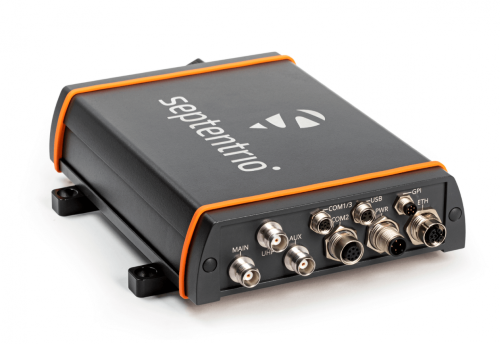
    Photo: Septentrio
    The AsteRx-U3 receiver. (Photo: Septentrio)

    Septentrio will hold a GPS spoofing demonstration, as well as a detailed comparison of jamming solutions from various high-end receivers. The integration of the latest anti-spoofing authentication mechanism, Galileo’s Open Service Navigation Message Authentication (OSNMA), will also be shown.

    “With our growing dependence on GPS technology, resilience of PNT is an important point of attention, especially for mission-critical applications, tactical ground or aerial vehicles as well as autonomous systems,” said Gustavo Lopez, market access manager, Septentrio. “Since the number of malicious jamming and spoofing attacks is on the rise, it is crucial to understand how various GPS receivers can be affected. We are pleased to explain and display this with specific examples at JNC this year.”

    Advance Interference Mitigation (AIM+) is an interconnected set of sophisticated anti-jamming and anti-spoofing technology components, securing GPS/GNSS receivers against various forms of interference.

    AIM+ is an interconnected set of anti-jamming and anti-spoofing technology components comprising a robust defense system against various forms of GPS/GNSS interference. Such resilience to jamming combined with anti-spoofing measures ensures the safety of autonomous machines, improves the security of GNSS-based infrastructure, and increases efficiency with extended PNT availability.

    OSNMA anti-spoofing authentication from Galileo is available on Septentrio receivers such as the mosaic module as well as the recently released AsteRx-U3 boxed receiver. Other products such as AsteRx-SBi3 also add inertial sensors for increased protection against spoofing.

    Septentrio will be at booth 220 in the ION JNC exhibit hall.

  • Hemisphere GNSS launches Vega board with Lyra II, Aquila chipsets

    Hemisphere GNSS launches Vega board with Lyra II, Aquila chipsets

    Logo: Hemisphere GNSSHemisphere GNSS has announced another Vega heading and positioning OEM board using the Lyra II and Aquila chipsets.

    The Vega 60 GNSS board fits industry-standard 46 x 71 mm form factors with a 60-pin connector. It can be used to replace more expensive and lesser abled 60-pin boards with either single- or dual-antenna capabilities.

    Hemisphere’s Lyra II and Aquila application-specific integrated circuit (ASIC) designs provide the ability to simultaneously track and process more than 1,100 channels from all GNSS constellations and signals including GPS, GLONASS, Galileo, BeiDou, QZSS, NavIC, SBAS and L-band. The ASIC technology offers Vega 60 scalable access to every modern GNSS signal available.

    Cygnus interference mitigation technology is also a standard feature, providing built-in digital filtering capabilities and spectrum analysis. This provides enhanced anti-jamming as well as interference detection and mitigation.

    “We are excited for the opportunity to introduce our Vega 60 board,” said Miles Ware, director of marketing at Hemisphere. “Vega 60 brings our industry-leading heading and position solutions to an OEM board footprint with very few affordable upgrade paths.”

  • BAE Systems receives $325M for M-code GPS modules

    BAE Systems receives $325M for M-code GPS modules

    BAE Systems Inc. has received a $325.5 million contract from the Defense Logistics Agency for advanced military code (M-code) GPS modules that will provide reliable and secure positioning, navigation and timing data with anti-jamming and anti-spoofing capabilities.

    The modules will help warfighters conduct operations in contested electronic warfare environments.

    “Our state-of-the-art GPS technology works with the advanced military M-code signal to provide reliable information to the warfighters who depend on it,” said Greg Wild, director of Navigation and Sensor Systems at BAE Systems. “This contract will ensure the availability of M-code module inventory to build advanced, next-generation GPS receivers.”

    Under the multi-year contract, BAE Systems will deliver Modernized GPS User Equipment (MGUE) Increment 1 Common GPS Modules (CGMs) compatible with the advanced M-code signal to support the U.S. Department of Defense and international allies through 2030.

    BAE Systems will manufacture the modules, manage their inventory on behalf of the Defense Logistics Agency, and use them to build military-grade GPS receivers for ground and precision-guided munitions.

    BAE Systems’ portfolio of M-code GPS receivers provides flexible, efficient, and reliable navigation and guidance solutions for airborne systems, precision munitions, handheld receivers, and embedded applications.

    The company’s Miniature Precision Lightweight GPS Receiver Engine – M-Code (MPE-M) — the smallest M-code solution on the market — and the NavStrike-M GPS receiver for precision-guided munitions are both available today. Additional receivers from the company’s military GPS family are in development for transition to M-code.

    Photo: BAE Systems
    Photo: BAE Systems
  • New GAJT-410MS provides anti-jamming in marine environments

    New GAJT-410MS provides anti-jamming in marine environments

    The GAJT-410MS provides anti-jamming to marine vessels. (Image: NovAtel)
    The GAJT-410MS provides anti-jamming to marine vessels. (Image: NovAtel)

    Hexagon | NovAtel has released the GAJT-410MS in response to the increase of interference and jamming in marine environments worldwide. The GAJT-410MS is the company’s latest addition to its proven GPS Anti-Jam Technology (GAJT) for the commercial and defense marine markets.

    The low size, weight and power (SWaP) variant protects civil and military operations from interference and jamming, with jammer direction-finding capabilities for enhanced situational awareness in the marine environment.

    The GAJT-410MS provides dynamic protection on both GPS L1 and L2 bands, as well as Galileo E1, QZSS L1 and L2 and SBAS L1 to combat intentional and unintentional interference. If a vessel experiences jamming, the device’s direction-finding capabilities provide improved situation awareness of their RF environment to identify and locate the source of the jamming signals.

    The commercial off-the-shelf, non-ITAR solution is easy to install or retrofit onto existing fleets, enabling assured PNT for continuous operations, cybersecurity and safe navigation at sea, NovAtel said.

    Interference, both benign and malicious, is a challenge facing civilian and military operations. Commercial marine applications like shipping, tankers and bulk carriers are under threat from interference targeting their navigation and cybersecurity. Without assured positioning, these vessels can drift off-course and place the vessel, crew and cargo at risk.

    Nearshore marine applications like survey, construction and piloting also require reliable positioning for uninterrupted operations in crowded waterways and RF environments. Interference mitigation and jammer direction-finding for advanced situation awareness ensure users acquire assured positioning, navigating and timing (PNT) while identifying and limiting risk from interference sources.

    “Assured navigation and cybersecurity defenses are growing priorities for marine users as global threats from interference and jamming increase,” said David Russell, marine segment portfolio manager for Hexagon’s Autonomy & Positioning division. “The GAJT-410MS is an anti-jam solution protecting vessels from interference and jamming disruptions to ensure continuous operations wherever your application takes you. With GAJT, your position, navigation and timing are protected and assured.”

    The GAJT-410MS is the latest iteration of proven, high-performance anti-jam products from NovAtel. It includes flexible mounting options, jammer presence and direction-finding capabilities for advanced situation awareness.

  • Trimble launches GNSS timing module for 5G network synchronization

    Trimble launches GNSS timing module for 5G network synchronization

    Dual-frequency timing module provides anti-jamming and anti-spoofing capabilities

    Photo: Trimble
    Photo: Trimble

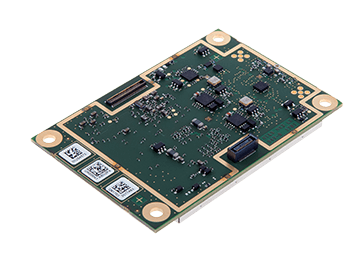
    Trimble has introduced its first dual-frequency embedded timing module that provides next-generation networks with 5-nanosecond accuracy.

    Surface mountable, the Trimble RES 720 GNSS timing module can be integrated into network equipment. It uses L1 and L5 GNSS signals to provide superior protection to jamming and spoofing, mitigates multipath in harsh environments, and adds security features to make it suitable for resilient networks.

    Precise timing and synchronization optimizes and improves wireless network performance. At 19 x 19 millimeters, the RES 720 module provides a low-cost, easy-to-use, highly accurate and reliable GPS timing source for critical infrastructure in a broad range of industries. The RES 720 is suitable for 5G Open RAN/XHaul, smart grids, data centers, industrial automation and satellite communication networks, as well as calibration services and perimeter monitoring applications.

    The RES 720 meets the resilient timing requirement mandated by the U.S. 2020 Executive Order (EO13095) for timing services and critical infrastructure operators. Using dual-frequency (L1 and L5), RES 720 provides better multipath detection capabilities than single frequency, and provides protection against signal jamming and spoofing. Multi-band capability helps compensate for the ionospheric error from multi-GNSS satellite constellations, while reducing the timing error under clear skies to less than 5 nanoseconds. To further improve its accuracy locally, the RES 720 module features differential timing modes for highly accurate local timing.

    Powered by Trimble’s Smart GNSS Assurance technology, the RES 720 offers protection against jamming and hacking of signals with automatic fallback to available GNSS signals. Infrastructure equipment suppliers, system integrators and network operators can benefit by integrating highly accurate synchronization capabilities into their network and synchro-phasor devices, while enabling resilient timing for critical infrastructure.

    The RES 720 is expected to be available in the second quarter of 2021.

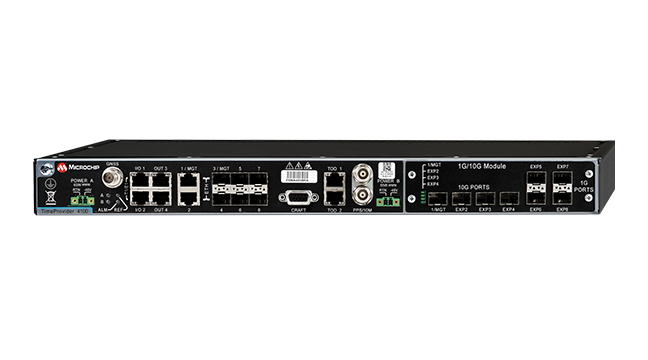
  • Microchip TimeProvider 4100 Grandmaster now more redundant, resilient

    Microchip TimeProvider 4100 Grandmaster now more redundant, resilient

    IEEE 1588 precise timing grandmaster with gateway clock now offers software-based redundancy

    Photo: Microchip
    Photo: Microchip

    For today’s critical infrastructure providers — 5G wireless networks, smart grids, data centers, cable and transportation services — a fundamental need exists for a redundant, resilient and secure precise timing and synchronization solution.

    Microchip Technology Inc.’s TimeProvider 4100 Release 2.2 grandmaster provides a new level of resiliency with the introduction of an innovative redundancy architecture in addition to support for a multi-band GNSS receiver and enhanced security to ensure always-on precise timing and synchronization.

    Redundancy is key for infrastructure providers to ensure uninterrupted services. Infrastructure deployments previously relied on hardware redundancy to avoid service disruption despite costly modular architectures. Microchip’s TimeProvider 4100 Release 2.2 grandmaster provides redundancy via software implementation, enabling flexible deployment and lower hardware costs without sacrificing ports.

    In addition, the TimeProvider 4100 Release 2.2 grandmaster introduces an increased level of resiliency by supporting a new GNSS multi-band, multi-constellation receiver to protect against time delay resulting from space weather, solar events and other disruptions that may impact critical infrastructure services.

    Multi-band GNSS is particularly important for the highest levels of accuracy, including primary reference time clock class B (PRTC-B, 40 ns) and enhanced primary reference time clock (ePRTC, 30 ns).

    With a focus on security solutions across its technology portfolio, Microchip’s new TimeProvider 4100 Release 2.2 grandmaster adds support for RADIUS and TACACS+ as well as new anti-jamming and anti-spoofing capabilities.

    “Resilient, redundant and secure precise timing and synchronization solutions are necessary to mitigate security risks to critical infrastructure,” said Randy Brudzinski, vice president and general manager of Microchip’s frequency and time business unit. “This latest release brings an innovative software redundancy that enables always-on technology as well as support for multi-band GNSS to eliminate ionospheric time error delays. It provides new key security, anti-jamming and anti-spoofing so critical infrastructure services can be accessed only by authorized, authenticated personnel.”

    In addition, the TimeProvider 4100 Release 2.2 grandmaster provides a super oven controlled crystal oscillator (OCXO) option for enhanced holdover capabilities in case of GNSS disruption.

    The TimeProvider 4100 Release 2.2 grandmaster is a family of products with hardware expansion modules for legacy fan-out or Ethernet fan-out with 10 Gigabit Ethernet support. It can be configured in specific operation modes to act either as a gateway clock, a high-performance boundary clock or an ePRTC.

    The TimeProvider 4100 Release 2.2 grandmaster embeds additional Microchip technology including its OCXO, super OCXO, rubidium atomic clock, field-programmable gate arrays (FPGAs), Ethernet switch, synthesizers and cleaning oscillators.

    The TimeProvider 4100 is part of Microchip’s Virtual Primary Reference Time Clock (vPRTC) product portfolio, offering end-to-end precise time and synchronization solutions. These include Cesium atomic clocks for source of frequency and time, the BlueSky GNSS Firewall for security, TimeProvider 4100 high-performance boundary clock and TimeProvider 4100 Gateway clocks, as well as the TimePictra software suite, which manages the end-to-end precise time architecture across all Microchip timing products.

    Microchip’s TimeProvider 4100 Release 2.2 grandmaster offers several options for software and hardware support including installation, sync audits, network engineering and 24/7 worldwide support. It is available now for both new and already-deployed systems.

  • Raytheon Intelligence & Space delivers 3,000th GPS receiver

    Raytheon Intelligence & Space delivers 3,000th GPS receiver

    Raytheon Intelligence & Space, a Raytheon Technologies business, delivered its 3,000th MAGR 2000-S24 GPS system to the U.S. Air Force. The MAGR2K is a secure, resilient GPS receiver that allows the warfighter to navigate the battlespace with protection against interference and jamming.

    The MAGR2K is an upgrade to the legacy miniaturized airborne GPS receivers and is in service aboard 20 types of fixed-wing and rotary-wing platforms from Department of Defense and Foreign Military Sales customers.

    “In the battlespace, disruptions to navigation are not an option,” said Eric Ditmars, vice president of Secure Sensor Solutions at RI&S. “Our MAGR2K GPS receivers enhance GPS acquisition and performance ensuring military forces reliable and assured GPS data they can act on. Delivery of the 3,000th unit is a significant milestone for our team.”

    Raytheon Intelligence & Space continues to upgrade the MAGR2K technology to stay current with the evolving battlespace. Development is underway for the MAGR-2K-M, which uses the company’s M-code technology.

    The first production readiness units are undergoing platform integration on the U.S. Air Force’s B-2 platform.

    B-2 Spirit multi-role bomber capable of delivering both conventional and nuclear munitions. In December 2017, the Air Force completed a series of successful flight tests of M-code GPS using a Raytheon Company receiver on board a B-2 Spirit at Edwards Air Force Base, California. (Photo: U.S. Air Force/Bobby Garcia)
    B-2 Spirit multi-role bomber capable of delivering both conventional and nuclear munitions. In December 2017, the Air Force completed a series of successful flight tests of M-code GPS using a Raytheon Company receiver on board a B-2 Spirit at Edwards Air Force Base, California. (Photo: U.S. Air Force/Bobby Garcia)
  • NovAtel ships GPS anti-jam GAJTs worldwide

    NovAtel ships GPS anti-jam GAJTs worldwide

    NovAtel’s GPS Anti-Jam Technology (GAJT) product lines achieved a milestone of thousands of units shipped worldwide in 2020. Despite COVID-19, 2020 has proven to be one of NovAtel’s most successful years in protecting positioning, navigation and timing (PNT) from cyber electromagnetic activities (CEMA) for military and civil organizations, the company stated in a press release.

    Jamming and interference are growing threats, from a crowded RF spectrum to malicious jamming attempts. However, the GNSS market is responding with anti-jam technologies. Across the world — on land, in the air and at sea — NovAtel customers use GAJT to protect their GNSS navigation and precise timing receivers from intentional jamming and unintentional interference.

    The GAJT portfolio includes commercial off-the-shelf solutions with short order lead times for rapid deployment. The range of products can be readily integrated into new platforms or retrofitted into legacy fleets.

    Photo: Hexagon | NovAtel
    Photo: Hexagon | NovAtel

    The GAJT-710, its smaller counterpart GAJT-410 and the GAJT-AE variants are used worldwide to protect PNT against jamming and interference no matter the environment.

    Beyond defense, GAJT enables users to be proactive against cyber electromagnetic activities using situation awareness technology to indicate the presence and direction of jamming signals.

    “Jamming and interference are growing threats worldwide. GAJT protects our customers no matter where they operate,” said Steve Duncombe, executive VP of Aerospace and Defense at NovAtel. “We’re proud to achieve this milestone during a challenging 2020 and will continue delivering assured positioning in our customers’ critical applications with extremely short delivery times.”

  • Quantum Reversal adds new GNSS anti-jam units to product offerings

    Quantum Reversal adds new GNSS anti-jam units to product offerings

    The QR100 and QR201 anti-jamming devices. (Photo: Quantum Reversal)
    The QR100 and QR201 anti-jamming devices. (Photo: Quantum Reversal)

    Quantum Reversal has added several new models to its flagship anti-jamming line. The company introduced in February the QR100 L1/L2 GPS anti-jamming unit and the QR101 L1/L2 GPS anti-jamming antenna.

    The current solution consists now of five products designed for the commercial market to solve the issue of unintentional RF interference or jamming:

    • QR100 – GPS dual frequency L1/L2 anti-jamming unit
    • QR200 – GPS dual frequency L1/L2 anti-jamming antenna
    • QR101 – GNSS multi frequency bands anti-jamming unit
    • QR201 – GNSS multi frequency bands anti-jamming antenna
    • QR202 – GNSS multi frequency band anti-jamming antenna with additional L-band reception
      (1520-1560 MHz)

    All models provide robust GPS or GNSS navigation solution, blocking intentional jamming and unintentional RF interference for services such as timing or 3D positioning.

    All the products are lightweight (230 grams for QR1xx series and 500 grams for QR2xx series) with low power consumption (1-1.5 Watt typically, depending on the configuration), and can be mounted on any platform (cars, poles, drones, etc.).

    Quantum Reversal operates in the information and wireless technology sector, developing innovative wireless and antenna technologies for various commercial markets. The QR team has experience designing products for applications in space, underwater, robotics and unmanned aerial vehicles (UAVs) for the commercial and user end. Each application requires a specific solution to deal with specific environmental (pressure, temperature, vibration, etc.) and operational conditions.

    The company sells stand alone products as well as OEM products that can be integrated within the customer products.

  • ComNav releases cost-effective M300 Plus GNSS CORS receiver

    ComNav releases cost-effective M300 Plus GNSS CORS receiver

    ComNav Technology has released the M300 Plus GNSS receiver to the international market.

    The M300 Plus is designed to supplement the company’s M300 Pro, which is aimed at clients who need a more economical version for their CORS networks. The M300 Plus not only can be used as a CORS receiver, but is a good choice for monitoring projects and other applications.

    With ComNav Technology’s new-generation GNSS engine, the M300 Plus can track all current and future constellations. By using a powerful, adaptive detecting and canceling technology, the M300Plus provides enhanced anti-jamming capability, which is critical for a reference station providing reliable GNSS data.

    Photo: ComNav
    Photo: ComNav

    The M300 Plus’ powerful built-in web server provides full remote control of the receiver configuration, status checking, firmware update and data download. It supports multiple independent data transfer through TCP/UDP/Ntrip protocol in RTCM, ComNav binary, NMEA and BINEX data formats, combined with Email Alert and FTP push, which improves the efficiency and profitability of businesses.

    In addition to its standard Ethernet port for data transmitting, the M300 Plus GNSS receiver also fully implements a 4G module as an internet backup, which enhances the stability of data connections.

    M300 Plus is now available through ComNav Technology authorized local distributors or ComNav Technology directly.

  • New Septentrio receiver integrates correction service

    New Septentrio receiver integrates correction service

    Photo: Septentrio
    Photo: Septentrio

    Septentrio has unveiled the AsteRx-m2 Sx OEM board, which provides a GPS/GNSS receiver with always-on sub-decimeter accuracy without the need for additional correction service subscriptions.

    With the AsteRx-m2 Sx, Septentrio is pioneering a novel approach to high-accuracy positioning. Its latest core GNSS technology is integrated with a sub-decimeter correction service enabling simple plug-and-play positioning solutions.

    High-accuracy positioning is available directly out of the box as GNSS corrections are automatically streamed to the receiver. This significantly simplifies the receiver set-up process and eliminates the hassle of corrections service subscription and maintenance.

    “This product marks a new step for GNSS technology towards convenience and ease-of-use,” said Danilo Sabbatini, product manager at Septentrio. “By integrating the correction service directly into the GNSS receiver, we are removing the hassle of positioning service set-up and maintenance from the user. This means faster set-up times for our customers and worry-free, always-on high-accuracy positioning throughout the receiver lifetime.”

    The AsteRx-m2 Sx is an efficient positioning solution for small robots, aerial drones and automation applications. Its optimized size, weight and power (SWaP) means longer operation on a single battery charge and better value in the field, according to Septentrio.

    Advanced anti-jamming technology AIM+ ensures robust and reliable operation in challenging environments, even in the presence of RF interference.

    Septentrio is offering a free GNSS corrections webinar on July 8 at  5 p.m. CEST/ 8 p.m. PST.

  • Quantum Reversal releases GPS L1/L2 anti-jamming unit and antenna

    Quantum Reversal releases GPS L1/L2 anti-jamming unit and antenna

    Photo: Quantum Reversal
    Photo: Quantum Reversal

    Quantum Reversal has released the QR100, a novel L1/L2 GPS anti-jamming unit, and the QR101, an  L1/L2 GPS anti-jamming antenna, designed for the commercial market to solve the issue of unintentional RF interference or jamming.

    The QR100 uses three external passive or active GPS antennas of the user’s choice, while the QR101 has three passive L1/L2 antennas embedded inside the enclosure. Low power consumption of 1 Watt and low cost allow for a wide range of applications where the continuity of GPS service is a must.

    “Clever RF signal nulling in the RF domain allowed us to eliminate the need for signal processing, and hence, significantly reducing the power consumption when compared to existing military solutions,” said Waldemar Kunysz, Quantum Reversal President and CTO.

    The technology prevents the RF front-end from saturation when the interfering signal is very strong due to its power or close proximity to the antenna. This extends the range of the operation for mobile applications and reduces susceptibility to nearby sources of interference for any type of fixed installations.

    Learn more at the company’s website.