Tag: construction

  • DT Research’s new military-grade tablet has RTK GNSS

    DT Research’s new military-grade tablet has RTK GNSS

    DT Research has released the DT301T rugged RTK tablet (DT301T-RTK), a lightweight military-grade tablet purpose-built for GIS mapping applications. It features real-time kinematic (RTK) satellite navigation to enhance the precision of GNSS position data.

    The tablet enables 3D point cloud creation with centimeter-level accuracy, meeting the high standards required for scientific-grade evidence in court.
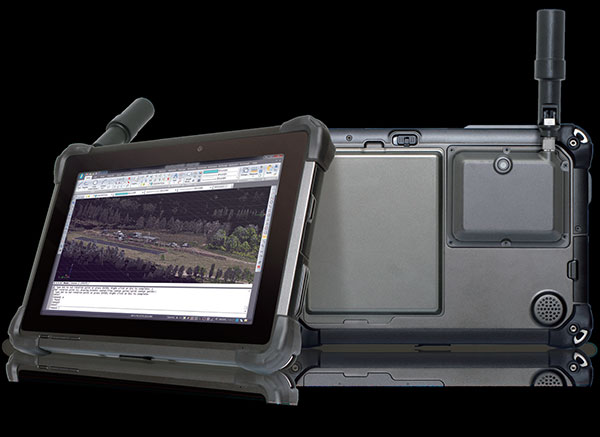
    The DT301T-RTK is a rugged tablet with scientific-grade GNSS. (Photo: DT Research)

    The DT301T Rugged RTK tablet is military-grade with an IP65 rating. Because it’s lightweight, the DT301T can be used in the field, office and vehicles, the company said.

    A dual-frequency GNSS module is built into the tablet, which uses real-time reference points within 1–2-centimeter accuracy to position 3D point clouds created from aerial photogrammetry, using GPS, GLONASS and Galileo receivers. Users can measure with the RTK GNSS positioning directly using a foldable antenna or connect to an external antenna for more robust receiving and survey-grade precision.

    “We’ve seen a dramatic uptick in the need for rugged tablets to be purpose-built for a range of mapping uses across industries,” said Daw Tsai Sc.D., president of DT Research. “In designing the DT301T with RTK satellite navigation, we also took into consideration the other features and capabilities necessary within a rugged tablet to quickly and easily conduct forensic mapping, land surveying, e-construction, building information modeling (BIM) and other mapping scenarios.”

    The DT301T is compatible with existing GIS software for mapping applications and brings together the advanced workflow for GIS data capture, accurate positioning and data transmitting.

    Uses

    According to DT Research, the tablet can be used in a variety of scenarios.

    Forensic mapping. Public safety teams, investigators and crash reconstructionists can use the DT301T Rugged RTK tablet to accurately collect measurements that are scientifically defensible by using the real-time centimeter reference points to position 3D point clouds created from aerial photogrammetry or take stand-alone measurements.
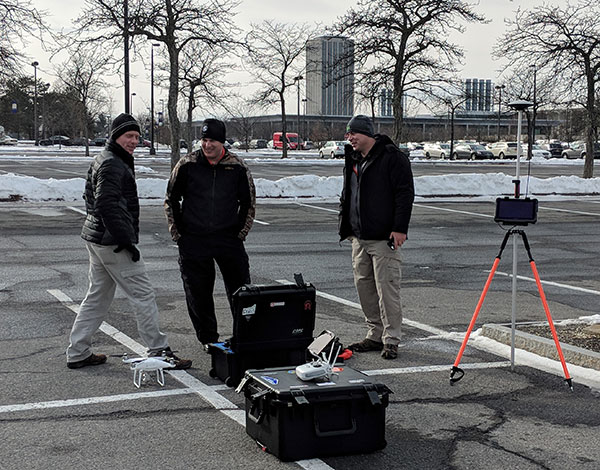
    DT301T-RTK tablet during forensic mapping training. (Photo: DT Research)

    The results will have the precision necessary to stand up as evidence in court, said Andrew S. Klane, a former Massachusetts State Police Lieutenant who teaches Forensic Mapping and is now the chief operating officer at Forensic Mapping Solutions Inc.

    “As more drones are being used for mapping, there is a growing need for ground-control positioning devices,” Klane said. “By using a DT301T Rugged RTK Tablet in combination with a drone, users can more quickly and cost-effectively create a 3D model to deliver an accurate representation of the scene with scientific-grade tolerance that will hold up in a court of law.”

    It could also help clear crash scenes faster, restoring the normal flow of traffic on congested roadways, reducing secondary crashes and lowering the chance of first responders and other workers getting hurt while clearing the scene.

    Land surveying. Surveyors can use the DT301T tablet to measure the altitudes, angles and distances on the land surface so that they can be accurately plotted on a map to determine property boundaries, construction layout and mapmaking.

    E-construction. Construction workers can manage the collection, review, approval and distribution of highway construction contract documents in a paperless environment using the DT301 tablet.

    Building information modeling (BIM).  Architecture, engineering, and construction (AEC) professionals can use the tablet to create 3D models to efficiently plan, design, construct and manage buildings and infrastructure.

    FEATURES

    The DT301T Rugged RTK tablet has been purpose-built for precision mapping in a variety of environments and includes the following features and capabilities:

    • Dual-frequency GNSS module: GNSS L1 and L2 RTK that receives GPS, GLONASS and Galileo signals up to 372 channels with RMS 10 mm + 1 ppm accuracy.
    • High-performance CPU and Windows OS: Intel 6th-generation core i5 or i7 processor with Microsoft Windows 7 Professional or Windows 10 IoT Enterprise. Units come with either 8 GB or 16 GB of RAM.
    • Sunlight-readable display: A 10.1 inch LED-backlight, sunlight-readable screen with capacitive touch and 1920 x 1200 resolution.
    • Wireless connectivity: Long-range Class 1 Bluetooth powers connectivity up to 1,000 feet and 4G mobile broadband for LTE, HESPA+, GMS/GPRS/EDGE, EV-DO, Rev A and 1xRTT.
    • Storage: For field data collecting, the tablet can store up to 1 terabyte of data.
    • Military standards: The tablet is fully ruggedized to meet the highest durability standards with an IP65 rating, MIL-STD-810G for vibration and shock resistance, and MIL-STD-461F for EMI and EMC tolerance.
    • Battery pack: High-capacity hot-swappable battery pack delivers 60 or 90 watts for up to 15 hours of continuous mobile communications.
    • Accessories: Those available include external antennas, pole mount cradles, detachable keyboards, battery charging kits and digital pens.

  • Trimble acquires e-Builder to expand construction management solutions

    Trimble has acquired privately-held e-Builder, a software-as-a-service (SaaS)-based construction program management solution for capital program owners and program management firms.

    e-Builder extends Trimble’s ability to accelerate industry transformation by providing an integrated project delivery solution for owners, program managers and contractors across the design, construct and operate lifecycle, the company said.

    e-Builder manages more than $300 billion of construction project value and over 200,000 projects from some of the most influential owners in North America. Owners benefit from the e-Builder solution through improved transparency and accountability while contractors benefit from faster payments, increased productivity and improved competitive advantage.

    The e-Builder solution is uniquely designed to measure and manage every step of the capital project delivery process including planning, design, procurement, construction and operations.

    Trimble’s wide range of construction hardware and software solutions significantly improve project cost, schedule and effectiveness — beneficially impacting owners, architects, engineers and contractors. The Trimble presence in construction has two points of focus, one on civil engineering projects and the other on the construction of buildings and structures. Both will benefit from the e-Builder acquisition.

    Trimble solutions leverage constructible building information model (BIM) workflows to integrate processes, improve information fidelity, reduce rework, establish transparency and deliver higher productivity. By using Trimble technologies, contractors and owners are realizing substantial reductions in total project cost.

    The combination of Trimble and e-Builder accelerates value creation for both owners and contractors by combining e-Builder’s best practice solutions for owners with Trimble’s construction lifecycle solutions, access to contractors and global reach.

    The combined solution portfolio will accelerate the integration of field operations with enterprise needs, enabling additional productivity gains. The tangible benefits include more consistent on-time and within-budget project delivery that is enabled by improved visibility, clear accountability for outcomes and the ability to convert large volumes of disparate data into actionable workflows and measurable outcomes.

    “e-Builder has always recognized that owners play a key role in the construction lifecycle and that their influence will be key to the adoption of transformative construction technology,” said Steven Berglund, president and CEO of Trimble. “Trimble will extend its reach into the owner community by leveraging e-Builder’s presence. In turn, we intend to aggressively bring e-Builder solutions to civil and building contractors and the international market. We see a significant opportunity in leveraging data and intelligence gained through design-construct workflows across the full infrastructure lifecycle. e-Builder’s solutions and, more importantly, its organization provide a strong platform for significant growth.”

    “e-Builder’s mission is to improve project execution to make construction faster, less expensive and more reliable,” said Ron Antevy, president and CEO of e-Builder. “The addition of our solutions to Trimble’s broad portfolio extends our collective ability to best support owners and contractors with project delivery and management. e-Builder current and future customers will benefit from Trimble’s construction management expertise, culture of innovation and global reach to take e-Builder solutions to the next level.”

    The e-Builder business will be reported as part of the Buildings and Infrastructure Segment.

    Financial Terms

    The all cash purchase price of $500 million will be financed through a new $300 million credit facility and cash. The new facility has terms and conditions similar to the existing revolver with a 364 day term.

    e-Builder’s reported trailing twelve month revenue is approximately $53 million. In recent years, e-Builder’s revenue growth rate has exceeded 20 percent annually, with greater than 65 percent subscription revenue as a percentage of total revenue. The transaction is expected to be dilutive to Trimble’s first quarter non-GAAP net income per share by $0.01 per share and dilutive to full year 2018 non-GAAP net income per share by $0.02 to $0.03 per share, due to the impact of fair value accounting of e-Builder’s deferred revenue and interest expense. Trimble expects the acquisition to be accretive to 2019 non-GAAP net income per share.

    An overview of e-Builder and the strategic rationale for the acquisition is available on Trimble’s Investor Relations website. For a more detailed description of the acquisition and credit agreements see Trimble’s Form 8-K filed with the U.S. Securities and Exchange Commission (SEC) on Feb. 2, 2018.

    About e-Builder

    Founded in 1995, e-Builder is a provider of integrated, cloud-based construction program management software for top facility owners and the companies that act on their behalf.

    The company’s flagship product, e-Builder Enterprise, improves capital project execution, resulting in increased productivity and quality, reduced cost and faster project delivery.

    Since 1995, e-Builder’s technology leadership and construction industry focus have helped thousands of global companies, government agencies, and health care and educational institutions manage billions of dollars in capital programs with solutions to improve the plan, build and operate lifecycle.

    The company is based in Plantation, Florida.

  • NVIDIA Jetson takes to the sky to improve worksite visualization

    Komatsu plans to introduce NVIDIA graphics processing units (GPUs) to its SmartConstrution jobsites. The GPUs will communicate with drones from Skycatch, a Komatsu partner, which will collect 3D images, generate terrain data and “visualize” site conditions.

    Komatsu is deploying the artifical intelligence (AI) project as an extension of its SmartConstruction initiative in Japan; the drone-assisted, automated equipment service was launched to alleviate the burden of the country’s severe shortage of skilled workers.

    The company has deployed SmartConstruction at than 4,000 jobsites across the country, and the AI extension will be integrated into those sites.

    Working with NVIDIA, OPTiM Corp. — another Komatsu partner and an internet of things management software company — will provide an application to correlate terrain data to jobsite workers and construction machines for visualization.

    Enter Jetson. At the center of this collaboration is the NVIDIA Jetson artificial intelligence platform. When Jetson, which works with NVIDIA’s cloud technology, is installed in construction machines, it will be able to provide 360-degree images, enabling prompt recognition of workers and other machines nearby. The technology could potentially decrease fatalities that result from workers being struck by an object, piece of equipment or vehicle.

    Jetson will also be used with the stereo cameras installed in the cabs of construction equipment, and will recognize continuously changing jobsite conditions on a real-time basis, to better provide accurate instructions to machine operators.

    Future plans call for use not only for automatic control of devices, but also for high-resolution rendering and virtual simulation of construction and quarry jobsite operations.

  • Handheld launches Nautiz X9 rugged Android PDA

    Handheld launches Nautiz X9 rugged Android PDA

    Image: Handheld
    Image: Handheld

    Handheld Group has launched the Nautiz X9, an ultra-rugged enterprise handheld built for fieldwork in challenging outdoor or industrial environments. It can be used as a mobile computer, data collector or field controller, the company said.

    The Nautiz X9 offers:

    • A quad-core processor and easy-to-use Android 7 (Nougat) OS.
    • GPS/GLONASS capabilities standard.
    • Optional high-quality, high-speed 2D imager.
    • Dual cameras including 13-megapixel rear-facing with autofocus and flash, and 2-megapixel front-facing.
    • 4G/LTE Android phone functionality.
    • Google GMS for Google Maps navigation and Play Store app access.
    • A sunlight-readable 5-inch capacitive display with multi-touch sensitivity.
    • IP67 ruggedness rating for waterproof, dust-tight performance.

    The Nautiz 9 is MIL-STD 810G tested for drops, vibrations, humidity, extreme temperatures and varying altitudes.It has a fast 1.3-GHz processor with 2-GB RAM and 16-GB Flash. The 4800-mAh battery will run for a full shift, even with heavy use.

    “Adding the Nautiz X9 to our family of products reflects our commitment to bringing truly rugged field devices to market,” said Johan Hed, Handheld Group director of product management. “The Nautiz X9 also extends our wide Android offerings, which have been in increasingly high demand. GMS certification is an extra feature not always included in enterprise devices, but it has proved to be invaluable for our customers, giving them access to the full suite of Google applications. The reliability and toughness of the Nautiz X9 will bring great value to field users worldwide.”

  • Topcon, Bentley Systems kick off Constructioneering Academy

    Topcon Positioning Group and Bentley Systems announced the kick-off date of their collaborative Constructioneering Academy initiative. The first session is scheduled for Feb. 13 in Livermore, California.

    Topcon and Bentley have joined efforts to provide opportunities designed to allow construction industry professionals to learn best practices in constructioneering, a process of managing and integrating survey, engineering and construction data, to streamline construction workflows and improve project delivery.

    “The courses are designed in a dialogue format to allow Topcon and Bentley personnel to interact directly with attendees to cater the experience for their specific questions and demands,” said Ron Oberlander, senior director of Topcon Professional Services. “The future of construction automation continues to move forward with constructioneering digital workflows, which make the work of surveyors, engineers, and construction professionals automated, continuous, and continuously more valuable, throughout project lifecycles and beyond completion.”

    “Topcon and Bentley’s federated constructioneering technologies enable firms to gain unprecedented digital visibility and insights into their project outcomes, as compared to traditional construction workflows. Attendees of our Constructioneering Academy will learn how their organizations can improve project delivery by leveraging constructioneering technology, methods, and best practices to execute their projects more efficiently, monitor construction performance and progress, and reduce project costs,” said Vinayak Trivedi, Bentley Institute vice president.

    The Constructioneering Academy will continue with additional sessions throughout learning centers located worldwide designed to reach industry professionals with hands-on training in real-world scenarios and workflows.

    To register, visit constructioneering.com.

  • Tersus kits include centimeter-accurate GNSS OEM RTK boards

    Tersus kits include centimeter-accurate GNSS OEM RTK boards

    Tersus GNSS Inc., a GNSS positioning solution provider, has introduced three new GNSS kits. The BX305, BX306 and BX316 HRS kits feature high-precision BX305, BX306 and BX316 GNSS RTK boards.

    The HRS kits consist of RTK receivers, GNSS antennas, RS05R radio station modems, radio station antennas, and related cables and converters.

    Embedded in the receivers are the Tersus RTK boards. They are compact-design, energy-efficient, centimeter-level accurate GNSS real-time kinematic (RTK) boards, bringing high-precision positioning accuracy to the market, the company said.

    Different from the standard BX305/306/316 GNSS kits, the new HRS versions are equipped with RS05R, lightweight and robust UHF, which is a rover radio solution for wireless application.

    It provides reliable data communication for demanding conditions that require a combination of stability, high performance and long-range operation.

    With complete components and accessories in the kits, they can be used in a variety of applications, such as unmanned aerial vehicle (UAVs), surveying, mapping, precision agriculture, construction engineering and deformation monitoring.

    Tersus GNSS BX316-HRS kit. (Photo: Tersus)
    Tersus GNSS BX316-HRS kit. (Photo: Tersus)
  • Drone platform guides earthworks projects

    Drone platform guides earthworks projects

    Kespry now offers a suite of capabilities that extends the value of aerial intelligence to the full life cycle of planning, bidding and managing earthworks projects in the major site construction industry.

    The company is focused on making it easier to capture, process, use and share high-resolution information from the field with its fully autonomous aerial intelligence system.

    Capabilities include grade planning and analysis, site and surface comparison including cut/fill visualization, and design plan development and compliance.

    Compared to other drone mapping solutions, the earthworks-specific tools enable construction companies to more accurately plan the work, improve their cost structure, and deliver safer working environments through frequent analysis of changes to the site, according to Kespry.

    The new capabilities are a result of customer and partner feedback, including from John Deere, dealers and clients.

    The new earthworks capabilities provide:

    • Faster and more accurate production of earthwork grading plans through on-demand drone data capture and analysis. Mass haul plans can be easily developed before projects begin with an entire site mapped and analyzed in hours. New tools also enable haul road planning to support more efficient site planning.
    • Reduced costs for grading project bids, with project estimates delivered faster than with traditional estimating techniques. Ongoing operational costs are also reduced with on-demand cut/fill analysis enabling close management of the project and specific bid requests.
    • More efficient and safer project operations with progress comparisons delivered through daily drone flights. This enables design plan comparison through project plan overlay onto Kespry data, reducing the complexity and cost of rework. Safety can also be improved through close monitoring of change and analysis of grades around the site.
  • Delair unveils large-area mapping drone

    The UX11 drone from DelAir.

    Commercial drone-maker Delair has introduced a professional unmanned aerial vehicle (UAV) for survey-grade photogrammetric mapping.

    The UX11 is a small fixed-wing UAV that combines a powerful integrated onboard system, industry-grade sensors, limitless communication range and PPK centimeter-level positioning. It  carries enough onboard computing power to access and process the pictures, then sends them to the operator in real-time.

    According to the company, it will run automated quality checks on the images (such as blur detection or overlap checks) to help ensure the operator is acquiring quality data.

    The UX11’s redundant communications system includes a proprietary line of sight radio and 3G/4G connectivity between the ground control station and the UAV using a worldwide machine-to-machine pre-paid plan.

    Building on Delair’s experience with beyond visual line of sight (BVLOS) operations since 2012, the UX11 is ready for BVLOS flights with unlimited range and adds a new level of safety with this communication link.

    The UX11 is lightweight, ultra-stable, simple to hand-launch at takeoff and it lands precisely where planned using distance measuring technology. New user-friendly Android mission planning software boasts innovative features such as support for in-flight camera feedback and live data review, the company said.

    Made to help professionals in GIS, survey, and construction optimize area coverage per flight, the UX11 flies for 59 minutes with the best coverage and resolution specifications in its class for flights at 122 m (400 ft) altitude above ground level. The UX11 will be available for purchase via DELAIR’s global network of distributors by January, 2018.

    The UX11 is a product offer for data acquisition which can be complemented by data processing and analytics software programs to address a range of commercial applications. Geospatial users can create 2D and 3D models and then generate elevation profiles, contour lines, slope qualifications and volumetric estimates with high accuracy and resolution using post-processed kinematic data and ground-control points.

  • Sharper Shape, SkySkopes string transmission lines using drones

    A pair of companies is using unmanned aircraft systems (UAS) for powerline construction.

    Sharper Shape, a drone-based automated inspection provider, and SkySkopes, a professional UAS flight operator, took on a project in cooperation with an investor-owned utility.

    Photo: Sharper Shape
    Photo: Sharper Shape

    The mission used the Sharper A6 UAS to string sock lines for a 675-kilovolt line construction project.

    Sock pulling, the act of flying a strong and lightweight rope and attaching it to the towers, is typically performed via helicopters or by workers climbing the towers.

    Both these methods involve risk to both helicopter pilots and ground crews. The use of UAS is eliminating the previously complex process — consisting of several steps of reattaching the rope — and decreasing the risk of injury for people involved.

    The mission highlighted how UAS are a safe and effective option for many applications in the utility industry beyond basic inspections, according to Matt Dunlevy, CEO and president of SkySkopes.

    “This is a great proof of concept for unmanned aircraft because we proved that they can string both the outboard lines and the center line through the middle of the center phase of a tower,” Dunlevy said. “There are risks associated with both helicopter and tower climbing methods. Now there is another option as proven by Sharper Shape and SkySkopes.”

    Photo: SkySkopes
    Photo: SkySkopes

    “When the utility first reached out there were lots of unknowns,” said Paul Frey, director, electric utilities for Sharper Shape. “Working as a team, we pulled together, developing a test plan and executing the flights.”

    The team modified a heavy-lift small UAS to carry line, and then ran five test flights to test objectives related to pulling the line through each of the tower phases and setting the line on the center pulley.

    SkySkopes’ pilots are trained for difficult missions, often flying advanced heavy-lift multi-rotor aircraft with precision where autonomy is impractical.

  • Topcon upgrades SmoothRide road data-collection software

    Topcon Positioning Group is updating its data-collection software for the SmoothRide resurfacing workflow solution. RD-M1 Collect 2.0 includes updates designed to facilitate and optimize mapping of road conditions.

    Topcon is exhibiting at Intergeo 2017 in Hall 2.1, Booth A2.008, and in Hall FG, Booth 005. Intergeo takes place Sept. 26-28 in Berlin, Germany.

    The improvements feature an improved interface that is designed to simplify setup and automatically detect the position of the wheel sensor during data collection, the company said.

    An RD-M1 Collect 2.0 graphical interface status bar indicates the optimum speed for collecting road information based on project requirements, helping the software deliver the best results for the project.

    Memos is a new feature designed to allow operators to create balloons with messages on the map while collecting data that also can be made visible in the processing software, enabling specific site conditions to be noted for future reference.

    The new Manage Runs feature is designed to enable operation without necessitating Windows explorer to be open.

    Large buttons make using a tablet or laptop with touchscreen easy. Operators can copy data collections to a USB drive, delete them from the hard drive, and add or remove them from the manager.

    The RD-M1 Collect 2.0 new Plan Route feature allows for the import of kml files of predetermined routes, designed to ensure nothing is missed on the drive.

    Using the new map downloader, operators can have all map details visible while collecting data, without an internet connection. Overlapping locations can be managed by creating areas where predefined overlaps are required for the project.

  • Hexagon presents solutions for geospatial, construction industries at Intergeo

    Hexagon AB showcased its geospatial and construction portfolio at Intergeo 2017 in Berlin, Germany.

    Hexagon’s sensor portfolio combined with a range of software creates solutions that support the geospatial and construction industries.

    According to the company, visitors were able to explore a number of solutions, including mobile mapping; asset collection and management for geographic information systems (GIS); 3D laser scanning; photogrammetry; remote sensing; airborne sensors and unmanned aerial vehicles (UAVs); global positioning and monitoring like GNSS; construction project controls and progress documentation; utility detection; measurement software and cloud-based dynamic mapping. Hexagon will be at booth A1.024 in Hall 1.1.

    “Hexagon is focused on creating smart digital realities,” said Hexagon President and CEO Ola Rollén. “At Intergeo, we will demonstrate the productivity and savings that can be realized from digitalizing customer workflows, automating processes and ensuring all stakeholders have access to dynamic, critical information.”

    During the conference portion of Intergeo, Hexagon executives addressed the growing need for digitalization in geospatial and construction industries:

    • Transformation through digitalization. Hexagon Geosystems President Juergen Dold provides the Intergeo opening keynote exploring the need for businesses to transform from efficient digitisation to connected digitalisation for continued progress.
    • The power of combining cost, schedules and models in the cloud. Director of Global Business Development for HxGN SMART Build at Hexagon PPM, Cathi Hayes, explains how SMART Build integrates model, schedule, cost and digital layout capabilities into a single solution that addresses the most critical phases of construction planning and execution.
    • Hexagon integrated solution for utility detection and mapping. Leica Geosystems Construction Tools President Katherine Broder and IDS GeoRadar President Alberto Bicci present how to achieve high productivity in mapping utilities with Hexagon’s underground detection portfolio, including ground penetrating radar (GPR) solutions.
    • Escaping the flatlands. Hexagon Geospatial President Mladen Stojic envisions new and easier approaches that ingest the influx of data, use automated approaches to extract the signal from the noise and provide intuitive ways of communicating insights to decision makers and field teams so they can shape smarter change.
    • Connecting perceptions with reality in the world of BIM, GIS and survey. Leica Geosystems Laser Scanning Vice-President of Business Development Faheem Khan looks at the benefits of sensor fusion, the growth of digital reality solutions and how both are affecting project lifecycles in the real, digital world.
    • Streamlining UAV workflows for surveying, construction and inspection. Leica Geosystems Product Manager for UAV Solutions Valentin Fuchs and Leica Geosystems Director of Marketing and Communications for UAV Solutions Benjamin Federmann deliver a series of presentations and hands-on demonstrations on how Hexagon integrates UAVs as part of the technology tool kit to digitalise workflows.
  • Hemisphere debuts next-generation S321+ and C321+ GNSS smart antennas

    At Intergeo 2017, Hemisphere GNSS released its next-generation multi-frequency, multi-GNSS S321+ and C321+ GNSS smart antennas.

    The S321+ and C321+ are upgrades to the previous versions S321 and C321 and offer added benefits, according to the company. Powered by the Eclipse P326 OEM board, the smart antennas support 394 channels and can simultaneously track all satellite signals including GPS, GLONASS, BeiDou, Galileo and QZSS, making them robust and reliable.

    S321+ and C321+ come standard with two long-life lithium batteries providing up to 12 hours of operation. The batteries are hot-swappable, so users can change them without stopping work, maximizing efficiency and return on investment.

    The S321+ and C321+ GNSS smart antennas are being featured at the Hemisphere GNSS booth in Hall 2.1/stand C2.008 at Intergeo 2017 in Berlin, Germany, Sept. 26-28.

    The S321+ and C321+ combine Hemisphere’s Athena GNSS engine and Atlas L-band correction technologies with a new webUI, offering an unparalleled level of customer-friendly performance. The ruggedized antennas are designed for challenging environments; both meet IP67-standard requirements.

    The S321+ and C321+ come in two versions, with 4G LTE optimized for either North American or international locations.

    Powered by Athena GNSS engine, the S321+ and C321+ provide best-in-class, centimeter-level RTK. Athena excels in virtually every environment where high-accuracy GNSS receivers can be used. Tested and proven, Athena’s performs with long baselines in open-sky environments under heavy canopy, and in geographic locations experiencing significant scintillation.

    “The S321+ and C321+ represent the advanced technology, durability, and ease of use that our customers have come to expect,” said Miles Ware, director of marketing at Hemisphere GNSS. “By upgrading these systems with increased functionality and management capabilities, we are offering unbeatable value to the industry.”

    Atlas GNSS Global Corrections.
    The S321+ and C321+ ship pre-configured to test-drive corrections from Hemisphere’s Atlas L-band correction service. The bundled solution provides users worldwide with an easy way to utilize Atlas, including Hemisphere’s Atlas H10 service offering 8 cm 95 percent accuracy (4 cm RMS). They also use Hemisphere’s aRTK technology, powered by Atlas, which allows the receivers to operate with RTK accuracies when RTK corrections fail. If the S321+ and C321+ are Atlas-subscribed, they will continue to operate at the subscribed service level until RTK is restored.

    The S321+ is designed for use in applications such as land or marine survey, GIS, mapping, and construction. Together with SureFix, Hemisphere’s advanced processor, the S321+ delivers high-fidelity RTK quality information that results in guaranteed precision with virtually 100% reliability.

    The C321+ was designed specifically for construction environments, adding another system component that empowers heavy equipment manufacturers to deliver their own machine control and guidance solutions to their customers. The C321+ can also be paired with Hemisphere’s recently announced SiteMetrix site management software platform that helps manage all of your construction jobsite activities, including grade and volume checking.