Tag: construction

  • Topcon's new ES series total station has advanced data-transfer functionality

    Topcon_ES-60_Field-WTopcon Positioning Group announces the release of the latest addition to its ES total station series in the Americas, the ES-60. Featuring advanced reflectorless capabilities and an upgraded data-transfer functionality — the new ES-60 is designed to provide an entry-level total station option with a fast and powerful EDM.

    “The ES-60 is an excellent solution for customers looking for the dependability and accuracy of the ES series in an entry-level package,” said Ray Kerwin, director of global surveying products. “Incorporating all the time-honored expectations of the ES series along with a reflectorless EDM of up to 350 m, and 4000 m with a prism — the instrument also offers a USB option for quick and easy data transfer.”

    The ES-60 offers 2- and 5-arc second accuracies. “It’s ideal for land surveying, topography, construction layout, foundations and exterior job sites as well as as-built projects,” said Kerwin.

    Additional features include 10,000 points of memory, a battery life of up to 15 hours, dual axis compensation, a waterproof design and a laser pointer.

  • TerraGo partners with CompassTools on advanced GIS and GPS data collection

    TerraGo is partnering with CompassTools, a provider of integrated GIS, GPS and wireless solutions for field data collection across numerous industries, including government, utility, natural resources, transportation, architecture and construction.

    “We help our customers build the best bundled solution for their GIS and GPS goals, whatever they may be, and TerraGo’s mobile solutions give us the flexibility we need for the wide spectrum of accuracy, workflow and data collection requirements,” said Andrew Carey, manager of Geospatial Solutions at CompassTools. “TerraGo provides out-of-the-box integration for all the leading platforms, while enabling customizable precision, basemaps, forms and workflows, which fits well with our customer-focused approach.”

    “CompassTools helps organizations identify and implement the best combination of GPS receivers, hardware and software to meet their unique requirements,” said John Timar, vice president, Worldwide Sales, TerraGo. “TerraGo Edge and TerraGo Magic were designed from the ground up to support that type of customization; which makes it easy for customers to get the benefit of CompassTools’ expertise to help them deploy a solution tailored to their mission.”

    TerraGo is hosting a webinar on Tuesday, Feb. 14, at 12 p.m. ET with a live demonstration of mobile GIS and GPS solutions available from TerraGo and CompassTools.

  • Trimble introduces construction technology for small site and utility contractors

    Trimble introduces construction technology for small site and utility contractors

    Trimble is offering office software, site positioning and machine control solutions designed for site and utility contractors and owner/operators. These solutions offer small to mid-sized contractors a reliable, flexible and affordable option to leverage construction technology.

    The announcement was made at Trimble Dimensions.

    Office Software for Site Visualization and Layout

    Photo: TrimbleMany contractors already use SketchUp Pro for layout and visualization. SketchUp’s affordable price point and ease of use make it an ideal solution for small site and utility contractors who do not have a software specialist on staff.

    Now, SketchUp files can be exported to Trimble SCS900 Site Controller Software using the new Trimble Site Contractor extension for use in site positioning applications.

    Site Positioning

    Trimble Site Positioning Systems have also made significant improvements for smaller contractors. Trimble SCS900 Site Controller Software has introduced two new capabilities, EZ Level and BaseAnywhere.

    EZ Level replaces traditional laser transmitters with GNSS or total stations for easy elevation checking when no design is available. BaseAnywhere allows contractors to quickly set up their Trimble SPS585 GNSS Smart Antenna as a base station anywhere on the site, with no survey control necessary, making it much simpler and faster for a non-surveyor to use GNSS.

    In addition, corrections can now be streamed to the SPS585 using BaseAnywhere and Wi-Fi. No radio is needed, so smaller contractors have a very affordable way to receive GNSS corrections on site.

    Machine Control

    The Trimble GCS900 Grade Control System can now be installed on many skid steer loader grading attachments from a variety of manufacturers. The installation includes integration to the machine’s joystick controls, so contractors can take full advantage of the technology on their machine to increase productivity and accuracy.

    “Trimble has made it easier than ever for smaller contractors to take advantage of construction technology,” said Scott Crozier, director of marketing for Trimble’s Civil Engineering and Construction Division. “With office software, site positioning and machine control solutions designed to make the technology easier to use and more affordable, site and utility contractors are able to enjoy increased productivity gains and efficiency that larger companies benefit from today.”


  • Trimble and Hilti deliver integrated solutions for construction professionals

    Trimble and Hilti deliver integrated solutions for construction professionals

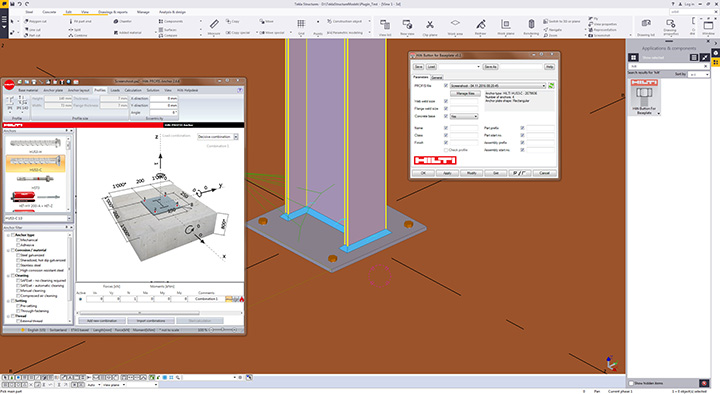
    Trimble  and the Hilti Group announced today that they are collaborating to deliver new software integration and data exchange solutions. These new integrated solutions provide a connected and improved digital experience for building construction professionals.

    The announcement was made at Trimble Dimensions.

    The Hilti PROFIS Plugin for Trimbe's Tekla Structures.
    The Hilti PROFIS Plugin for Trimbe’s Tekla Structures.

    New software and data exchange solutions include:

    • Sharing design information between software applications — Hilti PROFIS Plugin for Tekla Structures allows engineers and detailers to apply PROFIS design information directly in a Tekla Structures model through the Trimble Connect collaboration platform.
    • Easy access to data in the cloud — Hilti’s total stations POS 150/180 and PROFIS Layout Office solutions, and PROFIS detection solutions are now integrated with the Trimble Connect collaboration platform, enabling data to be easily exchanged and shared with others.
    • More design content, specification information and pricing at a user’s fingertips — Hilti has significantly increased its design content in the Tekla Warehouse to include anchors and cast-in solutions as well as providing more than 7,000 items through Trimble’s TRA-SER and LuckinsLive pricing services.

    Since 2010, Trimble and Hilti’s relationship has been built upon shared values that focus on a deep understanding of customer needs and harnessing innovation to develop value-added solutions that increase customer productivity.

    Hilti Corporation supplies the worldwide construction industry with technological products, systems, software and services.


  • Eos introduces photogrammetry software for drone photography

    Eos Systems Inc. has introduced new photogrammetry software optimized specifically for photographs taken with drones or unmanned aerial systems (UAS).

    The new PhotoModeler UAS 2016 creates 3D models, measurements, and maps from photographs taken with ordinary cameras built-in or mounted on drones. It has numerous features for operation with drone photos, including post processing kinematics (PPK), volume objects, full geographic coordinate systems support, multispectral image support and control point assist.

    Eos Systems will be showcasing PhotoModeler UAS Oct. 31 to Nov. 2 at the Commercial UAV Expo in Las Vegas, and will offer the new software at 35 percent off the normal price Nov. 1-30.

    eos-photogrammetry-wThe new version of PhotoModeler is suited for drone photogrammetry applications, including surveying, ground contouring, surface model creation, stockpile volume measurement, mining and mine reclamation, environmental analysis, slope analysis, forensic analysis, construction and agricultural crop analysis.

    New applications for drone photogrammetry are developed monthly. Eos PhotoModeler was introduced 23 years ago and has become one of the leading photogrammetric software platforms with a wide range of users in fields such as architecture, engineering, surveying, research, manufacturing and forensics.

    PhotoModeler UAS 2016 software includes numerous features that provide higher performance in drone photogrammetry. Camera calibration is optimized for high accuracy with UASs and GPS. Post processed kinematics (PPK) makes it possible to correct a survey with GPS data after the fact for survey grade accuracy.

    Volume objects provide easy and accurate volume data for stock piles and mining operations. Full geographic coordinate system support enables users to work in their local geographic coordinate system for better compatibility. Support is provided for multispectral images including Normalized Difference Vegetation Index (NDVI) surface models and orthomosaics for precision agriculture. An intuitive interface is provided for efficiently marking ground control points.

  • Carlson releases BRx6 GNSS receiver for surveyors

    Carlson releases BRx6 GNSS receiver for surveyors

    Carlson Software has released the Carlson BRx6, a multi-GNSS, multi-frequency receiver. Each BRx6 contains a multi-constellation, multi-band 372-channel GNSS receiver, Athena RTK technology and an integrated Atlas L-band receiver.

    PositionIT-Carlson-620x620-e1464842339861In addition, the BRx6 contains electronic sensors that measure tilt, direction (electronic compass) and acceleration, supporting Carlson SurvCE’s advanced features such as LDL (live digital level or e-bubble), leveling tolerance, auto by level, tilted-pole correction and advanced stakeout features.

    SurvCE contains sophisticated checks for compass and acceleration anomalies to ensure accuracy.
    Designed for use by surveyors, contractors, builders and engineers, the Carlson BRx6 delivers the high positional accuracy at an affordable price.

    Manufactured to Carlson’s exacting specifications by Hemisphere GNSS, the BRx6 provides robust performance and high precision in a compact and rugged package, Carlson said. With multiple wireless communication ports and an open GNSS interface, the BRx6 can be used as a precise base station or as a lightweight and easy-to-use rover.

    The BRx6 receiver is powered by an Athena RTK (real-time kinematic) engine. RTK corrections can be received over UHF radio, cell modem, Wi-Fi, Bluetooth or serial connection.

    The BRx6 also works as a base and rover with the new Carlson Listen-Listen cloud-based low latency RTK correction delivery service. The Carlson Listen-Listen service taps the built-in cell modem and reduces the need for UHF radio communication.

    Multiple RTK rovers of any type can “talk to” a single BRx6 base by cell modem or Wi-Fi hot spot over extreme long distances. It reduces or eliminates dependency on VRS systems. Listen-Listen is provided on a free, 30-day trial basis with each BRx6 base and rover package purchased.

    The BRx6 receiver can also be used with the subscription-based Atlas service, Hemisphere’s industry leading global correction service provided over L-band communication satellites and the internet.

    When this service is included in an upcoming release of Carlson SurvCE, BRx6 users can achieve sub-decimeter positioning performance anywhere on earth, without the need for a fixed base station, a virtual reference network or other communication infrastructure.

    The BRx6 can be purchased as either a rover or as a base/rover package. The base/Rover package includes two BRx6 GNSS receivers, two hard-sided carrying cases, four BRx6 batteries with two chargers, one GPS tribrach and one tribrach adapter, and two Carlson GPS receiver poles. The Rover package includes the BRx6 GNSS receiver, carrying case, two BRx6 batteries with charger, and cables. The BRx6 rover is available as a network rover (GSM cell modem only) or as a complete rover with UHF radio and GSM cell modem.

    The Carlson BRx6 GNSS receiver is designed to work seamlessly with most data collectors including Carlson’s rugged and popular data collectors: the Carlson MINI2, the Carlson Surveyor2 and the Carlson RT3ruggedized tablet.

  • Dam repair monitored by robotic total station

    The project raised the dam height by 60 centimeters, reinforcing existing abutments and adding two piano key spillways.
    The project raised the dam height by 60 centimeters, reinforcing existing abutments and adding two piano key spillways.

    At the Razisse dam in southwest France, a Spectra Precision Focus 35 robotic total station was used to monitor structural movements during major repairs.

    The Focus 35 total station on the job.
    The Focus 35 total station on the job.

    The Focus 35 monitored to a half-millimeter accuracy movement of the arch dam abutments during a critical six-week period in the project. Raising the height of the dam was expected to cause the abutments to settle, so the Focus 35 was positioned to measure XY movement to ensure they were settling properly and within expectations.

    Measurements were taken at each step, with results communicated in real time to the contractor through an Excel file. The results enabled engineers to make critical decisions on whether to move further into the project. The final movement was less than a tenth of a millimeter, well within the acceptable value.

  • Hexagon launches SMART Build for construction management

    Hexagon-SMART-Build

    Hexagon AB has launched HxGN SMART Build, an enterprise construction management software solution designed to alleviate cost overruns and delays.

    SMART Build facilitates the convergence of construction planning and execution through real-time clarity, accountability and management of the project lifecycle. This empowers construction executives with top-down visibility of progress and deviations and field crews with automation and real-time access to the relevant and up-to-date information they need every day on the job site, Hexagon said.

    “General contractors face an almost impossible challenge with the number of variables they deal with every day,” said Hexagon President and CEO Ola Rollén. “SMART Build will deliver cost savings, improved workflows, increased productivity and countless other benefits to an industry seeking a better way to deliver projects on time and on budget. Hexagon has long been a leader in information technology software solutions for large scale construction in the process, power and marine industries and HxGN SMART Build is our next-generation offering, providing the AEC/BIM industries with a fully integrated solution that did not previously exist.”

    Leveraging industry leading technologies from Hexagon’s Process, Power & Marine and Geosystems businesses, SMART Build is a fully integrated construction solution that brings all relevant project information together on a single platform — from design down to the smallest tasks — in a secure, cloud-based environment.

    Participants at all levels can access data and information any time, from anywhere — from 2D drawings and 3D models, to work packages, detailed instructions, point clouds, and as-built measurements, to project progress and deviations from plan. This real-time visibility and transparency clarifies, connects and simplifies the construction management process, the company said.

  • Kuwait high-rise goes up with assist from BeiDou

    Kuwait high-rise goes up with assist from BeiDou

    Kuwait-high-rise-Beidou-1

    CORS station tracks China’s constellation over three frequencies.

    Headquarters for the National Bank of Kuwait, a new 300-meter-tall building under construction, combines concrete, steel, glazing and glass-reinforced concrete in a unique shellfish shape. The engineering challenges behind this building led the engineers of Ahmadiah Company, the contractor, to use GNSS technology to install the core wall structure with millimeter accuracy.

    They adopted the core wall control survey method developed by Joël van Cranenbroeck during construction projects in Dubai. To guarantee the precise vertical thrust of a tower during construction, complete control must be maintained of the position of each new element erected on top of the existing core walls. Such new elements, and their formwork structures, must be precisely positioned with respect to the main axis of the design reference frame, defined as the vertical positioned in the tower center. This means that the position of the formwork structures at the top of the tower must be continuously measured during erection of the building.

    Core walls are constructed bit by bit, one on top of the other. Each core wall element consists of several concrete pours. The placement of the formwork structure on top of existing core walls must be done precisely, determined from the position of previously placed elements. For this purpose, control points (nails in this instance) are set in the top of the concrete. The basic task of the surveyor is to determine the coordinates of these control points and to compute and stake out the position of the formwork structure in a design reference system based on the main axis of the tower. Dual-axis inclinometers, precise leveling observations and vertical laser plummets complete the method, which is based on a sensor fusion approach.

    Kuwait-high-rise-Beidou-2

    Active Control Points

    A small network of three to four GNSS receivers and antennas are installed on top of the formwork to provide control points to total station operators. As the construction stages rise, surveyor sightings of ground-based control points decrease.

    An active GNSS control point consists of a 360° reflector with a GNSS antenna screwed on its top. The coordinates obtained by post-processing the GNSS observations are transformed in the local datum and are available for any total-station “free station” calculation operating on the building top.

    The technique has proven to be successful in several other projects worldwide. Comparisons with resection on ground control points, when made possible by tower height, indicated differences of less than a few millimeters.

    GNSS CORS Station

    As GNSS can only deliver such performances in differential mode, this requires setup of a local GNSS base station.

    Kuwait-high-rise-Beidou-3

    The local GNSS CORS station receiver and a geodetic-grade GNSS antenna were placed near the construction site and connected to an Internet router to provide easy access whenever the data had to be downloaded for post-processing the GNSS receivers placed on top of the building.

    To confirm that the GNSS observations by the selected reference receiver match with those of GNSS receivers used in previous similar projects, a zero baseline test was performed by connecting both sets of equipment to the same GNSS antenna. Simultaneously, a temporary GNSS base station was set up using another geodetic receiver.

    All the RINEX data collected over an hour was processed using open-source RTK-LIB software. The results showed less than a millimeter variation between the receiver selected for the project and those used on previous projects.

    The baseline components between the temporary base station and both receivers showed respectively 1 millimeter in X and Y (WGS-84) and 2 millimeters in Z difference.

    BeiDou Role

    Up to 11 BeiDou satellites are now visible in the sky over Kuwait. By setting up the selected BeiDou-capable receiver as a local CORS station — processing signals over the three constellation frequencies (B1, B2 and B3) — project operators benefit from additional GNSS signals that aid positioning where obstructions make GNSS use challenging.

    The National Bank of Kuwait construction is the first GNSS CORS station tracking Beidou satellite signals deployed in the Middle East area. Surveyors on this job can access remotely via the on-board web server all the information (satellites in view, quality indicators, memory, RINEX files and so on), and can evaluate the impact of new signals and new frequencies within the context of an exceptional architectural project.

    Manufacturers

    The GNSS M300 Pro from ComNav Technology (Shanghai, China), a multi-purpose GNSS receiver for a range of applications, has 256 channels tracking GPS, GLONASS and BeiDou, with Galileo capability.

    Joël Van Cranenbroeck established Creative Geosensing Belgium as an engineering geodesy consultancy company specialized in high-definition positioning, positioning infrastructures (CORS network) and monitoring.

  • Hemisphere GNSS debuts smart antenna for survey

    Hemisphere GNSS debuts smart antenna for survey

    Hemisphere GNSS has released the S321, its next-generation multi-frequency, multi-GNSS survey smart antenna. The S321 — designed for land or marine survey — combines Hemisphere’s Athena and Atlas technologies with a new web user interface offering customer-friendly performance.

    For professional marine applications — such as  marine construction, hydrographic surveying or dredging — using the S321 with Athena RTK (real-time kinematic) enables users to achieve impeccable results and maintain peak up-time, the company said. The ruggedized antenna was designed for demanding and challenging environments and meets IP67 requirements.

    The S321 smart antenna by Hemisphere GNSS.
    The S321 smart antenna by Hemisphere GNSS.

    “The S321 is another example of how much Hemisphere has changed,” said Chuck Joseph, president and CEO. “A fantastic survey smart antenna with industry-leading RTK, connectivity, and management capabilities, the S321 offers unbeatable performance and value to the industry.”

    Athena RTK

    Athena excels in environments where high-accuracy GNSS receivers can be used. Hemisphere’s customers have tested and proven Athena’s performance in long baseline, in open-sky environments, under heavy canopy, and in locations experiencing significant scintillation.

    • Initialization time – Reliably consistent initialization performance, while at the same time performing initializations in less than 15 seconds at better than 99.9 percent reliability.
    • Robustness in difficult operating environments – Extremely high productivity under aggressive geographic and landscape-oriented environments for GNSS.
    • Performance on long baselines – Position stability for long baseline applications.
    • Performance under scintillation – Sustained accuracy under ionospheric scintillation activities.

    Atlas GNSS Global Corrections

    The S321 ships preconfigured to test drive corrections from Hemisphere’s Atlas global corrections service. The bundled solution provides users worldwide with an easy way to use Atlas, including the worldwide H10 service offering 8-centimeter, 95-percent accuracy (4 cm RMS).

    Network RTK Augmentation

    BaseLink technology allows Atlas-capable receivers like the S321 to self-calibrate, self-survey, and automatically manage the transmission of RTK correction data to augment or extend established or new GNSS reference networks in areas of poor Internet connectivity.

    The S321 introduces Hemisphere’s aRTK technology. Powered by Atlas, aRTK enables the S321 to operate with RTK accuracies when RTK corrections fail. If the S321 is Atlas-subscribed, it will continue to operate at the subscribed service level until RTK is restored.

    The S321 also introduces SureFix, Hemisphere’s new processor running in combination with Athena to provide high-fidelity RTK quality information that results in guaranteed precision with virtually 100 percent reliability.

    Features:

    • Athena RTK engine
    • GPS, GLONASS, BeiDou, Galileo, QZSS
    • 372 channels
    • Atlas corrections delivered via L-band and over the Internet
    • Wireless connectivity via Bluetooth and Wi-Fi
    • Powerful web user interface
    • Two versions (Each can be configured as Base or Rover):
      • UHF + GSM / WCDMA
      • GSM / WCDMA (Network Rover)
    • 4 GB internal memory card and 64 GB-capable MicroSD card for data logging, download and upload.

    The S321 can be ordered now and is available to ship before the end of the month.

    The S321 is making its tradeshow debut at Oceanology International 2016 at ExCeL, London, UK, March 15-17, at booth G500.

    For more information about the S321, Athena, Atlas, or its other advanced features, please call +1 (844) 217-2845 (within Canada / USA only) or +1 (480) 291-6766, or email [email protected].

  • Topcon announces robotic-based system for concrete paving

    Topcon Positioning Group is offering a local positioning system (LPS) for concrete paving. The LPS Paving System is designed to provide a stringless paving solution in conditions when GNSS signals are blocked or unavailable.

    It uses multiple Topcon PS series robotic total stations — tracking two prisms mounted to the concrete paver — for steering and elevation control.

    “This robotic-based system does not encounter sensor outages from bridges and tight paving lanes, including sound walls and active traffic on a mainline project, which could be a problem using GPS,” said Brian Lingobardo, Topcon­ 3D road construction systems manager.

    The LPS system uses the new MC-i4 receiver with LongLink for local communications between the robots.

    “Multiple robots can be setup ahead of time for seamless transitions and without the need to stop to switch total stations. Often a contractor needs to minimize stoppage to achieve tight ride specifications on projects such as tollways,” Lingobardo said.

    “The robots provide very accurate data to the paver’s control system and in turn the results are very impressive,” said Lingobardo.


  • TerraGo and Eos Positioning partner on next-generation GPS/GNSS solutions

    TerraGo and Eos Positioning partner on next-generation GPS/GNSS solutions

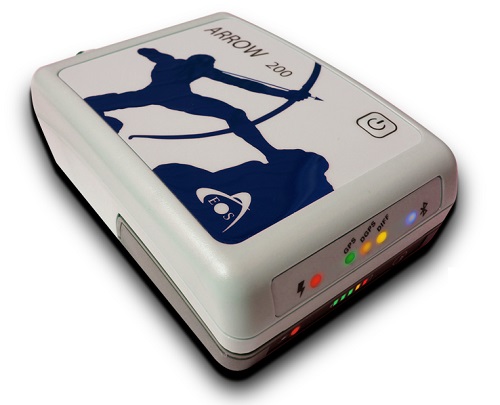
    Eos Positioning's Arrow 200 Bluetooth receiver supports Hemisphere's Atlas correction service.
    Eos Positioning’s Arrow 200 Bluetooth receiver.

    TerraGo and Eos Positioning Systems have entered a collaboration to combine the TerraGo Edge mobile GPS data-collection platform with the Eos Arrow line of sub-meter and centimeter accuracy receivers. The combination delivers a modern, cloud-based, real-time data collection capability, according to a TerraGo press release.

    While the working environments and the projects are very different, customers in for water utilities, energy, survey and engineering are using TerraGo Edge and Eos Arrow receivers to replace traditional GPS handhelds for cost-savings and improved productivity.

    Enmapp, a pipeline inspection company based in Canada, was able to cut hardware costs by 85 percent while capturing sub-meter data in real-time, eliminating all the costs of post-processing handheld data.

    Summit Engineering, a Colorado-based engineering and land surveying firm, was able to reduce hardware costs by over 50 percent and improve productivity by more than 30 percent while surveying power lines in Minnesota for one of the country’s largest energy companies. Similar performance improvements and cost reductions are reported by joint customers in water utilities, forestry, engineering, agriculture and environmental operations, TerraGo said.

    “When we talk about Eos Arrow, we’re not simply pairing their receivers via Bluetooth, there are millions of apps that do that without any meaningful integration,” said Dave Basil, VP of products and services at TerraGo. “We interoperate with their receivers at the software level to ensure our customers get the full real-time GPS data set so they can monitor, alert and capture data that meets the highest accuracy and quality standards. For customers, it’s as simple as Bluetooth pairing, but we’ve done the work to turn their phone or tablet into a survey-grade receiver.”

    “TerraGo and Eos Positioning are strategic technology partners,” said Jean-Yves Lauture, chief technology officer of Eos Positioning Systems. “This means that our collaboration goes beyond simple marketing and includes sharing core technology for the benefit of our customers. For example, we have been able to share Eos software components, which TerraGo has built into the Edge app. This integration provides the full fidelity monitor and lossless capture of NMEA data from the Eos receivers, including the Arrow 200.”