Tag: CRPA

  • Anti-jam systems: Which one works for you?

    Anti-jam systems: Which one works for you?

    In my April column, I introduced the basic concepts behind GPS anti-jam technology, along with a bit of history around its evolution. I knew this was a popular topic, but I didn’t anticipate the enormous amount of positive correspondence I’ve received since, including many inquiries about where to buy this technology and who is entitled to have it.

    So this month we return to the controlled reception pattern antenna (CRPA) topic, to look specifically at the major suppliers of GNSS anti-jam technology in a bid to help you select the best fit for your requirements.

    As mentioned in April, CRPAs can trace their roots back to military radar developments in the 1970s and 1980s. It’s no surprise, then, that the main players in the CRPA market tend to be large defense primes. But there are many smaller companies, universities and research institutions that also play in the CRPA arena these days.

    What about export?

    When GNSS jamming was a little-known military problem, the situation was simple: anti-jam was a military technology for military applications only. Later, as GPS evolved into a dual-use technology, critical infrastructure and civilian applications brought a new demand for anti-jam in non-military domains.

    Confusion then abounded about who exactly is entitled to make use of anti-jam technology. There are two distinct factors here: security classification, and export control. Let’s clear these up.

    Security classification is simple: If a product is classified, it is only available to customers who hold the appropriate level of security clearance. Usually it is the performance and vulnerabilities of a product that would attract a classified status. As you might expect for in-service military products, the military would not wish everyone to know the performance and weaknesses of its deployed technology. This is why many datasheets for CRPAs omit performance information.

    The second issue is export control. This, of course, varies by country. In the U.S., a CRPA developed towards a defense program is likely to have International Traffic in Arms Regulations (ITAR) restrictions attached to it. In Canada, CRPAs are subject to the Controlled Goods Program. In the UK, CRPAs sit on the “dual-use” export control list, which recognizes that CRPAs have both military and non-military application. An export license is usually required.

    Before I go any further, a little disclaimer: I am not making any product recommendations in this article. There are many things to consider when choosing anti-jam technology, and you should always consult a navigation warfare expert and carry out appropriate evaluations prior to choosing a product. You should also seek guidance from your own government regarding any restrictions on export or import.

    With that out of the way, let’s look at the offerings of a few suppliers. This is by no means a complete list, but I did manage to catch up with a few of the major players to ask them about their anti-jam technology offerings.

    NovAtel

    I spoke with Peter Soar, business development manager, Military and Defence, at NovAtel about NovAtel’s offerings.

    Peter Soar: “The GAJT-710 series are retrofittable GPS anti-jam products that combine a seven-element controlled reception pattern antenna (CRPA) and the antenna electronics in a single unit. The GAJT-AE-N is a GPS anti-jam antenna electronics system that supports a separated four-element antenna.”
    Main features: “All three products protect the GPS L1 and L2 bands simultaneously, and are suitable for military (SAASM) receivers as well as open-signal receivers, normal civil receivers and ‘survey grade’ receivers. The wideband design means that the units are ready for M-code. In the GAJT-710, there are seven antenna elements for up to six independent nulls on both frequencies, and the GAJT-AE-N supports four antenna elements, for up to three independent nulls. All products use space-frequency adaptive processing for increased degrees of freedom. System messages provide an indication of jamming presence, even when the nulling is defeating the jamming.”

    Intended market: “GAJT-710ML is optimized for land use, while GAJT-710MS is used for maritime and littoral applications. Both types are currently in use on mobile platforms and fixed installations. The GAJT-AE-N is optimized for smaller platforms such as unmanned air vehicles, and is currently in use on a variety of platforms. GAJT products have been shipped to customers in 16 countries to date.”

    Example customers: “The GAJT-700ML (a predecessor to the 710ML) was selected for trials by the Canadian Army through the Build in Canada Innovation Program, with exercises performed on the Artillery Observation Post Vehicle (LAV III OPV). Both GAJT variants were selected for field testing by the U.S. Army Communication-Electronics Research Development and Engineering Center (CERDEC) through the U.S. Army Rapid Innovation Fund. The United States Naval Observatory (USNO) selected the GAJT-710ML to satisfy a requirement at sites throughout the Department of Defense Information Network (DoDIN). The GAJT-AE-N is deployed on the Schiebel Camcopter S-100, and was also selected for testing on the M777C1 Howitzer by the Canadian Army.”

    Situation with regards to export: “All GAJTs are designed and built in Canada. As such, they are subject to the Controlled Goods Program of Canada, but they are free from ITAR for non-U.S. customers.”

    Raytheon UK

    Some Raytheon products were mentioned briefly in the April column; I caught up with Alan Wright, business development executive, Force Protection, to get the latest information.

    Alan Wright: “Raytheon UK offers a range of anti-jamming products ranging from high-performance products with multiple-element CRPAs to low size, weight and power products. Our current product lines utilize either analog or digital technologies to suit specific end-user requirements.”

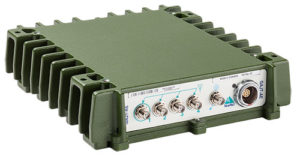
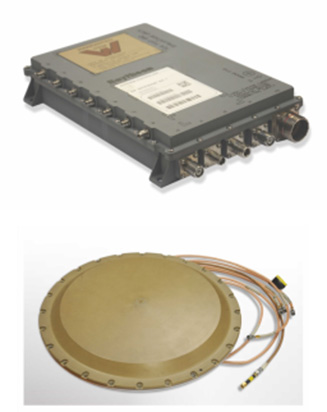
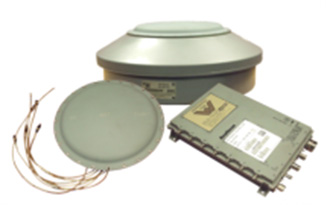
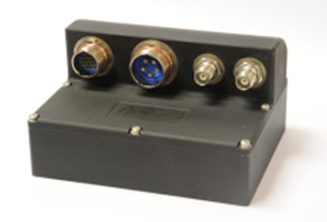
    Product

     Image

    Key Features

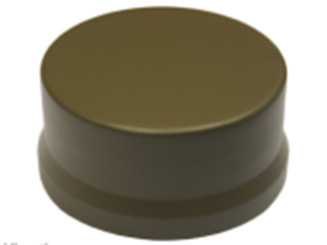
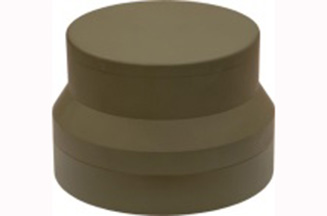
    GAS-1 Analog technology, 7 antenna elements, switchable L1/L2 protection, minimal quiescent time delay, nulling, J/N, M-code signal bandwidth, AE/antenna integrated variant, fiber optic output variant.
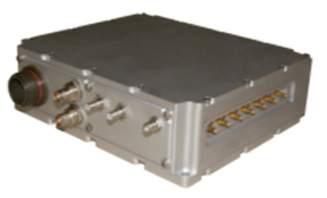
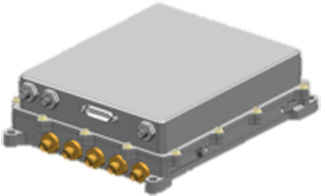
    ADAP Digital technology, 7 antenna elements, simultaneous L1/L2 protection, STAP, nulling, J/N, jamming flag, M-code signal bandwidth, AE/antenna integrated variant, fiber optic output variant.
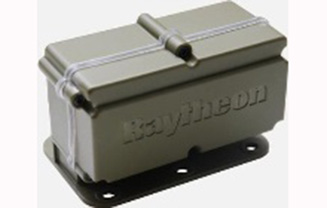
    SAS Digital technology, 5 antenna elements, simultaneous L1/L2 protection, low size, weight & power, STAP, nulling, J/N, direction finding, anti-spoof, jamming flag, M-code signal bandwidth.
    Landshield   Digital technology, integrated 4-element antenna, simultaneous L1/L2 protection, low size, weight and power, STAP, nulling, J/N, direction finding, anti-spoof, jamming flag, M-code signal bandwidth, switched antenna variant.
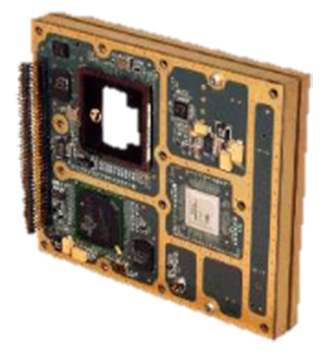
    MiniGAS   Analog technology, integrated 4-element antenna, simultaneous L1/L2 protection or L1 with L2 passthrough, low size, weight and power, minimal quiescent time delay, nulling, jamming flag.
    MicroGAS Analog technology, integrated 2-element antenna, simultaneous L1/L2 protection, very low size, weight and power, minimal quiescent time delay, nulling.

    Intended market: “With over 25 years’ experience, Raytheon UK is a world leader in the development, production and supply of GPS Anti-Jamming (GPS-AJ) systems to the majority of the world’s military forces (including the U.S. DoD and UK MOD), with solutions developed and certified for air, maritime and land applications. Raytheon UK has designed and manufactured in excess of 10,000 GPS anti-jam units for the worldwide market.”

    Situation with regards to export: “GAS-1, ADAP and SAS are subject to U.S. ITAR restrictions. Landshield, MiniGAS and MicroGAS are free from ITAR and subject to UK export control.”

    Rockwell Collins

    I spoke with Al Simon, business development for navigation products/solutions, to get the latest on Rockwell Collins’ offerings. Rockwell’s portfolio includes some CRPA products aimed specifically at weapons. Al kindly provided the following table to summarize:

    Product

    Image

    Platform

    Key Features

    Integrated GPS Anti-Jam System (IGAS) Weapons (Embedded) GPS receiver + AJ, nulling and beamforming, spatial, 20 in3, <2 lbs, up to 4 RF antenna inputs, 90+ dB J/S performance *, GPS (simultaneous L1 & L2), path to M-code
    Strategic Anti-Jam Beamforming Receiver (SABR) Weapons (Embedded) GPS receiver + AJ, nulling and beamforming, STAP, 46 in3, <3 lbs, up to 7 RF antenna inputs, 120+ dB J/S performance*, GPS (simultaneous L1 & L2), path to M-code
    NavStorm+   Weapons Nulling, spatial, 6.9 in3, <.6 lbs, up to 5 RF antenna inputs, 20,000 G shock, 90+ dB J/S performance*, GPS (simultaneous L1 & L2), path to M-code
    NavFire Weapons Nulling, spatial, 2 in3, <.2 lbs, 1 or 2  RF antenna inputs, 25,000 G shock, 85+ dB J/S performance*, GPS (L1 or L2), path to M-code
    DIGAR-200 Airborne, Maritime, Ground Nulling and beamforming, spatial, 218 in3, <11 lbs, up to 7 RF antenna inputs, 110+ dB J/S performance*, GPS (simultaneous L1 & L2), path to M-code
    DIGAR-300   Airborne, Maritime, Ground Nulling and beamforming, STAP/SFAP, 69 in3, <5 lbs, up to 7 RF antenna inputs, 125+ dB J/S performance *, GPS (simultaneous L1 & L2), path to M-code
    Small Platform AJ
    (Pre-Production)
      Ground, Airborne Nulling and beamforming, STAP/SFAP, 45 in3, <3 lbs, up to 7 RF antenna inputs, 95+ dB J/S performance*, GPS (simultaneous L1 & L2), path to M-code
    STAP (Space Time Adaptive Processing); SFAP (Space Frequency Adaptive Processing)
    * Beamsteering mode. Actual performance is classified

    Situation with regards to export: All listed products are unclassified, but are subject to U.S. ITAR restrictions.

    Roke Manor Research

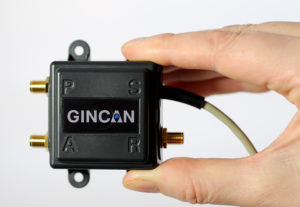
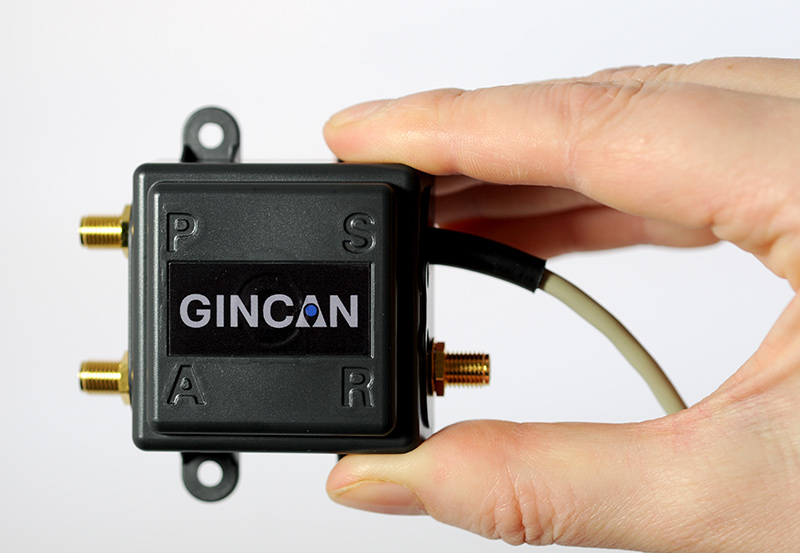
    This column wouldn’t be complete without a few words on my own organization. Roke has been developing anti-jam CRPAs since the 1980s, but rarely offers its own products. Typically Roke develops bespoke anti-jam and anti-spoof technology for other defense organizations, including for some products already listed above. Examples of bespoke developments for more specialist markets include Gincan and the Helium antenna.
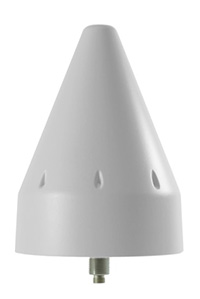
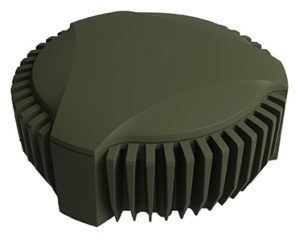
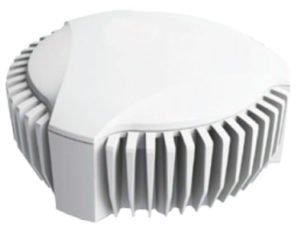
    Main features: Both these products are aimed at the commercial civilian market, but do also have defense interest. The Gincan is a very basic low-cost CRPA, with just two antenna elements. The Helium is a conical spiral design, using four antenna elements, and is primarily aimed at protecting GNSS in critical infrastructure. The Helium has excellent low-elevation performance. Both antennas feature very low latency, making them particularly suitable for timing receivers.

    Intended market: The Gincan is primarily aimed at providing a basic level of anti-jam capability to the automotive mass market, including cars and trucks, but also has been adopted by some lightweight UAV platforms. The Helium is aimed directly at timing receivers for critical infrastructure, including mobile base stations, digital TV networks, stock exchange and financial institutions, and power and utility grids.

    Example customers: Gincan has been delivered to 42 countries, with a mixture of commercial, defense and national security customers. Helium is a relatively new product, and is being trialed on infrastructure in two countries.

    Situation with regards to export: Both products are unclassified and suitable for commercial use. They are subject to UK export control as dual-use items, and are ITAR-free.

    Others

    There are many other suppliers of CRPA technology — unfortunately, too many to cover in this column. Mayflower Communications offer a good range of CRPA products in the form of their NavGuard range. Some other suppliers include Cobham Antenna Systems, BAE Systems Rokar, Thales, Harris Corporation, L-3 Interstate Electronics and Lockheed Martin. I encourage you to contact these companies for the latest information if you are contemplating a CRPA product. If you’re a CRPA supplier and I’ve missed you, please feel free to post a link to your products in the comments section below.

    So, that was a bit of a whirlwind tour through some of the products currently around. CRPAs come in all shapes and sizes, and they all have their own particular characteristics and subtleties.

    I conclude by reiterating my earlier point. Always conduct a threat analysis, seek the help of a navigation warfare expert if necessary, and properly evaluate your choices. Happy choosing!

  • Anti-jam technology: Demystifying the CRPA

    Controlled reception pattern antennas (CRPAs, pronounced “serpers”), adaptive antennas, null-steering antennas, beamforming antennas…

    You’ve probably heard of at least one of those terms in any discussion around GPS anti-jam technology for defense.

    Because they are all terms that describe essentially the same thing: a specialized antenna that helps protect GPS receivers from interference and jamming.

    But what exactly are they? Where did they come from? How do they work? What comes next? Read on and find out.

    A bit of history

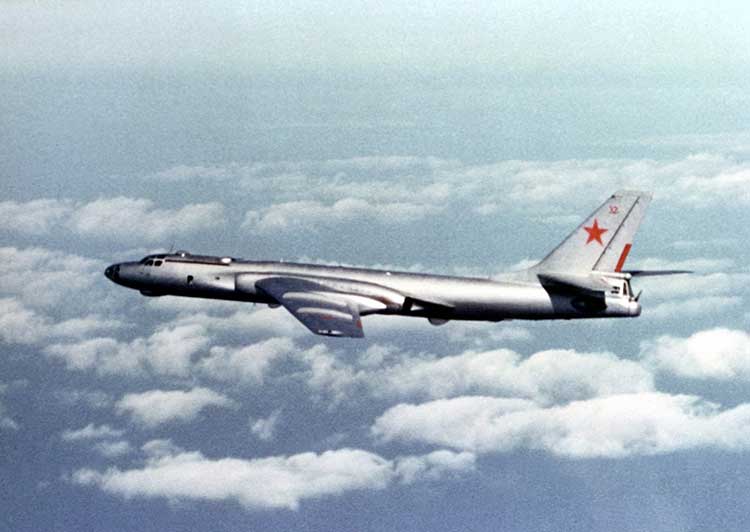
    Let’s go back to the Cold War era, at a time when Soviet and Western states were continuously battling for electronic warfare (EW) superiority. In the early to mid-Cold War, radar jamming was the name of the game. Soviet aircraft, such as the TU-16 Badger and its derivatives, carried a range of EW equipment, including some very high-power jammers designed to interfere with radar systems.

    Figure 1: TU-16 Badger, an important Soviet electronic warfare platform during the Cold War (Photo: Wikipedia)
    Figure 1: TU-16 Badger, an important Soviet electronic warfare platform during the Cold War (Photo: Wikipedia)

    Fast forward to the latter years of the Cold War, and we reach the era when the U.S. was busy developing the exciting new GPS system. The Department of Defense (DoD) wanted to ensure that a robust and accurate global navigation system was available to the military, and so the Navigation System with Timing and Ranging (NAVSTAR) launched its first satellite in 1978, eventually becoming the fully operational GPS system by 1993.

    Magnificent and ground-breaking though it was, it was recognized very early on that GPS relied on very low-power satellite transmissions, and would be vulnerable if someone tried to interfere with it. Given the prevalence of high-power jamming during the still-ongoing Cold War, there was concern that, if an adversary knew about GPS, they could easily render it useless in a given operational area.

    And so it was that the CRPA came to the rescue.

    Enter the CRPA

    Once again, this GPS anti-jam technology finds its roots in the Cold War, and specifically in radar technology, where engineers developed clever ways to ensure their radars could continue to operate in the presence of jamming. Sidelobe cancellation (SLC) was a well-established technique in the radar community, where a received jamming signal could be “cancelled” by combining the outputs of more than one antenna in the right way.

    So, it didn’t take long to adapt this radar anti-jam technology to the problem of GPS protection, and the CRPA was born. At this point I must declare a modicum of national pride, as the earliest operational GPS anti-jam unit that I know of was British. The Plessey PA 9800 GPS Anti Jam Unit was built at Roke Manor in 1984, and tested in the U.S. at the Yuma Proving Ground, Arizona, in 1985.

    This pioneering technology could defeat up to three simultaneous jammers in the shown configuration, but was modular in construction, allowing further channels to be added for handling higher numbers of jammers. And all of this in 1984, in the UK, for a U.S. military navigation system that wasn’t even fully operational yet. Incredible.

    From then until the present day, CRPAs have seen continual interest and development as the technology of choice to protect GPS from jamming. So how do they work?

    Theory of operation

    A CRPA is attractive, because it doesn’t require you to make any changes to the GPS receiver itself: It simply replaces the existing antenna. CRPAs are generally larger than typical GPS antennas, because they contain a number of antenna elements, and some associated electronics to do the clever stuff.

    There’s nothing magical or mystical about the basics of CRPAs: It’s just standard theory from your favorite textbook on adaptive signal processing. But, as ever, the devil is in the detail — how to make them work well in practice is more involved. And as the technology is generally export-controlled, I shall leave out the important in-depth details.

    CRPAs work by exploiting spatial diversity; that is, making use of the fact that the desired satellite signals, and the unwanted jamming signals, generally arrive from different directions. In simple terms, you create a spatial filter, one that removes signals that arrive from particular directions, whilst letting through signals from other directions. To achieve this, rather than use a single antenna, we use an array of antenna elements.

    Let’s think in simple and intuitive terms about how this works. Take a look at Figure 3. Here we have a primary antenna P, and some auxiliary antennas A1, A2, and so on. A signal arriving from the direction shown impinges on antenna A2, and slightly later it arrives at A1, and later still it arrives at P. For the sake of argument, if the signal is a simple sine wave, you will then find that the output from each antenna is that same sine wave, but with a different phase shift depending on the spatial arrangement of the antennas.

    Now, let’s consider what we call the “weights,” which are labeled as w1, w2 and so on. Each of the weights, in this case, is simply a phase shift that we can define. By careful choice of weights, we could choose to make each of the antenna outputs align perfectly in phase, and then, when we sum all the outputs together as shown, we end up with a bigger version of the input signal.

    This is what we would like to achieve if the signal was a satellite. We “steer” maximum overall antenna gain towards that satellite. This is typically what is meant when we refer to “beamforming;” It means steering maximum antenna gain towards a satellite.

    Conversely, we could also choose the weights to have the opposite effect: to minimize or completely cancel out the signal. This, of course, is what we would like to do if the signal was a jammer, and is referred to as “nulling” or “null-steering.”

    Figure 3. Adaptive antenna basics.How do we determine what those weights should be? Well, this is where your standard theory in adaptive signal processing comes in. Let’s say the objective is to minimize the jamming power out of the antenna. We can write the output power of the adaptive antenna as:

    Figure: Michael Jones
    Figure: Michael Jones


    The average output power can be found by taking expectations:

    Figure: Michael Jones
    Figure: Michael Jones


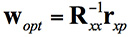
    Taking the minimum and rearranging this leads to the well-known Wiener equation:

    Figure: Michael Jones
    Figure: Michael Jones


    This Wiener equation is the one to remember. It says that the optimum weights can be found by taking the inverse of the data covariance matrix, and multiplying it by the vector of cross correlations between the primary and auxiliary antennas. As in any adaptive signal processing problem, a simple way to solve the Weiner equation and get the weights might be to use your favorite gradient descent algorithm, such as least mean squares (LMS):

    Figure: Michael Jones
    Figure: Michael Jones


    However, a solution using this approach does have its problems, for reasons beyond the scope of this article. The mathematics of beamforming are also bit more involved, so I’ll leave that out here.

    Rather than the grossly simplified diagram used here, most decent CRPAs also use a more complex architecture based on space-time adaptive processing (STAP) or space-frequency adaptive processing (SFAP). This generally allows much higher levels of jammer cancellation against a wider range of threats.

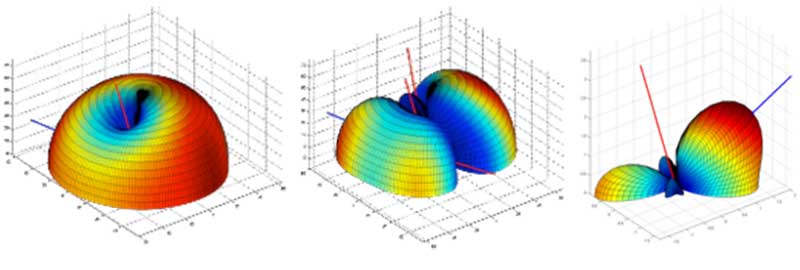
    To finish off this whirlwind section on CRPA basics, let’s see what some example antenna gain patterns might look like. In the figures below, the blue line represents the direction of arrival of a GNSS satellite signal, whilst the red lines indicate the direction of arrival of a jammer. In the first diagram we have a single jamming signal: the antenna gain pattern is a nice hemisphere, as we would generally like, but there is a nice deep null in the direction of the jammer. Moving on to the next diagram, we can see the effect of having three simultaneous jammers on the same CRPA: again we have nice deep nulls in the direction of each jammer, but we are starting to lose more of the sky, and we may start to lose the odd satellite as a consequence. Finally, we have an example of beamforming on a single satellite, whilst nulling out a jamming source.

    Again, it’s beyond the scope of this article, but the layout of the antenna elements plays an enormously important part in the performance and behavior of the CRPA.

    Figure: Michael Jones
    Figure 4. Illustrative beam patterns of a CRPA antenna in the presence of jamming. (Figure: Michael Jones)
    Figure 4: Illustrative beam patterns of a CRPA antenna in the presence of jamming (Figure: Michael Jones)
    Figure 4: Illustrative beam patterns of a CRPA antenna in the presence of jamming (Figure: Michael Jones)

    Operational Anti-Jam Units

    With some images courtesy of my friends at Raytheon, let’s look at a few examples of deployed military CRPA hardware over the years.

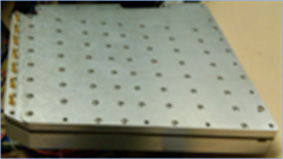
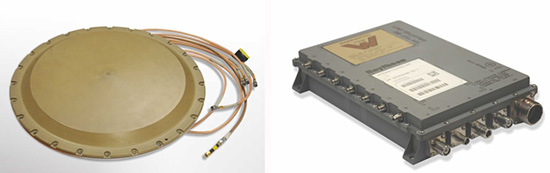
    The GAS-1 system entered service in the U.S. in 1997, as a replacement for the earlier AE-1 (1990 to 1996). The CRPA is composed of two parts: the antenna array, which is a seven-element layout, and the antenna electronics as a separate box. The GAS-1 was incredibly successful and became the de facto standard anti-jam technology, fitted to air and sea platforms around the world. Even today, 20 years after its launch, it continues to be fitted to many platforms.


    Figure 5. GAS-1 CRPA. (Credit: Raytheon)
    Figure 5. GAS-1 CRPA. (Photo: Raytheon)

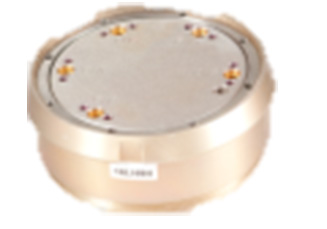
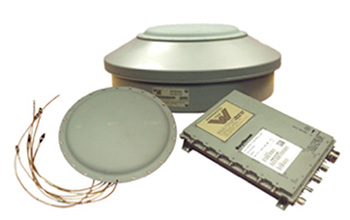
    By the late 1990s and early 2000s, the Navigation Warfare (NAVWAR) program was in full swing, and the military was looking for enhanced protection against evolving jamming threats. The U.S. initiated a program called Advanced Digital Antenna Production (ADAP). The ADAP product, launched in 2006, was a direct form-fit replacement for the analog GAS-1 system, and introduced a number of advanced features. Most notably, the ADAP simultaneously protects both the L1 and L2 frequency bands, and utilizes STAP processing to achieve high levels of wideband jammer cancellation.

    Photo: Raytheon
    Figure 6. ADAP Digital CRPA. (Photo: Raytheon)

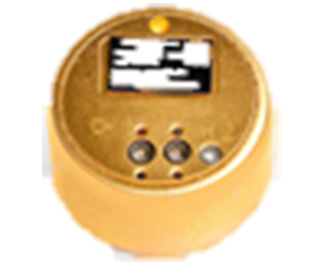
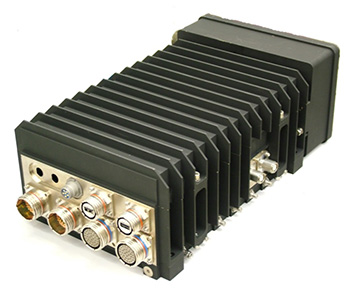
    In parallel with the ADAP development, the Digital Antenna Control Unit (DACU) was different in a number of ways. Firstly, it was a true beamforming solution, allowing simultaneous antenna beams to be steered toward satellites, whilst simultaneously nulling out jammers.

    Secondly, it was tightly integrated with the GPS receiver, with the GPS receiver hardware located in the same unit.

    Thirdly, the DACU was able to perform a number of other advanced functions, such as direction-finding of interference sources. Interestingly, the DACU was used to help locate the source of the interference at the notorious Newark airport jamming incident in 2009.

    Figure 7. DACU Beamforming CRPA. (Photo: Raytheon)
    Figure 7. DACU Beamforming CRPA. (Photo: Raytheon)

    By the mid-2000s, CRPA electronics were pretty mature and well-understood. The electronics had been miniaturized, and pretty much everything was put onto a single chip. But the physical size of the antennas persisted as a problem for some platforms requiring low size, weight and power (SWAP).

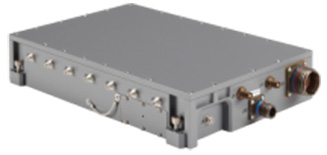
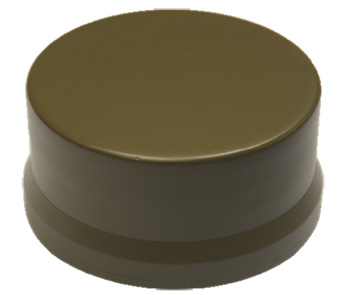
    The Landshield, launched in 2014, was a step-change in CRPA technology. Not just because it was a small and fully self-contained unit (about the size of a hockey puck), but because it was the world’s first CRPA to include true anti-spoofing capability.

    Figure 8. Landshield Advanced CRPA with Anti-Spoof Technology.
    Figure 8. Landshield Advanced CRPA with Anti-Spoof Technology. (Photo: Raytheon)

    Blurring the lines between military and civilian

    Going back a few years, the military was heavily focused on CRPAs and anti-jam techniques in general. Military GPS receivers had been developed and deployed, and the question was how they could retrofit robustness to them. At the same time, the commercial world was heavily focused on mass-market GPS receivers — reducing cost, increasing performance — with little care about jamming.

    If you’d talked to me five or six years ago, I would have said the military sector is 20 years ahead of the commercial sector in anti-jam technology, and the commercial sector is 20 years ahead of the military sector in receiver technology.

    This assertion holds far less true these days; the lines of separation are much more blurred. The military is learning from the commercial world, embracing COTS, and developing new GNSS receivers. Conversely, civilian applications are now much more concerned with jamming, leading to the adoption of low-cost CRPAs in non-military applications.

    The future of the CRPA

    Where will CRPA technology go from here? We’ve already seen that the latest generation of CRPAs now performs anti-spoofing, as well as anti-jamming. But there is plenty more to see yet.

    Although the core technology behind CRPAs is now mature, the trend for the future will be about “doing more with less.” CRPA technology will become more of a multi-function system. Military platforms need to cut down on the number of separate systems they install, and so CRPAs are likely to become multi-functional, performing situational awareness and signals intelligence.

    As antenna technology progresses, we will likely see protected navigation solutions utilizing the same hardware as communication systems and radar systems, providing CESM and RESM functions, and being part of an integrated electronic warfare suite. And conformal antennas will see a resurgence of interest for complex and space-constrained platforms.

    Watch this space.

  • Tracking RFI: Interference localization using a CRPA

    A controlled radiation-pattern antenna can preserve GNSS positioning while providing at least an azimuth angle towards an interference source. If integrated with an attitude and heading reference system (AHRS), only a few lines of position pointing towards the RFI source could provide a fast indication of the probable ground location.

    By Gerhard E. Berz, Pascal Barret, Brent Disselkoen, Michael Richard, Vincent Rocchia, Florence Jacolot, Todd Bigham and Okko F. Bleeker

    GNSS is an essential enabler for many aviation applications that rely on either accurate position or time synchronization. While the idea of “sole means” GNSS is disappearing, it remains challenging to match the performance and coverage of GNSS with terrestrial systems. This is why aviation is working on Alternate Positioning, Navigation and Time (A-PNT) to cope with the potential for a wide-area GNSS outage. Current navigation aids are clearly part of this approach in the short term. We will continue to need a terrestrial capability for some time, but we don’t expect that it will support the same level of performance as GNSS. Even if we have back-up, we must be able to resolve GNSS outages efficiently.

    Among principal GNSS vulnerabilities — constellation performance issues, space/solar weather and radio-frequency interference (RFI) — RFI is the one where observability on the ground is often limited. While the protection of radio services from interference is a state responsibility typically assigned to a telecommunications or other government agency, it is in the interest of an air navigation service provider (ANSP) to be able to request help and enforcement action from the telecommunications regulator in an efficient manner.

    As a part of its contribution to Single European Sky ATM Research (SESAR, a collaborative project to improve European airspace and its air traffic management), Eurocontrol has developed an RFI Mitigation Plan as a guidance framework with the objective to maintain risks to GNSS and the associated operations at tolerable levels. The document will be published by ICAO in its GNSS Manual in the new 2017 edition.

    MITIGATION PLAN

    RFI can be a security issue. Consequently, a commonly used philosophy in the security domain was used in the mitigation plan: there are many potential threats, but not necessarily all of them translate into operationally relevant risks. Threats are thus sort of dormant risks, which, if left to develop unmitigated, could develop into risks to aviation. The mitigation process monitors threats, assesses risks, and then implements suitable mitigation to stop threats from developing into risks. Three successive stages have been identified where such barriers can be applied:

    • Prevent transmission of RFI, mostly through radio regulatory actions and coordination;
    • Prevent interruption of positioning and navigation capabilities in the presence of RFI. This is achieved at the avionics level by making sure receivers can tolerate some RFI as well as redundant capabilities;
    • If interruption cannot be avoided, ensure that other communication, navigation and surveillance capabilities provide continued safety while being able to detect, locate and eliminate an RFI source efficiently.

    This third barrier is where flight inspection or other aerial work platforms can play a significant role. However, this role is not limited to risk mitigation. Aerial measurement capabilities can also play a role in threat monitoring by getting data on RFI emissions that are too weak to pose operational risks, and facilitate risk assessment by providing a reliable reference of the impact of such signals on an aircraft in flight.

    FLIGHT INSPECTION

    Similar to the subject of flight validation, airborne GNSS signal-in-space testing must not necessarily rely on traditional flight inspection capabilities. Other aerial work capabilities can be used, and it is hoped that, over time, data from regular aircraft operations and event recording systems can be used at least for threat-monitoring purposes. However, as soon as a significant RFI occurs, purpose-built aerial detection and localization capabilities are hard to beat. Given that aviation is carrying the risks related to RFI, and telecom regulators are unlikely to have such capabilities, this naturally points to the experience and resources of flight inspection aircraft and their crews.

    Even if a significant amount of ground-based RFI sensors are available, local building shadowing can make it difficult to impossible to detect and locate an RFI emitter. Aircraft-provided data can be superior to ground data, and a rough aircraft-based localization can greatly increase efficiency of ground-based localization and source elimination efforts. Aerial RFI localization capabilities offer unique strengths in an overall cooperative process.

    EVOLVING SIGNALS

    GNSS manifests the transition from analog signals of conventional navigation aids to digital ones. A common characteristic of digital signals is their better use of a frequency channel by spreading the carrier energy such that distinct carrier or subcarrier tones become difficult to observe. Unfortunately, RFI sources have kept up with this, and now most commonly employ swept CW signals, easy to produce but still looking essentially like broadband signals. Many unintentional RFI sources also look like broadband.

    Because GNSS is a multi-modal system not uniquely used by aviation, a new type of RFI threat is becoming more common: intentional RFI, which is not directed at aviation, but may nonetheless have an impact. Because there is no direct intent to harm aviation, the nature of these signals and RFI scenarios can become diverse and unpredictable. Furthermore, given the prevalent and ubiquitous nature of GNSS, the number of potential RFI threats is more significant and will evolve more dynamically than aviation capabilities.

    A recent effort collecting GPS outage data reported by pilots revealed that a small but surprising number of outages that could potentially be linked to RFI occur on a regular basis, even during en-route operations in some limited regions of the world. For flight inspection, this implies it would be useful to increase the sensitivity of RFI source detection commensurate with the digital nature of GNSS and consistent with the power levels that can impact receivers.

    Another particular challenge comes from the specification of an interference mask for GNSS. Other navigation systems do not have such a mask, or any kind of minimum signal-to-noise ratio standard. The mask represents a realistically achievable interference environment. It has been adopted as a global benchmark where receivers experiencing signals above the mask may not produce misleading information, but may stop operating.

    However, in practice, little is known about by how much typical receivers exceed the minimum masks. Some tests have reported a margin as significant as 23 dB to CW and 10 dB to broadband signals. This means that an RFI which may not bother one type of receiver at all could be a significant problem for another, limiting the possibility to rely on observed receiver performance. It also implies that signal-in-space effects should be detectable at the low levels of the ICAO receiver RFI mask.

    CRPA LOCALIZATION

    For civil aviation as opposed to military operations, a CRPA could make sense provided that it outperforms current RFI localization methods at a reasonable price. In military applications, the exact location of the RFI source may be of a secondary nature, as long as desired signal tracking can be maintained.

    However, by steering a null (negative gain) towards the angle of arrival of an undesired signal source, a line or sector of possible source positions can be obtained. In this case, the main objective would not be to null a deliberate interferer or jammer, but to obtain a bearing on the type of the interferer. The main scenario we worry about that leads to low-power events are those where aviation is not the desired target, such as a PPD. Unintentional cases can be a mix of high- or low-power cases. The use of a GNSS-specific antenna is expected to provide the required sensitivity, while being able to profit from the military off-the-shelf development. When further integrated with standard flight-inspection sensors such as an attitude and heading reference system (AHRS) and additional geolocation software, this approach has the potential to increase the reliability, accuracy and speed of geolocation while reducing operator effort and flying time. An additional potential benefit is the preservation of ownship position when flying into an area of significant RFI.

    The suggested use of military technology brings with it the question on how such use could be authorized. CRPA antennas and associated antenna electronics manufactured in the United States fall under the International Traffic in Arms Regulation (ITAR). While this is a solvable but, nonetheless, cumbersome issue, the approach taken by this project was first to evaluate possible benefits from using a CRPA before worrying about the ITAR issue.

    This study was conducted by Eurocontrol in the frame of a SESAR Project on GNSS, including a contract with Rockwell Collins for a feasibility study of the CRPA RFI localization concept. The French (DSNA/DTI) and U.S. FAA Flight Inspection service supported the project with expertise and in-kind contributions. The FAA conducted an overflight with a direction-finding-equipped aircraft for direct comparison between the CRPA approach and other, non-GNSS specific, commercial solutions.

    TECHNOLOGY OPTIONS

    Current, common GNSS CRPAs come in either 4- or 7-element variants. CRPAs always require antenna electronics for further processing of the RF inputs, and perform either nulling (steering negative gain towards RFI sources) or beamforming (steering positive gain towards GNSS satellites), or both. The most performant system is a 7-element CRPA in combination with digital beam-former antenna electronics. The 7-element CRPA has a diameter of 36 cm (14 inches), which is of some concern for installation on a typical flight-inspection aircraft such as the Beech King Air. But for a feasibility study, it makes sense to first evaluate the most-performing option. If there is unnecessary margin, the solution can be simplified afterwards.

    A top-mounted solution on the airplane fuselage was retained due to experience with military anti-jam performance suggesting that RFI localization performance would be sufficient while retaining the benefit of stable ownship position. A key element of the assessment focused on how to best use aircraft banking to facilitate geo-localization.

    As shown in Figure 1, the CRPA is connected to the Digital Integrated GPS Anti-Jam Receiver (DIGAR). As there is one RF cable per CRPA element, it is useful to install the DIGAR as close as possible to the CRPA. The standard military-production DIGAR contains not only the antenna electronics but also the receiver including baseband processing. For civil purposes, either a civil receiver would need to be integrated into the DIGAR or, alternatively, a single RF output is available to connect a standard civil GPS receiver. The DIGAR will also feed angle-of-arrival information into a direction-finder software.

    Figure 1. System configuration.
    Figure 1. System configuration. Source By Gerhard E. Berz, Pascal Barret, Brent Disselkoen, Michael Richard, Vincent Rocchia, Florence Jacolot, Todd Bigham and Okko F. Bleeker

    The software provides angle-of-arrival information with respect to the antenna/aircraft reference frame. To provide a geolocation capability, this must be combined with ownship position and aircraft attitude. As most flight inspection aircraft are equipped with an AHRS, this is not expected to be a problem. Project resources did not permit full integration, so testing was done using the direction-finder display only. The AHRS would need to provide 10–50 Hz updates with an error of not more than ±2 degrees.

    Figure 2 shows an example of the direction-finder output. Lighter areas show where the antenna electronics produce negative gain, while darker areas represent stronger positive gain. The red dot indicates a potential interferer has been identified. Source location is at about 280 degrees of azimuth with respect to aircraft nose.

    Figure 2. Excerpt from direction finder polar display of RFI signal angle of arrival.
    Figure 2. Excerpt from direction finder polar display of RFI signal angle of arrival. Source By Gerhard E. Berz, Pascal Barret, Brent Disselkoen, Michael Richard, Vincent Rocchia, Florence Jacolot, Todd Bigham and Okko F. Bleeker

    Correct detection probability will depend on the sensitivity threshold and associated false detection probability being considered acceptable. A visual localization may still be possible at carrier-to-noise density ratios (C/N0) below those needed to produce the red dot here, especially if the visible ambiguity can be removed through some aircraft maneuvering. It can be inferred from the system description that once the full integration is accomplished, the provision of a direct output using only a few lines of position to find a probable RFI source location in terms of approximate lat/long coordinates should be straightforward.

    SIMULATOR TESTING

    A well-calibrated simulator capable of feeding the seven RF inputs was used to assess detection performance for different flight patterns near an RFI source. The tested patterns include a rectangular, a circular and an oscillating, S-shaped trigger-and-hunt trajectory. A variety of different encounter scenarios in terms of power levels and free space path loss were tested. Power levels were adjusted to produce a 1-dB reduction in the C/N0. Both a continuous wave (CW) interferer at the L1 center frequency and a broadband (BB) interferer were simulated (using a 20-MHz-wide PSK signal). Figure 3 shows an example of achieved detection accuracies in both azimuth and elevation angle.

    Figure 3. Example result of angular detection performance.
    Figure 3. Example result of angular detection performance. Source By Gerhard E. Berz, Pascal Barret, Brent Disselkoen, Michael Richard, Vincent Rocchia, Florence Jacolot, Todd Bigham and Okko F. Bleeker

    While there is a strong peak within ±10 degrees of azimuth, there are also significant outliers. For the elevation (note the normalized scale), however, the main peak is thinner with even stronger sidelobes. Due to the installation of the antenna on top of the aircraft fuselage, the simulation results indicate that the elevation angle output is not very useful for detection. The time series result for the azimuth is given in Figure 4, where it can be seen that there are many good detection matches but also some “sympathetic nulls” that move in the opposite direction of the ground track truth reference (circled in grey). It is expected that with additional software processing, these sympathetic nulls can be filtered out.

    Figure 4. Azimuth Time Series Result Corresponding to Figure 3.
    Figure 4. Azimuth Time Series Result Corresponding to Figure 3. Source By Gerhard E. Berz, Pascal Barret, Brent Disselkoen, Michael Richard, Vincent Rocchia, Florence Jacolot, Todd Bigham and Okko F. Bleeker

    For all tested scenarios (assuming additional filtering), azimuth detection capability was better than ±10 degrees (one standard deviation), and in some cases as accurate as ±2 degrees. There was no significant difference between CW and BB results. As could be expected, simulated aircraft banking significantly improved detection capability. Consequently, the use of orbits seems to be the best search strategy. The simulator testing used a figure-eight pattern with one of the orbits passing over the interference source.

    LIVE-SKY VAN TESTING

    Rockwell Collins has an authorization to broadcast RFI test signals at the GNSS L2 frequency. Previous work showed that the results at L2 can be applied equally to L1. Figure 5 shows the test area, including a –100-dBm signal level boundary. The interferer was installed on a tripod and fed by a signal generator using a normal GPS fixed radiation pattern antenna (FRPA).

    Figure 5. Live-sky test area.
    Figure 5. Live-sky test area. Source By Gerhard E. Berz, Pascal Barret, Brent Disselkoen, Michael Richard, Vincent Rocchia, Florence Jacolot, Todd Bigham and Okko F. Bleeker

    Locations B and C were used to both calibrate the RFI level and as check points for the van trajectory. The test van included a fixture that allowed a tilting of the CRPA by 30 degrees from zenith to either side. Figure 6 shows a schematic of the tilt fixture. It can be seen that this set up creates a realistic RFI path that arrives with an elevation slightly below the horizon at the unit under test. Two sets of tests were performed: one where the van drove straight into or out of the area of interference to determine overall equipment sensitivity, and varied paths to quantify angular detection performance. Again, both CW and BB RFI signals were evaluated.

    Figure 6. CRPA with tilt fixture.
    Figure 6. CRPA with tilt fixture. Source By Gerhard E. Berz, Pascal Barret, Brent Disselkoen, Michael Richard, Vincent Rocchia, Florence Jacolot, Todd Bigham and Okko F. Bleeker

    Not surprisingly, elevation angle results turned out not to be very reliable given the below horizon signal path. But azimuth errors were slightly greater than obtained during the wavefront simulator testing (±12 degrees, one sigma). This can be attributed to both multipath and a less accurate heading truth reference. Taking these additional factors into account, the results are very consistent. Tilting the antenna by 30 degrees towards the RFI source significantly improves azimuth resolution (to about ±8 degrees) while also reducing sympathetic nulls. When the tilted antenna points away from the RFI source path, azimuth accuracy will decrease, which is considered helpful in avoiding false detections.

    Summary. Even if a good bit of integration work remains necessary to produce a production-ready system for flight inspection or other similar aircraft, the approach shows promise. Further testing, especially using an actual aircraft installation, is recommended. Installation of a 7-element CRPA will be challenging on a typical Beech King Air, but possible. Antenna calibration requirements are expected to be manageable with a standard network analyzer. To avoid further complications with export regulations, the use of a separate civil GNSS receiver is recommended. The overall system is, at this stage, still on the costly side.

    While a 4-element CRPA could be used, this was estimated to double or triple angular azimuth detection errors and reduce the detection distance, and consequently not likely to be worth the additional cost. While smaller 7-element CRPAs than the one used are available, their performance would need to be assessed.

    For a top-mounted CRPA, aircraft banking is essential to ensure good performance. This could increase the amount of airspace required for detection and lead to operational complications. Furthermore, since the aim is to increase detection sensitivity to geo-locate weak power sources such as personal privacy devices, maintaining ownship position is not that critical, as it can be managed by maintaining an appropriate distance from the RFI source if needed. Consequently, both DSNA and FAA recommend using a bottom-mounted CRPA. In addition to adding 10 dB of detection sensitivity on average and reducing the need for maneuvering, it may restore the utility of the elevation output, thereby potentially further reducing search time. Either way, it will be useful for equipped aircraft to have alternate positioning capabilities to GNSS both for aircraft guidance and truth reference systems.

    The system required a 15-dB stronger signal to transition from detection to localization. However, this is dependent on the accepted false-alarm rate. A tunable procedure can be envisaged where the software accepts a higher false-alarm rate at first to maximize search capability and moving to a lower alarm rate to confirm suspected RFI source locations later. Both the potential of the additional filtering software and any human-machine interface aspects would need to be further evaluated.

    GENERIC CAPABILITIES

    The two common options for in-flight detection of RFI sources in any relevant frequency band are the use of either a spectrum analyzer or, if available, a direction finder. The spectrum analyzer approach depends on connection to a suitable antenna, preferably with some directionality. In this way, the aircraft can be maneuvered to point the antenna either towards or away from the RFI source. Normally there is very little directivity, making this a challenging search. A direction finder is a significant improvement. Figure 7 shows the L-band antenna array used by a DF-4400 as installed on the bottom of the aircraft.

    Figure 7. CRPA with tilt fixure.
    Figure 7. CRPA with tilt fixture. Source By Gerhard E. Berz, Pascal Barret, Brent Disselkoen, Michael Richard, Vincent Rocchia, Florence Jacolot, Todd Bigham and Okko F. Bleeker

    Newer generation spectrum analyzers with a good GNSS-specific pre-amplifier, using digital sampling with a fast A/D converter, could provide useful capability. However, the subject is beyond the scope of this discussion, and we focus here on comparing the CRPA approach with a standard direction finder.

    The FAA Flight Inspection service conducted complementary flights during the Rockwell Collins live-sky van testing. The flights included orbits and a direct overflight of the RFI source. This was complemented by additional laboratory calibration to ensure that results could be compared. The sensitivity results of the CRPA approach are more meaningful in comparison with a generic direction-finder capability. Since test data is only available for a top-mounted CRPA, the comparisons here are made for the preferred bottom-mounted CRPA using engineering estimation.

    The key finding was that while direction-finding capability was quite comparable between the CRPA- system and the DF-4400 for CW, the CRPA-system outperforms the DF-4400 by a significant margin when encountering broadband signals. This is considered to be a significant improvement given the expected nature of RFI sources. During the FAA overflight, the aircraft did not manage to detect the broadband signal. Consequently, the values given here are reconstructed from laboratory analysis. Table 1 compares the estimated achievable sensitivities.

    Table 1. Comparison of direction-finding sensitivity.
    Table 1. Comparison of direction-finding sensitivity. Source By Gerhard E. Berz, Pascal Barret, Brent Disselkoen, Michael Richard, Vincent Rocchia, Florence Jacolot, Todd Bigham and Okko F. Bleeker

    In view of the limitations of the data analysis performed, these values must be interpreted with caution. In general, we can conclude that the direction-finding sensitivity of the CRPA system is relatively insensitive to the encountered modulation of the RFI signal, and that the bottom-mounted CRPA system outperforms the DF-4400 system by a small margin in the CW case and by a large margin in the broadband case. How many additional dBs can be gained by both approaches through further optimizations is for future analysis. The performance improvement of the CRPA system does come at a cost, as could be expected.

    DETECTION

    Before the search for an RFI source can begin, it must be detected. Normally it should be easier to detect an RFI source than to locate it, since direction-finding requires a certain signal strength to obtain bearing information. However, given the directionality of DF arrays, this may not necessarily be true. Another potential factor is the reliance on a spectrum analyzer to detect RFI, which may not achieve the corresponding noise floor, especially when using a broad scan across a wide frequency range. The direction-finder system needs about a 15-dB difference between detection and localization ability.

    Figure 8 shows the detection ranges for the top-mounted CRPA system for a given ground-based emitter while the aircraft altitude is assumed at 2000-ft AGL. The bottom mounted system would improve the minimum detection threshold further. Given that 15 dB can translate into a significant difference in free space path loss distance, concepts for efficient direction finding once an RFI source is detected deserve further attention.

    Figure 8. Detection ranges for top-mounted CRPA system.
    Figure 8. Detection ranges for top-mounted CRPA system. Source By Gerhard E. Berz, Pascal Barret, Brent Disselkoen, Michael Richard, Vincent Rocchia, Florence Jacolot, Todd Bigham and Okko F. Bleeker

    HUMAN FACTORS

    During the FAA overflight, the broadband RFI couldn’t be detected by either the spectrum analyzer in use or the DF-4400. Part of the challenge was using the right equipment settings. For the DF-4400, it was found that best performance could be obtained for detecting broadband RFI when using the FM wide mode of demodulation. Similar findings were obtained for the use of the spectrum analyzer, where specific skills are necessary to use the equipment to its fullest capability. Similar issues are expected when having to interpret the display of a CRPA-based system. This means that regardless of the RFI source geo-location approach used, specific training should ensure that aircraft operators have the greatest chance of success in finding RFI sources.

    CONCLUSIONS

    An approach using a CRPA antenna, electronics and processing software proved superior to current, generic direction-finding capabilities, especially with respect to broadband signals. Maintaining ownship position in the presence of RFI is a secondary objective when looking for the expected weak signal sources, and the use of a bottom-mounted CRPA system is preferred. Additional filtering to eliminate sympathetic nulls and other issues require further investigation.

    Significant benefit derives from employing aerial work aircraft in cooperation with ground-based capabilities. We recommend that equipment manufacturers further study all aspects of GNSS RFI geo-location and improve their capabilities. Such capabilities are expected to limit the exposure time to RFI cases and allow a more efficient deployment of ground-based spectrum enforcement resources. These studies should include the improvement of detection and localization equipment, and the development of corresponding operational procedures for flight crews.

    ACKNOWLEDGMENTS

    The Eurocontrol-funded contract with Rockwell Collins is part of the Eurocontrol contribution to SESAR Project 15.3.4, GNSS Baseline and the GNSS RFI Vulnerability Mitigation Task.

    Rockwell Collins provided the DIGAR and Direction Finder Software.

    This article is based on a paper presented at ION-GNSS+ 2016.

    Disclaimer. This article does not contain any official Eurocontrol, SESAR, FAA or DSNA position or policy. It does not constitute any endorsement of a particular product, or a statement of any kind relating to any future procurement activity.


    GERHARD BERZ and PASCAL BARRET work at Eurocontrol, Belgium; VINCENT ROCCHIA and FLORENCE JACOLOT with Direction des Services de la Navigation Aerienne, France; BRENT DISSELKOEN and MICHAEL RICHARD at Rockwell Colins, U.S; Okko F. Bleeker with OFBConsult System Engineering, the Netherlands; and TODD BINGHAM with the U.S. Federal Aviation Administration.

  • Expert Opinions: Testing and simulating against GNSS jamming, spoofing

    Q: What special considerations should be taken into account for testing and simulating against GNSS jamming and spoofing?


    Lou, Pelosi, VP, Customer Support, Cast Navigation
    Lou, Pelosi, VP, Customer Support, Cast Navigation

    A: Current integrations of GPS include a controlled reception pattern antenna (CRPA). Testing with a standard interference or jamming source will not provide accurate results. Wavefront generator simulators are capable of outputting signals that correctly stimulate the GPS receiver’s antenna electronics. All of the signals are correctly displaced according to the antenna’s reception pattern with a jamming source that is coherent.


    Said Jackson, President, Jackson Labs Technologies
    Said Jackson, President, Jackson Labs Technologies

    A: Testing GNSS receiver spoofing and jamming resilience under real-life scenarios requires mixing live-sky GNSS signals with synthesized spoofed signals. This requires the spoofing signal generator to be time- and position-locked to the live-sky signal to within nanoseconds. GNSS simulators that allow nanosecond-level synchronization to live-sky signals can enable such testing. Low-cost simulators can enable testing with multiple simultaneous spoofers/jammers.


    Iurie Ilie, CTO & Co-Founder,  Skydel
    Iurie Ilie, CTO & Co-Founder, Skydel

    A: With the sophistication of GNSS threats, simulators should be able to generate a variety of interferences and jammers that users can easily control. Also, the jammers’ characteristics (Doppler, power level, and so on) should reflect the dynamic of the vehicle and jammers. Such characteristics are almost impossible to simulate when the jamming source is not integrated with the simulator.


    Lisa Perdue, Applications  Engineer, Spectracom
    Lisa Perdue, Applications
    Engineer, Spectracom

    A: For jamming, test for multi-frequency/constellation, accurately controlling jamming-to-signal ratios and strength levels, and simulate several types of jammers: carrier-wave, sweep, noise, FM chirp and so on. For spoofing, two synchronized simulators are best: one for the live sky and one for the spoofer. Tightly control the sync accuracy, the relative power between the two signals, and the spoofer’s estimation accuracy of the target’s position.


    Paul Crampton, Senior Systems Engineer, Spirent Federal
    Paul Crampton, Senior Systems Engineer, Spirent Federal

    A: Antenna technology, directionality and filtering have a large part to play in mitigating the impact of jamming and spoofing. Conventional laboratory receiver testing often overlooks the effect of the antenna. New approaches need to be developed to allow antenna effects be incorporated into testing either by including the antenna to be part of the test setup or by accurately simulating the directionality/filtering capability of the antenna.


    Cyrille Gernot, GNSS Expert, Syntony GNSS
    Cyrille Gernot, GNSS Expert, Syntony GNSS

    A: Most jamming occurs due to RFI used to keep positioning unavailable. As such, typical jammers are CW or sweep-CW. Testing is then mostly a matter of proper jamming-to-signal simulation. On the contrary, spoofing aims at luring the receiver from its true position. Simulations are difficult as slowly power increasing spoofing signals must be synchronized with true received signals to take over the locked tracking loops.

  • Innovation: Getting Control

    Innovation: Getting Control

    Off-the-Shelf Antennas for Controlled-Reception-Pattern Antenna Arrays

    By Yu-Hsuan Chen, Sherman Lo, Dennis M. Akos, David S. De Lorenzo, and Per Enge

    GPS World photo
    INNOVATION INSIGHTS by Richard Langley

    THE ANTENNA IS A CRITICAL COMPONENT OF ANY GNSS RECEIVING EQUIPMENT. It must be carefully designed for the frequencies and structures of the signals to be acquired and tracked. Important antenna properties include polarization, frequency coverage, phase-center stability, multipath suppression, the antenna’s impact on receiver sensitivity, reception or gain pattern, and interference handling. While all of these affect an antenna’s performance, let’s just look at the last two here.

    The gain pattern of an antenna is the spatial variation of the gain, or ratio of the power delivered by the antenna for a signal arriving from a particular direction compared to that delivered by a hypothetical isotropic reference antenna. Typically, for GNSS antennas, the reference antenna is also circularly polarized and the gain is then expressed in dBic units.

    An antenna may have a gain pattern with a narrow central lobe or beam if it is used for communications between two fixed locations or if the antenna can be physically steered to point in the direction of a particular transmitter. GNSS signals, however, arrive from many directions simultaneously, and so most GNSS receiving antennas tend to be omni-directional in azimuth with a gain roll-off from the antenna boresight to the horizon.

    While such an antenna is satisfactory for many applications, it is susceptible to accidental or deliberate interference from signals arriving from directions other than those of GNSS signals. Interference effects could be minimized if the gain pattern could be adjusted to null-out the interfering signals or to peak the gain in the directions of all legitimate signals. Such a controlled-reception-pattern antenna (CRPA) can be constructed using an array of antenna elements, each one being a patch antenna, say, with the signals from the elements combined before feeding them to the receiver. The gain pattern of the array can then be manipulated by electronically adjusting the phase relationship between the elements before the signals are combined. However, an alternative approach is to feed the signals from each element to separate banks of tracking channels in the receiver and form a beam-steering vector based on the double-difference carrier-phase measurements from pairs of elements that is subsequently used to weight the signals from the elements before they are processed to obtain a position solution. In this month’s column, we learn how commercial off-the-shelf antennas and a software-defined receiver can be used to design and test such CRPA arrays.


    “Innovation” features discussions about advances in GPS technology, its applications, and the fundamentals of GPS positioning. The column is coordinated by Richard Langley, Department of Geodesy and Geomatics Engineering, University of New Brunswick. To contact him with topic ideas, email him at lang @ unb.ca.


    Signals from global navigation satellite systems are relatively weak and thus vulnerable to deliberate or unintentional interference. An electronically steered antenna array system provides an effective approach to mitigate interference by controlling the reception pattern and steering the system’s beams or nulls. As a result, so-called controlled-reception-pattern-antenna (CRPA) arrays have been deployed by organizations such as the U.S. Department of Defense, which seeks high levels of interference rejection.

    Our efforts have focused on developing a commercially viable CRPA system using commercial off-the-shelf (COTS) components to support the needs of Federal Aviation Administration (FAA) alternative position navigation and timing (APNT) efforts. In 2010, we implemented a seven-element, two-bit-resolution, single-beam and real-time CRPA software receiver. In 2011, the receiver was upgraded to support all-in-view, 16-bit-resolution with four elements.

    Even though we can implement these CRPA software receivers in real time, the performance of anti-interference is highly dependent on the antenna array layout and characteristics of the antenna elements. Our beamforming approach allows us to use several COTS antennas as an array rather than a custom-designed and fully calibrated antenna. The use of COTS antennas is important, as the goal of our effort is to develop a CRPA for commercial endeavors — specifically for robust timing for the national airspace. Hence, it is important to study the geometry layout of the individual antennas of the array to assess the layouts and to determine how antenna performance affects the array’s use.

    In our work, we have developed a procedure for calculating the electrical layouts of an antenna array by differential carrier-phase positioning. When compared to the physical layout, the results of electrical layouts can be used to determine the mutual coupling effect of each combination. Using the electrical layout, the resultant gain patterns can be calculated and used to see the beamwidth and the side-lobe issue. This is important as these factors have significant effects on anti-interference performance. This study focuses on understanding the performance effects of geometry and developing a method for describing the best geometry.

    We adopted three models of COTS antenna and two possible layouts for a four-element array. Then, signal collection hardware consisting of four Universal Software Radio Peripheral (USRP) software-defined radios and one host personal computer was assembled to collect array data sets for each layout/antenna combination. Our developed CRPA software receiver was used to process all data sets and output carrier-phase measurements.

    In this article, we will present the pattern analysis for the two selected layouts and describe how we collected the experimental data. We’ll then show the results of calculating the electrical spacing for the layouts are compare them to the physical layouts. Lastly, we’ll show the resulting patterns, discuss the antenna mutual coupling effects, and give our conclusions.

    Antenna Array Pattern Analysis

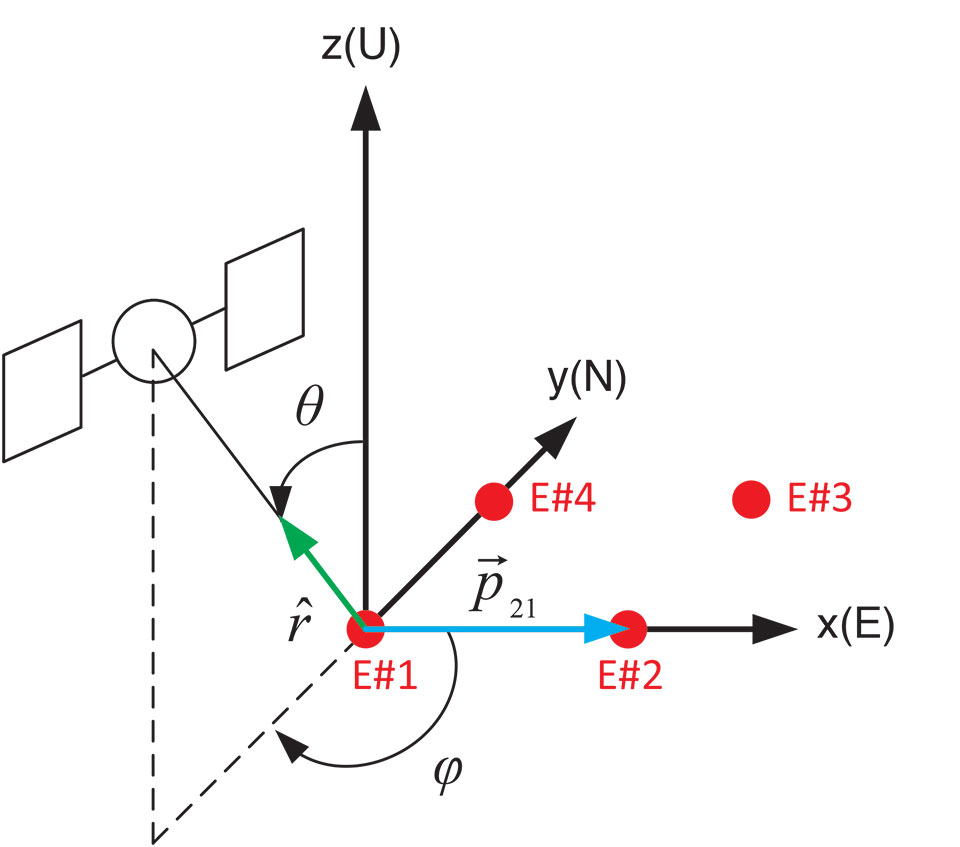
    Pattern is defined as the directional strength of a radio-frequency signal viewed from the antenna. The pattern of an antenna array is the product of the isotropic array factor and the isolated element pattern. We assume that the pattern of each element is identical and only consider the isotropic array factor. FIGURE 1 shows the coordination of an antenna array. The first element is set as a reference position. The x-axis is the east direction, the y-axis is the north direction, and the z-axis is the up direction. The baseline vector of the ith antenna is given by I-pi and I-r is the unit vector to the satellite.

    I-Fig1
    Figure 1. Antenna array geometry and direction of satellite. Array elements are identified as E#1, E#2, E#3, and E#4.

    The isotropic array factor is given by

    I-Eq1   (1)

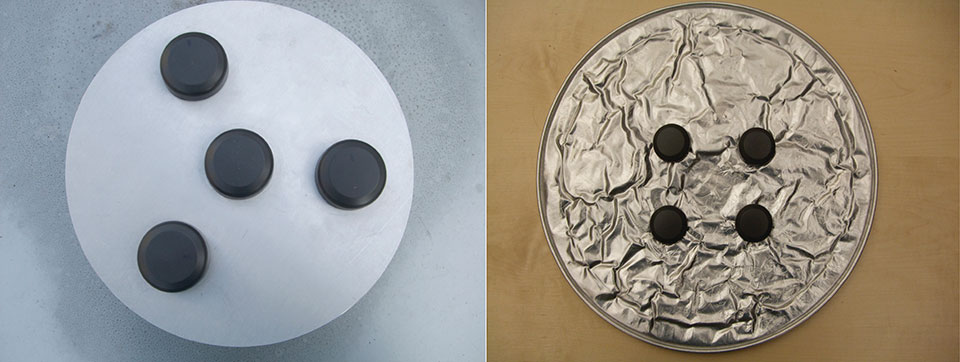
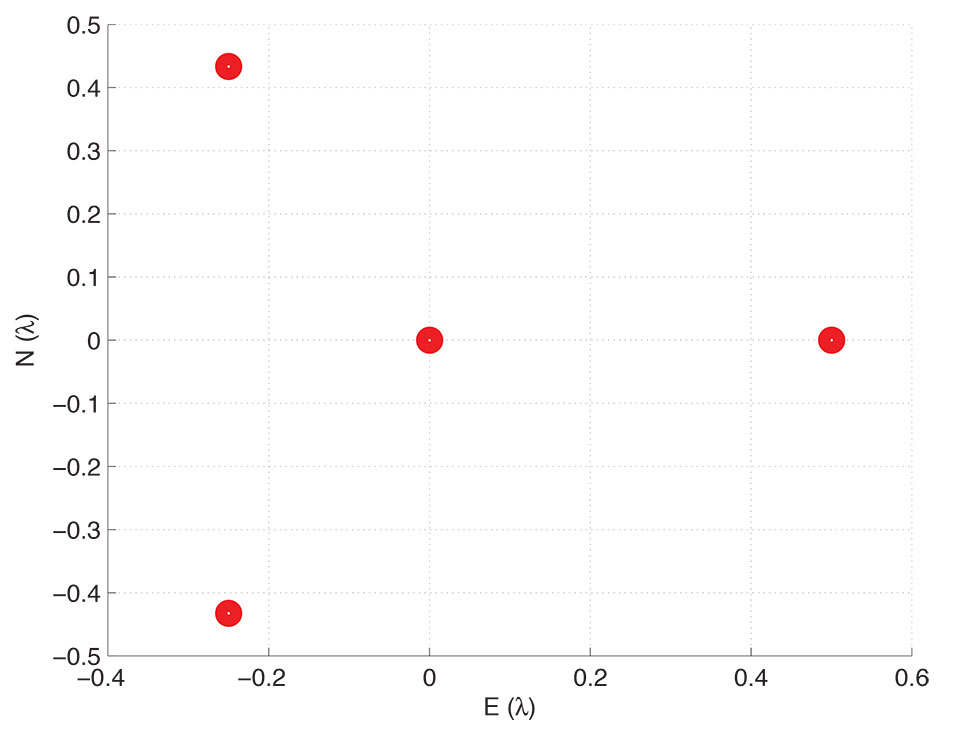
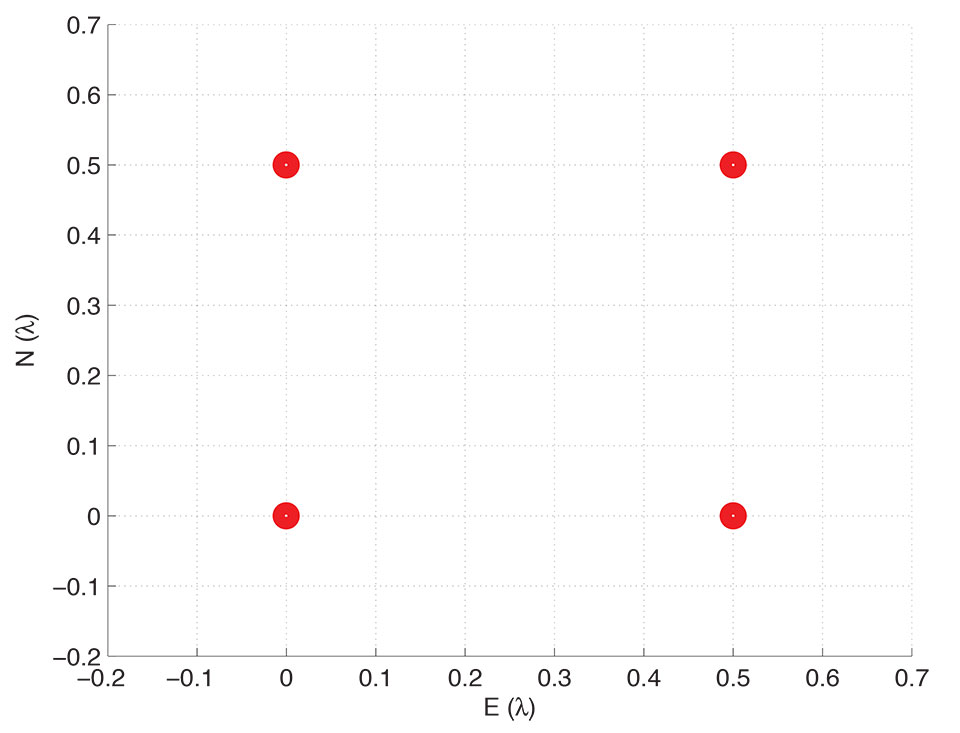
    where λ is wavelength, and Ai is a complex constant. Currently, we only implement a four-element-array CRPA software receiver in real time. Hence, we analyze two kinds of layout of half-wavelength four-element arrays: a symmetrical Y array and a square array. Each antenna is separated from its nearest neighbor by a half wavelength. FIGURE 2 shows photos of the two layouts. FIGURE 3 shows the physical layouts.

    I-Fig2
    Figure 2. Photos of antenna arrays (left: Y array; right: square array).
    I-Fig3top
    Figure 3A. Physical layout of antenna arrays (Y array).
    I-Fig3bottom
    Figure 3B. Physical layout of antenna arrays (square array).

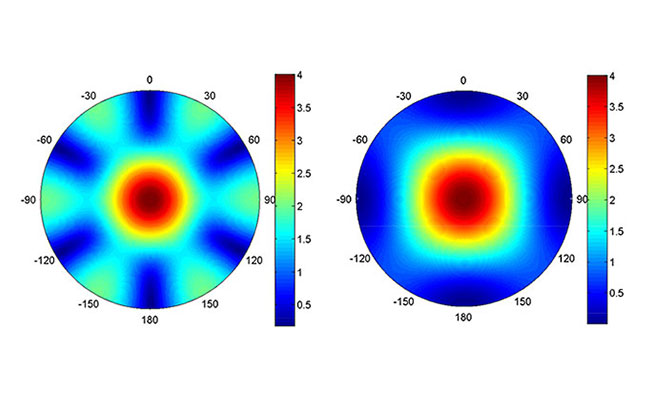
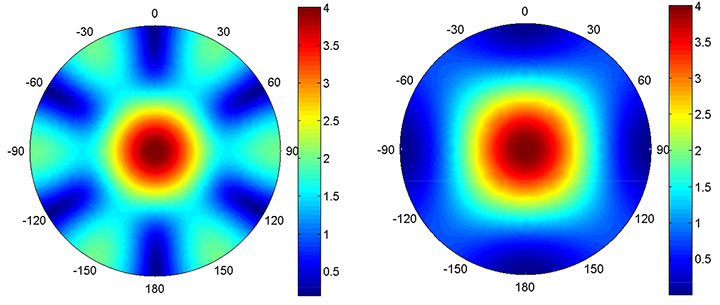
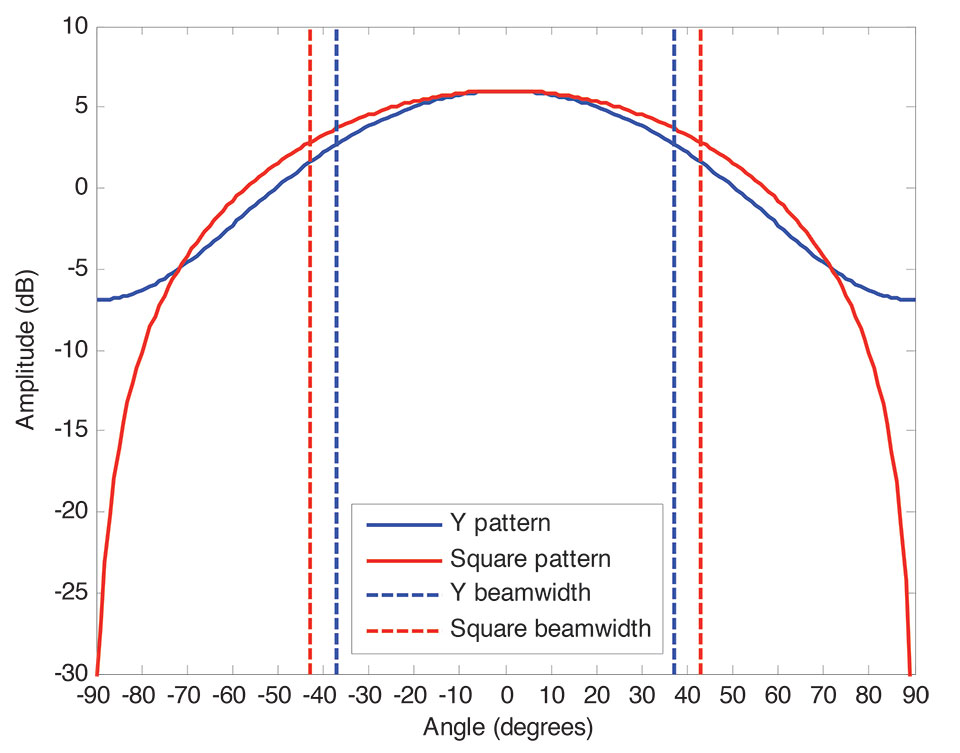
    The antenna patterns towards an elevation angle of 90 degrees, computed using equation 1 and the design layouts, are shown in FIGURE 4. One of the key characteristics of a pattern is the beamwidth, which is defined as the angle with 3-dB loss. FIGURE 5 shows the patterns in elevation angle where the beamwidth of the Y layout is 74 degrees and 86 degrees for the square layout. A narrow beamwidth will benefit anti-interference performance particularly if the interference is close to the direction of a target satellite.

    I-Fig4
    Figure 4. Patterns of antenna arrays (left: Y array; right: square array).
    FIGURE 5 Pattern beamwidths of Y and square arrays (3 dB beamwidth shown).
    Figure 5. Pattern beamwidths of Y and square arrays (3 dB beamwidth shown).
    Specifications of COTS Antennas

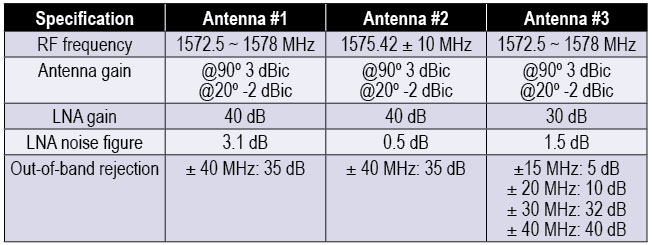
    Typically, the COTS antenna selection is determined by high gain and great out-of-band rejection. TABLE 1 shows the specifications of the three antenna models used in this article. These antennas are all patch antennas. The antennas are equipped with surface-acoustic-wave filters for rejecting out-of-band signals. A three-stage low noise amplifier with over 30 dB gain is also embedded in each antenna.

    I-T1
    Table 1. Specifications of COTS antennas used.
    Signal Collection Hardware and Experimental Setup

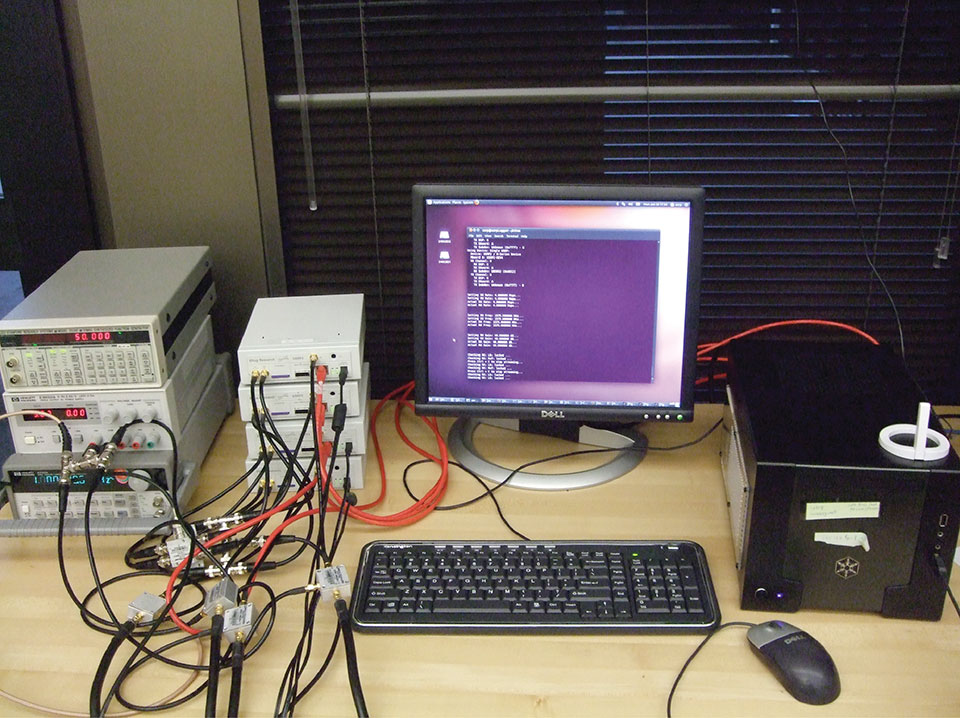
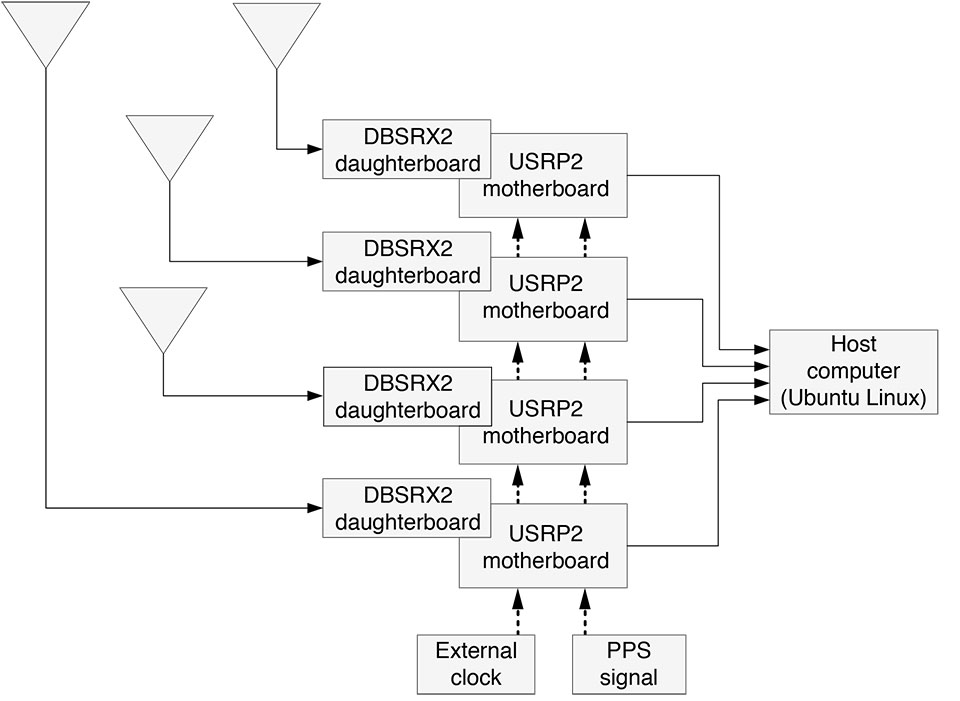
    The hardware used to collect the antenna array datasets is shown in FIGURE 6 with block-diagram representation in FIGURE 7. The hardware includes a four-element antenna array, four USRP2 software radio systems and one host computer. The signal received from the COTS antenna passes to a USRP2 board equipped with a 800–2300 MHz DBSRX2 programmable mixing and down-conversion daughterboard. The individual USRP2 boards are synchronized by a 10-MHz external common clock generator and a pulse-per-second (PPS) signal. The USRP2s are controlled by the host computer running the Ubuntu distribution of Linux. The open-source GNU Radio software-defined radio block is used to configure USRP2s and collect datasets. All USRP2s are configured to collect the L1 (1575.42 MHz) signal. The signals are converted to near zero intermediate frequency (IF) and digitized to 14-bit complex outputs (I and Q).

    I-Fig7
    Figure 6. Photo of the signal collection hardware.
    I-Fig6
    Figure 7. Block diagram of the signal collection hardware.

    The sampling rate is set as 4 MHz. The host computer uses two solid state drives for storing data sets. For our study, a 64-megabytes per second data transfer rate is needed. The fast solid state drives are especially useful when using high bandwidth signals such as L5, which will require an even higher data streaming rate (80 megabytes per second per channel).

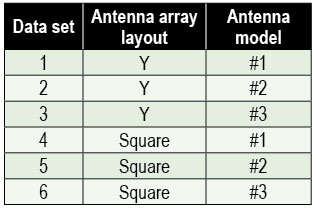
    To compare the physical and electrical layouts of the antenna arrays, we set up the signal collection hardware to record six data sets for the two layouts and the three antenna models as shown in TABLE 2. All of the data sets were five minutes long to obtain enough carrier-phase measurements for positioning.

    I-T2
    Table 2. Experimental setups.
    Logging Carrier-Phase Measurements

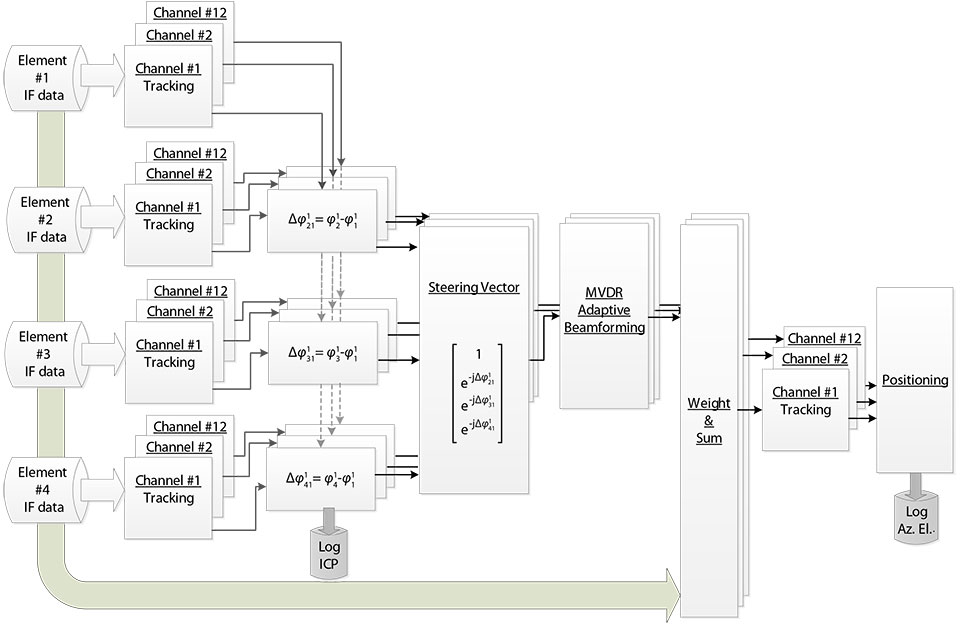
    To calculate the precise spacing between the antenna elements, hundreds of seconds of carrier-phase measurements from each element are needed. The collected data sets were provided by our in-house-developed CRPA software receiver. The receiver was developed using Visual Studio under Windows. Most of source code is programmed using C++. Assembly language is used to program the functions with high computational complexity such as correlation operations. The software architecture of the receiver is depicted in FIGURE 8. This architecture exploits four sets of 12 tracking channels in parallel to process each IF signal from an antenna element. Each channel is dedicated to tracking the signal of a single satellite. The tracking channels output carrier-phase measurements to build the steering vectors for each satellite. The Minimum Variance Distortionless Response (MVDR) algorithm was adopted for adaptively calculating the weights for beamforming. Here, there are 12 weight sets, one for each satellite in a tracking channel, for the desired directions of satellites.

    Figure 8. Block diagram of the software architecture.
    Figure 8. Block diagram of the software architecture.

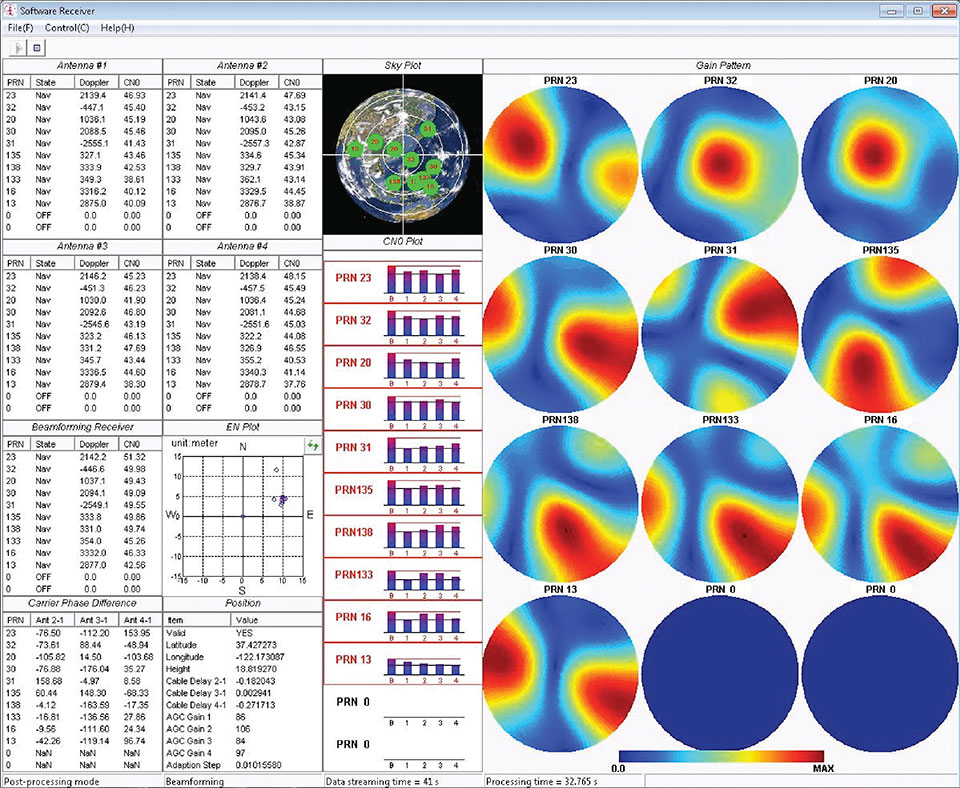
    Using the pre-correlation beamforming approach, the weights are multiplied with IF data and summed over all elements to form 12 composite signals. These signals are then processed by composite tracking channels. Finally, positioning is performed if pseudoranges and navigation messages are obtained from these channels. FIGURE 9 is the graphical user interface (GUI) of the CRPA software receiver. It consists of the channel status of all channels, carrier-phase differences, positioning results, an east-north (EN) plot, a sky plot, a carrier-to-noise-density (C/N0) plot and the gain patterns of the array for each tracked satellite. In the figure, the CRPA software receiver is tracking 10 satellites and its positioning history is shown in the EN plot. The beamforming channels have about 6 dB more gain in C/N0 than the channels of a single element. In each pattern, the direction with highest gain corresponds to the direction of the satellite. While the CRPA software receiver is running, the carrier-phase measurements of all elements and the azimuth and elevation angle of the satellites are logged every 100 milliseconds. Each data set in Table 2 was processed by the software receiver to log the data.

    FIGURE 9 Screenshot of the controlled-reception-pattern-antenna software-receiver graphical user interface.
    Figure 9. Screenshot of the controlled-reception-pattern-antenna software-receiver graphical user interface.
    Electrical Layout of Antenna Array – Procedure

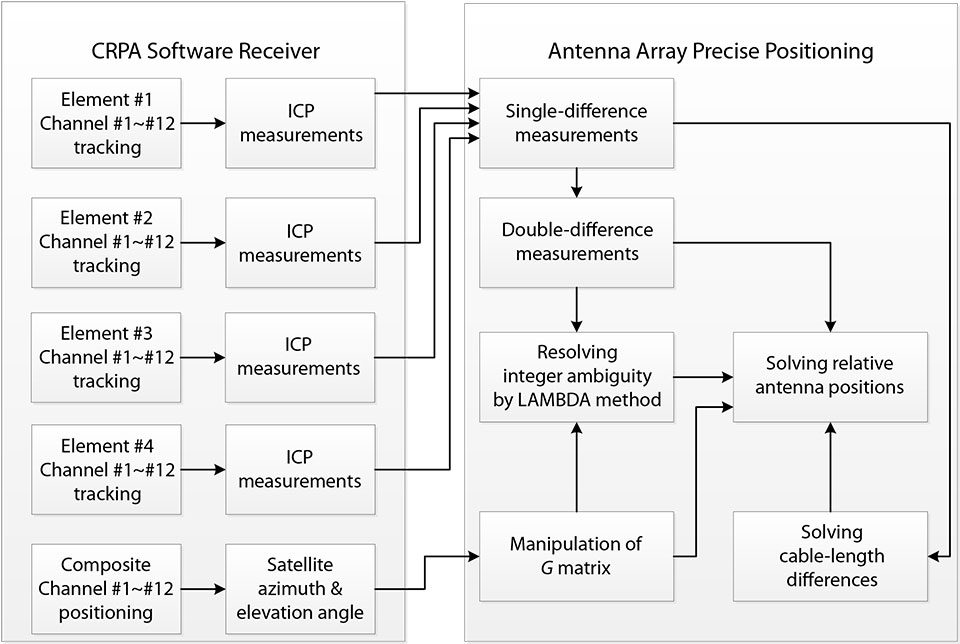
    The procedure of calculating the electrical layout of an antenna array is depicted in FIGURE 10. The single-difference integrated carrier phase (ICP) between the signals of an element, i, and a reference element, j, is represented as:

    I-Eq2   (2)

    where rkij is differential range toward the kth satellite between the ith and jth antenna elements (a function of the baseline vector between the ith and jth elements), δLij is the cable-length difference between the ith and jth antenna elements, Nkij is the integer associated with Φkij , εkij and  is the phase error. The double-difference ICP between the kth satellite and reference satellite l is represented as:
    I-Eq3   (3)

    The cable-length difference term is subtracted in the double difference. Since the distances between the antenna elements are close to one wavelength, equation (3) can be written as:
    I-Eq4   (4)

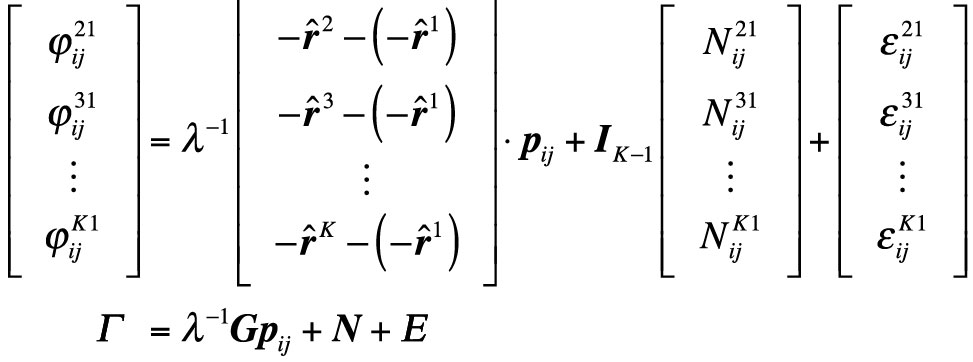
    where i-rk is the unit vector to satellite k, pij is the baseline vector between the ith and jth elements. By combining all the double-difference measurements of the ijth pair of elements, the observations equation can be represented as:
    I-Eq5      (5)

    From the positioning results of composite channels, the azimuth and elevation angle of satellites are used to manipulate matrix G. To solve equation (5), the LAMBDA method was adopted to give the integer vector N. Then, pij  is solved by substituting N into equation (5). Finally, the cable-length differences are obtained by substituting the solutions of N and pij into equation (2).

    This approach averages the array pattern across all satellite measurements observed during the calibration period.

    FIGURE 10 Procedure for calculating antenna-array electrical spacing.
    Figure 10. Procedure for calculating antenna-array electrical spacing.
    Electrical Layout of Antenna Array – Results

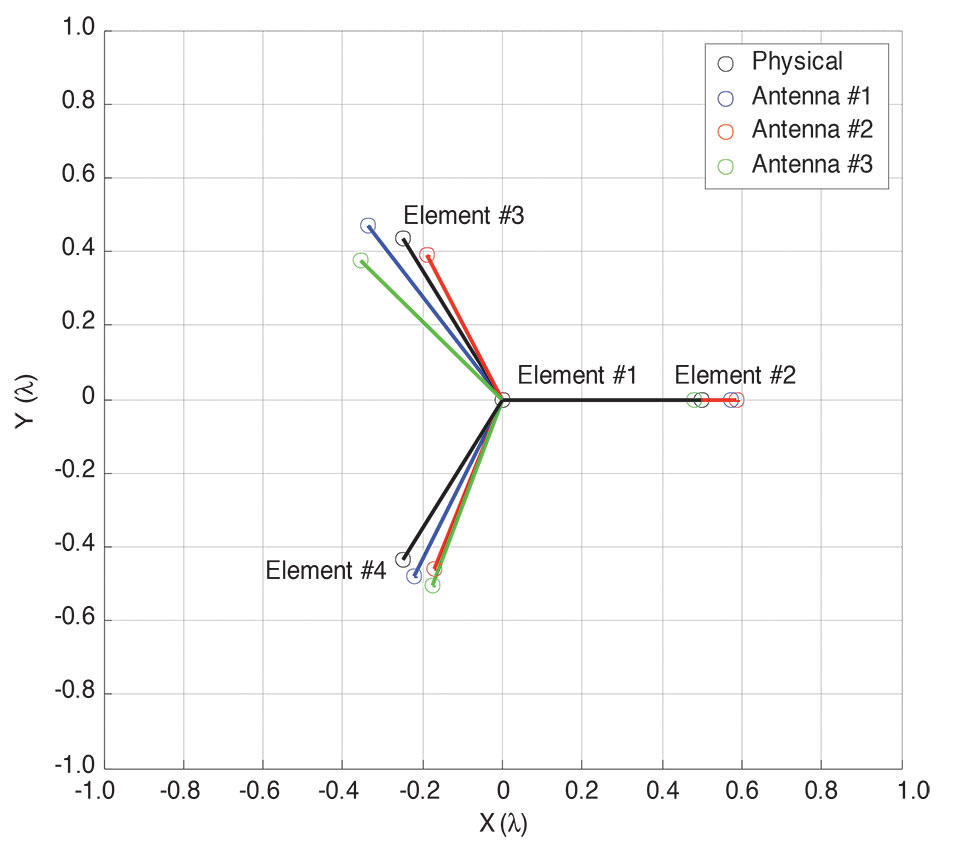
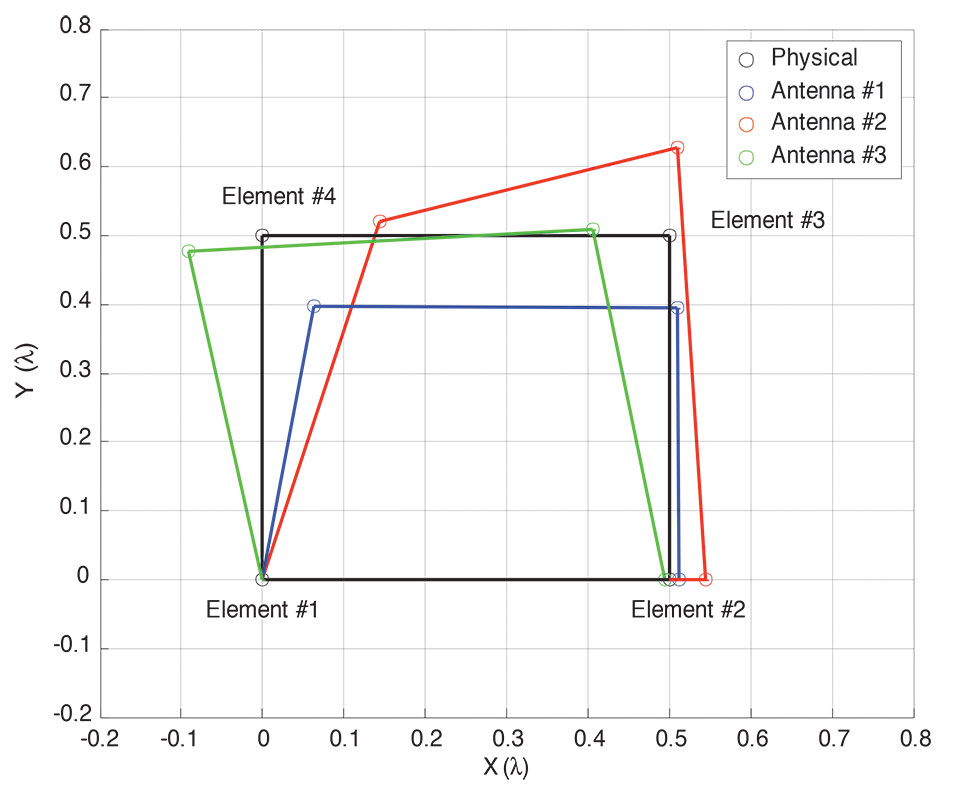
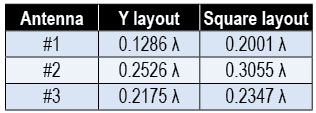
    Using the procedure in the previous section, all electrical layouts of the antenna array were calculated and are shown in FIGURES 11 and 12. We aligned the vectors from element #1 to element #2 for all layouts. TABLE 3 lists the total differences between the physical and electrical layouts. For the same model of antenna, the Y layout has less difference than the square layout. And, in terms of antenna model, antenna #1 has the least difference for both Y and square layouts. We could conclude that the mutual coupling effect of the Y layout is less than that of the square layout, and that antenna #1 has the smallest mutual coupling effect among all three models of antenna for these particular elements and observations utilized.

    FIGURE 11 Results of electrical layout using three models of antenna compared to the physical layout for the Y array.
    Figure 11. Results of electrical layout using three models of antenna compared to the physical layout for the Y array.
    I-Fig12
    Figure 12. Results of electrical layout using three models of antenna compared to physical layout for the square array.
    Table 3. Total differences between physical and electrical layouts.
    Table 3. Total differences between physical and electrical layouts.

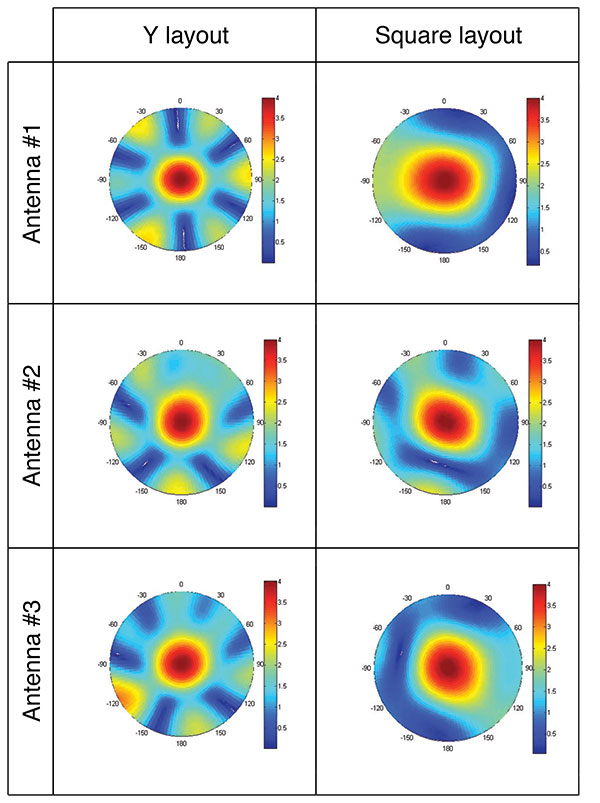
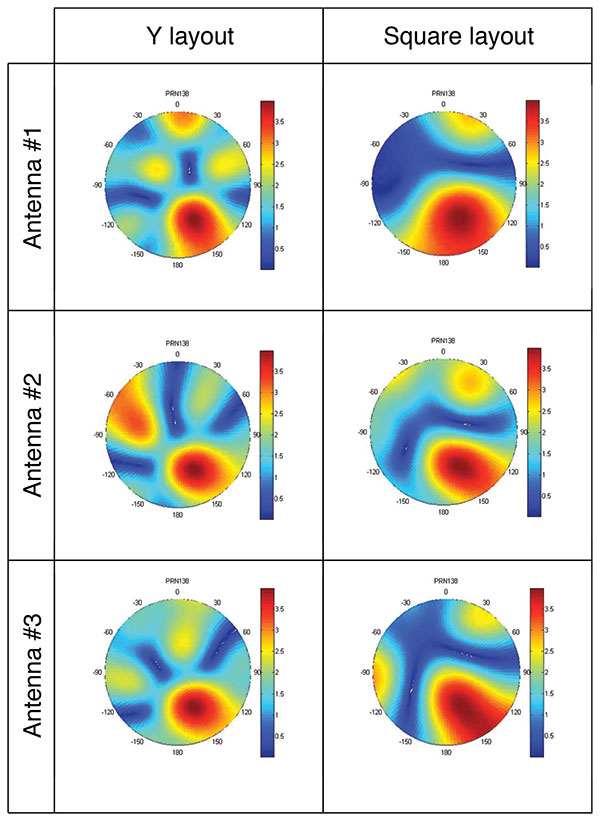
    To compare the patterns of all calculated electrical layouts, we selected two specific directions: an elevation angle of 90 degrees and a target satellite, WAAS GEO PRN138, which was available for all data sets. The results are shown in FIGURES 13 and 14, respectively. From Figure 13, the beamwidth of the Y layout is narrower than that of the square layout for all antenna models. When compared to Figure 5, this result confirms the validity of our analysis approach. But, in Figure 14, a strong sidelobe appears at azimuth -60º in the pattern of Y layout for antenna #2. If there is some interference located in this direction, the anti-interference performance of the array will be limited. This is due to a high mutual coupling effect of antenna #2 and only can be seen after calculating the electrical layout.

    I-Fig13
    Figure 13. Patterns of three models of antenna and two layouts toward an elevation angle of 90 degrees.
    I-Fig14
    Figure 14. Patterns of three models of antenna and two layouts toward the WAAS GEO satellite PRN138.
    Conclusions

    The results of our electrical layout experiment show that the Y layout has a smaller difference with respect to the physical layout than the square layout. That implies that the elements of the Y layout have less mutual coupling. For the antenna selection, arrays based on antenna model #1 showed the least difference between electrical and physical layout. And its pattern does not have a high grating lobe in a direction other than to the target satellite.

    The hardware and methods used in this article can serve as a testing tool for any antenna array. Specifically, our methodology, which can be used to collect data, compare physical and electrical layouts, and assess resultant antenna gain patterns, allows us to compare the performances of different options and select the best antenna and layout combination. Results can be used to model mutual coupling and the overall effect of layout and antenna type on array gain pattern and overall CRPA capabilities. This procedure is especially important when using COTS antennas to assemble an antenna array and as we increase the number of antenna elements and the geometry possibilities of the array.

    Acknowledgments

    The authors gratefully acknowledge the work of Dr. Jiwon Seo in building the signal collection hardware. The authors also gratefully acknowledge the Federal Aviation Administration Cooperative Research and Development Agreement 08-G-007 for supporting this research. This article is based on the paper “A Study of Geometry and Commercial Off-The-Shelf (COTS) Antennas for Controlled Reception Pattern Antenna (CRPA) Arrays” presented at ION GNSS 2012, the 25th International Technical Meeting of the Satellite Division of The Institute of Navigation, held in Nashville, Tennessee, September 17–21, 2012.

    Manufacturers

    The antennas used to construct the arrays are Wi-Sys Communications Inc., now PCTEL, Inc. models WS3978 and WS3997 and PCTEL, Inc. model 3978D-HR. The equipment used to collect data sets includes Ettus Research LLC model USRP2 software-defined radios and associated DBSRX2 daughterboards.


    Yu-Hsuan Chen is a postdoctoral scholar in the GNSS Research Laboratory at Stanford University, Stanford, California.

    Sherman Lo is a senior research engineer at the Stanford GNSS Research Laboratory.

    Dennis M. Akos is an associate professor with the Aerospace Engineering Science Department in the University of Colorado at Boulder with visiting appointments at Luleå Technical University, Sweden, and Stanford University.

    David S. De Lorenzo is a principal research engineer at Polaris Wireless, Mountain View, California, and a consulting research associate to the Stanford GNSS Research Laboratory.

    Per Enge is a professor of aeronautics and astronautics at Stanford University, where he is the Kleiner-Perkins Professor in the School of Engineering. He directs the GNSS Research Laboratory.

    FURTHER READING

    • Authors’ Publications

    “A Study of Geometry and Commercial Off-The-Shelf (COTS) Antennas for Controlled Reception Pattern Antenna (CRPA) Arrays” by Y.-H. Chen in Proceedings of ION GNSS 2012, the 25th International Technical Meeting of The Institute of Navigation, Nashville, Tennessee, September 17–21, 2012, pp. 907–914 (ION Student Paper Award winner).

    “A Real-Time Capable Software-Defined Receiver Using GPU for Adaptive Anti-Jam GPS Sensors” by J. Seo, Y.-H. Chen, D.S. De Lorenzo, S. Lo, P. Enge, D. Akos, and J. Lee in Sensors, Vol. 11, No. 9, 2011, pp. 8966–8991, doi: 10.3390/s110908966.

    “Real-Time Software Receiver for GPS Controlled Reception Pattern Array Processing” by Y.-H. Chen, D.S. De Lorenzo, J. Seo, S. Lo, J.-C. Juang, P. Enge, and D.M. Akos in Proceedings of ION GNSS 2010, the 23rd International Technical Meeting of The Institute of Navigation, Portland, Oregon, September 21–24, 2010, pp. 1932–1941.

    “A GNSS Software Receiver Approach for the Processing of Intermittent Data” by Y.-H. Chen and J.-C. Juang in Proceedings of ION GNSS 2007, the 20th International Technical Meeting of The Institute of Navigation, Fort Worth, Texas, September 25–28, 2007, pp. 2772–2777.

    • Controlled-Reception-Pattern Antenna Arrays

    “Anti-Jam Protection by Antenna: Conception, Realization, Evaluation of a Seven-Element GNSS CRPA” by F. Leveau, S. Boucher, E. Goron, and H. Lattard in GPS World, Vol. 24, No. 2, February 2013, pp. 30–33.

    “Development of Robust Safety-of-Life Navigation Receivers” by M.V.T. Heckler, M. Cuntz, A. Konovaltsev, L.A. Greda, A. Dreher, and M. Meurer in IEEE Transactions on Microwave Theory and Techniques, Vol. 59, No. 4, April 2011, pp. 998–1005, doi: 10.1109/TMTT.2010.2103090.

    Phased Array Antennas, 2nd Edition, by R. C. Hansen, published by John Wiley & Sons, Inc., Hoboken, New Jersey, 2009.

    • Antenna Principles

    “Selecting the Right GNSS Antenna” by G. Ryley in GPS World, Vol. 24, No. 2, February 2013, pp. 40–41 (in PDF of 2013 Antenna Survey.)

    GNSS Antennas: An Introduction to Bandwidth, Gain Pattern, Polarization, and All That” by G.J.K. Moernaut and D. Orban in GPS World, Vol. 20, No. 2, February 2009, pp. 42–48.

    A Primer on GPS Antennas” by R.B. Langley in GPS World, Vol. 9, No. 7, July 1998, pp. 50-54.

    • Software-Defined Radios for GNSS

    “A USRP2-based Reconfigurable Multi-constellation Multi-frequency GNSS Software Receiver Front End” by S. Peng and Y. Morton in GPS Solutions, Vol. 17, No. 1, January 2013, pp. 89-102.

    Software GNSS Receiver: An Answer for Precise Positioning Research” by T. Pany, N. Falk, B. Riedl, T. Hartmann, G. Stangl, and C. Stöber in GPS World, Vol. 23, No. 9, September 2012, pp. 60–66.

    Simulating GPS Signals: It Doesn’t Have to Be Expensive” by A. Brown, J. Redd, and M.-A. Hutton in GPS World, Vol. 23, No. 5, May 2012, pp. 44–50.

    Digital Satellite Navigation and Geophysics: A Practical Guide with GNSS Signal Simulator and Receiver Laboratory by I.G. Petrovski and T. Tsujii with foreword by R.B. Langley, published by Cambridge University Press, Cambridge, U.K., 2012.

    “A Real-Time Software Receiver for the GPS and Galileo L1 Signals” by B.M. Ledvina, M.L. Psiaki, T.E. Humphreys, S.P. Powell, and P.M. Kintner, Jr. in Proceedings of ION GNSS 2006, the 19th International Technical Meeting of The Institute of Navigation, Fort Worth, Texas, September 26–29, 2006, pp. 2321–2333.