Tag: Defense PNT newsletter

  • Grand Setting for a Grand Summit

    Most of Munich is an ultra-modern German city, albeit one of the most expensive cities in Europe, where you can travel anywhere by tram, automobile, S-Bahn, rail or taxi. But why bother when you have the opportunity and thrill of walking through the old city center and have Bavarians greet you with “May God greet you” or “God bless­”? — what a way to say hello. That experience, which brings back fond memories — more on that in my main column — combined with the wonderful aromas from bakeries and early morning baristas hard at work, which are hard to pass by, made the short walk to the Residenz München seem all too short; and then you are there — greeted with the magnificence of the Munich Satellite Summit venue.

    The Residenz München served as the seat of government and residence of Bavarian dukes, electors and kings from 1508 to 1918. The Residenz began life in 1385 as a castle on the outskirts of München and subsequently transformed over the centuries into a magnificent palace or Schloss, its buildings and gardens extending further into the center of town or Stadtmitte. And this is the incredible venue for the Munich Satellite Summit. It is breathtakingly magnificent and yet for all its age and history the Residenz serves its varied and ever-changing purposes well, and certainly is the perfect venue for the summit. This is the 10th anniversary of the summit in this location, and hopefully it will never change. Anything else now, with so much grandeur and history, would be a huge disappointment.

    As you ascend steps that have been trod and worn down daily by kings, dukes, barons, and commoners alike for more than 625 years, it comes home that you are in a very special place. If that is not enough, the König’s guarded banquet room, which is still set with silver place settings, silverware, and crystal goblets to feed more than 100 at one grand table, soon gives you a clue that you are someplace special. Whilst there are several large banquet rooms and court areas easily capable of holding the 400+ attendees, the organizers have wisely chosen to keep you moving from place to place to pique your interest in the old castle and to keep the blood flowing after sitting through a series of high-tech presentations.

    In the alte Schloss, the summit presentations are in one area, the company and sponsor booths are in another, and the German coffee and refreshments in yet another. This keeps you moving and also keeps the noise and modern-day distractions to a manageable level — plus, of course, it is perfect for networking. There are a myriad of interesting nooks and crannies for meet-ups and impromptu discussions. Fortunately the conveniently provided summit Wi-Fi signals penetrate the thick stone walls and are available in all meeting and presentation areas.

    The real danger of meeting in this iconic Bavarian palace is that you are constantly distracted by the beauty and history surrounding you. I constantly reminded myself I was attending a 21st-century satellite summit and not a whirlwind tour of gorgeous historical Bavarian architecture. Although I must admit I managed to do a little of the latter in between presentations and meetings. Just don’t tell my editor.

    Fortunately, lunch is served in-suite, so you do not have to leave the fabulous Schloss for sustenance — and what a gourmet lunch. You guessed it: the meals were fit for a King or König, certainly more than sufficient for a mere journalist. Although I must admit to being a bit worried since as a vegetarian, Germany does not exactly have the reputation of providing veggie substitutes for wurst und sauerbraten. However, to say I was happily surprised is putting it mildly.

    Frauleins Heike Haas and Bärbel Deisting, whom I cannot praise highly enough, the intrepid and unflappable organizers of this wonderful international event, had obviously warned their chef and he provided sumptuous vegetarian or “vegetarisch auf Deutsch,” options for every meal. My most common refrain at mealtimes, as I returned for seconds and thirds, was…are you sure this does not have any meat in it? The meals, snacks, and of course the coffee are not to be missed. You might miss five minutes of a presentation but don’t dare miss a meal.

    This was my first year to attend the Munich Summit as Alan Cameron, our intrepid editor-in-chief and now publisher, has always attended in the past. So most of the greetings went like this: “Hi Don, glad you are here. Where’s Alan?” My invariable response was, “Busy being the publisher.”

    The opening plenary, as it is so aptly named, took place in the Allerheiligen-Hofkirche, or Court Church of All Saints, and it was a fitting venue. The master of ceremonies opined that the Court Church of All Saints only took 11 years to complete in the 1800s, in direct contrast to the Galileo constellation, which has already been in existence for more than 11 years with…well, you get the point.

    Now for an historical note: King Ludwig 1 who commissioned the Court Church of All Saints married Therese of Saxe-Hildburghausen in October 1810 and the resulting wedding celebration was the occasion for the first ever Oktoberfest. Beer drinkers for the last 200 years are still celebrating that wedding. I know I did when I attended University in München more than 45 years ago, but that is a story for another time. And no, this is not the Neuschwanstein, Wagner loving, mad King Ludwig, who unfortunately after a lifetime of swimming forgot how at the crucial moment…that was his grandson.


  • Grüss Gott – Munich Satellite Summit

    There is a reason the Munich Satellite Summit is billed as a summit and not a symposium or conference. It’s a different atmosphere that invites group chats, informal get-togethers, and networking. One item of note that I came away with is that the Chinese are looking for help and partners for their PNT constellations, of which there appear to be three in the making. But asked point blank when they would finally release the full ICD specifications for receivers (a partial ICD has been released) the answer was the same as last year. They did not know when that might happen. It is hard to build receivers and support a specific program, much less three PNT constellations, when you don’t have the specifications.

    Grüss Gott! rang out across the ancient cobblestoned Marienplatz, home of the beautiful and timeless Glockenspiel or mechanized clock tower as I strolled along. The Glockenspeil is located in the heart of the old city of München, Germany and I passed it every morning as I strolled toward the Residenz München, which centuries ago was home and castle to the Kings of Bavaria. This particular beautiful spring morning the ancient castle was my destination and the incredible venue for the Munich Satellite Summit. Talk about location, location, location! (Read more about this incredible setting.)

    Plenary Session

    There were no less than 10 plenary speakers on opening night. In retrospect there should have only been five, but that is a lesson learned, as is the fact that the Chinese presenter was totally indecipherable. Even reading his slides I still could not understand a word he said. As an organizer of such events, and yes I know from experience, you quickly learn that poor and even unintelligible speakers are just a curse that comes with the territory. However, the musical interludes presented by an a cappella musical group were outstanding. This was the highlight of the evening, which tells you something about the plenary — it was not bad actually as plenaries go, everything worked like clockwork. It was just a tad bit too long. No one ever hopes…well maybe that is backwards…actually everyone hopes to attend a plenary that is actually informative but it rarely occurs. The summit plenary wasn’t bad; the food, drink and networking opportunities were great, but next year I vote for more songs, fewer indecipherable speeches and, until they get their act together, the only Chinese item on the plenary or any summit agenda should be egg rolls.

    This is not an expression of Xenophobia or bigotry, not at all — I just hate to waste my time. I spent several hours listening to the Chinese presentations during the summit and literally understanding about 10% or less, and unless I, and everyone else missed it, there was absolutely nothing new announced. It was a total rehash of the National Space Symposiums uninformative Chinese forum from last April.

    The one item of note that I did comprehend is that the Chinese are looking for help and partners for their PNT constellations, of which there appear to be three in the making. But asked point blank when they would finally release the full ICD specifications for receivers (a partial ICD has been released), the answer was the same as last year. They did not know when that might happen. It is hard to build receivers and support a specific program, much less three PNT constellations, when you don’t have the specifications.

    I met Joel Szabat, the senior government representative at the plenary who is currently serving as a senior official in the U.S. Department of Transportation. Joel and I have corresponded but never met, so this was a great opportunity to get acquainted. And I must add that Joel’s comments during the plenary session were right on the mark. They were short, concise, and to the point. Very well done. If only others had emulated him.

    Other notable U.S. attendees were Colonel Bernie Gruber, director of the GPS Directorate, who gave a well received but brief GPS status briefing, and some of his staff along with Hank Skalski, the Civil GPS liaison at HQ AFSPC; Ron Hatch from John Deere (Starfire); as well as an old friend, Dr. Per Enge, director of the GPS laboratory and senior professor in the Department of Aeronautics & Astronautics at Stanford University. Representatives from Lockheed-Martin Space Systems and other U.S. companies were present as well, so the U.S. space program was well represented.

    One of the Royal Lions Guarding the entrance
    to the Munich Satellite Summit.

    Summit

    There is a reason the Munich Satellite Summit is billed as a summit and not a symposium or conference. There is a different atmosphere that invites group chats, informal get-togethers and networking. It may sound strange; however, in an ancient German palace the atmosphere is a bit less formal than at the National Space Symposium in Colorado Springs, Colorado, which is the largest Space Symposium in the world. The Munich Satellite Summit will garner ~400 international attendees while at the Broadmoor Resort there will be closer to 5,000 attending. So the summit is definitely a bit more intimate and less rushed. More conducive to networking, which in my estimation is the real value of the summit. At the summit you can easily visit all the booths in 30 minutes or less and in Colorado Springs you will be lucky to get through all the booths in less than three days of dedicated booth-hopping. In Germany everyone is a bit more relaxed, and at the National Space Symposium everyone is trying to see and attend everything; it is definitely a bit more frenetic and yet both venues are amazing in their own way and each event has its place in the scheme of things.

    Both the Munich Space Summit and the National Space Symposium, which includes Cyber 1.2 (15-19 April 2012), are about more than GPS and PNT, yet these are the predominant themes at both events…and this is only as it should be… Who me? Biased!

    eLORAN

    Seriously, the Munich Space Summit is naturally more European Space Agency (ESA) and Galileo-oriented than the National Space Symposium, and yet this year one of the main themes and topics of conversation was eLORAN and the USCG-supported UrsaNav foray into that endeavor.

    My GPS World column on that timely topic came out on March 14, the first full day of the summit, so it was a constant topic of conversation for me and I was happy to hear that sections from the article were quoted numerous times during the summit. Many were happily surprised by the UrsaNav efforts and even more surprised by the USCG support.

    A dedicated eLORAN session included Professor David Last from the UK and a speaker from the subcontinent, who told some pretty hair-raising pirate stories to illustrate his points of why a strong, impervious to jamming, low-frequency timing and PNT system is needed in his part of the world and is generally a good idea on a global basis. I would agree — when being attacked by pirates, knowing immediately exactly where and when you are can be of critical importance when seeking help. It was an entertaining, informative session that was standing-room only.

    During the entire summit, I only heard the word LightSquared used as an expletive. Most everyone said…thank goodness that “§”&%” is over… or words to that effect. Most everyone marveled that it took a year to get through the whole fiasco and wondered what will happen next…it is like waiting for the other shoe to drop…but there was an obvious huge sigh of relief and then inevitably comments like …see, that’s why the United States needs an eLORAN system. ” Point taken I hope.

    And the U.S. does desperately need a proven high-power LF Stratum-1 timing signal that covers the U.S., approaches to the U.S. as well as portions of Canada and Latin America. Faithful readers know that I often quote the statistic that 90% of GPS users globally use GPS for time. Time and frequency standards are critical to our national infrastructure, even more so since GPS freely provides time to a very high degree of accuracy for all and using the GPS timing source has become ubiquitous among most U.S. government agencies.

    Time is critically important to all we do — more so than most of us ever take the time to consider. However the subject of time fascinates many. I remember a conference on timing a few months ago in Boulder, Colorado, at NIST with numerous timing briefings given by an old friend, Judah Levine. The topics included, “What is Time?”, “What is a Second?”, “What is a Leap Second?” and “The Importance of Frequency” — I don’t remember anyone leaving the room while Judah was speaking.

    Some of the more critical factors concerning time as associated with GPS and eLORAN are that unlike mechanical devices — such as an INS (inertial navigation system) that display your position — GPS and eLORAN signals contain data that informs you when you are as well as where you are. GPS and eLORAN can give you the day, date and time as well as a geographical or spatial position, which is crucial data for automated scheduling of activities that is so prevalent in many of our critical infrastructures today.

    I and several subject matter experts will discuss aspects of eLORAN and more during a GPS World-sponsored webinar in June 2012. Stay tuned for more information concerning that event.

    Other Forays

    Munich is a big modern city with all that brings with it and it has changed a great deal in the last 45 years, since I attended University there. I helped edit the university newspaper, worked as a disc jockey at Radio Free Europe to pay my way though university, and worked as a roving correspondent. See, I really have been in this business for a long time in one way or another. So, being the intrepid journalist I have always been, only much older and wiser and with much less hair to lose, I scheduled side trips to Astrium, Audi, BMW, Mercedes, VW-Porsche, and NATO AWACS. Do you see a trend developing?

    The Astrium personnel and the factory tour were very special, and you will be hearing more about both at another time. Astrium is building several of the key components of the Galileo satellites as a subcontractor to OHB Technology AG in Bremen, Germany.

    Bottom Line

    There is so much to say about the Munich Satellite Summit and of course the extra curricular excursions; it is impossible to do so in just one or two columns, so I will be covering different aspects over the next several months. Bottom Line: the Munich Satellite Summit is a seminal event and a treat not to be missed. I want to thank our Editor-in-Chief and Publisher Alan Cameron for allowing me to attend this year, and I hope that Alan remains so busy that I will have the opportunity to personally greet you with Grüss Gott in München in February 2013. Tschüss!

    Until then, happy navigating.


  • eLoran and UrsaNav: Timing Is Everything

    The first part of the recent UrsaNav press release says it best:

    This week for the first time since August 2010 advanced low frequency (LF) signals, including a new eLORAN, are on the air in North America! As a result of a Cooperative Research and Development Agreement (CRADA) between the United States Coast Guard (USCG) and UrsaNav, Inc. live testing of a wide-area precise timing solution has begun. These initial tests include a comprehensive pallet of signals, including eLoran, that are being evaluated for their ability to provide a robust, wide-area, wireless precise timing alternative that can operate cooperatively with GPS, or during periods of GPS unavailability.

    Why eLORAN

    Global government, industry, and academic experts recognize that advanced LF signals, of which eLORAN is just one example, can provide alternative timing — either as a stand-a-lone service, or as a component of an existing PNT service. The high power, virtually jam proof and spoof proof LF signals operate independently of GPS and GNSS, and provide a Universal Coordinated Time (UTC) time reference in the order of tens of nanoseconds. The recognition of the criticality of time to many aspects of our national critical infrastructure has led to establishment of the CRADA to evaluate the benefits of an LF wide-area timing system.

    UrsaNav on-air eLORAN tests continue at various sites throughout the United States (CONUS and Alaska). Broadcast demonstrations will test several different frequencies, waveforms, and modulation techniques using evolutionary state-of-the-art technology.

    Reception demonstrations of the eLORAN broadcasts are planned at both on- and offshore locations, and will include advanced LF data delivery techniques. Trial results will be presented at national and international conferences. Anyone interested in any part of the testing or interested in making their own measurements are invited to contact UrsaNav.


    UrsaNav eLORAN system. Arthur Helwig (UrsaNav) and
    Aaron Grant (Nautel) prepare the LF transmitter for the next
    set of on-air tests.

    Partnered with Symmetricom and Nautel, UrsaNav says it has the world’s most advanced LF alternate PNT and data solutions to include the world’s best high-performance eLORAN timing receivers. UrsaNav has partnered with two of the best in the business for timing and transmitters, and this alliance of expertise provides the foundation technology for the best wide-area terrestrial-based alternative to GNSS such as GPS, GLONASS, and Galileo.

    That being said, I would add that you should not only consider the UrsaNav LF system as an alternative, but during normal GPS operations as a complimentary and/or augmentation to GPS, and then as a back-up and integrity system when the situation warrants.

    As one of my professional colleagues, who is a retired USCG officer and once ran the USCG Navigation Center, stated, “This is a big deal! It is in fact the first and biggest piece of good news about a true PNT (position, navigation, and timing) backup for GPS since Loran-C was killed in the FY2010 budget.

    “Not only is this an independent timing backup, but the LF signals can also be used as pseudoranges mixed in with GPS, or if enough transmitters are available, as a fully independent PNT network. In other words, a true backup PNT capability for safety-of-life navigation, for dispatching first responders, and for supporting critical national infrastructures.”

    This is a pretty enthusiastic response, even from a LORAN aficionado, and it is indicative of the responses I received whenever I reached out for comments from knowledgeable PNT SMEs (subject matter experts) around the globe.

    The response nationally and internationally has been extremely positive as well — especially in light of the recent LightSquared debacle and the now better-understood vulnerabilities of the very low-power GPS signals.

    I hoped I would never have to type or have you read that word again, as a noun or a verb, but the whole LightSquared scenario did serve to point out a dire need and shortcoming in the U.S. PNT infrastructure. Fortunately, the proposed UrsaNav eLORAN system appears to be on track to fill that need perfectly.

    For the first 32 years that GPS signals were broadcast, LORAN-C served as a critical backup for timing and a less accurate but viable alternative for navigation. In fact, Loran-C, along with GPS and cesium clocks synchronized to UTC, were the only accepted Stratum 1 frequency sources at the time (Stratum 1 frequency sources provide a minimum frequency stability of 1 x 10-11 per day.). Then in 2010 the current U.S. administration was looking for government programs to cut and for some unknown reason they latched onto LORAN-C, which was in a critical state of transition at the time.

    LORAN-C has been around since World War II. I among many other aviators used it extensively in Vietnam, and frankly for many countries and users today it is still a totally adequate service. With USCG expertise and support for 52 years, LORAN-C provided unparalleled timing and navigation services around the United States and Canada until the pretender known as GPS came along and dethroned the aging monarch.

    Now, that may sound like a natural sequence of events, except that LORAN-C was in metamorphosis, 80% of the way through the process actually, of morphing into a new digital (1990s era technology) LORAN know as eLORAN or enhanced LORAN with better, more reliable transmitters, smaller receivers, and a virtually jam-proof signal structure. Many likened the legacy eLORAN to a strong ground-based GPS with coded signals for security. All that was in place and 80% complete when the whole process was killed by an administration with a strong Luddite orientation and subsequently the bean counters pulled the plug in 2010, despite recommendations to complete eLoran from both the Department of Transportation’s Positioning and Navigation (PosNav) Committee and the Department of Homeland Security Geospatial Committee and the strong personal support of the DOT Undersecretary for Policy and the DHS Deputy Undersecretary for Preparedness and National Protection and Programs. My sources tell me the Office of Management and Budget (OMB) was determined to do away with Loran-C and facilitated its ultimate demise. An unfortunate theme we have seen played out much too often: Non-technical people forcing ill-advised technical decisions. In a country whose greatness has always been its technical acumen, willingness to take risks, and self-assurance, OMB stands as a chilling element of focus today…but, that’s a subject for a future article.

    Since that time the U.S. Coast Guard spent more money dismantling the legacy LORAN-C infrastructure and antennas than it would have taken to complete the 20% upgrade for a full transition to eLORAN. Taking down the Port Clarence, Alaska, tower, the video of which was a YouTube favorite for many weeks, cost an estimated $8 million. The destruction of the towers in Attu (right), Shoal Cove and St. Paul were probably on average $5 million each. With the tower removal in Baudette, Minnesota, the cost of removing Loran towers to date cost close to $25 million. One could argue that the administration created some jobs in these “shovel-ready” tower tear downs, but I have no doubt that a better use of the funding would have been to deliver a robust positioning, navigation, and timing backup for the nation. But alas that is ancient history in the technology world, a whole 18 months to be exact.

    Then along comes the Lone Rang… I mean Chuck Schue, the CEO and president of UrsaNav, which is a small company originally founded by Charles “Chuck” Schue, because frankly he has always been interested in navigation. Chuck is a former ION (Institute of Navigation) Washington, D.C., Section Chair and is a current member of the ION Council. Chuck is also a retired USCG officer and his last job in the USCG was as Commanding Officer of the Loran Support Unit, providing direct support to a large portion of the functions supported by the USCG Navigation Center (NAVCEN). So it is no accident that Chuck and UrsaNav saw the gaping hole for GPS support that was created when LORAN-C and the legacy eLORAN programs were unceremoniously put on the chopping block. Now UrsaNav with their new 2012 version of eLORAN and the help of the USCG, through a CRADA, have stepped in to fill a very real need.

    In my opinion (pun intended) their timing could not have been better. LightSquared is hopefully behind us along with the threat of losing GPS capabilities and all GPS P&T (positioning and timing) enables without a viable backup. This is definitely not a scenario any sane person wants to see happen again and fortunately UrsaNav LF timing and eLORAN can provide a critical back-up, augmentation and integrity check while simultaneously providing the USG with a security blanket, as Linus would say.

    The USCG-UrsaNav CRADA

    Before considering reactions from other USG agencies and then international reactions to the UrsaNav program, maybe it would be best, in case any of you are wondering, to describe the function of the subject CRADA since it has been mentioned several times.

    In February 2012 the U.S. Coast Guard Research & Development Center (R&DCEN) announced it had entered into a Cooperative Research and Development Agreement (CRADA) with UrsaNav to research, evaluate, and document at least one alternative to the Global Positioning System (GPS) as a means of providing precise time. The alternative under consideration is a wireless technical approach for providing precise time using U.S. government facilities and frequency authorizations.

    While this is a very general statement and does not give much away, it is meant to be that way since it is, after all, an R&D effort and general statements give you the most leeway when considering options and trade space.

    CRADAs are authorized by the Federal Technology Transfer Act to promote the transfer of technology to the private sector for commercial use as well as specified research and/or development efforts that are consistent with the mission of the federal parties to the CRADA. The federal party or parties (USCG) agree with one or more non-federal parties (UrsaNav) to share research resources, but the federal party does not contribute funding.

    This means that the USCG and UrsaNav are sharing R&D efforts, data, and even non-monetary resources, but the USG is not providing any funding to UrsaNav for the project. So UrsaNav is footing the bill; at the same time, it has access to USG data and resources, to include buildings and transmitting towers, for example, and UrsaNav knows it has at least generated interest among government and commercial users for LF timing signals.

    DOT/FAA Reactions

    When I first saw the UrsaNav announcement, I immediately thought of the DOT and FAA, since they have been trying to think of ways to provide a common, non-GNSS, distributed timing backup for all their facilities and customers as part of their efforts to develop an alternate PNT (APNT) capability. One of the APNT alternatives is considering distributing time to air traffic control facilities and aircraft through their ground-based DME (distance measuring equipment) facilities. For the non-aviators among you, DME signals allow aircraft to determine their distance from a DME location. Properly equipped aircraft (primarily commercial and high-end general aviation) can use ranging from multiple DMEs to actually determine their position and follow area navigation (RNAV) procedures for more effective routing and flexibility. In order to utilize the DMEs as a ground-based, high-power (1000 W) equivalent of a satellite constellation will require each DME facility to be synchronized in time to around 30 nanoseconds or better. Now, with the possibility of an eLORAN time standard with a huge booming, virtually jam-proof and spoof-proof signal, across the CONUS and Alaska, this FAA alternative solution could be greatly facilitated. While the FAA also has the option to use GPS time, or time from its own WAAS ground-based clock ensemble, or WAAS retransmitted time combined with GPS time for remote locations and to back it all up and provide an integrity check, the availability of an eLoran alternative is certainly worthy of FAA APNT consideration. The FAA’s distribution problems would be solved, and since both GPS and eLORAN have the capability for encoded signals, the integrity (information assurance) and security problems are solved as well. Comparison of the vulnerable GNSS signal with the robust eLoran timing signal could alert an operator to possible spoofing or even a less sinister loss of integrity event. So this is a win/win for the FAA and several other critical national agencies and infrastructures that must remain nameless for security purposes.

    International Partners

    What makes the UrsaNav solution so promising and frankly exciting is that they are not conducting these experiments and demonstrations in isolation. For the past few months UrsaNav has been working with the Lighthouse Authorities of the United Kingdom and Northern Ireland as well as Chronos Technology, a world leader in GNSS jamming and interference detection, in Great Britain. To determine how the UrsaNav eLORAN program is progressing internationally, who are you going to call? Personally, if it concerns GPS, time, and the UK, there are two people who immediately come to mind: Dr. David Last and Martin Bransby.

    Professor David Last is a consultant engineer and internationally renowned expert witness specializing in radio navigation and communications systems. David is a Professor Emeritus (that means he is at least as old as I am) at the University of Bangor, Wales, and Past-President of the Royal Institute of Navigation (RIN), the equivalent of the U.S. ION, but RIN has only been around since 1947. David acts as a consultant on radionavigation and communications to companies and to governmental and international organizations worldwide and is active as an expert witness, especially in forensic matters concerning GPS.

    Both David and Martin are highly qualified SMEs and BLUF, or bottom line up front; their praise for the UrsaNav initiative could not be higher.

    According to Professor Last, “…a ‘sky-free’ timing service like the one UrsaNav will hopefully soon be radiating in the United States is already available across the British Isles and adjacent parts of Europe. The eLORAN system uses the GLAs’ prototype eLoran system plus GPS/eLoran timing receivers from UrsaNav and Chronos Technology.

    “The prototype eLoran service has been running 24/7 since January 2008, serving the eastern half of Britain and the North Sea. It now delivers 10-meter (~30 feet) navigation accuracy in the approaches to Harwich and Felixstowe, the UK’s major container ports, where a prototype full differential service has been in place since mid-2010.

    “In addition, the UK transmissions support a prototype robust, nationwide data channel that will benefit in future from the techniques currently being developed by UrsaNav to expand the data capacity of eLoran-compatible LF transmissions.

    “This is all part of the resurgence of terrestrial LF services in response to the vulnerability of GPS and all other GNSS (read LightSquared). The GLAs are leading this movement to adopt eLoran as the terrestrial complement at sea and supporting the use of the new eLoran transmissions for sky-free complementary navigation, timing, data, and tracking of land vehicles. And the neat thing about LF timing and data is that a single station serves a large area. So the UK station delivers data across the UK and timing even more widely. This appeals to all sorts of folks who aren’t interested in navigation. But once enough timing and data stations are on the air, you get back navigation!”

    Now, Martin Bransby is the R&RNAV (Research and Radionavigation) manager for the General Lighthouse Authorities (GLAs) of the UK & Ireland. Which simply means he is a senior engineering manager and program manager with extensive experience in R&D of highly technical assets, such as maritime aids to navigation, radar, C4ISTAR, and tactical data links, and he is the official GLA POC working the eLORAN program in the UK and Ireland, which he indicates is progressing extremely well. So well, in fact, the GLAs awarded a 15-year contract to provide a state-of-the-art eLORAN service to improve the safety of mariners in the UK and Western Europe. The service contract includes R&D work and the operation of an eLORAN service through 2022.

    Support: The Good News

    Back on this side of the pond, my sources at the USNO (U.S. Naval Observatory) our resource for Coordinated Universal Time or UTC are supportive of the UrsaNav eLORAN effort. A senior source, who prefers to remain anonymous, stated that the USNO will support any USG terrestrial time distribution system that may emerge from the UrsaNav eLORAN effort by providing the underlying timing reference “UTC (USNO).” However, to achieve true GPS independence, my source would like to see either fiber-optic or two-way satellite time transfer (TWSTT) utilized to sync the eLORAN ground transmitters. And in the end higher power, GPS independence, and good indoor reception are probably the greatest advantages. My source is looking forward to the results of this initial demonstration by UrsaNav and the USCG.

    According to Chuck Schue, UrsaNav, anticipated this USNO preference and is working with Symmetricom on a TWSTT while also developing a TWLFTT, or two-way low-frequency time transfer capability, which allows for time transfer from a UTC source such as USNO or NIST that is completely sky-free.

    The Bad News

    We’ve all heard the Biblical phrase that originated in Matthew concerning “the right hand not knowing what the left hand is doing.” In this instance, where eLORAN is concerned, the USCG may have adopted that as a program motto.

    Note: The real motto of course is Semper Paratus, and the brave men and women of the USCG live up to it everyday.

    Originally in the Unites States, CONUS, and Alaska, there were 24 LORAN-C transmitters with towers between 600 and 1350 feet tall; add the towers supporting the Joint U.S.-Canadian LORAN-C system plus the LORAN-C Support Unit tower, and there were a total of 30 huge LORAN-C towers with all the accompanying support structures for the transmitters, support crews, etc. Today, there are only 25 towers remaining — as the USCG engineers are in the process of dismantling the LORAN-C infrastructure — five towers in the last 18 months.

    As often happens in a large distributed organization, though Headquarters (CG-5) supports the eLORAN CRADA with UrsaNav and fully realizes that future eLORAN deployment depends on reuse of existing infrastructure, the civil engineering support organization gets its money and develops its project lists separately. Consequently the antenna towers at Attu (located at the end of the Aleutian chain) and Port Clarence (situated well north of Nome) have come down, as have the towers in St. Paul (in the Pribilof Islands, northern Bering Sea) and Shoal Cove (located in SE Alaska, near Ketchikan). Only two towers remain in Alaska; one in Kodiak (adjacent to the USAF-Alaska launch facility) and one at Tok Junction (on the ALCAN Highway, southeast of Fairbanks). Within CONUS, the USCG engineers are in the process of dismantling the facilities in Baudette — which is just about as isolated as some of the sites in Alaska.

    Operational Issues

    The operational problem is that while the much more powerful and economical energy-scavenging transmitters from UrsaNav’s partner Nautel, and new wave forms being produced by UrsaNav, probably only need to utilize 8-10 towers — the system is that much better and more powerful — no one knows where they need to be located until more tests are conducted. So how do the USCG engineers know which ones to dismantle? Obviously they don’t and there’s the rub, plus if the system is really successful and the data portion is a success, there could be a need for even more towers. Solution — the R&D guys (RH) need to coordinate with the engineering crews (LH) and put a hiatus on dismantling LORAN-C towers and the associated infrastructure, unless they pose a safety hazard, until the outcome of the CRADA and subsequent acquisition decisions have been made.

    Seriously, the USCG and UrsaNav are heroes for initiating the CRADA, and my hat is off to them for realizing the critical need for eLORAN, but seriously, somebody pick up a phone and call the engineers, call the Commandant, call somebody that can put the tower demolitions on hold.

    The bottom line is UrsaNav and the USCG are to be congratulated for their foresight and planning. Let’s hope the eLORAN demonstrations continue to be successful and that a contract is forthcoming quickly before we, and the powers that be, forget the LightSquared lessons learned…like we would ever let that happen.

    All in all, this is a win/win proposition for the USCG, the USG, and for GPS users everywhere. Stay tuned for more on this topic.

    While you are reading this I will be attending the Munich Satellite Summit in Germany, so guess what my topic will be next month?

    Until next time, happy navigating.

  • Rugged GPS-Enabled Windows Laptops

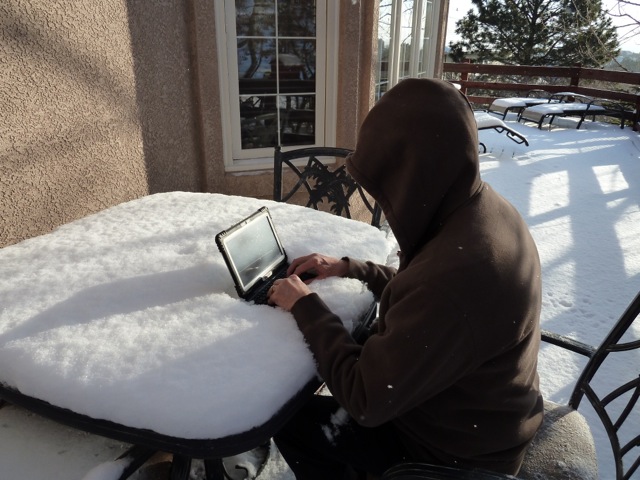
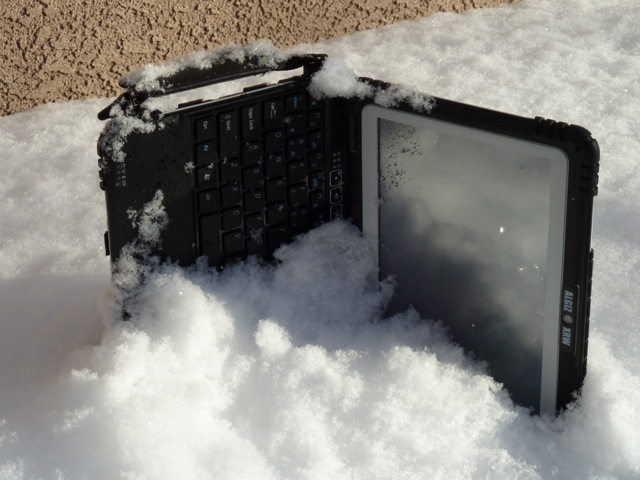
    I brushed the snow from the XRW keyboard and in my mind I could hear the neighbors whispering, “Call the men in white coats, there he goes again.” And actually there may be reason for concern, as I am sitting on my deck during a lull in a major blizzard and typing on a laptop computer half buried in snow. But not just any computer.

    I am composing the beginning of this month’s column, the words you are reading now, on the Algiz XRW built in the non-tropical Swedish paradise known as Lidköping (which must mean something like “coping by the frozen lake”), and brought to you by the folks at Handheld US. Of course, I know — or certainly hope — my neighbors are not really calling anyone to come take me away to a little padded room because for them my once-strange behavior should by now be almost commonplace. Like swallows returning to Capistrano, when it snows in the Rockies I can be found on my deck with several new devices: dropping them in snow banks and freezing pools of water, and generally putting them through their paces. Where I live in the Rockies, we are eligible for snow 12 months out of the year, so this is not an uncommon occurrence. There are lots of opportunities for testing supposedly rugged devices.

    Unfortunately, only about one in ten survive this tortuous treatment, and those are the ones you read about in this column. Remember, my rules of engagement (ROE) are that I only review top-notch products that our warfighters and first responders can use. I never pen a negative review unless it is a comparison evaluation where one of the products is clearly inferior. These inferior products, the ones I don’t write about, are returned to the manufacturers in various states of disrepair. Frankly, I am amazed and disturbed by the huge number of substandard and sometimes just poorly conceived “rugged” laptops on the market. Fortunately, the XRW is not one of them. Indeed, as a rugged GPS-enabled Windows laptop, it rises above the herd of less capable machines and demonstrates that a great device can be produced with just a little, or in the case of the XRW, a lot of planning and forethought, and be genuinely useful to our warfighters and first responders.

    Photo: Don Jewell
    The XRW being put through its paces during a lull in a Colorado Blizzard.

    Why Test?

    I decided to test several rugged laptops during our latest blizzard. A full 20 percent of my warfighter correspondence indicates that there are just some warfighting computer tasks more suited to a rugged laptop than a rugged handheld device.

    One of the greatest weaknesses and strengths of current military user equipment (MUE), and be assured it is only one of many, is that the mission planning software requires a separate Windows computer to fully plan missions and download numerous waypoints. The only upside is that, certainly speaking generically, it is usually more convenient and more comfortable to make changes on a laptop versus a rugged handheld. The problem comes with the restriction that this is the only way to make major mission changes to your government-furnished PNT (position, navigation and timing) device. If the mission changes in the field, which happens more often than not, about 90 percent of the time according to warfighters, then you need a rugged laptop in the field to update or change the mission coordinates that are input into the extremely outdated government-furnished GPS device. So for the warfighter, since a laptop is required to make changes, it makes sense to use a rugged laptop or notebook computer to do the updating in the field. Having said that, and considering that in Afghanistan there are really no front lines, everyone is in the field in some respect, I suspect the perceived need is actually very real. Employing a rugged laptop or notebook that actually has an excellent inherent GPS capability adds a layer of familiarity and comfort as well as necessity; consequently and for good reason, many of our warfighters feel strongly that they need a rugged laptop, so a search and subsequent blizzard testing commenced.

    Photo: Don Jewell
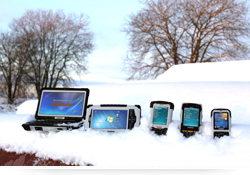
    Handheld US produces several mil-spec rugged
    devices. We have put many of them through
    their paces over the last several years.

    The Algiz XRW, henceforth referred to as the XRW, passed all the mil-spec tests with flying colors, but there was one test event that provided a result I have never before encountered — the first time I dropped the XRW into a snow bank from about five feet up, it hit a hidden rock and the keyboard popped off. I was surprised and a bit disappointed, until I realized this was a design feature, not a fault. The keyboard is connected via an electrical connection that does not alter the imperviousness of the laptop case, ensuring the XRW is immune to water and dust. I simply reinserted the keyboard; it popped back in place very easily, and it has been functioning perfectly ever since.

    Photo: Don Jewell
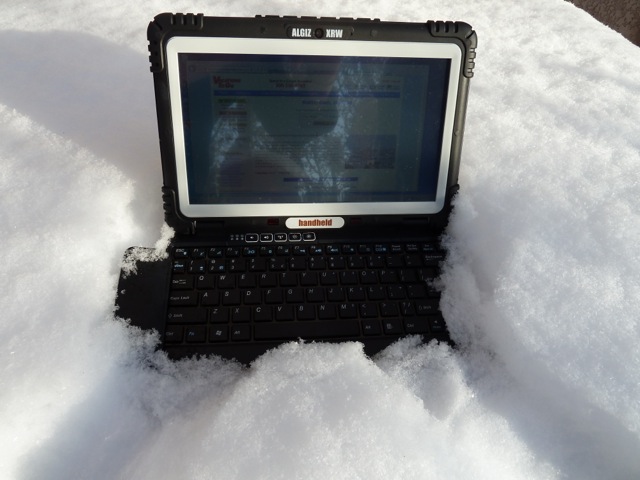
    There really is a keyboard underneath all that snow and the XRW is running applications
    as it gets cold soaked for further mil-spec testing
    .

    The XRW is truly a rugged laptop with a keyboard that can take everything you can throw at it. As you can see in several of the pictures, the keyboard is covered in fresh snow while I allowed the XRW to cold soak and repel moisture for over an hour with no ill effects. Everything still functions perfectly. And I must admit the XRW keyboard has a nice feel, almost as good as the Apple keyboard I use daily, and that from me is high praise indeed, as I freely admit that I am enamored with the touch and feel of Apple keyboards.

    Photo: Don Jewell

    Photo: Don Jewell
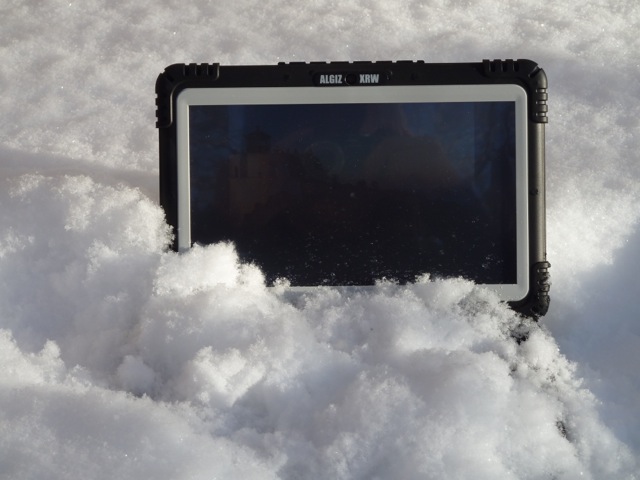
    The XRW running applications while embedded in fresh Colorado snow. Note the leather
    strap on the left side of the XRW that can be used as a handhold or as an attachment point
    for a lanyard, a warfighter requirement.

    The XRW is probably more correctly called an ultra-rugged notebook, but most notebooks don’t have touchscreen capabilities. Whether you choose to call it a laptop or notebook, it is extremely rugged. Its size and capabilities make it very well suited for use by warfighters and first responders, as you can see by reviewing the following specifications that include very stringent MIL-STD (military standard) specifications:

    Algiz XRW Specifications
    Size 260mm x 178 mm x 40 mm (10.2″ x 7.0″ x 1.6″)
    Weight 1.5 kg (3.3 lb)
    Environment Operating: -20 °C to 55 °C (-4 °F to 131 °F) MIL-STD-810G, Method 501.5

    Procedure II, MIL-STD-810G, Method 502.5, Procedure I, II, III

    Storage: -40 °C to 55 °C (-40 °F to 131 °F) MIL-STD-810G, Method 501.5

    Procedure II, MIL-STD-810G, Method 502.5, Procedure I, II, III

    Drop: 26 drops from 1.22 m (4 ft) MIL-STD-810G, Method 516.6, Procedure IV

    Vibration: MIL-STD-810G, Method 514.6 Procedures I & II, General minimum

    integrity and the more rigorous loose cargo test

    Sand & dust: IP65, MIL-STD-810G

    Water: IP65, MIL-STD-810G

    Humidity: MIL-STD-810F, Method 507.5, 90% RH temp cycle 0 °C/70 °C

    Altitude: 4572 m (15.000 ft) at 22 °C (73 °F)

    Processor Intel ATOM Z550 2.0 GHz/US15W chipset
    Memory/Disk 2GB RAM/64 GB solid state hard drive
    Operating system Microsoft Windows 7 Ultimate
    Screen 10.1″ touchscreen 1366×768 resolution LED high brightness, MaxView

    Technology

    Keyboard/keypad Keyboard with touch pad. English, French, Spanish, Italian, German,

    Nordic languages. Keyboard illuminated by 2 LEDs.

    Battery 1 x Battery, 4800mAh, 57.6Wh, 8 hours
    Connections 2 x USB 2.0 port

    1 x 9-pin serial RS-232 port

    1 X RJ45 for Ethernet 10/100/1000 LAN

    1 x DC power input

    1 x SD Slot

    1 x VGA

    Docking Connector (Contact Pin Type)

    Dual Speaker/Mic

    Microphone input jack

    Headset Jack

    Receiver (Audio In)

    Communication Audio: Speaker /MIC

    Bluetooth: PAN: Bluetooth v.2.0 + EDR

    Cellular (WWAN): HSDPA/3G, Gobi 2000 ready

    Wireless LAN: Wireless LAN 802.11b/g/n, WiMax option

    Optional WiMax

    Navigation u-blox GPS, WAAS/EGNOS capable
    Camera 2 Megapixel camera with auto focus
    Options Kensington lock, Vehicle cradle, USB office dock,

    carrying equipment, vehicle charger, screen protectors


    Warfighter Requirements

    At just over three pounds, the XRW is easy to hold and has a side strap with a leather Velcro cover that is easily adaptable to attaching to a warfighter via a lanyard. This allows the warfighter to instantly drop the XRW and bring his or her weapon to bear without ever worrying about the rugged notebook hitting the ground. I tested this scenario several times and the side strap held up well. The computer was no worse for wear, mainly because it is rugged and has a 64-GB solid-state drive — in other words, no moving parts. The lanyard and instant-drop capability is fast becoming a requirement or “must have” among our warfighters, and the XRW meets the requirement handily.

    Another warfighter requirement, especially in the mountains of Afghanistan, is that the MaxView Technology 10.1-inch touchscreen be usable by a warfighter wearing gloves or using a stylus, a pencil eraser or a bare finger. The XRW’s touchscreen responds well to all these input devices. Therefore with the XRW, whatever comes to hand or the hand itself works for inputting data or selecting applications.

    The screen is readable in all lighting conditions, including bright sunlight and sunlight reflected off snow, which can be blinding. Alternatively, the light level of the screen can be lowered to the point that it is only visible to those in a very small radius. The XRW also employs what I like to call a tactical “instant off” capability. Just touch one button and the screen doesn’t just fade-to-black — it goes black instantly, a handy and potentially life-saving feature for our warfighters.

    GPS

    The XRW’s GPS capabilities are best displayed using an onboard program named U-Center developed by ublox in Switzerland. The display provides more information than the average warfighter would ever want to know about their GPS position and the satellites responsible. A built-in data recorder and viewer can be automatically programmed to reconstruct GNSS environments displaying the number of satellites available by PRN (pseudorandom noise) codes, satellites used (in several graphical formats) and the PDOP or Positional Dilution of Precision (3D) and HDOP or Horizontal Dilution of Precision during any given moment.

    The U-Center also displays velocity of the user or, more correctly, the XRW unit, altitude, time, date, coordinates, compass heading, whether you are in 2D or 3D mode, and the last time to first fix (TTFF) when the GPS capability was last initialized on the XRW. Your position and the sub-point position of the GPS satellites utilized is displayed on a global map for geospatial situational awareness. I used Google Maps indoors with the 3D function and the display was crisp and clear. The ublox GPS chipset is sensitive enough to use indoors, where on average I received seven satellites for 5-meter navigation data with the FAA’s (Federal Aviation Administration) WAAS (wide area augmentation system) enabled. EGNOS or the European Geostationary Navigation Overlay Service is also available. This is excellent performance for indoors.

    Outdoors, there were always 10-12 satellites available, at 7000+ feet with an approximate 15-degree masking angle toward the Rocky Mountains. The XRW’s GPS accuracy was consistently below three meters and half the time better than two meters. Combine this with the 3G and Wi-Fi communications capabilities, and unless you are geocaching this is excellent performance and certainly acceptable for our warfighters and first responders. Note: I employed Skype using a military tactical headset with a small adapter and it worked flawlessly. With the headset attached, the very capable internal speakers are disengaged.

    Philosophy

    Try Skyping with the current MUE; no, don’t bother because it doesn’t work. Please note that when I question the status quo and indeed the legitimacy of the current MUE program for our warfighters, it is for good reason. The U.S. Army last year spent $450M on supplying our warfighters with decades-old proprietary equipment that has a user interface from the early ’70s. At the same time the Army is now instigating a program to provide warfighters with very capable Android phones, while setting up what can only be described as an Android apps store for military users, programmers and developers. The U.S. Air Force has several special programs in place that take advantage of the unique capabilities of the iPhone and iPad. The DoD and Services routinely support waivers for specialized GPS/PNT equipment that fills a requirements void. So while the military response to new technology can only be described as bipolar in nature, it is important that our warfighters and first responders have access to the best equipment available, hence the periodic equipment reviews in this column. The Algiz XRW is certainly a piece of equipment that fills one of the equipment voids for our warfighters and first responders.

    eXtreme Road Warrior 

    The XRW or eXtreme Road Warrior performs all the functions of your normal office laptop running Windows 7 Ultimate. I found the screen to be clearly viewable from all angles, even when the unit was unfolded to an almost flat aspect, in all lighting conditions, and the touchscreen to be very intuitive. There were times when touching the screen to enable a function or application seemed much more intuitive than using a mouse. While I agree with Steve Jobs concerning the use of a stylus, that “once a stylus is required you have lost the battle,” in fact there are times with the XRW when the mouse works best, times the stylus works best, and then sometimes your digits are the best tools. The beauty of the XRW is that all three options work when enabled, and it makes using this great little machine very intuitive.

    I put the Algiz XRW through the ringer for over two months, and this is another machine that is going to be tough to send back. Do you have any idea how much it costs to FedEx a package to Sweden?!

    Bottom Line

    The bottom line is the Algiz XRW is the perfect solution for those warfighters and first responders that need a rugged touchscreen netbook capable of doing double duty in the office and in the field.

    As the folks in Lidköping, Sweden, home of the Algiz XRW would say, it is lagom.

    Until next time, happy navigating.


  • Where Am I?

    I have long advocated that our warfighters and first responders deserve the best equipment available so they can answer the basic question, “Where Am I?” quickly and with complete certainty. Or, “Where am I now and how do I get to someplace of relative safety quickly?” Unfortunately, government-furnished equipment (GFE), in this case the GPS handheld equipment we supply our warfighters, does not do a good or even adequate job of answering that question.

    At this time of year, while everyone else is busy making New Year’s resolutions and breaking them, I tend to wax nostalgic. About 45 years ago when I was a college newspaper editor — yes my fascination for the written word has been going on for at least that long — I had the opportunity to interview a wonderful elderly professor who taught a combined psychology and philosophy course on the human condition. I am absolutely sanguine he gently pontificated marvelous, life-changing platitudes, many of which are unfortunately long forgotten, but I do remember his famous Daniel Boone quote related to being lost, and I present to you the slightly modified version. When Daniel Boone, the famous wilderness scout, became a legislator later in life, he was asked by a senator if he had ever been lost while he was roaming around in the wilderness. Daniel Boone thought for a moment and replied, “No, I have never been lost, but since my compass was government furnished equipment supplied by the lowest bidder, I was mighty bewildered once for about three weeks.” This kindly professor also encouraged his graduate students to constantly ask themselves, metaphorically of course, “Where Am I?”.

    It is a philosophy that we should all adopt, one I have followed through the years. It has served me well, certainly much more so than the plaintive words from the 7th Cavalry General Custer query, where we hear the oft-cited and mournfully questioning lyric, What Am I Doing Here? Recently, the troubling aspects of the “Where am I?” and “What am I doing here?” questions have come home to roost. Of course, I am speaking of when and where I am physically, as in time and place, not metaphorically. While the answer seems straightforward and simple for most of us, emails I have received over the last ten years from our warfighters indicate this may not always be the case for everyone. Many of us, and in fact I hope, all of us, at one time or another, ask that question: Where in the heck am I anyway? When you and I ask that question and we are momentarily disoriented or just trying to find the location of our next appointment, it can be mildly frustrating, but when our warfighters ask that question in the heat of battle, it can be a life or death interrogative.

    In this column from day one, I have strongly advocated that our warfighters and first responders deserve the best equipment available that enables them to answer that basic question — Where am I? — quickly and with complete certainty, no ambiguity. Where am I now and how do I get to someplace of relative safety quickly? Unfortunately the GFE or government furnished equipment, in this case the GPS handheld equipment we supply our warfighters, does not do a good or even adequate job of answering that question. Let’s face it — the government furnished equipment fails miserably at what should by now be a simple task.

    Our warfighters may eventually be able to determine where they are located with the help of a paper map, but the handheld versions of GPS GFE do a lousy job providing situational awareness and indicating the route to a safe haven. If there are still doubters, one need only remember the Jessica Lynch story as you contemplate the disasters resulting from disorientation, being lost, or making a wrong turn in combat conditions. That one infamous wrong turn will affect Jessica Lynch and her comrades for the rest of their lives as well as the families of those who died because of a simple and basic navigational error.

    Since that very public scenario played out almost eight years ago, our GFE GPS equipment has unfortunately not changed one iota for the better. Our warfighters are still using . . . let’s be precise, are still issued the same outdated, overweight, battery limited, lousy handheld equipment, with a monochrome screen, that they actually rarely use as a stand-alone device. The current GPS GFE functions almost adequately when it is embedded in another piece of equipment and our warfighters do not have to deal with the sorely antiquated and frustrating user interface. When bullets are flying and our warfighters are enmeshed in the fog of war is not the time to deal with an infuriating user interface.

    The bottom line is thousands of our warfighters — if their cards, letters, telephone calls and public testimonials are any indication — consider the GFE GPS they are issued to be vastly inferior PNT equipment.

    iphone-5-black-and-white
    Apple iPhone 4S

    As a natural consequence, many warfighters have turned to commercial equipment for their PNT (Position, Navigation and Timing) needs. Familiar commercial GPS providers such as Garmin, TomTom, Trimble, and Apple have seen their devices proliferate in theater. Service providers such as Verizon have seen a ten-fold increase in commercial spectrum since the conflicts began more than eight years ago. Face it: When your life is on the line, you are going to quickly determine what you really need to survive, purchase it, and learn how to use it. This is why in my previous column I mentioned that the new Apple iPhone 4S may prove to be the most useful and versatile PNT device on the market today. This is true especially for our warfighters and first responders, who have stated categorically in more than 8,000 letters and emails to me that availability of PNT signals is the critical metric for judging the efficacy of a handheld/portable PNT device in war time and emergencies.

    Consider the following iPhone attributes:

    1. Receives 30+ GPS satellites.
    2. Receives 24+ GLONASS satellites.
    3. Receives WASS and EGNOS GEO satellite transmissions where available. Note that a GEO (geosynchronous Earth orbit) PNT satellite may be the geometric equivalent of more than three MEO (medium Earth orbit) satellites. As I have said many times, where PNT is concerned geometry matters.
    4. Receives Wi-Fi signals and un-encoded GPS signals processed by Skyhook wireless software, which providing a TTFF (time to first fix) of only four seconds.
    5. Receives 3G and 4G signals from cellular towers and provides a position when all other signals are obscured or otherwise unavailable. Note: While the Apple iPhone GPS chip is sensitive enough to work indoors, even when that fails due to electrical interference or dense shielding, the Wi-Fi signals and cellular signals usually penetrate. Warfighters tell me even in Afghanistan it is rare not to have an accurate position and time displayed on an Apple iPhone, iTouch or iPad.
    6. The iPhone user has access to 30+ PNT programs with highly accurate color terrain maps and satellite views that the GFE GPS does not provide.
    7. The Apple iPhone fully incorporates the multi-sourced PNT derived position with other applications on the iPhone and makes the most of situational awareness, which is critical to a warfighter and first responder.
    8. The Apple iPhone fully incorporates the PNT position with the communications capabilities of the iPhone to include cellular, Wi-Fi and SMS or texting for the younger generation.
    9. The iPhone allows users to take photos of their surroundings and encode the photos with PNT information, alerting others to their situation. It provides situational awareness for the users and those communicating with the users.
    10. The embedded and integrated communication capabilities of the iPhone allow the user to talk with mission planners, taskers and superiors while simultaneously reporting findings or accepting mission changes, all on the same device.
    11. If the iPhone is lost, its position can be determined with another iPhone or Apple computer. If it has fallen into enemy hands, it can be tracked and found, or if that is not feasible all the information on the Apple device can be deleted and the device rendered inert.

    While this is quite a list of capabilities, it is far from a complete or exhaustive list. The really tragic part of this true story is that with just a little imagination and subject-matter expertise combined with some planning, the GFE GPS could have incorporated the same capabilities, and more; who knows, The iPhone could be the future GFE for PNT. As it is of the eleven PNT and related capabilities listed for the Apple iPhone, only one can be accomplished by the current GFE handheld GPS — a tragic state of affairs!

    To make matters worse, officially our warfighters cannot use the iPhone and its abundant situational awareness capabilities, or devices like it, for official mission or mission-related activities. To the U.S Army’s credit, it is attempting to change this inane and life-threatening policy. Until that happens or new GFE PNT equipment is developed, U.S. military personnel are forced to use the worst handheld equipment available, from a size, weight and power perspective (SWAP) that provides the least amount of information possible. This makes current DoD policy concerning PNT hardware, software and frequencies about 20+ years out of date and consequently, or should I say thankfully and to their credit, our warfighters have basically totally ignored this antiquated policy.

    To be perfectly clear, I cannot and would never advocate ignoring official government policy or denigrate those who do. The current GFE GPS serves a purpose, or so I am told, and even though it is marginal, the equipment should be utilized where officially mandated. However, the smart warfighter will incorporate numerous GPS/PNT backups and utilize them judiciously — or as one clearly frustrated warfighter wrote, “…I use the GFE GPS and Viper combination, which is very unwieldy and cumbersome, to call in or direct fire because I can be prosecuted by the military if I don’t, but I use my iPhone [PNT capabilities] for everything else including communicating with and getting my comrades and I back to our unit at the end of our patrol. Why can’t the military furnish me with something like the iPhone that works, is a tenth the size and weight, and costs only one fifth what the current GFE GPS costs? It already exists, just authorize my teammates and me to use it. How hard can that be?”

    You can literally feel the warfighter’s confusion in that statement. Let’s hope the U.S. military is successful in mandating desperately needed changes. We will keep track of those efforts and let you know. Meanwhile, buy your favorite warfighter a backup PNT device such as a Trimble, Garmin or iPhone — anything so they can answer the age-old question of “Where am I?” and then find their way safely home.

    Until next time, with full apologies to CWO5 William Dagenhart (USMC) and to the men and women of the 7th Cavalry, happy navigating.


  • Interview: 2nd Space Operations Squadron Commander, Lt. Col. Jennifer Grant

    December is typically the month when writers of regularly featured columns wax nostalgic and engage in a certain amount of prognostication. This year I enlisted the help of Lt. Col. Jennifer Grant, the 2SOPS/CC at Schriever AFB, the home of GPS, to help us with our year-end review and crystal-ball gazing as we look ahead to the GPS horizon. Lt. Col. Grant reminisces about her first 16 months as 2SOPS/CC, reviews numerous major accomplishments, and updates us on the status of the GPS constellation as well as the often overlooked, ever contentious and always seemingly in flux critical Command and Control (C2) segment.


    By way of introduction, I first met Lt. Col. Grant when she was assigned to the Command Suite at Headquarters Air Force Space Command at Peterson AFB in Colorado Springs, Colorado, and served under the four-star commander General Robert Kehler, who is now the commander of USSTRATCOM (United States Strategic Command). At the time she impressed me as being intelligent and insightful. Her professional reputation as a perfectionist certainly supported that assessment. The next time I met Jennifer, we were both wearing different hats and serving in different roles.

    Several of us on the GPS Independent Review Team (GPS-IRT) were sent by General Kehler to Schriever AFB to check in with the new 2SOPS/CC and see if we could offer her any assistance. This is a role we, the IRT, have played many times in the past, and just like the old saw concerning Inspector General (IG) visits, our mantra was and is “…we are only here to help…that’s our story and we are sticking to it.” Regardless of the perception or even trepidation over our visit, Jennifer and her staff were extremely supportive and it was abundantly clear that Lt. Col. Grant was drinking from a fire hose and doing more than surviving. She actually seemed to be handling it well and possibly even enjoying herself. While she was not new to Space Command, she was new to the GPS.

    More than a year later, I and another IRT member paid Lt. Col. Grant another official visit and the transformation was nothing short of amazing. Did I fail to mention that she is also known as a quick study? In 16 months’ time Jennifer went from the new kid on the block in GPS operations to a sophisticated, erudite, extremely knowledgeable and passionate advocate and supporter of the GPS and all aspects of 2SOPS operations.

    Recently she stood toe-to-toe in a meeting with the same GPS-IRT members that visited her 16 months ago and proved without a doubt that she has matured as a commander and GPS operator beyond our wildest imaginations. To her credit she is not intimidated by titles, rank or history. She knows her job. She walks the talk and will not hesitate to challenge anyone, although very politely and with a smile, who is not totally accurate and fair in his or her assessment of GPS operations yesterday, today and tomorrow.

    Like any good commander, she is totally and relentlessly supportive of her command and her people. However, she is pragmatic enough to know that changes, and big ones, are on the horizon. At the same time she realizes that she commands not only the largest and most well-known military space constellation on orbit today, but also one that supports the entire planet’s critical infrastructures with crucial timing, frequency, position and navigation information. GPS has become the de facto time and time frequency distribution system for the world we live in today. There are more than two billion known users worldwide, and that conservatively equates to more than 5 billion GPS receivers. Indeed, given the number of stealth GPS receivers in almost every appliance we use today, that number could easily grow to more than 10 billion. No stress there!

    When I called Lt. Col. Grant about a follow-up IRT visit and mentioned that an interview might also be in order, she replied that she would get right on that as soon as she spent Thanksgiving with her family. Imagine that, she actually took a day off. In the real world she seems to balance being a wife, mother and commander of the world’s most visible satellite constellation with a maturity beyond her years.

    Now that we have peeled back the curtain just a bit, let’s see what Lt. Col. Jennifer Grant has to say about the Global Positioning System and PNT in general.


    DJ: Don Jewell, GPS World Defense Editor
    JG: Lt. Col. Jennifer Grant, 2SOPS Commander 


    DJ: What can you tell us about your first year as the 2SOPS/CC?  What makes you happy about your command job and GPS specifically?

    JG: Don, my time as the new 2SOPS/CC has really passed quickly! Commanding the largest DoD satellite constellation is both humbling and invigorating. It is amazing to look back over the past year and recount our accomplishments as a team: I accepted satellite control authority of the first two GPS IIF satellites; we completed the largest satellite repositioning in history with expandable-24; we successfully completed two major test exercises involving demonstrations of flex power and SA/ASM (Selective Availability and Anti-Spoofing Module), respectfully; we successfully completed the largest major software sustainment installation, AEP 5.7.0 [ed. Architecture Evolution Plan]; we flawlessly executed two operation mission transfers to our back-up (Command & Control) location; we’ve completed dozens of station-keeping maneuvers; we’ve resolved on-orbit anomalies and sustained the constellation of satellites which have outlived their estimated design life — and celebrated the 21st birthday of SVN-23, our oldest IIA satellite on orbit. We’ve also disposed of SVN-24 and are preparing for the disposal of SVN-30. Our GPS Operations Center (GPSOC) has provided 75,000+ products to our mission planners and warfighters down range, and we have seen the implementation of our GPS Google Earth tool.

    On the personnel front, we were part of the team, along with 19SOPS and SMC — Space and Missile Systems Center, awarded the USAF Chief of Staff Team Excellence Award (CSTEA) in Washington, D.C., for the GPS IIF Launch; and we were part of the past and present GPS team of personnel earning the International Aerospace Federation’s 60th Anniversary Award for excellence in aerospace. General Shelton accepted this award in Johannesburg, South Africa, on behalf of the U.S. Air Force contributions to the GPS. We have also achieved the most accurate signal-in-space in our history, far surpassing the office of the Secretary of Defense, Standard Positioning Service Performance Standard requirement of seven meters!

    2SOPS, with assistance from our reserve mission partner, 19SOPS, supports more than two billion position, navigation and timing (PNT) users worldwide. The work we do every day and the mission we execute supports critical infrastructure, life-saving missions and worldwide operations.

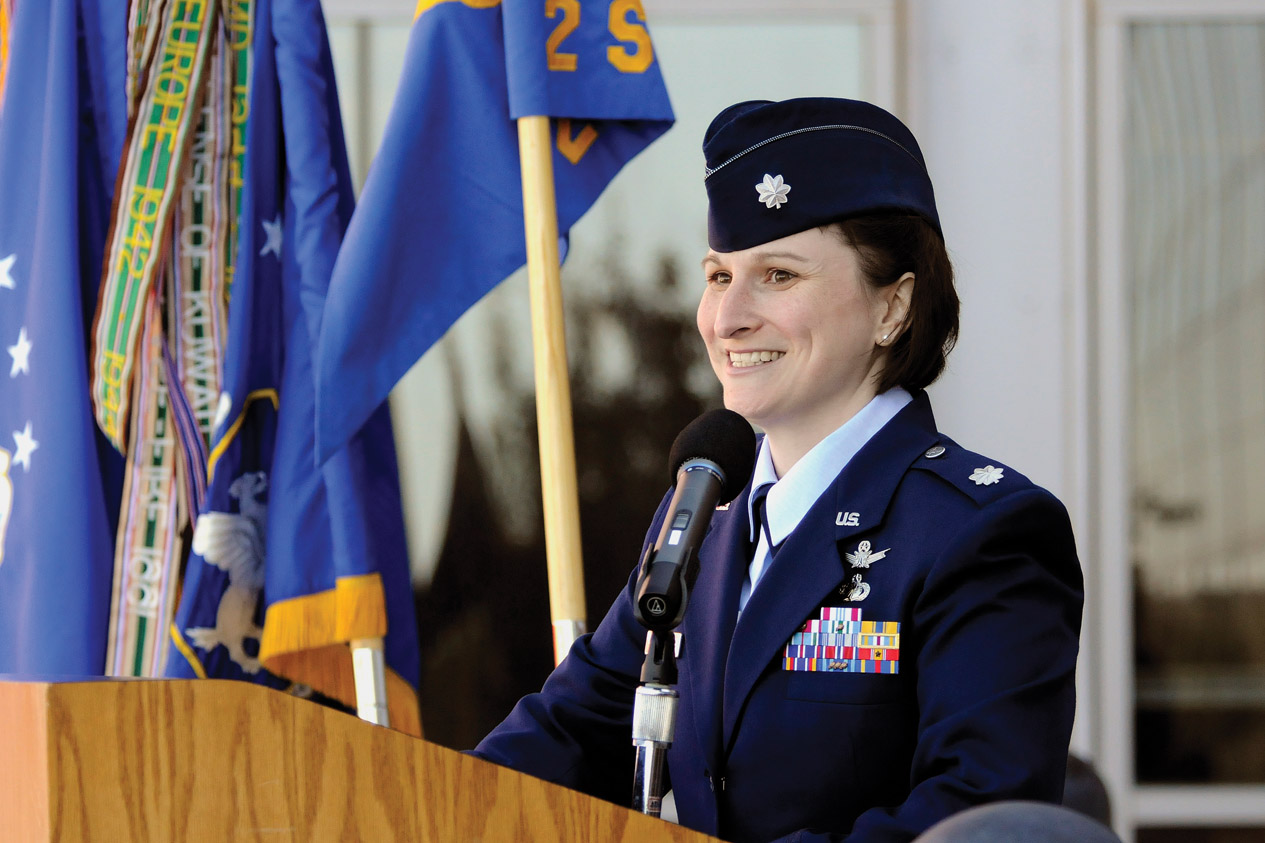
    100820-F-1631A-028 . Headshot: Lt. Col. Jennifer Grant
    Lt. Col. Grant speaks at the change of command ceremony in August 2010,
    when she took over command of 2SOPS.

    In short, Don, I love my job — and I have the sharpest, best and brightest team of personnel employed to execute these tasks. I am amazed every day at the level of proficiency and professionalism demonstrated by our Total Force team of active duty, reservists, aerospace engineers, contractors and government personnel. Our team has managed and maintained the position, navigation and timing gold standard and will continue to do so.

    Making a difference in the lives of people gives me a great deal of personal and professional satisfaction. We are not doing our jobs right if we are not making the world a better place…one contact at a time, be it people or payloads.

    DJ: Can you give us a status of GPS as a system of systems, to include ground control, monitoring and the on-orbit constellation? Give us, if you will, a status brief of where GPS stands today, including SVN-49. And, since you are known for being precise when you speak about GPS matters, can you please answer using the nomenclature we should all use when we refer to the various segments of the GPS?

    JG: Absolutely, Don! The GPS constellation is the most robust and capable system in the history of space.  We currently have 30 actively engaged operational satellites on orbit (9 GPS IIAs, 12 GPS IIRs, 7 GPS IIR-Ms and 2 GPS IIFs). We maintain a program baseline minimum 24-satellite constellation consisting of six orbital planes each containing four primary satellite slots. Our four dedicated ground antennas and six monitoring stations are working as intended, and our MCS (Master Control Station) at Schriever AFB as well as our AMCS (Alternate Master Control Station) at Vandenberg AFB are both fully functional.

    On 15 June 2011, we completed expansion of a total of three primary slots, which added 3 satellites into our current baseline and enables us to optimize GPS assets to improve operational effectiveness for global users and warfighters in terrain-challenged areas.

    Currently, there are 30 satellites set healthy to users, and a 31st satellite, a GPS IIA, will be set healthy on 16 December 2011. We have one satellite awaiting disposal and three remaining satellites in residual status. Each of the three remaining residual satellites are in LADO, which is our unique Launch/Early Orbit, Anomaly Resolution, Disposal, and Operations system. One of the residual satellites is SVN-49, and they will all be tested and checked out for determination of future use and viability as a long-term operational decision.

    DJ: Those of us who have been Squadron Commanders know there are persistent problems in any organization that just won’t go away, be they programmatic, operational or personnel issues. What is it that keeps you up at night?

    JG: Thankfully, Don, I am a sound sleeper with peace of mind, so not much!  But really, one of the main responsibilities we manage is maintenance and sustainment of the GPS constellation, and the older the satellites in the constellation get, the more care and feeding they require. Right now, about a third of our constellation has exceeded its satellite design life by 100% — satellites designed to last 7.5 years are between 15 and 21 years old. So we have invested a great deal of time into contingency planning in the event of component failures, multiple vehicle anomalies, etc. We are doing everything we can to continue to extend the lives of our satellites, and it is a tribute to engineering, design and the satellite builders as well as the expert sustainment operations and engineering that they have lasted as long as they have.

    We need to ensure our replenishment launches for the current generation IIF vehicles stay on schedule and a priority.

    DJ: Would you give us your view and hopefully the MAJCOMs view of the way ahead for GPS as it supports military, civil and commercial users around the globe? Look forward to the future for us — how do you see GPS operations evolving in the years ahead?

    JG: Don, the Air Force is constantly being asked to do more with less — resources, manpower and time.  In this fiscally constrained environment we are being challenged to find effective and efficient ways to accomplish our mission. We have come a long way from the legacy systems in improving our operations, and I think we will see even more improvements in increased automation, faster satellite contact times, and increased downlink capabilities, as well as streamlined operations.

    We will also, I believe, see an increased need for interaction and interoperability with our international position, navigation and timing providers and consumers. GPS, though still the largest PNT provider, is no longer the only game in town.

    Although the GPS satellite constellation is procured and operated by the US Air Force, we understand we support a much broader user community in the civil, commercial and military sectors. We take pride in providing extremely accurate PNT services to billions of users worldwide.

    And we are spending considerable resources to modernize the GPS constellation to provide even better service in the future. The continued fielding of new GPS IIF satellites and GPS control segment software updates are key to current modernization efforts. GPS III satellites and the Next Generation Control System (OCX) will further enhance GPS capabilities. Fully compliant user equipment is essential as modernization efforts continue.

    We’ll continue to improve our constellation with the launches of new satellites; the next GPS IIF is scheduled to launch in September of 2012 and the first GPS III should be available for launch in FY 2014. And OCX remains on-track for a Ready-To-Operate (RTO) date in 2015.

    DJ: And finally, if you were Queen for a Day, what would you like to see changed?

    JG: For operators, there is always an interest in and a desire for greater capability, faster processing…and for us it is in pushing the envelope for even greater accuracy with precision timing, position and navigation.

    There is also an interest in expanding application of our NAVWAR (Navigation Warfare) knowledge, application and operations — having an even greater number of people trained and embedded with warfighters as NAVWAR experts. This is where I think we will see some real growth in the future.

    DJ: Colonel Grant, I know you are incredibly busy and I can’t thank you enough for your time, your expertise and the look ahead to the future of GPS. Best of luck in all your future endeavors.


    Editor’s Note: I have visited the 2SOPS more than 20 times in the past five years, and I have known and visited every 2SOPS commander since that organization began to include then Lt. Col. and now General William Shelton, the four-star AFSPC/CC. I have never seen a more motivated GPS crew force than the one I saw during my last visit with Lt. Col. Grant. Squadrons tend to reflect the work ethic, mores and integrity of their commander, and my hat is off to Lt. Col. Jennifer Grant because her crews are obviously very motivated to support the warfighter, and they seem very happy in their jobs. The atmosphere in 2SOPS these days is positive, upbeat and very customer (that’s you and me) oriented. Plus, many of the crewmembers are just back from tours in Afghanistan and Iraq, so they know the needs of the warfighter and they are working hard to fulfill them.
    Till next time, happy holidays and happy navigating.

  • The Good, the Bad, and the Really Ugly

    The Good, the Bad, and the Really Ugly

    The Good

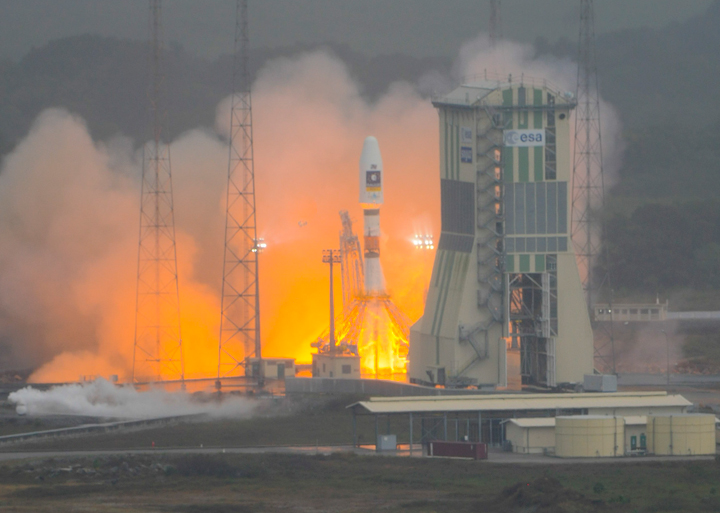
    This month there is good news — great news, actually — where GPS and PNT (Position, Navigation and Timing) systems are concerned. On October 22, a Russian Soyuz rocket placed in orbit the first two validation satellites, built by EADS Astrium Germany, in the Galileo PNT constellation after making its maiden launch from Kourou. Don’t confuse these recent satellites with the earlier experimental satellites, GIOVE-A launched in 2005 followed by GIOVE-B launched in 2008. These initial satellites served to preserve the Galileo ITU frequency filings and test the first-ever space borne Hydrogen Maser atomic clock, which by all accounts is proving to be extremely accurate.

    21102011-_SCO3184-W-1
    The Soyuz launch of two Galileo IOV satellites.

    While it is interesting the Europeans decided on a Russian vehicle for the first Galileo dual launch, the U.S. recently pinned its hopes on a European Ariane Five (pictured at right) to launch a commercially hosted U.S. government payload known, appropriately enough, as the “Commercially Hosted Infrared Payload” or CHIRP sensor, which was specifically developed by the U.S. government as a test payload to test both the payload sensor capability and the commercially hosted options for sensor payloads in GEO. The CHIRP sensor features a fixed telescope that can view one quarter of the Earth from geosynchronous orbit. So it appears that hosted payloads and international launch cooperation efforts are growing and are apparently working successfully.

    The two newest Galileo satellites deployed four hours after the Soyuz rocket lifted off from Kourou, in French Guiana.

    The Soyuz launched the first two of four validation Galileo satellites designed to validate the Galileo concept by testing both space and ground operations. Two additional validation satellites are scheduled to follow in the summer of 2012. Once the In-Orbit Validation (IOV) phase is completed, an additional 12 satellites will be launched to reach an Initial Operational Capability (IOC) of 16 satellites sometime in 2014, and that date looks extremely doubtful.

    According to our own Richard Langley, “During initial operations, the [Galileo] satellites will be controlled by a joint ESA and CNES French space agency team in Toulouse, France. Once that week-long phase ends, the satellites will be handed over to the Oberpfaffenhofen Galileo Control Centre near Munich, [Germany], operated by the DLR German Aerospace Center, which will be responsible for routine operations. Operating the satellite payloads to provide navigation services will be the task of the Fucino Control Centre, near Rome, operated by Telespazio.”

    Now, does that sound like a confusing and expensive ground support system? Everybody and every country insist on their piece of the pie, regardless of efficiency and continuity of operations. Who knows this might work; only time will tell.

    The approximately $7.5 billion Galileo constellation will eventually, hopefully, comprise a retinue of 27 operational satellites with three on orbit spares by 2020.

    The PNT business is obviously good for the Russian launch business. Russia successfully launched a GLONASS-K1 test satellite back in February, followed by three GLONASS-M satellites this month into a constellation that finally, after 29 years, accounts for 23 operational and three hopefully soon-to-be operational satellites. The first operational GLONASS-K1 is not scheduled to be launched until sometime early in 2012. GLONASS satellites have historically proven to be fragile affairs with extremely short lifespans; it remains to see how long this number and capability will be maintained. Hopefully the new K1 and M generation GLONASS satellites have resolved many of the longevity issues. Only time will tell when and if the Russian GLONASS will ever regain Full Operational Capability (FOC), which requires 24 simultaneously operating satellites. The Russians were briefly FOC in December 1995, but unfortunately only for a few months. The word “simultaneous” is important as Russian scientisst frequently state they have 25 or 27 GLONASS satellites in orbit, but unfortunately only 22 or 23 of them are operating. But it is possible, miracles still happen, that by the time you read this GLONASS may actually legitimately have achieved FOC once again.

    Now on the Boeing IIF side of the house, more good news as it was announced this week that the second IIF satellite (IIF-2), which has been operational with an elevated signal strength for several months, now has its signals back within the specified signal strength and is good to go. GPS IIF-3 was originally scheduled for launch this coming summer, but the latest launch schedules show the launch in September 2012, about 11 months from now. With 30+ operational GPS satellites on orbit plus residuals, hopefully this will be soon enough.

    Apple & GLONASS

    Always betting on the come, we now know that the late genius Steve Jobs directed his enterprising engineers to include GLONASS PNT software in the latest iPhone 4S; the latest version iPhone that sold 1.3 million units in one day. This effectively gives the iPhone 55 potential satellites to choose from for PNT information as well as the Wi-Fi, cellular tower, and SkyHook Wireless PNT information. With the addition of the GLONASS PNT resources, the iPhone may now well be the most versatile and capable general-purpose PNT platform that exists today. Is that a sad commentary for other GPS and mobile phone providers, a marketing challenge, or merely a positive sign of the technologically advanced times in which we live? It may in fact simply be a true reflection of the capabilities of the most recognized and profitable corporation in the world today. Apple is doing many things right, and one of them is listening to the consumer and giving them more than they expect. Consequently, customers are loyal and Apple Inc. surpassed Microsoft in market capitalization in 2010, and in 2011 became the most valuable consumer-facing brand in the world. Apple is a company Fortune magazine has named the most admired company in the United States for the last three years running. Apple iPhones and numerous PNT applications are certainly in use by thousands of our warfighters in and out of theater. Interesting, to say the least, plus food for thought and a topic for a future column.

    The Bad

    The bad news not surprisingly comes via the U.S. government and no, it is not about LightSquared, because that situation continues to be worse than merely bad. No, the bad news comes in the form of a recently released but curiously out-of-date publication concerning GPS by the Congressional Budget Office (CBO).  In late October 2011, the CBO released a publication entitled The Global Positioning System for Military Users: Current Modernization Plans and Alternatives.

    I was unfortunate enough to receive both a soft and hard copy; and to make matters worse I don’t own a parakeet. The good news is we do have several fireplaces in our home and winter is rapidly approaching. Truthfully, the report is that bad and out of date, but at least it is boring and long. Fortunately hardly anyone is likely to actually endure the pain and suffering required to read through the entire document. However if you are a masochist and/or suffering from acute insomnia I highly recommend this CBO report as a possible cure. Some of you might justifiably complain I have no business giving medical advice because I am not a medical subject matter expert (SME) and I wholeheartedly agree, just as I agree that the CBO is definitely not a GPS SME and should stay with what they do know. Whatever that is.

    I can assure you when and if the military needs advice concerning future GPS operations and options the last place they will or should turn is to the CBO. For example, the preface of the document clearly states, “In keeping with CBO’s mandate to provide objective, impartial analysis, this study makes no recommendations.” Contrary to what you may think this is actually good news, since now we don’t have to waste valuable time dealing with flawed recommendations; garbage in, garbage out. Now if only the analysis were impartial or objective, which it is decidedly not. I would even settle for accurate, which it is definitely not. The information in this document is in some cases, as in M-Code satellites, erroneous and confusing; it is out-of-date where the GPS III nomenclature and options are concerned, especially the spot-beam; and it is always misleading concerning objectivity that presents facts not in evidence. There is so much erroneous and misleading information in this report that I sincerely hope no one else reads it, especially our military users.

    Seriously, all kidding aside, if you must read this document, consider it to be retitled as: The Global Positioning System for Military Users: Outdated Modernization Plans and Alternatives Not Currently Being Considered by the DoD.

    Against my better judgment I am including a link to the CBO document for those of you who practice self-flagellation. I truly regret the number of tree lifespans cut short to produce this confusing, misleading, out-of-date, and totally unnecessary document. Sometime I will tell you how I really feel.

    The Really Ugly

    The “really ugly,” as you have probably surmised by now, refers to LightSquared and the clueless FCC. Can you believe we have been dealing with this fiasco for more than 12 months? You are probably tired of it all, I know I am, but I see that as a true danger signal. The situation is very clear technically, the LightSquared signals, both from the terrestrial transmitters and receivers, will significantly impair and jam GPS signals to the detriment of all GPS users. Of course the political and business ineptness continues apace so who knows how long we will be dealing with this issue, but we cannot afford to let down our guard. Although this is exactly what LightSquared, the FCC, and the current administration, in an upcoming Presidential election year, obviously hope will happen. They hope we will all just get tired of dealing or even hearing about this LightSquared mess and then they win by default. We all have more important matters demanding our attention, right? Of course we cannot and are not going to allow that to happen. We will continue to use LightSquared as a verb when necessary and keep the real facts front and center, right here in GPS World, until all aspects are resolved. You can count on it.

    Until next time, happy navigating.


  • Steve Jobs’ Impact on Defense; plus CGSIC, ION

    Like many who had the pleasure of interacting with the genius that was Steven Paul “Steve” Jobs, I have been reflecting recently concerning his incredible impact on our lives. Indeed his impact on every aspect of our lives including GPS is almost beyond description.

    For example, our warfighters are increasingly using iPads and iPhones in theater for multiple functions, including some dedicated and warfighter-developed GPS applications that far outshine any GPS application provided by the government. When will we learn that we must provide our warfighters what they need or they will go elsewhere to find it because lives are at stake? Today many of our warriors are developing their own applications on their individual iPads and iPhones, exactly as Steve Jobs intended.

    NeXT, PIXAR, and USG

    My first interaction with Steve was after he had been summarily fired from Apple (the company he cofounded) in 1985 and began a new computer company called NeXT. All I can really say in this venue about that initial interaction is that the U.S. military bought a great many NeXTstation integrated/networked computers, and many of them are in still use today. Indeed, in many circles Steve Jobs credited the U.S. government (USG) with helping NeXT computer get its start. The hardware was definitely better than anything else on the market at the time, but the selling point was the incredibly powerful and user-friendly interface and software, known as NeXTSTEP, which proved to be an early version of the next step in the sequence leading to the modern-day Mac operating system that hundreds of millions of us use today.

    To put the power of the NeXT computer and Steve Jobs’ genius in the right context, think PIXAR Animation Studios. PIXAR was another of Steve’s successful collaborations (Steve was co-founder and CEO) when computer-intensive animation required powerful computers that artists as well as business people could understand and use — user-friendly, in other words — and few computers or software applications in the mid-1980s were up to the task. The U.S. government was not into animation but was into high-fidelity simulations and knew an excellent product when they saw it, hence the early supporting partnership. Those little black cubes were among the most powerful and user-friendly computers of their era, and many are still churning away today in settings befitting their hue.

    This comes to mind because recently I visited a secure government facility where NeXT computers and NeXTSTEP software are still being utilized, and the users think they have no equal. I have no idea what version of the operating system they are using, but regardless, this is quite a testament to the genius and foresight of Steve Jobs and the company that helped save Apple when Apple bought NeXT and Steve Jobs returned to Apple in 1996. The rest, as they say, is history.

    No Competition

    Every time I use a new application on my iPhone, iTouch, iPad, or iMac, I think about the clueless CEO of one of the world’s major phone companies who was interviewed about his views concerning the iPhone just before it was released. He foolishly said and probably really believed, “We are not worried about Apple and the iPhone, because they are not a recognized phone company.” Obviously underestimating the brilliance of Steve Jobs caught a great many companies and CEOs by surprise. As I wrote concerning a PC World magazine article listing the world’s best products a few years ago, “If Apple had a product in the category, it was always number one, without fail.” I know of no other company that can make that claim.

    Recently Bobby Zafarnia wrote in “Digital Exec”

    “How has Apple managed to stay so successful over 35 years? …no one can dispute that the company is the dominant American corporate brand, period. The hard numbers prove this, with Apple’s market capitalization recently surpassing Exxon-Mobile, making it the most valuable company in the world. Of course, the news always breathlessly captures Apple’s characteristics: Legendary CEO. Masterful marketing. Amazing stagecraft. Sexy products. Industry renegades. Tradition breakers. Cult-like devotion.”

    Even as I totally agree with this description of the Steve Jobs-led-Apple, I feel there is a glaring omission. Apple gives the consumer what they want and need, and they do it in such an intuitive way that consumers have come to expect only the best as well as the next great product from Apple. The fact that companies worldwide then attempt to emulate the latest Apple product or service is ample evidence that this is a working and successful strategy for Apple. Remember: “Imitation is the greatest form of flattery.”

    GPS on a Train

    I was thinking about this recently during the 30-plus-minute train ride from the greater Portland Airport to the Oregon Convention Center where I had the pleasure of attending ION GNSS 2011 September 17-23 (Institute of Navigation, Global Navigation Satellite Systems). During that train ride I was monitoring my GPS application on my iPhone and iPad, comparing the two and trying to determine the closet stop to my hotel. I originally thought my fellow passengers might consider my activities strange or excessive, being as I was on a train, until I noticed that actually most of the people in my train car were monitoring their travel with iPhones, iPads, or smartphones. A young couple across from me wanted to know what GPS application I was using. So even on a train I experienced the extra and sometimes comforting situational awareness that GPS can provide. I knew that on a long straight stretch we once hit a top speed of 68 miles per hour, the entire trip was going to take ~35 minutes, and I was sure I exited at the nearest stop to my hotel and then found my way there on foot without any wrong turns. So, you see, a GPS application on an iPhone or an iPad while traveling on a train does make sense, because when tunnels and buildings obstruct the sky view you still have Wi-Fi, telephone (3G), and SkyHook wireless applications to keep you oriented, and in a strange location it will give you peace of mind. That is indeed priceless, and I think Steve Jobs knew that. He thought about what was needed and what could be. He made our lives better.

    So when I think of Steve Jobs I will always remember the outside-the-box thinker that was never afraid to take on any challenge and who usually won simply because he gave us what we needed, sometimes even before we knew it.

    ION and CGSIC

    This was the second year for ION GNSS in Portland, Oregon and as with most ION events it was better this year than last. More than 1400 attended this year, which is a ten percent increase over last year and in this economic environment that is quite a feat and speaks well of the value that ION events bring to companies bottom lines. There were also more exhibitors this year; so many it was difficult to get by and visit them all because the paper presentations were so interesting.

    The whole international GNSS event actually began on September 19 with the 51st Civil GPS Service Interface Committee (CGSIC) meeting held in conjunction with ION GNSS. This is always a great venue for an exchange of ideas and an opportunity for the various federal and state agencies that deal with GNSS on a daily basis to present their latest projects and innovations. It is always an uplifting session for me because it demonstrates that even federal and state bureaucracies’ can be innovative when the people involved are passionate about what they do. If you ever have an opportunity to attend the CGSIC sessions I highly recommend them.

    You can become a member of the CGSIC, it is totally free of charge, by visiting the NAVCEN website registration page. In fact many people will erroneously but understandably tell you the CG stands for US Coast Guard because as a Service they are so heavily involved in the CGSIC. The NAVCEN CO (Commanding Officer) manages the committee, maintains membership roles, coordinates committee meetings, represents the committee chair at GPS related meetings, and coordinates responses to submitted issues, however the CG still stands for Civil GPS. However, just a reminder if you do have a question about the civil GPS signal or experience interference or outages then the place to call is the NAVCEN or U.S. Coast Guard Navigation Center at (703) 313-5900, or visit the very informative NAVCEN website.

    ION GNSS

    As much as I would like to highlight individual papers at ION GNSS, it is impossible. There are hundreds of papers and presenters, and whether or not you find them interesting depends on your area of interest, but I can say there is something for everyone. Name a GNSS topic and there is most likely a paper being presented at ION GNSS that addresses your specific interest in a cutting-edge manner.

    The exhibitors and their products were as always very informative, and I will be highlighting a few of those in the months to come. As a former marketing executive, I can tell you that if you have a cutting-edge GNSS product, hardware or software, and you aren’t exhibiting at ION GNSS, then you are missing the boat.

    As usual this event is extremely well organized, and it runs like clockwork. My hat is off to ION President Dr. Todd Walter and Executive Director, Lisa Beaty along with her fine staff, for another outstanding and informative GNSS event.

    LightSquared

    For the past year almost every meeting of GPS professionals has been dominated by the LightSquared (LSQ) fiasco; ION GNSS and CGSIC were no exceptions. The best-attended meetings at both events concerned the current status of the LSQ fiasco. There were LSQ updates from the Pentagon, the 50SW, SMC, and finally there was a forum with an invited LSQ executive moderated by Tom Stansell titled: “Can LightSquared and GPS Coexist? Current Status and Ongoing Activities.” An excellent question that, in my opinion, was answered firmly and clearly in the negative. In my opinion, shared by many, the first three presentations, including the presentation by the LSQ exec, were of dubious value and only the Trimble, Garmin, and John Deere presentations addressed the actual issues. My hat is off to Tom Stansell and ION for making the effort, and to the extent that a great many people are now more informed about the LSQ fiasco the session was a success, and it was the best attended individual session, standing room only, of the entire ION event.

    My Favorite and Most Unique Presentation

    My favorite and most entertaining presentation was by none other than Alan Cameron, the editor-in-chief of GPS World magazine. Alan’s presentation, “Out in Front: C’mon, People Now” was, now don’t be shocked, on the LightSquared fiasco, and was presented to the music and words of Sonny and Cher. The highlight, however, was when Alan actually sang the chorus and the audience joined in. Leave it to Alan to do the unexpected.  Most importantly, he more than made his point. This whole fiasco long along ceased to be about the laws of physics, no matter how hard LightSquared tries to change them. It is now unfortunately a sad tale full of sound and fury but not much else. It is all about politics, an embarrassed administration that attempts to tamper with congressional testimony, and a clueless FCC chairman trying to save face, his job, or both.

    GPS World Dinner

    To wrap up the conference’s after hours activities on Thursday night, GPS World magazine held its annual GPS gala and exclusive dinner. The GPS literati, dare I say cognoscenti, were present in all their finery, yours truly included, and a good time was had by all. Of course the LightSquared fiasco was again the main topic of discussion, and where I actually heard LightSquared used as a verb. As in, “You’ve been LightSquared!” A vision of a common fastening device comes to mind. It’s amazing but not even a couple glasses of vino rosso make that bitter LSQ pill any easier to swallow. Fortunately, the camaraderie and food were excellent as always. And once again there was record attendance.

    Personally, I can’t wait until we do this all again next year in Nashville, Tennessee. I hope to see you there September 17-21, 2012, at the Nashville Convention Center.

    Until next time, happy navigating!


  • Product Review: The Trimble Ranger 3

    The Trimble Ranger 3 being tested in its natural environment.


    First of all, thanks to all those who wrote me about the Trimble Ranger 3 and suggested I pen a review.

    Rules of Engagement

    Many of my long time readers will know that I never write a bad review, which is why I found it interesting that an e-mail from a USAF captain fighter pilot in Afghanistan commented that I “seemed to really like” every unit I reviewed. So here again are the ROE (rules of engagement) for my reviews. I will never write a bad review, and believe me I see scores of “bad” (my evaluation) GPS units that I will never review or endorse in GPS World.

    The Trimble Ranger 3 was never of any danger of falling into the “non-review” category. The Ranger 3 impressed me from the very first moment I saw the unit. First of all, it is designated correctly by Trimble, and the military and first responder users who wrote me, as a rugged handheld GPS-enabled computer, and it certainly fulfills all the requirements for that designation.

    If you are looking for a GPS device the size of an Apple iPhone, this is not the device for you. The Trimble Ranger 3 is for the user, and many of you are warfighters and first responders who need a portable and rugged but powerful handheld computer with tightly integrated GPS capabilities that can connect and communicate, wired and wirelessly, with other users and servers. The Ranger 3 can accomplish all that and much more.

    GPS Capabilities

    As soon as I powered up the Ranger 3 for the first time, outdoors for this test, the stopwatch was running to see how long it took to figure out how to enable the unit’s GPS SiRFstar III chip and firmware and obtain an accurate position. This is the new handheld TTFF (time to first fix) scenario that I always go through, in the same geographic location, with any new unit. Some GPS units, even dedicated ones, fail miserably, but not the Ranger 3. Fortunately, the unit’s battery was fully charged when it arrived, and the green power button was obvious. The 4.2 inch TFT (thin film transistor) resistive touch, sunlight readable color screen fired up immediately with a Windows menu soft key, which led me via an iPhone like “flickable” scrolling screen to the GUI (graphical user interface) or icon labeled SatViewer, (version 1.0.4.0) which comes with every Trimble GPS unit I have ever tested or reviewed. I tapped that GUI or icon and hit connect GPS and within 40 seconds had an “unaided GPS position,” or so the voice prompt from the unit informed me. Exactly 28 seconds later I had a “GPS-aided” position, again I was informed by the voice prompt, which can be turned on and off by user input. I found the voice prompts helpful because I did not have to look back at any menus to determine what type of position I was using. The initial position “unaided” was four feet or 1.33 meters from a surveyed reference position at my home, and the “aided” position was under a meter from the surveyed position. As I said, the first unaided position was pronounced 58 seconds after removing the unit from the box for the first time and hitting the power button. The aided sub-meter position was announced at 1 minute and 26 seconds after initial power on. Very impressive, and something very few units can accomplish today. Not even the best MUE or military user equipment available today can equal this feat right out of the box.

    Afterwards I played around with the GPS advanced inputs but found very few settings that needed to be changed. It comes (default mode and with a default button) with SBAS capabilities enabled; in this case the FAA WAAS (Wide Area Augmentation System) was enabled. Had I been conducting this exercise in Europe, EGNOS or the European Geostationary Navigation Overlay would have been automatically enabled. There is also a tab for setting DGPS or differential GPS parameters, on or off or auto, and the unit software is designed for future enhancements. It incorporates an SBAS PRN designation capability, if you want to choose the SBAS PRN number manually, in case one is sending bad data and is NOTAMed (Notice to Airmen) or NANUed (Notice Advisory to NAVSTAR Users) out. Frankly, I just set the SBAS feature to auto and it worked flawlessly.

    GPS Bottom Line

    So the bottom line for the Ranger 3’s GPS capabilities is that the tightly integrated, aided GPS SiRFstar III receiver, compass, accelerometer, and 5 megapixel auto focus camera with auto flash and geotagged image capabilities enable almost endless possibilities for today’s ever-proliferating location-aware software to combine location, bearing, and motion data for use by our warfighters and first responders. Add these capabilities to the substantial communications features of the rugged handheld computer, and you have prodigious potentiality for the Trimble Ranger 3. There is not a single MUE GPS unit today that can touch the Ranger 3 for its tightly integrated GPS and subsequent capabilities and communications.

    I also tested several new windows applications that I will not name now because they require considerable testing before I review or recommend them, but the cogent message is they integrated automatically and worked flawlessly with the Ranger 3.

    Trimble SatView Software

    I will, however, comment on the installed Trimble SatView GPS software on the Ranger 3. It is just so absolutely intuitive that you never really wonder about what to do next, which button to push, or box to check. Just push the button or tap the box or icon you think is the correct one and most of the time you will be correct. And if you aren’t, nothing is undoable. I intentionally push the “wrong” buttons in my tests just to see what happens, and with SatView nothing catastrophic has ever occurred. I have always been able to navigate back to where I needed to be.

    The orbit inspired graphic depiction of the GPS satellites in view (almost always 12) and the satellites being used for your position (from 4 to 10+), to include SBAS satellites, is informative and useful. You merely tap on the PRN (pseudorandom noise code assignment) graphically designated SV (satellite vehicle) and it will open a tiny widow displaying the SVs PRN number, elevation, and azimuth. There is also a very useful graphical illustration of the current P (position), V (vertical), and H (horizontal) DOP for your position, which are also programmable simply by checking a box. Many of you say you don’t know or care about the various GPS DOP, even though Estimation of Dilution of Precision (DOP) plays an important role in determining the overall accuracy of your GPS position. For those of you who do care, the data are readily available on the Ranger 3. All the data, to include programmable mask angles and DOP parameters, can be automatically captured in a log file, saved, and downloaded for future use — a simple and intuitive task. I attached an 8 GB flash drive to the full-size USB port on the Ranger 3, and simply dumped the data log to a file on that device. The Ranger 3 saw the device as an extension of its built-in 8 GBs of flash storage (flash hard drive). You can also save data directly to the onboard flash memory. It is then a simple matter to export the data into an Excel spreadsheet and use however you see fit. Take it from me, not all datalogging programs are this simple and straightforward.

    As the CEO of MobileEpiphany, Glen Kletzky, who produces some of the most intuitive software I have ever had the pleasure of using, once informed me, “Software that is inherently useful with an intuitive interface usually seems simple to the user, but underneath is usually very powerful and sophisticated. My goal as a software provider is to ensure the user never has to deal with the complicated bit
    s.” In this regard, the Trimble SatView software as enabled on the Ranger 3 has met and exceeded the goals of simplicity, usefulness, exportability, and intuitiveness.

    Trimble Ranger 3 Specifications

    Now that we have covered the basic GPS functions, let’s look at the unit itself and all the Ranger 3’s integrated capabilities.

    As I said, the unit is physically imposing, especially if you are looking for an iPhone-type device, which the Ranger 3 is definitely not. But neither can the iPhone accomplish all the tasks of a rugged, handheld portable computer with multiple scanners, readers, and numerous ports.


    Physically the Trimble Ranger 3 is not small. It is 10.5 in × 5.2 in × 1.9 in (26.6 cm x 13.1 cm x 4.8 cm) and weighs in at 2.3 lb (1.04 kg), including battery and stylus. You don’t have to use the stylus, but for some functions it is more accurate than your fingertips. And of course, since this is a Trimble unit, to paraphrase that great entrepreneur Henry Ford, “You can have it in any color you desire as long as it is your basic black…with a yellow face.”

    The Ranger 3 has an elastic (black, of course) hand strap that stores the stylus, and enables you to hang on to the Ranger 3 during all kinds of field maneuvers. The stylus is also tethered to the back of the Ranger 3, and that is handy as well. All in all, ergonomically it is a very well-designed GPS-enabled rugged handheld computer.

    Features

    STANDARD FEATURES

    • Texas Instruments AM3715 Sitara ARM Cortex A8 superscalar processor
    • 256 MB of RAM
    • 8 GB of Flash storage (serves as hard drive)
    • Bluetooth 2.0 +EDR
    • Wi-Fi (802.11b/g)
    • GPS receiver (SiRFstarIII, SiRFInstantFixII, WAAS, EGNOS/SBAS capable)
    • Electronic compass
    • Accelerometer
    • Three tri-color notification LEDs
    • USB 2.0 full speed host port
    • USB 2.0 high speed client port
    • Serial port, 9-pin RS-232
    • Secure Digital (SD/SDHC) card slot
    • Microsoft Windows Mobile 6.5 Professional
    • 4.2 in (10.6 cm) landscape VGA display, sunlight-readable color TFT
    • Resistive touch screen
    • QWERTY keypad with number pad, directional buttons and 4 programmable buttons
    • Speaker and microphone
    • Headset jack (3.5 mm stereo audio and microphone)
    • Operating system language options: Simplified Chinese, English, French, German, Japanese, and Spanish (customer selectable on initialization)

    OPTIONAL INTEGRATED FEATURES

    • 5 MP auto focus camera with dual white LED flash
    • 3G GSM cellular data modem
    • LED Flashlight function
    • 1D barcode laser scanner

    STANDARD SOFTWARE

    • SMS Text Messaging Support
    • Microsoft Office Mobile, Mobile versions of Word, Excel, PowerPoint & Outlook
    • Internet Explorer Mobile
    • Calculator
    • Microsoft Pictures and Videos
    • Calendar/Contacts
    • Windows Media Player
    • Messenger
    • Adobe Acrobat Reader
    • Notes/Tasks
    • Trimble SatViewer (GPS interface software application)

    SOFTWARE FOR OPTIONAL FEATURES

    • Customized camera and flash control through Microsoft Pictures & Videos software
    • (Geo-tagging camera software)
    • Flashlight mode control application
    • Trimble CellStart software application (cellular connection setup)
    • Trimble ScanAgent barcode scanning software
    • Trimble Ranger 3 Software Development Kit

    STANDARD ACCESSORIES

    • Rechargeable lithium-ion battery pack
    • Black Elastic Hand strap
    • Stylus tether
    • Clear screen protectors
    • Display cleaning cloth
    • Quick Start guide sheet
    • Getting Started Guide on CD-ROM
    • International AC charging kit with four plug adapters
    • USB cable
    • Stylus with force-modulating spring tip (package of 2)
    • Audio port dust cover
    • I/O port dust cover

    OPTIONAL ACCESSORIES

    • Standard soft carry case
    • Vehicle mount (compatible with RAM mounts)
    • Spare battery charger and12 V vehicle charger

    ENVIRONMENTAL SPECIFICATION: Meets or exceeds:

    • Water: Immersed in 1 meter of water for 30 minutes
    • Water jet 12.5 mm diameter @2.5 m–3 m, 100 Liter/, min; IEC-529, IP67
    • Sand & dust: 8 hours of operation with blowing talcum powder; IEC-529, IP67
    • Drop: 26 drops at room temperature from 4 ft (1.22 m) onto plywood over concrete; 6 additional drops at –22 °F (–30 °C); 6 additional drops at 140 °F (60 °C)
    • MIL-STD-810G, Method 516.6, Procedure IV
    • Vibration: General Minimum Integrity and Loose Cargo test MIL-STD-810G, Method 514.6, Procedures I, II
    • Operating Temperature: –22 °F to 140 °F (–30 °C to 60 °C) MIL-STD-810G, Method 501.5, Procedure II MIL-STD-810G, Method 502.5, Procedure I, II, III
    • Storage Temperature: –40 °F to 158 °F (–40 °C to 70 °C) MIL-STD-810G, Method 501.5, Procedure II MIL-STD-810G, Method 502.5, Procedure I, II, III
    • Temperature shock: –31 °F/149 °F (–35 °C/65 °C) MIL-STD-810G, Method 503.5, Procedure I
    • Humidity: 90%RH temp cycle –4 °F/140 °F (–20 °C/60 °C) MIL-STD-810G, Method 507.5
    • Altitude: 15,000 ft (4,572 m) 73 °F (23 °C) 40,000 ft (12,192 m) –22 °F (–30 °C)
    • MIL-STD-810G, Method 500.5, Procedures I, II, III

    PHYSICAL

    • Size: 10.5 in × 5.2 in × 1.9 in (26.6 cm x 13.1 cm x 4.8 cm)
    • Weight: 2.3 lb (1.04 kg), including battery and stylus
    • Color: Black with Yellow face

    ELECTRICAL

    • Processor: TI AM3715 Sitara ARM Cortex–A8 Superscalar Processor at 800 MHz
    • Memory: 256 MB RAM
    • Storage: 8 GB non-volatile Flash
    • Expansion: SD/SDHC card slot, USB host port
    • Display: 4.2 in (10.6 cm), 640 x 480 pixel, VGA TFT
    • Batteries: 11.1 V, 2500 mAh, 27.8 Wh Li-ion rechargeable pack1
    • I/O: USB host and client; 15 V DC power; 3.5 mm stereo + microphone audio port; 9-pin RS-232 serial port
    • GPS accuracy: 2–4 m with SBAS correction2
    • Radios: Bluetooth 2.0 +EDR; Wi-Fi 802.11b/g
    • WWAN radios: HSDPA 3.6 Mbit/s, Tri-band; HSDPA/UMTS: 850/1900/2100 MHz, Quad-band; GSM/GPRS/EDGE: 850/900/1800/1900 MHz

    CERTIFICATIONS: FCC, CE, R&TTE, IC (Canada), C-tick, GCF compliant, RoHS compliant, Section 508 compliant, AT&T certified, Wi-Fi Alliance certified, MIL-STD-810G, IP67, MIL-STD-461.

    Torture Tests

    The Ranger 3 is already in garrison with several of our warfighters in Iraq and Afghanistan. As I said, it was letters from our warfighters and first responders that first alerted me to the Ranger 3’s capabilities for wartime and disaster-preparedness purposes.

    I have only been testing the Ranger 3 since early June, so many of you might erroneously assume that the freezing temperature, snow bank, and ice water immersion torture tests were not possible. Au contrair, mon ami —after all, this is the Rocky Mountains and there is almost always snow and ice somewhere to be found. This year, I found snow and ice and freezing water in the Snake River in Keystone and Breckenridge, Colorado, in June. Indeed, there was skiing at the A-Basin until late July. So the bottom line is the normal torture tests were inflicted upon the Ranger 3 and it passed with flying colors. And yes, before you ask, there have been several units that did not pass these torture tests, and they are dried out and mailed back to the manufacturers. A Trimble
    unit has never failed to pass the tests, even a couple that were not rated as truly rugged with MILSPEC qualifiers. Trimble makes a quality product, and the company is evidently learning more about battery technology from Apple. The battery on the Ranger 3 lasted well over 30 hours.

    Applications

    As I mentioned earlier, the software applications on the Ranger 3 make it entirely suitable for warfighters and first responders. Plus, with the Windows software and operating system, the 3G GSM (Global System for Mobile Communications) phone features and Wi-Fi (WWAN, Wireless Wide Area Network) capabilities, the Ranger 3 can communicate almost anywhere in the world you can legally travel (it won’t work in North Korea). The Ranger 3 recognized my phone’s 3G-sim chip immediately, and after loading Skype, I was able to make and receive calls and download files via Wi-Fi. By the way, if you don’t know about transferring files, and I mean large files, via Skype’s direct IP chat capability, then give it a try. It is an amazing capability, especially for handheld computers like the Ranger 3.

    While it is not necessary to use a headset with microphone for the communication capabilities on the Ranger 3, if you want any degree of privacy it is highly recommended. I tested several headsets, including a new Bose model that worked without any issues. No software downloads were required — all the headset models I tested were immediately recognized by the Microsoft Windows 6.5 mobile operating system.

    The unit I tested came complete with the optional laser scanner and bar-code reader, which worked as advertised.

    One feature that I found very useful but also one that is not aggressively marketed is the physical navigation pad with six buttons and scroll bars that can be operated with one thumb. With some practice you can use this navigation pad without ever resorting to the stylus or your fingers for inputs, other than text inputs of course. And in that regard another little touted feature is the Microsoft Word auto-completion software. The software suggests words with about, for me, 90 percent accuracy and learns as you go along. Within a particular document, the software will remember certain words and phrases and suggest them where it seems appropriate. For a rugged handheld computer with a small physical 56-key QWERTY keyboard with numeric keypad suitable only for thumb texting, the navigation panel and auto-completion software are a huge help and time savers.

    Bottom Line

    The bottom line for me echoes what Trimble says about the Ranger 3: “It has the outdoor rugged design and integrated features that users count on.” I think this is especially true for our warfighters and first responders, if my mail expounding the virtues of the Ranger 3 is an accurate barometer, and I believe it to be true.

    I am certainly taken with this unit and highly recommend it. As usual with Trimble equipment, I am going to hate to send it back. If you are currently using the Ranger 3, drop me a line and let me know how you are using it and how you like it.

    Until next time, Happy Navigating.

  • A Tale of Two Symposia

    Defense PNT Newsletter, July 2011

    It is not the best of times as we have been at war for ten years without significant upgrades to the military GPS user equipment supplied to our valiant warfighters. It is not the worst of times as war inexorably draws to a close; now of course come a few military GPS upgrades for which the warfighters have been clamoring for ten years.

    Space and CyberSpace Warfare Symposium

    The warfighter clamoring has been accomplished for all to hear in warfighter panels at symposia such as I had the honor to attend in Colorado during the month of June. Ski season was still in full swing in selected portions of the Rocky Mountains (it sometimes lingers through July), and many warfighters took advantage of the situation to spend some time on the slopes with their families or play a round of high-altitude golf during the sixth Annual Space and Cyberspace Warfare Symposium held in beautiful Keystone, Colorado, June 14-16, 2011. This symposium, which is sponsored by the Lance P. Sijan Chapter of the Air Force Association, usually attracts about 300+ warfighters and senior decision-makers to the Rocky Mountains to spend time networking and sharing facts and perspectives concerning the war first-hand from warfighters of every description.

    In just six years, Kevin Estrem, the current Lance Sijan Chapter president, and his staff have made this the place to be for space and cyberspace warriors as well as the wannabees in the month of June. According to Kevin, the Lance P. Sijan Chapter is one of the largest and most active and award-winning chapters in the AFA, and when you experience the top-flight event they put on for the space and cyberspace warriors every year, it is easy to see why they win so many awards. Timely topics, great venue, great speakers, incredible attention to detail, tremendous service, and an extraordinary venue — how can it not be a great symposium?

    Warfighters Run the Gamut

    At this space and cyberspace symposium you will see warfighters from across the Department of Defense (DoD) wearing four stars and warfighters with one stripe. The great thing is all are heard and have the opportunity to interact in an incredibly relaxing and collegial atmosphere.

    You can opt to play golf with other warfighters, as I mentioned, or exchange thoughts and opinions over the wonderful meals provided by the Keystone Conference Center. Or many, like yours truly, prefer to ride their mountain bikes or just jog along the roaring and cascading Snake River. This year, due to the abundant rainfall in the mountains, the sinuous Snake was running close to flood stage but was contained within its banks, if barely, and that just made it all the most exciting and vociferous. What a sound and what a thrill to ride just inches away from that huge winding and cascading volume of icy cold mountain water. Imagine if you will all the fury of Mother Nature contained in that narrow channel. Breathtaking!

    The high mountain backdrop for the Keystone Space and Cyberspace Warfighter Symposium can be both exciting and relaxing at the same time, while still affording everyone opportunities to express their viewpoints in a unique atmosphere. A truly inspiring venue for this type of gathering with more than 100,000 square feet of meeting exhibit and function space.

    Nation’s Senior Space Warfighters

    The four-star guest and evening banquet speaker at this year’s event was General William L. Shelton (USAF), the Commander of Air Force Space Command. As such General Shelton is officially responsible for organizing, equipping, training, and maintaining mission-ready space and cyberspace forces and capabilities for North American Aerospace Defense Command (NORAD), U.S. Strategic Command (USSTRATCOM), and other combatant commands around the globe. As the senior space warfighter, General Shelton oversees U.S. Air Force network operations; manages a global network of satellite command and control (C2), communications, missile warning, and space launch facilities; and is responsible for space system development and acquisition. He leads more than 46,000 space and cyber professionals, assigned to 88 locations worldwide and deployed to an additional 35 global locations. So you might say he possesses unparalleled qualifications to be the senior warfighter at this year’s warfare symposium.

    You might even get the idea that General Shelton likes Colorado, since he began his Air Force career there in 1972 at the United States Air Force Academy (USAFA) and this is his forth assignment to Colorado since that time. But for our purposes in GPS World, one of his most telling Colorado assignments was from August 1990 to June 1992, when he served as the Commander of the 2nd Space Operations Squadron (the folks who fly and maintain the GPS constellation among other things) at Falcon (now Schriever) Air Force Base, Colorado. In fact when I have the opportunity to speak to the space operators at Schriever AFB these days, my old stomping grounds, I quickly remind them that where General Shelton is concerned, almost any topic you broach concerning space operations, especially GPS, he can truthfully say, “Been there…done that,” and he has not the T-shirt, but the stars to prove it.

    General Shelton’s Vice Commander, Lt. General Michael Basla (USAF), a lifelong communicator, was also a speaker and attendee again this year. Indeed, Mike has been a regular at this seminal warfighter event since he arrived in Colorado Springs at Peterson AFB. General Basla really knows how to stir up a crowd and he did not disappoint. While both General’s Shelton and Basla had important things to say, it was more important for the warfighters to see them there in person. The presence of the nation’s two senior space warfighters at a symposium for warfighters meant a lot to these brave young men and women, and it showed. All week long I heard the warfighters talking about meeting and getting to hear General Shelton and General Basla speak. A few even hoped to be able to speak to them privately, and they were not disappointed.

    General officers do not of course vie to win popularity contests, but if either General Shelton or General Basla were running for public office this year, and the warfighters had their say, the generals would win by a landslide after their presentations and their presence at Keystone.

    General Jerome O’Malley Award

    The General Jerome F. O’Malley Distinguished Space Leadership Award was awarded to Brigadier General David D. Thompson, the Director of Air, Space and Cyberspace Operations for Air Force Space Command. Mrs. Sharon O’Malley Berg was on hand to present the award and speak about her famous father who many credit for originating the idea of and laying the groundwork for Air Force Space Command.

    Warfighter Panel

    Nothing Earth-shattering came out of this year’s conference, and that’s probably a good thing, but the highlight had to be the warfighter panels. The young warfighters were exceptional this year; their stories were both heartwarming and heartrending. It is incredible the feats our young warfighters accomplish, whether they are in an F-16 Fighting Falcon or infiltrating Taliban positions as Special Operators on the ground, always in harm’s way. There are space and cyberspace warfighters supporting all the warfighter missions, as space operators in CONUS (Continental U.S.), in the
    ater at command positions, and in theater with the Special Operators; heck, as many of us discovered many of them are the Special Operators. I could not have been prouder, and everyone else felt the same way, as was demonstrated by the thundering applause and standing ovation each panel received. If you have never been to one of these events you can justify it by the warfighting panels alone. It is something you will always remember — bravery has that effect.

    Memorable

    I attend a great many symposia and numerous conferences every year. Sometimes, unfortunately, the venues tend to blend together and you may not even know in what city you are located. However, few if any come close to the ambiance and connectedness of the warfighter symposium at Keystone. You will never mistake it for any other location. The facilities at the Keystone Hotel and Convention Center are first class, and the staff treat the warfighters with special care. More than one of the warfighter panel members, who had just arrived back home from theater, commented that he and his family (yes, the symposium sponsors paid for him to have his family with him) felt like they were in a five-star resort, and it was a much-needed vacation and time together with his family. Many of the warfighters also commented on the extraordinary level of service and the excellent cuisine. For that they have the fantastic magician Angela Andrews, the director of Conference Services and Catering, and her excellent staff at the Keystone Convention Center to thank. Angela and her staff oversee every detail and you do feel pampered. Another distinct advantage of a small but personal and service-oriented symposium in the Rocky Mountains. The cuisine is five-star quality and they have their own pastry chef, which is immediately evident the first morning you partake of the incredible breakfast pastries and treats. Don’t tell my wife, but I’m quite sure I had more than one every morning. It generates a genuine desire to have breakfast for lunch, and breakfast for dinner, if you catch my drift!

    Now, I ask you, don’t our warfighters deserve this kind of treatment? From a dark, dank, dangerous, and stinking goat-infested cave in the mountains of Afghanistan, with enemies on every side, to the Keystone Hotel in the beautiful Rocky Mountains where everyone is your friend and supporter. Frankly, it doesn’t seem like too much to me; it just simply seems like the right thing to do. Join us next year won’t you? June 2012, and if you dare, bring your mountain bike.

    Joint Navigation Conference (ION-JNC)

    Actually, the real name of this conference is a mouthful: The Joint Services Data Exchange (JSDE) and The Institute of Navigation (ION) Annual Joint Navigation Conference (JNC) — or just JNC for short.

    For our purposes, the difference between this conference or symposium and the previous warfighter symposium is that papers, presentations, and demonstrations are given by GPS, GIS, and GNSS experts from around the globe on our favorite topics, things to do with positioning, navigation, and timing (PNT).

    There are numerous exhibits and an exhibit hall, which will suck you in and never let you go if you allow it to, but only because the exhibits are so interesting. There are of course plenary and general sessions, but basically everyone comes for the individual papers, the research, the camaraderie, the networking, the technical expertise, and the of course the warfighter panels. Indeed, the warfighter panels at this conference are held at the SECRET level each year in a secure location and are limited to citizens of the U.S., U.K., Australia, and Canada. This year the classified events were held in Colorado Springs at Fort Carson, Colorado, one of five military installations in the Colorado Springs area. More on the warfighter panels later.

    JNC Venue

    This year the JNC ran June 27-30 at the Crowne Plaza Hotel in the Springs, and as I said the classified sessions were held at a separate and secure location.

    The accommodations at the Crowne Plaza were barely adequate this year because no one knew the conference would grow so much in popularity. But then when your conference is in demand, attendance will grow, and attendance at the classified sessions alone this year doubled from 300-600 attendees. So the normally unflappable Lisa Beaty that I know and respect at ION and her excellent staff were caught a bit off guard. People typically travel from all over the globe to attend JNC, and this year was no exception. As the numbers mounted, Lisa had a choice between restricting attendance and limiting papers or opening the gates and hoping for the best. The latter choice was the correct one, of course, and in the end it all worked out fine. Some sessions were standing room only and the hotel could not accommodate everyone, but there are numerous excellent hotels in the vicinity. There may have been room for a few more exhibits, but if it grows by as much next year the space may well be maxed out. Such is the price of popularity, and who knows? There may be some hidden space no one noticed. I am sure they will have it all sorted out by next year.

    There were few senior officers present this year, although they have frequently been there in the past. But again this is more of a technical and warfighter exchange than it is a policy meeting. Frankly, the people that needed to be there were there, although a few more stars might increase the draw for some potential attendees. Sure, just what Lisa needs right now, a bigger draw! Stars or no stars, if you are a technical PNT geek, this is the conference/symposium for you.

    While the presentations generally ran the gamut from good to great (we are generally speaking about engineers here after all), the information exchange and networking that went on were phenomenal to see. There are numerous subject-matter tracks to follow, and only you can decide where you need to be when, but fortunately there are plenty of readily identifiable JNC staff members around to help you find your way.

    Presentations

    As far as presentations go, the presenters have a stop-light system to help them stay within time limits and ION is ruthless about enforcing it. After all, why wait all day for your favorite presentations just to have them canceled because someone was long winded? This will never happen at JNC. Stars, bars, stripes, mister, or doctor — you have your allotted time for sound and fury on stage and then the hook. It is all very politely accomplished of course, and no one gets the bum rush, but that red light blinking in your face lets you know your allotted time has come to an end. I sincerely wish more conferences ran with this much precision and efficiency. Lisa and her staff are to be congratulated for their Teutonic punctiliousness.

    FOUO

    I wish I could relate more concerning the excellent FOUO papers; however, ever since 9/11, many JNC presentations have been conducted at the FOUO or For Official Use Only level. Frankly that means that, since this is an international magazine, I cannot relate details of the various presentations. I know some publications blithely ignore that restriction, at their own peril, but you won’t catch me making that mistake. For ION members the papers will be published online at the ION site, and of course you are always free to attend and hear them in person, which is what I hope you will do next year. The presentations are well worthwhile, take my word for it. You can of course peruse the agenda and paper topics at the ION website. When they are posted you should be able to download a cleared version of some of the papers. The papers cover the gamut from an excellent GPS constellation update by Lt. Col. Jennifer Grant (USAF), the current Commander of the 2nd Space Operations Squadron, to something as esoteric as Al
    ternative Navigation Technologies (Natural Occurring Phenomena) chaired by my good friend and colleague James Doherty (Capt., USCG Retired) at the Institute for Defense Analysis. Jim is a former President of ION and former Commander of the United States Coast Guard (USCG) NAVCEN (Navigation Center), and for Jim the more esoteric the presentation the better. Jim was also the moderator and organizer of the excellent warfighter panel. He shared the panel duty this year with the immediate past ION President Mickel Miller.

    JNC Warfighter Panel

    While there is indeed something for everyone at JNC, again the highlight of the event was the final classified day, which included the warfighter panel. And since it was held at the SECRET level I can say almost nothing except that you should have been there. However, Jim Doherty did ask a question of the panel that relates directly to GPS — the question we have been asking of warfighters in this column for the last five years, “If you could have the perfect handheld GPS/communications device, what features would it have?” Not surprisingly, the answers have not changed. The consolidated answer was basically an iPhone-sized device with iPhone weight and battery life with embedded military (SAASM-enabled) PNT and communications capabilities with an Apple- or Garmin-like friendly operating system, and a color screen with maps and multiple grid coordinate systems displaying blue force tracked assets and networking capabilities. In other words, everything the current MUE (like the DAGR) does not do in an iPhone-sized device with an operating system someone could actually enjoy using. There were other specifics, of course, that I cannot go into in this venue. But there were no surprises. The warfighters’ needs have not changed and the DoD continues to not meet them. I thank Jim for asking the question.

    In the end the warfighters were simply phenomenal, and there was again thunderous applause, and the only standing ovation of the day, and possibly for the whole conference. If you are reading this in GPS World magazine, then this is not a conference you can afford to miss. I hope to see you in Colorado Springs next June at JNC 2012.

    Until next time, happy navigating.

  • My 1967 Israeli GPS, Eyewitness to History

    The recent furor concerning President Obama telling Israel to withdraw to its 1967 pre-war boundaries brought back some vivid memories for me. I was there in Israel in 1967, coincidentally and thus unintentionally covering the Six-Day War for Radio Free Europe, along with several other genuinely surprised correspondents and journalists. We encountered many unusual situations and not a few difficulties, which I will relate shortly.

    In his Mideast statement, the President obviously misread his GPS (Geo-Political Situation) where Israel is concerned. He, along with his appointee at the Federal Communications Commission, also misreads the needs of this nation, and here I’m talking about the real GPS — the Global Positioning System.

    The two scenarios — Israel in 1967 and the United States today — are connected, and that connection has to do with GPS. I urge all my readers to take prompt action, as outlined at the end of this column. Believe me, it is in your own best interest.

    Navigation in 1967

    One of the difficulties my fellow journalists and I encountered in 1967 was navigating around Israel in the pre-GPS era. All we had then were paper maps, of course, and after six days everything had changed, and not in small ways, either. Plus, there were mined roads and mined pathways everywhere that were not marked accurately on any map, but were marked on the ground with white flags that approximated the area of the minefield.

    Think for a moment about navigating through minefields with simple paper maps as designators, and hopefully that will get your attention and give you some idea of the daunting navigation challenges we faced in 1967.

    If President Obama, the Federal Communications Commission, and LightSquared have their way, we may soon find ourselves navigating without GPS and reverting to paper maps here in the United States as well. I wonder if that is really the legacy for which the Obama administration wants to be remembered: destroying the efficacy of the greatest satellite constellation ever placed in orbit. More on the FCC and LightSquared later.

    Return Visits

    I have returned to Israel several times over the last 44 years on various military assignments, including one to the vastness of the Negev desert, which comprises half of Israel’s southern landmass, where there are few discernable landmarks. Navigating in the Negev can be a daunting task without GPS, because believe me when I say Israel is still a country surrounded by a host of enemies. This means that a wrong turn when you are navigating close to those borders can be disastrous, even fatal; for that reason among others, GPS units are very popular in Israel. Almost everyone I met had one or more units. Handheld units are extremely popular because you can get just as lost and in as much trouble walking around and making wrong turns as you can by driving, even in the Israeli capital of Jerusalem.

    Consequently there are several Israeli companies today that produce excellent GPS units, including ruggedized military units. In fact, an Israeli company makes one of the best military SAASM GPS units for warfighters manufactured today. But that is another story, for another time. For now let’s briefly travel in time back to 1967.

    There I was…

    For reasons probably left better to the imagination, I found myself in Israel just as the Six-Day War drew to a rapid close. At the time I was attending University Abroad in Munich, Germany, and working as a broadcaster for Radio Free Europe. Even though I had not planned it, I was able to cover the immediate aftermath of the Six-Day War on the scene for Radio Free Europe as a foreign correspondent. Great shades of Edward R. Murrow.

    It was an amazing, tension-filled, historical moment that I will never forget. As I mentioned, one of those memories involves how we managed to navigate around a country that had just won a war conducted throughout its own and neighboring territories. To say that navigation in post-war Israel in 1967 was sometimes a major issue is putting it mildly.

    For example, during a memorable journey from the port of Haifa to our quarters in Jerusalem and then on to our destination of Masada, near the Dead Sea, we used several different forms of transportation. We departed the busy port city in a tour bus to Jerusalem, and then continued by desert trucks toward Masada. Halfway there, we switched to horses, then to camels, and our final transports were tiny burros supposedly able to carry us up the ramps at the lofty 2,000-year-old natural stone fortress steeped in history.

    Granted, all these forms of transportation were not strictly necessary, but since we were in Israel for the experience, an unforgettable experience is what transpired — although a full-blown war and its exciting but very confusing aftermath were not exactly what we had envisioned. I might add that we were constantly accompanied by bodyguards and a security force for the entire duration of our visit, which was vaguely comforting and troubling at the same time. I will never forget our first meal at Masada when we were able to converse with our bodyguards and ask the proverbial question, “What did you do during the war, Jacob?” The answer was of course “If I told you I would have to …” Well, you know the rest.
    Masada-1
    Aerial view of Masada and the remains of the camp of Roman besiegers built in 73 C.E.


    Considering all the forms of modern and ancient transportation we utilized during our visit, you might ask how we managed to navigate accurately, since the GPS was of course still eleven years away even from its initial launch, let alone operability.. The answer is, we navigated as accurately as possible and we did it the old-fashioned way, using the pre-1967 version of GPS: Global Navigation & Planning (GNC) maps, ancient street maps, and at times hand-drawn maps. The GPS abbreviation in 1967 stood not for Global Positioning System but for Going Places Slowly, while stopping every fifteen minutes to consult a paper map of dubious accuracy.

    Today

    Today, of course, the trip from Haifa to Jerusalem and then to the storied fortress of Masada can be made on a fancy European tour bus in air-conditioned comfort, and you can take a cablecar to the top of Masada. Once there, you might be able to just barely see the Dead Sea, which is much further away now than it was in 1967.  Yes, unfortunately the Dead Sea is shrinking drastically, due to the high demand for water in Israel today. It is barely visible from the top of Masada’s highest vantage point. You might find it interesting to know that all the young men and women in the Israeli armed forces today take their oaths of allegiance atop Masada. The reasons are historical and make interesting reading, check it out.

    Today, of course, everyone navigates accurately to all these wonderful historic venues with a handheld or vehicle-mounted GPS. And believe me, as I said, it seems that everyone in Israel has at least one. And no one in that country today, for personal and security reasons, wants to go back to the old days of navigating with paper maps, where one wrong turn can be catastrophic.

    Lessons Learned

    So anytime you find yourself being the least bit complacent about GPS and what it does for you, think about what it is like to live in Israel, where GPS has revolutionized the way an entire county navigates and literally serves as a lifesaving device every single day.

    Here is the United States, we tend to take our technology for granted — no surprise there — but when you find yourself in some place like Israel, Iraq, or Afghanistan, and your life
    literally depends on a satellite system 12,500+ miles up in space, believe me, you no longer take it for granted.

    An Enabler

    Always remember: GPS is a ubiquitous utility that is provided to the world free of charge, as a gift from the United States government. Countries around the globe, including Israel, use the positioning, navigation, and timing (PNT) capabilities enabled by GPS for critical national infrastructure, for military planning and execution, and yes, for everyday navigation. Plus, as I have stated many times, more than 90 percent of the 1 billion-plus people around the world who use GPS, use it for time and all the capabilities that time accurate to 1×10-E14 enables.

    Will It Be There?

    Please never take your GPS for granted. Part of not taking it for granted is ensuring that GPS is available and is protected from encroachment and jamming by companies like LightSquared. If LightSquared has its way, and its FCC terrestrial license is not revoked, then the company will be able to legally jam GPS and deny everyone in the United States from enjoying the innumerable activities that GPS enables around the globe.

    Does that make sense? The U.S. government provides the GPS service globally, but we in the United States cannot benefit from it because a private company has convinced the FCC that being able to Google or Twitter on a cell phone in the middle of Kansas is more important than all the industries and capabilities that GPS enables, not to mention the $100 Billion in revenue that the GPS industry generates every year?

    I ask again — does that make sense?

    Bottom Line

    Let’s hope we never have to fight another war on our homeland, because if we do and LightSquared and the FCC have their way, we will do it without GPS. We will find ourselves navigating by the seat of our pants, just as I did in Israel in 1967. Call your Congressman and complain loudly about LightSquared and the FCC. Help put an end to this insanity.

    Until next time, Happy Navigating.

    P.S.  Our 1967 group of war correspondents included the grandson of former British Prime Minister Sir Winston Churchill, who was named after his famous grandfather. Young Winston wrote an excellent book about the war shortly afterwards. If you want to know more about the Six Day War from an eyewitness then I highly recommend The Six Day War by Randolph S. Churchill and Winston S. Churchill. As I was there, I can verify that Winston’s book is forthright and factual. Winston tells it like it was with no dithering of the facts for political correctness.

  • Space Symposium, Partnership Council Offer Valuable Information

    As it happens April, May, and June are watershed months for space and PNT geeks every year. In April I was honored to attend the National Space Foundation sponsored 27th annual National Space Symposium held at the incomparable five-star Broadmoor Resort in Colorado Springs, Colorado, and in May, just last week I attended the 10th annual GPS Partnership Council at SMC (Space and Missile Systems Center) in Los Angeles, California. Currently I am planning my strategy and greasing the chain on the mountain bike for the sixth annual Space and Cyberwarfare Symposium in the beautiful mountain village of Keystone, Colorado, which is followed later in June by the Joint Navigation Conference, also in Colorado Springs.  I know this is really an incredibly tough June schedule, but somehow I will manage.

    Seriously, my purpose in telling you about these wonderful events is two-fold: number one, they are important events and number two, they are events you should attend if you are the least bit interested in space and especially PNT or GPS. All the events this year had/will have maximum time built in for networking with colleagues and businesses you may not come into contact with any other time during the year. You know that Executive VP for Space you have been trying to see for months? He or she will probably be attending one of these events. Take a shot.

    National Space Symposium

    The 27th National Space Symposium (NSS) just gets better and better every year. Yes, I know I say that every year, but it is true. I have had the honor of attending 24 of the symposiums and have witnessed phenomenal growth. This year there were more than 9,000 participants and yet it never really seemed crowded because the event encompasses the entire Broadmoor resort. There is so much happening that I will have to say this year, for the first time, I did not make it to all the events I planned. But I was able to network, and for a journalist as well as a business executive that is key. I see people at the Space Symposium every year that I never see at any other event probably because there is no other event in the world quite like it. The National Space Symposium is truly unique in its scope and venue and frankly this year I thought, also for the first time, that it could have easily continued for one more day. Then maybe I just might have been able to take in everything, albeit on the run. When you consider that a great many of the attendees start and end their NSS journey with trips to the nearby Rocky Mountain ski slopes, attendees and businesses would not really experience any more downtime due to the symposium adding an extra day, but hitting the slopes is sure is a great and unique way to start and end a business conference.

    NSS Exhibits

    There were more exhibitors this year than ever before, and some of the exhibits, especially the static displays, were phenomenal. For example, as I mentioned in my NSS blog in GPS World, on the first morning I was able to see and actually touch (before I saw the “Please Do Not Touch” sign, of course) the X-37B, the U.S. Air Force autonomous space vehicle. The USAF says the X-37B Orbital Test Vehicle, or OTV, is a non-operational system (an adjective conveying minimal veracity in my opinion) that demonstrates a reliable, reusable, unmanned space test platform. Indeed, on March 5, just five weeks before the 27th NSS, the USAF launched the second X-37B from Cape Canaveral, Florida.x-37b-W
    The OTV-2 launch comes on the heels of the successful flight of OTV-1, which made an autonomous de-orbit and landing at Vandenberg Air Force Base, California, on December 3, 2010, after successfully logging 224 days in space, something for which the current NASA manned space shuttles were never designed  and are unable to accomplish. According to USAF officials, post-flight analysis of OTV-1 revealed OTV-2 needed no significant changes, and the second X-37B flight is aimed at helping Air Force scientists better evaluate and understand the vehicle’s performance characteristics and expand upon the tests from OTV-1.

    The spacecraft measures more than 29 feet long and nine-and-a-half feet tall. Its wingspan is 14 feet, 11 inches, and it weighs approximately 11,000 pounds at launch. The objectives of the OTV program include space experimentation, risk reduction, and a concept of operations development for reusable space-vehicle technologies.
    x-37BThe X-37B OTV is America’s newest and most advanced re-entry spacecraft. Based on NASA’s X-37 design, the unmanned OTV is designed for vertical launch to low Earth orbit (LEO) altitudes where it can perform long-duration space technology experimentation and testing. Upon command from the ground, or as preprogrammed, the OTV autonomously re-enters the atmosphere, descends, and lands horizontally on a designated runway. The X-37B is the first vehicle since NASA’s Shuttle Orbiter with the ability to return experiments and surveillance sensors to Earth for further inspection and analysis.

    The X-37B OTV is a military autonomous space vehicle, and that is where the excitement resides. It brings back memories, from around 1959, of the promised but unfulfilled capabilities of the early Boeing Dyna-Soar or X-20 (yes, I spelled it correctly) space and atmospheric skipping vehicle and, well… just use your imagination. Early estimates are the X-37B OTVs could actually stay on orbit for more than a year if necessary. That sounds like a real time, persistent space surveillance platform/sensor to me, just to name one option among a list of many valuable military missions. I suspect we will be hearing about many more amazing feats and record flights concerning the X-37B or not; and because I attended the NSS I actually got to see the real article up close and personal…that alone was worth the price of admission.

    NSS Presentations

    Certainly the presentations at the NSS are not to be missed, but you have to plan your time carefully since there is so much to see and do. Just roaming the halls of the multiple exhibition areas (four this year) is an education in itself, and you just never know who you are going to run into. Former and current astronauts abound, and senior officers from all services will freely stop and chat with you about the various exhibits and their pet programs. Treat them to beautifully hand scooped ice cream at AGI or a hot Italian Cappuccino at the LMCO booth and who knows what you may learn.

    National Strategic Infrastructure versus LightSquared

    480px-Gen_William_L_SheltonAs I mentioned in my NSS blog, the whole event, both the Cyber and the Space Symposiums, were kicked off by my old friend and colleague General William L. Shelton, the commander of Air Force Space Command. General Shelton tends not to be long winded — in other words, his
    speeches are brief and to the point, and historically right on target. His presentations at the Cyber and Space symposiums were no exception.

    General Shelton took on the new and emerging cyber threats, the future of space with a flat or declining national security space budget, and of course the imminent national GPS threat from LightSquared. As the steward of GPS and as a warfighter himself, General Shelton is the only four-star officer from any service that has manned up, stood tall, and been counted on the LightSquared issue, which is an ominous harbinger (pun intended) of a possibly disastrous future for our warfighters and first responders (see PDF report) — actually, it poses a threat for all GPS users in the U.S. The LightSquared debacle is led by a Luddite administration where no one has the guts to tell the commander-in-chief he has no clothes, or a clue for that matter, when it comes to military or first-responder PNT related technology. Just ask Seal Team Six how important GPS and all the capabilities that GPS enables was to their successful mission taking out Bin Laden. But of course this administration has a history of denying critical PNT-related support to the national strategic infrastructure. Just think back to the eLORAN fiasco, and now there is the LightSquared debacle with the potential catastrophic denial of GPS signals across the United States, or you may wish to refer to it as FCC-sponsored nationwide GPS jamming as I have often heard it described.

    In my opinion, the whole LightSquared issue is ludicrous and borders on the criminal. If LightSquared and inept FCC commissioners, who can’t spell space, have their way, our warfighters and first responders will not be able to train the way they fight in the U.S. or for that matter “… defend the United States against all enemies foreign and domestic…” which, to the best of my recollection, they are sworn to do, and LightSquared would cripple that ability. And this is how the loss of GPS signals across the United States applies to you and me on a daily basis. When you are having a medical emergency, say a major coronary, the short-staffed paramedics will no longer be able to find your home in time to save your life, and the undermanned fire department won’t arrive until your home has burned down or the over-burdened police department won’t arrive until the burglars are long gone, because they will be too busy looking at outdated paper maps trying to determine where you live. And don’t get me started on undermanned FAA control towers, the potential loss of next-gen, GPS enroute navigation, approaches, departures, and sleepy overworked controllers. The entire future of the FAA and our air travel in the U.S. is based on satellite navigation and in the U.S. that means GPS. That is now at risk plus the millions of dollars and jobs that will be lost because of LightSquared. GPS is and always has been a recognized force multiplier and without it critical service providers across our nation will become even more short-handed. and he U.S. could loose over $100B in revenue annually. All so young people, who are mostly too young to vote Mr. President, can have a broadband signal to browse the Internet and play games in the middle of Kansas, or of course the all-important ability to download, read, and comment on those Congressional Bills awaiting the President’s signature…just another promise by candidate Obama that has never materialized. Don’t hold your breath. Write your congressman now.


    LightSquared Webinar Set for May 26, 10 a.m. PDT

    A panel of experts will discuss findings contained in the May 15 status report by the FCC Technical Working Group on LightSquared/GPS Interference Issue. The TWG’s third report is anticipated to include at least some testing results of GPS receivers under LightSquared conditions: terrestrial transmitters in the L-1 Band (1525 MHz–1559 MHz) immediately adjacent to the band (1559–1610 MHz) where GPS and other GNSSs operate. Webinar panelists will represent the high-precision sector, aviation, consumer handsets, and timing infrastructure. Register today.


    NSS Speakers

    Alas, I digress, so let’s step off the soapbox momentarily and move on to more positive happenings at the NSS, but you haven’t heard the last of LightSquared. If only we were so fortunate. Onto the outstanding agenda of presentations… There were almost 100 speakers at this year’s Space Symposium, and if you count the Cyber Space presentations there were well over 100 speakers, some with topics more interesting than others of course, but all the presentations I attended were professional and at a minimum engaging and focused on the future of the space enterprise. Unfortunately you could not go more than five minutes without a speaker expressing his or her opinion, or someone asking your opinion, about the LightSquared debacle. At least I can say that regardless of the opinions, they were certainly passionate.


    Bottom Line At The End: BLATE

    So the bottom line on the NSS is if your interests, personal or business related, are in the National Security Space arena, then the NSS is the place to be. A time-sensitive agenda with interesting and high-level presentations, exhibits from the world’s leading space companies, networking opportunities that are second to none, and all in a venue that King Arthur would love. Truly the Broadmoor accommodations, the courteous and professional staff, the excellent cuisine, and the breathtaking views are second to none. Plan now and see what all the fuss is about at the “Premier Gathering of the Global Space Community,” the 28th National Space Symposium, in the foothills of the Rocky Mountains, April 16-19, 2012.

    GPS Partnership Council

    Fast-forward a mere two weeks and now we are attending the AFCEA (Armed Forces Communications and Electronics Association) sponsored 10th Annual GPS Partnership Council at SMC, Space and Missile Systems Center, at Los Angeles Air Force Base in California. This event, which was successfully and artfully resurrected four years ago by the then GPS Wing Commander, Colonel David Madden, has carried on under the auspices of Colonel Bernie Gruber, the current director of the newly designated GPS Directorate. Managerially sponsored by the local AFCEA chapter with funding provided in the most part by numerous GPS primes and their sub-contractors, this is a first-class event you need to attend if you are a hard-core GPS groupie. The folks at AFCEA ably aided by Colonel J.B. Borris (USAF Reserves), the indomitable event chairman for four years running, and his team — especially this year’s narrator extraordinaire, Captain Tiffany “Tupperware” Ware, who fortunately had a great sense of humor, which certainly comes in handy with this crowd — put on another memorable council. Frankly, even though I fondly remember the old GPS Partnership Councils, pre-Madden, they do not hold a candle to the content and professional first-class events of the last four years. If you are a military, civil, or commercial GPS/PNT professional, or work in a GPS-related industry, then the GPS Partnership Council in Los Angeles is where you needed to be last week, and it is never too early to plan for next year’s event in May 2012. One old-timer I overheard explaining this event to a newcomer said it this way: “Think of this as a joint military, inter-agency, civil, and comm
    ercial get-together of GPS subject matter experts.” That works for me.

    While the venue is two hours west by fast jet and about 6100 feet lower in altitude than the NSS, the same professionalism still prevails. Of course this event is GPS centric and since GPS is so ubiquitous in our everyday lives, we should all take note of the news coming from this important event. While it is only 1/45 the size of the NSS, it is no less important to those who depend on GPS as their raison de vivre. This years’ theme was “Executing Modernization…Enabling New Paths and Beyond.” However, I enjoyed General Robert Rosenberg’s comment, during his rousing remarks relating to the way ahead in a fiscally restrained environment, that the theme might more appropriately be taken from one of Winston Churchill’s famous quotes during WWII, “Gentlemen, we have run out of money. Now we have to think.”

    The speakers at this years’ event, especially General Rosenberg, were on the whole outstanding from the introductory comments by Lt. Gen. Tom Sheridan (USAF), SMC/CC, who will be hanging up his military spurs later this month, encouraged us all to have a good time and left us with a quote from the International Academy of Astronautics, which has declared that to date “GPS is the space program that has proven the greatest human benefit in the history of space.”

    Just after General Rosenberg’s wonderful invigorating and thought provoking lecture, and yes he included the LighSquared debacle, a very senior and well-known member of the audience, who was speaking to me as a colleague and friend and not as a journalist, so I will respect his wish for anonymity, expressed his dismay that… “a private for-profit company should be allowed to wreak such havoc on our critical national infrastructure… it is simply criminal. Why doesn’t someone in the military speak up? What is wrong with this administration? Do you think the President is not aware of the potential devastation he has wrought? This whole LightSquared issue just makes me ill.” I could not have said it better.

    Warfighter Panel

    While it was great to hear about the proclamation by the International Academy of Astronautics, the awesome warfighter panel presentation on the last day of the GPS Partnership Council was in my opinion the highlight of the event. To see and hear how the panel of Army Rangers, Navy SEALs, USAF Special Operators, and USAF aviators and others actually use GPS not only to accomplish their missions but to save lives every day is exciting. The warfighter panel provided feedback on how warfighters’ lives depend on GPS, and as a former warfighter the moving presentations made my chest swell with pride and brought a tear to my eye. These young men and women are going in harm’s way and they deserve the best equipment and support we can provide. At the end of the day the warfighter panel received a much-deserved standing ovation and I was proud to be in the audience. I hope they caught it on video so you can all experience it someday. Emotions were running high to say the least.

    Extras + Networking

    Just as during the NSS, the networking opportunities at the GPS Partnership Council were abundant and rife with potential. Plus fun was had at the biggest networking opportunity of all, the annual golf tournament, where you get to rub shoulders and compare bogies, with a who’s who of the GPS community; plus the now traditional libation-fueled networking event at “Shade” was a fun time for all who attended as well.

    Exhibits

    Certainly the exhibits at this event are at a minimum, but the companies that do exhibit have a very interested, attentive, and GPS-educated audience. If I were running a GPS/PNT/GNSS centric company, I would definitely want to be there as an exhibitor, because 100% of the audience is greatly interested in what you do. While current exhibit space is somewhat limited, there does appear to be room for expansion if needed. The biggest challenge at this event is a common one in California and that is parking, but there was a plan and it worked well as far as I could determine. I did not hear any complaints.

    Boeing II-F Factory Tour

    Since you are attending a GPS event at the home of GPS acquisition, opportunities for additional information abound with the large prime contractors in the area that support GPS, and this year as in the years past we were able to take advantage of that circumstance. This year wearing a slightly different hat I, and several of my think tank colleagues, visited with Ken Torek, the vice president for Navigation and Communications Systems & Space and Intelligence Systems, and his staff, which included Jan Heide, the new Boeing GPS Program Director, at the new Boeing GPS II-F facility in El Segundo, California. We were given the VIP treatment and were able to see IIF satellite vehicles three through seven, all in various stages of completion on the innovative, labor, and cost savings Boeing Pulse Line. In this configuration the satellite comes to you in a fashion that would make Henry Ford proud. While on our tour we learned that SV IIF-2 has already been shipped to Cape Canaveral, Florida, for a launch scheduled sometime in July. We also learned this will most likely be the only II-F launch in 2011. Since there are 31 active satellites on orbit, with three residuals and one in standby mode, the launch schedule has been moved to the right with the lack of urgency resulting in one GPS launch per year for the foreseeable future. Barring a catastrophic event on orbit, this will most likely be the future of GPS launches for the life of the II-F program. As previously predicted we will most probably witness several IIIA launches (built by LMCO) before the II-F launches are complete. My hat is off to Boeing for a great afternoon of briefings and tours, plus here’s hoping for a successful IIF-2 launch in July.

    PRNs and Accuracy

    During the council the USAF and DOT announced that they would be removing the PRN-1 number from SVN-49 (the one with spurious signals that has been placed in standby mode) and releasing the test PRN for use with IIF-2, that when launched in July will utilize PRN-1 while it is being checked out. Once operational, another PRN will be assigned that will be especially helpful for precision users (surveyors and such). Since the ground command and control system cannot currently handle more than 31 PRN’s, for reasons not appropriate to this venue, (a problem that will supposedly be fixed by OCX in 2015) this means that SVN-49 will be placed in residual status for now and in all likelihood also means another SV will be placed in residual status as well, bringing that total number to five SVs in residual status. When I checked this move with other sources they were quick to assure me that this does not mean they have given up on SVN-49 and indeed they hope to find a way to make it a fully functioning member of the GPS constellation in the years to come. No timetable for that move obviously. But I was assured they are still working the issues.

    Since the single on orbit instance of the II-F SV is proving to have an extremely accurate clock, hopes are that IIF-2 will follow by broadcasting a more accurate timing signal, which translates to more accuracy on the ground. Remember from MEO one nanosecond of timing accuracy equates to one foot of position accuracy on the ground.


    Another Civil Focus Day?

    Colonel Gruber announced that General Shelton, the current AFSPC/CC will more than likely follow in the footsteps of General Kehler, the former AFSPC Commander, and announce a follow-on Civil Focus Day most likely to be held at Air Force Space Command sometime this year. The first resurrected event of it’s kind in about ten-years, it was a big success in 2010.

    <e
    m>GPS-IIIA: OCX Updates and the Gap

    Colonel Gruber provided us with an update on the GPS-IIIA program by Lockheed Martin, which is on track for the first GPS IIIA launch sometime in 2014, and an update on the Raytheon OCX program, or new GPS ground Command and Control system, due to be operational sometime in 2015. While Colonel Gruber is happy with the way both contracts are progressing, in my opinion we still have the famous “gap” that everyone goes out of their way to explain is not really a gap, but in new government speak as proclaimed by a pundit from the stage during the National Space Symposium, what we really have is “negative operational margin.” But seriously it is still a gap, no matter how you characterize or spin it and one that still needs to be closed. And yes I know all about the plan to fill the “gap that doesn’t exist” with the new LCS (Launch and Checkout System). While I don’t object to LCS per se, I do object to the way ahead as currently envisioned by SMC. There is in my opinion an extremely clear way ahead for LCS; why not use the same incredibly reliable, low risk, and very affordable independent LADO (Launch/Early Orbit, Anomaly Resolution, Disposal, and Operations (LADO) System, built by Braxton Technologies, that the USAF used for the IIA, IIR, IIRM, and IIF SVs and is the only technology that allows us to operate residual satellites today? Can you say past performance matters? Can you understand excellence and low risk are key performance parameters? Alas, on this issue the acquisition community for some reason beyond my ken cannot, and now the politicians and cost accountants are involved. Indeed, it has become the dreaded forest for the trees sort of issue. I’ll do my best to keep you updated. And I would very much like to say that surely reason, logic, and common sense will prevail, but then I inevitably think about the LightSquared debacle and I am not at all sanguine about filling the gap, excuse me, the negative operational margin, in a logical or timely fashion with the current plan in place. For the same reason I am not sanguine about the U.S maintaining GPS as the Gold Standard for the world. Can you spell insanity? L I G H T S Q U A R E D or just abbreviate it as F C C, take your pick.

    Constellation Update

    Colonel Gruber’s constellation update read like this (comments are mine):

    Status of the Enhanced 24 GPS Constellation

    • 35 total GPS satellites on orbit (Most ever on orbit)
    • 31 total GPS satellites set healthy (Max for AEP)
    • 3 residual GPS satellites (enabled by LADO)
    • 1 standby GPS satellite (SVN 49)
    • IIA – 11 GPS satellites on orbit (average life 16 years, oldest 20 years)
    • IIR – 12 GPS satellites
    • IIR (M) – 7 GPS satellites
    • IIF – 1 GPS satellite

    It was a very uplifting and “good news” presentation right up to the point where someone in authority hinted that the entire GPS Modernization effort being briefed by Colonel Gruber was in danger due to the LightSquared debacle. Do you sense an underlying theme?

    GPS Hall of Fame

    At the end of Colonel Gruber’s presentation we all had a nice surprise when he inducted the distinguished aerospace engineer  William (Bill) Feess from Aerospace Corporation into the GPS Hall of Fame. Bill has been a stable and guiding force at Aerospace for the last 48 years with many of those years spent in the GPS arena dating from the 621B era. A well-deserved honor for Bill and the Partnership Council was the perfect venue for the award.

    Rockwell Collins

    During one of the numerous networking breaks I ran into Trevor Overton the Principal Program Manager for Surface Navigation Programs and Government Systems at Rockwell Collins, the company that produces the DAGR or Defense Advanced GPS Receiver. Rockwell Collins had a large booth and display, as they do every year and they were well represented in the DAGR and micro-DAGR arena by Gina Krug who serves as the Principal Account Manager for Precision Navigation and Government Systems. Mr. Overton is the one that got my attention however because somehow his title translates into the engineer who is in charge of the embedded side of the GPS operations at Rockwell Collins and he let me know rather quickly and in no uncertain terms that he had nothing to do with the handheld DAGR but worked solely with embedded systems. Then he showed me the fruits of Rockwell’s latest endeavor, the MicroGRAM, a new embedded GPS with GPS SAASM (v3.7) chip that area wise is about the same size as an SD chip, 19 mm sq, but about three times as thick since it is built with 90 nanometer technology. It has solder points for embedding on a systems board by OEMs (original equipment manufacturers) and is 12-channel capable. However, it was the near SD size that intrigued me. While embedded works and I hope they sell a ton of them, being able to slide this GPS + SAASM chip capability into an SD slot on any device with an SD slot, an antenna and a display is very appealing and constitutes a capability the war fighters have been asking for and could benefit from today; but Rockwell tells me there would be significant security issues with this approach. More on this chip in a later article when I have had a chance to visit Rockwell Collins and see what the future holds. Iowa in the Spring sounds doable.

    GPS and Seismology

    There was a very interesting briefing on what is now known as the Tohoku earthquake and tsunami in Japan. Seismologist have apparently settled on a 9.0 rating on the Richter scale, which is the fourth largest earthquake on record since 1900, with enough power was generated to power the entire planet for 40 years if someone could figure out a way to harness all that raw power. The Tohoku earthquake and tsunami are catastrophic events that Japan and the world will long remember. Undoubtedly there will be lessons learned, especially in the nuclear power plant protection arena. In the briefing at the GPS Partnership Council, we learned that Japan had prepared as best they could from a geodetic warning point of view by building more than 1,000-networked GPS receiver sites known as GEONET. It was hoped that GEONET would provide warnings of cataclysmic seismic events, but the system experienced a real-time telemetry failure, as in it is hard to transmit when your antennas are under a hundred feet of seawater. However, now critical GPS data from the event are being retrieved and processed so there are still valuable lessons to be learned even in a post-processing environment. One of the most impressive graphs of the data shows that just prior to the tsunami the GPS monitoring stations around the Sendai area of Japan actually shifted to the east by four meters. I was shocked by that information. You might expect four centimeters or four inches of movement but four meters represents an event of catastrophic proportions in the seismology world, and indeed we have all seen the results on the nightly news. Obviously the GPS seismology data is crucial to future earthquake planning and even to earthquake-proof building codes around the globe. Consequently, in the future in Japan and in the Unites States we can expect to see GPS used co-seismically as a real-time monitoring and warning tool. The question is how do you make the seismology warning system survivable to a four-meter (~12 feet) physical displacement and able to survive a 125-foot wall of seawater moving at jet speeds?

    Garmin Has a Deal for You

    During another of the networking breaks I was introduced to Rick Evans, a former Marine, who serves as the business development manager for government and law enforcement at Garmin, in Olathe, Kansas. Since Garmin does not have a designated military division, this is as close as it gets. It is a
    well documented fact (we have a database of more than 8,000 responses to surveys and interviews) that a huge majority (>95%) of our warfighters use Garmin or other civilian, commercial equipment in theater because it works, meets their needs in a non-jamming environment, and has a very user-friendly interface. I plan to follow up with Rick and possibly visit Garmin, but I want to pass on a bit of interesting and valuable information to our warfighters and first responders. If you fit in either of those categories, there is a website just for you that allows you to order Garmin equipment at a considerable discount. But again it is only for warfighters and first responders/law enforcement, and you can find it at Strohman Enterprises. More on this at a later date. Let me know how this works for you if and when you order from this site.

    Future Events

    I’m running out of airspeed and space but I do want to mention two upcoming Colorado events I will be attending in June and you should attend if you are interested in GPS and the warfighter or from a first-responder perspective. The first event is the Space and Cyberwarfare Symposium in Keystone, Colorado, June 14-16. This will be the sixth year for this up-close-and-personal gathering of space and cyber experts. This year’s theme is Space and Cyberspace Innovation: Leveraging the Enterprise to Win the Joint Fight. And of course today it is all about the joint fight. Even the Seal Team Six raid in Pakistan was a joint endeavor. I’m sure we will hear more about that at the Symposium.

    My favorite parts of this symposium are the small size and the access you have to senior decision makers who are far away from their office and phones and able to relax in the Rocky Mountains. There are extended networking sessions between briefings that provide you with plenty of opportunities to connect. Plus, do you know how much farther a golf ball flies at 10,000 feet? It really makes a difference. So you can probably predict my next favorite features are the venue and the people involved. This professional and educational yet relaxed atmosphere event is very well put together and you will be happy you attended. Come join me as I ride my mountain bike alongside the roaring Snake River — with GPS attached of course. Hope to see you there.

    ION

    The next event is the annual ION (Institute of Navigation) and JSDE or Joint Services Data Exchange co-sponsored Joint Navigation Conference (JNC), which will be held in Colorado Springs, Colorado, this year and next. This year’s FOUO events take place June 27-30 at the Crown Plaza Hotel, while the classified session on June 30 takes place at the Elkhorn Conference Center located on Ft. Carson in south Colorado Springs. According to ION officials, this year’s JNC will be the largest U.S. military navigation conference of the year, with joint service and government participation. The event will focus on technical advances in positioning, navigation, and timing (PNT) with emphasis on joint development, test, and support of affordable PNT systems, logistics, and integration. From an operational perspective, the conference will also focus on advances in battlefield applications of GPS, critical strengths or weaknesses of fielded navigation devices, warfighter PNT requirements and solutions, to include navigation warfare. Plus the classified warfighter panel on June 30 at Ft. Carson (USA) should be enlightening because the warfighters are free to speak in a classified environment (SECRET) and relate details and experiences that would not be possible in a public forum. So go online and register today and don’t forget to have your security manager send your clearances and join us for the warfighter panel.

    So June looks like it is a busy month for PNT professionals. I hope to see you all in the Rocky Mountains. Until next time, happy navigating.