Tag: Department of Transportation

  • Executive Order requires resilience of critical PNT infrastructure

    Executive Order requires resilience of critical PNT infrastructure

    On Feb. 12, President Donald Trump signed an Executive Order establishing a comprehensive national policy to promote the responsible use of positioning, navigation and timing (PNT) services by the federal government.

    The order directs federal agencies to take steps to reduce disruption of critical infrastructure that relies on PNT, including GPS. It also directs critical infrastructure owners and operators to strengthen their systems’ resilience.

    Markets affected include including the electrical power grid, communications infrastructure and mobile devices, all modes of transportation, precision agriculture, weather forecasting and emergency response.

    The federal government will engage both the public and private sectors to identify and promote responsible use of PNT services, with the goal of ensuring that “critical infrastructure can withstand disruption or manipulation of PNT services.”

    “Because of the widespread adoption of PNT services, the disruption or manipulation of these services has the potential to adversely affect the national and economic security of the United States,” the order states. “To strengthen national resilience, the Federal Government must foster the responsible use of PNT services by critical infrastructure owners and operators,” the order reads.

    PNT Profiles

    The Commerce Department is tasked with developing PNT profiles, due a year from today, for PNT-dependent  systems, networks and assets. The profiles will be developed through consultation with the private sector.

    The profiles will also:

    • identify appropriate PNT services;
    • detect the disruption and manipulation of PNT services; and
    • manage the associated risks to the systems, networks and assets dependent on PNT services.

    The profiles will be reviewed and updated every two years.

    Reaction to the Order

    Reacting to the Executive Order on PNT,  J. David Grossman, executive director of the GPS Innovation Alliance (GPSIA), stated:

    “The GPS Innovation Alliance (GPSIA) welcomes today’s Executive Order recognizing the critical economic and societal benefits of GPS and other Global Navigation Satellite Systems (GNSS). Resiliency is among the core attributes that have made GPS the gold standard for delivering positioning, navigation, and timing (PNT) functions to our military as well as a wide range of other sectors, including transportation, agriculture, electricity, and finance. Today’s Executive Order represents a crucial next step in ongoing efforts to maintain the security, robustness, and redundancy of PNT capabilities, including GPS, that millions of Americans rely on every day. GPSIA looks forward to working with key government stakeholders to support the implementation of this effort.”

    The Department of Transportation stated,

    “Our challenge is to enable increased resilience across our transportation systems and ensure the traveling public and freight transporters experience an increased level of safety and efficiency without the possibility of interference caused by loss or manipulation of PNT.

    Department of Homeland Security Acting Secretary Chad F. Wolf said,

    “From mobile phone applications to automobile navigation, our digital, interconnected society is dependent every day on PNT services.That is why it’s critically important that PNT services remain properly functioning as a major component of the nation’s critical infrastructure. By adopting responsible use of PNT services, the federal government and owners and operators of critical infrastructure can contribute meaningfully to national resilience and ensure the continuous, uninterrupted delivery of services to the nation.”


    Photo: adamkaz/E+/Getty Images
    Photo: adamkaz/E+/Getty Images

  • Editorial Advisory Board PNT Q&A: Policy on jamming

    What is or would be the best policy response from Congress and/or executive branch agencies to the growing threats to GPS from jamming and interference?

    Brad Parkinson
    Brad Parkinson

    “Homeland Security has declared GPS to be an essential system to virtually all of our infrastructure. It is time to install a national system to identify and shut down interference. As part of that, all cell phones should periodically report interference to that national system and allow law enforcement to pinpoint and eliminate offenders.”

    -Bradford W. Parkinson

    Stanford Center for Position, Navigation and Time


    Allison Brown
    Allison Brown

    “On Dec. 5, 2018, the president signed into law the National GPS Timing Resilience and Security Act tasking the Secretary of Transportation with establishing a backup timing system for GPS within two years. To date, only limited technology demonstrations have been performed. Congress needs to fund the Department of Transportation to rapidly acquire and deploy a back-up timing capability, using available commercial solutions, to assure resilience within the Air Traffic Control system and other critical infrastructure to GPS jamming or spoofing.”

    -Alison Brown

    NAVSYS Corporation


    Members of the EAB

    Tony Agresta
    Nearmap

    Miguel Amor
    Hexagon Positioning Intelligence

    Thibault Bonnevie
    SBG Systems

    Alison Brown
    NAVSYS Corporation

    Ismael Colomina
    GeoNumerics

    Clem Driscoll
    C.J. Driscoll & Associates

    John Fischer
    Orolia

    Ellen Hall
    Spirent Federal Systems

    Jules McNeff
    Overlook Systems Technologies, Inc.

    Terry Moore
    University of Nottingham

    Bradford W. Parkinson
    Stanford Center for Position, Navigation and Time

    Jean-Marie Sleewaegen
    Septentrio

    Michael Swiek
    GPS Alliance

    Julian Thomas
    Racelogic Ltd.

    Greg Turetzky
    Consultant

  • CGSIC meeting material available for download

    CGSIC meeting material available for download

    CGSIC logo

    By Rick Hamilton, CGSIC Executive Secretariat, U.S. Coast Guard Navigation Center

    The 59th meeting of the U.S. Civil GPS Service Interface Committee was held Sept. 16-17 at the Hyatt Regency Miami hotel in Miami, Florida, in conjunction with the Institute of Navigation’s GNSS+ (ION-GNSS+) conference.

    For readers who were unable to attend, a synopsis of the meeting is provided below. The full agenda and presentations are available for download from the GPS.gov website.

    The meeting of the CGSIC is an annual event, free and open to the public, conducted to provide updates from U.S. GPS program officials and ensure effective information exchange between the U.S. government and civil GPS users.

    The two-day meeting is hosted by the U.S. Department of Transportation (DOT) and the Coast Guard Navigation Center (NAVCEN). DOT serves as the civil lead for GPS and chairs the CGSIC in this capacity. NAVCEN is assigned duties as Deputy Chair and Executive Secretariat for the CGSIC.

    Engaging sessions were conducted throughout the day of Sept. 16 for the CGSIC Timing, Surveying Mapping and Geo-Sciences, and International Information Subcommittees. The plenary session of the full committee was held on Sept. 17.

    Keynote. Diana Furchtgott-Roth, deputy assistant secretary, Office of the Assistant Secretary for Research and Technology, U.S. Department of Transportation provided the keynote for this year’s plenary session.

    She conveyed to the audience the importance of the U.S. GPS for transportation safety and numerous other civil applications and that its spectrum must be protected from harmful interference.

    However, given threats from jamming and spoofing, the U.S. is committed to leading the world in positioning, navigation and timing (PNT) and to building and using the best possible PNT solutions to maintain resiliency.

    James Platt, director at the PNT Program Management Office of the U.S. Department of Homeland Security, highlighted the need to understand cyber vulnerabilities in critical infrastructure supply-chain management.

    The meeting included many other interesting briefings related to the status of the U.S. GPS program and the use of GPS around the world, including presentations from the National Space-Based PNT Coordination Office, U.S. Air Force, State Dept., FAA, DOC and NASA.

    Presentations during the plenary session focused on the operational status of the GPS constellation and ground control system modernization, U.S. Space-Based PNT policy, GPS augmentation systems, U.S. engagement with other international GNSS providers, as well as a variety of topics related to the status and progress of ongoing GPS programs in the U.S. government.

    If you have suggestions for topics to include in upcoming CGSIC meetings, would like to present a topic, or if you found information from past meetings useful and would like to hear more, contact Hamilton via the Navigation Center “contact us” form. Be sure to select “Civil GPS Service Interface Committee (CGSIC)” from the pull-down menu.

    From a GPS operational perspective, civilian non-aviation users can submit GPS-related inquiries or report signal interference or degradation to the U.S. Coast Guard Navigation Center online or to the 24 hour watch desk at 703-313-5900.

    Civil aviation users within the United States should contact the Federal Aviation Administration for GPS user support. The GPS Operations Center at Schriever Air Force Base, Colorado, is the lead in the Department of Defense for operational issues and questions from military users of GPS.

  • Iran jams GPS on ships in Strait of Hormuz

    Iran jams GPS on ships in Strait of Hormuz

    Ships sailing through the Strait of Hormuz and the Persian Gulf have been experiencing GPS interference that U.S. officials suspect is the work of the Iranians, according to CNN.

    The U.S. Department of Transportation’s Maritime Administration issued an advisory on Aug. 7 to ships traveling in the Persian Gulf, Strait of Hormuz, Gulf of Oman, Arabian Sea and Red Sea. Ships have reported GPS interference, bridge-to-bridge communications spoofing and jamming, and other problems.

    Iran’s goal is for ships and aircraft to wander into Iranian waters or airspace, justifying a seizure, a U.S. defense official told CNN. He said Iran has placed GPS jammers on Iran-controlled Abu Musa Island, which lies in the Persian Gulf close to the entrance of the Strait of Hormuz.

    “Heightened military activity and increased political tensions in this region continue to pose serious threats to commercial vessels,” reads the advisory. “Associated with these threats is a potential for miscalculation or misidentification that could lead to aggressive actions. Vessels operating in the Persian Gulf, Strait of Hormuz, and Gulf of Oman may also encounter GPS interference, bridge-to-bridge communications spoofing, and/or other communications jamming with little to no warning.”

    In at least two incidents, vessels reported GPS interference. One vessel reportedly shut off its Automatic Identification System (AIS) before it was seized, complicating response efforts.

    Vessels have also reported spoofed bridge-to-bridge communications from unknown entities falsely claiming to be U.S. or coalition warships.

    Since May 2019, the following maritime incidents have occurred in this region:

    • Six attacks against commercial vessels.
    • Shoot-down of U.S. Navy remotely piloted aircraft over international waters
    • Attempted at-sea interdiction of Isle of Man-flagged M/V British Heritage (oil tanker)
    • Seizure of ex-Panama-flagged M/V Riah (oil tanker)
    • Seizure of U.K.-flagged M/V Stena Impero (oil/chemical tanker)
    • Detention and subsequent release of Liberian-flagged M/V Mesdar (oil tanker).
    Photo: Igor Grochev/Shutterstock.com
    Photo: Igor Grochev/Shutterstock.com
  • DOT gets cracking on a new PNT concept

    DOT gets cracking on a new PNT concept

    Congress mandated movement in December 2017.

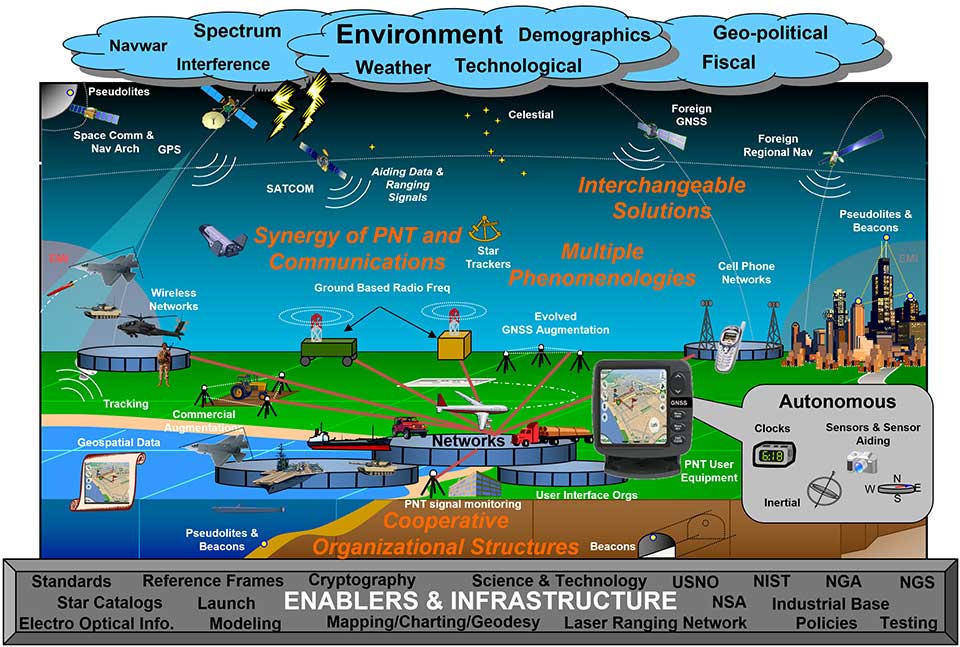
    U.S. National PNT Architecture from a 2007 Department of Transportation report, updated in 2017. (Graphic: U.S. Department of Transportation)
    U.S. National PNT Architecture from a 2007 Department of Transportation report, updated in 2017. (Graphic: U.S. Department of Transportation)

    The U.S. Department of Transportation (DOT) says it will implement a terrestrial timing system to complement and back up GPS signals, and plans to demonstrate the new system “toward the end of the calendar year.”

    The demo is anticipated to include a range of technologies, including among others local positioning systems such as Locata and NextNav, wide-area coverage by eLoran, and — though the parameters of DOT’s mandate specified terrestrial backup — space-based signals furnished by Satelles.

    The statement came in response to an inquiry in March from the House of Representatives’ Transportation and Infrastructure Committee concerning progress on a GPS Backup Technology Demonstration that was mandated in December 2017. Although funds were appropriated for the project, committee chair Peter DeFazio of Oregon saw little to no evidence of work being done, and so required a status report.

    DOT issued a Request for Information (RFI) on May 3, with a due date of June 3. The RFI asked for “readiness-level six” technologies (bearing demonstrated results in a relevant environment) “capable of providing backup positioning, navigation, and/or timing services to critical infrastructure in the event of a temporary disruption to GPS.

    “This demonstration effort also is expected to encompass technologies capable of providing complementary PNT functions to GPS by either expanding PNT capabilities, including cross checks, or extending them to GPS or Global Navigation Satellite System (GNSS)-denied or degraded user environments.”

    The DOT said it is “interested in leveraging PNT service technology initiatives.” Possibly, the agency intends to contract for a service rather than build a new system.

    Congress first required DOT to establish an operational terrestrial timing system to back up GPS signals, then expanded that definition to include positioning and navigation services.

    Systems or services, or combinations thereof, must now provide all three functions.

  • USDOT plans to preserve 5.9 GHz spectrum for V2X safety

    USDOT plans to preserve 5.9 GHz spectrum for V2X safety

    The U.S. Department of Transportation (USDOT) convened leaders from state departments of transportation, stakeholders in academia, and representatives from the auto industry in Washington, D.C., to discuss the importance of preserving the 5.9 GHz spectrum for transportation safety.

    The 5.9 GHz band supports vehicle-to-everything (V2X), a wireless technology that enables data exchanges between a vehicle and its surroundings. Starting with advanced technology development and demonstrations about 20 years ago, America has deployed 54 operational V2X projects, improving safety today, with more in the pipeline.

    Vehicle manufacturers are planning to equip new cars with the technology. This next generation of intelligent transportation communications promises to improve safety for drivers and for vulnerable roadway users, such as pedestrians, bicyclists, disabled persons and transit users.

    The National Highway Traffic Safety Administration (NHTSA) estimates that full adoption of just two V2X safety applications would prevent about half a million crashes and save approximately 1,000 lives a year. As more safety applications are developed for vehicles, more lives could be saved.


    V2X will also support an efficient, safe, and smooth transportation system, with vehicles communicating with traffic lights to improve the flow of traffic. V2X applications such as dynamic traffic signal control and prioritization have the potential to reduce travel times by up to 27% and reduce fuel emissions.

    Photo: USDOT
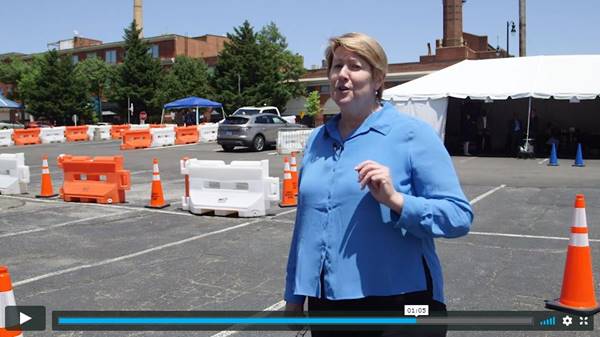
    Link to video of CV2X demonstration in Hawaii in June. (Photo: USDOT)
  • Feedback sought on federal GPS backup plan

    The U.S. Department of Transportation is seeking feedback on the potential use by the federal government of one or more positioning, navigation and timing (PNT) technologies to back up GPS signals and ensure resiliency of PNT for critical infrastructure (CI).

    A Federal Register notice was published Nov. 30, with a deadline for comments of Jan. 30, 2017.

    The Transportation Department also said it is interested in “leveraging PNT service technology initiatives under consideration or currently undertaken by industry.”

    “The federal government is presently documenting civil requirements for PNT capabilities to serve as the basis for potential future acquisition activity. The initial objective is to support sustainment of domestic CI timing continuity with the capability to extend service(s) in the future to provide positioning/navigation continuity as well.”

    The “Presidential Policy Directive on Critical Infrastructure Security and Resilience” (PPD-21; Feb. 12, 2013) designates 16 CI sectors: Chemical; Commercial Facilities; Communications; Critical Manufacturing; Dams; Defense Industrial Base; Emergency Services; Energy; Financial Services; Food and Agriculture; Government Facilities; Healthcare and Public Health; Information Technology; Nuclear Reactors, Materials, and Waste; Transportation Systems; and Water and Wastewater Systems. To support the initial objective, CI sectors need access to timing information for both nationwide applications and, in some cases, for more stringent regional and local applications.

    For more information, see the notice.

  • NDGPS to remain operational, fewer sites face decommissioning

    NDGPS to remain operational, fewer sites face decommissioning

    The United States Coast Guard, Department of Transportation and Army Corps of Engineers have issued a notice that reduces the number of Nationwide Differential Global Positioning System (NDGPS) sites that will be decommissioned.

    The agencies published a notice on Aug. 18, 2015, seeking public comments on the proposed shutdown and decommissioning of 62 the then-existing 84 NDGPS sites.

    “After a review of the comments received, we have reduced to 37 the number of NDGPS sites to be shut down, nine of which are USCG Maritime sites and 28 of which are DOT inland sites,” the notice reads. “As a result of this action, the NDGPS system will remain operational with a total of 46 USCG and USACE sites available to users in the maritime and coastal regions.”

    Over time, a number of factors have contributed to the declining public use of the NDGPS, including lack of a carriage requirement, technological advances in GPS and limited availability of consumer-grade DGPS receivers.

    The Federal Register Notice reduces the number of Differential GPS sites throughout the country, while maintaining coverage in major maritime ports and waterways.

    Read the full notice at the Federal Register website, including a list of sites to be decommissioned. Termination of the broadcast signal is scheduled to occur within the next 30 days.

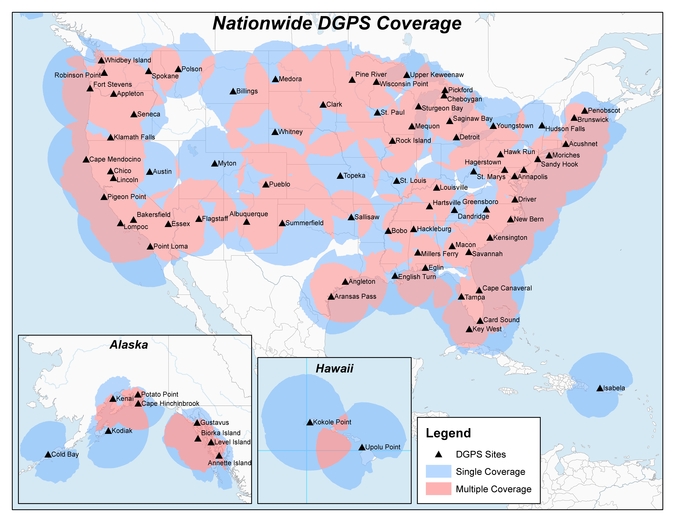
    Graphic depicting NDGPS after site reductions. (U.S. Coast Guard)
    Graphic depicting NDGPS after site reductions. (U.S. Coast Guard)
    Graphic depicting NDGPS coverage after site reductions. (U.S. Coast Guard)
    Graphic depicting NDGPS coverage after site reductions. (U.S. Coast Guard)
    Original NDGPS coverage.
    Original NDGPS coverage.
  • US congressmen seek delay to NDGPS closings

    Four U.S. congressman sent a letter to the Department of Transportation asking the DoT to delay shutting down Nationwide Differential GPS (NDGPS) sites, a proposal that was posted in the Federal Register.

    The congressmen are asking for a delay until the “administration has decided upon and implemented a resilient national positioning, navigation and timing (PNT) architecture.”

    Read the full text of the letter below, or download the PDF.


  • US government says it will invest $4B in self-driving cars

    In his final State of the Union address, delivered Jan. 12, President Obama signaled his intent to invest in a 21st century transportation system.

    U.S. Transportation Secretary Anthony Foxx has revealed part of the president’s proposal: a 10-year, nearly $4 billion investment to accelerate the development and adoption of safe vehicle automation through real-world pilot projects.

    Secretary Foxx also announced that the U.S. Department of Transportation (DoT) is removing potential roadblocks to the integration of innovative, transformational automotive technology that can significantly improve safety, mobility and sustainability.

    Secretary Foxx made the announcement at the North American International Auto Show in Detroit, where he was joined by leaders in technology, executives of traditional auto manufacturers, and newcomers to the industry.

    “We are on the cusp of a new era in automotive technology with enormous potential to save lives, reduce greenhouse gas emissions, and transform mobility for the American people,” said Secretary Foxx. “Today’s actions and those we will pursue in the coming months will provide the foundation and the path forward for manufacturers, state officials, and consumers to use new technologies and achieve their full safety potential.”

    The president’s FY17 budget proposal would provide nearly $4 billion over 10 years for pilot programs to test connected vehicle systems in designated corridors throughout the country, and work with industry leaders to ensure a common multistate framework for connected and autonomous vehicles.

    Secretary Foxx also unveiled policy guidance that updates the National Highway Traffic Safety Administration’s (NHTSA) 2013 preliminary policy statement on autonomous vehicles. The new guidance, just released, reflects the reality that the widespread deployment of fully autonomous vehicles is now feasible.

    “NHTSA is using all of its available tools to accelerate the deployment of technologies that can eliminate 94 percent of fatal crashes involving human error,” said NHTSA Administrator Mark Rosekind. “We will work with state partners toward creating a consistent national policy on these innovations, provide options now and into the future for manufacturers seeking to deploy autonomous vehicles, and keep our safety mission paramount at every stage.”

    DOT is committing to the following milestones in 2016:

    • Within six months, NHTSA will work with industry and other stakeholders to develop guidance on the safe deployment and operation of autonomous vehicles, providing a common understanding of the performance characteristics necessary for fully autonomous vehicles and the testing and analysis methods needed to assess them.
    • Within six months, NHTSA will work with state partners, the American Association of Motor Vehicle Administrators, and other stakeholders to develop a model state policy on automated vehicles that offers a path to consistent national policy.
    • Secretary Foxx encouraged manufacturers to submit rule interpretation requests where appropriate to help enable technology innovation. For example, NHTSA responded to an interpretation request from BMW confirming that the company’s remote self-parking system meets federal safety standards. Click here to read this interpretation.
    • When interpretation authority is not sufficient, Secretary Foxx further encouraged manufacturers to submit requests for use of the agency’s exemption authority to allow the deployment of fully autonomous vehicles. Exemption authority allows NHTSA to enable the deployment of up to 2,500 vehicles for up to two years if the agency determines that an exemption would ease development of new safety features.
    • DOT and NHTSA will develop the new tools necessary for this new era of vehicle safety and mobility, and will consider seeking new authorities when they are necessary to ensure that fully autonomous vehicles, including those designed without a human driver in mind, are deployable in large numbers when they are demonstrated to provide an equivalent or higher level of safety than is now available.

    In 2015, Secretary Foxx refocused the national dialogue about the future needs of our transportation infrastructure by releasing Beyond Traffic, a report examining the challenges facing America’s infrastructure over the next three decades. This draft framework has already influenced decisions by elected officials, planners and stakeholders nationwide, the DOT said.

    In December 2015, the Secretary launched the Smart City Challenge, a national competition to implement bold, data-driven ideas that make transportation safer, easier and more reliable. He also worked to accelerate the DOT’s efforts to incorporate vehicle-to-vehicle (V2V) communication technology into new vehicles.

  • GPSIA Submits Filings Supporting 1 dB Standard for GPS Adjacent Band Assessment

    WASHINGTON – On Friday, Oct. 16, the GPS Innovation Alliance (GPSIA) submitted two filings regarding federal spectrum policy. Comments were filed in response to a public notice in the U.S. Department of Transportation’s (DOT) GPS Adjacent Band Compatibility assessment, and testimony was submitted for the record to a U.S. House Energy and Commerce subcommittee in response to its recent hearing, “Improving Federal Spectrum Systems.” Both filings stressed that the “1 dB standard” is the appropriate criterion for testing the compatibility of terrestrial broadband and GPS operations.

    The GPS Innovation Alliance has consistently supported the more complete use of underused spectrum where technically feasible. In both filings, GPSIA expressed support for each government entity’s ongoing efforts and stressed the importance of protecting GPS, one of the country’s most important and ubiquitous national utilities.

    Regarding the DOT effort, GPSIA offered suggestions relating to certain aspects of the proceeding and voiced support for the “1 dB standard” in testing — which would determine Adjacent Band Masks based on a measurement of received interference test signal power levels that cause a 1 decibel (dB) degradation in the receiver’s Carrier-to-Noise Density Ratio.  As outlined in GPSIA’s comments, the organization’s support for the 1 dB standard is based on its long and well-established history in international and domestic regulatory proceedings and difficulties associated with other standards.

    GPSIA wrote: “While DOT has proposed recording other performance metrics, such as loss of signal lock or degradation of pseudo-range or position accuracy, GPSIA believes these are inappropriate metrics for interference assessment since their inherent basis is an interference level that seriously degrades the RNSS spectrum environment and causes significant disruption to GPS receivers.”

    Degradation of accuracy or otherwise attempting to determine effects on the “user experience” are not practicable interference metrics, and DOT should rely upon the 1 dB protection criteria in derivation of the Adjacent Band Masks.  GPS receivers are used in a tremendous range of end user applications beyond simple navigation.  It is unclear how it would be possible to determine whether there has been “material degradation” in the functioning of this wide range of GPS applications, much less what constitutes degradation that is “material.”

    GPSIA also submitted testimony for the record in response to an Oct. 7 hearing by the House Subcommittee on Commerce and Technology, where the potential for repurposing spectrum currently reserved for use by satellite applications for terrestrial broadband was discussed, but without addressing the difficult technical challenges associated with repurposing satellite spectrum.

    A key theme raised in the GPSIA testimony is support for allocating similar uses for spectrum in close proximity to each other.  Doing so is an approach that is preferable to adopting receiver standards.  GPSIA also explained the unique technical differences between communications and navigation spectrum use.

    “A straightforward approach is to minimize the number of dissimilar spectrum applications in close spectral proximity to each other,” GPSIA said. “Put another way, similar spectrum uses should be grouped together to the greatest extent possible to minimize the number of band edges or ‘border areas’ where dissimilar uses in close proximity create serious interference challenges. This approach minimizes the need for the FCC to engage in extensive rule making to balance the interests of dissimilar spectrum uses in every spectrum ‘border’ area.”

    GPSIA then noted that “attempts to attribute Global Navigation Satellite System (GNSS) interference issues mainly to poor receiver design are misguided. The FCC has long understood that receivers designed to receive one set of frequencies can be ‘overloaded’ by transmissions in adjacent frequencies.”

    In fact, overload interference is not unique to GPS, whose receivers are typically designed to withstand adjacent band transmissions hundreds of millions of times stronger than GPS signals and compare favorably to other common types of mass market receivers.

    GPSIA again voiced support for the 1 dB standard for testing, explaining that communications systems operate above the noise floor spectrum while GPS signals are below the thermal noise floor when they are received.

    “Because GNSS operates below the noise floor, the most appropriate means by which to assess the potential of new adjacent band systems is whether the new service causes a 1 dB degradation in a receiver’s Carrier-to-Noise Ratio.” Other interference metrics, the GPSIA explained, “are based on interference levels that seriously degrade the GNSS spectrum environment and will cause devastating disruption to GPS receivers.”

    “Use of a 1 dB standard is vastly superior to an approach that attempts to assess whether there is ‘actual’ harm to an incumbent service, which wrongly assumes that you can accurately predict the impact of a new service across a heterogeneous series of devices in adjacent spectrum. Defining harmful interference by reference to a level of degradation to a particular key performance indicator among a limited universe of devices and applications fails to account for and support future innovation, including known and currently unknown applications which could take advantage of ever increasing accuracy of the position, navigation and timing functions of GPS. Use of a defined change in the noise floor (1 dB) provides a readily identifiable and predictable metric that all interested parties can take into account now and in the future.”

    GPSIA’s testimony concluded by urging policy makers to engage in “rational, long term spectrum planning,” noting that a focus solely on regulation of receiver characteristics is likely to have limited usefulness and may be inefficient and harmful to continued innovation in affected spectrum uses.

    The GPS Innovation Alliance recognizes the ever increasing importance of Global Positioning System (GPS) and other Global Navigation Satellite System (GNSS) technologies to the global economy and infrastructure and is firmly committed to furthering GPS innovation, creativity and entrepreneurship. The GPS Innovation Alliance seeks to protect, promote and enhance the use of GPS. For more information, visit www.gpsalliance.org.

  • PrecisionHawk Joins Task Force for UAS Registration

    PrecisionHawk Joins Task Force for UAS Registration

    PrecisionHawk will serve as a technical resource to regulators. (PRNewsFoto/PrecisionHawk)
    PrecisionHawk will serve as a technical resource to regulators. (PRNewsFoto/PrecisionHawk)

    PrecisionHawk is contributing to a safety task force created by the U.S. Department of Transportation and the FAA. The task force brings together a diverse group, representing the UAS and manned aviation industries, the federal government, and other stakeholders, to develop an augmented registration process for Unmanned Aircraft Systems.

    “PrecisionHawk is working on many safety solutions, procedural and technological, that we believe can contribute to safer operations for commercial drones in the national airspace,” said Ernest Earon, PrecisionHawk CTO and co-founder. “The creation of this task force further demonstrates the willingness of the FAA to move forward with industry leaders to promote rapid and safe integration.”

    “As a UAS technology company and operator, we know how important coordinated identification is to the environments in which we work,” said Thomas Haun, VP of Strategy at PrecisionHawk. “The goal of this task force, to create a streamlined registration process for UAS, will have a direct and positive impact on the operations of our partners and service teams.”

    “This task force presents another opportunity for PrecisionHawk to serve as a technical resource to regulators as we move towards the adoption of UAV regulations. Earlier this year PrecisionHawk was also named, alongside CNN and BNSF, to the FAA Pathfinder Program to test and develop technology solutions to solve beyond line of sight operations,” PrecisionHawk said in a statement.