Tag: Esri

  • Esri takes top award for Internet of Things innovation

    Electric-Vehicle_shutterstock_192060521-660x400
    The Smart Energy Catalyst. The project showcased how a smart home, smart electric vehicle and smart energy system can work together in an IoT ecosystem with location as a key interaction point.

    Geospatial technology company Esri was honored at the TM Forum Catalyst InFocus event for the company’s contributions to developing solutions for a more connected world. TM Forum, a global industry association for digital business, presented Esri and partners with the Most Innovative Catalyst Award.

    “We’re driving toward the ultimate Internet of Things (IoT) ecosystem where you can bring different applications together that are going to make our lives safer, more energy efficient, and much better in the future,” said Randy Frantz, telecommunications solutions director at Esri.

    Esri’s telecommunications team collaborated with Orange and BearingPoint on the award-winning proof-of-concept project called the Smart Energy Catalyst. The project showcased how a smart home, smart electric vehicle and smart energy system can work together in an IoT ecosystem with location as a key interaction point.

    The multiphase project examined the infrastructure necessary to support a smart energy ecosystem. With the latest iteration of the Catalyst, the project team demonstrated how geofencing in homes and cars can work with Esri’s geographic information system (GIS) technology. When the consumer leaves home or work, mobile devices trigger the GIS to initiate a series of notifications and actions. For example, lights in homes automatically turn off, security systems are enabled, and users are notified that their electric vehicle needs charging.

    “Location provides context to the IoT network. It transforms raw sensor data into useful, actionable information,” Frantz said.

    TM Forum’s Strategy Committee gave the award to the Smart Energy Catalyst team based on several criteria, including having a compelling and inspiring demonstration; growth potential and business value; and potential for humanitarian or other positive effects on society.

    Nearly 200 industry leaders attended the Catalyst InFocus conference, where they explored the organization’s 11 project demonstrations.

    TM Forum’s Catalyst program connects diverse companies from across industries, facilitating collaboration and fostering the cocreation of innovative solutions to pressing telecommunications business challenges. Catalysts are member-led projects and demonstrations that both inform and leverage TM Forum best practices and standards including TM Forum Frameworx.

    The organization announces Catalyst Awards biannually. Winning teams leverage proven technologies, competencies, and investments. Teams have six months to develop proofs of concept that outline digital solutions.

    In addition to his work on the Smart Energy Catalyst, Frantz accepted a position earlier this year as colead of TM Forum’s IoT work stream. The endeavor explores how location, advanced sensor and device data, and powerful industrial and consumer solutions can change social norms and bring business into the modern technology framework.

    TM Forum includes more than 900 member organizations and 85,000 individual members.

    Photos: Esri

    The Esri team at the TM Forum.
    The Esri team at the TM Forum.
  • Esri, Microsoft join on location, spatial services

    Esri Inc. is working with Microsoft to integrate location services and spatial analytics to the Microsoft Azure IoT (Internet of Things) Suite.

    The collaboration will rapidly enable IoT scenarios by offering customers and partners a set of highly capable platform services as ready-to-use, preconfigured solutions. The forthcoming integrated offering is the next step in Microsoft’s and

    Esri’s long-standing alliance to spatially enable the enterprise, Esri said in a press release.

    Smart city concepts and innovations in the automotive industry are examples of how data from many sources increases understanding. Governments and businesses use that data to improve safety features, reduce air pollution, and mitigate traffic congestion.

  • Esri scientist Dawn Wright delivers honors lecture at AGU meeting

    Esri chief scientist Dawn Wright gives honors lecture at AGU Fall Meeting.
    Esri chief scientist Dawn Wright gives honors lecture at AGU Fall Meeting.

    Dawn Wright, chief scientist at Esri, delivered a named honors lecture at the 2015 American Geophysical Union (AGU) Fall Meeting, Dec. 14–18, at the Moscone Convention Center, San Francisco, Calif. The AGU Earth and Space Science Informatics Focus Group designated Wright to represent Esri in delivering the Leptoukh Lecture.

    AGU is among the world’s most well-respected Earth science scholarly organizations. Its Fall Meeting is the largest Earth and space science meeting in the world. The Leptoukh Lecture award recognizes achievement in computational sciences, data sciences and informatics that leads to advancements in the domain sciences.

    “This is a great honor and opportunity for Esri,” Wright said. “It allows us to describe how Esri’s continuing progress helps advance both data science and Earth science. Given the host of pressing issues facing the planet, such as the impact of climate change on human systems and the natural environment, Esri’s involvement with the scientific community is now more important than ever.”

    The Leptoukh Lecture award was named for the late Greg Leptoukh, an Earth scientist at the NASA Goddard Space Flight Center. He was involved in many projects related to data quality and data provenance. The honors lecture’s purpose is to raise awareness of the often-overlooked computational and data advances that enable breakthroughs in domain science. It also fosters exceptional individuals to make continued contributions in informatics and data science.

    The Leptoukh Lecture Toward a Digital Resilience (with a Dash of Location Enlightenment) has been selected to be live streamed and recorded as part of the AGU On-Demand program.

    The AGU Earth and Space Science Informatics Focus Group addresses an array of research questions and projects. This year’s session topics range from large-scale data management within global cyber infrastructures or virtual observatories, to intelligent systems theory, semantics, and handling of near-real-time data streams, to issues of “dark data,” data transparency, reproducibility and more.

    The aim of the lecture is to build, in part, on these themes but to consider more broadly how we might push the boundaries of informatics knowledge more along the lines of use-inspired science — responsive to the needs and perspectives of society while still being fundamental and cutting edge. 

  • Esri ArcGIS to support SAP HANA as enterprise geodatabase

    esri-logoEsri plans to commercially support ArcGIS using SAP HANA as an enterprise geodatabase, SAP SE announced in a news release.

    sap-se-logoThis release of ArcGIS, planned for 2016, expands the existing native integration with SAP HANA and allows customers to run SAP Business Suite and ArcGIS applications within an architecture based on SAP HANA. The companies said they will further enhance the SAP HANA platform by more deeply integrating advanced ArcGIS geospatial capabilities and content across SAP’s broader application portfolio.

    The collaboration between SAP and Esri is expected to provide the ability to run both GIS workloads and advanced spatial analytics on a single SAP HANA geodatabase. The companies stated that customers will be able to apply sophisticated business rules and relationships to spatial data directly in SAP HANA, define advanced georelational models such as topologies and networks, and permit both GIS and enterprise business users to work within the same multiuser access and editing environment.

    “We’re very excited about the enterprise geodatabase support for SAP HANA,” said Jack Dangermond, Esri’s president. “It will bring our customers speed, simplicity and better integration with their enterprise information. For SAP customers, it delivers a complete platform for mapping and geospatial intelligence. By synchronizing our platforms, our respective customers will benefit across the enterprise. We’re doing the work to make sure that GIS and mapping is available to all — not just traditional mapping experts.”

    SAP and Esri have been technology partners for a number of years, providing integration of their respective platforms, SAP HANA and Esri ArcGIS. Companies invested in Esri and SAP can immediately create maps populated with data from SAP HANA and instantly access those maps anywhere on any ArcGIS client, as well as in SAP or custom applications. Today users of SAP HANA can access ArcGIS for geospatial data and geoservices and perform analytics, while Esri users can similarly access, analyze and query both spatial and nonspatial data directly in SAP HANA. Esri supports deployments of SAP HANA with query layers and features services for customers that want to dramatically increase spatial query performance by running SAP HANA side by side with ArcGIS.

    “Our customers represent a new generation of data stewards requiring an in-memory computing platform that performs at scales unseen before — including large-scale geography,” said Daniel Schneiss, senior vice president and global head, SAP HANA Platform and Databases, SAP. “As we enter a world of exponential data growth and the Internet of Things, the need to geospatially analyze Big Data will only increase from this point forward. We look forward to teaming with Esri to address this need by integrating the full power of ArcGIS technology with SAP HANA.”

  • Map shows flu activity throughout US

    With flu season upon us, Esri is providing a new map that shows flu activity in U.S. communities.

    Built on Esri’s ArcGIS platform, Walgreens Flu Index provides state and market-specific information regarding flu activity.

    It is compiled using retail prescription data for antiviral medications used to treat influenza across Walgreens locations nationwide.

  • Jane Goodall launches Tapestry of Hope interactive map

    TapestryofHope-Goodall

    Jane Goodall and the Jane Goodall Institute have launched the Tapestry of Hope, an interactive online tool to visualize the thousands of projects led by young people around the globe who are protecting the environment.

    As world leaders struggle to make progress in Paris for the 21st Conference of the Parties to the United Nations Framework Convention on Climate Change, Goodall, spreading her message of hope for our world, is calling on each of us to take action ourselves to protect our natural world.

    Founder of the Jane Goodall Institute and UN Messenger of Peace, Goodall, through her Roots & Shoots program, has inspired hundreds of thousands of people around the globe to take action to make the world a better place for people, animals and the environment. Together, these individual actions weave together a story of impact — a narrative of change for what Goodall has come to call the Tapestry of Hope.

    The launch of Tapestry of Hope reflects a snapshot of the projects young leaders have led in the past several years through Roots & Shoots,” said Erin Viera, associate vice­ president of Roots & Shoots. “Moving forward, the map will be a critical tool to document, manage, visualize and share the actions and impacts of Roots & Shoots projects that are making a positive difference for the environment, animals and people. The map will continue to grow and populate with the launch of each new Roots & Shoots community project that young people continue to pioneer around the world.”

    “Esri and the Jane Goodall Institute have collaborated on conservation programs across Africa for more than 10 years now. These projects have included applications ranging from using geospatial technologies for chimpanzee behavior research in Gombe to supporting the development and implementation of conservation action plans and improving village land use using geodesign and community mapping across East Africa and Congo basin,” said Lilian Pintea, the Jane Goodall Institute’s vice­president of conservation science.

    Esri technology that powers the mapping behind JGI’s conservation work forms the basis of the Tapestry of Hope. The map connects the work of young people around the world with other young people who are passionately making the world we all share a better place through local projects.

    In addition to documenting and visualizing the work of young people around the world, the Tapestry of Hope map serves to further Goodall’s message of hope. It brings together the critical observations, creative ideas and clever solutions of thousands of passionate young minds all working to make a difference in the world. It is designed to represent and inspire a global movement of change showing that young people care about the future of the world they are inheriting, and are taking action.

  • Esri story map considers Katrina 10 years later

    Esri story map considers Katrina 10 years later

    Photo: Esri

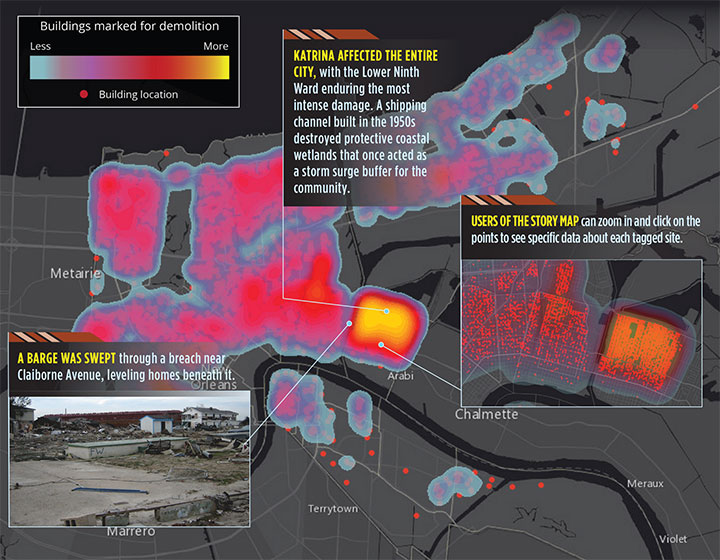
    In August 2005, Hurricane Katrina struck the city of New Orleans, causing devastating damage and loss of life. A new Esri story map, “Katrina +10: A Decade of Change in New Orleans,” analyzes the damage from the storm.

    “The story map is a new Esri medium for sharing not only data, photos, videos, sounds and maps, but for telling a specific and compelling story by way of that content,” wrote Esri Chief Scientist Dawn Wright in a blog. “This is all done with sophisticated cartographic functionality that does not require advanced training in cartography or GIS.” According to Wright, story maps are applications built from web maps, which in turn are built from web-accessible data.

    The below map shows the physical damage in terms of buildings marked for demolition. In all, 10,317 buildings were tagged for demolition by the city of New Orleans. Following Hurricane Katrina, all properties within the city were reviewed for damage under Section 106 of the National Historic Preservation Act.

    The heat map shows the density of houses deemed eligible for federally funded demolition through the Federal Emergency Management Agency (FEMA). Although not all properties on this map were demolished, the points illustrate Katrina’s extensive and pervasive physical toll on the city of New Orleans.

    For this and other story maps, visit http://storymaps.arcgis.com/.

  • Track Cat 5 Hurricane Patricia as It Nears Mexico

    Hurricane Patricia — “Extremely Dangerous” Category 5 Hurricane — Is the Strongest Storm Ever Recorded.

    Esri is providing a continuously updated hurricane map that shows the projected paths, storm surge, weather warnings and precipitation of Hurricane Patricia, the “strongest hurricane ever recorded.” In addition, the real-time effects of the storm can be seen via social media posts. The website, Hurricanes & Cyclones, is part of the Esri Disaster Response Program.

    Hurricane Patricia became the most powerful tropical cyclone ever measured in the Western Hemisphere on Friday morning as its maximum sustained winds reached an unprecedented 200 mph (320 kph).

    The National Oceanic and Atmospheric Administration (NOAA) is offering updates through its National Hurricane Center (NHC).

    Hurricane Patricia is heading toward Mexico’s west coast, and is expected to make landfall near Puerto Vallarta. “Confidence is high that Patricia will make landfall in the hurricane warning area along the coast of Mexico as an extremely dangerous category 5 hurricane this afternoon or evening,” according to a Friday morning forecast discussion from the National Hurricane Center.

    It will then cause massive rainfall in Texas after it hits landfall. “The global models continue to depict the development of a cyclone near the Texas coast over the weekend. This system should be non-tropical in nature. However, this cyclone is expected to draw significant amounts of moisture from Patricia’s remnants, and could result in locally heavy rainfall over portions of the northwestern Gulf of Mexico coastal area within the next few days,” according to the NHC discussion.

    Patricia-hurricane-O

  • Mapillary Partners with Esri to Provide Real-Time Street Photos

    Mapillary-O

    Mapillary, a community-based mapping photo app, is partnering with Esri to help governments and businesses see their cities evolve in real-time through the ArcGIS platform integration.

    Mapillary creates detailed maps that go beyond street view by instantly stitching together hundreds of thousands of crowd-sourced photos, giving cities the ability to gain insights immediately rather than weeks or months later. The ArcGIS integration provides governments and cities with a tool to help them manage inventory and city assets, monitor repairs, inspect pavement quality, assess sites for public transportation projects, and more.

    With ArcGIS support, Mapillary users will be able to:

    • Navigate photos in a web-based viewer
    • Load any ArcGIS data layer or base map
    • Use Mapillary street-level photos to edit and update their data
    • Automatically sync edits back to ArcGIS Online.

    Learn more at the Mapillary website.

  • GeoDecisions Helps PennDOT Handle Millions of Traffic Records

    GeoDecisions-TMS
    The PennDOT TDS developed by GeoDecisions enables collection and processing of millions of data points.

    GeoDecisions, an information technology company specializing in geospatial solutions, has developed a new traffic data system (TDS) that processes more than 20 million new records per month for the Pennsylvania Department of Transportation (PennDOT).

    Built on the Esri platform, the TDS helps PennDOT’s Bureau of Planning and Research better manage the download of traffic data from collection sites throughout the commonwealth of Pennsylvania.

    “Built to Federal Highway Administration standards, GeoDecisions’ redesign of our TDS provides us a method to seamlessly introduce new counting devices, more efficiently verify our raw traffic data, and speed up our process for creating yearly traffic volume maps,” said Andrea Bahoric, planning division manager with PennDOT.

    The new TDS improves PennDOT supervision of 45,000 short-term or portable counters that classify vehicles, record traffic volume and weight, and determine driving speed. The system’s mobile Field Operations Module (FOM) also streamlines in-pavement counter inventory and maintenance activities.

    “FOM enables PennDOT field technicians to use smartphones or tablets to perform site reviews and document issues,” said Greg Ulp, senior project manager with GeoDecisions. “Convenience and efficiency are critical factors when enhancing technology and managing assets.”

    PennDOT’s predecessor traffic data management system contained nine applications with dated technology requiring manual intervention to collect and verify information. GeoDecisions’ TDS redesign features five modules streamlined for better performance and usability. The new automated system includes remote user access and cutting-edge GIS mapping, web service, database and coding technologies.

    “Our transportation system solutions provide a proven business model for analytics, reporting, reliability, and technology workflow management,” said Tom Saltzer, vice president of government delivery with GeoDecisions. “PennDOT’s redesigned TDS is a long-term collection, verification, and geospatial solution that reflects their ongoing enterprise GIS investment strategy.”

  • New Esri Book Guides Use of Lidar

    learn-to-make-decisions-using-lidar-data-and-gis-WA new book published by Esri teaches how to use GIS software to analyze and visualize lidar data. Lidar is an optical remote-sensing system that uses a laser to measure topography, vegetation, objects such as buildings, and the ocean floor at some depths. Data collected from lidar can be used to create highly accurate elevation and terrain models.

    Making Spatial Decisions Using GIS and Lidar: A Workbook presents problems that need to be solved using lidar data and the geospatial analysis tools in Esri’s GIS software, ArcGIS for Desktop. The book contains 10 learning modules that focus on how to use lidar data with GIS to answer questions and make informed decisions about real-world situations. Exercises include determining how much land to excavate for an underground parking garage, locating cell-phone towers for maximum signal coverage, placing solar panels based on the amount of solar radiation in an area; analyzing how a coastline has changed after a major hurricane; and making flood insurance rate maps based on hurricane inundation zones.

    The workbook covers basic lidar data analysis techniques, 2D and 3D modeling, volumetric analysis, shadow maps, forest vegetation height analysis, and other lidar-related analyses. The book is a college-level textbook for students and geospatial technology professionals and was written with the assumption that readers are familiar with lidar and have some experience using ArcGIS for Desktop software.

    Making Spatial Decisions Using GIS and Lidar: A Workbook is the third book in the Making Spatial Decisions series written by Kathryn Keranen and Robert Kolvoord. Keranen is an instructor at James Madison University in Harrisonburg, Virginia. Kolvoord is a professor of integrated science and technology at James Madison University. They wrote Making Spatial Decisions Using GIS and Remote Sensing: A Workbook and Making Spatial Decisions Using GIS: A Workbook, also published by Esri.

    Making Spatial Decisions Using GIS and Lidar: A Workbook is available in print (ISBN: 9781589484290; 264 pages, $79.99 or as an e-book (ISBN: 9781589484344). The book is available at online retailers worldwide, at esri.com/esripress, or by calling 1-800-447-9778. Outside the United States, visit esri.com/esripressorders for complete ordering options, or visit esri.com/distributors to contact a local Esri distributor.

  • Track Hurricane Joaquin with Maps, Social Media

    Hurricane-Joaquin-Esri-O

    Esri is providing a continuously updated hurricane map that shows the projected paths, storm surge, weather warnings and precipitation of Hurricane Joaquin. In addition, the real-time effects of the storm can be seen via social media posts. The website, Hurricanes & Cyclones, is part of the Esri Disaster Response Program.

    The National Oceanic and Atmospheric Administration is offering updates through its National Hurricane Center.

    Hurricane Joaquin strengthened into a Category 4 storm on Thursday as it moved through the eastern Bahamas, and could grow more intense as it nears the U.S. East Coast.