Tag: Europe

  • European Court Rules on Privacy — Is Location Next?

    European Court Rules on Privacy — Is Location Next?

    google-afterThe highest court in the European Union has granted the right to be forgotten by a search engine. Will location privacy be next on the docket? We are seeing the beginnings of the in-car smartphone-type apps market and are watching for approaching hockey-stick style growth that is a year or two away. Google has added rich, engaging features to maps. And we take a look at results from indoor location advertising. Read more.

    The European Court (EU) of Justice, made a curious and powerful ruling on privacy. The court stated that upon request, Google is obliged to remove reputation-hurting information that is generated by searching a person’s name. Like Mr. González, who brought this case to court, many of us have things in our distant past that we don’t want to be aired each time we are Googled. Perhaps it is an old bankruptcy or a youthful prank gone bad. The continuous re-airing of this information can make it hard for people to move forward in their lives. But while the court rule serves a purpose, it is poorly conceived and vague. The administrative complexity for search engines to comply is staggeringly onerous. And the information that it seeks to shield will still reside in websites.

    How does this relate to location privacy? The EU Court of Justice is in the mood for privacy restrictions, and the use and handling of location data may be in their scopes. Also, sensitive location information can turn up in Google searches. A person in the EU will be able to request to have it shielded. Location information can be revealing. There may be records of check-ins from the café outside a rehab center or other treatment center, for instance.

    Market, Fast Approaching. Companies are falling over each other for a piece of a new market about to burst open — software apps within vehicles. Analysts at IHS Automotive expect there will be 370 million smartphone apps for cars in use by 2020, a hefty growth from the 6.9 million units projected by the end of this year. Aha Radio is in Honda cars. General Motors is embedding Pandora, the music streaming app. 4G Internet connectivity will be in some GM and Audi models next year. BMW is opening app stores, this year in Europe and next year in the U.S.

    The Players. Google and Apple (Google Projected Mode and Apple CarPlay) are poised to together dominate the market for auto apps integration, but other companies are in pursuit as well, including MirrorLink, Aha by Harman, and Ford Sync AppLink. North America is ahead of the global rush. Let’s hope some money flows into Detroit.

    Google v. Apple. Information about Googles’ Projected Mode is scarce. Daimler posted an ad for a software engineer to help implement Google’s new in-car system, referred to as “Google Projected Mode.” The employment ad described Project Mode as a way to “seamlessly integrate” Android smartphones into a dashboard’s head unit. There is no mystery about Apple’s CarPlay, an extension of IOS. CarPlay simplifies the in-car experience by offering the same look and feel as an iPhone.

    GM Pulls Ahead. Ford was the early automotive leader to offer smartphone-type apps with its Sync system, but more recent versions of the offering have had issues. They weren’t alone. Other car makers have had confusing interfaces that often contained annoying bugs. IHS now predicts that vehicle OEM adoption and integration will be led by General Motors. “Apps for autos are growing rapidly and will have a profound impact on auto infotainment and connectivity in the next decade,” said Egil Juliussen of IHS Automotive. “Auto apps will influence the competitive landscape among auto manufacturers and will even change the brand market share between them. OEMs will have to keep up to remain competitive.”

    Better Google Maps. Google’s navigation system will now offer less congested or otherwise quicker routes during navigation, a byproduct of Google’s purchase of Waze. In addition, the navigation system will now advise on the best traffic lane, replacing less precise directions such as “keep left at the fork.” Google has partnered with cab provider Uber to show how long it would take to get home via cab when searching for public transit or walking directions. Google maps also now enable users to save entire cities for offline use.

    Indoor Location Pays? In order for retailers to adopt indoor location technology, there needs to be clear returns. “A body of information is now gathering that verifies the effectiveness of these technologies,” reports Dominque Bonte of ABI Research. “We can see how limited trials are showing increases of advertising local search click-through rates from 0.1 to 3.5 percent, indoor location applications increasing basket sizes 10 percent, and how smartphones are significantly changing the cross channel shopping habits of users.”


  • Expert Advice: Galileo, EGNOS Open Europe’s Road Ahead

    Expert Advice: Galileo, EGNOS Open Europe’s Road Ahead

    Tim Reynolds
    Tim Reynolds

    By Tim Reynolds, GPS World’s contributing editor for Europe

    This spring, two Brussels conferences focused on new possibilities and modes of transport enabled by satellite navigation, showing the added value delivered by current and future European GNSS solutions.

    The European GNSS Agency (GSA) hosted the first gathering in February, discussing its GNSS Applications Action Plan in areas relating to road transport including smart tachographs, long-range buses, transport of dangerous goods, multimodal logistics, and road tolling. The 11th Annual Road User Charging Conference (RUC) in March, an industrial gathering, highlighted recent developments in truck tolling and a possible future breakthrough for lighter vehicles.

    Huge Market

    The GSA identified the road sector as the largest GNSS market segment (with location-based services) in its October 2013 Market Report. Most GNSS devices were already enabled for European GNSS services, either via EGNOS or Galileo. Developments such as lower costs for connectivity, growing numbers of embedded devices, intelligent transport systems (ITS), and vehicle-to-vehicle (V2V) and vehicle-to-infrastructure (V2I) communications, together with new European Union policies and regulations, drive new requirements for vehicle positioning, and GNSS technologies are poised to fulfill these.

    In two specific policy areas, road tolling and eCall emergency response, GNSS shows particular promise for adding value and providing flexible solutions. The GSA manages a large portfolio of research and innovation projects to develop near-market applications in this area.

    e-Freight

    E-Freight, a vision of a paperless freight transport system where electronic data flow is linked to the physical flow of goods, can lead to future intelligent-cargo concepts to further automate and improve logistics. Positioning services naturally form an integral part of this concept. The increased availability, resilience, integrity, and accuracy offered by European GNSS will support the uptake and efficiency of e-Freight systems through georeferenced cargo-status monitoring, among other services, seamlessly delivered across transport modes and national borders.

    Road Tolling

    The GSA delivered its perspective on road tolling in advance of the later industrial conference. Location-based charging offers flexibility, easy extension of schemes, low transaction costs, and — most promising from an agency point of view — could have a big impact on traffic management and environmental policy. GNSS is becoming the technology of choice for free-flow road tolling with its three main advantages: coverage, availability, and no direct installation costs.

    The final GSA presentation focused on authentication services offered by Galileo to benefit the next-generation digital tachograph, a device fitted to a vehicle that automatically records its speed and distance, together with the driver’s activity selected from a choice of modes. New government proposals for the digital tachograph will mandate the inclusion of GNSS technology.

    Clearly, a tachograph requires a robust and trusted GNSS service that is also very low-cost and resilient against spoofing and other interference. An authentification signal provided via the Galileo Open Service could provide a suitable solution free of charge, offering global coverage and easily initiated in existing Galileo-enabled receivers and terminals when the service was introduced. There is growing interest in such a service and its market potential from a range of stakeholders.

    Road-User Charging

    GNSS should be a key enabling technology for a scalable and cost-effective approach to fair and flexible road charging. But despite its great promise, implementation of such schemes have proven difficult on both sides of the Atlantic.

    GNSS-enabled road-use charging systems now operate in Switzerland, Germany, Slovakia, and Hungary for heavy-goods vehicles (HGVs). Plans are in hand for a similar scheme in France covering 15,000 kilometers of national roads. Russia aims to introduce a GLONASS-mandated operation, initially for 50,000 kilometers of federal road and perhaps half a million kilometers of regional roads.

    Belgium plans a HGV GNSS-enabled system to start in 2016, initially using GPS and GLONASS signals, eventually covering its full 150,000-kilometer road system. On-board units (OBUs) will be mandatory, and the system will have the capacity to define up to 10,000 toll rates dependent on factors such as location, time of day, direction of travel, road, and vehicle category.

    Factor of Seven. The flexibility and scalability of a GNSS-based charging system was demonstrated by the SkyToll organization that operates the road-user charging scheme for HGVs in the Slovak Republic. This system’s network coverage has recently been extended seven-fold from main motorways and major roads to encompass 17,762 kilometers, effectively bring all motorways and class 1, 2, and 3 roads under charge.

    To achieve this with a terrestrial system would have required the construction 4,000 gantries, but the huge expansion was built using software in three months. “This is only possible via GNSS,” stated spokesperson Miroslav Bobošik.

    The two-way communications possible with GNSS-enabled OBUs also meant that tariff and network models could be updated and amended quickly and easily. Charge collection efficiency exceeds 99 percent and is independent of road type. “There is a clear trend to GNSS-enabled systems due to their flexibility, efficiency and fast implementation,” said Bobošik.

    Belgium First? On the first day of the RUC conference, a Flemish regional government spokesperson described plans for the Belgian road-user charging system for HGVs heavier than 3.5 tonnes that could be launched across the whole of the country in 2016.

    In parallel to these developments for HGVs, a major pilot project for lighter vehicles, that is, passenger automobiles, has just started in Belgium’s GEN-zone. This area is effectively the capital city, Brussels, and its surrounding provinces of Flemish and Wallonian Brabant. The pilot will test the practicalities of a GNSS-enabled mileage-based charging system and involves 1,000 selected participants in a three-month trial. First results will be available in April, and the final report is due in the summer. This report will form the basis of future national policy on road-user charging and will likely be on the desk of the new Minister for Transport when he or she takes office after the upcoming Belgian elections.

    If the political will is there — and post-election the necessary political capital may well be in place — could Belgium become the first nation to implement a GNSS-enabled road-user charging scheme for all vehicles as early as 2016? Watch this space!


    Tim Reynolds is director of Inta Communication Ltd. and a long-term Brussels observer writing on many aspects of European government policy and implementation for a range of clients and publications. The material presented here was first prepared in a somewhat different form for the GSA. He is the contributing editor for GPS World’s new quarterly e-newsletter, EAGER: the European GNSS and Earth Observation Report. Subscribe free at env-gpsworld-integration.kinsta.cloud/subscribe.

  • More Airports Across Europe Add EGNOS Approaches

    Flight operators can now use EGNOS approach procedures at airports in the Czech Republic, Austria, Finland, and Tunisia, all part of a growing list of airports across Europe that have implemented localizer performance with vertical guidance (LPV) procedures. The European Satellite Services Provider (ESSP), a Toulouse-based company which has the contract for EGNOS system operation and service provision, made this and several other announcements recently.

    In all, 17 EGNOS Working Agreements (EWA) with airports have been signed and 171 EGNOS-based approach procedures authorized for specific runways.

    The European GNSS Agency (GSA) is launching the implementation of the first LPV procedures in seven countries in 2014, as an exercise to gain the necessary competencies at national level, leading to a further plan for EGNOS adoption in the Perfromance-Based Navigation (PBN) plans.

    EGNOS provides a cost-effective alternative to ILS CAT I, offering similar performance, and increasing safety by allowing Instrument Flight Rules (IFR) approaches at difficult locations or under meteorological conditions where previously such approaches were not possible due to safety concerns. The use of EGNOS is free of charge.

  • Synergies between Europe’s Rail and SatNav Programs Can Make Rail Travel Affordable

    Cost-effective synergies between the European Rail Traffic Management System (ERTMS) and satellite technologies such as Galileo can make rail transport more efficient and reliable, agreed European authorities in February at a Rail Forum Europe dinner in Brussels. But while the technology is now available, its implementation pace is still too slow due to the long term return on investment.

    Francesco Rispoli, manager of satellite technologies at Ansaldo STS, an Italian provider of rail-traffic management, planning, train control and signalling systems, stressed that satellite technology can improve the penetration of ERTMS in the worldwide market as well as on European local and low-traffic lines. He predicted that further synergies will be developed on the SHIFT²RAIL initiative: “EGNOS and Galileo are key enabling technologies for a market-driven step change in the rail sector” he concluded. In that light, Ansaldo STS is developing an open platform to allow the ERTMS to fully exploit EGNOS and Galileo.

    Olivier Onidi, director for Innovative and Sustainable Mobility at the EC’s Directorate General for Mobility and Transport (DG MOVE), highlighted the role of ERTMS in achieving an interoperable Single European Railway Area. “2014 is a key year in terms of innovation for the rail sector. Major progress is expected on ERTMS, Galileo, and SHIFT2RAIL”.

    SHIFT²RAIL is a European technology initiative  seeking to double the capacity of the European rail system, increase its reliability and service quality by 50 percent ,and cut lifecycle costs in half.

    Carlo des Dorides, executive director of the European GNSS Agency, applauded the ERTMS Memorandum of Understanding envisaging the future use of EGNOS and Galileo to improve the competitiveness of train control systems. “There are signs that GNSS will be adopted globally as in the aviation sector. In this scenario, Europe now has the opportunity to exploit the synergy between ERTMS and GNSS.”

  • Downstream Dialog, Tests in Europe

    With Galileo services set to take effect in December, the two European entities charged with the program are engaging manufacturers — the European Space Agency (ESA) in consumer markets, and the European GNSS Agency (GSA) in the government security sector, respectively.

    “We put out an open call to satnav manufacturers offering testing with our laboratory facilities,” said the head of ESA’s Radio Frequency Systems, Payload, and Technology  Division. “We have gone on to work with five mass-market chipset makers and a comparable number of professional receiver manufacturers.”

    Available ESA facilities include:

    • a hybrid localization solution rack for receiver plug-in; it generates simulated constellations of multiple satnav systems along with Wi-Fi or mobile networks. It can also simulate inputs from inertial devices.
    • the octobox, a mini anechoic chamber into which phones or mobile devices can be placed, to feed them simulated satnav and cellular network signals.
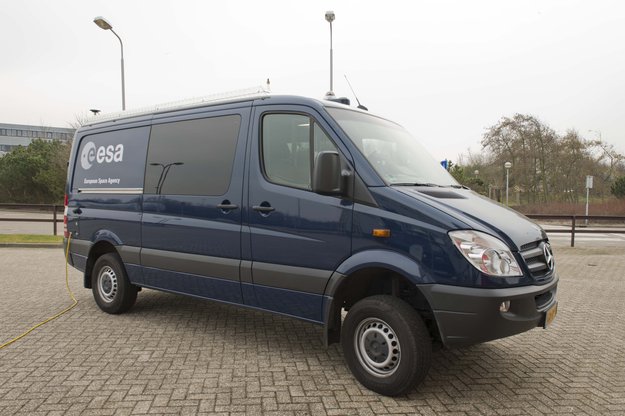
    • a telecommunications and navigation testbed vehicle for field tests, carrying its own extremely accurate receivers to assess the performance of the consumer devices under test.

    “Thanks to earlier collaboration with ESA and the EU, the millions of multi-constellation satnav chips we sell annually have been equipped for Galileo signals since 2009,” stated Philip Mattos of ST Microelectronics, whose Teseo II receiver chips are used in satnavs and embedded in cars (see detailed technical article on page 36). “It will take only a software update to enable them to start using Galileo. This cooperation allows us to optimize our software based on access to actual signals and background technical information.”

    Regulated Service. The GSA invited European industries and member states’ Public Regulated Service (PRS) authorities to share views and ideas on technologies at the user segment level for the adoption of the PRS. The PRS uses encrypted signals designed to resist jamming, involuntary interference, and spoofing. GSA’s objective is to ensure that PRS service is affordable and secure for all interested users while also ensuring that European industry maintains its competitive edge in the global satellite navigation marketplace.

    GSA consultations will focus on:

    • steps transforming technologies into products competitive enough in terms of cost, power, dimension;
    • euro-manufacturing capability and capacity, especially nanotechnology;
    • how to build the manufacturing lines capable of serving PRS user segment needs;
    • main domains, elements, and interfaces that will benefit from standardization, allowing for a stronger market adoption of PRS.


  • Europe’s Spring Season for GNSS

    Europe’s Spring Season for GNSS

    EUResidencePermit-WThe hounds of spring are on winter’s traces. As Galileo emerges from its long, cold slumber, the energy of a new constellation radiates through the skies to encourage blossoms across Europe. ESA’s recent declaration of in-orbit validation means the downstream satnav market can now truly get going.

    If a lot of demand has yet to be demonstrated, certainly a lot of pioneer applications have been developed, and the pent-up current is about to flow. Witness a plethora of GNSS and geospatial conferences in March, April, May, and June, from Munich to Rotterdam to Geneva to London, and on to Prague. The presentations at these gatherings no longer lean so heavily on academic and technical projections and predictions, but embody real-world applications and actual products. Long awaited, Europe’s GNSS spring has finally sprung.

    Brad Parkinson, the chief and original architect of GPS, fittingly kicked off the season this month in London, where he told a UK conference that GNSS needs to be made more robust to ensure worldwide availability of services to users. His concerns over signal availability relate to threats such as the loss of authorized frequency spectrum (implicitly creating licensed jammers), space weather due to hyperactive ionospheric conditions, and deliberate or inadvertent jamming of GNSS signals. Parkinson made his remarks as the keynote speech at GNSS Vulnerabilities and Resilient PNT 2014, hosted by the Royal Institute of Navigation.

    Coming up soon, Dr. Parkinson will also deliver the keynote address for the European Navigation Conference on April 15 in the Netherlands — but more on that anon.

    Munich Satellite Navigation Summit, Munich, March 25–27

    The scene now shifts southward to Bavaria, where the long-running Munich Summit gathers government, financial, industrial, and scientific dignitaries for high-level perspective on all GNSS, certainly with a Galileo emphasis but prominently featuring GPS, GLONASS, BeiDou, QZSS, IRNSS, and SBAS.

    The technical program of the Munich Satellite Navigation Summit includes a multitude of panel discussions involving invited speakers on further topics such as the legal issues of privacy devices and GNSS re-transmitters, achieving precise point positioning (PPP) on a global scale, the role of other autonomous sensors in future navigation, monitoring of climate and natural disasters, and integrated applications of GNSS and Earth observation.

    The summit will also officially open the European Satellite Navigation and provide a parallel track on Copernicus, the European Commission´s Earth observation program.

    GPS World’s contributing editor Tony Murfin will file a complete report on the Munich Summit in the inaugural issue of EAGER, the European GNSS and Earth Observation Report. Subscriptions are free to this new quarterly email newsletter at the preceding link.

    EAGER will feature news of European industry, agency, and scientific developments in satellite-based positioning, navigation, and timing; geospatial technology; Earth observation from space; digital mapping; and location-based services. EAGER focuses on the EU programs Galileo, EGNOS, and Copernicus along with their applications, but also encompasses European involvement in the other GNSSs and their geospatial applications of all kinds. Knowledgeable reporting from European sources, and interviews with and articles by European GNSS/geospatial community leaders. The latest technologies, launch schedules, applications, equipment, and industry and policy developments.

    ENC GNSS 2014, Rotterdam, April 14–17

    More than 120 technical papers will be presented at the European Navigation Conference (ENC 2014), under the thematic header Technology, Innovation, Business. As previously mentioned, Bradford Parkinson will deliver one of the two keynotes on “Assured PNT – Assured World Economic Benefits,” joined on the podium by Prof. Erik Theunissen of Delft Technical University, speaking on “So You Think You Are Safe.”

    The program continues with a Galileo session, in which ESA will present the latest results of Galileo IOV and future plans for FOC.

    Preliminary meetings will be held by the European Maritime Radionavigation Forum (EMRF), the Resilient PNT Forum, EUGIN, IAIN, and European Journal of Navigation. On Tuesday, another kick-off (!!) of the European Satellite Navigation Competition (ESNC) 2014 will take place.

    The Netherlands Institute of Navigation’s organizing committee chair Jac Spaans (also a long-time Editorial Advisory Board member of this magazine, and furthermore a knight in the Order of Orange-Nassau) is pleased to invite all satnav enthusiasts to the conference, taking place the week before Easter, allowing you to extend your stay and enjoy the tulip fields, the windmills, and other objects of interest in The Netherlands. Host-city Rotterdam, one of the biggest ports in the world, gives proof the Dutch saying, “In Rotterdam they do not sell shirts with long sleeves, because they roll them up anyway.”

    Another of GPS World’s contributing editors, Don Jewell, will attend and report on the conference, either in his Defense PNT newsletter in May or as a guest columnist in this GNSS Design & Test newsletter of that month. To be sure, his column will also appear prominently in the second (June) issue of EAGER, the European GNSS and Earth Observation Report. Subscriptions are free to this new quarterly email newsletter at the preceding link.

    Geospatial World Forum, Geneva, May 5–9

    Geo-World-ForumNow in its sixth edition, the Geospatial World Forum concentrates on geographic information systems (GIS) in mapping, remote sensing, satellite navigation as applied to the electricity sector and energy distribution; architecture, engineering, and construction; sustainable agricultural industrialization; smart cities, municipal management; disaster preparedness and coping, natural hazard monitoring; big data as a competitive business asset, business intelligence, and market analysis; multi-sensor integration for monitoring; geospatial’s role in healthcare; global peace and prosperity; and last but by no means least, in fact probably the most important in our long term, climate change.

    If I’m lucky, I’ll make it there myself. Did I mention that coverage will surely feature in EAGER, the European GNSS and Earth Observation Report? Subscriptions are free!

    GEO Business 2014, London, May 28–29

    Next up on our busy travel schedule — and nothing says an industry is growing like the launch of another new conference — comes GEO Business, primarily an exhibition but also conference featuring industrial training and demonstrations featuring the technology and services used by those working with spatial data.

    GEO Business boasts that it was born out of consultation with key industry leaders, and as a result the show is organized in collaboration with the Chartered Institution of Civil Engineering Surveyors (ICES), the Royal Institution of Chartered Surveyors (RICS), The Survey Association (TSA), and the Association for Geographic Information (AGI). This is a joint cooperative event involving major players, both organizational and industrial, in the geospatial community.

    Presentations will be given by Leica Geosystems (Mobile GIS), Esri UK, Carlson Software, Fugro (Advanced airborne survey), Trimble, GeoPlace (spatial addressing), Altus Positioning Systems (single- and dual-frequency data collection), Topcon (global-scope monitoring), Spectra Precision, Ordnance Survey (geospatial data management), iXBlue, and others.

    GPS World publisher Steve Copley will attend, and you can bet I will lean on him for reportage in the June issue of EAGER, the European GNSS and Earth Observation Report.

    By this point, I should start charging a subscription fee to anyone who has failed to sign up for EAGER.

    European Space Solutions 2014, Prague, June 11–13

    EuropeanSpaceSolutions
    photo: European Space Solutions

    Finally, the European Space Solutions conference in Prague has yet to be formally announced by the European GNSS Agency, but a pre-registration page is open.

    The 2013 generation of this conference featured sessions on indoor location-based services and solutions, environmental protection, emergency response and disaster management, mobile applications, sustainable energy, road and traffic management, and the future of the Galileo Public Regulated Service, an encrypted navigation service designed to be more resistant to jamming, involuntary interference and spoofing, designated for authorized users.

    Tim Reynolds, GPS World’s newest contributing editor, will likely report from Prague on this, as he will from several of the earlier spring shows. Based in Brussels for the last decade-plus, Tim will provide in-depth and up-close perspective on Galileo, Copernicus, and all things Europe connected with space and satellite navigation. His main public forum will be EAGER, the European GNSS and Earth Observation Report, but he will also furnish regular stories for the Navigate! e-newsletter and this one.

    Turn on and tune in!

    For winter’s rains and ruins are over,

    And all the season of snows and sins;

    The days dividing lover and lover,

    The light that loses, the night that wins;

    And time remember’d is grief forgotten,

    And frosts are slain and flowers begotten,

    And in green underwood and cover

    Blossom by blossom the spring begins.

     Algernon Charles Swinburne, 1837–1909

  • Out in Front: A Glow under the Snow

    Out in Front: A Glow under the Snow

    Prague is now the headquarters of the European GNSS Agency (GSA).
    Prague is now the headquarters of the European GNSS Agency (GSA).

    A holiday card from a colleague in Europe calls to mind GNSS’s headlong course into the future, coupled with that most backward-reflective of human preoccupations, history.

    The European GNSS Agency (GSA), whence originated this card, moved from Brussels to Prague in September 2012, in a nod to the pan-European nature of the European Union (EU) generally and its GNSSs, Galileo and EGNOS, in particular. No EU agency headquarters had been sited in Eastern Europe, and it was deemed that some soon must do. Prague made a strong bid for the GSA.

    A political, cultural, and economic center of central Europe under its current name since the year 908, it has a settlement history dating back to 1306 BC. Good King Wenceslaus, who looked out upon the snow round about, deep and crisp and even, and about whom we sang festively this past season, ruled from Prague around 935, subsequently rose to sainthood, and is the patron saint of Bohemia, the Czech homeland.

    The GSA has a rather variegated mission: it “manages public interests related to European GNSS programmes.” This includes everything from marketing to security — in a sense, everything satnav-related that scientists and engineers do not do. Its list of tasks and responsibilities includes 12 subheads and 61 bulleted points.

    Carlo des Dorides, GSA executive director, noted upon opening the new headquarters in 2012 that Prague derives from the Slavic word praga, for threshold. “I think this is appropriate for the GSA and Galileo, as it represents the beginning of a key step for both.” EC vice-president Antonio Tajani added, “Galileo is important not only for space policy and science, but for the services and jobs that it brings.”

    Thus the many GSA staffers labor to wring full advantage for modern economies from the space-based radio signal generators, amid the cobblestone streets and ancient monuments of one of the best-preserved ancient European cities, a UNESCO Cultural Heritage site.

    While busily plunging into the future, we cannot escape our past.

  • Europe Tests Galileo Public Regulated Service

    European Union member states began their independent testing of the Public Regulated Service (PRS) broadcast by the four Galileo navigation satellites in orbit. Transmitted on two frequency bands with enhanced protection, PRS offers a highly accurate positioning and timing service, with access strictly restricted to authorized users, such as government defense, security, and emergency services.

    PRS access was initially considered for Galileo’s Full Operational Capability phase, but it has been enabled in 2013 in response to the strong interest of member states in this service. To allow early access to PRS during the current phase, the European Commission and ESA began the joint project PRS Participants To IOV (PPTI) in July 2012.

    ESA ensured the availability of several tools developed under ESA contracts, including test receivers and other qualification equipment. ESA’s PRS Laboratory, based at the Agency’s ESTEC technical centre in Noordwijk, the Netherlands, provided training, demonstrations and sample data.

    “Belgium, France, Italy, and the UK have now performed independent PRS acquisition and positioning tests. In parallel, ESA, through collaboration with Dutch and Italian authorities, is conducting PRS fixed and mobile validation in several locations in the Netherlands and Italy,” said Miguel Manteiga Bautista, head of ESA’s Galileo Security Office.

    The PRS tests have demonstrated a current autonomous positioning accuracy of less than 10 meters when in the correct geometrical configuration. This is an impressive result considering the small number of Galileo satellites in orbit and the limited ground infrastructure so far deployed.

    Italy has developed its own PRS receiver, and tests have confirmed the feasibility of independent PRS receiver development and verification based on specifications provided by ESA.

    “The PPTI project is still ongoing to test more advanced functionalities this coming autumn and to run the first aeronautical PRS tests in collaboration with the Dutch authorities. Other member states have also expressed their willingness to join the IOV PRS experimentation campaigns soon,“ concluded Miguel Manteiga.

    The project is a first step to ensure use of the PRS as soon as it becomes operational. It will be complemented by PRS pilot projects, focused on PRS applications, which are currently under definition in a common effort between European agencies.

    The United States has submitted a request to be able to use Galileo’s PRS. Other non-EU countries have also expressed a desire to be associated with the program.

  • Galileo’s Secure Service Tested by Member States

    EU Member States have begun their independent testing of the most accurate and secure signal broadcast by the four Galileo navigation satellites in orbit.

    Transmitted on two frequency bands with enhanced protection, the Public Regulated Service (PRS) offers a highly accurate positioning and timing service, with access strictly restricted to authorized users.

    “Galileo is in its In-Orbit Validation phase, planned to include experimental demonstrations of PRS capabilities in terms of positioning and access control,” explained Miguel Manteiga Bautista, heading ESA’s Galileo Security Office.

    PRS access was initially considered for Galileo’s Full Operational Capability phase, but it has been enabled in 2013 in response to the strong interest of Member States in this service. To allow early access to PRS during the current phase, the European Commission and ESA began the joint project ‘PRS Participants To IOV’ (PPTI) in July 2012.

    ESA ensured the availability of several tools developed under ESA contracts, including test receivers and other qualification equipment. ESA also provided the critical knowhow and expertise required to conduct these experimental campaigns.

    ESA’s PRS Laboratory, based at the Agency’s ESTEC technical centre in Noordwijk, the Netherlands, was used to provide training, demonstrations and sample data.

    “As a result, Belgium, France, Italy and the UK have now performed independent PRS acquisition and positioning tests. In parallel, ESA, through collaboration with Dutch and Italian authorities, is also conducting PRS fixed and mobile validation in several locations in the Netherlands and Italy,” added Miguel Manteiga.

    The PRS tests have demonstrated a current autonomous positioning accuracy below 10 m when in the correct geometrical configuration. This is an impressive result considering the small number of Galileo satellites in orbit and the limited ground infrastructure so far deployed.

    In the case of Italy, which has developed its own PRS receiver, the tests have already confirmed the feasibility of independent PRS receiver development and verification based on specifications provided by the Eurpoean Space Agency (ESA).

    ESA's new Telecommunications and Navigation Testbed Vehicle, a mobile test platform to support test campaigns for navigation and telecommunications services, most notably Europe's Galileo constellation.
    ESA’s new Telecommunications and Navigation Testbed Vehicle, a mobile test platform to support test campaigns for navigation and telecommunications services, most notably Europe’s Galileo constellation.

    “But the PPTI project is still ongoing in order to test more advanced functionalities this coming autumn and to run the first aeronautical PRS tests in collaboration with the Dutch authorities. Other Member States have also expressed their willingness to join the IOV PRS experimentation campaigns soon,“ concluded Miguel Manteiga.

    The project is the first step to ensure the use of the PRS service as soon as it is operational. It will be complemented by the PRS Pilot Projects, focused on PRS applications, which are currently under definition in a common effort between the EU Member States, the European Commission, ESA and the European Global Navigation Satellite System Agency.

    In addition to the qualification of the PRS service, these initiatives will allow the timely availability of competitive PRS receivers in Europe and the setting up of organizations in the Member States required to handle PRS, ESA said.

  • European Secured Navigation Arrives with Galileo PRS-only Positioning

    image001QinetiQ and Septentrio jointly announced today that a milestone in the Galileo European Navigation Satellite System’s development and deployment program has been achieved. On March 12, staff at the European Space Agency at ESTEC, Noordwijk, The Netherlands, achieved the first navigation solution using only the encrypted Galileo Public Regulated Service (PRS) signals broadcast by the four Galileo In-Orbit Validation (IOV) satellites launched in 2011 and 2012. Septentrio and QinetiQ, working in close partnership, developed one of the two PRS test user receivers used in this historic first test.

    PRS positioning was achieved using the Galileo PRS Test User Receiver (TUR-P) jointly developed by Septentrio and QinetiQ under an ESA contract. For the reception test, the receiver was installed in the PRS test facility in ESTEC and operated by technical experts from ESA. Positioning accuracy of ~10 meters was achieved, excellent for a first test so early in the system’s deployment. The TUR-P now continues to be used as part of the campaigns running during the Galileo In Orbit Validation Phase.

    This milestone builds on a number of previous major Septentrio/QinetiQ achievements including:

    • First laboratory demonstration of the PRS signal acquisition and tracking in QinetiQ (Malvern, UK, 2006).
    • Successful RF compatibility test between a Galileo payload and the TUR-P (Portsmouth, UK, 2010).
    • Successful Galileo end-to-end system test including the Galileo Ground Mission Segment (GMS) and its key management facilities, satellite and TUR- P (Rome, Italy, 2011).
    • First successful reception and processing of the PRS signal from space (Fucino, Italy, 2012).

    As key, long-term contributors to the Galileo program, Septentrio and QinetiQ have worked closely with ESA, the European GNSS Agency (GSA) and European industrial partners since 2003.

    “Following last year’s first successful reception and processing of PRS signals from Galileo satellites, I am very pleased to see the program moving forward successfully,” said Leo Quinn, CEO of QinetiQ. “Achieving a first PRS-only Galileo navigation solution is a major achievement. With positioning, navigation and timing services increasingly critical to the safety, security and economic activity of UK and our European neighbours QinetiQ are very proud to be contributing to the development of Europe’s first secured satellite navigation services.

    “This milestone is another important step towards the launch of operational Galileo services and will continue to build confidence in both prospective users and the industrial supply base. It showcases QinetiQ’s capabilities in this field and signals the way towards the production of exciting new solutions for critical navigation and timing applications.”

    “Today, together with our partners, we take another decisive step in the early availability of commercial PRS receivers and Septentrio is extremely proud of this historic milestone for the Galileo program,” commented Peter Grognard, Septentrio’s founder and CEO. “This builds on a list of major achievements for Septentrio since the reception of the first Galileo signal from space in 2006. We are delighted to continue the excellent collaboration with ESA and to contribute to this ambitious European project.”

  • Maiden EGNOS Flight Trials Prove Successful in Eastern Europe

    Maiden flight trials have been successfully conducted in Moldova using GMV’s magicSBAS solution. These trials form part of a GMV-led European Commission FP7 collaboration project.

    In 2011 the European GNSS Agency (GSA) awarded GMV the EEGS2 project (EGNOS Extension to Eastern Europe). The main objective of the project is to demonstrate through flight trials the benefits of the European Geostationary Navigation Overlay Service (EGNOS) in areas of Eastern Europe where it is not yet available, such as Poland, Romania, Ukraine, Moldova and Russia, and to prepare the civil aviation authorities and air navigation service providers for future use of the system.

    In the context of this project, after the tests conducted in Spain, the maiden flights have been successfully carried out in Moldova, using the equipment and tools developed by GMV. The Moldova demonstrations have given pilots and service providers a clear idea of the potential benefits of EGNOS and the flying procedures of the near future, GMV said.

    Four flights had previously been conducted in Spain in November, December and February. The satisfactory results of these flights then paved the way for the demonstrations in Moldova.

    The magicLPV system, developed under this project, enables LPV approaches (localizer performance with vertical guidance) to be carried out using the signal generated by the magicSBAS application. This test environment allows any region of the world to analyze the air-navigation benefits to be obtained with deployment of a Space Based Augmentation System (SBAS). This signal is read by Internet and transmitted by radio frequency in the vicinity of the airport, allowing LPV approaches to be made in places where SBAS is either completely unavailable or available only on a very limited basis.

    Eight flights in all were carried out in various Moldovan airports, including Chișinău International Airport. Test results were highly satisfactory, demonstrating the simplicity of equipment configuration and operation, and the performance of the magicSBAS signal, GMV said.

    “These trials are an important milestone for GMV, for the project and, fundamentally, for the use of EGNOS in the countries of Eastern Europe in the near future,” said Miguel Romay, executive director of GNSS–Aerospace.

    GMV will continue with these demonstrations in other countries of Eastern Europe. The next trip in two weeks will be to Romania, where new flights are expected to be just as successful.


  • ENC 2013 Releases Preliminary Program

    The Preliminary Programme for the European Navigation Conference 2013 is now available.

    Early Bird Registration ends Friday, March 15.

    Organizers will also be hosting the European Satellite Navigation Competition 2013 International Kick-Off Meeting on April 25.

    The European Navigation Conference 2013 will be the 17th conference in the GNSS series held under the auspices of the European Group of Institutes of Navigation (EUGIN). The conference will be hosted by the Austrian Institute of Navigation (OVN) and will take place April 23-25 in Vienna, Austria.

    Each year the conference attracts researchers, policy makers, manufacturers, users and service providers from around the world. The conference will focus on the present status as well as on future developments in navigation systems, with special emphasis on Galileo. Thus, the ENC 2013 will be a showcase for state-of-the-art technology and for innovations in the fields of terrestrial and satellite navigation. The implementation of new technologies in navigation will be illustrated in the industry exhibition, running in parallel to the conference.