Tag: Galileo E1

  • Orolia Skydel will support Galileo OSNMA

    Orolia Skydel will support Galileo OSNMA


    Image: Orolia
    Image: Orolia

    Orolia, a Safran Electronics and Defense company, announced its Skydel GNSS simulation engine will support Galileo Open Service Navigation Message Authentication (OSNMA) simulation in the form of two-phased and separate solutions. These solutions will be available to users who have purchased simulation access to the Galileo constellation, which will be available in the next few months.

    OSNMA is an emerging authentication service that allows GNSS receivers to verify the authenticity of received data to protect against potential jamming or spoofing attacks that can result in service disruptions, denial incidents and more.

    The first solution is well-suited for most receiver integrators that want to test the OSNMA capability of a GNSS receiver with the official test vectors from the European Union Agency for the Space Programme (EUSPA). This solution will support the available official test vectors sample data, which supports the verification of OSNMA functionality implementation.

    The second option will provide full flexibility in the configuration of the scenario as well as the OSNMA authentication parameters. It will be suitable for advanced users that test receivers in a wide range of edge and corner cases.

    Available later in 2023, this phase will include the following elements in Skydel: authentication of the Galileo E1 OS navigation message, a new Skydel engine supporting OSNMA SIS ICD 1.0, support for the timed efficient stream loss-tolerant authentication protocol, and useful crypto material for running user-programmable simulation test scenarios.

    This feature will be ready for future software updates in accordance with the next phases recommended by EUPSA.

  • Mil-spec GPS/GNSS antennas released by Pasternack

    Mil-spec GPS/GNSS antennas released by Pasternack

    Image: Pasternack
    Image: Pasternack

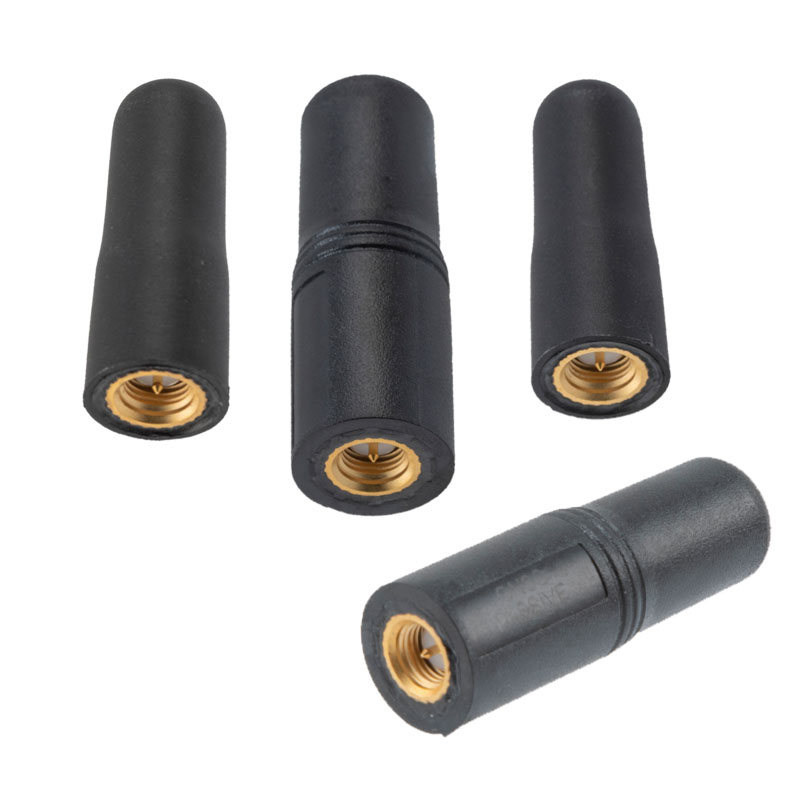
    Pasternack has released a series of GNSS antennas that meet military specifications for use in several small form factor and mobile applications.

    The mil-spec GNSS antennas are engineered for environmental performance according to the MIL-STD-810G standard and include multi-standard GPS L1, Galileo E1 and GLONASS options.

    The MIL-STD-810G GNSS antennas are IP67 rated. They are available in passive and active versions and provide coverage from 1,597 MHz to 1,607 MHz. The GNSS antennas feature linear polarization for cross-polarized isolation, nominal gain options of -3 dBic and 10 dBic, and SMA mounts.

    Pasternack’s mil-spec GNSS antennas are available now.

  • Taoglas GNSS antenna flies with Parrot drones

    Taoglas GNSS antenna flies with Parrot drones

    Photo: Parrot
    Photo: Parrot

    Every ounce counts on a drone. While a larger ground plane on a GNSS patch antenna improves its performance, the additional size increases weight — an unacceptable tradeoff.

    The antenna’s location on the drone is another factor. It must be distant from motors and other electronic components that generate interference, which undermines positional accuracy. But remote locations are often off-limits because the antenna’s weight in those spots would disrupt the delicate balance drones require.

    Drone-maker Parrot took these factors into consideration when choosing a GNSS antenna for its ANAFI USA drone. Although it weighs just 500 grams, ANAFI USA is designed to operate in winds up to 53 km/h.

    To meet these challenges, Parrot chose the Taoglas DSGP.1575.15.4.A.02, a passive patch antenna that supports GPS L1 and Galileo E1. At 3.3 grams and 4 mm high, with a 15-mm2 footprint, the DSGP.1575 is designed for ultra-compact devices.


    Key customers

    High GNSS accuracy and reliability are critical for Parrot customers such as the French military, which recently ordered 300 ANAFI USA drones for reconnaissance and intelligence missions by its conventional and special forces.
    Manufactured in the United States, ANAFI USA has also been selected by U.S. federal government partner organizations as part of the Blue sUAS project — the only UAV from a non-American drone manufacturer to be commercialized on the GSA Schedule, the buying platform of the U.S. military and civilian government agencies.
    Police departments, federal agencies and firefighters in the United States and other countries also use ANAFI USA. The drone is also used for surveying, inspection and other commercial enterprises.

    Tuned on a 50×50 mm ground plane, the DSGP.1575 operates at 1575.42 MHz with a 2.59 dBi gain. It uses ceramic materials — suitable for UAV applications because drones spend most of their time flying parallel with the horizon, a position in which ceramic antennas collect sufficient GNSS signals to meet performance requirements. 

    The DSGP.1575’s light weight and energy efficiency enable the ANAFI USA to carry bigger payloads and fly longer, up to 32 minutes compared to the consumer model’s 25 minutes.

    “We chose Taoglas because of the quality of their antennas and their ability to tune an existing antenna in the mechanics of the product and to make it on a large scale for mass production,” said Meryam Abou El Anouar, Parrot technical leader for RF and Connectivity. “They are also known for their great experience with the GNSS propagation specificities as multipaths, so that is helpful when you try to achieve good GNSS accuracy.” 

    Taoglas provided Parrot with design and testing support in its design centers, as well as making regular visits to Parrot’s facility in Paris.

    “Our engineering team managed to carry out tests at antenna and system levels,” said Baha Badran, Taoglas Global Antenna Technology director. “This includes passive antenna testing, in-chamber active antenna testing and GPS field testing of the drone. Each of these tests was carried out to ensure optimum GPS system performance was achieved, to give the highest possible positional accuracy for such an application.” 

    The support also helped Parrot minimize the cost and lead time for bringing the ANAFI USA to market.

  • FCC to vote on allowing US devices to use Galileo

    FCC to vote on allowing US devices to use Galileo

    The U.S. Federal Communications Commission will vote in November on whether to allow U.S. devices to access Galileo.

    The Galileo Order is tentatively on the agenda for the Open Commission Meeting scheduled for Thursday, Nov. 15:

    Galileo Order – The Commission will consider an Order that addresses waivers of certain satellite licensing requirements for receive-only earth stations operating with the Galileo Radionavigation-Satellite Service. (IB Docket No. 17-16)

    “Enabling the Galileo system to work in concert with the U.S. GPS constellation should make GPS more precise, reliable and resilient for American consumers and businesses alike ,” said FCC Chairman Ajit Pai.

    In 2015, the National Telecommunications and Information Administration (NTIA) submitted to the FCC a request from the European Commission to waive certain of the commission’s earth station licensing rules to permit non-federal U.S. receive-only earth stations to operate with Galileo.

    The NTIA recommended grant of the requested waivers, and the International Bureau issued a Public Notice seeking comment on the potential public interest benefits and technical issues associated with the waiver request.

    The FCC is proposing to waive its licensing requirements for non-federal operations with Galileo signals known as E1 and E5, subject to certain technical constraints, officials said.

    The FCC includes conditions to ensure users of satellite-based positioning, navigation and timing services in the United States will benefit from Galileo signals. The systems are interoperable under a 2004 agreement.

    Below is a summary of the order; the full text can be downloaded here.

    • Grant in part the request of the European Commission for waivers of certain of the Commission’s earth station licensing rules to permit non-federal U.S. receive-only earth stations to operate with specific signals of the Galileo GNSS without obtaining a license or grant of market access.
    • Find that the Galileo GNSS is uniquely situated as a foreign GNSS system with respect to the U.S. GPS, since the two systems are interoperable and radiofrequency compatible pursuant to the 2004 European Union/United States Galileo-GPS Agreement.
    • Find that there are significant public interest benefits associated with operations of non-federal U.S. receive-only earth stations with the Galileo GNSS, including increased availability, reliability, and resiliency of position, navigation, and timing services in the United States.
    • Grant the request for operations with the Galileo E1 signal, which is transmitted over the 1559-1591 MHz frequency band.
    • Grant the request, and a waiver of the non-federal portion of the U.S. Table of Frequency Allocations, for operations with the Galileo E5 signal, which is transmitted over the 1164-1219 MHz frequency band.
    • Deny the request for operations with the Galileo E6 signal, which is transmitted over the 1260-1300 MHz frequency band, since there is no federal or non-federal allocation for RNSS in the U.S. Table of Frequency Allocations in that band and grant of waiver could constrain our future spectrum management for non-federal operations in the U.S. in spectrum above 1300 MHz, where potential changes in the non-federal allocation are under consideration.
  • Research Online: A way to authenticate Galileo Open Service

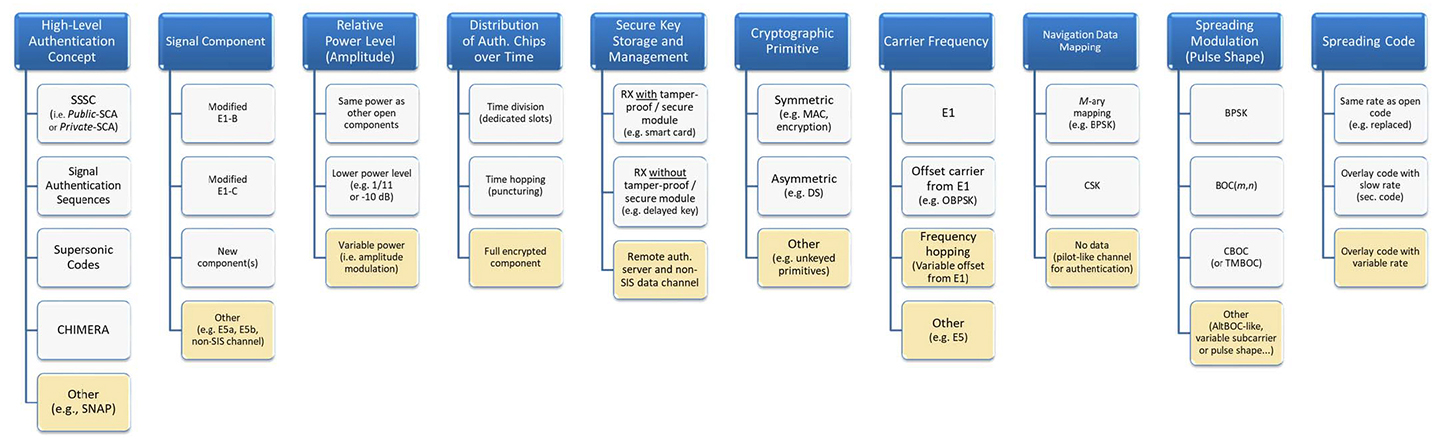
    Overview of the main signal design aspects relevant for authentication at the spreading code level. (Image: Authors)
    Overview of the main signal design aspects relevant for authentication at the spreading code level. (Image: Authors)

    SNAP: An Authentication Concept for the Galileo Open Service

    By Beatrice Motella and Davide Margaria, Istituto Superiore Mario Boella
    and Matteo Paonni/European Commission
    Presented at ION/IEEE/PLANS 2018

    The design of a solution for the authentication of both navigation data bits and spreading code chips — Spreading Code and Navigation data-based Authentication Proposal (SNAP) — and suitable for the evolution of the Galileo E1 Open Service (OS) signal is presented in this paper. Though the technique is innovative and able to achieve predefined authentication performance, it exploits the structure of the legacy Galileo signal and the characteristics of the OS Navigation Message Authentication (NMA) that will be transmitted starting in 2018. A detailed overview of the open choices for the design of signal components dedicated to authentication is provided, together with an analysis of signal parameters definition. A possible implementation option of the SNAP solution is also presented.

    After investigating the performance of the solution under different families of spoofing attacks, a trade-off analysis addressed to the definition of the solution parameters is presented, followed by a possible implementation of the SNAP concept, referred to as working point.

    Available online via www.ion.org/publications/browse.cfm.

  • Tallysman introduces new high-gain GNSS antennas

    Tallysman introduces new high-gain GNSS antennas

    Tallysman, a manufacturer of high-performance GNSS antennas and related products, has released two high-gain (50dB) GNSS antennas: the TW3152 and TW3752.

    High-gain GNSS antennas are useful in situations where long cable runs are required, such as in timing systems and GNSS re-radiator systems, the company said.

    The TW3152 provides reception of GPS L1. The TW3752 provides reception of GPS L1, GLONASS G1, BeiDou B1 and Galileo E1 signals. Both antennas employ Tallysman’s Accutenna technology, which provides a high degree of multipath signal rejection through the full bandwidth of the antenna.

    According to Tallysman, the antennas are triple filtered to prevent the saturation of the front-end LNA by strong near frequency and harmonic signals, which are a growing concern throughout the world.

    These antennas are available with a choice of radome shape (flat or conical), color of radome (white or grey), as well as a wide variety of connectors.

  • China Launches First of Next-Gen BeiDou Satellites

    China Launches First of Next-Gen BeiDou Satellites

    Beidou-3M1-3 Photo: BeiDou
    Photo: BeiDou

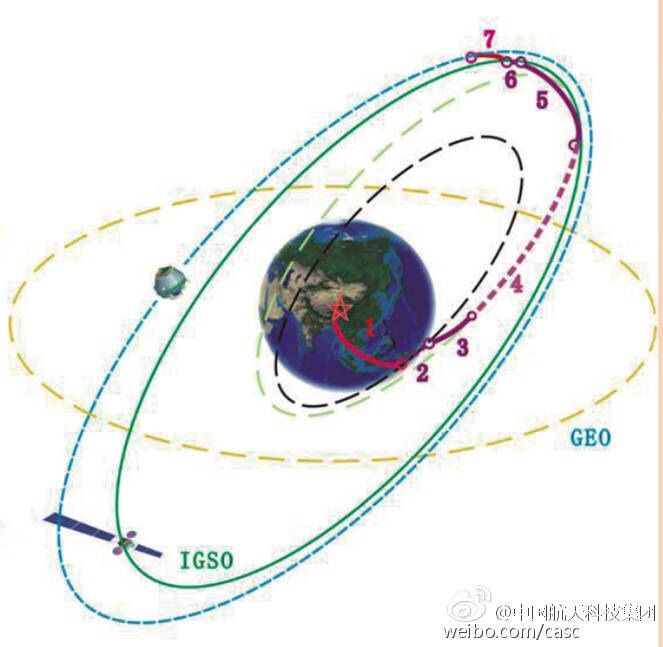
    UPDATE (3/31/15): The BeiDou satellite is being targeted for an IGSO orbit, not a MEO orbit as previously speculated. The two images below make this clear.

    BeiDou-orbit-2
    Photo: BeiDou
    BeiDou-Orbit-1
    Photo: BeiDou

    Below is a CCTV (China Central Television) news story covering the launch.


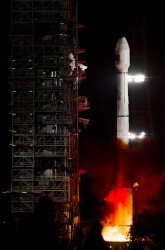
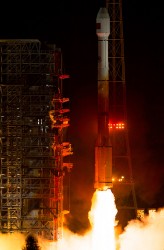
    UPDATE (3/30/15): China’s launch of BeiDou-3 M1 is now being reported in that country’s media. The launch occurred at 21:52 on March 30. BeiDou-3 M1 is the first of 17 next-generation Beidou navigation satellites. It will have a new navigation signal system with inter-satellite links and other tests to verify the satellite navigation system.


    NASA Spaceflight is reporting that China is believed to have launched the first of a new generation of navigation satellites for its BeiDou constellation. However, the launch has received a blackout in China, with lift-off only confirmed by local observers.

    The possible launch of BeiDou-3 M1 took place at 13:52 UTC today from the Xichang Satellite Launch Center on a Chinese Long March 3C rocket, with the debut use of the new Expedition-1 (Yuanzheng-1) upper stage.

    If confirmed, this is the fifth successful launch of a navigation satellite in less than a week, following GPS IIF-9 on WednesdayGalileo 7 and 8 on Friday and India’s IRNSS-1D on Saturday.

    Today’s launch involved a new series of satellites that is expected to mark an advancement in the completion of its Beidou Phase III program several years ahead of schedule, by as soon as 2017 rather than 2020, NASA Spaceflight reports.

    The Beidou Phase III system includes the migration of its civil Beidou 1 or B1 signal from 1561.098 MHz to a frequency centered at 1575.42 MHz – the same as the GPS L1 and Galileo E1 civil signals — and its transformation from a quadrature phase shift keying (QPSK) modulation to a multiplexed binary offset carrier (MBOC) modulation similar to the future GPS L1C and Galileo’s E1. The current (Phase II) B1 open service signal uses QPSK modulation with 4.092 megahertz bandwidth centered at 1561.098 MHz.

  • E1 and E5 Galileo IOV Signals: Report from U. Calgary

    This article gives a brief overview of the acquisition and tracking of Galileo IOV signals received from the GSAT0101 satellite on the morning of December 15. Researchers in the PLAN Group successfully recorded E1 and E5 data using a single dual-channel front-end and subsequently acquired and tracked E1 B/C, E5a and E5b signals using the PLAN Group GSNRx software GNSS receiver.  

    A little over seven weeks after launch, one of the two Galileo IOV satellites began to transmit on the E1 band. To the delight of eagerly waiting researchers worldwide, Galileo-PFM (GSAT0101) broke radio silence on December 10, 2011. Within hours the community was alive with reports of successful acquisition and tracking of the E1 B/C signals. Four days later the E5 signal was also activated. In the early hours of the morning of the 15th of December researchers gathered in the PLAN Group at the University of Calgary and observed the sky filled with broadcasting satellites from three GNSS. Using a dual channel front-end designed in-house, a Novatel GPS-703-GGG antenna and a laptop computer, IF data was collected to examine these new signals. This data was processed by GSNRx, a reconfigurable a multi-system, multi-frequency software receiver developed by the PLAN Group [1]. The equipment used to acquire and process the data is shown in Figure 1.

    Figure 1 The equipment used to acquire and process the Galileo-PFM signals included an in-house dual frequency front-end, a 10 MHz OCXO, a Novatel GPS-703-GGG antenna and a standard laptop computer running the GSNRx software receiver.

    At approximately 03:20 MST (UTC – 7:00) more than 20 GNSS satellites were visible from a rooftop mounted antenna. Having reconfigured the front-end to accommodate the E5 band, IF data was collected which included Galileo E1 B/C and E5 A/B, GIOVE-B E1 B/C and E5a, GPS L1 C/A and L5, and GLONASS L1 C/A. Following some last minute modifications to GSNRx to include the Galileo E5b signals, the samples were processed, simultaneously tracking GPS and Galileo on both the L1/E1 and L5/E5 frequencies and GLONASS on L1. A screenshot of the receiver in operation is shown in Figure 2.

    Figure 2 Screenshot of GSNRx while processing the Galileo PFM signals

    The versatility of GSNRx had been exploited in the past when new signals were brought online. In particular, the modular design adapted for PLAN’s software receiver had been utilized to quickly add new signals and new signal processing techniques. Once again this flexibility was drawn upon to facilitate the last-minute addition of the E5b I/Q signals (that very night) and to enable the stand-alone tracking of each signal component. By the same means, of course, this structure could be easily manipulated to enable composite tracking of data/pilot signal pairs or even facilitate vector tracking of all signals in view.

    A subset of the raw correlator values for the E1 B, E1 C, E5a I and E5a Q signals are shown in Figure 3, (note that the E1 C values have been offset by -2.0×10⁵ for clarity). A data-rate of 250 symbol/s is clearly visible on the E1 B and E5b signals while a 50 symbol/s stream can be observed on the E5a I signal. The 25 chip secondary code is also evident on E1 C at a rate of 250 chip/s.


    Figure 3 Raw Correlator Values for the E1 B/C, E5aI/Q and E5bI/Q signals. The bit periods can be clearly seen on E1B, E5aI and E5bI. The secondary code can be observed on E1C while the pilot signal can be seen on singals E5aQ and E5bQ.

    All six components of the Galileo-PFM signals shown above (transmitted on PRN 11) were tracked independently and their signal modulations were found to agree with the Galileo Open Service ICD [2]. A trace of the measured carrier-to-noise floor ratios for the Galileo signals is shown in Figure 4. As indicated by the ICD, the E5b signals were observed at 2 dB lower power than the E1 B and C signals. The E5a signals, however, were expected to be received at the same power as E5b and yet were observed at approximately 4 dB lower power. This is believed to be a combination of the antenna and IF filtering within the front-end as the E5a center frequency is located relatively near the pass-band edge of both.  This front-end was initially designed for 40 MHz bandwidth, but used in this experiment at 50 MHz, as will be discussed later.

    Figure 4 Measured C/N0 for Galileo-PFM Signals

    The software receiver was once again reconfigured, this time to produce signal correlator values spaced along a delay of approximately 700 m and 70 m for the E1 A/B and E5 A/B signals, respectively, such that the cross-correlation of the received and local-replica PRN sequences could be examined. The signals were tracked for 10 seconds and the 1 ms correlator values averaged, to produce estimates of the code cross-correlation function. The characteristic ripple of the CBOC modulation on E1 B/C can be seen in Figure 5 (left), particularly on the right-most ascending feature of the envelope. Likewise, the alt-BOC cross-correlation of E5a Q in Figure 5 (right) is as expected. It is noted that the E5a I signal has suffered some distortion due to the filtering effects mentioned above.

    Figure 5 Measured cross-correlation functions for the Galileo PFM E1 B and C signals (left) and E5a I and E5b I signals (right).

    The PLAN group’s front-end is a highly flexible GNSS signal capture tool ideally suited for use with the GSNRx software receiver. The front-end, photographed in Figure 6, allows software reconfiguration of oscillator source (onboard, or external), antenna bias voltage, sampling rate, and IF bandwidth in addition to other low level control options making it highly adaptable.   Furthermore, the center frequency, and filter bandwidth of each of the two hardware channels is independently configurable between 1150 – 2000 MHz, and between 4—40 MHz bandwidth (single sided) respectively.

    Figure 6: PLAN group two-channel reconfigurable front-end with main system blocks labeled.  The external clock and GNSS antenna SMA connectors are along the right edge, while the data interface is via mini-USB on the opposite side of the front-end.

    Typically the front-end is configured to collect dual bands of 40 MHz two-sided bandwidth in order to cover the L1 and L2 transmission bands of both GPS and GLONASS as is shown in the right and central blocks within Figure 7.  To allow the capture of E5a/E5b, the front-end configuration software was used to move the center frequency of channel B from 1237 MHz to 1192 MHz, the bandwidth of channel B from 33 MHz to 50 MHz, and to increase the sampling rate of both channels from 40 to 50 Ms/s.

    Figure 7: Front-end channel A and channel B typically configured to capture GPS and GLONASS L1+L2, but reconfigured here to allow capture of Galileo IOV E5a+E5b signal in lieu of L2 band.

    While each of the E5a and E5b signals have main lobe widths of 20.46 MHz (two sided), the composite E5 signal covers 50 MHz of spectrum, overlaying both the current GPS L5 signal at 1176, and the future GLONASS L3 signal near 1207 MHz.  In order to demonstrate the capabilities of the GSNRx software receiver as an L5/E5 + L1/E1 system, it was desirable to capture the new IOV signals in their entirety.

    The Galileo PFM satellite was observed from the Calgary Laboratory on the E1 link since the 12th of December at approximately 08:00 hrs and on the E5 link since the 14th of December at approximately 18:00 hrs. The last successful acquisition of the satellite on either E1 or E5 was at 03:20 hrs on the 15th of December and indicated a Doppler of approximately +2.3 kHz at E1. This figure is compatible with a reported elevation of approximately 40 degrees and rising, as reported by a number of software packages operating on a TLE [3]. Researchers recorded IF data once again at 03:55 on the 15th of December but failed to acquire any of the Galileo-PFM signals, suggesting the satellite may temporarily have ceased transmission.

    References
    Petovello, M. G., and C. O’Driscoll, G. Lachapelle, D. Borio and H. Murtaza (2008), “Architecture and Benefits of an Advanced GNSS Software Receiver,” Journal of Global Positioning Systems, vol. 7, no. 2, pp. 156-168.
    Galileo Project Office. Galileo OS SIS ICD. http://ec.europa.eu/…/galileo/files/galileo-os-sis-icd-issue1-revision1_en [Accessed: 15 December 2011].

    NORAD Two-Line Element Sets.  http://celestrak.com/NORAD/elements/, [Accessed: 15 December 2011].