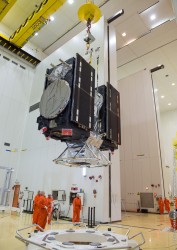
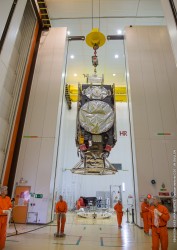
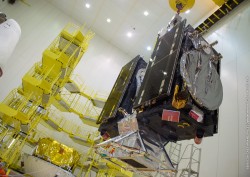
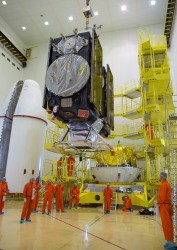
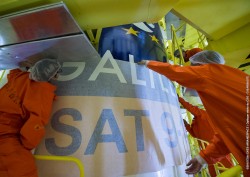
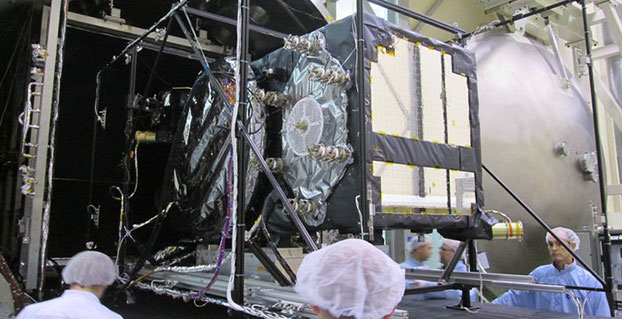
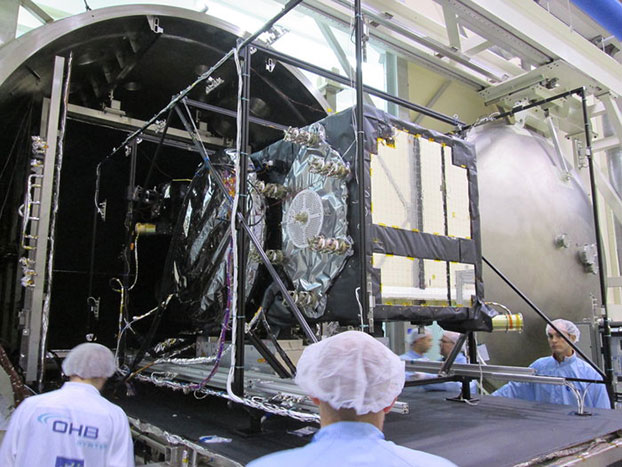
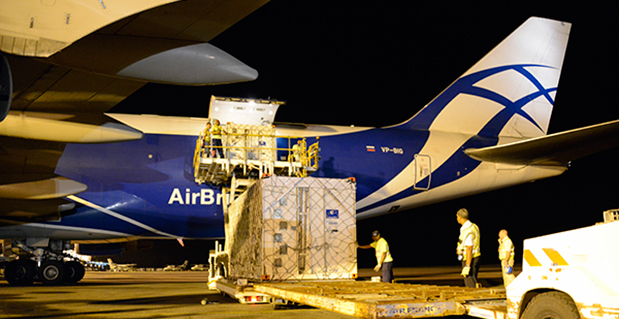
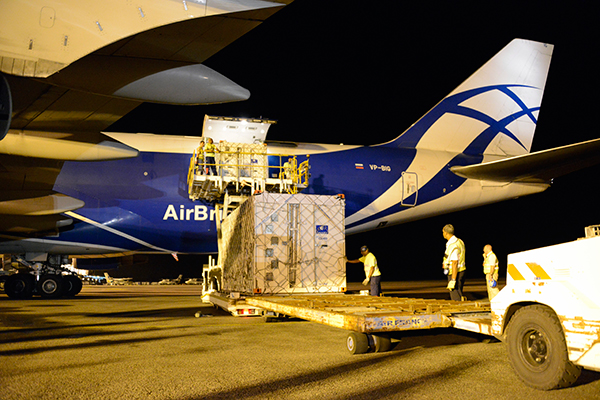
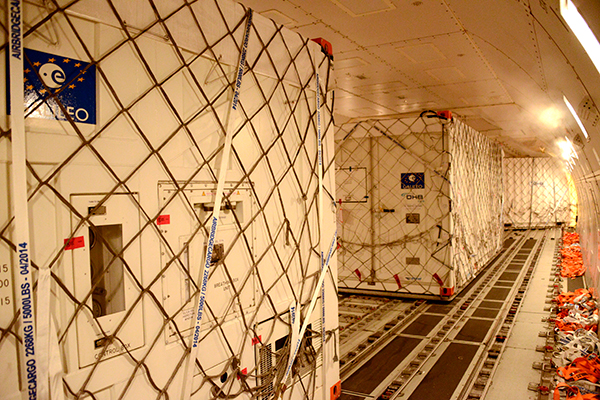
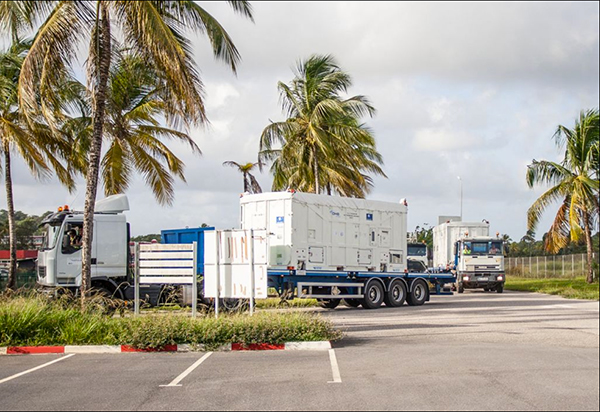
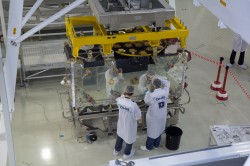
One of four Galileo satellites being unloaded from its 747 after arriving at Cayenne–Félix Eboué Airport in French Guiana on Sept. 6. The satellites were then transported to Europe’s Spaceport.
News from the European Space Agency
A transatlantic flight delivered four Galileo satellites to French Guiana on Tuesday, in preparation for a shared launch this November by Ariane 5 — the first for Europe’s satnav constellation.
The satellites’ odyssey began the previous day, when they left ESA’s technical center in Noordwijk, the Netherlands, where every Galileo satellite is tested.
Each satellite was placed into protective containers before leaving the cleanroom environment of the test facility. These containers incorporate sophisticated environmental control, satellite monitoring systems and shock absorbers.
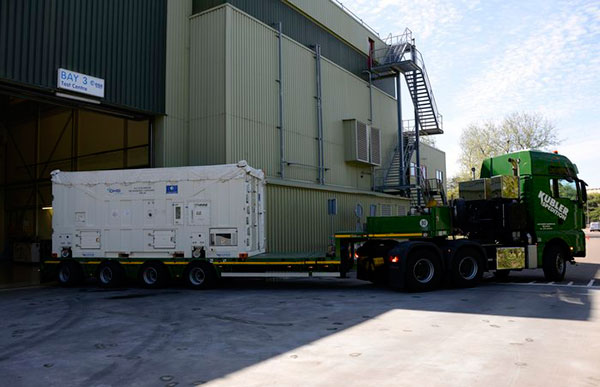
Four Galileo satellites leaving ESA’s technical centre in the Netherlands on Sept. 5, destined for Europe’s Spaceport in French Guiana for a scheduled November launch. (Photo: ESA)
They were then driven by separate lorries to Luxembourg Findel Airport. On Tuesday morning they were flown by 747 aircraft to Cayenne–Félix Eboué Airport in French Guiana, touching down around 10:30 local time.
They were taken to the S1A payload preparation building of the Guiana Space Centre, to be unboxed the following day.
The building will remain their home as their launch campaign begins. The first activity is a ‘fit check’ with the dispenser that will release them into orbit from the rocket’s upper stage.
The modified Ariane 5 that will carry the four Galileos into orbit arrived in French Guiana a fortnight ago.
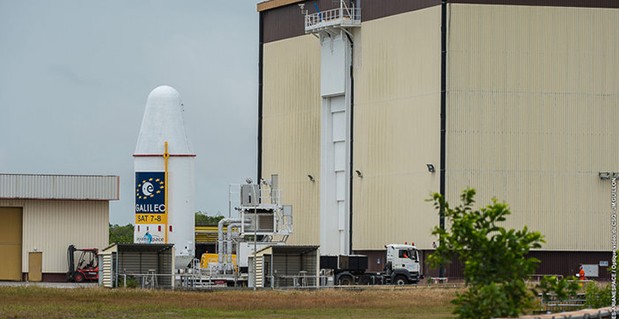
Elements of Galileo’s specially customised Ariane 5 were unloaded from the MN Colibriroll-on/roll-off ship at French Guiana’s Pariacabo Port on Aug. 22. (Photo: ESA)
In development since 2012, this new variant has evolved from the Ariane 5 used to place ESA’s 20 tonne supply ferry for the International Space Station into low orbit.
This new version will carry a lighter payload — four fully fuelled 738 kg Galileo satellites plus their dispenser — but must take it up to the much higher altitude of 23,222 km.
November’s launch is a major step up for Galileo. The 14 Galileo satellites already in orbit have been launched two at a time, by Soyuz from French Guiana.
Four Galileo satellites left ESA’s technical centre in the Netherlands on Sept. 6, destined for Europe’s Spaceport in French Guiana, scheduled for a November launch. (Photo: ESA)
Having 18 satellites in orbit should enable initial Galileo operational services to begin, a decision that will be taken by the European Commission, the system’s owner.
Two more Galileo launches by Ariane 5 are due in the next two years.
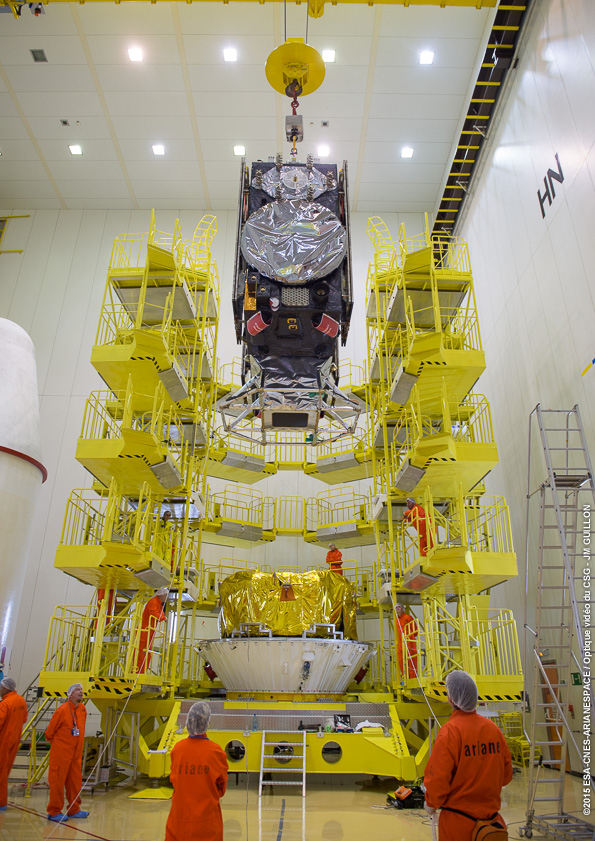
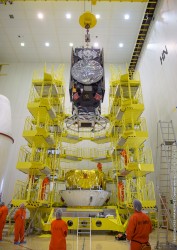
Galileos 9 and 10 are lowered onto the Fregat upper stage.
Galileo 9 and 10 are ready for launch atop a Soyuz rocket at 23:08 local time on Sept. 10 (02:08 GMT and 04:08 CEST on Sept. 11) from Europe’s Spaceport in French Guiana.
After being attached to their carrier last week, the pair of fully fueled satellites was carefully lowered onto the Fregat upper stage on Wednesday, Sept. 2, in the 3SB preparation building of the Guiana Space Centre. The following day was devoted to functional checks and inspections, preparing the Galileos plus Fregat to be encapsulated within the halves of their Soyuz rocket fairing, which took place on Sept. 4. This complete “upper composite” was then transported to the launch site and attached vertically to the first three stages of the Soyuz ST-B, the 12th Soyuz to be operated from the spaceport.
As much a spacecraft as a launcher stage, the re-ignitable Fregat will take the Galileos the bulk of the way to their designated medium-altitude orbit once the first three stages achieve low orbit, 9 minutes and 24 seconds after launch. A pair of Fregat firings will be separated by a 3-hour, 13-minute coast up to their target 23,222 km orbital altitude and 57.394° inclination.
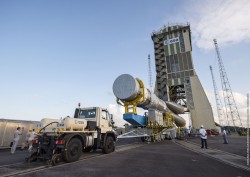
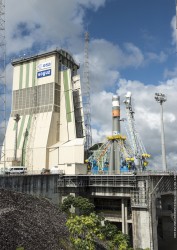
Soyuz in Launch Zone. The basic three-stage vehicle for Arianespace’s Sept. 10 Flight VS12 rolled out from its MiK integration building in the Spaceport’s northwestern sector this morning, and was transferred horizontally to the ELS launch zone by a transporter/erector rail car.
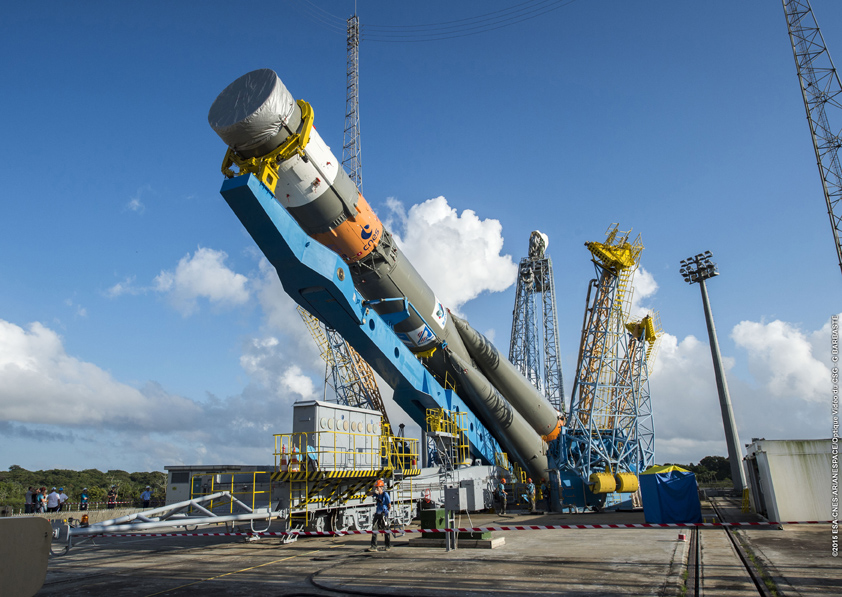
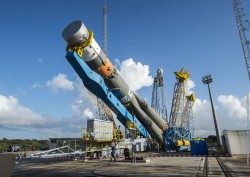
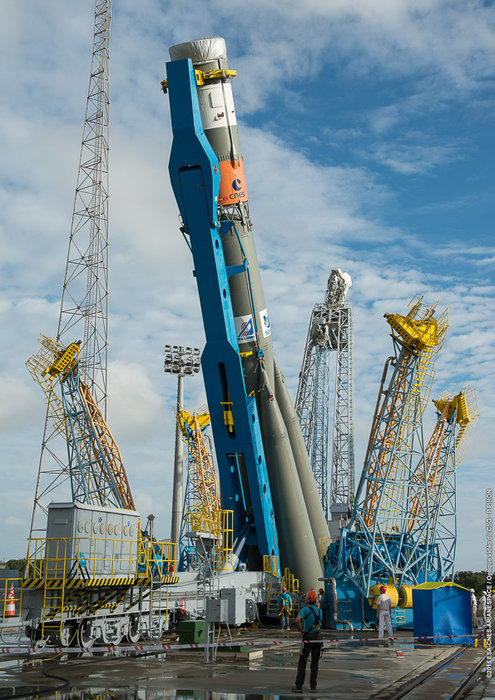
The Soyuz rocket is moved to the launch pad and lifted into a vertical position.
The Soyuz was then erected in a vertical position and suspended over the launch pad, held in place by four large support arms. This was followed by the 53-meter-tall mobile gantry’s move-in to protect the launcher, providing a safe environment for installation of the “upper composite” containing the Galileo satellites.
Galileo 9 and 10 are the fifth and sixth Galileo FOC (full operational capability) spacecraft, and have been designated “Alba” and “Oriana” — continuing the naming process after children who won a painting competition organized by the European Commission in 2011. The satellites were built by OHB System, with Surrey Satellite Technology Ltd. supplying their navigation payloads.
The European Commission is managing and funding Galileo’s FOC phase — during which the network’s complete operational and ground infrastructure is being deployed. The European Space Agency has been delegated as the design and procurement agent on the Commission’s behalf.
Two More this Year. Two further satellites are scheduled for launch by the end of this year. One is under test at ESA’s ESTEC technical centre in Noordwijk, the Netherlands, while the other has already completed its checks and is awaiting transportation to Kourou in the second half of October. In addition, the first satellite of the following batch (Galileo 13) has arrived at ESTEC and is undergoing its thermal-vacuum test. The next will arrive by mid-September.
Follow Arianespace’s launch activity on its website.
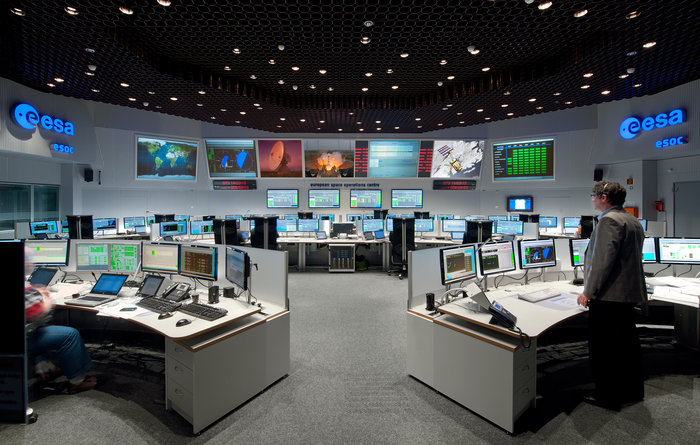
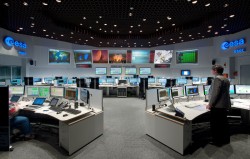
ESOC serves as the Operations Control Centre for ESA missions and hosts ESA’s Main Control Room (shown here), combined Dedicated Control Rooms for specific missions and the ESTRACK Control Centre, which manages ESA’s worldwide ground tracking stations.
Mission Control’s Mission. When the next pair of Galileo satellites is boosted into orbit on Friday, a team of mission control experts in Darmstadt, Germany, will spring into action, working around the clock to bring the duo through their critical first days in space. The fiery ascent to space will last just over nine minutes, after which the Fregat upper stage will fire twice to place the satellites into their release orbit.
Separation from Fregat, about 3 hours and 48 minutes into flight, marks the start of the critical early orbits for the team at ESA’s European Space Operation Centre in Darmstadt. Within the combined flight control team from ESA and France’s CNES space agency, each position is paired with its counterpart from the other agency and mixed “CNESOC” shifts will rotate to conduct operations around the clock. The same team conducts all the Galileo early operations alternately from ESOC and from the CNES control centre in Toulouse, France.
“Upon separation, the team will be very focused, and we’ll be watching for a number of critical events on the satellites to happen automatically at the right time and in the right order,” said ESA’s Liviu Stefanov, lead flight director for this phase. “The satellite must switch on, go into a basic flight configuration, deploy its solar wings for power, orient them towards the Sun and acquire Sun-pointing attitude. “As soon as we get communications, we’ll check its health and start sending commands to configure the satellite after completion of the automatic sequence and prepare it for the next major activity: pointing Galileo towards Earth.”
The intense activity will begin the 10-day early operations phase, during which the joint team will work 24 hours/day to oversee steps to prepare the satellites for handover to the Galileo Control Centre in Oberpfaffenhofen, for routine operations, and ESA’s Redu Centre in Belgium, for detailed payload testing.
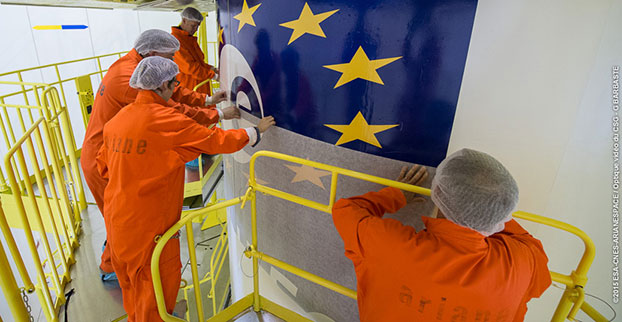
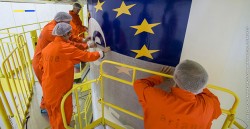
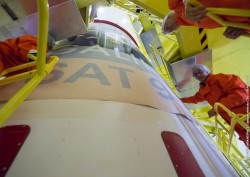
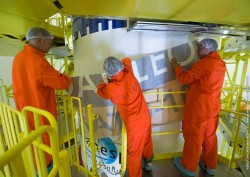
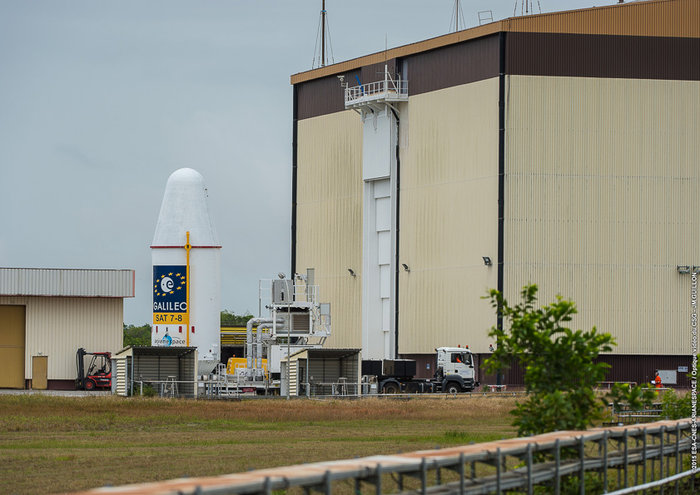
The logos of the two new satellites in the Galileo constellation are placed on the launcher fairing.
Photo Gallery
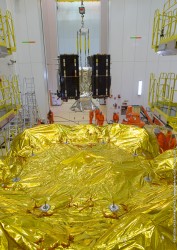
Galileos 9 and 10 are lowered onto the Fregat upper stage. (Credit: CNES/ESA)
Galileos 9 and 10 are lowered onto the Fregat upper stage.(Credit: CNES/ESA)
Galileo 9 and 10 on their dispenser being lifted towards the gold-insulation-covered Fregat upper stage. (Credit: CNES/ESA)
Galileos 9 and 10 are lowered onto the Fregat upper stage.(Credit: CNES/ESA)
Galileos 9 and 10 are lowered onto the Fregat upper stage. (Credit: CNES/ESA)
Galileos 9 and 10 are lowered onto the Fregat upper stage. (Credit: CNES/ESA)
The Soyuz launcher is transferred to the launch pad. (Credit: Arianespace)
The Soyuz rocket is moved to the launch pad and lifted into a vertical position. (Credit: Arianespace)
The Soyuz launcher is transferred to the launch pad. (Credit: Arianespace)
The logos of the two new satellites in the Galileo constellation are placed on the launcher fairing. (Credit: CNES)
The logos of the two new satellites in the Galileo constellation are placed on the launcher fairing. (Credit: CNES)
The logos of the two new satellites in the Galileo constellation are placed on the launcher fairing. (Credit: CNES)
The logos of the two new satellites in the Galileo constellation are placed on the launcher fairing. (Credit: CNES)
ESOC serves as the Operations Control Centre for ESA missions and hosts ESA’sMain Control Room (shown here), combined Dedicated Control Rooms for specificmissions and the ESTRACK Control Centre, which manages ESA’s worldwide groundtracking stations. (Credit: ESA)
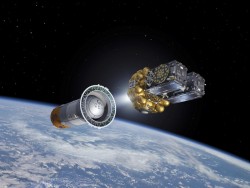
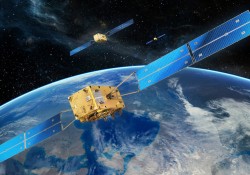
Artist’s view of Galileo satellites attached to their dispenser atop their Fregat upper stage separating from the Soyuz upper stage. The Fregat then flies them the rest of the way up to medium-Earth orbit. (Credit: ESA)
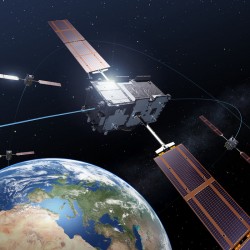
The Galileo GNSS. (artist’s rendering, courtesy ESA)
Weeks of testing simulated the airlessness and temperature extremes of orbital space, taking place at the ESTEC Test Centre in Noordwijk, the Netherlands during May 2015. (Photo: ESA)
News by the European Space Agency
Europe’s latest Galileo was unboxed at ESA’s technical centre in the Netherlands in May, bringing the total number of satellites at the site to four.
ESTEC in Noordwijk is the largest satellite test facility in Europe, with all the equipment needed to simulate every aspect of the launch and space environment under a single roof. It is an essential stop on the way to space for Europe’s Galileo satellites, built by OHB in Bremen, Germany, with navigation payloads from Surrey Satellite Technology Ltd. in Guildford, UK.
The 12th Galileo arrived by lorry from Bremen on May 13, in a custom-built environmentally controlled container. The satellite will begin with a thermal vacuum test in a 4.5-meter-diameter stainless steel chamber, subjected to about five weeks of hard vacuum and the temperature extremes of space.
Galileo-11 recently completed the same trial before moving on to final system testing, including a compatibility run with the ground network.
Meanwhile, the ninth and tenth satellites are in storage at ESTEC, having passed their own checks. They will be flown to Europe’s Spaceport in French Guiana in late July for launch by Soyuz in September, which will bring the total in orbit into double figures.
The 12th Galileo satellite, FOC FM-08, arrived at the ESTEC Test Centre on May 13. It was transported by lorry from Bremen in a protective air-conditioned container.
The first four Galileos, launched in 2011 and 2012, were in-orbit validation satellites, built by prime contractor Airbus Defence & Space. They confirmed that the overall system worked as planned, while also serving as the foundation of the full constellation to follow.
The follow-up Full Operational Capability satellites are now being launched regularly to increase the size of the constellation to the point where early Galileo services can begin next year.
European Partners. Galileo is a collaboration between ESA and the European Commission (EC). The validation phase was co-funded by ESA and the EC, while the full operational phase is funded by the EC. Under a delegation agreement, ESA acts as design and procurement agent on behalf of the commission.
The upper composite, containing the seventh and eighth Galileo satellites attached to their dispenser atop the Fregat upper stage inside the launcher fairing, being moved from the S3B building to the Soyuz launch site of Europe’s Spaceport on March 24. Photo: European Space Agency
By the European Space Agency
The seventh and eighth Galileo satellites attached to their dispenser atop the Fregat upper stage being enclosed within their Soyuz launcher fairing on March 20. Photo: European Space Agency
Thousands of engineers have worked on the seventh and eighth navigation satellites of Europe’s Galileo constellation in recent years, but last Friday marked the very last time the spacecraft were glimpsed by human eyes.
The team from ESA and builders OHB in the S3B building of Europe’s Spaceport in French Guiana looked on as the focus of their work disappeared from view.
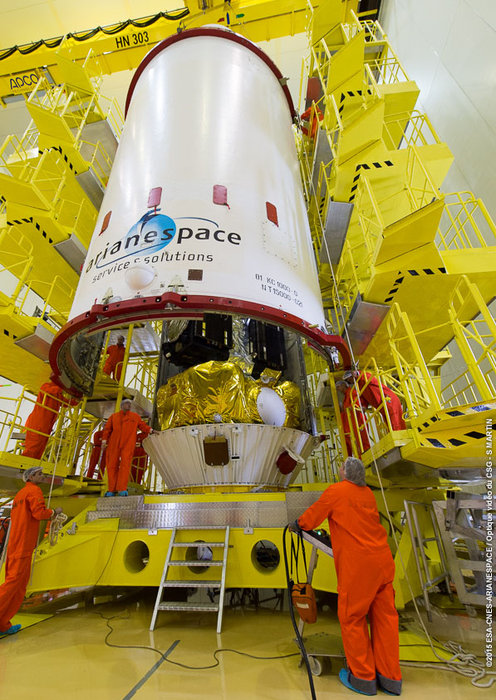
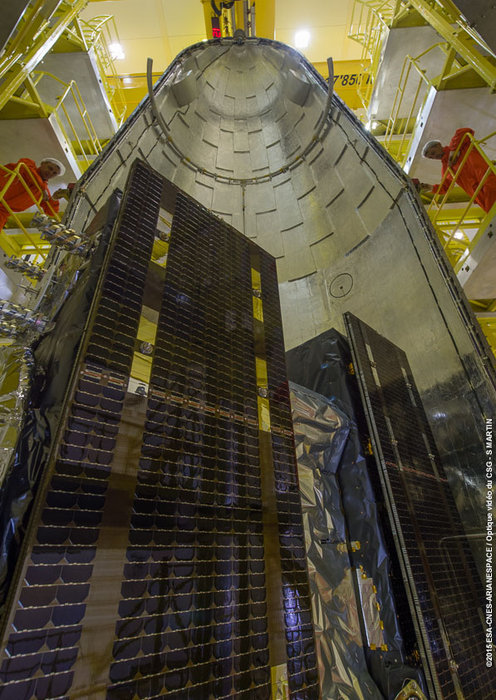
The pair of satellites — already resting atop their Fregat upper stage and attached to their dispenser — was enclosed within the halves of the Soyuz rocket’s protective fairing.
This unit was moved yesterday to the launch site, where it will be lifted atop the first three stages of the Soyuz ST-B to complete the vehicle for Friday’s launch.
Last week saw the two satellites being fuelled in the Spaceport’s S5A preparation hall and then brought together atop the dispenser that will support them during the rigours of ascent.
The dispenser’s final task is to release them in opposite directions once their 22 522 km-altitude orbit is reached. The satellites themselves will then gradually lower themselves to their working 22 322 km orbit.
After fueling, the satellites plus dispenser were moved to the S3B processing building, where their Fregat was already fueled and waiting.
The first three stages of the seventh and eighth Galileo satellites’ Soyuz ST-B rocket being raised to the vertical on the launch pad at Europe’s Spaceport in French Guiana, awaiting the addition of the ‘upper composite’ containing the Galileo satellites plus the Fregat upper stage enclosed within the Soyuz fairing. Photo: European Space Agency
The reignitable Fregat is as much a spacecraft as a rocket stage. Once the Soyuz reaches low orbit, Fregat will take over the task of hauling the satellites higher through a pair of burns.
The two Galileos and their dispenser altogether weigh more than one and a half tonnes, so the attachment operation took place with great care and precision.
Then the fairing halves were slowly slid into place around them and closed. Enclosed in this way, the satellites will be protected from the harsh slipstream and vibration of the first few moments of launch, when the Soyuz is still travelling through the thickest layers of atmosphere.
The fairing is due to be ejected 3 min 29 sec after liftoff. Until liftoff, the satellites remain connected to the outside world via power and data links, allowing ESA’s Galileo team keep a check on their battery charging and the health of their atomic clocks.
The satellites stay switched off during launch, and will be activated automatically on separation from the dispenser.
Launch is due at 21:46:18 GMT (22:46:18 CET, 18:46:18 local time) on 27 March. The satellites are scheduled for release upon reaching their set orbit 3 h 47 min 57 sec after launch.
The seventh and eighth Galileo satellites were enclosed within their protective Soyuz fairing on Friday, 20 March 2015, ahead of their launch a week later. Photo: European Space Agency
The troubled Galileo E20 satellite restarted E1 signal transmission Wednesday evening, August 6.
Galileo E20, also known as GSAT0104, the fourth in-orbit validation (IOV) satellite, has been set “unavailable until further notice” according to the European GNSS Service Centre because of a sudden, unexpected loss of power on May 27.
Based on a selected set of IGS MGEX stations and all CONGO stations, the first signals were tracked at AREG, AUT0, LLAG, and UNB3 at 23:13:00. No E5 signals and no navigation messages are currently transmitted. However, some JAVAD GNSS receivers report from time to time false E5a locks with zero or extremely small C/N0.
Europe’s next two Galileo satellites are unloaded from the Boeing 747 cargo aircraft at Cayenne. The two satellites are scheduled to be launched together by Soyuz from Europe’s Spaceport this summer.
The first two Galileo Full Operational Capability (FOC) satellites arrived safely at a clean room in Kourou, French Guiana, at 20:00 on Wednesday, May 7, in preparation for launch this summer.
Named “Doresa” and “Milena,” the two Galileo FOC satellites arrived at the Félix Éboué international airport in French Guiana at 02:00 local time. They spent the day in an airlock to acclimatize before being taken to their new home, the S1A clean room, where they could be safely unpacked to begin the launch campaign.
Europe’s two latest Galileo navigation satellites touched down at Europe’s Spaceport in French Guiana packed safely within protective and environmentally controlled containers. The satellites were carried across the Atlantic aboard a 747 cargo carrier, according to the European Space Agency.
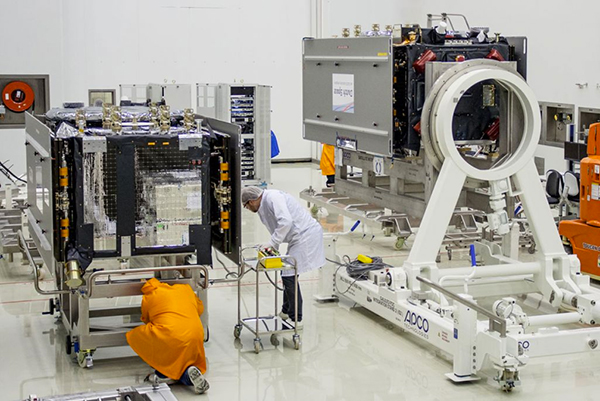
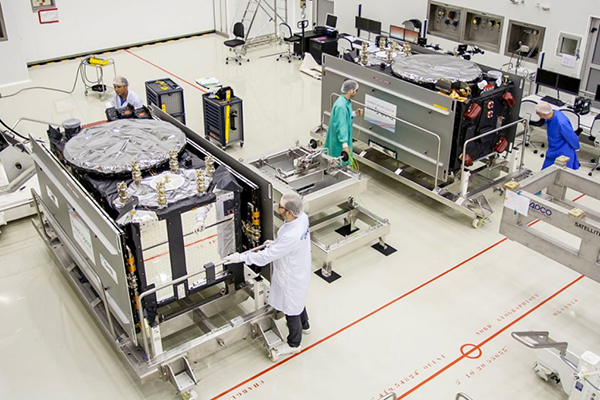
Manufactured by OHB in Bremen, Germany, with navigation payloads contributed by Surrey Satellite Technology Ltd. in Guildford, UK, these satellites – the first of 22 full-capability models — had spent several months at ESA’s Technical Centre, ESTEC, in Noordwijk, the Netherlands, where they underwent exhaustive testing in simulated space conditions.
“Adam”, the third Galileo FOC satellite is currently undergoing testing under space conditions at ESTEC. The fourth Galileo FOC satellite, “Anastacia,” will begin final testing at OHB in Bremen before being shipped to ESTEC. The Galileo satellites are named for the children who won a painting competition organized by the European Commission in 2011.
After successfully passing the Flight Readiness Review (FRR) last week, Doresa and Milena were released for shipment to the French overseas department. “Thanks to the good collaboration between the participating industrial teams and the experts at the European Space Agency ESA as our customer, OHB was able to successfully finish the FRR,” says OHB’s Director of Navigation Wolfgang Paetsch who will be personally overseeing the launch preparations in Kourou.
On May 5, the two satellites left on a pair of lorries for Frankfurt Airport in Germany, from where they flew the following evening. After landing in French Guiana, the satellites were driven to the clean room. The pair will be launched together aboard a Soyuz rocket, joining the four Galileos already in orbit. This initial quartet — the minimum number needed for achieving a position fix — has demonstrated the overall system works as planned, while also serving as the operational nucleus of the coming full constellation.
“Similar arrival scenes should become familiar over the next couple of years,” said Giuliano Gatti, Head of ESA’s Galileo Space Segment Procurement Office. “These first two Full Operational Capability satellites are effectively preparing the way for the rest of the constellation, allowing the final validation of assembly, testing and launch preparation procedures. A steady stream of satellites is foreseen, coming from OHB to ESTEC for acceptance testing and then on to French Guiana. Thanks to the preparatory work done with these pioneer satellites, future Galileos will be processed more rapidly.”
The definition, development and in-orbit validation phases of the Galileo programme were carried out by ESA and co-funded by ESA and the EU. The Full Operational Capability phase is managed and fully funded by the European Commission. The commission and ESA have signed a delegation agreement by which ESA acts as design and procurement agent on behalf of the commission. OHB System is the industrial prime contractor responsible for the total of 22 Galileo FOC satellites.
The two Galileo FOC satellites were enclosed in protective, air-conditioned containers for their flight.“Doresa” and “Milena” head to the clean room.The two satellites in the clean room.Dorese and Milena rest side by side in clean room S1A.
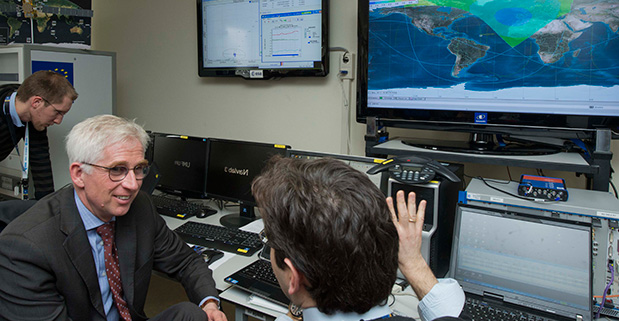
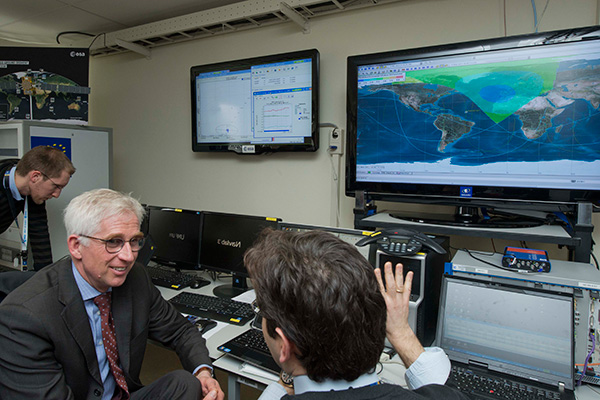
Javier Benedicto, ESA’s Galileo Project Manager, looks on as Europe’s own satellite navigation system performs its historic first position fix of longitude, latitude and altitude. The position fix took place at the Navigation Laboratory at ESA’s technical heart ESTEC, in Noordwijk, the Netherlands on the morning of March 12, 2013, with an accuracy between 10 and 15 meters — expected taking into account the limited infrastructure deployed so far. Horizontal accuracy reached as high as 6 m. The left-side screen shows the position fix while the right side screen shows the position of the four Galileo satellites and their current signal coverage.
Did you get a fix on four Galileo satellites? Then there could be a certificate in it for you! ESA will recognize Galileo pioneers with commemorative certificates to the first 50 entities who document their achievement of a past or present fix. Details of how to apply are provided here.
To mark the first anniversary of Galileo’s historic first satnav positioning measurement, ESA plans to award certificates to groups who picked up signals from the four satellites in orbit to perform their own fixes.
In 2011 and 2012 the first four satellites were launched — the minimum number needed for navigation fixes.
Europe’s Galileo satnav system.
On March 12, 2013, Galileo’s space and ground elements came together for the first time to perform the historic first determination of a ground location — the Navigation Laboratory of ESA’s Technical Centre in Noordwijk, the Netherlands.
From this point, generation of navigation messages enabled full testing of the entire Galileo system — not just by ESA and its industry and institutional partners but also by any entity with a customized satnav receiver.
ESA’s Galileo team has heard about position fixes carried out by organizations and companies all over Europe and beyond, including as far away as Vietnam.
A year after the first fix, ESA is recognizing these Galileo pioneers with commemorative certificates to the first 50 entities who document their achievement of a past or present fix.
Applicants should send in their name, address, details of the receiver they used, the start and end time of their fixes in Universal Time Coordinated (UTC) and a plot of their latitude/longitude position fixes overlaid on a map, such as Google Earth. Submissions should be sent to [email protected] within the next two months. Certificates will be sent out after May 12, along with an online results update. See details of how to apply here.
The first Galileo services are scheduled to begin later this year, as more satellites are delivered into orbit. The next launches will occur in the second half of this year, each with two satellites aboard a Soyuz ST-B. They will take place in close succession to build up the constellation.
Many satnav receiver chips are already technically Galileo ready, requiring only software upgrades from their manufacturer to begin working with Galileo signals along with GPS and other international satnav systems.
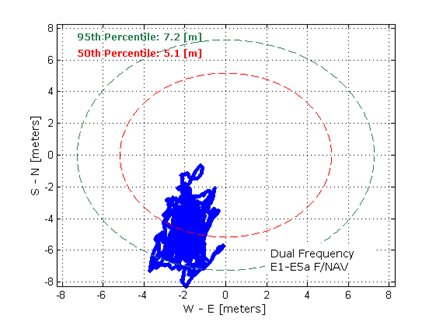
Dual-frequency Galileo positioning performance during the In-Orbit Validation phase: positioning accuracy is an average 8 m horizontal and 9 m vertical (95% of the time). Its average timing accuracy is 10 nanoseconds on average. Plot courtesy of ESA.
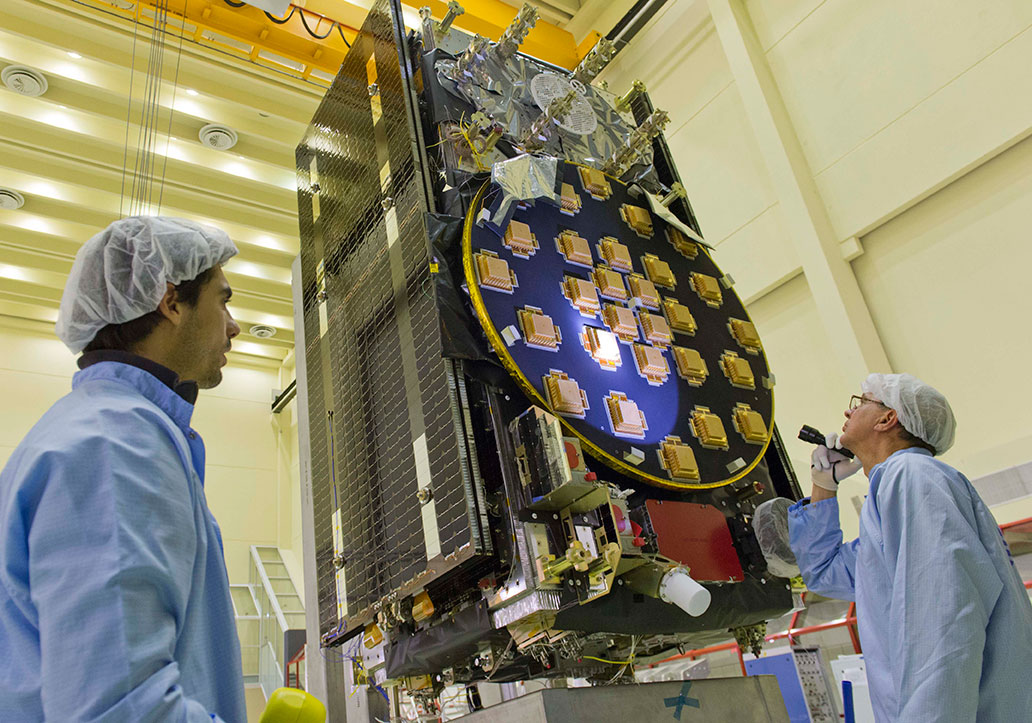
The main antenna of the second Galileo Full Operational Capability (FOC) satellite being inspected with a flashlight in advance of mass property testing during August 2013.
Europe’s next pair of Galileo satellites have been the focus of a busy autumn at the European Space Agency’s (ESA’s) technical centre in the Netherlands, continuing a full-scale campaign to ensure their readiness for space.
The first Galileo Full Operational Capability (FOC) satellite, FM1, seen beside the Phenix test chamber being readied for its five-week long thermal vacuum testing in October 2013.
With the first four Galileos already in orbit, these new versions are the first two of a total 22 Full Operational Capability (FOC) satellites being built by OHB in Germany with a payload from Surrey Satellite Technology Ltd. in the UK.
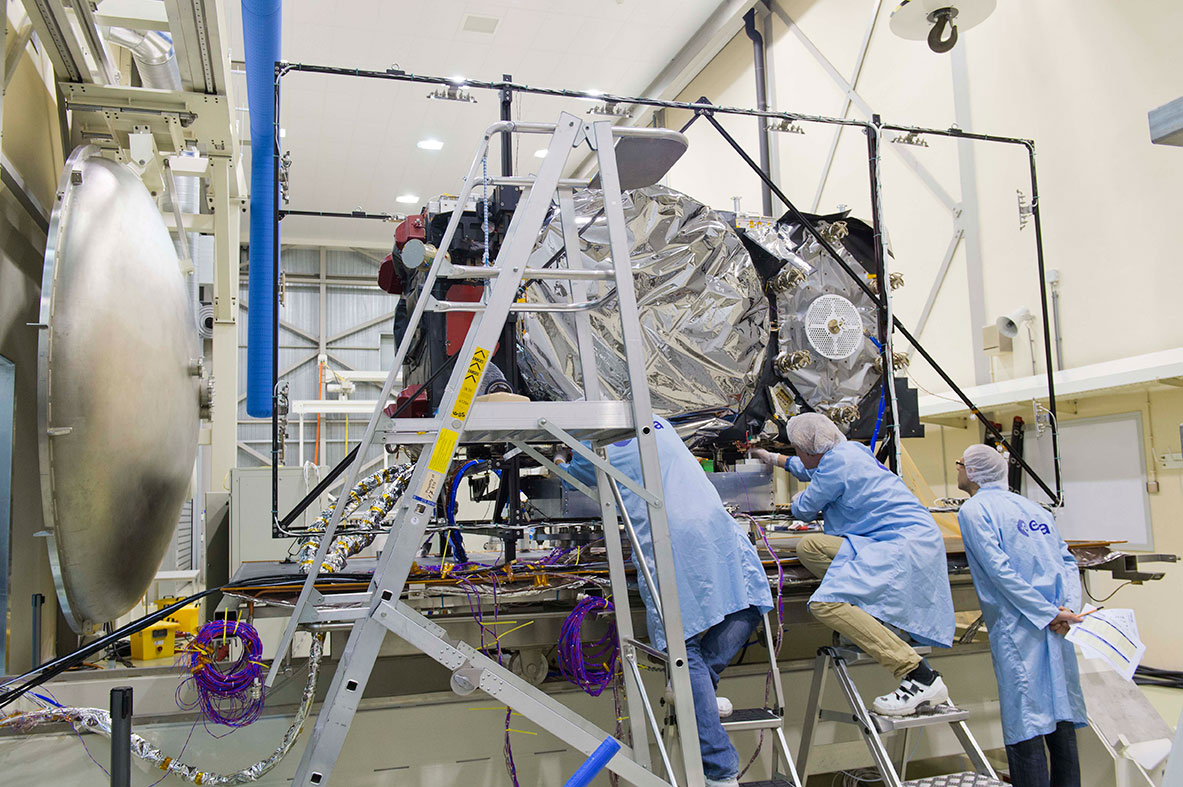
The second satellite joined its predecessor in mid-August at ESA’s European Space Research and Technology Centre in Noordwijk. This is the largest spacecraft testing site in Europe, with a full range of space simulation facilities under a single roof in cleanroom conditions. A wide range of tests have been performed on the two satellites.
The first of the two satellites is now midway through a five-week immersion in vacuum and temperature extremes that mimic the conditions it faces in space. This thermal-vacuum test takes place inside a 4.5-meter diameter stainless-steel vacuum chamber called Phenix. An inner box called the thermal tent has sides that are heated to simulate the Sun’s radiation or cooled down by liquid nitrogen to create the chill of Sunless space.
Second Galileo Full Operational Capability (FOC) satellite being prepared for acoustic testing, simulating the noise of a rocket launch, inside the Large European Acoustic Facility, LEAF, of the ESTEC Test Centre in early September 2013.
The newly arrived satellite first underwent a mass property test — measured to check its center of gravity and mass are aligned within design specifications. The more precisely these are known, the more efficiently the satellite’s orientation can be controlled with thruster firings in orbit, potentially elongating their working life by conserving propellant.
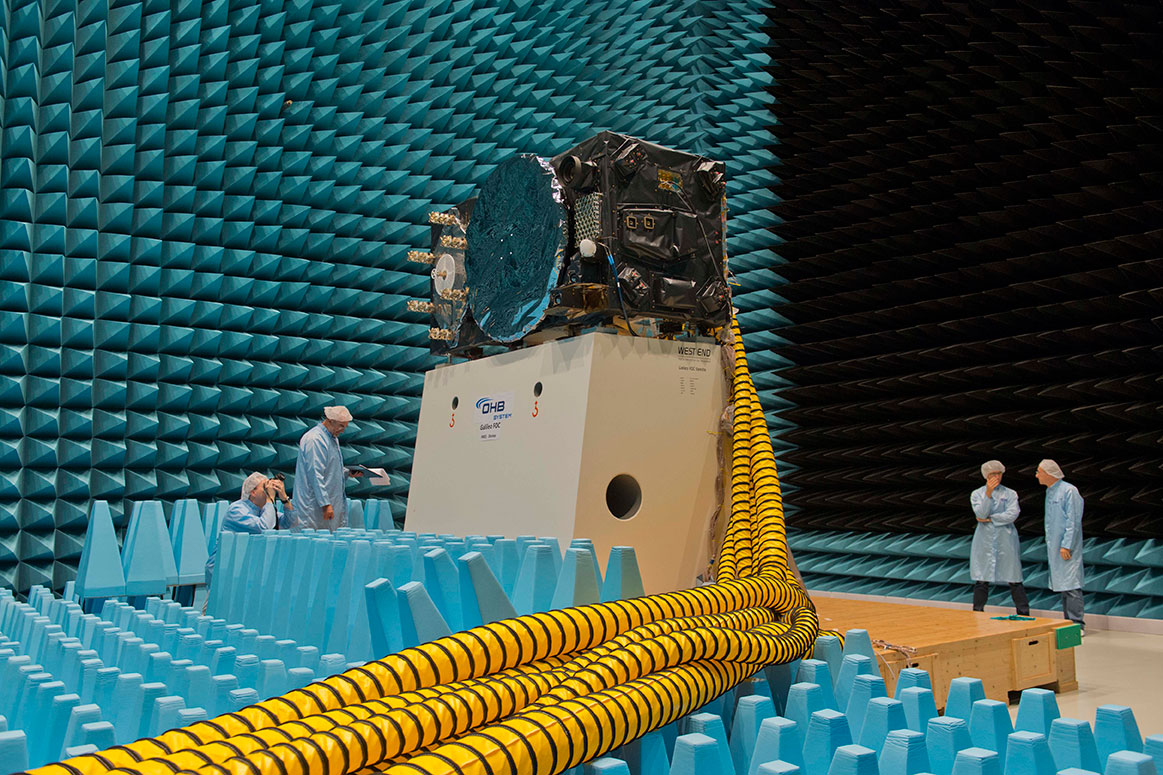
Meanwhile, its predecessor left the wider universe behind in the Maxwell Test Chamber. Shielded walls blocking out all external electrical signals and spiky, radio-absorbing anechoic material lining the chamber enable electromagnetic compatibility testing. Isolated within the chamber as though floating in infinite space, the satellite could be switched on to check all its systems can operate together without interference.
September saw the second satellite undergo acoustic testing in the Large European Acoustic Facility, LEAF, effectively the largest sound system in Europe. The first satellite submitted to this trial just a few weeks before. A quartet of noise horns are embedded in one wall of this 11-meter-wide, 9-meter-deep and 16.4-meter-high chamber, generating sound by passing nitrogen gas through the horns, surpassing 140 decibels.
Galileo Full Operational Capability (FOC) satellite first flight model, FM1, being prepared for ‘passive intermodulation testing’ within the Maxwell electromagnetic test facility inside the ESTEC Test Centre at the end of August 2013.
Accelerometers placed within the satellite checked for potentially hazardous internal vibration during this trial by sound. Then the spacecraft was vibrated on the shaker tables, simulating the violent forces of a rocket launch.
Up-and-down vibration on the QUAD shaker followed by side-to-side shaking on the horizontal shaker, with data gathered across hundreds of channels.
The satellite was then connected to the dispenser that will hold it during launch to simulate the separation at the end of its climb to orbit. This separation is triggered by firing a pyro device which then pushes the satellite away from the dispenser. This demonstration took place last month.
“There will always be two Galileo satellites being tested at the ESTEC Test Centre for the next few years,” explains Giuliano Gatti, the head of the Galileo Space Segment Procurement Office.
“As the Galileo constellation takes shape, ESTEC will remain an essential part of each satellite’s pathway to space, between the end of manufacturing in Germany and UK and the launch by Soyuz ST-B or Ariane-5 from Europe’s Spaceport in French Guiana.
“Of course, the testing on these initial FOC satellites is especially rigorous because we are validating the overall design. The Galileo satellites to follow will undergo more streamlined ‘acceptance’ testing instead.”
The next two satellites are in final assembly at OHB in Germany, scheduled to reach ESTEC early next year, as these first two satellites head off to French Guiana for launch.
Galileo Full Operational Capability Flight Model 2, FM2, satellite’s main L-band antenna used for broadcasting navigation messages, seen during preparation for a mass property test at the ESTEC Test Centre at the end of August 2013.
Orolia has finalized the contracts to supply Rubidium atomic clocks (Rubidium Atomic Frequency Standard, RAFS) and passive hydrogen masers to equip eight satellites for Galileo’s Full Operational Capability Phase II program. The two new contracts, totaling 14.5 million euros, follows the authorization to proceed received in June 2012 for the manufacture of these two types of high-precision clocks.
Orolia brands include Spectratime and Spectracom. The announcement was made through Orolia subsidiary Spectratime.
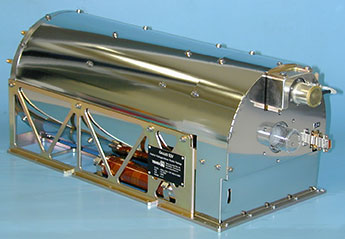
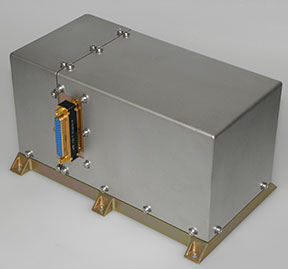
Each Galileo satellite carries two Rubidium atomic clocks and a passive hydrogen maser, the most stable clock in the world, according to Spectratime. Once completed, this new contract, in partnership with Astrium and Selex Galileo, will make Spectratime the leading supplier in the world for active atomic clocks in space, including 72 for the Galileo system.
Rubidium atomic clock, or RAF.
Atomic clocks are used in satellite navigation because of their stability, low weight and high reliability. Very accurate time is used to precisely measure the path of radio signals from the satellites to Earth, and by calculation, the distance between the satellites and the Galileo receiver. The stability of these clocks is enough to guarantee geo-location accuracy of one meter with a fully operational ground infrastructure.
Spectratime said it has the expertise and capability in designing advanced maser physics packages for high-performance, high-reliability space applications, where the clocks need protection in the hostile space environment from radiation, magnetic fields, shock, vibration, or thermal variations.
The European Space Agency (ESA) has released a series of photos providing the first detailed views of the next batch of Galileo satellites, the first of which has already been delivered to ESA for rigorous testing in simulated space conditions. Scroll down to see the photos.
The first Galileo Full Operational Capability (FOC) satellite was delivered to ESA’s ESTEC technical centre in Noordwijk, the Netherlands, on May 15. It is being prepared for testing in the ESTEC Test Centre, a unique facility for Europe with all the facilities needed to validate a satellite for launch under one roof.
This initial FOC satellite is functionally identical to the first four Galileo In-Orbit Validation satellites already in orbit, the operational nucleus of the full Galileo constellation, but has been built by a separate industrial team.
Like all the other 21 FOC satellites so far procured by ESA, the satellite’s prime contractor is OHB in Bremen, Germany, and the navigation payload was produced by Surrey Satellite Technology Ltd. in Guildford, UK. The photos shown here were taken at OHB.
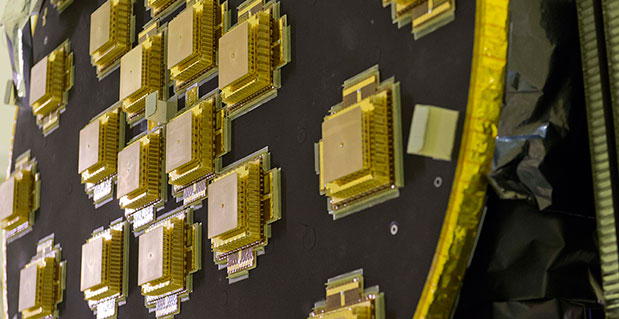
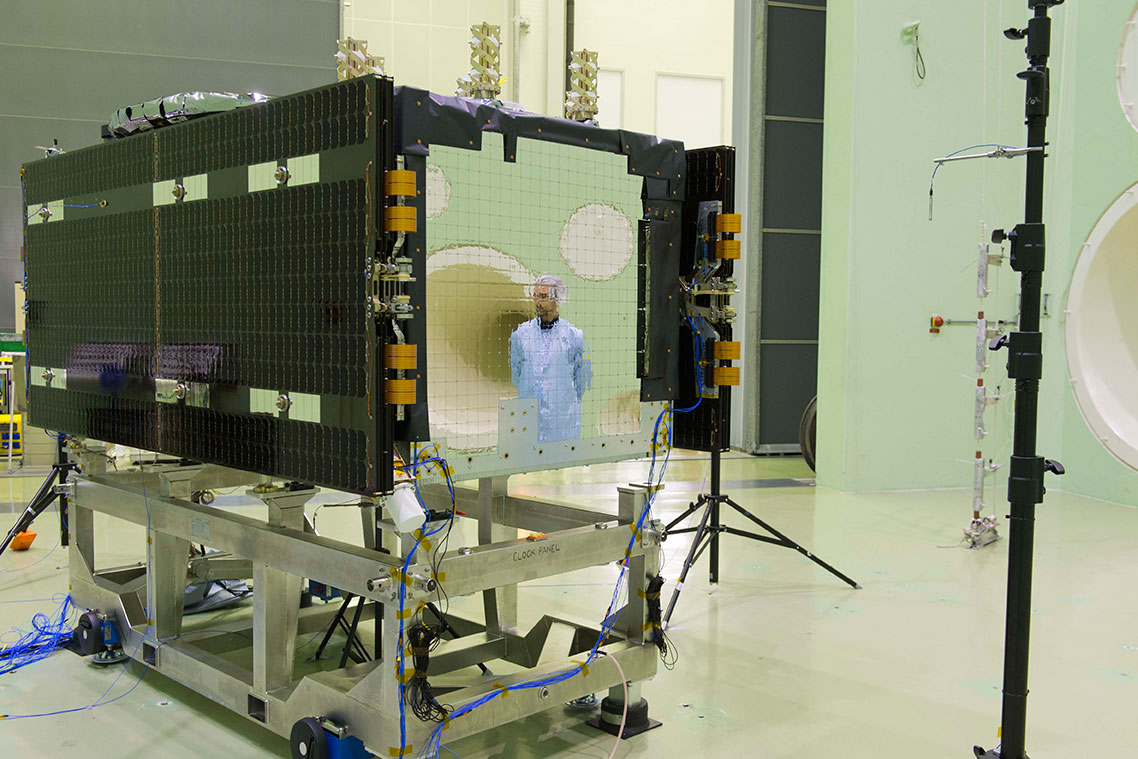
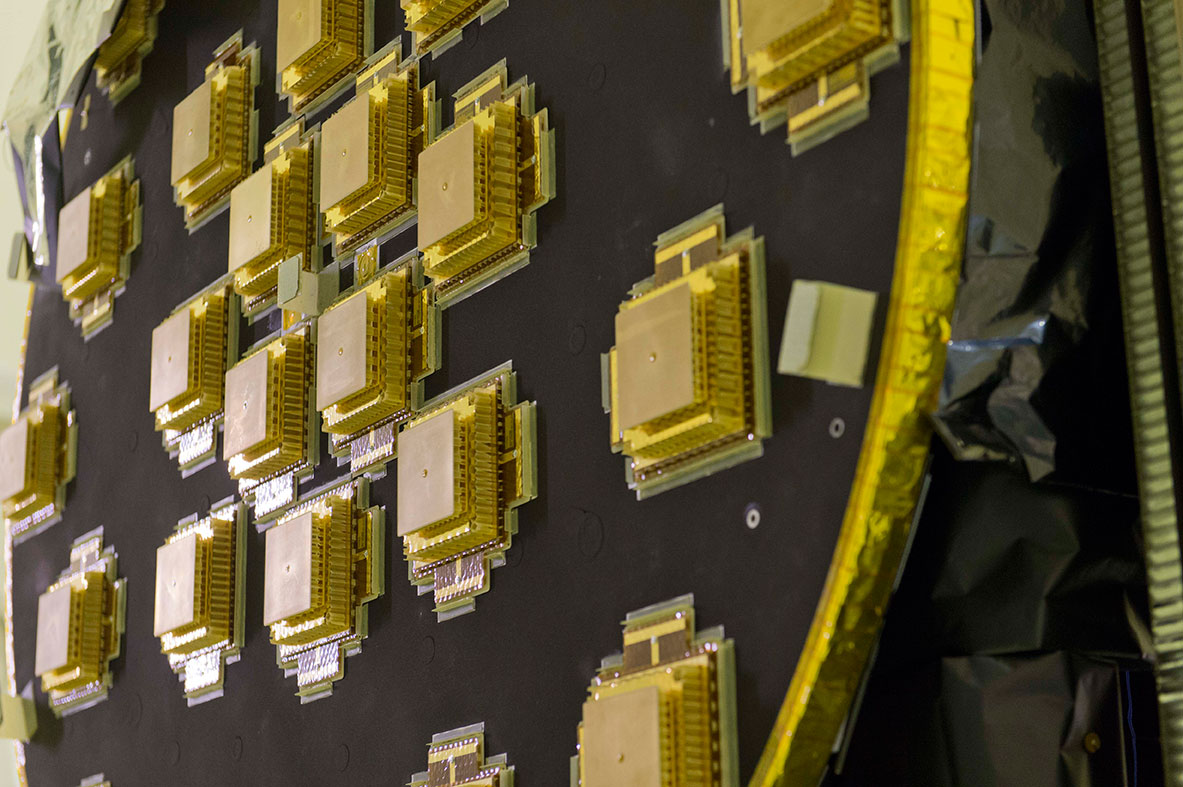
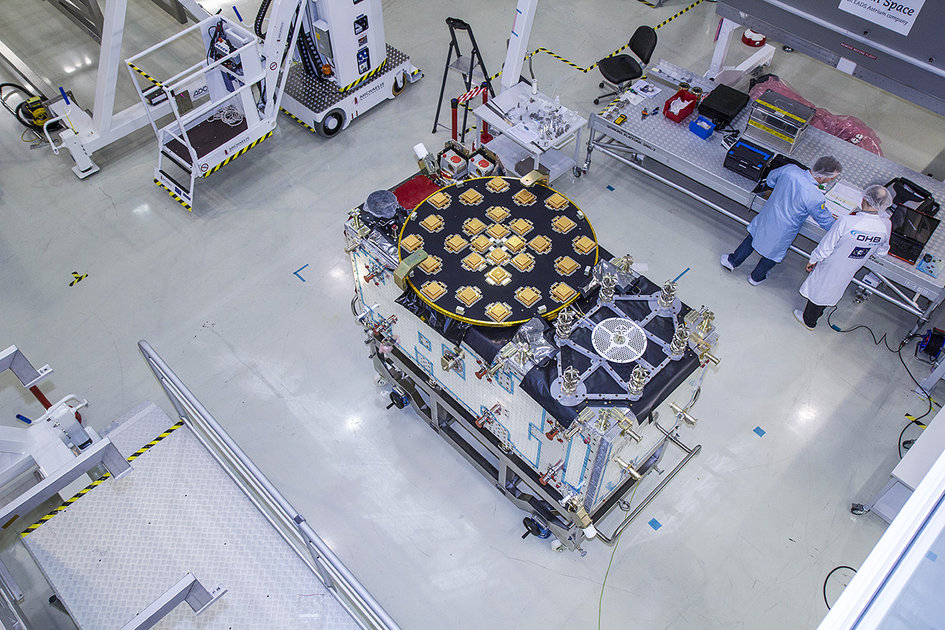
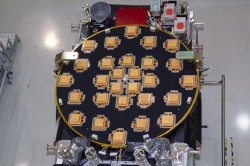
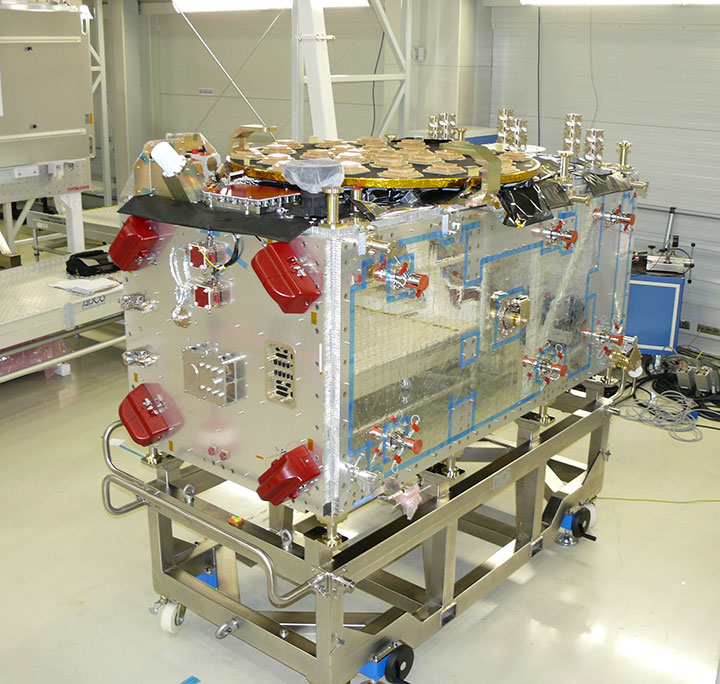
The satellite is approximately the size and shape of an old-fashioned telephone booth, dominated by its circular L-band antenna that will continuously broadcast navigation messages down to Earth.
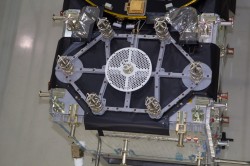
The smaller, hexagonal antenna beside it will perform a no less vital task — picking up emergency messages from vessels in distress to relay to search and rescue authorities, contributing to the international Cospas–Sarsat system.
A second Galileo FOC satellite is due to join its predecessor at ESTEC later this summer, preparing for a launch scheduled for later this year.
Galileo FOC: These pictures give the first detailed views of the next batch of Galileo satellites, the first of which has already been delivered to ESA for rigorous testing in simulated space conditions. Credit: OHB
Galileo FOC main antenna: Galileo FOC is dominated by its circular L-band antenna that will continuously broadcast navigation messages down to Earth. Credit: OHB
The Galileo FOC satellite is approximately the size and shape of an old-fashioned telephone booth, similar to the preceding IOV design. Credit: OHB
Galileo FOC search and rescue antenna: Galileo’s smaller, hexagonal antenna beside its main navigation antenna is designed to pick up emergency messages from vessels in distress to relay to search and rescue authorities, contributing to the international Cospas–Sarsat system. Credit: OHB
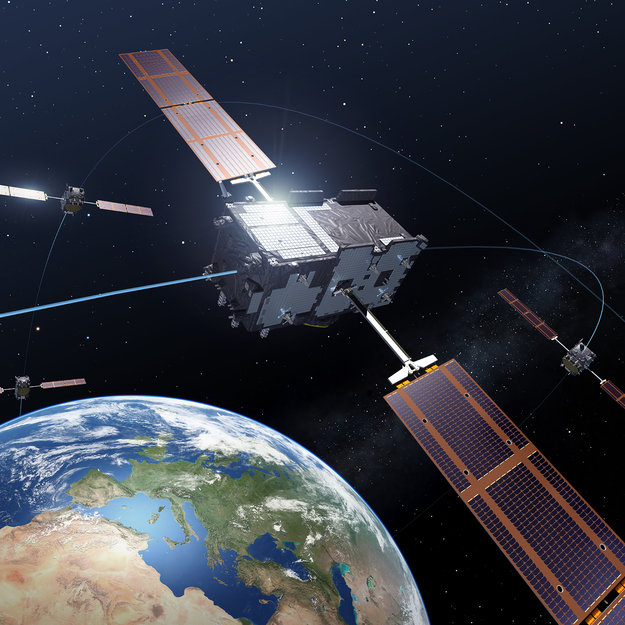
Gaileo Full Operational Capability satellites in orbit – the second batch of Galileo satellites. These FOC satellites follow on from the initial four Galileo In-Orbit Validation satellites, the first two of which went into orbit on 21 October 2011 with the remaining two joining them on 12 October 2012. As prime contractor for the FOC satellites, OHB is responsible for developing the satellite platform and integrating the satellite with its payload – the part of the satellite that provides Galileo’s precision positioning measurements and services to users worldwide – developed at Surrey Satellite Technology Ltd in Guildford, UK (also providing assistance to OHB with final satellite assembly). Credit: OHB
Galileo FOC satellite does same work as the IOV predecessor. The ‘business end’ of the Galileo FOC satellite hosts the L-band navigation antenna and the smaller search and rescue antenna on the same face. This initial FOC satellite is functionally identical to the first four Galileo In-Orbit Validation satellites already in orbit, the operational nucleus of the full Galileo constellation, but has been built by a separate industrial team. Like all the other 21 FOC satellites so far procured by ESA, the satellite’s prime contractor is OHB in Bremen, Germany and the navigation payload was produced by Surrey Satellite Technology Ltd in Guildford, UK. Credit: OHB
In the early hours of May 15, Galileo’s first full operational capability (FOC) satellite left the manufacturer’s integration hall in Bremen, Germany. The satellite, assembled by OHB System AG, is now headed for Noordwijk in the Netherlands, where it will undergo an environmental testing campaign and further system testing at the ESTEC’s Test Center on the premises of the European Space Agency (ESA).
Before the satellite was shipped, it had successfully completed integration and system testing, according to OHB System.
The first Galileo FOC satellite. (Photo credit: OHB System AG.)
Its twin FOC satellite is in the final phase of completion at OHB System. Over the next few weeks, it will also be integrated and tested, after which it will be shipped to Noordwijk. The two satellites are to be placed in orbit on board a Soyuz launcher, which will is planned to lift off from Kourou in French Guyana this fall.
These two satellites are the first of a series of 22 Galileo FOC satellites manufactured by OHB System and its industrial partners. The FOC phase of the Galileo program is managed and funded by the European Union. The European Commission and ESA have signed a delegation agreement by which ESA acts as design and procurement agent on behalf of the commission.
At ESA’s test center, thermal vacuum testing will simulate the temperature extremes the satellites must endure in the airlessness of space throughout their 12-year working lifetimes. Without any moderating atmosphere, temperatures can shift hundreds of degrees from sunlight to shadow.
Other activities on the schedule include shaker and acoustic noise testing — simulating the vibration and noise of launch — as well as electromagnetic compatibility and antenna testing, placing the satellite in chambers shielded from all external radio signals to reproduce infinite space and check that its various antennas and electrical systems are interoperable without harmful interference.
Each satellite will offer the full range of Galileo positioning, navigation and timing services, plus search and rescue message relays, their accuracy ensured by on-board atomic clocks kept synchronized by a worldwide ground network.
“The Galileo FOC satellites provide the same capabilities as the previous IOV satellites, but with improved performance, such as higher transmit power,” explained Giuliano Gatti, head of the Galileo Space Segment Procurement Office. “They are to all intents a new design that requires a full checkout before getting the green light for launch. By fully validating this satellite, the second flight model due to follow it here at beginning of June, and the third one due to arrive in ESTEC at middle of July, we gain full knowledge of their characteristics, and the further satellites in the series will require less rigorous functional testing.”
Scientists in Hanoi, Vietnam, send word that on March 27 the four Galileo in-orbit validation satellites were visible at the same time in the sky over that Southeast Asian country for nearly two hours (from 2:15 to 4:00 GMT) while transmitting a valid navigation message.The research team of the NAVIS Centre at Hanoi University of Science and Technology (HUST) successfully computed what they claim is the first Galileo-only position fix in Asia.
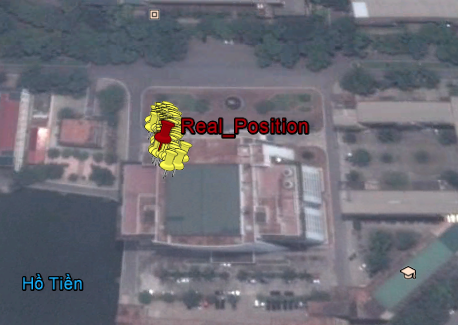
Figure 1 depicts the obtained positions are depicted on top of the roof of the NAVIS Centre, where the antenna used to receive the signals is located (latitude = 21°00’16.69” N, Longitude = 105°50’37.90” E, height = 35,2 meters).
Figure 1. Positions obtained by only Galileo E1 Open Service (the antenna is located at the roof of the Ta Quang Buu library building inside HUST campus)
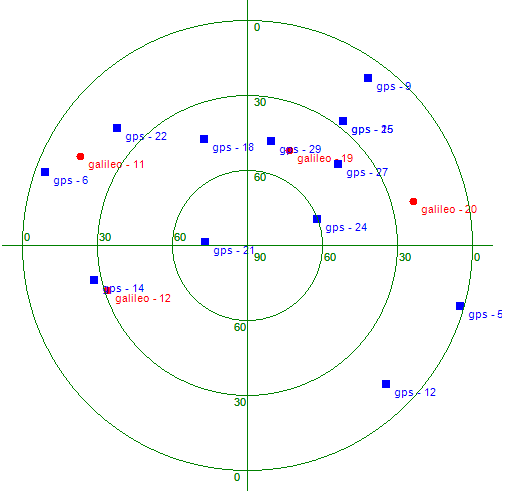
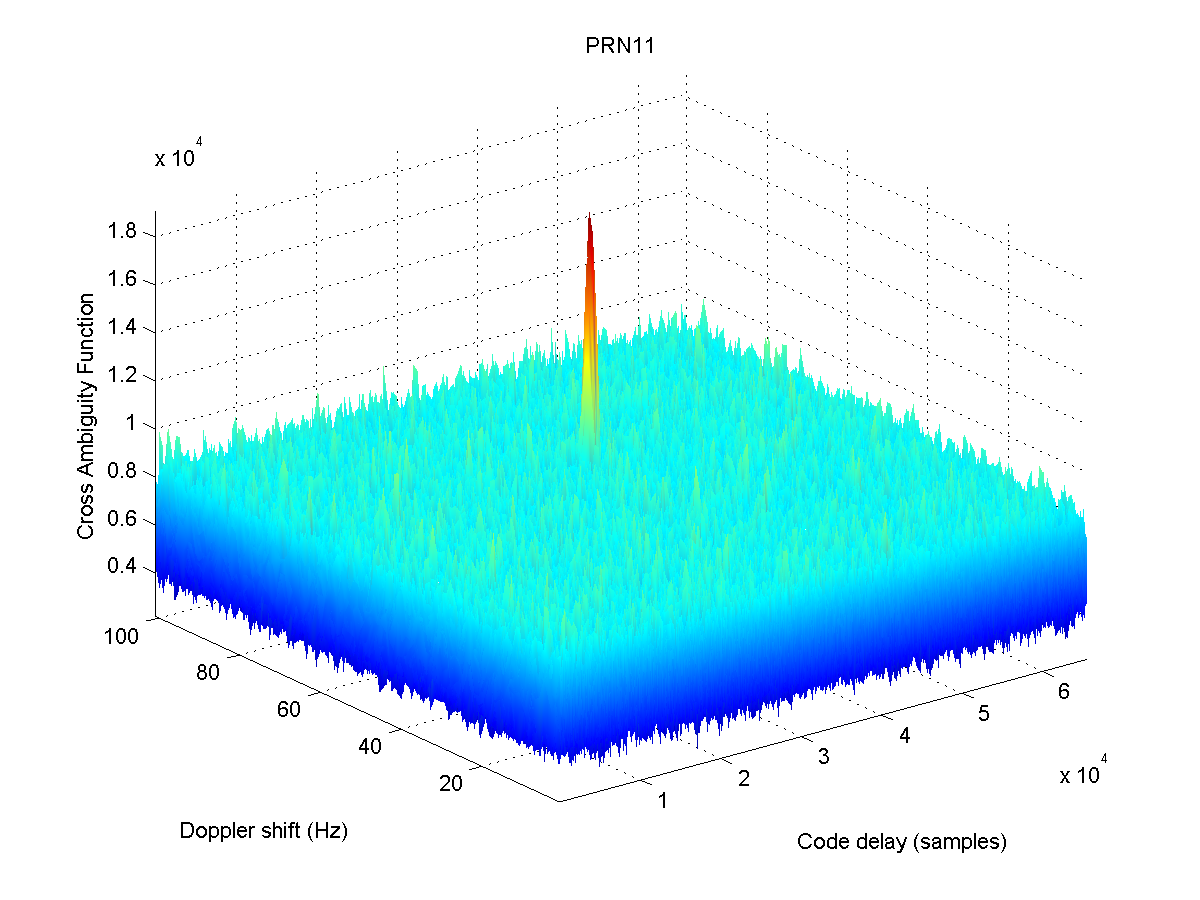
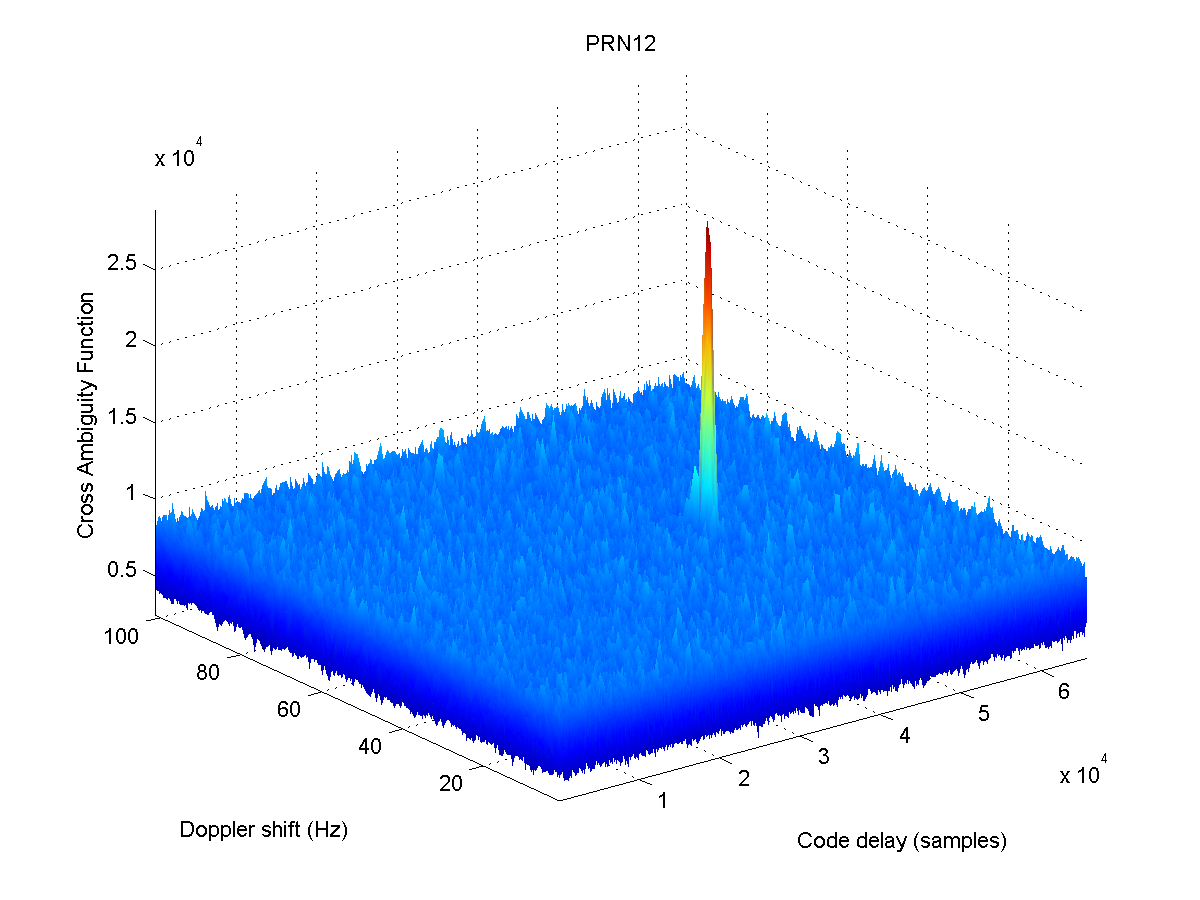
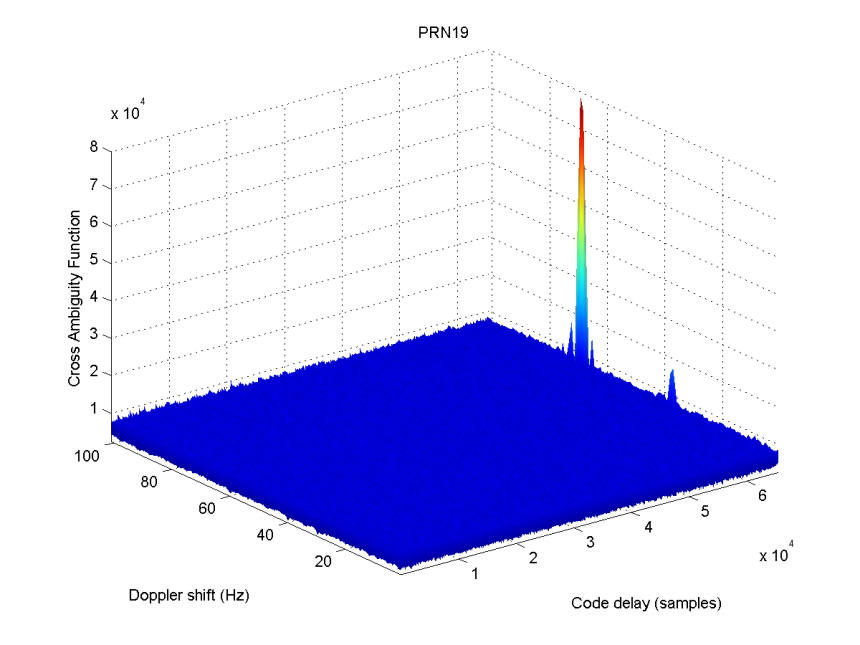
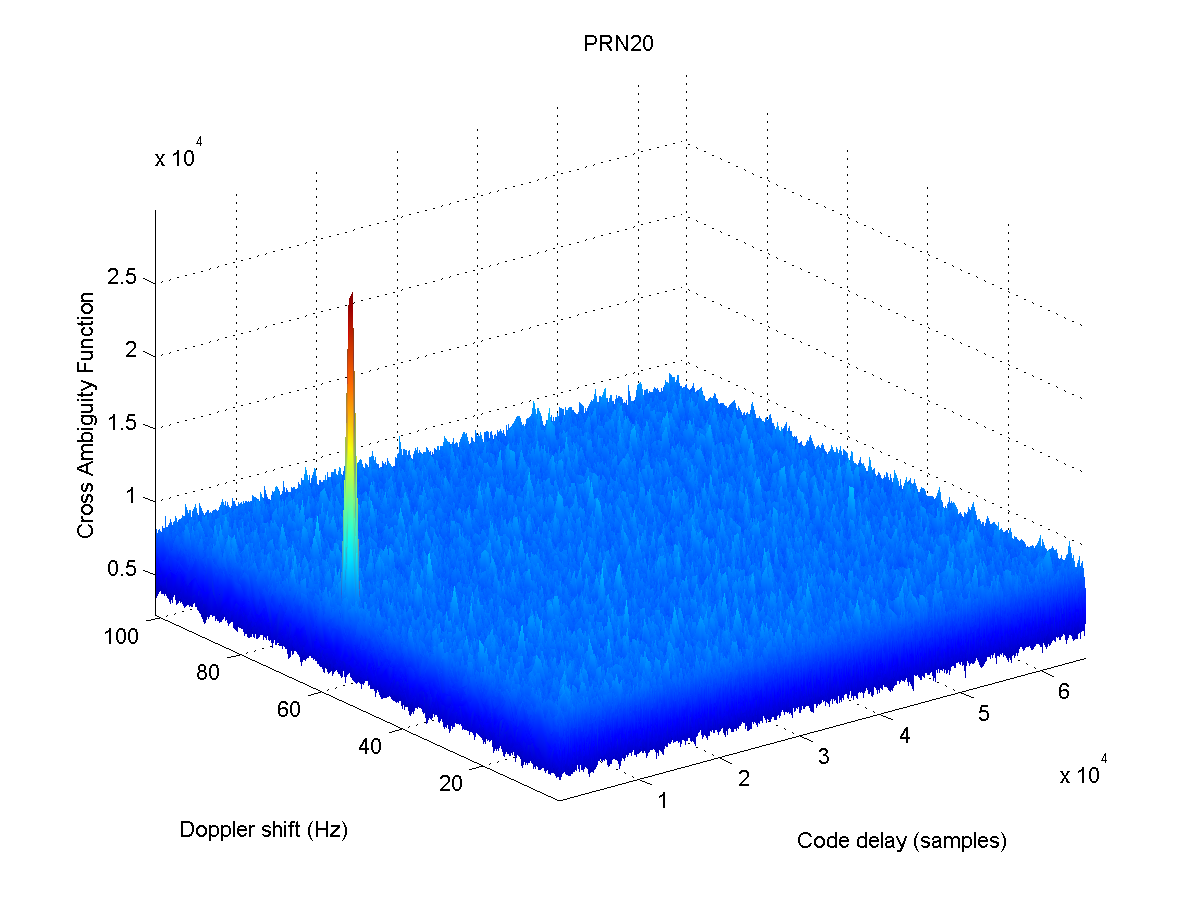
Figure 2 shows the positions of the four Galileo satellites and of 12 GPS satellites at time of acquisition, while Figure 3 reports the acquisition results of the four Galileo IOV satellites.
Figure 2. Skyplot of the satellites of the GPS and Galileo systems at the time of the campaign. The Galileo satellites are PFM (PRN11), FM2 (PRN12), FM3 (PRN19), and FM4 (PRN20).Figure 3. Acquisition results of the four Galileo IOV satellites: PRN 11.Figure 3. Acquisition results of the four Galileo IOV satellites: PRN12.Figure 3. Acquisition results of the four Galileo IOV satellites: PRN19.Figure 3. Acquisition results of the four Galileo IOV satellites: PRN20.
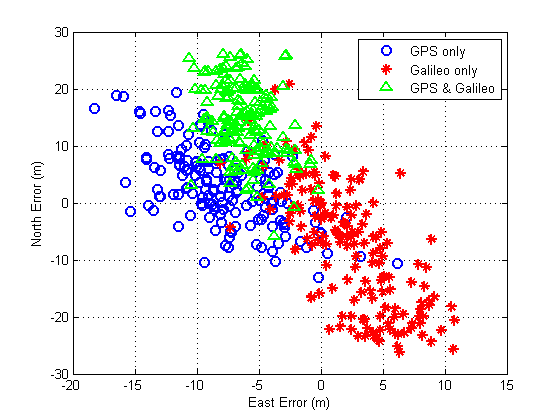
Comparison of the position computed using only Galileo, only GPS or both systems together is also presented in Figure 4. It should be noted that during the campaign, the data demodulation process reports that the Galileo system announces the “navigation data valid” status for PFM and FM3, meanwhile the “working without guarantee” for FM2 and FM4.
Figure 4. Position computed when using GPS only, Galileo only, or GPS+Galileo
The NAVIS Centre, located at the Hanoi University of Science and Technology in Hanoi, Vietnam, was established with a project co-funded by the European Union and collaborates with European and Asian partners on research and development of satellite navigation technology in Southeast Asia. This report was made by Dr. Ta Hai Tung, director of the NAVIS Centre, and Prof. Gustavo Belforte, co-director.