Tag: Galileo satellite

  • Ariane 5 to Launch Galileo Constellation

    Jean-Yves Le Gall, chairman and CEO of Arianespace, and Didier Faivre, director of the Galileo Program and Navigation-related Activities at the European Space Agency (ESA), signed an agreement February 2 in London to launch satellites in Europe’s Galileo satellite positioning system by Ariane 5 launchers.

    This agreement provides for the possibility of using Ariane 5 launchers in 2014 and 2015 to complete the deployment of the Galileo constellation. Arianespace will have launched the 26 satellites in this constellation using a combination of Soyuz launch vehicles (two satellites per launch), and Ariane 5 launchers (four satellites per launch). The contract for adapting the Ariane 5 launcher to enable simultaneous launch of four Galileo satellites was also signed today by the European Space Agency and EADS-Astrium.

    The Galileo satellite launch contract is managed by ESA on behalf of the European Commission. The contract signing ceremony was also attended by David Willets, U.K. Minister of State for Universities and Science, and Antonio Tajani, Vice President of the European Commission.

    These satellites, built by the team of OHB Technology of Germany and Surrey Satellite Technology, Ltd. of the United Kingdom, will be placed in a circular orbit at an altitude of 23,000 kilometers by Soyuz and Ariane 5 launchers operating from the Guiana Space Center in French Guiana.

    Arianespace and its subsidiary Starsem have already orbited the Giove-A and Giove-B in-orbit validation satellites, thus securing the frequencies allocated to the Galileo constellation. On October 21, 2011, Arianespace launched the first two satellites in the constellation — built by Astrium during the IOV (In Orbit Validation) phase — using a Soyuz launcher at the Guiana Space Center.

    With both Ariane 5 and Soyuz, Arianespace offers the best solution for launching the entire Galileo constellation, thus guaranteeing independent access to space for Europe, Arianspace said.

  • SSTL-OHB System Consortium to Build Eight More Galileo FOC Satellites

    European Commission Vice President Antonio Tajani announced in London that the consortium led by OHB System AG and Surrey Satellite Technology Ltd. (SSTL) will build a further eight satellites for the European Union’s Galileo satellite navigation program under the supervision of the European Space Agency.

    The new contract will see SSTL continuing its role as payload prime, assembling, integrating and testing the navigation payloads in the UK, whilst OHB System, as the prime contractor, builds the eight satellite platforms and executes the final integration of all the satellites in Germany. The SSTL-OHB partnership is already building fourteen satellites for the Galileo program and will draw on its heritage and experience to produce the additional satellites to demanding schedules.  

    Matt Perkins, SSTL Group CEO commented “SSTL has played a key role in the development of the Galileo program for nine years and we have the commitment, experience and track record to deliver this substantial contract.  We are delighted to have been selected with our partner, OHB, to continue to play our part in building Europe’s operational navigation system.”

    SSTL is assembling the Galileo program payloads at its recently opened purpose-built Kepler technical facility in Guildford, UK. Under the contract, SSTL is fully responsible for the construction and test of the navigation payloads. SSTL will manufacture the electrical harnesses and the electronics to interface the navigation payload with the satellite platform. The remaining payload equipment will be externally procured by SSTL from European and other suppliers. SSTL's payload solution is based on European-sourced atomic clocks, navigation signal generators, high power travelling wave tube amplifiers and antennas and will provide all of Galileo’s services.

    Galileo is Europe’s own Global Navigation Satellite System (GNSS), providing real-time positioning, navigation and timing services with unrivalled accuracy and integrity. It will be interoperable with the American GPS system and Russia’s GLONASS system.

    The Full Operational Capability phase of the Galileo program is managed and fully funded by the European Union. The Commission and ESA have signed a delegation agreement by which ESA acts as design and procurement agent on behalf of the Commission. The views expressed in this Press Release can in no way be taken to reflect the official opinion of the European Union and/or ESA. “Galileo” is a trademark subject to OHIM application number 002742237 by EU and ESA.

  • NavSAS Group Acquires, Tracks Second Galileo IOV Satellite

    On January 17, the E1 signal of the Galileo Flight Model 2 satellite (FM2, also known as GSAT0102) was successfully acquired and tracked by the researchers of the Navigation, Signal Analysis and Simulation (NavSAS) group (Politecnico di Torino / Istituto Superiore Mario Boella) for the first time at 11:54:10 CET (10:54:10 UTC).

    This signal has been received at the Istituto Superiore Mario Boella (ISMB) premises (located in Torino, Italy, latitude = 45°03'54.99" N, longitude = 7°39'32.29" E, height = 311.97 meters) with a non-directive GNSS antenna, a commercial narrowband E1 RF front-end, and the N-GENE receiver, a fully software receiver developed by the NavSAS researchers.

    The FM2 satellite currently broadcast a Galileo Open Service signal on E1 band using the Code Number 12 of the Galileo Interface Control Document (ICD). It is the second of the two Galileo In-Orbit Validation (IOV) satellites launched on October 21, 2011. The first IOV satellite — the Galileo-ProtoFlight Model (PFM) spacecraft — was received by NavSAS researchers for the first time on December 12.

    Both the PFM and the FM2 satellites were in view January 17, and their E1 signals have been successfully received and processed.

    Figure 1 and 2 show the orbits of the two Galileo satellites at the moment of the signal acquisition. These screenshots have been produced by a free software tool (Orbitron, by Sebastian Stoff). In Figure 1 the two satellites, denoted as GALILEO-PFM GALILEO-FM2, are visible. Figure 2 shows a detailed skyplot computed in Torino, Italy.


    Figure 1. Galileo IOV satellite orbits at the moment of the signal acquisition.


    Figure 2. Skyplot of Galileo IOV satellite orbits at the moment of the signal acquisition.
     

    The Galileo FM2 satellite signal (PRN 12) has been successfully acquired for the first time at 11:54:10 and the first acquisition and tracking results are reported from Figures 3 to Figure 6. It can be noticed that the satellite signal was received with a C/N0 of approximately 46.4 dBHz and a Doppler frequency shift equal to -2595 Hz.


    Figure 3. Search space of the successful acquisition of the Galileo FM2 satellite (PRN 12).


    Figure 4. Zoom on the peak obtained acquiring the Galileo FM2 satellite (PRN 12).


    Figure 5. Estimated C/N0 and correlation values obtained tracking the PRN 12.


    Figure 6. Estimated Doppler values obtained tracking the PRN 12.
     

    Also, the Galileo PFM satellite was in view on January 17, and the signals from both satellites have been measured and compared by the NavSAS researchers. Figure 7 shows the elevation patterns of PFM and FM2 satellites as obtained from prediction visibilities based on NORAD tracking information (two-line elements of Galileo satellites downloaded on January 17). Figure 8 shows both the estimated Doppler and C/N0 profiles obtained from multiple measurements performed on the same time interval: their trends agree with the satellite elevations shown in Figure 7.


    Figure 7. Elevation pattern versus time of the PFM and FM2 satellites over Torino on January 17.


    Figure 8. Estimated Doppler and C/N0 profiles along multiple measurements performed on January 17.

    As a final step, the demodulation of the E1b data channel has also been performed, checking the navigation messages for both the satellites. It has been noticed that, at the moment, the navigation messages present only two types of page: reserved (word type field with value 63) and type 0 (spare). Type 0 words have valid Week Number and Time Of Week fields. On the other hand, both the satellites broadcast a valid secondary code on their E1c pilot channels, compliant with the Galileo ICD.

  • Second Galileo IOV Satellite Transmitting Signals

    News courtesy of CANSPACE Listserv.


    On Monday, 16 January, at about 02:18 UTC, the second of the two Galileo In-Orbit Validation (IOV) satellites, FM2 (Flight Model 2) also known as GSAT0102, started transmitting navigation signals on the L1/E1 frequency using the E12 ranging code, according to tracking reports from the COoperative Network for GIOVE Observation (CONGO).

    FM2 was launched together with PFM, the ProtoFlight Model (GSAT0101), on October 21, 2011. PFM started transmitting E1 signals on December  10, 2011, and E5 signals on December 14, according to CONGO network tracking reports. Subsequently, ESA confirmed that the E6 transmitter was powered up the weekend before Christmas.

    CONGO is a global network of 19 tracking stations established by the German Space Operations Center (DLR/GSOC) and the German Federal Agency for Cartography and Geodesy (BKG) in cooperation with several agencies including Technische Universitaet Muenchen.

  • GMV Tracks the First Galileo IOV Satellite

    GMV, one of the world’s leading companies in satellite navigation systems, announced the tracking of both data and pilot channels of Galileo first satellite signal with its own line of GNSS receiver products.
     
    The first two Galileo satellites were launched from Kouru Spaceport in French Guiana on October 21st and are now in in-orbit test campaign. The Galileo PRN 11 started transmitting the first navigation signal last Saturday.
     
    GMV has been involved in GNSS for the last 25 years and today GMV’s GNSS team includes more than 120 highly specialized engineers, some having more than 15 years experience in the GNSS field. GMV plays a critical role in the ongoing development of Europe’s GNSS strategy, being a key partner in the EGNOS and Galileo programmes.
     
    GMV has developed its own GNSS software receiver products: SRX-10 on GPS, which has been optimized for the urban environment, NUSAR for GPS L1 and Galileo E1 and its own L1 front end. This experience has been applied, even previously to the development of the receivers, to many studies on receiver performances under very diverse signal conditions and designs, namely by processing the GIOVE satellites signal.
     
    Supported by its line of GNSS receiver products, GMV now presents its results on the first Galileo signals on both data (E1-B) and pilot (E1-C) channels of the Galileo PRN 11 satellite.

  • E5 Aloft, Second Galileo Signal Transmitted

    The Galileo PFM IOV satellite (GSAT0101) began transmitting E5 signals early on December 14. It had already started airing E1 signals on December 10. Several COoperative Network for GIOVE Observation (CONGO) stations, including one at the University of New Brunswick, are now tracking both the E1 and E5 signals.

    Meanwhile, the European Space Agency (ESA) has released a statement on the start of IOV satellite transmissions, titled "Galileo in tune: first navigation signal transmitted to Earth":
     
    "Europe’s Galileo system has passed its latest milestone, transmitting its very first test navigation signal back to Earth.
     
    "The first two Galileo satellites were launched into orbit on 21 October. Since then their systems have been activated and the satellites placed into their final orbits, positioned so that their navigation antennas are aligned with the world they are designed to serve.

    "Last weekend marked the first orbital transmission from one of these navigation antennas. The stage was set, the singer in place and an audience – in the shape of engineers on the ground – was waiting eagerly.

    "The question was would the singer make music, and if so, would it be in tune?  
     
    "The turn of Galileo’s main ‘L-band’ (1200-1600 MHz) antenna came on the early morning of Saturday 10 December. A test signal was transmitted by the first Galileo satellite in the ‘E1’ band, which will be used for Galileo’s Open Service once the system begins operating in 2014.

    "To prepare for the test, the payload power amplifiers were switched on and ‘outgassed’ – warmed up to release vapours that might otherwise interfere with operations – before transmission began.
        
    "The signal power and shape was well within specifications. The shape is especially important because its modulation is carefully designed to enable interoperability with the ‘L1’ band of US GPS navigation satellites: Galileo and GPS can indeed work together as planned.

    "The test campaign is concentrating on the first satellite for the reminder of the year, with the focus moving to the second Galileo satellite from the start of 2012. The plan is to complete In-Orbit Testing by next spring.

    "The next pair of Galileo In-Orbit Validation satellites will also be launched next year, to form the operational nucleus of the full Galileo constellation. Meanwhile the next batch of Galileo satellites are currently being manufactured for launch in 2014."

  • Galileo Broadcasting Satellite Identified

    On Saturday, December 10, at about 06:00 UTC, one of the two Galileo In-Orbit Validation (IOV) satellites launched on October 21 started transmitting navigation signals on the L1/E1 frequency using the E11 ranging code.

    According to prediction visibilities based on NORAD/JSpOC tracking information, the transmitting satellite is PFM, the ProtoFlight Model (GSAT0101). The FM2 (Flight Model 2) satellite (GSAT0102) has not yet started transmitting navigation signals.

    Stations of the COoperative Network for GIOVE Observation (CONGO) were among the first to track the satellite. Results have also been reported by Thales Avionics, JAVAD GNSS, Politecnico di Torino's NavSAS group, and Thales Alenia Space.

    The following figure shows C/N0 values in dB-Hz of PFM 1-Hz data collected at the University of New Brunswick CONGO station on December 10. Time axis runs for 24 hours starting at 01:00 UTC. Receiver is a Javad Delta-G2T.

  • JAVAD GNSS Tracks Galileo IOV Satellite

    On December 12, JAVAD GNSS announced that it has tracked the Galileo in-orbit validation satellite designated PRN-11. It is one of two Galileo satellites launched on October 21.

    "An important point is that we tracked it with our units that are already in the market," said Javad Ashjaee, CEO. "This is not a lab tests. Our customers can track it too."

    Here are the company's tracking results of PRN-11 for now, plots of pseudorange (in chips), doppler (in Hz), and SNR (relative number):

    JAVAD GNSS expects to publish additional results soon.

  • Thales Avionics Tracks L1 Signal of First Galileo Satellite

    Following the recent launch of two Galileo in-orbit validation satellites, Thales Avionics of Valence, France, has successfully acquired and tracked the new L1 Open Service signal transmitted by one of the space vehicles (PRN 11) on Monday, December 12, at 13:30 (GMT). Thales Avionics has developed a Galileo receiver capable of processing the Open Service, Commercial Service, and Safety of Life service of the Galileo constellation.

    Figure 1 shows a screenshot of the receiver interface program highlighting the L1 signal energy (top right) and the pilot secondary code (bottom).

    Figure 1: Real-time measurements.

    The satellite Doppler and C/N0 values have been recorded and are provided below.

    The raw navigation message has been decoded. It contains INAV type 0 and INAV dummy data as shown in the next figure. These messages enable Galileo system time transfer.

    The signal modulation and characteristics show no discrepancy relative to the Galileo Open Service ICD released last year.

    The fact that only L1 frequency is broadcast for the moment prevents providsion of further  results based on dual-frequency measurements.

    Thales has developed a coherent processing of the Galileo E5 AltBOC(15,10) signal compatible with hardware architecture designed for independent processing of both E5a and E5b. This processing is fully compatible with the mismatch between the two RF channels on E5a and E5b, thanks to real-time calibration based on satellite signals. This processing only requires software implementation, without additional recurrent costs. The technique is relevant for future receivers operating in the E5 band, in order to significantly enhance the accuracy, with respect to thermal noise and multi-path, and to improve the cycle slip probability.

    Thales Avionics, involved for many years in GNSS receivers design and production, has developed a Galileo receiver capable of processing the Open Service, Commercial Service, and Safety of Life service of the Galileo constellation. This high-end receiver includes patented state of the art algorithms capable of processing up to four different frequencies.

  • Galileo IOV Satellites Reach Operating Orbits

    News from CANSPACE Listserv.

    An announcement from ESA on November 4 stated "Europe’s first two Galileo IOV satellites have reached their final operating orbits, opening the way for activating and testing their navigation payloads." But, based on NORAD/JSpOC tracking of the satellites, it seems that the final orbits were achieved only a day or so ago.

    The plot above (and linked here) shows the mean motion (mm) of the PFM and FM2 satellites since launch. As evidenced by the lengthy gaps in the mm history, it is clear that NORAD/JSpOC sometimes has difficulty in reacquiring satellites after delta-V manoeuvres. We do know, however, that both satellites have appeared to reach their final orbits sometime between November 19 and 23. The mm values are now very close to the value 1.7046556 orbits per day derived from the mean semimajor axis of the Galileo constellation as given in the Galileo Open Service Signal-In-Space Interface Control Document: 29601.297 km.

    The arguments of latitude of the two satellites, essentially in the same orbit plane, are now 40 degrees apart as intended. There have not been any public reports that navigation signals from the satellites have yet been switched on.

  • Galileo Satellites Handed over to Control Center in Germany

    Europe’s first two Galileo satellites have reached their final operating orbits, opening the way for activating and testing their navigation payloads, reports the European Space Agency (ESA).
     
    Marking the formal end of their LEOP Launch and Early Operations Phase, control of the satellites was passed on November 3 from the CNES French space agency center in Toulouse to the Galileo Control Centre in Oberpfaffenhofen in Germany.

    Oberfaffenhofen, operated by the German Aerospace Center DLR, will be in charge of the satellites' command and control for the whole of their 12-year operating lives, ESA said.

    The two Galileo satellites were launched by Soyuz from French Guiana on 21 October. Three hours and 49 minutes after launch, their Fregat-MT upper stage carried them into their planned 23 222 km orbit, where they were released simultaneously.

  • First Galileo Satellite Arrives in French Guiana for October Launch

    The first Galileo navigation satellite has arrived in Europe’s Spaceport in French Guiana, ready to begin preparations for launch on October 20, reports the European Space Agency (ESA). Packed within a protective, air-conditioned container, the satellite known as Flight Model 2 (FM2) landed at Cayenne Rochambeau Airport aboard an Antonov aircraft at 06:45 local time on Wednesday after departing from Thales Alenia Space Italy’s Rome facility where it was built.

    A Thales and ESA team stood ready to receive FM2, having flown into French Guiana the previous week, along with all the testing and support equipment. The team loaded the satellite container on a lorry for transport to the Guiana Space Center, where it arrived at 10:00 local time and was moved into the preparation facility. It stayed there overnight for the temperature to settle before it was taken out of its container the following morning.

    The FM2 satellite is due to be launched aboard a Soyuz ST-B vehicle on October 20, together with a second Galileo satellite called the Proto-Flight Model (PFM), now being readied for its own flight to French Guiana.

    This will be the first launch of Russia’s Soyuz rocket from French Guiana, and the first Soyuz launch from a spaceport outside of Baikonur in Kazakhstan or Plesetsk in Russia. The launch will take place from a new facility 13 km northwest of the Ariane 5 launch site. French Guiana is much closer to the equator, so each launch will benefit from Earth’s spin, increasing the maximum payload into geostationary transfer orbit from 1.7 tonnes to 3 tonnes.

    The first four Galileo satellites, built by a consortium led by EADS Astrium Germany, will form the operational nucleus of the full Galileo satnav constellation.

    For more information, see the ESA website.

    Source: GPS world staff
    Galileo IOV satellite in its protective wrap.
    Source: GPS world staff
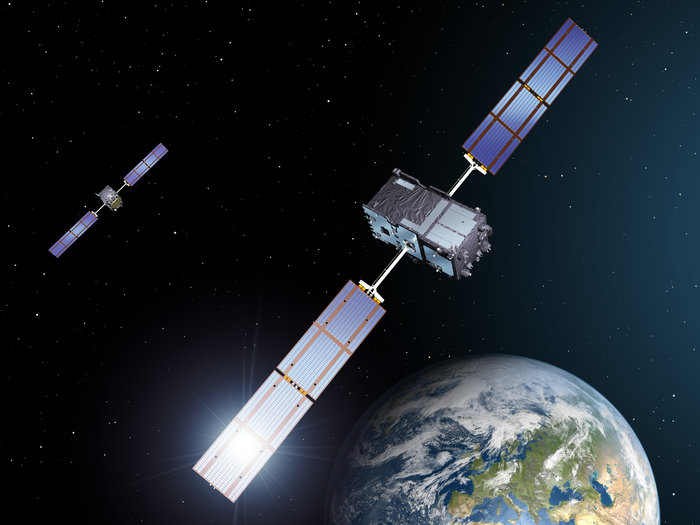
    Artist’s concept of Galileo IOVs in orbit.