Tag: Galileo satellite

  • Galileo IOV Satellites Begin Transmitting Navigation Messages

    News courtesy of CANSPACE listserv.

    Two of the Galileo In-Orbit Validation satellites, E11 and E12, began transmitting navigation messages on their Open Service signals on January 17. Several stations in the Cooperative Network for GNSS Observation and the International GNSS Service’s Multi-GNSS Experiment network received the messages. The epheremis data in the messages appears to be updated every 10 minutes.

  • Latest Galileo IOV Satellites on Orbit

    News courtesy of CANSPACE listserv

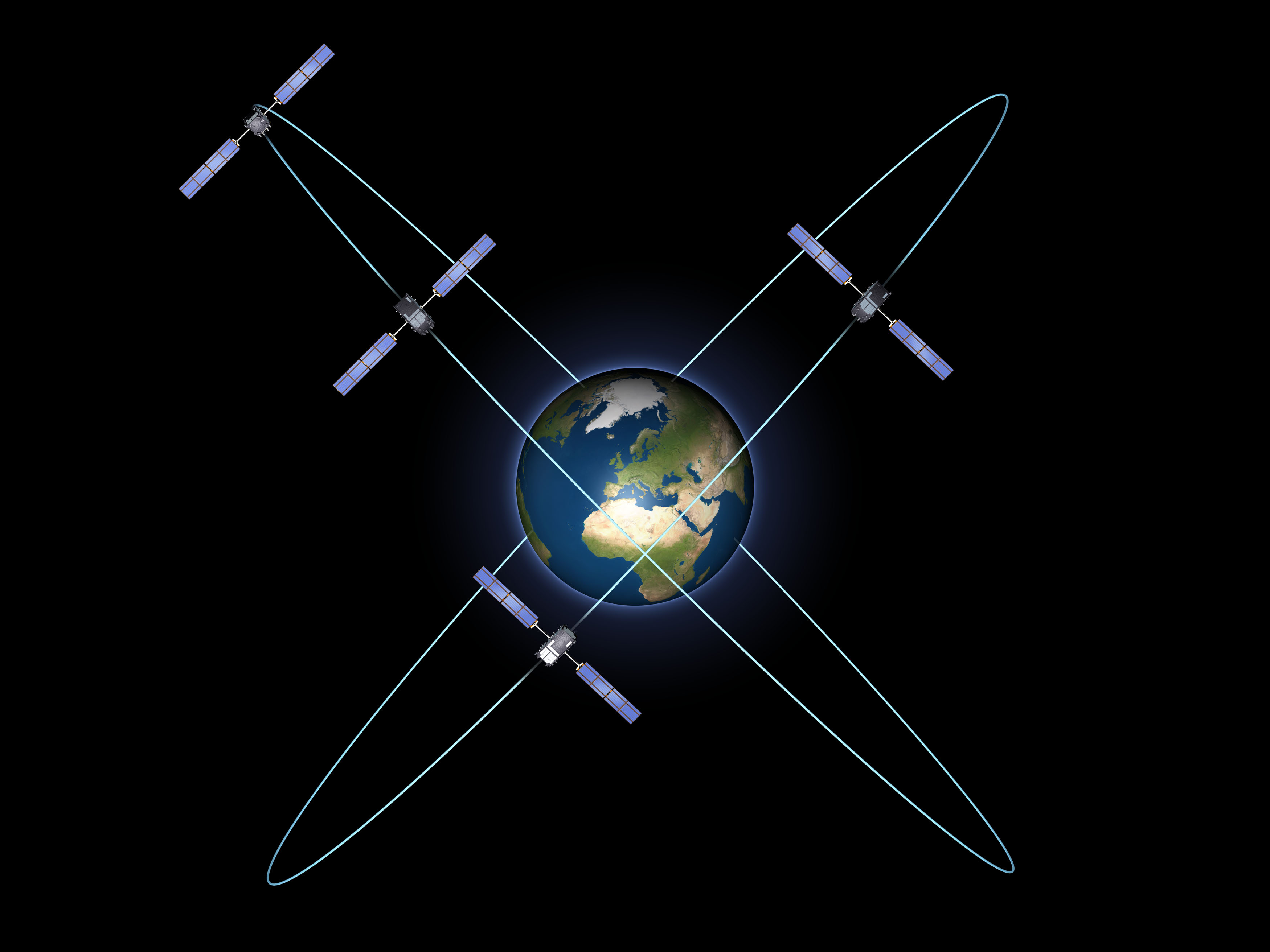
    The Galileo In-orbit Validation (IOV) satellites launched on October 12 (Flight Model 3 and 4), have now been positioned in their designated orbits, according to tracking data from the U.S. Joint Space Operations Center. A plot of the IOV constellation is now available.

    The four IOV satellites are in two orbital planes separated by about 120 degrees. Within each plane, the satellites are separated by about 40 degrees. This orbital arrangement will allow the four satellites to be simultaneously tracked for periods of time by GNSS monitoring stations, permitting positioning tests using only IOV data to be carried out. However, no signals from FM3 or FM4 have yet been detected by stations of the International GNSS Service.

  • New Galileo Satellites Pass Early Orbit Phase

    New Galileo Satellites Pass Early Orbit Phase

    A week after the dual liftoff from Kourou, French Guiana, the two latest Galileo satellites completed the critical Launch and Early Orbit Phase on October 19-20. The satellites are expected to reach their assigned orbits November 10 and 12.

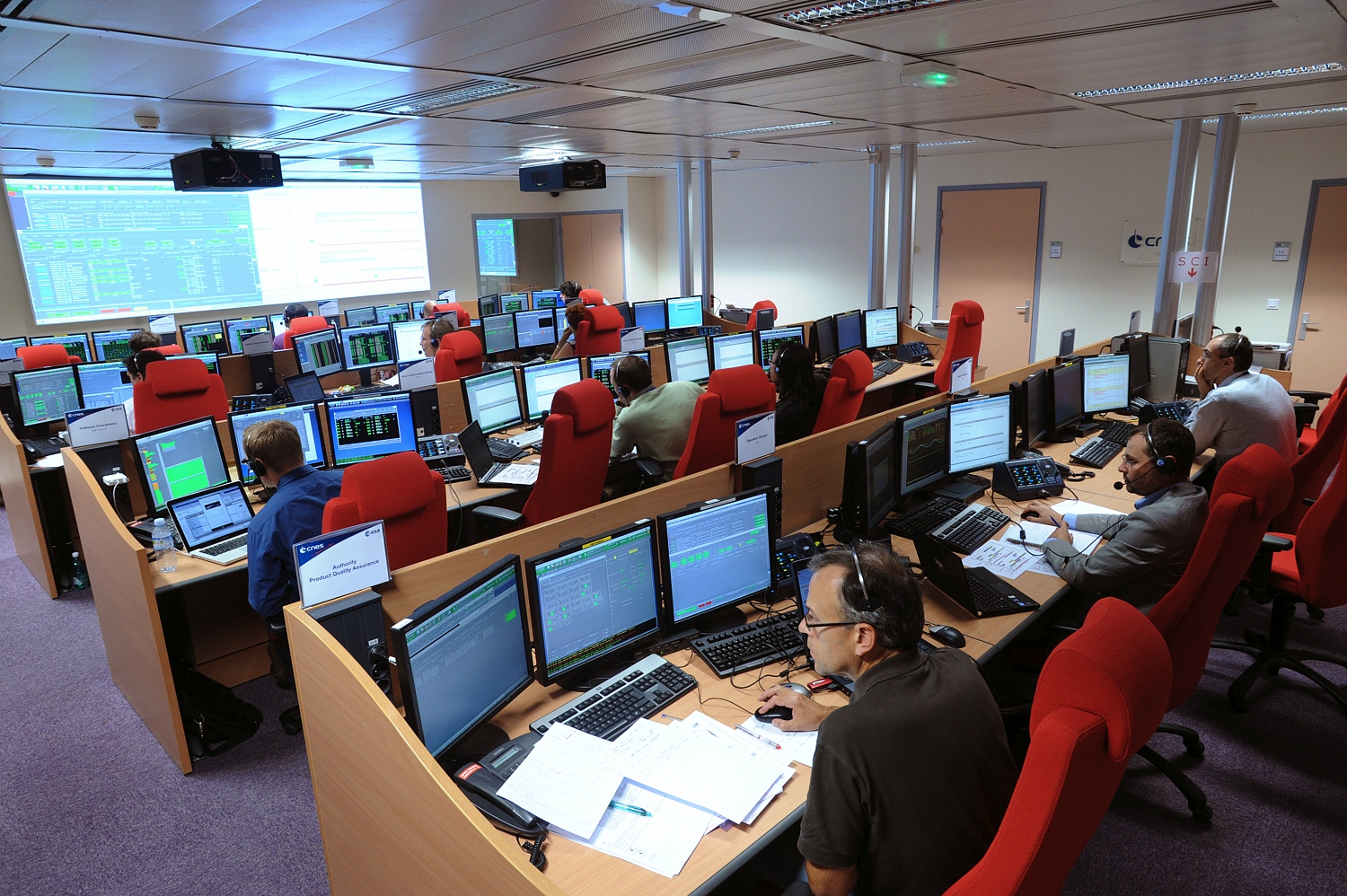
    The FM3 and FM4 satellites were handed over from the joint ESA/CNES Launch and Early Orbit Phase (LEOP) team in Toulouse, France, to the Galileo Control Centre, Oberpfaffenhofen, Germany, from where Spaceopal will manage the operations of the Galileo constellation.

    Following liftoff at 18:15 GMT on October 12, the intensive LEOP activities began upon separation of the satellites from the Fregat upper stage of their Soyuz launcher, with the first signals being received from the pair almost four hours later, according to the European Space Agency.

    The handovers took place at 06:00 GMT on October 19 for FM4 and at 18:10 GMT on October 20 for FM3. During the week, LEOP operations proceeded according to the planned sequence.

    Three orbit manoeuvres were conducted for each satellite to start them on drift orbits towards their operational positions, where they are expected to arrive on November 10 (FM3) and November 12 (FM4) after a series of drift-stop and fine-positioning manoeuvres.

    The satellites were configured into a secure mode shortly after handover. While underway to their final positions, they will also undergo a series of tests to confirm the performance of their subsystems before switching on the payload.

  • Launch Tomorrow for Second Pair of Galileo IOV Satellites

    The European Space Agency (ESA) will be launching a second pair of Galileo IOV satellites tomorrow from Europe’s Spaceport in French Guiana.

    The satellites will ride a  Soyuz ST-B rocket from Europe’s Spaceport in French Guiana. Launch is scheduled for 18:15:00 GMT (20:15:00 CEST) October 12.  Live streaming will begin at 17:48 GMT (19:48 CEST) for about one hour.

    From launch to final deployment, when the dispenser releases the satellites sideways in opposite directions, takes three hours and 44 minutes. Live coverage resumes at 21:25 GMT (23:25 CEST).

    More details, including live streaming of the launch, are available at the ESA website.

    This flight is designated VS03 in Arianespace‘s mission numbering system, and it will be the Spaceport’s third launch since Soyuz was introduced at this near-equatorial facility one year ago. Arianespace is the launch contractor.

    The two Galileo satellites will join the first two spacecraft orbited by Arianespace’s historic VS01 flight on October 21, 2011, marking Soyuz’ introduction at the Spaceport.  Once all four are operational in space, they will provide the minimum number of satellites required for navigational fixes — enabling system validation testing when all are visible in the sky.

    As a European initiative, the Galileo satellite navigation system is being developed in a collaborative effort of the European Union and the European
    Space Agency.  The In-Orbit Validation (IOV) satellites weigh 700 kg. each and were built by a consortium led by the Astrium division of EADS — which
    produced the platforms and has responsibility for the payloads, while Thales Alenia Space handled the assembly and testing tasks.

  • Galileo Satellites Cleared for Launch

    Photo: Galileo
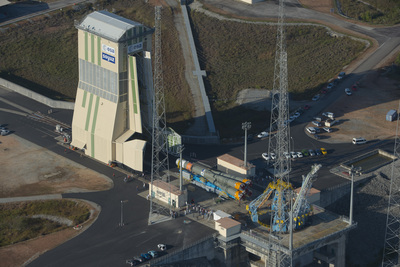
    Soyuz VS03, the third Soyuz flight from Europe’s Spaceport in French Guiana, was transferred to the launch zone on October 8. The vehicle was rolled out horizontally on its erector from the preparation building to the launch zone and then raised into the vertical position, in preparation of the launch of two Galileo satellites.

    Europe’s next two Galileo satellites have received technical clearance for their launch this Friday. They are currently resting in place atop their Soyuz launcher.

    Yesterday saw the three-stage Soyuz ST-B launcher moved horizontally to the launch pad on the 600-meter long railway. It was then lifted into the vertical position to await the attachment of the Upper Composite — the combination of twin Galileo satellites, the dispenser holding them in place, the Fregat-MT upper stage and the protective fairing.  
    Meanwhile, the satellites themselves underwent their formal Launch Readiness Review, after which the Upper Composite joined the Soyuz at the launch pad to be mated to the Soyuz that evening using the mobile gantry. The Soyuz and Upper Composite will undergo a full launch dress rehearsal in the remaining days before the 18:15:00 GMT (20:15:00 CEST) launch on October 12, including preparations for fueling the vehicle, which will begin four and a half hours before liftoff.

    This follow-up launch marks a major step for Europe’s own satellite navigation system. Four is the minimum number of satellites needed to achieve a navigational fix on the ground, with one satellite each to measure latitude, longitude, altitude and provide a time reference. So once this second pair of satellites has been commissioned and tested, the quartet will form a completely operational mini-constellation that will be used to validate the Galileo system.

    The performance of the satellites in space together with the worldwide ground infrastructure serving to maintain Galileo’s service accuracy will be assessed in depth, to prepare the way for the launch of further satellites and then deliver initial services by mid-decade and finally build up to full operational capability.

    These two new satellites are also the first to carry search and rescue antennas to pinpoint aircraft and ships in distress as part of the international Cospas–Sarsat system.

    Photo: Galileo
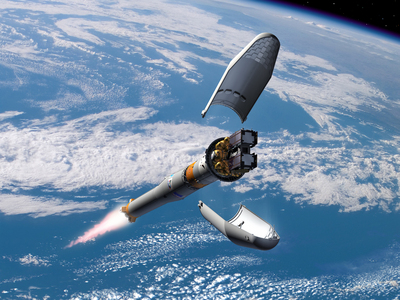
    The two Galileo In-Orbit Validation satellites are protected during their launch by Soyuz by a launch fairing. Once the Soyuz has passed most of the way through the atmosphere, this fairing can then be ejected.


  • Twin Galileo Satellites Fueled and Ready for Launch

    credit: ESA
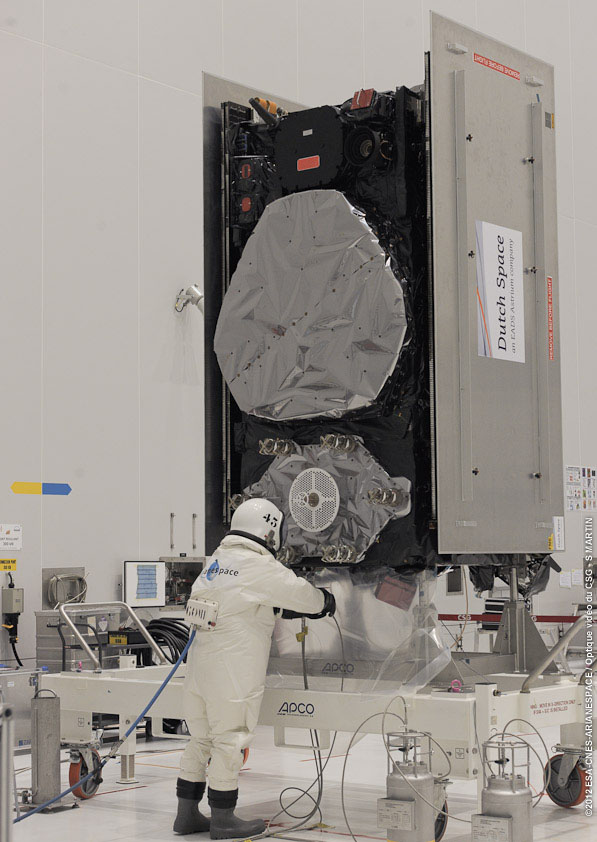
    Galileo FM3 Fueling (credit: ESA).

    A pair of Galileo satellites are now fully fueled and mated together atop the upper stage that will haul them most of the way up to their final orbit. The launch is planned for the evening of October 12, reports the European Space Agency.

    Technicians donned protective suits to fill the two satellites’ tanks with hydrazine fuel, used to maintain the satellites’ attitude and orbital position during their planned 12-year lifetime.

    Rather than carry a significant amount of extra fuel to insert themselves into their planned orbits – like typical telecommunications satellites or Galileo’s US GPS equivalents – the Galileo satellites are transported to medium orbit by the Fregat fourth stage of their Soyuz ST-B launcher.

    Doing without this extra fuel and orbital thrusters means that Galileo satellites are small enough to be launched in pairs aboard the Soyuz – or in fours by the new Ariane 5 variant currently being prepared.

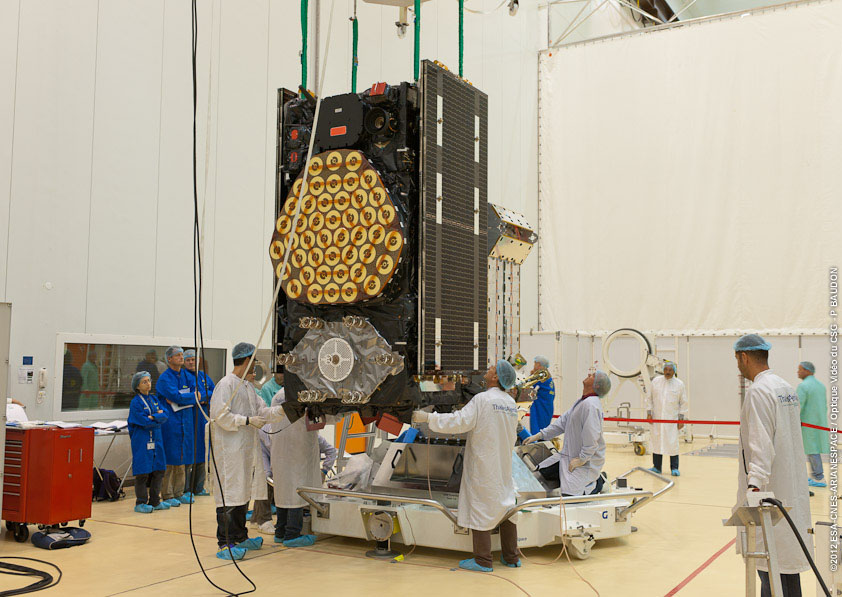
    The Galileo satellites are attached to a special dispenser that holds them securely in position during launch, before pyrotechnic mechanisms release them sideways in opposite directions once their set 23 222 km altitude is reached.

    The aluminum plates on each side of the satellites are temporary additions to protect their delicate solar panels; these will be removed later.

    credit: ESA
    Galileo’s fit-check with dispenser (credit: ESA).

    The combined satellites, dispenser and Fregat upper stage will now be carefully checked ahead of the next major milestone, the fitting of the protective launch fairing on Thursday.

    The mission’s satellite launch readiness review will begin at the start of the following week. If that goes well, the combined ‘Upper Composite’ will be moved from the Fregat Integration Building to the launch pad, where it will be attached to the Soyuz launcher.

    Completing Galileo’s validation phase

    The launch will see these two new Galileo In-Orbit Validation satellites joining the first two that have been orbiting since October 2011.

    This is a significant milestone for Europe’s Galileo programme because four is the minimum number required for navigational fixes, enabling full system testing whenever they are all visible in the sky.

    This validation phase will be followed by the deployment of more satellites and ground segment components to achieve ‘Full Operational Capability’. After that, users on the ground can exploit the services.

    The first four Galileo satellites were built by a consortium led by EADS Astrium, Germany, with Astrium producing the platforms and Astrium UK responsible for the payloads. They were assembled and tested in Rome by Thales Alenia Space.

    credit: ESA
    Galileo IOV in orbit (artist’s rendering, courtesy of ESA.)
  • Preparations Move Forward for Next Galileo Launch


    Galileo Flight Model #3 (FM3) is readied for the satellite’s fit check on the dispenser that will carry it and FM4 in a parallel arrangement on Soyuz’ next launch. The silver-colored dispenser is partly visible behind two mission team members during this activity in the Spaceport’s S1B payload preparation building.


    Both Galileo navigation satellites for Arianespace’s third Soyuz flight from the Spaceport are now in French Guiana, marking a new milestone for this mission scheduled in the second half of 2012, according to Arianespace.

    The Flight Model #4 (FM4) satellite arrived Friday at Félix Eboué International Airport near the capital city of Cayenne, delivered by a chartered Ilyushin Il-76TD cargo jetliner.

    Its FM3 co-passenger remains busy in the Spaceport’s S1B payload preparation building — completing its fit check with the dispenser for the dual-satellite payload arrangement on Soyuz. The dispenser was developed for Arianespace by RUAG Space, and carries the satellites in a parallel arrangement.

    These two spacecraft will join another pair of Galileo satellites launched by Arianespace in October 2011 on Soyuz’ maiden flight from French Guiana. All four are In-Orbit Validation platforms that will enable European industry to validate prototype Galileo-based receivers and services using actual satellite signals, while also allowing performance assessments of the ground system that will maintain the Galileo system’s precision.

    Arianespace is responsible for deploying the entire Galileo constellation, to be composed of 30 satellites in orbit as an independent global satellite navigation system for Europe.

    Galileo launches began with the 2005 and 2008 orbiting of two experimental satellites — GIOVE-A and GIOVE-B — carried on Soyuz vehicles operated from Baikonur Cosmodrome in Kazakhstan by Arianespace’s Starsem affiliate. It was followed by October 2011’s maiden Soyuz launch from French Guiana with the constellation’s first two operational satellites.

    Arianespace is able to use a mix of both its medium-lift Soyuz and heavy-lift Ariane 5 launchers in deploying the full Galileo system, demonstrating the company’s flexibility in orbiting satellite constellations.


    The photo shows FM4’s unloading from the Ilyushin Il-76TD cargo jetliner at Cayenne’s Félix Eboué International Airport.


    The fourth Galileo flight model satellite being unloaded at Cayenne Airport in French Guiana on August 17. (Credits: ESA/EADS Astrium – Raoul Kieffer)

  • GIOVE-B: Lost and Found

    News courtesy of CANSPACE Listserv.


    After more than four years of service as a Galileo test-bed satellite, GIOVE-B was retired on July 23. Its navigation transmitters were switched off and, according to an announcement from the European Space Agency, the satellite’s height was subsequently raised in a series of steps to place it in a so-called “graveyard” orbit where there will be no danger of it interfering with the operational Galileo satellites or other spacecraft.

    After the first delta-V orbit manoeuvre, NORAD/JSpOC lost the satellite — at least NORAD/JSpOC stopped providing updated two-line orbital element sets for it. Eventually, 24 days later, the agency found it and resumed issuing element sets.

    Just before the orbit manoeuvres, GIOVE-B had a mean motion of 1.70959839 orbits per day according to NORAD/JSpOC, which translates to an orbit semi-major axis value of approximately 29,544 kilometres. When NORAD/JSpOC recovered the satellite, its mean motion was 1.65377594 orbits per day with a semi-major axis of 30,205 kilometres, a change of 661 kilometres.

  • Spectratime Atomic Clocks Selected for Eight Galileo Satellites

    Spectratime, a provider of atomic clocks and a business of the Orolia Group, has announced it has been selected to provide the Rubidium atomic clocks and passive hydrogen masers for eight satellites for Europe’s Galileo GNSS. Spectratime expects this Authorization to Proceed will lead to a final contract for the manufacture of these two types of high precision clocks, estimated at 14 million euros, by summer 2012.

    “This new authorization to proceed, just a year after the signing contracts totaling nearly 20 million euros for the supply of the clocks for the first 14 operational satellites for the Galileo satellite navigation system, confirms Spectratime’s position as a world leading supplier of space atomic clocks,” said Jean-Yves Courtois, CEO of the group. “Each satellite carries on board two rubidium atomic clocks and a passive hydrogen maser, the most stable type of atomic clock in the world. In a few years, after the execution of the contract, which will be implemented in partnership with Astrium and Selex Galileo, we will have the most currently active atomic clocks in space, including 72 for the Galileo system alone.”

  • Soyuz Takes Shape in French Guiana for Dual Galileo Launch

    Assembly process for the Soyuz launcher began with integration of the four first-stage strap-on boosters to the Block A core second stage (photos at left and center).  At right, the Block I third stage is seen after its mating to the launcher’s core.

    The launcher for Arianespace’s next Soyuz mission from the Spaceport in French Guiana is completing its initial checkout for a flight in the second half of 2012, which will carry another two spacecraft for Europe’s Galileo satellite navigation constellation, according to Arianespace.

    During activity at the Spaceport’s Soyuz Launcher Integration Building — known by its Russian “MIK” designation — the vehicle’s four first-stage strap-on boosters have been mated with the Block A core second stage, followed by integration of the Block I third stage.

    With its initial build-up concluded, the Soyuz is undergoing regular maintenance checks that are standard for the Russian-built vehicles that have been in storage prior to their mission. Such verifications include testing of the launcher’s pneumatic and electrical systems, Arianespace said.

    This Soyuz will carry Europe’s next two Galileo In-Orbit Validation (IOV) satellites, joining the first pair of spacecraft lofted on Arianespace’s historic maiden flight of the Russian-built launcher from French Guiana in October 2011. Once the four IOV satellites are in orbit, they will provide the minimum information needed for space-based navigation: latitude, longitude and altitude data, along with ranging accuracy, enabling assessment of the Galileo system’s performance, while also allowing suppliers to realistically check their receivers and services against actual signals.

    Arianespace has been chosen to deploy the entire Galileo constellation of 30 satellites. This began with the launch of the first two experimental satellites, GIOVE-A and GIOVE-B, orbited by Arianespace’s Starsem affiliate on Soyuz launchers from Baikonur Cosmodrome in 2005 and 2007. Subsequently, Arianespace lofted the initial pair of In-Orbit Validation spacecraft on Soyuz’ October 2011 inaugural mission from the Spaceport.

    The remaining 24 Galileo constellation satellites will be orbited through 2015, using six additional Soyuz vehicles carrying two spacecraft each, along with three Ariane 5s configured with four per launch.

    Initial phases of the Galileo program were carried out by the European Space Agency (ESA) in activity co-funded with the European Commission. Galileo’s Full Operational Capability phase is being managed and funded by the European Commission, with ESA and the Commission having signed a delegation agreement by which the space agency acts as design and procurement agent.

    The upcoming Galileo mission is designated VS03 in the numbering system for Arianespace’s launcher family — which is composed of the medium-lift Soyuz, heavy-lift Ariane 5 and light-lift Vega – all operated at the Spaceport. The “V” represents the French word for “flight” (Vol), while “S” signifies the use of a Soyuz launch vehicle. Its “3” denotes the third Arianespace mission of Soyuz from French Guiana.
  • First Payload Ready for Next Batch of Galileo Satellites


    These payload panels for the first Galileo Full Operational Capability satellite are undergoing
    final testing in the Assembly Integration Test hall at Surrey Satellite Technology Ltd. in
    Guildford, UK, in April 2012 before being boxed up for shipment to prime contractor OHB in Germany.

    The first of 14 Galileo Full Operational Capability (FOC) navigation payloads has been shipped from Surrey Satellite Technology Ltd. in the United Kingdom to prime contractor OHB System AG in Bremen, Germany, according to the European Space Agency. The payload, which provides Galileo’s precision positioning measurements and services to users, will then be added to the waiting satellite platform.

    “The payload for the fifth satellite in the Galileo constellation is ready,” said Didier Faivre, ESA’s director of the Galileo Programme and Navigation-related Activities. “While the next two satellites to be launched are currently undergoing testing, the next ones are being built. Another important step forward for the programme was made today.”

    The SSTL payload is engineered to provide all Galileo navigation services, and is based on European atomic clocks, navigation signal generators, high-power amplifiers and antennas. “The delivery of our first Galileo payload is an important milestone towards achieving full satellite qualification at the end of the year,” commented Matt Perkins, SSTL CEO.

    The first two Galileo satellites entered orbit October 21, 2011, with two more due at the end of this summer. These initial satellites carry payloads built by Astrium UK in Portsmouth, with Thales Alenia Space in Italy integrating them with their satellite platforms.

    The new satellites are the follow-up batch of Galileo satellites, planned to begin launches in 2014. Once all 14 are in orbit, the 18-satellite Galileo constellation will achieve Initial Operational Capability and will be able to provide initial navigation services — the full range of services will be available once all 30 satellites are in place in 2018.

    In addition to these first 14 FOC satellites, the OHB–SSTL consortium was awarded a contract to build a further eight satellites for the Galileo system in February this year.

  • Galileo Launches Accelerated

    Javier Benedicto, the head of the Galileo Project Office for the European Space Agency (ESA), set an aggressive schedule for launching some Galileo satellites as many as four at a time in 2014 and 2015, in an effort to meet a target provision date of Galileo’s initial services in 2014 and full services in 2015. The announcement emerged at the Munich Summit on March 14.

    The hurry-up to carry a further 22 satellites into orbit will get underway with continued dual-satellite launches aboard Russian Soyuz rockets, as was the case for the most recent in-orbit validation (IOV) launch in October, 2011. There will be three Soyuz launches in 2013, for a total of six new satellites boosted into orbit, and two Soyuz launches in 2014, adding four more. Then the burden will shift to European rockets provided by Arianespace, according to a contract signed in February of this year. One Ariane 5 rocket is slated to carry four Galileo satellites aloft in 2014, bringing the projected total of IOV and eventually operational Galileo satellites in space to 16 by the end of 2014.

    Previously, ESA had aired plans to continue with Soyuz-borne IOV launches in 2012, but the schedule announced in Munich did not mention these.

    In 2015, two more Ariane 5 launches will add eight satellites, for a total on orbit of 24, estimated to be sufficient for Galileo full operational capability.

    In subsequent talks with European satellite manufacturers OHB Systems and Astrium, GPS World contributing editor Don Jewell was told that the future launch schedule is “subject to change.”

    ESA has made no official announcement of a detailed launch schedule; inquiries regarding the Benedicto remarks were referred to the February contract statement, cited above.