Tag: GIS

  • Eos Positioning Systems: Building a System to Build an Island Resort

    Eos Positioning Systems: Building a System to Build an Island Resort

    When Chris Kahn arrives by helicopter on the island of Barbuda, in the Caribbean, he sees reef-lined beaches, meadows, marshes, and construction underway on a private club consisting of more than 200 luxury family homes, a world-class golf course, and other amenities. Construction on the project, by Discovery Land Management, will last at least another 10 years, said Kahn, who began working on it in late 2019. The island, which can also be reached by ferry or small plane, is 15 miles long and has a local population of about 1,500 people.

    The biggest challenge for the project was the total lack of internet connectivity on the island, except for satellite communication at basecamp. A consultant who designed the golf course irrigation layout had attended many meetings for the project in which the participants discussed in vain how to coordinate their work without an internet connection, a problem that a few engineering firms had also been unable to solve. So, he suggested that they turn to Kahn, with whom he had already worked closely. Discovery Land Management hired Kahn, founder and owner of AlphaRTK, to provide a common operating picture for the teams of surveyors, architects, planners, construction workers and landscapers building the resort and the golf course.
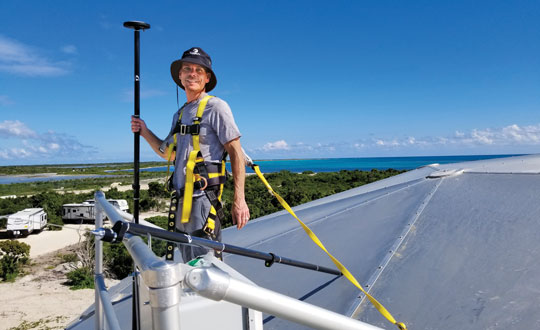
    Chris Kahn installing a UHF base station (its antenna is visible in the foreground on a telescopic mast) atop a 50-ft water tower. (Photo: Chris Kahn, AlphaRTK)
    Chris Kahn installing a UHF base station (its antenna is visible in the foreground on a telescopic mast) atop a 50-ft water tower. (Photo: Chris Kahn, AlphaRTK)

    RTK UHF Base Station

    Kahn proposed they build their own RTK UHF base station. “You can get about a seven-mile line of sight out of UHF and with repeater radios we can extend that, which is what we eventually did,” Kahn explained. So, he put the base station where the project had an internet connection and relayed the UHF signal from there. He gave the teams Eos Arrow Gold GNSS receivers, which have a UHF plug on the side, with Satel UHF radios. “It works like a charm,” he said. He also set up for the project an ESRI ArcGIS Online account, which now hosts all its maps and data.

    “They’re doing a lot of earthwork that needs survey-grade accuracy but does not legally require a survey,” Kahn pointed out. Starting in about 2010, he explained, RTK accuracy began to explode for geographic information systems (GIS) and unmanned aerial systems (UAS). “It’s accelerating,” he said. This has greatly increased opportunities for high accuracy data collection beyond traditional surveying tasks such as boundary surveying. “My niche, and one of the places where there’s a lot of pain, is this interoperability between projects that have surveyors and landscape architects and all sorts of folks in subject matter expertise that are trying to come together to build something.”

    Like the rovers, the base station contains an Eos Arrow Gold, with a 35-watt Satel UHF output. Project staff and contractors can connect to it with any device that can accept that UHF protocol. Their rovers are set up to work with ESRI ArcGIS Field Maps, so that workflow is very smooth, Kahn said. The project started where they began to build the golf course, at a worksite seven miles away from the base station, across open water. Kahn then installed a UHF repeater antenna there and additional ones as construction moved inland.

    The island is relatively flat, but the sand dunes are quite large. Therefore, to enable the line of sight that UHF requires, Kahn had to install the antennas for the repeaters as high as possible. For one, he used a whip antenna on top of a 15-foot telescopic mast on top of a 20-ft high deck. A repeater antenna costs about $2,500 and takes a few hours to install. “It is fairly old technology,” he said. “I tend to look for an easy button and string together inexpensive ways to do things fairly rapidly.”

    UAS Photogrammetry

    The project covers 2,500 acres at two locations. While traditional surveyors are working on the project for building construction, their speed is too slow for the crews doing earthwork, particularly on the golf course. This involves pushing sand around, dredging lagoons, and building the course, which requires taking many elevations very rapidly. To speed things up, Kahn decided to use UAS to fly frequent photogrammetry collections. He began by installing ground control points, surveyed them, and put them around the construction sites. He then trained the laborers on the project to conduct high-accuracy, survey-grade workflows using UAS the flight paths of which he programmed.

    All the laborers need to do is launch the UAS and, after each flight, extract the SD memory card and upload the data to a shared directory. “They don’t even have to put the props on anymore because they just fold out,” Kahn said. He processes the data and publishes the aerial photogrammetry into the project maps. The next day, everyone on the project has access to survey-grade accurate aerial imagery and a map.

    “How frequently they fly them depends on how much activity is going on at the various sites,” Kahn said. “That turnaround time can be as short as a few hours if they need it, between them flying it, uploading it for me, and having it back in their maps. Everything has sub-inch positional accuracy. When they zoom into some of the foundation pilings on the homes, they’re aligning perfectly.”

    Survey-Accurate GIS

    Project managers need GIS to see everything — survey, landscape design, architectural design, engineering design — in a common operational picture, which they were not able to do prior to Kahn joining the project. “I was looking at email threads that were 45 messages long, with two dozen people on three different continents, talking about where something’s located and referencing something else, with many civil drawings attached as PDFs — one from the landscape architect, one from survey, one from a civil engineer. They were saying, ‘Well, this doesn’t look like it matches.’ I was brought in to make it all one pane of glass.” That requires overlaying survey-grade accurate architectural and engineering information on the GIS information.

    “That’s where you run into this niche area in which I work that often surveyors don’t fully understand,” said Kahn. “In the United States, there are civil engineering surveyors and design-build shops that include geospatial, though it is not commonplace. Outside of the United States, it is rare.”

    The rovers for GIS data collection are sub-centimeter accurate, as are the ground control point targets that Kahn installed for the UAS workflows. Workflows were designed for simplicity, allowing laborers to reliably perform UAS and GNSS data collection.

    ESRI ArcGIS Field Maps is well suited for this project because it works offline. As they walk around the site and try to understand what they will build, planners, architects and engineers can see the most current maps on their phones, rather than having to consult PDFs or paper.

    “I had to do a lot of work with their engineering firm, though, to get their 3D civil drawings to interact with GIS,” Kahn recalled. “Now, all the line work coming from engineering is perfectly aligned, and all field adjustments made by construction are real-time updated in the design drawings. You can see how accurate this GIS is. Everything is perfectly placed, and these are data coming from four different places: GIS, UAS, engineering design, and survey. Everything is aligned within one to two centimeters.”
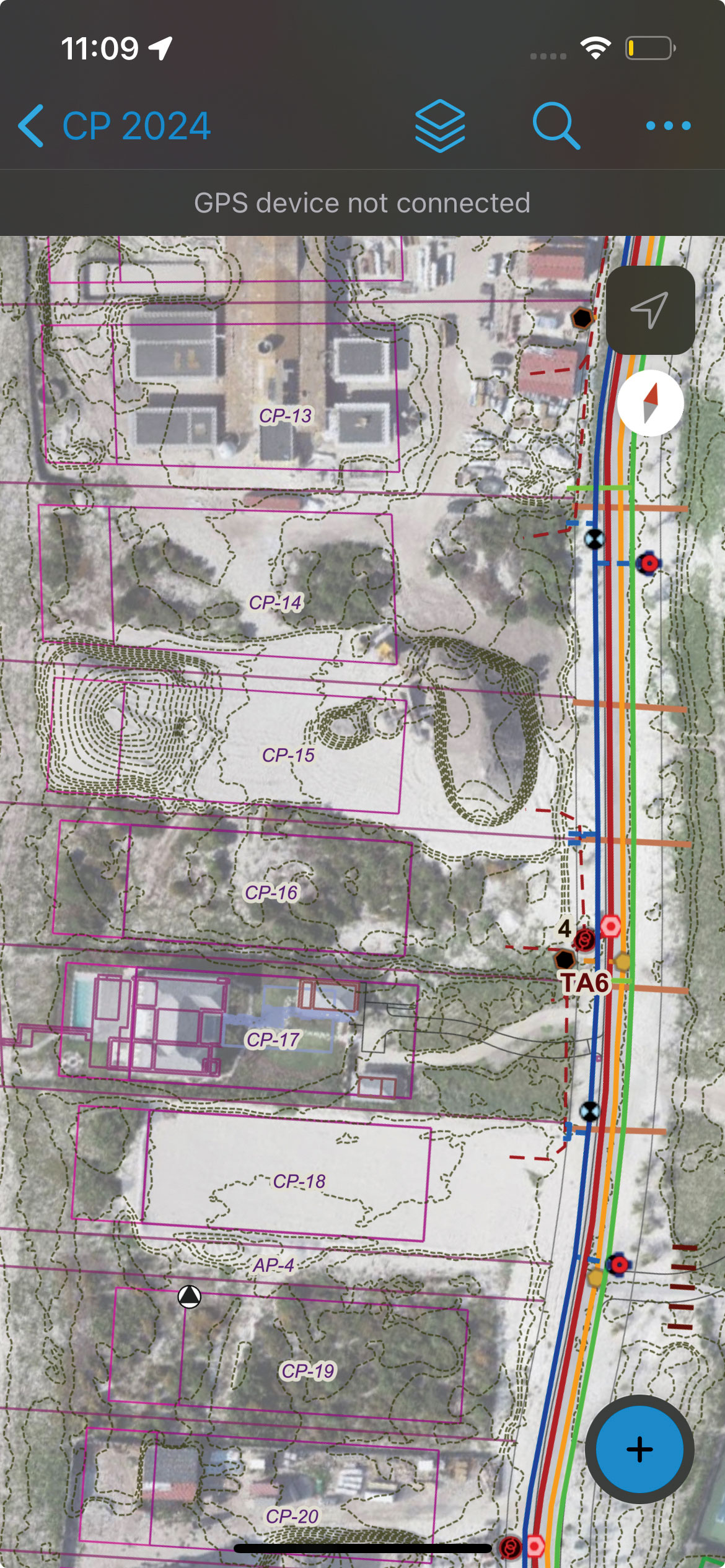
    iphone screenshot, showing lots, foundations, finished construction, virgin sand, and utility lines. (Photo: Chris Kahn, AlphaRTK)
    iPhone screenshot, showing lots, foundations, finished construction, virgin sand, and utility lines. (Photo: Chris Kahn, AlphaRTK)

    With golf course building, “design is a suggestion,” Kahn said, and many changes are made in the field. “In fact, the pace of ‘field adjustments’ was a crucial reason I was brought in. Engineers cannot wait a year for an as-built drawing set to be delivered.”

    Cut-and-Fill

    This workflow streamlines the many cut-and-fill operations involved in the project. “Coco Point is a good example,” Kahn said, “because some of the lots there are completed.” Zooming into one of the completed lots, he can see the nine-foot grade for which one construction company is responsible and the 11-foot grade for which another construction company is responsible. “It’s important for them to know those two grades because of cost; it’s very expensive to bring fill in here. So, as they’re doing these drone flights, they have dashboards that show them how much fill they need to bring in.”

    The common operational picture enables project managers to optimize the cut-and-fill transfers. The golf course was particularly challenging because it is in a very swampy area, making it difficult to move the dredging equipment. So, they asked Kahn to design the path for the trucks and determine how much fill they would extract out of these lagoons. “I knew they needed this much to meet design on the green and could get this much out of the lagoon,” he said. “It was very helpful for them procedurally with the planning.”

    Challenging Environment

    The environment on the island is challenging. “It was wild,” Kahn recalled. “Nothing but wild donkeys and enormous boars, which I really learned to avoid after a while. It is mostly wetlands, so it is hard to get around.” A construction manager told him: “Chris, I’ve led projects on every continent, but this place is the [expletive] moon.”

    The challenging environment and the lack of internet connectivity make the system that Kahn set up particularly helpful, because it provides accurate data quickly and with a streamlined workflow. “The big story here is that common operational picture,” Kahn said. “It’s taking the best tools of the GIS/geospatial world — such as RTK and UAS. They must be accurate, work offline, and be very easy and fast. You must maintain that accuracy so that the surveyors who work on this project aren’t going to yell and scream.”

    The project also requires building and maintaining utilities — water, gas, sewer, stormwater, electric, and telecom — which are all in underground plastic pipes and are often not placed as designed. “Doing the digital ‘as building’ up front, as it goes in the ground,” Kahn said, “saves time and money down the road.” Additionally, the turnover of people who work on these projects, including managers, is high, so institutional knowledge is constantly lost. “Utilities in the United States have a fairly stable workforce, but in the resort world, everything’s plastic and sand,” said Kahn. “The high turnover and the low institutional knowledge make it even more important to have a true digital twin.”

  • Linux Foundation’s AgStack Project will build dataset of field boundaries

    Linux Foundation’s AgStack Project will build dataset of field boundaries

    Photo:
    Image: fotokostic /iStock/Getty Images Plus/Getty Images

    On Dec. 20, the Linux Foundation announced its AgStack Project, which will host an open-source code base, along with a fully automated, continuous computation engine that will maintain a global dataset of boundaries for agricultural fields. The AgStack Asset Registry dataset will aid food traceability, carbon tracking, crop production, and other field-level analytics.

    This ‘registry’ is designed to continuously update using data from satellites and real field registrations that contain boundary information, which will train machine learning models to ascertain more boundaries, among other capabilities.

    Agricultural datasets are rarely public information. By using computer science and artificial intelligence (AI), users can create global field boundaries as a digital open source for public use, which can help farmers, agricultural companies, and the public manage crop production, study management practices, assess levels of productivity, monitor the spread of pests and diseases and more.

    The AgStack project seeks to enable all types of agricultural data and services by combining computing and AI expertise with a global network of partners in an open-source software system. All code is being contributed under an open-source license and will be governed by the AgStack community, within the Linux Foundation.

  • CHC Navigation launches Landstar8 data-collection app

    CHC Navigation launches Landstar8 data-collection app

    Screenshot: CHCNAV
    Screenshot: CHCNAV

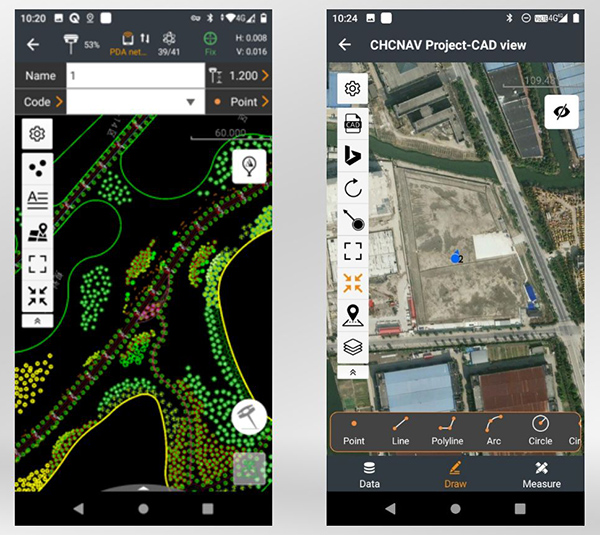
    CHC Navigation has released LandStar8, a field surveying and mapping application for Android devices. LandStar8 is designed to be flexible and user-friendly for surveying and mapping tasks.

    LandStar8 is versatile, modular and customizable for topographic tasks such as surveying, stake out, cadastral, mapping and geographic information systems (GIS). Building on the legacy of LandStar7, the new LandStar8 provides features such as a refined user interface, streamlined workflows, faster operation, and integrated cloud services.

    “With LandStar8, we want to provide our users with unprecedented field experience,” said Rachel Wang, product manager of CHC Navigation’s Surveying and Engineering Division. “LandStar8’s modular design allows users to customize the interface according to their usage habits, making it easier and more efficient for field crews to work.”

    Cloud connectivity is built in, for backup, data storage or remote technical support.

    LandStar 8 has a simple and intuitive layout with large map windows and sharp graphics. Users can hide features they rarely use and display only those they need.

    On LandStar8, users can copy coordinate settings, control and staking points from another handheld controller by scanning a QR code. Projects can be edited and sorted by history and attributes. Custom coordinate systems, geoid models and coding libraries can be updated at any time by using resource packages. LandStar8 also features a terrain calibration wizard designed specifically for non-expert users.

    A proprietary MetaCAD graphics engine opens DWG and DXF base maps faster and with smoother rendering. DXF files up to 200 MB can be opened in less than 10 seconds. LandStar8 also supports opening external reference files, automatically recognizes CAD length units, and allows editing of CAD base maps directly in the field.

    LandStar8 is designed around a comprehensive cloud-based architecture that supports project backup, collaborative work and data storage. Its remote support capabilities help the office helpdesk resolve user problems and provide personalized technical assistance. A “share code” feature allows users to transfer project data between desktop computers and field controllers or among field controllers quickly to further boost work efficiency.

  • Fugro joins forces with Carbonix on remote aerial operations

    Fugro joins forces with Carbonix on remote aerial operations

    The Carbonix Volanti vertical take-off and landing (VTOL) drone. (Photo: Carbonix)
    The Carbonix Volanti vertical take-off and landing (VTOL) drone. (Photo: Carbonix)

    Fugro is partnering with Australian drone manufacturer Carbonix to establish a new long-range drone capability. It is Fugro’s first partnership working towards long-range beyond-visual-line-of-sight (BVLOS) missions, bolstering Fugro’s existing geographic information system (GIS) capability.

    Carbonix will supply Volanti and Ottano vertical take-off and landing (VTOL) drones over the next 27 months, to further enhance Fugro’s remote operations.

    Fugro is engaged in the transition to remote and autonomous operations with a global network of nine remote operation centres (ROCs). From these centers, Fugro operates boats and other vehicles, and provides survey, inspection and piloting services to the global maritime industry.

    Carbonix will support Fugro’s Australian long-range maritime and land projects from the sky, using aerial surveying and data-capture technology, while integrating with Fugro’s ROCs for the joint development of systems technology and capabilities.

  • Trimble introduces high-accuracy mapping solution for GIS field applications

    Trimble introduces high-accuracy mapping solution for GIS field applications

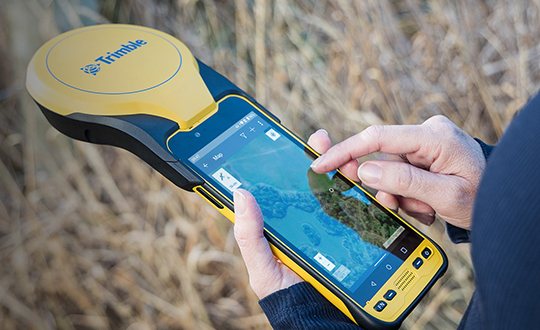
    Trimble has announced a new high-performance data collector for its Mapping and Geographic Information Systems (GIS) portfolio — the Trimble TDC650 handheld. Built for GIS data collection, inspection and asset management activities, the TDC650 provides users a rugged solution with scalable high-accuracy GNSS positioning for professional field workflows.

    The TDC650 is fully integrated with today’s demanding GIS data environment, powered by the Trimble Software Development Kit (SDK) that enables precision GNSS positioning for apps such as Esri ArcGIS Field Maps and Trimble TerraFlex software. The TDC650 is also a scalable solution that allows customers to choose their desired accuracy down to the centimeter-level to meet needs and budget requirements.

    “This is an ideal tool for customers tasked with modernizing critical utilities including electric, gas and telecommunications networks,” said Gareth Gibson, marketing director, Trimble Mapping and GIS. “The precision, quality and data integration workflows needed to map the physical world to a digital one in these projects requires a modern data-collection platform like the TDC650.”

    City, state and local governments and utilities will benefit from this solution, which is part of the larger Trimble Public Sector ecosystem that includes Cityworks software for stormwater inspections and Trimble Unity for monitoring municipal water pressure and hazards. As GIS data continues to grow more complex, Trimble helps simplify, visualize and make sense of the data so customers can make better decisions in managing their communities’ assets.

    Photo: Trimble
    Photo: Trimble
  • Leadership Talks: Interview with Gareth Gibson, Trimble

    Leadership Talks: Interview with Gareth Gibson, Trimble

    Precision at Any Level

    Business Model Enables Mass Adoption of Product with Service

    In September 2021, Trimble released its DA2 GNSS receiver with Trimble Catalyst service. I asked Gareth Gibson, the company’s marketing director, Mapping & GIS Solutions, about the product and recent developments in GNSS-enabled mapping.


    When I started in this business, more than 20 years ago, we used to divide GNSS receivers into three categories, broadly speaking: consumer grade, resource grade, and survey grade. Are those distinctions still useful?

    The survey world and the mapping world have been coming together over the last 20 years or so. Probably Jack Dangermond was one of the first people to publicly acknowledge that. Surveying is an ancient profession whereas mapping and GIS, as an industry, has evolved much more recently. The techniques and the expectations of precision and the complexity of the workflow coming from the survey side has always been somewhat at odds with what the mapping world has been trying to achieve, so the products and the tools of these industries were quite different.

    The Trimble DA2 receiver boosts the performance of the Trimble Catalyst GNSS positioning service. (Photo: Trimble)
    The Trimble DA2 receiver boosts the performance of the Trimble Catalyst GNSS positioning service. (Photo: DroneWorks)

    However, there has been a blurring of the lines. Today, the capabilities of mapping-grade GNSS systems are no different from those that can be used in the survey industry as well. Catalyst is an example of that. However, the focus is much more on ensuring that the technology gets out of the way. Let the technology vendor take care of the hard parts, to make it work in the environments where it needs to work, and to make sure it operates with the software that allows the mapping user to focus on the job, with less complexity. We’ve reached that point where it’s difficult to distinguish the capabilities of a survey-grade receiver from those of a mapping-grade receiver. Technically, there’s very little difference.

    You can think of Catalyst as renting the performance of the receiver to enable the work to get done. The convergence of technology is enabling the business model transformation, and the business model transformation is aiming to better address the needs of the user. The types of services that these tools enable, the methods with which these tools communicate with homebase and with the vendors—licensing systems, platforms and so forth—have reached a point of enabling delivery of products as a service. That is a good thing because customers are not interested in owning a product as much as they are in getting to the solution that they need.

    So, the focus switches from “How do we deliver this product?” to “How do we best deliver this service and the solution?” Catalyst attempts to do that by delivering, in effect, positioning as a service. You are not buying a piece of hardware; you are purchasing the capability to generate and use high accuracy within your workflow to get your job done. That shifts the focus from upfront expense to delivering positioning as an operational cost.

    What does the DA2 with Trimble Catalyst service enable that was not previously possible?

    It enables the mass deployment of precise GNSS across organizations with tens or hundreds or even thousands of workers. They can now benefit from adding GNSS technology to their work where it was previously prohibitively expensive, too complicated, or simply incompatible with their workflows. Catalyst and the DA2 is enabling that through the business model, which we have employed for the technology, and through the technical capabilities of the platform, which has reached a point of being much easier to be mass adopted across organizations.

    The significant change that we’ve made with the DA2 was the addition of support for Apple-based devices. The norm now is to use the phone or the tablet that you have in your pocket, as opposed to purchasing dedicated equipment, especially as it relates to the group of workers we would describe as the location-enabled workforce. These are people typically who are not trained surveyors or GIS professionals but are performing a function with an organization and location-enabled workflows. Software applications are just part of their toolkit for their day-to-day work. It does not make sense to equip these teams with very expensive and complicated equipment, but the functionality that the equipment can provide can unlock some areas of productivity that would have otherwise been inaccessible to them.

    What are the remaining technical challenges to mapping for GIS and asset management applications?

    The nut that we’ve cracked is enabling precision at almost any practical level, using GNSS, anywhere around the world. We continue to strive towards having access to that level of precision in any environment. There’s a limit to what can be achieved with GNSS alone. So, we start to see more and more the use of combined technologies, different data and sensor fusion. People are leveraging different parts of the technology jigsaw — what is available on their phones, what is available from external sensors, and what they can do with the raw data they are capturing, either directly within a piece of software on their mobile device or somewhere in the cloud, to make better use of the raw information that has been captured.

    The second major area is the merging and connecting of workflows, not just the types of data that these organizations are capturing. Organizations are working with field teams, all that data coming together and being able to be used in a toolbox to enable different types of work to get done. In the past, things have been a lot more siloed. Now, technology is enabling us to work together in more clever ways. It is easier to share information.


    “The nut we’ve cracked is enabling precision at almost any practical level, using GNSS, anywhere around the world.”


    Is accuracy the only difference between surveying and mapping?

    For surveyors, the primary deliverable is location. The historical basis of that industry is all about being able to capture and work with information in the most precise way possible. In the mapping world the focus is more on the information that’s being captured about that position, and its precision is just another attribute. That has helped to change our perspective on the relative importance of precision as part of the workflow and has driven us more towards trying to simplify the way that location is captured in a mapping workflow.

    Our goal is to capture the most accurate position and to simplify the process for the user. We’ve tried to automate such things as the choice of correction service so that it’s a much more approachable technology and the user can focus on their area of expertise, which is the collection and designation of the mapping attributes.

    What are the components of the Trimble Catalyst solution?

    There are two elements to Catalyst. One is positioning as a service, enabled through a subscription. The other is the GNSS antenna. The latest generation of that is the DA2. We have made some changes to the DA2 to enable some better functionality and broader applicability. Without a high-quality antenna, there’s only so much that you can do with GNSS. Our focus with DA2 was to make the antenna component of the solution as small and lightweight as possible, but as high performance as possible. We’ve enabled that through a combination of very clever engineering.

    The physical structure of the antenna is quite different from that of any other antenna that we build within Trimble. The idea to make it simpler, lighter and lower cost influenced almost every design decision that went into how that antenna is built — from how it fits and mounts with varying carrying solutions to how it is powered. In the first version of Catalyst, we had this notion of running the GNSS receiver as software inside using a computer that was freely accessible and available to every user without needing to burden the antenna itself and create a smart antenna. We said, “Well, if we can deliver GNSS by software, let’s leverage the computing power of the user’s phone or tablet.” So, we took the Catalyst GNSS receiver engine and ran it as an app on a phone.

    The Trimble DA2 receiver boosts the performance of the Trimble Catalyst GNSS positioning service. (Photo: Trimble)
    The Trimble DA2 receiver at work. (Photo: Trimble)

    There were some limitations with that approach. We needed to have a fully cabled solution between the antenna and the phone to enable the required bandwidth from the antenna to the software itself, which required a USB connection and put a fairly heavy computational burden on the phone. However, that enabled us to strip out a lot of the excess weight and complexity from the antenna design, which lowered the cost of the antenna. It was a trade-off decision.

    With the DA2 we’re acknowledging those changes, plus the limitations that are imposed by wanting to be compatible with the Apple environment of devices. We can still create a very low cost and lightweight computing package to run this same engine in software, but just move that computing resource back into the antenna again. So, it’s still a software defined receiver—effectively a completely different technology from what you would find on a typical hardware receiver.

    We have added a wireless radio to allow GNSS positions to be communicated back to your phone or your tablet via Bluetooth. So, DA2 is a lot more versatile because it enables iOS device usage and wireless transfer information from the antenna to the phone or tablet.

    Now, how do you make that work as a package to deliver high-precision results? You need access to correction services and a definition of how you want the receiver to behave based on a business model of what consumers are charged. That’s where the subscription component of the Catalyst service comes in. With Catalyst, we want to simplify the way that customers choose what they want and how they get it.

    So, rather than purchasing a specific hardware configuration, figuring out what correction services to use, and how to configure them, you simply subscribe to whatever your required performance level is, and Trimble handles the rest. Each subscription is time-based, so it could be annual, monthly, or even hourly. It is a completely managed system that works everywhere in the world.

    What are the options for receiving the corrections?

    The DA2 supports delivery of corrections over the internet or through the antenna itself — so, in an offline or an online environment. Catalyst uses Trimble’s dedicated correction services, so Trimble VRS Now, which is available in parts of North America and most of Western Europe, as well as Trimble RTX, which is available everywhere in the world and is also delivered by internet or by satellite L band. Globally or regionally available augmentation systems such as EGNOS and WAAS, and those smaller systems for DGPS-type positions, are also used where it’s necessary as a fallback option.

    The receiver will choose what correction service it needs to use based on the user’s subscription level and the environment in which the receiver is currently operating. It knows where in the world it is and which license type the user has, so it will try to use the best available source without the user needing to really think about it. The user just specifies to which precision level they want to subscribe — such as one centimeter or 10 centimeters — and the receiver figures out the rest. Catalyst also supports those customers who have their own correction services and want to use it. In most cases, however, that’s not necessary.

    Does the current version of Trimble Catalyst differ from the previous version in any other way?

    With the latest generation of Catalyst you no longer need a high-end phone to run the service because we have removed the reliance on USB to deliver the data from the antenna to the controlling device. Now, you can effectively do all the computation in the antenna and use Bluetooth for data transfer, which makes it a bit more versatile. Additionally, we have introduced a handle that allows you to use the DA2 in a handheld format that also stores a battery pack.

    The biggest leap was certainly the addition of iOS support. After releasing the DA1, we quickly realized that it was not addressing your needs if you were not an Android user it. In North America, more than 70% of business organizations prefer Apple to Android. So, this improvement has more than doubled our addressable customer base. It’s also for those mixed fleet organizations that did not adopt Catalyst because they did not want to have one solution for their Android users and a different one for their iOS users.

    What markets and applications are you targeting with it?

    We’ve been pleasantly surprised by the response to DA2 and the types of customers that we are seeing. We define our customers in four buckets. One consists of small, independent, non-geospatial businesses, which is a new area for us—the geospatially enabled workforce, people who are using applications that have a location component, who previously would not have been able to justify the purchase of dedicated and expensive equipment. In this bucket I would put landscape gardeners for example, or golf course designers or people who now can create a map much more easily and effectively.

    Another consists of consultants and contractors. These are organizations small and large doing geospatial contract work. They are specialists who get sent out into the field to either do mass data collection projects or to consult and provide professional services with a geospatial bent. These are much more traditional customers; they know a little bit more about the technology and what they’re doing. For these customers, Catalyst is a new tool. It enables them to deploy GNSS more broadly across their organizations.

    Then there are the sort of organizations and businesses that run their own teams and perhaps have their own GIS department and a field crew dedicated to operating and maintaining the GIS. But they also have the field operations groups, who aren’t geospatially savvy or aren’t geospatial professionals. They’re starting to deploy GNSS across their teams more effectively, as well, because Catalyst is the type of tool that you can keep in the glove box of your car and have available to use at a moment’s notice. So, utilities, municipalities, public works organizations and the like, large federal government agencies in the United States especially.

    Finally, the owners of large infrastructure assets, privately owned organizations running ports or oil and gas operations. Again, this is an attractive solution for them. We’re finding that this solution will enable us to address the full range of the market much more effectively.

  • Hexagon helps Ghana utility modernize electricity distribution

    Hexagon helps Ghana utility modernize electricity distribution

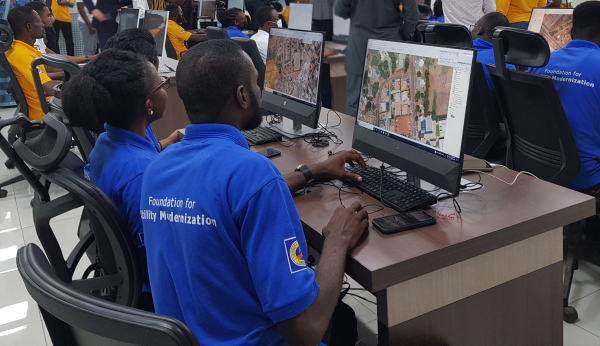
    Hexagon’s Safety, Infrastructure & Geospatial division successfully deployed an advanced utility geographic enterprise asset management (EAM) system for the Electricity Company of Ghana (ECG). The smart EAM, featuring Hexagon’s G/Technology, will allow ECG to plan, manage and efficiently operate its distribution network to meet the growing needs of 4.5 million customers.

    The enterprise system from Hexagon unifies data from a variety of geographic information systems (GIS), enabling bi-directional data flow with other systems based on the Common Information Model (CIM) standard. The system enhances ECG’s ability to geographically reference and manage assets with integrated tools for data surveying, capture and maintenance and network planning and calculation.

    Mobile capabilities enable efficient inspections and maintenance, while a web portal assists employees with locating assets, reviewing the network and more. Migrating to Hexagon’s system will increase process efficiency and reduce asset-management costs by harmonizing systems, validating existing data and capturing missing data.

    “The utility GIS is the critical component that fuels innovation in the utility,” said Keli Gadzekpo, board chairman of ECG. “This project is the foundation and the first step to modernizing ECG operations. It is the platform for digitization of electrical network assets, a prerequisite for bringing efficiency in the wire business.”

    Photo: Hexagon
    Photo: Hexagon

    Part of ECG’s Modernizing Utility Operations Activity, the project was commissioned by Millennium Development Authority (MiDA), Ghana, on behalf of the Government of Ghana’s Millennium Challenge Account Entity Program and funded by the U.S. government.

    “We are exceedingly grateful to Hexagon for working tirelessly to deliver this innovative product,” said Julius K. Kpekpena, Ag CEO and COO, Millennium Development Authority. “The technology sets Ghana’s biggest electric distribution utility on the path to modernizing its operations. The GIS is the foundation for modern tools to help ECG plan its networks, reduce losses, collect revenues and serve customers more efficiently.”

    The project included procurement and installation of system software, server hardware, mobile field units and services for data migration by Hexagon, field validation of assets by PDSA Ghana (part of Hexagon), and production of aerial imagery by ILV Wagner using Hexagon’s Leica Geosystems surveying and airborne imaging technologies.

    “Reliable electricity requires accurate data and tools to plan, design and manage networks, which can also reduce overall maintenance costs,” said Maximillian Weber, senior vice president, Global Utilities & Communications, Hexagon’s Safety, Infrastructure & Geospatial division. “We are proud to support Electricity Company of Ghana in delivering quality service to its customers.”

  • Improved 1Data Gateway provides new localization options

    Improved 1Data Gateway provides new localization options

    1Spatial logo1Spatial is improving its platform, adding a new language option and user experience enhancements to its data submission portal 1Data Gateway.

    Features in 1Data Gateway 2.5 are designed to make it easier for data contributors to submit their data. An Optional Data Submission feature allows contributors to submit exceptions to validations, and new integration with Esri ArcGIS Online adds a simple method of user authentication and authorization.

    A new Welsh-language option and updated support for 1Integrate 3.2 are included. Areas improved include schema mapping, allowing contributors to see the target schema and easily select attributes from dropdown menus.

    “This release is great for data contributors and streamlining our processes,” said Michael Martin, director of Consultancy at 1Spatial Inc. “We’re using new email notifications to receive an email upon successful submission, or for submissions that need my attention. Authenticating and authorizing via ArcGIS Online makes user-group maintenance easier, and the new Schema mapping is now also so much quicker, with easy selection of attributes from the target schema. Overall, this release is a huge time saver.”

    “This new release comes with many improvements to the user interface,” said Ricardo Cifres, senior product manager for 1Data Gateway. “The possibility of copying assignments as well as deleting projects, specifications and assignments makes the administrators’ lives even easier, and new PDF reports provide clear and concise information. We’ve also continued expanding our localization options, adding Welsh language to support a national project, and we have more languages in the pipeline. 1Data Gateway truly brings our rules-based technology to a worldwide audience.”

    1Data Gateway is used with 1Integrate to ensure compliance of data for use across the enterprise and provides automated data validation, cleaning, transformation and enhancement. It enables users to assess the quality of data to ensure it meets defined specifications and is fit for purpose.

  • New app helps local governments reduce traffic

    New app helps local governments reduce traffic

    Photo: Geoxphere
    Photo: Geoxphere

    A new software app helps local governments in the UK plan alternative routes, infrastructure and access that facilitate walking and cycling in cities, reducing traffic. XMAP, a cloud-based web geographic information system (GIS) for local governments from Geoxphere, now offers Isochrone. It provides a detailed and visual insight into existing transport infrastructure, assessing accessibility and the local environment to calculate and compare travel times by foot, cycle and car. The tool enables planners to understand how the existing infrastructure is enabling or restricting green journeys. It also helps them model and visualize how improvements to the transport network can be made and engage with communities to promote specific schemes and opportunities for active travel.

    The XMAP Isochrone tool allows a user to create polygons on a map showing how far it is possible to drive, walk or cycle in a set amount of time. Using algorithms that take into consideration the actual road, foot path or cycle network, as well as historic speed data and average walking and cycling rates, it provides a more accurate methodology of calculating travel times compared to traditional concentric circles based on straight line distances.

    XMAP is accessible from any web-enabled device, without plug-ins, bolt-ons or additional installations. It includes a suite of inbuilt workflows to support delivery of local government services such as planning, housing, waste and recycling, and street services. XMAP comes complete with more than 250 geospatial data layers, from a variety of government agencies, as well as a fully maintained Ordnance Survey map stack.

    Provided as a Software as a Service (SaaS), XMAP allows users to create and share business-critical map data without the risks involved in using open-source silos of GIS or the high cost of traditional GIS solutions. XMAP gives access to Ordnance Survey mapping, aerial photography, together with third party and in-house datasets, for more than 1,700 government organizations as well as a range of commercial clients. 

  • AEC firms use aerial mapping to share infrastructure funding

    Photo: Nearmap
    Photo: Nearmap

    With Congressional approval of $17 billion in infrastructure funding, the largest single allocation ever, the scramble to win contracts is about to get red hot and AEC firms are gearing up. In this very competitive game, top engineering firms are relying on their experience, technology, business acumen and ability to execute.

    Advances in aerial mapping play a key role in how AEC firms pursue these contracts. Savvy firms have been using this technology for years. Rather than rely on lower resolution satellite imagery or local drone imagery, they use wide-area-coverage aerial maps to clearly display the detail needed to plan and execute.

    Over the past decade, maps made using aerial photogrammetry have played an important role in the AEC space. Using high-performance cameras, fleets of planes capture hundreds of square miles per plane per day, provided that the weather is clear. The imagery is processed and made available to engineering companies within days of capture, allowing them to see very clear imagery.

    AEC organizations use different forms of aerial maps to evaluate sites, improve their survey designs, and build and maintain infrastructure (roads, highways, bridges, tunnels, overpasses, rail, airports, housing, commercial building development, water resources, parks, pavement and more). Imagine you’re a state or local government that needs to build a bridge, or a developer who wants to contract with an engineering and construction firm to build affordable housing. Why travel to perform time-consuming site evaluations when you can meet with engineering teams in your office and review hundreds of potential sites instantly using current aerial photos that show change over time?

    The engineering teams point out elevation changes, the presence and height of vegetation, neighboring communities, bodies of water, ponding and more. They easily navigate from one location to another as you discuss where the entrance to the community could be, how the road network might be configured, and the proximity to retail, schools and healthcare. Within minutes you measure risk, understand the landscape, make decisions, and begin to estimate the project costs. Your teams collaborate, discuss the pros and cons, measure distances and navigate across the terrain virtually.

    Aerial mapping provides a competitive advantage for AEC companies to win their fair share of the infrastructure bill. It also gives governments and developers the confidence they need to make the right decisions. Typically, this involves looking at sites from all angles. The classic form of aerial mapping used by engineers is a top-down perspective. Increasingly, these organizations have used oblique imagery captured at an angled perspective, which shows height.

    Artificial Intelligence and Aerial Photography

    Starting a few years ago, 3D imagery and digital surface models began to allow engineers to navigate through the imagery and query it based on elevation. More recently, aerial mapping has leveraged artificial intelligence (AI) to classify properties and the landscape. Do you need to see nearby construction sites? AI applied to aerial photography can do that automatically. This rich set of data includes attributes such as tree overhang, roof condition, roof material, building footprints, vegetation height, surface material, swimming pools and even solar panels.

    The blend of all these imagery types and AI into a single solution makes everything discoverable. Users can search by address, city, location or point of interest. They can visualize the imagery along with lat/long coordinates and quickly switch from top-down views to obliques to 3D. As they learn more about the landscape, they begin to turn on AI attributes, gaining deeper insights.

    Sometimes, the analyses go even further. Engineering organizations export the imagery to tools of their choice from such companies as Autodesk, Esri or Bentley Systems, use field-collected ground control points to ensure that it is survey grade, then use it as a base layer for their designs. They even create marketing presentations and video content to help them win the business. Current high-resolution aerial maps have become a cornerstone of how these organizations operate.

    This approach provides unique advantages for engineering firms. For example, they can combine geospatial and construction datasets in a common operating environment to reduce complexity, streamline communication, ensure that all stakeholders are up to date, and check their progress toward meeting contractual obligations.

    Planners have current, contextual designs and models to make accurate decisions about planning and development activities. They can view asset locations and conditions to facilitate maintenance and upgrades, leverage aerial maps inside other platforms to improve work orders and reduce field visits, and ensure regulatory compliance.

    Whether it’s improving highway safety, constructing ferry terminals, improving transportation systems, developing land or building a network of recreational trails, aerial imagery provides engineering and construction companies with a competitive advantage to win new business, improve client satisfaction and meet growth targets. With $17 billion on the line, sophisticated firms are finding a way to secure their fair share of the pie.

  • Locana and Bent Ear Solutions form strategic alliance

    Locana and Bent Ear Solutions form strategic alliance

    Combined geospatial solutions improve operations using location intelligence and mapping

    Locana logoLocana and Bent Ear Solutions  are collaborating to provide location-based solutions that help customers improve their performance and decision-making across the organization, including their operations center. Locana was formerly known as Critigen.

    The companies will work closely with clients and identify issues, challenges and mission priorities to modernize their geospatial capabilities and improve organizational effectiveness using location intelligence and mapping.

    “Leveraging the complementary skills and expertise each company provides, clients gain tremendous value with focused and optimized technology, services, training, and support,” said Mike Eggenberger, VP, North America Sales, Locana. “Locana and Bent Ear Solutions understand the power of location for gaining an accurate understanding of circumstances and acting with clarity and precision.”

    Bent Ear Solutions maintains deep domain expertise in operations, crisis management and business continuity. The organization has a track record of providing configured, situational awareness based on geographic information systems (GIS) combined with targeted workflows that support multiple requirements.

    Locana has an extensive history of successfully designing and delivering robust, large-scale geospatial projects. Integrating business systems with scalable GIS, Locana helps clients spatially enable their enterprise with location analytics and high-powered mapping.

    “Locana and Bent Ear Solutions are both dedicated to being a trusted partner for our clients,” said Chris McIntosh, CEO, Bent Ear Solutions. “We have a unique opportunity to combine our areas of excellence to address their complex challenges. We believe our collaborative approach will help them maximize the value and use of GIS across the enterprise.”

    Locana and BES combined will deliver tailored GIS solutions and integration that organizations need to overcome system silos and enable situational awareness. The partnership will supply strategic and tactical planning, workflow development, team-building processes, documentation, procedural support and systematic training and exercises.

    The result is long-term value in the form of access to sophisticated analysis and actionable intelligence, the companies said.

  • Asensing demos HD-MapBox for lane-level positioning


    Photo: Asensing
    Photo: Asensing

    Guangzhou Asensing Technology Co. Ltd, which specializes in high-precision positioning technology for intelligent transportation, demonstrated HD-MapBox at the Consumer Electronics Show (CES), which took place Jan. 5-8 in Las Vegas.

    HD-MapBox integrates high-precision map data based on high-precision positioning.

    The device can achieve lane-level positioning and 1+ mile (2 km) predictive cruise control (PCC), providing a decision basis for advanced assisted driving to better meet the demanding positioning requirements of autonomous vehicles.

    “As the premise for autonomous driving safety, high-precision positioning is of great importance for integrating positioning technology based on inertial measurement units (IMU), GNSS signals, visual perception systems and high-definition (HD) maps,” said Situ Chunhui, Asensing Technology CTO. “High-precision positioning is becoming the preferred choice due to higher positioning accuracy and improved redundancy as well as an enhanced passing rate under all scenarios.”

    Under any driving scenario, autonomous vehicles must accurately interpret their own lane-level location information to better predict and prevent risks and make safe driving decisions. As a result, positioning is not only part of the autonomous driving process, but also the premise of autonomous driving.

    However, any single positioning technology has its own limitations, especially in certain scenarios such as in tunnels and underground garages where the perception system may be adversely affected by changes in the amount of light and low GPS signal, thereby affecting driving safety.

    Fusing data from a GNSS receiver, IMU, ADAS camera, vehicle dynamics and HD maps, the HD-MapBox can achieve a lateral error of less than 8 inches (0.2 meters) and a longitudinal error of less than 6.5 feet (2 meters) with a 95 percent confidence interval, providing an accurate reference for highway pilot (HWP) and automated valet parking (AVP). Even if both GNSS and lane line detection are not available, the HD-MapBox can still enable vehicles to keep in lane for at least a quarter mile (400 meters).