Tag: GIS

  • DT Research’s new military-grade tablet has RTK GNSS

    DT Research’s new military-grade tablet has RTK GNSS

    DT Research has released the DT301T rugged RTK tablet (DT301T-RTK), a lightweight military-grade tablet purpose-built for GIS mapping applications. It features real-time kinematic (RTK) satellite navigation to enhance the precision of GNSS position data.

    The tablet enables 3D point cloud creation with centimeter-level accuracy, meeting the high standards required for scientific-grade evidence in court.
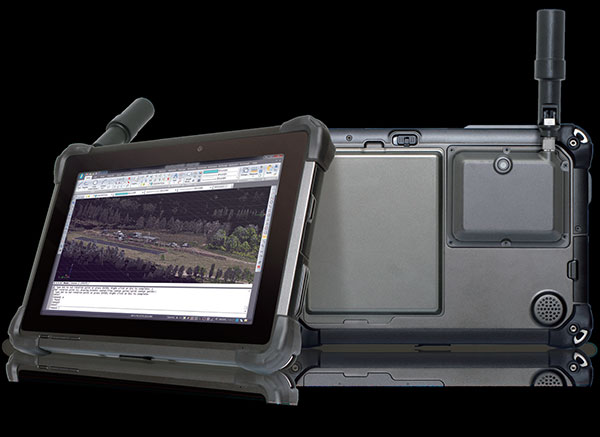
    The DT301T-RTK is a rugged tablet with scientific-grade GNSS. (Photo: DT Research)

    The DT301T Rugged RTK tablet is military-grade with an IP65 rating. Because it’s lightweight, the DT301T can be used in the field, office and vehicles, the company said.

    A dual-frequency GNSS module is built into the tablet, which uses real-time reference points within 1–2-centimeter accuracy to position 3D point clouds created from aerial photogrammetry, using GPS, GLONASS and Galileo receivers. Users can measure with the RTK GNSS positioning directly using a foldable antenna or connect to an external antenna for more robust receiving and survey-grade precision.

    “We’ve seen a dramatic uptick in the need for rugged tablets to be purpose-built for a range of mapping uses across industries,” said Daw Tsai Sc.D., president of DT Research. “In designing the DT301T with RTK satellite navigation, we also took into consideration the other features and capabilities necessary within a rugged tablet to quickly and easily conduct forensic mapping, land surveying, e-construction, building information modeling (BIM) and other mapping scenarios.”

    The DT301T is compatible with existing GIS software for mapping applications and brings together the advanced workflow for GIS data capture, accurate positioning and data transmitting.

    Uses

    According to DT Research, the tablet can be used in a variety of scenarios.

    Forensic mapping. Public safety teams, investigators and crash reconstructionists can use the DT301T Rugged RTK tablet to accurately collect measurements that are scientifically defensible by using the real-time centimeter reference points to position 3D point clouds created from aerial photogrammetry or take stand-alone measurements.
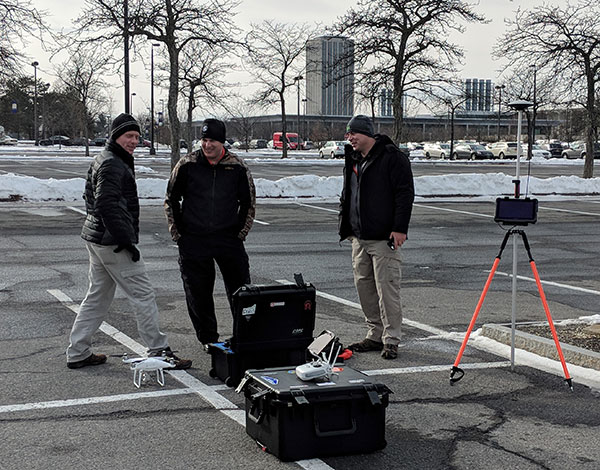
    DT301T-RTK tablet during forensic mapping training. (Photo: DT Research)

    The results will have the precision necessary to stand up as evidence in court, said Andrew S. Klane, a former Massachusetts State Police Lieutenant who teaches Forensic Mapping and is now the chief operating officer at Forensic Mapping Solutions Inc.

    “As more drones are being used for mapping, there is a growing need for ground-control positioning devices,” Klane said. “By using a DT301T Rugged RTK Tablet in combination with a drone, users can more quickly and cost-effectively create a 3D model to deliver an accurate representation of the scene with scientific-grade tolerance that will hold up in a court of law.”

    It could also help clear crash scenes faster, restoring the normal flow of traffic on congested roadways, reducing secondary crashes and lowering the chance of first responders and other workers getting hurt while clearing the scene.

    Land surveying. Surveyors can use the DT301T tablet to measure the altitudes, angles and distances on the land surface so that they can be accurately plotted on a map to determine property boundaries, construction layout and mapmaking.

    E-construction. Construction workers can manage the collection, review, approval and distribution of highway construction contract documents in a paperless environment using the DT301 tablet.

    Building information modeling (BIM).  Architecture, engineering, and construction (AEC) professionals can use the tablet to create 3D models to efficiently plan, design, construct and manage buildings and infrastructure.

    FEATURES

    The DT301T Rugged RTK tablet has been purpose-built for precision mapping in a variety of environments and includes the following features and capabilities:

    • Dual-frequency GNSS module: GNSS L1 and L2 RTK that receives GPS, GLONASS and Galileo signals up to 372 channels with RMS 10 mm + 1 ppm accuracy.
    • High-performance CPU and Windows OS: Intel 6th-generation core i5 or i7 processor with Microsoft Windows 7 Professional or Windows 10 IoT Enterprise. Units come with either 8 GB or 16 GB of RAM.
    • Sunlight-readable display: A 10.1 inch LED-backlight, sunlight-readable screen with capacitive touch and 1920 x 1200 resolution.
    • Wireless connectivity: Long-range Class 1 Bluetooth powers connectivity up to 1,000 feet and 4G mobile broadband for LTE, HESPA+, GMS/GPRS/EDGE, EV-DO, Rev A and 1xRTT.
    • Storage: For field data collecting, the tablet can store up to 1 terabyte of data.
    • Military standards: The tablet is fully ruggedized to meet the highest durability standards with an IP65 rating, MIL-STD-810G for vibration and shock resistance, and MIL-STD-461F for EMI and EMC tolerance.
    • Battery pack: High-capacity hot-swappable battery pack delivers 60 or 90 watts for up to 15 hours of continuous mobile communications.
    • Accessories: Those available include external antennas, pole mount cradles, detachable keyboards, battery charging kits and digital pens.
  • Beta program opens for Pix4Dfields for agriculture

    Pix4D has announced Pix4Dfields, its first fully dedicated product for agriculture. A beta program to test the software is now open.

    Pix4Dfields is designed to give users fast and accurate maps while in the field, with a simple yet powerful interface fully dedicated to agriculture.

    “When we decided to create a fully dedicated product for agriculture, we wanted to go beyond the research and development and create a product that actually understands agriculture,” the company said in a press release. “So in July 2017, we opened a new office in Berlin fully dedicated to do exactly that: Understand the agriculture industry, listen to our users, and create a product that caters to all the main agricultural practices.”

    Pix4Dfields is equipped with fast processing that provides accurate and instant results and an easy-to-use interface with tools tailored to agricultural workflows.

    Pix4Dfields is currently available as a closed beta, which we are opening to select users to test it and provide feedback. The product will evolve at a fast pace with new and updated features being added with every new iteration, the company said

    Pix4Dfields is currently available for macOS only; the next iterations will include Windows support as well.

    To join the beta program or learn more, visit the website.

  • Topcon’s new laser designed for construction projects

    Topcon-RL-H5 series-WTopcon Positioning Group has added a new laser series to its RL-H line of self-leveling rotating lasers.

    The RL-H5 series is designed for high-accuracy and long working range in laser applications for grading, excavating and general construction projects. The new offering includes instruments to support diverse jobsite demands.

    Lasers in the series include options in working range of up to 800 meters and up to 100 hours of battery life. The RL-H5A with ±1.5 mm at 30 m horizontal accuracy will be available in the Americas, Europe and Oceania. An additional option, the RL-H5B, with ±3 mm at 30-m horizontal accuracy, will be available in the United States and Oceania.

    RL-H5 series-closeup-W“The RL-H5 builds on what Topcon has been bringing to the market for years and pushes the contractor’s productivity capabilities to the next level. It is another example of our commitment to The Intersection of Infrastructure and Technology, the point at which construction productivity can be improved by applying advanced positioning technology,” he said.

    The series is covered by the five-year guarantee on Topcon manufactured lasers.

  • Bentley Systems to celebrate Year in Infrastructure in October

    Bentley Systems’ Year in Infrastructure 2018 Conference will be held Oct. 15-18 in London at the Hilton London Metropole.

    Bentley Systems is a global provider of comprehensive software solutions for advancing infrastructure.

    Presented by Bentley Institute, the conference is a global gathering of leading industry executives and prominent thought leaders in the design, construction and operations of the world’s infrastructure. The theme of this year’s conference is “Going Digital: Advancements in Infrastructure.”

    The conference features nearly 70 speakers and more than 50 informative sessions, including keynotes by leading industry experts, interactive workshops, forums, panel discussions and product demonstrations. Attendees can visit the Technology Pavilion, which features exhibits and presentations from Bentley Systems and its strategic partners Microsoft, Siemens, Topcon and Bureau Veritas.

    On the first day of the conference, Bentley Institute will host Digital Advancement Academies, featuring presentations and interactive discussions with subject matter experts who provide insights and best practices in their areas of expertise including reality modeling, BIM strategy and constructioneering.

    The conference also includes the selection and announcement of the winners of Bentley’s Year in Infrastructure 2018 Awards (formerly known as the Be Inspired Awards), which honors the extraordinary infrastructure projects by users of Bentley software throughout the world.

    During six industry-focused forums featured during the conference — Buildings and Campuses, Digital Cities, Industrial Infrastructure, Rail and Transit, Roads and Bridges, and Utilities and Water — more than 55 awards finalists will present their projects to independent panels of jurors, more than 100 members of the press, and conference attendees.

    From those presentations, winners are selected by the jurors, and will be announced at the conclusion of the conference on Oct. 18 during an evening ceremony and gala.

    Aret Garip, technical director for WSP, attended Bentley’s conference last year in Singapore to represent WSP’s One Blackfriars project in London, which was chosen as an awards finalist.

    “The conference has been truly inspiring and educational,” Garip said. “It’s a great event to learn about the latest tech in engineering design software and an opportunity to meet the creative, intelligent people who develop new tools to make it easier for us to design buildings.”

    In October 2019, the Year in Infrastructure Conference will return to the Marina Bay Sands Expo and Convention Centre in Singapore.

  • MicroPilot selects Simlat payload emulator for UAV cameras

    MicroPilot is working with Simlat to develop a pan, tilt and zoom payload simulation tool to help improve the camera-centric parts of MicroPilot’s autopilot software.

    Simlat is a provider of training systems for UAVs, enabling training on any platform with any payload for any mission. The tool Simlat has developed emulates a camera payload on a UAV, including simulated video, when set up with an “iron bird.”

    This allows more testing to be performed on the ground, and potential problems with the payload worked out before flight testing begins.

    “Flight testing is time consuming and expensive and simulation is an essential tool that reduces the amount of flight testing necessary to bring a drone to market,” said Howard Loewen, president of MicroPilot. “We are pleased to be working with Simlat to add this capability to our software development process.

    “MicroPilot is always looking for useful tools and features to integrate with our products in order to help deliver more capable and reliable products to our customers. This camera payload emulator is just one of many third-party tools we have incorporated into our testing and development and yet another way MicroPilot has shown its dedication to product quality and performance.”

    MicroPilot is an ISO 9001 autopilot manufacturer to bring to market an ISO 9001 sub-30-gram autopilot, triple redundant autopilot, and full-function general-purpose autopilot. MicroPilot offers a family of lightweight UAV autopilots that can fly fixed-wing, transitional, helicopter and multirotor UAVs.

  • SpaceDataHighway starts full Copernicus service

    The Airbus-operated SpaceDataHighway has begun regularly relaying data from the Sentinel-2A satellite, after the successful end of the commissioning period.

    SpaceDataHighway-WThis marks the start of the SpaceDataHighway service using all four Copernicus Sentinel satellites and the beginning of a new era for space-based imagery users.

    The first two sets of Earth-observing Copernicus Sentinels-1A and -1B and -2A and -2B are signed up to this service as SpaceDataHighway’s anchor customers under an agreement between the European Union and the European Space Agency (ESA) as owners of the Copernicus programme, and Airbus as the owner and commercial operator of SpaceDataHighway.

    Since using the SpaceDataHighway, the Sentinel-1 constellation has increased the amount of data it produces by about 50%. The service is also able to bring operational added-value to Sentinel-1 users by greatly improving the data timeliness for observations outside Europe. This is an important asset for users, especially when it comes to the routine monitoring of remote areas in the domain of maritime applications or assessment of natural disasters and first line response for emergency.

    The SpaceDataHighway is the world’s first “optical fibre in the sky” based on cutting-edge laser technology. It will be a unique system of satellites permanently fixed over a network of ground stations, with the first — EDRS-A — already in space.

    Each day, it can relay up to 40 terabytes of data acquired by observation satellites, UAVs and manned aircraft, at a rate of 1.8 gigabits per second.

    The relay satellites are designed to lock on to low-orbiting satellites via laser and collect their data as they travel thousands of kilometres below, scanning Earth. SpaceDataHighway then immediately sends the collected data down to Europe from its higher position hovering in geostationary orbit, acting as a go-between.

    This process allows the lower satellites to continuously downlink the information they are gathering, instead of having to store it until they travel over their own ground station. That way, they can send down more data, more quickly.

    The SpaceDataHighway is a public-private partnership between ESA and Airbus, with the laser terminals developed by Tesat-Spacecom and the DLR German Space Administration. EDRS-A, the first SpaceDataHighway relay satellite launched in January 2016, offers coverage from the American East Coast to India. A second satellite will be launched in 2018.

    It will double the system’s capacity and extend the coverage and redundancy of the system. Airbus is willing to expand the SpaceDataHighway with a third node, EDRS-D, to be positioned over the Asia-Pacific region.

  • SimActive launches free data-processing service using Correlator3D

    SimActive Inc., a developer of photogrammetry software, is offering a new free data-processing service using Correlator3D.

    New users can upload their first UAV, satellite or aerial image project to obtain digital surface model (DSM), digital terrain model (DTM), point cloud and orthomosaic outputs.

    Along with optimal results, users also receive tailored feedback, recommendations and training from SimActive experts.

    The service requires no obligation, and is based on Correlator3D software, building on more than a decade of innovation on computer vision algorithms, a subfield of artificial intelligence. Quick turnaround is also possible due to the speed of the software and extensive use of GPU.

    “Our new offer is unique to get the best possible results from the very first project onward,” said Philippe Simard, president of SimActive. “Following this, users are trained with industry-leading technology, custom advice and necessary knowledge for successful mapping.”

  • Viametris mobile backpack scanner includes panoramic camera

    Mobile-scanning company Viametris has launched the bMS3D backpack mobile scanning system, which features an embedded 360° camera.

    Narrow streets and pedestrian zones are considered hurdles when it comes to mobile scanning. The new bMS3D-360 makes these tasks achievable. It is now available on the market and it comes with post-processing software. It will be presented at SPAR 3D 2018 in June.

    “Users of mobile scanning systems know how difficult it is to cover an entire city with this kind of system and how complex the completeness is,” said Jerome Ninot, founder of Viametris.

    Improved Data Exploitation with Panoramic Images. Viametris has found a solution to scanning challenges by developing the bMS3D-360: the mobile scanning backpack system includes a panoramic camera. This sensor allows the user to maintain continuity of results with mobile mapping systems on cars that already include this kind of camera. Operation and visualization with such 360° images are now easy to use.

    Since Google provided massive street views, people are used to navigating through panoramic images. Navigating through bMS3D-360 images becomes easy and intuitive compared to navigating with 3D point clouds, the company said.

    Ten years of experience have allowed Viametris to produce its GNSS mono-antenna system based on GNSS-free scanning (indoor or denied-GNSS area): the system trajectory is calculated by lidar-SLAM. It produces colorized point clouds with absolute accuracy of less than 5 centimeters under appropriate satellite reception conditions.

    Compared to many mobile scanners, this backpack does not rely on GNSS to work. If the GNSS reception is not good enough, control points can be added for absolute localization. The backpack can be used to scan all sorts of indoor areas such as airports, industrial buildings or shopping malls.

    The bMS3D-360 is lightweight. It protects the retractable camera an all other components since it is self-contained.

    Post process in VIAMETRIS PPiMMS Software. PPiMMS post-processing software manages the dataset coming from the system. Its mission is to calculate, control and improve the trajectories by calling lidar-SLAM functions, and reducing drifts, thanks to loop closure algorithms.

    The user can manually add GCPs to constrain the result when GNSS reception is poor. But, in most cases, the user will be able to include post-processed global positions (PPK) using GNSS post-processing software. Additionally, the panoramic camera can be used to colorize the point cloud using PPiMMS.

  • Wingtra launches WingtraOne PPK precision mapping drone

    wingtraone_septentrio.OEMboard-WWingtra has officially launched the WingtraOne PPK high-precision mapping drone. Wingtra said its drone, which features vertical take-off and landing, is designed to set a new benchmark for large-scale surveying and mapping applications.

    WingtraOne PPK offers large area coverage, ultra-high accuracy and brilliant image resolution. It features an advanced PPK module and high-quality cameras like the 42-megapixel full-frame camera Sony RX1RII, it is now possible to reach down to 1-centimeter absolute accuracy in aerial mapping.

    To prove this accuracy claim, the Wingtra team performed test flights in a gravel quarry. The process was documented and is now explained in a white paper on the company website.

    Conventional drone mapping on centimeter accuracy requires ground control points (GCPs) to correct the final map. Besides requiring additional surveying equipment and being extremely time consuming, setting up GCPs might be downright risky or just not possible in the area of interest.

    More advanced solutions achieve similar levels of accuracy by using GPS correction technology for the georeferencing of the aerial imagery: namely RTK (real-time kinematics) or PPK (post processed kinematics).

    RTK requires real-time base station connectivity and corrects GPS signals during the flight, while PPK corrects them after the flight and therefore offers greater robustness and consistency.

    Moreover, PPK is independent from base stations or base station networks. It is highly reliable, accurate and time saving to use, Wingtra said. Neither special flight preparations nor intensive post-processing steps are required to achieve down to 1-cm accurate aerial maps.

  • Esri FedGIS Conference showcases spatial analytics for government action

    Esri will be hosting the 21st annual Esri Federal GIS (FedGIS) Conference March 20-21 at the Walter E. Washington Center in Washington, D.C. All federal government agency workers are invited to join an anticipated audience of 3,000 attendees and share their experience in collaborating, innovating and connecting their work using spatial analytics technology.

    Esri founder and president Jack Dangermond will discuss how location intelligence can be used to derive a deeper understanding of complex issues through data, as well as how it enables collaboration to develop innovative solutions for government.

    He will be joined on the main stage by representatives from several leading organizations, including the following:

    • U.S. Department of Agriculture Animal and Plant Health Inspection Service (USDA APHIS) — “Protecting Plants and Animals to Feed Our Country and the World”
    • U.S. Department of Health & Human Services Office of Inspector General — “Fighting Fraud, Waste, and Abuse through Spatial Analytics”
    • American Red Cross — “Connecting and Helping Volunteers, Partners, and Citizens in Need”

    On Wednesday, March 21, Dangermond will lead a thought-provoking conversation with the Honorable Susan M. Gordon, principal deputy director of National Intelligence at the Office of the Director of National Intelligence on the importance of connecting intelligence agencies through spatial analytics.

    “It is always inspirational to attend this conference and hear how location intelligence has helped federal workers share information across agencies and connect to citizens,” said Jeff Peters, head of the national government sector at Esri. “Attendees will get a chance to hear directly from top government and technology leaders as they share their experiences collaborating, innovating, and connecting using spatial analytics.”

    The conference is the site for announcements about the innovative use of Esri’s ArcGIS platform in federal, state and local government. The latest enhancements to ArcGIS and ArcGIS Pro, along with updates on desktop and enterprise mobile app environments, will be shared.

    Other organizations will be providing use cases and best practices during workshops throughout the two days of the conference. Learn more at esri.com/events/federal.

  • USGIF extends partnership with DigitalGlobe Foundation

    USGIF’s 14 accredited collegiate programs granted DigitalGlobe imagery access

    The United States Geospatial Intelligence Foundation (USGIF) has furthered its partnership with the DigitalGlobe Foundation.

    Together, they will grant 14 schools under USGIF’s Collegiate GEOINT Accreditation Program access to DigitalGlobe’s satellite imagery archive and cloud-based service Basemap.

    USGIF-Accredited_Schools_generalThrough the agreement, students and faculty at USGIF’s 14 accredited schools will have DigitalGlobe imagery at their fingertips, with access to high-resolution, high-accuracy imagery and better answers to their research questions.

    USGIF’s Collegiate Accreditation Program prepares students with the necessary knowledge and skills for entering the professional geospatial intelligence (GEOINT) workforce.

    USGIF-accredited GEOINT programs include Fayetteville State University, George Mason University, James Madison University, Universidade Nova de Lisboa, Northeastern University, Pennsylvania State University, the University of Texas at Dallas, the University of Utah, the U.S. Air Force Academy, the University of Missouri of Columbia, the University of Redlands, the University of South Carolina, the University of Southern California and the U.S. Military Academy.

    “DigitalGlobe Foundation’s partnership with USGIF on promoting the geospatial tradecraft creates a force multiplier in our common objective to reach out to educational institutions worldwide,” said Kumar Navulur, DigitalGlobe Foundation president. “Under this partnership, students in USGIF-accredited academic institutions are now able to access DigitalGlobe’s vast library of processed global imagery.”

    “Imagery access helps faculty, researchers, and students map and analyze trends in infectious disease, threatened ecosystems, crop yields, or archeological sites,” said Camelia Kantor, USGIF’s Director of Academic Programs. “Our collaborative efforts bring the academic community into a new era of innovation in which high-quality imagery products will allow students enrolled in GEOINT programs to make educated decisions and provide solutions to a wider range of problems.”

    USGIF has had a long-standing partnership with DigitalGlobe Foundation, and USGIF CEO Keith J. Masback is a member of DigitalGlobe Foundation’s Board of Directors.

  • GEOINT 2018 features top US defense speakers

    The GEOINT Symposium, hosted annually by the United States Geospatial Intelligence Foundation (USGIF), returns to Tampa, Florida, April 22-25.

    The annual symposium gathers the defense, intelligence and homeland security communities as well as other users and producers of geospatial information for keynote speakers, panel discussions and breakout tracks offering the opportunity to learn from senior leaders and subject matter experts.

    Confirmed keynote speakers include:

    • Robert Cardillo, Director, NGA
    • The Honorable Susan M. Gordon, Principal Deputy Director of National Intelligence
    • Dawn Meyerriecks, Deputy Director, CIA Science and Technology Directorate
    • Gen. Raymond A. Thomas III, Commander, USSOCOM

    A complete list of GEOINT leaders who will be speaking throughout the event can be found here.

    GEOINT 2018 is expected to draw more than 4,000 geospatial professionals and well in excess of 200 exhibitors. For complete symposium details, visit www.geoint2018.com.