Tag: GNSS-denied

  • Eos, Laser Technology and Esri Introduce Laser Mapping Workflow for Esri’s Collector for ArcGIS

    Eos, Laser Technology and Esri Introduce Laser Mapping Workflow for Esri’s Collector for ArcGIS

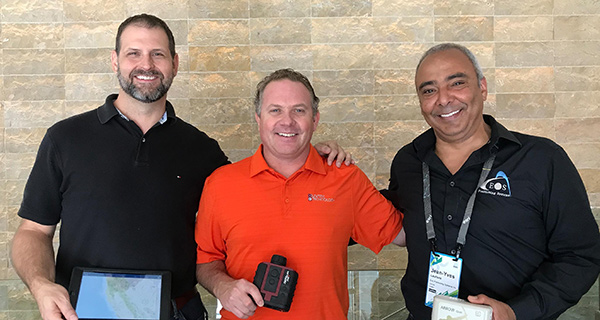
    From left: Esri Program Manager Doug Morgenthaler, Laser Technology Sr. Product Manger Derrick Reish and Eos CTO Jean-Yves Lauture.(Photo: Eos Positioning)
    From left: Esri Program Manager Doug Morgenthaler, Laser Technology Sr. Product Manger Derrick Reish and Eos CTO Jean-Yves Lauture. (Photo: Eos Positioning)

    The three-way partnership will enable field crews to collect centimeter-accurate 3D data in GNSS-impaired environments.

    GNSS receiver maker Eos Positioning Systems has released a laser offset solution within the Esri Collector for ArcGIS workflow.

    When combined with Laser Technology Inc.’s (LTI’s) laser rangefinders, the solution will allow field crews to capture centimeter-accurate 3D locations of hard-to-reach assets and in GNSS-impaired environments.

    “By combining the high-accuracy of the Eos Arrow Series GNSS receivers and the laser capabilities of LTI, we can empower field crews to capture highly accurate XYZ coordinates from a safe distance,” LTI Senior Product Manager Derrick Reish said. “This eliminates the need for physically occupying every point. It also provides more accurate location data, with a more affordable mobile asset-management workflows.”
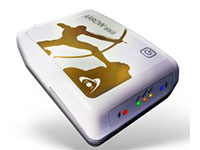
    The Arrow Gold. (Photo: Eos Positioning)
    The Arrow Gold. (Photo: Eos Positioning)

    The solution has been in the works for months, as demand has grown for hard-to-reach, high-accuracy mapping within the Collector workflow.

    “Eos is extremely grateful to be a part of this initial release in high-accuracy asset location data with LTI’s laser rangefinders and Esri’s Collector mobile app,” Eos CTO Jean-Yves Lauture said. “Enabling this kind of accuracy means even the most budget-conscious field crews will be able to access the location of their hard-to-reach assets.”

    All three teams have been working closely to ensure a seamless integration with Collector and ArcGIS Online. When using an LTI laser rangefinder and an Eos Arrow Series receiver with Collector, a field worker can easily shoot, capture and share high-accuracy 3D location data that is streamed into ArcGIS Online in real-time.
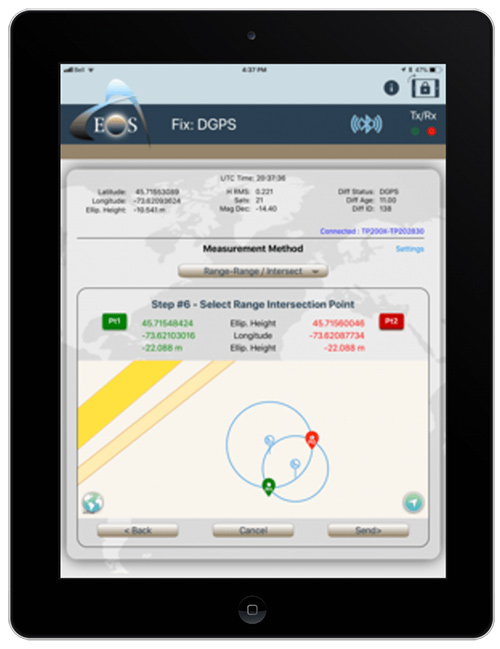
    Image: Eos Positioning
    Image: Eos Positioning

    The solution is expected to be particularly useful in urban corridors, highway settings, forested (or wetlands) areas, and other areas where assets are hard or dangerous to occupy. This will both increase accuracy and efficiency, as well as decrease safety liabilities in dangerous situations, the companies said.

    “Esri is extremely pleased that Collector can now support the capture of high-accuracy asset locations from afar, leveraging our unique partnership with both Eos and LTI,” Esri Product Manager Jeff Shaner said. “This is a game changer for asset management.”

    Prior to this release, field crews challenged with capturing high-accuracy 3D locations for hard-to-reach assets would need to use a total station with a different software workflow and then mesh the data back in the office, a clumsy and inefficient workflow requiring lots of additional training and expertise. With the new workflow, field crews can operate in GNSS-impaired environments at a high-accuracy level without leaving the Collector/AGOL environment, creating a highly efficient workflow.

    The solution has been designed to provide several offset-mapping methods.

    “The implementation of several measurement methods gives users the freedom of choice, so they can pick the right laser option which meets their accuracy needs,” Reish said.

    Eos will unveil its offset measurement solution for Collector at the upcoming Esri User Conference in San Diego. For a field demonstration of how the solution works, attendees can visit Eos at booth #1019 during the conference, and attend the session “LaserGIS for Everyone: How to Combat Costly and Tedious Data Collection Workflows” at 10 a.m. on Wednesday.
  • New Viametris backpack scanner integrates SBG Systems product

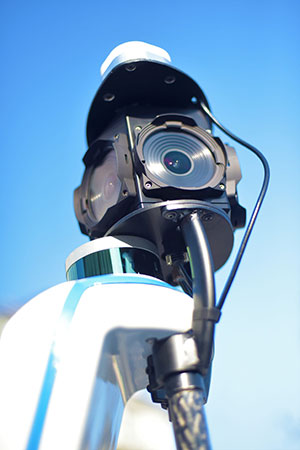
    Viametris, specialist of SLAM-based mobile scanning systems, has launched a backpack-based scanning system called the bMS3D-360. The company continues to rely on SBG Systems’ expertise in inertial navigation by integrating the Ellipse2-D, an inertial navigation system with embedded real-time kinematic (RTK) GNSS receiver.

    Photo: Viametris
    Photo: Viametris

    Viametris has been developing SLAM-based scanning systems for more than 10 years, including the iMS3D, a full indoor mapping system and the VMS3D, a car-based mapping system.

    The bMS3D-360 has been designed for the most challenging environments where GNSS is not accessible (indoor) or highly perturbed (urban canyons, forest, etc.). The surveyor starts the system, checks on a tablet that the GNSS and inertial information are computed, and starts the survey.

    Back at the office, the user launches the INS/GNSS post-processing software to increase orientation and position accuracy, and then uses the Viametris software to georeference and colorize the point cloud.

    Collected data are ready to be imported into common design software. This workflow (from collection to plan drawing) is seven times faster than a traditional method.

    The bMS3D-360 offers a 360-degree camera, which greatly simplifies the treatment work. When navigating in the point cloud, the user opens a unique picture of the 360-degree scanned environment instead of looking at four different camera points of view.

    Photo: SBG Systems
    Photo: SBG Systems

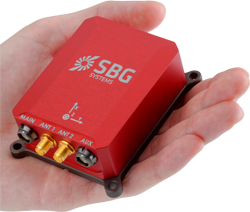
    The Ellipse2-D from SBG Systems is a compact inertial navigation system integrating an L1/L2 GNSS receiver. This industrial-grade INS computes roll, pitch and heading as well as position because of its embedded Extended Kalman Filtering.

    In real time, Ellipse2-D orientation data are used to correct the equipment attitude and help the SLAM computed heading. The embedded GNSS receiver provides absolute positioning to the point cloud as well as altitude constraint.

    When the GNSS faces sources of disturbance, the INS maintains the trajectory were the SLAM technology is limited.

  • Viametris mobile backpack scanner includes panoramic camera

    Mobile-scanning company Viametris has launched the bMS3D backpack mobile scanning system, which features an embedded 360° camera.

    Narrow streets and pedestrian zones are considered hurdles when it comes to mobile scanning. The new bMS3D-360 makes these tasks achievable. It is now available on the market and it comes with post-processing software. It will be presented at SPAR 3D 2018 in June.

    “Users of mobile scanning systems know how difficult it is to cover an entire city with this kind of system and how complex the completeness is,” said Jerome Ninot, founder of Viametris.

    Improved Data Exploitation with Panoramic Images. Viametris has found a solution to scanning challenges by developing the bMS3D-360: the mobile scanning backpack system includes a panoramic camera. This sensor allows the user to maintain continuity of results with mobile mapping systems on cars that already include this kind of camera. Operation and visualization with such 360° images are now easy to use.

    Since Google provided massive street views, people are used to navigating through panoramic images. Navigating through bMS3D-360 images becomes easy and intuitive compared to navigating with 3D point clouds, the company said.

    Ten years of experience have allowed Viametris to produce its GNSS mono-antenna system based on GNSS-free scanning (indoor or denied-GNSS area): the system trajectory is calculated by lidar-SLAM. It produces colorized point clouds with absolute accuracy of less than 5 centimeters under appropriate satellite reception conditions.

    Compared to many mobile scanners, this backpack does not rely on GNSS to work. If the GNSS reception is not good enough, control points can be added for absolute localization. The backpack can be used to scan all sorts of indoor areas such as airports, industrial buildings or shopping malls.

    The bMS3D-360 is lightweight. It protects the retractable camera an all other components since it is self-contained.

    Post process in VIAMETRIS PPiMMS Software. PPiMMS post-processing software manages the dataset coming from the system. Its mission is to calculate, control and improve the trajectories by calling lidar-SLAM functions, and reducing drifts, thanks to loop closure algorithms.

    The user can manually add GCPs to constrain the result when GNSS reception is poor. But, in most cases, the user will be able to include post-processed global positions (PPK) using GNSS post-processing software. Additionally, the panoramic camera can be used to colorize the point cloud using PPiMMS.

  • iXBlue offers new inertial positioning systems for offshore, ROVs

    iXBlue offers new inertial positioning systems for offshore, ROVs

    iXBlue — a subsea navigation, positioning and imaging systems company — is offering two new positioning sensors.

    Fifth-generation Octans

    Photo: iXBlueiXBlue is offering its customers the opportunity to upgrade their fourth-generation Octans positioning reference system to the fifth-generation system. The fourth-generation Octans was manufactured beginning in January 2014.

    Built on iXBlue’s high-performance fiber-optic gyroscope technology, the Octans is an all-in-one gyro compass and motion sensor (attitude and heading reference system) with features such as IMO/IMO-HSC certification. The upgraded system provides extremely accurate real-time output for roll, pitch, heading and heave, as well as acceleration and rate of turns under challenging GNSS-denied environment.

    Heading measurement accuracy has been doubled over the fourth-generation Octans: with still 0.1° Seclat in stand-alone, the system can now provide 0.05° Seclat with GNSS.

    Moreover, the fifth-generation Octans now offers the ability to align on transit and the extended capability to deliver, in real time, accurate heave for swells up to 30 seconds.

    The offer from iXBlue includes both the upgrade and calibration, backed by a five-year warranty.

    Rovins Nano for remotely operated underwater vehicles (ROVs)

    Photo: iXBlueiXBlue has also launched a new inertial navigation system for the offshore industry, the Rovins Nano.

    Based on iXBlue’s fiber-optic gyroscope technology, the Rovins Nano has been designed for ROV pilots performing maintenance and construction operations. It offers the stability and accuracy of the inertial position, outputting true north, roll, pitch and rotation rates.

    “Rovins Nano is able to directly transmit the ROV’s position with extreme accuracy thanks to its integrated INS algorithm capable of collecting acoustic data,” said Paul Wysocki, iXBlue Rovins Nano product manager. “This is now possible regardless of the depth at which it is located: it is therefore not just an evolution, but rather a revolution for the middle water station keeping.”

    Where the Doppler Velocity Log (DVL) has limitations, especially when operating in middle water, Rovins Nano is now there to guarantee optimal navigation safety.

    “In the future, it will no longer be necessary to use a DVL,” Wysocki said. “Even in ‘sparse array’ LBL fields, with the presence of only one or two beacons, the combination between Rovins Nano and our Ramses acoustic system enables us to reach extremely accurate positioning data.”

    A science ROV being retrieved by an oceanographic research vessel.
    A science ROV being retrieved by an oceanographic research vessel.

    iXBlue provides more flexibility to its customers: by avoiding the use of DVL, operators reduce their operational and associated calibration costs.

    Besides its high level of performance, Rovins Nano adapts itself to the user: the configuration, installation and product’s use have been considerably facilitated, while incorporating a system as complex as the inertial navigation system (INS). The ultimate goal is for the pilot to forget the existence of the product when maneuvering. Moreover, thanks to its compactness, lightness and open architecture with all third-party sensors, Rovins Nano is easy to integrate.

    The French high technology company iXBlue is now offering an expanded range of subsea navigation systems, from ROV navigation to survey applications.