Tag: GNSS Design & Test Newsletter

  • Faster than a Speeding Light Particle


    We published a news story recently suggesting that Albert Einstein, the Mighty Hip Einie, got one thing wrong, or at least not quite totally right: the universal upper limit constituted by the speed of light. Precise-timing GPS receivers in a Geneva lab helped indicate that subatomic neutrinos can travel at a velocity just a smidge faster than the speed of light. Someone at a burning idea factory in the Netherlands riposted that the scientists erred in their conclusion because they failed to take into account the relative movement of the GPS clocks in space and thus miscalculated the neutrinos’ time of flight. We hereby refute that assertion with our heavy-lifting Innovation columnist, Richard B. Langley.

    The original news story, derived from a breathless announcement out of the European Organization for Nuclear Research (CERN) in Geneva, Switzerland, reported that Septentrio’s precise-timing GPS receivers PolaRx2eTR synchronize the time bases at CERN and Gran Sasso Laboratory in Italy, 730 kilometers away, for the OPERA experiment. Researchers at the two labs synchronized to an accuracy of a couple of nanoseconds and then measured transit speeds of 15,000 neutrino events in a neutrino beam between the two sites.

    Light moves at 299,792,458 meters per second. Let’s see, doing the math, that’s 299,792.5 kilometers per second, divide into the distance from Geneva to Gran Sasso, carry the one, cross the fingers, spit downwind, gives 0.002435017553808 seconds. Two-and-a-half thousandths of a second. 24,350 nanoseconds. If the neutrinos got to sunny Abruzzo any sooner, well then, they were the new universe record-holders.

    It turns out, the little buggers made the trip 60 nanoseconds faster than that. Killing it. Just killing it. And poking a hole in the Mighty Hip Einie’s Special Theory of Relativity.

    “This result comes as a complete surprise,” said Oscillation Project with Emulsion-tRacking Apparatus (OPERA) spokesperson Antonio Ereditato.

    Then Ronald van Elburg of the University of Groningen in the Netherlands climbed into the ring. The OPERA project researchers did not take into account the relative movement of GPS clocks in space and thus miscalculated the distance, he said. “From the perspective of the clock, the detector is moving towards the source and consequently the distance travelled by the particles as observed from the clock is shorter.”

    Thus, according to van Elburg, the travel time measured by the GPS was shorter than the travel time measured in the reference frame on the ground. Accounting for the changing distances between the GPS clocks and the neutrino detectors would lengthen the observed time of flight by 32 nanoseconds on each end of the experiment, making for a total time delay of 64 nanoseconds — close to the interval that OPERA observed using the difference between the speed of neutrinos and that of light. Case dismissed.  Einstein restored.

    Unable to parse this myself, I asked Richard Langley of the University of New Brunswick whether it seemed reasonable.

    “No, I don’t think so,” Langley replied. “Special Relativity is already taken into account whenever GPS is used, whether for timing or positioning, which amounts to the same thing, since 1 nanosecond of timing error equals about 30 centimeters of distance error (simply using the speed of light). Of course, anyone can use GPS incorrectly or infer something incorrectly. There is an error (likely) somewhere but I don’t think it is in the “standard way” that clocks are synchronized using GPS. The error is either a timing error (unrelated to Special Relativity but perhaps related to the electronics and associated delays) or a neutrino-path-length measurement error. The OPERA folks have put online their internal reports on the calibration of the GPS time link between the neutrino emitter and detector:

    http://operaweb.lngs.infn.it/Opera/publicnotes/note134.pdf

    and on how the distance travelled by the neutrinos was determined:

    http://operaweb.lngs.infn.it/Opera/publicnotes/note132.pdf

    I haven’t had time to read these reports yet but it appears, at face value, that the work was quite thorough.

    “By the way,” Richard said, “there have been a number of relevant articles in GPS World over the years. And we do apologize that some of these are no longer available digitally, due to a trashing of this site by its former owner, Questex Media Group.

  • Compass ICD in October; Harmonizing GNSS

    China’s GNSS, Compass or Beidou, intends to publish its signal interface control document (ICD) in October. Representatives of the system made an unprecedented showing at ION GNSS in Portland, and referred frankly to “internal deliberations” that may be at the root of much of the public uncertainty about the system’s planned structure and timeline. Meanwhile, representatives of other navigation satellite systems also delivered updates on their status and plans. Everyone is concerned about LightSquared interference, but everyone continues to move forward.

    This month’s column is a two-parter: a guest appearance by Len Jacobson, editorial advisory board member for GPS World magazine and president of Global Systems and Marketing Inc.  Len writes on the “Harmonizing GNSS” aspect, the briefings by all systems and their efforts to achieve compatibility and interoperability. Then I’ll return with an account of the Compass panel that formed part of the CGSIC meeting immediately preceeding ION.


    len_jacobsonHarmonizing GNSS

    by Len Jacobson

    Representatives of the International Committee on GNSS (ICG) participated in briefings and a panel discussion at the ION-GNSS Conference in Portland on Thursday, Sept. 22, 2011. The ICG is a committee formed under the auspices of the United Nations Office of Outer Space Affairs. The purpose of the panel was to acquaint the audience with the activities of the ICG and to allow the global and regional satellite navigation systems providers to describe their policies and efforts with regard to interoperability and compatibility among the various GNSS and to advise how multi-GNSS services could be harmonized.

    Rick Hamilton from the U.S. Coast Guard Navigation Center organized the panel, and Jeffrey Auerbach, from the same U.S. Department of State (DOS) office as the U.S. ICG representative Dave Turner, moderated it.

    The first speaker was Sharafat Gadimova, from the ICG Executive Secretariat. She described the functions and make-up of the ICG and suggested visiting their web site www.icgsecretariat.org for further information. The next meeting of the ICG is scheduled for December 4–9, 2012 in China.

    David Turner, the deputy director of the Office of Space and Advanced Technology in the DOS, reiterated the President’s 2010 Space Policy and in particular the addition emphasizing international cooperation and more use of foreign systems by the U.S. government to enhance GPS. Turner co-chairs Working Group (WG)-A on compatibility and interoperability. He discussed a Multi-GNSS Monitoring Network using new and existing GNSS monitoring receivers and networks. He stated that the various GNSS geodetic and timing references can be found on the ICG web site.

    Dr. Sergey Revnivykh, deputy director-general, GLONASS Information and Analysis Center, stated his desire that all GNSS be considered equal. In this sense, Russian policy differs from U.S. policy, which considers GPS as the premier GNSS. Dr. Revnivykh discussed the GLONASS System of Differential Correction and Monitoring (SCDM), the Russian version of WAAS. It will augment both GLONASS and GPS. He had to leave after his presentation so was not able to participate in the ensuing panel discussion.

    Independently, we have learned from GLONASS communications that the launch of GLONASS-M No. 42 from Plesetsk is scheduled to take place on October 1 at 20:19 UTC. The launch of GLONASS-M Nos. 43, 44, 45 from Baikonur may occur as early as November 2. The launch of GLONASS-M No. 46 from Plesetsk is now scheduled for November 22. The launch  of the next-generation GLONASS-K1 No. 12 from Plesetsk will likely slip to 2012. Additionally, Luch-5A, a Russian geostationary communications satellite that includes an SBAS payload, will launch together with Amos-5, a Russian-built Israeli communications satellite, on December 10 from Baikonur.

    Next we heard a short briefing by Xavier Maufroid from the Galileo Implementation office of the European Commission in Belgium. He stressed compatibility with all services, and then interoperability. He stated that the European Union (EU) is concerned about LightSquared (LS) because LS transmissions could affect Galileo reception in the United States and also could expand to provide a similar disruption in Europe if they were to expand into that area. And if not LS, then someone else could attempt a similar broadband service over Europe with the same potential to interfere with Galileo. He later added that 7 billion euros are budgeted for Galileo between 2014 and 2021.

    From the Chinese Electronics Technology Group came Dr. Xiancheng Ding, the deputy director-general. He described Beidou (Compass) as having nine satellites with five more to be launched in 2012. This will provide regional service by the end of 2012, including over Australia and New Zealand. Beidou has a communications capability for short messaging, which is needed in rural China.

    Dr. Ding said the Beidou signal interface control document (ICD) would be released soon. Other sources indicate it to be as early as October 2011. He indicated that Beidou is fully funded for phase 2 (regional system) and will probably be funded for phase 3 (global system).

    The final briefer was Dr. Satoshi Kogure from the Japan Space Ageny. He gave a QZSS update similar to one given in other ION GNSS sessions.

    During the panel interchange and answers to questions from the audience, various combinations of signals were discussed as needing to be compatible. That is, to not interfere in same frequency band and to comply with International Telecommunications Union (ITU) regulations. Specific signal pairs mentioned in this context included: GPS L1 and L5 with Galileo; Compass and future GLONASS CDMA; the QZSS LEX with Galileo; and others.

    A WG-A workshop proposed jointly to ICG to study the potential noise impact of too many satellites. By 2020, more than 100 satellites are expected to be transmitting the myriad of GNSS signals, with up to 35 in view at any one place. This could cause mutual interference, which in turn could cause degradation in the levels of service of the various GNSS.

    Dr. Kogure described a Multiple GNSS demo campaign sponsored in part by the Japanese Space Agency consisting of tens of receivers monitoring GNSS signals over Asia and the Western Pacific. For multi-GNSS testing there is better availability in these region as there are initially more GNSS signals in view. This experiment is a prototype of a multi-GNSS monitoring network with 20 QZSS receivers by March of 2012 and 40 by a year later. China will supply Beidou receivers to Japan for the multi-GNSS Monitoring Network in cooperation with the ICG. There will be a workshop on this topic in November in Korea.

    There is still an issue between China and the EU on frequency compatibility for authorized services, but Dr. Xiancheng said a technical solution is known. Negotiations are still ongoing.

    All members of the panel were cognizant of the LS problem and are focused on providing interference detection and mitigation for their GNNS.


    Compass ICD in October

    The long-awaited signal interface control document (ICD) for China’s growing GNSS will appear this month, according to representatives of the system who spoke in a “Compass: Progress, Status, and Future Outlook” workshop as part of ION GNSS and the CGSIC meetings in Portland in September.

    The ICD has been rumored to be available previously to receiver manufacturers within China, creating some disgruntlement among companies outside the country. One of the workshop panelists affirmed that GPS/Compass chips and receivers are being actively developed by many Chinese manufacturers and research institutes.

    The ICD announcement came among many valuable pieces of information presented during the pre-ION workshop, sponsored by the International Association of Chinese Professionals in Global Positioning Systems. The workshop was chaired by Jade Morton, professor of electrical and computer engineering at Miami University, Ohio.

    Dr. Xiancheng Ding of the Beidou Program Office described Compass as a demo system in transition to an operating navigation system. Two more satellites will launch in 2011, making a total of five new space vehicles this year,as part of a total “simple navigational system” of nine satellites that has been built up, and what is termed a “test system” over the Asia-Pacific region, to be complete by the end of the year.

    Five more satellites will rise into orbit in 2012, and the system will graduallly extend its coverage and improve its performance. Compass will start official regional service by the end of 2012, meeting user requirements in the Asia-Pacific region.

    ICD document v1.0 will be published in 2011, and probably in the month of October. It will be available for international download on the Compass website, www.beidou.gov.cn (as yet without an English version), also at www.compass.gov.cn.

    There was some disagreement among panelists as to the final targeted number of satellites in the system: either 30, or 35. Subsequent comments indicated that much of the structure may still be under discussion. The impression given was very much of a dynamic system in formation and growing rapidly.

    In a presentation on “preliminary Results of GPS/Compass Integrated Positioning and Navigation,” Dr. Uanxi Yang of China’s National Administration of GNSS and Applications reported integrated navigation with a Unicore UB 240 Compass/GPS receiver, and also mentioned a Shanghai Huace Compass/GPS receiver. Some systematic errors in Compass positioning were reported, and attributed to the sparse satellite distribution currently.

    Dr. Yang concluded with the exhortation, “Reasonable Wishes for Compass!” emphasizing the desire of the delegation to continue working hard on, but with realistic expectations for, the new system.

  • Watching and Waiting. And Questioning. GPS in the Balance

    The difference between navigation and communication signals — a key point not well or not at all understood in Washington — and an FCC rule that could cause LightSquared to foot substantial GPS refitting bills even if it prevails to interfere, were two of several subjects that came to light in last week’s “LightSquared Watch” webinar. As the Federal Communications Commission goes through its deliberations, two inside-the-Beltway experts joined me to speculate on what may happen, what we might do about it at that time, and the long, strange trip that brought us to this point. These matters, and your questions answered, in this month’s column.


    To download the slides and one-hour audio recording of the “LightSquared Watch” webinar, click here.

    Webinar speaker Scott Pace, director of the Space Policy Institute at George Washington University, included in his presentation a substantial chunk from an FCC filing by Glenn Borkenhagen of Cody, Wyoming. Here it is, verbatim.

    Nav Signals Are Different from Com Signals

    “The interference problems exhibited by precision GPS receivers can be fixed with filters.”  [according to LightSquared]

    This sounds plausible, even to some engineers knowledgeable in radio-signal processing, until it is realized that the typical filtering concepts don’t really apply here because the critical data for accurate GPS position is the ranging information that is derived from the arrival times of the state transition in the code message modulated onto the GPS carrier frequency and the arrival times of the carrier waves.

    Synchronized atomic clocks on each of the satellites tell us when the signals leave the satellites, and when the GPS receiver is tracing four or more satellites the receiver can measure with atomic-clock accuracy when the clean signals arrive at the receiver’s antenna. To oversimplify a bit, the important factor about a clean code-message signal is that it has a good sharp and square edge when the digital signal modulated onto the carrier frequency changes from a digital 0 to a digital 1 or vice-versa.  We know the signal traveled at the speed of light from the satellite to the receiver’s antenna and when we know how long it took to make the trip we know how far the receiver’s antenna is from each satellite and can determine the position of the receiver’s antenna.

    Accurate edge/transition-time detection is necessary to determine when the signals arrive at the receiver’s antenna. When heavy filtering is applied to remove strong near-band interference, the signal edge transitions get rounded, blurred, and even time-displaced so determining an accurate arrival time becomes much more difficult if not impossible. It is easy in comparison to filter simple 0s and 1s to transmit a video file, for example – much more difficult to filter code and carrier without destroying the essential ranging information.  GPS is essentially determining position using a “measuring stick” that is moving at 3 x 10 **8 meter/second. 

    [end of Glenn Borkenhagen’s comments, as excerpted in the webinar]

    Thus, the fix proposed by LightSquared will not fix anything. It is broken to begin with.

    Pace also alluded briefly to Section 25.255 of the FCC’s own rules. It states:

    § 25.255 Procedures for resolving harmful interference related to operation of ancillary terrestrial components operating in the 1.5./1.6 GHz, 1.6/2.4 GHz and 2 GHz bands.
    If harmful interference is caused to other services by ancillary MSS ATC operations, either from ATC base stations or mobile terminals, the MSS ATC operator must resolve any such interference. If the MSS ATC operator claims to have resolved the interference and other operators claim that interference has not been resolved, then the parties to the dispute may petition the Commission for a resolution of their claims.
    [68 FR 33653, June 5, 2003]

    Note the date of enactment: 2003. This was at the time of, or immediately following, negotiations involving the FCC, a previous owner of the MSS band now held by LightSquared, and the U.S. GPS Industry Council. The regulation seems to imply that LightSquared could be held accountable for the costs associated with coping with the interference created by its signal, as incurred by the multitudinous arms of the GPS industry and user community, not to mention various arms of government such as the Federal Aviation Administration.  We’re talking many billions here.  Many billions.

    Our other webinar speaker, Jules McNeff, vice president of strategy and programs for Overlook Systems Technologies, noted that this is a very political process that since the beginning has appeared heavily slanted to favor LightSquared entry. The political access of company executives and the owner to the White House has been well documented. Misinformation is rampant throughout the waiver petitioner’s arguments pre- and post-, and the pressure for action before analysis has been strong, surprisingly so. History has been reinterpreted — and McNeff should know, he was a key participant in those historical discussions of the late 90s and early 2000s — with facts twisted to fit the desired reality. The FCC’s  actions are inconsistent with what public should expect from an unbiased federal rulemaking agency: public statements by agency leaders and staffers undermine the GPS industry and its users, agency positions ignore the fundamental differences between GPS and comm., and its statements resonate with assertions from LightSquared about the GPS community.

    Both speakers concurred that the safest and most fact-based course of action for the FCC to take — and the only approach fully consistent with the terms of both the National Space Policy and the Broadband Memorandum as well as the FCC’s own regulations — is for the agency to conclude that the terms of the LightSquared conditional waiver have not been met and withdraw LightSquared license to deploy a terrestrial network in the 1525-1559 MHz band.

    And now, your questions:

    Q: What GNSS frequencies will and will not be affected by Lightsquared?

    Webinar speakers’ Answer: The entire Radionavigation Satellite Service (RNSS) band from 1559 to 1610 MHz will be affected by LSQ transmissions below the band (ground stations) and above (handsets).

    Q: Will you discuss Doppler shift and how the GPS recieved frequencies may fall in the bandwidth being used by LightSquared?

    A: GPS uses relativistic doppler shift corrections and the adjusted carrier frequency is in the navigation message. Doppler effects don’t shift the received frequencies out of the RNSS band.

    Q: Are there other MSS service in the band that will be affected by the power levels of LS?

    A: Inmarsat is the primary MSS service affected that I’m aware of. Omnistar and Starfire use MSS to provide DGPS serives

    Q: Can we address the potential effects on GPS timed simulcast radio systems?

    A: Any GPS-enabled systems, capabilities, or applications would be affected within the areas covered by LSQ ground transmitters

    Q: Will this problem undermine the position of the FCC?

    A: If, on investigation by competent oversight authorities, the FCC’s actions prior to and following the issuance of the LSQ waiver (including rulemaking in previous years) are found to violate accepted practices or be motivated by political bias counter to the public interest or adversely affecting public safety, then yes, it will undermine the position (perception?) of the FCC as an independent federal rul
    emaking organization.

    Q: Does anyone have a read of how the FCC will actually rule and when? If the FCC approves LightSquared deployment, is the "Save Our GPS" coalition prepared to go to court in order to stop LightSquared deployment?

    A: No to both parts. Any further actions taken by the FCC are subject to unpredictable political considerations at present. The coalition itself likely does not have the legal standing necessary to bring a lawsuit.  Individual members and specific adversely affected parties would have to act

    Q: This appears to me to be a factual and fair interpretation of the situation. Thank you. I assume that that since the slides provide credit to their authors and origin, I can share them with others without reproach.

    A: Yes. To download the slides and full audio of the webinar, click here.

    Q: How long do you think the FCC will take to review the docket before issuing a decision? Does anyone know when the FCC will render its final decision?

    A: Any further actions taken by the FCC are subject to unpredictable political considerations at present.

    Q: Given that the laws and regulations cited are settled law, is the GNSS industry prepared to go to The Court of Appeals for the District of Columbia to stop the harmful and illegal waiver process?

    A: This matter is still being considered in the political arena for the moment, and so going to court is premature at this point.  If the FCC upholds the waiver it issued at the beginning of this year, then my personal opinion is that adversely affected parties would have to bring suit individually (at least at first) based on the specific damages they can attribute to the FCC’s decision.

  • GPS and GNSS Cannot Count on Good Sense in Government

    You’ve got to put some in yourself, to get some out.

    Don’t expect the FCC to make a rational decision in the Lightsquared versus GPS case. As clear as the conclusions may seem to an engineering mind examining the Technical Working Group’s report on the subject, the Federal Communications Commission does not maintain engineering minds at its top level. That’s the level that makes the decisions, and it is driven by money and politics in equal measure. The only things that will get the FCC’s attention are legislators and strong opposition from citizens.

    Comments in the FCC docket so far come largely from the surveying and agriculture communities. The rest of the GNSS industry has not shown up. Individuals count, too, not just companies. Here’s how to make your voice heard, and why. Time’s a-wastin’.

    HERE’S HOW.

    The FCC will accept public comments on the LightSquared interference with GPS issue until July 30, and replies to those comments until August 15, 2011. After the public comment period is closed, the FCC can render a decision at any time.

    Comments may be filed electronically using the Internet by accessing the ECFS.

    Follow the instructions provided on the website for submitting comments. First, click “Submit a Filing.” Once the following screen comes us, in the first box labeled "Proceeding Number" enter 11-109. You’ll then be required to enter identifying information into the form and add your comments. In completing the transmittal screen, ECFS filers should include their full name, U.S. Postal Service mailing address, and IB Docket No. 11-109.

    Supply information on how you use GPS and what would happen if GPS became unavailable or unreliable. GPS World suggests including comments that state LightSquared’s operations and GPS are fundamentally incompatible and that the FCC should not permit LightSquared to use its mobile satellite services frequency for terrestrial broadcast. You may wish to add that the FCC’s own Technical Working Group tasked with investigating this issue, and the Departments of Defense and Transportation, all agree on this.

    It may further be worth adding that GPS is an important, if not vital, resource for a wide range of users — not just yourself or your industry sector. These include many life- and safety-critical applications.

    AND HOW.

    Whether or not you file a comment by the July 30 deadline (that’s THIS Saturday), I urge you to immediately write on the same subject to both your U.S. senators and to your congressperson in the U.S. House of Representatives.

    To find your U.S. senator, go to this website and enter your state in the pull-down menu.  You’ll get name, e-mail, phone, and mailing address.

    To find your representative in the House, go to this website and proceed similarly.

    GNSS community members in Europe, Asia, Africa, Latin America, and elsewhere may write to the U.S. State Department representative tasked in this matter: clorere @ state.gov.

    I submit that GPS needs your help, now. If the mothership goes down, the case for other GNSS only becomes more difficult, not less so. And similar attacks may soon be mounted against GNSS internationally, if encouraged by success on this front.

    NOW, WHY.

    Some troubling trends that I hope will stir you to action:


Troubling Trend Number One. The test results, conclusions, and recommendations of several comprehensive studies, conducted by a combination of industry, government, and independent organizations (NPEF, TWG, RTCA) over a period of months, are currently being questioned, downplayed, dismissed, and/or ignored by FCC and NTIA, while at the same time ad hoc, wild-eyed claims by LightSquared with no substantiation in either fact or test data appear to have attained the same status as gospel truth with these august bodies.

    Troubling Trend Number Two. The so-called solution proposed by LightSquared claims to eliminate interference to "99.5 percent" of GPS receivers — although nowhere is this solution supported with any factual basis or evidence whatsoever.  
    When unsubstantiated claims are made in the public arena, one can surmise either or both of two things:

    1. Those making the claims are confident that no one is awake enough or cares enough to examine the claims carefully.
    2. Those making the claims are confident that they have some sort of fix in with the decisive powers — so it doesn’t matter what kind of case they make, as long as there is the semblance of one, transparent or not.

    Upsetting Trend Number Three. As to the applications and importance of the "0.5 percent" remaining receivers, we may well ask: How many users and beneficiaries of these "0.5 percent" are there?  You know and I know that this number, a wild guess at that, represents the high-precision receivers for which no LightSquared so-called solution will work. The beneficiaries of GPS use in survey, construction, and agriculture certainly number in the hundreds of billions, if not higher.  

    Ask your better half: Does only 0.5 percent of the U.S. population eat? 

    Alarming Trend Number Four. LightSquared blandly maintains that it has been around for 10 years or more, and people believe this statement. 

    Fact: LightSquared bought the assets of a company called SkyTerra, which had great difficulty making its business case work and was thus extremely ripe for acquisition at an attractive price. SkyTerra descended in similar fashion from another company, MSV (Mobile Satellite Ventures), which also had great difficulty making its business case work and was also extremely ripe for acquisition at an attractive price.

    Thus, LightSquared’s ancestral history is turbulent. This page gives a fairly good summary of a key episode.   

    LightSquared says that in 2002 and 2003 it was "operating under a different name."  No, those were different companies.  Where were the LightSquared executives back then?  Working for other companies, that’s where. Hard to be the same company with a different name, different address, and completely different personnel.

    If they can’t tell you honestly who they are, how can you trust anything they say?
     
    Nowhere on the LightSquared web site does the company mention its heritage or link to MSV and/or SkyTerra.  Instead, it continually speaks about its new vision and how new and novel it is in the world of broadband.


    Bald-faced Lying Trend Number Five. LightSquared says that its business plan has been consistent throughout the period from 2002 (the MSV and SkyTerra era) to the present, and people in power at the FCC nod their heads.

    No. Not the case. False statement. Lie.

    SkyTerra and MSV had business plans that used the "ancillary terrestrial component" (ATC) as the regulators intended, as a gap-filler, with its primary service being provided by satellite.  ATC signals could not interfere with satellite signals without undercutting the company’s primary service.  This worked for GPS as well.  

    SkyTerra and MSV went out of business trying to make their business plans work while complying with the ATC requirements.  

    Enter LightSquared in 2010, with the new broadband vision and the new business plan to — hold fo
    r it now — flout ATC requirements, ignore them, demolish them, waive them out of existence, all with the FCC’s willing cooperation.

    The LightSquared waiver request of November 2010 upset the heretofore fundamental foundation for even considering ATC in L-band. LightSquared does not provide a primary satellite service, but instead is a terrestrial service — completely different from the business plans of the predecessor companies, and completely at odds with the original intended use of L-band for ATC. 


    Smelling a Rat in the Smokehouse Trend Number Six. The FCC continues to back LightSquared, to the point of ignoring positions put forward very strongly by top-ranking officials in the U.S Department of Defense, the U.S. Department of Transportation, other U.S. government agencies, Congress, industry and public groups.

    Part of this is “because they can."  The FCC is a so-called independent agency.  However, it is part of the administrative arm of U.S. government, under the direction, appointments, and pleasure of the White House. There are Congressional investigations of FCC contact with the White House (Representative Issa) and on contact with LightSquared (Senator Grassley).  

    There are numerous reports in various quarters of other close ties between Administration officials and LightSquared.


    In that regard, I commend to you these two articles:


    Big payday for U.S. ambassador with stake in go-go wireless Internet firm
    
By John Aloysius Farrell and Fred Schulte. July 22, 2011
    

Donald Gips, the top Obama aide who became ambassador to South Africa, cashed in his stock options for LightSquared, a new wireless Internet firm, for as much as $500,000 ten days after the company won a favorable decision from the Federal Communications Commission, newly released documents show.

 Gips, a friend and major campaign fundraiser of President Obama, was the White House personnel chief until being appointed ambassador to South Africa in 2009.


    That’s half a million dollars, people. 

    Full story.

    Politically-connected LightSquared pushes wireless Internet plan despite GPS concerns
    LightSquared’s ties to Obama’s supporters and the administration’s policy interests run deep. Several major Democratic campaign contributors and longtime Obama supporters have held investments in the company and its affiliates during its tangled decade of existence.


Obama installed one of his biggest fundraisers, Julius Genachowski, a campaign “bundler” and broadband cheerleader, as chairman of the FCC, which granted LightSquared a special waiver to operate.


    “The more that’s revealed, the more questions there are,” said U.S. Sentor Charles Grassley."Without transparency, the public can’t know whose interests the FCC is pursuing and so can’t trust the agency’s work. The FCC should comply with my request for information to uphold the public’s trust.”

    Full story.
     

  • LightSquared, FCC Rebuttals Distort Record

    A claim frequently made by LightSquared spokesperson Jeff Carlisle, and recently by FCC chairman Julius Genachowski, that the GPS industry knew long ago about LightSquared’s plan for powerful terrestrial transmitters, would be a telling point — if it were true. But it is not. The verifiable fact is that the GPS industry knew about and agreed to a plan by a previous version of the company, for a different purpose, with a different business concept, and employing a completely different technological approach, one that would not have harmed GPS transmissions and disabled GPS users the way the current plan does. Calling the 2010 LightSquared plan the same as the 2003 Motient plan is running a wolf in sheep’s clothing.

    The GPS industry worked cooperatively with previous incarnations of LightSquared, known variously as Motient, Mobile Satellite Ventures Subsidiary LLC, and SkyTerra, to facilitate the provision of ancillary terrestrial component (ATC) service: a terrestrial service authorized by the Federal Communications Commission (FCC) as an ancillary component of an integrated satellite offering.

    [Definition of ancillary: Providing necessary support to the primary activities or operation of an organization, institution, industry, or system.]

    The Record. Since at least 2003, the FCC has contemplated terrestrial operations as an ancillary supplement to a primarily satellite-based service. And since 2003, the GPS industry has been aware of this, and cooperated with it. The plan involved no foreseeable harm to the GPS signal or millions of GPS users. In fact, its very design to protect its own satellite signals also protected GPS signals from interference.

    LightSquared’s predecessors — Motient, MSV, and SkyTerra, in succession — presented a series of technical proposals in limited proceedings, and the FCC accepted a series of incremental modifications of its technical rules, all against the backdrop of the fundamental requirement: that the terrestrial operations would be ancillary to and fully integrated with a primary satellite service. The GPS community evaluated changes in the technical rules in this context and did its best to cooperate in technical modifications that would apply to terrestrial operations subject to these fundamental constraints.

    More to the point, those predecessor companies had to protect their own primary satellite operations from interference. The protection that their own satellite operations required was also sufficient — at that time — to protect GPS receivers. Because of these companies’ self-interest in protecting their own satellite signals in-band, the GPS industry focused its efforts on limiting out-of-band emissions from the anticipated ATC operations to GPS reception in the adjacent spectrum band, as evidenced by the agreements reached between the parties involved.

    Ring in the New. The present situation is completely different. The current owners of LightSquared — entities affiliated with the New York hedge fund Harbinger Capital Partners — took over SkyTerra in March 2010.  That’s when everything changed.  A new senior management team, a new business plan, and a new technological implementation: 40,000 powerful terrestrial transmitters adjacent to the L1 band in which GPS operates. Nothing previously seen by the FCC or the GPS industry even hinted at this approach.

    LightSquared now proposes an extensive deployment of terrestrial transmitters, operating independently of its satellite offering, which will create interference to GPS far beyond what was contemplated by prior FCC policy and applicable rules. GPS operators understood and agreed that satellite operators in the Mobile Satellite Service (MSS) band could deploy terrestrial service on an ancillary basis to complement satellite-based services in areas where satellite reception was weak. But there was never any agreement to, nor awareness of, the kind of dense and very powerful terrestrial network that LightSquared now seeks to install.

    LightSquared spokesperson Carlisle paints his organization as involved in prior communication to and negotiations with the GPS community in connection with the ATC rules. This disguises an essential point. That was a different organization, with a different ownership and leadership, a different business plan, and a different technology to back it up.

    Carlisle himself says so in a November, 2010 update letter to the FCC, which is when the rumbling really began.

    “In the six years since LightSquared’s [initial terrestrial] application was granted, control of the company has been transferred and its business plans have evolved.”

    FCC chairman Julius Genachowski picked up the ball in a recent letter replying to Senator Charles Grassley’s concerns about LightSquared interference. “It should be no surprise to anyone involved in the LightSquared matter that the company was planning for some time to deploy a major terrestrial network in the spectrum adjacent to GPS.”

    If an untruth is repeated enough times in enough different places, it begins to pass itself off as the truth.

    Two to Ponder. The evolution of LightSquared’s business model involves two key elements, both of them at odds with established FCC policy, not to mention GPS viability — and thus not reasonably anticipatable by anyone.

    First, LightSquared’s proposed terrestrial broadband operations cannot be described as ancillary to the primary purpose for which its predecessors, Motient, MSV, and SkyTerra, received their spectrum and licenses — that is, to provide a service that was primarily a mobile satellite service.

    Second, a requirement for the ATC service in the MSS band was that any terrestrial service be integrated with the satellite service. LightSquared’s new business model contemplates no meaningful integration of terrestrial service with satellite service.

    The deviations from established policy and rules required to accommodate LightSquared’s new business model were not mere technicalities. They represent a fundamental change to a complex and interrelated set of rules and policies that were carefully designed to protect GPS users from interference.

    On Its Head. The November 2010 Lightsquared letter to the FCC described a new business model that turns the original concept on its head. LightSquared for the first time revealed plans to build a “nationwide network of 40,000 terrestrial base stations,” and stated that “the capacity of its fully deployed terrestrial network across all base stations will be tens of thousands of times the capacity of either of [its] satellites.”

    Under the only combined satellite/terrestrial service plan described in the letter, an end user would be provided with basic usage (that is, usage before additional charges apply) of one gigabyte of terrestrial wireless broadband usage but only 500 kilobytes of satellite date usage, less than what is needed to send a single email in many cases.

    It appears that the purpose of Lightsquared’s satellite service is, now, to provide ancillary service in remote areas not covered by the ubiquitous primary terrestrial network, or in the event that the terrestrial network is destroyed — exactly the opposite of what the FCC authorized and the GPS industry had understood and agreed to.

    In 2003, the FCC stated that: “We will authorize MSS ATC subject to conditions that ensure that the added terrestrial component remains ancillary to the principal MSS offering. We do not intend, nor will we permit, the terrestrial component to become a stand-alone service.”

    LightSquared now claims, and at least one FCC commissioner wants Congress to believe, that the GPS industry should have anticipated that what was bedrock when the FCC adopted its ATC rules would become quicksand by 2011. But there is no language in prior Commission orders that might have put the GPS community on clear notice that the rules of the game were likely to be changed in such a fundamental way.

    The Distortion. LightSquared has mischaracterized the GPS community’s earlier cooperation as permission to extend the technical rules, without further consideration, to the fundamentally different, new and far more threatening mode of operation now proposed by its 2010 re-incarnation.

    When the FCC first authorized ATC, it made it clear that in the event that services in bands adjacent to ATC operations, like GPS, suffered harmful interference, it would be the responsibility of the ATC operator, not the GPS provider, to cure that interference. If LightSquared cannot demonstrate that it will not cause – or that it alone will ameliorate – harmful interference to GPS operations, it must not be permitted to initiate service.

    A cursory examination of Carlisle’s and Genachowski’s backgrounds reveals nothing pertaining to engineering or technical knowledge. Both are lawyers. Such professional experience has proven to go far in Washington D.C., of course. That and a line of talk.

    Interestingly, Carlisle served as deputy chief and then chief of the FCC’s Wireline Competition Bureau from 2001 to 2005 — the period during which the earlier, less harmful ATC agreement was reached.  Carlisle managed the development of FCC policies on broadband and competitive entry into the local exchange market, and was the architect of FCC policies on bankruptcy of common carriers.

    Genachowski has a long-term and reportedly close relationship with President Obama, who appointed him to the FCC chairmanship.  His background as a Supreme Court law clerk has led some to speculate that he may play a strong role in determining legal strategy on FCC court cases. His official bio states that “Prior to his FCC appointment, Genachowski spent more than a decade working in the technology and media industries as an executive, investor, and board member.”

    The GPS industry is amply on record as supporting the goal of ensuring that all Americans have access to broadband services, and President Obama’s goal to make more spectrum available for wireless broadband operations. However, pursuit of those goals cannot jeopardize the many critical functions performed by GPS in the national economy, security, or defense, and the overall U.S. infrastructure.

  • Block IIF: Follow-on, or Failure?

    A few short weeks ago, the U.S. GPS program had its posterior firmly planted in the catbird seat. Government spokespeople in international fora looked on benignly as European, Chinese, and Russian GNSS programs struggled to resolve their issues and meet their heady challenges. All was well with the world. A new GPS satellite launched, a segment of radio-frequency spectrum secured for a promising new signal, a next-gen satellite shipped to the Cape, and the next-next-gen program nearing successful preliminary design review (since completed).

    In the blink of an eye, the world is turning.

    A progression of seemingly unrelated events began to affect GPS outlook.

    • While successfully broadcasting the new L5 signal, IIR-M (20) also began generating “out of family” measurements on L1 and L2 at low elevations.
    • The long-withheld Independent Assessment Team (IAT) report on eLoran appeared, unanimously recommending that “the U.S. government complete the eLoran upgrade and commit to eLoran as the national backup to GPS for 20 years.” While in itself this is good news — that is, if you believe in backing up critical systems — it does not augur well that a two-year Freedom of Information Act fight had to be waged to pry the report loose from know-nothings in the Department of Homeland Security, and that the vaunted Obama administration, heralded as a breath of change, had earlier come down on the same-old same-old government side of taking Loran out.
    • Then, the motherlode. The U.S. Government Accountability Office (GAO) issued a report on the future of GPS, characterizing the constellation as susceptible to falling below full operational capability between 2010 and 2018.
    • It turns out that while a IIF payload did travel to Cape Canaveral on May 7, this was solely for the purpose of preliminary launch-system compatibility testing. The satellite itself is not ready to operate in space, and in fact the IIF currently at the Cape is just a placeholder. Or, to use press-release verbiage, to “serve as a risk-reduction pathfinder for SV1 processing later this year.” The real satellite, the IIF that may, repeat may, go into orbit at the end of this year or early next year, continues in critical payload testing at the contractor facility.
    • Here’s a bright spot, at long last. Brad Parkinson, the first GPS Program Office Director, chief architect and advocate for GPS, has a plan for mitigating possible GPS brownouts — the gaps in service that may occur if the constellation should fall below quorum. Parkinson states that “It is possible that the constellation will be at a level of less than 24 satellites. I would like to focus on the options that would help reduce this risk.”

    Parkinson cites two principal causes for the current at-risk status of GPS service. “The first is that the generation of replacement satellites called IIF has been greatly delayed.  A substantial part of the reason for this is that the contract for IIF satellites was placed during a period when DOD imposed a grand experiment in contracting.  In addition there were some changes to the satellite to modernize its design, but the bottom line is the satellite has been on contract since 1996 and will not be launched until 2010. The design is quite old, and the capability of the satellites does not meet the latest requirements.”

    The second cause is protracted delays by the decision-making and budgeting processes in getting Block IIIA going. These issues have now been resolved, and Parkinson points out that both reasons “are now a matter of history. The current issue, that should concern us all, is: what options should we pursue to substantially reduce the risks of brownout.”

    Parkinson makes three recommendations in his personal presentation to the PNT Advisory Board meeting; the same presentation was also submitted as written testimony to the Congressional hearing following on the GAO report. Download the full Powerpoint file, with written details.

    “In my view, there are three major options for mitigating brownouts. Fortunately, these  options could be done together. These are:

    1. To reactivate the previously retired GPS satellites that are still operating in normal GPS orbits.
    2. To speed up the GPS IIIA development space (expedite the milestone approvals).
    3. To develop a simplified GPS IIIA based design, Spartan satellite (IIIS) that would not include the extra payloads, and, once designed, could be built quickly and launched into space with two satellites on a booster. This would be done in parallel with the current program.”

    Dr. Parkinson adds that “There is a fourth option, which may have been offered by some. This is to restart or expand the GPS IIF production line. The apparent advantage of this is that the GPS IIF is close to its first launch. Some might think major advantage would have been the fact that it is already designed. Weighing against this advantage is the fact that the design and the parts are obsolete. Virtually all the boxes and components would have to undergo a major redesign. Furthermore, the design is still untried, and was developed during an era of flawed procurements.”

    Counterpoint. Boeing says its engineers are working “very closely with the Air force and its team” and that the company has taken “aggressive steps to resolve the technical issues on IIF with a strong emphasis on mission assurance.” It maintains that it is on track to deliver the first IIF satellite, ready for launch, later this year.

    “Boeing’s GPS IIF satellites,” the press release continues, “will deliver more capability and improved mission performance to military and civilian users. . . . Design changes were required to ensure performance over the satellite design life and these have caused schedule delays, but these changes are in the final phase of implementation and a fully integrated satellite (SV1) has already successfully completed the thermal-vacuum test program — the most stressing system level test. SV2 was shipped to the Cape (Canaveral) on May 6 to perform system-level compatibility tests and serve as a risk reduction pathfinder for SV1 processing later this year.”

    The Department of Defense also made a presentation to the May 14–15 National Space-Based PNT Advisory Board meeting, and in it highlighted three risks: delay of IIF, delay of the ground control segment (OCX) contract award, and delay of GPS IIIA.

    Some in the GNSS community feel that the GAO-generated furor focuses too much on Block IIF and not enough on these other unknowns. They foresee a strong likelihood that the IIF satellites will get aloft on time, suitably “following on,” as they have been named. The real scary part will come later, in the 2015-2017 timeframe when GPS IIIA doesn’t get into orbit in sufficiently quick
    numbers.

    Further, the GAO report did not account for two mitigation tools that the DoD has in reserve: three retired satellites still in space that could be brought back into operation, and power-shedding as a means to extend satellite life.

    Back to the Mitigation Talk.Coming up are some of the strongest words Parkinson employed in the PNT Advisory Board presentation: further congenital defects.

    “While the Air Force has undertaken a very rigorous test program,” read the presentation notes, “it is still conceivable that we will find further congenital defects. The IIF satellite lacks the powerful military signal that will be extremely helpful against potential hostile jammers. In addition, it does not broadcast the new international signal L1C. Because of the extensive redesign it seems probable that the satellite would have to be re-competed. Finally, this would be a major near-term budget hit in a period when the IIF satellite is still over running its budget.”

    Not Even Half the Picture. GPS program planners have one of the most complex tasks going. They must consider many other issues in addition to keeping an integer number of satellites flying. Dual handling of the space and ground segments while both undergo modernization so that they remain in phase with each other, further synchronization with military user equipment on its own track of development, operating under a leadership and decision-making structure that lacks unity at the top, structuring future interoperability with other GNSS neither aloft nor complete in their signal-structure design — and then the various PR issues involved with servicing a worldwide, multinational, multi-industry, multi-requirement customer base.

    Personally, I feel much more comfortable here in my armchair.

    And despite all the grim news this month, I remain confident that GPS will continue to lead the field of GNSS, providing exemplary service round the clock, round the world.

  • Expert Advice: Managing the GPS Constellation for Today’s Needs

    Expert Advice: Managing the GPS Constellation for Today’s Needs

    John Lavrakas
    John Lavrakas

    In a recent editorial in GPS World’s Survey & Construction e-newsletter entitled “No Joy in Surveyville,” Eric Gakstatter lamented the performance of the GPS constellation for surveying. He is not alone. In June, the Australian Broadcasting Company reported that farmers in Australia were experiencing major problems with GPS because two satellites had been removed from service.

    For many, GPS is at its best performance ever, with 29 satellites in orbit and user range errors at their lowest levels in years. Yet for others, GPS performance falls short of expectations. What is the real issue here? Is it the number of usable satellites in the constellation — or have the demands of the user community grown?

    Today’s Performance

    Let’s first take a look at the performance relative to the current constellation. The GPS Standard Positioning Service (SPS) Performance Standard identifies 24 nominal orbital slots for a 24-satellite constellation. In this article, I refer to these as the 24 primary slots. My source material for the slot allocations is the U.S. Coast Guard operational advisories.

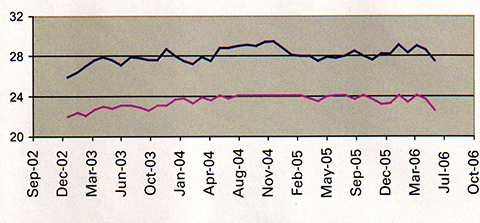
    Examining GPS performance over the past three years with respect to satellites in the key orbital slots, we see some interesting trends. Figure 1 presents the average number of satellites on orbit as well as the average number of healthy satellites in the 24 primary slots. A healthy satellite is one that has not been removed from service either due a scheduled outage (satellite and clock maintenance) or from an unscheduled anomaly (for example, degraded clock operation or problems with the spacecraft bus).

    Figure 1. Average number of healthy satellites on orbit (blue) and average number of healthy satellites in the 24 primary slots (red).
    Figure 1. Average number of healthy satellites on orbit (blue) and average number of healthy satellites in the 24 primary slots (red).

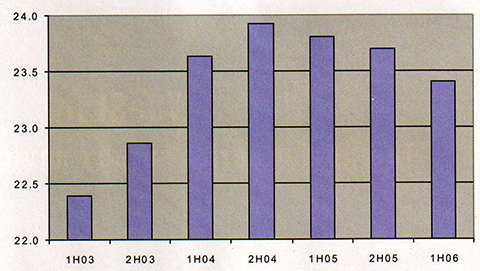
    The number of usable (healthy) satellites grew from 26 to about 28 on average, but this has not changed substantially in the past three years. It has varied between 27 and 29 satellites, with no significant upward or downward trend over this period. The number of satellites in primary slots, however, does show a noticeable trend, growing steadily through 2003 until late 2004 when it leveled off, after which it began to decrease. This trend recurs in Figure 2, where we view the same metric in half-year increments.

    Figure 2. Average number of healthy satellites in primary slots, shown in half-year increments.
    Figure 2. Average number of healthy satellites in primary slots, shown in half-year increments.

    The reduced number of filled primary slots stems from unscheduled outages. Scheduled outages have no significant impact on number of satellites usable since the operators typically remove a satellite from service for only a few hours, and such maintenance is performed on the order of once a month per satellite. Unscheduled outages, however, can last days and may require significant effort on the part of the satellite operators to resolve.

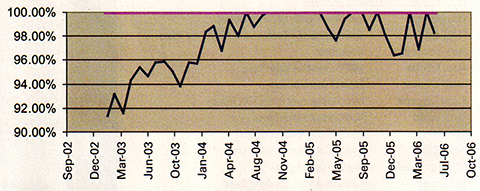
    The SPS Performance Standard states that 24 operational satellites must be available on orbit with 0.95 probability (averaged over any day). We see this figure has been met at the 100 percent level over the past three and a half years.

    The SPS Performance Standard further states that at least 21 satellites in the 24 nominal plane/slot positions must be set healthy and transmitting a navigation signal with 0.98 probability (yearly average). This figure is met.

    Figure 3 presents the monthly availability of the primary 24-satellite constellation (blue plot), that is, the percent of time over a month that there is a full set of 24 usable satellites in their primary slots. Here we see a marked trend, showing a steady growth from the beginning of 2003 up to the end of 2004, followed by a reduction, but still above the 95 percent level. Figure 3 also shows the monthly availability of 21 or more satellites assigned to the 24 primary slots (red plot), which has been at 100 percent over the past three and a half years.

    Figure 3. Monthly availability of the primary  24-satellite constellation (bue) and of 21 or more satellites assigned to the 24 primary slots (red).
    Figure 3. Monthly availability of the primary 24-satellite constellation (bue) and of 21 or more satellites assigned to the 24 primary slots (red).

    So What’s the Problem?

    If the U.S. government is meeting its commitments, why do users see degraded performance?

    Part of the issue is that the government manages the constellation to a set of metrics that is not up with the times, so to speak. The SPS Performance Standard has a legacy dating from prior to May 2000 when the government imposed Selective Availability, the intentional degradation of the positioning and timing accuracy for civilian users.

    Surveyors back then were considered eccentrics, as it were, living off the crumbs that fell from the table of the basic service. They took advantage of carrier phase tracking, but were content to post-process the data. Work that took days and weeks prior to GPS could now be done in hours. Well, those days are gone, and the push is now to get work done in minutes.

    The familiar adage “Give GPS users a yard and they’ll want an inch” has a corollary: “Give GPS users a process that takes them hours and they’ll want it done in minutes — or seconds!” Users have found they can do their processing much faster, as long as the constellation performance is well above the levels set in the SPS Performance Standard. This has indeed been the case since 2000.

    The GPS program has placed into orbit more satellites than originally anticipated. The general thought was that 27 satellites were sufficient to support the 24 satellite constellation. With 28, 29, and even 30 satellites in orbit, GPS has exceeded expectations, yet now the new expectations are that the government will sustain this level of performance.

    Improvements Happen

    The U.S. Air Force has made significant improvements in GPS operations as well in recent years. The satellite operators have become more user-focused. Prior to taking a satellite offline for maintenance, operators examine the effect of its removal to users worldwide. Also, they have adjusted operational procedures such that anomalies that once took hours to correct are now resolved within minutes. These improvements have directly benefited users, yet despite this, the mindset of the GPS operators is still to provide the service identified in the SPS Performance Standard, which is not the same as day-to-day service that users have come to expect.

    The Presidential Policy on National Space-Based Position, Navigation and Timing (PNT), issued in December 2004, provides high-level guidance on what service users can expect. Among its goals for space-based PNT, the policy states:

    • provide uninterrupted availability of positioning, navigation, and timing services
    • meet growing national, homeland, economic security, and civil requirements, and scientific and commercial demands.

    What “availability” is assumed in the first goal? Is it availability for users employing the 5-degree mask angle (as defined in the SPS Performance Standard), or is it the more stringent demand of mask angles at 10 degrees or higher? Is it availability of four satellites in view to support the generic user or that of six satellites in view to support receiver autonomous integrity monitoring with fault detection and exclusion?

    What “demands” mentioned in the second goal are to be met? Are they the demands of the precision farmer and surveying community? Or perhaps the tighter requirements of the urban user?

    This policy also states that the government will improve the performance of space-based positioning, navigation, and timing services. This implies that the service identified in the SPS Performance Standard will need to be changed to accommodate these improvements.

    To some extent, the U.S. government can only go so far in meeting user needs with the current system. The maximum number of satellites today’s operational control system can support is 30. As of the time of this article, GPS had 29 operational satellites on orbit, although at any given time not all are usable, due to necessary maintenance or unscheduled downtime. Whenever satellites are set unusable, the satellite operators look at the resulting performance, comparing it to the SPS Performance Standard. This is where the issue lies. The SPS Performance Standard assumes a generic user with only a 5-degree mask angle, yet this one assumption no longer represents a significant class of GPS users: the precision users.

    If there are 29 satellites available, why is a reduction to 27 such a big issue? Today’s GNSS users are more demanding than the users were even five years ago. Accuracy is the thing, and real-time accuracy is the most important thing. Today GNSS is used in precision applications such as agriculture, surface mining, and seismic drilling. To get the needed accuracy, users of GNSS exclude low-elevation angle satellites to mitigate the effects of the atmosphere. They set the mask angle in their receivers to 8, 10, even 12 degrees. This higher mask angle reduces the number of available satellites to the users, and correspondingly the dilution of precision and associated positioning error goes up, as illustrated in Figure 4.

    Figure 4. Picture of DOP performance over various mask angles for June 5, 2006.
    Figure 4. Picture of DOP performance over various mask angles for June 5, 2006.

    Is GPS Properly Managed?

    So the issue becomes, is the U.S. Air Force managing the constellation in the best interests of all of its users? Is keeping older satellites in orbit the best policy, and asking the satellite operators to do the best they can with the constellation provided to them? Or is it better to expend taxpayer dollars to replace the older, yet still operational, satellites with newer satellites?

    From a user’s perspective, the newer satellites are better — far better than the older satellites in range accuracy, health, and resistance to integrity failures. The increased reliability produced by their redundant systems also acts as insurance against longterm failures of GPS.

    Today’s users do expect more from GNSS. While today they have but one choice, in the future they will have at least two others, as Galileo and GLONASS come online. So it is important for the U.S. government to continue to adapt GPS operations to support its current user base.

    Recommendations

    There is no easy solution to the problem of ensuring that GPS continues to meet today’s user’s needs, since the field of users and applications is becoming more diverse and demanding. For many, the preferred answer is to launch more satellites, keeping the level at 30 satellites, but there are significant cost implications with this approach.

    On the other hand, relying on an aging constellation to remain operational is also fraught with peril. Many satellites are on their final legs, with key components on a single point of failure. The clocks onboard the satellites are not as stable as they used to be, and require considerable attention from the satellite operators. The cost of losing satellites is significant for certain sectors in our economy, the sectors that employ precision GNSS. In the distant future this problem will be eliminated through the diversity of fully operational Galileo and GLONASS constellations, but for now the issues are immediate and real.

    The U.S. government can and should take several steps to better address the increasing demands on GPS:

    • The government should update the SPS Performance Standard to accommodate other classes of users and bring the metrics up to date with respect to current performance.
    • The satellite operators should refine their assessments of user impact to include a view of how special classes of users are impacted. In particular this should include precision users and aviation applications. This involves using higher mask angles in their assessments and incorporating receiver autonomous integrity monitoring (RAIM) availability.
    • The decision-making authorities in GPS should continue to support an aggressive program to replace aging satellites.

    Such improvements will continue to benefit GPS users worldwide, and help ensure the U.S. government’s goal of providing the best PNT service available.


    John W. Lavrakas is a consultant in satellite navigation. He has spent the past 26 years in GPS, working in satellite command and control, user operations, GPS receiver development, and satellite navigation performance analysis. Contact him at [email protected].

  • Potential Problems for Users of Modernized GPS Signals in Mixed-Mode Operations

    PRN 17, the first IIR-M satellite launched in September 2005, began broadcasting the second GPS civil signal, L2C, in December 2005. PRN 17 is the first in the new generation of GPS satellites with a new feature called flex power. According to the U.S. Air Force, flex power adds the capability for the Department of Defense to increase power on both P- and M-code (both military) signals to defeat low-level enemy jamming.

    When flex power was enabled for testing (for a very short period of time), a problem was observed by certain GPS users. This problem was associated with the definition of the phase relationship between L2C and legacy L2 P/Y. In this scenario, users who are operating L1/L2/L2C GPS equipment, in conjunction with legacy L1/L2 GPS equipment, could have a problem maintaining carrier-phase ambiguity resolution with any modernized satellite operating in modes where signal phase relationships are changing or are unknown.

    This is not just a flex power issue, but a potential issue with any new modernized GPS signal if provisions are not included to inform users in real time of signal phase relationships. This is potentially a long-term problem because there will be a mixed set of modernized/legacy signals for an extended period of time, as well as a mixed set of modernized/legacy user equipment. The important thing is that these potential problems can be fixed by broadcasting appropriate data in the GPS navigation messages in a timely manner.

    This fix to this potential problem would slightly change the GPS user interface specifications and add bits for defining the phase relationship between the modernized and legacy signals. This data would have to be added to both the L1 and L2C signals since, for the time being, there is no data on the L2C signals. For L1C, (in the draft L1C specification) the phase relationship between L1C and L1 C/A has been defined. For L2 and L2C interoperability during modernization, a similar parameter to provide the phase relationship between the L2 P/Y and L2C is needed for mixed equipment processing. (Refer to Section 3.5.4.6 subframe 3, page 7 signal phase of the newly released Draft IS-GPS-800 L1C specification dated April 19, 2006.)

    Another possible solution is for L2C-capable receivers in a network to track both L2C and L2 P/Y simultaneously, to directly measure the phase difference between the two phases. However, the drawback is that the more robust L2C signal will be tracked at times when the legacy L2 P/Y cannot &#151 the main reason for implementing L2C in the first place.

    — Eric Gakstatter
    Contributing editor of the Survey & Construction newsletter