Tag: GNSS

  • Establishing orthometric heights using GNSS — Part 11

    Establishing orthometric heights using GNSS — Part 11

    Strategically Occupying Stations to Support NGS’ GPS on Bench Marks Program

    This is the 11th segment in my series on “Establishing Orthometric Height Using GNSS.” Each column has focused on a specific topic and provided procedures and tools for analyzing that topic. The columns are meant to build on each other. When addressing a topic that has been discussed in a previous column, web links are provided so the reader can review the previous columns.

    The last column, December 2016, highlighted NGS plans for the 2022 Vertical Reference Datum and provided approximate height differences that users can expect to see. It also provided a little history behind the differences between the NGVD 29 and NAVD 88, and how each replacement of the United States’ National vertical reference datum is improving the user’s ability to obtain the most accurate orthometric height. The October 2016 column demonstrated how to use the GPS on BMs dataset to identify potential issues in published NAVD 88 and NAD 83 (2011) heights. It focused on analyzing the NGS’ GPS on BM data set that was used to create NGS’ GEOID12B hybrid geoid model. It provided procedures that users could employ when analyzing the differences between the modeled geoid values and the computed geoid values using GNSS/Leveling data (GNSS-derived ellipsoid height minus leveling-derived orthometric height). The October 2016 column provided several examples of large relative differences in residuals between neighboring stations. Each example represented stations that should be investigated based on different reasons, such as a weak NAVD 88 leveling network design in the region, the station’s published height attribute code implies that the station was not rigorously adjusted into the NAVD 88, and station pairs have different adjustment dates indicating a possible adjustment distribution correction issue or movement.

    The following questions still need to be addressed: (1) Is the large difference due to an issue with the NAVD 88 orthometric height or the NAD 83 (2011) ellipsoid height? and (2) Should the station be included in the development of NGS’ hybrid geoid models? This column will provide suggestions on how users can assist NGS in determining the reason for the large difference between the modeled hybrid geoid value and computed GNSS/leveling geoid computed value. This information will be useful to NGS when developing hybrid geoid models and the 2022 Vertical Transformation model.

    At this moment, the user is limited to what they can do to assist in identifying the problem. There are basically two options: (1) perform precise leveling observations between two or more stations and/or (2) perform accurate GNSS observations between two or more stations. Performing geodetic leveling between two stations is the desired option but is very expensive and time consuming; however, performing accurate GNSS observations between the two stations is relatively inexpensive and, if NGS’ OPUS-Projects is used to process the data then it is relatively simple to determine accurate NAD 83 (2011) ellipsoid heights and height differences. Even if the project is not submitted to NGS for inclusion into NAD 83 (2011), OPUS-Projects provides a easy and traceable mechanism for others to analyze the results and make their own decision.

    First, let’s look at what NGS provides the user on their GPS on Bench Mark Program. The October 2016 column discussed the GPS on Bench Mark dataset used to create GEOID12B. It provided basic information about the program and provided links to websites that address the program. This column will provide additional information that will be useful for those individuals that desire to participate in the GPS on Bench Mark program. The website provides information on bench mark reconnaissance and recovery. NGS outlines to the user how to use their data files to perform a desktop reconnaissance. They provide eight steps that they believe will be helpful to the user when supporting the GPS on Bench Mark program. (See box titled “NGS’ Suggested Eight Steps for Users to Follow When Participating in the GPS on Bench Mark Program.”)

    NGS’ Suggested Eight Steps for Users to Follow When Participating in the GPS on Bench Mark Program

    North American Vertical Datum of 1988 (NAVD 88) consists of a leveling network on the North American Continent, ranging from Alaska, through Canada, across the United States, affixed to a single origin point on the continent:

    1. Desktop reconnaissance
    2. Reconnaissance materials
    3. Reconnaissance equipment
    4. Bench Mark Hunting
    5. Photos
    6. Observe and record
    7. Plan for Survey Observation
    8. Add your Planned Observation to the ArcGIS Online Map

    Each step has a short narrative that provides helpful information for users that want to participate in the program. This column will focus on the first step titled Desktop reconnaissance. (See box titled “Excerpt from the National Geodetic Survey on Bench Mark Reconnaissance and Recovery.”)

    Excerpt from the National Geodetic Survey on Bench Mark Reconnaissance and Recovery

    North American Vertical Datum of 1988 (NAVD 88) consists of a leveling network on the North American Continent, ranging from Alaska, through Canada, across the United States, affixed to a single origin point on the continent:

    1. Desktop reconnaissance

    Bench marks of First and Second order leveling are targeted for GPS observations. Identify where you are looking for survey control. Generally surveyors try to tie into the NSRS without traveling too far from their project areas. Once you have determined your area of interest, use mapping applications to find marks that meet your criteria. The two recommended mapping applications are the NGS Data Explorer and DSWorld. The NGS database does not always get updated when geocachers recover marks on their web site, but DSWorld does provide information from their web site by showing a when it has been recovered.

    To help assist surveyors and geocachers we have also created an ArcGIS Map Package , a zip file for non ArcGIS users and an ArcGIS Online (AGOL) Web Map available using the links below. The Web Map Application is available using any browser and the Map Package and zip file is for users interested in performing their own analysis.

    GPS-on-bench-marks-agol-map
    GPS on Bench Marks AGOL Map

    ngs-gps-on-bench-marks-esri-map-package
    NGS GPS on Bench Marks
Esri Map Package (~178 MB)

    NGS GPS on Bench Marks
Shapes/rasters (~88 MB)

    NGS GPS on Bench Marks
Shapes/rasters (~88 MB)

    These datasets provide the bench marks that were used in the creation of Geoid12B as well as the new GPS on bench marks that have been incorporated into NAD 83 (2011) since the creation of Geoid12B. This is useful information for those that want to occupy different bench marks than those previously observed with GNSS, and it is especially useful for identifying areas of the country that do not have enough bench marks occupied by GNSS. However, as I mentioned in my October 2016 column, the GPS on Bench Mark dataset can also be useful for identifying issues with NAVD 88 orthometric heights and NAD 83 (2011) ellipsoid heights. In the October 2016 column, I recommended that users perform an analysis of the differences between the published Geoid12B values and computed values from the NGS datasheet. (See box titled “Excerpt from October 2016 column – Analyzing Stations in the GPSBM Table.”)

    Excerpt from October 2016 column – Analyzing Stations in the GPSBM Table.

    So, what should the user do with the GPSBM table? I recommend that users perform the following steps when analyzing the stations in the GPSBM table.

    1. Compare the modeled GEOID12B (N12B) value to the computed GPS/Leveling (h minus H) value using the following formula: Published N12B from the NGS data sheet minus (ellipsoid height from the GPSBM table minus orthometric height from the GPSBM table). We discussed this procedure a year ago in column 3 (October 2015). It should be noted that the orthometric height in the GPSBM table may be different than the published NAVD 88 height on the NGS data sheet if the station has been readjusted since the GPSBM table was created.
    2. Repeat the procedure in Step 1 using the latest NGS experimental geoid model, e.g. xGeoid16b. At this time, NGS only provides the experimental geoid models referenced to IGS08 so the user will have to use NGS’ xGeoid16 web tool to obtain the station’s IGS08 ellipsoid height and xGeoid16b value. The input to the tool is the station’s NAD 83 (2011) coordinates (latitude, Longitude, and ellipsoid height). [An example of using the xGeoid16 web tool is provided in the box titled “Example of Using NGS xGeoid16 Web Tool.”] As discussed in column 3 (October 2015), the user will have to remove a bias and trend based on the differences in the region.
    3. Use the station’s data sheet to identify how the station’s orthometric height was determined; for example, was it rigorously adjusted into the NAVD 88 (published height attribute – Adjusted). We discussed the attributes of the NGS data sheet in column 5 (February 2016). A summary of the attributes from the NGS data sheet DSDATA.TXT file is provided in the box titled “Extracted from NGS’ DSDATA.TXT.” I have highlighted the most common attributes of the stations involved in making GEOID12B.
    4. Use the station’s NGS data sheet to determine the adjustment date of the station’s published NAVD 88 orthometric height. We discussed this in column 7 (June 2016). As mentioned in column 7, if the station has a different adjustment date than other stations nearby, there could be inconsistencies due to adjustment distribution corrections and/or movement.

    If you download the Zip file or the Esri Map Package, you should have a layer titled “NGS_Bench_Marks.” This layer contains all the bench marks from the NGS database that have NAVD 88 orthometric heights with the attribute “ADJUSTED.” It should be noted that this is not the complete list of stations used to create the hybrid geoid model GEOID12B. This file only contains bench marks that were established using precise geodetic leveling procedures and incorporated into NAVD 88 using NGS’ leveling adjustment program. The list of attributes and their meaning was provided in my February 2016 column. The ArcGIS NGS_Bench_Marks layer contains a NAVD 88 orthometric height, a Geoid12B value, and an ellipsoid height if the station was occupied in a GNSS project. The ArcGIS user can select all bench marks that have a NAD 83 (2011) ellipsoid height in their state by using an ESRI query builder statement; for example, “STATE” = ‘NC’ AND “DATUM_TAG” = ‘(2011)’ AND “POS_DATUM” = ‘NAD 83’. Now the user can compute the GPS on BMs residual using the following formula: GPS on BMs Residual = Geoid12B value minus [NAD 83 (2011) Ellipsoid Height – NAVD 88 Orthometric Height)]. The user can perform this operation in the ESRI ArcGIS program or download the ArcGIS “NGS_Bench_Marks.dbf” file into Excel (or another spreadsheet program) and compute the computation in that spreadsheet program. The user can then import the file back into ArcGIS or their own GIS software. Once you have the GPS on BMs Residuals you can plot them and look for outliers. This is what I denote as “Strategically Occupying Stations to Support the GPS on Bench Mark Program.” I performed the above operation for the entire “NGS_Bench_Marks” file.

    The file can be downloaded as an Excel document here and as a text document here.

    So, what do I really mean by strategically occupying station to support the GPS on Bench Mark Program. Once you plot the GPS on Bench Marks residuals, the user should use the plots to identify stations that should be re-occupied because of large residuals or new stations that should be occupied in areas void of control. Figure 1 is an example of the GPS on BMs residuals for the State of North Carolina.

    Figure 1 – GPS on Bench Marks Residuals using GEOID12B computed using NGS GPS on Bench Marks Shapes/rasters
    Figure 1 – GPS on Bench Marks Residuals using GEOID12B computed using NGS GPS on Bench Marks Shapes/rasters

    Looking at figure 1, the reader should notice some large red circles (negative GPS on BMs residuals) are located near some large blue circles (positive GPS on BMs residuals). In my opinion, these regions should be analyzed to determine if stations should be re-observed during a GPS on Bench Mark campaign. This doesn’t mean that if other stations are occupied that they will not help improve the hybrid geoid model and the NAVD 88 transformation model to the new 2022 Vertical Reference Datum, it just means that these previously occupied stations are questionable and re-observing these stations may help to explain why the residuals are so large. I’ve provided a couple of examples in North Carolina to explain what I mean.

    Figure 2 depicts a station with a large negative residual (-7.9 cm) surrounded by stations with smaller residuals (mostly positive residuals). This station’s published NAVD 88 height may be an invalid height; that is, the station may have moved after the leveling-derived orthometric height was determined. In my opinion, this station should not be used in the development of a hybrid geoid model or any transformation model from NAVD 88 to another vertical reference datum. It would be useful information to know if the NAVD 88 orthometric height is invalid. In this example, the user could re-observe station Z 183 (PID = FA0997) with a long GNSS session, or simultaneously observe station FA0997 and another nearby station (such as AH5641) during the same long session. The second option allows the user to estimate a new ellipsoid height difference between the two stations that can be compared with the published ellipsoid height difference.

    Figure 2 – Large Negative Residual Surrounded by Smaller Residuals – Station FA0997
    Figure 2 – Large Negative Residual Surrounded by Smaller Residuals – Station FA0997

    The ArcGIS NGS_Bench_Marks layer includes when the station was first recovered (e.g.,1967) and last recovered (e.g., 2009), and the condition of the station (e.g., good condition). The NGS dataset provides the network and local accuracies for published NAD 83 (2011) stations. (See box titled “Excerpt from NGS’ Datasheets for Stations FA0997 and AH5641.”) We discussed NGS’ datasheet and published local and network accuracy values in the August 2015 column.

    ngs-datasheet-excerpt-1

    ngs-datasheet-excerpt-2

    The stations’ local and network accuracy values are highlighted in the box titled “Excerpt from NGS’ Datasheets for Stations FA0997 and AH5641.” Station AH5641 local ellipsoid standard error value (0.51 cm) is much better than station’s FA0997 value (2.47 cm). Next, we should look at the local network accuracies to determine which stations were simultaneously observed during a GNSS survey. Once again, these options on the NGS’ datasheets were discussed in the August 2015 column.

    column-11-ngs-excerpt-3

    column-11-ngs-excerpt-4

    The box titled “Excerpt from NGS’ The Local and Network Accuracy Data Sheet for Stations FA0997 and AH5641” provides the local and network accuracy data sheet for stations FA0997 and AH56412. The readers should notice that Station FA0997 only has one local accuracy to another station and that station is not AH5641. This implies that these two stations were not observed during the same session. The large relative difference in residual could be due to an invalid NAVD 88 orthometric height but it could also be due to an undetected error in the ellipsoid height due to a weak GNSS survey design. Let’s look at another example where there’s more than one outlier in a small group.

    Figure 3 depicts two stations (AI7070 and AI7073) that appear to be inconsistent with their neighboring stations (FB3216 and FB3222). If we look at the datasheets for these stations, it can be determined that stations AI7070 and AI7073 were observed in the same session but neither station was occupied in a session with FB3216 or FB3222. The datasheets do indicate that FB3216 and FB3222 were observed during the same session. In this case, I would recommend simultaneously observing stations FB3222 and AI7073 to determine an accurate ellipsoid height difference to determine if the relative ellipsoid height difference computed from the published ellipsoid heights are really as accurate as their published network and local accuracy values. If these stations do not get re-observed, I would not recommend using stations AI7070 and AI7073 in the hybrid geoid model.

    Figure 3 – Several Large Negative Residual Surrounded by Smaller Positive Residuals – Stations AI7070 and AI7073
    Figure 3 – Several Large Negative Residual Surrounded by Smaller Positive Residuals – Stations AI7070 and AI7073

    I have focused on North Carolina but this analysis can be performed on any state or region. Figure 4 is a plot of GPS on BMs residuals using Geoid 12B for the State of Florida. Looking at figure 4, there appears to be a lot of stations with large GPS on Bench Mark residuals.

    Figure 4 – GPS on BMs residuals using GEOID12B for the State of Florida
    Figure 4 – GPS on BMs residuals using GEOID12B for the State of Florida

    Figure 5 is a plot of the GPS on Bench Mark residuals using GEOID12B in the Lynn Haven, Florida, area. Looking at figure 5, the reader can see that station BE1497 has a large relative difference between its neighbors (BE0604 and AA9918). This station and one of its neighboring station should be re-observed in a GNSS survey. In my opinion, if this station is not re-observed then it should be rejected and not included in the development of the hybrid geoid model.

    Figure 5 – GPS on BMs residuals using GEOID12B for Lynn Haven, Florida, Area
    Figure 5 – GPS on BMs residuals using GEOID12B for Lynn Haven, Florida, Area

    Some States have enough bench marks that have been occupied by GPS that re-observing a station may not improve the hybrid geoid model. It may be sufficient to reject the station so it doesn’t distort the hybrid geoid model. Figure 6 is a plot of the GPS on BMs for the State of Missouri. If you compare figure 1 (plot of GPS on BMs in North Carolina) with figure 6 (plot of GPS on BMS in Missouri), it’s obvious that the State of North Carolina has more bench marks occupied by GPS than Missouri. Most of the residuals in figure 6 seem reasonable but the user should investigate those stations that are greater than +/- 5 cm. An example of a station that should be re-observed is station C 10 (KD0210). Figure 7 is a plot of the GPS on BMs surrounding station C 10 (KD0210). The NGS data sheet for station C 10 states that the station was incorporated into NAD 83 (2011) in May 2015; therefore, it wasn’t used in the creation of GEOID 12B. The data sheet also provides the Network and Local Accuracy values for the station. [See the box titled “Excerpt from NGS’ Datasheets for Station KD0210.”] The network and local ellipsoid height accuracy values (6.49 cm) are larger than most published NAD 83 (2011) stations.

    column-11-ngs-excerpt-5

    column-11-ngs-excerpt-6

    Figure 6 – GPS on BMs residuals using GEOID12B for the State of Missouri
    Figure 6 – GPS on BMs residuals using GEOID12B for the State of Missouri
    Figure 7 – GPS on BMs residuals using GEOID12B Surrounding Station KD0210 (C 12)
    Figure 7 – GPS on BMs residuals using GEOID12B Surrounding Station KD0210 (C 12)

    This is an area that is void of GPS on bench mark control so this station is extremely important. However, this station has a large GPS on BM residual and a large local accuracy value which makes the station’s published orthometric height and ellipsoid height questionable. I would recommend that this bench mark and several nearby bench marks be observed in a GNSS survey to provide additional estimates of the relationship between the NAVD 88 orthometric heights and NAD 83 (2011) ellipsoid heights in this area. Saying that, it is very important that users perform procedures that result in an accurate GNSS-derived ellipsoid height. This means that users may have to observe stations for several hours and repeat observations on different days and at different times of the day. Of course, I realize that this may be too expensive for most surveyors but the end result may not be sufficient to determine why the station has a large GPS on BM residual.

    I stated in my October 2016 column that step 2 was to use the latest experimental geoid model in the analysis. (See box titled “Excerpt from October 2016 column – Analyzing Stations in the GPSBM Table.”) I have focused this column on using data that can easily be obtained from the NGS’ website. Saying that, in my next example I have computed the GPS on Bench Marks residuals using a detrended xGeoid16b that is consistent with NAD 83 (2011) [i.e., a bias and trend has been removed from the differences]. This information is not currently available from NGS’ website but I want to show the differences between the hybrid model residuals and the experimental geoid model, xGeoid16b.

    It’s very difficult, if not impossible, to identify how much the hybrid geoid model has been distorted to fit a GPS/Leveling station by looking at published data from NGS data sheets. Figures 8 and 9 demonstrate how some large GPS on Bench Marks residuals using GEOID12B may be distorting the hybrid geoid model. Figure 8 is a plot of the GPS on BM residuals using GEOID 12B in an area in Rockbridge County, Virginia, and Figure 9 is a plot of the same stations using a detrended scientific geoid model xGeoid16b that is consistent with NAD 83 (2011). Looking at figure 8, stations GW2113 and GW0934 appear to be large outliers, -8.8 cm and 11.8 cm, respectively. Station GW0934 was rejected by the geoid team. However, looking at figure 9, using a detrended xGeoid 16b model, the GPS on BM residual of station GW2113 is -19.3 cm and the residual of station GW0934 is only 3.4 cm. What is very important to notice on figure 8 is that nearby stations GW1042 and GW0822 residuals are only -3.3 cm and -2.0 cm, respectively; but, on figure 9, using the detrended xGeoid16b model, the residuals of stations GW1042 and GW0822 are -12.2 cm and -11.5 cm, respectively. Some of these stations need to be re-observed to determine if the NAVD 88 orthometric heights are no longer valid or if there are undetected errors in the published ellipsoid heights. This is why the experimental geoid model should also be used when analyzing GPS on Bench Mark residuals; and why some GPS on BM stations that are inconsistent with their neighboring stations should not be included in the development of a hybrid geoid model. This means that analyzing GPS on Bench Marks residuals using just the hybrid geoid model will only identify outliers that are significantly different from their neighbors. Some outliers will be missed but the procedure does help to prioritize those stations that should be re-observed to help support NGS’ GPS on Bench Mark Program.

    Figure 8 – GPS on BMs residuals using GEOID12B for a Large Outlier in Rockbridge County, Virginia (PID =GW2113)
    Figure 8 – GPS on BMs residuals using GEOID12B for a Large Outlier in Rockbridge County, Virginia (PID =GW2113)

    Figure 9 – GPS on BMs Residuals Using a Detrended GEOID16b [consistent with NAD 83 (2011), bias and trend removed] for a Large Outlier in Rockbridge County, Virginia (PID =GW2113)
    Figure 9 – GPS on BMs Residuals Using a Detrended GEOID16b [consistent with NAD 83 (2011), bias and trend removed] for a Large Outlier in Rockbridge County, Virginia (PID =GW2113)
    It should be noted that many of these large GPS on BM residuals could be due to an invalid NAVD 88 published height because the bench mark moved since the last time the height of the bench mark was adjusted and published, and/or an undetected error in an ellipsoid height due to a weak GNSS project design. Either way, in my opinion, most of these stations with large GPS on BMs residuals don’t accurately represent the current NAVD 88. When performing a geodetic survey, these stations would be identified as bench marks with invalid heights when following the appropriate Federal geodetic survey guidelines, procedures, and specifications. These bench marks should not be used in the hybrid geoid model just like they would not be used in controlling geodetic surveys. I want to emphasize that I’m not criticizing NGS process for creating their hybrid geoid model. NGS’ goal is to create a hybrid geoid model that is consistent with published NAVD 88 values. I believe NGS is using all the data and information available to them. I am trying to emphasize to users the importance to strategically occupy stations to help support the GPS on Bench Marks Program and create a hybrid geoid model that accurately represents the current NAVD 88.

    This column focused on addressing the following questions: (1) Is the large GPS on BM residual due to an issue with the NAVD 88 orthometric height or the NAD 83 (2011) ellipsoid height? and (2) Should stations with large GMS on BM residuals be included in the development of NGS’ hybrid geoid models? The column provided suggestions on how users can assist NGS in determining the reason for the large difference between the modeled hybrid geoid value and computed GNSS/leveling geoid computed value. This information will be useful to NGS when developing hybrid geoid models and the 2022 Vertical Transformation model.

  • GNSS CEOs see bright future, alternative PNT promises well

    It has been a good year for all global navigation satellite systems (GNSS), as the chief executives of each system testify here. Alternative positioning, navigation and timing (PNT) also thrives. In this roundup of the latest highlights from the past year and forecasts for the future, 2017 augurs very well indeed! Let’s look at the newest alternative-PNT offerings first, followed by forecasts from the chief executive officers (CEOs) of each of the conventional GNSS.

    Alternative PNT grows and expands

    Two new entrants to the positioning, navigation and timing (PNT) marketplace offer key capabilities to fill in the gaps left by GNSS. A new satellite timing and location (STL) service from low-Earth orbit satellites, provided by Satelles and Orolia, gives a strong signal capable of penetrating buildings.

    Satellite Time and Location (STL) Service. Pursuant to a recent announcement of new PNT solutions independent of GPS/GNSS signals, provided via the Iridium constellation, GPS World talked with Jean-Yves Courtois, CEO of Orolia. Orolia has partnered with Satelles to bring new PNT products and services to the global market, with a focus on military, and defense, government and commercial customers worldwide.

    Jean-Yves Courtois, CEO of Orolia

    Jean-Yves Courtois, CEO of Orolia.

    “We are a manufacturer and integrator of timing equipment,” Courtois said. Orolia is the parent company of GPS/GNSS product and service providers Spectracom, McMurdo and Spectratime. “This new STL service is not fully commercialized yet, but it’s operational and it can be tested. Receivers are available and can be integrated into our equipment.

    “The timing signal is very accurate and close enough to GPS for most timing applications, although the positioning accuracy is lower than what GPS users are used to. It is an augmentation for timing primarily, and secondarily for positioning.

    “In terms of timing accuracy, it provides on the order of tenths of microseconds in accuracy, and this covers a lot of timing applications, very familiar to us and to our customers. This is an ideal timing backup or augmentation of GPS. As number 2 worldwide in high-precision timing, we know this market and its applications very well.”

    Correlator beamforming. The Locata Corporation announced a patented correlator beamforming technology to stem multipath mitigation. The new technique’s performance under rigorous testing by the U.S. Air Force Institute of Technology will be detailed in the January 2017 issue. Look for it! Here are a series of snippets as a preview of that lengthy technical article appearing in Richard Langley’s Innovation column.

    “Unlike conventional or traditional beamsteering technology, the new correlator beamforming approach combines RF signals received by any number of individual antenna elements into a single switched-RF signal. This time-multiplexed signal is then downconverted and digitized by a single RF front-end. The correlator beamforming design will should offer cost savings because the resulting data stream is processed using a single correlator channel per beam. This markedly reduces the complexity when compared to the traditional beamsteering methodology.

    “The correlator beamforming technique performs antenna array signal processing to form beams as part of a receiver’s correlation process. The complete explanation of this technology can quickly get complex, even for the seasoned RF engineer. To describe this process more simply, we will assume noiseless signals and no multipath (except as noted), as well as equal noise figures for all front-end processing chains. To further simplify our explanation, modulation on the carrier and switching losses will be ignored.”

    “To evaluate the performance of correlator beamforming as fairly as possible compared to traditional beamsteering and single-element processing, AFIT set up its data collection such that all three approaches could be implemented in a software receiver. Additionally, a seven-element Naval Air Systems Command GPS Antenna System 1 (GAS-1) antenna was used for this experiment. The antenna was mounted on a 51-inch (130-centimeter) diameter rolled-edge ground plane provided to the ANT Center by the MITRE Corporation.”

    “The testing focused on demonstrating an easily modified GNSS receiver to potentially deliver a low-cost solution for mitigating multipath — specifically targeting short delay and carrier multipath. The results presented here show that the multipath rejection performance nearly equals that of a traditional beamsteering GNSS receiver. Applications that can significantly benefit from this technology include stationary GNSS monitoring installations such as those used in satellite-based and ground-based augmentation systems and GNSS receivers for autonomous vehicles and UAVs in high multipath areas such as urban canyons.”

    GPS III ready, steady

    Col. Steve Whitney, Director, U.S. Air Force GPS Directorate
    Col. Steve Whitney, Director, U.S. Air Force GPS Directorate

    “The [GPS III] program is  working to solve several technical challenges as we progress to completion,” Col. Steve Whitney, director of the U.S. Air Force GPS Directorate, wrote in GPS World’s December issue. “SV-01 testing uncovered electro-magnetic interference between a payload component and a hosted payload. Testing also uncovered electron impact issues on the L-band antenna elements. In partnership with Lockheed Martin, the program developed corrective action and design mitigations for both of these issues and is implementing these steps within our production flow for all the SVs.”

    “In the coming year, SV-02, the second GPS III satellite, will also be progressing towards completing production. Currently, all of the SV-02 sub-assemblies have been received by Lockheed Martin and are being integrated into the spacecraft. The next major step in the production flow for SV-02 will be to mate it with its propulsion core.

    “Recently, we completed negotiations with Lockheed Martin to extend the production line with purchases of SV-09 and SV-10. These satellites will be technically equivalent to SV-01 through SV-08. This $395 million purchase of two satellites marks a significant affordability milestone for the procurement of GPS III satellites.

    “Looking ahead, we are analyzing how to acquire satellites beyond SV-10. We are executing a phased strategy which starts first with determining the viability of a GPS III production design existing beyond the current contractor. We awarded an initial phase of contracts to the Boeing Company, Lockheed Martin Space Systems Company, and Northrop Grumman Aerospace Systems in May 2016 to provide a feasibility assessment of the readiness of their satellites designs. In this phase, the contractors will provide a GPS III production design, manufacturing plans and a navigation payload brassboard test report, along with manufacturing/production processes and facilities maturity.”

    Galileo coming on strong

    Director of the Galileo Programme Paul Verhoef of the European Commission wrote in that same issue of the magazine, “The production of the satellites continues to maintain a steady rhythm, with a production line stretching from suppliers across Europe to OHB and SSTL and then to ESA’s ESTEC Test Centre in the Netherlands for acceptance testing, based on a wide range of simulated space tests.”

    Closing out the year on a triumphant note, Galileo declared its Initial Services on December 15.

    Paul Verhoef, director of the Galileo Programme and Navigation-related Activities, European Space Agency.
    Paul Verhoef, director of the Galileo Programme and Navigation-related Activities, European Space Agency.

    “The acceptance of the next satellites to launch is scheduled for this year’s end,” continued Verhoef. “Along with the two more Ariane 5 launches to come — one in the second half of 2017 and another in 2018 — the current plan is to commission further launch services as well as additional satellites in order to have Galileo fully operational by 2020. For these launches, Galileo may be the first customer of the new Ariane-6 launch vehicle.

    “2017 will see the upgrade of various elements of the Galileo Ground Segment to reinforce its robustness, including updated releases to the Galileo Control Segment overseeing the satellites and the Galileo Mission Segment, overseeing the navigation signals. A new release of elements of the Galileo Security Facility, for security monitoring of the system, as well as the secure Public Regulated Service, will be deployed at the two Galileo Security Monitoring Centres.

    “The Galileo Ground Segment will gain a sixth tracking telemetry and control facility, for monitoring the satellite platforms in Papeete, Tahiti, and additional processing chains for increased redundancy will be deployed across the Uplink Stations in Kourou, Reunion and Noumea used to update the navigation message information. Similar redundant chains will be finalized for all 15 current Galileo Sensor Stations, which perform continuous collection of Galileo signals to identify the tiniest clock error or satellite drift.”

    EGNOS. “Along with the progress of Galileo, contracts are planned to cater for the further development of the ESA-designed European Geostationary Navigation Overlay Service, Europe’s first navigation system. EGNOS was certified for safety-of-life aviation use in 2011, and is managed by the European Commission through a contract with operator the European Satellite Services Provider, based in France. ESA will support the technical evolution of EGNOS version 3, intended as multi-constellation in nature, again through the Horizon 2020 framework.”

    GLONASS looks forward to a new signal: CDMA!

    Sergey Karutin, GLONASS Chief Designer, wrote “On the threshold of the first GLONASS-K2 launch, new GLONASS reference documents were published in October 2016, describing the family of code-division multiple-access (CDMA) radionavigation signals. The draft GLONASS Open Service Performance Standard has been developed. The GLONASS User Information Support System continues to evolve.”

    From left: Sergey Karutin, GLONASS designer general; Nicolay Testoedov, director general, SC Information Satellite Systems; and Andrey Tulin, director general, SC Russian Space Systems.
    From left: Sergey Karutin, GLONASS designer general;
    Nicolay Testoedov, director general, SC Information Satellite Systems; and Andrey Tulin, director general, SC Russian Space Systems.

    “The system transmitting CDMA navigation signals is referred to in four interrelated interface control documents containing general information on signals and the detailed description of signal structures and digital message data. The new signals make it possible to include 63 satellites in the constellation, not only in circular medium-Earth orbit but also on geostationary and high-Earth orbits.

    “The transition to the flexible string-type structure of the message data produces 2-second periodicity of integrity information delivery to users. The increased number of digits occupied by the ephemeris and clock parameters contributes to a better orbit and clock broadcast accuracy. The ephemeris broadcast precision improves from 0.4 to 0.001 meters. Time-stamp length in CDMA signal has increased to 30 bits, compared to 12 bits of frequency-division multiple-access signals.”

    BeiDou approaches full regional services

    Li Wang
    Li Wang

    “In 2017, three to four launches of BeiDou satellites will occur,” wrote Li Wang, Director of the International Cooperation Center in China’s Satellite Navigation Office. “BDS will provide basic services to the countries along the Belt and Road region by 2018, and possess global service capability by 2020.”

    “BDS will keep improving its nationwide reference station network and steadily enhance its service performance. The dense reference stations for the nationwide frame network will be constructed by 2018, providing meter and decimeter level real-time location services for users in China, even centimeter level service in some areas.

    “BDS will carry out the design, validation and construction of SBAS in accordance with international civil aviation standards. The first GEO satellite of BDSBAS will be launched in around 2018. The satellite-based augmentation services covering China and surrounding regions will be provided from 2020, to provide CAT-I services to civil aviation users.

    “China will promote construction of a national comprehensive positioning, navigation and timing (PNT) system based on BDS, and strive to establish such a national PNT system with a united benchmark, no-gap coverage, security and effectiveness by 2030, as well as to upgrade capabilities to provide time and space information.”


  • Galileo declares Initial Services

    Galileo declares Initial Services

    At a Dec. 15 ceremony in Brussels titled “Galileo Goes Live,” two high officials of the European Commission issued the Galileo Initial Services Declaration.

    The Declaration of Initial Services means that the Galileo satellites and ground infrastructure are now operationally ready. These signals will be highly accurate but not available all the time, since the constellation is not yet complete and users cannot always count on four satellites being visible at one time at all points on the Earth.
    Simultaneously, the European GNSS Agency (GSA)  awarded the Galileo Service Operator (GSOp) contract, with a value of up to 1.5 billion euros, to Spaceopal, a joint venture between Telespazio and the German Space Agency (DLR).

    At the moment, the Galileo constellation consists of 18 satellites in orbit. However, two of these are in an orbit not totally useful for positioning and navigation. Four more, launched in November, may or may not have completed their on-orbit testing (a series of notice advisory to Galileo users or NAGUs appeared today relating to the flag status of each satellite, see details at the end of this story) but have not yet been integrated to the operational constellation. This is foreseen to take place in spring 2017.

    During the initial phase, the first Galileo signals will be used in combination with other satellite navigation systems, like GPS. In coming years, new satellites will be launched to enlarge the constellation, gradually improving Galileo availability worldwide. The constellation is expected to be complete by 2020 when Galileo will reach full operational capacity (FOC) of 30 satellites: 24 satellites plus six orbital spares, intended to prevent any interruption in service.

    “The announcement of Initial Services is the recognition that the effort, time and money invested by ESA and the Commission has succeeded, that the work of our engineers and other staff has paid off, that European industry can be proud of having delivered this fantastic system,” stated ESA Director general Jan Woerner.

    Paul Verhoef, ESA’s Director of the Galileo Programme and Navigation-related Activities, added, “Today’s announcement marks the transition from a test system to one that is operational. We are proud to be a partner in the Galileo programme.

    “Still, much work remains to be done. The entire constellation needs to be deployed, the ground infrastructure needs to be completed and the overall system needs to be tested and verified.

    “In addition, together with the Commission we have started work on the second generation, and this is likely to be a long but rewarding adventure.”

    Galileo Initial Services are managed by the European GNSS Agency (GSA). The overall Galileo programme is run by the European Commission, which has handed over the responsibility for the deployment of the system and technical support to operational tasks to the European Space Agency (ESA).

    Operator Contract

    The GSOp contract runs for 10 years and covers  operation and maintenance of the Galileo satellite system and its committed performance level: in particular, the operations and control of the system, the logistics and maintenance of the systems and infrastructure as well as the user support services.

    “With its emphasis on service performance, this contract will shape the future of Galileo. We look forward to building a strong partnership with Spaceopal as Galileo moves towards full operational capability under the responsibility of the GSA from January 2017,” said GSA Executive Director Carlo des Dorides.

    Specifically, under GSA management the contract awarded to Spaceopal includes:

    • Secure operations of Galileo from two mission control centres (GCC), located in Germany and Italy, and the European GNSS Service Centre (GSC) for user support services in Spain;
    • Management of the Galileo Data Distribution Network (GDDN);
    • Integrated logistics support and maintenance for the entire space and ground infrastructure;
    • Monitoring of the system performance;
    • Support the completion of the Galileo infrastructure and associated launches.

    Spaceopal has served as the contractor for Galileo operations since 2010 under the Galileo Full Operational Capability (FOC) Operations Framework Contract.

    Products and Services

    The first Galileo smartphone by Spanish company BQ is now available on the market, and other manufacturers are expected to follow suit. Application developers can now test their ideas on the basis of a real signal.

    With this Declaration, Galileo will start to deliver, in conjunction with GPS, the following three types services free of charge. Their availability will improve as more satellites are launched.

    The Open Service is a free mass-market service for users with enabled chipsets in, for instance, smartphones and car navigation systems. Fully interoperable with GPS, combined coverage will deliver more accurate and reliable positioning for users.

    Galileo’s Public Regulated Service is an encrypted, robust service for government-authorised users such as civil protection, fire brigades and the police.

    The Search and Rescue Service is Europe’s contribution to the long-running Cospas–Sarsat international emergency beacon location. The time between someone locating a distress beacon when lost at sea or in the wilderness will be reduced from up to three hours to just 10 minutes, with its location determined to within 5 km, rather than the previous 10 km.

    Maroš Šefčovič, à gauche, et Elżbieta Bieńkowska
    Maroš Šefčovič, à gauche, et Elżbieta Bieńkowska.


    Accolades and Encouragements

    At the “Galileo Goes Live” ceremony in Brussels, EC Vice-President Maroš Šefčovič, responsible for the Energy Union, said: “Geo-localisation is at the heart of the ongoing digital revolution with new services that transform our daily lives. Galileo will increase geo-location precision ten-fold and enable the next generation of location-based technologies; such as autonomous cars, connected devices, or smart city services. Today I call on European entrepreneurs and say: imagine what you can do with Galileo — don’t wait, innovate!”

    Commissioner Elżbieta Bieńkowska, responsible for Internal Market, Industry, Entrepreneurship and SMEs, said: “Galileo offering initial services is a major achievement for Europe and a first delivery of our recent Space Strategy. This is the result of a concerted effort to design and build the most accurate satellite navigation system in the world. It demonstrates the technological excellence of Europe, its know-how and its commitment to delivering space-based services and applications. No single European country could have done it alone.”

    Canadian GNSS manufacturer NovAtel,  a long-time participant in Europe’s space navigation programs, sent its congratulations to ESA, the EC and GSA upon the launch of Galileo Initial Services. President and CEO Michael Ritter stated, “Today’s declaration validates the confidence of the program’s supporters that Europe would join the world’s operators of global navigation satellite systems.”

    NovAtel‘s receivers, antennas and certified ground-reference station receivers have supported Galileo signals in anticipation of the complete constellation. NovAtel now broadcasts Galileo Precise Point Positioning (PPP) corrections through its TerraStar correction services, and states that its  OEM customers are already benefiting from the enhanced reliability, availability and accuracy the Galileo constellation adds to the GNSS.

    Graham Purves, president and CEO of Veripos, a provider of global precise point positioning (PPP) correction services to the marine oil and gas industry, stated, “As a European company, we are particularly proud and excited about the opportunities the Galileo services create for our customers. The reliability and safety enhancements made possible through these new services allow Veripos to continue to expand the capabilities of our cutting edge safety critical positioning solutions.”

    Veripos’s worldwide network of 80 reference stations already supports Galileo, enabling Veripos to deliver Galileo PPP corrections over satellite through products such as its commercially available Apex5 correction service. Veripos also offers Galileo support on its LD5 and LD56 GNSS receivers and Quantum software for industry leading high precision marine positioning solutions.

    Advisory Updates

    USABINIT NAGUs were issued for 11 satellites: 0101, 0102, 0103, 0203, 0204, 0205, 0206, 0208, 0209, 0210, and 0211. USABINIT, or Initially Usable, notifies users that a satellite is set healthy for the first time. 0104 had a power problem and is operating on E1 only. 0201 and 0202 were launched into lower orbits. 0207 and 0212-0214 are still undergoing commissioning and drifting to their designated orbital slots.

  • Towering solutions: Using GNSS, BIM and a head-up display for speed, safety

    Towering solutions: Using GNSS, BIM and a head-up display for speed, safety

    Modern tower cranes can reach a height of more than 200 meters. They operate in a complicated, chaotic and constantly changing environment. This creates obstacles for the crane operator: poor visibility and dead angles — places the operator can’t see.

    Aiming to solve the problem is the Augmented Crane Navigation System (ACNS) project, which provides innovative intelligent operation of tower cranes on construction sites through the integration of highly accurate navigation receivers and a powerful processor unit.

    Photo © Natasza Figiel
    Photo © Natasza Figiel

    Polish researcher Piotr Krystek took home the DLR Special Prize from the European Satellite Navigation Competition (ESNC) for the ACNS, which is designed to increase efficiency and safety at construction sites.

    Using the ACNS, the position of the crane elements can be determined and oriented using four to five low-cost yet highly precise Galileo or GNSS receivers. The central processor calculates the best possible route for load management. In addition to the position values of the various satellite navigation receivers, the digital model of the physical structure or Building Information Model (BIM) is used. Using a head-up display, the visualization is projected directly onto the crane operator’s field of view to enable easy and precise navigation.

    The ACNS has a modular design and can be mounted on the crane easily; this includes the retrofitting of existing cranes.

    The project is still in the concept phase. To implement the idea, the market must be explored and feasibility studies carried out with cranes in collaboration with crane manufacturers, Krystek said.

    The ACNS also could be transferred to other construction machinery and commercial vehicles, Krystek said. As one of the leading economic sectors, the construction industry can benefit immensely from GNSS-based solutions.

    Krystek was inspired to pursue the project because of the tower cranes visible from his window in Krakow — along with the availability of low-cost RTK receivers. He is also inspired by the trend to automate everything that can be automated, such as self-driving cars.

  • Expert Opinions: Projection of 2017 PNT developments

    Q: What significant new developments in positioning, navigation or timing can we anticipate in 2017?

    Dan Conway, Executive VP, Guidance & Stabilization, KVH Industries
    Dan Conway, Executive VP, Guidance & Stabilization, KVH Industries

    A: With increasing focus on robust and resilient positioning, navigation and timing (PNT), the industry must respond with improved access to accurate and trusted position and timing, particularly for the warfighter. For military vehicles, this translates to a requirement for improved navigation systems that will provide commanders and onboard vehicle electronic systems with resilient PNT in contested environments. Secure and more robust navigation systems must now, more than ever, assure position and timing regardless of access to satellites.


    Jeff Martin, VP of Business Development & Sales, Spirent Federal
    Jeff Martin, VP of Business Development & Sales, Spirent Federal

    A: Global navigation satellite systems have continually evolved, and 2017 should be no exception. With the scheduled launch of GPS III satellites, the world will see two new signals: M-code from a directional antenna and L1C (new civil signal). The European Galileo system may become operational. Russia is not expected to launch the new GLONASS K-2 satellites in 2017, but it’s not far off. Developers, integrators and users will have lots of options in 2017!


    Mark Sampson, Product Manager, RaceLogic
    Mark Sampson, Product Manager, RaceLogic

    A: With approximately 65 percent of mass-market receiver chipsets already capable of multi-constellation tracking — and with this figure set to rise significantly in the near future — the demand for cost-effective but highly capable consumer goods with GNSS capabilities is clearly growing at an exponential rate. The forthcoming civilian signals offer huge opportunity to many sectors, but also present a challenge in the test and validation of new products, which will require highly capable and flexible simulation equipment.


    Fergus Noble, Co-Founder and CTO, Swift Navigation
    Fergus Noble, Co-Founder and CTO, Swift Navigation

    A: Next year will bring huge strides in autonomous navigation. Multi-band high-precision GNSS will be a key enabler for robotics applications. Customers are demanding navigation solutions that are accurate, fast, robust and affordable. Multi-band enables convergence times measured in seconds, not minutes. Rapid time to first fix and reacquiring fix quickly after passing under obstructions will be essential for autonomous driving applications. Low-cost L1/L2 RTK GNSS will help bring these autonomous robotic applications to life.

  • The System: First OCX receiver delivered to Air Force

    The System: First OCX receiver delivered to Air Force

    Photo: Harris
    Photo: Harris

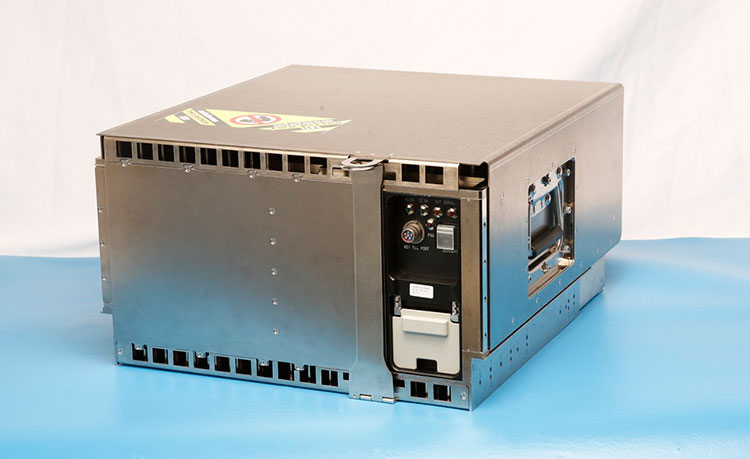
    Harris Corporation delivered the first of 34 modernized receivers to support the GPS Next-Generation Operational Control System (OCX). They will receive the signals sent by the current GPS satellite constellation plus the new signals sent by the next generation GPS III — 13 military and civilian signals in all.

    The receiver was shipped to the prime contractor, Raytheon Company, in Aurora, Colorado, after it passed a critical electromagnetic interference test, the first of many stringent qualification requirements. Though the receivers will be placed throughout the world, this first production unit will be installed in Aurora as OCX software development and integration continues.

    OCX will replace the existing ground control system that receives signals from the 31 operational GPS satellites already orbiting Earth. Only OCX will be able to receive and decrypt all GPS III military and civil signals, however.

    In addition to receivers, Harris has delivered 14 ground encryptors that will help protect the GPS signal. Harris also is providing critical software elements, which provide the fundamental navigation data to the GPS satellites and enable U.S. Air Force operators to better know and monitor the exact position and timing of the GPS constellation.


    Risk Reduction Testing Completed for GPS OCX

    Image: Raytheon
    Image: Raytheon

    Raytheon reached a milestone in development of the GPS Next Generation Operational Control System (OCX), completing a series of Risk Reduction functional checkouts of OCX Block 1 capabilities, with a focus on OCX software.

    This activity integrated iteration 1.5 of the OCX Block 1 Master Control Station with the GPS System Simulator and ran operational scenarios, representing the first end-to-end integration of available Block 1 capabilities.

    The testing included GPS constellation management and sustainment, demonstrating OCX’s abilities for precision navigation and timing capabilities in a fully cyber-hardened environment.

    The test also included running Kalman filters and generating GPS satellite navigation uploads. Future development will add to and expand capability to include both the civil and military modernized signals.

    OCX’s development is delivered in “blocks,” with Block 0 comprising the Launch and Checkout System to take GPS III satellites into early orbit. Block 1 is built on Block 0 and delivers the full OCX capability, which allows the Air Force to transition from its current GPS ground controls to the modernized and secure GPS OCX master control station.

    GPS OCX is being developed by Raytheon under contract to the U.S. Air Force Space and Missile Systems Center.


    M-Code User Equipment Certified

    L-3 Communications announced that its next-generation military code (M-code) GPS user equipment has successfully completed the final step in a government security certification process. L-3’s M-code GPS features advanced user equipment technology, increasing soldiers’ ability to resist enemy jamming and spoofing and performing significantly better in contested environments. The development and certification of this technology was performed under the Air Force Military GPS User Equipment (MGUE) program led by the GPS Directorate.

    Certification review was performed by an independent government review team, with a focus on the security design of the L-3 GPS User Equipment. The goal of these new security standards is to further protect the integrity of the navigation and timing solutions and provide required safeguards for critical information inside GPS User Equipment.

    Work on this project will be done by L-3 Interstate Electronics Corporation (L-3 IEC), which is part of the Precision Engagement and Training sector within L-3’s Electronic Systems business segment.


    The first eight GPS III satellites are under contract and in production at Lockheed Martin’s GPS III Processing Facility outside of Denver.
    The first eight GPS III satellites are under contract and in production at Lockheed Martin’s GPS III Processing Facility outside of Denver.

    GPS III Satellites 9 and 10 Procured, Launches Targeted for 2022

    The U.S. Air Force Space and Missile Systems Center awarded a contract option to Lockheed Martin Space Systems Company to procure two additional GPS III satellites, space vehicles nine and 10 of the next generation. The contract option procures long lead and production hardware.

    “The GPS III SV 9 and 10 satellites are expected to be ready for launch in 2022, thus sustaining the GPS constellation and the global utility the world has come to expect,” said Lt. Gen. Samuel Greaves, the Space and Missile Systems Center’s commander.

    The Lockheed Martin team is finishing up final testing and integration activities on the first GPS III satellite, GPS III SV01, and is preparing to deliver it to the Air Force later this year. The second satellite, GPS III SV02, is poised to have its major functional systems fully integrated into one space vehicle prior to starting its own environmental testing. GPS III SV03 also is beginning to take form in the company’s production clean room as its major subcomponents are being assembled. All eight of the first set of GPS III satellites are in various stages of production at Lockheed Martin’s GPS III Processing Facility outside of Denver.

    The government expects to compete future purchases of GPS III satellites, beginning with GPS III SV 11. This competition will maintain the current technical baseline of GPS III and will add additional hosted payloads to increase system accuracy, search-and-rescue capability, and universal S-band compatibility.


    European GNSS Service Centre Opens

    The European GNSS Agency (GSA) is gearing up to assume its operational role for Galileo in early 2017. This summer, the GSA formally accepted the Loyola de Palacio facility in Madrid, Spain, that houses the European GNSS Service Centre (GSC). This is a significant milestone in the development of the programme and its service provision as Galileo’s “door to the GNSS world.”

    GSA already oversees the operation and service provision for the European Geostationary Navigation Overlay Service (EGNOS), along with managing the security accreditation and general security provision for both programmes.

    The GSC offers 1,100 square metres of space and employs over 40 people. Since 2013, the core team at GSC has been providing limited services and working as a precursor to GSC v1. Its key work includes supporting the lead up to Galileo Initial Services provision, along with operating the GSC Helpdesk, disseminating orbital products to the search-and-rescue community, supporting GNSS-related research and industrial activity, and monitoring user satisfaction.

    Once operational, GSC v1 will be connected to the Galileo core system, enabling the long-anticipated Commercial Service. This service is expected to enter operations by mid-2017.

  • Research: GNSS receiver fingerprinting

    The U.S. Department of Transportation booth at ITS America focused on the connected car.
    The U.S. Department of Transportation booth at ITS America focused on the connected car.

    GNSS Receiver Fingerprinting for Security-Enhanced Applications

     
    By Daniele Borio, Ciro Gioia, Gianmarco Baldini and Joaquim Fortuny, European Commission, Joint Research Centre (JRC), Directorate E: Space, Security & Migration. Presented at ION GNSS+, September 2016.

    GNSS data faking is similar to node forgery in a wireless network: A simulator or another device can be used to impersonate an actual GNSS receiver in a system which uses GNSS services. In this way, misleading Position, Velocity and Time (PVT) information can be send to the final PVT user in the system. To mitigate the risk of GNSS data faking, GNSS receiver fingerprinting can be adopted in security-enhanced applications to verify, at least to a certain extent, the authenticity of GNSS data.

    For example, the injection of GNSS fake data in an Intelligent Transport Systems (ITS) vehicle platform could be identified using GNSS receiver fingerprinting.

    This paper investigates the potential of receiver clock bias and drift as sources of features for fingerprinting. In particular, several features, including Allan Deviation (ADEV), maximum and Root Mean Square (RMS) Time Interval Error (TIE) and correlation of the clock time series, have been investigated. The potential of the different features has been empirically investigated. It shows that three features are sufficient to discriminate the different receiver types. In particular, the ADEV and the Maximum TIE (MTIE) at 1 second, and the correlation value at 20 seconds have been selected for fingerprinting. These features allow one to effectively cluster the different receiver types and to build a “white list” for receiver identification.

  • Innovation: Better GNSS navigation and spoofing detection with chip-scale atomic clocks

    Innovation: Better GNSS navigation and spoofing detection with chip-scale atomic clocks

    Getting there more safely

    INNOVATION INSIGHTS with Richard Langley
    INNOVATION INSIGHTS with Richard Langley

    It’s all physics. How things work, that is. You’ve heard me say that before in this column, but I suppose I’m a little biased (or realistic) as my first degree is in physics — applied physics, to be more precise. Mind you, some chemists might disagree that it’s all down to physics. But as Sheldon Cooper in the popular American TV sitcom The Big Bang Theory stated in a radio interview with real science journalist Ira Flatow following his apparent discovery of the first stable super-heavy element, “Yes, yes, I’d be a physicist with a Nobel in chemistry. Everyone laugh at the circus freak. You know, I don’t need to sit here and take this, Flatow. It is because of bullies like you, every day more and more Americans are making the switch to television.”

    But in all seriousness, it really was physicists who first explained the physical phenomena associated with a range of technologies that had to be understood before global navigation satellite systems could become a reality. From orbital mechanics, to relativity theory, to semiconductors, to transatmospheric propagation of radio signals, to atomic clocks, the fundamental understanding of how these worked was provided by physicists.

    This was particularly true for atomic clocks. An atomic clock, like any clock, consists of two basic components: a resonator or oscillator and a counter. The oscillator generates a stable frequency, whose cycles are counted, converted to units of seconds, minutes, hours and perhaps days, and continuously displayed. This is the case whether we are describing a wristwatch with a quartz crystal oscillator or an atomic clock whose oscillator is made up of atoms undergoing quantum energy transitions. A crystal oscillator is stimulated to vibrate at its design frequency and thereby generate a fluctuating electrical current with that frequency. The atomic oscillator works thanks to the principles of quantum physics. Atoms have energies, but the energies are quantized, meaning that only specific energy levels are possible. An atom may exist at a particular energy level and spontaneously transition to a lower energy level and in so doing emit electromagnetic radiation (such as radio waves or light) of a specific frequency equal to the change in energy divided by a fundamental physical constant called Planck’s constant, named after Max Planck, who introduced it in 1900. The atom can be stimulated to return to the higher energy level by exposing it to radiation of that same exact frequency. A practical atomic oscillator can be constructed by confining a collection of atoms in an enclosure and bathing them in electromagnetic radiation from a tunable generator. By automatically tuning the frequency of the generator to maximize the number of stimulated atoms through a feedback loop, a very pure and constant frequency will result.

    The first clocks based on an energy transition of the cesium atom were developed in the mid-1950s. Later on, clocks based on energy transitions of the rubidium and hydrogen atoms were developed. By the 1960s, commercial rack-mountable cesium and rubidium clocks became available. But a need existed for miniaturized atomic clocks that could be easily embedded in equipment requiring a very stable frequency source. Funded in part by the Defense Advanced Research Projects Agency, the first chip-scale atomic clock was demonstrated by physicists in 2004, and by 2011, a chip-scale atomic clock based on a cesium atom transition became commercially available.

    In this month’s column, we look at how chip-scale atomic clocks can help us navigate more safely by allowing a GNSS receiver to position itself more accurately even with only three satellites in view, and to protect itself by being able to detect a sophisticated spoofing attempt. Physics — isn’t it wonderful!


    GNSS positioning and navigation are based on one-way range measurements. Synchronization of the receiver and satellite timescales is carried out with respect to a third time scale of higher stability, such as GNSS system time, by introducing so-called clock errors. To account for the time and frequency offsets of the satellites, the user can obtain appropriate corrections from the broadcast navigation message in real time. In post-processing, more accurate corrections are provided by various products of the International GNSS Service (IGS).

    Due to the generally poor accuracy and limited long-term frequency stability of a quartz oscillator built into a GNSS receiver, the receiver clock error has to be estimated epoch-by-epoch. This is the typical case for single-point positioning (SPP) based on code (pseudorange) observations only. This comes with certain drawbacks:

    • The up-coordinate is determined two to three times less precisely than the horizontal coordinates,
    • Higher dilution of precision values are obtained than in the hypothetical case of trilateration,
    • High correlations of up to 99 percent between the receiver’s up-coordinate and clock error persist, and
    • At least four satellites are necessary for positioning.

    Especially in the case of kinematic positioning, this situation can be significantly improved by using a more stable (atomic) clock for the receiver and introducing the information about its frequency stability into the estimation process. This approach is called receiver clock modeling (RCM), and basically requires that the integrated clock noise is smaller than the receiver noise during the modeling interval. Besides SPP, this method can also be applied in a common-clock setup in relative positioning using single-differenced observations (which, by their nature, contain more information) instead of typically used double-differenced observations, or precise point positioning.

    The recent development of chip-scale atomic clocks (CSACs) offers the required frequency stability and accuracy, and opens up the possibility of using atomic clocks in real kinematic GNSS applications without any severe restrictions regarding power supply or environmental influences on the clocks. When connecting one of these clocks to a GNSS receiver, replacing or steering the internal oscillator accordingly, and modeling its behavior in a physically meaningful way instead of epoch-wise estimation, the navigation performance can be improved distinctly.

    The receiver clock parameter absorbs signal delays common to all simultaneous line-of-sight signals whether these delays represent the physical clock or any other common delay. Thus, it is especially vulnerable to delays caused by jammers or spoofers. If the clock behavior is predictable, information about jamming or spoofing can be retrieved, and thus the integrity of the positioning solution can be improved.

    Chip-Scale Atomic Clocks

    For our test purposes, we used two different commercially available CSACs, dubbed CSAC A and CSAC B. To gain knowledge about their frequency stabilities, we compared them against an active hydrogen maser at the Physikalisch-Technische Bundesanstalt (PTB), Germany’s official metrology institute. We analyzed the raw fractional phase measurements and computed individual Allan variances for our devices. The resulting frequency stabilities are shown in FIGURE 1.

    Clock Model

    Basically, a clock is an oscillator generating a sinusoidal signal with a given nominal frequency coupled with a frequency counter. The deviation of the signal’s nominal frequency with respect to a reference time scale can be described by a frequency offset and drift plus random frequency fluctuations. In the time domain, the resulting clock error δt, that is, the difference between nominal time t and the time read simultaneously on the clock, can be approximated by the following equation:

    (1)
    atomic-clock-equation-1


    with systematic time offset b0, frequency offset b1, frequency drift b2, and random noise x(t,t0). Thus, the main (deterministic) part of a clock model can be described by a quadratic polynomial.

    The more interesting characteristics of a clock are contained in the underlying noise processes. The time-dependent Allan deviation (ADEV) enables the determination of a modeling or predicting interval τp over which receiver clock modeling is physically meaningful; that is, the integrated clock noise x(t,t0) is smaller than GNSS receiver noise:

    (2)
    atomic-clock-equation-2


    The noise σrx of a typical commercial GNSS receiver can be assessed to approximately one percent of the chip or wavelength of the signal in use, such as 3 meters, 0.3 meter, or 2 millimeters for C/A-code, P-code, or L1 carrier-phase observations, respectively.

    To apply the knowledge gained about the devices’ frequency stabilities, appropriate models for GNSS data analysis should be established. One prerequisite is that the clock noise has to be well below the GNSS receiver noise; that is, the integrated random frequency fluctuations of CSACs cannot be resolved by the GNSS observations in use. We assume typical values for code and ionosphere-free carrier-phase observations from modern geodetic GNSS receivers of 1 meter and 5 millimeters, respectively. Since these observations are phase-based measures, we can model the dominating underlying noise process as white-noise phase modulation (WPM) over time. The corresponding graphs are depicted in FIGURE 1 as dashed lines. The intersection points between these lines and the ADEV curves define maximal time intervals Δt for physically meaningful receiver clock modeling in our case study. Depending on the CSAC in use, RCM is applicable over time intervals of at least ten minutes and up to one hour in C/A-code-based applications, such as SPP.

    GNSS Applications

    We have tested and validated our receiver clock modeling approaches for GNSS navigation.

    Kinematic Experiment

    We carried out a real kinematic experiment on a cart track in farm fields with an approximately 500 × 800 square meter area with only a few natural obstructions in the form of a tree-lined lane (see FIGURE 2). The basic measurement configuration consisted of four GNSS receivers running the same firmware version connected to a GNSS antenna via an active signal splitter. Three of these receivers were fed by the 10-MHz signals of our CSACs. For comparison purposes, the fourth receiver was driven by its internal quartz oscillator.

    Each test drive with our motor vehicle lasted approximately 8 to 10 minutes. We recorded GPS and GLONASS data with a sampling interval of one second. (Only GPS-based results are described herein.) That was also the case for our temporary local reference station, which consisted of a GNSS antenna mounted on a tripod and connected to another GNSS receiver. Hence, we were able to generate reference solutions for the vehicle trajectories in relative positioning mode with baselines of up to only some hundred meters, yielding 3D coordinate accuracies below 20 centimeters.

    The RCM algorithms presented here were implemented in the Institut für Erdmessung GNSS Matlab Toolbox. To compute a typical real-time SPP navigation solution based on GPS C/A-code observations only, broadcast ephemerides were used. Tropospheric and ionospheric signal delays were corrected by the Saastamoinen and Klobuchar models, respectively.

    [Click on an image to enlarge it.]

    Precision and Accuracy

    Two of the most important GNSS performance parameters are the precision and accuracy of the coordinate solution. FIGURE 3 shows topocentric coordinate differences with respect to the reference trajectory and clock-error time series of the receiver driven by its internal quartz oscillator, estimated without RCM. This is typical for almost all end users. The (linearly detrended) receiver clock error exhibits values between roughly −100 and +200 nanoseconds, which is typical for a quartz oscillator.

    The noise of the coordinates is in the range of 20–25 centimeters in the horizontal components and about 50 centimeters in the up-component, respectively. Furthermore, certain coordinate offsets are visible due to remaining systematic effects such as ionospheric delay and orbit errors. We could attribute these effects thanks to repeated analysis runs with different correction models such as precise IGS final orbits or by forming the ionosphere-free linear combination. Hence, the assessment of the accuracy of the results is difficult since it chiefly depends on the applied correction models, and it is less influenced by receiver clock modeling.

    Without use of RCM, the three receivers connected to the CSACs show similar behavior in the coordinate domain. However, the clock residuals become very small compared to those of the internal oscillator and amount to only a couple of nanoseconds at most. As an example, FIGURE 4 depicts the results for CSAC A. Even over a relatively short period of time of approximately eight minutes, this oscillator shows a significant frequency drift, which we have to account for in RCM. Note that this is also true for the device’s oven-controlled crystal oscillator (OCXO) post-filtered signal.

    When applying RCM, as expected, no changes in the time series of the north and east coordinates occur, but a strong decrease of the up-coordinate residuals is clearly visible. The noise level is up to 20–30 centimeters. Due to the applied polynomial clock model, the clock residuals are also reduced. Thanks to the increasing number of epochs/observations contributing to the estimation of the clock parameters, the course of these residuals gets smoother over time. Furthermore, spikes in the up-coordinate time series at around minutes five to seven caused by sudden signal obstructions are almost eliminated thanks to RCM. Also, when applying RCM, there are no improvements in the horizontal components, but the scatter of the up-coordinates is decreased in the range of 48 percent (CSAC B) to 58 percent (CSAC A).

    Our second RCM approach based on an existing extended Kalman filter clock model shows comparable results. The most obvious difference to a sequential least-squares approach is that the spikes in the up-coordinate and clock residual time series at around minutes five to seven are not smoothed as strongly.

    Reliability and Integrity

    Reliability and integrity are very important GNSS performance parameters, especially for real-time and safety-of-life critical applications. In general, we distinguish between internal and external reliability, which are both measures for the robustness of the parameter estimation against blunders in the observation data. Thereby, good reliability makes it easier to identify and remove gross errors and outliers in GNSS data analysis.

    Internal reliability is calculated in terms of so-called minimal detectable biases (MDBs) of the GNSS observations. These values determine lower bounds for gross observation errors so that these can still be detectable. External reliability describes the influence of these MDBs on the parameter estimates. In our experiments, we found reductions in the size of the MDBs of up to 16 percent.

    As a consequence, the vertical protection level — a measure of integrity — is also improved.

    Positioning with 3 Satellites

    Generally, GNSS positioning requires at least four satellites in view to solve the equation system for the four unknowns. This can become a severe restriction in difficult environments such as urban canyons. Taking benefits of an oscillator of high accuracy, with known and predictable frequency stability, enables positioning using only three satellites. This approach enhances GNSS continuity and availability, and is called clock coasting.

    Thanks to the stability of CSACs, the GNSS observations are corrected by an additional receiver clock term, which is computed from the latest clock-coefficient estimates. To show the effects of this method, we generated two artificial partial satellite outages so that only observations on only three satellites remain. The latter were chosen in such a way that typical situations in an urban canyon were simulated; that is, only satellites with high elevation angles were visible to the receiver.

    The resulting coordinate and clock time series are depicted in FIGURE 5. When coasting through periods with only three satellites available, the horizontal coordinates become approximately two to three times noisier (1–2 meters). Due to the poor observation geometry, an additional offset of about 1 meter is induced in the north component during the first partial outage. However, the noise of the up-coordinate is only slightly increased in both of the outage periods, although a significant drift is visible during the first one. Most likely, this is because the coefficients used for clock coasting are only based on 60 epochs up until that time. During the second partial outage this drifting behavior vanishes independently of the satellite geometry. Due to the fact that the clock time series are linearly detrended and a linear clock polynomial is applied, the corresponding residuals shown in FIGURE 5 equal zero during the coasting periods.

    The presented approaches for RCM and clock coasting are applicable in multi-GNSS positioning and timing data analysis, too, where we also have to consider inter-system biases. Thanks to the high temporal stability of these biases, they can be modeled by a polynomial in the same sense as the receiver clock error.

    [Click on an image to enlarge it.]

    FIGURE 3. Topocentric coordinate deviations with respect to the reference trajectory and clock errors. The receiver is driven by its internal oscillator. No receiver clock modeling was applied in a sequential least-squares adjustment. Note the different y-axis scales.
    FIGURE 3. Topocentric coordinate deviations with respect to the reference trajectory and clock errors. The receiver is driven by its internal oscillator. No receiver clock modeling was applied in a sequential least-squares adjustment. Note the different y-axis scales.

    FIGURE 4. Topocentric coordinate deviations with respect to the reference trajectory and clock errors for a receiver connected to the CSAC A signal. The results without receiver clock modeling are depicted in black and blue. The results applying a quadratic polynomial for clock modeling in a sequential least-squares adjustment are shown in red.
    FIGURE 4. Topocentric coordinate deviations with respect to the reference trajectory and clock errors for a receiver connected to the CSAC A signal. The results without receiver clock modeling are depicted in black and blue. The results applying a quadratic polynomial for clock modeling in a sequential least-squares adjustment are shown in red.

    FIGURE 5. Topocentric coordinate deviations with respect to the reference trajectory and clock errors. The receiver is connected to CSAC B. The solution is obtained from a sequential least-squares adjustment with clock coasting from minutes one to two and five to seven.
    FIGURE 5. Topocentric coordinate deviations with respect to the reference trajectory and clock errors. The receiver is connected to CSAC B. The solution is obtained from a sequential least-squares adjustment with clock coasting from minutes one to two and five to seven.

    Spoofing Detection

    Jamming and spoofing of GNSS signals have become major threats to GNSS positioning and timing. Although these authentication issues have been well known since the beginnings of GPS, they have become more severe in recent years due to the greatly increased number of applications that rely on (highly) accurate GNSS positioning and timing.

    Experiment

    A spoofing attack’s goal is for the signal tracking loops of a target receiver to acquire the spoofing signal, and then pull its navigation solution away from the authentic position. So as not be detected by the target receiver, the common delay of the spoofing signals — which will be absorbed by the receiver’s clock-error estimate — must not deviate significantly from the receiver’s authentic clock error. This means that the injected delay has to be as small as possible so that it cannot be separated from the typical random frequency (and thus time) fluctuations of the oscillator driving the receiver.

    To simulate a spoofing attack, we set up an experiment consisting of two GNSS receivers, one driven by its internal quartz oscillator, and one connected to CSAC B, both recording the same GNSS signals via a signal splitter. The input signal of the latter comes from an active coaxial switch, which allows us to switch between two different antennas in less than 1 second. Both antennas in our measurement configuration were mounted on tripods. However, one antenna was connected to a commercial GNSS repeater, which generates an additional delay, and its output signals were transmitted via cable to the coaxial switch (see FIGURE 6). When switched to the antenna without the repeater, the receivers recorded authentic signals. When switched to the repeater, they recorded spoofed signals. The location of the repeater antenna ranges from 2 to 25 meters away from the authentic antenna, thereby introducing different delays — in addition to the repeater delay — into the signal processing of the two receivers. We assume that a short delay of about 2 meters (7 nanoseconds) is more difficult for receivers to detect than a delay of about 25 meters (83 nanoseconds).

    Whenever the signal path is switched from the authentic antenna to the repeater antenna, this should result in a jump in the clock-error time series. Combined with the known frequency stability of the receivers’ oscillators, we can establish a hypothesis test for the significance of such a clock-error jump.

    For each new location of the repeater antenna, the measurement procedure was the same. We recorded authentic and spoofed data four times alternating for two minutes with a data rate of 1 Hz.

    FIGURE 6. Measurement configuration of a spoofing detection experiment.
    FIGURE 6. Measurement configuration of a spoofing detection experiment.

    Results

    FIGURES 7 and 8 show the original clock-time offsets for two different locations of the repeater antenna as recorded by the receivers, and the corresponding predicted clock states from the Kalman filter. The jumps in each clock-error time series are more or less clearly visible, especially in the case of the 2-meter distance. For the latter, the hypothesis test of the temperature-controlled crystal oscillator (TCXO) always accepts the alternative in favor of the null hypothesis; that is, from a statistical standpoint, no spoofing attack is detectable. This is because of the small signal delay attributable to the measurement geometry, which cannot be properly separated from random time deviations caused by the TCXO’s low frequency stability. On the contrary, even for this short distance between the spoofing and authentic antennas, every start and end of the four spoofing attacks were detected.

    As an example, FIGURE 8 shows the results for a larger distance (around 14 meters). In this case, all spoofing attacks can be properly detected by both the TCXO- and the CSAC-controlled receivers. The seven-times-increased distance ensures that even the low-cost TCXO inside the receiver combined with a sophisticated receiver internal clock estimation is capable of spoofing detection by monitoring its clock states.

    Conclusions

    In this article, we have proposed a deterministic approach for receiver clock modeling in a sequential least-squares adjustment by applying a linear or quadratic clock polynomial whose coefficients are updated each consecutive epoch. As a prerequisite, an individual characterization of the frequency stabilities of three miniaturized atomic clocks was carried out with respect to the phase of an active hydrogen maser showing an overall good agreement with manufacturers’ data.

    A real kinematic experiment was carried out with two chip-scale atomic clocks, and typical code-based GPS navigation solutions were computed. We showed that the precision of the up-coordinate time series are improved by up to 58 percent, depending on the clock in use. Furthermore, internal and external reliability were significantly enhanced. Additionally, it was shown that our algorithm is capable of coasting through periods of partial satellite outages with only three satellites in view. This increases availability and continuity of GNSS positioning with poor satellite coverage caused by high shadowing effects or multipath, for example.

    Finally, we investigated the benefits of an atomic clock in spoofing detection and showed first results. Our approach, based on a Kalman filter and a hypothesis test, enhances the detectability of a spoofer when using a CSAC instead of the receiver’s internal oscillator, especially in the case of small signal delays injected by the spoofing device, which helps to identify a sophisticated spoofer very quickly.

    Manufacturers

    We used two different CSACs: a Jackson Labs (jackson-labs.com) LN (CSAC A) and a Microsemi Quantum SA.45s (CSAC B). For the kinematic experiment, we used four JAVAD GNSS Delta TRE-G3T receivers connected to a NovAtel 703 GGG antenna via an active signal splitter. The local reference station consisted of a Leica (leica-geosystems.us) AX1202GG antenna connected to a Leica GRX1200+ GNSS receiver. A JAVAD Delta TRE-G3T was used in the spoofing experiment.

    Disclaimer

    The authors do not recommend any of the instruments tested. It is also to be noted that the performance of the equipment presented in this article depends on the particular environment and the individual instruments in use.

    Acknowledgments

    This article is based, in part, on the paper “Benefits of Chip Scale Atomic Clocks in GNSS Applications” presented at ION GNSS+ 2015, the 28th International Technical Meeting of the Satellite Division of The Institute of Navigation, held Sept. 14–18, 2015, in Tampa, Florida.

    The authors would like to thank Andreas Bauch and Thomas Polewka, who are both with PTB, for their support during execution and analysis of the clock comparisons, and Achim Hornbostel from the German Aerospace Center (Deutsches Zentrum für Luft- und Raumfahrt) for discussions on spoofing experiments.

    We also thank IGS and its participating agencies for their GNSS products, which were a valuable contribution to our case study.

    Our work was funded by the Federal Ministry of Economics and Technology of Germany.


    Further Reading

    • Authors’ Conference Paper

    “Benefits of Chip Scale Atomic Clocks in GNSS Applications” by T. Krawinkel and S. Schön in Proceedings of ION GNSS+ 2015, the 28th International Technical Meeting of the Satellite Division of The Institute of Navigation, Tampa, Florida, Sept. 14–18, 2015, pp. 2867–2874.

    • Chip-Scale Atomic Clocks and GNSS Applications

    Reducing the Jitters: How a Chip-Scale Atomic Clock Can Help Mitigate Broadband Interference” by F.-C. Chan, M. Joerger, S. Khanafseh, B. Pervan and O. Jakubov in GPS World, Vol. 25, No. 5, May 2014, pp. 44–50.

    Time for a Better Receiver: Chip-Scale Atomic Frequency References” by J. Kitching in GPS World, Vol. 18, No. 11, Nov. 2007, pp. 52–57.

    • Time, Frequency and Clocks

    “A Historical Perspective on the Development of the Allan Variances and Their Strengths and Weaknesses” by D.W. Allan and J. Levine in IEEE Transactions on Ultrasonics, Ferroelectrics, and Frequency Control, Vol. 63, No. 4, April 2016, pp. 513–519, doi: 10.1109/TUFFC.2016.2524687.

    Time – From Earth Rotation to Atomic Physics by D.D. McCarthy and P.K. Seidelmann, published by Wiley-VCH Verlag GmbH & Co. KGaA, Weinheim, Germany, 2009.

    “Special Issue: Fifty Years of Atomic Time-Keeping: 1955 to 2005,” Metrologia, Vol. 42, No. 3, June 2005.

    The Measurement of Time: Time, Frequency and the Atomic Clock by C. Audoin and B. Guinot, published by Cambridge University Press, Cambridge, U.K., 2001.

    The Science of Timekeeping by D.W. Allan, N. Ashby and C.C. Hodge, Hewlett Packard (now Agilent Technologies) Application Note 1289, 1997.

    The Role of the Clock in a GPS Receiver” by P. Misra in GPS World, Vol. 7, No. 4, April 1996, pp. 60–66.

    Time, Clocks, and GPS” by R.B. Langley in GPS World, Vol. 2, No. 10, Nov./Dec. 1991, pp. 38–42.

    • Clock Modeling

    Feasibility and Impact of Receiver Clock Modeling in Precise GPS Data Analysis by U. Weinbach, Ph.D. dissertation, Gottfried Wilhelm Leibniz Universität Hannover, Hannover, Germany, Wissenschaftliche Arbeiten der Fachrichtung Geodäsie und Geoinformatik der Leibniz Universität Hannover, Nr. 303, and Deutsche Geodätische Kommission bei der Bayerischen Akademie der Wissenschaften, Reihe C, Dissertationen Heft Nr. 692, 2013.

    “Time and Frequency (Time-Domain) Characterization, Estimation, and Prediction of Precision Clocks and Oscillators“ by D.W. Allan in IEEE Transactions on Ultrasonics, Ferroelectrics, and Frequency Control, Vol. UFFC-34, No. 6, Nov. 1987, pp. 647–654, doi: 10.1109/T-UFFC.1987.26997.

    Relationship Between Allan Variances and Kalman Filter Parameters” by A.J. van Dierendonck, J. McGraw and R.G. Brown in Proceedings of the Sixteenth Annual Precise Time and Time Interval (PTTI) Applications and Planning Meeting, Greenbelt, Maryland, Nov. 27–29, 1984, pp. 273–292.

    Spoofing

    GNSS Spoofing Detection: Correlating Carrier Phase with Rapid Antenna Motion” by M.L. Psiaki with S.P. Powell and B.W. O’Hanlon in GPS World, Vol. 24, No. 6, June 2013, pp. 53–58.

    Assessing the Spoofing Threat” by T.E. Humphreys, P.M. Kintner, Jr., M.L. Psiaki, B.M. Ledvina and B.W. O’Hanlon in GPS World, Vol. 20, No. 1, January 2009, pp. 28–38.

  • Geodata key to new business world, says Intergeo report

    Geodata key to new business world, says Intergeo report

    Geodata is key to the digital future and a 4.0 business world, according to a new report released at InterGeo in Hamburg, Germany. At the heart of this business vision is the networking of sensors that must have location data in order to fulfill their value.

    ausgabeThe 116-page Intergeo Report, in parallel German and English, includes sections on smart cities, public participation, autonomous driving with live mapping, and surveying on the open seas. An eight-page GNSS Update section features CEOs answering questions market focus of their GNSS products, the role of geo-referencing in the Internet of Things, the coming-of-age of precise point positioning (PPP), and the opportunities for GNSS opened up by autonomous driving.

    Access to company-specific geodata offers managers in the automotive industry a competitive ad- vantage. Apps show today’s motorists the way to the nearest electrical charging station. Soon, the same motorists will talk to their on-board computer to find a parking space. It will guide them instantly to the nearest free space. Geoinformation will then no longer just be found in the satnav but also in the integrated sensor in the road paving infrastructure and in the status reports of other road users.

    Networking Everything. The Internet of Things is taking shape and permeating all areas of life. At its center are the tiny pieces of information that assign coordinates to a parking space, a loading berth for a container ship, a screw in the shelves of a supplier’s warehouse, or the alarm system of a family home. Degrees, minutes and seconds show people the way, answer a range of questions and help make informed decisions. Geoinformation is both an asset and an essential source of information.

    Content Is King. Key companies in the geoinformation sector have naturally taken onboard the value of geoinformation. It forms the basis of their business activities. The use of geodata as added value for their products is still very new. Esri realized early in the sector that selling software is no longer sufficient on its own. Only data enables customers to harness the value of products. Cloud solutions store the mountains of data, while platforms deliver the answers.

    Such new business leading lights as AirBnB, Uber, Facebook and Google could not survive without geoinformation. It is part of increasingly intelligent systems that make users’ lives a little easier and more comfortable, optimizing processes and enabling people to operate and participate in ways that were previously impractical or impossible.

    The examples are myriad. Consider just a few. Digitally aided planning and construction in building information modeling not only streamlines processes and reduces costs, it enables public participation in planning procedures, using digital models of planned reality. Aerial surveys and data gathering by UAV, not only for traditional survey needs but for growing requirements in natural resource planning and management, infrastructure inspection and maintenance, surveillance and security, and more. Guidance systems for the blind.

    All require location data. GNSS (satnav) is the core supplier of this data, but must be augmented by other technologies in special environments.

    Releasing Geodata Pays Dividends. Managers of geodata realize they need to release it in order for it to lead them to “more” – more value, more benefits, more transparency, more importance. Geoinformation and digitization are inextricably interlinked, and this is just the beginning.

  • Launchpad: Multi-frequency GNSS RF front-ends

    Launchpad: Multi-frequency GNSS RF front-ends

    4- and 7-channel research and evaluation platforms

    The NT1065_USB3 and Multi_GNSS_Grabber_Board are research and evaluation platforms for professional navigation receivers, based on NTLab’s RF front-end integrated circuits: the NT1065 “Nomada” (4-channel GPS/GLONASS/Galileo/BeiDou/IRNSS/QZSS, L1/L2/L3/L5 band) and NT2024 (3-channel GPS/GLONASS L1/L2 and S-band).

    Both boards support USB3 connection, thus allowing the user to process captured satellite signals on a PC.

    NT1065_USB3

    Multi-band multi-system 4-channel coherent GNSS RF front-end based on NT1065 “Nomada” IC.

    nt1065_usb3-nt-labs-wFeatures

    • 4 coherent GNSS channels
    • IF bandwidth up to 32MHz for each channel
    • Acquisition of wideband signals up to 64 MHz (such as Galileo E5) with 2 coherent channels
    • Built-in 2-bit ADC
    • USB3 interface (up to 800 Mbit/s)
    • Ability to connect 4x CRPA

    Multi_GNSS_Grabber_Board

    All-band, all-system 7-channel GNSS software-defined receiver platform based on RFFE ICs: NT1065 “Nomada” and NT2024.

    multi_gnss_grabber_board-nt-labs-wFeatures

    • All NT1065_USB3 features, plus:
    • Two additional L1/L2 GNSS channels
    • IRNSS S-band support
    • Built-in FPGA for pre-processing and channel synchronization

    NTLab, www.ntlab.com

  • Galileo Initial Services looming

    With Galileo Initial Services at last on the horizon and a quadruple satellite launch scheduled for November, here’s hoping that Europe’s GNSS constellation will be delivering limited, but reliable, global PNT services before the year is out.

    The four Galileo satellites for Arianespace’s first Ariane 5 mission for the constellation are being prepared at ESA’s launch facility in French Guiana. The flight is scheduled for 17 November. However neither these four new satellites, nor the two orbited in May, are required to deliver Galileo Initial Services, which should be launched officially some time in November. Fingers crossed.

    The European GNSS Agency (GSA) is gearing up to assume its operational role for Galileo in early 2017. During the summer the GSA formally accepted their Loyola de Palacio facility in Madrid, Spain that houses the European GNSS Service Centre (GSC). This is a significant milestone in the development of the programme and its service provision as Galileo’s “door to the GNSS world” as GSA Executive Director Carlo des Dorides described the facility at the handover ceremony.

    GSA already oversees the operation and service provision for the European Geostationary Navigation Overlay Service (EGNOS) (since 2015) along with managing the security accreditation and general security provision for both programmes.

    The GSC offers over 1,100 square metres of space and currently employs over 40 people. Since 2013, the core team at GSC has been providing limited services and working as a precursor to GSC v1. Its key work includes supporting the lead up to Galileo Initial Services provision, along with operating the GSC Helpdesk, disseminating orbital products to the Search and Rescue (SAR) community, supporting GNSS-related research and industrial activity and monitoring user satisfaction. Once operational, GSC v1 will be connected to the Galileo core system, thus enabling the long anticipated Commercial Service. This service is expected to enter operations by mid-2017.

    Once the Galileo Operations Contract is awarded and Initial Services officially declared, the GSC is expected to see a significant increase in staff.

    Also in the summer CNES President and France’s inter-ministerial coordinator for European satellite navigation programmes Jean-Yves Le Gall was elected as the new chair of the GSA Administrative Board with Mark Bacon, representing the United Kingdom, elected as deputy chair.

    “I am honoured to have been elected chair of the GSA Administrative Board, with Galileo now poised to enter its operational phase,” said Le Gall. “This election confirms the desire of Member States to join forces on the cusp of a prolific period for European space as we move Galileo towards full operational capability.”

    Brexit blues?

    Mark Bacon added “I am very pleased to have been elected to work with the Board and I look forward to helping the GSA deliver on the Galileo and EGNOS programmes over the coming years.”  However the UK’s decision to leave the EU (Brexit) must make his position rather uncomfortable – and temporary – to say the least.

    The GSA Administrative Board is composed of representatives from each EU Member State, the European Commission, and the EU parliament. The Board meets three times per year to ensure that the Agency performs its tasks correctly. As things stand if the UK is no longer an EU Member State it must lose its representative(s) on the advisory board.

    However, the relationship between the UK and EU space programmes is, of course, subject to the Brexit negotiations. The UK will almost certainly remain a member of the European Space Agency (ESA) as this is a pan-European body not an EU agency, however when it leaves the EU the country will have to renegotiate terms if it wants to continue to participate in the key EU programmes such as Galileo GNSS and Copernicus Earth Observation system.

    The ESA is autonomous from the EU and should not be directly affected by Brexit confirmed Jean Bruston, head of ESA’s EU policy office at a media briefing in mid-September. But “As soon as it [Britain] is leaving the EU it is not participating in these programmes [Galileo / Copernicus] any longer,” he observed.

    In addition, UK-based companies hold contracts worth tens of millions of euros from ESA to supply hardware for the Copernicus and Galileo GNSS. “If nothing changes [and Brexit goes ahead], we would have to stop these contracts,” said Bruston bluntly.

    Of course, Britain could still contribute to Galileo and Copernicus if it negotiated a third-party agreement with the EU, as Norway and Switzerland (both non EU members) have done. The down side is that this may take some time to initiate, let alone complete, and if Britain sticks to its guns on issues such as free movement of people then the likelihood of a successful outcome for the UK is not high.

    In an interview with French media ESA director-general Jan Woerner reinforced Bruston’s views saying that “the UK will remain a member state of ESA, this is very clear” but also continuing “As we are also dealing with European programmes like Copernicus and Galileo, and also the question of UK citizens working on the continent and all these legal issues, we have to take this into account.”

    EU opportunity

    Many in ‘continental Europe’, as we Brits so often condescend to describe our fellow Europeans, will be more than happy to see the U.K. no longer participating in deciding key aspects of EU space and other policy areas.

    It is no coincidence that the European Commission has become much more vocal on plans for a European defence force since the Brits announced their departure. The U.K. has long been opposed to the concept of an ‘EU Army.’ However planning and military cooperation between Member States outside normal NATO channels has been increasing over many years. The small and discreet (so discreet that I didn’t realise the exact location of its HQ in Brussels until the recent terrorist incidents meant burly Belgian paratroopers were stationed outside and I asked them what they were guarding. Has to be said they were not discreet!) has seen its budget frozen for the last five years, but this may now change.

    The interface of EU space and defence policy – in particular ‘dual use’ issues – will also become simpler without the U.K.’s protests. A leaked draft of the upcoming EU Space Policy communication talked directly of dual-use synergies to reinforce security from space, in particular to reduce costs and improve efficiency, and that the next generation of EU GNSS and Copernicus programmes should be designed from the start to be more relevant for security purposes. Defence-related research is also slated for future Horizon 2020 calls.

    The draft policy document also underlines that with EU space programmes becoming fully operational, building stability, trust and confidence in users is a key objective. Current services must be fully deployed and their long-term continuity and evolution assured. This continuity should be driven by user needs and take into consideration the mid-term (hardly mid-term for Galileo!) evaluation of the programmes that should happen in 2017. For Galileo and EGNOS, the document looks to improvements in the current services, including greater robustness and performance, and provision of additional services, such as regional or timing services.

    California dreaming

    So with Brexit what is the U.K.’s GNSS – and space-related – industry and research community to do? Of course many of the UK industrial players are multi-national companies and internal transfer of people and/ or projects will overcome many issues. And bi-lateral collaborative agreements on exchange of talent and ideas between partners can also achieve the same results for smaller companies and research groups. However not having a seat in the policy process and the development of programmes will put ‘UK plc’ at a distinct disadvantage in my opinion.

    But U.K. leaders say that Brexit is an opportunity to be seized and that the U.K. should be looking to sell  goods and services in other global markets than the EU. Which is something most U.K. industry has been doing since trade/ time began. And in my experience U.K. business leaders have always been much more eager to go jump on a plane to the States or Australia than go visit their European neighbours – something to do with our renowned national language skills perhaps?

    Space is no exception – and one that has been shown to be a success in recent times. A helping hand is provided by InnovateUK, the U.K.’s government innovation agency, that is organising its third ‘Space Mission UK’ to the US in November. These are trade and investment missions specifically designed to support U.K. start-up companies to build world-leading space and satellite application businesses.

    Space Mission 1 visited Utah, LA and Silicon Valley in August 2015 and Space Mission 2 landed in Houston in November 2015. Space Mission 3 will visit San Francisco and LA from 5-11 November this year.

    Mission programmes are varied but typically include visits to companies working at the forefront of the sector, networking opportunities with investors and corporate venture people interested in space, visits to incubators, accelerators and technology hubs, and masterclasses on pitch development, business culture and market entry.

    The previous two Space Missions have had immediate impact for the companies involved, including securing over £1 million in investment, and initiating collaborations with major organisations such as NASA and (ironically) ESA, and winning contracts with the UK Ministry of Defence at home.

    GNSS-related companies in previous missions include Arralis who build high-end semiconductor chips but have also been funded to develop novel GNSS antennas, and an exciting data fusion start-up – Gyana – that takes complex inputs from multiple data sources, including satellite, to build simple to understand 3D situational images. The founder of the business, engineering graduate Joyeeta Das, has raised US $1.1m since the mission.

    You can find a complete list of companies who have participated on the previous missions here.

    The selection for Space Mission 3 has closed and I am told there is at least one GNSS applications company that has been chosen to be on the plane in November. Good luck to them all!

    Google emergency LBS upgrade

    E112 is a location-based version of the 112 universal European emergency number, where the telecommunication operator transmits location information to the emergency centre in parallel to the call itself. With more than 70 percent of calls to emergency services coming from mobile phones, getting help fast and efficiently to the caller can be challenging if they don’t know where they are. Now, in a major step forward for implementation, Google has created and rolled out in two European countries (U.K. and Estonia) its Emergency Location Service on Android, with other regions to follow. The feature, when supported by the caller’s network, sends the phone’s location to emergency services when the 112 (or equivalent) emergency number is dialed.

    Emergency Location Service is supported by more than 99 percent of existing Android devices (version 2.3 and above) through Google Play services. The service activates when supported by the mobile network operator or emergency infrastructure provider.

    The new geographical location system claims to identify the source of a mobile phone emergency call to typically within 0.003 square kilometres (less than half the size of a football field) instead of a current average of around 12 square kilometres.

    When an emergency call is made with an enabled Android smartphone, the phone automatically activates its location service and sends its position by text message to the 112 service. This usually takes less than 20 seconds. This text message is not visible on the handset and is not charged for.

    And the first European Galileo-ready smartphone has been launched with the Aquaris X5 Plus smartphone, produced by the Spanish technology company BQ, and based on the Galileo-supported Qualcomm Snapdragon 652 processor with Galileo capability accessible via a software update to be released in Quarter 4 2016.

    U.S.-based Qualcomm announced in June that it was adding support for Galileo across its Snapdragon processor and modern portfolios for smartphone, computing, automotive and IoT applications.

    As well as Galileo capability, the Aquaris X5 Plus is powered by the latest Google Android OS and has all the usual features of a top end smart phone including 16 mega pixel ‘back’ camera and support for 4k video recording with a stabiliser and fingerprint recognition for added security.

    If you want to take the pulse of the GNSS user technology industry and keep up with the latest trends then you’ll need to get your hands on the GSA’s GNSS User Technology Report due out at the beginning of October.

    The 2016 report will be launched on 4 October as part of the Horizon 2020 Space Information Days in Prague. This two-day GSA-hosted event will introduce the third call for GSA-funded Horizon 2020 research and innovation proposals for Galileo and EGNOS.

    The document will take an in-depth look at the latest state-of-the-art GNSS receiver technology, along with providing expert analysis on the various trends that are defining the future global GNSS technology landscape. The report will focus on three key areas: mass market solutions; transport safety and liability-critical solutions; and high precision, timing and asset management solutions.

    Pulsar GNSS for deep space

    The use of pulsars, highly magnetized, rotating neutron star that emits a beam of electromagnetic radiation with a very precise period, have been potential candidates for a deep space navigation system for many years. Now a paper from the U.K.’s National Physical Laboratory (NPL) and the University of Leicester shows that pulsars can be used to obtain position along a particular direction in space to an accuracy of two kilometres in the direction of the pulsar. Furthermore such a technology could operate autonomously and greatly increase the number and capabilities of space missions, the paper claims.

    To calculate their position a space craft would need to carry a small X-ray telescope. The method uses X-rays emitted from pulsars, which can be used to work out the position of a craft in space in 3 dimensions to an accuracy of 30 km at the distance of Neptune. Certain types of pulsar, called ‘millisecond pulsars’, emit pulses of radiation with the regularity and precision of an atomic clock and therefore could be used much like GNSNS in space.

    The paper, published in Experimental Astronomy[1], details simulations undertaken using data, such as the pulsar positions and a craft’s distance from the Sun, for an ESA feasibility study of the concept. The simulations took these data and tested the concept of triangulation by pulsars with current X-ray telescope technology and state-of-the art position, velocity and timing analysis. This generated a list of usable pulsars and measurements of how accurately a small telescope can lock onto these pulsars and calculate a location.

    The key finding was that at a distance of 30 astronomical units – the approximate distance of Neptune from the Earth – an accuracy of 2km or 5km can be calculated in the direction of a particular pulsar (PSR B1937+21) by locking onto the pulsar for ten or one hours respectively and that by locking onto three pulsars, a 3D location with an accuracy of 30km can be calculated.

    This is an improvement on the current navigation methods of the ground-based Deep Space Network (DSN) and European Space Tracking (ESTRACK) network as it could be autonomous with no need for Earth contact for months or years, if an advanced atomic clock is also on the craft. Also ESTRACK and DSN can only track a small number of spacecraft at any one time. It is also possible that the pulsar technique could be quicker.

    Dr Setnam Shemar from NPL commented: “How these [space]craft navigate will in future become a limiting factor to our ambitions. The cost of maintaining current large ground-based communications systems based on radio waves is high and they can only communicate with a small number of craft at a time. Using pulsars as location beacons in space, together with a space atomic clock, allows for autonomy and greater capability in the outer solar system.”

    This simulation uses real-world technology and proves its capabilities for this navigation task. The X-ray telescope can be launched into space due to its low weight and size and it will be flown on a mission to Mercury in 2018. Could we be seeing the emergence of a navigation technology that can enable a new era of space exploration?

    And with that look into the future it is time to say “adios” to this column. From now on my EAGER dispatches will be sprinkled through other GPS World imprints and platforms. I’ll be at the global geospatial fun-fest that is Intergeo in Hamburg in October and sniffing around the first Galileo ‘hackathon’ in Berlin in early November, so I hope to see many of you at those and subsequent Euro-GNSS events in the future.

    A bientot as they say in these parts.

    [1] Towards practical autonomous deep-space navigation using X-Ray pulsar timing’ Shemar, S., Fraser, G., Heil, L. et al. Exp Astron (2016). doi:10.1007/s10686-016-9496-z

  • High-precision positioning to improve as next-gen GNSS begins

    A four-satellite dispenser for Galileo’s Ariane 5 is shown during shaker testing at Airbus Defence and Space near Bordeaux, France. The dispenser has had four Galileo engineering models attached to it for test purposes. (Photo: ESA)
    A four-satellite dispenser for Galileo’s Ariane 5 is shown during shaker testing at Airbus Defence and Space near Bordeaux, France. The dispenser has had four Galileo engineering models attached to it for test purposes. (Photo: ESA)

    In Geospatial Solutions’ sister publication, GPS World magazine, I’ve written quite a bit about how high-precision GNSS is going to significantly improve over the next few years.

    Most GNSS users have receivers capable of using GPS (31 satellites) and Glonass (about 24 satellites). That generally equates to between 13 and 20 satellites in view with a clear sky and average terrain. However, add in variable terrain, some trees and perhaps a nearby building or two, and it can be a challenge to find enough solid satellites to track to obtain a high-precision GNSS position (less than a meter).

    As the demand for high-precision GNSS positioning continues to grow, users are going to want to work in increasingly more difficult environments where high-precision GNSS struggles. More satellites will help, but they won’t come from GPS, nor GLONASS.

    The GPS constellation is currently full, and is not going to grow any larger than 31 satellites (due to limitation in current GPS ground control software) in the foreseeable future. Even if GPS could fly more satellites, the orbit design accommodates only 27 satellites. GLONASS appears happy at 24 satellites and is not expanding anytime soon.

    The answer lies in Europe, with China following.

    After two decades of start, stop, restart, retool, regroup and start again, Europe’s Galileo constellation is real — very real. It’s all fun and games until Galileo starts launching four satellites at a time, which it is scheduled to start doing in a couple of months. Those four new satellites, added to the 12 in orbit (plus two in odd orbits), should be enough for Galileo to begin initial operation in Q4 of this year. Then, each new launch of four additional Galileo satellites will only improve the reliability and robustness of high-precision positioning. That’s a big deal for high-precision GNSS users.

    Get ready for another jump in performance in high-precision GNSS positioning.

    Do you remember the value that GLONASS added to GPS-only receivers 10-plus years ago? It was a premium feature on high-precision GNSS receivers in those days. Now, GLONASS is a standard feature on your smartphone.

    Not very long from now, we’ll be making similar comments about Galileo. Satellite positioning in general, and high-precision GNSS positioning specifically, are satellite-hungry. As high-precision GNSS technology continues to embed itself deeper into a wide variety of industries, users will expect the technology to work. Some of those expectations, maybe many expectations, will be unreasonable. In dense urban environments? Under heavy tree canopy? In rugged terrain?

    Unreasonable expectations are O.K. — that’s what pushes GNSS product managers and GNSS engineers to think outside of the box. More satellites will help meet some of the unreasonable user expectations.

    What’s even better is that China’s global BeiDou system isn’t far behind Galileo. China’s regional BeiDou system (16 satellites in regional orbits over China) already makes China the best place in the world for high-precision GNSS positioning. Like Galileo, China’s global constellation is said to consist of 30 satellites.

    That means in the not-too-distant future (about 2018 for Galileo and 2020 for BeiDou):

    31 x GPS
    24 x GLONASS
    30 x Galileo
    30 x BeiDou
    Total: 115

    This translates into more than double the satellites in view that we have at this point in time. But, you don’t have to wait. Galileo satellites are usable this year if your receiver has been designed to use them. With each new Galileo launch, you’ll have access to four more satellites until the constellation reaches 30. The same goes for BeiDou.

    Don’t take this wrong, GPS isn’t done. Not by a long shot. However, historically speaking, at one satellite per rocket launch, it’s only averaging about one launch every six months. To complicate things, the U.S. Air Force has launched all of the current GPS model (IIF) satellites and aren’t ready to launch GPS III satellites yet. See Don Jewell’s August column in GPS World magazine for details.

    The good news is that the user community doesn’t have to rely on an expanded GPS constellation to improve performance any more than the “gold standard” it has become. The difference-makers are going to be Galileo beginning this year and BeiDou beginning in 2018. So, get ready folks, and fasten your seatbelt. The next generation of GNSS is about ready to begin, and your geodatabase is about ready to get a double-shot of Vitamin B.

    Follow me on Twitter @GPSGIS_Eric.