Tag: Hemisphere GNSS

  • Hemisphere GNSS Releases Next-Generation GNSS RTK Engine

    Hemisphere GNSS has released Athena, its next-generation GNSS engine. Offering significantly enhanced performance, Athena provides Hemisphere with a new, future-oriented foundation providing strong performance, flexibility and reliability, according to the company.

    Athena has yielded outstanding performed in virtually every environment where high-accuracy GNSS receivers can be used, the company stated. Hemisphere customers have tested Athena’s performance in long baseline, in open-sky environments, under heavy canopy, and in geographic locations experiencing significant scintillation.

    Hemisphere has designed its new core engine to maximize the company’s ability to excel at the rigorous GNSS requirements in multiple market segments, supplying its customers in machine control, survey and GIS, with a design for now and in the future, Hemisphere said in a statement.

    The release of Athena is a significant milestone for Hemisphere, which promises another new product entry into the market in the coming months.

    Features of Athena include these capabilities:

    • Initialization time — A reliably consistent initialization performance, less than 15 seconds at better than 99.9 percent reliability.
    • Robustness in difficult operating environments — Extremely high productivity under the most aggressive of geographic and landscape oriented environments for GNSS, while delivering up to 50 percent better performance in user tests matched against competitive systems.
    • Performance on long baselines — Position stability for long baseline applications, with position quality often times exceeding the performance of other leading RTK systems on the market.
    • Performance under scintillation — Sustained accuracy under ionospheric scintillation activities, providing one of the most reliable means to work with GNSS in scintillation-affected areas.

    Rodrigo Leandro, Hemisphere’s director of engineering, GNSS Positioning Systems, gave this description of the design process for Athena.

    “Development of Athena started shortly after I came to Hemisphere in August of 2013. The company has been a leader in RTK solutions for many years. During those years, we focused in certain specific market segments such as agriculture, and under new leadership we determined there was a need to address a wider spectrum of market segments, with very high accuracy and feature rich capabilities built on the strong legacy platform we had already established. So, working with Mike Whitehead, the company CTO and our main RTK technologist, we identified the goal of reengineering our RTK engine to match the needs of RTK for the next 10 years, and to provide a foundation for future product development.”

    Leandro continued, “As part of this, we made a decision to build an expanded, world-class software development team, pulling great talent from around the industry to create a group of 11 totally focused on what we should do to move GNSS technologies forward — looking at all types of positioning techniques, not just RTK. Athena is just the first result of that work to become publicly available — you will see plenty more coming from the team over time.

    “Looking at Athena specifically, we did a complete review, touching every part of the engine — from how we deal with the atmosphere, quality-control of the data, modeling the clock of the receiver, and so on, through to how to do external corrections, whether single-based or network-based. We even looked at and modified the receiver system, improving the multitasking architecture to more actively use the CPU for our computational work,” Leandro said.

    I’m proud to say that the results of all that work match up to what we envisioned. RTK is a pretty mature technology at this point, so improving on what is available in the industry is a tough ask. However, our extensive competitive testing shows that the engine performs really well in terms of initialization, accuracy, and stability across a range of different environments, for instance in long baselines and under tree canopy, and our tests of scintillation are showing great results as well. Overall, we have seen excellent accuracy coming out of this engine compared to legacy as well as others in the marketplace. It’s hard to win every single time in a toe-to-toe comparison, as systems and conditions differ in every test, but our broad testing shows us not only matching, but beating competitive systems pretty consistently.”
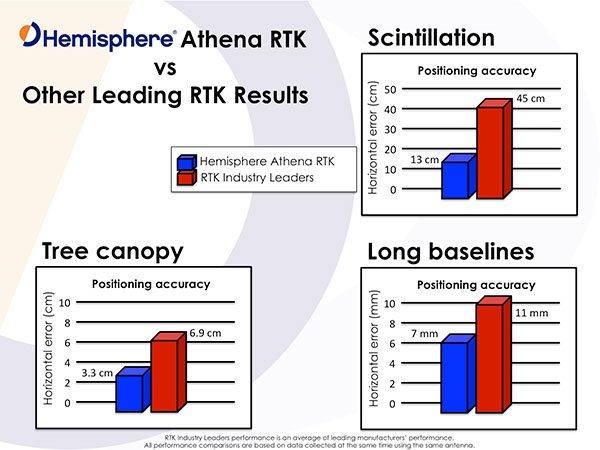
    Photo: Hemisphere GNSS

    “In our user base, both Hemisphere branded products and our OEM boards, we get exposed to a wide variety of applications and environments, from agriculture and marine, through machine control applications and survey systems,” Leandro said. “Our goal from the start was to build a system that performed across that user base, and we are proud to say that we have delivered with Athena.”

    “In terms of availability, we want to get the Athena engine on as many current and legacy systems as possible, so our users have the best possible experience. However, we have also been improving the legacy engine as well, delivering gradual steps of improvement to our customers, so whatever version they are using, their experience should be much improved,” Leandro concluded.

    Test Reports

    Hemisphere GNSS provided the following statements by an independent tester and from customers, widely distributed around the industry.

    “I’ve had an opportunity to thoroughly test Athena in both moderate and extreme environments,” said Andy Carbognin, an independent GNSS test specialist at Vecto Geomatics of Ottowa, Canada. “I’m very impressed with the performance, and we’ve tested alongside the current industry leaders’ top-of-the-line products. In every situation, Athena is proving to be a tremendous improvement over Hemisphere’s most widespread legacy firmware versions, at a minimum, matching the industry’s best while in many cases exceeding their performance.”

    “Carlson Software has extensively tested Hemisphere’s new Athena RTK engine on the Carlson BRx5 GNSS receiver,” said Butch Herter, director of Hardware Development, Carlson Software. “The Athena RTK engine provides precise, reliable, and repeatable positions. Athena exceeds or matches the performance of all other GNSS receivers it has been tested against. We have been particularly impressed with the performance of the Athena engine, when using a long baseline or in areas where there is a limited view of the sky. Athena is a first class RTK engine.”

    “We’ve been working with Hemisphere’s technology for a number of years,” states Randy Noland, vice president of business development and director of Machine Control, Carlson Software. “I’m amazed at the team they’ve brought together and how they’re radically modernizing their technology. Collaborating with the ‘new’ Hemisphere has been an eye-opening experience, and I’m excited at how their innovative technologies will positively impact our future business.”

    “In the marine construction and hydrographic survey markets, time is money. We’ve seen very high system reliability and impeccable results using the Athena RTK engine, which ensures we are achieving maximum up-time,” said Harrison Steves, operations manager at Cable Arm. “As well, not being tied to a specific make of RTK base gives us flexibility with our equipment deployment.”

    “We’ve found Athena to offer exceptional performance, especially their RTK fix times and maintaining RTK lock on long baselines,” said David Vaughn, CEO, Novariant. “With the latest competitive performance testing completed, Novariant is excited about adding Hemisphere’s Athena offering to the list of the Novariant-recognized certified receivers that, when combined with our precision steering solution, can assure centimeter-level steering control in the toughest environments in the world.”

    CEO Statement

    “Our goal is to be nothing short of the best GNSS technology partner in the industry, and a key component of that is delivering market-leading technologies tailored to our customer’s needs,” said Chuck Joseph, Hemisphere GNSS CEO and president. “To that end, we have put together a world-class team that is totally rethinking our product family, and our new Athena engine is just the first, powerful proof of our fresh approach. Watch this space!”

    Availability

    Before the end of this month, Athena will be included in all Hemisphere multi-frequency, RTK-capable products, such as the A325, R330, S320 and VS330. To download and install Athena, visit Hemisphere’s Software page.
  • Hemisphere GNSS Offers RTK-Capable Compass Antenna

    Hemisphere GNSS Offers RTK-Capable Compass Antenna

    The Hemisphere GNSS V320 GNSS compass.
    The Hemisphere GNSS V320 GNSS compass.

    Hemisphere GNSS is offering a new RTK-enabled Vector V320 GNSS compass. The Vector V320 smart antenna supports multi-frequency GPS, GLONASS, Galileo (future firmware upgrade required) and BeiDou, and Hemisphere GNSS says it’s “the first of its kind.”

    Designed for the professional marine and marine survey markets, the Vector V320 is the a multi-frequency, multi-GNSS, all-in-one smart antenna capable of both RTK-level positioning accuracy and better than 0.2-degree heading accuracy in a simple-to-install package.

    “The Vector V320 combines our expertise in GNSS and smart antenna design,” said Lyle Geck, senior manager, Product Marketing, at Hemisphere GNSS. “With RTK performance that competes with current industry leaders, extremely accurate accelerometer-aided GNSS heading, and the simplicity of install offered by the smart antenna design, it is an incredible product.”

    The Vector V320 is the latest in a line of GPS/GNSS compasses, including the multi-frequency, multi-GNSS Vector VS330 receiver as well as the Vector V102, Vector V103 and Vector V104 compass smart antennas.

    “There has been a void in the market. Our customers have been looking for a product that provides RTK accuracy together with precision heading in an easy-to-install package,” said Andy Smith, managing director of Saderet Ltd. “The Vector V320 delivers.”

    The Vector V320 GNSS compass is being featured by Hemisphere GNSS at Ocean Business in Southampton, UK, April 14-16, at stand K12.

  • DT Research Rolls out Mapping and GIS Tablets

    The DT391GS tablet.
    The DT391GS tablet.

    DT Research Inc. has launched a new line of rugged tablets with the GNSS modules for surveying and mapping applications. The DT391GS, DT395GS and DT307GS rugged tablets feature integrated high-accuracy GNSS receiver modules with built-in antenna for seamless data capture, the company said.

    Built to travel and provide reliable operations in the real world, the tablets are designed for field work in mapping, geographic information systems (GIS), and accurate synchronization, tracking and networking.

    The DT391GS combines a 9-inch sunlight-readable, capacitive touch display with an energy-efficient Intel dual-core processor in a compact, durable package. With the high-accuracy GNSS module options (Hemisphere or Trimble), the foldable antenna, and Windows or Android operating system. The DT391GS also offers protection in demanding environments with IP65 and MIL-STD-810G ratings for dust and water, and shock and vibration resistance.

    The DT395GS tablet.
    The DT395GS tablet.

    The DT395GS offers a 9-inch sunlight-readable capacitive touch screen, an energy efficient Intel dual-core processor, and a choice of Windows or Android operating systems. The GNSS positioning module has u-blox GNSS module. The IP65 rating, and military-standard MILSTD-810G and MIL-STD-461F ratings, as well as wide temperature range, make the DT395GS reliable even in harsh, mission-critical environments.

    The DT307GS GNSS tablet features a brilliant 7-inch capacitive touch screen and a quad-core, energy efficient processor with a built-in, high-accuracy u-blox GNSS module. The size and weight of the DT307GS make this tablet portable for long-term handling in the field, DT Research said.

    The DT307GS tablet
    The DT307GS tablet

    All of the DT Research Rugged GS Tablets offer hot-swappable batteries for continuous operation, enabling real-time project efficiency between staff in the field and in the office. With wireless support for Bluetooth, 802.11, WCDMA and HSPA+ connectivity and optional GSM networking, the tablets keep staff connected from any location.

    The DT391GS and DT395GS have Trusted Processing Module (TPM) encryption for security support, and a choice of Microsoft Windows Embedded Standard 7 or 7 Professional, or Android operating system making these tablets flexible to integrate with existing applications.

    An optional 5-megapixel camera offers another data capture tool to record visual information, and an optional 3G cellular data module provides data connectivity for navigation and real-time data transfer, DT Research said.

    The DT391GS, DT395GS, and DT307GS are available now, form more information, contact DT Research at [email protected].

  • Hemisphere GNSS Introduces Tiny High-Accuracy GPS Compass

    Hemisphere GNSS Introduces Tiny High-Accuracy GPS Compass

    The Hemisphere GNSS V-104 compass.
    The Hemisphere GNSS V104 compass.

    Hemisphere GNSS is offering the Vector V104, a tiny high-accuracy, dual-receiver GPS compass and the latest addition to its precise heading and positioning product line.

    “Our Vector V104 provides an astonishing level of accuracy in such a small form factor,” said Chuck Joseph, Hemisphere president and CEO. “The smart, compact design offers better than 2° heading accuracy and sub-meter DGPS position accuracy without requiring maintenance or calibration and while being immune to magnetic interference.”

    Based on the company’s patented Crescent Vector technology, the Vector V104 integrates two GPS antennas, a multi-axis gyro, and a tilt sensor into a single, easy-to-use system. The dual-integrated antennas provide both heading and position data, and the gyro and tilt sensor improve system performance and provide backup heading information if the GPS-based heading is ever lost.

    The Crescent technology provides highly accurate code phase management and outstanding multipath mitigation. This results in excellent accuracy and stability, enabling the user to install the V104 in areas where competing products have difficulty.

    “As the world’s smallest GPS compass, the V104 will significantly change the onboard experience in navigation, making it more accurate, easier to install, and more cost efficient,” said Anders Bergström, founder and senior partner of True Heading AB, who sells a custom-branded V104 as the Vector Compact into the marine market.

    An alternative to traditional gyro and fluxgate compass sensors, the Vector V104 offers a choice of either serial or NMEA2000 communications and is designed for a wide array of applications, especially in the marine, GIS mapping, and machine control markets.

  • Hemisphere GNSS Offers New Survey-Grade GNSS Antennas

    Hemisphere GNSS Offers New Survey-Grade GNSS Antennas

    The A25 and A45 antenna. Photo: Hemisphere GNSS
    The A25 and A45 antennas. Photo: Hemisphere GNSS

    Hemisphere GNSS has announced two low profile, multipurpose antennas that it says will exceed expectations in all GNSS applications. With unique filtering patterns and precise attention paid to mitigation of multipath and interference, the A25 and A45 antennas complement all GNSS products, from L1 GPS to multi-frequency, multi-constellation.

    Both antennas are being featured at the InterGeo 2014 Conference and Trade Show in Berlin this week, at stand C2.007.

    The A25 and A45 have been designed to support millimeter accuracy for land and marine applications. Both antennas support present and future GNSS signals, including GPS, GLONASS, BeiDou, QZSS, and Galileo. The A25 supports the previously mentioned signals at a single-frequency level, while the A45 supports these signals at a multi-frequency level.

    “We’ve designed these antennas to excel in challenging environments such as near buildings or under foliage,” said Lyle Geck, senior manager of product marketing at Hemisphere GNSS. “They have superior multipath mitigation, stable phase centers and strong SNR’s, even at low elevations.”

    The ruggedized housing used by both antennas is made of an aluminum base that has been pretreated for the marine environment and will withstand salt, fog, and spray. The antennas pass the two-meter pole drop test.

    The A25 is a multi-GNSS precision antenna, designed for a variety of applications including GIS, single-frequency RTK positioning and navigation, and precision guidance. The A45 is a survey-grade, multi-GNSS precision antenna for a variety of applications including surveying, RTK positioning and navigation, precision guidance, and machine control.

    For more information about Hemisphere GNSS’ antennas and other products, please visit www.hgnss.com/Products-Solutions.

  • Satlab Geosolutions Adds Americas Office, Appoints Phil Gabriel

    Satlab Geosolutions Adds Americas Office, Appoints Phil Gabriel

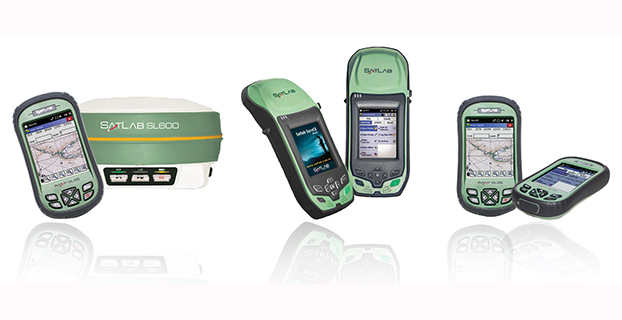
    Satlab products include (from left) the SL600 6G GNSS receiver, the SL300 6G GNSS receiver, and the SL55 controller. Photo: Satlab Geosolutions AB
    Satlab products include (from left) the SL600 6G GNSS receiver, the SL300 6G GNSS receiver, and the SL55 controller. Photo: Satlab Geosolutions AB

    Swedish-based survey and GIS equipment maker Satlab Geosolutions AB has expanded into the U.S. and Americas with the creation of a new sister company Satlab Geosolutions (USA), Inc., based in Scottsdale, Arizona. Phil Gabriel has been named managing director of the USA office.

    Setting up a formal base of operations in the U.S. will allow Satlab to better service their clients and expand their customer base in the U.S., Canada, Mexico and Latin America, a company release said. As past president of Hemisphere GNSS, Gabriel brings to the team his many years of experience in the survey, GIS, GNSS, machine control, marine and navigation industries, Satlab said.

    The U.S. location will sell, support and service the new product lineup being introduced at InterGeo in Berlin, Germany, on October 7.  Satlab is seeking dealers to expand its business throughout the Americas.

    “The addition of a U.S. office is an exciting next step for us, after successful expansion into Turkey and the Czech Republic in the last few years,” said Bjorn Agardh, CEO of Satlab Geosolutions AB.

    “Our products have been well received and continue to perform extremely well,” added Birol Gucluer, CTO and partner of Satlab.

    “I’m excited to join Bjorn and Birol, extending their success by ensuring their high standards in customer service are maintained here in the Americas,” Gabriel said.

    Satlab invites Survey and GIS dealers to meet the expanded team at InterGeo October 7-9 in Berlin, where they will be introducing several new models of their popular receivers and handhelds.

  • Hemisphere GNSS Vector Products Now Have GLONASS Functionality

    Hemisphere GNSS has announced that all professional-level Vector products — including the V103, V113, VS131, and VS330 — now include the ability to utilize the GLONASS system along with GPS in the navigation solution. The tracking of the additional GLONASS signals provides a more robust solution, especially in challenging environments, the company said.

    Vector Technology processes L1 GPS and GLONASS signals to deliver precise heading, greater positioning reliability, and improved performance in challenging environments. Hemisphere GNSS’ patented Vector technology computes the heading and pitch or roll angle while stationary or in motion allowing for heading accuracy of up to 0.01 degrees depending upon the product selected. A variety of differential correction methods also make it possible for Vector products to provide sub-meter to centimeter level RTK position accuracy.

    Professional marine industry organizations can maximize performance by integrating Hemisphere GNSS Professional Vector technology into their systems for hydrographic and bathymetric surveys, autopilots, dredging, and buoys. For land applications, Vector Technology is designed for the alignment of cameras, antennas, and projectiles, and for machine control applications in agriculture, construction, and mining.

  • The Business — February 2014

    The Business section from the January 2014 issue (Download the PDF). Includes: 2014 Receiver Survey Addendum (for the full survey, click here); FAA Selects Six Sites for UAV Research; NovAtel Supplies Reference Receivers for IRNSS Ground Segment; SkyTraq Seeks Crowdfunding for GPS/BeiDou Development Board; Hemisphere GNSS Names Chuck Joseph President and CEO; Honda Joins Google Alliance to Develop GPS Solutions; Garmin Launches New Outdoor Series; Saelig Introduces Low-Cost SMD Antennas; Events

  • Hemisphere GNSS Names Chuck Joseph President and CEO

    Hemisphere GNSS, Inc. today announced that Chuck Joseph has been named president and chief executive officer, effective immediately, replacing Phil Gabriel. Joseph has also been appointed to the Hemisphere GNSS Board of Directors.

    Joseph has more than 30 years of executive leadership across multiple industries, serving in corporate officer and board of director capacities. He has extensive proven experience in GNSS OEM and direct sales market segments including survey and mapping, GIS, machine control, marine, avionics, personal (mobile) navigation, and tracking systems.

    Before joining Hemisphere GNSS, Joseph most recently served as president and chief operating officer of nusola, Inc., an energy technology company he co-founded and where he continues to serve as executive chairman of the Board. Previously, among other roles, Joseph was senior vice president and general manager of Immersion Corporation, a tactile feedback technology company focused on GPS-centric mobile and industrial applications, corporate vice president of marketing and sales for Magellan Corporation, and executive vice president and general manager of Trimble Navigation.

    “Chuck is a proven executive with the experience and expertise to lead Hemisphere GNSS as we enter our next phase of growth and development,” said Jonathan Ladd, chairman of the Hemisphere GNSS Board of Directors. “Over the course of his career, Chuck has repeatedly demonstrated the ability to develop critical corporate strategies to help innovative companies scale and grow globally. His understanding of our business, significant international experience, and deep OEM and GNSS industry experience make him ideally suited to lead Hemisphere as we seek to accelerate company growth.”

    “Hemisphere has long been recognized for its pioneering and trend setting high-precision GNSS technology, and I look forward to leading the company’s talented team as we make the strategic decisions necessary to expand our market share and OEM presence globally,” Joseph said. “Leveraging our deep GNSS experience and strong, core GNSS technologies, along with UniStrong’s high quality, low-cost product design and development resources, Hemisphere is poised for significant global growth.”

    In conjunction with the reported change in management, Hemisphere GNSS is also announcing the departure of Phil Gabriel, the company’s previous president, effective today. Ladd commented, “Phil was instrumental in getting our company off the ground after the acquisition from AgJunction Inc. in early 2013. We thank Phil for his contributions and dedication during the past year, and wish him good fortune and success on his next endeavor.”

  • Hemisphere GNSS Offers New Eclipse Positioning Modules

    Hemisphere GNSS Offers New Eclipse Positioning Modules

    Photo: Hemisphere GNSS
    Photo: Hemisphere GNSS

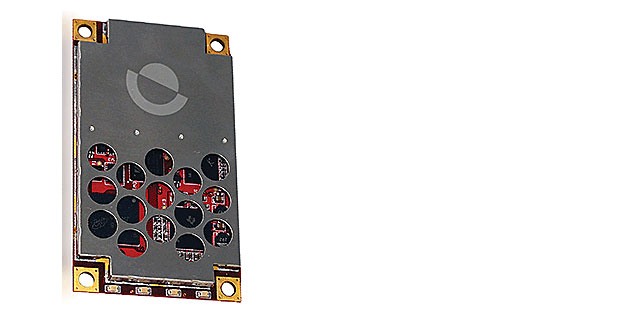
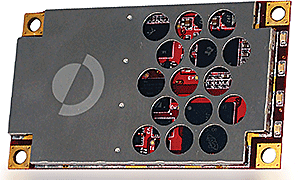
    Today, Hemisphere GNSS introduces the Eclipse P306 and P307, the latest models in the Eclipse series. The Eclipse P306 and P307 track multi-frequency GPS, GLONASS, and BeiDou satellite signals and are Galileo and QZSS ready. By tracking more signals, RTK positioning performance improves especially in challenging environments.

    The Eclipse P306 and P307 are the first products to utilize the company’s new SX4 ASIC. Capable of simultaneously tracking code and phase signals on 89 satellites, SX4 boasts 372 channels and can be configured to address several diverse applications through software.

    Smaller than a business card, the Eclipse P306 upgrades existing designs using Hemisphere’s standard 34-pin modules. The Eclipse P307 is a drop-in upgrade for designs based on the industry accepted 20-pin module. Both products offer scalable performance. RTK accuracy is achieved in either single- or dual-frequency mode. When subscribed for multi-frequency, multi-constellation RTK, Eclipse receivers have fast RTK initialization times even over long distances.

    “While the Eclipse P306 and P307 provide outstanding RTK performance,” commented Dr. Mike Whitehead, Chief Technology Officer of Hemisphere GNSS, “non-RTK users benefit from our COAST, SureTrack, and HeadStart technologies.” COAST and SureTrack work together to maintain sub-meter positioning for 40 minutes when differential corrections are lost. HeadStart reduces the occurrence of cold starts by keeping time while the receiver module is powered off, providing faster startup times.

    Support of the Chinese BeiDou GNSS constellation is significant. The BeiDou constellation not only fully covers China, but extends beyond, covering 2/3 of the world’s land mass, benefiting 5.8 billion people. Coverage currently includes Asia, Australia, New Zealand to South Africa, Europe and all of Russia, as well as Hawaii with, on average, three or more BeiDou satellites visible above 15°.

    In February 2013, Hemisphere GPS changed its name to Hemisphere GNSS, Inc., after parting ways with its agriculture unit. While both names are owned by the company, in order to reflect the company’s support of all GNSSs and update the company’s image, “Hemisphere” has been adopted as its brand name. The company also has adopted a new logo and has launched an updated website, www.HemisphereGNSS.com.

    Hemisphere will be introducing the new Eclipse P306 and P307 OEM positioning modules at the annual Intergeo conference in Essen, Germany, October 8th-10th, 2013 at Booth #A3.070.

  • Hemisphere GNSS Launches GeoMapper Mobile Handhelds and GIS Software

    Hemisphere GNSS Launches GeoMapper Mobile Handhelds and GIS Software

    Photo: Hemisphere GNSS
    Photo: Hemisphere GNSS

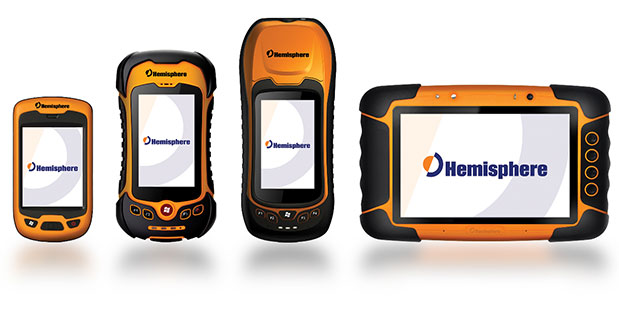
    Today, Hemisphere GNSS announced an all-new series of rugged mobile handheld devices with application software options to support survey, GIS, and mapping professionals. GeoMapper handhelds are designed to work in harsh outdoor environments and features an intuitive and scalable software package.

    The GeoMapper family of products (GM100, GM200, GM300, and GM500) offers a variety of features also suitable for forestry, public safety, asset management, utilities, meeting a variety of field data collection requirements. GeoMapper 100, GeoMapper 200, and GeoMapper 300 feature a Windows Mobile operating system. The GeoMapper 500 tablet offers added flexibility and functionality on the Android OS platform. All GeoMapper models provide high-resolution and direct-sunlight-readable display technology for ease of visibility in all situations.

    The GeoMapper 300 has dual cameras and a unique built-in laser range capability for acquiring instant geo-referenced images and target location data. Both GeoMapper 300 and GeoMapper 500 feature Hemisphere’s high-accuracy, multi-GNSS, multi-frequency Eclipse RTK technology as standard. All GeoMapper handhelds are IP65 rating or higher for their enclosures to ensure durability in most outdoor environments.

    All GeoMapper handhelds feature a newly developed, user-friendly, and scalable GeoMapper Mobile software package designed for professional Field Mapping and GIS applications. GeoMapper Mobile and GeoMapper Office products feature optional post-processing and RTK positioning capabilities to meet the needs of the most demanding professionals.

    “Hemisphere has made substantial investments in expanding our Survey and GIS product portfolio, leveraging our unique capabilities of designing GNSS receivers, antennas, and handheld computing technology from our parent company, providing our customers with exceptional value,” said Phil Gabriel, president of Hemisphere GNSS. “Leveraging our 23 years of GNSS development experience with the latest in handheld technology is a natural and exciting next step for us.”

    In February 2013, Hemisphere GPS changed its name to Hemisphere GNSS Inc. after parting ways with the Agriculture business unit (Now AgJunction Inc.). While both Hemisphere names are owned by the company, in order to reflect the company’s support of all Global Navigation Satellite Systems (GNSS) and update the company’s image, Hemisphere GNSS Inc. has adopted the use of a new logo and launched a new website.

    Hemisphere GNSS will be introducing the new GeoMapper series at the annual Intergeo conference in Essen, Germany, October 8-10, 2013 at booth #A3.070.

  • Hemisphere GNSS Launches New Branding, Website

    Hemisphere GNSS Launches New Branding, Website

    The new Hemisphere GNSS logo.
    The new Hemisphere GNSS logo uses only the word Hemisphere.

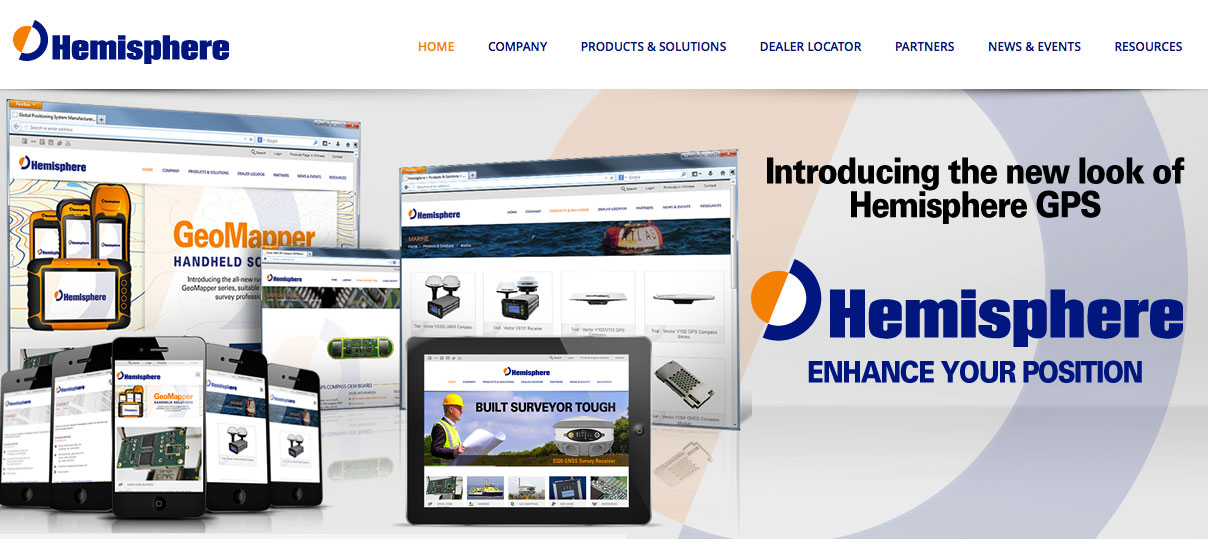
    Today, Hemisphere GNSS introduced its new “Hemisphere” corporate branding and logo to reflect its global GNSS focus. The company is also announcing a new website that has been built from the ground up based on customer and partner input.

    In February 2013, Hemisphere GPS was renamed and incorporated as Hemisphere GNSS Inc. The company owns both names, but in order to reflect the company’s support of all Global Navigation Satellite Systems (GNSS) and update the company image, Hemisphere GNSS Inc. will be adopting the use of the new “Hemisphere” logo.

    “We are pleased to have completed our transition from a GPS agriculture-focused organization to a truly global GNSS Technology and Applications company. Today we are reaffirming our commitment to offering the best value in GNSS OEM boards, antennas, marine positioning, survey, mapping, and machine control products,” said Phil Gabriel, president at Hemisphere GNSS. “We are now introducing our new stylized globe logo and our updated branding to simply read ‘Hemisphere,’ as well as our new website and URL; www.HemisphereGNSS.com.

    The new website is easier to navigate and will assist customers in finding the information they need in a shorter amount of time, the company said. Employee email addresses are also being updated to first name initial, last name @HemisphereGNSS.com, though old email addresses will continue to work for the foreseeable future.

    HemisphereGNSS-W