Tag: INTERGEO 2025

  • NV5 to deploy Hexagon’s Leica CoastalMapper bathymetric lidar system

    NV5 to deploy Hexagon’s Leica CoastalMapper bathymetric lidar system

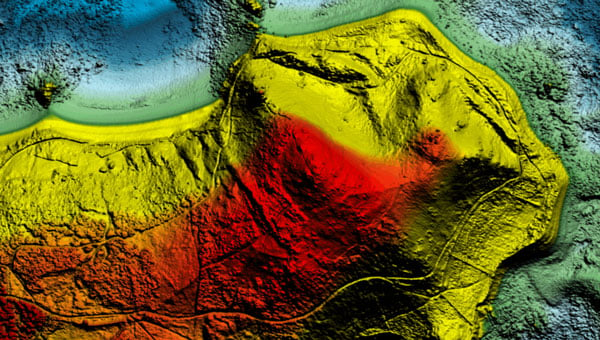
    NV5, a division of Acuren Corporation, has become the first geospatial company to acquire and deploy Hexagon’s Leica CoastalMapper, an airborne bathymetric lidar system for coastal and riverine mapping.

    The CoastalMapper, developed by Leica Geosystems, combines a bathymetric lidar module with topographic lidar and an imaging sensor in a compact pod. The system collects bathymetric and topographic lidar data simultaneously with high-resolution imagery during a single flight. It captures up to 1 million bathymetric points per second and 2 million topographic points per second, producing imagery at a 5-centimeter ground sampling distance at standard flying altitudes.

    The system can operate at higher altitudes than previous generation systems, enabling surveys of steep mountainous river terrain. Applications include infrastructure resilience, flood monitoring and environmental investigations in shallow and deep waters.

    Kurt Allen, president of NV5’s Geospatial Business Unit, said the sensor system will allow the company to deliver more comprehensive datasets in coastal and riverine environments and support environmental resilience and infrastructure planning.

    NV5 Geospatial will receive the Leica CoastalMapper from Hexagon by the end of the year, with a handoff that took place at Intergeo in Frankfurt, Germany, Oct. 7-9, 2025.

  • Topcon and Amberg launch integrated solutions for rail and tunnel at Intergeo

    Topcon and Amberg launch integrated solutions for rail and tunnel at Intergeo

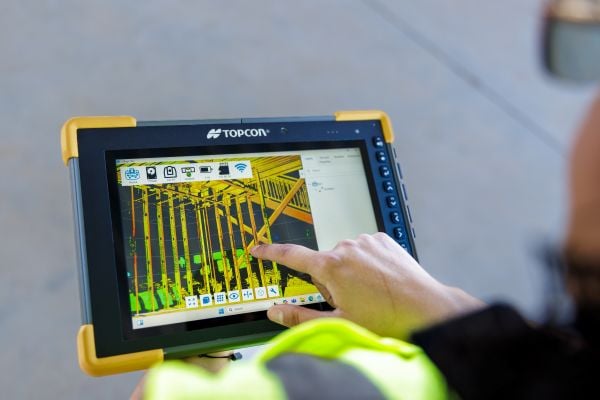
    Topcon Positioning Systems and Amberg Technologies are entering into a collaboration agreement and launching fully integrated solutions for rail and tunnel applications. The interoperability of hardware and software platforms is designed to allow professionals to seamlessly combine technologies from both companies to enhance workflow efficiency and accuracy.

    The announcement was made at Intergeo 2025, held Oct. 7-9, in Frankfurt, Germany.

    At the show, Topcon also announced an expansion of its geomatics portfolio, featuring advancements in mass data software solutions central to a connected workflow ecosystem. The producs follow
    the announcement of the dedicated business structure focused on delivering high-precision technology, software, and services for geomatics.

    The agreement with Amberg Technologies comes at a time when increased urbanization is driving demand for new underground infrastructure and placing demands on aging and existing infrastructure. Digitalization and automation can help contractors and civil engineering firms address these critical industry challenges, as well as labor shortages, tight project schedules, and increasingly complex design requirements.

    Key capabilities resulting from this collaboration include the ability to utilize Topcon’s advanced positioning technology directly with Amberg’s rail and tunnel hardware and software platforms. This integration streamlines tasks such as track alignment, tunnel profiling, and volumetric analysis. The integrations address the need for technology systems that reduce data translation gaps between different hardware and software platforms, eliminating potential errors that can occur when transferring data between systems. 

    Geomatics products and services

    Foundational tools for Topcon’s connected workflow are Collage and ClearEdge software, which allow for data, feature extraction, and the seamless delivery of results into GIS, BIM or CAD environments. Topcon Collage, available in Site, Office and Web versions, serves as a central data hub, enhancing data sharing among all project stakeholders in both the field and office. Topcon is also introducing the Collage Cloud Connector for improved connectivity with Autodesk platforms and ClearEdge solutions such as EdgeWise or Verity.

    Featured hardware and software include:

    • CR-H1 handheld scanner: The CR-H1 handheld mapping solution utilizes iPhone Pro devices with integrated LiDAR that collects georeferenced images and employs photogrammetry to create detailed, full-color 3D point clouds. The iPhone connects to the Topcon HiPer CR receiver, enabling centimeter accuracy with RTK corrections from the Topnet Live GNSS corrections service. The receiver and iPhone are both mounted on a specialized handle, so users can easily capture point clouds while walking throughout the job site. The devices needed can quite simply be held in one hand for maximum mobility in the field.
    • CR-M1 scanner and new Onami software: The CR-M1 is an indoor/outdoor mapping system that can be utilized on a backpack or on a survey pole. The CR-M1 is ideal for urban and construction mapping, multi-floor buildings, real estate, underground mapping, mines and tunnels, stockpiles, and forestry environments. Publishing and sharing the CR-M1 data with Collage Web allows the user fast, web‑based visualization and manipulation of their 3D point clouds and meshes.
    • CR-P1 multi-functional 3D terrestrial laser scanner: The CR-P1 provides real-time, georeferenced point cloud generation on-site, equipping the user with actionable data that can be used for various applications. Enhancements to the Topcon Collage Site software solution provide new mass data workflow capabilities designed to allow for the real-time acquisition and processing of data more accurately, efficiently, and quickly to provide the user with greater productivity.
    • CR-S2 handheld scanner with Magnet Flow and Bridge software: The CR-S2 is a handheld scanning system that uses multiple localization fusion-SLAM to perform mapping projects in challenging environments. It is designed to work in construction and infrastructure applications as well as open, featureless environments such as beaches, coastlines, farmland, and airports. In open environments, the RTK connection to the Topnet Live network ensures position quality. Publishing and sharing the CR-S2 data into Collage Web allows the user fast, web-based 3D point cloud and mesh visualization with easy-to-use measurement and annotation tools.
    • LN-1000i Layout Navigator withTopcon Digital Layout software: The LN-1000i is an addition to the Layout Navigator series that includes new features, including reflectorless measurement capabilities, green laser beam pointer and an integrated camera for live view, camera control and enhanced prism lock. When combined with the new Topcon Digital Layout 2.0 software, this instrument is designed to set new standards in building construction.
    • Expanded Hybrid Positioning capabilities with Topcon software updates for Field – Office – Tools – Enterprise: Allows for better cooperation switching between GT robotic total stations and the HiPer XR GNSS receiver as an optical and GNSS hybrid solution. The new version 10 Topcon Field software enables the user to use the tilt of the IMU when measuring to the prism in Hybrid Positioning mode.
    • Collage Cloud Connector: New Windows app designed to simplify and automate the process of downloading and synchronizing project data from Collage Web to a local machine for use with Autodesk, ClearEdge3D software, or Collage Office.
  • Trimble unveils mobile mapping systems for land and air applications

    Trimble unveils mobile mapping systems for land and air applications

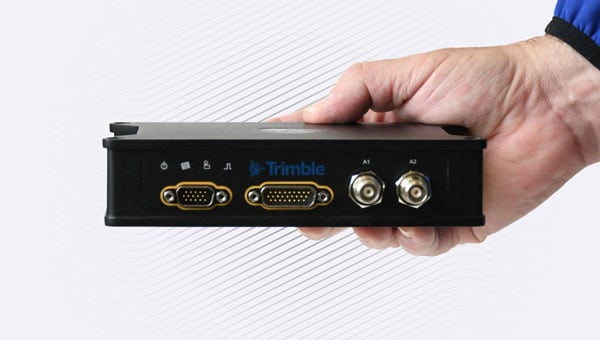
    Trimble has released two positioning system portfolios for mobile mapping and direct georeferencing — Applanix POS LVX+ and Applanix POS AVX RTX — designed to meet evolving demands in the geospatial industry. The solutions are designed to deliver improved accuracy and efficiency for land-based and airborne mobile mapping applications.

    Trimble is showcasing both portfolios at Intergeo 2025, alongside Applanix POSPac Complete advanced post-processing software introduced last week.

    Both portfolios include a one-year subscription to the Trimble CenterPoint RTX correction service and Applanix POSPac Complete for desktop and cloud, which includes post-processed CenterPoint RTX. By integrating real-time and post-processed data, users can achieve global coverage without traditional GNSS base stations, avoiding complications from base stations in different local datums or epochs. Both systems achieve centimeter-level accuracy and support Trimble IonoGuard technology for advanced mitigation against ionospheric disruptions.

    “By bundling both real-time and post-processed RTX into the POS LVX+ land and POS AVX RTX air solutions for mobile mapping, these ready-to-use systems simplify procurement and enable immediate deployment,” said Steve Woolven, president and general manager of Applanix at Trimble. “These portfolios enable our customers to tackle the most complex mapping projects and ensure optimal accuracy for final deliverables.”

    Land-Based Systems

    The POS LVX+ portfolio offers six models with several key features: a smaller, lighter and more cost-effective design with rugged components suitable for diverse users and project types; the Applanix IN-Fusion+ multi-sensor aided inertial engine that maintains performance in challenging environments like urban canyons or tree canopy; suitability for projects using lidar sensors or cameras, plus fleet management and automotive applications; and onboard and external inertial measurement units that enhance reliability and performance.

    Airborne Positioning

    The Applanix POS AVX RTX portfolio includes four variants for mapping at different flying heights through improved orientation accuracy. Key features include over-the-air correction technology achieving positioning, velocity and orientation accuracy up to 0.03 horizontal meters root mean square (RMS) and 0.06 vertical meters RMS without additional setup or infrastructure; robust hardware with advanced inertial measurement units (IMU) and FAA-certified antenna and cabling; and combined real-time and post-processed RTX correction data for time-critical missions, large-scale corridor mapping and projects in remote or inaccessible areas.

    Availability

    The POS LVX+ and POS AVX RTX will be available in the first quarter of 2026 through Trimble Applanix sales channels. After the initial 12-month period, customers can purchase CenterPoint RTX license renewals and POSPac Complete term licenses. For more information or to request a demo, visit https://applanix.trimble.com/en/products/hardware/applanix-avx-rtx or https://applanix.trimble.com/en/products/hardware/applanix-pos-lvx+.

  • Trimble launches POSPac complete post-processing software

    Trimble launches POSPac complete post-processing software

    Trimble as released its new post-processing software, Trimble Applanix POSPac Complete.

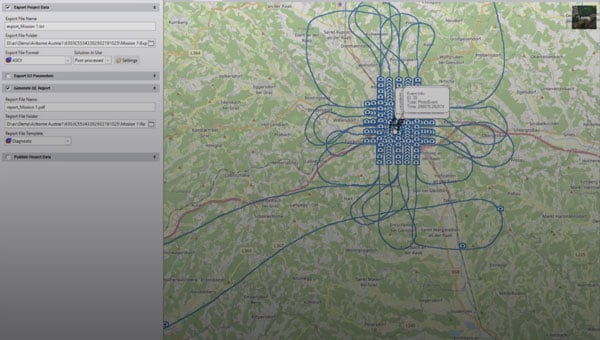
    The solution combines Trimble ProPoint positioning engine, post-processed Trimble CenterPoint RTX (POSPac PP-RTX) and Applanix IN-Fusion+ multi-sensor aided inertial engine. This integration offers geospatial professionals the ability to deliver accuracy and efficiency in the crewed and unmanned systems, land and marine mobile mapping and surveying industries.

    POSPac Complete will be showcased at INTERGEO 2025.

    A redesigned software solution embedded with POSPac PP-RTX, Applanix POSPac Complete is available exclusively as an all-in-one term license that bundles essential GNSS augmentation options — single base, Applanix SmartBase post-processed VRS and POSPac PP-RTX service — into a single, transparent annual fee. This eliminates hidden costs, simplifies budgeting and ensures access to software updates, while Trimble RTX removes the need for base stations and provides global coverage.

    Because Trimble RTX is embedded into the software, users around the world can attain seamless and efficient workflows with centimeter-level accuracy, even in remote or inaccessible areas, increasing productivity in their mapping process. Additional time savings are gained with the elimination of the time-consuming and challenging task of setting up and managing base stations that may be in different local datums or epochs.

    “The new POSPac Complete is more than just a software update; it’s a paradigm shift in how geospatial professionals achieve high-accuracy results because of Trimble’s unique RTX factor,” said Nico Jaeger, product manager at Trimble. “By integrating the power of PP-RTX directly into the software, we’ve eliminated the logistical headaches of base stations and streamlined the entire workflow, making mobile mapping more accessible than ever before. Altogether, it helps new and experienced users to produce survey-grade results with unprecedented speed and simplicity, truly representing the next generation of geospatial processing software.”

    Additional features in the new POSPac Complete include:

    • Modernized user interface: A new look and feel with a background map and a streamlined project wizard for easier and more efficient workflows, and a better user experience.
    • Trimble IonoGuard: Trimble’s latest technology that detects and mitigates the effects of ionospheric scintillation, which is especially important during the solar activity peaks, supported in single base and PP-RTX processing modes.

    Optional add-on features available for purchase:

    • Camera QC tools: The robust successor to CalQC, providing rapid IMU to camera boresight calibration for single-head and multi-head (oblique) camera constellations with minimal user interaction.
    • Lidar QC tools: Trimble’s leading software application for IMU to lidar boresight calibration and trajectory adjustment using SLAM techniques is now enhanced with support for automatic ground control point (GCP) detection, the RIEGL lidar native file format and reduced RAM requirements for faster processing.

    The POSPac Complete solution will be available in November 2025 through the Trimble sales channels. For more information or to request a demo, click here.

  • Teledyne Optech to showcase mapping and marine technologies at INTERGEO 2025

    Teledyne Optech to showcase mapping and marine technologies at INTERGEO 2025

    Teledyne Optech will showcase its portfolio of solutions designed for topographic and marine mapping and electric utility inspection at Intergeo 2025, taking place Oct. 7-9 in Frankfurt, Germany. The company will exhibit at Hall 12.0, Stand 0C067.

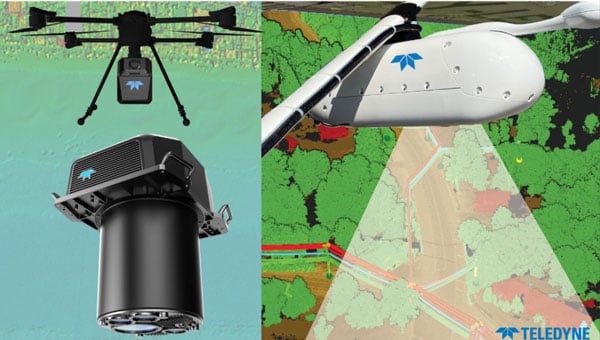
    Featured technologies will include Fathom, a topo-bathymetric airborne lidar system designed for data integration of topo lidar, bathy lidar and a multispectral camera capturing the coastal scene from dry land to below water. Also on display will be EchoONE, Optech’s smallest lidar sensor to date at just 1.65 kilograms, combining long-range performance with NDAA compliance and real-time generation of georeferenced point clouds. Visitors will also see Network Surveyor, powered by Galaxy Edge and designed to meet the time constraints of electric utilities, featuring real-time processing and a software analytics stack for utility operators.

    Visitors are invited to view a new compact lidar sensor designed for integration in modern wing and belly pods. Deployable in lightweight aircraft and helicopters, the sensor delivers high resolution for mapping projects, utility asset management and vegetation monitoring. Teledyne Optech will host a reception Tuesday, Oct. 7, from 4-6 p.m. at the stand.

    The booth will also showcase Teledyne Marine’s sonar and software solutions for marine infrastructure projects, including dredging, offshore wind and port and harbor operations. Live demonstrations of Teledyne FLIR IIS’ spherical imaging camera Ladybug 6, with spatial accuracy of plus or minus 2 millimeters at 10 meters distance, will be available.

    Mike Lee, director of product management at Teledyne FLIR IIS, will speak Tuesday, Oct. 7, from 12:50-1:10 p.m. on “Beyond Resolution: Advancing Mobile Mapping Through Spherical Imaging Innovation.”

    Teledyne Optech is a lidar solutions provider. With operations and staff worldwide, Teledyne Optech offers solutions for topographic and marine mapping, defense and electric utility inspection.

  • Topcon launches Geomatics division ahead of Intergeo

    Topcon launches Geomatics division ahead of Intergeo

    Topcon Positioning Systems has created of a dedicated business structure focused on delivering high-precision technology, software and services for geomatics. The new organization consolidates and expands Topcon’s portfolio of surveying, geospatial and GIS solutions, while opening new pathways into emerging markets.

    The specialized division is an addition to the company structure, which includes established divisions dedicated to construction and agriculture.

    “Geomatics is entering a new era,” said Ivan Di Federico, president and CEO of Topcon Positioning Systems. “It is no longer only about collecting points and producing maps. Today, it is about capturing massive amounts of geospatial data, connecting multiple data streams, and delivering insight with the speed and simplicity our customers demand. Topcon’s role is to reduce the gap between field capture and business decisions. By elevating geomatics into its own global business group, we are signaling that this discipline is vital — not just for traditional professionals, but for every sector where spatial intelligence drives efficiency and growth.”

    Photo:
    Neil Vancans will lead the new Geomatics Sales Unit of Topcon. (Photo: Topcon)

    Neil Vancans, an experienced leader in the surveying and geospatial industries, has joined the company as the head of its new Geomatics Sales Unit. He brings decades of experience in senior leadership roles at companies including Leica Geosystems, Thales Navigation, Septentrio, and Altus Positioning Systems.

    “Topcon has the precision technology, the global resources, and the vision to reshape what users can expect from geomatics,” Vancans said. “The demand for accurate, reliable positioning is expanding rapidly, and our goal is to turn raw data into usable, actionable intelligence. That means creating value for customers, empowering dealers and partners, and ensuring that geomatics solutions accelerate digital transformation.”

    Topcon geomatics solutions — including the expanding Capture Reality portfolio — will be showcased at Intergeo 2025 in Germany, Oct. 7-9.

    For more on Topcon’s focus on precision, watch the video “Since Precision Exists.”

  • Frankfurt welcomes INTERGEO 2025 as geospatial tech tackles global challenges

    Frankfurt welcomes INTERGEO 2025 as geospatial tech tackles global challenges

    Geoinformation has evolved from a specialist tool to an essential resource for government, business and civilian use. Whether captured from space or drones, analyzed through artificial intelligence (AI) or 3D visualizations, geographic data now, more than ever, drives critical decisions across industries.

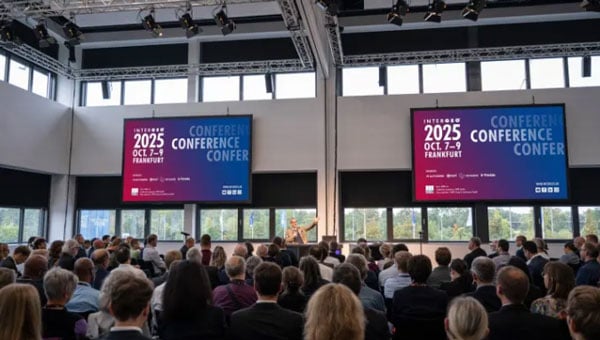
    INTERGEO 2025 exemplifies this transformation. From Oct. 7-9, the Frankfurt Exhibition Center will host the world’s leading conference and trade show for geodesy, geoinformation and land management, featuring more than 500 international exhibitors ranging from innovative startups to industry giants.

    Three-Day Conference Program Features 100 Sessions
    The INTERGEO Conference will present approximately 100 presentations and sessions over three days, drawing speakers from space agencies, United Nations organizations, government ministries and international technology companies.

    Key topics include AI-powered remote sensing, urban digital twins, open data strategies, Earth observation for climate and crisis management and building information modeling (BIM) integration for infrastructure lifecycle management.

    Keynote presentations such as “Earth Observation and Artificial Intelligence” and “Cartography for the Future” will provide forward-looking insights, while panel discussions on digital sovereignty and standardization will address strategic frameworks. Each session demonstrates how geoinformation serves as the critical foundation for climate adaptation, disaster preparedness, urban development and infrastructure protection.

    Opening Day Features Space Technology Focus

    DVW President Prof. Rudolf Staiger will open INTERGEO on Tuesday, Oct. 7, followed by a keynote from Johann Dietrich Wörner, space coordinator for the state of Hesse. His presentation, “Earth Observation and Artificial Intelligence,” will explore how AI transforms massive Earth observation datasets into actionable insights for climate, agriculture and urban planning projects.

    Prof. Serena Coetzee of UNU-FLORES will deliver the German Cartography Congress keynote on Wednesday, Oct. 8, addressing cartography’s evolution amid growing geodata volumes and governance challenges.

    Thursday morning’s panel discussion, “Digital Transformation – Perspectives, Trends and Theses,” will examine the need for reorienting geoinformation management to foster innovation and collaboration.

    Revolutionizing Geospatial Data Analysis

    AI is accelerating the transformation of raw data into actionable insights, fundamentally changing how professionals work with geoinformation. The session “AI-Based Analysis of Remote Sensing Data for Updating the ATKIS Basic DLM” demonstrates practical applications in public administration.

    The Hessian Administration for Soil Management and Geoinformation uses AI methods to automatically detect landscape changes, significantly improving the quality and timeliness of digital landscape models.

    Urban digital twins are rapidly advancing from static models to powerful operational platforms. The session “From Data to Insights: Visualization Technologies for Next-Generation Digital Twins” will showcase how modern visualization makes complex systems accessible and accelerates planning processes.

    The research project “DigitalCities4Us” illustrates practical applications, using high-resolution 3D data to enable barrier-free urban planning and improve accessibility for people with mobility restrictions.

    Additional sessions will examine implementation across administrative levels. “The Digital Twin NRW: A Practical Report” presents a statewide geospatial data infrastructure that is freely accessible and continuously developed. The city of Zurich will demonstrate its transition from traditional geospatial data infrastructures to multifunctional twin platforms.

    Geodata infrastructures, open data and data spaces form the backbone of digital transformation and serve as key prerequisites for digital sovereignty. Multiple sessions will emphasize the importance of stable, future-ready geodata infrastructure.

    Standardization receives particular attention through presentations like “Three Perspectives, One Goal: Digital Sovereignty through Open Standards in BIM and GIS” and the position paper “Official Geodata as a Basis for Digital Processes in Planning, Construction and Operation.” These sessions demonstrate how uniform standards for data exchange between geographic information systems and building information modeling can accelerate planning, construction and operational processes.

    The position paper represents a joint initiative of buildingSMART Germany, the Working Committee of the Surveying Authorities and the Federal Association of Publicly Appointed Surveyors.

    Critical infrastructures require precise, reliable data to minimize risks. The presentation “Regional and Effective Flood Protection in the State Capital of Düsseldorf” demonstrates how geoportals and flood forecasting tools prevent flooding and strengthen urban infrastructure resilience.

    Bringing Innovation to the Exhibition Floor

    Registration is now open at the INTERGEO website. The INTERGEO 2025 team looks forward to welcoming attendees to the Frankfurt Exhibition Center from Oct. 7-9.