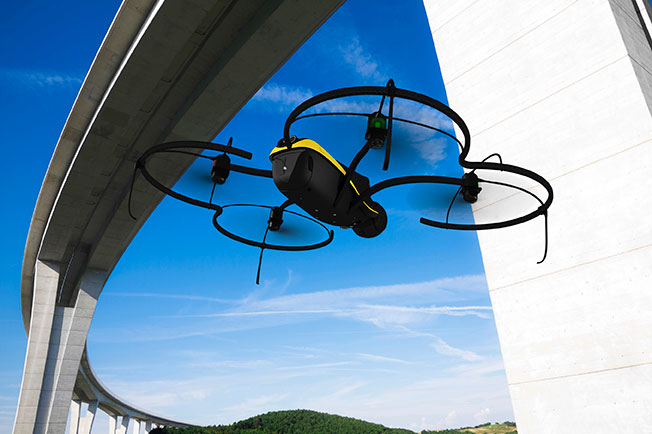
The inaugural European Drone Summit will be taking place Oct. 15 in Frankfurt, Germany.
According to event sponsor UAV DACH e.V., the conference will give operators, manufacturers and public authority representatives the chance to gather and discuss the potential modes of operation and applications that are opening up for professional drone service providers and companies in light of the unmanned aircraft industry’s new European general aviation regulation.
Keynote speakers at the event will include Peter van Blyenburgh, UVSI; Max Scheck, Vereinigung Cockpit; Jules Kneepkens, EASA a.D.; Martin Brandenburg, DJI; Andreas Lamprecht, AIRMAP; and Jörg Seebach, DeDrone. The Intel Drone Group’s Anil Nanduri will also present a keynote speech.
“We are delighted that high-ranking experts from different companies, some of whom are even competitors, have accepted our invitation to come on board,” said Michael Wieland from UAV DACH e.V. “Global players’ first-hand experience and solutions offer added value to everyone taking part.”
The goal of the European Drone Summit is to channel ideas and decisions relating to unmanned aircraft systems (UAS) in order to highlight how unmanned aerial vehicle technology can be used now and in the future by representatives of various sectors, organizers said. The summit will take place at the same time as Intergeo, which will take place Oct. 16-18.
The first European Drone Summit will take place Oct. 15 in Frankfurt, Germany, to bring together stakeholders to discuss the future of drones in Europe. The summit is sponsored by UAV DACH e.V. and Interaerial Solutions of Intergeo.
In addition to being a smart, up-and-coming technology, commercial drones are also an integral part of the digitalisation of business and society. The EU member states have agreed to introduce legislation regulating the operation of unmanned aircraft in Europe that takes into account both economic potential and safety requirements.
The programme will be put together by UAV DACH experts and will explore legal aspects, technological issues and various application areas. Legislators, industry representatives and user groups will meet on the eve of Europe’s largest trade fair for commercial drones.
The following experts will speak (with more to be named later):
Peter van Blyenburgh, UVSI
Max Scheck, Vereinigung Cockpit
Jules Kneepkens, EASA a.D.
Martin Brandenburg, DJI
Andreas Lamprecht, AIRMAP
Jörg Seebach, DeDrone
UAV DACH is an association for commercial unmanned aviation in Europe. It represents the interests of 175+ corporate members from research, manufacturing and application located in Germany, Austria, Switzerland, Italy, Spain and the Netherlands.
The Interaerial Solutions part of Intergeo is the largest commercial drone trade fair in Europe. It takes place Oct. 16-18, also in Frankfurt.
The theme for this year’s Intergeo, taking place Oct. 16-18 in Frankfurt, Germany, is “Geoinformation — The DNA of digitalization.”
According to event organizers, this year’s event will focus on the digital transformation of business and society. The event, hosted by the German Society for Geodesy, Geoinformation and Land Management (DVW), will contextualize key developments and scenarios for a geoinformation-based digital future.
“Over the course of three days, the spotlight will be placed on the products, solutions, know-how, innovations and visions behind geoinformation in the era of digitalization,” said Professor Hansjörg Kutterer, president of DVW. “And we confidently label geoinformation the DNA of digitalization. After all, in the same way as humans are shaped by their genes, geoinformation is steering the digital revolution.”
Intergeo 2018 will feature 130 speakers, with each day of the show beginning with keynote speeches. Among the keynote speakers are Kutterer; Professor Jürgen Döldner from the Hasso Plattner Institute in Potsdam, Germany; and Ron Bisio from Trimble.
In addition, more than 600 companies will be exhibiting at the show.
TerraGo is exhibiting at Intergeo 2017, which is taking place Sept 26-28 in Berlin, Germany.
“Intergeo brings together the global leaders of the industry and creates an exceptional forum for interpersonal collaboration and the opportunity to show the industry’s only zero-code platform to visitors from nearly 100 countries,” said Stuart Miller, international sales manager at TerraGo. “The event gives us a chance to dialogue and understand our visitors’ goals before we demonstrate our technology. Then by understanding their specific objectives, we can show them how to customize geospatial apps for their unique requirements.”
TerraGo’s GeoPDF products enable free, lightweight GIS applications and have evolved into a de facto standard around the globe, helping organizations get more value — for more users — from their current investments in GIS and imagery platforms, the company said.
Also, TerraGo Magic enables end users without development skills to build custom apps that enable high-accuracy, survey-grade GNSS with advanced GIS and mapping features on Android and iOS devices.
TerraGo’s exhibition will be located at the UK Pavilion, Hall 1.1, Booth D1.016. Click this link to schedule a time for a live demonstration.
Harxon is showcasing a series of GNSS antennas and wireless data-link modems at 2017 Intergeo, being held Sept. 26-28 in Berlin, Germany.
The products aim to provide the user better industrial solutions in the fields of surveying and mapping, precision agriculture and unmanned aerial vehicles (UAVs).
The Harxon D-Helix Antenna.
D-Helix Antenna: The multi constellation antenna is capable of superior tracking signals from 4 satellite constellations, including GPS L1/L2 L-Band, GLONASS L1/L2, BDS B1/B2/B3 and Galileo. The innovative quadrifilar helix antenna design of low wind-resistance is ideal for aerial photographs, telemetry technology, disaster monitoring and security monitoring industries. Its 3.5dBi peak gain ensures exceptional low elevation tracking performance. The low noise figure enhanced transmission interference reduction and improve the signal quality.
The Harxon GPS 1000 Survey Antenna.
Survey Antenna GPS 1000: The all constellation GNSS antenna has passed the NGS certification, which receives GPS L1/L2/L5 L-Band, BDS B1/B2/B3, GLONASS L1/L2, Galileo E1/E2/E5a/E5b signals. It can be used in land survey, marine survey, channel survey and agriculture applications, with a consistent performance across the full bandwidth. GPS 1000 has high gain and wide beam width to ensure the signal receiving performance of satellite at the low elevation angle, and the phase center remains constant as the azimuth and elevation angle of the satellites change. The influence of measurement error can be minimized via the multi-feed design and embedded multi-path rejection board.
Rover Radio HX-DU1603D: The high-speed, Bluetooth-enabled ruggedized UHF rover radio is designed for GNSS/RTK surveying and positioning. It ensures the data communication between 410MHz and 470 MHz in either 12.5KHz or 25 KHz channels. HX-DU1603D is equipped with a Bluetooth transceiver for wireless communications of external devices, features a 6800mAh rechargeable internal battery and configurable transmit power between 0.5W and 2W, also the IP67 waterproof capability allows outdoor long operational hours.
Harxon Frequency Hopping Module HX-DU1018D/HX-DU2017D.
Frequency Hopping Module HX-DU1018D/HX-DU2017D: The built-in frequency hopping transceiver modules are small size, light weight, low power consumption and strong resistance to disturbance. They provide a reliable, high speed and low latency data transmission, which are suitable for UAV flight control. These modules support a band range among 400MHz, 840MHz and 900MHz and long distance of communication. Besides, HX-DU1018D/HX-DU2017D can realize a switchover between air baud rate and serial port baud rate.
Harxon Smart Antenna.
Smart Antenna: It is a multi-functional GNSS product which is integrated by multi-frequency OEM antenna, OEM receiver and frequency hopping transceiver. Smart Antenna utilizes the dual anti-multipath antenna to receive stable GNSS signals under the bad-signal environment and precisely output the direct information with a centimeter-level positioning accuracy. The IP67 waterproof design allows the smart antenna for a long time outdoor operation.
The Harxon H-RTK.
H-RTK: H-RTK is for UAV positioning and navigation, which reaches the positioning accuracy to a centimeter level. It is integrated with positioning, height setting and heading functions to provide accurate, reliable solutions. H-RTK ensures the positioning accuracy to a centimeter level for a more stable flightpath. Also, it provides the reliable height information and solve the height-error problem to prevent air turbulence. H-RTK outputs precise navigation information with powerful magnetic disturbance resistance, it enables the flight reliability under a magnetic disturbance environment, and avoid security risks. The built-in anti-interference frequency hopping transceiver helps data transfer back to the base station, and supports the frequencies of 400 MHz, 840 MHz and 900 MHz.
For more information,visit Harxon’s booth at Intergeo in Hall 4.1 booth C4.013.
SBG Systems will demonstrate Qinertia, its in-house next-generation INS/GNSS post-processing software, at the Intergeo trade show, which takes place Sept. 26-28 in Berlin.
SBG Systems can be found is in Hall 1.1, stand C1.007.
For more than 10 years, SBG Systems has been designing inertial navigation systems from the internal inertial measurement unit (IMU) to filtering with GNSS data.
Designed for the surveying market, Qinertia is a fully in-house INS/GNSS post-processing kinematic (PPK) software. Whether the survey is made from a car, a UAV, a plane or a vessel, Qinertia will secure and enhance a surveyor’s acquisition, the company said.
The company will hold four live demonstration at its stand during Intergeo. The demonstrations will take place at 11 a.m. and 15 p.m. on both Tuesday, Sept. 26, and Wednesday, Sept. 27. There is no need to book to attend a demonstration, but please note that seats are limited.
In Portland, Oregon, and in Berlin, Germany, the two largest and most important international conferences on GPS, GNSS, PNT, survey, mapping and geodesy take place this year on exactly the same dates — just 5,177 miles apart. Now that’s bad timing. Our strategy is to divide our forces and send key personnel to interact with industry leaders at each gathering — to bring you the news and developing stories you need to keep on the forefront of change.
If you’re at ION GNSS+ or Intergeo, look for these faces, come up and introduce yourselves. We want to talk with you! If you’re not fortunate enough to attend either conference, look to our website, newsletters and this magazine for product launches, videos and in-depth stories filed from the developing frontiers of PNT. We’ll be reporting !!Live!! and for weeks, even months, to come.
Attending Intergeo in Berlin:
Burch
Barwacz
Joyce
Gerard
Tim Burch is our survey editor; in his day job he’s a professional surveyor and board of directors secretary of that profession’s national society.
Allison Barwacz is digital media content producer for North Coast Media (NCM, that’s us) with a passion for videography and writing.
Mike Joyce and Ryan Gerard, senior account manager and account manager, respectively, work closely with our marketing partners, who make this magazine and multi-media communications channel possible.
Attending ION GNSS+ in Portland:
Stoltman
Whitford
Mitchell
Cozzens
Harms
Sabau
Limpert
Cameron
Langley
Kevin Stoltman is founder and president of NCM, with a distinguished career in business-to-business publishing.
Marty Whitford is editorial director and publisher; earlier, he actually worked at GPS World and attended ION-GNSS 2004.
Michelle Mitchell is account manager for GPS World and senior marketing and event manager for NCM. She knows the GPS industry landscape and players extremely well.
Tracy Cozzens is our managing editor, with her hands on all the controls.
Joelle Harms is an award-winning digital media manager, focused on content planning and creation.
Joe Sabau is an account manager with a keen eye for market trends.
Kelly Limpert is a digital media content producer developing a strong online and social media presence for all of our partners.
Richard Langley is GPS World’s innovation editor and a professor at the University of New Brunswick.
It’s almost September. For the GPS World staff, this means scramble time. We have two important industry events to attend: The venerable ION GNSS+ conference and the huge Intergeo trade show.
ION GNSS+ is the Institute of Navigation’s largest technical meeting and showcase of GNSS technology, products and services. Hundreds of papers are shared by experts in the field, in presentations and panels.
The show has changed over the years to broaden its focus to applications, and added a “+” to its name to incorporate all the positioning, navigation and timing (PNT) technology that aids GNSS in location, much as we have also done in providing a new subtitle to our magazine.
New this year are Short Courses, aimed at bringing your non-technical staff up to speed on the technology behind the industry, no matter their background. For instance, one course is “GNSS 101: An Introduction.”
Intergeo, which is held each year in different city in Germany, comes to Berlin. The huge show, attended by about 17,000 people, is a conference and trade fair (emphasis on trade fair) for the fields of geodesy, spatial data, surveying, UAVs and land management.
A hot topic at Intergeo continues to be Geospatial 4.0, the massive transformation where big data, mobility and cloud solutions are driving a new global digital economy.
Other buzzed-about topics include photogrammetry, building information modeling (BIM) and smart cities.
One important and timely topic is the need for infrastructure that ensures data security and protection. Once again, the Interaerial Solutions show for UAVs will take place as part of Intergeo.
We’ve entered a new golden age for photogrammetry, powered by the ease of digitizing images and their ubiquitous availability.
Photogrammetry is the science of making measurements from photographs. While science drives the process, business is driving a wealth of associated applications.
“Photogrammetry is ahead of its time because everything is already fully digital in this discipline,” said Heinz-Jürgen Przybilla, professor of Geodesy at Bochum University of Applied Sciences.
UAVs, digital cameras and image sensors on the Internet of Things, in aircraft or on satellites are opening up applications that only the world of science was predicting a few years ago.
Intergeo Show. The developments that photogrammetry is setting in motion will be on display at Intergeo 2017, Sept. 26–28 in Berlin.
The art of using photographs for surveying, which laid the foundation for present-day photogrammetry, dates back 150 years and involves developing processes to derive information from images that go far beyond simply viewing them. In recent years, the discipline has made huge progress, with businesses discovering new application areas.
The high level of automation makes it possible to interpret huge volumes of data from sources such as large-scale satellite imagery. The process also works in real time — a prerequisite in applications such as autonomous navigation.
“Automation in image evaluation makes people incredibly flexible. We’re no longer restricted to viewing the world from our own height,” said Christian Heipke, president of the International Society for Photogrammetry and Remote Sensing (ISPRS).
Photogrammetry applications are moving into numerous sectors and tackling a host of challenges. Global change is being documented using images from space. Image data is being used to forecast crop sizes. Inaccessible structures are being monitored with the help of images from UAVs.
As Przybilla said, image evaluations from UAVs are already being used for high-precision land register surveys. What took days manually can now be accomplished in minutes.
Disaster Prevention. Other applications include disaster prevention and monitoring refugee movements. In many cases, drones provide a rapid overview, while satellites offer the large-scale basis for evaluating a situation.
In architecture, 3D models from aerial images complement computer-aided design (CAD) plans. In conjunction with virtual reality, 3D models enable design variants for a building to be depicted in the actual environment.
Information is also being shared with disciplines such as computer vision and robotics, with “seeing robots” increasingly recording and mapping their surroundings.
Industrial site in 3D: A digital elevation model from a series of overlapping photos taken from a UAV at 300 feet above ground level. (Image: Eric Gakstatter)
More and more, the processes and algorithms on which image evaluations are based are becoming like a “black box” for users — hard to understand from the outside. While the black box is getting bigger, scientists are refining their methods.
“We’re increasingly combining existing data and this will leverage a huge amount of new potential,” explained Heipke. The black box for photogrammetry will be discussed at Intergeo.
Once the process of image content recognition is automated, applications are limitless.
Several sessions organized by the German Society for Photogrammetry, Remote Sensing and Geoinformation (DGPF) at Intergeo will be looking at topical issues in photogrammetry. The contents of the presentations range from new sensors and remote sensing to “engineering geodesy meets photogrammetry.” Numerous companies will also be showcasing their image-evaluation solutions at Intergeo’s specialist exhibition.
Contributing Editor Tony Murfin is on vacation this month. In place of his column, we bring you an advance look at an important UAV show as applied to surveying and mapping, and a story about drone use in surveillance.
In the zone
Legal issues, international market analyses and best practices will take center stage at the Interaerial Solutions Expo (IASEXPO), which will take place Sept. 26–28 in conjunction with Intergeo 2017 in Berlin, Germany.
At IASEXPO, the international UAV sector will be demonstrating the potential for civil and commercial UAV applications. IASEXPO will consist of an exhibition, forum and the FlightZone for UAV demonstrations. About 150 providers from 25 countries are expected to represent the young drone market at the IASEXPO.
IASEXPO’s practical forum will cover the latest topics with renowned experts. Visitors don’t have to walk far to switch between market overviews and expert presentations. The aim is to efficiently combine the trade fair and talks.
IASEXPO Forum 2016.
Regulations. As Germany’s drone regulations come into force this year, the legal aspects of using and operating UAVs is a key focus of the practical forum. Multicopters and drones weighing more than two kilograms can now only be flown in Germany by someone who holds a “drone driving license.” Pilots will be able to take the drone license test at the trade fair.
Frank Wichert from project management company procow will detail the requirements and reveal the precise procedure that pilots must follow. Speaker Ulrich Dieckert is a lawyer and expert on the approval process; he specializes in exceptions to operating bans that hinder drone work.
Market prospects. Kay Wackwitz, CEO of Drone Industry Insights, will present economic analyses of application opportunities and limits for UAVs, and discuss market developments and collaborations.
UAV Issue Manager Ralf Heidger from German traffic control (DFS) will discuss how DFS tackles the challenge of drones in the air space and tracking them within the air-traffic-management system.
Best practices. First-hand reports will provid examples of best practices in using drones for surveying and inspecting buildings and industrial complexes. Friedrich Wilhelm Bauer from Hannover University of Applied Sciences and Arts will highlight use of thermal-imaging technology for inspections. Benjamin Federmann from Aibotix-Leica will discuss the economic benefits of using drones in surveying and construction.
The German Association of Copter Pilots will weigh the question of whether to “make or buy” needed drones and services. Answers come from success stories in niche segments such as 3D modeling and smart framing. Maik Neuser from Westnetz and Carlo Zgraggen from Aeroscout will discuss inspections in the energy sector.
Other topics will be the use of drones in agriculture, forestry and disaster relief. Antoine Cottin from Carbomap and Bobby Vick from Precisionmapper will speak to the practical forum on drones used for surveying forests.
Drones on patrol
UAVs will soon be a common sight over border zones, crime hotspots and city streets in South Africa, as public safety and security officials and police departments discover the cost saving and efficiencies offered by drone patrol “armies,” according to Airborne Drones, a South African-based manufacturer of enterprise-grade drones.
Airborne Drones Vanguard 35-km long range surveillance drone ready to take flight. (PRNewsfoto/Airborne Drones)
Drones provide a solution to the limitations of other surveillance methods such as GPS tracking, CCTV camera observation, biometric surveillance and ground patrols. Aerial surveillance is increasingly being harnessed for security monitoring — traditionally, with costly helicopters. Drone surveillance present an faster and cheaper method of data collection.
Specialized security drones can enter narrow and confined spaces, produce minimal noise, and can be equipped with night-vision cameras and thermal sensors, allowing them to provide imagery that the human eye is unable to detect. In addition, UAVs can quickly cover large and difficult-to-reach areas, reducing staff numbers and costs, and don’t require much space for operators.
Autonomous, long-range security drones are at the vanguard of new policing methods, accoring to Airborne Drones. “Offering live video feeds to ground control stations, these drones can range autonomously over pre-programmed flight paths for extended periods of time, allowing for ongoing routine patrols across wide areas such as borders, maritime regions and high security installations.
Should an incident be detected, ground crews can then follow objects or intruders from a safe distance, providing visual support to safety and security teams. UAVs can provide detailed visual documentation of sites, enabling effective analysis, risk management and security planning.”
Around the world. Numerous countries are rolling out security drones to support public safety and defense initiatives”, says Airborne Drones. Israel has long harnessed advanced drones for military surveillance, and recently sold a fleet of “spy drones” to the Irish army.
The U.S. FBI has used drones for surveillance and tracking for several years. In Australia, the new $50 million Defence Cooperative Research Centre will develop long-range drones, automated vehicles and robots to help Australian soldiers fight the wars of the future. India is looking to military-grade UAVs for maritime and other surveillance and intelligence gathering.
In June, Brazil’s São Paulo became the first Latin American city to use drones for public security surveillance, and in July, Hamburg, Germany, deployed surveillance drones for the estimated 100,000 demonstrators at the G20 summit. In Australia’s New South Wales, the authorities are using helicopter and drone surveillance along the coast to protect holiday-goers from rip currents and sharks.
UAVs are also instrumental in managing transport infrastructure safety and security and event security, from event security infrastructure to spectator and crowd control and safety, to overall health and safety planning.
“Smart cartography” is the top theme at the 65th Cartography Conference, which will take place Sept. 26-28 in conjunction with Intergeo in Berlin, Germany. Numerous examples at the conference and trade fair will reveal smart cartography’s wealth of potential.
The latest smart maps are as far removed from their 2D relatives on paper as is the state-of-the-art GIS platform from the analog planning basics of bygone years. But just what is so smart about these cutting-edge maps? Here’s a handful of examples of smart cartography.
Smart maps are intuitive and attractive
Maps have always been used to represent relationships and make sense of our surroundings. More often than not, they achieve this far better these days than ever before. Maps have become more accessible to their target groups and more intuitively understandable. You rarely need instructions on how to read a map nowadays. A prime example of innovative design is the widely discussed and highly praised new plan of Berlin’s public transport network. Architect Jug Cerovic uses his own special standard to translate complex public transport systems into both functional and aesthetically appealing maps. (http://www.jugcerovic.com/maps/inat-metro-mapping-standard/)
Smart maps provide customized information
Smart maps provide customized information right where it is needed. This might be the optimum route for mountain bikers or hobby cyclists (www.bikemap.net) or for navigating stress-free through the city using whichever mode of transport you like (https://wego.here.com/). While in the past, maps flattened reality into 2D, nowadays 3D is the norm. Not only that, but the fourth dimension of time is becoming increasingly prominent in digital maps. (http://360.here.com/2017/03/28/4d-mapping-can-change-world/)
Smart maps capture the moment – right now
Today’s smart maps are a dynamic product. They don’t lead to dead-ends, but instead simply keep on evolving. In the Internet of Things, where vehicles, mobile objects and sensor data gather and network millions of items of information, companies are working on creating living maps that constantly display real-time status. These form the basis for the self-driving vehicles of the future, on the streets and in the air close overhead. (https://here.com/en)
Smart maps reveal new insights
Whether you’re interested in commuter flows or refugee accommodation (https://www.findingplaces.hamburg/), smart maps are the number-one tool for planners and are now being used by politicians and citizens alike as the basis for political debate. The ability to explore visual representations turns raw data into a practical basis for making decisions. In Hamburg, for example, smart maps have become a game-changer in the search for locations for refugee accommodation and also help plot the most suitable corridors for projected commuter flows.
Multi-sensory maps
Click on a street to see how it sounds, at goodcitylife.org
Acoustic maps have been able for some time to visually represent “soundscapes” or add sound with the aid of audio files (http://www.life-dynamap.eu/). What’s new is the addition of olfactory elements. Researchers at Goodcitylife are working on capturing the “smellscape” of cities. And their Happymaps offer a completely new slant on the city – for those who are not as much bothered about getting from A to B as “enjoying the ride”. (http://goodcitylife.org/index.html)
Virtual and augmented reality
No one can fail to have noticed the craze whipped up by the AR application Pokémon Go (http://www.pokemongo.com/de-de/). This plainly revealed the potential that lies in virtually embellished maps. VR and AR map applications now liven up tours of museums and churches (http://dom360.wdr.de/) and are being used as planning and information tools.
Teledyne Optech launched survey instruments and workflow solutions for collecting 3D spatial data at Intergeo 2016, which was held Oct. 11-13 in Hamburg, Germany. General Manager Michel Stanier highlights the Polaris terrestrial scanner, Maverick mobile scanner, Eclipse airborne sensor and Galaxy sensor.
 The inaugural European Drone Summit will be taking place Oct. 15 in Frankfurt, Germany.