Nexcom introduces in-vehicle computers VTC 7230 and VTC 7240 to foster the growth of connected vehicles in the IoT (Internet of Things), which aims to offer safer and more efficient driving experience. Featuring fifth-generation Intel Core processors, the in-vehicle computers have numerous telematics features to support fleet management, security features to protect vehicles in the IoT, and performance to drive ADAS (Advanced Driver Assistance Systems) and stream multiple video surveillance feeds.
For fleet management, VTC 7230 and VTC 7240 feature built-in GPS for vehicle tracking and navigation, and a CAN bus 2.0B interface with optional OBD II function for vehicle diagnostics. To enable remote monitoring of vehicle diagnostics, store and exchange data of video surveillance feeds and IVI (In-Vehicle Infotainment) services, VTC 7230 and VTC 7240 feature four mini-PCIe expansions with dual WWAN support and dual external HDDs, providing high cellular bandwidth for fast connections and ample storage for large video and media files.
“The pursuit of driving safety and efficiency has been the driving force for advancements in in-vehicle technologies,” said Steven Wu, general manager of Nexcom’s Vertical Industry Platform (VIP) Business Unit. “Using fifth-generation Intel Core processors i3-5010U and i7-5650U respectively, VTC 7230 and VTC 7240 provide signal processing, machine vision, and video transcoding capabilities required of ADAS, ANPR (Automatic Number Plate Recognition) and video surveillance, giving abilities to sense and to think to fleet transport, public transport, police vehicles, ambulances and more.”
“The fifth-generation Intel Core processors utilizing Intel’s new 14nm process has integrated Intel HD graphics 5500 and 6000 and expanded hardware security. Its excellent performance adds multitasking capability for compute-intensive applications such as Advanced Driver Assistance Systems (ADAS), while the Intel Quick Sync Video provides fast transcode time. Furthermore, hardware security design, Intel OS Guard and Intel AES-NI, helps protect systems against malware intrusions and helps accelerate data encryption.” said Samuel Cravatta, IOTG product line director, Intel.
For added physical security, the pre-alarm function on the in-vehicle computers features two DI and DO channels and an event button signal that can both operate in power-off state, ensuring alarms and emergency notifications are constantly available at times of intrusion or urgent conditions.
For fleet management, VTC 7230 and VTC 7240 feature built-in GPS for vehicle tracking and navigation, a CAN bus 2.0B interface with optional OBD II function for vehicle diagnostics. Furthermore, to enable remote monitoring of vehicle diagnostics, store and exchange data of video surveillance feeds and IVI (In-Vehicle Infotainment) services, VTC 7230 and VTC 7240 feature four mini-PCIe expansions with dual WWAN support and dual external HDDs, providing high cellular bandwidth for fast connections and ample storage for large video and media files.
Zano is a portable aerial photography and video platform designed for consumers that measures 65 x 65 millimeters and weighs 55 grams. Torquing Group, who is developing Zano with the help of a successful Kickstarter campaign, said that Zano’s ability to fly autonomously will provide new possibilities for users seeking to capture images and videos. The drones can even be programmed to swarm.
What flies, takes selfies and fits in the palm of your hand? The tiny Zano drone.
Zano is a portable aerial photography and video platform designed for consumers that measures 65 x 65 millimeters and weighs 55 grams. Torquing Group, who is developing Zano with the help of a successful Kickstarter campaign, said that Zano’s ability to fly autonomously will provide new possibilities for users seeking to capture images and videos. The drones can even be programmed to swarm.
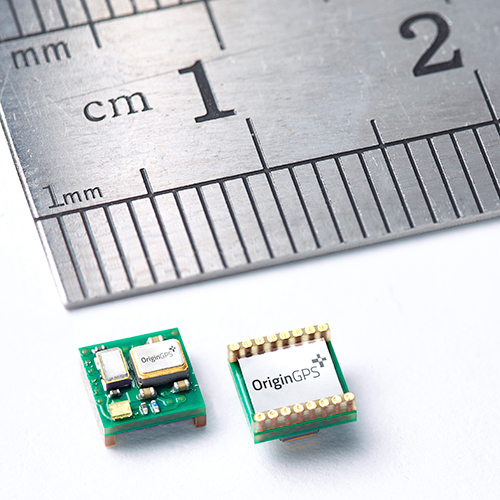
Zano’s location capabilities are powered by OriginGPS’ Nano Hornet, a tiny GPS module with an integrated antenna. Measuring just 10 x 10 x 3.44 millimeters, the Nano Hornet delivers performance and sensitivity with low power consumption. It achieves a rapid time to first fix of less than one second, with approximately one meter accuracy and -163 dBm tracking sensitivity. Because it detects changes in context, temperature, and satellite signals, it achieves a state of near continuous availability, while consuming mere microwatts of battery power.
The Zano connects directly with smart devices (iOS or Android) via onboard Wi-Fi to upload and share images or videos instantly. With the help of OriginGPS, Zano is able to know exactly where it is in relation to a smart device, even when powered off. Through a virtual tether, Zano will echo any movement made by the smart device it is synced to, with simple gesture control. A user will be able to control multiple Zanos from one device, enabling photographs and video of the same event from multiple vantage points.
Zano is also able to function in a “free flight” mode, which uses on-screen joysticks for an experience similar to a regular RC-operated UAV. OriginGPS’ location capabilities allow Zano to know if it is getting too far from its corresponding smart device and automatically return. Likewise, it is able to recognize its distance from the smart device and maintain that distance in “follow me” mode.
Since 2008, Torquing Group has developed small unmanned aerial vehicles (UAVs) for the military and defense industry.
To further push the boundaries of GPS modules designed to be small, agile and light weight, OriginGPS introduced the Nano Spiderintegrated GPS receiver in November. The Nano Spider module is designed to support ultra-compact applications where size is at a premium, such as smart watches, wearable devices, trackers and digital cameras. Like the Nano Hornet, it packs a wide range of functionality into its small form factor, including dual-stage LNA, RF LDO, SAW filter, TCXO, RTC crystal and RF shield with market-leading SiRFstarIV GPS SoC.
Ultra-Low-Power, High-Accuracy Location for Wearable GNSS Devices: From Host-Based to On-Chip
Photo: Steve Malkos, Manuel del Castillo, and Steve Mole, Broadcom Inc., GNSS Business Unit
As location penetrates smaller and smaller devices that lack memory and computation power, GNSS chips must reacquire the standalone capability that they shed when first going to small form factors such as phones. A new chip with a new architecture demonstrates navigation and tracking and avoids burdening its main processor with heavy software.
By Steve Malkos, Manuel del Castillo, and Steve Mole, Broadcom Inc., GNSS Business Unit
End users first experienced the amazing capabilities of GPS 12 years ago with early mass-market GPS devices. The focus was on navigation applications with specific tracking devices like personal navigation devices and personal digital assistants (PNDs, PDAs). With the advent of smartphones, GPS became a must-have feature. Other constellations were added to improve performance: GLONASS, QZSS, SBAS, and very recently, BeiDou. In the current phase, the focus is shifting to fitness applications and background location. This is not an insignificant change.
Always-on connected applications, high-resolution displays, and other such features do not improve battery life. This article describes new ultra-low-power, high-accuracy location solutions for wearables’ power consumption.
Impact of Always-On Connected Applications
New applications require frequent GNSS updates with regard to user position. Sometimes the application will be open and other times it will not. The chips need to keep working in the background, buffering information and taking predefined actions. The GNSS chips need to be able to cope with these new requirements in a smart way, so that battery life is not impacted. Saving power is now the name of the game.
Furthermore, GNSS is penetrating small devices: the Internet of Things (IoT) and wearables. They do not have the luxury of large resources (memory, computation power) as smartphones do. GNSS chips cannot leverage the resources in those devices; they need to be as standalone as possible. In summary, the new scenario demands chips that:
do not load device’s main processor with heavy software;
use less power while maintaining accuracy;
can be flexibly configured for non-navigation applications.
New GNSS Chip Architectures
The industry is designing chips to meet these requirements by including the following features:
measurement engine (ME) and positioning engine (PE) hosted on the chip;
accelerometer and other sensors directly managed by the chip;
new flexible configurations, duty cycling intervals, GNSS measurement intervals, batching, and so on.
These features require hardware and software architectural changes. The new chips need more RAM than that required for smartphones, as they must now host the ME and PE. Wearables and IoT devices are small, cheap, and power-efficient. They do not have large processors and spare memory to run large software drivers for the GNSS chip. In many cases, the device’s microcontroller unit (MCU) is designed to go into sleep mode if not required, that is, during background applications. Therefore, new GNSS chips with more RAM are much better adapted to this new scenario.
New chips must tightly integrate with sensors. The accelerometer provides extremely valuable information for the position update. It can detect motion, steps, motion patterns, gestures, and more. However, as a general rule, the MCU’s involvement in positioning should be minimized to reduce power consumption. For power efficiency, the new GNSS chips must interface directly with the sensors and host the sensor drivers and the sensor software.
Finally, new chips must adapt to different human activities as they are integrated into wearable devices. This is the opposite approach from past developments where GNSS development was focused on one use case: car navigation. Now they must adapt to walking, running, cycling, trekking, swimming, and so on. All these activities have their particularities that can determine different modes in which new GNSS chips can work. Electronics must now conform to humans instead of the other way around. New wearable-chip GNSS tracking strategies include dynamic duty cycling and buffering, which contribute to the goal of reducing power consumption without compromising accuracy.
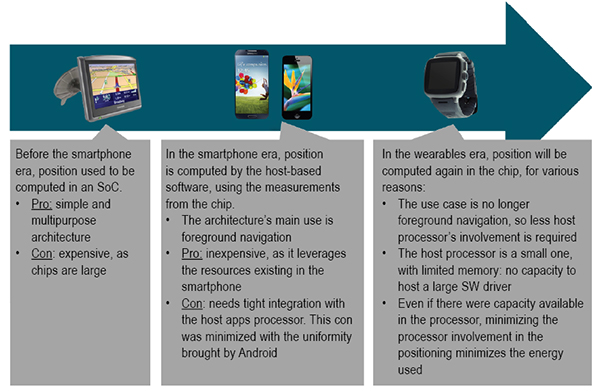
Satellite positioning embedded in devices over the last few years first saw on-chip positioning before the era of smartphones, where you had dedicated SoCs that supported the silicon used to compute the GNSS fix. These expensive chips had lots of processing power and lots of memory. Once GNSS started to be integrated into cellphones, these expensive chips did not make sense. GNSS processing could be offloaded from the expensive SoCs, and part of the GNSS processing was moved onto the smartphone application processor directly.
Since navigation is a foreground type of application, the host-based model was, and is still, a very good fit. But with advances in wearable devices, on-chip positioning will become the new architecture. This is because the host processor is small with very limited resources on wearables; and because energy must be minimized in wearables, reducing the processor involvement when computing GNSS fixes is critical.
Some vendors are taking old stand-alone chips designed for PNDs and repurposing them for wearable devices. This approach is not efficient, as these chips are large, expensive, and use a lot of power.
GNSS Accuracy
While the new fitness and background applications in wearables have forced changes in GNSS chips’ hardware and software architectures, GNSS accuracy cannot be compromised. Customers are used to the accuracy of GNSS; there’s no going backwards in performance in exchange for lower power consumption.
Figure 1. Software architecture for wearables.
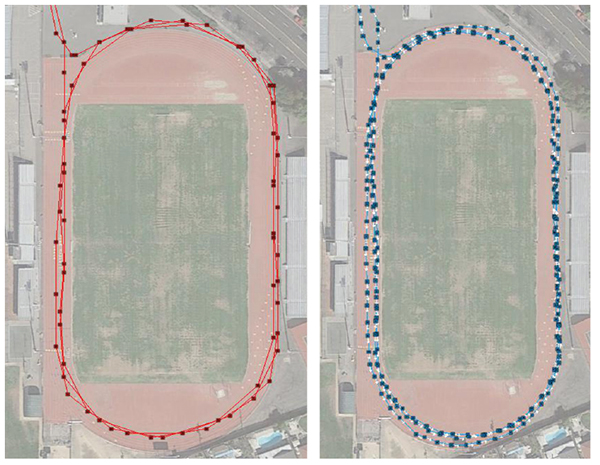
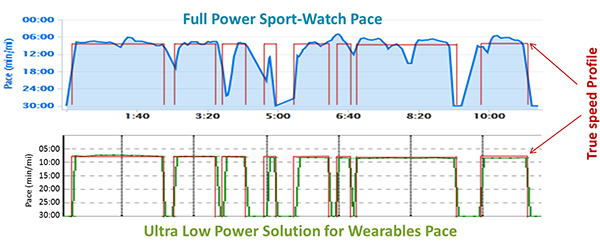
A series of tests shown here demonstrate how a new wearable, ultra-low-power GNSS chip produces a comparable GNSS track to existing devices using repurposed full-power sportwatch chips, while using only a fraction of the power.
Speed Accuracy. Not only does the ultra-low-power solution produce a comparable GNSS track, it actually outperforms existing solutions when it comes to speed and distance, thanks to close integration with sensors and dynamic power saving features (Figures 2 and 3).
Figure 2. Ultra-low-power versus full power.Figure 3. Full-power sportwatch, left, and ultra-low power chip, right, in more accuracy testing.
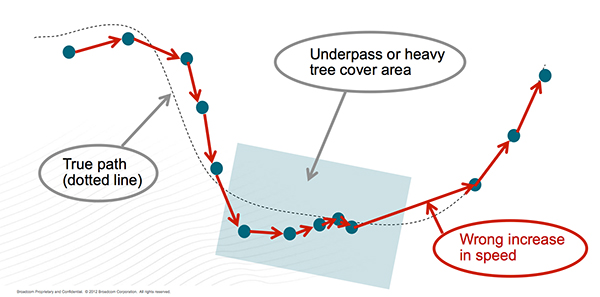
GNSS Reacquisition. GNSS-only wearable devices face a design challenge: to provide complete coverage and to avoid outliers. This is seen most clearly when the user runs or walks under an overpass (Figure 4). Familiar to urban joggers everywhere, the underpass allows the user to cross a busy road without needing to check for traffic, but requires the GNSS to reacquire the signals on the tunnel exit. See the GNSS track in Figure 5: when the device reacquires the signals, the position and speed accuracy suffers.
Figure 4. Position accuracy on reacquisition, emerging from overpass.Figure 5. GNSS speed accuracy on reacquisition.
Using the filtered GNSS and sensors, however (Figure 6), enables smooth tracking of speed and distance through the disturbance.
Figure 6. Sensors provide smooth speed estimate.
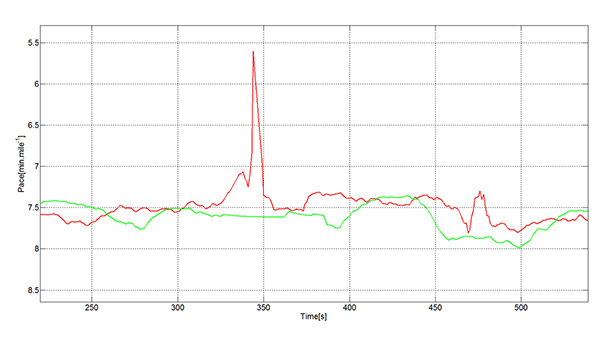
Urban Multipath. The pace analysis in Figure 7 shows a user instructed to run at a constant 8-minute/mile pace, stopping to cross the street where necessary. The red line on each plot shows the true pace profile. The commercial GNSS-only sportwatch on top shows frequent multipath artifacts, missing some of the stops and, worse for a runner, incorrectly showing erroneously high pace. The ultra-low-power chip captures all the stops and shows a constant running pace when not stopped.
Figure 7. Urban multipath tests.
It is well known in the community that regular sportwatches give unreliable speed and distance estimates in urban environments — where most organized running races are held! There’s nothing worse, as a runner, than to hear the distance beep from your watch going off earlier than expected: how demoralizing! The major benefit of this solution is that the speed estimate is much more reliable in the presence of multipath. At the same time, battery life can be extended because the GNSS is configured to use significantly less power.
fSpeed in existing solutions is computed in two different ways: indirectly from two consecutive, time-stamped GNSS position estimates, each derived from range measurements to the satellites, and directly from the Doppler frequency offset measurements to the satellites. Both range and frequency measurements are subject to significant error when the direct path to the satellite is blocked and a reflection is acquired.
The effects of multipath mean that the range error may in typical urban environments be hundreds of meters. The frequency error is also a function of the local geometry and is typically constrained by the magnitude of the user’s horizontal speed.
In either case, the GNSS device alone, in the presence of signal multipath, generates a velocity vector that fluctuates significantly, especially when there is a change in the satellites used or signal propagation path between the two consecutive positions. A variety of real-life cases generate this sudden fluctuation in velocity vector:
Running along a street in an urban canyon and turning a 90-degree corner.
Running along a pedestrian lane and taking a short road underpass.
Running under tree cover and suddenly arriving at an open area.
Running under an elevated highway and turning 90 degrees to a wide-open area.
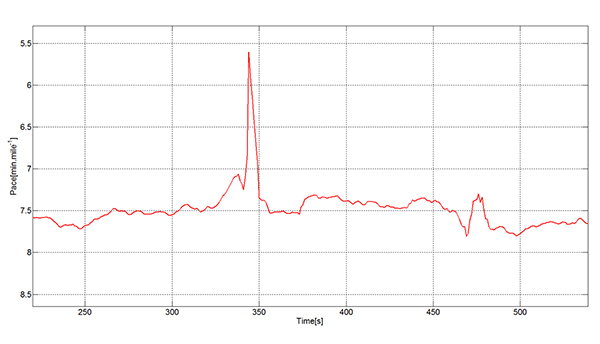
In each case, the chips are using a certain set of satellites, and suddenly other, higher signal-strength satellites become available. A typical situation is for the position to be lagging the true position (while under tree cover, going through an underpass) and needing to catch up with the true position when arriving to the wide-open area. A jump in position is inevitable in that situation. This is not too bad for the GNSS track, but it will mean a noticeable peak in the speed values that is not accurate. Fitness applications save all of the computed speed values and generate a report for each workout. These reports are not accurate, especially the maximum speed values, for the reasons explained above.
Figure 8 describes a typical situation where the actual speed of the runner is approximately constant. GNSS fixes are computed regularly; however, the speed computed from subsequent GNSS fixes have sudden peaks that spoil the workout speed reports.
Figure 8. Sudden peaks spoil workout speed reports.
The new ultra-low-power solutions for wearables solve this problem by deriving speed and accumulated distance from the sensors running in the device. This avoids incorrect speed peaks, while still being responsive to true pace changes by the runner.
In running biomechanics, runners increase pace by increasing step cadence and/or increasing step length. Both methods depend on the runner’s training condition, technique, biomechanics, and so on. As a general rule, both step cadence and step length increase as the running speed increases from a jogging speed to a 1,500-meter race speed.
A runner may use one mechanism more than the other, depending on the moment or on the slope (uphill or downhill). In the case of male runners, the ratio of step length to height at a jogging speed is ~60 percent.The ratio of step length to height in a 1,500 meter race speed is ~100 percent. For female runners, the respective ratios are ~55 percent and ~90 percent.
The ultra-low-power chips take into account both mechanisms to derive the speed values. The sensor algorithms count the number of steps every time interval and translates the number of steps into distance multiplying by the step length. The reaction time of the GNSS chip to speed changes based on a higher cadence is immediate.
Speed changes due to longer steps are also measured by the ultra-low-power chips. The step length is constantly calibrated by the GNSS fixes when the estimated GNSS position error is low. The reaction time of the GNSS chip to speed changes based on longer steps has some delay, as it depends on the estimated error of the GNSS fixes.
Manufacturer
The ultra-low-power, high-accuracy, 40-nanometer single-die BCM4771 chip was designed by Broadcom Corporation. It is now being manufactured in production volumes and is focused on the wearables and IoT markets.It consumes five times less power than conventional GNSS chips (~10 mW) and needs 30 KBytes of memory in the MCU for the software driver. It features tight integration with the accelerometer and innovative GNSS tracking techniques for extremely accurate speed, accumulated distance, and GNSS tracking data.
Steve Malkos is an associate director of program management in the GPS Business Unit at Broadcom, responsible for defining GPS sensor hub and indoor positioning features. He has a B.S. in computer science from Purdue University, and currently holds eight patents,10 more pending, in location.
Manuel del Castillo is an associate director of marketing for Broadcom in the GNSS group. He has an MS in electronic engineering from the Polytechnic Universityand an MBA from the Instituto de Empresa, both in Madrid, Spain. He holds three patents in location with five more pending.
Steve Mole is a manager of software engineering for Broadcom in the GNSS group. He received his bachelor’s degree in physics and astrophysics from the University of Manchester.
OriginGPS has launched the Nano Spider, a tiny yet fully integrated GPS receiver. The Nano Spider module is designed to support ultra-compact applications where size is at a premium, such as smart watches, wearable devices, trackers and digital cameras.
OriginGPS, which previously introduced the Micro Spider (5.6 x 5.6 mm) module, said the Nano Spider is 47 percent smaller than its previous solutions, measuring 4 x 4 x 2.1 mm. The Nano Spider’s proprietary structure is a multi-level circuit for surface mounting, built to reduce footprint size.
“The wearable technology trend requires components that balance a small size with high-performance and best-in-class power consumption,” said Gal Jacobi, CEO of OriginGPS. “OriginGPS aims to continue to shrink the size of components, while increasing features to make adding location functionality possible for every device.”
OriginGPS’ Nano Spider continuously tracks all GPS satellites in view and provides real-time positioning data in the standard industry format defined by the U.S. National Marine Electronics Association (NMEA). The Nano Spider offers a complete System in Package (SiP) that includes:
Fully integrated features – The Nano Spider includes a low noise amplifier (LNA), surface acoustic wave (SAW) filter, temperature controlled crystal oscillator (TCXO) and real-time clock (RTC) crystal, a power management unit, and radio frequency (RF) shielding.
Superior sensitivity and performance – The Nano Spider module offers accuracy of approximately one meter, and achieves a rapid time to first fix of less than one second and tracking sensitivity of -163 dBm.
Continuous connectivity with minimal power consumption – It achieves a state of near continuous availability by detecting changes in context, temperature and satellite signals by maintaining and opportunistically updating its internal fine time, frequency, and satellite data, while consuming microwatts of battery power.
Improving marginal signal conditions – It includes OriginGPS’ proprietary Noise Free Zone (NFZ) system to increase noise immunity even under marginal signal conditions, such as urban canyons, under dense foliage or a rapidly changing receiver position.
To see a demo of the Nano Spider and Nano Hornet modules, visit OriginGPS’ booth (Hall A4 Booth 271) at Electronica 2014 in Munich, Germany.
Qualcomm, Inc., has agreed to buy British CSR for $2.5 billion, to enhance its automotive infotainment and Internet of Things (IoT) offerings. CSR is known to the GPS/GNSS industry as the maker of the SiRFstar series of chips, which are used in many consumer devices. Qualcomm is a leading maker of chips used in smartphones.
According to Qualcomm, the acquisition complements the company’s offerings by adding products, channels, and customers in the important growth categories of Internet of Everything (IoE) and automotive infotainment. “This opportunity is aligned with Qualcomm’s established strategic priorities in these rapidly growing business areas,” according to a Qualcomm statement. The transaction is expected to close by the end of the summer of 2015.
Once the transaction is complete, the two major U.S. wireless/mobile-chip design/manufacturers will have GPS/GNSS technology firmly embedded within their organizations. In July 2007, Broadcom acquired Global Locate. More recently, CSR acquired SiRF Technology in June 2009, and now CSR has in turn been acquired by Qualcomm. Throughout 2008, Broadcom and SiRF were locked in a patent battle that Broadcom eventually won, precipitating a decline in SiRF’s one-time dominance and sending it into eventual disappearance/acquisition by CSR. The two companies are again aligned as opponents as part of the rival camps, Qualcomm and Broadcom, whose competition is fully as intense as the former Global Locate (then Broadcom) versus SiRF tussle.
“The addition of CSR’s technology leadership in Bluetooth, Bluetooth Smart, and audio processing will strengthen Qualcomm’s position in providing critical solutions that drive the rapid growth of the Internet of Everything, including business areas such as portable audio, automotive and wearable devices,” said Steve Mollenkopf, chief executive officer of Qualcomm Incorporated. “Combining CSR’s highly advanced offering of connectivity technologies with a strong track record of success in these areas will unlock new opportunities for growth. We look forward to working with the innovative CSR team globally and further strengthening our technology presence in Cambridge and the UK.”
The full announcement, issued in accordance with Rule 2.7 of the UK Takeover Code, can be found on Qualcomm’s website at www.qualcomm.com/2.7.pdf.
After the death of Mao Zedong, who had himself changed the “cultural” face of China, Deng Xiaoping led China from 1978 until his death in February 1997. During that period, China advanced economically further than it did in the previous 200 years, and rose from a financial backwater into one of the world’s largest economies. From 1978 to 1998, GNP increased 500%, average annual income rose from a few hundred dollars to $1,800, savings increased 14,000%, and exports went from $10 billion a year to $153 billion. In a Chinese 1998 survey, Deng was named the number-one hero in China.
Deng Xiaoping.
To achieve all this, there had to be a strategy — a vision of how to bring about such significant change. The approach chosen was to lead and support through government-sponsored initiatives — and the group who was in the best position to be able to convince people and demonstrate by example was China’s well-educated military.
So now we get to GNSS, and of course one of these initiatives was to emulate what the U.S. had done and to create its own satnav system. So we have the BeiDou/Compass space and ground control infrastructure. And having built all this, indeed they did come and a Chinese GNSS industry began to emerge. But it nearly didn’t happen.
In 1994 as part of Deng Xiaoping’s efforts, a state company was formed to pursue economic reform. Ruxin Zhou was one of those military guys who was there, and he recognized that the planned military BeiDou satnav system could be an avenue towards a huge commercial opportunity for China. But the Chinese military was already launched on a course to build BeiDou for their own purposes, and maybe they didn’t want to get caught up in these economic changes going on with the civilian population. As a member of the government advisory group, Colonel Zhou worked long and hard to promote his concept with several levels of government and to persuade military leaders and those involved with BeiDou that they should participate in Xiaoping’s reforms. Ultimately he was successful, and BeiDou eventually emerged as a joint military civilian system.
The next step was to somehow create a commercial business out of all this. To do that, in 2000 Mr. Zhou formed Beijing BDStar Navigation Company Ltd. with only himself and another original founder — Mr. Jianhui Li. Based in Beijing, BDStar was ideally located close to the government, close to military management, and close to the BeiDou operations and control centers. Coincidentally, around the same time, NovAtel in Calgary was beginning to be active in the region and was looking for dealers to market its OEM receivers into China. After a trial phase with a couple of dealers, it was finally agreed that BDStar would represent NovAtel exclusively in China.
That’s when I first met Ruxin Zhou — with U.S. WAAS development well underway, it turned out that China was also interested in creating its own Satellite Navigation Augmentation System (SNAS), and was considering NovAtel’s WAAS GI reference receivers for the ground infrastructure. Mr. Zhou became the contact point between NovAtel and BDStar, and what followed was what appeared to us to be a lengthy, frustrating negotiation which rolled out in both China and in Canada. Now we know that not only was the SNAS program making sure it understood the technology inside the NovAtel WAAS receiver, but Mr. Zhou was also learning English, the ways of doing Western commercial business, and, most of all, he was getting to know and be comfortable with us.
NovAtel went on to win three contracts to supply 85 WAAS receivers to the SNAS system over three years, and the relationship with BDStar and Mr. Zhou became one which both sides wished to grow and prosper. NovAtel OEM receivers were also supplied in quantity into a number of applications that BDStar developed in China over many years. BeiDou was also an important catalyst to initially help BDStar gain traction — the company equipped 40,000 fishing boats with BeiDou messaging receivers over several years, used for basic communication across the fleet and for location reporting to monitor authorized fishing areas.
Fast forward to today. Almost 15 years have gone by. Mr. Zhou is now chairman of the board of the BDStar Navigation group of companies, and Mr. Li is president, running day-to-day ongoing business at BDStar. I sat down with my old friend in Tampa at the Institute of Navigation (ION) GNSS + Conference to catch up with the growth and expansion of this business and listen to the many achievements that have now turned BDStar into the largest (¥780 million RMB = $127 million US) GNSS-based public company in China. BDStar had a difficult beginning between 2000 and 2007, like many start-ups, but has now emerged as a profitable leading enterprise within the Chinese BeiDou industry.
Ruxin Zhou, Chairman of the Board, BDStar Navigation.
Ruxin Zhou was born in March 1963, and he has been involved in China’s GNSS industry since 1994. He lives in Beijing, and is the father of two sons. He is also vice chairman of the Association of GNSS of China. He earned his BSc degree in 1983 followed by his master’s in 1989, both at University of NanKai in Tianjin. His MBA was awarded by the University of Beijing in 2003.
Ruxin Zhou considers BeiDou an important part of the GNSS industry, and he is looking forward to cooperating with other GNSS related companies inside and outside China to add more value to users.
Mr. Zhou chairs the BDStar board of directors — one of whom is the president of the company. There is also a group chief technology officer (CTO), a board secretary who is responsible for investment, three outside directors from industry, and an advisor who is familiar with government financial policy. Along with the parent company BDStar Navigation Products Division and its internal GNSS Applications Division, there are nine subsidiary companies, each of which is governed by a small management board.
BDStar Information Service Co. — Largest BeiDou operations service provider.
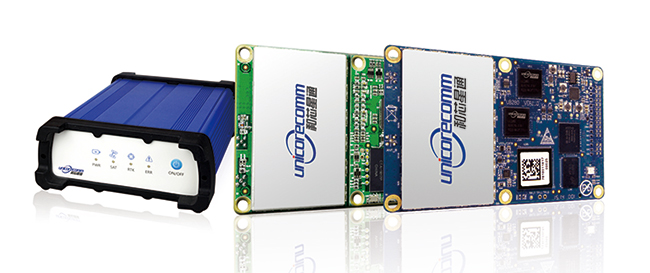
Unicore Communications, Inc. — Consumer and precision chipset and board-level receivers.
BDStar Hong-Kong — Import/export company for the group.
Shenzhen XG Electronics Co. — Vehicle electronics and installations.
BeijingSinsTek Technology — MEMS inertial technologies for defense.
Beijing Hanvic Photoelectricity Co. — Navigation using IR/photo–electric technologies.
BeiDou Information Equipment Co. — National Defense equipment and services.
Recently, the BeiDou Equipment Division within BDStar has become a separate company known as BeiDou Information Equipment Co., and another company — Harxon, which manufactures antennas — is in the process of being added to the group.
The number of people working within the BDStar group has grown from an initial staff of 20 when Mr. Zhou and Mr. Li began operating the company, to around 1,500 people today in 2014.
BDStar Navigation is where this all began as a value-added reseller for NovAtel OEM receivers — integrating them into a number of applications, such as vehicle, marine and military navigation installations. BDStar was also instrumental in the establishment of the ground infrastructure for SNAS and took part in the construction of the system. As this business increased, installations became focused within a separate group, along with building the equipment using integrated NovAtel GPS and inertial OEM equipment — the GNSS Applications Division.
With an increasing number of satellite launches, and a growing ground infrastructure, BeiDou began to become a more important part of China’s GNSS/navigation infrastructure. BDStar began to play a larger role in the emerging BeiDou program (BeiDou System or BDS), and it became clear that BeiDou technology would have to be developed by BDStar in China. And so the spin-off and company start-up phase of BDStar’s growth got underway.
BDStar Information Service Co., Ltd.
BDStar Information Services Limited is a wholly owned subsidiary of BDStar Navigation, providing location-based system solutions and information services, based on the BeiDou Navigation Satellite System, for the fishery, agriculture, forestry, water conservancy, and meteorology industries. By integrating Internet and mobile communication networks with geographic information, BDStar Information Service has now become the largest BDS information service provider in China with more than 40,000 BeiDou end-users, hundreds of government users and more than 100,000 mobile phone users. The service is 24/7/365 and includes real-time positioning, and short message communication for typhoon warnings, emergency alarms and other related services. The system has capacity for over 100 million navigation positioning and communications messages per year.
Ship terminal. Photo: BeiDouBeidou Operational Service Center. Photo: BeiDou
Unicore Communications Inc. (Beijing)
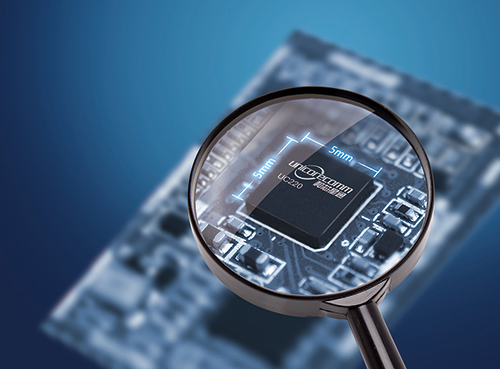
Unicore Communications Inc. is a share-holding subsidiary of BDStar Navigation — a high-tech company dedicated to highly integrated system-on-a-chip (SoC) IC design and GNSS algorithm development. Unicore is focused on the commercialization of BeiDou through advanced GNSS professional applications and innovative technology breakthroughs — one of the leading Chinese companies involved in the “industrialization” of BeiDou systems.
Unicore provides turn-key location-based services (LBS) in both the GNSS professional and consumer navigation segments. An innovative core chip has been independently developed, providing high-performance GNSS as well as low-cost, low-power, high-quality products with positioning accuracy ranging from millimeter all the way up to meter levels. Not only have high-precision requirements for surveying, mapping and CORS reference stations been satisfied, these components have also been used in less onerous applications such as vehicle monitoring and personal navigation.
By the second quarter of 2014, Unicore has sold more than one million BeiDou SoC chips and won multiple breakthroughs in BeiDou multi-GNSS applications such as in-dash automotive navigation, automatic driving test system, Ground-Based Augmentation System (GBAS), and the International GNSS Monitoring and Assessment Service for Open Service (iGMAS).
Beijing Hanvic Photoelectricity is a share-holding subsidiary of BDStar Navigation targeted at the infrared thermal imager market. The company has used in-house infrared optics, imaging circuitry, image processing, artificial intelligence, mechanical structures and system engineering to develop a number of products using planar and linear arrays. Short-medium-long-wave infrared cooling thermal imagers can provide users with a visual context under varying weather conditions from up to tens of kilometers from a target object. These products are widely used in scientific research, electrical distribution, forest-fire prevention, surveillance, public security, firefighting, and anti-smuggling.
Beijing SinsTek Technology Co., Ltd.
Beijing SinsTek Technology is a shareholding subsidiary of BDStar Navigation specializing in the original development of inertial navigation, inertial measurement, and measurement and control systems and devices- for which SinsTek owns all related intellectual property rights. SinsTek has independently developed products such as high-precision quartz accelerometers and gyros, mixed inertial navigation systems, missile-borne computers, a missile overload switch and a ground control system. Products and systems have been widely used within China in various fields of national defense and also commercially.
Shenzhen XuGang Electronics Co., Ltd.
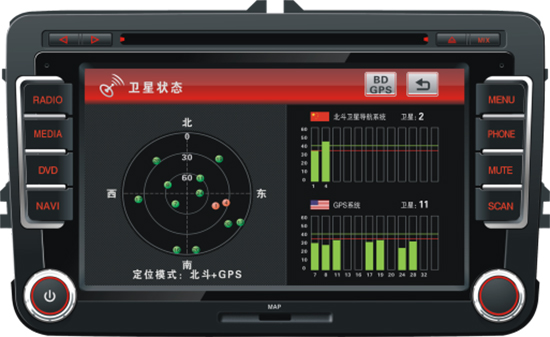
Shenzhen XuGang Electronics was founded as a shareholding subsidiary of BDStar Navigation in 2001. The company undertakes product development, design, manufacture and sales of medium- to high-end consumer-level vehicle audio-video navigation products and services. The company has more than two decades of experience in automobile accessories, and has good cooperative relationships with China’s major automobile manufacturers. With a marketing network that extends across China, the company is one of the most important automotive electronics and navigation products providers in China. Automotive products are also exported to the U.S., Russia, Brazil, Israel and to other countries.
The scope of this business includes:
CAR navigation/CAR audio original design manufacturer (ODM) — High volume/high-quality production of auto accessories, auto electronics and GNSS products.
Marine radio ODM — Waterproof hi-fi player/radios have won wide recognition in Europe and the U.S. This is the only Chinese company whose SIRIUS satellite radio technology has been certified in the U.S.
Telematics auto network solutions — BDStar auto navigation system and BDStar Black Box have been independently developed, fusing sensors, network communications, processing and controlling technologies to provide telematics products and services for auto makers and commercial consumers.
BeiDou online telematics. Photo: BeiDou
Navigation Products Division
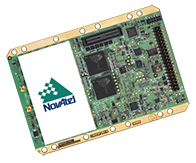
The Navigation Products Division has successfully collaborated for more than 10 years with NovAtel as its value-added reseller (VAR) of GNSS and GNSS-inertial products in China. Focused on satellite positioning and inertial navigation applications, BDStar has promoted domestic Chinese navigation and positioning applications development, and has established close cooperative relationships with domestic inertial and integrated mapping companies, research institutes, and other sectors. Application fields include railways, electricity, telecommunications, meteorology, and seismology. Quite naturally, independently developed BeiDou products have also followed this route to market in China.
NovAtel OEM6 receiver. Photo: BeiDou
GNSS Application Division
The GNSS Application Division is the business division of BDStar Navigation, which is mainly engaged in the development, production, sales, and service of the products based on high-precision GNSS technology applications. With the objective of becoming expert in high-precision GNSS solutions used in the developing industry using the “Internet Of Things (IOT),” the company provides a series of GNSS terminal products and solutions for the civilian market. Applications have included agriculture, container ports, and deformation monitoring. Meanwhile, the successful port IOT that this division has provided for Tianjin Port has now been implemented at more than 20 domestic and foreign ports including Shanghai, Ningbo, Shenzhen, and in India.
BeiDou Internet of ships Photo: BeiDou
BeiDou Information Equipment Co.
BeiDou Information Equipment, a wholly owned subsidiary of BDStar Navigation, is focused on supplying products for national defense and government agencies, and provides complete solutions and products for dispatch management of hazardous materials and special cargo handling. Several successful projects have been undertaken, including special hazardous vehicle command and monitoring, public security, anti-terrorism, forest-fire prevention, emergency management, personnel command and monitoring of disaster relief, public security, and border defense. The division relies on its experience in system engineering, command and control software, radio system design, and military satellite navigation to provide users with terminal products such as navigation, timing and heading, and location-based military information service systems. Specific products developed include terminal equipment, vehicle-mounted navigators, vehicle traveling data recorders, police positioning and telecommunication terminals, and an emergency communication system.
Following this phase of significant growth, what does the future hold for BDStar? We know that China’s huge annual rate of GDP growth may have slowed a little, but Mr. Zhou still has pretty big aspirations for his group of companies. His target for 2020 is to have BDStar reach annual sales of 10 billion RMB ($1.63B US). To get there, his intermediate step is to reach 2 billion RMB ($326m US) by the end of next year. Overall, this represents a ten-fold growth in revenue over six years — by Chinese industrial standards, this might even be termed “modest” growth.
But where will all this growth come from? The strategy appears to be textbook:
Through significant organic (internal) growth, or by doing the same things better and to a greater extent.
Through strategic partnerships with targeted leading companies in key growth areas.
Through further acquisition of companies that would improve the bottom line and also benefit from the synergies of the existing corporate group.
While the anticipated course would be to add companies at the corporate level, it’s possible that some companies within the organization may also get to the point where they see adding an organization below or alongside may become a profitable avenue for their own growth. Of course, other suitable companies in China would be on Mr. Zhou’s strategic acquisition list, but he’s also looking for expansion elsewhere around the world. The U.S. market is significant for the type of products and technologies available in the BDStar group, so it would be natural to anticipate that a North American acquisition could help improve product distribution and development. As BeiDou becomes an integral part of global GNSS, and industry partners seek more than Open Service capability and better Chinese access, its also conceivable that partnerships with North American players could come about.
So, at least with BDStar and some other similar Chinese companies, it would seem that those earlier 1990s aspirations of the Chinese government to create a commercial economic sector within the Chinese economy have at least begun to show a measure of success in the GNSS market segment.
The Consumer Electronics Association (CEA) has announced that Boo-Keun Yoon, president and CEO of Samsung Electronics, will deliver the keynote address at the 2015 International Consumer Electronics Show. The International CES will take place in Las Vegas, January 6-9, and Yoon will talk at 6:30 p.m. January 5 in the Palazzo Ballroom at the Venetian.
Yoon will discuss connected devices, the future of the Internet of Things (IoT), and the vision of the smart home. He also will focus on Samsung’s vision of strategic partnerships that will drive the next wave of technology breakthroughs.
“Samsung is widely-known for its disruptive technologies and business models, and has been one of the fastest growing CE brands in the world,” said Gary Shapiro, president and CEO, CEA. “Samsung amazes at each CES with its innovative products spanning the entire tech ecosystem. We welcome Boo-Keun Yoon back to the keynote stage for the 2015 CES.”
Yoon began his career at Samsung Electronics in 1978. After serving in a number of leadership positions at Samsung Electronics, Yoon headed Samsung’s Visual Display Business from 2007, seeing its revenue double while maintaining the company’s No. 1 global TV market share for eight consecutive years. Currently, Boo-Keun Yoon serves as the president and CEO of Consumer Electronics at Samsung Electronics, leading Samsung’s Visual Display, Digital Appliances, Printing Solutions and Health & Medical Equipment Business. In addition, Yoon also acts as the company’s Chief Design Officer.
According to CEA/GfK research, global consumer technology spending will top more than $1 trillion in 2015. Lauded for its innovative design and technology across its diverse portfolio of products, Samsung Electronics is a leading global brand for high-tech electronics and digital media.
The 2015 CES will feature more than 3,500 exhibitors unveiling the latest consumer technology products and services across the entire ecosystem of consumer technologies. For more information on the 2015 CES, visit CESweb.org.
CTIA’s Super Mobility Week featured machine-to-machine technology, connected vehicle vendors, and a few location-based services companies. While combining its spring and fall conferences, which drew a big crowd, CTIA also tried to be everything to everyone in wireless. Meeting planners also placed the conference with conflicting dates — as the Institute of Navigation, Berlin IFA and ITS World Congress were held in the same week. One of my goals as a reporter was to make sense of a big trade show — and to limit the times an interviewee said “Internet of Things.”
LAS VEGAS — Outside of the announcement by GM and AT&T to expand OnStar to Europe, the CTIA Super Mobility Week here featured several connected car panels, but limited location news. The action seemed to be in company backroom meetings with existing clients — or trying to find additional niche opportunities for location products.
One company, Annapolis, Maryland-based TeleCommunication Systems, said it is proving its navigation product for the Atlanta-based AT&T Drive Studio. The company is involved in most location markets, now ranked No. 2 in terms of units deployed (second to Ericsson, according to one source), said Jay Whitehurst, TCS president, commercial software group.
TCS’ Location ToolKit, which will be used in the 5,000-square foot AT&T Drive Studio, offers navigation, with automatic map updates, traffic, real-time gas prices, weather, movies and showtimes.
Whitehurst said a market that is growing is e-health and mobile payments, which are both big topics at CTIA SMW and at the Barcelona Mobile World Congress. “We are developing a new product in conjunction with physicians to allow first responders to be able to reach patients who are not responsive. We are working the system into clinical workflows to provide diagnosis,” he said.
Standards, particularly for connected vehicles and handsets that control functions, will be important as new systems and vehicles offer this technology, said Alan Ewing, Car Connectivity Consortium president and executive director.
“Having a proprietary service is okay until someone says, ‘Hey, we don’t want to do this anymore,’ then there is a button in a car that does nothing,” he said. “We want to ensure that button is meaningful. While a lot of cars have MirrorLink built in, what happens when it disappears and consumers don’t know where to buy a compatible phone? [Consumers] don’t want three different phones for their vehicles.”
Ewing said that despite proponents’ arguments that autonomous vehicles are here to stay, he believes it is a generational issue. “I don’t want to give up control of a vehicle. But it is a surprise to hear younger people are not even getting driver’s licenses.”
Ford, which is not a MirrorLink member, had its inaugural developer’s conference at CTIA SMW. The developer’s conference was a big hit, with more than 200 application developers, said Douglas VanDagens, Ford global director, connected services solutions organization.
u-blox Rolls Out New Module, Outlines Marketing Strategy
Several companies at CTIA SMW are attempting to find niche opportunities in the crowded machine-to-machine market — and Switzerland-based u-blox is no exception. The company is focusing on the mobile, industrial and consumer-location markets, said Thomas Seiler, u-blox CEO.
While Seiler says there is no one dominant market for u-blox, the fleet market has been very good for the company. In addition, asset tracking has been a good market, he said.
“We are also seeing consumer markets such as e-bikes, golf carts, commercial helicopters and drones growing,” Seiler said.
While many location companies are fretting about government regulation, u-blox is taking the position that most agency requirements have actually helped build the market. “Regulatory requirements have been driving business for us. The [National Highway Traffic Safety Administration] proposes that vehicles report location, speed and direction,” said Nikolaos Papadopoulos, u-blox America president. “The collision avoidance regulations have helped to create an ecosystem that drives business.”
The company recently rolled out its ODIN-W160 multi-radio module for automotive, industrial, medical and security applications.
Nick Papadopoulos, president of u-blox America, tells CTIA Super Mobility Week show-goers what they should see at the u-blox booth.
The recent $37.5 million purchase of offender-monitoring company Omnilink allowed Numerex to boost its presence in the tracking of prisoners, Alzheimer’s patients and children, said Kelly Gay, Numerex president, security solutions.
“Our strategic focus is on M2M solutions — the Omnilink purchase is a perfect fit. Both companies are based in Atlanta and we have a lot of products we are working on together,” she said. “It’s been a great four months [since the acquisition].”
Gay said Numerex is focusing on four markets, or “battlefields” for growth: solutions as a service; asset identification and tracking; supply chain delivery; and remote monitoring, which includes oil and gas, tank monitoring, water systems and tracking weather.
LBS Companies Few and Far at CTIA…
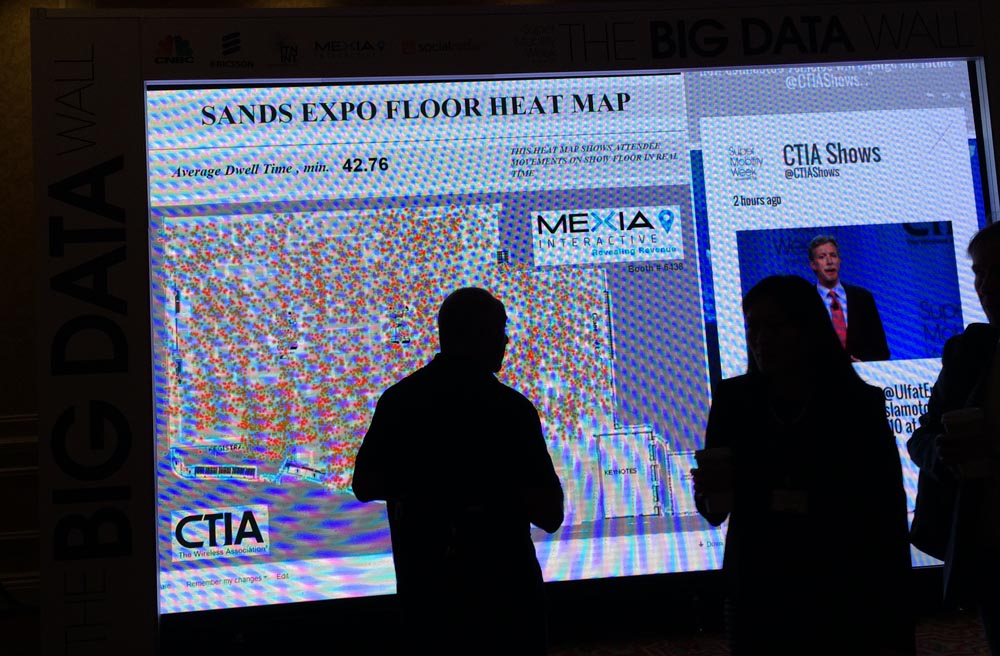
While there were only a handful of LBS companies at CTIA SMW, one company, Mexia Interactive, mapped the exhibit hall in the Sands Convention Center. The Winnipeg, Canada-based company is offering indoor location beacons — and has installations in four airports, with six more under contract.
“We set up 80 sensors in this area to capture data from mobile devices, every 10 seconds, to place the information on a heat map. With this heat map, retailers can see how many people are in a registration area, patterns of who is going to booths — and who is not,” said Glenn Tinley, Mexia president and CEO.
While Tinley says his company, which was founded in 2010, can work with both Apple and Android systems, he believes Apple is pushing Android out of the indoor market.
At airports, both security and airlines can see how long lines are with the technology to open up new lines and distribute personnel to meet the need, Tinley said. “We can instantly send a text alert to have a new check-in line established. Retailers can do the same thing at check out,” he said. “At retailers, [long lines] represent potentially billions in losses each year.”
Iridium Expanding M2M Market Demand
Iridium recently reduced the price of its short-burst data receivers by 50 percent to allow its OEMs and value-added resellers to offer a product that works worldwide in areas with no cellular coverage.
“The machine-to-machine market is one of our fastest growing [segments]. We see a combination of new services being developed,” said David Wigglesworth, Iridium vice president and general manager. “By the end of the year, we should have a push-to-talk service like the old Nextel phone.”
Big changes are coming to Iridium and its satellite constellation. The Iridium NEXT satellite network will consist of 66 in-orbit satellites and several in-orbit spares. The constellation is expected to begin launching in 2015 and will offer greater bandwidth and data speeds when fully operational in 2017.
“We are replacing the whole Iridium system. Space X is our launch partner — and they have been great,” Wigglesworth said. “The new constellation will allow new services. We see aviation as being a big market. The satellite industry has many niche markets.”
In other CTIA SMW news:
One of a handful of antenna companies exhibiting at SMW was Ireland-based Taoglas, which says there is growth in distributed antenna systems, said Dermot O’Shea, Taoglas president. “We are seeing a huge movement to LTE,” he said. One of Taoglas’ customers is Omnilink, which uses a custom GPS antenna in its offender-monitoring product.
Stockholm-based Birdstep is getting into the connected car market, based on its defense experience, with future data plans that turn off when a car is stationary. “Why should consumers pay for a data plan when a car is parked 90 percent of the time?” asked Lonnie Schilling, Birdstep CEO.
Spirent Communications launched its Elevate Test Framework for M2M devices and services. Because of the surge in smartphone and M2M devices, the new testing device allows evaluation and performance tests to enable faster development cycles, the company said.
Fleet Freedom rolled out a new mobile resource-management product that works with Android, iOS and Magellan’s RoadMate fleet units at SMW. “This unit is the fourth generation. It features dispatch integrated, while most of our competitors view this as a separate product,” said Andrew Singer, Fleet Freedom general manager.
The morning sunlight steams into the Sands Expo Center.
To those attending CTIA’s Super Mobility Week in Las Vegas September 9-11, it was clear that we’ve entered a period of divergence. Sensors, multiple platforms, all sorts of devices, computing in clouds, processing in clouds, car companies, connected houses, smart watches and indoor location positioning are being touted as part of the “Internet of Things” that will work together seamlessly. Some day. The connected car was a highlight of the show and Ford held (purportedly) the automotive industry’s first developers’ conference. The exhibit floor was jammed with machine-to-machine (M2M) solutions, some positioned for the Internet of Things, most for traditional telematics. In the past, wearable devices were in the show’s fringe, but new smart watches have mainstreamed wearables.
Telematics solutions were plentiful at CTIA, but these companies are all looking for new markets. The second-largest telematics market in the world is China, but it has been a bit of a mystery. C.J. Driscoll and Associates’ report on the Chinese commercial telematics market was just released. “There are five million fleet vehicles in China that use a tracking system,” says Clem Driscoll. “Regulations are part of the impetus for telematics, but the cost of transporting goods in China is very high, so economics play a role in the adoption.” Almost all telematics devices sold in the U.S. market are being manufactured in China.
Jeff Lawson, CEO of Twilio, comparing “hardware people” and “software people,” says Tesla’s Model S interior forgoes extra buttons for useful, adaptable software.
Ford, a newbie at CTIA, entered the conference with a bang, hosting what it claimed to be the first developers’ conference for the automobile. Developers from 17 countries participated and received access to simulated vehicle data, including speed, fuel economy and GPS, based on data from Los Angeles. As the night wore on, I expect the floor was littered with spent energy drinks, coffee and pizza in the all-night coding session. Currently, there are 60 apps developed for Ford; the company forbids apps with games, videos and complicated demands on the driver. Ford had been at the forefront of the connected vehicle and already has connected collision avoidance, adaptive cruise control, smartphone integration, and parallel parking assistance.
GM is furthest ahead in bringing cars to market with embedded connectivity and, unlike Ford, has plans for an app store. Embedding connectivity into the car greatly deepens the functionality of car apps and also allows for over-the-air updates of firmware and software (FOTA and SOTA). Maintenance issues can be caught quickly. “Software and firmware updates save OEMs the $400-$500 that it costs each time a vehicle is serviced at the dealer for a recall,” said Egil Juliussen of market research firm IHS. “Currently, 70 percent of recalls come into the dealers, but with over-the air-updates, I expect about 95 percent of car owners will obtain updates.” Juliussen expects to see self-driving vehicles on highway lanes in 2017, followed by automated lane switching and local road driving in 2025. His assessment is consistent with other automotive experts.
CTIA President Meredith Atwell Baker laughs as The Daily Show’s Larry Wilmore provides news updates between opening keynotes.
Besides pleading to the FCC for more spectrum, most keynote speakers talked about technologies or products that require LTE (often called 4G) for fast connectivity. GM, in partnership with AT&T, leads U.S. car makers in LTE deployment. The 2015 Chevrolet Malibu is the first 4G LTE-equipped GM vehicle, to be followed by more than 30 more GM models by the end of the year. In 2016, GM plans to roll out “Super Cruise” for hands-free highway driving, at both highway and stop-and-go speeds, as well as lane following, speed control and braking that will be available in an undisclosed Cadillac model in 2017.
To spur usage, a three-month free data trial is being offered by GM, and 90 percent of owners with cars equipped with LTE are participating. Billing for in-car connectivity is complicated. Few OEMs have a mechanism for collecting ongoing fees, such as for data services. With the GM offering, current customers of AT&T can add a car (similar to adding another phone) onto a phone plan for $10 per month. Otherwise, data can be purchased in increments, the same way some pre-paid phone plans work.
CTIA fielded a panel of experts moderated by CNBC’s Julia Boorstin to respond to Apple’s Live Event.
Google and Apple each want to get a proprietary connected platform into vehicles as a way to control the integration of apps with vehicles, as well as to “own” the ecosystem. The traditional automotive players, including the OEMs, have banded together to create MirrorLink, a collaborative, standards-based non-proprietary platform, an effort facilitated by the Car Connectivity Consortium. MirrorLink is being created by collaborators from 105 countries who grapple with standardization issues. “The biggest concern we have right now, is how to get the platform distributed throughout the world,” remarked Alan Ewing of Car Connectivity Consortium. “In three years we will be talking about the ecosystem of apps, and you will see 100 more times than what we see today.” Who prevails with this platform — MirrorLink, Apple or Google — will have a huge advantage.
The location services that deliver content to vehicles and devices have been in the foreground, but there is a quieter category of location services. Companies like LocationSmart and Locate are automatically identifying the location of customers (with permission) for enterprises that include asset management, mobile gaming, financial security services, and customer management services. Initially, the services were based on identifying the location of callers to customer service centers, who could then route callers accordingly. A broader set of use cases is now seen. “We’ve moved far beyond traditional location determination,” says Mario Proietti of LocationSmart. “For instance, LocationSmart is providing financial service companies with the location of a customer’s phone, which is matched with the location of financial transactions.” If a credit card is being used at a store in Chicago while the customer’s cell phone is in Miami, fraud may be involved.
An engaging heat map of all attendees in the exhibit hall demonstrated the power of indoor positioning. On the hall’s ceiling, Mexia Interactive installed Wi-Fi/Bluetooth sensors to receive attendees’ cellular signals. The sensors were spaced at about every 10,000 square feet. Mexia has the distinction of being the only exhibitor mentioning a bathroom use case. A customer is using the sensors to keep 90 bathrooms clean. After the sensor receives signals from a set number of phones, the cleaning staff receives an alert to service the bathroom.
The show floor heat map, by Mexia, uses sensors throughout Sands Expo to show where people are connecting to Wi-Fi.
Things people said:
“Wearable smart watches are not quite enough to get everyone to buy one.” — Steve Mollenkopf, CEO, Qualcomm
“Wearables are highly unregulated. Experiential apps will always have a privacy component. The most privacy-sensitive areas are fitness, health and children.” — Rudy Zefo, Vice President, Intel.
“Of consumers looking to buy a car within the next two years, 50 percent are willing to switch brands to get connected services.” — Ralph de la Vega, President and CEO, AT&T Mobile and Business Solutions.
What will we be talking about at CTIA 2015? I’m betting that we will still be focused on the connected car and the Internet of Things. I expect to see more automotive and indoor location companies, and of course, smart watches. And yes, there will be more pleas for added spectrum.
Intel has commercially launched the XMM 6255 modem to provide a wireless solution for the billions of “smart” and connected devices that are expected in the coming years. At about 300 square millimeters, Intel says it is the world’s smallest standalone 3G modem, designed for networked sensors and other Internet of Things applications such as wearables, security devices and industrial equipment.
The XMM 6255 features the SMARTI UE2p transceiver, which is based on the new Intel Power Transceiver technology, a design that combines transmit and receive functionality with a fully integrated power amplifier and power management on a single chip. This design approach reduces XMM 6255’s component requirements, resulting in a smaller modem that helps manufacturers minimize their build of material costs. It also protects the radio from overheating, voltage peaks and damage under tough usage conditions, which is important for safety monitors and other critical IoT devices.
Additionally, the XMM 6255 modem features a radio architecture that enables it to perform exceptionally well in challenging real-world situations, including:
Low signal network coverage: The XMM 6255 modem provides reliable communication when it comes to transmitting information in low signal zones like a parking garage or a home basement.
Small-sized devices: Devices with a small form factor like a smartwatch or a sensor may not have enough space for a normal-sized 3G antenna, which can affect connectivity quality and reliability. The XMM 6255 modem is specially designed for such devices and delivers great 3G connectivity even with small volume antennas not meeting conventional mobile phone quality standards.
The integration of the power amplifier and transceiver in this modem simplifies the design and minimizes device development costs, which means developers can launch more products more quickly, and in a more cost-effective manner.
The XMM 6255 is available in the u-blox SARA-U2 module and Intel expects to have additional partnerships in the coming months.
Qualcomm Incorporated, through its wholly-owned subsidiary Qualcomm Technologies, Inc., has announced an Internet of Everything (IoE) development platform based on Qualcomm Technologies’ QSC6270-Turbo chipset that supports Oracle’s Java ME Embedded 3.2. The IoE development platform features support for standalone GPS.
The platform, which uses Qualcomm Technologies’ Gobi modem solution for 3G, enables developers to accelerate development efficiency and decrease time-to-market for a wide range of applications and devices to connect to the AT&T mobile internet. AT&T and Qualcomm Technologies expect this IoE development platform to be available to developers in the second quarter of 2013.
The IoE development platform provides a starting point for creating a range of cellular-connected products and applications for IoE verticals such as tracking, industrial controls and health care. With this platform being capable of supporting Oracle’s Java ME Embedded 3.2 software release, developers with little mobile development experience can quickly go from concept to writing and executing Java applications directly on the QSC6270-Turbo chipset.
In North America, this IoE development platform will be supported by AT&T, allowing developers to test their solutions and demonstrate functionality on a live network in the design and development phases, which can reduce complexity, cost and time for developers as they drive to get their solutions to market. With access to the various hardware interfaces and capabilities of the 3G modem via the application environment hosted on the QSC6270-Turbo chipset, developers can also customize and optimize end-product PCBs without the need for additional discreet processors or micro-controllers, thus cost-effectively integrating cellular capabilities into a wider range of devices and solutions.
The platform includes several onboard sensors and indicators, including an accelerometer, light sensor and temperature sensor. The Java ME 3.2 software release, which can run on this platform, includes several new JSRs for IoE applications, as well as Device Access and AT Command Pass Through APIs that give developers access to a large number of chipset IOs and interfaces, such as GPIO, I2C and SPI. The platform supports cellular coverage for tri-band UMTS/HSDPA – 2100/1900/850 MHz – and quad-band GSM – 850/900/1800/1900 MHz – support, as well as 2.4GHz Wi-Fi a/b/g/n via a Qualcomm Atheros, Inc. AR6103 module.
“This IoE development platform opens a world of opportunity for equipment makers who want to connect their devices to the mobile internet,” said Chris Penrose, senior vice president, emerging devices, AT&T. “Wireless connectivity makes products better, and this IoE development platform makes it easier for both existing and new AT&T developers to embed wireless into their products.”
“Qualcomm Technologies sees the Internet of Everything as having significant potential. In addition to large IoE verticals like automotive and energy that have established industry players, application developers are key to creating future IoE verticals and applications that haven’t even been thought of yet,” said Kanwalinder Singh, senior vice president of business development, Qualcomm Technologies, Inc. “This IoE development platform with Java support is a tool to extend the power of our integrated chipsets to application developers. We are excited that AT&T shares our vision of a cellular-connected IoE, and by the opportunities that will be created by the AT&T developer community.”