Tag: internet of things

  • Telit releases category 11 LTE full mini PCIe card

    Telit has launched the LM940, a global Full PCI Express Mini Card (mPCIe) module for the router and gateway industry supporting LTE Advanced Category 11 (Cat 11) with speeds of up to 600 Mbps.

    The internet of things (IoT) module is available with various mobile network operator approvals in the fourth quarter of 2017, the company said.

    The module includes quad-constellation integrated GNSS and is in an mPCIe form factor to support Cat 11 with the Snapdragon X12 LTE modem. The industrial-grade LM940 delivers significant flexibility and a competitive edge to original equipment manufacturers (OEM) looking to quickly deploy next generation products.

    Today, customers of router and gateway OEMs demand additional bandwidth and near instant network response times as applications like high definition video streaming with digital signage, commercial and enterprise failover needs and pop-up stores are becoming increasingly sophisticated.

    “This industrial-grade module from Telit supporting LTE Cat 11 with global coverage will be very attractive for equipment manufacturers looking to deploy the latest solutions now, especially in the router and gateway market supporting high-bandwidth dependent applications like digital signage,” said Sam Lucero, senior principal analyst for IHS Markit, a global information provider. “As detailed in our June 2016 report on the industrial cellular IoT gateways market, IHS Markit anticipates gateway shipments will rise from nearly two million shipped in 2016 to more than six million shipped in 2021. The value of these industrial cellular IoT gateways shipped in 2021 will slightly exceed USD $1.6 billion.“

    “Telit extends its leadership again by delivering customers the latest releases in LTE Advanced technology that they can take to market today,” said Manish Watwani, vice president of global product marketing for Telit. “The LM940 is the only global product for the router and gateway segment that allows OEMs to immediately leverage the 3x carrier aggregation and the higher order modulation of the 256 QAM capabilities currently available amongst most mobile operator networks. Combined with an exceptional power efficiency platform, this is by far the ideal solution to enable commercial and enterprise applications in the router industry, such as branch office connectivity, LTE failover, digital signage, kiosks, pop-up stores, vehicle routers, construction sites and more.”

    “The Snapdragon X12 LTE modem with LTE Advanced technologies providing peak download speeds of 600 Mbps, defines a new level of service for emerging applications,” says Gautam Sheoran, director of product management for Qualcomm Technologies, Inc. “We are pleased with our ongoing collaboration with Telit to bring technologies that enable emerging applications like 4K video, virtual reality and cognitive computing to the global market.“

    Additional technical features include:

    • LTE Category 11 LTE Cat. 11 DL / Cat. 5 UL Rel.10
    • 3x Carrier Aggregation leverages extended capabilities of the network for increased coverage and bandwidth
    • Up to 600 Mbps DL w/3x Carrier Aggregation and 256 QAM
    • Up to 75 Mbps UL w/ 64QAM
    • HSPA+ Rel. 8
    • Quad-constellation integrated GNSS
    • Popular mPCIe form factor (50.95 x 30 x 2.8 mm)
    • Temperature range: -40 to 85° C
    • Linux and Windows driver support
  • PCTEL launches multi-band LTE/Wi-Fi/GNSS antenna with sub-inch profile

    PCTEL launches multi-band LTE/Wi-Fi/GNSS antenna with sub-inch profile

    PCTEL Inc. is offering a new multi-band LTE/Wi-Fi/GNSS antenna with a sub-inch profile. The antenna combines PCTEL’s high rejection multi-GNSS technology for precision timing and location tracking with high performance multi-band data connectivity.

    The antenna is also rugged and easy to install, making it suitable for covert public safety operations, precision agriculture and the industrial Internet of Things (IoT).

    “Complex, high performance antennas are critical for modern public safety communications, as well as for commercial applications such as mobile asset management,” said Rishi Bharadwaj, senior vice president and general manager of PCTEL’s Connected Solutions group. “However, vehicles and autonomous systems have limited space for antenna installation. PCTEL’s sub-inch antenna addresses these space limitations while delivering high performance multi-band coverage. PCTEL also offers external and embedded antenna system design services for customers with more severe antenna size constraints or other specialized requirements.”

    Within its ruggedized ultra-low profile housing, PCTEL’s new antenna supports multi-band LTE MIMO and dual-band 2.4/5 GHz Wi-Fi for data connectivity, as well as GPS, GLONASS, BeiDou and Galileo GNSS satellite technologies.

    All GNSS elements feature PCTEL’s proprietary high rejection technology to ensure reliable satellite connectivity in the presence of LTE signals or other interference. The antenna has been fully tested for use in extreme environments and on heavy agricultural equipment.

    PCTEL will display its new multi-band LTE/Wi-Fi/GNSS antenna along with other antenna solutions for public safety communications at APCO 2017 in Denver Aug. 14-15, in booth #1943. The antenna can be ordered using part number GNSMB-COV beginning Aug. 15.

  • Sierra Wireless offers LPWA module with GNSS

    Sierra Wireless offers LPWA module with GNSS

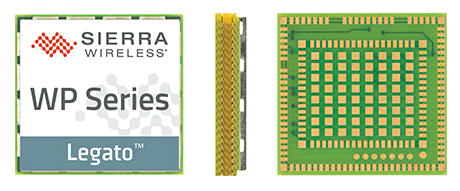
    Sierra Wireless, a provider of fully integrated device-to-cloud solutions for the Internet of Things (IoT), is offering global, dual-mode low-power wide-area (LPWA) cellular modules. The AirPrime WP77 smart wireless modules simplify LPWA deployments for customers developing products that need to connect to multiple networks where different LPWA technologies are supported.

    The Sierra Wireless AirPrime WP Series.

    The WP series simplifies development for secure telematics and gateway applications, providing a dedicated application CPU core running the Linux-based open source Legato application framework.

    With integrated GNSS for tracking and location-based services, low-power modes and a comprehensive set of interfaces for connecting sensors and companion chips, including Wi-Fi and Bluetooth, customers can develop multi-service platforms for the transportation market, and use the WP77 for applications requiring low throughput and optimized power performance.

    The WP77 supports both LTE-M (Cat-M1) and NB-IoT (Cat-NB1) with optional 2G fallback, allowing customers to deploy the same device with multiple network operators worldwide. For those deploying in regions where 4G LTE coverage is not as widely available, 2G fallback ensures their devices stay connected to the network.

    ABI Research forecasts that cellular LPWA network technologies will begin to see rapid growth from 2018 onward as carriers upgrade their networks in 2017, however, carriers have varying plans and timelines for LTE-M and NB-IoT.

    “A module with dual-mode, global coverage will be very attractive for global equipment manufacturers, especially for applications such as telematics, metering, and location tracking, which we expect will lead the way for LPWA volume deployments,” said Dan Shey, managing director and vice president at ABI Research.

    With the commercialization of LTE-M and NB-IoT LPWA technologies, cellular is now a superior option for many IoT applications that were previously restricted to short-range technologies due to cost and battery life. LPWA technologies combine lower cost, broader coverage and better battery life with globally available and secure cellular networks and will connect millions more things to the Internet.

    “With the AirPrime WP77 modules, IoT developers have everything they need in a single module to quickly build low-power connected products that can be deployed anywhere in the world,” said Dan Schieler, senior vice president and general manager, Embedded Solutions, Sierra Wireless. “The integrated open source Legato platform and AirVantage cloud provide our customers with a proven device-to-cloud architecture to design innovative LPWA solutions that extend the IoT into new applications.”

  • Telit introduces Bluetooth module with integrated MEMS

    Telit has launched BlueMod+S42M, a Bluetooth low-energy (BLE) 4.2, standalone, single-mode module with embedded 3-axis accelerometer, temperature and humidity sensors.

    The cost-effective component is optimized for efficiency and simplicity in end-device design and manufacturing, delivering reliable BLE functionality with robust endpoint security, motion and environmental sensors and essential features that reduce development costs, bill of materials, and time to market.

    Designed for large-scale projects, the BlueMod+S42M expedites device design across a wide range of industrial and consumer applications areas, the company said. The embedded sensors are for high-value, fragile asset tracking, and time- or temperature-sensitive applications such as cold chain monitoring in the pharmaceutical and agriculture industries.

    The release of the certified BlueMod+S42M complements the Telit portfolio of Bluetooth and BLE modules and directly addresses the demand in the rapidly growing BLE-dependent market. A report released by IndustryARC Analysis, forecasts Bluetooth Low Energy enabled devices shipments to increase to 8.4 billion units by 2020 at a CAGR of 29 percent.

    “Cost, power, and reliability are critical to the success of IoT applications that demand efficient BLE solutions,” said Ronen Ben-Hamou, Telit EVP of products and solutions. “Our new qualified Bluetooth module caters to designers of all levels with tight development, materials and manufacturing cost constraints and even tighter timelines. The beauty of the +S42M is it’s simplicity: single-chip SoC (system on chip), feature packed, sensibly priced, exceptional power savings and extensive interoperability.”

    Full applications can be embedded in the BlueMod+S42M, which is a self-contained SoC requiring no additional external supporting components. It is equipped with an on-board micro controller, integrated chip antenna, passive components, T°/Humidity sensor, and an accelerometer.

    Leveraging a rich subset of features from Telit’s diverse family of BlueMod+Sx modules, including a GATT interface and terminal I/O profile combination, the new BlueMod+S42M greatly simplifies and accelerates the development of applications, Telit said.

    In addition to efficient performance and low power consumption, BlueMod+S42M includes value-added features that further streamline development:

    • Bluetooth v4.2 Qualified Module
    • RED, SRCC Certified
    • Generic GATT Client and Server
    • LE Secure Connections
    • Configurable DIS (Device Information Service)
    • LE Data Length Extension
    • Terminal I/O for Easy Transparent Data Transfer (BLE- SPP like)
    • Embedded Sensors
    • Over-the-Air Updates
    • Sample Code for iOS and Android
    • WeChat Air Sync Protocol

    Designers using the BlueMod+S42M have access to comprehensive development and integration tools including evaluation and development kits.

    Visit Telit at the Sensors Expo in San Jose, California, June 27-29, booth 1244.

  • Sprint certifies Telit module for its LTE Cat 1 network

    Sprint has announced that Telit is to start commercial deliveries of its LE910C1-NSLTE Cat 1 module upon conclusion of Sprint certification, expected this month. The product is an embedded industrial Internet of Things (IoT) LTE module delivering up to 10 Mbps download and 5 Mbps upload speeds.

    Because of pin-to-pin compatibility with both CDMA and EV-DO versions of Sprint certified xE910 modules, Telit integration support, powerful development tools and resources, the new Cat 1 module allows Sprint IoT customers to realize significant reduction in time to market and savings for both new projects as well as upgrades from 2G and 3G to LTE.

    The module will primarily be used for IoT applications, enabling cellular data communication in devices used in warehouse management, remote monitoring and control, robotics, traffic control, logistic services, supply chain management, fleet management and telemedicine.

    “We are excited to certify this module because Telit is a world-class leader in the IoT,” said Mo Nasser, director of product development and marketing at Sprint. “Having this module commercially available and Sprint certified allows us to expand the number of applications we can provide new customers and has the added benefit of simplifying migration of current IoT customers to LTE.”

    The Telit LE910C1-NS single-mode module operates in multiple bands including LTE B2, B4, B5, B12, B25 and B26. Features include a high-speed USB 2.0 port, industrial operating temperature range (-40°C to +85°C) and advanced power-saving modes (3GPP Release 12).

    “We’re certain that supplying Sprint customers with this module will open doors to numerous new application areas requiring the longevity and speeds of LTE with the reliability and coverage of the Sprint nationwide network,” said Manish Watwani, vice president of global product marketing at Telit. “We believe that our technology is cutting-edge, enabling Sprint to continue delivering world-class customer experience in the IoT space.”

  • Roadmap helps guide city planners to the smart, connected cities

    Smart-Cities-Roadmap-Cover_1494274629094The 5G network, augmented reality, machine learning and other innovations are delivering a wealth of options to rapidly advance the power of Smart Cities technology.

    The Smart Cities Technology Roadmap helps city planners know what’s on the horizon for tomorrow so that they can start developing their technology vision today. The report is developed by the Alliance for Telecommunications Industry Solutions (ATIS), an organization that brings together the top global information and communication technology (ICT) companies.

    The roadmap is the first ICT industry publication designed for city decision makers including CTOs, CIOs and technology advisors that provides an overview of the network-enabled technologies to have the greatest impact on the evolving Smart City.

    The goal is to foster better budgeting, purchasing and staging decisions. The end result will be to position city decision makers to more effectively manage their upcoming technology investments as they create the connected cities of the future.

    ATIS’ Smart Cities Technology Roadmap was developed through extensive discussions with city leaders, solution providers and manufacturers — all heavily invested in creating successful Smart Cities environments. It is available free of charge on the ATIS website.

    “Rapidly advancing capabilities to collect and analyze constant real-time data are starting to help better manage many citizen-centric functions, improving traffic flow monitoring, public safety, and more,” said ATIS President and CEO Susan Miller. “The Roadmap is a much-needed focal point for dialogue between city planners and the ICT industry. It can enable planners to turn their Smart Cities projects into a comprehensive Smart Cities vision.”

    Plans being made now will be more effective if they consider the introduction of 5G solutions in the next few years. These deliver the promise of high bandwidth, low-latency and pervasive connectivity offering Smart City ecosystems a new generation of applications.

    The Roadmap helps planners look ahead to leverage advancements such as these. It provides an overview of Smart Cities technology challenges and benefits and offers a high-level technology framework and summary of key technology enablers.

    The Roadmap also includes a deeper analysis on the current state of standards, a review of technology choices, and an assessment of critical factors that may impact future deployment.

    Following publication of the guide, ATIS will gather feedback on collaborative activities that can advance Smart Cities technology investments. Input from city planners is welcome. ATIS is engaging cities to develop prioritized next steps, whether it be developing data exchanges, building on ATIS’ Internet of Things registry or another business framework. Opportunities are being explored to standardize foundation-level aspects of Smart City infrastructure, allowing customization and innovation to meet each city’s unique vision.

    Companies participating in the roadmap include AT&T, Bell Canada, C-Spire, CenturyLink, Cisco, Cox Communications, Ericsson, Fujitsu, HPE, iconectiv, InterDigital, JMA Wireless, Motorola, NextNav, Nokia, Oracle, Qualcomm, Sprint, TELUS, Verizon, Viavi and West Safety Services.

  • Oscilloquartz unveils dual-antenna GNSS SyncReach for small cells

    Oscilloquartz has launched the OSA 5405 SyncReach, an integrated PTP grandmaster and GNSS receiver with a patent-pending dual antenna and receiver to enable the mass roll out of small cells.

    The new technology has been specifically engineered to provide accurate and affordable phase synchronization for the rapidly growing small-cell market and meet the stringent timing requirements of 4.5G and 5G connectivity.

    With the OSA 5405, operators can migrate from legacy GNSS RF antennas and cables to standard, cost-effective copper and fiber Ethernet cabling, reducing capital expenditure and operating expenses, Oscilloquartz said.

    Available in both indoor and outdoor variants, the OSA 5405 can be deployed in challenging environments, including urban canyons where GPS signals fail. The OSA 5405’s miniscule form factor also enables it to be positioned on indoor windows to avoid multipath signal interference from objects within the building.

    The OSA 5405 uses a unique dual GNSS antenna and receiver algorithm to mitigate interference from multipath signals that can affect accuracy, particularly in urban canyons, according to the company.

    “We’re at the start of a new era. With the internet of things (IoT) connecting more wireless devices and 5G just around the corner, small cells will have a big role to play,” said Gil Biran, general manager at Oscilloquartz. “This market is set to grow exponentially in the next few years. Small cells will soon be everywhere and that makes precise synchronization essential. Operators urgently need a way to reliably and affordably deliver new levels of phase accuracy.

    “We’ve created our OSA 5405 to effectively deliver small cell synchronization in any environment and eliminate all restrictions,” Biran said. “Our new technology radically simplifies GNSS antenna installation. The use of PTP removes the need to compensate for cable delay and extends the reach of GNSS. It enables operators to forget about archaic and expensive RF cables and use simple copper cabling or optical fiber for longer distances. And, with variants that can be positioned in almost any location, it provides strictly accurate timing precisely where it’s needed.”

    The compact design and power-over-Ethernet capabilities of the indoor- or outdoor-mounted OSA 5405 enable synchronization at the edge of the mobile network. This creates dramatic reductions in complexity and power requirements as well as lower costs for installation and operation.

    Another feature of the new technology is IP connectivity, so that synchronization becomes another element of the internet of things.

    The OSA 5405’s highly precise GNSS-sourced synchronization is supported by network-based Sync-E and PTP backups. In high-rise buildings it can also deliver synchronization recovered from the GNSS smart receiver over optical fiber.

    The ADVA FSP Network Manager with comprehensive Syncjack assurance guarantees efficient operation.

    “Make no mistake; the launch of our OSA 5405 is a major milestone in the progress towards mass-scale small cell deployment,” said Nir Laufer, product line director at Oscilloquartz. “With its plug-and-play simplicity, miniscule form factor and multiple timing functions in a single device, this is a key technology for 5G networks and the IoT.

    “Currently deployed in trials with major carriers, it will shortly be available to all operators looking to harness next-generation synchronization precisely where it’s needed,” Laufer said.

  • Taoglas launches street-view-ready GPS performance certification services

    Taoglas launches street-view-ready GPS performance certification services

    Taoglas, a provider of Internet of Things (IoT) and GNSS antenna products, has released two new GPS certification testing services for Google and its device partners. The services are required for devices to meet Google’s new Street View auto-ready standard.

    Auto-ready certification distinguishes 360-degree cameras that deliver accurately positioned 360 video, even at high speeds. Taoglas worked with Google to develop the performance requirements, as well as the test methodology used to establish a basic minimum level of GPS receiver performance.

    The services are available at any of Taoglas’ design centers and labs in the United States, Ireland, Germany and Taiwan.

    Compact wireless devices such as digital cameras with built-in GPS receiver systems contain complex electronic systems that can emit unwanted RF signals that can impact radio receiver performance. The effect of this RF noise can be combated with critical design decisions like the antenna, low noise amplifier, filters, and transmission line choice and implementation.

    Taoglas’ new services will help device manufacturers objectively measure real-world performance to understand any GPS performance issues with their products. With this information, product manufacturers will know if their performance is optimized and will meet or exceed user expectation for the application at hand, as well as how it compares with their competitors.

    “Google Street View provides people with a 360-degree view of the world, and to enable these services, we require highly accurate location data,” said Charles Armstrong, product manager at Google. “By working with Taoglas to establish a standardized compliance process, we’re helping device manufacturers understand our requirements for GPS performance and quickly deliver products that match and exceed those high performance standards.”

    Taoglas is offering two levels of certification testing:

    Street View Auto-Ready Conformance Testing (GSA.31) provides a quick verification of minimum performance (in a pass/fail manner) required to achieve Street View certification. Taoglas uses its GPS constellation simulator and anechoic chamber to verify that radiated tracking and acquisition sensitivity meet a minimum performance standard at 15-degree intervals in one hemisphere.

    From these test results, manufacturers will be able to clearly see if the device’s GPS is performing adequately for basic location capabilities. The condensed period needed to run this test provides device manufacturers the best value to answer the question, “Is the GPS working optimally?”

    A street view image of Guatemala. (Credit: Google)

    Street View Auto-Ready Performance Testing (GSA.32) provides an absolute level of testing to assess the GPS receiver performance according to the optional Google Street View Assessment test procedures.

    Taoglas uses its GPS constellation simulator and anechoic chamber to measure radiated tracking and acquisition sensitivity at 15-degree intervals in one hemisphere. These optional tests provide more insight into how well a device performs, providing absolute receive sensitivity performance data.

    Testing results for both services include suggestions on next steps to resolve identified issues.

    “This partnership with Google to deliver GPS testing solutions for Google Street View compliance is an excellent example of how we’re working successfully with the world’s biggest companies to delivering high-quality, reliable antenna solutions,” said Dermot O’Shea, co-CEO of Taoglas. “By certifying their products through Taoglas, device manufacturers will also be able to take advantage of Taoglas’ deep RF expertise, achieving success quickly and reducing time to market.”

    “Street view” of the Ambrym Volcano, Vanuatu. (Credit: Google)
  • GSA launches 2017 GNSS Market Report

    GSA launches 2017 GNSS Market Report

    GNSSMarketReport2017-coverWith an in-depth look at market opportunities and trends across eight market segments, the European GNSS Agency’s (GSA’s) annual GNSS Market Report serves as a key resource for navigating the fast-evolving world of satellite navigation technology and GNSS applications.

    The fifth edition, the 2017 GNSS Market Report, was released May 10 by Carlo des Dorides, executive director for the GSA, at the European Navigation Conference held in Lausanne Switzerland.

    According to the new report, the growing demand for precise location information, in combination with the ongoing evolution of GNSS technology, means that today’s GNSS market is bigger than ever.

    According to the 5th edition of the GSA’s popular GNSS Market Report:

    • The global GNSS market is expected to grow from 5.8 billion devices in use in 2017 to an estimated 8 billion by 2020.
    • The GNSS downstream market is expected to produce over € 70 billion in revenue annually in 2025. When the revenue created by added-value services is included, this number could more than double.
    • The global GNSS downstream market is forecast to grow by more than 6 % annually between 2015 and 2020. Following the declaration of Galileo Initial Services in 2016, chipset and receiver manufacturers and application developers are leveraging Galileo signals, and a number of Galileo-ready devices are already on the market.
    • By 2025, the installed base of GNSS devices in drones will reach 70 mln, more than twice the sum of other professional market segments combined.

    Regularly referenced by policy-makers and business leaders around the world, the GNSS Market Report serves as the go-to resource for an in-depth look at GNSS market opportunities and trends across an array of essential market segments.

    “Providing in-depth information on today’s GNSS market opportunities and a data-driven forecast of its evolution through to 2025, this edition is a must-read for anyone looking to successfully navigate this promising market,” des Dorides said.

    The GNSS Market Report takes a comprehensive look at the global GNSS market, providing a thorough analysis per market segment (Location-Based Services, Road Transportation, Aviation, Maritime, Rail, Agriculture, Surveying and Timing & Synchronisation), region and application type, including information on shipments, revenues and installed device base.

    The 2017 edition includes such new features as:

    • An expanded section on macro-trends like the Internet of Things (IoT), Smart Cities and Big Data.
    • Segment-specific user perspectives, with an emphasis on the increasingly stringent demands of today’s GNSS users.
    • The unique added-value that European GNSS (EGNOS and Galileo) brings to each segment and how Galileo is already enhancing the functioning of many applications.
    • A special feature on the important role that GNSS plays in the growing market of drones (i.e., UAVs/Remotely Piloted Aircraft Systems).

    The full 100-page report is available for download free of charge.

    Methodology

    The GSA GNSS Market Report is compiled by the GSA and the European Commission and was produced using the GSA’s systematic Marketing Monitoring and Forecasting Process.

    The underlying market model uses advanced forecasting techniques applied to a wide range of input data, assumptions, and scenarios to forecast the size of the GNSS market in terms of shipments, revenue, and installed base of receivers.

    Historical values are anchored to actual data in order to ensure a high level of accuracy. Assumptions are confronted with expert opinions in each market segment and application and model results are cross-checked against the most recent market research reports from independent sources before being validated through an iterative consultation process involving pertinent sector experts and stakeholders.

  • New antennas meet NB-IoT standard

    Credit: u-blox.
    Credit: u-blox.

    Narrowband IoT (NB‑IoT) is a new way of communicating with the “things” in Internet of Things that was standardized by 3GPP in June 2016.

    The latest mobile broadband standard, NB-IoT is aimed at devices that need to communicate small amounts of data over long periods in hard-to-reach places. It connects devices through existing GSM and LTE spectrum networks.

    NB-IoT uses the 3GPP-licensed network spectrum, which is secure and free from interference, and offers low power, long range, the ability to penetrate walls and metal barriers, and support for about 50,000 devices per single cellular cell.

    “Narrowband IoT will be good for connecting devices in locations where the signal distance is in kilometers and for locations in basements and underground,” said Antenova CEO Colin Newman.

    “It could be the enabler for some of the IoT applications that are emerging that are not suited to the established telecoms networks, where the data throughput is quite low and infrequent.

    “We see these antennas being used for smart metering, agricultural technologies, building automation and smart-city applications with lighting, waste bins and parking spaces,” Newman said.

    Digicom's narrowband IoT GPS tracker has u-blox inside.
    Digicom’s narrowband IoT GPS tracker has u-blox inside.

    u-blox and Digicom. Chip-maker u-blox partnered with Digicom to develop its NB-IoT products, carrying out a series of innovative and successful field trials of the new NB-IoT technology.

    Digicom offers solutions for industrial markets using NB-IoT, with a focus on connectivity solutions for smart cities, smart buildings, industry 4.0 in general and the automotive industry. Digicom platforms are designed for the protection of vehicles, people and pets, offer ultra-low-power consumption and several years of operation in battery mode.

    Embedded in Digicom’s products are u-blox modules such as the SARA‑N2 NB-IoT.

    CEVA Dragonfly. CEVA Inc. and Hong Kong Applied Science and Technology Research Institute Company Limited (ASTRI) introduced Dragonfly NB1, a comprehensive NB-IoT solution with excellent performance and power consumption. It is easily integrated into a system on chip (SoC).

    GMV Add-On for GNSS.
    Also, CEVA and ASTRI teamed up with GMV to offer integrated GNSS for smart devices with location tracking of logistics, assets, wearables and more.

    The GNSS IP is available as an add-on software that runs on the CEVA-X1 together with NB-IoT and leverages ASTRI’s GNSS RF IP embedded in the solution.

    GMV’s software IP supports all four GNSS constellations: GPS, BeiDou, GLONASS and Galileo, and allows seamless switching between constellations when required or to run multiple constellations concurrently to improve resolution and offer global asset tracking.

    Antenova Latona. Antenova has developed a new NB-IoT chip antenna in the company’s lamiiANT antenna family named Latona. The antenna measures 20 x 11 x 1.6 mm, and is built to a novel design that allows it to perform well within a device while being easy to integrate onto a small printed circuit board (PCB), as with all of Antenova’s embedded antennas.

  • Fleet Complete acquires compliance solutions provider

    Fleet-Complete-LogoFleet Complete, a global Internet of Things (IoT) provider of fleet telematics and mobile workforce technology, acquired BigRoad, an hours-of-service (HOS) and regulatory compliance solutions provider.

    BigRoad will continue to operate and sell directly to owner-operators and fleets, and the integrated Fleet Complete BigRoad platform will be offered through their North American partner channels, AT&T and Telus.

    According to Fleet Complete, BigRoad was founded to address the new HOS regulations imposed on the commercial motor vehicle industry. BigRoad released a mobile HOS application, BigRoad Mobile App, as well as DashLink, an engine-connected electronic logging device.

    This acquisition aligns with the company’s goal of expansion, Fleet Complete says. The company also expanded into Europe in 2015 and Australia in 2016.

    “BigRoad is an impressive organization that has had a laser focus on creating the industry’s leading product for ELD compliance,” said Tony Lourakis, CEO of Fleet Complete. “Outperforming the competition in usability and connectivity, BigRoad’s driver-friendly and feature-rich application will be a great complement to our integrated platform, giving Fleet Complete customers the most reliable top-of-the-line HOS solution.”

  • Antenova reveals chip antennas for new NB-IoT standard

    Antenova reveals chip antennas for new NB-IoT standard

    Antenova's new NB-IoT antenna "Latona."
    Antenova’s new NB-IoT antenna “Latona.”

    Antenova Ltd., manufacturer of antennas and RF antenna modules for machine-to-machine and the Internet of Things (IoT), has developed a new antenna for the new narrow-band IoT (NB-IoT) standard that was ratified in 2016. The company showcased the antenna at Embedded World in Nuremberg in March.

    The antenna is small, measuring 20 x 11 x 1.6 mm, and is built to a novel design that allows it to perform well within a device while being easy to integrate onto a small printed circuit board (PCB).

    The new chip antenna in the company’s lamiiANT antenna family is named Latona (part no. SR4C033)

    Narrow-band IoT is the latest mobile broadband standard. It uses the 3GPP licensed network spectrum, which is secure and free from interference, and offers the combined advantages of low power, long range and the ability to penetrate walls and metal barriers.

    “Narrow Band IoT will be good for connecting devices in locations where the signal distance is in kilometers and for locations in basements and underground.” explains Antenova’s CEO, Colin Newman. “It could be the enabler for some of the IoT applications that are emerging that are not suited to the established telecoms networks, where the data throughput is quite low and infrequent. We see these antennas being used for smart metering, agricultural technologies, building automation and smart city applications with lighting, waste bins and parking spaces.”

    As with all of Antenova’s embedded antennas, the NB-IoT antennas are designed for quick and easy integration onto a host PCB.

    Samples of Latona areavailable to order. Antenova provides full design, testing and tuning services for customers who are adding wireless capabilities to their IoT devices and other electronic products.