Through the ION Online Job Board, ION corporate members can post job listings for free. For a limited time, non-ION corporate members can also post job listings for free. The job postings will expire automatically after 14, 30 or 60 days, depending on which expiration date the job poster chooses.
“To meet the burgeoning demand for a targeted talent pool specific to the PNT community, the new ION Online Job Board will help connect qualified job seekers with exciting and diverse employment opportunities for this niche audience, and in turn will help our corporate members continue to build talented teams to better ensure the success of their business,” said Lisa Beaty, executive director at ION.
The The Institute of Navigation is a not-for-profit professional organization dedicated to advancing the PNT industry.
The Institute of Navigation (ION) will be hosting a complimentary webinar, “Impact of Sample Correlation on SISRE Overbound for ARAIM,” at 12 p.m. ET on May 28.
This topic was originally presented at ION GNSS+ 2018 and published in the Spring 2020 issue of Navigation, Journal of the Institute of Navigation, Volume 67, No. 1, pp 197-212, by Dr. Santiago Perea Diaz, Prof. Michael Meurer and Dr. Boris Pervan.
According to ION, this paper analyzes the effect of error correlation on the SISRE bounding for GPS and Galileo satellites. For a given period of data collection, it computes the effective number of independent samples contained in a dataset applying an estimation variance analyses. Results show that the time between effective independent samples is highly dependent on the constellation and onboard clock type. On one hand, GPS satellites equipped with Rubidium clocks exhibit significantly longer error correlation than those with onboard Cesium clocks. On the other hand, Galileo satellites show substantially shorter correlation time among samples with less variability on a monthly basis, ION added.
This paper also introduces a methodology to compute SISRE bounding accounting for the limited number of independent samples, ION said. Using a Bayesian approach, it computes the so-called uncertainty factor by which the Gaussian distribution needs to be inflated in order to account for the observation data independence.
The Institute of Navigation’s (ION) ION GNSS+ 2020 advance conference program is now available online.
The show, which is the the 33rd International Technical Meeting of the Satellite Division of the Institute of Navigation, is slated to take place Sept. 21-25 in St. Louis.
According to ION, the show will feature Commercial and Policy tracks and Research tracks with more than 36 technical sessions Sept. 23-25, in addition to a commercial exhibit.
ION GNSS+ 2020 will offer short courses on pre-conference tutorials to provide in-depth learning of specific GNSS-related disciplines and will again facilitate the CGSIC meeting. These will take place Sept. 21-22. ION’s Satellite Division will also bring back complimentary short courses, taught by internationally recognized PNT experts and educators on Sept. 21.
This year’s ION GNSS+ 2020 Plenary Session will feature two dynamic keynote addresses from Dr. Christine Darden, retired NASA program manager and one of the key researchers featured in the book Hidden Figures, and Dr. Bradford Parkinson, who will be presenting “Radio Navigation from Marconi to GNSS.”
Finally, nominations are currently being accepted for ION’s Johannes Kepler Award, which honors an individual during their lifetime for sustained and significant contributions to the development of satellite navigation, as well as the Bradford W. Parkinson Award, which recognizes an outstanding graduate student in the field of GNSS. Nominations, along with required reference letters, are due June 30.
The U.S.-only For Official Use Only sessions will be hosted at the Northern Kentucky Convention Center in Covington, Kentucky, and the U.S.-only secret sessions will be hosted at the Air Force Institute of Technology in Dayton, Ohio.
According to ION, the rescheduled conference will host the original program, which was scheduled to take place in June.
“We are aware of the importance of this community of dedicated public servants meeting in an environment where they can effectively collaborate, exchange research, and demonstrate technology,” said Lisa Beaty, executive director for ION. “The current global climate made our ability to hold this conference in June unlikely, and we needed to provide an alternative opportunity for all our stakeholders.”
Those scheduled to present at JNC 2020 will receive emails from ION asking them to respond electronically to confirm the rescheduled dates and times of their presentations. Those who have registered to attend will receive an email from ION letting them know what their options are.
The IEEE/ION PLANS Conference has been canceled. The conference — officially the IEEE/ION Position Location and Navigation Symposium (PLANS) — was scheduled to take place April 20-23 in Portland, Oregon.
“After careful consideration, the ION Executive Committee, in cooperation with the IEEE/ION PLANS program committee, made the decision this afternoon to cancel,” said ION Executive Director Lisa Beaty in an email sent March 12.
The Institute of Navigation’s (ION’s) official position has been posted here.
The ION National Office has notified PLANS authors, exhibitors and vendors and provided each with additional information pertaining to their particular relationship or circumstance.
“The ION Executive Committee will be discussing additional follow-up considerations later this month,” Beaty said.
ION GNSS+ 2020, themed “GNSS + Other Sensors in Today’s Marketplace,” will feature two tracks: commercial and policy tracks and research tracks. The commercial and policy tracks will include high performance and safety critical applications; status and future trends in GNSS; and mass market and commercial applications. The research tracks will include multi sensor and autonomous navigation; algorithms and methods; and advanced GNSS technologies.
In addition, authors whose abstracts are accepted in these sessions (either as a primary or as an alternate presenter) will have the option to have their paper peer reviewed.
The Institute of Navigation (ION) has published its Global Navigation Satellite Systems (GNSS) Software Defined Radio Metadata Standard document.
According to ION, The standard is the product of a three-year long effort of the ION GNSS SDR Standard Working Group and defines parameters and schema to express the contents of SDR sample data files. The standard promotes the interoperability of GNSS SDR data collection systems and processors, ION added.
“In recent years there has been a proliferation of software defined radio data collection systems and processing platforms designed for Global Navigation Satellite System receiver applications or those that support GNSS bands,” ION said in a press release. “For post-processing, correctly interpreting the GNSS SDR sampled datasets produced or consumed by these systems has historically been a cumbersome and error-prone process. This is because these systems necessarily produce datasets of various formats, the subtleties of which are often lost in translation when communicating between the producer and consumer of these datasets. This specification standardizes the metadata associated with GNSS SDR sampled data files and the layout of the binary sample files.”
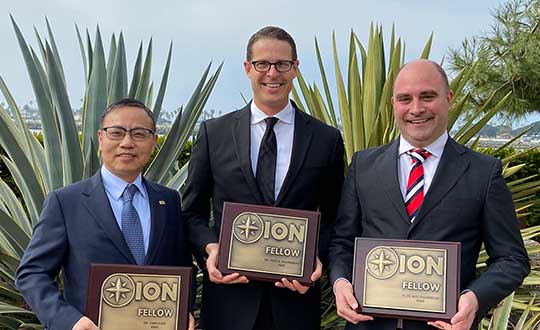
The Institute of Navigation (ION) announced the recipients of the 2020 Fellow memberships during the ION International Technical Meeting (ITM) and Precise Time and Time Interval Systems and Applications (PTTI) held Jan. 21- 24 in San Diego, California.
Election to Fellow membership recognizes sustained professional accomplishments that have significantly contributed to the advancement of the arts and sciences of Positioning, Navigation and/or Timing (PNT) in the areas of technology, management, practice or teaching and a demonstrated and sustained impact on the PNT community.
Fellows have maintained an observable presence in the ION community over the long term, including contributions to ION programs and publications.
José Ángel Ávila Rodríguez has been elected for his pioneering contributions to the design of the Galileo signal plan, and leadership in the modernization of Galileo.
Yang Gao has been elected for significant contribution to the development, dissemination and commercialization of high-precision GNSS technologies; and for significant educational and training impact on navigation engineers and professionals.
Todd E. Humphreys has been elected for significant and fundamental contributions to PNT security and precise GNSS positioning for the mass market, and for dedication to GNSS education and outreach.
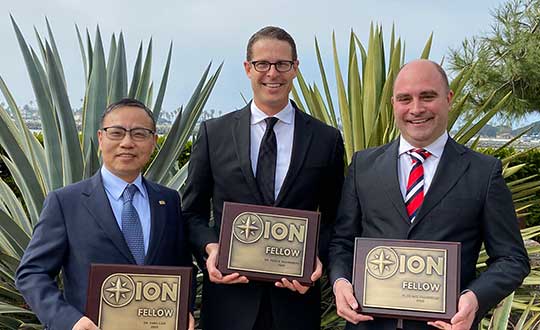
With their new Fellowship plaques are (from left) Gao, Humphreys and Rodríguez. (Photo: ION)
The Institute of Navigation (ION) presented its annual awards during the ION International Technical Meeting (ITM) and Precise Time and Time Interval Systems and Applications (PTTI) meeting in San Diego, California, Jan. 21-24.
The ION Annual Awards Program is sponsored by The Institute of Navigation to recognize individuals making significant contributions or demonstrating outstanding performance relating to the art and science of navigation.
Ramsey Faragher received the Per Enge Early Achievement Award for outstanding innovations in mobile positioning and navigation, and in particular for pioneering the revolutionary SuperCorrelation technology. The Per Enge Early Achievement Award is presented in recognition of outstanding contributions made early in one’s career.
Pascal Rochat received the Distinguished PTTI Service Award for advancing the state-of-the-art in high stability atomic clocks and for producing the only space-based H-maser in the world, operating on all Galileo satellites. The Distinguished PTTI Service Award is presented to recognize outstanding contributions related to the management of PTTI systems.
Jordan D. Larson, Demoz Gebre-Egziabher and Jason H. Rife received the Samuel M. Burka Award for their paper “Gaussian-Pareto Overbounding of DGNSS Pseudoranges from CORS” published in the Spring 2019 issue of NAVIGATION, Journal of The Institute of Navigation, Vol. 66, No. 1, pp. 139-150. The Samuel M. Burka Award recognizes outstanding achievement in the preparation of a paper advancing the art and science of positioning, navigation and timing.
Joseph J. Rushanan received the Captain P. V. H. Weems Award for sustained contributions to the design of GPS, including M-code, the L1C signal, and the promotion of assurance concepts for all GPS users. The Captain P. V. H. Weems Award is presented to individuals for continuing contributions to the art and science of navigation.
André Hauschild received the Tycho Brahe Award for outstanding and sustained contributions in the field of GNSS-based navigation, timing and attitude determination of space vehicles. The Tycho Brahe Award is given in recognition of outstanding contributions to the science of space navigation, guidance and control.
James J. Miller received the Norman P. Hays Award for exemplary leadership in establishing and sponsoring the National Space-based Positioning, Navigation and Timing (PNT) Advisory Board to serve the worldwide user community. The Norman P. Hays Award is given in recognition of outstanding encouragement, inspiration and support contributing to the advancement of navigation.
Zaher (Zak) M. Kassas received the Thomas L. Thurlow Award for foundational work in the theory and practice of exploiting signals of opportunity for accurate and reliable positioning, navigation and timing. The Thomas L. Thurlow Award recognizes outstanding contributions to the science of navigation.
Suneel I. Sheikh received the Distinguished Service Award in recognition of his visionary leadership in promoting positioning, navigation and timing education through the establishment, promotion and administration of the ION Satellite Division’s Autonomous Snowplow Competition. The Distinguished Service Award recognizes extraordinary service to The Institute of Navigation.
The Institute of Navigation is asking for abstracts for the 2020 ION Joint Navigation Conference. JNC 2020 will be held June 1-3 at the Northern Kentucky Convention Center in Covington, Kentucky/Cincinnati, Ohio.
The US ONLY CLASSIFIED sessions will be held June 4 at the Air Force Institute of Technology in Dayton, Ohio.
Abstracts are due Feb. 3, 2020.
JNC is the largest U.S. military Positioning, Navigation and Timing (PNT) technologies conference of the year with joint service and government participation. The JNC theme is Enhancing Dominance and Resilience for Warfighting and Homeland Security PNT.
The event will focus on technical advances in PNT with emphasis on joint development, test and support of affordable PNT systems, logistics and integration with more than 150 operational presentations.
Abstracts will be accepted through Feb. 3, 2020. For more information about JNC 2020, visit ion.org/jnc.
Exhibit Opportunities
JNC features a technical exhibit and showcase of guidance, navigation and control technology products and services. The exhibit hall (June 2-3) will be open to all conference participants, exhibiting organizations, their employees and related organizations.
All materials displayed in the exhibit hall shall be publicly releasable (Distribution A). For more information on exhibiting, visitwww.ion.org/jnc.
Attendance Restricted Technical Sessions
Conference attendance for both FOUO US ONLY (June 1-3) and US ONLY Secret Clearance (June 4) sessions will be screened by the Joint Navigation Warfare Center and will be restricted to US ONLY. Advance visit requests and approvals are required for all technical participants.
The Institute of Navigation (ION)’s Satellite Division presented two prestigious awards Sept. 20 at the ION GNSS+ Conference in Miami.
Peter Teunissen receives the prestigious 2019 Johannes Kepler Award from ION’s Satellite Division. (Photo: ION)
Peter Teunissen was honored with the career-highlight Johannes Kepler Award. The Johannes Kepler Award recognizes and honors an individual for sustained and significant contributions to the development of satellite navigation. It is the highest honor bestowed by the ION’s Satellite Division.
Teunissen was recognized for his influential and groundbreaking contributions to the algorithmic foundations of satellite navigation, and for sustained dedication to the global education of the next generation of navigation engineers.
Teunissen invented the Least Squares Ambiguity Decorrelation Adjustment (LAMBDA) method, the worldwide standard for ambiguity resolution, which revolutionized high precision GNSS positioning capabilities. LAMBDA has thus become an indispensable tool that is most widely used in land, air and space navigation; positioning and attitude determination; differential and network processing; and in surveying and geodesy. He also extended the method to MC-LAMBDA, a multivariate constrained resolution method for optimal GNSS attitude determination.
Among others, Teunissen laid the mathematical and algorithmic foundation of reliability theory, which enables a proper understanding of the quality of different integer ambiguity resolution methods and a rigorous characterization of their failure rates, which even led to the development of an optimal test for ambiguity validation.
His findings are particularly important for multi-GNSS processing, which require a proper understanding of individual system characteristics and their respective contributions to achieve navigation solutions of the highest precision and integrity.
Teunissen has made contributions in the field of precise point positioning, the exploitation of triple-frequency observation, and the joint use of new GNSS such as Galileo, BeiDou and QZSS. Pioneering work in this area include the early setup of multi-GNSS receiver test beds in the Asia-Pacific area; the discovery and proper handling of mixed-receiver inter-satellite-type biases, which were vital to fully exploit ambiguity resolution in the regional, BeiDou-2 system; and the first demonstrations of mixed GPS/Galileo/IRNSS/QZSS L5 processing for precise positioning applications.
Teunissen has made significant contributions to educating future generations. He is currently a Professor of Satellite Navigation at Delft University of Technology, The Netherlands and Curtin University, Australia.
He received his Ph.D. at Delft University of Technology in Mathematical and Physical Geodesy. He holds several honorary professorships and fellowships of numerous international organizations, including Australia’s prestigious Federation Fellowship of the Australian Research Council.
He has published more than 300 papers, seven books, is co-editor and author of the Handbook of Global Navigation Satellite Systems, and is a member of 13 editorial boards.
He is a regular contributor to ION and ION programs. He is a Fellow of the ION, the RIN and the Royal Netherlands Academy of Sciences.
Advanced RAIM topic earns Diaz the Parkinson Award
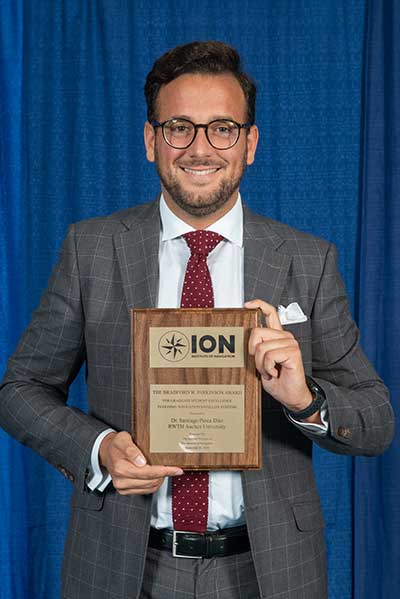
Santiago Perea Diaz receives the 2019 Bradford W. Parkinson Award from ION’s Satellite Division. (Photo: ION)
The Bradford W. Parkinson Award recognizes an outstanding graduate student in GNSS. It is presented in honor of Parkinson for his leadership in establishing the U.S. GPS and for his work on behalf of ION’s Satellite Division.
Santiago Perea Diaz was recognized for graduate student excellence in GNSS in his thesis, “Design of an Integrity Support Message for Offline Advanced RAIM.”
Any graduate student who is a member of the ION and is completing a degree program with an emphasis in GNSS technology, applications, or policy is eligible for the award.