Trackimo, a U.S.-based IoT (Internet of Things) solution provider enabling worldwide connectivity for M2M (Machine to Machine) devices, showcases its tracking devices at the Association for Unmanned Vehicles Systems International’s Xponential show, held May 2-5 in New Orleans.
Trackimo’s technology integrates GPS, GSM, an accelerometer and sensors that provide smart data. Cellular network signaling manages the devices and dispatches information to systems and apps.
Trackimo covers both consumer and businesses sectors including fleet tracking and logistics management solutions, customizable and scalable IoT platform, remote gateways and consumer tracking devices.
Penton’s TU-Automotive has unveiled the agenda and speaker line-up for TU-Automotive Detroit 2016, which is being held June 8-9 in Novi, Michigan. The 16th annual conference and exhibition is dedicated to innovation in automotive technology, covering connected cars, autonomy and mobility.
At TU-Automotive Detroit 2016, the city’s automakers — Ford, General Motors and Fiat Chrysler Automobiles — will join international OEMs to discuss their vision for how the car can become the leading “node” of the Internet of Things (IoT), Penton says in a news release.
The 80-plus session agenda and more than 150 speakers will focus on automotive’s leading role within the rapidly expanding connected world, collaboration of efforts, resources and competencies is needed within companies and across the industry.
“Last year we saw the emergence of three core trends in automotive: connectivity, mobility and autonomy,” Gareth Ragg, managing director of TU-Automotive, says in the news release. “This year, these are coming together to form one pillar in automotive strategy, connecting with the wider connected world.”
3,000 are expected to attend this year’s event, which will cover connectivity, ADAS, mobility models, insurance, data, infotainment and more.
Keynote speakers from Ford, GM, Zipcar, Nissan, NHTSA, Jaguar Land Rover, car2go, FCA, Hyundai, MIT, Audi and Mercedes-Benz will demonstrate how collaboration will make auto the pioneer of the IoT.
Telit Communications PLC, a global enabler of the internet of things (IoT), has agreed to acquire several cellular module product lines, related intellectual property (IP) and related assets from Novatel Wireless, Inc., for an initial cash purchase price of $11 million and conditional earn-out consideration, which Telit expects to be non-material.
Novatel Wireless is not associated with GNSS receiver maker NovAtel.
The Telit portfolio includes integrated products and services for end-to-end IoT deployments — including GNSS, cellular communication modules, short-to-long range wireless modules, IoT connectivity plans and IoT platform services.
As part of the acquisition, Telit acquired specific IP and was granted an exclusive license to other Novatel IP related to the acquired cellular module lines, including subsequent versions in development.
The acquisition is not expected to have a material impact on the Group’s financial performance.
“The acquisition of these products and associated IP strengthens Telit’s position in the security market segment, a segment that is expected to be an early adopter of LTE Cat1. The acquisition is part of our strategy to enhance our product offering by both acquisition and our own R&D,” said Oozi Cats, Telit’s chief executive.
ORBCOMM Inc., a global provider of machine-to-machine (M2M) and Internet of Things (IoT) solutions, has added to its fleet management portfolio.
Announced at the Mobile World Congress (MWC) are the new cellular-only SkyWave IDP-782 device and the viaFleet web application for tracking, monitoring and managing trucks, railcars and other mobile assets. MWC is being held Feb. 22-25 in Barcelona, Spain.
By leveraging ORBCOMM’s fleet management solutions, fleet operators can reduce fuel costs, optimize travel routes, monitor driver behavior, minimize idle times and ensure cargo and driver security, the company said.
ORBCOMM’s cellular-only SkyWave IDP-782 device is designed for vehicle tracking and driver monitoring applications specifically for areas where cellular coverage is widely available. This device provides customers the same functionality and flexibility as the dual-mode version at a more economical cost for cellular-only applications.
ORBCOMM’s comprehensive viaFleet application enables fleet operators to see the location of mobile assets in real-time, monitor driver behavior, streamline vehicle maintenance schedules, communicate with drivers and much more. With an intuitive, easy-to-use graphical interface, the viaFleet application works with the IDP-782 to display the location of assets on a map in real time, tracks asset movements with breadcrumb reports, and supports advanced reporting capabilities on speeding events, dwelling times, geofence access and asset health, allowing customers to significantly improve operational efficiencies and productivity.
In addition, ORBCOMM recently introduced several other innovative wireless solutions. These products and services enhance ORBCOMM’s M2M and IoT solutions portfolio, which span from device to dashboard, for system integrators, end user customers and Original Equipment Manufacturers (OEMs) across a wide variety of industries.
The ORBCOMM OGi modem, which has a footprint smaller than a credit card, is the smallest and lowest cost IDP modem built to date and is targeted for mission-critical applications that require low latency. The versatile modem’s design provides customers with unrivaled ease of use, flexibility and quality of service based on their unique application needs, including message size, delivery speed, geographic coverage and regulatory requirements. Both ORBCOMM’s OG2 and OGi modems use the same electrical and application interfaces, including the connectors, power input and programming environment. This interchangeable format enables OEM customers to plug-n-play satellite connectivity utilizing the ORBCOMM VHF network or the Inmarsat L-band network without the need to redesign their M2M solutions.
The ORBCOMMconnect subscriber management portal gives ORBCOMM customers complete comprehensive control over wireless services and connected devices, while reducing the complexity of managing and integrating multiple connectivity offerings. Customers can access three satellite and seven Tier One cellular networks in one comprehensive platform, optimizing M2M and IoT service delivery and subscriber management, enabling better business planning and helping to reduce and control costs.
ORBCOMMmobile is a mobile app that integrates with ORBCOMM’s M2M and IoT applications, including ORBCOMM’s cold chain monitoring solution and the ORBCOMMconnect portal. ORBCOMM’s mobile app runs on both iOS and Android devices to facilitate easy access to ORBCOMM solutions and technology in real-time and remotely outside of the traditional office environment.
ORBCOMM Enterprise Connect is an end-to-end 4G xLTE wireless failover solution for distributed enterprise, financial, hospitality and retail locations that need reliable, high-bandwidth WAN connectivity for M2M and IoT applications. The solution works with integrated routers from industry-leading hardware manufacturers as a back-up to existing broadband connections in the event of a primary network communications failure. The affordable turn-key solution combines world-class connectivity, hardware, management capabilities along with network and deployment support. ORBCOMM Enterprise Connect allows both large and small enterprises to conduct business efficiently and reduces risks of downtime, reduced productivity, lost revenue and customer experience issues.
To learn more about ORBCOMM’s latest innovations, visit Booth G11 in Hall 8.0 at Mobile World Congress.
InvenSense Inc., a provider of micro-electrico-mechanical (MEMS) sensor platform solutions, is showcasing the company’s latest innovations in its Internet of Sensors platforms and solutions for mobile, smart home, wearable, industrial, and automotive segments in Hall 2 — stand 2C16MR — at the 2016 Mobile World Congress (MWC). MWC is being held in Barcelona, Spain, Feb. 22-25.
InvenSense brings innovative human-like interfaces, including motion, audio and software solutions in both consumer and industrial devices. This year, InvenSense is progressing the idea that the Internet of Sensors is the next wave of intelligent sensor system-on-chip (SoC) solutions and that they connect any conceivable consumer electronic and industrial device and allow them to behave, react and think autonomously.
InvenSense’s pioneering of Internet of Sensors motion, audio and software solutions are synergistic with consumer electronic devices and the Internet of Things (IoT) requisite to track behavior, enhance contextual awareness, and help sensor-driven decision analytics.
InvenSense will showcase:
SensorStudio and the InvenSense FireFly development kit, a sensor prototyping and development platform for Internet of Things (IoT) applications.
Optical Image Stabilization (OIS) and Electronic Image Stabilization (EIS) solutions for drones, digital still cameras, smartphones and more.
Invensense’s TrustedSensor IoT Security Solution, showcased by Intrinsic-ID, a leader in the field of Cyber Physical Security Systems as a provider of “Physical Unclonable Functions” (PUF).
InvenSense’s continuous heart rate monitoring with vital sign monitoring system solution, delivering accurate Heart Rate Measurement (HRM) while walking, running, biking, and gym activities.
The new CoursaSports.com, a cloud-based sensor Software as a Service (SaaS) fitness tracking platform for smartphone and smartwatch health and fitness applications.
The new CoursaRetail.com, an infrastructure-free, indoor-location analytics for Bricks & Mortar, enabled from your mobile app on customers’ phones and capturing sales from missed conversions on previous visits.
Spirent Communications and Oasis Smart SIM have created a strategic partnership to remove connectivity and network provisioning barriers for the rapid development of connected products and devices, such as cameras, smart vehicles, logistics and production goods.
Spirent Communications is a provider of device intelligence solutions, and Oasis Smart SIM is a global Universal Subscriber Identity Module (USIM) connectivity and management provider.
The partnership marks both firms’ entry into the connected Internet of Things (IoT) business, which analyst Gartner forecasts will result in 6.4 billion connected devices worldwide in 2016, reaching 20.8 billion by 2020.
Beefore launching the new product, Spirent and Oasis undertook extensive research into the hurdles that original equipment manufacturers (OEMs) face in making diverse connected products, ranging from white goods in the kitchen to those used in animal management, suitable for sale in world markets. It became clear that old technologies and business models based on use of the traditional SIM were not suitable for IoT device activation and subscription provisioning on a global scale.
The partnership between Spirent and Oasis will introduce a two-click software solution, including USIM functionality, that OEMs can embed into products for seamless cellular service activation in any of the world’s markets, as well as life-cycle management.
The new product will be showcased on the stands of Spirent (Hall 6, Stand 6J37) and Oasis (Hall 2, Stand 2D13/15/19MR) at Mobile World Congress, in Barcelona (22-25 February, 2016).
“Spirent and Oasis have teamed up to help manufacturers build better and smarter products for the connected world,” said Dennis Juul Poulsen, general manager of Spirent’s IoT Connectivity and Subscription Management business. “Be it a connected truck or a pair of smart running shoes, OEMs in whatever vertical market now have a solution that provides customers with seamless instant connectivity and the freedom to choose whatever cellular service provider they wish.”
“Spirent’s unique automatic access point name (APN) setup and remote subscription management solution with Oasis’ embedded smart USIM functionality is a game changer in connected products and devices,” said Olivier Leroux, CEO of Oasis Smart SIM. “OEM vendors now have a leaner way to manufacture, distribute and maintain connected products compared to solutions centered on the traditional SIM.”
Atmel Corporation has launched an ultra-low-power connected platform for cost-optimized applications for the Internet of Things (IoT) and wearable markets, the company announced in a news release. The platform is being showcased at CES 2016, held Jan 6–9 in Las Vegas, in Atmel’s meeting room area, South Hall 2, booth No. MP25760.
“The new platform features the world’s lowest power ARM Cortex-M0+, the Atmel SMART SAM L21 and BTLC1000 Bluetooth SMART solution, making it the perfect solution for battery-operated applications requiring activity and environment monitoring,” the company said.
The SAM L21 achieves a ULPBench score of 185, the highest recorded score for any Cortex-M0+ while running the EEMBC ULPBench, the industry marker for low power, with a power consumption down to 35µA/MHz in active mode and 200nA in sleep mode.”
Atmel’s Bluetooth SMART solution is 25 percent smaller than the closest competing solution packaged in a 2.2 by 2.1 millimeter Wafer Level Chipscale Package, the company says, enabling designers to build ultra-small industrial designs for next-generation connected IoT and wearable applications.
Embodied in a 30 by 40 millimeter form factor, the platform integrates the Atmel SMART ultra-low power MCU, Bluetooth SMART low-energy connectivity, capacitive touch interface, security solution, complete software platform, real-time operating system (RTOS), a BHI160 6-axis SmartHub motion sensor and a BME280 environmental sensor from Bosch Sensortec. The platform can be powered by a simple coin cell utilizing extremely low power consumption, and manufacturers can also leverage Atmel’s extensive list of sensor partners.
To simplify the design process, the new platform is compatible with Atmel’s flagship Studio 7, an integrated development environment, along with Atmel Start, a web-based platform for software configuration and code generation.
“As a leading provider of ultra-low power IoT solutions, we know that out-of-the-box, easy to implement reference platforms are a necessity to help accelerate the adoption of wearable applications and enable a rapid time-to-market for new product ideas,” said Andreas Eieland, director of product marketing for the Microcontroller Business Unit, Atmel Corporation. “Atmel’s new reference platform allows our customers to develop differentiated solutions for cost-optimized, yet competitive, markets including healthcare, fitness, wellness and much more. We continue to help drive the IoT and wearable market with simple, ultra-low power platforms with complete hardware and software solutions.”
Esri Inc. is working with Microsoft to integrate location services and spatial analytics to the Microsoft Azure IoT (Internet of Things) Suite.
The collaboration will rapidly enable IoT scenarios by offering customers and partners a set of highly capable platform services as ready-to-use, preconfigured solutions. The forthcoming integrated offering is the next step in Microsoft’s and
Esri’s long-standing alliance to spatially enable the enterprise, Esri said in a press release.
Smart city concepts and innovations in the automotive industry are examples of how data from many sources increases understanding. Governments and businesses use that data to improve safety features, reduce air pollution, and mitigate traffic congestion.
Note: In May 2013 this newsletter published a column on “What’s New in GNSS Simulation.” This month, Editor Tony Murfin takes a brief look at a new start-up in GNSS simulation, Skydel, and its software signal simulator. We also provide quick updates on the latest from those simulation companies and others.
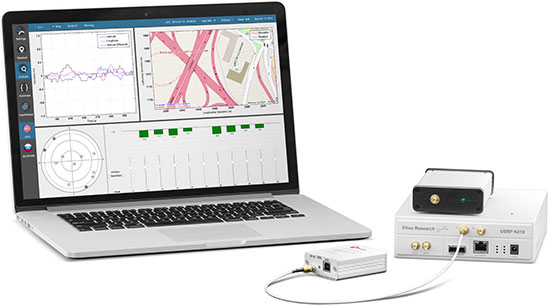
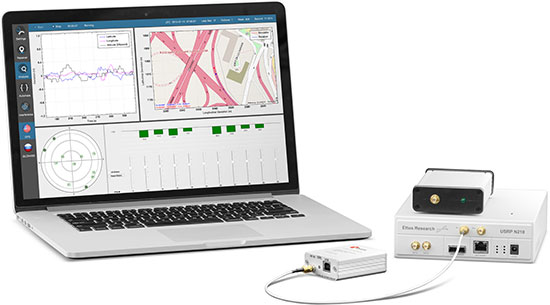
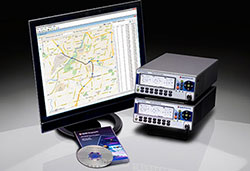
Skydel Software-defined simulator Skydel provides a software-defined simulator using generic hardware to accommodate system integrators who may have a consumer product or application with GNSS inside, and may not require a full-function simulator. Skydel uses a regular GPU to perform modulate the GNSS signal. The computer can be a laptop or desktop, but must include an Nvidia graphics card. The Universal Software Radio Peripheral (USRP) here is the Ettus N210. Skydel also uses the bladeRF x40 made by nuand, an alternative USB 3.0 Software Defined Radio, and Averna RP-6100 Record & Playback system.
“What’s New in GNSS Simulation” Updates
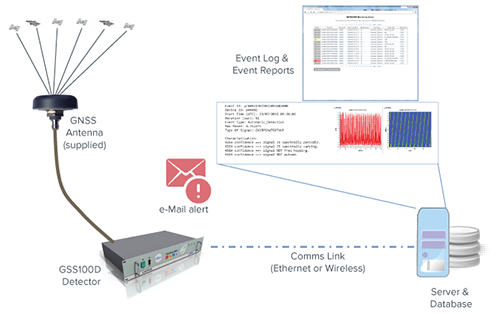
Spirent Spirent debuts practical PNT framework for more robust position, navigation and timing systems Threats to GNSS and related PNT applications are more orchestrated and coordinated, with the motivation to disrupt or cause financial loss. The technology to disrupt GPS has also become much more accessible, resulting in GPS vulnerability even gaining attention at hacker conventions. Spirent’s GNSS Interference Detector System helps users solve these problems.
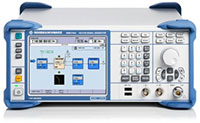
Rohde & Schwarz Solutions for all aspects of LBS testing Need to verify your location based service (LBS) applications based on A-GNSS, OTDOA and eCID? Rohde & Schwarz offers a wide range of testing solutions for all aspects of LBS testing, including protocol conformance, minimum performance and OTA. Applicable from development and production to installation, the solutions support the positioning techniques and protocols deployed by mobile network operators.
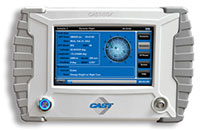
CAST CAST lightweight GPS Satellite Simulator With its compact size of 7 x 11 x 3 inches and weighing in at just over four pounds, the SGX is CAST’s smallest fully capable simulator to date. The SGX lightweight portability features 16 channels of L1 C/A and P codes and is extremely accurate and repeatable. Features include a touchscreen, individual satellite power control and start-and-stop scenarios with the touch of a button.
Spectracom GNSS Simulator Compatible with IRNSS and QZSS Spectracom’s GPS/GNSS simulator is now available for testing receiver compatibility with India’s global navigation satellite system, IRNSS, and Japan’s regional satellite system, QZSS. The Spectracom GSG-6 Series multi-frequency GNSS signal simulator is designed to be field upgradeable to readily enable the addition of all current and future GNSS constellations.
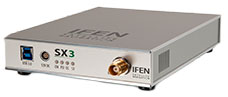
iFEN SX3 GNSS Software Receiver The SX3 Black Edition is a modular dual-RF multi-GNSS software receiver with superior flexibility and performance, whether processing the dual-RF front-end data stream in real-time or post-processing IF samples from storage. Graphical user interface provides easy access to signal processing configuration properties and gives real-time feedback for channel output, correlation function and RF spectrum.
RaceLogic The 2015 leap second – LabSat scenarios now available With the LabSat 3 Simulator you can reliably test your products on the bench to see how they cope with events such as the leap second, alongside standard issues such as multipath and signal obscuration. Recordings of the leap second from the three main constellations are now available for use with LabSat 3.
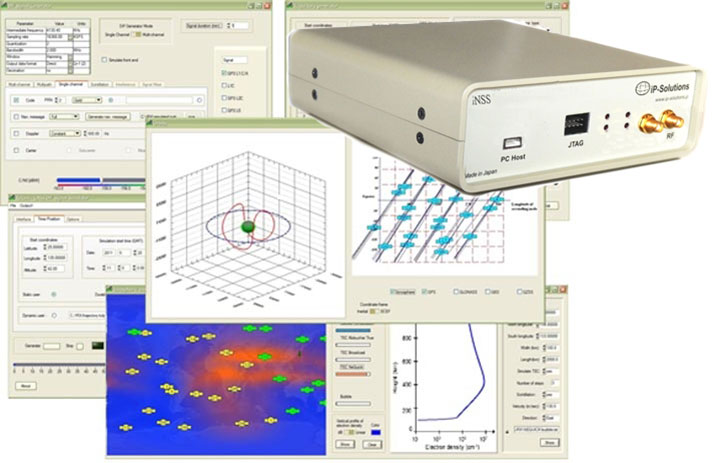
IP-Solutions Replicator GNSS RF simulator, recorder and playback device — inexpensive, economical, flexible, with a high-fidelity GNSS simulation solution. This product was originally developed cooperatively for JAXA (Japan Aerospace Exploration Agency). Originally developed for, and in cooperation with, the Japan Aerospace Exploration Agency (JAXA).
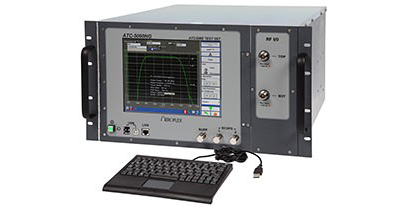
Cobham AvComm ATC-5000NG NextGen ATC/DME Test Set Formerly the Aeroflex AvComm business unit, Cobham introduced this year the ATC-5000NG NextGen ATC/DME Test Set, an RF signal generator/receiver for testing Mode A, C and S transponders. The ATC-5000NG was designed with modern software-defined radio technology for engineering development, design validation, manufacturing and return-to-service testing.
TeleOrbit GIPSIE TeleOrbit’s software-based GNSS multi-system performance simulation environment, GIPSIE, consists of a satellite constellation simulator and an intermediate frequency simulator. The digital signal simulator GIPSIE streams the software-generated signals or recorded live data exactly into the receiver’s baseband processing chain to support development, test, verification, validation, qualification and certification.
Averna RP-6100 The Averna RP-6100 Multi-Channel RF Record & Playback for RF application testing allows users to to record real-world signals such as GNSS, HD Radio, LTE and Wi-Fi, plus impairments, to advance projects and harden product designs. Frequency range of 10–6000 MHz, up to 4×40 MHz or 2×80 MHz bandwidth, 14-bit resolution, tight channel synchronization. Records up to 22 hours, supports Skydel’s software-defined, real-time GNSS Simulator.
Syntony GNSS Syntony RTG2 Constellation Simulator Syntony offers the RTG2, a GNSS constellation simulator that generates realistic GNSS RF signals, taking into account the current and future GNSS constellations. The generator is entirely configurable (troposphere and ionosphere effects, simulated receiver trajectory, etc) through a user friendly interface accessible on a separated PC through Ethernet.
Aeris is partnering with Isotrak Ltd. to provide improved cellular connectivity and data analytics for Isotrak’s global customers.
By leveraging Aeris’ machine-optimized and patented AerCore IoT and M2M network, AerPort connectivity platform and AerVoyance IoT and M2M analytics platform, Isotrak has added advanced capabilities to its 3iS FleetVision solution, part of its real-time ATMSi (Active Transport Management System) fleet management system. Isotrak can now provide business intelligence data to provide retailers and manufacturers with a full view of their transportation ecosystem — including their own fleets as well as those of third-party suppliers.
The collaboration between Aeris and Isotrak will provide customers with a reliable mobile network optimized to meet the demands that IoT/M2M solutions for fleet management creates, while providing actionable visibility and measurement into the performance of vehicles and drivers through data analytics. Isotrak’s integrated supply-chain solutions depend on accessing near real-time data with robust alerting and reporting capabilities, which Aeris is able to deliver through its carrier-agnostic network.
“Our fleet management system provides data for a total vision of a fleet manager’s transportation ecosystem. We wanted to ensure reliable connectivity services and data insights no matter where our customers are located,” said Jason Price, sales and marketing director with Isotrak. “By leveraging Aeris’ expertise in IoT network solutions, we are able to quickly provide a robust, global solution that goes well beyond improved connectivity and competitive rate plans to offer customers real-time, useful information at their fingertips to help improve their cost structure.”
Aeris’ global support of major cellular technology standards, such as GSM, CDMA and LTE, enables partners like Isotrak to offer customers flexibility and the potential for growth throughout the globe, the companies said.
“The inherent security built into the Aeris system gives companies like Isotrak peace of mind, and the speed of onboarding, even with a private virtual network, provides a competitive advantage,” said Mohsen Mohseninia, vice president for international market development at Aeris. “We can deliver technology that can be quickly deployed and will show immediate value while also helping to reduce the time to market for new products and services.”
LAS VEGAS — About 30,000 attendees sweltered in Las Vegas for CTIA’s Super Mobility show this past week. Attendance was flat from last year, but the exhibit floor and meeting rooms bustled. The energy of the show focused on M2M and Internet of Things (IoT). In past years, the connected vehicle was a highlight, but not so this year. Wearable technology was scant. Those looking for the big product introductions of the past were disappointed. However, CTIA’s keynote speakers added focus and vision into the show, reminding us of the drive and vigor that built the industry.
In the past, the network operators (we once called them carriers) and device manufacturers owned the CTIA show, where they made their biggest product reveals. This year, AT&T had a flurry of announcements, including a partnership with car manufacturer Jaguar Land Rover North America. AT&T will supply connectivity to the cars for features such as Wi-Fi hotspots, connected navigation and a suite of apps. Customers will be able to share wireless data between phones, tablets and vehicles on its Mobile Share Value plan for an additional 10 dollars per month access fee. AT&T previously signed agreements with Audi, BMW, GM, Ford, Tesla, Nissan, Volvo and Subaru.
AT&T and Telogis announced a collaboration to offer solutions for companies with mobile workforces, a combination of AT&T’s network and Telogis’ telematics, compliance and navigation fleet solutions. AT&T was showing off ZTE Mobley, AT&T’s first plug-in vehicle Wi-Fi hotspot, which has just appeared in stores. Smaller announcements from AT&T included the formation of a dedicated smart city organization and a personal security app that provides live, OnStar-type professional monitoring (video and audio).
Verizon unveiled Go90, a streaming-video, social media service that works across carriers. Go90 is a free, ad-based service accessed only on a mobile phone and focused on short clips, viral videos and a social element, with crowdsourced recommendations and the ability to join groups. Go90 is targeted at Millennials, people younger than 30 years old. Although this seems like a minor announcement, obtaining the loyalty of Millennials and Generation Z (those still in their teens) is critical. With two-thirds of Millennials considering smartphones as their most important device for video, the strategy behind Go90 makes sense.
New Sprint CEO Marcelo Claure is never boring and used his time at the podium to continue trash- talking the competition. With cocky confidence, he pronounced that under his leadership, Sprint will enjoy “one of the biggest turnarounds in telecom history.” In July, Claure used Twitter to declare T-Mobile’s aggressive “uncarrrier” promotion to be “bullshit and a fake show.” He continued his rant at CTIA. “We spent the first year cutting AT&T or Verizon’s bills in half, which was fun. We’ve moved on today to offering all the DirecTV customers the choice to not be stuck with AT&T.”
One of the most pressing industry issues is spectrum. With wireless data forecast to grow ten-fold by the end of 2020, the industry is concerned that the 2016 spectrum auction will not be sufficient. Keynotes appealed for more spectrum to enable the U.S. to lead in 5G, just as it led in 4G. U.S. company-run operating systems are currently on nine out of ten smartphones, worldwide. FCC Chief Tom Wheeler was at CTIA to give assurances that the spectrum auction slated for March 2016 will be successful and occur as scheduled. He countered CTIA’s CEO Meredith Baker’s assertion that the FCC has no added plans beyond this auction for freeing up spectrum.
Freetel mobile products of Japan was one of several international companies participating in CTIA this year.
Location Players, M2M, IoT
TeleCommunication Systems (TCS), a stalwart of location-based services, beefed up its indoor location capabilities with the purchase of Loctronix. The platform, Sensorvision, aggregates and integrates location-positioning technologies, like Bluetooth, beacons and Wi-Fi, as well as content, such as mapping. Sensorvision is currently in beta testing and is aimed at wireless operators. With more stringent rules for 911, including indoor location requirements, TCS is positioned for both public safety and commercial needs. What’s next? In five years, Michael Mathews of TCS predicts, “We’ll be talking about the huge amount of information available from the road and the great impact on apps, including vehicles that are informing other cars of their actions, such as when they initiate traction control or start windshield wipers.”
u-blox, the maker of wireless and positioning modules and chips, announced a portfolio of new LTE low data rate cellular modules for IoT and M2M applications in the industrial and automotive markets. The portfolio consists of multi mode, multi carrier and of LTE only modules specific for large North American carriers. u-blox expects LTE Cat. 1 technology to become the future norm for M2M applications. And when asked about long-term success, Sven Etzold of u-box says, “The challenge for our industry is picking the right partners and being part of successful consortia. We need to partner with the right network operators and play with sensors’ companies.”
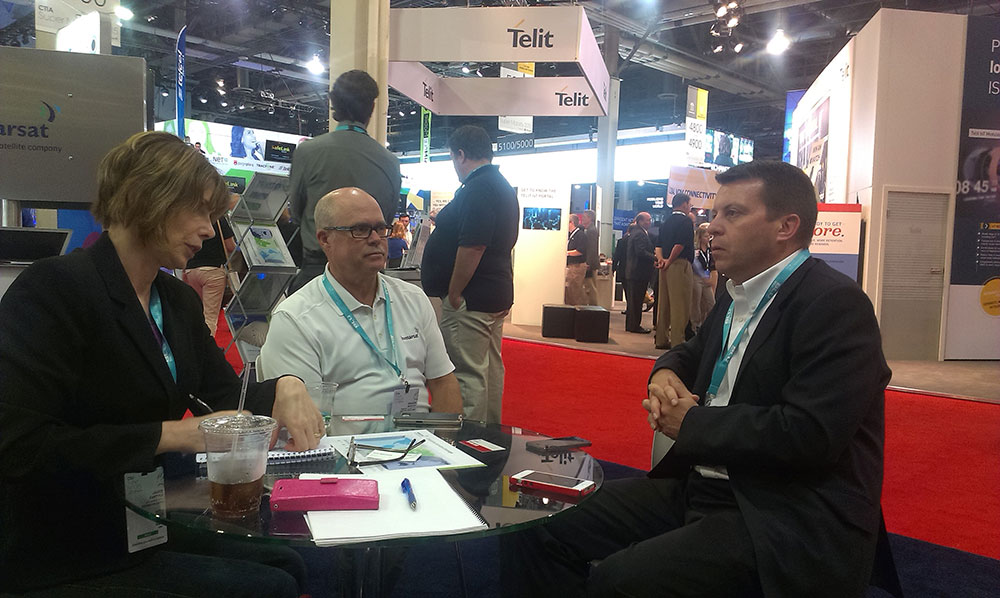
Janice visits with Chuck Moseley (center) and Don Wigglesworth (right) of Inmarsat.
Inmarsat unveiled its new machine-to-machine (M2M) and its IoT strategy, the “Internet of Everywhere.” The company is increasing use of VARs and OEMs to enable solutions that will provide more visibility and control of mobile assets throughout the world. “We are empowering existing and prospective VAR partners to offer unparalleled worldwide connectivity to their M2M and IoT customers through a single network and a single SIM,” said David Wigglesworth of Inmarsat. The company’s dedicated M2M services are IsatData Pro, a low-data-rate messaging service, and BGAN M2M, a two-way IP data service for monitoring and control of assets that require higher bandwidth capabilities.
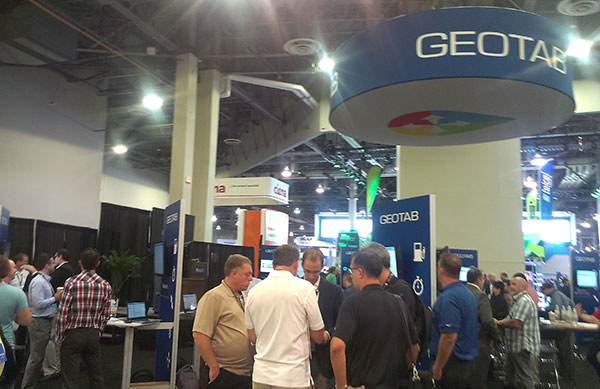
Geotab, with one of the exhibit floor’s most crowded booths, showcased the development platform of a small form-factor GPS tracking device. The Geotab GO7 device plugs directly into a vehicle’s OBDII port. Developers create applications that are available on the Geotab Marketplace. The booth was crammed with developers who offer M2M and IoT solutions.
Geotab’s booth was crowded with developers interested in the Geotab Marketplace for M2M and IoT solutions.
Microsoft’s Start-Up Alley contained interesting ventures from the Microsoft Accelerator. One young company, Parknav, offered an app for finding parking spaces based on predictive modeling, and not sensors. Users are guided to street blocks with the highest probability of available parking spaces. The app uses a number of sources, including number of parking spaces, traffic flow and undisclosed data. Parknav enables searches for free, paid and permit parking in 30 cities in Germany and a few cities in the U.S.
On a charitable note, Jimmy Whales of Wikipedia fame was at CTIA to promote his phone business, a Sprint-based MVNO cellular service. Like Wikipedia, The People’s Operator (TPO) is not a profit driven enterprise. Ten percent of a subscriber’s monthly bill goes to a charity of her choosing, and 25 percent of the company’s profits are donated to non-profits. In talking about Wikipedia, Whales cited China’s current ban of the website. Wikipedia has recently made changes to its website that make it impossible for censors to ban specific Wikipedia pages, although the entire site can be blocked, as it currently is in China.
I have parting advice for the organizers of CTIA. This year’s show was disrupted by competing events that included the iPhone 6 announcement in Cupertino. Shame on Apple, who is a member of the CTIA board. Also, CTIA had organized a virtual co-conferencing with Internationale Funkausstellung Berlin (IFA), one of the largest trade shows for consumer electronics and home appliances. The IFA event was held in Berlin the prior week and stole attention from CTIA. It isn’t all about location. Timing matters.
Telit, a global enabler of the Internet of Things (IoT), today announced that Cellocator, a Pointer Telocation division, has selected the Telit IoT Platform as the underlying IoT Cloud infrastructure for its new CelloTrack Nano system. The platform, powered by deviceWISE, automatically performs all the critical connection, management and integration functions to simplify deployments of the Nano system across markets and industries worldwide.
The CelloTrack Nano system enables real-time status monitoring of goods in transit. That includes location and a variety of critical operational sensing of the cargo or asset in real time, using a portable hub and a short range Wireless Sensor Network (WSN). The sensors monitoring capabilities include temperature, humidity, light, pressure, impact, movement, tampering and sound. It ensures continuous recording, enables event-triggered logic and “management by exceptions” through flexible programming of business rules to eliminate supply chain mistakes, avoid delays or damages and reduce insurance expenses.
“We see high demand for the CelloTrack Nano in our traditional markets and count on Telit’s platform to bring us to the new IoT market,” said Joshua Rozanski, VP sales & marketing, Pointer Telocation. “By using the scalable, comprehensive Telit IoT Platform, Pointer has been able to concentrate on the rapid creation of a compelling, market-driven end-to-end solution.”
“Pointer has been a valued customer of Telit’s modules for almost a decade and we are pleased that they have now also selected the Telit IoT Platform as the go-to-market technology solution for their newly announcement Nano system,” said Gideon Rogovsky, SVP of Sales and Marketing, Telit IoT Platforms. “The deviceWISE Ready certification offers CelloTrack Nano instant exposure across our thriving deviceWISE ecosystem and opens instant opportunities with our global network of business partners and customers.”
The Telit IoT Platform connects “things” to “apps” — integrating any devices, production assets and remote sensors with web-based and mobile apps and enterprise systems. The platform reduces risk, time-to-market, complexity and cost of deploying solutions for monitoring and control, industrial automation, asset tracking and field service operations across all industries and market segments around the world. The Telit IoT Platform offers extensive developer resources and support and a free trial can be accessed here.
 Penton’s TU-Automotive has unveiled the agenda and speaker line-up for