Tag: Iridium

  • Iridium and GPS revisited: A new PNT solution on the horizon?

    Iridium and GPS revisited: A new PNT solution on the horizon?

    How many times have you heard of a nearly 20-year-old space constellation being modified with a new technology? It almost never happens.

    I will never forget when the general slid the sensitive Iridium folder across my desk; I knew from his facial expression that he was not happy. The folder contained a controversial civilian plan to de-orbit the entire multi-billion dollar Iridium communications satellite constellation less than a year after it was launched.

    Fortunately, the folder also contained a proposed military, U.S. government (USG) and joint civilian proposal to sustain the constellation, with the only caveats being that a buyer be found and that the military and/or USG provide “indemnity” (insurance policy) for the Iridium constellation if it were to be utilized by the USG and our Allies, especially during wartime. At the time I was serving as the deputy chief scientist at Air Force Space Command headquarters. Our job was to determine the technical feasibility of both proposals and make a recommendation.

    Iridium satellites

    Replica of Iridium satellite. (Photo courtesy of Iridium)
    Replica of Iridium satellite. (Photo courtesy of Iridium)

    Launched in 1998 by Motorola, Iridium is a satellite communications constellation that is a “technological marvel,” as John Bloom writes in his new book about Iridium, Eccentric Orbits. Additionally, Iridium was and remains a capability sorely needed by the USG that in many ways revolutionized global communications — unfortunately, just not in the manner or time frame Motorola originally envisioned.

    Indeed, eventually not 66 or 77, or even 88, Iridium satellites would be launched, as you will read in many places. Rather, a total of 95 Iridium satellites have been launched to date, which should give the constellation the name Americium, since 95 is the atomic number for the element americium. But I digress.

    The problem with Iridium was not technical or even space-related. Motorola, which developed the technology and launched the constellation into low Earth orbit (LEO) — an amazing feat in so many respects — totally missed the correct marketing strategy. Motorola developed Iridium as a quick (five-year lifetime) money-making capability and profit center when in fact it proved to be a much longer term project. Today, there are Iridium satellites that are fully expected to be on orbit and fully functioning for more than 20 years.

    The original Iridium satellite was — and still is — a technological marvel that broke almost all the so-called rules for manufacturing spacecraft:

    • The satellites were built without any fully space qualified or certified parts.
    • The satellites were not built in a clean room.
    • The satellites were built “horizontally” on a moving assembly line, like automobiles, versus vertically, individually and historically as a stationery static device. The moving assembly line produced a satellite every five days by a little-known company that eventually became part of Lockheed Martin (LMCO).
    • The satellites were launched by nearly every space-faring nation that had a launch capability at the time.
    • The original Iridium satellites were built for a projected lifetime of five years — that was more than 18 years ago. The current Iridium constellation of 66-plus satellites (remember, 95 have been launched) has exceeded its projected lifetime by nearly 400 percent, and is still going strong.

    In 2010, Iridium Communications entered into a long-term agreement with Boeing for maintenance, operations and support of the satellite network. Boeing operates the constellation and provides support for Iridium’s satellite control system (SCS).

    Recently, the corporation that owns Iridium announced a global space-based capability that promises to compliment GPS and other PNT constellations.

    How many times have you heard of an almost 20-year-old space constellation being modified with a new technology? It almost never happens.

    The constellation’s legacy

    Amazingly, the only reason the Iridium constellation still exists today, in several respects, is due to the intervention of the USG and a major program that suffered a production failure. Originally Motorola contracted for an additional hosted payload that just never came to fruition. The nameless company developed an Iridium test program, on which it failed to deliver. This “major glitch” caused a weight and balance problem for the Iridium satellites, which Danny Stamp, an Iridium program engineer, solved at the time by recommending a quick fix: adding an additional fuel load of the same weight as the failed payload to the satellite. It was a simple fix just to get the satellites launched on time that no one thought much about at the time. However, the result was a key component — remaining or residual fuel — that ensures the satellites are still in orbit, and can be maneuvered and working properly today.

    As I mentioned earlier, one of the major reasons the entire Iridium constellation was not de-orbited was because the USG decided it was a necessary tactical capability during wartime for our warfighters, as well as being an amazing R&R tool for morale purposes. (The Iridium system enabled conversations with loved ones back home.)

    Add to that a civilian plan put together by some true visionaries, individuals such as Dan Colussy and corporate partners such as Boeing, that were able to purchase the entire constellation for pennies on the dollar, and you have an incredible success story.

    The result is one of the most successful — certainly the largest and most well known — satellite communication constellations ever flown. Plus, as I mentioned earlier, Iridium has proposed a brand-new capability that, if it comes to fruition, has the potential be a huge boon for GPS by serving as a key global PNT augmentation.

    The way ahead

    Just last week, Iridium announced that it is proposing, or has developed, in conjunction with other companies, an augmentation or compliment to GPS. Reuters quoted the CEO of Iridium Communications, Matthew Desch as saying the new technology used chips that were the size of a postage stamp, and could ultimately be integrated into other devices, heavy machinery, automobiles and the power grid.

    The system, known as STL or Iridium Satellite Time and Location System, transmits signals via Iridium’s satellite constellation, delivering codes to ground positions that are independently authenticated, Reuters reported.

    Both Iridium and the private firm Satelles said STL as a system has been demonstrated in military, academic and commercial applications. The Reuters article didn’t provide specific details on the exact nature of the devices or any launch customers. (Satelles and Boeing entered into a patent and technology license agreement for STL in 2013).

    Iridium NEXT, Iridium’s next-generation global satellite constellation, will support the STL solution. Iridium NEXT is scheduled for completion by late 2017. Along with supporting the current Iridium constellation, Boeing is under contract from prime contractor Thales Alenia Space to provide system integration and testing support for Iridium NEXT.

    So, while STL is far from concrete, it makes for an interesting possibility that Iridium is proposing or has apparently built an on-orbit satellite augmentation to GPS, and PNT in general. My government inquires brought the to-be-expected, “We can neither confirm or deny” response. As far as Iridium and Satelles are concerned, I suppose it is a wait-and-see proposal.

    Still, it is good to see company internal R&D funding being used to further support our global PNT infrastructure. Now that the word is out, we can look for more details on the horizon. So stay tuned. By the way, many of you may remember that this is not the first time Iridium has gone down this path; perhaps this time it will actually work.

    Yes, sometimes 18 years ago seems just like yesterday.


    Note: You can read about Iridium as a GPS augmentation solution in “Iridium/GPS Carrier Phase Positioning and Fault Detection Over Wide Areas, a paper by M. Joerger, J. Neale and B. Pervan presented at ION GNSS 2009. It is available for download per ION’s current download policies.

    Abstract: The iGPS high-integrity precision navigation system combines carrier-phase ranging measurements from GPS and low-Earth orbit Iridium telecommunication satellites. Large geometry variations generated by fast moving Iridium spacecraft enable the rapid floating estimation of cycle ambiguities. Augmentation of GPS with Iridium satellites also guarantees signal redundancy, which enables fault-detection using carrier phase Receiver Autonomous Integrity Monitoring (RAIM). Over short time periods, the temporal correlation of measurement error sources can be exploited to establish reliable error models, hence relaxing requirements on differential corrections.

    In this paper, a new ionospheric error model is derived to account for Iridium satellite signals crossing large sections of the sky within short periods of time. Then, a fixed-interval positioning and cycle ambiguity estimation algorithm is introduced to process Iridium and GPS code and carrier-phase observations. A residual-based carrier phase RAIM detection algorithm is described and evaluated against single-satellite step and ramp-type faults of all magnitudes and start-times. Finally, a sensitivity analysis focused on ionosphere-related system design variables (ionospheric error model parameters, code-carrier divergence, single and dual-frequency implementations) explores the potential of iGPS to fulfill some of the most stringent navigation integrity requirements with coverage at continental scales.


    ION Joint Navigation Conference

    The highly anticipated and always rewarding Institute of Navigation Joint Navigation Conference (ION JNC) kicks off this week, June 6-9, at the Convention Center in Dayton, Ohio, and at Wright Paterson Air Force Base.

    There are the expected technical and joint presentations, along with a classified day (U.S. only) and a Warrior Panel. It all sounds like a great time and an educational experience. Be sure to visit the National Museum of the U.S. Air Force, including the website where you can take a virtual tour; it is an amazing venue. Also take time to visit the Wright Brothers exhibits in the “Birthplace of Aviation” while you are there.

    Wright Brothers 1901 Wind Tunnel on display in the Early Years Gallery at the National Museum of the United States Air Force. (Photo: U.S. Air Force)
    Wright Brothers 1901 Wind Tunnel on display in the Early Years Gallery at the National Museum of the United States Air Force. (Photo: U.S. Air Force)

    ION always puts on a great event. I hope many of you are there to participate.

    Until next time, happy navigating, and remember: GPS is brought to you free of charge, courtesy of the United States Air Force.
  • Apple Acquires GPS Company Coherent Navigation

    Apple has acquired Coherent Navigation, according to various media reports.

    Coherent Navigation is a Bay Area GPS firm founded in 2008 by engineers from Stanford and Cornell. One of its areas of focus was high-integrity GPS (iGPS), an enhanced version of GPS that uses both normal, high-altitude GPS satellites and lower-altitude voice and data satellites from Iridium to increase the accuracy of a consumer’s GPS reading from the ground.

    The acquisition seems to be Apple’s latest efforts to bolster its mapping capabilities.

  • Aireon Plans Global Emergency Tracking Service for Aircraft

    Aireon LLC, developer of a space-based ADS-B global air traffic surveillance system, is planning the Aireon Aircraft Locating and Emergency Response Tracking (Aireon ALERT) service, a global emergency tracking service that will be provided free of charge to the aviation community beginning in 2017. The Aireon ALERT service will allow rescue agencies to request the location and last flight track of any 1090-MHz ADS-B equipped aircraft flying in airspace currently without surveillance.

    “A comprehensive, global aircraft tracking solution is essential in emergency situations, as evidenced by MH370 earlier this year and Air France 447 in 2009,” said Don Thoma, president and CEO, Aireon. “Aireon is being deployed to improve the efficiency and safety of aircraft operations in oceanic and unsurveilled airspace. The same technology behind these efficiency and safety gains can also make a significant difference in providing quick, accurate information in emergency situations. With one global view of ADS-B equipped aircraft, Aireon ALERT will provide accurate and real-time tracking data immediately to authorized search-and-rescue operations, without requiring airlines to equip aircraft with new avionics or the ANSPs and authorities to deploy new systems.”

    Aireon is deploying a global space-based ADS-B surveillance capability providing direct air traffic controller visibility of flights operating in oceanic or remote airspace, focused on improving the efficiency and safety of aircraft operations. When Aireon is fully operational, anticipated for 2017, it will create a powerful platform capable of tracking ADS-B equipped aircraft around the globe in real time.

    The Aireon ALERT service will be available soon after Aireon’s full deployment and will be provided through a 24/7 application and emergency call center. Historical track data will be available to pre-authorized users, including ANSPs, airlines, and search-and-rescue authorities, through Aireon ALERT soon after controller communications are lost with an aircraft. The system can also provide real-time tracking of aircraft in distress, provided ADS-B transmissions are still operational.

    “Tracking of aircraft in emergency and search-and-rescue situations is a complex issue,” said Cyriel Kronenburg, vice president sales and marketing for Aireon. “We plan to engage the various aviation stakeholders including the airlines, ANSPs, regulators, and search-and-rescue organizations over the next 12 months to define the technical, operational, and legal details of providing this data in emergency situations.”

    “We anticipate support from the world’s airlines for the approach taken by Aireon for emergency tracking,” said John Crichton, president and CEO of NAV CANADA. “Airlines already stand to gain over $125 million per year in fuel savings in the North Atlantic alone by using Aireon’s space-based surveillance service. The Aireon ALERT public service offers an additional benefit, free of charge, ensuring that ADS-B equipped aircraft can be tracked anywhere in the world, even in airspace managed by ANSPs that have not subscribed to the Aireon service.”

    Aireon is a joint venture among Iridium Communications Inc., NAV CANADA, ENAV, IAA, and Naviair, established to launch the Aireon system by hosting ADS-B receiver payloads on Iridium NEXT, Iridium’s second-generation satellite constellation, scheduled for first launch in 2015. This new capability will extend air traffic surveillance to the entire planet and increase the safety and efficiency of air travel over oceanic and remote regions.

  • CTIA SMW Features Large Connected Car Presence

    CTIA’s Super Mobility Week featured machine-to-machine technology, connected vehicle vendors, and a few location-based services companies. While combining its spring and fall conferences, which drew a big crowd, CTIA also tried to be everything to everyone in wireless. Meeting planners also placed the conference with conflicting dates — as the Institute of Navigation, Berlin IFA and ITS World Congress were held in the same week. One of my goals as a reporter was to make sense of a big trade show — and to limit the times an interviewee said “Internet of Things.”

    LAS VEGAS — Outside of the announcement by GM and AT&T to expand OnStar to Europe, the CTIA Super Mobility Week here featured several connected car panels, but limited location news. The action seemed to be in company backroom meetings with existing clients — or trying to find additional niche opportunities for location products.

    One company, Annapolis, Maryland-based TeleCommunication Systems, said it is proving its navigation product for the Atlanta-based AT&T Drive Studio. The company is involved in most location markets, now ranked No. 2 in terms of units deployed (second to Ericsson, according to one source), said Jay Whitehurst, TCS president, commercial software group.

    TCS’ Location ToolKit, which will be used in the 5,000-square foot AT&T Drive Studio, offers navigation, with automatic map updates, traffic, real-time gas prices, weather, movies and showtimes.

    Whitehurst said a market that is growing is e-health and mobile payments, which are both big topics at CTIA SMW and at the Barcelona Mobile World Congress. “We are developing a new product in conjunction with physicians to allow first responders to be able to reach patients who are not responsive. We are working the system into clinical workflows to provide diagnosis,” he said.

    Standards, particularly for connected vehicles and handsets that control functions, will be important as new systems and vehicles offer this technology, said Alan Ewing, Car Connectivity Consortium president and executive director.

    “Having a proprietary service is okay until someone says, ‘Hey, we don’t want to do this anymore,’ then there is a button in a car that does nothing,” he said. “We want to ensure that button is meaningful. While a lot of cars have MirrorLink built in, what happens when it disappears and consumers don’t know where to buy a compatible phone? [Consumers] don’t want three different phones for their vehicles.”

    Ewing said that despite proponents’ arguments that autonomous vehicles are here to stay, he believes it is a generational issue. “I don’t want to give up control of a vehicle. But it is a surprise to hear younger people are not even getting driver’s licenses.”

    Ford, which is not a MirrorLink member, had its inaugural developer’s conference at CTIA SMW. The developer’s conference was a big hit, with more than 200 application developers, said Douglas VanDagens, Ford global director, connected services solutions organization.


    u-blox Rolls Out New Module, Outlines Marketing Strategy

    Several companies at CTIA SMW are attempting to find niche opportunities in the crowded machine-to-machine market — and Switzerland-based u-blox is no exception. The company is focusing on the mobile, industrial and consumer-location markets, said Thomas Seiler, u-blox CEO.

    While Seiler says there is no one dominant market for u-blox, the fleet market has been very good for the company. In addition, asset tracking has been a good market, he said.

    “We are also seeing consumer markets such as e-bikes, golf carts, commercial helicopters and drones growing,” Seiler said.

    While many location companies are fretting about government regulation, u-blox is taking the position that most agency requirements have actually helped build the market. “Regulatory requirements have been driving business for us. The [National Highway Traffic Safety Administration] proposes that vehicles report location, speed and direction,” said Nikolaos Papadopoulos, u-blox America president. “The collision avoidance regulations have helped to create an ecosystem that drives business.”

    The company recently rolled out its ODIN-W160 multi-radio module for automotive, industrial, medical and security applications.

    Nick Papadopoulos, president of u-blox America, tells CTIA Super Mobility Week show-goers what they should see at the u-blox booth.

    Numerex Exec Talks Omnilink Purchase

    The recent $37.5 million purchase of offender-monitoring company Omnilink allowed Numerex to boost its presence in the tracking of prisoners, Alzheimer’s patients and children, said Kelly Gay, Numerex president, security solutions.

    “Our strategic focus is on M2M solutions — the Omnilink purchase is a perfect fit. Both companies are based in Atlanta and we have a lot of products we are working on together,” she said. “It’s been a great four months [since the acquisition].”

    Gay said Numerex is focusing on four markets, or “battlefields” for growth: solutions as a service; asset identification and tracking; supply chain delivery; and remote monitoring, which includes oil and gas, tank monitoring, water systems and tracking weather.

    LBS Companies Few and Far at CTIA…

    While there were only a handful of LBS companies at CTIA SMW, one company, Mexia Interactive, mapped the exhibit hall in the Sands Convention Center. The Winnipeg, Canada-based company is offering indoor location beacons — and has installations in four airports, with six more under contract.

    “We set up 80 sensors in this area to capture data from mobile devices, every 10 seconds, to place the information on a heat map. With this heat map, retailers can see how many people are in a registration area, patterns of who is going to booths — and who is not,” said Glenn Tinley, Mexia president and CEO.

    While Tinley says his company, which was founded in 2010, can work with both Apple and Android systems, he believes Apple is pushing Android out of the indoor market.

    At airports, both security and airlines can see how long lines are with the technology to open up new lines and distribute personnel to meet the need, Tinley said. “We can instantly send a text alert to have a new check-in line established. Retailers can do the same thing at check out,” he said. “At retailers, [long lines] represent potentially billions in losses each year.”

    Iridium Expanding M2M Market Demand

    Iridium recently reduced the price of its short-burst data receivers by 50 percent to allow its OEMs and value-added resellers to offer a product that works worldwide in areas with no cellular coverage.

    “The machine-to-machine market is one of our fastest growing [segments]. We see a combination of new services being developed,” said David Wigglesworth, Iridium vice president and general manager. “By the end of the year, we should have a push-to-talk service like the old Nextel phone.”

    Big changes are coming to Iridium and its satellite constellation. The Iridium NEXT satellite network will consist of 66 in-orbit satellites and several in-orbit spares. The constellation is expected to begin launching in 2015 and will offer greater bandwidth and data speeds when fully operational in 2017.

    “We are replacing the whole Iridium system. Space X is our launch partner — and they have been great,” Wigglesworth said. “The new constellation will allow new services. We see aviation as being a big market. The satellite industry has many niche markets.”

    In other CTIA SMW news:

    • One of a handful of antenna companies exhibiting at SMW was Ireland-based Taoglas, which says there is growth in distributed antenna systems, said Dermot O’Shea, Taoglas president. “We are seeing a huge movement to LTE,” he said. One of Taoglas’ customers is Omnilink, which uses a custom GPS antenna in its offender-monitoring product.
    • Stockholm-based Birdstep is getting into the connected car market, based on its defense experience, with future data plans that turn off when a car is stationary. “Why should consumers pay for a data plan when a car is parked 90 percent of the time?” asked Lonnie Schilling, Birdstep CEO.
    • Spirent Communications launched its Elevate Test Framework for M2M devices and services. Because of the surge in smartphone and M2M devices, the new testing device allows evaluation and performance tests to enable faster development cycles, the company said.
    • Fleet Freedom rolled out a new mobile resource-management product that works with Android, iOS and Magellan’s RoadMate fleet units at SMW. “This unit is the fourth generation. It features dispatch integrated, while most of our competitors view this as a separate product,” said Andrew Singer, Fleet Freedom general manager.
  • Harris Corp. Completes Space Qualification Testing of Hosted Payload for Global Aircraft Tracking System

    Harris Corporation has achieved a key milestone under a five-year contract with Aireon LLC that will create the first global satellite-based aircraft tracking system. The announcement was made during the SATELLITE 2014 Conference and Exhibition, held March 10-13 at the Washington Convention Center in Washington, D.C.

    The company’s Automatic Dependent Surveillance-Broadcast (ADS-B) 1090 Extended Squitter receiver payload has been successfully tested and qualified for simulated operation in the harsh environment of space for more than 12 years. Simulated performance testing also validated the agility of the payload to adapt to evolving aircraft traffic patterns over the same span of time.

    Harris is providing Aireon with 81 of the ADS-B receiver payloads. They will be hosted on board the Iridium NEXT satellite constellation to enable precise aircraft tracking that will optimize air traffic management around the world. Ground-based ADS-B networks, which process GPS signals and other data from aircraft, are limited by an infrastructure that cannot monitor flights over oceans or remote regions, a limitation now highlighted by the disappearance of a Malaysia Airlines jetliner on March 8.

    The Harris payloads are based on the company’s AppStar reconfigurable payload platform. They will be mounted on 66 low Earth-orbiting satellites, six on-orbit spares and nine ground spares that comprise the Iridium NEXT constellation. The air traffic surveillance function will be performed separately from the main mission of the spacecraft. The constellation’s main mission is providing voice and data coverage to satellite phones, pagers and integrated transceivers over Earth’s entire surface. The launch of the first Iridium NEXT satellite is planned for 2015.

    “Completion of this testing verifies that our payload design works for its intended environment and moves us into the production phase,” said Bill Gattle, vice president and general manager, National Programs, Harris Government Communications Systems. “This program exemplifies the benefits of a public-private partnership model, using commercially hosted payloads to get both government and commercial mission capabilities into space without the time and cost required to build and launch separate satellites.”

    “Harris has met or exceeded all of the major milestones in the development and test of the receiver payload for this groundbreaking program,” said Don Thoma, president and CEO, Aireon. “The combined, powerful offering our collective organizations will provide to the global air traffic community will transform air travel.”

  • Satelles Announces Patent and Technology License Agreement with Boeing

    Satelles, a division of iKare Corporation, has entered into a patent and technology license agreement with The Boeing Company. This license allows Satelles to provide timing and location solutions to commercial markets delivered over the Iridium constellation of 66 low-Earth-orbiting satellites.

    The timing and location signals are available anywhere on Earth, without the need for local infrastructure, making the system perfect for augmenting GPS and other location-based technologies, Satelles said. Unlike standard GPS, the high-power signals can reach into many building structures. The signal-in-space provides a location-specific signature that can reliably prove (or authenticate) the location of a mobile device or other equipment, while being virtually impervious to spoofing and other attacks, Satelles said.

    Gregory Gutt, CEO of iKare Corporation, stated, “After working closely with Boeing for years to create a global indoor-positioning solution, we are thrilled to be entering this license agreement, which includes over 30 issued and pending patents.”

    Michael O’Connor, CEO of the Satelles business, agreed. “We see tremendous dual use potential for the technology going forward. Indoor location is an exciting area, and we are seeing keen commercial interest in a solution that delivers trusted location for secure network communication or network transaction security.”

    Satelles is headquartered in Silicon Valley, in Redwood City, California, with an office in Ashburn, Virginia.

  • Zoning in on Assets: Cubic Global Tracking Gets Iridium Certification

    By Tracy Cozzens

    A system that tracks and monitors valuable high-risk assets for defense and commercial customers has received certification from Iridium Communications, increasing the system’s accuracy and effectiveness. The Iridium constellation of low-Earth satellites provides voice and data services for areas not served by terrestrial communication networks.

    The Global Sentinel System, by Cubic Global Tracking Solutions, tracks and monitors assets with two-way, redundant encrypted communications. The system provides up to 2,000 unique geozones for each Global Sentinel device to control precise reporting rules along the supply chain. It can monitor asset conditions including temperature, humidity, light sensing, motion, and container door status.

    The latest generation of Cubic’s Global Sentinel System provides continuous global coverage by incorporating the Iridium 9602 short-burst-data transceiver. “As an Iridium partner for the past seven years, we’ve worked closely to integrate the Iridium 9602 transceiver into Cubic’s fifth generation of products,” said Mary Ann Wagner, president of CGTS.

    Wagner said Cubic relies on Iridium to provide real-time low latency reporting on customers’ assets in areas where other modes of communication are unavailable. This capability allows for continuous global coverage for reliable secure reporting of asset position, status, and event alerts. “This is essential because of the critical nature of the assets we are tracking and monitoring for our Department of Defense and commercial customers,” Wagner said.

    Power-Saving GPS. GPS also plays an important role. With the flexibility derived from geozone attributes for GPS, Cubic can provide an optimum balance between position accuracy and power management.

    Cubic’s devices take full advantage of GPS receiver circular error probable (CEP) estimates to set accuracy limits for reporting, explained Randy Shepard, vice president of technology innovations for CGTS. While higher position accuracy may be a challenge for battery-powered units operating for years between servicing, it is often necessary to avoid false alarming for events like route deviation where position accuracy is important.

    “One of the unique features of Cubic’s devices is the aggressive manner in which we manage power for all device functions including GPS,” Shepard said. “Using the geozones that are remotely reconfigurable on the device, GPS accuracy and response time can be controlled as a function of geozone.

    “As an example, for our current GS-5B receiver used for global tracking and monitoring of shipping containers, the initial default dwell time to capture GPS position is 60 seconds. Our experience is that from a cold start we get a normal lock in less than 45 seconds. The maximum acceptable CEP is 100 meters. If a CEP of less than 100 meters is not received, we do not update position. If a CEP of less than 100 meters is received, we wait up to an additional 60 seconds to improve the CEP. Once a CEP of 10 meters or less is received, the position is captured and the GPS receiver turned off. Again, all four of these parameters are remotely reconfigurable for each of the 2,000 user-defined geozones.”

    The other GPS receiver parameter that is configurable as a geozone attribute is whether power is maintained on the receiver to retain satellite ephemeris data. If the position update interval for a geozone is more often than every 15 minutes, data back-up power is usually maintained on the GPS receiver and the satellite ephemeris data is retained. This provides and effective warm start for the GPS and usually results in a much quicker initial position lock, which saves overall power.

    To provide real-time asset tracking worldwide, Cubic’s Global Sentinel System relies on a variety of transmission links to communicate the positioning and status of an asset. Based on the location of the asset, the system selects whichever link is the most cost-effective for data transmission. This includes wireless mesh networking, cellular, or the ubiquitous global two-way coverage of the 66-satellite Iridium constellation. The Global Sentinel System relies on the Iridium network’s ability to eliminate blind spots when the asset is out of range of other routing methods.

  • Boeing Awarded Contract for GPS Enhancement Demonstration

    The Boeing Company has been awarded a $153.5 million U.S. Naval Research Laboratory contract to demonstrate High Integrity Global Positioning System (GPS) technology concepts. The contract is expected to run through 2010.

    The High Integrity GPS effort combines satellite signals from the Iridium Low Earth Orbit telecommunications system and GPS Mid Earth Orbit navigational satellites to enhance navigation availability, integrity, accuracy, and jam-resistant capabilities for warfighters.

    “High Integrity GPS is an effective near-term tool that will augment GPS satellites to provide critical new capabilities, including aggressive levels of additional anti-jam protection,” said David Whelan, Boeing Integrated Defense Systems chief scientist and vice president/deputy general manager, Advanced Systems. “Our research concluded that significant low-cost improvements to GPS can be achieved by using existing signal platforms and systems such as the Iridium constellation.”

    The need to provide a more capable GPS for warfighters stems from the increasing sophistication of hostile jamming capabilities, according to Boeing. GPS supports numerous military and civil applications, so the ability to jam the system presents a grave threat, the company said.

    “Boeing has been working over the years to find new ways to maximize the effectiveness of the GPS constellation,” said Alex Lopez, vice president, Advanced Network and Space Systems. “With this integrated approach, we can increase the value of the current system by improving its operational mission-assurance capabilities.”

    Based on its years of experience supporting the operation of the Iridium system, Boeing is able to integrate the system with GPS in a manner to create the first such combined navigation and communication “system-of-systems,” the company claimed.

    The High Integrity GPS team includes Boeing Advanced Systems and Phantom Works, Iridium LLC, Rockwell Collins, Coherent Navigation, and experts from academia.

    Iridium Satellite LLC, headquartered in Bethesda, Md., operates the Iridium constellation to provide worldwide voice and data satellite communications services for the private sector and the U.S. government. Boeing has provided Iridium with systems engineering and constellation management functions since the system became operational in 2000.

    Phantom Works is the advanced research and development unit of Boeing. Its charter is to provide innovative technology solutions that reduce cycle time and cost of aerospace products and services while improving their quality and performance.

  • Boeing Can Mix GPS with Iridium

    The Boeing Co. announced concepts for combining the GPS network with the Iridium low-earth orbit telecommunication network to improve accuracy, and signal acquisition in urban environments. Boeing executives delivered the briefing at the National Space Symposium for Pentagon and industry officials. There is no firm plan to turn it into a fielded system, however.

    “In any event, this would not obviate the need for GPS upgrades in any way,” said retired Maj. Gen. Craig Cooning, vice president and deputy general manager of space and intelligence systems at Boeing. “What it does represent is an elegant solution for augmentation of GPS.”

    According to the company, GPS signals could be acquired more quickly through amplification and rebroadcasting in a low-earth-orbit system.

    Iridium is a constellation of LEO communication satellites originally developed by Motorola Inc. in the late 1990s. When the system proved uneconomical, it was almost de-orbited early in the decade, until the Defense Department and private investors put in new money to keep the systems in orbit. The Iridium constellation would have to be replenished in order to support the IGPS concept, according to Boeing, but an upgrade of the system would be necessary in any event by 2014.

  • Leadership Talks: Is Galileo Real, or Not?

    Leadership Talks: Is Galileo Real, or Not?

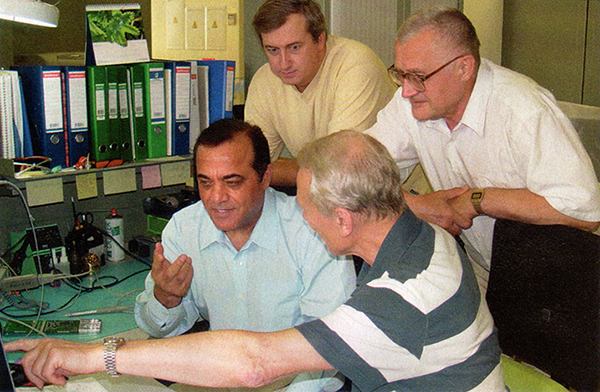
    Javad Ashjaee, front left, with colleagues in his Moscow office.
    Javad Ashjaee, front left, with colleagues in his Moscow office.

    Javad Ashjaee (JA) is president and CEO, Javad Navigation Systems. Alan Cameron (AC) interviewed him by phone at his Moscow office.

    AC: What details can you give us about the “new beginning” you mentioned in your May profile?

    JA: Things have changed a lot during the past six years. ASICs, microprocessors, and electronic technology in general have progressed significantly. These advances give us much better fundamental tools to implement new signal processing innovations and to design better and smaller products, while at the same time reducing their cost. With new GPS signals, improved GLONASS, and Galileo on the horizon, there are lots of opportunities and challenges to get me going for many years again. I phrased it as a “new beginning” because in the past six years I was not as productive as I wanted to be, due to situations beyond my control.

    AC: How do you see your “complete independence” playing out in the marketplace?

    JA: Now I can start working on GNSS technology again and hope to make a difference in this field again. The last six years were the darkest years of my professional life. The partnership that I had hoped would be a complementary force in pursuing the most innovative technologies turned out mostly frustrating, and it put stumbling blocks in the way of what I wanted to accomplish. By “complete independence” I mean the contractual limitations have expired, and I am free to pursue new technologies on my own and bring innovations to the marketplace that my team and I feel proud of.

    We have just started this new round of technical development and we are trying to define the technical directions. I hope to bring a completely new generation of GNSS products to the market in the second half of 2007. What keeps me motivated and as excited as my first attempts of 25 years ago is the level of support and encouragement that I receive from all my colleagues, friends, and even some of my competitors.

    AC: What technology challenges are you and your team tackling?

    JA: One of my technology challenges is to bring high-end Galileo into the GPS/GLONASS picture. My first decade of GNSS involved GPS, the second decade GPS+GLONASS, and in the third decade I hope for GPS+GLONASS+Galileo. Of course there are also innovations in signal processing in every one of these navigation systems. As I said earlier, enhancements in the electronic industry, as always, keep pushing us to come up with new products, similar to what you see in the computer and mobile communications industries. The life of any product cannot be longer than two years.

    I’m waiting for the Europeans to tell us what is really their plan for Galileo. I want to focus a lot on Galileo but I should admit that with Galileo I’m partially hopeful, but partially disappointed, too.

    AC: Why are you disappointed about Galileo?

    JA: I basically do not know, or I should say do not understand, the current plan of Galileo as presented; and I could not find anyone who could give reasonable answers to my questions. It is not obvious who the forces behind the Galileo project are, who is going to fund it, and who needs it to the extent that they are willing to pay for it. On several occasions, in different forums I tried to raise such questions and subsequently became convinced that unfortunately my worries and questions regarding Galileo were valid. Let me raise these questions once again here with you. I hope all my worries and suspicions regarding Galileo prove to be false and sincerely hope that Galileo to become a reality soon.

    Despite all the questions and uncertainties about Galileo, but due to good publicity, in many communities Galileo has received much more attention than GLONASS, which already has about 20–25 years of on-orbit history and currently about 16 operational satellites on orbit — and recently, with current oil prices, a solid plan to complete the system soon. Until recently many companies were trying to fight or ignore GLONASS, believing that it was not likely that Russia would complete the system. Now Trimble, NovAtel, and Leica have recently announced that they have GLONASS in their receivers, too.

    The attention given to Galileo, even before they have a first real satellite, is because of the credibility that the Europeans have earned. I hope this credibility continues to grow by providing open information to the public. Unfortunately, in my belief, so far they have not done so.

    One of the issues confronting Galileo is the explanation of its funding and management. It has been said that Galileo will be funded as a private business, but no one has ever provided a business model. When I try to guess about the structure of any business plan based on the information I have received, I conclude that it is very unlikely that it can be funded as such. The fate of Iridium — which did have a detailed business plan but overestimated its number of subscriptions — makes us more worried about Galileo, which does not even have a business plan. Iridium had the support of large, experienced industrial names like Motorola.

    Any company whose stock is being traded publicly will suffer a lot as soon as they announce involvement in any project that does not have a solid business plan. The larger the company, the more vulnerable they are to close scrutiny by stock-market analysts.

    Funding in Doubt

    In providing details on Galileo funding, it was said that most of the Galileo funding will come from bank loans. This makes the issue of a business plan much more urgent and critical for Galileo, especially given the fate of Iridium. Alternatively, the money could come from specific governments. This would easily put an end to the discussion of private funding and give much hope to all of us. I hope this will happen soon.

    There are several other flaws in Galileo’s private financial planning. First, GPS tried to make itself a self-funded program but quickly concluded that it was not feasible. Second, if GPS authorities were wrong, and it could have been done as a self-funded project, now with GPS being offered for free, Galileo has a much tougher time to make it as a private enterprise. Note that GLONASS is also there for free. Can you start a pizza business, when you know the guy next door is giving away pizza for free?

    Third, it is extremely unlikely that anyone will buy Galileo-only receivers, which means Galileo wants to piggy-back itself on GPS and receive money from the operational GPS. In our pizza example, imagine that your pizza shop can sell its pizza only if it can add slices of pizza from the free shop next door! Clearly the shop next door will stop providing you free pizza if it sees you are making money — or it will at least want its share of the profit.

    The progress in GLONASS, also offered free of charge, makes it even harder for Galileo’s private plan to succeed. With 30 GPS and 24 GLONASS satellites, at any given instance we have more than 14 visible satellites. The critical number to have reliable and robust RTK is something like 10 satellites. The additional Galileo satellites are a plus, but the European system cannot survive if it bases its financial plan on riding on the shoulders of GPS (or GPS+GLONASS).

    It short, the Galileo private funding scheme assumes free support from GPS — which means Galileo assumes that U.S. tax payers will continue to fund Galileo.

    I am certain that even if GPS authorities do not object, the U.S. taxpayers will. U.S. citizens and organizations like the U.S. GPS Industry Council will take the issue to the proper authorities.

    By collecting the first license fee from users or manufacturers, Galileo authorities open the door for large international disputes that put the fate of Galileo in question and raise the issue of customer liability, if it is going to be modeled financially as I mentioned earlier.

    In the private business model of sharing profit with GPS, Galileo will be at a disadvantage for many years until they have operational satellites comparable to GPS.

    The current situation of Galileo, as I see it, is that some independent and mostly research-oriented organizations have been able to collect enough money to define signals. We have seen some published information, such as Günter Hein’s article in GPS World (“Galileo Signal and Frequency Design,” June 2003) on the signal structure. But now when the ICD is published, the signal structure is drastically different.

    The Military Question

    Similar to GPS and GLONASS, the need for Galileo mostly comes from military establishments and markets. The two recent wars showed that the benefits of satellite navigation systems are no longer a luxury, but a necessity for any country that possesses a certain level of modernized military. The French government needs its own navigation system to independently market its Exocet missiles and Mirage 2000, for example. The Chinese government also has need for such systems, and this could be the reason that they push to fund and participate in the Galileo project.

    Does this mean France will break from NATO and join forces with China? This brings us to the very difficult question of international alliances, much more serious than the financial and funding issues that I raised earlier. I find it unlikely that the United Kingdom may want an independent navigation system separate from the United States. France may be the only major country that is willing and can afford to fund such system. This is an extremely difficult issue. I cannot think of any country in Western Europe that is pushing for the breakup of NATO.

    This is an order of magnitude more difficulty than money. This is an issue of East-West alignment, and the breakup of NATO, which has many more consequences.

    It is very simple-minded if we think Paris taxi drivers are pushing to have their own system because they do not trust the United States!

    Although the European military should be most concerned about the future of Galileo, they have been absent from all the Galileo conferences that I have attended. The only European military uniforms I have seen were those of a German Air Force brass band that played Mozart songs at the Munich ENC-GNSS conference.

    At best, it seems that some large European companies have teamed up to lead the Galileo project and keep space, control, and user segments under their management and control, and then try to attract money from military sources. This scenario also does not seem to have much chance of success. It is unlikely that military organizations will allow leadership and control of their vital navigation systems to remain in private-sector hands. Under any circumstances, the military organizations will be the real force behind the Galileo even though they may hide it publicly, at least for a while.

    Galileo’s best chance of success is for the French government to pay all or at least most of the costs, and not depend on support from other countries who do not have much vital interest and dependence on a new navigation system. I hope this will happen sooner rather than later.

    Galileo is not going to delay because of technical issues. There is no problem for the Europeans to have a good signal structure, or to launch good satellites. There is enough intelligence in Europe, they can solve those quickly. Financial and, more important, political issues will determine the future of Galileo.

    Will Galileo happen or not? I have no answer. I had a chance to share my thoughts with several prominent authorities. They mostly agreed with my concerns but they said it was politically incorrect for them to even discuss these sensitive issues.

    To go forward, I will work on Galileo and will assume that the Galileo authorities will work with the GPS authorities and will make a playing field such that U.S. GPS manufacturers can have the same benefits from Galileo that Europeans have from GPS. Previously we followed the information that was released unofficially by Galileo (by semi-official authorities) and we made chips to track those signals. Next we will follow the new ICD and we will make receivers based on it.

    Meanwhile we will try to tap whatever legal authorities, the GPS authorities in the U.S., to help us make the playing field level, to make the Europeans give us the same prompt access to information that they give to European organizations, without any charge.

    The United States has been so generous and so open in providing complete and honest GPS information to all, that the first GPS satellite was actually tracked in the UK. Dr. Brad Parkinson noted this point in his keynote speech at the European Navigation Conference in Manchester.

    I was so hopeful and supportive of Galileo in the article I wrote for you some months ago. But as I tried to find information regarding the future of Galileo, I developed serious concerns. I pray for Galileo to become a reality soon.

    AC: What percentage of Javad Navigation Systems’ annual budget is devoted to research and development?

    JA: We do not have a fixed percentage. Developing technology is our first priority and has always been a priority for me. We spend whatever it takes to have the best technology, even if we have to borrow money — though we have never had to. Probably this has been the reason that in all my history of involvement with GPS, the past 25 years, we were profitable every single quarter, because our focus was spending on technology, and giving priority to it. I don’t think there is any other GPS company in the world that can claim profitability for every quarter for 25 years. Our cumulative annual growth in each company was 45 percent. Currently we have a staff of over 100. Our Advanced Theoretical Design team alone consists of more than twelve professors and scientists with more than 200 person-years of experience.

    AC: How can we best navigate the next years of new signals, structures, and so on?

    JA: The main thing is that we request all U.S. GPS authorities to help to make this a level playing field.

    If the Galileo authorities really intend to combine GPS with Galileo for commercial markets, they’d better be as gracious and open as GPS authorities were to them.


    Iridium

    Iridium communications service was launched on November 1, 1998, and went into Chapter 11 bankruptcy on August 13, 1999.

    The system was originally to have 77 active satellites (later reduced to 66) to enable worldwide voice and data communications using handheld devices. Its financial failure was largely due to insufficient demand for the service. The system is currently being used extensively by the U.S. Department of Defense for its communication purposes.