Tag: LightSquared

  • The System: NTIA, FCC Waiver No More on LS

    “We conclude that LightSquared’s proposed mobile broadband network will impact GPS services and that there is no practical way to mitigate the potential interference at this time.” These words from Lawrence Strickling, U.S. assistant secretary for communications and information and head of the National Telecommunications and Information Administration (NTIA), appear to signal the end of LightSquared’s run.

    Strickling’s letter to Federal Communications Commission (FCC) chairman Julius Genachowski appeared in public on February 14. Later that same day, FCC spokesperson Tammy Sun released a statement from that agency that “the Commission will not lift the prohibition on LightSquared,” and that it plans to “vacate the Conditional Waiver Order, and suspend indefinitely LightSquared’s Ancillary Terrestrial Component authority.”

    The NTIA and the FCC share responsibility for controlling U.S. radio spectrum use. The FCC supposedly has final authority in these matters, although the NTIA, representing government interests, may swing the bigger cat in the room. LightSquared’s inability to satisfy the requirements of the Federal Aviation Administration (FAA), coupled with unremitting frowning and glowering from the Department of Defense, may have been the deciding factors — more so than the uproar among most GPS manufacturers. The FAA and the U.S. military, two key government entities with widely fielded GPS equipment and applications, constituted the backbone that the NTIA finally showed, although the military has been, with one notable exception, silent on the issue, and indeed is not mentioned in the NTIA letter.

    Strickling’s eight-page letter recaps the history, with a July 6, 2011, early climax: “Test results demonstrated that LightSquared’s then-planned deployment of terrestrial operations posed a significant potential for harmful interference to GPS services.” He relates further NTIA testing of cellular GPS receivers, joint continued analysis by FAA and LightSquared of impact on aviation receivers, and testing of general/personal navigation GPS receivers by the Executive Steering Group of the Interagency National Executive Committee for Space-Based Positioning, Navigation, and Timing (EXCOM).

    Strickling quotes a January 13 letter from Ashton Carter, deputy secretary for defense, and John Porcari, deputy secretary for transportation: “It is the unanimous conclusion of the test findings by the EXCOM agencies that both LightSquared’s original and modified plans for its proposed mobile network would cause harmful interference to many GPS receivers. Additionally, an analysis by the FAA has concluded that the LightSquared proposals are not compatible with several GPS-dependent aircraft safety-of-flight systems. . . There appear to be no practical solutions or mitigations that would permit the LightSquared broadband service, as prosposed, to operate in the next few months or years without significantly interfering with GPS. As a result, no additional testing is warranted at this time.”

    But Wait. We’re not done yet. Strickling calls for GPS receiver standards to be developed, citing the EXCOM’s decision that “federal agencies will move forward this year to develop and establish new GPS spectrum interference standards that will help inform future proposals for non-space commercial uses in the bands adjacent to the GPS signals.”

    NTIA and PNT EXCOM will devise “standards for the development and procurement of GPS receivers to support their various mission requirements.” NTIA recognized “the importance that receiver standards could play as part of a forward-looking model for spectrum management even beyond the immediate issue of GPS.”

    The FCC, in its concurrence statement to the NTIA letter, begins by reciting the mantras of “economic growth, job creation, and to promote competition . . . freeing up spectrum for mobile broadband,” and gradually works its way around to its decision on the waiver. This signals an ongoing commitment to make further efforts towards broadband implementation.

    In-Car Nav Under Safety Scrutiny

    The U.S. National Highway Traffic Safety Administration (NHTSA) proposed voluntary guidelines for car manufacturers on February 16, including a recommendation to design dashboards so that distracting devices are automatically disabled unless the vehicle is stopped and the transmission is in park. The agency is concerned about proliferation of text messages, GPS images, phone calls, and web surfing, and wants carmakers to curb those distractions when vehicles are moving.

    Technological advances, among them GPS-enabled navigation, have raised concerns that drivers’ attention is being diverted too much from the road.

    “We recognize that vehicle manufacturers want to build vehicles that include the tools and conveniences expected by today’s American drivers,” said NHTSA Administrator David Strickland. “The guidelines would offer real-world guidance to automakers to help them develop electronic devices that provide features consumers want without disrupting a driver’s attention or sacrificing safety.”

    Under the guidelines, GPS and other navigation devices that provide directions would be permitted while driving, but NHTSA asks that they be designed so that drivers can’t manually enter a destination unless the car is in park. A spokesperson for the Alliance of Automobile Manufacturers cautioned against this. “There are often passengers in the car who can enter addresses, so we need to consider that when looking at requiring these technologies to only be used in park,” she said. “And if the GPS is disabled when moving, consumers can always bring their own Garmin into the vehicle. It’s complicated.”

    Other dashboard technologies recommended for automatic disabling include text-messaging, Internet browsing, social media browsing, phone dialing and computer screen messages of 30 characters or more that are unrelated to driving.

    Manufacturers are also urged to revise in-car designs to reduce to two seconds or less the amount of time drivers must divert their eyes from the road to use a device. Devices should also be designed so that drivers don’t have to use more than one hand or glance through extraneous information.

    A spokesperson for state highway safety offices said that “the safest thing is for drivers not to use these systems at all — both hands on the wheel and the mind focused solely on driving.”

    The process for writing actual federal rules often takes years to complete. The guidelines represent a way “ to continue the drumbeat” that distracted driving is a serious safety issue that costs lives.

    NHTSA is also considering guidelines to address portable electronic devices drivers carry with them into cars, including GPS navigation systems.

    SSTL-OHB to Build Eight More Galileo Satellites

    European Commission Vice President Antonio Tajani announced in London that the consortium led by OHB System AG and Surrey Satellite Technology Ltd. (SSTL) will build a further eight satellites for the European Union’s Galileo satellite navigation program under the supervision of the European Space Agency.

    The new contract will see SSTL, builder of the GIOVE-A satellite, continuing its role as payload prime, assembling, integrating, and testing the navigation payloads in the UK, while OHB System, as the prime contractor, builds the eight satellite platforms and executes final integration of all the satellites in Germany. The SSTL-OHB partnership is already building 14 satellites for the Galileo program and will draw on its heritage and experience to produce the additional satellites to demanding schedules.

    SSTL is assembling the Galileo program payloads at its recently opened purpose-built Kepler technical facility in Guildford, UK. SSTL will manufacture the electrical harnesses and the electronics to interface the navigation payload with the satellite platform.

    The remaining payload equipment will be externally procured by SSTL from European and other suppliers. SSTL’s payload solution is based on European-sourced atomic clocks, navigation signal generators, high-power traveling-wave tube amplifiers, and antennas, and will provide all of Galileo’s services.

    Compass Poised

    As this magazine goes to press, a new GNSS satellite may simultaneously be rising. The Chinese government issued a Notice to Airmen (NOTAM) for a satellite launch on, February 24,  at about 16:20 UTC. According to web reports, the launch from the Xichang Satellite Launch Center will orbit the fifth geostationary satellite in the BeiDou-2/Compass constellation.

    Funding Affirms NextGen; Unmanned Flight Advances Also

    For the last five years, the Federal Aviation Adminstration (FAA) has made do with 23 short-term funding appropriations from Congress, but on January 30, congressional leaders agreed on a four-year, $63 billion funding bill. The funding will accelerate the creation of the NextGen (Next Generation Air Transportation System) air traffic control system. A new post will be created — the Chief NextGen Officer — to oversee the effort, and a schedule for progress will be set.

    A key piece of NextGen includes GPS-enabled Required Navigation Performance (RNP), which allows an aircraft to fly a specific path between two 3-dimensionally defined points in space.

    The bill also assures funding subsidies for rural airports at $190 million a year. New labor rules will make it harder for airline employees to unionize, requiring half the workers in a bargaining unit to petition for a vote to certify a union, an increase from the current 35 percent.

    “All of us at this table made compromises,” Sen. Jay Rockefeller, D-W.Va., chair of the Senate’s transportation committee, told USA Today. “The outcome is that we have a bill that will take steps to modernize our air traffic control system, make the air transportation system safer than ever, and make certain small communities have access to critical air service.”

    Unmanned Aircraft. Congress also passed legislation starting the clock on a number of deadlines the FAA must meet to safely integrate unmanned aircraft systems (UAS) into the national airspace system. Chief among them is a deadline for full integration by September 2015.

    Using GPS to underlie the whole concept, the UAS industry has made significant technological advancements during the last decade, and the legislation recognizes the important role UAS will play in the future air transportation system.

    Michael Toscano, president of the Association for Unmanned Vehicle Systems International (AUVSI) said, “UAS are truly a revolutionary-type technology, and I’m confident that once people can fly UAS in the national airspace for civil and commercial purposes, such as oil and pipeline monitoring, crop dusting, and search and rescue, a whole new industry will emerge, inventing products and accomplishing tasks we haven’t even thought of yet.”

    Other major provisions of the bill include:

    • Requiring six UAS test sites within six months (similar to the language in the already-passed Defense Authorization bill);
    • Requiring small UAS (under 55 pounds) be allowed to fly in the U.S. Arctic, 24-hours-a-day, beyond line-of-sight, at an altitude of at least 2,000 feet, within one year;
    • Requiring expedited access for public users, such as law enforcement, firefighters, emergency responders;
    • Allowing first responders to fly very small UAS (4.4 pounds or less) within 90 days if they meet certain requirements.

    The goal is to grant law enforcement and firefighters immediate access to start flying small systems to save lives and increase public safety.

    Spectrum Swamp

    On January 30, the same day that a LightSquared VP told an Institute of Navigation audience that moving to a different spectrum posed formidable difficulties, a company working on behalf of LightSquared contacted a Department of Defense official to discuss just such a spectrum swap.

    The McChrystal Group, led by retired four-star general Stanley McChrystal, contacted the Department of Defense’s Mid-Atlantic Area Frequency Coordinator at Pawtuxet River, Maryland, to discuss “a spectrum swap.”  The McChrystal representatives indicated interest in the upper 10 MHz (1515–1525 MHz) of the Aeronautical Mobile Telemetry band (1435–1525 MHz). This spectrum is vital to the development and test of aircraft and weapon systems, for both government agencies and industry, is heavily scheduled and utilized, and is also used for safety of life services (see “Letters to the Editor” in this issue, page 8).

    Moving LightSquared’s license to a different radio frequency spectrum has been suggested by some as a possible exit strategy from the LightSquared/GPS interference conflict. At least one wireless industry analyst has surmised that this  constituted a part of LightSquared’s strategic plan all along.

    A source familiar with the situation contacted GPS World after this story appeared online to say that “a swap would be complicated but never ‘insurmountable.’  The bottom line is that [LightSquared’s VP] did not talk about swaps of any specific spectrum. He talked about the difficulty to get a wireless company up and running, and if you’ve got something that has spectrum, technology, and a successful business model, then that’s very rare, and you can’t necessarily duplicate it. But he said nothing about whether a swap of some specific kind of spectrum could be done. If the parties are willing, it’s actually not that hard.”

    Nevada OKs Unmanned Driving

    Nevada became the first state in the nation to authorize the use of autonomous vehicles on its roadways.

    Manufacturers are developing vehicles that could allow a motorist to plug in a destination and let the vehicle drive there automatically. Google has several prototypes, logging more than 160,000 test miles.

    The Nevada Department of Motor Vehicles will formalize licensing procedures for companies that want to test their vehicles in the state.

    General Motors has run several tests, some in conjunction with Carnegie-Mellon University on a self-driving Chevrolet Tahoe, The Boss. BMW has several test vehicles in operation, as does Audi in collaboration with Stanford University. Many of these cars, or their predecessors, have participated in DARPA Grand Challenges, reported in this magazine.

    SVN-49 Broadcasting on L-Band

    GPS satellite SVN-49 began transmitting an L-band signal on or about February 2. SVN-49 is currently being used as a vehicle of opportunity for satellite subsystem testing. However, SVN-49 is declared unusable until further notice, and will not be included in the broadcast almanac.

  • Expert Advice: Thank Your Lucky Stars

    Eric Gakstatter
    Eric Gakstatter

    In my 20-plus years of involvement in the GPS/GNSS industry, nothing has come close to the LightSquared debate for technical and political complexity, nor for potential effects on nearly every high-precision GPS/GNSS user in the United States. The industry’s destiny is somewhat controlled by a federal agency that is not very knowledgeable about how, when, and where GPS is used — although I’m sure they’ve learned a lot in the last 14 months.

    While receiver manufacturers have a firm grip on the technical complications of what LightSquared proposed, they have jockeyed for market position, as information released to the public is filtered through their marketing heads. Finally, media coverage is all over the place, from “LightSquared is doomed” to “this will happen.”

    On January 13, as we all know, the U.S. deputy secretaries for defense and transportation wrote, on letterhead of the Space-Based Positioning Navigation & Timing National Executive Committee (PNT EXCOM), to the head of the National Telecommunications Information Administration (NTIA), declaring that “there appear to be no practical solutions or mitigations that would permit the LightSquared broadband service, as proposed, to operate in the next few months or years without significantly interfering with GPS.”

    On February 14, the NTIA director wrote to the Federal Communications Commission (FCC) chairman in a similar vein with nearly the same language. That same day, the FCC stated its intent to “not lift the prohibition on LightSquared,” and to “vacate the Conditional Waiver Order, and suspend indefinitely LighSquared’s Ancillary Terrestrial Component authority.”

    It just so happens that LightSquared cannot accomodate military GPS users nor aviation GPS users. Those of you who use high-precision GPS can thank your lucky stars that the military and aviation folks are standing in your corner. Otherwise, as I warned back in May of last year, high-precision users would have been thrown under the onrushing bus of national broadband.

    In testimony to a House of Respresentatives subcommittee meeting on GPS and aviation in early February, the Transportation deputy secretary revealed that the Federal Aviation Administration (FAA) spent more than $2 million of taxpayer dollars with two different independent labs to conclude that LightSquared proposals were not compatible with several GPS-dependent air safety-of-flight systems.

    Don’t expect the Department of Defense (DoD) ever to provide similar testimony. The Pentagon played its veto card off-air and out of the public eye.

    LightSquared has continued to complain about GPS receivers “looking into our spectrum” as the reason for the interference GPS receivers are suffering. If you missed Richard Keegan’s December 2011 article in GPS World, you should take a look. He succinctly addresses this issue, as I did in my November 2011 Survey Scene column.

    As LightSquared has clearly lost the engineering argument, it has taken a very creative approach in an attempt to convince the FCC that this isn’t an engineering problem, but rather all about the FCC rules. LightSquared petitioned the FCC to confirm that “GPS devices are not entitled to protection from interference.”

    Crazy statement? If you think so, see if you recall reading this statement on equipment such as GPS receivers. It is on almost every electronic device that relies on radio signals.

    “This device complies with Part 15 of the FCC Rules. Operation is subject to the following two conditions:

    “(1) This device may not cause harmful interference, and (2) this device must accept any interference received, including interference that may cause undesired operation.”

    What if LightSquared can convince the FCC that GPS receivers do, indeed, fall within the confines of Part 15 of the FCC rules and aren’t entitled to interference protection? That’s what the company is trying to do, and that’s why this fight ain’t quite done.

    Don’t underestimate the power of the White House pushing the National Broadband Plan, or of commercial interests — of which there are myriad — seeking to turn a buck on the hunger, whether real or only perceived, for limitless broadband. Even the transportation depsec allowed in his testimony as how “in the Obama administration, we believe deeply in what LightSquared is attempting to do, which is to make the Internet more accessible to more people all across the country. This is an urgent national priority.”

    Communications for My RTK

    Some people in the GPS industry who believe that the LightSquared service will do wonders for RTK operations, somehow replacing the communications methods we currently use (UHF/VHF, 900MHz, GSM/GPRS, CDMA, Wifi/Mifi, etc.). I disagree.

    LightSquared was relying on Sprint’s infrastructure (~31,000 towers) for its terrestrial operations, supplementing them with ~3,400 LightSquared towers at some point. I’ve used Sprint’s mobile phone service for about 12 years and I used Sprint’s data card service for several years (not any longer). I pretty much know that Sprint is good for metro areas and poor for rural areas. Like other wireless providers (AT&T, Verizon, T-Mobile, etc.), Sprint is strong in some geographic areas, and weak in others. Since LightSquared is focused on serving people (densely populated areas) rather than geographic areas (e.g., farmlands), their terrestrial service is not going to be even close to being nationwide. LightSquared’s solution for areas not covered by their terrestrial service is to use satellite communications for Internet connectivity.

    If you think you would enjoy ubiquitous coverage with satellite communications for your RTK operations, consider OmniSTAR’s service, which is in the same spectrum as what LightSquared proposed. OmniSTAR works great when there’s a clear view of the sky to one of OmniSTAR’s satellites (ironically, operated by LightSquared) such as in the agriculture industry. But I’ve used it a bit and — just like GPS — it doesn’t work in buildings, in vehicles, under trees, or in other obstructed-sky locations.

    Can you imagine using a LightSquared mobile phone that doesn’t work in buildings, in cars, or under trees? You wouldn’t. Anyone who’s ever used RTK knows that spotty base/rover communications is the quickest way to spoil an RTK party. With GPS/GLONASS receivers allowing us to use RTK in places where we’ve rarely ventured before, the limitation wouldn’t be the number of navigation satellites in view, but rather if the LightSquared satellite was in view.

    For those of you who heard that LightSquared might have been a good idea in order to make wireless mobile Internet access more affordable, I seriously doubt that statement as well. Documents in a huge Freedom of Information Act release by the FCC reveal what LightSquared was planning to charge its wholesale customers (not retail) when they were out of range of the terrestrial system and forced to use LightSquared’s satellite for wireless broadband. The wholesale cost of their satellite broadband service was to be $10 per megabyte (not gigabyte), an astonishingly high price for a company that’s been touting affordable, nationwide wireless broadband Internet service.

    Upgrade Costs

    A cool $2.4 billion was the official estimate given for aviation industry upgrades, should LightSquared have gone forward. I think that’s conservative because I doubt it covers the infrastructure upgrade cost (WAAS, GBAS, and so on) or the cost of NextGen program delays.

    How about something closer to home? I queried the administrator of a statewide RTK network of 103 GNSS reference stations, and used his estimates to extrapolate national costs in that regard: 7,000 CORS receivers across the United States. They look like this: optimistic scenario, $64 million; likely,$92 million; worst-case scenario, $120 million.

    Keep in mind that this is only the high-precision GPS/GNSS infrastructure in the United States. There are still hundreds of thousands of high-precision GPS/GNSS receivers owned by users across the country that would have to be upgraded. For many GPS receivers (think handheld), there will be no upgrade solution, so the manufacturer might offer trade-in credit for a new GPS receiver.

    After spending time to understand the actual costs of accomodating LightSquared, one state legislator who initially voiced his support for LightSquared said “we can’t afford it.”

    New Beginnings

    Included in the NTIA report was a recommendation that, with time, GPS receivers could be redesigned in order to accomodate LightSquared’s 10L signal.

    NTIA also reported that during the January 13 EXCOM meeting, it was agreed that “federal agencies will move forward this year to develop and establish new GPS spectrum interference standards that will help inform future proposals for non-space commercial uses in the bands adjacent to the GPS signals and ensure that any such proposals are implemented without affecting existing and evolving uses of space-based PNT services vital to economic, public safety, scientific, and national security needs.”

    In summary, GPS/GNSS receiver designs will change in the coming years and move towards more efficient use of spectrum. To me, a critical statement in the NTIA letter to the FCC is “without affecting existing and evolving” — meaning that not only should GPS be considered, but also GPS-like systems from other countries such as Russia’s GLONASS, Europe’s Galileo, and other developing satellite navigation systems and applications.


    ERIC GAKSTATTER is contributing editor for survey of GPS World, and editor of Geospatial Solutions.

  • Brave New World of Data via the Cloud

    The frightening thing about the Mobile World Congress in Barcelona, the bloody awful frightening thing is the sheer amount of data talked about, enthusiastically envisioned, planned for. Planned for in the sense of throwing up business cases and wheeling and dealing new products and services for millions and billions of users that will pump vast amounts of data, countless numbers of gigabytes, terabytes, petabytes, exabytes per second through the cloud.

    Not planned for in the sense of actually making provision for.  Seeing if there’s enough resource on hand. Calculating if the ecosystem will handle it.

    No, wireless carriers and everyone else involved in this industry make money on data. So let’s make, make, make, more, more, more.

    Did anyone happen to estimate the amount of bandwidth needed to upload and download all this data? Has anyone thought about what pressure it might bring on other spectrum users such as, perhaps, GNSS?

    My guess is no, and no, and we don’t care. Because we are creating the future, don’t you see?!!?

    From this brave new world sprang LightSquared, born of the ravenous need for more wireless data. It doesn’t take much time at the Mobile World Congress to see that venture as just the first very tentative probe. Armies are massed at our borders.

    I didn’t get to location as a blue-chip commodity, as promised yesterday. That will have to come tomorrow.

  • Gakstatter to Discuss LightSquared on America’s Web Radio February 27

    Eric Gakstatter, Survey Scene and GIS editor, along with Gavin Schrock (Administrator, Washington State Reference Network) and Laurence Socci (ACSM/NSPS Government Affairs Consultant) will be guests on America’s Web Radio on Monday, February 27, at 11 a.m. Eastern Time to discuss the latest developments in the LightSquared/GPS interference debate as well as other GPS/GNSS issues.

    The one-hour program is hosted and moderated by American Congress on Surveying and Mapping’s (ACSM) executive director Curt Sumner.
    You can listen to the radio broadcast by visiting America’s Web Radio website. The show will also be recorded and available on the ACSM and GPS World websites for download.
    ACSM, with its largest Member Organization being the National Society of Professional Surveyors (NSPS), was founded in June 1941 and is incorporated as a non-profit educational organization whose goal is to advance the sciences of surveying and mapping and related fields, in furtherance of the welfare of those who use and make maps. ACSM also encourages the development of educational programs and supports publications that represent the professional and technical interests of surveying and mapping. The society is comprised of four independently incorporated Member Organizations which include more than 5000 surveyors, cartographers, geodesist, and other spatial data information related professionals from private industry, government, and academia throughout the world. Each member Organization serves the specific interests of their respective members, while working collectively to achieve the overall goals of ACSM.
  • LightSquared Snuffed by NITA, FCC

    The more than year-long battle between wireless start-up LightSquared and the GPS industry peaked earlier this week when the National Telecommunications and Information Administration (NTIA), tasked by the Federal Communications Commission (FCC) to study the potential interference problem between LightSquared’s mobile wireless proposal and GPS receivers, issued a statement and report with the following conclusion:

    “The federal agencies and LightSquared have invested significant time and resources to identify and analyze proposed solutions to address the impact of LightSquared’s planned network implementations. Based on the testing and analyses conducted to date, as well as numerous discussions with LightSquared, it is clear that LightSquared’s proposed implementation plans, including operations in the lower 10MHz would impact both general/personal navigation and certified aviation GPS receivers. We conclude at this time that there are no mitigation strategies that both solve the interference issues and provide LightSquared with an adequate commercial network deployment.”

    Read the entire letter from the NTIA to the FCC here (pdf).

    Read the NTIA technical report here (pdf). 

    The FCC subsequently issued a statement including the following paragraph:

    “NTIA, the federal agency that coordinates spectrum uses for the military and other federal government entities, has now concluded that there is no practical way to mitigate potential interference at this time. Consequently, the Commission will not lift the prohibition on LightSquared. The International Bureau of the Commission is proposing to (1) vacate the Conditional Waiver Order, and (2) suspend indefinitely LightSquared’s Ancillary Terrestrial Component authority to an extent consistent with the NTIA letter. A Public Notice seeking comment on NTIA’s conclusions and on these proposals will be released tomorrow.”

    As promised, the FCC subsequently opened a Public Notice seeking comments based on NTIA’s report and conclusions. View the Public Notice here. Public comments close on March 1, 2012. If you have invested in GPS technology, you should enter your comments to protect your investment.

    Submitting your comments to the FCC only takes five minutes. You don’t need to write an essay. Just state that you support the NTIA’s conclusion.

    You can compose your comments in a text editor like Notepad, then save the file and attach it. Once you go to the FCC comment submission website, it will make sense. If you have any problems, email me.

    1. Go to the FCC comment submission website by clicking here.
    2. Type in the following information:
    • Proceeding Number: 11-109
    • Name of Filer: Enter your name
    • Address Line 1: Enter your address
    • City: Enter your city
    • State: Enter your state
    • Zip: Enter your zipe code
    • Attach your comments

    That’s it. Five minutes and you’re done.

    You might have heard about another Public Notice that the FCC issued regarding LightSquared. It is in response to LightSquared’s petition to rule that GPS receivers are not entitled to interference protection. I wrote about it last week. You can read my article here. At that time, I was planning to submit my comments, but that was before the NTIA released its report and conclusions this week. I wouldn’t suggest you not enter a comment to the earlier Public Notice, but certainly I’d focus on entering comments on the latest Public Notice in support of NTIA’s report and recommendations.

    For those of you who heard that LightSquared might have been a good idea in order to make wireless mobile Internet access more affordable, I have serious doubts about that statement. Here’s why…

    Borrowing from my article last week, LightSquared is relying on Sprint’s infrastructure (~31,000 towers) for its terrestrial operations, and supplementing them with ~3,400 LightSquared towers at some point. I’ve used Sprint’s mobile phone service for about 12 years, and I used Sprint’s data card service for several years (not any longer). I pretty much know that Sprint is good for metro areas and poor for rural areas. Like other wireless providers (AT&T, Verizon, T-Mobile, etc.), Sprint is strong in some geographic areas, and weak in others. Since LightSquared is focused on serving people (densely populated areas) rather than geographic areas (e.g., farmlands), their terrestrial service is not going to be even close to being nationwide. LightSquared’s solution for areas not covered by their terrestrial service is to use satellite communications for internet connectivity. If you want to know more about this, read Tim Farrar’s blog on the subject, which includes a map of LightSquared’s terrestrial coverage. I’ve asked LightSquared for the most current deployment map, but received no response. I’ve been unable to find it even in their FCC filings (maybe you can), but I have to believe that if it was something to be proud of, they would be showing it to everyone.

    Furthermore, in a huge FOIA (Freedom of Information Act) document release last week by the FCC, documents reveal what LightSquared was planning to charge their wholesale customers (not retail) when customers were out of range of their terrestrial system and forced to use LightSquared’s satellite for wireless broadband. The wholesale cost of their satellite broadband service was to be $10 per megabyte (not gigabyte), an astonishingly high price for a company that’s been touting affordable, nationwide wireless broadband Internet service. If you want to read for yourself, click here. You can read about LightSquared’s objections to the FOIA document release here.

    LightSquared bankruptcy looming?

    Of course, after the NTIA issued its report and conclusions this week, there were many rumors that LightSquared would soon declare bankruptcy. In response, LightSquared financier Phil Falcone told Reuters “It is clearly not on our table” and that “There are other ways around this.”

    Other rumors include a proposed spectrum swap that GPS World reported two weeks ago. Although it’s tough to rule out anything, this would be quite a stretch, especially for the spectrum mentioned in the GPS World article (1515-1525 MHz) since it’s still close enough to LightSquared’s 10L signal (1526-1536 MHz) that failed to pass the NTIA’s interference testing that it would likely require another round of GPS interference testing. Furthermore, one of the NTIA’s sticking points was the potential interference from LightSquared’s mobile devices, which operate (uplink) in the 1626.5-1660.5 Mhz range, so that would need to be addressed as well.

    The beginning of a new era of GPS/GNSS technology.

    Included in the NTIA report was a recommendation that, with time, GPS receivers could be redesigned in order to accomodate LightSquared’s 10L signal.

    NTIA also reported that during the January 13 Excom (Position, Navigation, Timing Executive Committee) meeting, it was agreed that “federal agencies will move forward this year to develop and establish new GPS spectrum interference standards that will help inform future proposals for non-space commercial uses in the bands adjacent to the GPS signals and ensure that any such proposals are implemented without affecting existing and evolving uses of space-based PNT services vital to economic, public safety, scientific, and national security needs.”

    In summary, GPS/GNSS receiver designs will change in the coming years and move towards more efficient use of spectrum. To me, a critical statement in the NTIA letter to the FCC is “without affecting existing and evolving,” meaning that not only should GPS be considered but also GPS-like systems from other countries such as Russia’s GLONASS, Europe’s Galileo, and other evolving satellite navigation systems and applications.

    For the latest news, join me next Monday on the ACSM Radio Hour (Monday, February 20)

    The LightSquared situation is still very fluid. There seems to be a new twist almost daily.

    This past Monday, I was a guest on ACSM’s (American Congress on Surveying and Mapping) Radio Hour with Gavin Schrock and Laurence Socci, hosted by ACSM’s Curt Sumner. You can listen to a recording of the show here.

    Due to the significant events that occured this week, I’m returning as a guest either next Monday or the following along with Gavin Schrock to discuss the latest developments. You can join us here at 8 a.m. Pacific/11 a.m. Eastern U.S. time on either day, or the show will be recorded and available for you to listen to at a later date.

    Thanks, and see you next week.

    Follow me on Twitter at http://twitter.com/GPSGIS_Eric

  • Privacy and the Devil Pact

    In the public dialogue about mobile privacy concerns, I’ve yet to hear a plea to turn back the clock to when mobile apps were supported by subscription fees. Surprisingly, many consumers don’t understand the devil pact that free services come with a loss of privacy. With the exception of enterprise offerings, subscription fees have shrunk or disappeared for most location-based services. At the Institute for Communication Technology Management at the University of Southern California, Allison Cera of Lucent-Alcatel talked about the intersection of technology and identity. More than half of the people in her study felt they shouldn’t have to provide information about themselves just to get the most out of online services. Among the most connected technology users, the expectation of privacy was lower.

    As companies rework privacy agreements, it’s interesting that Cera’s research indicates people prefer a simpler privacy policy that is easier to understand, over one that provides more comprehensive protection. In addition to simplicity, people prefer uniformity. Almost 90 percent want to see Internet and mobile service providers, social networking sites, and search engines all governed by the same laws and regulations regarding the collecting, analyzing, and sharing of online data.

    Google knows all? Google has experienced heat from lawmakers and consumers over its efforts to consolidate user privacy standards and share data among its offerings. Google announced plans to connect user data across desktop and mobile services including Google+, Gmail and YouTube. “Our new privacy policy makes clear that, if you’re signed in, we may combine information you’ve provided from one service with information from other services,” blogged Alma Whitten of Google. “In short, we’ll treat you as a single user across all our products, which will mean a simpler, more intuitive Google experience.”

    You know where I’ve been. Would consumers exchange transparency into whereabouts and driving behavior for a cheaper insurance premium?  TomTom is providing the technology behind a new insurance product, which bases premiums on driving behavior. TomTom has teamed up with insurance broker Motaquote for the launch of Fair Pay Insurance, a product that rewards “good” drivers with lower premiums. Drivers who sign up for Fair Pay receive a TomTom navigation device. They will also have a LINK tracking unit fitted in their vehicles, allowing driver behavior and habits to be monitored by the insurer. This information can also be viewed by the policy-holder in their driver dashboard.

    A kick without GPS. Mobile location-based advertising, dependent on geo-locating shoppers, hasn’t ramped up as fast as the industry diviners predicted, but shopkick, a location-based shopping app has gotten traction. The company asserts that it helped drive $110 million of in-store revenue to its retail partners in 2011.  shopkick rewards shoppers for walking into stores and interacting with products.  The solution is not GPS based, as indoor signals remain problematic. Instead, the shopkick phone app detects its presence in a particular store by “hearing” a signal that is emitted from a store-based device. The store is able to send the shopper a reward that can be redeemed for loot.

    Pressure mounts for LightSquared. Sprint has given LightSquared until mid-March to obtain FCC clearance for its LTE network.  Recent government tests showed that LightSquared interfered with GPS, even under a new deployment plan that the company promoted as a fix to the issue.  Lightsquared’s assertion that GPS receivers are “not entitled to any interference protection whatsoever” is open for public comment at the FCC until March 13. Harbinger Capital, the hedge fund that backs LightSquared, reported a 47% decline in its biggest fund.

    Love on the Road. Valentine’s Day was yesterday, and love is in bloom. TomTom undertook a mission to find love on the asphalt by seeking roads in the U.S. that are considered romantically named.  Texas was a stand out with 102 miles of romantically named roads.  Who would’ve thought that the lone star state was such a softie? The most common romantic road names are Rose Road, Lover’s Lane, Valentine Road, Darling Road and Love Street.  TomTom counted roads throughout the U.S. containing the words: Couples, Cupid, Darling, Forget-Me-Not, Kiss, Love, Lover, Romance, Rose, Smooch, Sweetheart, Valentine. Smooch Street?

  • NTIA Thumbs Down LightSquared; FCC Concurs

    “We conclude that LightSquared’s proposed mobile broadband network will impact GPS services and that there is no practical way to mitigate the potential interference at this time.” These words from Lawrence Strickling (right), U.S. assistant secretary for communications and information and head of the National Telecommunications and Information Administration (NTIA), appear to signal the end of LightSquared’s run.

    Strickling’s letter to Federal Communications Commission (FCC) chairman Julius Genachowski appeared in public on February 14. Later that same day, FCC spokesperson Tammy Sun released a statement from that agency that “the Commission will not lift the prohibition on LightSquared,” and that it plans to “vacate the Conditional Waiver Order, and suspend indefinitely LightSquared’s Ancillary Terrestrial Component authority.”

    Together, the NTIA and the FCC share responsibility for controlling U.S. radio spectrum use and making band allocations. The FCC supposedly has final authority in these matters, although the NTIA, representing government interests, may swing the bigger cat in the room. LightSquared’s inability to satisfy the requirements of the Federal Aviation Administration (FAA), coupled with unremitting frowning and glowering from the Department of Defense, may have been the deciding factors — more so than the uproar among most GPS manufacturers. The FAA and the U.S. military, two key government entities with widely fielded GPS equipment and applications, constituted the backbone that the NTIA finally showed, although the military has been, with one notable exception, silent on the issue, and indeed is not mentioned in the NTIA letter.

    Strickling’s eight-page NTIA letter recaps the background of our story, with a July 6, 2011 early climax: “The test results demonstrated that LightSquared’s then-panned deployment of terrestrial operations posed a significant potential for harmful interference to GPS services.” He continues with the history of the further NTIA testing of cellular GPS receivers, joint continued analysis by FAA and LightSquared of impact on aviation receivers, and testing of general/personal navigation GPS receivers by the Executive Steering Group of the Interagency National Executive Committee for Space-Based Positioning, Navigation, and Timing (EXCOM).

    Strickling quotes a January 13 letter to him from Ashton Carter, U.S. deputy secretary for defense, and John Porcari, deputy secretary for transportation:

    “It is the unanimous conclusion of the test findings by the EXCOM agencies that both LighSquared’s original and modified plans for its proposed mobile network would cause harmful interference to many GPS receivers. Additionally, an analysis by the FAA has concluded that the LighSquared proposals are not compatible with severl GPS-dependent aircraft safety-of-flight systems. Based upon this testing and analysis, there appear to be no practical solutions or mitigations that would permit the LightSquared broadband service, as prosposed, to operate in the next few months or years without significantly interfering with GPS. As a result, no additional testing is warranted at this time.”

    But wait, we’re not done yet. Strickling calls for GPS receiver standards to be developed, citing the EXCOM’s decision that “federal agencies will move forward this year to develop and establish new GPS spectrum interference standards that will help inform future proposals for non-space commercial uses in the bands adjacent to the GPS signals.”

    The FCC, in its concurrence statement to the NTIA letter, actually begins by reciting the mantras of “economic growth, job creation, and to promote competition . . . freeing up spectrum for mobile broadband,” and only graduallyl works its way around to its decision. This signals an ongoing, solid commitment to make further sallies in this area.

  • The System: U.S. DoD, DoT Tell FCC No LightSquared

    Ashton Carter, U.S. deputy secretary for Defense, and John Porcari, deputy secretary for Transportation, have written an official letter to the assistant secretary of Commerce stating that “there appear to be no practical solutions or mitigations that would permit the LightSquared broadband service.” Carter and Porcari are co-chairs of the National Executive Committee for Space-Based Positioning, Navigation, and Timing. This represents the strongest intra-government statement to date on the issue.

    Their letter further states that “both LightSquared’s original and modified plans for its proposed mobile network would cause harmul interference to many GPS receivers. Additionally, an analysis by the Federal Aviation Administration has concluded that the LightSquared proposals are not compatible with several GPS-dependent aircraft safety-of-flight systems.”

    “No additional testing is warranted at this time,” the authors conclude.

    They further propose to “draft new GPS spectrum interference standards that will help inform future proposals for non-space, commercial uses in the bands adjacent to the GPS signals.”

    No response has emerged from either the Federal Communications Commission or the National Telecommunications and Information Administration, the two bodies charged with making a determination on the issue. But the letter appears to signal a coming end to a conflict that has occupied many, and tied up many resources and consumed many millions of dollars, for the past year.

    One source commented off the record that “Our hope is this will be the end of the matter, and the FCC will withdrawal its initial approval and inform LSQ they must seek the 500 MHz in a different portion of the spectrum.”

    Second Galileo IOV Satellite Transmits

    On January 17, the E1 signal of the Galileo Flight Model 2 satellite (FM2, also known as GSAT0102) was successfully acquired and tracked by the researchers of the Navigation, Signal Analysis and Simulation (NavSAS) group at Politecnico di Torino / Istituto Superiore Mario Boella. The signal was received with a non-directive GNSS antenna, a commercial narrowband E1 RF front-end, and the N-GENE software receiver developed by the NavSAS lab.

    Other research facilities and advanced GNSS companies around the world have also reported reception of a signal from this, the second in-orbit validation Galileo satellite, launched on October 21, 2011. The first IOV satellite, Galileo-ProtoFlight Model (PFM) began broadcasting in December.

    FM2 currently transmits a Galileo Open Service signal on the E1 band using the Code Number 12 of the Galileo Interface Control Document (ICD). Acquisition and tracking results are reported in Figures 1, 2, and 3. The signal was received with a C/N0 of approximately 46.4 dBHz and a Doppler frequency shift equal to –2595 Hz.

    Both Galileo craft were in view on January 17. Figure 4 shows both the estimated Doppler and C/N0 profiles obtained from multiple measurements performed on the same time interval.

    As a final step, the demodulation of the E1b data channel has also been performed, checking the navigation messages for both the satellites. It has been noticed that, at the moment, the navigation messages present only two types of page: reserved (word type field with value 63) and type 0 (spare). Type 0 words have valid Week Number and Time Of Week fields. On the other hand, both the satellites broadcast a valid secondary code on their E1c pilot channels, compliant with the Galileo ICD.

    — Fabio Dovis


    FIGURE 1. Search space of the successful acquisition of the Galileo FM2 satellite (PRN 12).


    FIGURE 2. Peak obtained acquiring the Galileo FM2 satellite.


    FIGURE 3. Estimated C/N0 and correlation values obtained tracking the PRN 12.


    FIGURE 4. Estimated Doppler and C/N0 profiles along multiple measurements performed on January 17.


    More GPS III Birds, Launch, Checkout Awarded

    The U.S. Air Force awarded Lockheed Martin a $238 million contract for production of the third and fourth satellites in the next-generation GPS III constellation.

    In May 2008, the Air Force awarded Lockheed Martin an initial contract to design, develop and build the first two GPS III satellites. The contract also includes options for up to 10 additional spacecraft. With the most recent award, the GPS III team is now on contract to deliver four GPS III space vehicles, with the first launch scheduled in 2014. The Air Force has plans to build up to 32 GPS III satellites.

    The Air Force also signed a $21.5 million contract with Lockheed Martin to provide a launch and checkout capability (LCC) to command and control all GPS III satellites from launch through early on-orbit testing.

    The LCC will be integrated into the Raytheon-developed Next Generation Operational Control System (OCX). It includes trained satellite operators and engineering solutions in partnership with OCX to support launch, early orbit operations, and checkout of all GPS III satellites before the spacecraft are turned over to Air Force Space Command for operations.

    “Achieving initial launch capability in 2014 is critical to introducing new GPS capabilities on time and will enable the GPS III program to continue its production pace, maximize efficiencies and reduce long term costs for the GPS enterprise as a whole,” said Col. Bernard Gruber, director of the GPS Directorate. “LCC will ensure we can launch in 2014, effectively closing the time gap between GPS III and the Next Generation Operational Control System.”
    Lockheed Martin is the GPS III prime contractor with teammates ITT Exelis, General Dynamics, Infinity Systems Engineering, Honeywell, ATK, and other subcontractors.

    Increase Proposed for GLONASS

    A December 27 meeting in Moscow heard a proposal to expand the GLONASS constellation to 30 satellites and six orbital planes, among five other modernization options. The Presidium of the TsNIImash Council (Central Research Institute of Machine Building) is the arm of Roscosmos, the Russian federal space agency, responsibale for civil aspects of GLONASS.

    The other options include adding one more satellite to each of the existing three planes, but that would involve rephasing almost all of the operating satellites, which could cause problems. Adding three new planes to the constellation, each with two satellites, is the leading option, and will be considered in detail over the next few months.

    It is not clear how the present GLONASS frequency-division multiple-access (FDMA) channel spectrum could handle 30 satellites. It appears that the current arrangement can only handle a maximum of 28 satellites. The concept would need support from the Russian Defense Ministry among others to go ahead.

    Incomplete Compass ICD Released

    China announced the official start of Compass operational positioning, navigation, and timing services to China and surrounding areas and released a test version of an interface control document (ICD) on December 27. The ICD is available in both Chinese and English in PDF format from the system’s website, www.beidou.gov.cn.

    The nine-page test ICD is incomplete. It only describes the basics of the coordinate and time systems and the basic characteristics of the open service B1 signal transmitted as the in-phase component on the 1561.098 MHz carrier frequency, including the ranging codes assigned to different satellites. There is no discussion of the details of the navigation message or associated algorithms.

    A spokesperson stated that the test version is being released to stimulate research and development work and promote applications as soon as possible, and that some aspects of the transmitted signals are not yet finalized or “cured” and that is why they are not discussed in the test ICD.

    Leap Second

    The International Earth Rotation and Reference Systems Service (IERS) announced that a positive leap second will be introduced into Coordinated Universal Time (UTC) at the end of June 2012. UTC will be retarded by 1.0 second so that the sequence of dates of the UTC markers will be:

    2012 June 30 23h 59m 59s
    2012 June 30 23h 59m 60s
    2012 July 01 0h 0m 0s

    UTC and all time scales based on UTC will be affected by this adjustment. However, GPS will not be adjusted physically. For GPS, the leap second correction contained within the UTC data of subframe 4, page 18 of the navigation message transmitted by satellites will change.

    Before the leap second: GPS-UTC = +15s (that is, GPS is ahead of UTC by 15 seconds).

    After the leap second: GPS-UTC = +16s (GPS will be ahead by 16 seconds).

    Meanwhile, the International Telecommunication Union postponed until 2015 a vote on a proposal to do away with leap seconds completely.

  • Patch Antennas for the New GNSS

    By Gyles Panther

    Small ceramic patch elements offer nearly perfect single-frequency receive characteristics and have become the standard for GPS L1 antennas. However, the new generation of GNSS receivers now being introduced track many satellites in multiple constellations. Are these narrow-band devices up to the task for wider bandwidths?

    L1 Compass and GLONASS navigation signals are broadcast on frequencies close to GPS L1, but the offset exceeds the circular-response bandwidth of small patch antennas. This article discusses the nature of the defects to be expected with the use of small patches over the broader bandwidths required, and contrasts this with the higher performance of dual-feed patch antennas.

    It is very difficult to evaluate the relative merits of GNSS antennas without very specialized equipment and resources. An accurate method for comparative evaluation of competing antennas is described that makes use of the C/N0 values reported by GNSS receivers.

    A particular challenge facing GNSS is the threat posed by encroaching interfering signals; the LightSquared terrestrial segment signals often being quoted. Relatively simple measures are described to make GNSS antennas immune and the small resulting hit to antenna performance is quantified.

    Circularly-Polarized Carrier Signals

    The civilian signals transmitted from GNSS satellites are right hand circularly polarized (RHCP). This allows for arbitrary orientation of a receiving patch antenna (orthogonal to the direction of propagation) and, with a good co-polarized antenna, has the added benefit of cross polarization rejection.

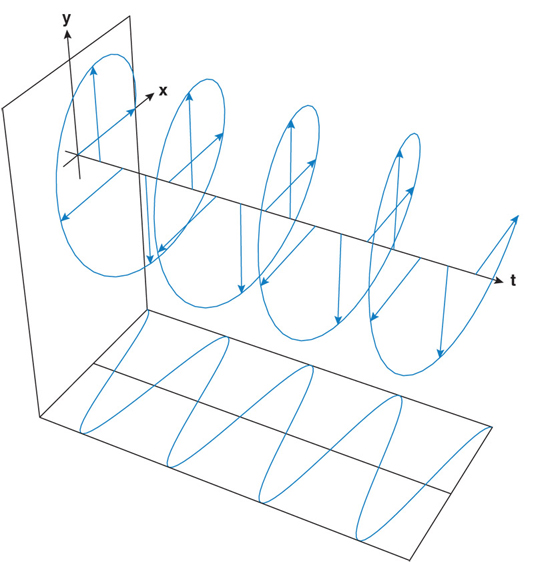
    For conceptualization, circularly polarized (CP) signals can be thought of as comprised of two orthogonal, linearly polarized signals offset in phase by 90 degrees, as shown in fig 1 below. With one feed defined as I (in-phase), and the other Q (quadrature), the response of the antenna will either be LHCP or RHCP depending upon the polarity of the Q signal phase relative to that of the I signal.

    If a CP signal is reflected from a metallic surface (such as metalized glass), the reflected signal becomes cross-polarized, so that a reflected RHCP signal becomes LHCP, and vice-versa. Unlike the linearly polarized (LP) case, a good CP receiving antenna will reject cross-polarized signals resulting from a single reflection. In this respect, reception of CP signals by a CP antenna is considerably improved relatively to linearly polarized signals.

     FIGURE 1. Graphic representation of circular polarization (from Innovation column, July 1998 GPS World). Credit: Gyles Panther
    FIGURE 1. Graphic representation of circular polarization (from Innovation column, July 1998 GPS World).

    Frequency Plans

    At this time, four global navigation satellite systems (GNSS) are either in service or expected to achieve full operational capability within the next 2–3 years: GPS, of course, GLONASS, also now fully deployed, Galileo, and Compass, expected to be deployed over the next two years.

    Thus the systems and signals to be considered are:

    • GPS-L1 at 1575.42 MHz;
    • GLONASS L1, specified at 1602MHz (+6, –7) × Fs, where Fs is 0.5625 MHz;
    • Compass at 1561 MHz;
    • Galileo L1 as a transparent overlay on the GPS system at 1575.42 MHz.

    It has emerged that considerable accuracy and availability benefits derive from tracking a larger number of satellites from multiple constellations. Notably, STMicroelectronics has produced an excellent animation of the GPS and GLONASS constellations that shows the theoretical improvement in accuracy and fix availability that derive from simultaneously tracking GPS and GLONASS satellites in Milan, For a really interesting comparison check out www.youtube.com/watch?v=0FlXRzwaOvM.

    Most GNSS chip manufacturers now have multi-constellational GNSS receiver chips or multi-chip modules at various stages of development. It is awe-inspiring that the navigational and tracking devices in our cars and trucks will in the very near future concurrently track many satellites from several GNSS constellations. Garmin etrex 10/20/30 handhelds now have GLONASS as well as GPS capability.

    Small single-feed patch antennas have good CP characteristics over a bandwidth up to about 16 MHz. This format is cheap to build and provides almost ideal GPS L1 characteristics.

    Multi-constellation receivers such as GPS/GLONASS require antennas with an operational bandwidth of up to 32 MHz, and up to 49 MHz to also cover Compass.

    Patch Antenna Overview

    The familiar patch element is a small square ceramic substrate, fully metalized on one side, acting as a ground plane, and on the other, a metalized square patch. This structure constitutes two orthogonal high-Q resonant cavities, one along each major axis. An incident circular electromagnetic wave induces a ground current and an induced voltage (emf) between the patch edge and ground plane so that at  resonance, the cavity is coupled to free space by these fringing fields.

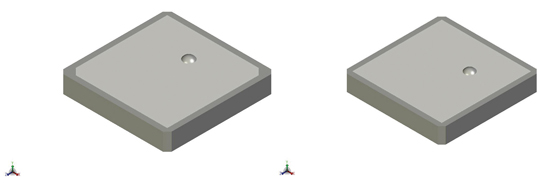
    A typical low-cost GPS L1 patch is a 25 × 25 × 4 mm block of ceramic (or smaller) with a single-feed pin. Patches as small as 12 mm square can be fabricated on high-dielectric constant substrates, but at the cost of lower gain and bandwidth. The two axes are coupled either by chamfered patch corners or by offset tuning plus diagonal feed pin positions (Figure 2).

     FIGURE 2. Patch RHCP configurations: left, corner chamfer; right, diagonal feed. Credit: Gyles Panther
    FIGURE 2. Patch RHCP configurations: left, corner chamfer; right, diagonal feed.

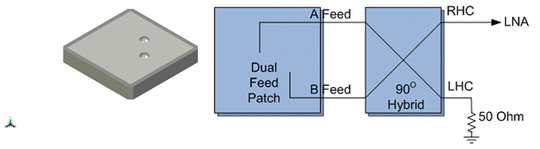
    An alternate form of patch antenna has independent feeds for each axis. The feeds are combined in a network that fully isolates the two feeds. Dual-feed antennas can provide nearly ideal characteristics but are inherently more expensive to build. See Figure 3.

     FIGURE 3. Dual-feed patch (left) and feed combiner (right). Credit: Gyles Panther
    FIGURE 3. Dual-feed patch (left) and feed combiner (right).

    Basic Performance Parameters

    The factors that have a direct bearing on patch performance are:

    • Gain and radiation pattern;
    • Available signal-to-noise as a function of receiver gain and low-noise amplifier (LNA) noise figure;
    • Bandwidth, measured as: radiated power gain bandwidth; impedance bandwidth; or axial ratio bandwidth.

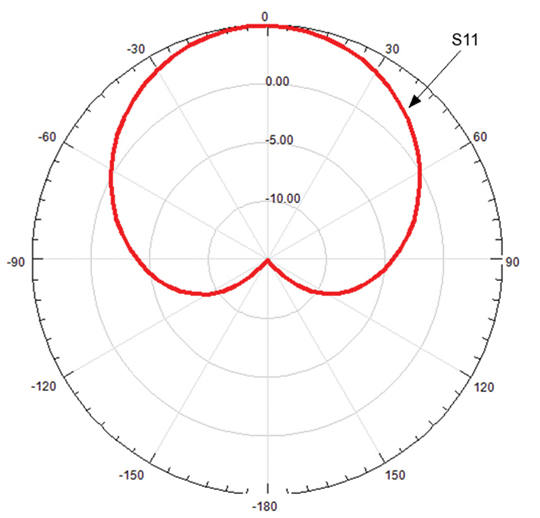
    Gain and Radiation Pattern. Patch antennas are specified and usually used with an external ground plane, typically 70 or 100 millimeters (mm) square. Without an external ground plane a reasonable approximation of the radiation pattern is a circle tangential to the patch ground plane with a peak gain of about 3 dBic (dBic includes all power in a circular wave). The addition of an external ground plane increases the peak gain at zenith by up to 2 dB.

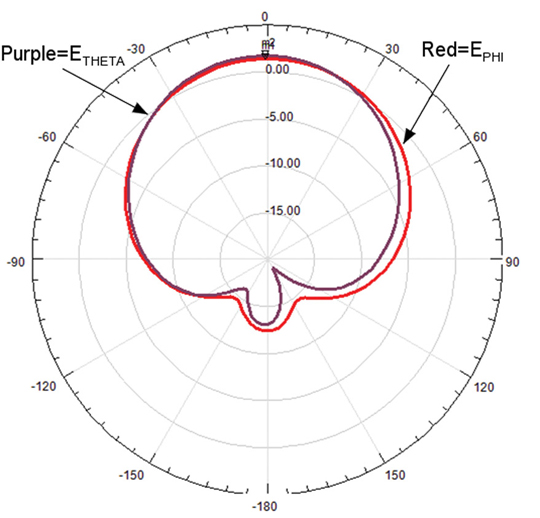
    The pattern shown in Figure 4 is typical for a 25 mm patch on a 100 mm ground plane. The gain peaks just under 5 dBic, dropping to about 0 dB at an elevation angle of ±60 degrees (the horizon is 90 degrees).

     FIGURE 4. Radiation pattern for 25 mm patch on 100 mm ground plane. Credit: Gyles Panther
    FIGURE 4. Radiation pattern for 25 mm patch on 100 mm ground plane.

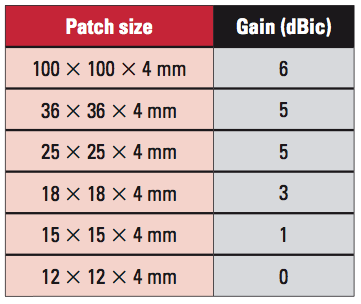
    Table 1 tabulates approximate gain values at zenith for a range of GPS L1 patch sizes, mounted on a 100-mm ground plane, at resonance, radiated with a RHCP signals (that is, dBic).

    Screen shot 2013-01-04 at 9.31.46 PM .Credit: Gyles Panther
    TABLE 1. Patch size versus gain at zenith.

    Clearly, gain is significantly lower for patches smaller than 25 mm square. Not illustrated here is that the bandwidths of antennas smaller than 25 mm also become too narrow for consideration for anything other than single-frequency signals such as GPS L1.

    Achievable C/N0. The carrier signal-to-noise density ratio (C/N0) is a fundamental measure of signal quality and hence antenna performance. For a given receiver, if the C/N0 is degraded due to any cause, be it a poorly tuned patch or bad LNA noise figure or other, the shortfall in performance is non-recoverable.

    The effective isotropic radiated power (EIRP) of the transmitted GPS L1 signal from the space vehicles is approximately 27 dBW. If D is the range to the satellite, and λ is the carrier wavelength, the free space path loss, PL, is given by

    PL = [ λ / (4 × π × D)]2

    The signal power received at the antenna terminals, Pr, is given by:

    Pr = EIRP × Gr × PL

    where Gr is the receive antenna gain.

    The noise power in a 1 Hz bandwidth, N0, referred back to the antenna terminals is given by:

    N0 = 10log(Te × k),

    where Te is the overall system noise temperature, and k is the Boltzmann constant.

    Thus C/N0, the ratio of received carrier power to noise in a 1 Hz bandwidth, referred to the antenna is

    C/N0 = Pr / N0

    Quantifying this calculation: For λ = 0.19 meters (corresponding to the L1 frequency), and an orbit height of 21,000 kilometers, the path loss,

    PL = –182.8 dBW.

    The received signal power,

    Pr = EIRP(dBW) + Gr(dB)+ PL(dB)

    (in dBW)

    Assuming the mid-elevation antenna gain, Gr, is 3 dBic,

    Pr = –152.8 dBW.

    For a cascaded system such as a GPS receiver, the overall noise temperature is given by:

    Te = Ts + Tlna + Tgps/Glna

    where Te is the overall receiver system noise temperature, Ts is an estimate of sky-noise temperature at 1575.42 MHz, assumed to be 80 K, Tlna is the LNA noise temperature (76 K for an LNA noise figure of 1 dB), Glna is the LNA gain (631 for 28 dB gain), and Tgps is the noise temperature of the GPS receiver (636 K for 5 dB receiver noise figure).

    Thus, Te = 157.1 K and N0 = –206.6 dBW.

    The available ratio of received carrier power to 1 Hz noise, C/N0, referenced to the antenna is:

    C/N0 = Pr/(Te × k) –
    (implementation loss)

    where implementation loss is an estimate of the decode implementation loss in the GPS receiver, assumed to be 2 dB (something of a fiddle factor, but reasonable!)

    Thus, C/N0 = –152.8 – (–206.6) – 2 dB = 51.8 dB.

    For satellites that subtend a high elevation angle, the reported C/N0 could be 2 dB higher or 53.8 dB best case.

    A good circular antenna should provide C/N0 values in the range 51 dB–53 dB. This can be checked using the (NMEA) $GPGSV message output from most GNSS receivers. Comparative measurement of C/N0 provides the basis for comparative antenna evaluation as described later.

    Single-Feed Bandwidth. Bandwidth of single-feed patches can be defined in several quite different ways.

    • Radiated power gain bandwidth: the bandwidth over which the amplitude at the terminals of the receiving antenna is not more than X dB below the peak amplitude, with an incident CP field.
    • Axial ratio bandwidth: the bandwidth over which the ratio of the maximum to minimum output signal powers for any two orthogonal axes is less than Y dB. This is an indicator of how well the antenna will reject cross-polarized signals.
    • Return loss (RL) or impedance bandwidth: that over which the feed input return loss is less than Z dB. This is very easy to measure, and gives the most optimistic bandwidth value.

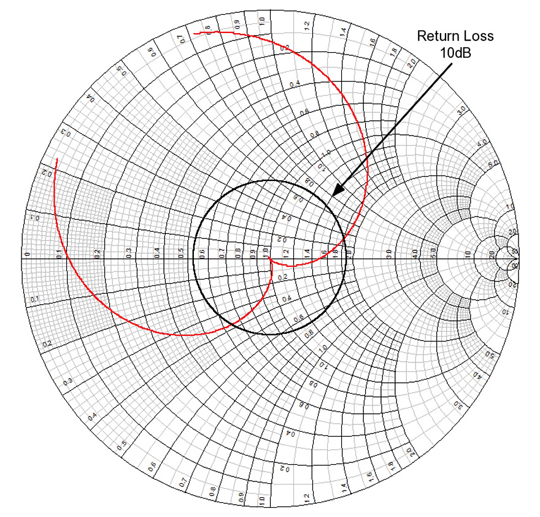
    The input impedance of a single-feed patch is shown in Figure 5. The rotated W-shape of the single-feed patch impedance is a result of the coupling between the two axes of the patch. The 10 dB return loss, called S11, is shown as a circle, outside of which |S11| > –10 dB.

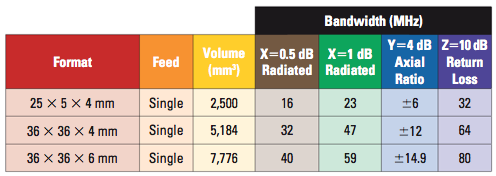
    These measures of bandwidth are shown for 25 × 25 × 4 mm and two thicknesses of 36 mm2 antennas in Table 2.

     G-Figure5 . Credit: Gyles Panther
    FIGURE 5. S11 for a 25 mm single-feed patch.
    Screen shot 2013-01-04 at 9.34.28 PM . Credit: Gyles Panther
    TABLE 2. The various measures of patch bandwidth.

    These different measures yield large differences in bandwidth. The merits of each depends on what is important to the user.

    From a purist viewpoint, the most intuitively useful measure of bandwidth is the 0.5 dB radiated gain value. Even then, at the band edges so defined, the axial ratio for a 25 mm2 × 4 mm patch is degraded to about 5 dB, just on the negative side of ok.

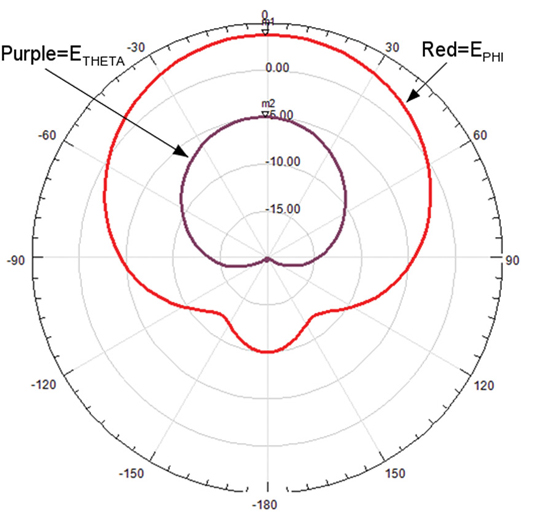
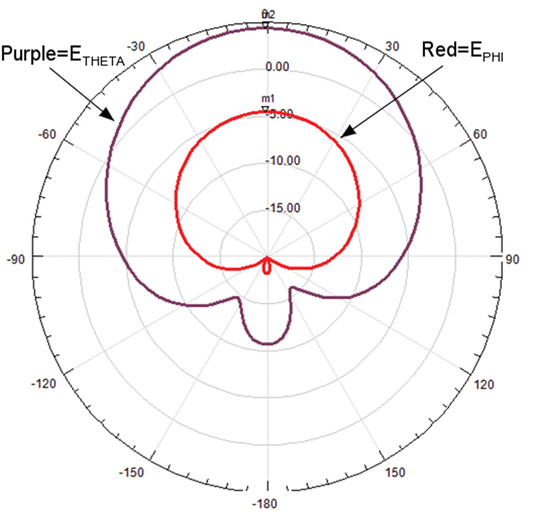
    As shown in Table 2, the 10 dB return loss bandwidth is comparatively wide. Figure 6 shows the EФ and Eϴ fields for a 36-mm patch a) at resonance and, b) and c), at the upper and lower –10 dB RL frequencies. At resonance the fields are equal, and the radiation is circular (add 3 dB for the CP gain). At the two 10 dB RL offset frequencies, the axial ratio is about 9 dB, with the dominant axis swapped at the band edges.

    G-Figure6a . Credit: Gyles Panther (a)

    G-Figure6b .Credit: Gyles Panther(b)

    G-Figure6c . Credit: Gyles Panther(c)
    FIGURE 6. (a) Realized gain patterns EФ and Eθ, single-feed at resonance, Fc.  (b) realized gain patterns EФ and Eθ , single-feed, Fc+F–10 dB.
    (c) realized gain patterns EФ and Eθ, single-feed, Fc-F+10dB.

    As a transmitter, a 10 dB return loss would correspond to 90 percent of the energy transmitted, in this case, mostly on a single axis. By reciprocity, as a receiver, the single axis gain of the patch at the 10 dB RL frequency is higher (by about 2 dB ) than at resonance. So, if a linear response can be tolerated, the 10 dB bandwidth is a useful measure, albeit for a very non-ideal response.

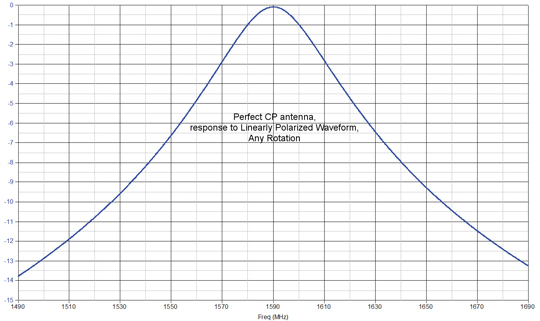
    Because the two axes are only balanced at resonance, single-feed patches are only truly circular at resonance. An ideal CP antenna has an equal response to a linearly polarized signal, for any rotational angle of incidence. Figure 7 shows the response of a CP antenna to a LP signal for any rotation, which is 3 dB down relative to the response to a co-polarized CP wave.

     G-Figure7 . Credit: Gyles Panther
    Figure 7. Perfect CP response to linearly polarized waveform.

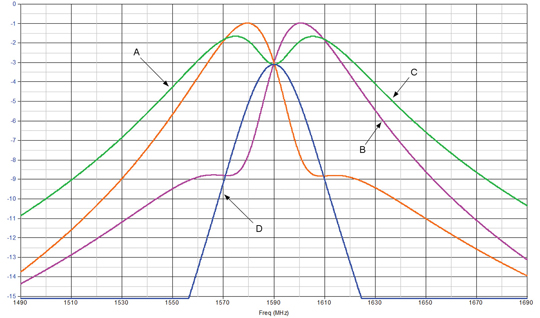
    In contrast, Figure 8 shows the responses of a single-feed patch (25 mm2 × 4 mm) as a function of field rotation with a linearlarly polarized wave. Note that, at resonance, all of the responses have the same amplitude because the patch is circular at that frequency.

     Figure 8. 25-millimeter single-feed patch response to linear polarization rotation. Credit: Gyles Panther
    Figure 8. 25-millimeter single-feed patch response to linear polarization rotation.

    The responses shown above are for the following conditions:

    A)  single axis excitation (axis A)
    B)  single axis excitation (axis B)
    C)  equal axis excitation, antipodal
    D)  equal axis excitation, in-phase.

    The relevance of this is that a circular polarized wave can become elliptical as a result of multipath interference. Figure 8 shows that the antenna response can be highly variable as a function of the angle of the ellipse principal axis. This is another way of looking at impaired cross-polarization rejection.

    In addition, poor axial ratio results in non-equal contributions from each of EФ and Eϴ as the E vector of a linearly polarized wave is rotated. Thus an antenna with a poor axial ratio has a non-linear phase response, unlike a truly CP antenna which has an output phase that rotates proportionally with the E vector rotation.

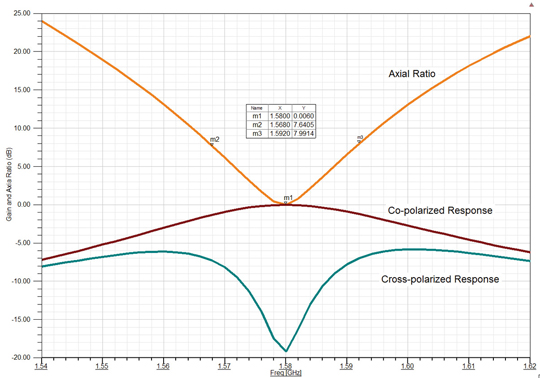
    25 mm2 patches for GPS/GLONASS applications are tuned to the mid frequency of 1590 MHz. Because the RHCP response is narrow, so is the cross polarization rejection, which is also centered at 1590 MHz, Figure 9 shows the simulated response of a single-feed 25 mm patch to co-polarized and cross polarized fields.

    G-Fig9 .Credit: Gyles Panther
    Figure 9. Co-polarized and cross polarized response, single-feed patch.

    The cross-polarization rejection is degraded at both GPS and GLONASS  frequencies, so that much of the ability of the antenna to reject reflected signals is lost.

    Against these criteria, a 25 × 25 × 4 mm single-feed patch element can provide good CP performance over about 16 MHz. Of course, initial tuning tolerance must be subtracted from this. However, even within the 0.5 dB radiated gain bandwidth the axial ratio rapidly becomes degraded to about 5 dB, and at larger offsets, the patch response becomes virtually linearly polarized, with poor cross-polarization rejection and phase response. However, as a redeeming feature, the single-feed patch has a wideband frequency response albeit linearly polarized at the GPS and GLONASS frequencies (the band edges).

    Dual-Feed Patches

    By comparison, dual-feed patches can provide almost ideal characteristics over the bandwidth of the patch element. Figure 3 shows a typical physical configuration and a schematic representation for the feed combining network. This ensures that the two axis feeds are fully isolated from each other over all frequencies of interest. The well known 90-degree hybrid coupler provides exactly the required transfer function.

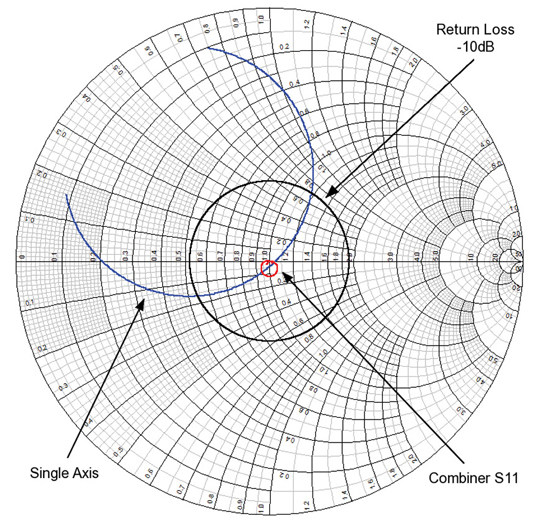
    The Smith chart in Figure 10 shows the impedance of one of the two feeds (that is, one axis) and the combiner output impedance, this being just a small locus close to 50 ohms.

    G-Figure10 . Credit: Gyles Panther
    Figure 10. Dual-feed patch, single axis and combiner S11.

    Contributions from each axis at all frequencies are theoretically identical for a perfect specimen, so that the configuration naturally has an almost ideal axial ratio (0 dB).

    Gain and Radiation Pattern. At resonance, the mode of operation of the single and dual-feed patches is identical so, unsurprisingly, the gain and radiation pattern are also the same; see Figure 4.

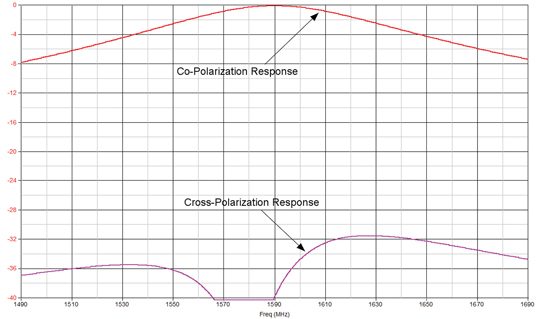
    Dual-Feed Bandwidth. The 1 dB radiation bandwidth of a dual-feed patch is just less than 1 MHz narrower than if configured as a single feed. Otherwise, the bandwidth of a dual-feed patch is simply the resonant characteristic of the cavities comprised of each axis. The allowable in-band roll-off defines the patch bandwidth, which in any event should not be worse than 1.0 dB, including initial tuning errors. The response for a 36 × 36 × 6 mm patch is shown in Figure 11.

     Figure 11. Co-polarization and cross-polarization response, dual-feed patch. Credit: Gyles Panther
    Figure 11. Co-polarization and cross-polarization response, dual-feed patch.

    Axial Ratio. Because the axial ratio of dual-feed patches is inherently good, the cross-polarization rejection is also good. The simulated cross-polarization response for the dual-feed patch is also shown in Figure 11.

    In reality, small gain and phase imbalances in the printed circuit board, hybrid coupler, and patch itself will prevent the axial ratio from being perfect and cross-polarization response not quite so ideal. With good manufacturing controls, axial ratio can be held to typically better than 2 dB.

    The obvious question is, since dual-feed devices have nearly ideal characteristics, why not just make a low cost small dual-feed antenna? There are three issues: The first is that the feed offsets required for a 25 mm2 patch are physically too close for two feed pins. Secondly, a dual-feed structure requires an additional relatively expensive combiner component; thirdly, sometimes, the only way to achieve the necessary bandwidth is through the considerably extended, but linearly polarized bandwidth of the single-feed patch.

    That said, were it possible, it would be the ideal solution.

    Comparative Performance

    The C/N0 value reported in the NMEA $GPGSV message provides a simple method for comparative evaluation of GNSS antennas. The idea is to compare reported C/N0 values for a number of competing antenna types.

    This requires a reference GPS receiver, a logging computer and the antennas to be evaluated, and these should be arranged so that:

    • The computer is set up to log the NMEA $GPGSV messages output from the receiver ($GLGSV for GLONASS).
    • Each antenna is placed and centered on identical ground planes (100 mm),
    • The antennas-under-test are not closer to each other than 0.5 meters (to ensure no coupling), and
    • Each antenna-under-test has a clear sight of the whole sky, and
    • It is possible to quickly switch the antenna connectors at the receiver.

    The method is to connect each antenna in sequence for 15 seconds or so, and to log NMEA data during that time. The antenna connector substitution should be slick, so that the receiver quickly re-acquires, and to validate the assumption of a quasi-stationary constellation.

    Each NMEA $GPGSV message reports C/N0, at the antenna, for up to 4 satellites in view. The best reported average C/N0 value for specific satellites 49 dB and above are the values of interest. The winner is the highest reported C/N0 value for each constellation.

    This sequence should be repeated a few times to get the best estimate. The important parameter is the difference between the reported C/N0 and the receiver acquisition C/N0 threshold. If the acquisition C/N0 threshold is –30 dB, an antenna that yields –49 dB C/N0 has a 19 dB margin, while an antenna that yields 52 dB has a 22 dB margin — a big difference.

    Immunity to LightSquared

    Much has been written regarding the threat of the prospective terrestrial segment that the LightSquared L-band communication system poses for GPS (and GNSS in general), which mostly is true. On the other hand, front-end protection for GNSS antennas is a relatively simple, inexpensive addition. The performance cost (in addition to a very small dollar cost increment) is an unavoidable but relatively small sensitivity hit. Note that L-band augmentation systems, other than WAAS and compatible systems, face a more difficult problem.

    This is not just a LightSquared issue. In several corners of the world, transmission of high-level signals are permitted that have the potential to interfere with GPS either by source distortion or inter-modulation within the GPS antenna front end itself.

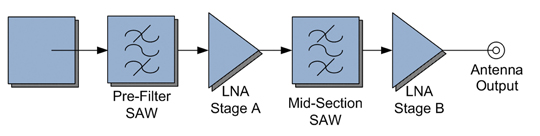
    The primary hazard is saturation of the first stage of what is usually a two stage LNA. So, the only way to protect against this is a pre-filter, as shown in Figure 12.

     FIGURE 12. Pre-filtered antenna architecture. Credit: Gyles Panther
    FIGURE 12. Pre-filtered antenna architecture.

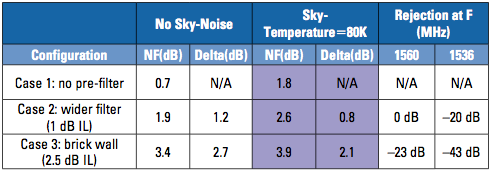
    There is a trade-off between the slope and corner frequency of the pre-filter out-of-band rejection and its associated insertion loss. The table below shows the response with a wider filter with an insertion loss of 1 dB, the second a more aggressive filter with a 2.5 dB insertion loss (IL).

    Table 3 shows overall noise figure including and excluding sky noise. Sky-noise temperature is used here as a catchall that includes true sky-noise, thermal noise (the antenna can partially see the local environment), plus similar factors. The value used is arguable, but experience indicates this is a reasonable number.

    The existence of sky noise limits the lowest available noise figure and sets the effect of a pre-filter in the correct context. In any event addition of a quite adequate pre-filter against a 1536 MHz signal can be achieved with less than 1 dB impact on received C/N0.

     TABLE 3. Rejection and noise figure for pre-filtered antenna. Credit: Gyles Panther
    TABLE 3. Rejection and noise figure for pre-filtered antenna.

    Putting It All Together

    Small (25 mm2 × 4 mm) single-feed patches are only truly circularly polarized at resonance but do have good CP characteristics over a bandwidth of about 16 MHz, and almost perfect for GPS L1. The pre-dominance of this format for GPS L1 is fully justified.

    However, when used to receive wider bandwidth signals such as GPS/GLONASS, single-feed patch antennas suffer from a litany of minor flaws, most particularly poor axial ratio and poor cross-polarization rejection.

    On the other hand, the coupling that happens in single-feed antennas results in a very wide 10 dB return loss bandwidth but at the band edges (where the GNSS signals are) they are virtually linearly polarized.

    There is no doubt that the performance of small single-feed patches for bandwidths such as those required for GPS/GLONASS coverage is marginal. However, to no small extent, the sensitivity of modern receiver chips is so good that marginal antenna performance can often be accommodated, at least from a basic operational viewpoint. The receiver bails out the antenna.

    However, the end result must be degraded GNSS reception. If the application cannot tolerate reduced GNSS availability or accuracy because of marginal antenna performance the choice should be a dual-feed patch type. This will present the GNSS receiver with more consistent signals levels and phase responses and less interference. The end result should be faster acquisition, and realization of the improvement in horizontal dilution of precision (HDOP) that GPS/GLONASS offers.

    The reported values of C/N0 in the $GPGCV NMEA message provides a simple and sensitive means to comparatively evaluate antenna performance.

    A not insignificant consideration is that the antenna is usually a very visible part of a bigger system, and unavoidably represents the quality of the user equipment. In that case, the antenna housing robustness and appearance may also be a criterion to maintain the image of the end product.
    The final point is that introduction of pre-filters into active GNSS is a good idea, whose time has come. This provides protection against the well known bug-a-boo, but also protects against known interference in other parts of the world.

    Acknowledgments

    I would like to acknowledge the assistance of Inpaq Technologies (Suzhou) Ltd., for provision of patch samples and technical support; Rony Amaya, adjunct research professor, Carleton University, Ottawa, for discussions and assistance in preparing this article; and STMicroeletronics for permission to cite the GPS+GLONASS demonstration video.


    Gyles Panther is president and CTO of Tallysman Wireless (www.tallysman.com) and has an honors degree in applied physics from City University, London. He has worked in the fields of RF and satellite communications for more than 20 years. As CTO of a precursor company he was the principal engineer for the development of a wide-area Canadian differential GPS corrections system (CDGPS) receiver. Tallysman is a new start-up specializing in high-performance GNSS antennas and systems.

  • FCC Asks If You and GPS Should Be Protected from Interference

    “We invite comment on LightSquared’s petition, and establish a pleading cycle.” Thus spake the Federal Communications Commission (FCC), groping for a way forward in the ongoing LightSquared/GPS conflict. The FCC has opened an Internet docket for public comment on the LightSquared position that GPS users and receivers “do not merit legal protection from interference” created by LightSquared. The FCC asks for comments by February 27.

    LightSquared asked the FCC in December to rule that GPS receivers and users “do not merit legal protection from interference” caused by the proposed wireless broadband service. Such interference has been amply demonstrated by comprehensive testing from May to October of last year. Opening the docket for public comment is the FCC’s way of fielding the LightSquared petition.

    LightSquared claimed in its December 20 petition that GPS makers sell “unlicensed and poorly designed” receivers that improperly listen to LightSquared’s airwaves.

    Jim Kirkland, general counsel of Trimble Navigation Ltd. and head of the Save Our GPS Coalition, responded that Congressional directives bar the FCC from clearing LightSquared before questions of GPS interference are settled. The company’s December requests consists of “gross mischaracterization of prior FCC decisions,” Kirkland stated. “LightSquared and its predecessors have never been allowed to interfere with GPS.”

    Parties are invited to file comments in response to LightSquared’s petition for declaratory ruling in IB Docket No. 11-109 or ET Docket No. 10-142, no later than February 27. Parties may file replies in response to those comments in IB Docket No. 11-109 or ET Docket No. 10-142, as appropriate, no later than March 13.

    Click here for the FCC Public Notice, “International Bureau Establishes Pleading Cycle for LightSquared Petition for Declaratory Ruling.”

  • Facts, Law, Table, Pound, Hand

    So it has come to this. LightSquared officers want the FCC to investigate Brad Parkinson.

    Senator Joe McCarthy is not a good look for them.

    A young attorney of my acquaintance, who also happens to be a contributing editor to this magazine, wrote me in this regard:

    “Lawyers have an old saying — when you don’t have the law on your side, pound on the facts; when you don’t have the facts on your side,  pound on the law; and when you don’t have either, pound on the table.”

    It appears that LightSquared has run out of technical solutions that it has variably proposed, without coming up with any to solve interference with the full range of GPS uses and users, and is now reduced to complaints about process. Engineering was never its strong suit, and there are many cautionary lessons to be learned from its near-run at GPS demolition. Financiers and lawyers can bring a whole heap of spectrum danger with just a little knowledge.

    In coverage of this issue over the past year, I have tried to keep the magazine and its various newsletters away from the posturing and saber-rattling on both sides, the stock-market speculations and the wireless industry tea-leaves reading, and stick instead to the facts: test results, official statements by government agencies, and so on. You gentle readers have plenty of other outlets for hyperbole and flights of imagination that you can go to for that sort of thing, and it’s never in short supply. I hope we have served you well.

  • Engineers Invited to Explore GNSS Filters at JAVAD GNSS

    Javad Ashjaee, president and CEO of JAVAD GNSS, invites engineers “who want to roll up their sleeves” to a working session at his company’s San Jose, California facility on Tuesday, January 17, to “find solutions and discuss technical details” related to the LightSquared/GPS conflict. The invitation comes at the end of a lengthy statement, “A Technical Story of a Bad Filter and a Good Filter — Which Turned Political!,” downloadable as a PDF from the company’s website.

    A few excerpts from the paper, which will also appear as an advertisement in the January issue of GPS World magazine, follow. The GPS World webinar that is mentioned in the paper is also downloadable as an audio file with presentation slides, a 50-minute talk given by Javad Ashjaee on December 8: A Proposed Solution for LightSquared Effects on High-Precision GPS.

    From the recently released paper:

    “I have been reflecting on events related to the GPS interference issue and LightSquared. What I discovered revealed the root of this problem, and as I will describe in this paper, it is entirely caused by poor design of GPS receivers The problem can be solved easily and with existing technology. In fact, it already has been solved.

    [ . . . . ] “In order to defend the GPS system and provide technical data, I started my own investigation of the problem. I soon realized that my own company had a fundamental problem in the first stage of our antenna system. It was allowing other radio energies into the receiver in addition to the Global Navigation Satellite System (GNSS) signals. I recognized that the flaw in our filter system would degrade the performance of our GNSS receivers whether LightSquared’s system is deployed or not.

    “As an engineer, I always strive to innovate my products and took it upon myself to see if we could develop a device that filters out as much noise as possible from the adjacent band without affecting the integrity of the GNSS signals. Unfortunately, this was never a priority in our industry – we always used filters that offered little protection against interference. I soon drew the conclusion that the standard operating procedure resulted in degraded performance.

    [ . . . . ] “Our challenge is to build the best filter that keeps the GNSS signals intact and blocks unwanted signals as much as possible. In other words, make the side slopes, or skirts, of a filter as steep as possible. How difficult it is to build such a filter? How much would it cost?

    [ . . . . ] “If we build better filters and better GNSS receivers, both general purpose users and high-precision users of GNSS will get improved results. In addition, the Figure 5 [all figures are shown in the downloadable PDF at JAVAD GNSS website] filter will protect the receiver from hearing LightSquared signals. This is shown in Figure 7, below. The GPS and GLONASS signals are shown in green. Our new steep-skirt filter is shown in grey, and the LightSquared signals are pink. Note that this new filter completely blocks out the LightSquared signals without reducing the signal strength of GNSS signals.”

    [ . . . . ] “The reaction from many of my industry peers to my scientific analysis was decidedly unscientific. My pure technical findings were tagged as hostile, harsh, disrespectful, political, self-serving and betraying. I ask my critics: How in the world could I possibly want to cause harm to GNSS systems that I have worked so hard in the past 30 years to improve?
    If GNSS system receives any harm, my company and I are among the first to feel the damage!

    “I’m not a stranger to controversy, so I chose to ignore them. I received similar personal attacks for ten years when I was working on GLONASS. Déjà vu!

    [ . . . . ] “This technical matter has a lot of lawyers, lobbyists and spin doctors involved, but it’s the engineers who have the ability to solve this problem.

    No matter what happens to LightSquared, I am determined to build a better filter system for our GNSS receivers and offer better products to surveyors worldwide, and if we can accomplish this while facilitating a better RTK network, all the more reason.

    I would like to invite engineers who want to roll up their sleeves and find solutions and discuss technical details to join me and several of my peers on Tuesday, January 17, 2012 in my San Jose facility. Please RSVP to javad at javad dot com.”