
Tag: LightSquared

  • Expert Advice: Give Us This Day Our Daily Bread

    Headshot: David Last and Sally Basker
    Headshot: David Last and Sally Basker

    David Last and Sally Basker

    Across transportation, agriculture, industry, commerce, and finance, GPS has replaced earlier technologies, opened up innovative applications, and led to new ways of doing old things. GPS now plays a key role in the critical infrastructures of all industrialized nations, from the most sophisticated telecommunications system to the production of a simple loaf of bread.

    Wheat is the world’s second staple food, and bread its main product. Bakers have been around for 30,000 years. GPS, among its manifold other duties, now also helps bring us our breakfast toast and midday sandwich.

    British farmers sow 2 million hectares (5 million acres) of wheat per year, harvest 8 tonnes per hectare (3.6 U.S. tons per acre) and sell it at £150 a tonne ($214 per U.S. ton), making their harvest worth £2.5 billion ($3.9 billion). Nearly a billion pounds-worth ($1.6 billion) goes to make bread.

    We use Britain as an example because we are British, but this same truth holds, at much grander scale, when you consider the United States, Russia, and many other European nations.

    A vital value chain wends its way from farm to mill to bakery to store to home: in the UK, 99 percent of households buy bread, 99 percent of which is made in this country, 80 percent of it from domestic flour. This relatively closed value chain lets us see how GPS is used, and that its loss would increase the price of a loaf and translate into inflation.

    GPS serves as the basis of the precision agriculture, cutting fuel costs and enabling selective and variable rate optimized application of fertilizers. It lets farmers use less manpower, reduces soil compaction, and even minimizes operator fatigue. Farmers now spend much more time on yield monitoring and within-paddock zone management than leaning on gates chewing straws. Though the capital cost of precision agriculture is high, the annual benefits are comparable with the investment. Losing GPS-based precision agriculture would increase the price of bread by at least 2 percent.

    Transport logistics is the glue that joins our value chain together. GPS in fleet management optimizes routings, accelerates dispatching, prevents theft, improves driver behavior, and delivers fuel efficiencies. Loss of GPS in the transport links in our chain would increase fuel costs alone by 13 percent.

    On top of all this, GPS is the ultimate source of precision timing supporting telecommunications links at every stage of the value chain, from wheat futures trading and banking transactions to voice, data, and Internet traffic.

    The sudden loss of GPS in farming, transportation, communications, business management, and retail distribution, would substantially raise the price of bread, hit every household, and impact the national economy.

    What applies to a traditional  and at first glance low-technology product like bread applies across the board. The recent report on GNSS vulnerabilities by the Royal Academy of Engineering says that GPS and other satellite navigation services have applications so pervasive that there is now a real threat to global security if the systems should fail — or be interfered with. The signals are used by almost every industry: rail, road, aviation, space, maritime, agriculture, energy, surveying, construction, law enforcement and communications.

    Dependence on GNSS connects many otherwise independent services into a so-called accidental system — with a single point of failure, the satellite signal. And a satellite signal, says the report, is a weak foundation for important services, since it can fail in dozens of ways.

    GPS is no longer the only GNSS, of course, as many nations, recognizing its political and economic value, have developed their own systems, and augmentations to enhance accuracy and integrity. Over the next few years, the number of navigation satellites may approach 150. This will help reduce vulnerability to the loss of GPS and so will be a benefit in the short term.

    But the long term is a very different matter. All these systems now use, or shortly will use, essentially the same technology. And, crucially, the same radio frequency bands.

    In those frequency bands, GNSS is threatened by rising levels of radio interference. This threat has several strands that are being recognized separately and handled individually, but which taken together will determine the future of GNSS.

    We face a Triple Whammy!

    The First Threat

    The first component of the Triple Whammy comes from the new satellite systems themselves. Each satellite transmitting in the GPS frequency band increases the noise level there. Satellite navigation receivers must find and lock onto the extremely weak signal that reaches the Earth, digging it out from the background noise of the cosmos. And the other GPS satellites add to the noise level.

    Günther Hein of the European Space Agency shows this remarkable diagram (Figure 1): as the number of systems increases and the number of satellites heads for that 150, up rises the noise they make, the blue-green line. More than about 70 of them, and satellite noise exceeds the cosmic noise floor in red and becomes the main source of noise. The more satellites, the worse the reception as GNSS interferes with itself. Too many satellites, and you’d pick up none at all! The first threat of the triple whammy is self-inflicted.
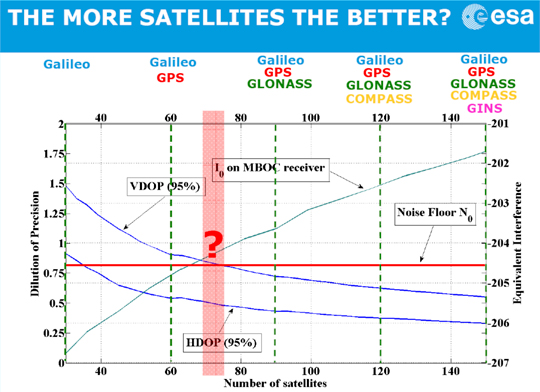
    Chart: David Last and Sally Basker
    Chart: David Last and Sally Basker

    Figure 1. The first threat of the Triple Whammy: new satellite systems. Source: Günther Hein.

    The Second Threat

    Conflicts between nations as their new GNSSs compete for radio spectrum also threaten GNSS viability.

    The frequency bands available to satellite navigation are essentially L2, L5, and the principal one we use currently, L1. On L1, the European Galileo system and the Chinese Compass system occupy the same areas. Now, that’s very desirable if the two systems are to share receivers. But they also compete for that spectrum, and there is conflict between Compass and Galileo.

    This battle for spectrum is a highly complex engineering problem. But chiefly, the spectrum wars are political, even emotional.

    Chinese satellites fly across American skies broadcasting signals that interfere with European receivers. Spectrum wars have everything to do with relationships between nations and little to do with battles between engineers. They are developing into a classic tragedy of the commons: a situation in which self-interest determines how a limited resource — here the radio spectrum — is to be shared in a regime in which regulation is weak. The International Telecommunication Union sets standards and registers claims. The UN Office for Outer Space Affairs seeks to mediate. But neither is a policeman; sovereign governments may sometimes be penniless, but they are very powerful.

    The second threat of the Triple Whammy is also self-inflicted.

    The Third Threat

    Communications systems compete with GNSS for spectrum: witness the current LightSquared case of a powerful new broadband system. For existing receivers, including those in government systems and aviation, it seems there is no fix for its devastating interference. LightSquared is driven by rich and powerful commercial forces; it could well win this fight.

    Communication technologies will continue to press upon the satellite navigation spectrum. LightSquared will likely erode spectrum gaps between communications and navigation services, the so-called guard bands.

    Satellite navigation has become highly political. The intense use of GNSS across our economies makes them vulnerable. GNSS is threatened by a Triple Whammy, by jamming, and by spoofing. These increase the risks to our security and our economies, both in probability and impact. The solution of detecting jammers and making ownership illegal will help with local problems in local areas. But the Triple Whammy threats are not local; they are national and international, world-wide.

    Today’s spectrum wars affect us all. That the loss of GPS would increase the price of a loaf — the very trigger for the French Revolution — brings this down to earth.

    These are not technical issues, they determine the price of our food! They constitute a real and present danger to our societies — down to the mundane yet very real level of our daily bread.


    David Last is a past-president of the Royal Institute of Navigation, a consultant and expert witness on radio-navigation and communications systems to companies, governmental and international organizations, and criminal investigators.

    Sally Basker, former director of research and radionavigation at the General Lighthouse Authorities of the UK and Ireland, has opened Traxis Ltd: management, business, and technology advice with expertise in navigation service provision. See www.traxis.co.uk.


    This article is adapted from a presentation at the European Navigation Conference, London, November 2011. A longer version of the talk appears in the Royal institute of Navigation News.

  • Expert Advice: MSS Misinformation, and Ten Truths

    By Rich Keegan

    LightSquared is currently conducting a public campaign intended to persuade federal regulators to approve a nationwide broadband service that would be detrimental to users and applications that depend on GPS. The campaign relies on misinformation, revisionist history, half-truths, and clear misstatements of fact. To understand the effort to convince regulators and legislators that the experts are wrong, one must consider 10 basic truths.

    1: The MSS Band Was Not Meant for High-Powered Terrestrial Use. The FCC authorized use of ancillary terrestrial component (ATC) ground transmitters many years ago within the mobile satellite services (MSS) band. The LightSquared campaign claims that this proves the band was intended for primary high-powered terrestrial use. But note ATC means ancillary terrestrial component, not primary. The FCC allowed this use only to fill in small holes in coverage from satellites. The term MSS recognizes that the band was for use by low-powered satellites, not high-powered land transmitters.

    The FCC conditional waiver given to LightSquared, if allowed to stand, would completely change the nature of the band, converting it to primary terrestrial use by 40,000 or more high-powered ground transmitters. Many FCC statements preceding the conditional waiver make it clear that the LightSquared effort is precisely what the FCC said would not be permitted.

    2: Interference to GPS Has Not Been Resolved. LightSquared assured the GPS community when the conditional waiver was announced that all interference issues had been addressed, and its system would not interfere with GPS. It was immediately clear to GPS engineers that this was wrong, and subsequent testing ordered by the FCC, along with that done by manufacturers, federal agencies, and independent organizations, confirmed that the original LightSquared system would cause massive interference with all classes of GPS receivers.

    Faced with irrefutable evidence of massive interference, LightSquared revised its system design to propose initial use of only 10 MHz of spectrum farthest from the GPS band (Low 10) for an unspecified period of time, after which it would be allowed to add the closer 10 MHz (High 10). While it may be feasible in the future to develop GPS receivers that could tolerate Low 10, several things are reasonably clear:

    • High-precision receivers that can tolerate High 10 and work as well as the ones we now use can’t be built, now or in the foreseeable future. LightSquared’s claims that “we can innovate our way out of this” are wrong with respect to High 10. Filters that LightSquared presently touts to allow Low 10 would not work in the High 10 environment.
    • Based on limited testing and analysis, Low 10 causes less interference than the original plan of Low 10+High 10, but the Low 10 effects on many receivers, particularly high-precision receivers in many high-value applications, remains substantial.

    With this plan, LightSquared claims that 99 percent of existing GPS receivers would not suffer harmful interference. This conclusion relies on a definition of harmful interference of C/N0 degradation of 6 dB for general navigation devices (the GPS industry and FCC precedent require only 1 dB), and on testing cell-phone GPS with a simple pass/fail criterion, ignoring performance degradation and the fact that modern cell phones are much more like general navigation devices and PNDs than older cell phones. Slanted and unorthodox analytical parameters produced this rosy assessment.

    Based on evidence of Low-10 interference, the NTIA and FCC ordered more testing specifically focused on Low 10. In response to mounting evidence of interference at this level also, LightSquared has now offered a third version of its system architecture, using Low 10 and limiting power on the ground. From a GPS interference perspective, this power reduction is useful. However, the latest LightSquared plan does not fully address three key problems:

    • There has been no renunciation of High 10. LightSquared says that in 5–6 years it will need spectrum capacity beyond Low 10. It would be irrational to design receivers now that tolerated Low 10, only to find in a few years that the requirements had changed to require tolerance to High 10 also (which is not possible).
    • There will still be interference with GPS receivers of various important classes in the power-limited environment of the latest plan.
    • None of the evolving plans deals with the massive installed base of GPS receivers.

    3: The GPS Industry Did Not Know of a Spectrum Conversion. LightSquared claims that for many years GPS manufacturers were aware of the proposed ground transmitters and should have designed receivers to avoid picking up strong signals in this neighboring band. These claims of foreknowledge of a recent fundamental change in proposed use of the MSS band are fallacious.

    The U.S. GPS Industry Council at the time of the limited conditional approval of ATC transmitters (circa 2003) consisted of only two or three GPS manufacturers. It is clear from USGIC statements at the time that it did not anticipate a spectrum reallocation. In any case, it is a huge stretch to claim that USGIC represented all GPS manufacturers, let alone the entire GPS industry and users. The GPS industry had no indication that the FCC would ever radically reallocate MSS band for a stand-alone high-powered terrestrial network, prior to November 2010.

    As [GPS World survey editor] Eric Gakstatter has pointed out, a major change with the potential to affect all GPS users should follow certain guidelines. The Air Force GPS Directorate demonstrated this in handling a much less important change to GPS signals: discontinuing support for the semi-codeless technique used in most high-performance receivers. In 2008, it hired consultants to question all manufacturers and many users of GPS about the potential impact. It then proposed that the signal change would occur on December 31, 2020, giving more than 12 years to prepare for the change.

    Should we ask anything less from LightSquared’s far more radical proposal?

    The FCC has a process that would have been much more appropriate for a proposal to reallocate the MSS L-band to high-powered terrestrial use: Notice of Proposed Rulemaking. Had it followed this process, we might be having a productive discussion of technical aspects.

    4: GPS Receivers Properly Use the MSS L-Band. LightSquared asserts that GPS receivers intrude into LightSquared’s spectrum— a misleading claim. Many GPS receivers in fact have filters that do not block signals from the MSS band. There are several reasons for this:

    • So long as the MSS band was a satellite band for signals from space to Earth, the signals from other systems in that band were low-power and not harmful to GPS reception. GPS receiver designers relied on this and assumed this allocation of the band would continue. The ability to use filters that overlap into the MSS band has enabled both low-cost and high-precision GPS receivers.
    • High-precision receivers cannot produce accurate measurements without using wideband GPS signals that occupy most or all of the GPS band. “Brick wall” filters that could capture all the energy in the GPS band and none of the energy in the adjacent MSS band do not exist.
    • Lightsquared ignores hundreds of thousands of high-accuracy, high-value GPS receivers that receive signals from the MSS band, using it for its intended purpose — satellite to ground communication. Deere receivers use the StarFire system leasing use of transmitters on MSS band Inmarsat satellites. Trimble leases use of MSS band on LightSquared’s own satellites for OmniSTAR correction signals.
    • GNSSs worldwide are modernizing their signals; many of these new signals are wideband. To take advantage of them, modern receivers of all classes will be wideband, as high-precision receivers are now, and will suffer interference similar to that of high-precision receivers now.

    5: GPS Receivers Do Not Ignore Government Design Standards. LightSquared asserts that the fundamental GPS L1 signal specification mandates receiver design standards that the GPS industry has ignored, to save a few cents of cost. These claims are false. The GPS specification defines the signal-in-space and explicitly says that it is not a receiver design standard; it simply uses a nominal receiver design to be able to translate signal-in-space specification into navigation performance effects.

    6: Receiver Replacement Costs and Schedules Are Large. LightSquared has offered $50 million to fund retrofit or replacement of legacy government receivers impacted by its signals. General Shelton of the Air Force Space Command testified to Congress that it would take billions of dollars to replace or retrofit the government receivers. He also estimated a 10-year time frame to test and validate replacement receivers.

    LightSquared says it will not bear the costs of replacing commercial receivers since, it claims, manufacturers are responsible for the improper design of those receivers. This is wrong, as shown earlier. LightSquared should bear the cost of replacing commercial receivers, if allowed to proceed. A realistic time frame needed to replace high-accuracy, high-value commercial receivers is also about 10 years.

    LightSquared argues that in five years, most current GPS receivers will be obsolete. This is clearly not true. Many current high-precision receivers are already prepared to use modernized signals from GNSS constellations. The L1C GPS civil signal, for instance, will not be available on any satellite until 2014, and the full constellation of satellites with L1C will not be available until 2026. Therefore, many receivers in use now will continue to be in use for many more years than five.

    7: Other GNSS Are Also Affected. Because Galileo, Compass, and GLONASS use or will use signals similar to GPS, in the same band as GPS, they will suffer interference very similar to that suffered by GPS. Users will lose the benefits of these other constellations, as well as GPS.
    The United States has entered into formal obligations to protect some other GNSS signals; LightSquared signals are not compatible with these U.S. obligations.

    8: Handset Interference is a Serious Concern. LightSquared handsets do not yet exist, but testing to date makes it clear that the handset signals to communicate with LightSquared base stations also interfere with GPS receivers when they are nearby (a few meters). The interference to GLONASS reception is also likely to be harmful. The interference effects of a group of LightSquared handsets has not been fully evaluated, but will certainly create more interference for nearby receivers.

    Out-of-band emissions from LightSquared handsets, if as high as FCC power masks currently permit, would substantially interfere with all GPS receivers, possibly more than LightSquared base stations.

    9: The Solution Is Not a $6 Filter. LightSquared displayed a Deere high-precision receiver with a “$6 filter” and told Congress this proved it could be done inexpensively and quickly. The claim is based on half-truths.

    • The Low 10 signal can be filtered out using low-cost parts, but the effect on performance is not known. There is good technical reason to be concerned about degraded performance from this filtering.
    • The Deere receiver displayed is not capable of readily being retrofitted with LightSquared’s or any other filter. Like many high-precision units, it is an integrated, hermetically sealed device. Retrofitting would entail returning the unit to the factory, cutting open and discarding the case, replacing the antenna/preamp assembly with a redesigned antenna/preamp assembly, inserting the unit into a new case and sealing it, re-testing the unit, and returning it to the customer. A costly process.
    • Filtering is one element of a design, usually distributed across several stages of the receiver. Changing filtering requires a redesign that may stretch across the entire RF front end, and cannot be done casually.
    • The displayed filter’s specified insertion loss is 3 dB, well above what GPS designers normally accept, and would result in about 2 dB more loss of sensitivity than with current filters.
    • LightSquared has suggested moving StarFire and OmniSTAR augmentation signals to the top of the MSS band, very close to the GPS band, so that filters that included GPS could include them. This is a reasonable approach, but the “$6 filter” might not permit that, as it would excessively attenuate at least the StarFire signal.

    10: The GPS Industry Supports National Broadband. The GPS industry broadly supports the goal of extensive and pervasive national broadband, and of strong competition among providers. Pervasive broadband would be helpful for applications such as real-time kinematic (RTK) positioning. It would be beneficial to GNSS users to have broadband services available everywhere, but not if the cost is to degrade or deny GNSS service.

    LightSquared’s broadband services require terrestrial base stations and cannot be done with the LightSquared satellites. It is unlikely that low-population areas will be covered with terrestrial base stations due to the economics involved, but if broadband coverage is nationwide, then so too will be GPS interference.


    Rich Keegan is a senior principal engineer at NavCom Technology, Inc., a wholly owned subsidiary of Deere and Company.

  • Out in Front: Feds Playing Footsie

    I’ll be the first to say that I don’t know how Washington works.

    I don’t know if Washington works, but that’s another story.

    Lacking that knowledge, and a competent lawyer to pepper my filings with the requisite “Vaughn v. Rosen, 484 F.2d 820 (D.C. Cir. 1973), cert. denied, 415 U.S. 977 (1972) . . . claims of nonsegregability must be made with the same degree of detail” language, all my Freedom of Information Act (FOIA) requests for agency communications to the National Telecommunications Administration (NTIA) failed. My FOIA won-lost record stands at 0–7.

    The reason cited by the Department of Transportation for withholding 11 documents and blacking out in their entirety the two pages that it thoughtfully provided was that being any more forthcoming might “cause harm to the government’s deliberative process.” If government told the people what it was up to behind closed doors, the people might object. Shades of Tammany Hall. “I’ll decide what is in the best interest of the electorate.”

    Several government agencies, responding to a tasking by the National PNT Executive Committee, sent their thoughts on LightSquared and GPS to the NTIA, which shares responsibility for spectrum with the Federal Communications Commission. At last notice, the NTIA had not forwarded these communiques to the FCC, and it sure does not want to share them with anyone on the outside. The NTIA was first to rebuff my FOIA, followed by others. Only Interior and NASA provided substance, but in both cases the documents had already been released by a House committee.

    The Citizens for Responsibility and Ethics in Washington (CREW) knows the system a lot better than I do. Its well (or at least copiously) worded FOIA to the White House Office of Science and Technology Policy for documents related to LightSquared elicited several boxloads of same.

    A nonprofit organization, CREW uses research, media outreach, and litigation to force officials to act ethically and lawfully, and to bring unethical conduct to public attention.

    CREW is combing through the voluminous documents, as you may now also do. So far, I’ve seen effusive emails from White House staffers to corporate folks they may or may not already know, fawning all over themselves about economic benefits and job creation that a new generation of wireless technology might bring.

    Not a word yet about downside or job loss that undermining an infrastructure cornerstone will produce. In an election year, point to new or hypothetical blooms and hide the detritus.

    This just in: LightSquared formally notified the FCC that any determination must not be based on “the subjective views of the federal agencies involved.”

    Now I wonder what kind of thrall the company thinks it holds the FCC in, to instruct it so?

  • LightSquared: Five Questions of My Own

    In true Wall Street lawyer fashion, LightSquared Executive VP Jeff Carlisle thinks he’s entitled to receive answers with regards to LightSquared’s GPS-jamming problem instead of providing answers. He seems to forget that LightSquared is the one applying for approval to proceed, and needs to provide the answers and solutions.

    Interestingly enough, LightSquared’s questions really point out how ignorant the company continues to be about the GPS industry, which is surprising since it’s been about a year since it submitted its application to the FCC. By now, you’d think that the company would have performed enough due diligence to become familiar with the GPS industry. From the questions for which it demands answers, apparently not.

    First of all — I’ve written before and I’ll write it again — the GPS user community is in its own corner on this issue. No one is looking out for your interest unless you are able to persuade your congressperson to act on your behalf.

    Incidentally, I spoke to a state legislator last week who reached out to me about the LightSquared GPS-jamming issue. He was one of those legislators who had submitted a letter of support for LightSquared to the FCC during the public comment period. He said that LightSquared lobbyists were reaching out again last week to state legislators looking for letters of support. He said he didn’t know anything about the technology but believed LightSquared’s claims of 15,000 jobs being created. What he didn’t understand was the chaos it would cause to the economy with respect to small business (agriculture, engineering, construction), fed/state/local government, aviation, and military. Of course, once he understood the full impact, he made it clear that he would not approve of a system that would have a negative impact on GPS. When I informed him that there’s a solution being floated by LightSquared (the “fix”), but that it is yet to be vetted and that the upgrade cost would run into the billions, he concluded “we can’t afford it.”

    I think this is a typical situation among legislators and other public officials who have voiced their support for LightSquared. They just don’t understand the issue and take what LightSquared lobbyists say at face value. Once it’s explained to them, they quickly understand that America can’t afford LightSquared’s current proposal.

    Speaking of lobbyists, if you didn’t watch “60 Minutes” on November 6, take a look the following video on the corruption taking place in the U.S. Congress. It’s disgusting.

    Now, back to the subject at hand.

    Yes, Trimble, Deere/Navcom, Garmin, and other GPS manufacturers are putting up a good fight via the Coalition to Save Our GPS. They’ve invested tens of millions, if not more than $100 million, in this debate over the last year, largely on behalf of and in support of the GPS user community. But make no bones about it, if LightSquared is granted approval to proceed, and that action requires your equipment to be upgraded (if an upgrade is even possible), this will be a huge windfall for the GPS manufacturers. They will make a ton of money. Salespeople will sit back and take orders. There’s no easier business than a forced upgrade (do you remember the Y2K problem?).

    That brings us to LightSquared’s first question to which it demands an answer.

    LightSquared Question #1: Isn’t it true that the so-called “non-biased” PNT Advisory Board, which advises the Pentagon, is represented by board members of GPS companies who have a financial stake in LightSquared not getting approval to proceed?

    They are referring primarily to Dr. Brad Parkinson, who has been a Trimble board member for many years, and who even acted as Trimble CEO for a period of time, more than a decade ago, after Charlie Trimble’s departure.

    Dr. Parkinson is an aeronautical engineer. He’s retired from the U.S. Air Force (at the rank of colonel) and is a professor emeritus at Stanford University. He was the first GPS Program Manager for the U.S. Air Force, and is largely responsible for the GPS getting on the road to being what it is today.

    LightSquared’s question implies that Dr. Parkinson, a Trimble shareholder and board member who has voiced his opposition to the LightSquared initiative, will somehow profit if LightSquared’s application is rejected by the FCC.

    If LightSquared personnel put some thought into it, they’d understand that Trimble (and its shareholders) stand to make a lot more money if LightSquared is allowed to proceed than if it isn’t. In other words, if LightSquared is allowed to proceed, Trimble makes a ton of money in forced upgrades from GPS users who hadn’t planned on it.  If LightSquared isn’t allowed to proceed, Trimble has just spent a year and ~$25 million (my estimate) in direct and indirect costs participating in this fire drill, not to mention the opportunity cost of the distraction of high-level engineers and executives.

    For example, the company/entity/individual who just bought the latest and greatest Belchfire XYZ GNSS receiver six months ago would face   an upgrade charge of thousands because it needs a new circuit board and a new antenna or antenna element. This would be gravy for Trimble because it’s revenue they thought they’d never see for a long time from a customer who just bought the receiver six months ago.

    Again, this assumes a technical fix is possible. That hasn’t been proven yet.  Far from it.

    LightSquared Question #2: Numerous annual reports and SEC filings from GPS manufacturers going back to 2001 acknowledge material harm to their business due to interference with neighboring spectrum. Why did you not prepare your devices with filters if you’ve known for ten years there would be interference problems caused by your devices looking into adjacent spectrum?

    Ok, for how long does LightSquared want to continue ignoring the fact that LightSquared and its predecessors (Skyterra, MSV) encouraged GPS receiver manufacturers to design GPS receivers that “look” into the MSS spectrum?

    Why would LightSquared and its predecessors encourage this?

    The answer? Because LightSquared and its predecessors sell satellite data communications services to the GPS industry using the MSS spectrum (via OmniSTAR), generating tens of millions of dollars in revenue from LightSquared and its predecessors.

    Now, if LightSquared chooses not to sell those satellite data communication services to the GPS industry any longer, that’s the company’s choice, but don’t blame the receiver because it was designed to receive LightSquared’s satellite data communication service it was promoting. That sort of logic is, well, illogical.

    LightSquared Question #3: True or false? Did the GPS industry manufacture devices knowing there would be interference with neighboring spectrum because this enhanced their performance?

    False. LightSquared promoted GPS receivers be designed to access the MSS spectrum in order to access its satellite data communication services that it sells to the GPS industry. Furthermore, LightSquared profited from it.

    LightSquared Question #4: Who funds the Coalition to Save Our GPS?

    I don’t know. Who cares? Certainly not Friends of LightSquared. Can you really not figure that out?

    LightSquared Question #5: Did the GPS industry falsely claim that it would take billions of dollars and more than a decade to find a solution to this problem?

    I don’t know who made this statement, but it wasn’t me.

    I do believe that LightSquared has no clue as to the extent of the negative economic impact its proposed system will cause — and it doesn’t care. The $50 million the company has pledged to repair damage it creates to federal government GPS users constitutes a sliver of what it will actually take.

    But all of this is moot until any sort of proposed “fix” is fully understood and vetted across all product lines and markets. Clearly, LightSquared does not understand the extent of the problem its system causes; otherwise it would have never predicted an FCC decision by the end of this year.

    My Questions

    I was offered the opportunity to interview LightSquared a few months ago. I declined. It’s senseless to speak to a lawyer or marketing guy about this technology. They don’t know what they are talking about. They just regurgitate the same senseless spin.

    But, given that they keep ignoring the fact that they sell satellite data communications services to the GPS industry utilizing the MSS spectrum, I’d pose these questions:

    Question #1 to LightSquared: True or false, does LightSquared sell satellite data communication data services to the GPS industry via frequencies in the MSS spectrum (1525-1559MHz)?

    Question #2 to LightSquared: True or false, did LightSquared’s predecessors, Skyterra and MSV, sell satellite data communications services to the GPS industry via frequencies in the MSS spectrum (1525-1559MHz)?

    Question #3 to LightSquared: When did LightSquared and its predecessors (Skyterra/MSV) first begin selling satellite data communication services to the GPS industry via frequencies in the MSS spectrum (1525-1559MHz)?

    Question #4 to LightSquared: How much gross revenue, in total, has LightSquared and its predecessors (Skyterra and MSV) generated from the GPS industry since they began selling said services to the GPS industry via frequencies in the MSS spectrum (1525-1559MHz)?

    Question #5 to LightSquared: List all of the frequencies in the MSS spectrum that LightSquared and its predecessors (Skyterra and MSV) have utilized in delivering satellite data communication services to the GPS industry since LightSquared/Skyterra/MSV began selling said services?

    Let’s see if LightSquared is as bold in answering questions as they are in asking.

    Thanks, and see you next time.

    Follow me on Twitter at http://twitter.com/GPSGIS_Eric


  • Out in Front: Catch a Wave

    Expecting guidance from FCC regulators by year’s end? LightSquared purports to do so, but a more measured evaluation finds a December decision unlikely.

    The current test cycle — hopefully not the final one — just reached its end on November 4 at White Sands Missile Range, under the Air Force’s watchful eye. That testing focused only on “cellular and personal/general navigation” receivers as specified in a September letter from the National Telecommunication and Information Agency. According to unconfirmed reports, this round of testing did not include the JAVAD GNSS precision receiver with a new filter prototype, although LightSquared lobbied strongly to have the potentially bacon-rescuing device included.

    Even if allowed, that move would have been highly premature, and ultimately misguided and misguiding. The 33 other high-precision and network GPS receivers that underwent May testing would all have to be retested, with the new filter incorporated somehow in each one, before any meaningful conclusion about technical feasibility could be drawn. Then retrofit cost issues would have to be addressed. Months of work remain before any fair and complete evaluation can occur.

    A National PNT Engineering Forum summary of the cellular and personal/general navigation testing at White Sands is expected by November 30. A complete report may not appear until December. An FCC decision that same month, or the next, or the next, would be speedy and premature beyond any precedent that even the trigger-happy commission has yet set for itself.

    As a basis for a decision on the waiver, the cellular and personal nav testing is still insufficient. At least one, probably two more rounds of testing — at bare minimum — involving the recent proposed filter fixes and a complete range of high-precision receivers should take place before putting national security, infrastructure, hundreds of thousands of jobs, and hundreds of billions of dollars of public and private-sector investments at risk.

    This doesn’t mean everyone not directly involved in testing can chill.

    This is a political and very high-stakes financial struggle, not just a series of complex technical issues. Decisions when they are made will reflect political  considerations and financial motives as well as technical test results.

    Everyone who cares about the outcome should sit down today and write letters or e-mails to their three congresspeople — two senators and one representative — stating strongly and clearly their views and reasons. Even if you have written before. Congress is the only place currently that any form of leverage can be exerted.

    We are riding a wave of change, and precariously at that. While keeping our balance, we must continually gauge the water, the wind, our own stamina — and warily watch the great white sharks that are circling.

  • LightSquared: The So-Called “Fix”

    LightSquared’s been in the news quite a bit since my last Survey Scene newsletter a month ago, but very little of it has actual consequence. A lot of the “news” is just noise. LightSquared pumped up its propaganda campaign nationwide to try to build a consensus in their favor and put pressure on the FCC, and is threatening a lawsuit if the FCC doesn’t do what LightSquared wants. No surprises there. However, other things have happened that I think you might be interested in hearing about.

    Most interesting was the partnership announced between JAVAD GNSS and LightSquared to develop a solution for LightSquared’s GPS-jamming problem. I had the opportunity to sit down briefly with Dr. Javad Ashjaee at the INTERGEO conference in Germany after he announced his company’s partnership with LightSquared. He’s a sharp engineer and well-worth listening to. Essentially, he made three points:

    1. This is a spectrum issue that isn’t going away even if LightSquared isn’t allowed to proceed, so it’s in the best interest of the GPS industry to work on a solution no matter what the FCC’s decision is.

    I’ve written about this issue before and I agree that the MSS spectrum has got a bull’s-eye on it. It’s a big piece of spectrum when not a lot of wireless spectrum is left to be developed. One could argue that it has its purpose as an MSS band, but the counter to that argument is that it’s under-performing. There’s only so much one can do with MSS spectrum.

    That leaves two choices: the first is to keep it allocated as low-power MSS (satellite-to-earth communications) as it has historically been used. It could also be officially established and recognized as a guard band for GPS so this problem doesn’t crop up again. GPS is an important enough national asset to make this a reasonable discussion. The LightSquared debate has done a fantastic job of raising awareness of the importance of GPS technology in our everyday lives as well as the commercial and military markets. GPS has and will continue to contribute more jobs, revenue, and growth to the U.S. and world economy than LightSquared could ever dream of. You can quickly dismiss anyone who claims otherwise.

    2.Secondly, Dr. Ashjaee opines that 4G LTE is something that the GPS industry needs. I don’t disagree with that statement. More and more you see the latest high-precision GPS receivers designed with integrated communications, primarily GSM modems to enable internet connectivity in the field. Connectivity in the field has always been a weak point of GPS systems. If one wireless technology could replace UHF/VHF/Spreadspectrum/GSM/MSS, that would be a good thing.

    I’m skeptical, though. I don’t believe LightSquared will be available where many GPS users need wireless communications even when it’s fully deployed — namely rural areas. They are going to chase after the money. The money is in the urban areas where the population is dense. Who in their right mind would spend money to establish and maintain infrastructure in areas with a very sparse potential customer base? I wouldn’t.

    So, that still leaves us with needing UHF/VHF/Spreadspectrum/GSM/MSS communications technology. It doesn’t solve the problem. But, I’m not against trying as long as LightSquared’s system has no affect on the performance of high-precision GPS/GNSS receivers.

    Incidentally, JAVAD GNSS intends to integrate a LightSquared mobile device into their product to manage potential interference from the uplink band (1626.50-1660.5MHz). However, this still doesn’t prevent interference from LightSquared mobile devices in the vicinity of JAVAD receivers. To this, Dr. Ashjaee says (I’m paraphrasing) “interference already exists today. Our mobile phones of today already create interference. If that happens, we simply move it away.”

    3. Lastly, Dr. Ashjaee states that with GPS modernization in full swing and with new GPS signals being deployed, GPS users are going to need to upgrade their equipment to keep up with the latest technology in order to stay productive.

    This is a point that he and I disagree on.

    There is no reason your GPS L1 receiver will become obsolete in the foreseeable future, whether it’s a high-performance sub-meter receiver or a cm-level surveying receiver (L1-only). There is no plan by the U.S. Government to change or obsolete the L1 C/A signal.

    For legacy L1/L2 GPS receivers that aren’t designed to utilize L2C or L5, it’s a different story. If you recall, back in 2008 the U.S. government floated the idea that it wanted to discontinue supporting the legacy semicodeless technique used by every L1/L2 GPS receiver in existence. Literally, several hundred thousand high-precision dual frequency GPS receivers would be rendered obsolete. At the end of the public comment period, the U.S. Air Force and Department of Commerce established a date of December 31, 2020 for this to happen. I wrote about this extensively at the time. My point is that there’s certain high-precision equipment that’s going to become obsolete at that time. However, that’s nearly ten years from now.

    Should those users be forced to upgrade earlier to accommodate LightSquared?

    Another point, and more serious, are the users who already upgraded in the past few years to equipment that was advertised as “future-proof”. In other words, they paid a premium for GNSS equipment that could track “all current and planned signals” such as L2C, L5, Galileo, GLONASS, etc. There is absolutely no reason those users would be required to upgrade their equipment for any imaginable reason. In fact, I’d be rather miffed if someone suggested I needed to spend money to do so.

    How much money are we talking about?

    That’s an interesting question.

    Dr. Ashjaee guarantees that he will upgrade all JAVAD GNSS receivers for between US$300 and US$800. If you think about it, that’s similar to what you might pay in annual maintenance fees on many receivers. The issue is that JAVAD receivers aren’t that common in the U.S. Realistically, there’s a wide variety of high-precision GPS receivers in the U.S. market. Many of them are not the latest models, but still working perfectly fine. Manufacturers are not going to re-open those product designs and try to implement LightSquared-hardened antenna and circuitry. At that point, the user’s only choice is to purchase new equipment. I think that would be a step backwards. Many small organizations were able to purchase GPS technology with a one-time grant or specific project funds. Faced with the prospect of spending thousands of dollars on a new high-precision GPS receiver, I think many would opt not to use GPS.

    To its credit, LightSquared has offered up $50 million to help retrofit or otherwise upgrade receivers owned by Federal government agencies. I think it will cost a lot more than that. I don’t believe $50 million would come close to covering the hard costs, not to mention the amount of time and effort that would be required to facilitate such a trade-in.

    Let’s talk about “the fix”

    JAVAD GNSS has a lot on the line, so it’s hard to imagine that the company hasn’t come up with something that works. That said, the conversation about retrofitting is meaningless until the design concept is proven, and empirical data demonstrates that it isn’t affected by LightSquared’s downlink (1526-1536MHz) or uplink (1626.5-1660.5MHz) signals, and that GPS receiver performance doesn’t pay a penalty.

    Of course, LightSquared is talking like this is a done deal and predicting FCC approval by the end of the year. This is just noise, like back in August when it predicted an FCC decision within a month. Do not put any credibility in LightSquared statements. Its track record is poor, as few of their claims have materialized.

    There’s no way the FCC is going to announce a decision by the end of the year. Mark my words. There’s not enough time to confirm a fix, how it might be implemented across multiple manufacturer’s receivers, and what the impact is. Believe me, there are many more hearings and information requests that are going to take place before any decisions are made by the FCC.

    The “fix”, as I understand it, includes a new antenna design as well as new circuitry (filter). If you understand the high-precision GPS industry, you know this includes a substantial number of handheld units such as the Trimble Geo series, Ashtech (formerly Magellan) Mobile Mapper and ProMark series to name a few. Replacing antennas and changing circuit design is not a minor effort in a handheld unit that’s already packed tight with electronics. Which models do you support? Which models don’t you support? Which models can’t be upgraded? There are many questions to answer.

    New antennas also mean new antenna calibrations by the NGS if you’re an OPUS user. Manufacturer software needs to be updated to reflect any change in antenna phase center. All of this will take time to investigate and understand. It should not be rushed just because LightSquared is in a hurry. Its “end of year” decision prediction, I’m sure, is directly correlated to an agreement with Sprint, which says the deal is off if FCC approval isn’t granted by the end of the year. Take a look at the Sprint presentation here.

    Don’t let LightSquared over-simplify this “fix.” LightSquared Executive VP and lawyer Jeff Carlisle likes to play “engineer” like he did last week at a congressional hearing looking at the LightSquared GPS-jamming impact on small business. I couldn’t believe it when he pulled out a massive GPS receiver head and demonstrated how he would retrofit it with a $6 component to solve the problem, even going so far as showing where he would place it on a circuit board. The sad part is that there was not an engineer in sight to call him on it. Take a look at the 4:50 mark in this video:


    Speaking of last week’s hearing, what a nightmare for the GPS industry. The House Committee on Small Business conducted a hearing entitled “LightSquared: The Impact to Small Business GPS Users.”

    Whoever put that panel together really did a disservice to this entire debate. LightSquared clearly came out on top, not because they should have, but because the witness list was not informed/prepared and the witness list wasn’t represented by the largest users of GPS in small business, surveying/engineering/construction/GIS.

    The epitome of this trainwreck was when Rep. Steve King asked the guy representing the agricultural community about delineation of spectrum.

    The grilling starts at the 1:49 minute mark and ends at the 4:20 minute mark.


    Somehow, the witness doesn’t know or doesn’t know how to communicate that LightSquared/Skyterra sells satellite communications services to the high-precision GPS user community (via OmniSTAR) and therefore has encouraged GPS receiver manufacturers to design receivers to look into the MSS spectrum. LightSquared/Skyterra has generated tens of millions of dollars in revenue from agriculture and other high-precision GPS users, and now it is whining about the very people who are paying for its satellite communications data services? Are you kidding me?

    Look, if LightSquared doesn’t want to sell satellite data communication services to the high-precision GPS industry anymore, that’s its decision, but don’t make this ridiculous claim that somehow GPS receiver designers are abusing LightSquared-licensed spectrum when LightSquared has been cashing in on it.

    By the way, if you watch the grilling video, the “first-come, first-served” argument is really weak. Someone needs to brief the witness better than that. Even I don’t believe in squatter’s rights, and that argument will never fly with the FCC.

    ACSM Radio Show Last Monday on LightSquared

    I spent an hour talking with ACSM Executive Director Curt Sumner about the latest on LightSquared. We also touched a bit on the exciting Galileo satellite launch scheduled for this week, Oct. 20, that ended up being postponed for a day. You can listen to the radio broadcast here or download and listen to it on your MP3 player.

    The debate goes on…stay tuned.

    Thanks, and see you next time.

    Follow me on Twitter at http://twitter.com/GPSGIS_Eric


  • The System: Compass Signal ICD this Month

    The long-awaited signal interface control document (ICD) for China’s growing GNSS will appear this month, according to representatives of the system who spoke in a “Compass: Progress, Status, and Future Outlook” workshop as part of ION GNSS and the CGSIC meetings in Portland in September.

    The ICD has been rumored to be available previously to receiver manufacturers within China, creating some disgruntlement among companies outside the country. One of the workshop panelists affirmed that GPS/Compass chips and receivers are being actively developed by many Chinese manufacturers and research institutes.

    The ICD announcement came among many valuable pieces of information presented during the pre-ION workshop, sponsored by the International Association of Chinese Professionals in Global Positioning Systems and chaired by Jade Morton, professor of electrical and computer engineering at Miami University, Ohio.

    Xiancheng Ding of the Beidou Program Office described Compass as a demo system in transition to an operating navigation system. Two more satellites will launch in 2011, making a total of five new space vehicles this year,as part of a total “simple navigational system” of nine satellites that has been built up, and what is termed a test system over the Asia-Pacific region, to be complete by the end of the year.

    Five more satellites will rise into orbit in 2012, and the system will gradually extend its coverage and improve its performance. Compass will start official regional service by the end of 2012, meeting user requirements in the Asia-Pacific region.

    ICD document v1.0 will be published in 2011, and probably in the month of October. It will be available for international download on the Compass website (as yet without an English version).

    There was some disagreement among panelists as to the final targeted number of satellites in the system: either 30, or 35. Subsequent comments indicated that much of the structure may still be under discussion. The impression given was very much of a dynamic system in formation and growing rapidly.

    In a presentation on “Preliminary Results of GPS/Compass Integrated Positioning and Navigation,” Uanxi Yang of China’s National Administration of GNSS and Applications reported integrated navigation with a Unicore UB 240 Compass/GPS receiver with up to 9-centimeter accuracy, and also mentioned a Shanghai Huace Compass/GPS receiver. Some systematic errors in Compass positioning were reported, and attributed to the sparse satellite distribution currently.

    Yang concluded with the exhortation, “Reasonable Wishes for Compass!” emphasizing the delegation’s desire to continue working diligently on, but with realistic expectations for, the new system.


    Orbit Roundup

    In other satellite news and debuts anticipated around the world:

    GPS. Back-channel reports say the cesium clock aboard SVN-63, the second IIF satellite, is not functioning properly, and that this is at least one reason why the satellite, turned over to 2SOPS control on August 19, has not been set healthy to users.

    [Correction: The September issue and env-gpsworld-integration.kinsta.cloud mistakenly reported that SVN-63 had been set operational on August 23. This is not the case. As of September 29, the satellite is still not healthy to users.]

    After repeated attempts to get the clock working, operators are ready to switch to a rubidium clock onboard, and may already have done so.

    GLONASS. The launch of GLONASS-M No. 42 from Plesetsk is scheduled for October 1. GLONASS-M Nos. 43, 44, 45 from Baikonur may occur as early as November 2. GLONASS-M No. 46 from Plesetsk is now scheduled for November 22. The launch of the next-generation GLONASS-K1 No. 12 from Plesetsk will likely slip to 2012.

    The K1 satellites will not be set healthy, but held in reserve only. The remaining M-generation vehicles launching this year will fill up the 24 almanac slots. GLONASS will have plenty of satellites held in reserve.

    Luch-5A, a Russian geostationary communications satellite that includes an SBAS payload, will launch on December 10 from Baikonur.


    FCC Calls for More Testing on LightSquared Interference

    The U.S. Federal Communications Commission (FCC)issued a Public Notice on September 14 stating that additional testing is necessary to ensure that LightSquared’s broadband network will not interfere with GPS.

    The notice states: “Following extensive comments received as a result of the technical working group process required by the International Bureau’s Order and Authorization dated January 26, 2011, the Federal Communications Commission, in consultation with NTIA, has determined that additional targeted testing is needed to ensure that any potential commercial terrestrial services offered by LightSquared will not cause harmful interference to GPS operations….

    “For more than three months, the technical working group, comprised of more than 120 participants including representatives from the Department of Defense, Department of Transportation and other federal agencies, the GPS community, various telecommunications companies and LightSquared, conducted an extensive set of tests, and LightSquared submitted a final report on June 30, 2011. The technical working group effort identified potential for harmful interference from LightSquared’s originally proposed deployment based on operation of terrestrial transmitters in both the upper and lower 10 MHz portions of its spectrum. The FCC issued a public notice on June 30, 2011, seeking comment on the report.

    “LightSquared submitted proposed mitigation techniques to remedy the interference to GPS simultaneously with the technical working group final report. Notably, LightSquared proposed to revise its planned deployment to operate terrestrial transmitters only in the lower 10 MHz of its spectrum. The results thus far from the testing using the lower 10 MHz showed significant improvement compared to tests of the upper 10 MHz, although there continue to be interference concerns, e.g., with certain types of high precision GPS receivers, including devices used in national security and aviation applications. Additional tests are therefore necessary.”


    Galileo Counts Down to October 20 for First Validation Satellites

    The first flight of a Russian rocket, Soyuz, from Europe’s spaceport in French Guiana will carry the first two satellites of Europe’s Galileo navigation system into orbit on October 20, and the European Space Agency is reporting on the preparations.

    The Soyuz launcher will be rolled out horizontally to the launch pad on October 14 and raised into its vertical launch position. The upper composite, comprising the Fregat upper stage, payload and fairing, will then be hoisted on top of Soyuz.

    The two Galileo satellites arrived from the Rome facility of Thales Alenia Space Italy, also in mid-September. In 2012, a second pair of satellites will join them in orbit, with the task of proving the design of the Galileo system in advance of the other 26 satellites. The four satellites, built by a consortium led by EADS Astrium Germany, will form the operational nucleus of the full Galileo satnav constellation. They combine reportedly the best atomic clock ever flown for navigation — accurate to one second in three million years — with a powerful transmitter to broadcast precise navigation data worldwide.

    The first Soyuz to rocket up from a port outside Baikonur in Kazakhstan or Plesetsk in Russia, the launch will take place from a new facility 13 kilometers northwest of the Ariane 5 launch site. French Guiana is much closer to the Equator than other launch possibilities, so each Galileo effort will benefit from the Earth’s spin, increasing the maximum payload into geostationary transfer orbit from 1.7 tons to 3 tons.

  • Out in Front: C’mon, People Now

    In this hour of crisis, in this hour of need, I would recall for you the immortal words of the Brotherhood of Man, as reprised here by their disciples, Sonny and Cher:

    For united we stand,
    Divided we fall,
    And if our backs should
    ever be against the wall,
    We’ll be together,
    Together, you and I.

    Or will we?

    The LightSquared crisis has been and continues to be the most perplexing and fascinating episode I have followed in 11 years of covering the GNSS community. Fascinating because it has so many political and societal implications, as well as tangled-up technical, application, and business issues. In the end, it’s all about money. Money and power.

    It further fascinates me from a sociological point of view. The way the unfolding of this process has affected the GNSS community, in particular the subset of that community that is the GPS industry in the United States, strikes many reverberating chords.

    At first glance, we can say that the crisis has pulled a diverse community together, united it against a common foe. Witness the work of the Coalition, the agreement among the TWG sub-groups, the NPEF, the chorus of supporting letters and comments in the FCC docket, and so on. This is true — but only to an extent.

    I believe the opposite is also true: it has exposed cracks or fissures within the community, driven wedges into those cracks, and widened the cracks into gaps. It has exploited natural divisions that exist because GNSS technology is so widespread in applications and variegated in types of users. The process threatens to fracture the industry, and the community, further. That’s alarming.

    In the early going, response was fairly uniform: how can LightSquared and the FCC do this? How can we stop them? Thus the Coalition to Save Our GPS was formed. The Coalition has functioned very ably, but in fact it represents only one segment of the community: the high-precision segment. It is staffed and directed, to my knowledge, largely by Trimble and John Deere with some help and assistance from the off-shore and aviation segments. There is participation and membership from other areas, but generally, high precision drives it.

    This is also largely true of the GPS Industry Council. I am making broad generalizations that are surely inaccurate, to a degree. The GPS Industry Council earlier served the community in the pre-LightSquared negotiations of 2002 and continues to do so today alongside the Coalition It is similarly oriented towards the interests of its principal members.

    The high-precision bias, if you will, of the scenario became apparent to me when I tried to recruit webinar speakers and contributed editorial pieces from the other end of the GPS community: consumer and handheld receiver and cell-phone chip manufacturers. These companies, among whom I number Qualcomm (which long ago snapped up SnapTrack), Broadcom (acquired Global Locate a few years ago), and CSR (now owns the company formerly known as SiRF), declined to participate, speak out, or become involved in any public way. They seemed content to stand on the sidelines, watching. A newly appointed Qualcomm board member of the PNT Excomm Advisory Committee recused himself from participation in LightSquared-related activities.

    Why? Money. These companies are much closer to, in many cases are business partners with, the wireless carriers and the cell-phone manufacturers who have stock in seeing 4G happen and broadband roll out across the land. The L1 GPS companies feel they have to be fairly careful about how they proceed.

    As one person from such a company told me, “I think we tend to have a positive view, which is contrary to everyone else. This was a political issue, not a technical one, and the political wheels were in motion for a long time. Now, it’s up to us to decide how to deal with it. Whine and cry that we were cheated and duped, or seize the day and do what we are good at: engineer our way out.

    “It’s interesting how much this industry likes staring at its own navel, rather than looking (or listening) to other points of view. It is what I call ‘violent agreement’.”

    No matter how violently you may disagree with this view, it is vital that you be aware that it exists within the same group that you are part of.

    So we have the beginnings of a split, of something that could become a gulf, between the high-precision and the consumer segments of the industry.

    On the second hand, we have the military, many of whom — now these are the oldtimers — are secretly pleased by the travail the industry and civil users are going through. Because they never really liked sharing GPS with the civils anyway. However shortsighted, impractical, and shoot-yourself-in-the-foot this attitude may seem, it also exists, and is held by powerful, influential people.

    Third, some people within and without the GNSS community accept some or all of the LightSquared claims: that there’s no problem, or if there is a problem then filters can solve it, that alternative solutions are ready-to-hand or can be found through diligence. You may disagree, violently or non-violently, with these believers; you must still take them into serious account.

    Finally, JAVAD GNSS has announced a partnership with LightSquared and declared that “LightSquared not only can coexist with GPS, it complements it.” The company has always set an independent course, but this breaks new ground.

    What to do?

    My colleague Eric Gakstatter perceived the need for a more broad-based organization, an all-inclusive industry and users association, which the GPS Industry Council patently is not, however earnestly it has tried to serve that purpose in the absence of anyone else to do so.

    Almost simultaneously, Glen Gibbons wrote a column in his magazine proposing just such an association. “The need for more effective, continuing organization and representation of the GNSS community — manufacturers, service providers, and users — seems clear. . . . Common interests abound, and I’m not just referring to the RF issues that fuel the present furor,” he stated.

    We have an assortment of forums already: the Civil Global Positioning System Service Interface Committee, industry councils in the United States, Europe, and Japan, the Institute of Navigation. But these bodies cannot represent nor accomplish — it is not in their respective charters to do so — all that must be represented and accomplished.

    Building and maintaining a new entity will not be easy, because the GNSS community is more diverse, and I venture to say more divided, than we may like to admit. A consensus-driven organization of divergent interests is a very ornery thing; just ask the European Union about its efforts to mount Galileo.

    A coalition of like-minded folks united around one issue differs greatly from a broad organization assembling diverse points of view. The GPS community may never speak with one voice, even in the matter of its own survival. But other courses of action lie open to us.

    Test Till You Drop. The new phase of Lower 10 testing extends into November. After that, the JAVAD filter technology must be widely distributed, as soon as it is available, to all interested parties and rigorously tested to determine its validity and, equally important, its extrapolability to other proprietary receiver technologies well established in the field. I dare say there are many further aspects that must be thoroughly investigated and analyzed before anybody asserts that “We’re not [doing] anything that creates problems for GPS safety and service.” Because Julius Genachowski said we can’t.

    Long after the unfounded claims and the tortured analogies have lapsed into dust, the laws of electromagnetic
    behavior will go on working, as they have always done. And very admirably at that.

    C’mon, people now,
    Call on your physics.
    Everybody get together,
    Try to use your analytics,
    Right now.

  • LightSquared’s Toughest Week So Far

    Like a bad week on the stock exchange, LightSquared hit speed bump after speed bump this week. After Monday when the company boldly claimed there would “be a resolution within a month” to the GPS interference problem, the FCC spanked them Tuesday by ordering more testing. The rest of the week turned even more sour.

    First of all, if you want a good backgrounder on the issue as it relates to the high-precision GPS/GNSS user, you can view my webinar “LightSquared: What It Means To the GPS Surveying/Mapping Community.”

    The issue really isn’t about blame, which is how LightSquared is trying to frame it with the “the GPS industry knew about it” argument. The fact is that hundreds of thousands (LightSquared estimates 750,000 to 1 million) of high-precision GPS receivers would be affected. These are high-end receivers valued at thousands and tens of thousands of dollars each.

    This week (September 12-16), things turned sour for LightSquared. Most alarming is that it really demonstrated how flakey LightSquared’s thought process is, thus substantially reducing the company’s credibility.

    Monday

    On Monday, it was reported that LightSquared said it was confident the FCC would make a decision in the next month. LightSquared Executive VP Martin Harriman said Monday at the Mobile Future Conference “We are at the end of the process and we expect the FCC to make a decision. We have made some big concessions… Sprint wouldn’t sign this big deal if it didn’t expect it to be resolved. I expect there to be a resolution in the next month.”

    Does he really think people are that stupid? Obviously, Sprint would love to have $9 billion of LightSquared’s money, but I guarantee the contract is contingent upon LightSquared gaining approval from the FCC. If I was Sprint, I’d sign it, too. There’s no downside for Sprint to sign the deal!

    After LightSquared’s statement on Monday, the week started going downhill in a hurry for the company.

    Tuesday

    On Tuesday, a day after LightSquared applied pressure and said it “expects the FCC to make a decision,” the FCC threw LightSquared a right jab by issuing a Public Notice stating that further testing is needed to understand the impact of LightSquared’s latest proposal. Following is from the FCC’s Public Notice:

    “This Public Notice is issued pursuant to the provision of LightSquared Subsidiary LLC’s (LightSquared) conditional Ancillary Terrestrial Component (ATC) authorization that LightSquared may not commence ATC operations until the Commission, in consultation with the National Telecommunications and Information Administration (NTIA), finds that Global Positioning System (GPS) interference concerns have been satisfactorily resolved. Following extensive comments received as a result of the technical working group process required by the International Bureau’s Order and Authorization dated January 26, 2011, the Federal Communications Commission, in consultation with NTIA, has determined that additional targeted testing is needed to ensure that any potential commercial terrestrial services offered by LightSquared will not cause harmful interference to GPS operations.”

    Furthermore, the FCC Public Notice stated:

    “LightSquared submitted proposed mitigation techniques to remedy the interference to GPS simultaneously with the technical working group final report. Notably, LightSquared proposed to revise its planned deployment to operate terrestrial transmitters only in the lower 10 MHz of its spectrum. The results thus far from the testing using the lower 10 MHz showed significant improvement compared to tests of the upper 10 MHz, although there continue to be interference concerns, e.g., with certain types of high precision GPS receivers, including devices used in national security and aviation applications.Additional tests are therefore necessary.”

    It was a no-brainer that the FCC would take this route. It really makes one wonder what these LightSquared guys are thinking. Maybe they think if they behave arrogantly enough, they can “will it” to happen?

    Wednesday

    This story got even better on Wednesday.

    On Wednesday, LightSquared representatives announced that they miraculously “found the solution” to the GPS interference problem with Jeff Carlisle stating, “We have a proof of concept that uses current technology and equipment that is available today and is affordable.” Riiiiight. Obviously, this guy never ran a product development project. He has nothing but a conceptual idea of how the problem might be solved. He further stated that LightSquared’s solution can be placed into production within several months.

    Implementing in the field is a lot different than proving a concept in a lab. Several months? Are you kidding me? Dude, you can’t even get your testing done on all the different GPS makes/models in “several months.” You can’t responsibly test your design concept in “several months,” and you’re already talking about going into mass production in “several months”? Honestly, I’ve lost a lot of respect for LightSquared this week.

    The Technical Working Group (TWG) didn’t test all makes/models of receivers that would be affected, only a sample set. In fact, just like LightSquared’s lack of due diligence in researching the GPS markets to begin with, the company’s doing enough now just to slide by, taking the shortest cut possible. I guarantee you it will be a disaster for the high-precision GPS markets if the LightSquared guys are granted permission to move forward, given their attitude and behavior. Responsible design engineers don’t behave this way. In fact, I’m guessing the design engineer(s) behind the scenes at LightSquared cringe whenever LightSquared executives (e.g., lawyers) make these kinds of flakey statements.

    OK, let’s think about LightSquared’s “fix” for a minute. For sure, it’s going to be a hardware accessory and/or a new antenna, or both. Think about all the high-performance GPS handhelds on the market (Trimble GeoXT/XH, Ashtech ProMark, Mobile Mapper, etc.). Are they really going to suggest a LightSquared “clip-on” accessory for those handheld units? Seriously? How about replacing antennas on CORS? New antennas would need to be characterized by NGS. That’s just the tip of the iceberg. All of this in “several months”?

    I’ve been pretty open-minded about LightSquared proposing a solution, but this really insults our intelligence. But as we’ve seen previously with LightSquared, it’s not about finding a practical solution for the GPS user community; it’s all about selling an idea to the FCC. The problem is that the FCC doesn’t have to live with LightSquared’s half-baked “solution,” we do.

    Ok, that’s about enough news on LightSquared for the week, right?

    Not a chance.

    Thursday

    On Thursday, The Daily Beast reported that General William Shelton, commander of the U.S. Space Command, said in a classified briefing that the White House tried to pressure him to change his testimony to make it more favorable to LightSquared.

    The Daily Beast reported that Shelton’s prepared testimony was leaked in advance to LightSquared. Reports the website, “The White House asked the general to alter the testimony to add two points
    : that the general supported the White House policy to add more broadband for commercial use; and that the Pentagon would try to resolve the questions around LightSquared with testing in just 90 days. Shelton chafed at the intervention, which seemed to soften the Pentagon’s position and might be viewed as helping the company as it tries to get the project launched, the officials said.”

    The White House confirmed Wednesday that its Office of Management and Budget suggested changes to the general’s testimony but insisted such reviews are routine and not influenced by politics. And it said Shelton will be permitted to give the testimony he wants, without any pressure.

    Kudos to General Shelton for speaking out. His career will likely take a hit for this, especially if this turns into a major political scandal.

    Subsequently, the National Journal reported that Congressman Mike Turner (R-OH), a member of the House Committee on Government Reform and Oversight, said at a hearing of the Strategic Force panel:

    “In my capacity as a member of the House Committee on Government Reform and Oversight, I will be asking Chairman Issa [Rep. Darrell Issa, R-Calif.] and Ranking Member Towns [Rep. Edolphus Towns, D-N.Y.] to promptly investigate this matter.”

    Also on Thursday, Congressman Tom Petri (R-WI) spanked LightSquared for its advertisement in the Wall Street Journal. In response to LightSquared’s claim that the GPS industry is to blame, Petri wrote:

    “This ignores the fact that GPS was located on this part of the spectrum long before LightSquared devised its plan to employ a terrestrial network within the Satellite band of radio spectrum.

    “In fact, your spectrum was purchased at bargain prices because it was not intended for terrestrial operations,” Petri continued.  “If it were always intended for such use, it would have been of much higher value. It became high-value spectrum when it became clear that LightSquared’s business plan was to abuse the ancillary terrestrial authorization and use the spectrum for terrestrial based operations — a radical change to the intended use of spectrum.

    “I would suggest that it is LightSquared using a part of the spectrum for inappropriate purposes that has led to this dilemma,” Petri wrote.  “Don’t blame GPS, a service that is vital to our national security, aviation safety and efficiency, serves billions of users and the overall public good.”

    Friday

    Rounding out the week, on Friday one of Fox News’ lead stories was titled “General Reported He Was Pressured on Testimony About White House-backed Project, Sources Say.” This is a good thing. There’s no way LightSquared is going to fly under the radar at this point.


    Rally Organized to Protest Potential GPS Band Interference by LightSquared

    Gavin Schrock, administrator of the Washington State RTK Network (WSRN) consisting of nearly 100 GNSS reference stations, is helping organize a rally to be held on September 22 at 8:30 a.m. in front of the Jackson Federal Building in Seattle. The rally is intended to support GPS and express concerns over a controversial application by LightSquared being considered by the FCC that would cause substantial interference for GPS users.

    He says similar rallies for the same day are being organized in other cities. “These rallies are in support of GPS as a critical public resource, and to voice end user concerns over the proposal being considered by the FCC that could cause damaging interference for high-precision GPS for end users like surveyors, aviation, construction, science, industry, and public safety (a.k.a. the “LightSquared” issue),” Schrock said.

    “The rallies are being spearheaded by surveyors and surveying associations, but other end-user segments are pitching in, like precision agriculture, academia, aviation, and public safety. This is purely grassroots about this specific issue with no other agenda,” he said.

    When I mentioned to him the rally is taking place during the week of the Institute of Navigation (ION) GNSS technical conference in Portland, OR, he said it was planned that way. Good idea. In fact, on Wednesday evening during the ION conference, there’s a LightSquared Discussion Panel taking place (see below).


    LightSquared Discussion Panel Next Week at the Institute of Navigation (ION) GNSS Conference

    The discussion panel will be held during the ION-GNSS conference at the Oregon Convention Center, 5:30 p.m.-7:00 p.m. Titled “Can LightSquared and GPS Coexist?”, the session will be moderated by GPS industry veteran Tom Stansell with the panel including:

    Michael Swiek – U.S. GPS Industry Council

    Bruce Peetz – Vice President Advanced Technology and Systems, Trimble Navigation Ltd

    Scott Burgett – Software Engineering Manger – Garmin Ltd

    Patrick Fenton – Chief Technology Officer – NovAtel Inc

    Dr. Paul Galyean – Director of Precise Positioning Systems – Deere & Co./NavCom

    Doug Smith – Chief Network Officer – LightSquared

    Greg Turetzky – Marketing Director for New Technology and IP –  CSR/SiRF

    According to Tom, “this ION meeting will be fairly technical in nature, with panelists talking about the test results and their implications”.

    I will be present at the event and possibly assisting Tom in facilitating the discussions (e.g., microphone runner). Follow my Twitter account if you want to follow the event closely.

    It’s a good mix of very knowledgeable people who can intimately discuss many applications of GPS/GNSS technology, from agriculture and surveying/mapping to consumer applications.

    Each panel member will be allotted ten minutes or less, followed by a Q&A session.


    Getting the latest GPS/GNSS (not just LightSquared) news

    If you haven’t signed up for Twitter, please consider it. It’s become a very popular method of getting relevant news quickly. I’ve been using it a lot to blog about conferences and events I’ve been attending. I’m able to attached photos to my Twitter messages to bring you closer to what I’m experiencing. Earlier this week, I was at the Field Technology Conference which I helped organize and sent quite a few Twitter messages with photos about the technical presentations. If your travel budget has been hit hard and you can’t attend conferences you’d like, this is a great way to stay connected to leading edge subjects being discussed at conferences.

    I’ll be sending tweets frequently from the ION GNSS conference next week and the INTERGEO conference the week after.

    You can sign up for a free Twitter account here.


    U.S House Committee Committee on Science, Space, Technology “Full Committee Hearing – Impacts of the LightSquared Network” – September 8, 2011

    If you have a chance, listen to all or parts of this hearing:

    Testimony is given by:


    Mr. Anthony Russo, Director, The National Coordination Office for Space-Based Positioning, Navigation, and Timing

    Ms. Mary Glackin, Deputy Under Secretary, National Oceanic and Atmosph
    eric Administration

    Dr. Victor Sparrow, Director, Spectrum Policy, Space Communications and Navigation, Space Operations Mission Directorate, National Aeronautics and Space Administration

    Mr. Peter Appel, Administrator, Research and Innovative Technology Administration, Department of Transportation

    Dr. David Applegate, Associate Director, Natural Hazards, U.S. Geological Survey

    Jeffrey J. Carlisle, Executive Vice President, Regulatory Affairs and Public Policy, LightSquared

    Dr. Scott Pace, Director, Space Policy Institute, George Washington University


    U.S. House Armed Services Committee Hearing on “Sustaining GPS for National Security – September 15, 2011


    If you have a chance, listen to all or parts of this hearing:

    Testimony is given by:


    General William L. Shelton, Commander, U.S. Air Force Space Command

    Ms. Teresa M. Takai, Chief Information Officer, U.S. Department of Defense

    Mr. Karl Nebbia, Associate Administrator, Office of Spectrum Management, National Telecommunications and Information Administration, U.S. Department of Commerce

    Mr. Anthony J. Russo, National Coordination Office, Space-Based Positioning, Navigation and Training, National Oceanic and Atmospheric Administration

    Mr. Julius Knapp, Chief of the Office of Engineering Technology, Federal Communications Commission


    Thanks, and see you next time.
    Follow me on Twitter at http://twitter.com/GPSGIS_Eric
  • North Korea Jamming Incident; LightSquared Issue

    My mailbox is currently overflowing with comments and questions concerning rampant rumors that in the March 2011 time frame a U.S. military reconnaissance aircraft was forced to land during an annual major east Asian military exercise, known as Key Resolve, due to GPS jamming. The jamming reportedly took place along the northern portion of the 684-mile long Korean peninsula, with the jamming supposedly originating with the North Koreans. The jamming scenario should come as no surprise, but it is the emergency or forced landing due to loss of a GPS signal among other supposed “facts” with which I take issue.

    The Rest of the Story

    As a former USAF (United States Air Force) aviator, who spent literally thousands of hours in the cockpits and mission compartments of various and highly sophisticated reconnaissance aircraft, allow me to set the record straight on several important issues. First the reports that the plane was forced down or made an emergency landing due to loss of GPS are certainly inaccurate, an exaggeration, and a devious way to generate headlines. The journalist who initially reported the incident was simply seeking media attention and was unfortunately successful. The reconnaissance aircraft was not forced down by jamming or enemy interference but rather the aircraft commander took the most prudent action, both from a military and political vantage point, and it may well have saved lives.

    Sordid Aviation and Military History

    Lest we forget, historically civilian airliners have been harassed, intercepted and even shot down in this area of the world. Consider North Korea’s extreme and high-profile actions of late concerning the U.S and South Korean military as well as the civilian populace of South Korea are solely for the purpose of provoking a military response. Both the U.S. and South Korean military have shown remarkable restraint. This latest jamming incident is merely another in a long series of provocations by North Korea. Remember the North Koreans reportedly sank a South Korean military vessel recently, with all lives lost, because it was supposedly in North Korean waters. Authorities do not know, or have not said, for certain if the South Korean vessel experienced GPS jamming, but GPS readouts and coordinates have now become the defacto standard for proving or disproving the legitimacy of reported border incursions, whether by land, sea, or air.

    To reiterate, the U.S. reconnaissance pilot took the prudent action once the GPS signal was reportedly jammed even though I can assure you the pilot (and crew if there were any) had numerous other means of navigation at their disposal. None of our reconnaissance aircraft depend solely on GPS for PNT information.

    Unlike so many of the critical, uninformed responses I have read concerning this incident, I applaud the reconnaissance pilot for making the right decision. And since this was a reconnaissance aircraft, it is very possible the military gained all the necessary data before deciding to terminate the mission. Suffice it to say our SIGINT (SIGnals INTelligence) tools are extremely sophisticated.

    Are We Too Dependent on GPS?

    This incident reminds me that the 19th USAF Chief of Staff, General Norton A. Schwartz, provoked quite a furor just 20 months ago when he spoke of a troubling operational dependency on GPS that must be tempered by other technologies and capabilites lest we become too dependent on one technology that could be denied our warfighters at critical times. It was reported at the time, by yours truly in GPS World and others, that General Schwartz’s call for alternative or augmenting technologies was “driven by serious threats to GPS… Officials familiar with the issue would not discuss current threats; however, they confirmed the GPS has been jammed or interfered with recently.”

    Course of Action

    The correct course of action is not to limit GPS — just the opposite. Refine GPS; increase the overall signal strength and accuracy for all users by integrating GPS with other embedded PNT (Position, Navigation and Timing) and communications systems through the use of intelligent software-defined receivers capable of utilizing all PNT signals available.

    The dynamic Perfect Handheld or embedded GPS Transceiver (PHGPST) that I originally wrote about in March 2007 has evolved. The PHGPST must now be capable of receiving PNT signals from GPS, GLONASS, Galileo, Compass, among others. It must be capable of receiving all the wide area and local area augmentation systems available globally, such as DGPS (Differential GPS), WAAS (Wide Area Augmentation System), and EGNOS (European Geostationary Navigation Overlay Service), just to name a few. Such a system would also utilize a chip-scale atomic clock (CSAC) and ingenious commercial systems such as Skyhook Wireless, which uses Wi-Fi and GPS carrier signals for immediate (under four seconds) PNT results, even indoors.

    Of course, to provide any future PNT capabilities GPS and all other satellite-borne PNT systems must exist within the protected satellite navigation spectrum currently threatened by LightSquared and an apparently clueless FCC (Federal Communications Commission).

    eLORAN

    The current LightSquared debacle and the North Korean jamming incident certainly underscore the reasons for General Schwartz’s concerns. The fact that the U.S. military has recently decommissioned one of the primary and historically viable backups and augmentations for GPS, that was essentially too powerful to be easily jammed — and I am speaking of course of eLORAN — is another matter for another column. In my opinion, and it is an opinion shared by many in the know, decommissioning eLORAN was a major operational blunder induced by minor budget concerns that both the current administration and the Coast Guard need to remedy. I would very much appreciate your comments, pro and con, on the eLORAN debate. This is far from a dead issue. Drop me a line at [email protected]. I digress.

    Historical Viewpoint: Lessons Learned

    The entire incident with the North Korean’s supposedly jamming GPS and General Schwartz’s comments regarding our dependency on GPS brings to light navigation concerns, actions, and lessons we should have learned from another well-known general officer who served as the fifth chief of staff of the USAF and as the commander of Strategic Air Command (SAC). I am speaking of the famous General Curtis “Bombs Away” LeMay who had a well-known aberration for navigation devices that were not passive in nature or integral to the aircraft being navigated. And even though he was primarily a command pilot, General LeMay understood navigation; in 1940 he served as the navigator on the prototype Boeing XB-15 heavy bomber that when it first flew, in 1938, was the most massive and most voluminous aircraft ever built in the United States. Late
    r in his career as USAF CSAF (Chief of Staff) General LeMay strongly advocated the introduction of satellite technology for navigation and pushed for the development of the latest electronic warfare techniques. However, for General “Iron Pants” (the XB-15 could fly unrefueled for over 20 hours) LeMay new technology was never allowed to overshadow or jeopardize the primary mission.

    General LeMay was a big believer in the basics, especially celestial navigation, and I can testify from personal experience that just a few years past, long after the advent of GPS and LORAN (LOng RAnge Navigation), SAC navigators and crews routinely flew vast distances across oceans and continents with nothing but a sextant and a very busy and nervous navigator. General LeMay was also concerned about SIGINT and required SAC aircraft to routinely practice radio and signals silence, no signal emissions. Entire missions were frequently flown from takeoff to landing without a single radio call or signal being transmitted. There were totally radio silent air refuelings by SAC tankers and bombers. Consider that celestial, inertial, eLORAN, and GPS fall into the silent and SIGINT free category. The inveterate cigar chomping and garrulous General LeMay would undoubtedly have approved and championed these new technologies. But he would never have allowed the loss of one capability to compromise the overall mission, and thankfully that same attitude is still prevalent in our Air Force today. Hence the timely comments by General Schwartz.

    Today SAC’s assets (SAC was disestablished as a USAF Major Command — MAJCOM — in June 1992 after the end of the Cold War) are divided among Air Combat Command (ACC), Air Mobility Command (AMC), and Air Force Global Strike Command (AFGSC). To my knowledge none of these MAJCOMs today require crews to carry sextants onboard their aircraft, and indeed many of the newer aircraft do not have sextant ports. Apparently manual aviation celestial navigation skills are no longer taught at the joint military navigation courses except to Navy and Coast Guard shipboard navigators/personnel. Perhaps a back-to-basics approach is needed in training as well as in operations.

    LightSquared Debacle

    While we should not be surprised that GPS jamming takes place, we should be surprised and indignant that the current FCC commissioner has initially authorized legal GPS jamming by LightSquared. I originally penned three articles about the FCC and the ridiculous chain of events that led to the LightSquared debacle, and then circumstances precluded me writing any further articles on the topic. What I can say now is the LightSquared terrestrial transmitters and receivers, if approved by the FCC, amount to FCC-sanctioned jamming that will cause mayhem among GPS users worldwide. This is no longer an issue confined to the CONUS (Continental United States). There are billions of dollars in economic and containment costs at stake as well as lost income and revenue, not to mention the potential loss of life, detailed in a recent FAA report. Approval of the LightSquared terrestrial plan would be a global catastrophe and I am incredulous that the administration and the FCC are still unsure of what action to take.

    Way Ahead

    It is really rather simple: LightSquared originally signed on to provide broadband communication capabilities via satellite to everyone in the U.S. They propose broadcasting in the spectrum allocated to satellite transmissions, and as long as they fulfill that mission at the nominal satellite power levels from orbit there is not an issue. In this originally approved LightSquared scenario, all users would have the capability to receive broadband signals everywhere they can now receive a GPS signal. As we all know, with ever more sensitive receivers you can now routinely receive GPS signals almost everywhere, even indoors. The proposed broadband satellite coverage area provides a huge customer base for LightSquared but apparently it is not enough. It becomes a matter of market dominance versus market share. The FCC needs to wake up and take immediate actions to curtail plans for all high-powered terrestrial transmissions in the protected satellite spectrum or face the disastrous consequences. The North Korean jamming headlines are bad enough; none of us want to read a headline that says “FCC GPS Actions Cause Huge Loss of Life as Airliners Collide.” This is far from over; write your Congressman.

    Until next time, happy navigating.

  • The System: 2 SOPS Takes Over Second IIF

    The U.S. Air Force 50th Space Wing’s 2nd Space Operations Squadron took command and control of the second GPS Block IIF satellite on August 19. SVN-63 (PRN 01) was set healthy on August 23.

    The total of 12 next-generation GPS IIF satellites built by Boeing will provide improved accuracy through advanced atomic clocks, a longer design life than legacy GPS satellites, and a new signal, L5, that will benefit civil aviation and safety-of-life applications.

    The Space and Missile Systems Center’s GPS Directorate at Los Angeles Air Force Base remained in control of the satellite during a 30-day on-orbit check-out period before hand off.

    The constellation is more robust and capable than at any other time in its history, the GPS Wing said. Members of 2 SOPS operate the largest Department of Defense satellite constellation via the Master Control Station and a worldwide network of monitoring stations and ground antennas.

    Recalls IIA to Duty. For only the second time in a quarter century, Air Force officials plan to transition a decommissioned GPS satellite back to active status. 2 SOPS staff noticed in late May that the clock on the GPS IIA SVN-30 was starting to malfunction. 2 SOPS engineers and counterparts at Boeing and Aerospace Corp. developed a plan to bring SVN-35 back in to service to replace the ailing bird. The 18-year-old satellite was decommissioned from active service in 2009 to make room for the eventual deployment of the latest GPS Block IIR vehicle; however, its navigational signal continued to function properly.

    “We keep on-orbit spares for exactly this purpose,” said Lt. Col. Jennifer Grant, 2 SOPS commander. “The robustness of our current constellation and the recent completion of the Expandable 24 architecture provide us with the flexibility to perform replacements like this with minimal impact to global users.”

    OCX Hits Bump: Does Not Pass Preliminary Design Review

    The next-generation GPS Ground Control system (OCX) under the direction of prime contractor Raytheon did not pass the recently concluded initial Preliminary Design Review (PDR).

    Not passing this critical PDR inspection so early in the OCX process and in the current fiscal environment (Congress has already trimmed the modernization budget and shifted elements to the right) constitutes a blow to the GPS modernization effort. It adds to the worry concerning the OCX-GPSIIIA gap having to do with the ability to launch the Lockheed-produced GPS IIIA space vehicles (SVs) and payloads that are scheduled to be ready for launch a full 14–16 months before the OCX ground system was originally scheduled to be able to control the launch.

    That timeline undoubtedly stretches to the right with this development.

    The PDR is a formal inspection by the government acquisition agency — the Air Force’s GPS Directorate in this case — of the high-level architectural design of the OCX automated systems and the associated C2 software. The PDR, critical for any military project but especially so for the new GPS Ground C2 system, is conducted to achieve confidence that the design satisfies the functional and nonfunctional requirements and conforms with the overall enterprise architecture. Overall project status, proposed technical solutions, evolving software products, and all associated documentation are reviewed at a high level during the PDR to determine completeness and consistency with contractual standards. The PDR also serves to raise and resolve any technical and/or project-related issues, and to identify and mitigate project, technical, security, and/or business risks affecting continued detailed design and subsequent development, testing, implementation, and operations and maintenance activities.

    Typically during a PDR the government has several choices concerning the outcome. It can:

    • Approve
    • Approve conditionally
    • Withhold approval
    • Disapprove or fail the program.

    In this case, the government chose to withhold approval and not approve conditionally or formally fail until all PDR action items are reviewed.

    LightSquared Interference

    For the first time in several months, there is little in the way of concrete news to report on this topic — as of press date August 24. The Federal Communications Commission weighs its options and scrutinizes the further data that it has requested: the number and lifespan of GPS receivers that will be interfered with, and the number of terrestrial base stations LightSquared plans to deploy. Here are highlights from the “LightSquared Watch” webinar on August 18:

    GPS is arguably the most efficient use of spectrum the world has ever seen; almost a billion people benefit from the GPS signal that is available today. This use represents a massive installed base and source of innovative advantage for the United States. Most importantly, it represents a high degree of trust and confidence in the United States and its stewardship of GPS.
    — Scott Pace

    Misinformation is rampant, and the pressure for action before analysis characterized the early stages of this process. History was reinterpreted, and the facts twisted to fit desired reality. We have heard lawyers’ assertions versus engineers’ judgements — with only the latter supported by verifiable data.
    — Jules McNeff

    Launches Round the World

    China launched a fourth inclined geosynchronous orbit (IGSO) satellite in the Beidou/Compass navigation system on July 26. Its orbit is currently centered on an East longitude of about 93 degrees, some distance away from the other three IGSO satellites. Plans call for completion of a 14-satellite constellation by 2012.

    A single GLONASS-M satellite was set to be launched on August 26. Five further GLONASS launches are planned this year: a triple and a single GLONASS-M launch in October, and the second GLONASS-K1 satellite in December.

    The first two Galileo In Orbit Validation satellites are set to be launched from French Guiana on October 20, with two more following them into orbit by mid-2012.

  • LightSquared: The Ball is in the FCC’s Court

    The FCC’s public comment period regarding the LightSquared/GPS interference issue has ended and the reply comment period is over as well. To date, more than 3,300 comments (not including the 15,000+ that were submitted by the Boat Owners Association of the United States) were entered that the FCC must sift through and arrive at some sort of conclusion. Following are my last comments filed with the FCC as well as my best guess at where this is heading.

    I decided to file a “reply comment” submission on August 15 to the FCC based on an August 11 filing by LightSquared where LightSquared Executive Vice President Jeffrey Carlisle stated “had the GPS industry complied with the DoD’s recommended filtering standards for GPS receivers, there would be no issue with LightSquared’s operations in the lower portion of its downlink band.” It’s a blatantly false statement, so I couldn’t let it pass without a rebuttal. Following is what I submitted to the FCC:


    August 15, 2011

    Eric Gakstatter
    Editor – GPS World magazine Survey Scene enewsletter
    Editor – Geospatial Solutions
    High-precision GPS Consultant
    PO Box 663
    West Linn, OR 97068
    Marlene H. Dortch, Secretary
    Federal Communications Commission
    445 12th Street SW
    Washington, DC  20554
    Re: IB Docket No. 11-109


    Dear Ms. Dortch,

    In addition to my comments posted on July 28, 2011, I’d like to reply to comments submitted by LightSquared in their letter dated August 11, 2011.

    Again, by way of background, as a Contributing Editor to GPS World magazine, my specialty is high-precision GPS receivers of which I’ve been involved with for more than 20 years as a product developer, power user and consultant. I’m in touch with tens of thousands of high-precision GPS users from around the world through my newsletter articles (bi-weekly), webinars and my attendance at technical conferences. I consider myself and I’m considered by others to be an advocate for the high-precision GPS community.

    In Jeffrey Carlisle’s (LightSquared Executive Vice President) comments to the FCC dated August 11, 2011, he stated that “had the GPS industry complied with the DoD’s recommended filtering standards for GPS receivers, there would be no issue with LightSquared’s operations in the lower portion of its downlink band.”

    This is a false statement, and to make matters worse, he knows it’s a false statement. Here’s why…

    LightSquared sells high-precision satellite data communications services to the GPS industry. Before LightSquared was formed in 2010, its predecessors (Skyterra, MSV) sold the same services to the GPS industry for many, many years.  In the course of business over many, many years, LightSquared and its predecessors have encouraged GPS receiver manufacturers to design receivers that look into the MSS band (1525-1559MHz) in order to access LightSquared’s satellite data communication services. This service has generated tens of millions of dollars in revenue for LightSquared and its predecessors over many years and continues to be a revenue source for LightSquared today.

    If LightSquared chooses to stop supplying satellite data communications services to the GPS industry, that’s their choice, but they should not fabricate a statement claiming that only the reason for interference in the “lower portion of its downlink band” is due to filtering technology. It’s just not true. Tens of thousands, if not hundreds of thousands, of expensive high-precision GPS receivers were specifically designed to access LightSquared’s and Inmarsat’s satellite data communications services that they sell to the GPS industry.

    LightSquared may state they will continue to offer these services to the GPS industry in the upper portion of its downlink band (1545-1559MHz) to create separation from the lower portion of the downlink band (1526-1536MHz). It’s too late for that. Billions of dollars of expensive, high-precision GPS receivers are already in the market that were designed to look in the entire MSS L-band (1525-1559MHz) for services provided by LightSquared and Inmarsat. Had the GPS user community been given sufficient notice, tens of thousands of high-precision GPS equipment owners could have planned for transitioning their GPS receivers over many years with a manageable financial impact. Unfortunately, that’s not the case. The GPS user community was blindsided by LightSquared’s application in November 2010 and the FCC’s waiver granted to LightSquared in January 2011.

    LightSquared and the FCC failed to adequately notify the GPS user community of their intentions. As I’ve submitted before, the precedent has already been set on how to effectively notify the GPS user community about an action that would render several hundred thousand high-precision GPS receivers obsolete. In 2008, the U.S. Air Force proposed to discontinue supporting the semicodeless technique that is used by virtually every civilian L1/L2 high-precision GPS receiver in existence. It was the first time in history that an action would render several hundred thousand high-precision GPS receivers obsolete, a scale which is very similar to the impact of the LightSquared system.

    There was no industry coalition formed to engage the Air Force. There was no industry outcry. A public/private technical working group was not formed to test the effects on receivers if semicodeless was not supported. Why is that?

    The answer is very simple. The U.S. Air Force, to its credit, did a fantastic job of communicating directly with the GPS user community along with the Department of Commerce. It issued public statements describing the impact the action would have on high-precision GPS receivers.

    The U.S. Air Force did its homework. At the end of the day, it set a sunset date of December 31, 2020 to discontinue supporting the semicodeless technique. It correctly determined that 12 years is about the amount of time that would allow a smooth transition with a manageable financial impact to the high-precision GPS user community.

    Imagine if the U.S. Air Force had set a period of one year to transition away from using the semicodeless technique. That action would have destroyed the high-precision GPS user community resulting in billions of dollars in losses and widespread small business closure. Fortunately, they did their homework, understood the impact, and made the correct decision.

    LightSquared, on the other hand, either didn’t do its homework or intentionally kept quiet in order to fly under the radar and push its initiative through before the GPS user community (and others) knew what was happening. In either case, the GPS user community shouldn’t be held accountable in paying for the FCC’s and LightSquared’s lack of communication/notification.

    LightSquared and the FCC incorrectly assumed that communicating/negotiating with the U.S. GPS Industry Council (USGIC) was the equivalent of communicating/negotiating with the GPS user community. That is a false assumption. The USGIC does not communicate directly with the GPS user community and never has. That’s not their role. I’ve been perso
    nally involved in the high-precision GPS industry for 20+ years and writing a monthly newsletter on high-precision GPS technology for GPS World magazine for more than five years. I attend almost every major GPS conference and high-precision GPS market segment conference in the U.S. and some abroad. The first I’d heard about the LightSquared interference issue was November 2010.

    Even if LightSquared only uses the lower portion of the downlink band (1526-1536MHz) as they’ve proposed, the number of high-precision receivers affected would be at least 200,000 at an estimated replacement cost of $10,000 per unit which equates to a total equipment replacement cost of $2 billion dollars. That does not include the cost of removal/installation, lost productivity, required software upgrades, and training. Do LightSquared and the FCC expect the GPS user community to bear that cost? Hopefully, you can see by the overwhelming number of public comments from small businesses and local government agencies, such an action would be devastating to the U.S. economy.

    Lastly, please do not forget about the potential devastating impact of LightSquared mobile devices (uplink band 1626.5-1660.5MHz) on GPS and GNSS receivers. I’m afraid this is being lost in all the discussion about the downlink band.  The uplink band could have a worse affect on GPS and GNSS receivers than the downlink band.

    LightSquared mobile devices are potentially portable GPS/GNSS jammers. The FCC needs to seriously investigate the interference impact of LightSquared mobile devices (1626.5-1660.5Mhz) on GPS receivers. It is already known that Inmarsat (1626.5-1660.5MHz) devices and Iridium (1616-1626.5MHz) devices interfere with each other, but Iridium devices are only used in remote areas so it’s not a widespread problem. It is also known that these devices interfere with the GLONASS L1 signal (1597-1605MHz). We don’t know the extent of the effect that LightSquared mobile devices will have on GLONASS L1, GPS L1, Galileo L1, or Compass L1 signals. The problem is that no LightSquared mobile devices are available to test. Yes, lab simulations can be performed, but LightSquared devices will be made in Asia, among other places, where the designers won’t care one bit about GPS/GLONASS interference. There is not an acceptable design margin, if any, to allow for sloppy LightSquared device designs.

    Thank you for your attention. If you feel that further testimony is needed, I’m more than happy to oblige.

    Sincerely,

    /S/ Eric Gakstatter

    Eric Gakstatter
    Principal – Discovery Management Group LLC
    Editor – GPS World Magazine Survey Scene enewsletter
    Editor – Geospatial Solutions
    PO Box 663
    West Linn, OR 97068

    I think that three things are batting against LightSquared at this point:

    1. As much as they say they gave fair warning, LightSquared and the FCC didn’t communicate with the GPS user community at all on this issue. The U.S. GPS Industry Council (USGIC) doesn’t count. They don’t represent the GPS user community nor communicate with the GPS user community at all. So, the GPS user community was blindsided by this in Nov 2010.

    This was either intentional or sloppy, but it doesn’t matter either way. The bottom line is that you can’t give nine months notice on obsoleting 200,000+ very expensive GPS receivers that are installed and used in critical infrastructure applications. It would take many years to transition to new equipment. The U.S. Air Force and Dept of Commerce have already been through this drill already and they determined that 12 years was about the right timeframe needed to transition high-precision civilian GPS equipment to new technology. If LightSquared and the FCC really understood this market, they would know it’s not a four-year exercise.

    2. Even with LightSquared using only the lower spectrum (1526-1536Mhz), it still interferes with $2+ billion dollars worth of high-precision GPS receivers. Who’s going to pay that bill? The GPS user community that was given no advanced notice?

    They can argue all they want about who’s fault it is, new filter technology, DoD standards, etc., but at the end of the day, obsoleting 200,000+ expensive high-precision GPS receivers valued at  $2+ billion dollars would be devastating to American small businesses and Fed/State/Local gov’t.

    3. LightSquared sells high-precision satellite data communications services to the high-precision GPS industry. Before LightSquared was formed in 2010, its predecessors (Skyterra, MSV) sold the same services to the GPS industry for many, many years. In the course of business over many, many years, LightSquared and its predecessors have encouraged GPS receiver manufacturers to design receivers that look into the MSS band (1525-1559MHz) in order to access LightSquareds satellite data communication services. This service has generated tens of millions of dollars in revenue for LightSquared and its predecessors over many years and continues to be a revenue source for LightSquared today.

    If LightSquared chooses to stop supplying satellite data communications services to the GPS industry, thats their choice, but they should not fabricate a statement claiming that only the reason for interference in the lower portion of its downlink band is due to filtering technology. Its just not true. Tens of thousands, if not hundreds of thousands, of expensive high-precision GPS receivers were specifically designed to access LightSquareds and Inmarsats satellite data communications services that they sell to the GPS industry.

    LightSquared may state they will continue to offer these services to the GPS industry in the upper portion of its downlink band (1545-1559MHz) to create separation from the lower portion of the downlink band (1526-1536MHz). Its too late for that. Billions of dollars of expensive, high-precision GPS receivers are already in the market that were designed to look in the entire MSS L-band (1525-1559MHz) for services provided by LightSquared and Inmarsat. Had the GPS user community been given sufficient notice, tens of thousands of high-precision GPS equipment owners could have planned for transitioning their GPS receivers over many years with a manageable financial impact. Unfortunately, thats not the case. The GPS user community was blindsided by LightSquareds application in November 2010 and the FCCs waiver granted to LightSquared in January 2011.

    Of course, I didn’t mention aviation, maritime, military and other safety-of-life applications of GPS. That’s a whole other story…

    Does that mean the FCC is going to tell LightSquared to go home?

    Maybe, but I doubt it.

    In a letter dated August 10, 2011, the FCC Office of Engineering and Technology Chief Julius Knapp requested more data from LightSquared and the U.S. GPS Industry Council (USGIC). Following is an important excerpt from the letter:

    “It is unclear to what extent the GPS receivers and devices tested are current production models, into what market  segments those receivers and devices are most commonly sold, what fraction of a given market segment those devices represent, and their design lifetimes and typical owner-use lifetimes.This information is important in assessing the likely impact, if any, of interference on various use cases over time. We therefore request production and U.S. sales information for each of the devices tested, including (1) the dates of production, (2) the market segment(s) to which the device is targeted or sold,  (3) total annual sales volume and annual sales volume by market segment or estimates thereof, (4) the date on which full support of the device by th
    e manufacturer ceased (or will cease), (5) estimated time period after which the device owner would likely replace or discontinue use of the device”.


    The letter also requests updated information from LightSquared based on their proposal to use only the lower spectrum (1526-1536MHz). The timeframe to provide the requested information is very aggressive, with all information to be supplied on or before August 22, 2011.

    I think this is good news in general. It is the FCC’s first solid attempt to understand the GPS receiver markets in which the proposed LightSquared system will cause interference problems, including high-precision.

    The bad news is that the FCC is only requesting market information on GPS receivers that were tested. If you recall in one of my earlier articles, I listed the GPS receivers being tested by the high-precision team. Obviously, if the FCC only used market data from these GPS receivers, the numbers will be underestimated by a large double-digit value and maybe orders of magnitude because many receiver models weren’t included in the test. Also, many CORS in operation are legacy GPS receivers that are out of production. Based on their questions, I have a feeling the FCC will discount those to little or no value, when they actually still provide economic benefit. However, the CORS owner can’t or aren’t in a position to replace them, resulting in a net loss.

    No matter which way this goes, I’m pretty confident the FCC is going to use this opportunity to rattle the GPS industry’s cage. Spectrum is a finite resource and the FCC is going to look at ways to allocate spectrum as efficiently as possible, as they should. Is the MSS L-band (1525-1559MHz) being used in the most efficient manner? Probably not. I bet the FCC orders changes in that area, or at least the FCC sets the wheels in motion towards change. I’m ok with that as long as it doesn’t come at the unreasonable expense of the GPS user community, be it high-precision, aviation, military, etc.

    All of this bruha is really about timing. Given enough time, GPS receiver manufacturers and component manufacturers have a chance to develop new technologies that use the MSS spectrum more efficiently, if at all. Actually, if the FCC pushes forward like they seem to want, it really isn’t MSS (Mobile Satellite Service) spectrum any longer, it would become a Mobile Terrestrial Service. But developing new technologies, designing/testing products and then allowing the GPS user community enough time to adopt the new technology with a reasonable financial impact takes years, a lot of years, not four or five. It takes more years than what LightSquared has to give no matter which part of the MSS spectrum (low or high) one is discussing.

    I think in the short-term the FCC is going to order more testing in order to understand the impact on GPS receivers of LightSquared using only the lower end of the MSS spectrum (1526-1536MHz). We already know it’s going to hammer most high-precision GPS receivers valued collectively at $2+ billion dollars. I don’t have a good grip on how it will affect aviation, military and other receivers in critical apps. We’ll see.

    Actually, I agree with what Jeff Kagan of E-commerce Times writes. LightSquared is playing the public relations game the wrong way and they’re getting their nose punched every time they turn around. They should be spending their energy on talking about how wireless communications will be enhanced by their service instead of scraping up obscure DoD specifications they claim that commercial GPS receivers are supposed to adhere to. I still don’t understand what they bring to the table that Sprint, Verizon, AT&T, etc. don’t. Yes, I get that they are a wholesaler and can bring 4G LTE to small service providers. I’m talking about technology. What technology do they bring to the table? If they are just a new distributor in the mix, there’s not much to talk about and maybe that’s why they are fighting the public relations game the way they are. Interesting enough, earlier this week LightSquared announced they hired a new Senior Vice President for Public Relations and Communications, presumably to attempt to resolve the GPS interference fiasco.

    Dish Network Announces Plan for 4G LTE Network and Applies for FCC Waiver Similar to LightSquared

    Dish Network is trying something eerily similar to LightSquared, but it will have no effect on GPS receivers since their spectrum is far away from GPS (2+ GHz). Dish bought two bankrupt companies last year, Terrestar and DBSD, and have 40MHz of spectrum to play with in 4G LTE. It will be interesting to watch how the FCC deals with this, especially if the Dish waiver is pushed through as LightSquared’s was. With no GPS interference concerns, Dish might be able to field a 4G LTE system before LightSquared can.

    As Phil Goldstein from GPS World’s sister publication, Fierce Wireless, comments:

    “One of they issues that has come to the fore in the wake of the FCC’s decision to grant a similar conditional waiver to LightSquared is that LightSquared’s L-Band spectrum sits adjacent to GPS spectrum, and that terrestrial transmissions from LightSquared’s proposed wholesale LTE network in the upper portion of its spectrum is causing GPS interference. Pointedly, in its filing, Dish said its 2 GHz S-Band spectrum “will not raise the technical issues that have hampered the use of the MSS L-Band, such as the interleaving of the operators’ assignments and the severe interference claimed by systems operating in adjacent spectrum.”
     
    In return for the waiver, Dish said it will commit to a “substantial terrestrial network deployment” of a branded retail service intended to increase wireless broadband competition, including in rural areas, using LTE-Advanced network technology. Dish said it is prepared to work with the FCC “to develop a reasonable, attainable buildout schedule keyed to commercial availability of the LTE-Advanced standard,” and that it is committed to developing a buildout schedule “consistent with FCC precedent and based on the buildout principles established” in Sprint Nextel’s (NYSE:S) combination of its spectrum assets with Clearwire (NASDAQ:CLWR).


    Read the full article by clicking here.

    America’s Web Radio Guest Appearance

    Last week, I was a guest on the American Congress on Surveying and Mapping’s (ACSM) weekly, one-hour America’s Web Radio program. Web radio is actually a very creative idea. You can listen to the live program on your internet-connected computer (11am U.S. Eastern time every Monday) or you can download the recorded program in MP3 format and listen to it using your iPod or other MP3 player. Click here if you’d like to listen to last week’s program when I was the guest.

    Thanks, and see you next time.
    Follow me on Twitter at http://twitter.com/GPSGIS_Eric