Tag: location-based services

  • Berg Insight: LBS Revenues in Europe to Reach €825M by 2017

    Berg Insight: LBS Revenues in Europe to Reach €825M by 2017

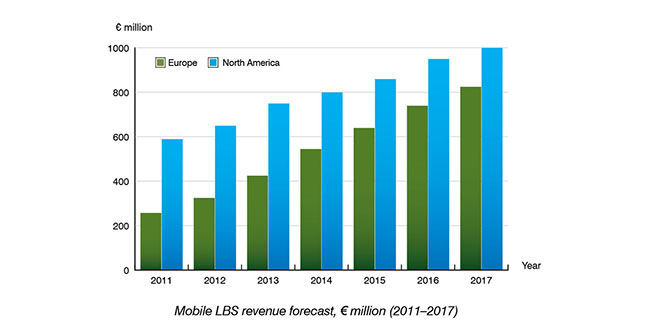
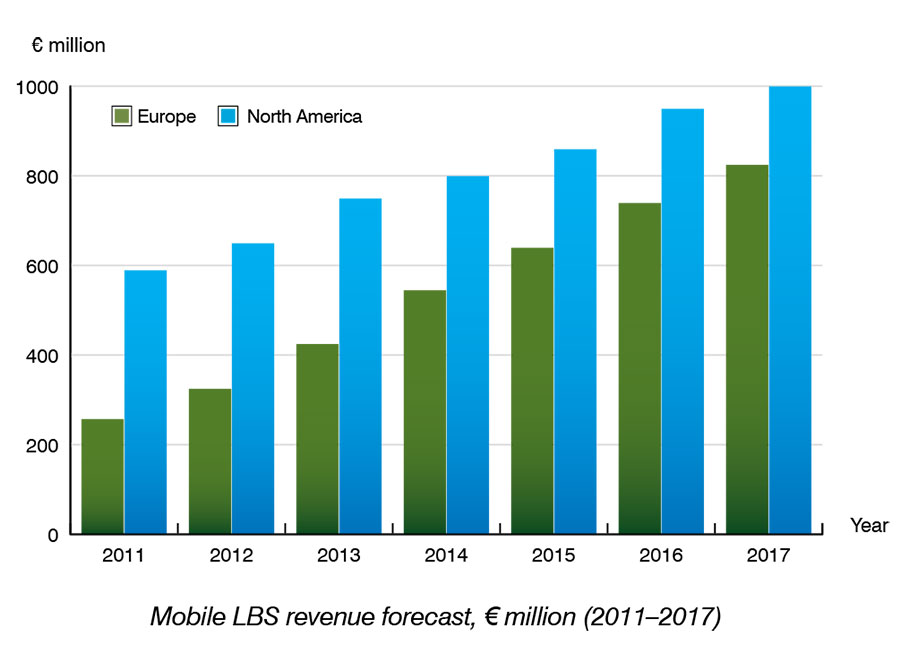
    According to a new research report by Berg Insight, mobile location-based service (LBS) revenues in Europe are forecast to grow from €325 million in 2012 at a compound annual growth rate (CAGR) of 20.5 percent to reach €825 million in 2017.

    The North American LBS market is forecast to grow at a CAGR of 9.2 percent from US $835 million in 2012 to reach US $1,295 million in 2017. Berg Insight estimates that 40 percent of all mobile subscribers in Europe use some kind of location-enhanced application on a regular basis. In North America, the larger installed base of GPS-enabled handsets and smartphones has enabled higher uptake of LBS.

    Berg Insight estimates that about 50 percent of all mobile subscribers in the region now access LBS at least monthly. Local search, social networking and navigation services are the top application categories in terms of number of active users. Mobile workforce management services that aim to improve operational efficiency for businesses are also gaining traction in new industry segments.Berg-LBS-report

    “Smartphones are the most important enabler for LBS adoption in general. The installed base of smartphones in Europe has now reached 45 percent of total handsets and already surpassed 55 percent in North America,” said André Malm, Senior Analyst, Berg Insight. He adds that besides differences in smartphone adoption, there are other regional differences. “Mobile operators still play a more central role in North America than in Europe, marketing branded services to both consumer and enterprise customers.”

    However, the operators’ central role in the LBS ecosystem is now being challenged by the smartphone ecosystems that bundle key LBS and give developers access to location data and distribution channels in the form of on-device app stores. Mobile operators are therefore showing renewed interest in offering network-based bulk location data for advertising and analytics, as well as new services such as secure authentication and fraud management.

    A brochure on the report can be downloaded here.

  • MediaTek Announces Multi-GNSS Receiver SoC Solutions Supporting Beidou

    MediaTek Inc., a fabless semiconductor company for wireless communications and digital multimedia solutions, today announced the availability of its MT3332/MT3333, a 5-in-1 multi-GNSS receiver system-on-chip (SoC) that support the Beidou Satellite Navigation System. The Beidou system has been commercially operational since the end of 2012, and can identify a user’s location to 10 meters (33 feet), their velocity to within 0.2 meters per second, and clock synchronization signals (one-way) to within 10 nanoseconds.

    The MediaTek MT3332/MT3333 can discover GPS, Beidou, GLONASS, Galileo and QZSS constellations. Featuring a multi-GNSS receiver design, the MT3332/MT3333 can reduce the cumulative distance and positioning error accumulated over time/multiple hops, and significantly improve navigation/positioning accuracy, MediaTek said. The MT3332/MT3333 also comes with excellent signal acquisition and tracking sensitivity, which efficiently enhances signal quality within dense cities, tunnels and multi-storey car-parks, while delivering a better user experience, the company said. Moreover, because of its highly integrated, low-cost and ultra-compact system architecture, the MT3332/MT3333 enables multi-GNSS receivers with the same reference board for mobile, industrial and automotive navigation applications.

    “The proliferation of LBS (location-based services) using mobile applications over wireless networks such as social check-in or nearby service recommending is driving demand for greater satellite navigation performance and coverage beyond existing technologies. This will also lead to the rapid adoption of multi-GNSS receiver solutions in smartphones, tablets and automotive vehicles because LBS is now an indispensable way for people to interact/communicate with each other on a daily basis,” said SR Tsai, general manager of the Wireless Connectivity and Networking Business Unit at MediaTek. “We believe the market for Beidou-compatible multi-GNSS receivers in China will accelerate in the coming years. MediaTek will deliver new products that offer high value and are capable of meeting the evolving needs of our customers in the Beidou navigation system market through continuous product innovation. The MT3332/MT3333 [models] are designed to accelerate the realization of satellite navigation services anytime, anywhere, in a seamless fashion.”

    The MT3332/MT3333 also incorporates MediaTek’s unique “AlwaysLocate” technology that can identify the state in which the user is (regardless of on-the-go or sleeping) and automatically adjust the satellite signal receiving modes for more accurate and reliable navigation services, and to save the battery power of the navigation system.

    The MediaTek MT3332/MT3333 is now in mass production stage and being designed into major satellite navigation systems and mobile communication platforms worldwide.

  • Tablets and Cameras to Be Major GPS and LBS Markets by 2017

    Despite relatively stunted growth thus far, the tablet and camera markets are forecast to be the next major market for location-based services and GPS IC penetration.

    ABI Research’s latest Report, “Location Applications for Tablets, eReaders, Digital Cameras & Handheld Gaming,” forecasts the uptake of LBS and how it will affect the adoption of location technologies. The tablet market has largely been dominated by Apple and its GPS/Modem strategy. GPS shipments are forecast to reach 37 million in 2012, yet it is still much less than had been previously anticipated. There has been mixed news of late, with the launch of Google’s Nexus 7 and Apple’s iPad mini. Wi-Fi location is a standard feature across all major tablets and while it is complementary, it does act as a barrier to GPS integration.

    Senior analyst Patrick Connolly said, “When we look at the adoption of applications on tablets, it is forecast to largely mirror that of smartphones, with a focus on local search, social, enterprise, navigation, and ambient intelligence.” Android will lead the way, as ubiquitous location becomes a necessary component.

    The camera market has huge potential, with geotagging a clear driver. With more than 30 GPS-enabled cameras on the market, shipments are expected to break 10 million in 2013, and a second wave of new applications emerging around tracking, maps and points of interest, and dead-reckoning. As an industry, there needs to be a complete overhaul of how cameras are designed, to find a way to leverage the photography revolution occurring on smartphones. ABI Research has forecast that this will open the door to GPS, alternative location, and LBS in future.

    The launch of the Sony Vita was expected to kick-start the location-based gaming (LBG) industry, featuring Wi-Fi location as standard, and an optional GPS/modem module. Practice director Dominique Bonte said, “Irrespective of limited device sales, location-based gaming and community applications still have fundamental barriers concerning critical mass and where and how the device is used. As a result, LBG is expected to initially flourish on smartphones, with GPS forecast to remain subdued on gaming devices.”

    These findings are part of ABI Research’s Location Based Services which includes Research Reports, Market Data, and Insights.

  • Waze to Offer Location-Based Ads

    Kevin Dennehy

    The month of October and now into November was filled with several conferences, but not a lot of location news. A few news snippets, while not blockbusters, were important. One was Waze’s decision to offer its own location-based advertising. Another was a milestone for Ford, which said its Sync information system is now in five million vehicles.  On an end-of-an-era note, of which there have been quite a few in the last two years, Sprint has decided to drop the Nextel name. Nextel was one of the innovative companies in the late 1990s and early 2000s, placing location capability into mobile phones and jump-starting an industry.

    Waze recently said it is offering a global location-based advertising platform that will be directed to its 30 million users. Waze, founded in 2009 in Israel, says smartphone users can try the service for free — the profit for them is ad revenue from local and large brands.

    GPS World’s LBS Insider recently reported that Tim Cook, Apple’s chief executive, actually endorsed Waze as an alternative to its own mapping service after users were experiencing problems with it. Waze, which is offering the advertisements in the United States, said it saw a jump in downloads after the announcement.

    Some industry analysts say it may be a mistake for Waze to swim in the deep end of the pool to compete with such mobile advertising giants as Google.

    Waze raised a total of $67 million from investor Kleiner Perkins and Hong Kong investor Li Ka-shing.  They cite big partners such as Circle K, Dunkin’ Donuts, MACS, Kum & Go, Wyndham Hotels, Jamba Juice, and P&G.

    Palo Alto-based Waze is probably best known for its driving directions based on user input.  The company says that its users spend an average of more than 7 hours in their vehicles a month.

    The company, in order not to annoy users, is minimizing the number of pins on a map advertisement. According to published reports, the company said its advertisements will include coupons.

    From the Waze blog:  “We don’t want to bombard you, so you’ll never see too many businesses crowded on the map at once. Instead, the algorithm that powers Waze Ads aims to bring you a helpful selection of the various retailers around you on your daily drive.”

    Waze is also making advertising inroads in Europe. It recently announced a partnership with Lumata, an Italy-based mobile marketing company. The deal allows Lumata to have a an exclusive right for advertising on Waze’s app in Italy, according to published reports.

    Waze announced in June that car models will soon integrate the company’s mapping software. The company’s iOS and Android app’s users contribute road data while they drive, share accident reports, police speed traps, traffic jams and other data.

    Five Million Sync Units in Five Years…

    Ford and Microsoft’s Sync infotainment system has been installed in five million Ford and Lincoln vehicles. The unit, which was rolled out at the 2007 Consumer Electronics Show in Las Vegas, was one of the first products to allow smartphones to work with car components.

    Sync was innovative in that it bundled turn-by-turn navigation, hands-free calling, text message reading, and other features.  Earlier aftermarket products, such as Clarion’s AutoPC, were busts — but perhaps five-to-seven years too early for the market.

    Ford jazzed up Sync with touchscreens and voice recognition since it rolled out its first model, which only used push buttons. It integrated other features such as audio, air conditioning/climate control, and navigation. Soon the newer version, MyFord Touch, offered video streaming, music, and a voice-activated climate control system.

    Ford announced earlier this year that it was working with State Farm to add all Sync-equipped vehicles to the insurance giant’s Drive Safe & Save approved vehicles. A customer, through a voluntary sign up, can run a Vehicle Health Report that sends information to State Farm. Potential insurance savings for a customer could be 40 percent.

    Ford is working with several industry companies, including Pandora and TeleNav Scout, through its AppLink program, which was globally offered earlier this year.

    In other LBS news:

    • Sprint’s recent decision to drop the Nextel name was the end of an era, but not a surprise. It was Nextel, before its 2005 merger with Sprint, that truly innovated consumer and enterprise applications and markets on the mobile handset. In the wake of Japan’s Softbank purchase of 70 percent of Sprint, the Nextel part of the Sprint name will go away in mid-2013. The new name will be Sprint Corp.  The Nextel brand was known for its iDEN technology and network, which is gradually being shut down by Sprint.
    • The recent U.S. presidential election had an LBS story. Foursquare had an app that had the goal of encouraging users to vote. The “I Voted” app allowed users to find their local polling station on Election Day and check in to show they cast a vote. Foursquare, trying to show that it offers more than “check-in” capability, recently announced a rating system for businesses. It is not clear whether the service, with 25 million users, is going after companies such as TripAdvisor and Yelp for a share of the evaluation/services market.
    • Samsung Electronics’ Galaxy S III managed to knock Apple’s iPhone 4S off the pedestal as the world’s most popular smartphone, in terms of sales, in the third quarter, said Strategy Analytics. Samsung sold around 18 million S III phones during the quarter, compared to Apple’s 16.2 million iPhone 4S units. The Galaxy S features a large touchscreen and GPS for location-based services.


  • Duntsu Releases Food Finding LBS App

    Dentsu has released a social app for location-based food search for iOS devices. FoodKing enables searching for a particular food item of interest, such as an omelet or pasta, based on the user’s location. Users can also “like” and “comment” on reviews and gather points to become a King of an individual food ranking.

    This app was released globally enabling users to communicate internationally through food reviews. Dentsu says it will be adding new food categories every month. Currently the app supports English and Japanese in the interface, and reviews in all languages. More languages are planned.

  • In-Location Alliance to Promote Location-Based Indoor Solutions

    The In-Location Alliance was launched August 23 by 22 companies across location industries to drive innovation and market adoption of high-accuracy indoor positioning and related services.

    Accurate indoor positioning opens up plenty of possibilities for new mobile services. For a consumer this could mean, for example, receiving directions to the right products and personalized product promotions in nearby shops; using real-time navigation inside a building; finding the precise location of assets and people; and even increasing security in emergency situations. For facility owners and local service providers this could enable, for example, increased local customer identification; enhanced product placement; and better customer satisfaction by deploying resources when and where needed.

    The alliance will focus on creating solutions offering high accuracy, low power consumption, mobility, implementability, and usability. It will create an ecosystem that stimulates innovation, enhances service delivery, and accelerates the adoption of solutions and technologies that optimize the mobile experience, the companies said.

    Founding members include: Broadcom, CSR, Dialog Semiconductor, Eptisa, Geomobile, Genasys, Indra, Insiteo, Nokia, Nomadic Solutions, Nordic Semiconductor, Nordic Technology Group, NowOn, Primax Electronics, Qualcomm, RapidBlue Solutions, Samsung Electronics, Seolane Innovation, Sony Mobile Communications, TamperSeal AB, Team Action Zone and Visioglobe.

    Alliance members will pilot the most promising services and use cases from a business and solution point of view. The other important task for the Alliance is to ensure a multivendor environment by promoting open interfaces and a standard-based approach.

    Alliance members are encouraged to execute their own pilots and present their data to the Alliance. The primary solutions will be based on enhanced Bluetooth 4.0 low-energy technology and Wi-Fi standards using relevant existing or coming features of those technologies. These technologies are commonly used in mobile handsets and are thus a natural starting point for the Alliance’s efforts.

    Pre-commercial pilots and business model verifications will start in 2012, while 2013 is expected to bring mobile handset-based implementation enabling the first consumer applications in the indoor mobile environment.

    The Alliance says: “The aim of the In-Location Alliance is to act as a pioneer opening up new business streams for indoor environments. Indoor positioning is the next frontier of mobile services, offering great opportunities to enhance consumer experiences. For the benefit of enterprises, the Alliance will drive a world-wide indoor positioning system for use in major venues. Our pilots, along with technical evaluations, are paramount for driving rapid market adoption.”

    Patrick Connolly from ABI Research says: “The indoor location market sits on the cusp of a wave, with the market set to reach a significant number of installations in 2015-2017. With a huge number of proprietary technologies vying for position, the establishment of the In-Location Alliance can encourage innovation, lower costs and, ultimately, widespread adoption of standard based technologies and solutions.”

  • Features Added to Free EGNOS Software Development Kit

    Now GNSS smartphone application developers can benefit from a range of new features from Version 2 the European Commission’s free EGNOS Software Development Kit (SDK), reports the European GNSS Agency (GSA). The SDK helps developers to easily implement EGNOS corrections coming from the signal in space or the Internet, and make use of EGNOS advantages when using location-enabled applications.

    The EGNOS SDK is a European Commission project that aims to foster the use of EGNOS in location-based services (LBS) applications for smartphones. It has been designed to allow application developers to take advantage of the benefits of EGNOS, and to use these in software they develop for mobile devices. The EGNOS SDK is the only toolkit — in an open-source library — that implements integrity and EGNOS corrections for a more accurate position than GPS alone can provide.
     
    New EGNOS SDK features and improvements include:

    • Tracking feature: Allows application developers to choose different options to display their GPS and/or EGNOS and/or R&D position over the smartphone’s map.
    • Skyplot view: Enables to display the position of the overhead EGNOS and GPS satellites with a time span of +12h or -12h. This feature shows information about the number of EGNOS satellites available, the number of GPS satellites used for the computation of the R&D, EGNOS and GPS positions, and the number of satellites not used.
    • Advanced Skyplot view: Provides an augmented reality showing a live video streaming of the sky and can identify EGNOS and GPS satellites in real time.
    • R&D Position Type menu: Displays six features proposing innovative ways of computing a position by deviating from the EGNOS standard EGNOS DO-229D, to get  even greater accuracy:
    1. The Increased satellite constellation improving the satellite constellation used by adding GPS satellites not monitored by EGNOS.
    2.  The Best satellite constellation selecting the most suitable GPS satellites geometry for the computation of the position.
    3.  The 2D Positioning displaying the position even if only 3 GPS satellites are in view (4 satellites are normally the minimum needed to compute a position). This is important in urban situations, where surrounding buildings can obstruct a clear view of the sky, making it difficult to track four satellites or more.
    4. The Fast correction with no RRC improving the positioning by eliminating the jumps that the Range Rate Correction (RRC) might cause in the fast corrections applied to the pseudorange (PR) measurements.
    5. The Best Weight Matrix rating the satellites involved in the position computation on the basis of the most beneficial weight matrix.
    6. The SBAS ranging function enabling SBAS geostationary satellites to be used in the same way GPS satellites are used to compute a position

    As far as integrity is concerned, the user can define different levels of integrity to be displayed (Horizontal Protection Level (HPL)): aviation, maritime or 85 percent.
     
    Since its initial release in November 2011, the EGNOS SDK is providing a useful tool to application developers who need the additional accuracy provided by EGNOS accessible in smartphone applications, according to customers:

    “I am interested in the toolkit because I started a project that aims at developing an application based on smartphones” – GeoMatica

    “I found the toolkit interesting, especially SISNet, in Finland the EGNOS signal is low…the corrections I receive with SISNet are more reliable than those I could receive with the satellite” – VTT

    The EGNOS SDK v.2 can be downloaded for free on the EGNOS Portal.
     

  • Esri Maps for Office Extends Location Analytics throughout Organizations

    Esri released Esri Maps for Office, a new analysis tool that allows business professionals to visualize data by creating and sharing interactive maps directly within Microsoft Office. Esri Maps for Office is a downloadable add-in for Microsoft Office 2010 that helps organizations make better decisions through location analytics.


    "By bringing the power of location analytics to Microsoft Office, Esri Maps for Office extends mapping and geographic intelligence capabilities to new people and departments," said Jack Dangermond, Esri president. "Esri Maps for Office is the next necessary step to offering more robust business analytics throughout an organization."

    With Esri Maps for Office, business professionals can quickly create interactive maps from their data in a Microsoft Excel spreadsheet. These live maps, which can be based on any geographic component, such as customer locations or sales by ZIP Code, can be simply added to Microsoft PowerPoint presentations or shared through Esri's cloud mapping platform, ArcGIS Online. Maps shared through ArcGIS Online can then be distributed throughout an organization or embedded into mobile or web applications.

    The interactive maps and presentations business professionals create with Esri Maps for Office provide a powerful way of exploring issues ranging from gaps in existing service to opportunities for growth. Esri Maps for Office allows analysts to investigate their data as color-coded maps, point maps, or heat maps, and provides full control over the way data is displayed on the map. Organizations can overlay their data on a set of standardized Esri background maps or search through the extensive library of geospatial content available through ArcGIS Online.

    Esri Maps for Office is available as a free download to organizations with ArcGIS Online subscriptions. For more information on Esri Maps for Office, visit esri.com/maps4office.

  • A Look at Small Indoor Location Competitors

    Everyone wants a piece of the pie, the upcoming indoor location pie. Big companies and start-ups are engaged, some in research, others having launched solutions. While Wi-Fi is the most common technology, many companies are pursuing alternate methods, including GPS, audio, Bluetooth, small cell/cellular, distributed antenna systems (DAS), near field communication (NFC), white band, sensors, movement tracking, beacons, and more. Of the large players who are making a play for the indoor market, Cisco, Google, Microsoft, Motorola, Nokia, Qualcomm, RIM, and TCS are the furthest along, reports Grizzly Analytics.

    At a minimum, indoor technology will do what we do outside and enable GPS-style mapping, navigation, local search, check-ins, location-sharing, and other location-based services. An explosion of other uses will evolve, enabling search for items on store shelves, sending deals, and contextual advertising.  This newsletter issue is devoted to looking at smaller companies, those not listed above, many start-ups competing for their piece of the pie.

    A pool of smaller indoor companies is focused on creating positioning technology, many ripe for acquisition. Navizon, sensewhere, and SkyHook are betting on unique approaches to determining indoor location position. No longer solely focused on driving the streets to map Wi-Fi signals, Skyhook has adopted a comprehensive approach to indoor location, integrating multiple technologies (GPS, Wi-Fi, cell, and sensor-based) to ascertain location, a solution that offers the advantage of flexibility. Navizon is focused on Wi-Fi signals, currently the most popular solution for indoor location. There are sometimes existing Wi-Fi nodes, but added nodes can usually be fairly easy to install. From a business standpoint, the downside of Wi-Fi positioning is the large number of competitors focused on solutions. sensewhere is pursuing an entirely crowd-based software offering  that locates and cross-references publically broadcast information, including MAC addresses, from consumer devices. It is the easiest solution. No infrastructure is required, but it requires a certain density of devices.

    I’ve asked Navizon, sensewhere, and Skyhook to write, in their words, about their company, technology and perspective on the industry:

    Navizon In Their Own Words. “Navizon Indoor Triangulation System (I.T.S.) uses Wi-Fi signals to provide indoor location throughout a building or campus. Navizon designed this system to locate users of smartphones, tablets and laptops, all of whom rely heavily on Wi-Fi.  This real-time locating system’s infrastructure uses small, easily deployable nodes connected through a mesh network.  No wiring or software installation, and only minimal configuration, are required. The administration dashboard is an online interface to Navizon’s cloud.  Integration is through a web services API.  This design delivers an affordable indoor location platform, with room and floor-level accuracy, up and running in a single day.” Cyril Houri, Navizon

    sensewhere In Their Own Words. “sensewhere technology automatically locates and cross-references RF access points via user devices to create an almost limitless proprietary, reliable, live, global RF location database. The solution does not require additional infrastructure installation nor calibration or re-calibration when the venue’s RF infrastructure changes. sensewhere technology is powered by patented algorithms that dynamically adapt to indoor environments to optimize the use of mobile device resources. Commercial benefits have been demonstrated in the largest shopping malls around the world where more than half of RF infrastructure can change within a few months.” Rob Palfreyman, sensewhere

    SkyHook In Their Own Words. “Location technology company Skyhook, provides seamless operation of indoor and outdoor mobile device positioning using integrated GPS, Wi-Fi, cell, and sensor-based positioning technologies. Venues have been hesitant to get involved with indoor location due to concerns over control of their data, cost of initial deployment, cost of maintenance, accuracy and consistency of the technology, and availability to deploy on a large variety of devices.  Skyhook is involved in industry efforts to provide venue owners the ability to manage their infrastructure data in a consistent, standardized way that addresses both the technical and business needs.” Ronda Billings, Skyhook

    Positioning technology is of limited use without indoor venue maps, which might include shopping malls, arenas, convention centers, and hospitals. Retail is very interested in being able to direct people into their stores, to a particular aisle, or even shelf location. Meridian, Micello, and Point Inside have distinct approaches. Micello creates indoor maps by using data found in public domain; their customers are not the venues, but the developer community. Meridian creates indoor maps based on maps drawn  by customers and adds navigation and points of interest. At its start, Point Inside had a similar focus, indoor map creation, but has since integrated positioning data and added an ad network to its solution. Point Inside is targeted to retailers.

    I’ve asked Meridian, Micello, and Point Inside to write, in their words, about their companies, technology, and perspective on the industry:

    Meridian In Their Own Words. “Meridian is focusing on providing software to allow employees of a location-based business to create an indoor way-finding app for visitors. The system enables a customer to upload maps (CAD, etc.) that are then converted into vector files.  Points of interest and turn-by-turn directions can be generated. The turn-by-turn directions can work with any wireless connectivity, from basic 3G to more sophisticated Wi-Fi systems. Indoor venues can achieve a GPS-like experience — that ‘glowing blue dot on the map’ — some are seeking. Meridian is seeing adoption from retailers, hotels and hospitals.” Jeff Hardison, Meridian

    Micello In Their Own Words. “Micello is a provider of indoor venue maps, including shopping malls, airports, college campus buildings, hospitals, retail stores, casinos, and stadiums in over half-a-dozen countries throughout the world. Micello uses proprietary, in-house mapping and navigation tools combined with map-manufacturing tools and dashboards. The technology ingests various sources of data and information about a given venue to create a well-defined, structured set of indoor map data. In the next 36 months, every building will have an app and mapping technology, integrated with positioning technology. Information will be automatically sorted and organized for users based on where they are located inside.” Ankit Agarwel, Micello

    Point  Inside In Their Own Words. “Point Inside provides retailers with detailed indoor maps, exact product location, and dynamic shoppers locations to help stores engage with in-store customers. The user’s shopping list, which is entered into the application, enables high-converting, hyper-targeted advertising.  With indoor location technologies advancing too quickly to pick a single winner, Point Inside uses proprietary algorithms to combine results from multiple location technologies to determine the most accurate fix. Primary technologies include: proprietary Wi-Fi fingerprinting, motion sensing to determine movement from known locations (such as product locations); partnership with other location providers; and correlation with indoor maps to determine valid locations.” Todd Sherman, Point Inside

    How does this shake out? It is too early to tell. In the coming year, I expect the indoor location market will be better formed. Consolidation will occur. Some companies will drop out and others will be purchased. Grizzly Analytics suggests eBay, Local.com, Amazon, Microsoft, Apple, GroupOn, TI, Qualcomm, CSR, Google, foursquare, and Google are all shopping or looking for strategic alliances to develop indoor location offerings. Time will tell who eats pie.

  • Social Loco Conference Highlights LBS Brand Marketing

    The Social Loco conference in San Francisco highlighted brands leveraging social location. However, it seems as if the conference focused more on the social than the location element. As one attendee said, “Location as a topic is almost like electricity as a topic, it’s just there.” In other industry news, veteran location executive Kanwar Chadha is moving on…


    SAN FRANCISCO — Most companies and attendees at the recent Social Loco conference here realize that while social is big, and such companies as Home Depot and Kraft are looking hard at it, the location part of it still has detractors who don’t know what to do with it.

    The problem with social location advertising is that ad execs and large companies don’t understand it — or know how to spend money against it, said Marc Prioleau, managing director of Prioleau Advisors.

    Prioleau said location industry executives would talk to each other on who is going to rule the world, with little effect. “[The problem is] that no one came from brand backgrounds and were hacking around an application, rather than focusing on a brand’s objective. Some of the ideas that were hot two years ago…aren’t so hot now,” he said.

    The big impact of location-based services, or social loco marketing, is getting consumers to take specific actions to get into a store, said speakers on a mobile panel. Location is relevant when a company can use it as a signal of intent to bring in a five- to 10-percent conversion [sale] rate. “There still has to be relevant and interesting ads, which will open the floodgates for innovation to come in,” said one panelist.

    Proximity marketing may be the key ingredient to making LBS a big part of a brand’s advertising strategy. Panelists believe that a large part of consumer purchasing comes in the proximity of someone’s home. Around 40 percent of mobile searches are local.

    The fact that a lot of searches are local is not enough, said Di-Ann Eisnor of Waze. “[Users] say that, ‘I am doing this thing already, what else could I be doing [around this area]?” she said. “Intent becomes very powerful — people sharing that intent.”

    A venture capital speaker said that brand managers at Pepsi, Gatorade, Mountain Dew, and others are holding back money to find new ways to have consumers “buy that one more can of Pepsi.” He said that brands are looking at social location as ways to try something they haven’t before. “They will get some air time with some senior leaders because of that,” he said.

    Still, hard to convice die-hard VCs that location is the way to go. “Social loco [constitutes] two important elements [of advertising]. But I don’t wake up and say, ‘Let’s do a social loco deal today’ — what is this business going to build over time?” asked John Malloy of BlueRun Ventures.

    One VC said that LBS is a technology, not necessarily a business mobile. “Investing in mobile, yes, but that’s like saying we invest in people who walk around on two legs. The challenge with location is that it tells me where I am, but not necessarily tells me what to do,” he said. “We need to see a connection to revenue. That’s a challenge with companies such as foursquare — to get a distribution to a network of merchants. Until you are getting paid, it’s just theoretical.”

    Travel May Be LBS Niche Market

    Using social location applications helps travel companies, airlines, hotels, and others in that industry find customers, said panel members. “Consumers are starting to look at social commerce and social proofing as a way to intelligently tap into friends. They are looking at five hotels my friends have been to,” said Kevin Fliess, Room 77 general manager and vice president of products. “Location and price is a huge consideration — and reading reviews from friends has more value than reading anonymous reviews.”

    “One of the challenges we face — location is sensitive — how they can share their trips [is important]. Clearly, the more options you deliver is confusing to consumers,” Nancy Ramamurthi, TripIt vice president, product management and marketing.

    One of the off-shoots of travel may be photography. David Staas, CEO of jiwire, said that the company surveyed 800 mobile consumers who used smartphones as the primary device to take a photo. “There is a location component to it; 31 percent want to remember where they took the picture,” he said. “Men and women we surveyed had different behaviors. Women want to use location to communicate with a broader network; 91 percent take pictures on the go; 20 percent of them are more likely to location tag.”

    Big Names and Big Companies Rarely Say Anything

    At such conferences as Social Loco, big-name entities such as Facebook and Google speak, which draw attendees. Sad thing is that none them say anything, most knowledgeable industry vets agree.

    Emily White, Facebook’s director of mobile partnerships, was a keynote speaker at Social Loco and fits in this big-company, no-substance conference speak genre. Yet the big media outlets, because it was Facebook speaking, quoted her with the earth-shaking news that mobile is important, and, hold on to your seat, “the web is being rebuilt around people.” Note to these big companies: Cut the PR stuff and ‘I’m so hip and my company owns the world’ talk, particularly when you are talking to a crowd of savvy marketing executives.

    Privacy Is Dead: That’s News to Me

    Actually, really isn’t news to me. Anytime a conference has a privacy panel, you know that fireworks will ensue and nothing ever gets resolved by the time the panel ends.

    Social Loco’s privacy panel was no different. One panel member said privacy is boring. “It’s boring to legislate, like seatbelts and helmets,” he said.

    A Qualcomm speaker said the company has a lawyer who does nothing but work privacy issues. Another speaker, in a rather politically incorrect manner, said more people are harmed from the Catholic Church than by Facebook’s location privacy policy.

    Chadha Leaving CSR/SiRF after 17 Years

    After more than 17 years with SiRF, including three as chief marketing officer following a merger with CSR, Kanwar Chadha is moving on. In a note to colleagues, he said he has “decided to move on and explore new destinations in my journey of adventure and discovery.”

    When Chadha co-founded SiRF in 1995, the company wanted to sell GPS for consumers, which was revolutionary as most in the industry were still trying to sell survey equipment.

    “Many thought we were pipe dreamers, some felt we were foolish to enter a market dominated by big companies with a technology controlled by the Department of Defense, and others looked at us as another flash-in-the-pan start-up,” he said. “We were technologists and evangelists at the same time. We developed innovative technologies and products to make GPS work in environments that system was never designed for, but are important for consumer usage such as urban canyons and dense foliage; all keeping in mind price points that mainstream consumers could afford.”

    Chadha was proud of an idea book he called “Navigations,” which outlined “futuristic, but artistic concept devices and scenarios highlighting potential use cases of GPS in our daily lives,” he said. “Things we may take for granted today but seemed quite far-fetched in 1995. It was expensive collateral, but probably the best I have done in my life, and it became quite popular,” he said.

    During his tenure at SiRF, the company acquired the GPS businesses of Motorola and Conexant as well some smaller companies such as Centrality, Enuvis, Impulsesoft, Kisel, and TrueSpan. He was at the company during the 2004 initial public offering and its merger with CSR in 2009.

    “Many of the original SiRFers have moved on, and I have focused my last three years on helping transform CSR into a ‘platform-focused company’ from being just a component supplier. There are many interesting challenges ahead, such as making indoor location reliable and meeting consumer expectations with location across a broad range of applications,” Chadha said.
     

  • Google Releases Indoor Maps for More than Twenty Museums Including Smithsonian

    Google announced on its official blog that it has released more than twenty popular U.S. museums to its collection of over 10,000 indoor maps that they launched in November: the de Young Museum in San Francisco, the Philadelphia Museum of Art, Cincinnati Museum Center, the Indianapolis Museum of Art, the American Museum of Natural History and 17 Smithsonian museums and a zoo.

    American Museum of Natural History, New York City

    National Air and Space Museum—Smithsonian Institution, Washington, D.C.

    Google reports that to access the floor plans, simply open Google Maps on your Android phone or tablet and zoom in on the museum of interest. To find the museum, either search for it by name using the magnifying glass icon or, if you’re already there, use the “My location” feature to orient yourself. With the “My location” feature enabled you can even get indoor walking directions.

    According to the announcement, more museums are adding their floor plans to Google Maps for Android soon, including the SFMOMA, The Phillips Collection, the Nelson-Atkins Museum of Art and the National WWII Museum in New Orleans. If you’re interested in getting your museum’s floor plan included in Google Maps, visit the Google Maps Floor Plans tool.


  • Two New Kindle Fire Apps Leverage Skyhook Technology

    Skyhook, a location information, context and intelligence company, has announced that two new Kindle Fire apps have integrated Skyhook to provide location services on this device. The applications include Happy Hour Finder and Scope. They join a list of other apps using Skyhook for location services on the Kindle Fire, including MapQuest, KAYAK, deCarta, and TweetCaster.

    Happy Hour Finder is a local search app that shows the nearest bars and restaurants with discount happy hours. Scope is an aggregated social media app that organizes all of a person’s social networks in one place.

    “"Location check-ins are a valuable piece of the complete social picture Scope provides of your friends' activity,"” said Anit Kumar, CEO of Scope. “"We knew we couldn'’t launch the app on Kindle Fire without location, and wanted to ensure all of our Android versions were the same, so Skyhook was necessary.”"

    "Developers are increasingly concerned with Android fragmentation,"” said Maggie Taylor, marketing manager of Skyhook. "“Our system provides consistent location functionality and protects developers from this problem, so apps are built once and will work across the board.”"

    Happy Hour Finder and Scope are both free and available today in the Amazon App store for download. Skyhook provides an SDK for developers across most platforms.