Lockheed Martin and the Warsaw University of Technology (WUT) successfully demonstrated their UAV optimization technologies using aerial command and control (C2) of multiple unmanned aerial vehicles (UAVs).
The demonstration marks a successful milestone in the joint WUT-Lockheed Martin advanced applied research program on optimization of diverse fleets of aircraft, and concepts associated with manned-unmanned command and control of airborne platform systems.
“These technologies have tremendous commercial and military potential as the world moves toward greater and greater use of unmanned aerial systems,” said Prof. Janusz Narkiewicz, head of WUT’s Department of Automation and Aeronautical Systems. “Understanding how different assets can interoperate, communicate and serve common objectives with maximum efficiency is a challenging task in the growing field of UAV technologies.”
Through the use of advanced mathematic calculations and a systems-of-systems approach, the technology bolsters mission efficiency by adapting the fleet’s commanded flight paths, speeds, division of duties and sensor performance. Modeling all the constraints of the task at hand, the students calculate the “best answer,” usually beating either the human best guess or simpler approaches by 10 to 20 percent.
The goal of the team’s latest project was to advance previous optimization work by incorporating airborne C2, improving user interfaces, and testing new methods for related subroutines. With a vision of ultimately developing fast dynamically adaptive approaches to live management of a UAV fleet, this work is an important contribution to the concept of manned-unmanned teaming, where manned assets operate seamlessly with surrogate UAVs, often controlling many at a time against specific tasks.
The technology demonstrates that, with the right tools, an operator may adapt to changing scenarios, calculate new solutions, and deploy those new, optimized solutions to the fleet of commanded aircraft, whether for civil or military purposes, a Lockheed Martin news release said.
The recent demonstration can be equated to a search-and-rescue task, where every minute shaved off of a search pattern could be the difference between life and death.
In another example, if UAVs were to be used to deliver small packages to consumers, the 10 to 20 percent performance improvement could be the competitive edge that keeps an operation in business ahead of the competition.
The program builds on the strong industrial and academic partnership between Poland and Lockheed Martin aimed at motivating young Polish engineers to address tomorrow’s defense and industrial needs. WUT and Lockheed Martin are seeking new Polish partners to further advance Polish research and development capabilities on manned-unmanned airborne platform system integration.
Dual Mode Plus uses inertial guidance with GPS updates to shape flight path for target engagement at desired impact heading and dive angle. (Photo: Lockheed Martin)
Lockheed Martin’s new Dual Mode Plus laser guided bomb (LGB) successfully completed two recent flight tests at the Naval Air Warfare Center Weapons Division in China Lake, California.
The tests demonstrated operation of the new linear optics, GPS/inertial navigation system (INS) guidance subsystem and the control actuation system, meeting all mission objectives.
Released from an F/A-18 Super Hornet, the two Mk-82 (500-lb.) inert warheads, fitted with Dual Mode Plus guidance kits, impacted fixed targets well within operational performance requirements.
“Lockheed Martin’s Dual Mode Plus benefits from the reliability and affordability of the Paveway II Plus LGB system while integrating a GPS/INS, all-weather moving target capability,” said Joe Serra, Precision Guided Systems director at Lockheed Martin Missiles and Fire Control. “This combination offers a precise and affordable direct attack weapon system to the U.S. and its allies.”
Effective against fixed, relocatable and moving targets, Dual Mode Plus will improve mission effectiveness by providing precision strike capabilities in all-weather conditions at extended standoff ranges.
Dual Mode Plus maintains Paveway II LGB physical dimensions and easily integrates with aircraft employing Paveway II LGBs or other similar direct attack weapons utilizing conventional MIL-STD-1760/1553 or Universal Armament Interfaces.
Lockheed Martin is a qualified provider of all three Paveway II MK-80 series LGB variants (GBU-10 MK-84 [2,000 lb.], GBU-12 MK-82 and GBU-16 MK-83 [1,000 lb.]) and is the sole provider of the Enhanced Laser Guided Training Round and Dual Mode LGB kits.
The company has delivered more than 150,000 training rounds, more than 75,000 Paveway II LGB kits and 7,000 dual-mode systems to the U.S. Navy, Marine Corps, Air Force and 23 international customers.
It was not a big wager as wagers go, at least not in monetary value, but the underlying premise of the wager spoke volumes. It all began innocently enough in 2005 when the first test, or proof of concept, Galileo satellite known as GIOVE-A was launched.
In March of that year, a group of PNT experts made a simple wager that there will be:
10 or fewer operational Galileo satellites by 12/31/15
or
11 or more operational Galileo satellites by 12/31/15
Galileo’s GIOVE-A retired in June 2012.
About 20 PNT experts took the bet, evenly divided on both sides, which essentially said that given that the first test (GIOVE) Galileo satellites were launched in 2005 and 2008 respectively, surely there would be at least 10 operational satellites on orbit or about one per year by 2015.
The stakes were modest, but as I said, the import of the faith (or lack of faith) in the European Union and its ability and understanding of the difficulties involved in the Galileo endeavor spoke volumes. As the chief scientist at Air Force Space Command stated at the time, “This is rocket science; this is hard.”
Chutzpah and/or naïveté
But the Europeans refused to believe it was a very hard problem. Indeed, after the second GIOVE launch, GIOVE-B in 2008, the European ministers announced, with incredible chutzpah and/or naïveté, that the Galileo constellation would be fully operational (24 fully operational on-orbit satellites) by 2013.
Of course, nothing of the sort has happened. Following the in-orbit validation (IOV) satellites, the first operational satellite launch did not occur until October 2011, almost six years later.
As of May 2016, there were 12 operational Galileo satellites on orbit along with two in early orbit or checkout stages — a far cry from the predicted 24 operational satellites. This is not a criticism of the Galileo system; rather, a validation of those who took the pessimistic side of the wager and of the chief scientist who clearly stated the obvious: this is indeed, as a popular euphemism states, a DARPA hard problem.
So the Europeans have been going about this PNT business since the initial decision to proceed in 2003 — 13 years. The United States has been producing and launching GPS satellites continuously since the first test launch of a NAVSTAR satellite in 1977 (39 years), with a continuously fully operational system (FOC) since 1995 (21 years), and guess what? It is still a hard problem. No one denies that. Which brings us to GPS III.
GPS III Update
Since the United States — specifically the United States Air Force (USAF) — has been in the space-borne PNT business longer than any other nation, you would think we would have this down by now. But it is still a hard problem with, fortunately, a long string of successes and very few (only two) failures.
To date, the U.S. government has launched a total of 72 GPS satellites. There are 31 active operational GPS SVs (satellite vehicles) on orbit, with seven additional in residual or test status; 32 have been retired into a parking orbit where they will not interfere with the operational constellation. That equates to 1.85 GPS satellites launched per year on average, or one every 6.5 months — an enviable record, failures and all.
Plus, there are GPS IIA satellites still on orbit that have been there for more than 22 years. Not bad for a satellite built to last (contracted service life) for 7.5 years.
Amazingly, the payloads on every GPS satellite to date were built, in part, in partnership with or completely by one company, now known as Harris, nee Exelis, nee ITT. Of course, the complexity of the payloads being built by Harris for the GPS III satellites is a far cry from the payloads built in 1975 for launch in 1977. According to GPS III program manager and VP Mark Stewart and his cohorts at Lockheed Martin (LMCO), the aerospace company building the GPS III satellites, GPS III
“…will deliver three times better accuracy, provide up to eight times improved anti-jamming capabilities and extend spacecraft life to 15 years [ed. contracted life], 25 percent longer than the [ed. latest family of satellites on orbit today]. GPS III’s new L1C civil signal … will make it the first GPS satellite to be interoperable with other international global navigation satellite systems.”
While many of you may look upon that LMCO statement as marketing hype, in fact it is a rather incredible prophesy. To a PNT expert it translates to: almost all GPS users globally will have sub-meter level positional accuracy from a group of signals that will rarely if ever be completely jammed, from an SV with a projected lifetime of 30 years that has more signals and greater signal strength, flexibility and interoperability than ever before. By the numbers GPS is still, far and away, the world’s gold standard.
So exactly where are we in relation to a launch of the first evolutionary GPS III satellite? After all, the last IIF launch, number 12 in the series, built by Boeing, occurred in February, so by the law of averages we should have the first GPS III launch later this month. That is not going to happen, but then what is a few months among friends when iterated over 39 years?
Currently the first GPS III launch date, according to the USAF, is scheduled for May 2017. All indications are the government is on track to meet that date with, interestingly enough, the availability of a suitable launch vehicle being the LIMFAC (limiting factor), not the availability of an GPS III SV to launch.
SV 01 in testing at Lockheed Martin’s Denver facility. (Photo: LMCO)
According to my sources, GPS III SV-01 is fully integrated, has completed all environmental testing and is essentially ready to ship to Cape Canaveral,. It would be available for launch (AFL) sometime before the end of the calendar year if there were a launch vehicle, a ground control system and range availability.
GPS III SV-02 will undergo full integration (“core-mating”) completion sometime this fall and — following successful completion of its environmental tests — should certainly be AFL in 2017.
The complete navigation panel (from Harris) for GPS III SV-03 should arrive in the LMCO Denver facility early next year. Providing the vehicle stays on track through testing, it should be AFL in 2018.
The government has yet to complete the contract award process for GPS III vehicles SV-09 and SV-10 to LMCO, but I am assured the award is imminent.
My sources confirm that Harris is continuing to pump money, expertise and technology into the GPS III payload development process, a manufacturing tour de force, and the company should be back on schedule early next year.
As for OCX, the future GPS Ground Control Segment, that is another tale for another time. For all other GPS III segments, all in all it is a positive message for development and deployment. Which is an admirable feat — after all, it is rocket science!
By the way, the Galileo wager is open to interpretation. There were certainly more than 10 Galileo platforms on orbit on the last day of December 2015, but only nine of them were operational at the time. Both sides are claiming victory. What a surprise!
A product to save your hearing
The EB15LE with Hearing Defenders with accessories. (Photo: ERI)
Before I close, I want to mention a product I have tested as extensively as I can in a limited environment. I agreed to test this non-GPS product because of all the emails and letters I receive concerning tinnitus and how it negatively affects our warfighters. Several emails make clear the necessity and criticality of a good sight picture or display for GPS guidance, especially where exfiltration is concerned.
When warfighters or law enforcement officers are suffering the ill effects of extremely loud noises, it is often disorienting. Much like the effects of a flash-bang device, a victim can lose his bearings and needs to have a clear visual of how to exit the threat environment.
The best solution would be not to suffer the devastating effects of the loud noises in the first place. This is where a company named Etymotic Research Incorporated (ERI) comes into play. ERI has developed electronic hearing protection for law enforcement officers and military users.
The version I tested was designated the EB15 for law enforcement. It functioned well as electronic hearing protection and amplification where needed. The device is essentially an electronic hearing aid that amplifies natural or quiet sounds up to five times, and a hearing defender that electronically blocks loud, harmful sounds by up to 25 decibels.
While I was not able to test the hearing defenders in actual combat, the testing I did perform demonstrated that the EB15-LE is an impressive product with a plethora of earplugs for various noisy environments that may help save a user’s hearing. Our warfighters and law-enforcement officers deserve the best technology available, especially if it helps them retain their orientation in a dangerous environment and saves their hearing.
Until next time, happy navigating, and remember: GPS is brought to you free of charge courtesy of the USAF.
Built by Lockheed Martin, the WorldView-4 satellite will expand DigitalGlobe’s constellation of high-accuracy, high-resolution satellites, and double the availability of 30-centimeter resolution imagery for commercial and government customers.
Final preparations are underway at Lockheed Martin to ship DigitalGlobe’s WorldView-4 Earth imaging satellite to Vandenberg Air Force Base for a Sept. 15 launch.
The Lockheed Martin team is completing final satellite testing and checkout before shipment. Testing includes calculating the weight and center of gravity of WorldView-4, completing a health check of major systems, and testing out image collection and downlinking capability.
“The high-resolution and high-accuracy images taken by WorldView-4 will support DigitalGlobe’s worldwide customer base,” said Carl Marchetto, vice president and general manager of Lockheed Martin Commercial Space. “DigitalGlobe’s smart imagery serves hundreds of thousands of end-users charged with the safety and security of nations, and enables the maps and geospatial applications relied on by billions of consumers.”
“Only the DigitalGlobe constellation, with the addition of WorldView-4, offers the highest quality, and most comprehensive global coverage of our changing planet through 2030, so our customers can be confident they will have the information to make critical decisions,” said Walter Scott, founder and chief technology officer, DigitalGlobe. “WorldView-4 will help us continue to transform the way we see the world, and advance our mission of keeping our planet and its people safe and secure.”
Once launched, WorldView-4 will double DigitalGlobe’s coverage of the world’s highest resolution imagery and increase the rate at which it grows its 15-year library of time-lapse high-resolution imagery. WorldView-4 will orbit Earth every 90 minutes, traveling 17,000 miles per hour and capturing more 680,000 square kilometers of the Earth’s surface daily (19.5 terabytes) the equivalent of the land area of Texas.
With an orbit approximately 400 miles from Earth, the satellite will be launched aboard a United Launch Alliance Atlas V rocket provided by Lockheed Martin Commercial Launch Services.
The I-want-free-advice syndrome was once called the “Doctor Syndrome” or “Expert Syndrome.” I have recently heard it referred to as the “unsolicited advice” syndrome, because there is a new version that involves shaming the expert in to giving free advice.
Occasionally those of us with expertise in an area of interest, which certainly include doctors and lawyers, are faced with tough decisions involving rules, regulations, laws and conflicts of interest.
We are all guilty of these ethical violations in one way or another. On an airplane you discover your seatmate is a doctor of osteopathic medicine; not five minutes have gone by and you are telling him or her about all your aches and pains and seeking advice. My daughter, a clinical psychologist, says this frequently happens to her, but legally it is not a syndrome, although it could certainly be described as a phenomenon.
Regardless of the nomenclature, the newest wrinkle goes like this, as stated by a congressman at our table at a fundraiser I attended recently, when he was asked about the troubled OCX program (Next Generation GPS Operational Control System) and GPS funding in general. “Well, I don’t know much about GPS or navigating, but this is what I know about OCX and GPS. I am sure Don will correct me if I am wrong…”
I mention this phenomenon because for position, navigation and timing (PNT) issues, it is growing at an alarming rate. For instance, my 10-20 emails per day asking about PNT issues have grown over the past few weeks more than tenfold. I perceive that many of you are confused and concerned about the future of GPS, PNT and GNSS in general.
With the House Armed Services Committee deleting more than $420 million from the GPS budget line for OCX in the 2017 budget and canceling funding for certain Acquisition, Technology and Logistics (AT&L) positions dealing with acquisition, there are all kinds of rumors and innuendo floating around. [Editor’s Note: the Senate did not make the same deletions, so this must be worked out in congressional committee meetings before the end of September]. So, I went out and formally asked the experts (GPS Directorate, Lockheed Martin and Harris Corp among others) what they think the future holds for GPS. Here is what I learned…
Artist’s concept of the nextgen GPS III satellite (courtesy of the USAF).
GPS III Spacecraft. According to Colonel Steve Whitney (USAF), the director of the Global Positioning Systems Directorate, Space and Missile Systems Center (SMC), Air Force Space Command (AFSPC), Los Angeles AFB, California: “The GPS III program is actively engaged in production of the first eight [GPS III] satellites (SV), while proceeding ahead with contracting actions for the ninth and tenth spacecraft. “
Colonel Whitney went on to explain, “We have had several notable successes over the last year, including delivery of the first two navigation payloads [from Harris Corp] and completion of the first spacecraft’s environmental tests (acoustic, thermal vacuum and electromagnetic compatibility). As we prepare to accept delivery of the first spacecraft, the directorate is gearing up for the Mission Readiness Campaign and satellite launch.”
I spoke independently with representatives from both Harris Corp and Lockheed Martin, and they expressed the same opinions. Work is progressing toward a launch of the first GPS III SV hopefully sometime in 2017.
Of course, all of the companies mentioned and many others are also involved in the follow-on production of GPS III satellites known officially, oddly enough, as the:
GPS III SV11 + Follow-On Production Phase One (1). According to Colonel Whitney, “The GPS SV11+ program is implementing a phased acquisition approach to determine first if viable alternate sources exist for a production-ready spacecraft. We successfully awarded three Phase 1 contracts on 5 May 2016, and are working with all three vendors to inform our follow-on approach.”
For those of you who have not been keeping up, the three Phase 1 contracts were in the amount of $5M to each company. LMCO is included in the competition and was one of the three companies. To go into a bit more detail, the three GPS III awards are firm-fixed-price contracts that are not-to-exceed $6 million; the base contract plus two $500,000 options. The base contract period of performance is 26 months, and each option extends that time by six months for a total period of just over three years or 38 months.
At the end of the competition, the GPS Directorate will award one GPS III Phase 1 Production Readiness Feasibility Assessment contract to one or more of the three companies:
Colonel Whitney’s boss, Lt. Gen. Sam Greaves, who is the Space and Missile Systems Center commander and Air Force program executive officer (PEO) for space, said: “Industry told us they were ready to compete for the GPS III space vehicles. We look forward to working with Boeing, Lockheed Martin, and Northrop Grumman to assess the feasibility of a follow-on, competitive production contract.”
The USAF has issued an artist’s concept of the GPS III satellite, but seriously, I have listened to the proposals from all three companies in detail, and the proposals are all so radically different that the picture is just that, an artist’s concept, it may not even be close to reality.
Artist’s concept of the nextgen GPS III satellite (courtesy of the USAF).
Certainly, $5-6M is not much money in the scheme of things, certainly not enough to design and build a GPS satellite from scratch, but it is a show of good faith on behalf of the U.S. government, proving they are serious in their search for a new and improved PNT satellite in the GPS III family.
Next-Generation Operational Control System (OCX). The original OCX contract was awarded for somewhere slightly south of $900M for a six-year total effort to deliver a new Full Operational Capability (FOC) ground control system for all GPS satellites except the long-lived GPS IIAs. The federal government, having watched programs like OCX go south before, took the Raytheon bid and quietly doubled it and assured everyone they had the program well in hand. The government assured us time and again that OCX would never breach Nunn- McCurdy levels as they planned for double the cost. Smart move, but OCX costs finally reached double the original estimate plus 25 percent, which triggered the Nunn-McCurdy breach on June 30.
Now Raytheon and the government have until October to decide whether to continue with the OCX program. However, Colonel Whitney and the folks at SMC remain confident; he kindly describes the current status of OCX this way: “The OCX team continues to pursue a restructured plan approved by the Defense Acquisition Executive [USD (AT&L)] and will hold its next deep dive with the Secretary of the Air Force [SECAF] and USD (AT&L) in early July [maybe this week]. Raytheon is driving for Functional Qualification Testing of the GPS III Launch and Checkout System (GPS LCS and OCX Block 0) in August 2016.”
My sources tell me that a realistic date for OCX FOC, based purely on past performance, software issues and cyber-security concerns, is 2023 with a total cost of $4.2B. This may all be academic if OCX cannot clear the Nunn-McCurdy hurdles.
The interesting story here is that there are alternatives. This brings us to the…
GPS III Contingency Operations or Cops, which Colonel Whitney described this way when I asked him about it. “We [USAF, SMC] awarded the GPS III Contingency Operations effort on 3 February 2016 on an expedited basis with the task of delivering the capability to put on-orbit GPS III spacecraft into operations, providing legacy mission capabilities. We successfully completed the Preliminary Design Review (PDR) on 11 May 2016 and are on-track for Critical Design Review (CDR) in November 2016.”s
What the Colonel meant to say — my words, not his — is that we (the U.S government) are finally hedging our bets. Just in case OCX does not come to fruition, both for launch and operations, we know we need to put a GPS III satellite on orbit soon so we can check it out before all the satellites are produced and sitting in a warehouse and we discover a major anomaly. We are running out of time.
If all of the GPS satellites are produced (and there are only six or eight more to be built under the current contract depending on the future award schedule), and not one of them has been launched, then the program is in trouble. If LMCO does not win the follow-on contract, then the GPS III production line will be shut down at LMCO and experts scattered to the winds. Spare parts for a satellite in storage will be hard if not impossible to find, much less repair or install. If the first GPS III satellite is not launched until after production ceases and a major flaw or anomaly is discovered, then the government’s options are slim to none.
To prevent a worst-case scenario, the government must launch a GPS III satellite, and soon. Certainly a date in 2016 is preferable, but a 2017 date will suffice, according to my sources. However that is doubtful with an OCX-based launch program that has yet to launch a satellite.
Kudos to the government for looking at OCX alternatives, and for looking down the road at…
Military GPS User Equipment or MGUE. Colonel Whitney, who successfully ran this program for several years before becoming the overall GPS SPO director, knowledgeably described the current MGUE effort this way. “We have taken delivery of the first GPS Military GPS User Equipment (MGUE) Final Test Articles this past month. These articles are going through initial checkout in the test labs as we prepare for integration into our lead platforms, like the B-2 Bomber.”
Approving the final test articles is a big deal for MGUE because it not only puts the products in the hands of operational integrators and users, but opens the door for a multitude of changes necessary to incorporate the latest up-to-date technology. This technology hopefully includes the use of GNSS signals and capabilities as well as other PNT signals and augmentations that can now be incorporated.
By the way, the congressman at the fundraiser dinner that I mentioned at the beginning did a credible job, but managed to get most of it wrong. But then, congress has so much more on its plate than GPS. That’s why the real experts need to make sure they keep everyone informed.
Wooldridge and Ramo on the cover of Time Magazine, 1957.
Simon Ramo
I hate to end on a sad note, but I must acknowledge the passing of a legend in the aerospace industry. Dr. Simon “Si” Ramo, who I knew well and worked with for many years early in my career, passed away on June 27 at the age of 103.
Si, who held two doctorates, was already a leader in the aerospace industry when I was born, and I credit many of his well-known books (he was a prolific author) for drawing many a young person to space, rockets, the dynamics of space launch, and engineering.
Dr. “Si” Simon Ramo
Si cofounded TRW Inc. in the late 1950s by taking two companies — Ramo-Wooldridge and Thompson Products — and leading them into the ICBM (Intercontinental Ballistic Missile) world. He was a tireless promoter of the space industry. The world will not soon see another character, gifted leader and entrepreneur like Si Ramo.
Until next time, happy navigating, and remember: GPS is brought to you free of charge by the United States Air Force.
The Federal Aviation Administration (FAA) has awarded a contract to Lockheed Martin worth $344 million to develop and implement a new NextGen technology that will improve the efficiency of departures and arrivals, as well as the movement of aircraft on the ground.
The new technology is expected save time for the flying public and lessen the impact on the environment by reducing emissions and noise.
Terminal Flight Data Manager (TFDM) will replace the paper flight strips that air traffic controllers currently use at most airports to share flight plans with electronic flight strips that will enable faster and more informed tactical decisions. The electronic strips will improve work efficiency, making it easier for controllers to accommodate traffic volume changes, bad weather and other evolving situations.
With TFDM, the digital flight plans used to estimate arrivals, gate push-backs, routings, departures and overall airport demand will be shared in real time among air traffic controllers, aircraft operators and airports to improve the handling of more than 40,000 flights each day.
The shared awareness of aircraft on the ground and in the air will enable arrivals, departures and surface flow to be managed more efficiently, providing accurate, predictive modeling tools to improve flight efficiency from gate to gate.
Other benefits include improved aircraft traffic flow on the ground, which maximizes airport efficiency, reduced taxi-time delays, and enhanced safety through an increase in controllers’ heads-up time.
As first reported Jan. 19, Lockheed Martin engineers have proved their design for the GPS III satellite, demonstrating that it can operate in and withstand the harsh conditions it will experience on orbit.
On Dec. 23, Lockheed Martin’s first GPS III satellite for the U.S. Air Force completed system-level Thermal Vacuum (TVAC) testing, validating the design of the entire assembled satellite. TVAC is a rigorous test designed to prove a satellite’s integrity and operational capabilities by subjecting it to prolonged cycles of simulated space temperature extremes in a special depressurized chamber.
“TVAC is the most comprehensive and perceptive test performed at the spacecraft level. If there is an issue with your design or production processes, you are going to find it here,” said Mark Stewart, vice president of Lockheed Martin’s Navigation Systems mission area. “Successful completion of this significant test validates the thermal design of the spacecraft and verifies that all spacecraft components and interfaces operate at the temperature extremes of the space environment. We credit this performance to the Back to Basics work we performed earlier and the program’s unique GPS III Non-flight Satellite Testbed.”
The first GPS III satellite undergoes system-level thermal vacuum testing. (Photo: Lockheed Martin)
In spring 2015, the GPS III satellite’s major functional components were successfully integrated to form the first complete satellite. In the fall, the new satellite also successfully completed acoustic testing, where it was pounded with sound waves to simulate the vibrations it will endure during its launch.
With eight satellites under contract, the production line is now on a steady tempo at Lockheed Martin’s GPS III Processing Facility outside of Denver, Lockheed Martin said. The first four GPS III satellites are in various stages of assembly and test with most major components — including their structure and propulsion systems, solar arrays, and antennas — already delivered.
This spring, with Harris Corporation’s delivery of its second navigation payload, the second GPS III satellite is expected to be integrated and begin environmental testing.
Components for the next four GPS III satellites are already being assembled, tested and delivered on schedule by more than 250 aerospace industry companies from 29 states.
“We have a world-class industry team supporting the development and production of GPS III for the Air Force and our nation,” continued Stewart. “I thank them for their excellent work and commitment to this program.”
GPS III will deliver three times better accuracy, provide up to eight times improved anti-jamming capabilities and extend spacecraft life to 15 years, 25 percent longer than the satellites launching today. GPS III’s new L1C civil signal also will make it the first GPS satellite to be interoperable with other international global navigation satellite systems.
The GPS Directorate at the Space and Missile Systems Center (SMC) continues to look for someone to build 22 GPS III satellites in the near future.
SMC issued a request for proposals on Jan. 8, with rather complicated terms. The first eight GPS III satellites are already under contract, and two have been built, but delivery and launch schedules have dragged. The Air Force incorporated several other payload requirements for the satellites, beyond those of new GPS signals themselves.
This is the Air Force’s third effort to find a builder.
The RFP is for “11+ Phase 1 Production Readiness Feasibility Assessment. “ It covers GPS III space vehicles 11 and beyond. The process, if followed as the Air Force envisions, will award up to three relatively small fixed-price contracts.
Artist’s concept of a GPS III satellite in orbit, courtesy of Lockheed Martin.
According to an Air Force press release, “The scope of this effort includes the current GPS III SV01–08 technical baseline with the addition of redesigned Nuclear Detonation Detection System (NDS), Search and Rescue/GPS (SAR/GPS), and Laser Retroreflector Array (LRA) payloads, Unified S-Band (USB) compliance, Regional Military Protection capability No changes are allowed to the GPS Next Generation Operational Control System (OCX) or Military GPS User Equipment (MGUE) interfaces.”
The first Air Force effort to recompete the contract for future GPS III satellites came in 2014. A 2015 initiative lowered the bar as far as requirements, but also lowered the award very dramatically, from $200 million each for two companies to $6 million each for three companies.
The 2016 announcement appears on the surface to replicate the terms of the 2015 campaign. There has been no official explanation as to why the terms changed between 2014 and 2015, and why they did not between 2015 and 2016.
GPS World‘s Leadership Awards were presented during a sponsored ceremony and dinner at ION GNSS+ 2015 in September in Tampa. The awards recognize significant recent achievement in four fields of position, navigation and timing: satellites, signals, services and products.
Nominations came from a group of industry executives and the magazine’s Editorial Advisory Board. Votes were cast by a slightly larger group of added VIPs from the community.
The Leadership Dinner was sponsored by Lockheed Martin, Harris, Raytheon and Braxton Technologies.
Satellites category winner
Marco Falcone, Galileo System manager, European Space Agency
Falcone led the Galileo program through a very difficult time, following the faulty orbital injection of the first two operational Galileo satellites in August 2014. He gave detailed descriptions of the anomalous launch, the planned activities to salvage what was possible from the event, and the likely impact of this event on the program. His mission control team worked around the clock to ensure that the satellites were configured so that final orbits would provide some utility to the Galileo program.
Remarks delivered by Daniel Blonski, system performance engineer at ESA, on behalf of Marco Falcone:
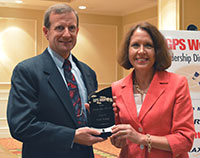
Marco Falcone, Galileo System manager, European Space Agency, winner of the 2015 Leadership Award for Satellites.
I would like to thank GPS World and the GNSS Community.
The recovery of satellites 5 and 6 of the Galileo constellation following the August 2014 launch wrong-orbit injection demonstrates the multidisciplinary capability of the European Space Agency and its industry. In fact, this recovery involved around 300 experts from our mission analysis and flight-control teams, system engineering signal and user receiver teams, space segment engineering teams, ground control and mission segment teams, as well as security operations. This award goes first of all to them for having believed in this recovery from the very first moment.
I apologise for not having been able to join this event in person due to the Launch and Early Operations Phase of the 5th Galileo Launch, which occurred Sept. 10. Galileo has now 10 (I repeat, 10) Satellites in orbit and operations are running smoothly. I count on GNSS chipset manufacturers to introduce Galileo constellation in their chipsets and eventually have Galileo-enabled devices as of next year.
In addition, the European Space Agency is also preparing for the future. In fact, we need already now to plan those system improvements that are necessary to replenish the constellation after 2020. These improvements go into the direction of higher positioning and timing accuracy, long-term validity ephemeris and faster time to first fix, improved interoperability with other GNSS and contribution to space users service volume, additional spoofing/jamming protection through authentication, enhanced online monitoring and signal-in-space flagging functionalities, as well as flexible digital signal generation to cope with the rapid time to market required for new services evolution.
Again, I thank you for recognizing the efforts of our teams at ESA and in industry. This award gives us even more energy.
Serving over A billion users every day
The most powerful GPS satellite ever is on its way
Remarks delivered by John Frye, program manager, Navigation Systems Advanced Programs, Lockheed Martin:
John Frye, program manager, Navigation Systems Advanced Programs, Lockheed Martin.
I would like to thank GPS World for the opportunity to speak briefly at this year’s GNSS Leadership Awards.
At Lockheed Martin, we are proud to continue our support of the U.S. Air Force’s GPS program. We applaud the Air Force on this year’s 20th anniversary of the GPS constellation reaching full operational capability.
This is a tremendous milestone in the history of positioning, navigation and timing, as well as global navigation satellite systems. In addition, I’d like to recognize tomorrow’s 68-year anniversary of the establishment of the Air Force.
Lockheed Martin is honored to have contributed to the GPS milestone. Right now, 19 of our GPS IIR and IIR-M satellites make up about 60 percent of the current GPS constellation. It is a real privilege to be serving more than a billion military, commercial and civilian users every day. But our commitment doesn’t end there. If you had the opportunity to see the pictures in our booth, you know that Lockheed Martin will soon be introducing the world to GPS III — the most powerful GPS satellite ever developed — and GPS III will be the first GPS satellite to field the internationally compatible L1C signal, offering a new level of GNSS compatibility.
So, thank you. It has been an honor to speak before you, the international PNT community. Thank you for all that you do, and congratulations to all of tonight’s honorees.
New messages: Any SBAS, any GNSS
Signals category winner
Todd Walter, senior research engineer, Stanford University
This past year, Todd completed the message design for dual-frequency, multi-constellation SBAS, a huge step forward for aviation and other multi-constellation users. It means that SBAS will be able to provide corrections and integrity data for all constellations, leading to better accuracy and availability.
Remarks delivered by Todd Walter:
Todd Walter, senior research engineer, Stanford University, and Ellen Mitchell, senior communications manager, Space and Intelligence Systems, Harris Corporation.
I ’d like to thank GPS World for this award. In reality, the work on the dual-frequency, multi-constellation SBAS messages has been a long ongoing group effort. Numerous people at Stanford, the FAA, Zeta, MITRE, ESA, CNES, RTCA, EUROCAE and others have contributed to the development of the planned messages on L5. ESA and CNES in particular have been handling the document management and comment resolution.
I would also like to especially thank my colleagues at Stanford University for their hard work and support.
The new messages now planned for L5 will allow any SBAS to correct any constellation that it chooses. Rather than only supporting L1-only signals on GPS, as the current systems do, SBASs will be able to support the use of two frequencies, using as many constellations and satellites as they choose to monitor.
We will no longer need to suffer availability outages due to limited satellite geometries. Furthermore, we will not suffer availability limitations due to ionospheric disturbances. Dual-frequency operation will allow precise vertical guidance throughout the globe, and in particular in equatorial regions.
The original L1 SBAS specification took more than 20 years of development. The new dual-frequency multi-constellation specifications are even more complicated and will require a similarly long development time. Our latest effort started many years ago when the GPS L5 was initially planned to be fully operational in 2018. Since that time, the GPS L5 date has moved back to 2024.
And in the mean time, the other constellations have progressed in their development. Our original efforts changed from a dual-frequency update to the SBAS messages into a truly multi-constellation concept.
In order to utilize new constellations and new signals for aviation, it is essential that the designs of these signals be stable and clearly documented. Furthermore, we require performance commitments from the constellation providers so that we can know what to expect.
To date, GPS leads the way in both of these requirements. Its signal designs have been stable and well described for many years, and it has published performance standards documenting the level of performance we can count on. There is widespread expectation that the other constellations will be very similar to GPS. However, this will not necessarily be the case.
We need to be prepared to deal with constellation-specific behaviors. Already we recognize differences in how GPS and GLONASS operate. We can only expect to uncover additional differences as we further utilize these constellations. Also, as we field new satellites and a new control segment on GPS, we can expect to see behavior that might be different from some of our fundamental assumptions.
It is important to plan for the future in order to incorporate new signals and new constellations; however, we must remain flexible with our planning to incorporate the reality of what we actually get.
— Postscript added in November: Thanks again for the award, it looks very nice on my desk!
All about the signal
Remarks delivered by Ellen Mitchell, senior communications manager, Space and Intelligence Systems, Harris Corporation:
On behalf of the Harris Corporation and its more than 22,000 employees, I congratulate the award recipients this evening. It is particularly fitting that Harris has the honor of presenting the Signals award. As the GPS navigation payload provider, we create and deliver the GPS signal. Furthermore, our products help our customers better utilize the GPS signal and detect and prevent jamming of the GPS signal. We’re all about the signal.
This is our first year at this dinner as Harris employees. As a result of Harris Corp. acquiring Exelis on May 29, there now are 9,000 engineers and scientists in the new company. Many Harris colleagues have expertise in areas directly applicable to cutting-edge GPS payload development, for example. Current and future customers will benefit from working with this larger and even more capable new team.
We believe the combination of Exelis’ heritage of proven, assured GPS navigation payloads joined with Harris’ skill in the RF spectrum, satellite communications and reprogrammable payloads gives the new company a unique and innovative edge to support the next generation of GPS satellites.
We look forward to telling you more about our progress at next year’s Leadership Dinner. But this year, now, without further ado, I’d like to call Todd Walter to the dais to receive the Leadership Award for significant recent achievement in the area of Signals. Thank you for this opportunity.
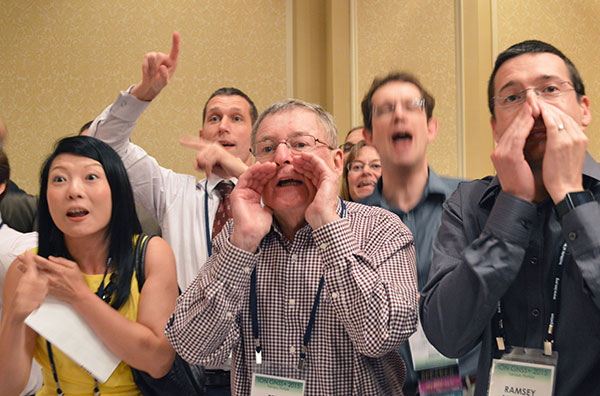
After the awards ceremony and dinner, attendees played the Interference Event, competing to see which team could generate the strongest, most accurate signal, conveying critical information in a GNSS trivia game.
Unprecedented opportunities
Services category winner
Jade Morton, professor, Colorado State University
For her work on advanced GNSS receiver algorithms for accurate and reliable operations in challenging environments; studies of the atmosphere using radar and satellite signals; and development of new applications using satellite navigation technologies. Her research has contributed to understanding of space weather phenomena and their effect on GNSS signals.
Remarks delivered by Morton:
Jade Morton, professor, Colorado State University
Thank you for a wonderful evening, and for offering the GPS World Leadership award to me. I am humbled!
Over the past decade, we have witnessed rapid progress in the development of multiple constellations of GNSS. While much of the focus has been on improvements in the availability, integrity, continuity, and inter-operability of multi-GNSS for PNT applications, a real winner as far as scientific discovery is concerned is in the use of GNSS in atmospheric and space weather studies. With a large and growing number of free open signals across a wide range of frequencies in the L-band, multi-GNSS will be able to provide distributed, low-cost, passive remote sensing of the atmosphere on a global scale. It is fair to say that there is no other technology that offers comparable potentials, coverage and cost-effectiveness.
In the coming decade, multi-GNSS will offer unprecedented opportunities for researchers to measure atmospheric and ionospheric parameters with high spatial and temporal resolution, and monitor atmospheric responses to solar, geomagnetic and other natural and man-made events.
This is an exciting time for multi-GNSS technological development and atmospheric research. I am fortunate to have the opportunity be a part of it and to explore and contribute to the interesting intersection between GNSS and the atmosphere.
Securing GPS against attack
Remarks delivered by Steve Moran, business development director, Raytheon:
Steve Moran, business development director, Raytheon
It’s great to be here with colleagues who understand the importance of a modernized GPS infrastructure.
I was asked to speak tonight because Raytheon is partnered with the Air Force in modernizing the GPS ground segment, which is at the core of the Air Force’s GPS modernization initiative. We like to call OCX the brains of GPS.
Over the past 30 years, GPS has ensured the safety and effectiveness of our nation’s warfighters and has become an integral component of global and national telecommunication, commerce and transportation infrastructures.
The GPS modernization initiative is essential to protecting our economy and the homeland, as GPS is an ingrained part of our nation and our world’s infrastructure. As critical as GPS is to so many key functions of daily life, it must be secured against cyber attacks.
The emergence of growing cyber threats creates daily headlines and drives an urgent need for GPS modernization. GPS has been recognized as an enabler of nearly all U.S. critical national infrastructure, such as the power grid or the water supply, and is a global utility that must be ready for emerging cyber threats.
OCX is a pathfinding program that answers that need and will deliver many other benefits to GPS users across the globe. Some of the new capabilities include enabling new civil and military signals; improving system accuracy and integrity; providing flexibility and evolvability to meet future mission needs; setting the bar for information assurance at an unprecedented level; and securely sharing information with net-connected users.
Raytheon’s OCX represents new approaches to emerging and even unimaginable changes and threats. We are confident that we have the right technology, team and resources in place to deliver the OCX program. It is critical we do so.
Thank you for inviting me here tonight, and I offer a sincere congratulations to all of the GPS World Leadership Award winners.
Novel GPS/GNSS uses just keep coming
Products category winner
Larry E. Young, GPS systems group supervisor, Jet Propulsion Laboratory
For many years he has been key in the development of radiometric technology. Specific areas of research include the development of GPS science receivers, multipath mitigation, sub-nanosecond clock synchronization, and sub-centimeter formation flying. He has been instrumental in developing the TriG multi-Global Navigation Satellite System receiver used in radio occultation to measure physical properties of the atmosphere, and key to NASA’s efforts to protect radionavigation satellite services from interference.
Remarks delivered on behalf of Larry E. Young by James J. Miller, deputy director, Policy and Strategic Communications, Space Communications and Navigation, NASA:
James J. Miller, NASA
I would like to thank GPS World and the GNSS community.
I greatly appreciate the honor conveyed by this award. We all know that most advances in technology are made by a team of smart, enthusiastic and hard working scientists and engineers. JPL’s advanced GNSS receivers are a true example of teamwork.
In particular, Don Spitzmesser was a prolific inventor who could quickly conceive of, build and test novel circuits and antennas. I do not think he ever passed kitchen utensils without thinking of antennas. There are actually “heli-wok” antennas in space. The original helix was wound onto a glass, glued onto a wok backplane.
Lyle Skjerve was a highly skilled experimentalist. His previous job was detecting incoming ground-to-air missiles from the backseat of a Marine jet, and conducting electronic countermeasures to steer the oncoming missile off course. In addition to being smart, he was quick to debug problems during an experiment, and never gave up.
NASA headquarters has provided great support to GNSS technology, continuing the program Jim Miller leads today. I especially thank John LaBrecque, who provided critical early support for our speculative development of the “all-digital” receivers that produced 0.1-millimeter baseline precision.
I have been very happy to be able to work on GPS, and I am most thankful for the great group of colleagues I’ve had the fortune to work with at JPL and from other NASA centers.
My training was in experimental nuclear physics, where I was excited to measure the anomalous orbital magnetic moment of a neutron orbiting inside a superconducting magnet on the beam line of a tandem Van deGraff accelerator. I always enjoyed building measurement systems for first-time measurements.
After graduation, I got an opportunity to shift from nuclear scales too small to see (femptometer) to those too large to imagine (109 lightyears), characteristic of the distances to quasars. In all, that was a change of 40 orders of magnitude! The Jet Propulsion Laboratory hired me to help develop Very Long Baseline Interferometry to measure tectonic plate drifts in real time, and oh yes, to precisely navigate NASA’s interplanetary spacecraft.
Larry e. Young, GPS Systems group supervisor, Jet Propulsion Laboratory
From VLBI, it was a short step to GPS. Even though quasars produce the greatest power levels known to man, the power per square meter is much higher from nearby GPS satellites. Scientists and engineers at JPL and elsewhere quickly realized that GPS would provide precision geodesy as soon as the first satellites were launched circa 1978.
During a 1984 receiver shootout among JPL’s SERIES and SERIES-X receivers, the MIT Macrometer, and Texas Instrument’s TI4100, we set up for the night’s experiment near an old Bilby tower in the desert. These were used in the old days to provide line-of-sight optical surveys. Now that we had GPS, those days were gone, and we (the shootout adversaries) teamed together and pulled down the tower, burning it to ward off the pre-dawn cold. It seemed quite symbolic. Remember, back then the only time four satellites were mutually visible in the winter was during early morning.
The current set of JPL’s receiver developments started when Tom Yunck realized we could use radio occultation, developed for interplanetary spacecraft, as a very useful means to probe the Earth’s atmosphere.
Novel uses for GPS/GNSS just seem to go on and on, as smart innovative people around the world continue to find productive new applications. Some of the older ideas we are working on include using non-GNSS signals for navigation and remote sensing, using GNSS signals as sources for bistatic radar measurements, and applying the GPS receiver’s precise phase shifters to form dynamic multiple high-gain antenna beams.
As always, advances in computers and chips will help drive applications. Our receivers have always been software driven and flexible, and the exponentially growing throughput of digital devices shows no signs of slowing. We are at a point where the number of GNSS satellites is exploding. Other signal sources are available to aid navigation and remote sensing. I do not want to call the exact shot, but I am confidant that at least one person reading this magazine today is already thinking of a new GNSS breakthrough, which will delight the world with its applications!
Commercialization and competition
Remarks delivered by Edward Baron, director, Braxton Technologies:
Edward Baron, director, Braxton Technologies
I would like to thank the GPS World team for organizing another wonderful awards dinner. As a commercial product company, Braxton is honored to help sponsor this event recognizing tonight’s Product Award innovator.
I’ve heard a few requests for innovation from the government this week. If they’re interested in innovation, I would like to make an argument for commercialization and competition as a key driver for it.
Within the navigation world, the receiver and application markets are excellent examples where innovation is driven by daily competition in a commercial market. It’s amazing to see the accelerating global pace of innovation these highly competitive markets drive — creating new and better products, along with their economic and social benefits.
We are also seeing competition between the constellations themselves, as they compete to increase their global market share.
If commercialization and competition drive innovation, and could benefit the performance of a constellation, who will take steps to commercialize other segments to improve their performance?
Galileo has already taken steps to commercialize their ground operations, and the U.S. is starting to talk about it.
It’s not possible to predict, but maybe in the future, GPS World will recognize someone for an innovation from a commercially operated GNSS system.
Lockheed Martin has demonstrated its ability to integrate unmanned aircraft system (UAS) operations into the National Airspace System (NAS) using its prototype UAS Traffic Management (UTM) capabilities.
During the demonstration on Nov. 18, the Stalker XE UAS provided data and a precise geolocation to the unmanned K-MAX cargo helicopter, which conducted water drops to extinguish a fire, while the UTM tracked the UAS operations and communicated with Air Traffic Control in real time.
The Stalker UAS directs the unmanned K-MAX cargo helicopter to conduct water drops at a precise location to extinguish a fire. (Photo: Lockheed Martin)
“This demonstration represents the path forward for flying UAS in the NAS using Flight Service-based UTM capabilities to extend the technology and systems that air traffic controllers know and understand,” said Paul Engola, vice president, Transportation & Financial Solutions. “We were able to successfully modify the existing K-MAX and Stalker XE ground control software to connect to the UTM services and conduct the firefighting mission.”
For more than 80 years, manned aircraft have supported firefighting missions during daylight hours. Because unmanned K-MAX can fly day and night, in all weather, its insertion into firefighting operations offers the potential to triple the amount of time ground firefighters can receive aerial support.
The Stalker XE UAS worked in tandem with K-MAX to identify hot spots and fire intensity with its electro-optical, infrared camera. Its stable, high-definition imaging capabilities enable day and night operations. Powered by a ruggedized solid oxide fuel cell, Stalker XE achieves more than eight hours of flight endurance.
The Stalker and K-MAX operated in collaboration with a prototype UAS Traffic Management (UTM) system, which provides essential capabilities to enable safe UAS operations. (Photo: Lockheed Martin)
An artist’s concept of a GPS IIR-M satellite in orbit (courtesy of Lockheed Martin).
Security upgrades developed by Lockheed Martin for the GPS ground control system are now fully operational to safeguard data and ensure satellite availability.
The GPS Intrusion Protection Reinforcement (GIPR) technology refresh is part of the Air Force’s strategy to modernize the current GPS system and to ensure the availability of its services for more than one billion global military, civilian and commercial users daily. GIPR advances the Operational Control Segment’s ability to protect data and infrastructure, enhance the sustainability of the system, and meet future GPS operational requirements. Infusing advanced hardware and software solutions for information assurance provides improved protection against today’s rapidly changing cyber threats, Lockheed Martin said in a news release.
“The GPS Control Segment Sustainment (GCS) contract is vitally important to the sustainment of positioning, navigation and timing services for our military, government officials and citizens,” said Vinny Sica, vice president of Lockheed Martin’s Space Ground Solutions. “A system this large requires continued security focus and that’s where Lockheed Martin’s information security capabilities are on the cutting edge.”
Beyond data protection, GIPR resolves many equipment obsolescence issues and increases system maintainability with modern vendor-supported hardware and operating systems. This is the second major technology refresh on the GPS command and control system since the GCS Sustainment contract was awarded.
The Air Force awarded Lockheed Martin the GIPR engineering modification in 2013, and the system is now fully deployed into the GPS Master Control Station and the Alternate Master Control Station. The project included system design, hardware procurement, software development, network configuration design and technical documentation.
The Global Positioning Systems Directorate at the U.S. Air Force Space and Missile Systems Center contracted the GIPR upgrade. Air Force Space Command’s 2nd Space Operations Squadron (2SOPS), based at Schriever Air Force Base, Colo., manages and operates the GPS constellation for both civil and military users.
At this year’s Association of the United States Army (AUSA) Annual Meeting, Lockheed Martin unveiled a new capability that will allow users to detect and counter emerging threats from unmanned aerial systems (UAS). The solution, ICARUS, was designed to operate defensively in various threat environments. The AUSA meeting was held Oct. 12-14 in Washington, D.C.
“The U.S. government is seeing an increase in the use of commercially available UAS platforms for surveillance and weaponization,” said Deon Viergutz, vice president of Cyber Solutions for Lockheed Martin. “What Lockheed Martin has developed in ICARUS is a system that can detect, recognize and counteract these systems with pinpoint accuracy.”
Lockheed Martin’s Counter-UAS system has been field tested and demonstrated to several domestic and international customers over the past year. Those tests demonstrated the ability of ICARUS to identify and intercept commercially available unmanned aerial systems.
The development of the ICARUS software system draws on Lockheed Martin’s history of innovations in electronic warfare, cybersecurity and countermeasures associated with sophisticated threats. It was developed through Lockheed Martin internal investment and combines advanced cyber and cyber electromagnetic activity experience with sensor technology and non-kinetic techniques.

 The goal of the team’s latest project was to advance previous optimization work by incorporating airborne C2, improving user interfaces, and testing new methods for related subroutines. With a vision of ultimately developing fast dynamically adaptive approaches to live management of a UAV fleet, this work is an important contribution to the concept of manned-unmanned teaming, where manned assets operate seamlessly with surrogate UAVs, often controlling many at a time against specific tasks.