Tag: Lockheed Martin

  • Lockheed Martin Powers on First GPS III Satellite

    The Lockheed Martin team developing the U.S. Air Force’s next-generation Global Positioning System III  satellites has turned on power to the system module of the program’s first spacecraft, designated GPS III Space Vehicle One (SV-1). The milestone is a key indication the team is on track to deliver the first satellite for launch availability in 2014, the company said.

    The GPS III program will replace aging GPS satellites, while improving capability to meet the evolving demands of military, commercial and civilian users. GPS III satellites will deliver better accuracy and improved anti-jamming power while enhancing the spacecraft’s design life and adding a new civil signal designed to be interoperable with international global navigation satellite systems.

    “This milestone is the latest in a series of critical events signifying that our joint government and industry GPS III team is performing efficiently and meeting its commitments,” said Lt. Col. Todd Caldwell, the U.S. Air Force’s GPS III program manager.

    Successfully powering on GPS III SV-1 demonstrates mechanical integration, validates the satellite’s interfaces and leads the way for electrical and integrated hardware-software testing. The satellite will complete its Assembly, Integration and Test (AI&T) in Lockheed Martin’s new GPS Processing Facility (GPF) designed for efficient and affordable satellite production. Like in aircraft or automobile manufacturing, each GPS III satellite will move through sequential work stations for various AI&T operations, culminating with shipment to the launch site.

    “Turning power on to the first GPS III satellite is a major milestone for the team,” said Keoki Jackson, vice president of Lockheed Martin’s Navigation Systems mission area. “The successful integration of the first satellite’s system module follows on the heels of our pathfinder GPS III Non-Flight Satellite Testbed (GNST), and demonstrates the great value of the investments made by the Air Force to implement low-risk spacecraft acquisition. In this challenging budget environment, we are focused on delivering the critical GPS III capabilities to users affordably and on schedule.”

    Lockheed Martin is currently under contract for production of the first four GPS III satellites, and advanced procurement funding of long-lead components for the fifth, sixth, seventh and eighth satellites. The Air Force plans to purchase up to 32 GPS III satellites.

    The GPS III team is led by the Global Positioning Systems Directorate at the U.S. Air Force Space and Missile Systems Center. Lockheed Martin is the GPS III prime contractor with teammates ITT Exelis, General Dynamics, Infinity Systems Engineering, Honeywell, ATK and other subcontractors. Air Force Space Command’s 2nd Space Operations Squadron (2SOPS), based at Schriever Air Force Base, Colo., manages and operates the GPS constellation for both civil and military users.

  • Air Force Awards Lockheed Martin Contracts for Next Set of GPS III Satellites

    The U.S. Air Force has awarded Lockheed Martin two fixed-price contracts totaling $120 million to procure long lead parts for the fifth, sixth, seventh and eighth next-generation GPS III satellites.

    The GPS III program will replace aging GPS satellites while improving capability to meet the evolving demands of military, commercial and civilian users. GPS III satellites will deliver better accuracy and improved anti-jamming power while enhancing the spacecraft’s design life and adding a new civil signal designed to be interoperable with international global navigation satellite systems, Lockheed Martin said.

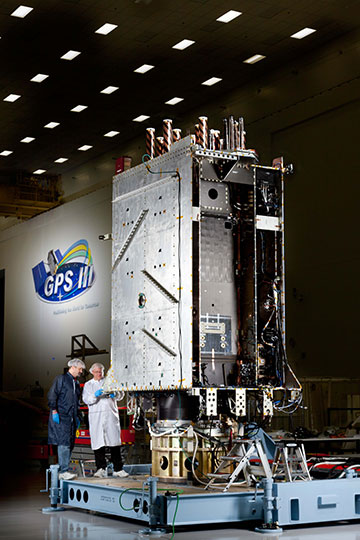
    Lockheed Martin engineers work on the full-sized prototype of the GPS III satellite in the company’s GPS Processing Facility (GPF) near Denver.
    Lockheed Martin engineers work on the full-sized prototype of the GPS III satellite in the company’s GPS Processing Facility near Denver. In November, the team completed thermal vacuum testing for the Navigation Payload Element of the GPS III Non-Flight Satellite Testbed.

    “The GPS III program was laid out at the very beginning to reduce risk early and facilitate affordable satellite production over the long term,” said Lt. Col. Todd Caldwell, the U.S. Air Force’s GPS III program manager. “This most recent award and our team’s ability to convert the contract structure to fixed price is a sign that we are on track to meet the affordability objectives and commitments we originally set out to achieve.”

    Incorporating lessons learned from previous GPS programs, the Air Force initiated a “back-to-basics” acquisition approach for GPS III. The strategy emphasizes early investments in rigorous systems engineering, industry-leading parts standards, and the development of a full-size GPS III satellite prototype to significantly reduce risk, improve production predictability, increase mission assurance and lower overall program costs. These investments early in the GPS III program are designed to prevent the types of engineering issues discovered on other programs late in the manufacturing process or even on orbit.

    “The Air Force’s back-to-basics acquisition strategy and the progress we have already made on our GPS III prototype gives us high confidence in our ability to perform efficient and affordable fixed-price satellite production going forward,” said Keoki Jackson, vice president of Lockheed Martin’s Navigation Systems mission area. “As our world becomes increasingly dependent on GPS technology, the new GPS III satellites will be a critical element of both our national and economic security, and we are committed to achieving mission success for the billions of military, commercial and civilian users worldwide.”

    Lockheed Martin is currently under contract for production of the first four GPS III satellites, and will now begin advanced procurement of long-lead components for the fifth, sixth, seventh and eighth satellites. The Air Force plans to purchase up to 32 GPS III satellites.

    The GPS III team is led by the Global Positioning Systems Directorate at the U.S. Air Force Space and Missile Systems Center. Lockheed Martin is the GPS III prime contractor with teammates ITT Exelis, General Dynamics, Infinity Systems Engineering, Honeywell, ATK and other subcontractors. Air Force Space Command’s 2nd Space Operations Squadron (2SOPS), based at Schriever Air Force Base, Colo., manages and operates the GPS constellation for both civil and military users.

  • Lockheed Martin Completes GPS III Flight Software Milestone

    The Lockheed Martin team developing the U.S. Air Force’s next generation Global Position System III satellites has completed a key flight software milestone validating the software’s ability to provide reliable and effective command and control for the GPS III satellites planned for launch into orbit.

    The GPS III program will affordably replace aging GPS satellites, while improving capability to meet the evolving demands of military, commercial and civilian users. GPS III satellites will deliver better accuracy and improved anti-jamming power while enhancing the spacecraft’s design life and adding a new civil signal designed to be interoperable with international global navigation satellite systems.

    The milestone, known as Software Item Qualification Testing (SIQT), was completed for the satellite’s spacecraft bus flight software, which is critical to controlling the spacecraft on orbit and monitoring the health and safety of the satellite’s subsystems. SIQT included 131 individual test events and represented the culmination of a rigorous software engineering risk reduction and development phase. The software will next be integrated and tested on the first GPS III satellite, which is on schedule for launch availability in 2014.

    “Completion of this flight software milestone demonstrates our continued positive program momentum and is another step forward in reducing risk up front to facilitate long term affordability,” said Lt. Col. William ‘Todd’ Caldwell, the U.S. Air Force’s GPS III program manager. “In this challenging budget environment, the entire government and industry team is focused on delivering the critical GPS III satellites affordably and efficiently for users worldwide.”

    To further reduce risk, the flight software has already been integrated and tested on the program’s satellite prototype, known as the GPS III Non-Flight Satellite Testbed (GNST).

    “Delivering fully qualified flight software this early in program development demonstrates the rigor of our GPS III software development processes,” said Keoki Jackson, vice president of Lockheed Martin’s Navigation Systems mission area. “Through up-front investments in high-fidelity, flight equivalent hardware and software testbeds, our team successfully executed on schedule to develop and qualify the flight software critical to the success of the GPS III program.”

    Lockheed Martin is on contract to deliver the first four GPS III satellites for launch. The Air Force plans to purchase up to 32 GPS III satellites.

    The GPS III team is led by the Global Positioning Systems Directorate at the U.S. Air Force Space and Missile Systems Center. Lockheed Martin is the GPS III prime contractor with teammates ITT Exelis, General Dynamics, Infinity Systems Engineering, Honeywell, ATK and other subcontractors. Air Force Space Command’s 2nd Space Operations Squadron (2SOPS), based at Schriever Air Force Base, Colorado, manages and operates the GPS constellation for both civil and military users.

  • Directions 2013: Doing More with Less to Advance GNSS

    Affordability, Capability, and Back-to-Basics Acquisition
    Headshot: Keoki Jackson

    By Keoki Jackson

    The history of GNSS shows each year has always been more successful than the year prior, and in 2013 we expect the trend to continue. In the United States, the role of GPS will continue to expand, and the applications for our technology will reach sectors we never imagined. As our international partner countries continue to launch GNSS satellites, and user equipment develops further, our community will increase its globalization, and international cooperation will reach new heights.

    At the same time, our industry will see its fair share of challenges. We anticipate several significant trends to be further defined next year.

    First, in the satellite world, affordability will be the name of the game. There is no disputing that the U.S. government is in austere budget times, and the Air Force will be asked to do more in acquiring GPS space, ground, and military user equipment, with fewer resources. Industry will partner with the Air Force in this new reality, and on the satellite manufacturing side, industry and government will need to demonstrate reduced costs, while sustaining the constellation and posturing for future demands.

    It is no secret that military operations depend on GPS, and adversaries are working aggressively to erode the GPS combat advantage with low-cost jamming devices, spoofing concepts, or cyber attacks. On the user demand side, we expect the need for anti-jamming capability to become even more critical for military users. We also expect users to demand better accuracy and integrity, both in the military and civil communities. In 2013, the United States must secure its critical modernization efforts to meet these demands and bolster the space, ground, and user architecture against potential threats.

    For us at Lockheed Martin, the message is clear. The threats and demands for enhanced capability are real, but the budget to meet those demands is shrinking. This presents a challenge, but we believe 2013 is the year we meet the challenge and position for the future.

    GPS III, the Air Force’s next generation GPS satellite system, is a central part of the modernized solutions for the challenges laid out above. GPS III is the most affordable way to meet the increasing demand from users, while also prudently posturing the enterprise for the future. In 2013, we intend to prove that.

    Space acquisition has weathered painful challenges in the past — that is not news — but the Air Force laid out the GPS III acquisition plan to reverse the trend and regain acquisition confidence. Leveraging hard-won lessons, the Air Force instilled a “back-to-basics” acquisition approach to provide better mission assurance, cost confidence, and schedule predictability. The approach emphasizes early investments in rigorous systems engineering, industry-leading parts standards, and the development of a fully functional GPS III satellite pathfinder to retire risks early and lower overall program costs. These investments early in the GPS III program were designed to prevent the types of engineering issues discovered on other programs late in the flight vehicle manufacturing process or even on orbit.

    Back to Basics

    The question in 2013 will be, “Is back-to-basics working?” — and we intend to show continued evidence of success next year. We will complete work on the GPS III Non-Flight Satellite Testbed (GNST), our full-sized GPS III satellite prototype. We will ship it to Cape Canaveral Air Force Station, Florida, for pathfinding activities at the launch site as we complete integration of the first space vehicle in our highly efficient GPS Processing Facility. The GNST is used to identify and solve development issues prior to integration and test of the first space vehicle. This will be a major milestone, putting the GNSS community on the cusp of fielding a new generation of PNT capabilities through very efficient and affordable production for all GPS III satellites.

    Further proving out the back-to-basics acquisition approach, in 2013 we will be converting our options to build the next eight GPS III satellites to a fixed price contract structure, rather than cost-plus. This transition will limit the government’s risk and significantly contribute to Air Force affordability goals. The back-to-basics acquisition strategy and the progress we have already made on our GPS III prototype give us high confidence in our ability to perform efficient and affordable fixed-price satellite production going forward.

    As the austere budget environment is amplified in 2013, we will focus our attention on our GPS III program performance while aggressively pursuing affordability and efficiency initiatives to ensure we are providing great value to the end user while being the best possible stewards of the American public’s investment.

    User Demands

    Affordability is one challenge; the other is meeting user demands. While the first GPS III satellites will bring on significant new capabilities, including improved accuracy, better anti-jam power, and a new civil signal to be interoperable with international GNSS systems, we do need to continue planning for technology upgrades in the future.

    The Air Force laid out the GPS III program from the very beginning with evolution in mind — and the GPS III satellites have pre-architected capacity to add new capabilities and technologies affordably and with low risk. The acquisition plan calls for technology insertion beginning on the ninth satellite. 2013 will be a critical year in finalizing the production schedule for the capability insertion program.

    We look at technology insertion in two ways: technology to reduce costs and technology to increase capabilities. To that end, we are developing dual launch, higher anti-jam signal power for the military, a new search and rescue payload, a digital navigation payload with the capability to incorporate new signals after launch, real time command and control cross links to improve system accuracy and a host of other innovations.

    The timing for when these new capabilities will be on ramped onto new satellites will be determined by user demands and technical maturity. In 2013, we will be working very closely with the Air Force to implement a low risk ongoing modernization program to ensure GPS III meets the needs of users for decades to come while maintaining or reducing the per unit cost of a GPS III satellite.

    In the uncertain and challenging environment of 2013 and beyond, GNSS technology will certainly continue to improve. User demand will increase significantly, while the resources to meet those demands will remain stable or decline. It is a tough challenge, but the GNSS industry has not disappointed yet, and we do not expect anything different in 2013 and beyond.


    Dana (Keoki) Jackson is vice president of Navigation Systems in Space Systems Company’s Military Space line of business for Lockheed Martin Corporation. He is responsible for leading all aspects of the next-generation GPS III navigation satellite program for the United States Air Force, as well as operations and sustainment of the GPS IIR and IIRM satellites. Prior to joining Lockheed Martin, he was a NASA research fellow at the Massachusetts Institute of Technology, conducting Space Shuttle flight experiments in the field of human adaptation to the space environment. He has a doctoral degree in Aeronautics and Astronautics fromthe Massachusetts Institute of Technology.

  • The System: Patent Attempt on GPS, Galileo Signals Appears Done

    One of the GNSS controversies of the past year ended, not with a bang nor with a whimper, but like the fog, silently creeping away on its little cat feet. The UK patent applications against the interoperative GPS/Galileo signal design appear to have been dropped.

    Vague rumblings emerged throughout spring and summer this year that two British technologists, backed by the U.K. Ministry Defense, had filed patents on the future interoperable GPS and Galileo binary-offset carrier signal designs. If granted and enforced, the patents would have severely disrupted modernization plans for both systems and levied unexpected costs upon receiver manufacturers. A company called Ploughshare Innovations Ltd. started contacting manufacturers and asking for payment of royalties, based on the patent filings.

    After significant uproar and negotiations before and behind the scenes, it now appears that the initiative has been quietly scuttled. The U.S. Patent Office file on application number 11/774,412, Modulation Signals for a Satellite Navigation System, on the Patent Office’s website, now reads “Expressly Abandoned — During Examination.” The status is dated September 16, 2012, some time ago, but none of the parties involved, whether as filers or negotiators, has made any public announcement about it.

    Both Sides Now. Checking the European Patent Office and its registry — which is no trivial task of website navigation — turns up a note, dated September 24, under the docket for EP1830199, Modulations Signals for a Satellite Navigation System. The note states “Patent surrendered.”  A few days later, another note: “Lapsed in a contracting state announced via postgrant inform. From Nat. Office to EPO,” with further information to the effect of “lapse because of failure to submit a translation or the description or to pay the fee within the prescribed time limit.”

    For good measure, a final docket note on October 3: “Lapsed due to resignation by the proprietor.”

    Lockheed Martin Logs Enviro OK on GPS III Sat

    The Lockheed Martin team developing the U.S. Air Force’s GPS III  satellites has completed thermal vacuum testing for the Navigation Payload Element (NPE) of the GPS III Non-Flight Satellite Testbed (GNST). The milestone is one of several environmental tests verifying the navigation payload’s quality of workmanship and increased performance compared to the current generation of satellites.

    During thermal vacuum testing, the navigation payload’s performance was proven in a vacuum environment at the extreme hot and cold temperatures it will experience on orbit to ensure it will operate as planned once in space. Following the test, the NPE will now be integrated with the GNST for final satellite level testing.

    The GNST is a full-sized prototype of a GPS III satellite used to identify and solve development issues prior to integration and test of the first space vehicle. The approach significantly reduces risk, improves production predictability, increases mission assurance and lowers overall program costs. Following integration and test at Lockheed Martin’s GPS Processing Facility (GPF) near Denver, the GNST will be shipped to Cape Canaveral Air Force Station, Florida, for risk reduction activities at the launch site.

    Lockheed Martin is on contract to deliver the first four GPS III satellites for launch. The Air Force plans to purchase up to 32 GPS III satellites.

    Galileo IOV Satellites in Position

    The Galileo In-Orbit Validation (IOV) satellites launched on October 12 (Flight Model 3 and 4), have now been positioned in their designated orbits, according to tracking data from the U.S. Joint Space Operations Center. A plot of the IOV constellation is now available at http://gge.unb.ca/test/Galileo.argper.690.432000.pdf.

    The four IOV satellites are in two orbital planes separated by about 120 degrees. Within each plane, the satellites are separated by about 40 degrees. This orbital arrangement will allow the four satellites to be simultaneously tracked for periods of time by GNSS monitoring stations, permitting positioning tests using only IOV data to be carried out. However, no signals from FM3 or FM4 have yet been detected by stations of the International GNSS Service.


  • Logistics, GIS and Disaster Response, Post-Sandy

    An exercise in planning for months proves timely in light of Hurricane Sandy

    By Art Kalinski

    I was going to write about the increasing presence of social media at GEOINT 2012, but I’ll cover that next month since Hurricane Sandy made an exercise I attended last week more significant in its timeliness.

    The Disaster Response Integrative Logistics Exercise was a joint effort of the Institute for Defense & Business and Lockheed Martin. Heading up the effort was retired U.S. Ambassador David Litt of the IDB and Corey Cook of Lockheed Martin. The almost week-long event was held at the Lockheed Martin Lighthouse located in Suffolk, Virginia, near Norfolk. The 65,000-square-foot high-technology facility is designed for experimentation and prototyping using analysis, modeling and simulation. It’s a reconfigurable command and control operations laboratory that permits participants to test and analyze concepts in a gaming environment.

    The stated purpose of the disaster response exercise was: “Given the nature, frequency, location and severity of disasters, inter-organizational collaboration – to include the private sector – is becoming increasingly critical to the efficiency and effectiveness of logistics in disaster responses.”  The exercise involved more than a 100 participants from the private sector, government agencies, non-profit organizations, and military services. Lou Kratz, Vice president and managing director, Logistics and Sustainment, Corporate Engineering & Technology for Lockheed Martin, stated that “Today’s crisis response efforts generally struggle with effective logistics collaboration among the multiple public and private stakeholders engaged. With our 21st-century logistics capabilities and global resources available from the public sector and private organizations, together we can develop solutions that will help our communities and businesses recover more quickly and effectively after a crisis.”

    And collaborate we did! The list of participants was quite extensive and quite diverse. To give you a sense of the attendees, here is a partial list of organizations represented:

    • commercial companies included DHL, Maersk, Florida Power and Light, Fluor, Home Depot, Walmart
    • federal government agencies included FEMA, DHS, GSA, HHS, USAID, State Department
    • military organizations included NAVSUP, NORTHCOM, USACE, USAF, USMC, USN, SOUTHCOM, National Defense University, USCG, NORTHCOM
    • NGOs included United Nations agencies, the Red Cross, Operation Blessing, Catholic Relief Services and many more.

    Conference attendance was significantly impacted by Hurricane Sandy, which also highlighted its timeliness.  FEMA, USAID, USACE, and the Red Cross, who were confirmed attendees and were instrumental in the development of the DRIL exercise, were deployed to Hurricane Sandy just hours before the start of the event. Fortunately, attendance to the DRIL by multiple organizations and substitute personnel was still robust, allowing for a highly successful exercise.

    Some of the exercise objectives included defining and understanding different agency logistics capabilities, leadership structures, institutional and regulatory obstacles, differences in cultures, missions and operating procedures while developing metrics to evaluate performance in disaster response efforts. To accomplish the objectives, all the participants were organized into four integrated teams that were then separated at times into functional teams and then reassembled with representatives speaking for each team to the entire group of attendees.

    Since this was the first exercise of its type, it was a learning experience for all involved and focused on the basics of personnel interactions and group consensus.  Each participant had access to his or her own computer, common computer resources and pre-developed exercise parameters. There were many artificial assumptions presented to the teams, and the team members made even more assumptions and guesses as they worked through the individual scenarios. Most of the exercise consisted of reviewing the effects of Category 5 hurricanes hitting the Dominican Republic, South Florida and Virginia, so there was a domestic as well as international impact. We participated in our groups, listening to individual team members with specialized knowledge and experience, then prioritized the delivery of needed resources and services. As the exercises ramped up, there were many animated discussions in which basics such as water, food, shelter, medical, electric power and transportation infrastructure were prioritized and justification documented.

    I made several observations to myself as the exercises progressed. First, there are definite cultural differences between federal, military, NGO and commercial agencies. Not bad differences, just different. Second, individual personalities can steer the group dynamics and outcomes. And third, situational awareness is critical to effective disaster response. Geospatial technology was not part of this first exercise, but would clearly have been valuable to provide a common operational picture. That level of complexity would not have been practical for this initial exercise, but it does lead me to the “Solutions” room next to the main exercise area.

    In a space adjacent to the main exercise room was a “Solutions” room that showcased potentially helpful technologies. The room was open to exercise participants toward the tail end of the week. It consisted of a diverse assortment of commercial and government solutions that addressed some of the issues  the teams struggled with during the week. Examples include a new computer-based system developed by the Navy Supply Systems Command (NAVSUP) that is similar to the commercial Kayak flight search system. The Transportation Exploitation Tool (TET) was explained to me by Greg Butler, division director, NAVSUP GLS Transportation, who initiated the effort. He explained that all too often resources are wasted flying parts or personnel on dedicated aircraft that are duplicate trips of other aircraft or ships with available space traveling to the same location. The new geospatial network scheduling system optimizes transportation resources across all branches of service and already saved the Navy $23M on a $750k investment.

    Lockheed Martin displayed several technologies, including communications and data management technologies. One of the most interesting was its Hybrid Aircraft that was initially developed for military use. However, its ability to transport equipment and supplies efficiently to undeveloped sites while providing a persistent platform for communications and to collect and download imagery makes it a valuable asset for emergency response activities.  To learn more, view the following video.

    A representative from NATO explained the NATO Civil-Military Fusion Center, including a map library and custom services. Several exhibitors demonstrated the use of social media, which can be a very valuable and timely source of information to build situational awareness during emergencies. A company I work with, Soft Power Solutions, integrates GIS resources such as Google, USGS, ortho and oblique imagery married to geographically placed social media to build situational awareness that is quite robust. It was especially dramatic that during demonstrations, a 7.2 earthquake was reported off the coast of Guatemala.  One could easily see the growing number of tweets that almost immediately confirmed the earthquake and level of damage. Here is a ShakeMap generated by USGS within minutes of the earthquake showing the level of impact on the Guatemalan coast (shown in yellow).

    One of the exercise objectives was to develop metrics that would evaluate performance in disaster response efforts. There were many metrics developed that one would expect – roads open, electricity restored, utilities restored, etc. However, the one informal metric that was developed through personal experience of Florida emergency responders was the “Waffle House” metric. Waffle House is a ubiquitous restaurant chain with locations throughout the southeast. The Florida responders observed that driving from one county’s Waffle House to another open Waffle House was a good indicator that the location was in OK shape.  Since a Waffle House needs minimal staffing and utilities compared to larger restaurants, it was a good indicator as to how bad conditions were in the location. Perhaps someone will develop a “Waffle House Open” type GIS layer as a metric to “okayness.”  Sounds like a good thesis for a GIS graduate student.

    Everyone who participated was enthusiastic about conducting another similar exercise. Planning is already underway to make that happen. I, for one, feel that this kind of exercise can have a significant positive impact on future disasters because it builds face-to-face relationships that are so valuable during actual events. I’m going to do what I can to help with a geospatial aspect in future exercises.

  • Lockheed Martin Completes Environmental Test on GPS III Pathfinder

    The Lockheed Martin team developing the U.S. Air Force’s next generation Global Positioning System III  satellites has completed thermal vacuum testing for the Navigation Payload Element (NPE) of the GPS III Non-Flight Satellite Testbed (GNST). The milestone is one of several environmental tests verifying the navigation payload’s quality of workmanship and increased performance compared to the current generation of satellites, the company said.

    The GPS III program will affordably replace aging GPS satellites, while improving capability to meet the evolving demands of military, commercial and civilian users. GPS III satellites are expected to deliver better accuracy and improved anti-jamming power while enhancing the spacecraft’s design life and adding a new civil signal designed to be interoperable with international global navigation satellite systems.

    “GPS III satellites have the most advanced navigation payloads ever manufactured.  This milestone is a key indicator that we have a solid design and are on track to provide unprecedented position, navigation, and timing capability for GPS users worldwide,” said Lt. Col. Todd Caldwell, the U.S. Air Force’s GPS III program manager.

    During thermal vacuum testing, the navigation payload’s performance was proven in a vacuum environment at the extreme hot and cold temperatures it will experience on orbit to ensure it will operate as planned once in space. Following the test, the NPE will now be integrated with the GNST for final satellite level testing.

    The GNST is a full-sized prototype of a GPS III satellite used to identify and solve development issues prior to integration and test of the first space vehicle. The approach significantly reduces risk, improves production predictability, increases mission assurance and lowers overall program costs. Following integration and test at Lockheed Martin’s GPS Processing Facility (GPF) near Denver, the GNST will be shipped to Cape Canaveral Air Force Station, Fla., for risk reduction activities at the launch site.

    “The completion of thermal vacuum testing on our first navigation payload is a critical milestone for our program that demonstrates we are on a solid path to meet our commitments,” said Keoki Jackson, vice president of Lockheed Martin’s Navigation Systems mission area. “The Air Force’s early investment in our GPS III pathfinder is now paying off and will enable highly efficient and affordable satellite production going forward.”

    Lockheed Martin is on contract to deliver the first four GPS III satellites for launch. The Air Force plans to purchase up to 32 GPS III satellites.

    The GPS III team is led by the Global Positioning Systems Directorate at the U.S. Air Force Space and Missile Systems Center. Lockheed Martin is the GPS III prime contractor with teammates ITT Exelis, General Dynamics, Infinity Systems Engineering, Honeywell, ATK and other subcontractors. Air Force Space Command’s 2nd Space Operations Squadron (2SOPS), based at Schriever Air Force Base, Colo., manages and operates the GPS constellation for both civil and military users.

  • Lockheed, Raytheon Complete First Launch Exercise for Next-Gen GPS Satellites

    Raytheon Company and Lockheed Martin have successfully completed the first launch readiness exercise for the U.S. Air Force’s next generation GPS III satellites. The exercise is a key milestone demonstrating the team remains on schedule to achieve launch availability in 2014, the companies said.

    The Lockheed Martin-built GPS III satellites and the Raytheon-developed next generation GPS operational control system, known as OCX, are critical elements of the U.S. Air Force’s effort to affordably replace aging GPS satellites while improving capability to meet the evolving demands of military, commercial and civilian users worldwide. This is the first space and ground enterprise successfully building the ground control and space vehicles by two independent prime contractors.

    The launch readiness exercise, completed over a three day period by mission operations personnel, validated the basic satellite command and control functions, tested the software and hardware interfaces and demonstrated basic on-console procedures required for space vehicle contacts during the launch and early orbit mission.  The event sets the stage for the first GPS III satellite’s mission readiness timeline, which includes five short-duration exercises and six, five-day mission rehearsals leading up tolaunch.

    “Completion of our first GPS III launch readiness exercise is a major milestone for the entire GPS enterprise and is a solid indictor that our space and ground segments are well synchronized,” said Col Bernie Gruber, the director of the U.S. Air Force’s Global Positioning Systems Directorate.

    To achieve first launch availability in the 2014 timeframe, the U.S. Air Force awarded Lockheed Martin and Raytheon contracts in January of this year to provide a Launch and Checkout Capability (LCC) for launch and early on-orbit testing of all GPS III satellites.  At the heart of the LCC is Raytheon’s Launch and Checkout System that will provide satellite command and control capability, an integral part of OCX’s  support of the first GPS III launch.

    “The completion of our first launch readiness exercise is an important milestone for the entire GPS enterprise,” said Keoki Jackson, vice president of Lockheed Martin’s Navigation Systems mission area. “This achievement is a testament to efficient planning and synchronization by the U.S. Air Force and demonstrates that we are on track to deliver critical GPS III capabilities to military, commercial and civilian users worldwide.”

    “This milestone represents the hard work and dedication of the entire GPS III and OCX government-industry team,” stated Ray Kolibaba, a vice president of Raytheon’s Intelligence and Information Systems business and GPS OCX program manager. “This is another demonstration of the rapid progress we’re making on OCX development, while maintaining GPS space-ground enterprise alignment. I’m confident that we’ll be prepared to support the first GPS III launch with an efficient, evolvable and secure ground control system built independently.”

    The GPS III team is led by the Global Positioning Systems Directorate at the U.S. Air Force Space and Missile Systems Center. Air Force Space Command, based at Schriever Air Force Base, Colo., manages and operates the GPS constellation for both civil and military users.

  • Lockheed Martin Completes Navigation Payload Milestone for GPS III Prototype

    The Lockheed Martin team developing the next generation Global Positioning System III satellites has completed a major integration and test event on the program’s satellite pathfinder, known as the GPS III Non-Flight Satellite Testbed (GNST). The milestone is a key indication that the GPS III team is on track to deliver the first satellite for launch availability in 2014.

    In Lockheed Martin’s new GPS Processing Facility (GPF), engineers successfully powered on the GNST with major elements of its navigation payload to include advanced atomic clocks for improved GPS accuracy, and the mission data unit, the heart of the GPS III navigation payload. The test was completed in advance of integrating the full navigation payload element, which is scheduled for delivery to the GPF this fall.

    The GPS III program will replace aging GPS satellites while improving capability to meet the evolving demands of military, commercial and civilian users worldwide. GPS III satellites are expected to deliver better accuracy and improved anti-jamming power, while enhancing the spacecraft’s design life and adding a new civil signal designed to be interoperable with international global navigation satellite systems.

    Incorporating lessons learned from previous GPS programs, the Air Force initiated a “back-to-basics” acquisition approach for GPS III. The strategy emphasizes early investments in rigorous systems engineering and industry-leading parts standards to significantly reduce risk, improve production predictability, increase mission assurance and lower overall program costs. These investments early in the GPS III program are designed to prevent the types of engineering issues discovered on other programs late in the manufacturing process or even on orbit.

    “The GNST is the cornerstone of the Air Force’s back-to-basics acquisition approach, and this milestone demonstrates that GPS III is on track and the acquisition strategy is working,” said Keoki Jackson, vice president of Lockheed Martin’s Navigation Systems mission area. “The Air Force’s early investment in meticulous parts standards and rigorous systems engineering will significantly reduce per unit production costs and ensure mission success.”

    As production progresses on the first GPS III satellite, the team has already benefited from lessons learned on the GNST. Early efficiencies identified include:

    • 50-80 percent reductions in labor hours and defect rates between similar activities on the GNST and the first space vehicle.
    • Identification of tens of millions of dollars in cost savings for the production satellites based on process improvements recognized during GNST integration and test.

    “As we continue learning lessons on the GNST and move into full scale satellite production, we expect to continually streamline our processes and reduce per unit costs,” Jackson said.

    In 2008, Lockheed Martin was awarded the contract for the design, development, and production of the GPS III Non-Flight Satellite Testbed (GNST) and the first two GPS III satellites, with priced options for up to 10 additional satellites. In early 2012, the Air Force exercised a $238 million option for production of the next two satellites, GPS III space vehicles three and four. The Air Force plans to purchase up to 32 GPS III satellites.

    The GPS III team is led by the Global Positioning Systems Directorate at the U.S. Air Force Space and Missile Systems Center. Lockheed Martin is the GPS III prime contractor with teammates ITT Exelis, General Dynamics, Infinity Systems Engineering, Honeywell, ATK and other subcontractors. Air Force Space Command’s 2nd Space Operations Squadron (2SOPS), based at Schriever Air Force Base, Colo., manages and operates the GPS constellation for both civil and military users.

  • The System: GPS III Endures Bad Press, IIAs an OCX Concern

    GPS III Endures Bad Press, IIAs an OCX Concern

    Reports in daily news media such as the Washington Post and Denver Post that “Lockheed Martin will lose its entire fee of about $70 million to defray an 18 percent cost overrun” on GPS III satellites misconstrue the facts.

    Don Jewell, contributing editor for GPS World, said after informal talks with key Lockheed executives, “This is a good story, but it has been sensationalized.”

    Lockheed Martin’s fee is 5 percent of the target cost, which includes one-time engineering tasks, test equipment, and satellite assembly, according to the Air Force.

    The first GPS III satellite remains on schedule to be available for launch in 2014, Lockheed Martin spokesman Michael Friedman said via email.

    “While we have encountered challenges associated with higher standards for parts testing and first-time technical issues, the program is on firm footing and our cost estimate remains within the original Air Force budget,” Friedman stated, adding that the company doesn’t discuss specifics of fees.

    “In their defense,” Jewell reports, “the program was initially identified as stable with no government change request allowed, to keep it on schedule and budget. The recent budget furor has introduced chaos into the requirements process and contributed significantly to the increased costs.”

    Lockheed Martin is using a full-sized prototype to identify and solve many assembly issues “that would have cost more and presented more risk if they had been discovered later in production,” Lockheed’s Friedman said.

    “We have identified tens of millions of dollars in cost savings for the production satellites and in some cases we are seeing 50 to 80 percent reductions in labor costs,” he added.

    Ground Control to Aged Birds

    By Don Jewell

    One of the long-standing issues for support of IIA vehicles after the future GPS Operational Ground Control Segment’s (OCX’s) ready-to-operate (RTO) date, which should fall in December 2016 at the latest, is what ground command-and-control (C2)system will steer GPS IIA satellites, do navigation uploads, and so on. The issue is that AEP, the current C2 system, will no longer be available once the transition to OCX takes place, and OCX has no requirement to control IIA satellites.

    The OCX program, which struggled early, is now under new program leadership within Raytheon Space Systems, and while Ray Kolibaba, the new OCX program manager, is making great progress, OCX does not need to be burdened with additional requirements at this stage of the program.

    Just how big an issue is GPS IIA C2? Initially the Aerospace projections were that there would only be one or two GPS IIAs left on orbit in 2017, and it was not worth the costs to include the C2 software for the legacy system in the new software code. However, I have long maintained that Aerospace and Space Missile Systems Command (SMC) neglected to count the residual satellites, maintained by Launch, Anomaly, and Disposal Operations (LADO), which might very well actually amount to 3–4 additional IIAs. Added to the two IIAs on orbit, this could amount to six IIA SVs that need to be maintained.

    The solution announced during the week at the National Space Symposium (NSS, April 16–19) by General William Shelton, the four-star chief of Air Force Space Command, is to fund the current LADO operator, Braxton Technologies, to build in this support for the IIAs. This is significant for several reasons: One, of course, is that it solves the IIA C2 issues, it does it now, and at a relatively modest cost, and it utilizes more of the capabilities of the Braxton Technologies’ LADO software. Additionally it provides a true backup capability for assets on orbit that become increasingly valuable as the number of available launch slots for GPS decreases.

    Braxton Technologies initially demonstrated this capability years ago in a lifeboat drill during the transition to AEP, but the navigation upload capability was never maintained for LADO after the successful transition. This is certainly a step in the right direction and provides a simple solution to a vexing problem that has plagued the GPS program for the last several years.

    Dual Launch. I asked General Shelton if he would support an approach that would allow the United States to go to dual launch of GPS III on vehicles 5–6 instead of waiting until 8–9 as planned today. He said the Air Force would certainly support that, and is looking at making it possible with vehicle 7 currently. That will come even sooner if the program advances with glitches.

    I also asked him about the gap between GPS III launch and OCX RTO. The gap seems to be getting wider, not narrower, and he agreed that OCX could probably not move to the left, and GPS III has moved significantly to the left, so this is still an issue that needs to be addressed. There are plans in place, but the recent budget activity has caused some uncertainty.

    Sequestration. On the subject of sequestration — a highly charged Congressional effort to force another $500 billion-plus in additional defense cuts — General Shelton said it would come on top of the approximately $487 billion already cut from programs, and that many space programs might be unsustainable in their current mode if that occurs.

    However, the U.S. Armed Services have been informed by the White House Office of Management and Budget not to make plans for sequestration. So right now, the services and other agencies of the U.S. government have been forbidden to make programmatic decisions based on a possible sequestration. Interesting.

    By the way, attendance at NSS this year surpassed 9,000.


    Galileo Launches Accelerated, First Payload Shipped

    Javier Benedicto, head of the Galileo Project Office for the European Space Agency (ESA), set an aggressive schedule for launching some Galileo satellites as many as four at a time in 2014 and 2015, to meet a target provision date of Galileo initial services in 2014 and full services in 2015. The announcement came at the Munich Summit, March 14.

    The hurry-up to carry 22 satellites into orbit proceeds with dual-satellite launches aboard Russian Soyuz rockets, as was the case for the most recent in-orbit validation (IOV) launch in October 2011. There will be three Soyuz launches in 2013, for a total of six new satellites in orbit, and two Soyuz launches in 2014, adding four more. Then the burden will shift to European rockets from Arianespace, according to a contract signed in February of this year. One Ariane 5 rocket is slated to carry four Galileo satellites aloft in 2014, bringing the projected total of IOV and eventually operational Galileo satellites in space to 16 by the end of 2014. ESA had ealier aired plans for further Soyuz IOV launches in 2012, but the Munich statement did not mention these.

    In 2015, two more Ariane 5 launches will add eight satellites, for a total on orbit of 24, estimated to be sufficient for Galileo full operational capability (FOC).

    In subsequent talks with European satellite manufacturers OHB Systems and Astrium, GPS World contributing editor Don Jewell was told that the future launch schedule is “subject to change.”

    ESA headquarters has made no official announcement of a detailed launch schedule; inquiries regarding the Benedicto remarks were referred to the February contract statement, cited above.

    Payloads. Meanwhile, Surrey Satellite Technology Ltd. (SSTL) delivered the first of 14 FOC satellite payloads to prime contractor OHB System AG, for mechanical integration of the payload with the satellite platform and the beginning of overall vehicle assembly, integration, and testing for what will eventually become the fifth satellite in the Galileo constellation.


    Compass on the Grow

    Discussions in Internet forums indicate that the next BeiDou-2/Compass launch will take place on or about April 28, after this magazine goes to press. The launch purportedly will place two mid-Earth orbit satellites into space: BeiDou M3 and BeiDou M4. Sometime in June, plans call for BeiDou M2 and BeiDou M5 to be launched.

  • GPS III Endures Bad Press

    Reports in daily news media such as the Washington Post and Denver Post that “Lockheed Martin will lose its entire fee of about $70 million to defray an 18 percent cost overrun” on GPS III satellites misconstrue the facts.

    Don Jewell, contributing editor for GPS World, said after informal talks with key Lockheed executives, “This is a good story, but it has been sensationalized.” Lockheed Martin’s fee is 5 percent of the target cost, which includes one-time engineering tasks, test equipment and satellite assembly, according to the Air Force.

    The first GPS III satellite remains on schedule to be available for launch in 2014, Lockheed Martin spokesman Michael Friedman said via e-mail. “While we have encountered challenges associated with higher standards for parts testing and first-time technical issues, the program is on firm footing and our cost estimate remains within the original Air Force budget,” Friedman stated, adding that the company doesn’t discuss specifics of fees.

    “In [Lockheed’s] defense,” Jewell reports, “the program was initially identified as stable with no government change request allowed, to keep it on schedule and budget. The recent budget furor has introduced chaos into the requirements process and contributed significantly to the increased costs.”

    Lockheed Martin is using a full-sized prototype to identify and solve many assembly issues “that would have cost more and presented more risk if they had been discovered later in production,” Lockheed’s Friedman said.

    “We have identified tens of millions of dollars in cost savings for the production satellites and in some cases we are seeing 50 to 80 percent reductions in labor costs,” he added.

  • Lockheed to Lose Fee on GPS III Satellites from Cost Overrun

    The U.S. Air Force says defense contractor Lockheed Martin will lose its entire fee of about $70 million to defray an 18 percent cost overrun on the first of its newly designed GPS III satellites, the Washington Post reported.

    Lockheed had estimated that it would cost $1.5 billion to develop, test and build the first two GPS III satellites, but Air Force spokeswoman Vicki Stein said the cost had risen to $1.62 billion.

    The new GPS III satellites are designed to deliver more accuracy, an anti-jamming capability and a civilian signal that can operate with Europe’s Galileo system.