Once the next-generation GPS III satellites begin launching in December, a series of updates to the current ground control system from Lockheed Martin will help the U.S. Air Force gain early command and control of the new satellites for testing and operations.
In 2016 and 2017, the Air Force placed Lockheed Martin under two contracts, called GPS III Contingency Operations (COps) and M-code Early Use (MCEU), which directed the company to upgrade the existing Architecture Evolution Plan (AEP) Operational Control System (OCS), which operates today’s GPS constellation.
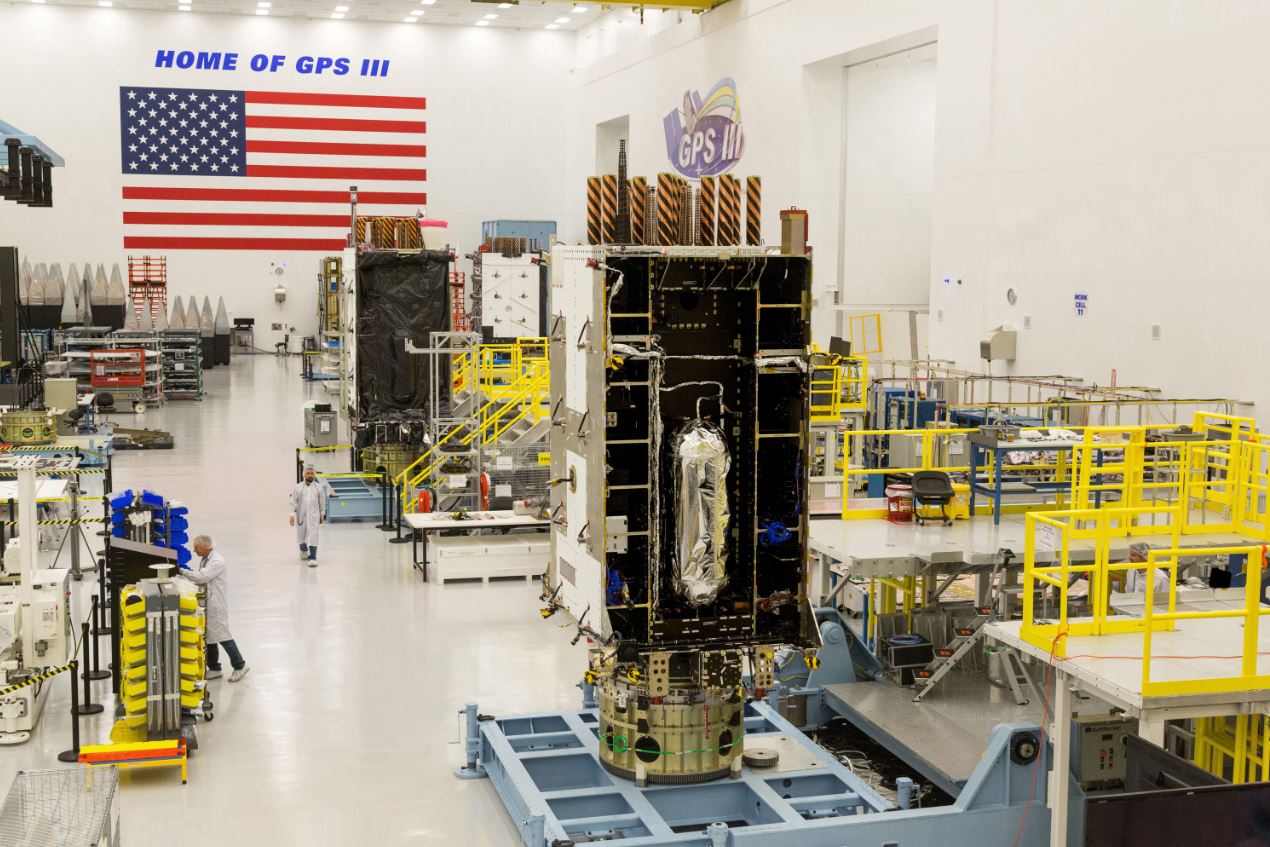
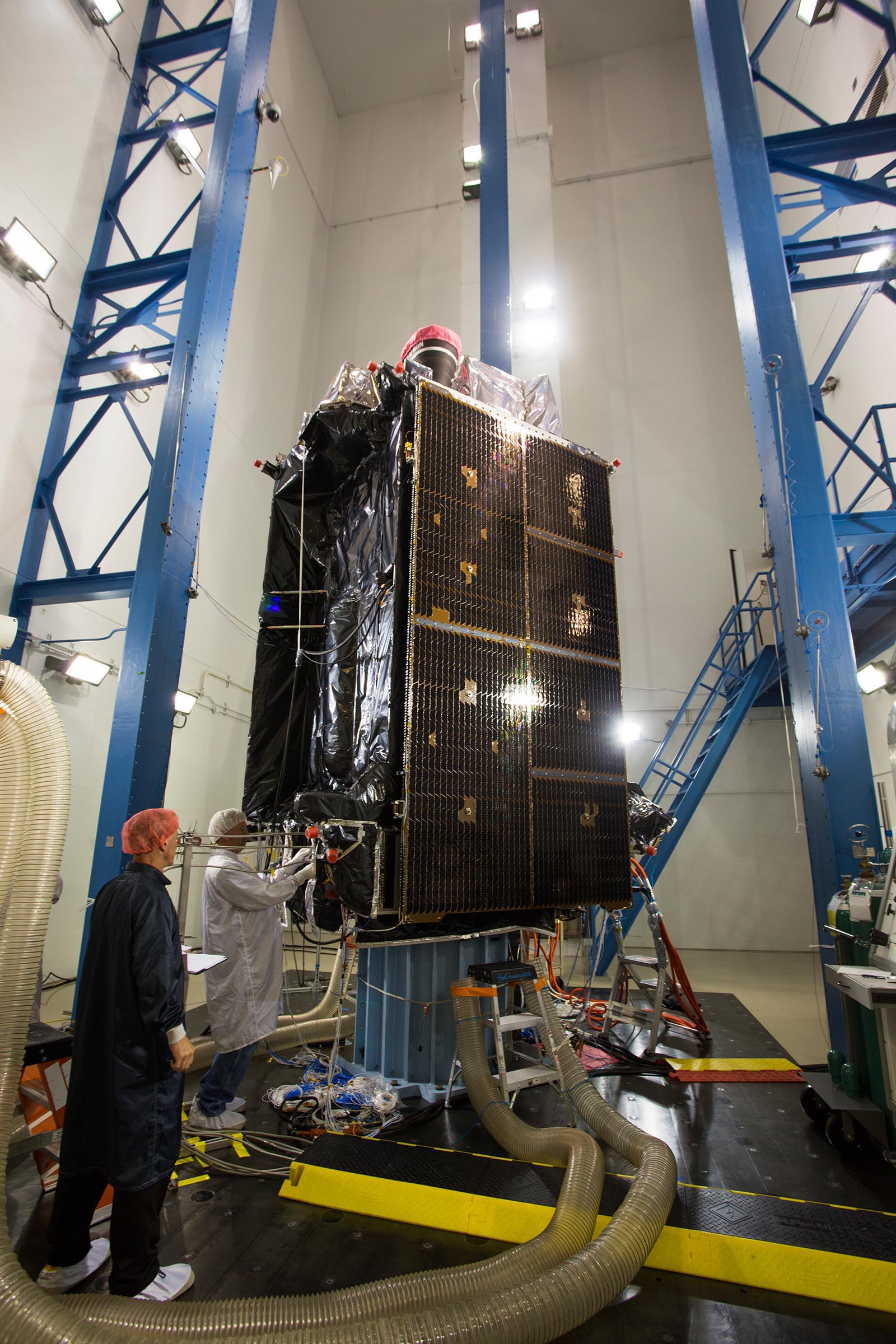
The fourth Lockheed Martin-built GPS Ill satellite is fully integrated. (Photo: Lockheed Martin)
These upgrades to the AEP OCS are intended to serve as gap fillers prior to the entire GPS constellation’s operational transition to the next-generation Operational Control System (OCX) Block 1, now in development.
In April, the Air Force approved Lockheed Martin’s critical design for MCEU, essentially providing a green light for the company to proceed with software development and systems engineering to deploy the M-code upgrade to the legacy AEP OCS.
The Air Force gave a similar nod to COps in November 2016. COps is now on schedule for delivery in May 2019 and MCEU is scheduled for delivery in January 2020.
“The Air Force declared the first GPS III satellite Available for Launch last year, and it’s expected to launch later this year. Nine more GPS III satellites are following close behind in production flow,” explained Johnathon Caldwell, Lockheed Martin’s program manager for Navigation Systems. “GPS III is coming soon, and as these satellites are launched, COps and MCEU will allow the Air Force the opportunity to integrate these satellites into the constellation and to start testing some of GPS III’s advanced capabilities even earlier.”
MCEU Capabilities
Part of the Air Force’s overall modernization plan for the GPS, M-code is a new, advanced signal designed to improve anti-jamming and anti-spoofing, as well as to increase secure access to military GPS signals for U.S. and allied armed forces.
To accelerate M-code’s deployment to support testing and fielding of modernized user equipment in support of the warfighter, MCEU will upgrade the AEP OCS, allowing it to task, upload and monitor M-code within the GPS constellation.
MCEU will provide command and control of M-Code capability to eight GPS IIR-M and 12 GPS IIF satellites currently on orbit, as well as future GPS III satellites.
COps Capabilities
Following launch and check out, each future GPS III satellite will take its place in the GPS constellation. The COps modifications will allow the AEP OCS to support these more powerful GPS III satellites, enabling them to perform their positioning, navigation and timing missions for more than one billion civil, commercial and military users who depend on GPS every day.
Besides the addition of GPS III, COps will also continue to support all the GPS IIR, IIR-M and IIF satellites in the legacy constellation.
Lockheed Martin has a long history of supporting ground systems, providing operations, sustainment and logistics support for nearly 60 Department of Defense satellites, including GPS, often allowing them to double their on-orbit operational design life.
GPS III Satellites
Lockheed Martin also is under contract to develop and build 10 GPS III satellites, which will deliver three times better accuracy and provide up to eight times improved anti-jamming capabilities compared to current GPS satellites.
GPS III’s new L1C civil signal also will make it the first GPS satellite to be interoperable with other international global navigation satellite systems.
The first GPS III satellite has been delivered to Florida for launch in December on a SpaceX rocket.
On Aug. 20, Lockheed Martin shipped GPS III SV01 to Cape Canaveral. GPS III SV01 is the first of 10 new GPS III satellites being built under U.S. Air Force contract and in full production at Lockheed Martin.
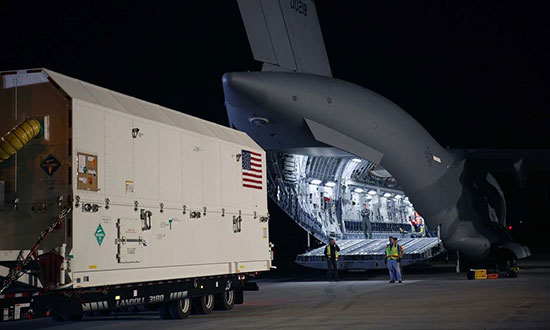
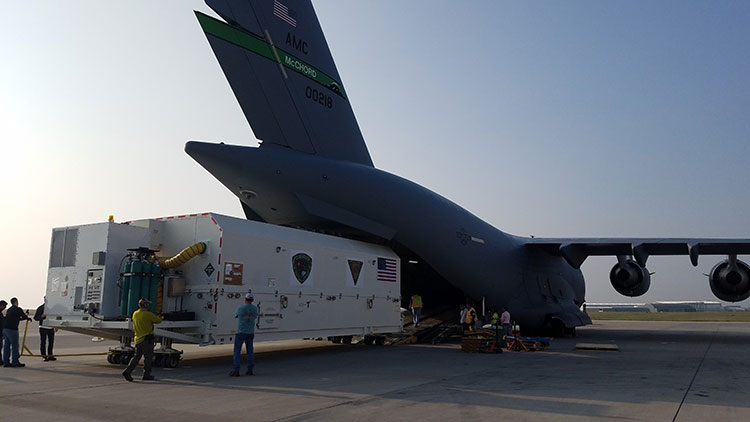
Designed and built at Lockheed Martin’s GPS III Processing Facility near Denver, the satellite was transported in a custom container from the Buckley Air Force Base in Colorado to the cape on a massive Air Force C-17 Globemaster III aircraft originating from Joint Base Lewis-McChord, Washington. On Aug. 21, it arrived at the Space Coast Regional Airport in Titusville, Florida.
The first GPS III satellite is loaded aboard a U.S. Air Force C-17 at Buckley AFB, Colorado, to begin processing for a December launch aboard a SpaceX rocket from Cape Canaveral. (Photo: U.S. Air Force/Lt. Col. Erin Gulden)
Start the Clock. The delivery of Satellite Vehicle 01 (SV01) starts the clock for final testing and checkout of the space vehicle prior to launch. The satellite will be processed at the Astrotech Space Operations Florida facility.
A government and contractor team will ensure the integrity of the satellite after shipment by performing a Mission Readiness Test to verify the health and safety of the vehicle, as well as communication compatibility with the ground operations center.
The team will then prepare for propellant loading and encapsulate the satellite in its protective fairing. At the completion of these activities, the satellite will be headed for a first-of-its-kind horizontal integration with the SpaceX Falcon 9 launch vehicle.
GPS III improvements. GPS III will be the most powerful and resilient GPS satellite ever put on orbit. Developed with an entirely new design, for U.S. and allied forces it will have three times greater accuracy and up to eight times improved anti-jamming capabilities over the previous GPS II satellite design block, which makes up today’s GPS constellation.
GPS III also will be the first GPS satellite to broadcast the new L1C civil signal. Shared by other international global navigation satellite systems, like Galileo, the L1C signal will improve future connectivity worldwide for commercial and civilian users.
“The shipment of the first GPS III satellite to the launch processing facility is a hallmark achievement for the program,” said Lt. Gen. John F. Thompson, U.S. Air Force’s Space and Missile Systems Center (SMC) commander and program executive officer for Space. “The modernization of GPS has been an outstanding collaborative effort and this brings us another step closer to launch.”
Vespucci. The satellite is dubbed “Vespucci” in honor of Amerigo Vespucci, the Italian explorer for whom the Americas were named.
The transportation crew consisted of both contractor and government personnel who oversaw the entire operation to ensure that the conditions of the transport environment would not damage any of the satellite’s sensitive components, the Air Force said.
“While the launch of the last GPS IIF satellite marked the end of an era, the upcoming GPS III launch will be the start of a brand new one,” said Col. Steven Whitney, director of the GPS Directorate. “It is the first of our new GPS III satellites, first to integrate with a SpaceX rocket, first to interact with elements of GPS’ Next Generation Operational Control System (OCX) Block 0, and first to have spacecraft acquisition and on-orbit checkout from Lockheed Martin facilities. We are excited to be at this point and we are ready for the upcoming launch of Vespucci.”
December Launch. The modernized GPS III SV01 is slated to launch in December. It will augment the current constellation of 31 operational GPS satellites. GPS delivers the gold standard in positioning, navigation, and timing services supporting vital U.S. and allied operations worldwide, and underpins critical financial, transportation and agricultural infrastructure that billions of users have come to depend on daily.
“Once on orbit, the modern technology of this first GPS III space vehicle will begin playing a major role in the Air Force’s plan to modernize the GPS satellite constellation,” said Johnathon Caldwell, Lockheed Martin’s program manager for navigation systems. “We are excited to start bringing GPS III’s new capabilities to the world and proud to continue to serve as a valued partner for the Air Force’s positioning, navigation and timing mission systems.”
GPS III Space Vehicle 02 (GPS III SV02) is complete, tested and expected to launch in 2019.
As the first Lockheed Martin-built GPS III satellite prepares to ship to the launchpad, the U.S. Air Force has declared that the second GPS III satellite is complete, fully tested and ready to launch.
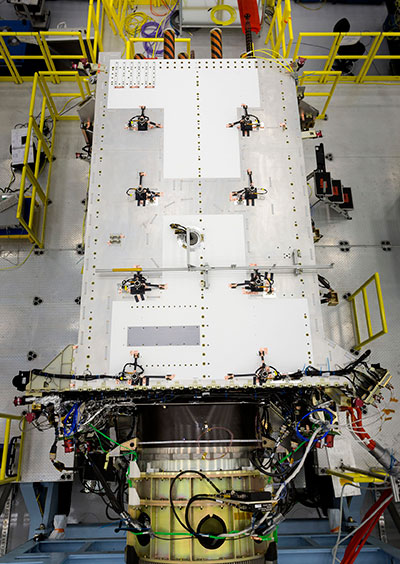
In May 2017, the U.S. Air Force’s second GPS III satellite was fully assembled and entered into Space Vehicle (SV) single line flow when Lockheed Martin technicians successfully integrated its system module, propulsion core and antenna deck. (Photo: Lockheed Martin)
The Air Force’s “Available for Launch” declaration is the final acceptance of Lockheed Martin’s second GPS III Space Vehicle (GPS III SV02), declaring it technically sound and ready to launch.
GPS III SV02 will bring new capabilities to U.S. and allied military forces, and a new civil signal that will improve future connectivity worldwide for commercial and civilian users.
GPS III SV02 now awaits official call up for launch in Lockheed Martin’s GPS III Processing Facility clean room in Denver. In June, the Air Force officially called up its first GPS III satellite for launch.
“The first GPS III satellite, GPS III SV01, was declared ‘Available for Launch’ in September 2017,” said Johnathon Caldwell, Lockheed Martin’s program manager for Navigation Systems. “It is now being prepared for shipment to Cape Canaveral, Florida, for a launch before the end of the year. With two GPS III satellites now ready for launch, and the third GPS III expected to be ready by early next year, we’re building strong momentum. These satellites will soon begin modernizing the current GPS constellation with new capabilities and more advanced technology.”
On July 13, 2017, the U.S. Air Force’s second GPS III space vehicle (GPS III SV 02) successfully completed acoustic testing. (Photo: Lockheed Martin)
GPS III will be the most powerful GPS satellite ever on orbit. It will have three times better accuracy and up to eight times improved anti-jamming capabilities.
GPS III’s new L1C civil signal also will make it the first GPS satellite to be interoperable with other international global navigation satellite systems.
Lockheed Martin is now in full production on 10 GPS III satellites at its GPS III Processing Facility near Denver.
In June, GPS III SV03 completed thermal vacuum testing, strenuous environmental trials simulating operations in the harshest space environments. In May, the antenna deck was added to GPS III SV04, fully integrating it into a complete satellite ready to begin environmental testing.
Right behind GPS III SV04 on the production line, the fifth, sixth and seventh GPS III satellites are in component build-up. The fifth satellite has its navigation payload and is expected to be fully assembled later this summer. To date, more than 90 percent of parts and materials for all 10 satellites under contract have been received.
In April, the company submitted a proposal to the government to build up to 22 additional GPS III Follow On (GPS IIIF) satellites which would bring even further enhanced capabilities to the GPS constellation’s more than four billion users.
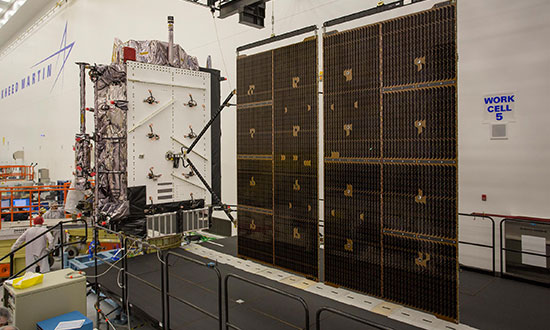
In July 2017, Lockheed Martin tested the deployment of the solar arrays for the U.S. Air Force’s second GPS III space vehicle (GPS III SV02). (Photo: Lockheed Martin)
Ligado’s proposed broadband service continues to pose a significant risk of harmful interference to GPS, several key signatories wrote in a July 18 letter to U.S. Federal Communications Commission (FCC) Chairman Ajit Pai.
The interference would occur despite Ligado’s May 31 amendments to its license modification applications, the letter states. “The proposed Ligado operations, even after the recently proposed amendments, will harmfully impact a wide range of GPS receivers and thus should not be permitted.”
Key signatories include representatives of Iridium Communications, the International Air Transport Association, Lockheed Martin, Rockwell Collins and Satelles.
The letter urges the FCC to deny Ligado’s pending license modification application unless Ligado can show it has addressed the substantive GPS interference concerns. Also encompassed in the letter are concerns over interference with satellite communications (SATCOM) and weather data.
“The record, augmented by recent government reports, makes clear that the interference will be particularly impactful to the countless government and commercial entities that rely on GPS and SATCOM services for aviation safety and other critical services,” the signatories wrote.
“A number of data points underscore the flaws in the way in which Ligado has attempted to measure interference to GPS from its proposed terrestrial operations.”
Ligado recently acknowledged that its license modification request as originally filed is insufficient to protect certified aviation GPS receivers, but offered no changes to its proposal to address interference to uncertified GPS systems, SATCOM services (also important for aviation safety), or concerns of the weather data community.
“Evaluating Ligado’s recent amendment to ensure protection of uncertified GPS receivers and protection of GPS receivers from aggregate interference will be necessary,” the letter states.
1-dB Criterion. One issue is the 1-dB degradation interference protection criterion, which Ligado has suggested is “neither accurate nor reliable.” That criterion was used in the U.S. Department of Transportation’s Adjacent Band Compatibility assessment issued in April, which examined the maximum transmitted power levels of adjacent band systems that can be tolerated by GPS receivers. The study endorsed and strictly applied the 1-dB criterion, and termed it the “accepted, worldwide standard for PNT and many other radio communication applications.”
“Each of these government efforts supports one conclusion — the proposed Ligado operations, even after the recently proposed amendments, will harmfully impact a wide range of GPS receivers and thus should not be permitted…
“We urge the Commission to deny Ligado’s pending license modification application as proposed unless Ligado can show it has addressed the substantive GPS, aviation, SATCOM, and weather data interference concerns still outstanding in the record,” the letter concludes.
Harris Corporation has provided Lockheed Martin with its fifth of 10 advanced navigation payloads contracted for the U.S. Air Force GPS III satellite program.
The GPS III navigation payload features a Mission Data Unit (MDU) with a 70-percent digital design that links atomic clocks, radiation-hardened computers and powerful transmitters — enabling signals three times more accurate than those on current GPS satellites, the company said.
The payload also boosts satellite signal power, increases jamming resistance by eight times and helps extend the satellite’s lifespan.
Lockheed Martin successfully integrated the navigation payload into the fifth GPS III space vehicle (GPS III SV05). Harris is committed to delivering three more payloads by the first quarter of calendar year 2019 for GPS III SVs 06-08.
Four navigation payloads have already been fully integrated on GPS III SV01-SV04. In September 2017, the Air Force declared the first GPS III satellite Available for Launch (AFL) with launch expected later in 2018.
In December 2017, GPS III SV02 completed rigorous thermal vacuum testing and is expected to be declared AFL this summer. GPS III SV03 and SV04 are expected to undergo environmental testing this year.
In November 2017, Harris announced that it completed development of an even more-powerful, fully digital MDU for the Air Force’s GPS III Follow On (GPS IIIF) program. The new GPS IIIF payload design will further enhance the satellite’s capabilities and performance for the Air Force.
Harris’ expertise in creating and sending GPS signals extends back to the mid-1970s — providing navigation technology for every U.S. GPS satellite ever launched. While the Air Force originally developed GPS for warfighters, millions of people around the world and billions of dollars of commerce now depend on the accurate, reliable signal created and sent by Harris navigation technology.
On April 26, the U.S. Department of Transportation publicly released the long-awaited GPS Adjacent Band Compatibility Assessment. See the June issue of GPS World for an expert and measured analysis of this highly impactful document.
The article will be posted online when it becomes available in mid-to-late May.
Merger Mystery
Contrary to the “Out in Front” editorial published in the April issue of GPS World magazine, there was an Izvestia story published on March 28 touting a merger of the GLONASS and BeiDou systems, and there will be an International Conference on Advanced Technologies in Manufacturing and Materials Engineering in Harbin, China, at which such a possibility may hypothetically be discussed.
However, neither hard news nor any official statements have emerged to substantiate such a dubious claim, despite repeated queries to officials of both countries.
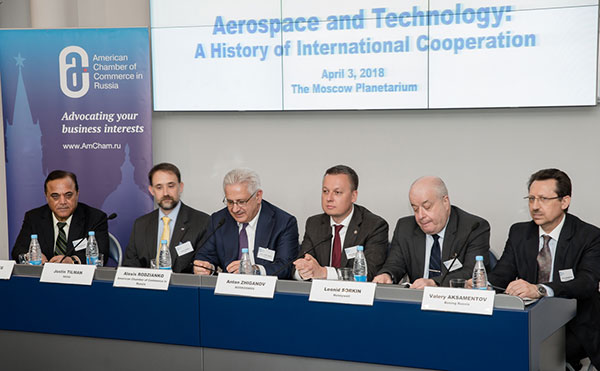
Javad Ashjaee (far left, above), CEO of JAVAD GNSS and based in Moscow, communicated that he spoke on a panel at an aerospace technology event organized by the American Chamber of Commerce in Russia, alongside representatives from NASA, Boeing, Honeywell and Roskosmos.
Ashjaee asked the Roskosmos official publicly about the prospect of a GLONASS merger with BeiDou, and “he knew nothing.”
Diverger Dilemma
As this magazine goes to press, stories emerge of a U.K. plan to launch a satellite-navigation system separate from the European Union’s Galileo project. This comes in response to an EU statement that the UK would be shut out of key elements of the European satnav program, particularly the Public Regulated Service, after Brexit.
Historically, in the late 1980s or early 90s the UK drew up plans for its own GNSS prior to the launch of Galileo. And UK-based Surrey Satellite Technology Ltd. built all operational Galileo payloads to date. So the country clearly has the capability. That SSTL is currently owned by Airbus (either German or Dutch division) may or may not constitute a wrinkle.
Finally, the UK spent 1.4 billion euros on Galileo, and may now file for a refund.
The Long Life of GPS III
By Robin Wrinn, Contributing Author
GPS III SV01 in electromagnetic interference, compatibility and passive intermodulation testing. (Photo: Lockheed Martin)
During interviews with Lockheed Martin and Harris Corporation at the 34th Space Symposium, time and space were a frequent focus of discussion, but not in the normal “continuum” kind of way.
Greater mission longevity is one of the key improvements GPS III delivers over those currently in service. Space Vehicles 1–10 have a planned mission life of about 15 years, 25 percent longer than their predecessors. Yet that begs the question “How long should a satellite live in space, with technology innovation occurring almost annually?”
Advanced payload technology provides a partial answer to that question. Both Lockheed Martin and Harris Corporation highlighted new payload capabilities with built-in flexibility to adapt satellites in orbit to technology advances, as well as changes in missions.
Lockheed Martin provided the media a tour of their Radio Frequency Payload Center of Excellence. Meanwhile, Harris recently announced completion of the fully digital Mission Data Unit (MDU), core to the navigation payload for GPS III 11 +. As a reminder, the current Harris payload for SVs 1–10 includes:
greater than three times reduction in range error,
up to eight times increase in anti-jamming power,
added signals, including L1C, compatible with other GNSS such as Galileo, and
greater signal integrity.
According to Harris, the fully digital navigation payload will provide the ability to change and upgrade the satellites incrementally over mission life.
Meanwhile, Lockheed announced a partnership with NEC to introduce artificial intelligence for computer learning in orbit. The company’s Payload Center experts touted significant advances in processers and a move toward next-generation antennas, arrays and transmitters to drive more satellite flexibility, capability and resilience.
Observation: The market pressures of ‘new space’ players is prompting delivery of products that can drive more value for less cost. In this case, delivery of a common payload architecture and electronically steered beams to make satellite antennas become any shape you want. Most likely, beams of a different size on demand is a much better business case than a static one built five years ago.
The day I interviewed Lockheed Martin’s Navigation Systems mission area Program Manager Johnathon Caldwell, the company had submitted its proposal for the U.S. Air Force’s GPS III Follow On (GPS IIIF) program. That same day, April 16, the media was given a tour of Lockheed Martin’s GPS III satellite assembly floor. It was clear from both Lockheed’s press materials and Caldwell that Lockheed Martin believes it is fully recovered from prior production hiccups and is
on track to deliver GPS Space Vehicles (SVs) 1 through 10, and
deserves to win the bid for GPS IIIF. Now that both Boeing and Northrop Grumman have dropped out of the running, Lockheed is virtually assured the contract. The government has said it will announce the award in March 2019.
What are the differences in the GPS III satellite payloads that were instituted to enable the new signals?
The main difference is the power. The Air Force’s requirements called for significantly more anti-jamming capability. All the transmitters are a higher power.
What was the most significant obstacle (or top obstacles, plural) in designing and manufacturing this new payload, to new Air Force specifications? How did you overcome it/them?
Same answer really, the higher power. Keeping in mind, we went from a 7-year mission life requirement to a 15 year. That higher power puts more strain on components and new cyber requirements in software. When you couple all that together we are not just upgrading payload technology. It is really engineering a new set of payload requirements. It’s new generation, advanced.
What are the advantages of a digital payload over the alternative?
The advantages and the 30 percent difference are the timekeeping system portion. We’re moving from a manual, analog timing to digital to deliver to the Air Force more flexibility. It’s a nice option to have to be able to reprogram in orbit and maybe enhance capabilities desired in the future.
with Johnathon Caldwell, Navigation Systems Mission Area Program Manager
Any changes in your production approach having completed SV01?
No, the performance on Vehicle 01 was as designed there were no technical or design changes necessitated throughout the rest of the fleet. So, it was a very successful from that perspective — from the standpoint of validating the design and wringing it out, Vehicle 01 served its purpose well.
It had a very good T-Vac. I would say overall when you look at the industry, Vehicles 01–02, our vacuum test campaigns are the most rigorous test. Both went through their tests quite well. Some of the best I’ve seen.
The decision means Lockheed Martin is all but assured the contract. Lockheed Martin announced on April 17 that it had submitted its proposal.
All three companies received study contracts in 2016 valued at up to $6 million each to demonstrate their ability to build future GPS satellites, in preparation for the planned competition.
This month, we bring you a guest column on the 34th Space Symposium in Colorado Springs, Colorado. Robin Wrinn, a communications professional based in Atlanta, gives her perspective on the premier annual space event, held in April. Among her findings: information on the mission longevity vs. technology innovation debate, GPS IIIF program bids, discussions of time and space, and more.
— Alan Cameron, editor
During recent interviews with Lockheed Martin and Harris Corporation conducted during the 34th Space Symposium (April 16-19) in Colorado Springs, time and space were a frequent focus of discussion, but not in the normal “continuum” kind of way.
Greater mission longevity is one of the key improvements GPS III delivers over those currently in service. Space Vehicles 1-10 have a planned mission life of about 15 years – 25 percent longer than their satellite predecessors. Yet that bragging right begs the question “How long should a satellite ‘live’ up in space with technology innovation occurring almost annually?” After all the last Block IIR-M series satellite was launched in 2009. To put that into perspective, that same year the Canadian company Blackberry (RIM) held 20 percent of the smartphone OS market share and was the second largest OS in the world. Apple had just introduced the iPhone two years earlier.
A partial answer to that question it seems is advanced payload technology. Both Lockheed Martin and Harris Corporation highlighted their advances in payload capabilities that would enable built-in flexibility to adapt satellites in orbit to advances in technology, as well as changes in missions. Lockheed Martin provided the media a tour of their RF (Radio Frequency) Payload Center of Excellence (Payload Center). Meanwhile, Harris Corporation recently announced that is has completed development of the company’s fully digital Mission Data Unit (MDU), which is core to the navigation payload for GPS III 11 +.)
As a reminder, the current Harris payload for SVs 1-10 includes:
Greater than three times reduction in range error,
Up to eight times increase in anti-jamming power,
Added signals – including one (L1C civil signal) compatible with other Global Navigation Satellite Systems (GNSS), like the European Space Agency’s Galileo.
And greater signal integrity.
According to Harris, the new, fully digital navigation payload it has engineered will deliver more powerful signals, PLUS the ability to change and upgrade the satellites incrementally over the mission life.
Meanwhile, Lockheed recently announced a partnership with NEC to introduce artificial intelligence for computer learning in orbit. And the company’s Payload Center subject matter experts touted their significant advances in processers and a move toward the next generation of antennas, arrays and transmitters that would drive more flexibility and capability and resilience into satellites.
Observation: It seems the market pressures of ‘new space’ players is prompting delivery of products that can drive more value for less cost. In this case, delivery of a common payload architecture and electronically steered beams to make satellite antennas become any shape you want. Most likely, beams of a different size on demand is a much better business case than a static one built five years ago.
GPS III 1-10 on track. in full production. GPSIII SV1 awaiting U.S. Air Force “Call Up” for Launch
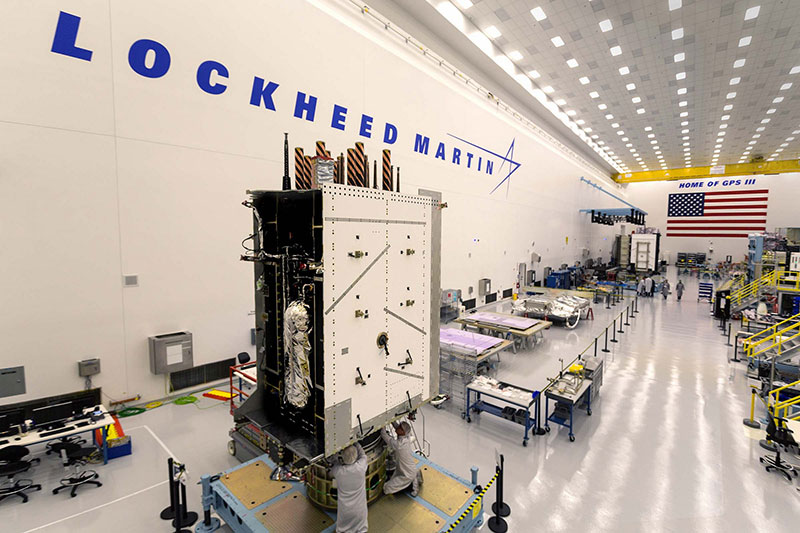
Lockheed Martin’s GPS III SV03 became fully integrated in August 2017. Photo: Lockheed Martin
The day I interviewed Lockheed Martin’s Navigation Systems mission area Program Manager Johnathon Caldwell, the company had submitted its proposal for the U.S. Air Force’s GPS III Follow On (GPS IIIF) program. That same day, April 16, the media was given a tour of Lockheed Martin’s GPS III satellite assembly floor. It was clear from both Lockheed’s press materials and Caldwell that Lockheed Martin believes it is fully recovered from prior production hiccups and is
• “on track” to deliver GPS Space Vehicles (SVs) 1 through 10, and
• deserves to win the bid for GPS IIIF. Now that Boeing has dropped out of the running, it seems they probably have it. (The government has said it will announce the award in March 2019.)
Here is the GPS III SVs 1-10 Update:
SV 01. Declared “Available for Launch” (AFL) by the Air Force on Sept. 28, 2017. Awaiting “Call Up” for launch. A formal date has not been set. “Sometime this year” was the answer Lockheed Martin provided when asked a timeframe.
SV 02. Completed Thermal Vacuum (TVAC) testing, Dec. 2017. Currently in final environmental EMI (electromagnetic)/EMC (electromagnetic compatibility)/PIM (passive intermodulation) testing. AFL expected Summer 2018.
SV 03. Fully integrated, Fall 2017. Currently in TVAC testing, AFL expected. Spring 2019
Interview with Harris Corporation’s Jason Hendrix, PNT Program Director.
GPS World readers are familiar with the differences in the GPS III signals as compared to those transmitted by satellites to date. What are the differences in the GPS III satellite payloads that were instituted to enable those new signals?
The main difference is the power. The Air Force’s requirements called for significantly more anti-jamming capability. All the transmitters are a higher power.
What was the most significant obstacle (or top obstacles, plural) in designing and manufacturing this new payload, to new Air Force specifications? How did you overcome it/them?
Same answer really, the higher power. Keeping in mind, we went from a 7-year mission life requirement to a 15 year. That higher power puts more strain on components and new cyber requirements in software. When you couple all that together we are not just upgrading payload technology. It is really engineering a new set of payload requirements. It’s new generation, advanced.
What are the advantages of a digital payload over the alternative? When you say “Our current GPS payload is 70 percent digital” does that refer to the IIR payload? The offered “fully digital navigation payload with enhanced performance” — is that the GPS III payload? What’s the new 30 percent that has gone digital?
The advantages and the 30 percent difference are the timekeeping system portion. We’re moving from a manual, analog timing to digital to deliver to the Air Force more flexibility. It’s a nice option to have to be able to reprogram in orbit and maybe enhance capabilities desired in the future.
Can you provide any perspectives on how Harris is performing now in delivering payloads for SVs 1-10?
We’re now ahead of schedule. We delivered the 5th payload three weeks early (early March 2018). We are on time for 4 and three more are due this year.
Interview with Lockheed Martin’s Navigation Systems Mission Area Program Manager Johnathon Caldwell
Can you provide some general updates on assembly of GPS 1-10?
Photo: LMCO
Vehicle SV01: It is ready and we’re very excited about that. We defer to the Air Force on questions about launch date. But once they call it up we will install the solar panels and take it to a C-17. Then load it in the back of the plane and fly it down to Florida. We will then take it over to the vehicle processing facility and mate it up with the launch vehicle provider. The GNST – the satellite prototype -has gone to the Cape twice already. So, we have conducted a dry run for shipping SV 01.
Vehicle SV02: It has completed thermal vacuum testing – a major milestone. We’re in the last of the environmental tests. And we’re tracking to have that vehicle declared AFL this summer.
Vehicle SV03. It is fully integrated and is in the T-Vac chamber now. The door is closed and it’s going through tests. (Pump down to vacuum is achieved in approximately three hours and the total testing time is 70 days.)
Vehicle SV04: It is fully integrated on the floor. It is in its baseline electrical tests and will be in environmental tests as soon as 3 comes out of the chambers. It is staged to go in right after – 3.
Vehicle SV05: It is about to go through its integration to the propulsion core. And five has its navigation payload. Integrating it this summer.
Any changes in your production approach having completed SV01 that you are fixing in your production approach to SV02, 03 or 04?
No, the performance on Vehicle 01 was as designed there were no technical or design changes necessitated throughout the rest of the fleet. So, it was a very successful from that perspective – from the standpoint of validating the design and wringing it out, Vehicle 01 served its purpose well.
It had a very good T-Vac. I would say overall when you look at the industry, Vehicles 01 – 02, our vacuum test campaigns are the most rigorous test. Both went through their tests quite well. Some of the best I’ve seen.
We consider thermal vacuum the gold standard for testing any satellite before it goes into operations. It really is putting the craft through the paces. When it goes through the testing, the satellite is on. It is working. It is exposing it to the heat and the cold and the zero pressure while the satellite is functional. The entire thermal vac testing from start to end is a little over 70 days. “Test like you fly.” From the time it launches and deployment sequence we test it like it is real. Minus the shaking, the satellite thinks it is getting launched. Meanwhile, our people are looking at the data and its health. T Vac is a huge milestone for a satellite to go through it and come out without any issues. Which is why we are so pleased about the two.
Have there been any production delays since last year.
No, we’ve been quite stable in our production schedule.
Can you shed some light as to how many Lockheed Martin employees are involved in the production of GPS III?
The way we’re organized, there are engineers that flux in and out of the project depending the stage we’re in. This is production program, so we use the skillsets we need at the time we need them, then those engineers go on to do other work. But this also comes back to some of the commonality we’re trying to achieve across out product lines. That when you have common processes, common parts and common procedures in building spacecraft you gain leverage and major cost savings to have flex in resources.
Can you speak to any issues with subcontractors? Any delays?
No, since last year, the Harris production line has stabilized. We’ve been receiving Harris payloads, and we’ve just received the 5th payload and we’re finishing up integration. Vehicle 6 navigation payload is currently in test. And Vehicle 7 and 8 payload production is going according to schedule. We feel Harris has definitely overcome some of the challenges of the past. And we’ve been seeing stable production deliveries. By the end of this year we should receive 3 more payloads and by the first quarter of next year, the 8th, and they are contracted for 9 and 10.
From a civilian perspective, can you remind us what will be different with GPS III?
Three times better accuracy and up to eight times improved anti-jamming capabilities. And it is a longer life vehicle and healthy constellation of satellites that people can rely on. The new L1C signal is common with other GNSS, like Galileo, so as that becomes incorporated into equipment, it will give you more data points for better service, more accuracy and reliability.
For GPS IIIF requirements, are there capabilities that will require innovation or new technology?
We’ve designed with some of those capabilities in mind. If you just look down the list. The regional military protection is about bringing higher power and boosting the signal where the military needs it most. That’s not a particularly new technology per se, but it is bringing a new capability that the current GPS satellites don’t have.
The Search and Rescue payload, again, I wouldn’t consider it a new capability, it is provided by a partner nation, a Canadian company, but it effects those folks in need.
Digital payload. For 11+, fully digital payload for greater flexibility for the government. It allows the government to expand or enhance capabilities of the mission over time. It enables loading new software to do different things.
GPS III was designed with a modular, flexible architecture. Because Lockheed Martin knew that as time goes by, technology evolves. New technology becomes available and the government’s mission needs are likely to change.
Now that ability to evolve is down to the payload with a fully, 100 percent digital payload.
Lockheed Martin has been working on a lot of the GPSIII F design requirements already (preliminary design review level).
Can you speak to the other “Risk Retired” you mentioned in your slides?
Last fall, we had our first time with the OCX zero ground system. It’s one thing to talk to satellite in the high bay, it’s another thing to talk to it with the entire Air Force control network you plan to use when you’re operating. So, we were excited to get that done and run the entire chain from the vehicle out from the Air Force control network the AFCN network, utilizing the OCX system to command the vehicle. It was a big milestone for us. And previously we demonstrated our compatibility of our signals (with OCX).
Our future satellites in our GPS IIIF proposal share a common design with GPS III so they also will be compatible with OCX because we have proven that compatibility.
Can you speak to the GPS III Ground System Support Contracts Lockheed Martin has received?
The government asked us to help provide some gap fillers for the ground system (rmw note: if OCX isn’t there yet). To take the heritage AEP ground system and provide the ability to fly GPS III satellites using that ground system. So that activity has been going well and the critical design review has been completed and it is on track for delivery to the government next year. And subsequently, we were also put on contract for the M-code new signal to add some capabilities to the legacy ground system to begin to furnish early use of that new GPS III M-code signal to the military. We’ve been working hard on that. We conducted our preliminary design review last fall and just recently completed a critical design review to add that capability.
Boeing has decided to not submit a proposal to build up to 22 GPS III satellites for the U.S. Air Force. The GPS III Follow On (GPS IIIF) program will supply additional upgraded satellites to replace ones now in the constellation.
“We have not put in a proposal for GPS III,” said Rico Attanasio, Boeing’s director of Department of Defense and civil navigation and communications programs, to Space News.
Lockheed has been the only producer of GPS III satellites, and is now under contract to build the first 10. Boeing built earlier versions of GPS satellites.
In February, the U.S. Air Force Space Command (AFSC) released its request for proposals (RFP) to build the 22 GPS III satellites, called the GPS III Follow-On Phase 2 contract. The estimated dollar value of the acquisition is $10 billion including all options.
Phase 2 is planned as a single, predominantly fixed-price incentive-type contract awarded via full and open competition for production of 22 GPS III satellites. Deadline for proposals is April 16. Construction is to begin in fiscal year 2019 (Oct. 1, 2018), with delivery of the first satellite in 2026.
Boeing thought it could compete based on “innovation, resilience [and] a new payload, but that wasn’t emphasized,” Attanasio told Space News. “It wasn’t a good fit for us.”
Lockheed Martin has submitted a competitive and fully compliant proposal for the U.S. Air Force’s GPS III Follow On (GPS IIIF) program, which will add enhanced capabilities to the most advanced GPS satellites ever designed. The GPS IIIF program intends to produce up to 22 next-generation satellites.
The U.S. Air Force’s first 10 GPS III satellites, now in full production at Lockheed Martin, are already the most powerful GPS satellites ever designed. GPS III will have three times better accuracy and up to eight times improved anti-jamming capabilities. Spacecraft life will extend to 15 years, 25 percent longer than the newest GPS satellites on-orbit today. GPS III’s new L1C civil signal also will make it the first GPS satellite to be interoperable with other international global navigation satellite systems, like Galileo.
Lockheed Martin’s proposal for the GPS IIIF program adds further power, resiliency and capabilities to GPS III.
The biggest feature of GPS IIIF will be a regional military protection capability, which will increase anti-jam support in theater to ensure U.S. and allied forces cannot be denied access to GPS in hostile environments.
Lockheed Martin’s GPS IIIF will feature a fully-digital navigation payload. The payload on the first 10 GPS III satellites is already 70 percent digital.
Each GPS IIIF satellite will include a laser retro-reflector array, which allows the positioning of on-orbit satellites to be refined with ground-based, laser precision. The precise positioning of each satellite ultimately enhances the positioning signals they generate.
Additionally, the U.S. government will provide each GPS IIIF with a new search-and-rescue payload. These hosted payloads, spread around the globe on GPS IIIF satellites, will make it easier for first responders to detect and respond to emergency signals.
“When we developed our design for the first 10 GPS III, we used a flexible, modular architecture that would allow for the insertion of modern technologies and new Air Force requirements in a low-risk manner,” said Johnathon Caldwell, program manager for Lockheed Martin’s navigation systems mission area. “In addition, our GPS IIIF solution is based off a design already proven compatible with both the Air Force’s next generation Operational Control System (OCX) and the existing GPS constellation.”
The first 10 GPS III satellites are in full production at Lockheed Martin’s GPS III Processing Facility, a $128 million cleanroom factory designed in a virtual reality environment to drive efficiency and reduce costs in satellite production.
GPS III SV02 completed rigorous Thermal Vacuum (TVAC) testing in December 2017, is in final environmental testing, and is expected to be declared AFL in summer 2018. GPS III SV03 was fully integrated in fall 2017 and recently began TVAC, and SV04 was recently integrated in anticipation of environmental testing later this summer. GPS III SV05 has now received its navigation payload and is in final vehicle build up. Not far behind, GPS III SV06 has begun its initial build with GPS III SV07 also planned to begin production this spring.
To date, more than 90 percent of parts and materials for all 10 satellites have been received, from more than 250 aerospace companies from 29 states, to help ensure GPS III maintains the gold standard in position, navigation and timing.
Lockheed Martin’s Joint Air-to-Surface Standoff Missile (JASSM) – Extended Range (ER) achieved full operational capability on the F-15E Strike Eagle, flown by the U.S. and allied nations’ air forces.
With completion of integration and the fielding of JASSM-ER’s Suite 8 Operational Flight Program, the F-15E Strike Eagle becomes the first Universal Armament Interface (UAI)-compliant platform to field JASSM-ER. UAI-compliant aircraft feature standardized interfaces to support future weapon integration.
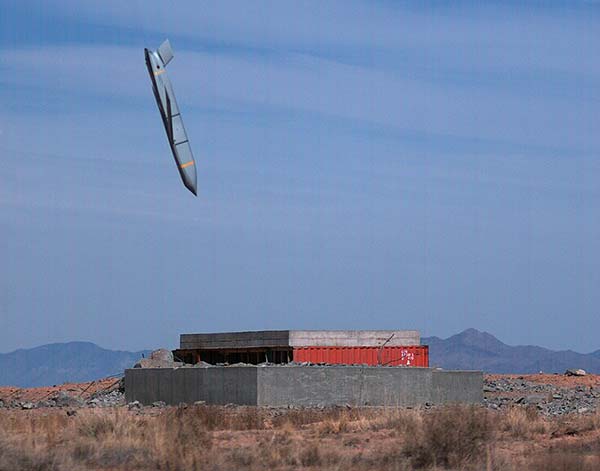
Like the JASSM, the JASSM-ER cruise missile employs an infrared seeker and enhanced digital anti-jam GPS to dial into specific points on targets.
JASSM employs an enhanced digital anti-jam GPS receiver and infrared seeker to dial into specific points on targets. (Photo: Lockheed Martin, courtesy of the U.S. Air Force)
“Fielding on the F-15E Strike Eagle expands JASSM-ER’s mission flexibility,” said Jeffrey Foley, program director of Long-Range Strike Systems at Lockheed Martin Missiles and Fire Control. “With its greater than 500 nautical-mile standoff range and planned block upgrades currently in work, JASSM-ER provides an impressive tactical advantage for U.S. and allied warfighters.”
Baseline JASSM was the first missile ever to be integrated onto a UAI platform. The U.S. Air Force Seek Eagle Office led the F-15E Strike Eagle JASSM-ER and JASSM integration.
Armed with a penetrating blast-fragmentation warhead, JASSM-ER and JASSM can be used in all weather conditions. They share the same powerful capabilities and stealth characteristics, though JASSM-ER has more than two-and-a-half times the range of JASSM for greater standoff distance.
Effective against high-value, well-fortified, fixed and relocatable targets, JASSM-ER is integrated on the B1-B and in the process of integration on the F-16C/D and the internal bay and wings of the B-52H. JASSM is integrated on the U.S. Air Force’s B-1B, B-2, B-52, F-16 and F-15E.
Internationally, JASSM is carried on the F/A-18A/B, F-18C/D and F-16 Block 52 aircraft.
Produced at the company’s manufacturing facility in Troy, Alabama, more than 2,150 JASSMs have been delivered.