Tag: mobile device

  • Trimble Juno T41: Rugged, Sturdy, and a Great Display

    I keep waiting for the cryptic phone call or emphatic email from Trimble that says, “You have had our evaluation units for over four months — when can we expect to see a review and when will you be returning our equipment?” Fortunately, Trimble is very understanding and would never make such a call or send such an email, I hope. The truth is Trimble sent me a T41 and Yuma 2 for review back when it was still snowing in the Rocky Mountains and I am still evaluating the units. You see that’s the rub with excellent equipment — it is a pleasure to review GPS equipment that exceeds all expectations, and frankly, it is difficult to send it back because there is always one more project, one more test or one more application that needs to be run. Fortunately the Trimble PNT equipment (position, navigation and timing) has never been found wanting. So here finally is the T41 review that so many of you have requested.

    First, however, for those of you who are of a similar age to yours truly — and let’s just say it hopefully relates to a certain level of maturity and in my case familiarity with GPS since 1978 — I just can’t see the designation T41 without thinking of: (1) a basic USAF pilot and navigation training aircraft once flown at Mather Air Force Base in California and one I still see every day at the Unites States Air Force Academy and flying over my home on a regular basis, and (2) the first successful commercial GPS unit built by my think-tank colleague Philip Ward at Texas Instruments, designated the T1-4100. I have no idea if Trimble was aware of these associations when naming conventions were considered for the T41, but for many of us seniors the associations certainly exist. That is not a bad thing — it probably even extends to goodwill in a business sense, if you understand that jargon. But, as usual, I digress!

    BLUF (Bottom Line Up Front)

    As loyal readers are aware, I never give a product a bad review. That is not to say I do not receive my share of simply “bad” GPS equipment to review. I just refuse to take the time to pen a bad review — my philosophy being, why should I take the time to write and why should you take the time to read about something you can’t or won’t use? There are enough “good,” even exceptional, GPS devices out there today that deserve to be written about — so let’s just skip the bad ones and save us all some grief and deflated expectations. So the very fact that I am writing about the Trimble T41 means that it has passed all my tests for ruggedness and usefulness. In fact (I checked the figures with my review logs for the past seven years), for every 20 GPS devices I receive, I only review one on average. This month it is the Trimble JunoT41/5 X-Model with gray pin striping and an IP68 ruggedness rating, and you will see why that level of model detail is important shortly.

    Who Matters as Much as What

    Before I get into the technical aspects of the T41, let’s consider for a moment who would want to use this unit. Without a doubt, it is perfect for warfighters and first responders or I probably would not write about it, but it is also perfect for anyone that needs a rugged handheld computer with embedded GPS running either the Windows or Android operating system (OS). The touchscreen display covers about the same real estate as the new iPhone 5 but the T41 is slightly larger, heavier, thicker and, it almost goes without saying, incredibly rugged. I guess that is why I have received several letters from T41 users that use it on horseback.

    Now, while I perceive the equine GPS market to be a niche market, another one of my think-tank colleague, the Honorable Jim Geringer, who ran the great state of Wyoming from 1995 to 2003, has mentioned several times in passing, and I mistakenly thought jokingly, ranchers using GPS on horseback. Now that I think about it and read some of my email from Colorado, Wyoming, and Montana ranchers, it makes sense. Think about navigating thousands of acres of ranch land that in some cases all looks the same, looking for lost cattle or damaged fences. Think about wanting to mark the spot where cattle or damaged fences were found and then being able to quickly communicate that information to someone who could help, and then just as quickly navigate back to civilization, even in a blizzard. The fact is my correspondence from several ranchers tells me that GPS has become indispensible – and not just any GPS, but a reliable, accurate and rugged GPS that has a long battery life, comes with a built-in camera, and the option for a solar charger, and of course has embedded communication capabilities. Sounds a great deal like the T41 – I think you will agree.


    Basics and Specifications

    The Juno T41/5 approximates a slightly larger iPhone 5 in size, but one with an extremely rugged case. The case  makes it bigger and heavier, but at the same time much more useable in all weather conditions, to include snow, ice, water, dust, all of which I personally tested for, and I suspect it will survive being dropped in horse manure, although I will admit this is one test that I have not personally performed. I will graciously defer to my equine mounted readers when it comes to performing this particular test. Can you say rubber gloves, Purell Hand Sanitizer and Fabreze?


    Trimble Juno T41/5 Specifications

    FEATURES

    • Processor: 800 MHz or 1 GHz, Texas Instruments DM3730
    • RAM: 256 MB or 512 MB
    • Flash Storage: 8 GB or 16 GB
    • 4.3” WVGA sunlight-readable Gorilla® Glass display
    • Light sensor to auto-adjust display brightness
    • Capacitive multi-touch interface
    • Integrated 3.75G cellular data, text and voice capability
    • 8 megapixel camera with geo-tagging and dual LED flash
    • Bluetooth 2.1 with Enhanced Data Rate
    • Wi-Fi (802.11 b/g/n)
    • GPS Receiver, 2-4 meter accuracy (WAAS/SBAS Capable)
    • MCX port for optional External GPS Antenna
    • Electronic Compass
    • Accelerometer
    • Robust Custom Port with USB 2.0 Full Speed Protocol
    • Conversion Cables available for 9-pin Serial or USB host
    • Micro SD memory card slot (supports SDHC up to 32 GB)
    • Integrated speaker and microphone
    • 3.5 mm Headset Jack with Audio Capability

    OPERATING SYSTEMS

    • Windows Embedded Handheld 6.5
    • Android 4.1 – which is faster, has better battery usage, more secure and with better developer specifications than the older version 2.3.4
    • Language Support: Chinese (Simplified), English, French, German, Italian, Japanese, Korean, Portuguese, Russian or Spanish

    Windows Embedded Handheld 6.5

    Standard Software:

    • Trimble SatViewer (GPS interface application)
    • Trimble CellStart (WWAN configuration application)
    • Microsoft Office Mobile 2010 (Word Mobile, Excel Mobile, PowerPoint Mobile, Outlook Mobile)
    • Internet Explorer Mobile 6
    • Microsoft My Phone with SMS Text Messaging
    • Camera Control Application
    • Flashlight Control Mode Application
    • Calculator
    • Calendar
    • Microsoft Pictures and Videos
    • Windows Media Player
    • Windows Live Messenger
    • Microsoft Task Manager and Notes
    • Adobe Reader LE 2.5

    Android 4.1 Advanced Software:

    • Trimble Outdoors Navigator
    • Email
    • Phone and SMS Text Messaging
    • Picture and Video Gallery
    • Multimedia Player
    • Web Browser
    • Camera Control Application
    • Flashlight Mode Control Application

    Application Developer Support:

    • Software Developer Kit with Documentation for WEH 6.5
    • Software Developer Kit with Documentation for Android 4.1

    STANDARD ACCESSORIES

    • International AC Charging Kit
    • T412 USB Cable
    • Wrist Strap
    • Ultra Clear Screen Protectors (qty-2) Kit
    • Quick Start Kit

    OPTIONAL ACCESSORIES

    • 9-pin Serial Adapter
    • USB Host Adapter
    • Capacitive Stylus with Tether
    • External Battery Pack
    • Port Cover
    • Ultra Clear Screen Protectors (qty-10) Kit
    • Anti-reflective Screen Protectors (qty-2) Kit
    • Vehicle Charging Kit
    • Capacitive Touch Screen Gloves
    • Trimble Headset
    • External GPS Antenna

    ENVIRONMENTAL SPECIFICATIONS

    Water: Survives immersion at 3.3 feet (1 meter) for two hours (gray models), IEC-60529 IPx8. Survives driving rain & water spray (yellow models), IEC-60529 IPx5, water jet 12.5 mm diam @ 2.5-3 m.
    Dust: Protected against dust, IEC-60529 IP6x, dust chamber with under-pressure
    Drops: Survives multiple drops of 4 ft. (1.22 m), MIL-STD-810G, Method 516.6, Procedure IV, Transit Drop
    Operating Temperature: -22 ºF to 144 ºF (-30 C to 60 C), MIL-STD-810G, Method 502.5, Procedure I, II, III (Low Temp Operating -30 C); Method 501.5, Procedure I & II (High Temp Operating 60 C)
    Storage Temperature: -40 ºF to 158 ºF (-40 C to 70 C), MIL-STD-810G, Method 502.5, Procedure I, II, III (Low Temp Storage -40 C); Method 501.5, Procedure I & II (High Temp Storage 70 C)
    Temperature Shock: Cycles between -22 ºF and 144 ºF (-30 C and 60 C), MIL-STD-810G, Method 503.5, Procedure I-C
    Humidity: 90% relative humidity with temperatures between 22 ºF and 144 ºF (30 C and 60 C), MIL-STD- 810G, Method 507.5, Procedure II
    Altitude: 15,000 ft (4,572 m) at 73 °F (23 C) to 40,000 ft (12,192 m) at -22 °F (-30 C), MIL-STD-810G, Method 500.5, Procedure I, II & III
    Vibration: General minimum integrity and loose cargo tests, MIL-STD-810G, Method 514.6, Procedure I & II, Category 5
    Solar Exposure: Survives prolonged UVB exposure, MIL-STD- 810G, Method 505.5, Procedure II
    Chemical Exposure: Resistant to mild alkaline and acid cleaning solutions, fuel hydrocarbons, alcohols and common vehicle and factory machine lubricants.

    PHYSICAL

    Size. . . . . . . . . .6.1 in . 3.2 in . .9 in (15.5 cm x 8.2 cm x 2.5 cm)
    Weight. . . . . . . . . . . . . . . . . . . . 13.5 oz (.4 kg), including battery
    Color . . . . . . . . . . . . . . . . . . .Black with Yellow or Black with Gray (Color does make a difference; see Product Models below.)

    ELECTRICAL

    Processor: 800 MHz or 1 GHz, Texas Instruments DM3730
    Memory: 256 MB or 512 MB
    Storage: 8 GB or 16 GB, non-volatile
    Expansion: micro SD card slot, SIM card slot
    Display: 4.3 in (10.9 cm), 480 x 800 pixel, WVGA TFT
    Battery: 3.7 V, 3.3 Ah, 12.2 Wh, Lithium-ion polymer
    I/O: 3.5mm audio jack; Custom Port that supports USB 2.0 Host, USB Client, 9-pin Serial and 5.6 V (5.0 V to 5.9 V) DC input power
    GPS Receiver: 2-4 m accuracy with WAAS/SBAS correction; MCX port for optional external antenna
    Radios: Bluetooth 2.1 +EDR; Wi-Fi 802.11 b/g/n
    WWAN radios: UMTS / HSPA+, GSM / GPRS/ EDGE; UMTS Bands (WCDMA/FDD): 800, 850, 1900, AWS and 2100 MHz; GSM Bands: 850, 900, 1800, 1900 MHz

    CERTIFICATIONS

    FCC, CE, R&TTE, IC (Canada), C-tick, GCF compliant, RoHS compliant, Section 508 compliant, PTCRB, SAR, AT&T network compatible, Wi-Fi Alliance certified, CCX, USB 2.0 Full Speed, MIL-STD-810G, IP65/IP68, MIL-STD-461E.

    PRODUCT MODELS

    Color

    IP Rating

    Processor          RAM       Storage

         WWAN

          GPS

    Camera

    M

    Gray

    IP68

    800 MHz

    256 MB

    8 GB

    2-4 m

    C

    Yellow

    IP65

    800 MHz

    256 MB

    8 GB

    2-4 m

    8 MP

    C

    Gray

    IP68

    800 MHz

    256 MB

    8 GB

    2-4 m

    8 MP

    X

    Yellow

    IP65

    1 GHz

    512 MB

    16 GB

    3.75G

    2-4 m

    8 MP

        X

    Gray

    IP68

    1 GHz

    512 MB

    16 GB

    3.75G

    2-4 m

    8 MP

    The M model features a GPS receiver, 800-MHz processor, 256 MB RAM, 8-GB storage and is available in gray with IP68 rating. The C model adds an 8-megapixel camera with dual LED flash, Bluetooth and Wi-Fi to the M model feature set and is available in yellow with IP65 rating or gray with IP68 rating. The X model adds penta-band GSM cellular phone and data capability to the features of the C model, has a 1 GHz processor, 512 MB RAM and 16 GB storage and is available in yellow with IP65 rating or gray with IP68 rating.


    Key Features

    WVGA Sunlight-Readable Gorilla Glass Display. I found the 4.3-inch color display to be readable in all lighting conditions. From very low light to bright sunlight, even sun reflecting off snow, which I have found to be the most difficult condition. The Gorilla glass is aptly named, as its unique composition allows for a deep layer of high compressive stress, which is created through an ion-exchange process during the manufacturing process by Corning Glass. This compression acts as a sort of “armor,” making the glass exceptionally tough and durable, and yet the display is crystal clear.

    Multi-Touch User Interface with Capacitive Stylus Compatibility. Now, I am well aware that one of my heroes, Steve Jobs, once said that “…if you are required to use a stylus on a computer, you have lost your advantage.” However, there are just simply times, especially with GIS (geographical information systems) and map displays, when something smaller and more accurate than the end of your little finger is called for, and on the T41 you have your choice. The display also functions with a capacitive glove, which you can purchase from Trimble as an option or from many other vendors. The bottom line is the 4.3-inch high resolution screen is very clear, and as Trimble says “…the multi-touch support allows complex selections and controlled zoom to optimize the user experience with maps and detailed information.”

    3.75G Cellular Data, Text and Voice Capability. A GPS or PNT device today without communication capabilities is a device that simply cannot compete, in the marketplace or in any situational awareness competition/situation you would care to name. Communication capabilities allow any PNT device to make use of PNT augmentation available over the Internet and through private networks such as the Trimble VRS or Virtual Reference Station and the John Deere StarFire network. Indeed, the Trimble VRS network enables precise, real-time GNSS positioning through the distribution of correction data. The global networks provide a highly reliable method for surveyors, warfighters, and other geospatial and PNT professionals to work faster and achieve accurate GNSS results, as precise as three centimeters in real time, for a variety of positioning applications including geodetic and cadastral surveying, road and bridge construction, mapping, agriculture, earthquake and tectonic plate movement monitoring, warfighter applications, and scientific research, as well as other high-accuracy positioning applications. Trimble’s VRS networks use RTK (real-time kinematic) solutions that, when combined with the Trimble RTKNet software, provide high-accuracy RTK GNSS positioning for wide areas. A VRS network improves productivity while reducing complexity and the global footprint for warfighters, by eliminating the need to set up a base station.

    A VRS network is made up of the latest in GNSS hardware, modeling, and networking software, plus communications interfacing. Once set up, RTK roving receivers in the field or AOR (Area of Responsibility) have access to real-time network modeled corrections. In the field you also have the reassurance of the built-in integrity monitoring system that warns if there are any problems with the data.

    Today Trimble’s VRS networks are considered an integral tool for providing fast, high-precision, wide area positioning for warfighters and first responders in countries around the world. The Trimble VRS and John Deere RTK StarFire systems also give the device, especially in the case of a warfighter, additional situational awareness, along with the capability to act not only as a receiver, but as a networked device, a sensor, and a monitoring station. The T41 handheld has voice, SMS text, and 3.75G cellular data transfer capabilities on GSM cellular networks worldwide. You can upload and download data from the cloud using Wi-Fi or WWAN connections. The 8-megapixel camera can be set to automatically include time and location metadata from the GPS receiver. The T41 not only has the ability to increase the individual warfighter’s situational awareness but to increase the SA for all users on the network and in the AOR as well.

    Bluetooth 2.1 + EDR and Wi-Fi b/g/n. You may well wonder why I have listed this as a separate feature when it could just be included under communications. I have listed it separately because of the Army’s laudable Puck and Hub endeavors. (See my GPS World May column for the detailed briefing). Without going into too much detail, the Puck and Hub are sorely needed PNT receivers with augmentation capabilities to include Wi-Fi, inertial, and CSAC (Chip Scale Atomic Clocks) that are hopefully multi-GNSS signal-capable. The only feature both devices lack is a suitable and rugged display mechanism. This is where the Bluetooth, Wi-Fi and Android capabilities of the T41 come into play. The Army seems, for the time being, to have mysteriously settled on the Android OS as a basic capability and building block that, when combined with Bluetooth and Wi-Fi, make the T41 the perfect display device. I cannot say much more in this venue, but take my word for it when I say I have never tested another purpose-built rugged PNT-capable device more suitable for the Army’s Puck and Hub applications. Suffice it to say that Software Developer Kits (SDK) for both Android and Windows OS enable custom application software to easily interface, wired and wirelessly, with the many built-in sensors, radios, and data ports on the T41. For instance, a secured Bluetooth signal embodied in the 2.1 and EDR (Enhanced Data Rate) specifications would allow users to transfer data to and from the Puck or Hub while maintaining voice or SMS connectivity with other networked users and commanders, who are able to make faster and hopefully better decisions based on real-time information.

    GPS Receiver with 2-4 Meter Accuracy. At its core, the T41 is indeed a GPS receiver that is SBAS (Satellite Based Augmentation System) capable, which means it can take advantage of the augmentation and integrity signals from the U.S. WAAS (Wide Area Augmentation System) and the European EGNOS (European Geostationary Navigation Overlay Service). However, when combined with the device’s prodigious communications capabilities — Wi-Fi, Bluetooth, and the Internet — the device becomes a truly multi-GNSS capable receiver with ports that can, hopefully in the future, accommodate such devices as the CGM (common GPS module) that includes SAASM (Selective Availability Anti-Spoofing Module) and M-Code capabilities. It also includes the Trimble and John Deere networks as mentioned earlier, and this gives the device the capability of 3-centimeter RTK accuracy. Think about it: I have never heard a warfighter say, “I need a less capable, less versatile and less accurate device.”

    Accelerometer and Electronic Compass. Ask a warfighter if he needs an accelerometer, and he might scratch his head, but ask about an electronic compass and the answer is an emphatic yes. Think map reading, orienteering, and getting out of Dodge fast. Think urban canyons or vast, featureless deserts where a warfighter has no intrinsic idea which way is which. That’s when you need a compass, but an accelerometer —as any iPhone aficionado will tell you — is almost indispensible. The accelerometer detects physical movement and is primarily used for motion sensing and tilt controls. It also detects vibration and acceleration, allowing the T41 to detect the distance and speed it has moved in three-dimensional space. Combined with the right software, it may prove to be a key component of determining position, distance, and speed in challenged environments.

    Nine-Pin Serial and Power Port. The last feature I will highlight about the T41 is the nine-pin serial data and power port. The serial cable is secured to the T41 for power and data by a secure data/power cable that is attached with thumb screws on one end and by a USB connector on the other. In rugged environments it provides both a secure means of power from multiple sources and a universal data connector, neither of which are going to work their way loose and leave you with a dead battery or no data. It is almost legacy in design, but innovative in that one multi-function cable provides power and serial data inputs. I used it for both power and data and it worked flawlessly — plus I never had to worry about a loose or lost connection.

    Bottom Line

    The bottom line is I highly recommend the Trimble Juno T41 in any of its configurations, which are many. It is rugged to a fault, sturdy and has one of the best displays I have ever seen. I reviewed the Windows OS version but have no doubt the Android OS works equally well, and that is, after all, the OS on which the Army is pinning its future plans and hopes for PNT devices. However, as I said in the beginning, I do not want to limit this device to the warfighter. It certainly fills the bill there, but it also competes well and indeed exceeds the capabilities of many similar devices that lack the built-in ruggedness and the Trimble reputation for consistently producing superior devices. This review is already 3,500 words, and I could easily write another 5,000 words, but hopefully you get the point. If you need a very rugged phone, a computer in a handheld form factor with embedded 3-cm level GPS capabilities that sports a crystal clear display and is a device with huge growth potential, then the T41 is exactly what you need. I know of nothing better in the marketplace today. It is really going to be tough to send this one back.

    Now I wonder just how long I can keep it before that dreaded emphatic phone call or cryptic email…

    Until next time, happy navigating and give the T41 a test-drive.


    Editor’s note: Readers interested in owning a Juno T41 can enter a GPS World drawing by filling out our State of the Industry Survey.

     

  • Android Beats iOS, Microsoft Handily in Smartphones, Tablets

    Three-fifths of all smartphones, tablets, and notebooks shipped worldwide during the first quarter of 2013 run Google’s Android mobile operating system, independent analyst firm Canalys reports.

    Manufacturers shipped 308.7 million smart mobile devices between January and March, Canalys states. Android powers 59.5 percent of all shipments. Apple’s iOS ranks a distant second at 19.3 percent, fueled by its strength in the smartphone and tablet markets, followed by Microsoft at 18.1 percent, buoyed by its relative strength in the notebook segment. Rival platforms including BlackBerry account for the remaining 3.1 percent.

    Among the three device categories under the microscope, the tablet market continues to experience the fastest growth: Worldwide tablet shipments grew 106.1 percent year-over-year to 41.9 million units. Apple continues to lead tablet shipments with a 46.4 percent share, but Android-based rivals narrowed the iPad’s lead for the third consecutive quarter.

    “Spearheaded by Google and Amazon, the commoditization of the tablet market has happened far quicker than that of the wider PC market,” said Tim Coulling of Canalys. “Profit margins are being squeezed and vendors without a low cost structure will find it hard to compete. A solid range of must-have accessories and a software and services strategy are vital as vendors will increasingly need to make revenue around their devices.”

    Smartphone shipments eclipsed 216.3 million during the first quarter, up 47.9 percent over year-ago totals. Android accounted for 75.6 percent of all smartphone shipments, led by Samsung Electronics, which increased its volume 64.3 percent year-over-year to capture 32 percent market share. Apple’s iPhone shipment volume grew just 6.7 percent over the first quarter of 2012, the smallest increase since the launch of the original iPhone back in mid-2007.

  • skobbler Launches GPS Navigation & Maps for Android, Competes with Google Maps

    skobbler-map-T
    Skobbler app

    skobbler brings together hybrid online and offline worldwide maps and full turn-by-turn navigation in a low-priced app with the launch of GPS Navigation & Maps for Android.

    skobbler is looking to exploit the weaknesses of established Android navigation alternatives with the fully featured GPS Navigation & Maps, which offers an improved experience compared to both Google Maps and high-priced third-party alternatives, skobbler said. GPS Navigation & Maps is effectively two apps in one, with both online and offline turn-by-turn navigation and digital mapping for smartphones.

    Using open-source digital map OpenStreetMap and powered by the skobbler NGx map engine, GPS Navigation and Maps has full online and offline capability. The £1 price includes worldwide online functionality as well as an installable map of one country of choice for offline use. From here, users have the option to in-app purchase individual cities, states, countries and continents to use offline, and worldwide maps are available as standard for online use. Existing users of ForeverMap 2 will receive a free upgrade to GPS Navigation & Maps. New users can either purchase the full app or try GPS Navigation & Maps’ free app with unlimited online functionality and a 14-day navigation trial.

    While Google Maps is free to download and use, its offline functionality is restricted. Users cannot perform any searching or routing tasks without an Internet connection, which means that when abroad or in low signal areas they either have to pay expensive roaming costs or spend a significant time without map coverage, limiting its usability while traveling, skobbler said. Expensive alternatives such as Co-Pilot Live or TomTom UK & Ireland/Europe do offer premium features and offline navigation, yet none of them give users a choice of which areas they want to use online and which offline. Most premium sat nav apps generally cannot be used as travel apps at all, as their pure map functionalities are limited at best. GPS Navigation & Maps is the perfect blend. Offering the best of both worlds for a fraction of the price, it can be relied upon to deliver any place, at any time, and being two great apps in one offers a fantastic cost-to-benefit ratio and unbeatable flexibility for consumers, skobbler said. Individuals can build their own navigation and maps app depending on what resources they use the most, and more effectively manage the limited storage space on their devices, skobbler said.

    GPS Navigation and Maps has full turn-by-turn navigation, worldwide mapping and all features of the software accessible both online or offline. This unique move, and market first, is made possible thanks to skobbler’s NGx map engine, which delivers a seamless browsing experience with ultrafast real-time rendering and stunning map visuals, skobbler said. NGx also offers a range of unique map styles to, for example, accentuate color density for outdoor use to improve clarity. Maps are highly customizable with control over features such as online/offline functionality, map display (style and zoom), routing, map matching and more.

    “We’re very proud to launch the first navigation product utilising our powerful NGx mapping engine,” said skobbler CTO Philipp Kandal. “Being the first and only company on the Android platform to offer full online and offline capability for both mapping and navigation, we hope both new users and our existing customers will be won over by the high performance and flexibility GPS Navigation & Maps offers. We’re already working on future updates and have a few powerful additions lined up to improve the app’s functionality and flexibility even further in the coming months.”

    Additional maps beyond the free map provided will be available via in-app purchases for offline use. In keeping with the low price for the initial app purchase, add-ons are similary competitive and are priced at £0.77 for cities, £1.11 for states, £2.22 for a whole country, £4.44 for a continent and just £7.77 for the entire planet, so users can quickly and easily supplement their map coverage as they see fit.

    skobbler is committed to providing regular updates to users to keep maps fresh and accurate, and promises a range of new premium features in future updates. GPS Navigation & Maps is now available from the Google Play Store, with existing ForeverMap 2 users able to upgrade for free.

    The full version of GPS Navigation & Maps, including one free offline country map, can be downloaded.

  • Comodo Integrates Skyhook Wireless Location Tech into Android Anti-Theft App

    Skyhook Wireless, a provider of location positioning, announced a partnership to integrate Skyhook’s hybrid location platform into Comodo’s Anti-Theft app for Android devices.

    Comodo’s Anti-Theft for Android is a new service that enables customers to remotely locate, lock and recover a lost or stolen Android smartphone or tablet. The app can remotely capture and upload photos of whoever is operating the missing device to aid authorities in their recovery efforts and also in identifying the thief.  The product is designed to address the security, monitoring, and management needs of users with limited time and IT support.

    “Comodo selected Skyhook’s leading hybrid location service because of its precision, speed, and power efficiency, all of which are critical to Comodo in our mission to locate, track, and recover lost or stolen devices,” said Melih Abdulhayoglu of Comodo.

    Comodo Anti-Theft for Android is free and available at the Android Play Store. Skyhook provides an SDK for developers across most platforms.


  • New Furuno Multi-GNSS Receiver Chips Available this Summer

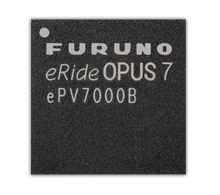
    The Furuno eRideOPUS 7.
    The Furuno eRideOPUS 7.

    Furuno Electric Co., Ltd., has announced that new multi-GNSS receiver chips eRideOPUS 6 and eRideOPUS 7 will be available in August. The new receiver chips are multi-GNSS compliant single-chip LSIs, capable of concurrently receiving signals from multiple satellites in GNSS systems and satellite-based augmentation systems, as well as Japan’s Quasi-Zenith Satellite System. Both chips receive signals from GPS and Galileo; the eRideOPUS 7 also receives GLONASS signals.

    The ability of concurrently receiving GNSS/GNSS augmentation signals from multiple satellites from different satellite services means that the receivers have more probability of acquiring a greater number of satellites at any single time. Subsequently, position stability as well as accuracy will be greatly improved, minimizing the chance of a position lost. Also, the receiver chips incorporate an enhanced level of noise rejection capability, implementing the anti-jamming function as well as the improvement of multipath mitigation.

    Time-to-first-fix capability of the existing eRideOPUS 5 (no more than 1 second when hot started) is retained in these new receiver chips with a combination of A-GPS compatibility and self-ephemeris extraction. Moreover, the position update rate of the new receiver chips is greatly improved, achieving a 10-Hz update (every 0.1 second), which is twice as fast as the capability achieved by eRideOPUS 5.

    The new receiver chips are capable of dead-reckoning navigation, using a gyro sensor and vehicle speed pulse signals, a gyro sensor and an acceleration sensor, and wheel tick data taken from a CAN-Bus network, achieving high positioning accuracy even in locations where satellite signal reception is not available, such as inside tunnels.

    In May 2013, Furuno is planning to start the delivery of evaluation kits for the receiver chips so that third-party manufacturers can evaluate the feasibility of incorporating the receiver chips into their products, and in August 2013, the new compact GNSS receiver module GN-86/GN-87 as well as
    dead-reckoning-capable GV-86/GV-87, using these new receiver chips, will be made available for automotive navigation systems as well as eCall systems.

  • MWC: Is the Connected Car the New Mobile Phone?

    This year’s Mobile World Congress, held late last month in Barcelona, featured the world’s largest mobility conference. While there was not a lot of strictly location-based services news, connected vehicles seemed to be the big deal. Ford and GM both made important announcements, sending a signal that wireless information and connectivity is here to stay in a vehicle — and location will be a big part of the growth. On the downside, MWC is becoming a mini Consumer Electronics Show with hotels gouging attendees, long cab lines, heavy traffic, expensive meals and long commutes to the show for those wanting to pay less than $400 a night for a room. Sounds like Las Vegas in January.

    By Kevin Dennehy

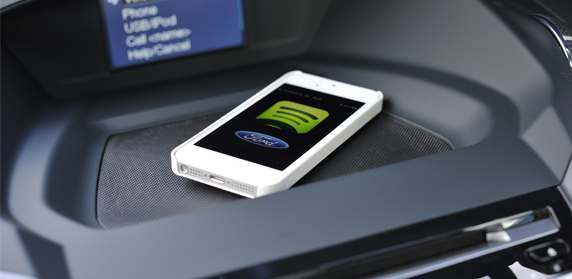
    The recent Mobile World Congress, held at Barcelona’s Fira Gran Via conference center, featured big connected vehicle announcements from Ford and GM. Ford announced a slew of deals, one partnering with Spotify to make Spotify Premium available through its Sync AppLink. GM’s big announcement is that its OnStar safety, security and navigation service will use AT&T Mobility’s network for LTE modules in 2014.

    Ford launches Spotify connection.
    Ford’s partnership with Spotify gives drivers access to millions of tunes on the road.

    Industry observers believe that GM’s announcement indicates the new AT&T deal could give the connected vehicle market a big boost as the units will go into most cars, including entry-level vehicles. Wireless carriers have indicated that transportation remains one of the key vertical markets they are aggressively getting in to.

    AT&T pulled a big coup as GM uses Verizon Wireless for its OnStar service. However, published reports indicate that the company has been disconnecting subscribers who are not currently using the service. Verizon said it had lost 490,000 connections in late 2011 — and said the losses were due to decline in telematics customers.

    There is no word on whether 2012’s $617 million purchase of Hughes Telematics had any effect on the Verizon-GM relationship.

    Overall, OnStar, which costs $18.95 per month, has more than 6 million customers worldwide.

    A concern with connected vehicles, and this is an issue that has been around for the past few years, is that automobile manufacturers do not believe the vehicle isn’t the new mobile phone — though some carriers believe it will be. Another concern is the form factor itself — what is better? What will the winner be? An embedded system or a system that integrates with a user’s smartphone?

    Not to be outdone by GM, Ford also said its 2104 Ford Ecosport will feature AppLink capabilities. The company also said it would be offering, in Europe, applications from Kaliki, Glympse and Aha. Ford says it now has 2,500 folks registered in its developer program — doubling the numbers from last month.

    Ultimately, many analysts say that two major market issues will need to be resolved for the connected vehicle segment to take off. One is what will consumers want? The other is standardization — will every vehicle have the same system in use? Already Ford and GM seem to have differing technology and business models for this market.

    Is Mobile World Congress Getting Too Big to be Useful?

    With more than 72,000 attendees this year, which is a little more than half the size of the gigantic Las Vegas-based Consumer Electronics Show, is MWC becoming too big and less focused for wireless application developers, LBS companies looking to partner and other location company entities?

    Does this sound like a mini CES? The Fira Grand Via had 1 million square feet of exhibit space, 1,700 exhibitors and 72,000 attendees from 200 countries. All of this is puzzling for a conference that had no Google (the company had a big exhibit last year) or Microsoft.

    In addition, there were no huge announcements — even the connected vehicle news would be mid-level news at CES. Does it say something strange about a big wireless show when your main news is connected vehicles?

    Deciding not to get lost in the hugeness of a big trade show, most of the wireless companies and handset manufacturers choose to make their own product and deal announcements at their own branded shows or independent press conferences. Outside of a handset having LBS capability rolled out, and companies saying they are rolling out capability in European nations, there wasn’t much location-specific news.

    With no big indoor position news at MWC, does that spell a struggle for the new technology and potential gigantic market? Many publications, including this one, has touted indoor positioning as one of the technologies that will spur LBS’ market growth.

    A few smaller companies did display indoor positioning products at MWC. Rx Networks rolled out its Xybrid Synchro that allows a device to self-located without an active data network connection. The company also rolled out a cloud-based GNSS systems that allows users to determine a location even when weak location signals are available, the company said.

    Another indoor positioning company, Insiteo, showed off its products that work on iOS and Android devices to allow users to find booths at MWC. The company says product finding, location-based marketing and data mining are all applications for the platform.

    In other Mobile World Congress news:

    • Telit launched m2mLOCATE, a feature that adds Cell-ID location for a range of its cellular connectivity modules. The company uses RX Networks’ XYBRID RT service, a database that encompasses 40 million cell-IDs.
    • CSR demonstrated its Location Services Platform, which features context detection and user self-learning to deliver indoor and outdoor location for the consumer and enterprise markets. The company says the platform has an indoor accuracy of less than 10 meters.
    • TeleCommunication Systems shopped its LBS suite of services at MWC to both enterprise and consumer companies. TCS recently deployed four new mobile operators on its hosted cloud LBS product. The company says it offers revenue-producing branded and private-labeled applications for navigation, hyper-local search, enterprise and family locators.
    • ALK Technologies, now owned by Trimble Navigation, said its CoPilot GPS navigation apps for smartphones and tablets will be available for Windows Phone 8 and Windows 8. The company said it’s always been high on Microsoft’s mobile products, as CoPilot was originally developed for Microsoft’s Pocket PC. CoPilot features voice-guided GPS navigation, turn-by-turn guidance, trip planning and automotive-grade street maps, the company said. The unit’s live services include Yelp, ActiveTraffic, Wikipedia and Google Search.
  • Magellan Debuts SmartGPS Apps for Apple and Android Mobile Devices

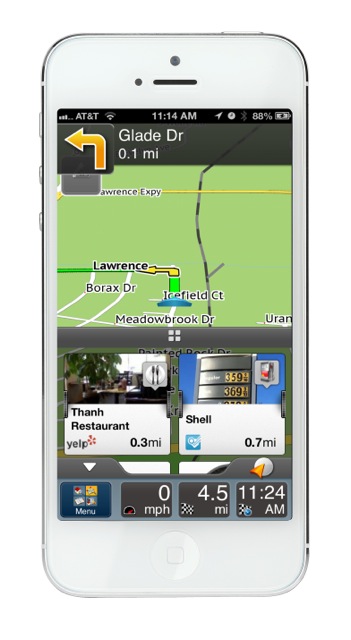
    Magellan SmartGPS App_iPhone
    screenshot: Magellan SmartGPS App

    Magellan has announced Magellan SmartGPS Apps for iOS and Android mobile devices.

    Following the recent announcement of Magellan’s SmartGPS device, the free Magellan SmartGPS Apps for iOS and Android devices are the next key elements in Magellan’s Smart Ecosystem, a cloud platform that integrates social media and navigation content directly onto a navigation map, the company said. The SmartGPS Apps automatically deliver continually updating reviews and tips for local businesses from social media including Yelp, Foursquare, and other partners to create current, local and personalized driving and pedestrian experiences.

    The Magellan SmartGPS mobile apps display location-relevant information “squares” that graphically flip to show reviews, tips and offers from Yelp and Foursquare for nearby restaurants, stores and services. Users can then navigate to those locations directly from the SmartGPS App without needing to open an additional application or device. The cloud architecture enables new monetization of end users’ mobile search and navigation, and additional social media and content partners.

    “We architected the Smart Ecosystem to integrate with automotive infotainment and mobile network service platforms so users can enjoy a truly mobile, connected car experience now,” said Peggy Fong, president of MiTAC Digital Corporation. “SmartGPS mobile apps connect to the vehicle dash, allowing users to easily search social media and points-of-interest for destinations, and send the locations via Bluetooth or Wi-Fi to SmartGPS-enabled vehicle navigation systems.”

    Magellan’s free iOS and Android SmartGPS apps create a total-solution SmartGPS experience that is truly mobile. Magellan connects the smartphone to the vehicle dashboard, enabling location sync and sharing, hands-free operation and data connectivity. Users can pair their Magellan SmartGPS app with SmartGPS-enabled navigation systems. Using their SmartGPS App, SmartGPS enabled navigation system, or PC, users can search for a location, save the location in Magellan’s Smart Ecosystem cloud, and sync and share the location to any SmartGPS enabled device via Wi-Fi or Bluetooth.

    The free Magellan SmartGPS Apps will be available in North America this Spring, and in Europe this Summer, from iTunes and Google Play. Premium versions of both apps featuring spoken turn-by-turn navigation will also be available.

  • Broadcom Launches GNSS Chip with Geofence Capabilities

    Broadcom Corporation has introduced the BCM47521, a GNSS chip with architecture that enables geofence capabilities while preserving battery life. According to Broadcom, the new chip opens the door to always-on location-aware applications such as social networking, place-based mobile commerce and local merchant advertising.

    Broadcom will showcase its GNSS innovations at the upcoming Mobile World Congress show in Barcelona, February 25-28.

    A geographical region of interest (“geofence”) is being used by many new and innovative location-aware applications. The geofence feature enables the application to receive a notification when a user enters or exits a virtual perimeter. However, the implementation of this feature in traditional architectures is not viable, as the applications processor needs to run constantly, causing rapid drain to the device’s battery. Broadcom’s new BCM47521 overcomes this issue, making it possible to continuously monitor geofence areas while consuming 60x less battery power.

    “The astounding growth of mobile devices is driving new opportunities for inventive applications that deliver valuable location-aware information,” said Scott Pomerantz, Broadcom vice president and general manager, GPS. “With the BCM47521’s low-power geofence mode, Broadcom is driving the next wave of system power consumption innovation that will allow OEMs to incorporate features that differentiate their mobile offerings and make location-aware, always-on applications a reality.”

    The BCM47521 chip also provides multi-constellation support by simultaneously collecting data from GPS, GLONASS, QZSS and SBAS, and using the best received signals, resulting in faster searches and more accurate real-time navigation, Broadcom said. Broadcom’s multi-constellation technology, coupled with advanced signal processing, provides faster positioning performance for improved user experience, especially in challenging urban environments where buildings and obstructions can dramatically impact accuracy and time-to-first-fix.

    A key feature is the 60x better system power efficiency versus a host-based architecture. An advanced host-offload mode monitors geofences in the background and only activates the applications processor when there is a trigger event, and smart algorithms adapt in real-time as the user gets closer to a geofence boundary.

  • MediaTek Announces Multi-GNSS Receiver SoC Solutions Supporting Beidou

    MediaTek Inc., a fabless semiconductor company for wireless communications and digital multimedia solutions, today announced the availability of its MT3332/MT3333, a 5-in-1 multi-GNSS receiver system-on-chip (SoC) that support the Beidou Satellite Navigation System. The Beidou system has been commercially operational since the end of 2012, and can identify a user’s location to 10 meters (33 feet), their velocity to within 0.2 meters per second, and clock synchronization signals (one-way) to within 10 nanoseconds.

    The MediaTek MT3332/MT3333 can discover GPS, Beidou, GLONASS, Galileo and QZSS constellations. Featuring a multi-GNSS receiver design, the MT3332/MT3333 can reduce the cumulative distance and positioning error accumulated over time/multiple hops, and significantly improve navigation/positioning accuracy, MediaTek said. The MT3332/MT3333 also comes with excellent signal acquisition and tracking sensitivity, which efficiently enhances signal quality within dense cities, tunnels and multi-storey car-parks, while delivering a better user experience, the company said. Moreover, because of its highly integrated, low-cost and ultra-compact system architecture, the MT3332/MT3333 enables multi-GNSS receivers with the same reference board for mobile, industrial and automotive navigation applications.

    “The proliferation of LBS (location-based services) using mobile applications over wireless networks such as social check-in or nearby service recommending is driving demand for greater satellite navigation performance and coverage beyond existing technologies. This will also lead to the rapid adoption of multi-GNSS receiver solutions in smartphones, tablets and automotive vehicles because LBS is now an indispensable way for people to interact/communicate with each other on a daily basis,” said SR Tsai, general manager of the Wireless Connectivity and Networking Business Unit at MediaTek. “We believe the market for Beidou-compatible multi-GNSS receivers in China will accelerate in the coming years. MediaTek will deliver new products that offer high value and are capable of meeting the evolving needs of our customers in the Beidou navigation system market through continuous product innovation. The MT3332/MT3333 [models] are designed to accelerate the realization of satellite navigation services anytime, anywhere, in a seamless fashion.”

    The MT3332/MT3333 also incorporates MediaTek’s unique “AlwaysLocate” technology that can identify the state in which the user is (regardless of on-the-go or sleeping) and automatically adjust the satellite signal receiving modes for more accurate and reliable navigation services, and to save the battery power of the navigation system.

    The MediaTek MT3332/MT3333 is now in mass production stage and being designed into major satellite navigation systems and mobile communication platforms worldwide.

  • Magellan Personal Nav Integrates Cloud, Social Media, Real-Time Location Data

    Magellan has announced the Magellan SmartGPS, a GPS device based on navigation integrated with social, local and mobile content, including Yelp and Foursquare, through Magellan’s cloud-enabled Smart Ecosystem. The Magellan SmartGPS navigation device wirelessly syncs the user’s navigation data, such as favorite places and contacts, with a smartphone or personal computer. The device intelligently delivers stored and dynamic location-based information to the GPS display that is personalized to the driver’s locale.

    “Magellan pioneered the GPS navigation industry, and in today’s socially driven world, we recognize that consumers want and need a much more comprehensive navigation solution that surpasses what traditional GPS devices and smartphones can offer,” said Peggy Fong of MiTAC Digital Corporation. “We engineered our cloud-based Smart Ecosystem and SmartGPS device from the ground up to deliver an innovative SoLoMo experience to consumers who desire discovery, relevance and local awareness combined with navigation. Additionally, the Smart Ecosystem is architected to integrate with automotive infotainment and mobile network service platforms.”

    The Magellan SmartGPS communicates with Magellan’s custom-built Smart Ecosystem, a cloud platform for a database of constantly-updating, location-relevant social media and navigation content that is automatically pushed to the SmartGPS display to create a unique driving experience, the company said.

    Magellan SmartGPS users can simultaneously view maps, navigate, and see reviews, tips and offers from Yelp and Foursquare for nearby restaurants, stores and services, plus navigate to those locations without needing to use an additional device or application. As a vehicle progresses on its route, the SmartGPS accesses the cloud-based Smart Ecosystem to deliver a variety of location-relevant information “squares” that are displayed on the SmartGPS screen and graphically flip between service establishments in the vicinity. When the user taps on a square, detailed profile information is displayed including the address, phone and any available special offers or consumer reviews, plus an icon to navigate to their selected destination. In addition, the SmartGPS delivers current gas prices in the vicinity, weather, traffic events and speed camera warnings.


  • Report Looks at Indoor Location Positioning and Mobile Markets

    In December 2011, Grizzly Analytics released its first comprehensive report on indoor location positioning technology, predicting that indoor location services were ready to revolutionize the mobile market. The five months that followed have shown how true this was, with new initiatives announced on a regular basis and numerous demonstrations at industry conferences, Grizzly Analytics says.

    In a fully revised and updated 163-page report, Grizzly Analytics gives an up-to-date analysis and comprehensive overview of indoor location positioning R&D. Included is information on the research activity of all the major mobile companies — Google, Microsoft, Samsung, Apple, Nokia, RIM, Cisco, Qualcomm, Broadcom, STMicroElectronics, Sony Ericsson and others — and also more than 30 start-up companies that are actively bringing indoor location services to market.

    “These technologies are poised to revolutionize smartphone usage by enabling GPS-style mapping, navigation, local search, check-ins, location-sharing and other location-based services to work indoors in malls, megastores, offices, airports, casinos and other big indoor places,” according to a statement by Grizzly Analytics. “Indoor location will also transform commerce, enabling searching for items on store shelves, sending deals and promotions to nearby customers, advertisements for nearby stores in malls, and more. Location services are also entering the enterprise, with indoor asset tracking, employee search, and more.

    “In this updated technology trend report, Indoor Location Positioning: Research Pipelines, Start-ups and Predictions, Grizzly Analytics answers the questions you have about this new technology. What approaches are being researched by different companies? Which companies have mature research? What are the gaps in each company’s research that they are likely to fill by acquiring start-up companies? Which start-up companies are likely to be acquired or to emerge successful in the market? What areas of technology are not yet addressed by start-ups, and remain open to new entrepreneurs and investors?”

    A related report, Indoor Location Solutions and Services: Challenges, Opportunities and Market Outlook, is also available from Research and Markets.

  • China Industry Report: “Amazing Growth” in Mobile Market

    A new China Navigation Map Industry Report, 2012-2014, released by Sino Market Insight, predicts that the revenue of Chinese navigation electronic  map industry will reach RMB 2.1 billion in 2014.

    Started in 2002, the navigation industry in China is still in the  initial stage of development compared with the international market, the report says. China’s car navigation market, PND navigation market and mobile phone navigation market are in the stage of rapid development, while the markets of LBS service, real-time traffic information service and value-added electronic map application services based on mobile communication technology are still in the initial stage of development.

    From 2006 to 2011, the sales volume of car navigation in China maintained high-speed growth, with CAGR hitting 47.5%. However, the penetration rate of car navigation is still low, so China’s car navigation  market still embraces huge space. Meanwhile, the growth speed of GPS mobile phone market in China is amazing, the report says. The sales volume of GPS mobile phone in China approximated 100 thousand sets in 2006, and skyrocketed to more than 50 million sets in 2011. Mobile Internet is an important development direction for the navigation map industry in future.

    According to the report, the global electronic navigation map market presents distinct regional and local characteristics. Major navigation application markets around the world, such as USA, Europe, Japan and South Korea, all have many regional electronic map suppliers which have competitive advantages in diversified segments and possess stable client groups.

    The navigation map market in China is led by AutoNavi and NavInfo. In particular, NavInfo is the pioneer, for it got approved to do navigation map business in the early 21st century. Joining the competition after 2006, AutoNavi captured the high-end brand automobile market quickly by virtue of advanced technologies, and penetrated into the medium-end automobile market thereafter. After 2010, the two companies launched fierce competition in the emerging mobile phone navigation market. In future, the competition in China’s car navigation and mobile phone navigation market will be fiercer, and the collision among navigation map enterprises in different sectors will be more frequent.

    China Navigation Map Industry Report, 2012-2014 covers the following contents:

    • Current status of China navigation map industry;
    • Development of China navigation map market;
    • Market status of navigation map in major regions worldwide;
    • Brief introduction, financial highlight, revenue structure by segment and by region, prospects and performance prediction, clients, etc. of 15 leading navigation map enterprises in China and around the globe.