Tag: National Geodetic Survey

  • NGS 2018 GPS on BMs program in support of NAPGD2022 — Part 5

    NGS 2018 GPS on BMs program in support of NAPGD2022 — Part 5

    My last column highlighted two components of the North American-Pacific Vertical Datum of 2022 (NAPGD2022) — the geoid undulation model of GEOID2022 and gravity model of GRAV2022. It expressed that these two models will be very important to future surveyors and mappers that are incorporating geodetic data into NAPGD2022. The last column also emphasized the significant differences between NAPGD2022 and the U.S. National Vertical Datums of NAVD 88 and NGVD 29. A year ago, my February 2017 column provided information on strategically occupying benchmarks to support NGS 2017 GPS on BM Program. The column focused on addressing the following questions: (1) Is the large GPS on BM residual due to an issue with the NAVD 88 orthometric height or the NAD 83 (2011) ellipsoid height? and (2) Should stations with large GMS on BM residuals be included in the development of NGS’ hybrid geoid models? The column provided suggestions on how users can assist NGS in determining the reason for the large difference between the modeled hybrid geoid value and computed GNSS/leveling geoid computed value. My October 2016 column demonstrated how to use the GPS on BMs dataset to identify potential issues in published NAVD 88 and NAD 83 (2011) heights. It focused on analyzing the NGS’ GPS on BM data set that was used to create NGS’ GEOID12B hybrid geoid model. It provided procedures that users could employ when analyzing the differences between the modeled geoid values and the computed geoid values using GNSS/Leveling data (GNSS-derived ellipsoid height minus leveling-derived orthometric height). The October 2016 column provided several examples of large relative differences in residuals between neighboring stations.

    It should be noted that many of these large GPS on BM residuals could be due to an invalid NAVD 88 published height because the bench mark moved since the last time the height of the bench mark was adjusted and published, and/or an undetected error in an ellipsoid height due to a weak GNSS project design. Either way, in my opinion, most of these stations with large GPS on BMs residuals don’t accurately represent a bench mark with a current NAVD 88 height (or what I call a valid NAVD 88 height). When performing a geodetic survey, these stations would be identified as bench marks with invalid heights when following the appropriate Federal geodetic survey guidelines, procedures, and specifications. These bench marks should not be used in the hybrid geoid model just like they would not be used in controlling geodetic surveys. NGS’ goal is to create a hybrid geoid model that is consistent with published valid NAVD 88 values. User participation in NGS’ GPS on BMs Program is critical to creating a hybrid geoid model consistent with a current NAVD 88.

    Recently, NGS performed a detailed analysis of the latest GPS on BMs data file using the published NAD83 (2011) ellipsoid heights, NAVD 88 orthometric heights, and the latest experimental geoid model height, xGeoid17b, to compute a new set of GPS on BMs residuals. At this time, the analysis has only included the 48 conterminous States, District of Columbia, Puerto Rico, and Virgin Islands. These data included NAD 83 (2011) ellipsoid heights from all submitted GNSS projects and OPUS Shared results. The goal of the detailed analysis was to create a statistical ranking of the marks based on a quantitative analysis of the leveling and GPS data. The following attributes were considered during the analysis:

    • Total number of GPS observations to and from the station
    • Date of last GPS observation to and from the station
    • Whether or not the GPS station has repeat baselines between closely spaced neighboring GPS on BMs stations
    • Total number of times the mark has been leveled to
    • Date of latest leveling
    • Quality of leveling (single run; double run; or single run, double simultaneous)

    The analysis of this data set was used to identify stations that should not be used in the creation of a hybrid geoid model or a NAPGD2022 Transformation tool. The stations identified as outliers and labeled as “Do Not Use” in a hybrid geoid model were based on issues associated with the NAVD 88 published orthometric height and/or the NAD83 (2011) ellipsoid height. I have described some of these issues in previous columns (August 2015 column, June 2016 column, October 2016 column and February 2017 column) so I won’t go into details in this column. NGS used the detailed analysis of the latest GPS on BMs dataset to: (1) generate a prototype hybrid geoid model to evaluate the residuals at stations not used in the hybrid geoid model, (2) confirm that the stations recommended for re-observations should be observed again, and (3) identify void areas that need additional observations.

    Since GEOID12B was created, users have been instrumental in providing OPUS results on bench marks in areas NGS said that they needed additional stations. Saying that, NGS realizes that everyone is busy and has limited resources to collect GNSS data on bench marks to support the next hybrid geoid model. NGS has used the detailed analysis to prepare material to assist users on strategically occupying stations to help support the GPS on Bench Marks Program, and create a hybrid geoid model that accurately represents a current NAVD 88. To eliminate confusion of where NGS would like new observations, NGS’ material contains a specific list of stations that they would like occupied with GNSS during the 2018 GPS on BMs program. This column provides a summary of the latest details of NGS’ 2018 GPS on BMs campaign which will be used to create the next hybrid geoid model in 2019 (see box titled “Personal Communication received from Galen Scott, Project Lead of NGS’ GPS in BM Program.”).


    Personal Communication received from Galen Scott, Project Lead of NGS’ GPS on BM Program

    In early 2019, NOAA’s National Geodetic Survey (NGS) will replace GEOID12B with GEOID18, a new hybrid geoid model to deliver improved GPS-derived NAVD 88-equivalent orthometric heights. This new model will serve as the official means for obtaining NAVD 88-equivalent heights via GPS. It will be the last hybrid geoid model that NGS will create before NAVD 88 is replaced by NAPGD2022.NGS will use available GPS on bench mark data to create the new model. Recent analysis of existing GPS on bench mark data and a prototype of the new hybrid geoid model created using that data has highlighted areas where additional data is needed to either confirm or update the local relationships between the ellipsoid, orthometric, and geoid heights.

    This email provides a prioritized list of bench marks for which additional GPS data is needed to improve the hybrid model. Data submitted on these marks will also support the development of the transformation tools that will be developed as part of the transition to the new datums.

    Data to support the hybrid geoid model will be accepted through August 31, 2018. NGS will continue to accept data to support the transformation tools through 2020. New prioritized lists of marks to support the transformation tools will be made available over the next few years as analysis of data requirements progresses.

    For the marks included in the attached document, NGS is requesting support in two ways:

    1. Attempt to locate the marks on the list and submit a mark recovery through DS World. Check this NGS page for more information on mark recovery.
    2. Collect 4 or more hours (more is better) of GNSS data on the mark following NGS guidelines, submit the data to OPUS and select the option to Share.

    More information, including training material, is available on the NGS GPS on Bench Marks (GPS on BM) website. Two matching, independent GPS observations are required for each mark. The list indicates how many observations we have so far on each mark (obs_cnt column). A tracking map showing the currently prioritized marks and the number of observations we have on each will be added to the GPS on BM website in the near future. To maximize efficiency, please check this map before observing a mark to ensure that the required data has not already been submitted.

    Please note: Marks on this list may be inaccessible, destroyed, or not GPS’able. If this is the case, please locate and observe another nearby NAVD 88 mark, within ~10 km.

    The mark list is provided in three file formats, but all contain the same information, so choose the format you are most comfortable with: excel spreadsheet, esri shapefile, and Google Earth kmz.

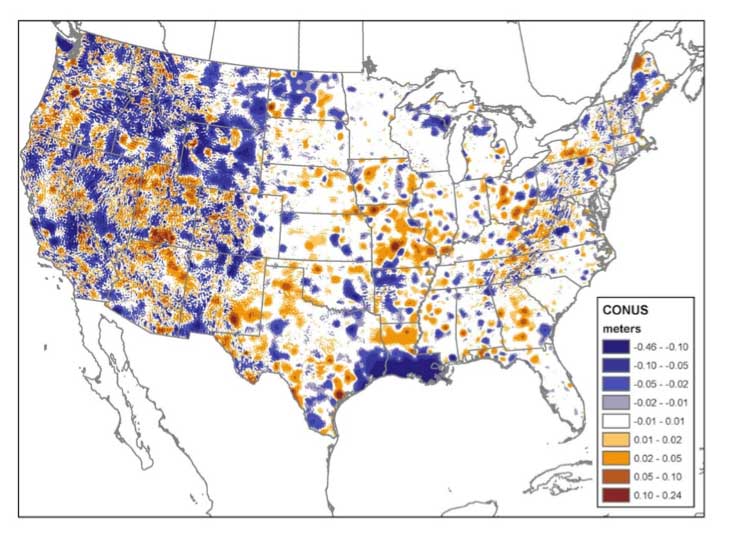
    The image below shows the changes between GEOID12B and the prototype hybrid geoid model. While data is needed on all the marks in the list, you may further focus your data collection efforts by looking for areas in this image that show large changes in your region.

    It is important for users to understand that NGS needs to have a high level of confidence that the OPUS Share results are accurate; therefore, they are requiring that “two matching, independent GPS observations are required for each mark.” The list of stations that they would like observed includes a count of the number of times that station has already been observed. NGS will be updating a website as stations are submitted so participants will not be wasting resources observing a station that has already been observed by someone else. It should be noted that if a station is only occupied once, it will still be useful for validating the hybrid geoid model; but stations occupied twice can be used in defining the hybrid geoid model.

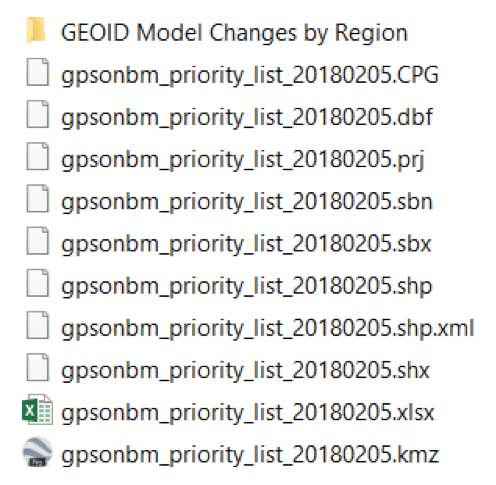
    The attached file includes the list of stations that NGS would like observed to support the next geoid model. The information is provided in three different formats — excel spreadsheet, esri shapefile, and Google Earth kmz (See the box titled “List of Files for the 2018 GPS on BMs Program.”)


    List of Files for the 2018 GPS on BMs Program

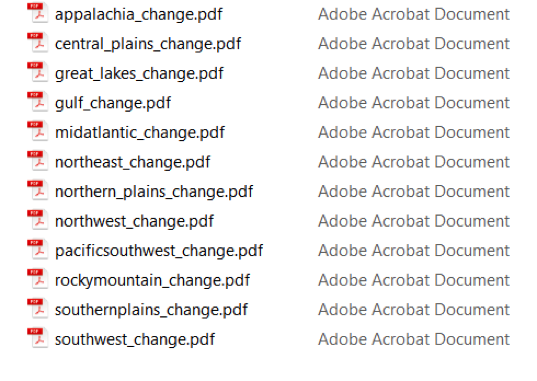
    The data set also contains a folder titled “GEOID Model Changes by Region” which contains plots that depict changes between GEOID12B and the Prototype Hybrid Geoid Model (Note: at this time, NGS is denoting this prototype hybrid geoid model as GEOID18v2.2).


    List of Files from Folder Titled “GEOID Model Changes by Region”


    Figure 1 is a plot of the change between the prototype GEOID18v2.2 and GEOID12B in the Mid-Atlantic States. Looking at figure 1, the reader can see that there are some significant differences between the prototype hybrid geoid model values and the published GEOID12B values. On figure 1, all of the dark blue values are differences at the -10 cm level and the dark orange values are differences at the 10 cm level. There are several reasons for these changes including newly observed gravity data observations (especially in area with new GRAV-D data), improved data and models from satellites programs, new and improved algorithms for processing gravity data and estimating topographic effects, additional OPUS Share results in areas where GEOID12B didn’t have observations, and differences based on stations that were included in GEOID12B but rejected in the prototype model based on the latest detailed analysis.
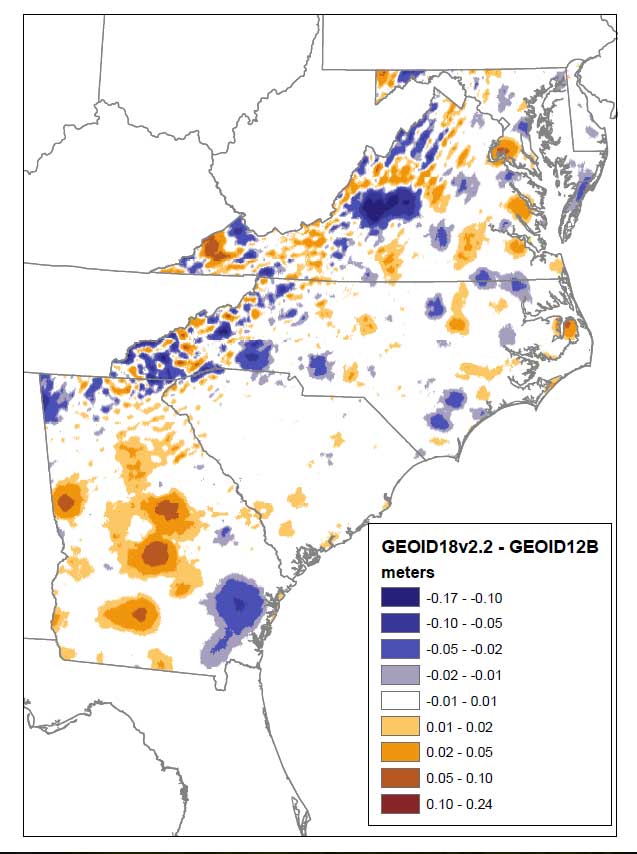
    Figure 1 – Changes between Prototype GEOID18v2.2 and GEOID12B in the Mid-Atlantic States (units = meters).

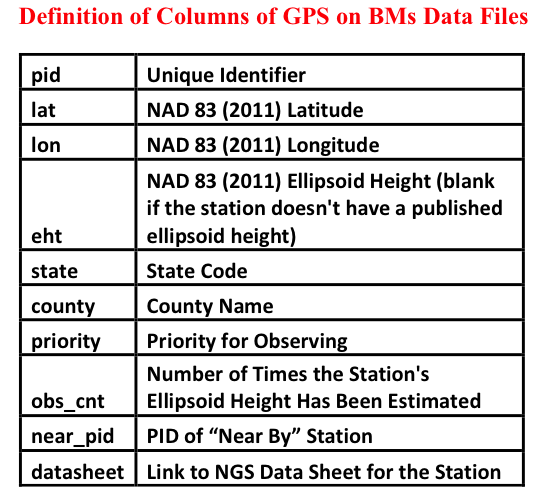
    As previously mentioned, the list of stations that NGS would like observed with GNSS are provided in three formats: excel spreadsheet, esri shapefile, and Google Earth kmz. The box titled “Sample Data Elements Extracted from the Excel File Titled “gpsonbm_priority_list_20180205.xlsx” provides a sample of the data from the excel file. The box titled “Definition of Columns of GPS on BMs data file” provide the columns and a brief definition of the data field.

    Sample Data Elements Extracted from the Excel File Titled “gpsonbm_priority_list_20180205.xlsx”
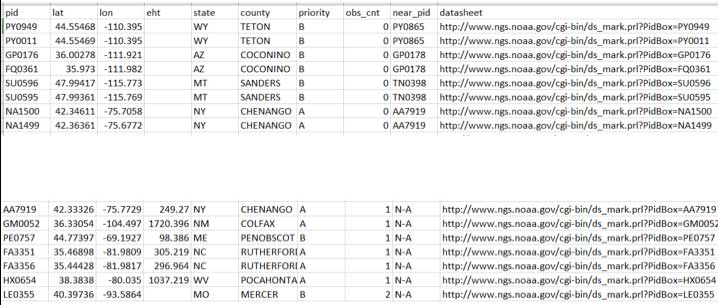
    The priority column has two entries – A or B. Priority A is more important than priority B. In other words, if the user has to make a choice, NGS would like the priority A station observed first. The obs_cnt field will be updated as users submit their OPUS Shared results. Remember, NGS is requiring two matching, independent GPS observations for the station to be included in the development of the hybrid geoid and transformation tool.

    The near_pid provides the pid of the station that is near the original station. The selection of the near_pid was based on the original station’s position and a search of the NGS database for a station within 5 to 15 kilometers of the original station. NGS’ analysis indicated that the original GPS on BMs station may have moved so an additional observation on the same station will not help to generate a hybrid geoid model that represents the current NAVD 88. It would warp the geoid model to fit the published NAVD 88 height but if the station moved since it was last leveled to, then it does not have a valid NAVD 88 height. As previously stated, when performing a geodetic survey, these stations would be identified as bench marks with invalid heights when following the appropriate Federal geodetic survey guidelines, procedures, and specifications. The surveyor would then level to another bench mark until they met the survey’s specifications. These bench marks with invalid heights should not be used in the hybrid geoid model just like they would not be used in controlling geodetic surveys. If the near_pid column is “n-a” then NGS would like the original station observed.

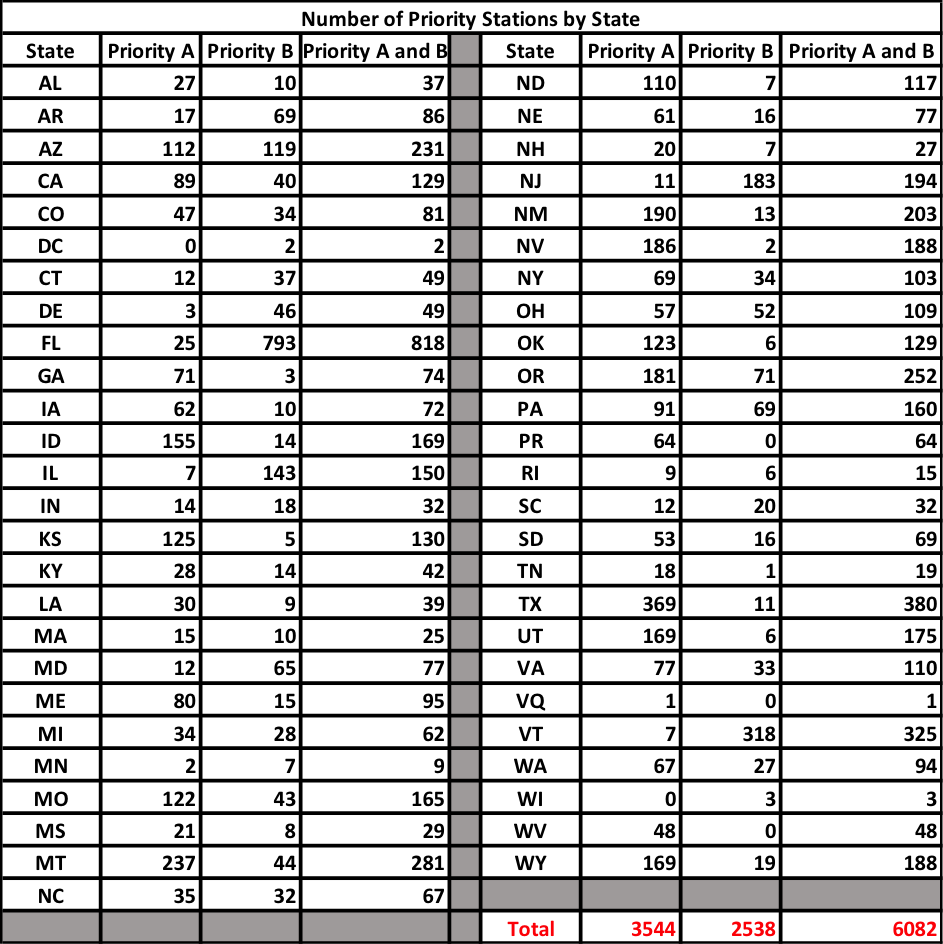
    The box titled “Number of Priority Stations in Each State” provides the number of priority A and B stations for every State in the lower 48, the District of Columbia, Puerto Rico, and the Virgin Islands. Overall, there are 6082 stations in the list – 3544 Priority A stations and 2538 Priority B stations.

    Number of Priority Station in Each State
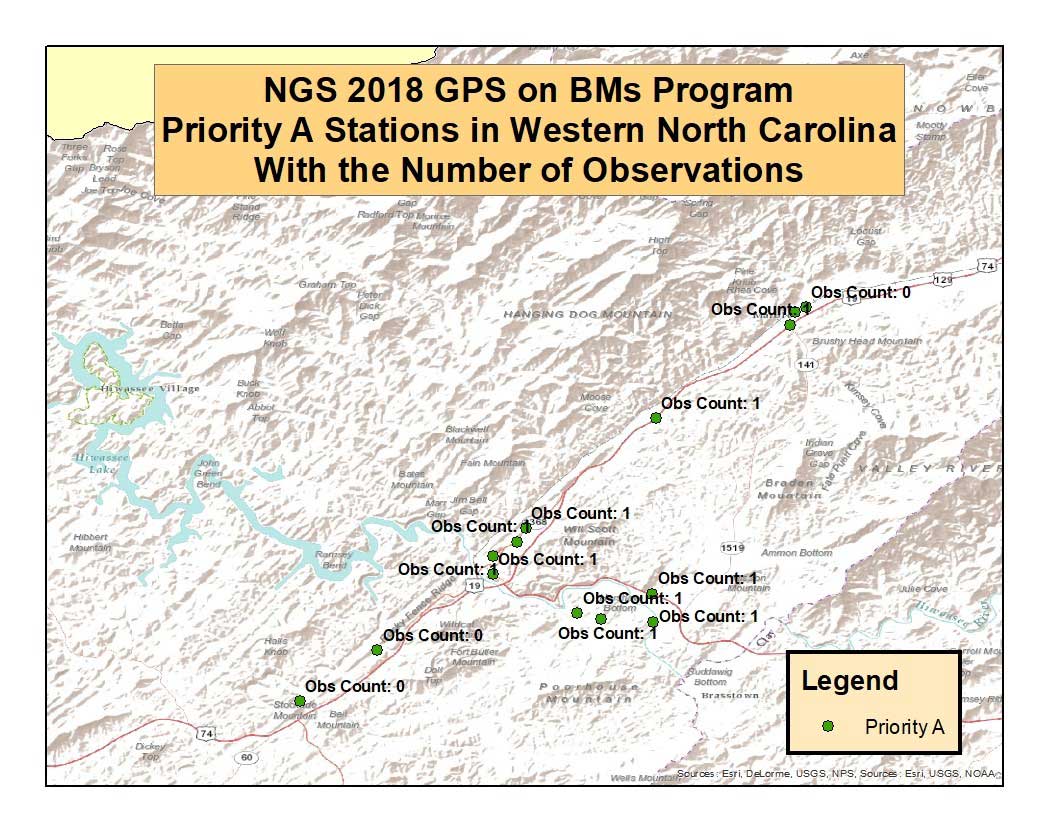
    As an example of a State in eastern United States, the box titled “List of PIDs of Priority “A” and “B” Stations in North Carolina” provides the list of priority A and B stations that need to be observed in North Carolina. The box titled “List of PIDs of Priority “A” Stations in North Carolina” provides the list of priority A stations in North Carolina. Figure 2, titled “NGS 2018 GPS on BMs Program, Priority A and B Stations in North Carolina,” depicts the locations of these stations. Figure 3 depicts the location and PID of the priority A stations in western North Carolina. Figure 4 depicts the same stations with their Obs_Cnt value.

    List of PIDs of Priority “A” and “B” Stations in North Carolina That Need to be Observed
    Information extracted from Excel File Titled “full_priority_list.csv”
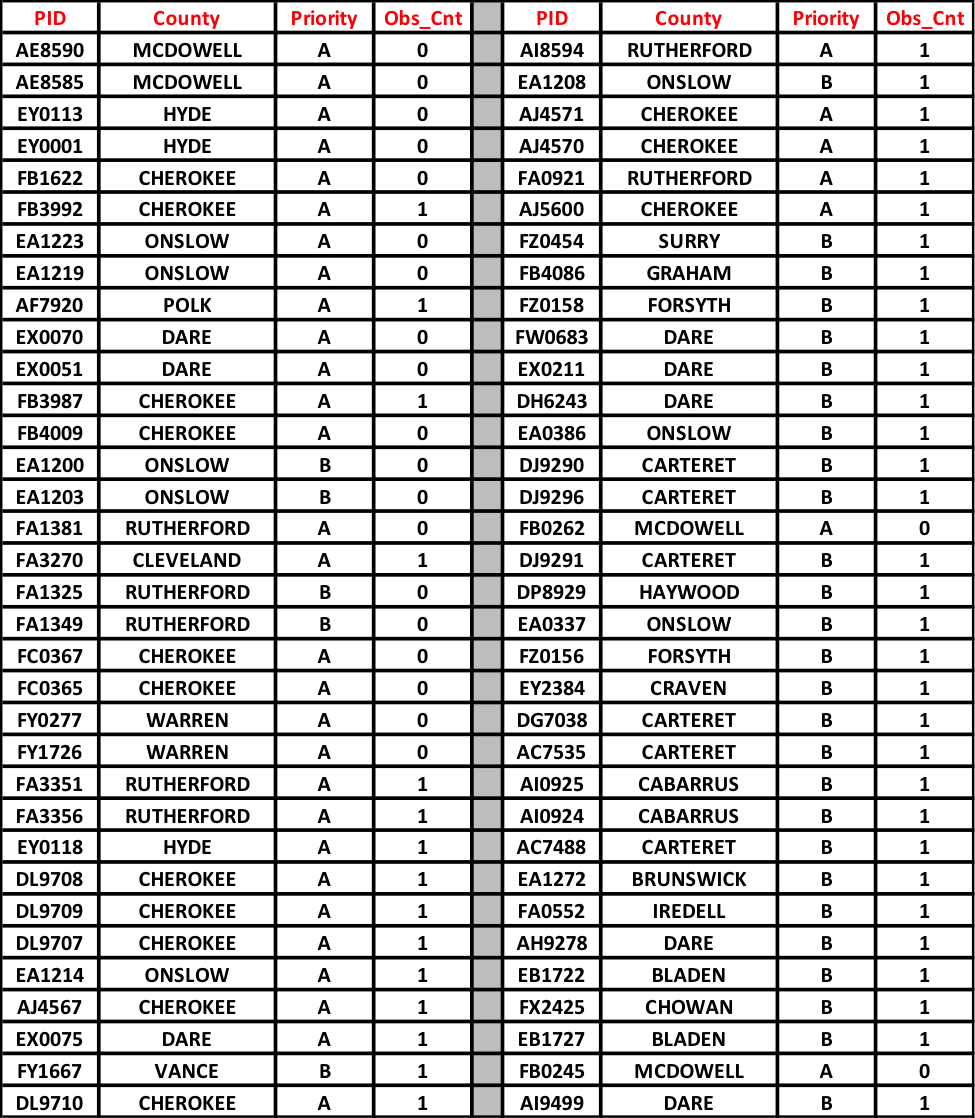
    (Note: The stations in this table may not be the final list of priority A and B. The attached zip file contains the latest list of stations. The latest list was received too late to modify the table.)

    List of PIDs of Priority “A” Stations in North Carolina
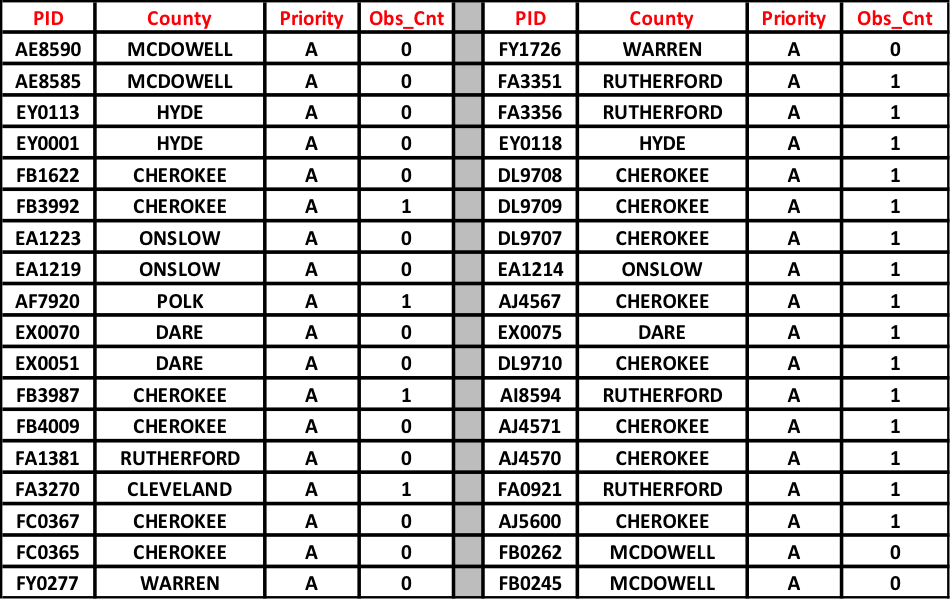
    (Note: The stations in this table may not be the final list of priority A and B. The attached zip file contains the latest list of stations. The latest list was received too late to modify the table.)
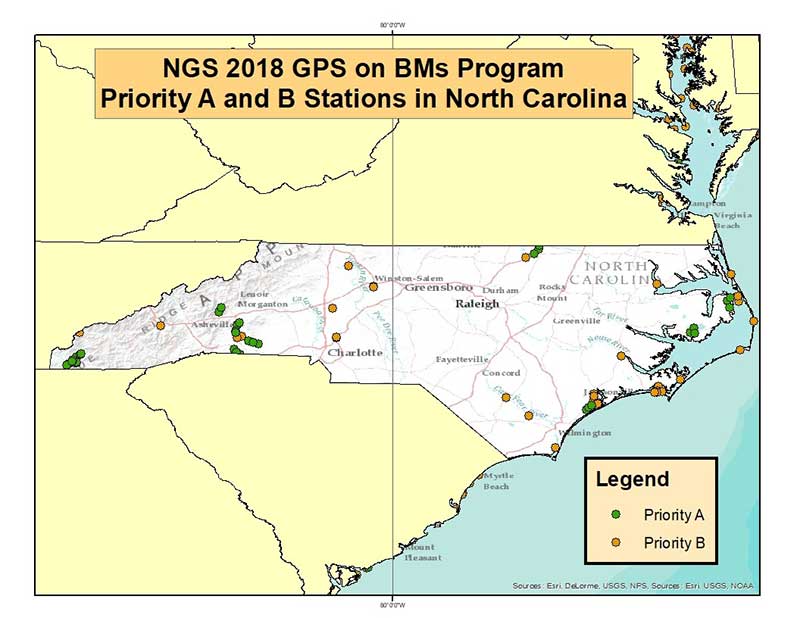
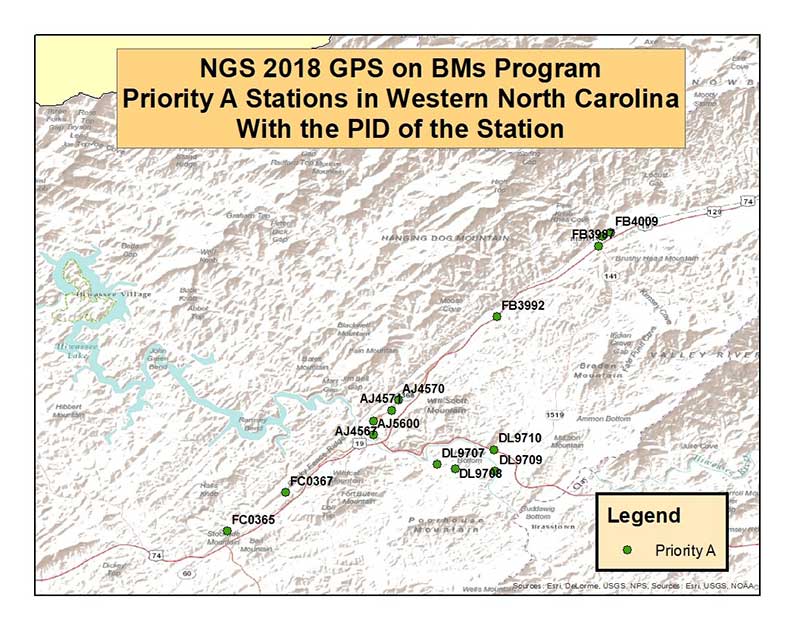
    Figure 2 – NGS 2018 GPS on BMs Program – Priority A and B Stations in North Carolina.
    Figure 3 – NGS 2018 GPS on BMs Program – Priority A Stations in Western North Carolina With the PID of the Station.


    Figure 4 – NGS 2018 GPS on BMs Program – Priority A Stations in Western North Carolina With the Number of Observations.

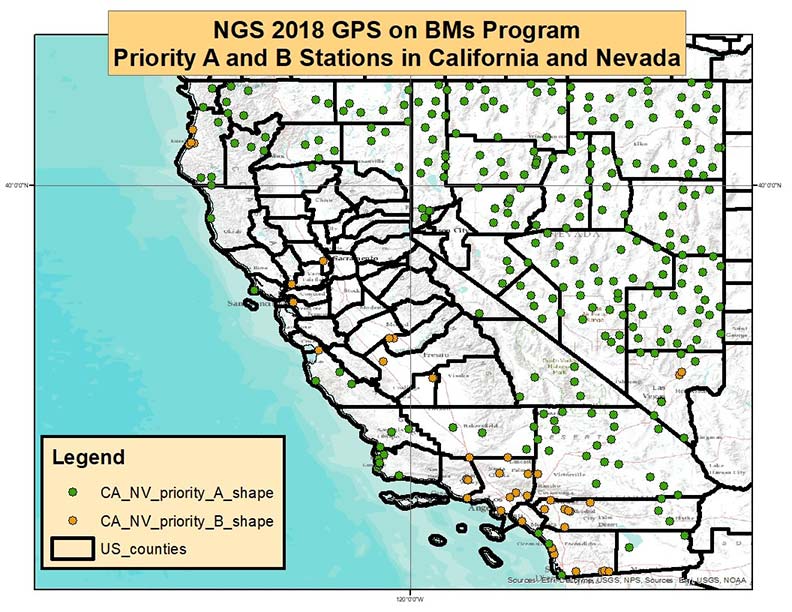
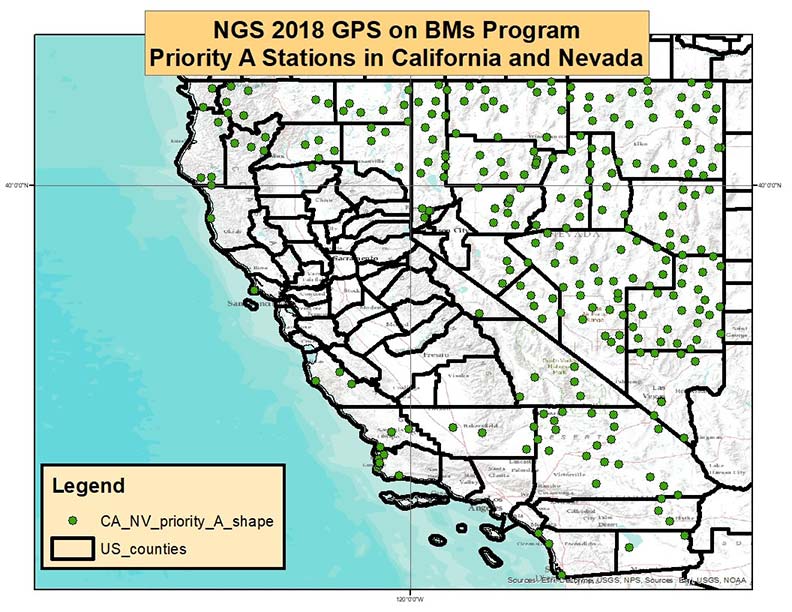
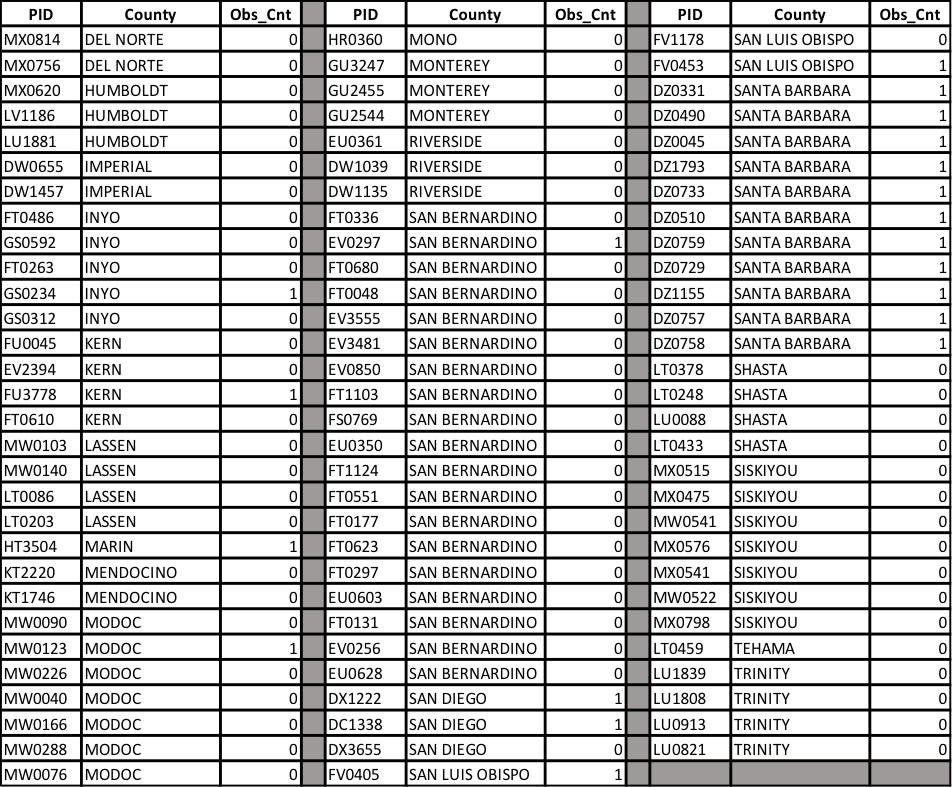
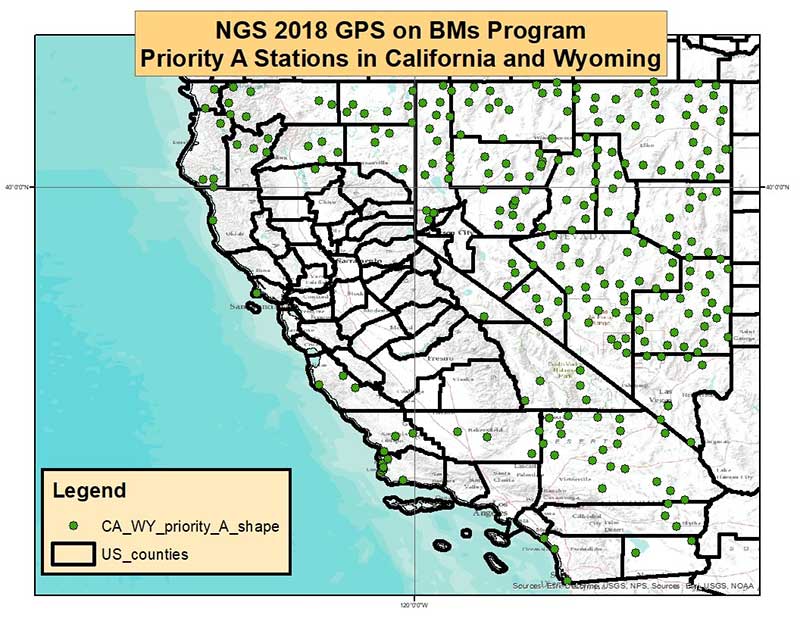
    For completeness, I will provide an example of a region in the western United States – California and Nevada. They are larger States than North Carolina and have more Priority A stations that need to be observed. Figure 5 depicts the Priority A and B stations in California and Nevada, and figure 6 depicts the Priority A stations in California and Nevada. It is recognized by NGS that managing how these stations are observed and who does what is a monumental task. Some state agency may undertake observing all of the Priority A stations; for example, Gary Thompson, Chief of the North Carolina Geodetic Survey, has committed to observing all of the Priority A stations (personal communication). Other States have County and City surveyors that will help observe and manage the process. All of the information provided in the 2018 GPS on BMs allow individuals to sort the data in ways that meet their needs. For example, the box titled “List of Priority “A” Stations by County in California” provide the list of stations in California by county.

    Figure 5 – NGS 2018 GPS on BMs Program – Priority A and B Stations in California and Nevada.
    Figure 6 – NGS 2018 GPS on BMs Program – Priority A Stations in California and Nevada.

    It should be noted that NGS identified the priority stations based on hybrid geoid requirements. The NGS geoid team would desire a valid GPS on BMs observation every 30 km. Therefore, some of the priority A stations are in areas void of any GPS on BMs stations. There may be many reasons for this but, most likely, it’s because it’s located in an unpopulated or mountainous region of the county. Either way, it may be difficult to obtain observations at these stations. The new hybrid geoid model will be created using whatever data are available. In these void areas, the geoid will be controlled by the nearest GPS on BMs stations. There is nothing wrong with this approach. The only issue will be that it will not be possible to evaluate the relation of the hybrid geoid model and NAVD 88 in these void areas. Figure 7 depicts the priority A stations and the population of cities in Northwestern Nevada and Northeastern California. The figure indicates that these priority A stations are located in an unpopulated region of Nevada. It’s obvious why there’s no GPS on BMs in this region since nobody lives there but the geoid doesn’t depend on population. In any event, if the user can obtain an observation in these regions it will really help in creating an accurate hybrid geoid model.

    List of Priority “A” Stations by County in California

    (Note: The stations in this table may not be the final list of priority A and B. The attached zip file contains the latest list of stations. The latest list was received too late to modify the table.)
     

    NGS’ process for determining which stations were outliers and which stations should be re-observed involved analyzing both GNSS and leveling data from NGS’ database. The GPS on BMs residuals were computed using the procedure described in the box titled “Procedure for Computing the GPS on BMs Residuals.”
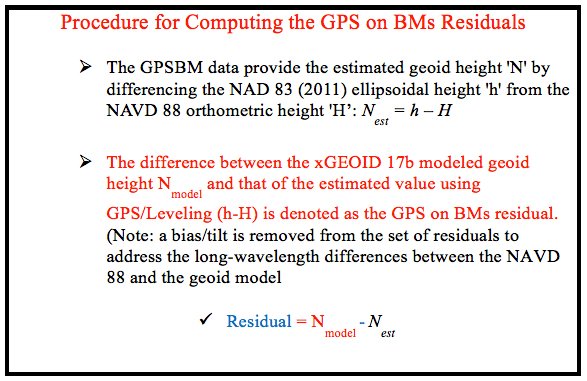
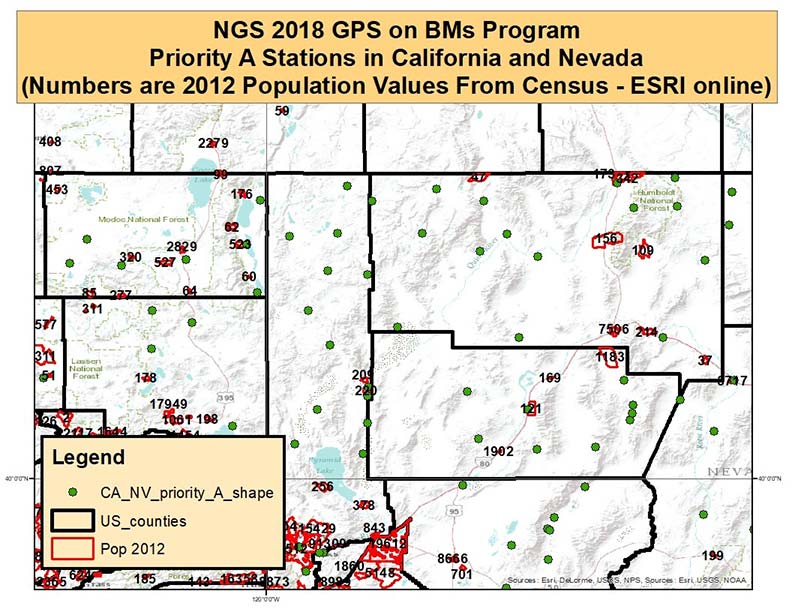
    Figure 7 – NGS 2018 GPS on BMs Program – Priority A Stations in California and Nevada. (Numbers are 2012 Population Values from Census – ESRI online)

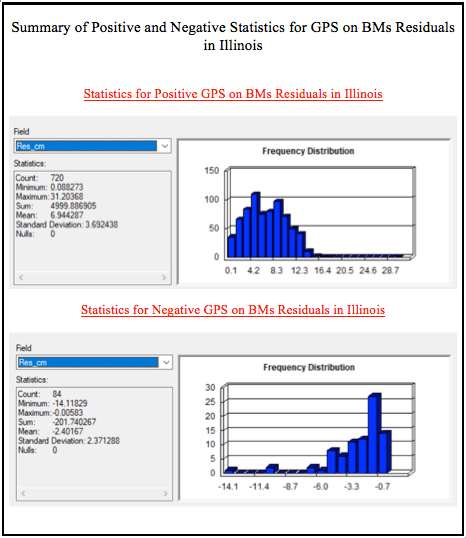
    Figure 8 depicts the location of the GPS on BMs stations in Illinois. The box titled “Summary of Statistics for GPS on BMs Residuals in Illinois” provides a summary of the GPS on BMs residuals for the State of Illinois. The results indicate that there are 804 GPS on BMs in Illinois and the residuals range between -14.1 cm to 31.2 cm. They have a mean of 6.0 cm with a standard deviation of 4.6 cm. The table titled “Statistics for GPS on BMs Residuals in Illinois With Rejections Removed” indicates that most residuals fall between 2 and 10 cm. The box titled “Summary of Positive and Negative Statistics for GPS on BMs Residuals in Illinois” provides a summary of the statistics for the positive and negative set of residuals.
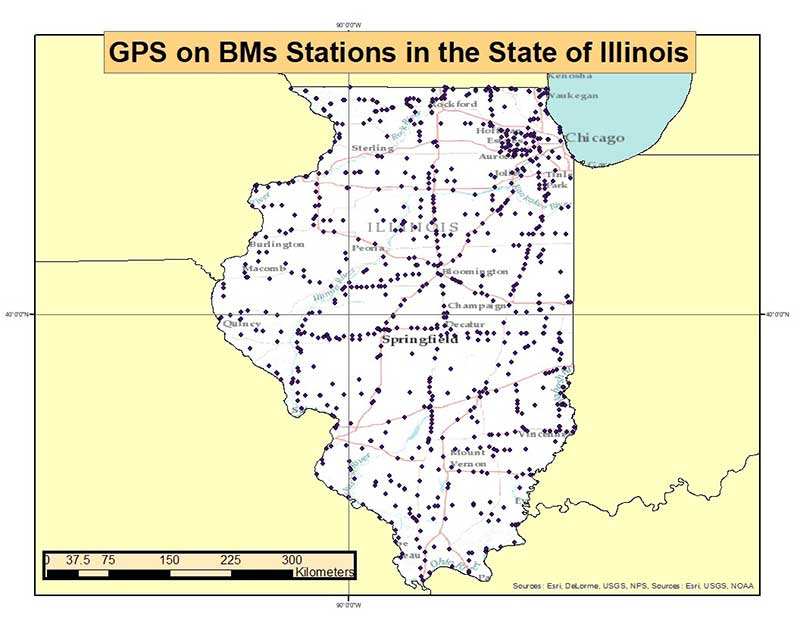
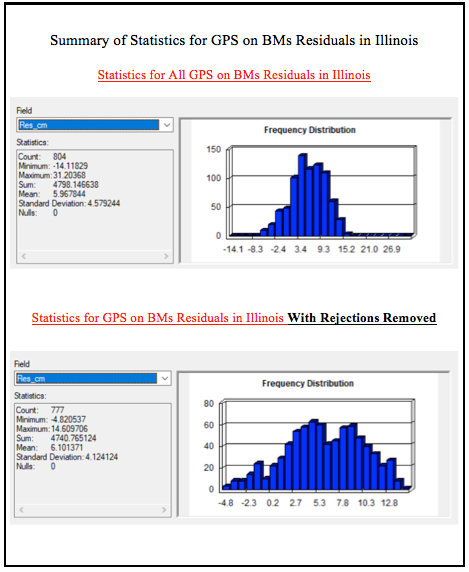
    Figure 8 – GPS on BMs Stations in the State of Illinois.

    Figure 9 depicts the GPS on BMs residuals in the Springfield, Illinois, Region. During the detailed analysis of the latest GPS on BMs dataset, the analysts identified outliers that appeared to be large relative to their neighbors. Figure 9 depicts these outliers with a “X.” Stations designated with a “X” are stations that were designated as DO NOT USE in the creation of the hybrid geoid model. Figure 9 also indicates were the analyst recommended that a station should be observed before the creation of the next hybrid geoid model. These stations are labeled as Priority A stations on figure 9. Figure 10 is an enlargement of the same area that depicts a station that was recommended to be rejected in the hybrid geoid model (PID KB0702). The stations surrounding PID KB0702 all seem to be consistent with each other (residuals in smaller blue squares) so the analyst recommended that station KB0702 be rejected. At the same time, by rejecting this station, this creates a void area that needs to be filled. Therefore, the analyst also recommended that a new station be observed here; hence, the two priority A station plotted near the rejected station. Figure 11 is a plot of another rejected station (KB1018) in the same region but, in this case, the analyst did not recommend an additional observation in the area because there was another nearby station (station in red triangle) that was consistent with its neighbors (residuals in smaller blue squares).
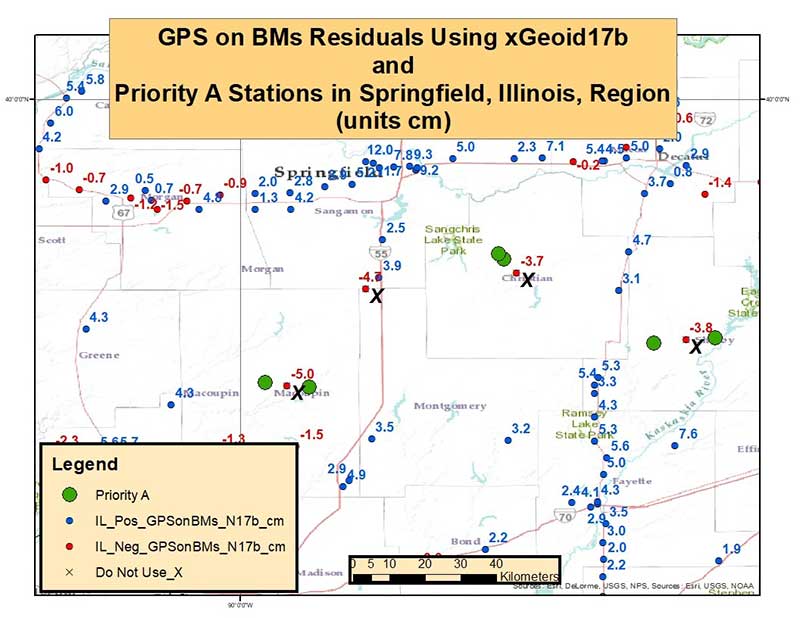
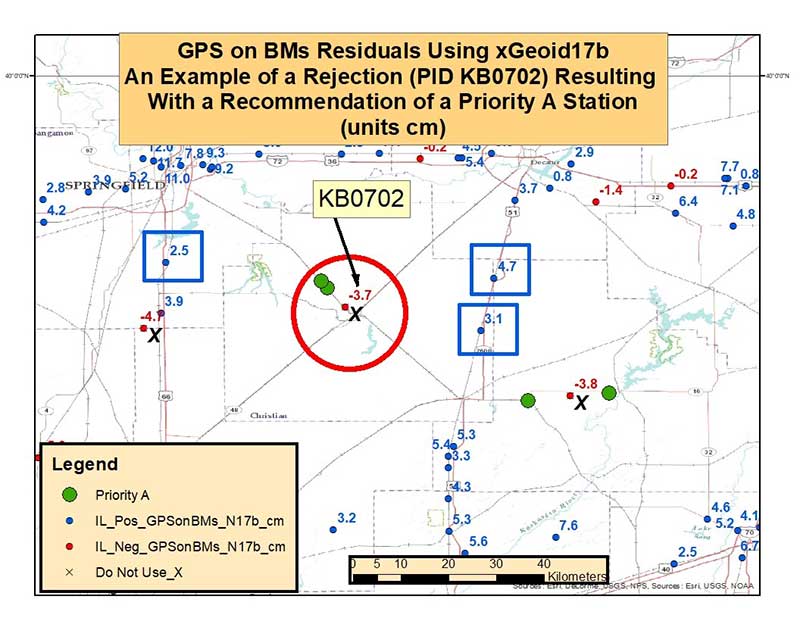
    Figure 9 – GPS on BMs Residuals Using xGeoid17b and Priority A Stations in Springfield, Illinois, Region (unit cm).
    Figure 10 – GPS on BMs Residuals Using xGeoid17b – An Example of a Rejection (PID KB0702) Resulting with a Recommendation of a Priority A Station (units cm).

    As previously mentioned, and provided in the box titled “Attributes Considered During Analysis,” several attributes were analyzed before making the recommendations but, typically, GPS on BMs residuals between +/- 5 cm were used to identify which stations needed to be investigated.

    Attributes Considered During Analysis

    ➢ Total number of GPS observations
    ➢ Date of last GPS observation
    ➢ Whether or not the GPS station has repeat baselines
    ➢ Total number of times the mark has been leveled to
    ➢ Date of latest leveling
    ➢ Quality of leveling
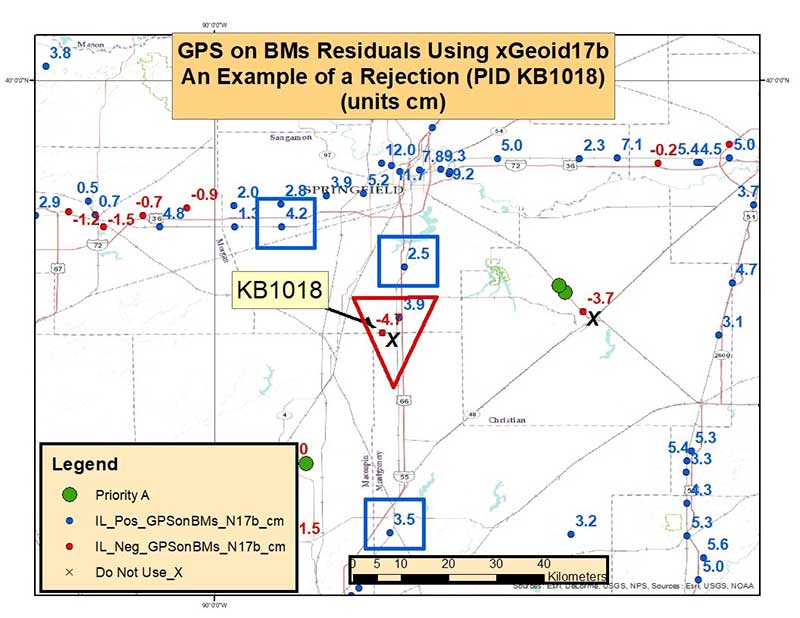
    Figure 11 – GPS on BMs Residuals Using xGeoid17b – An Example of a Rejection (PID KB1018) of an Outlier (units cm).

    This analysis is the first cut at identifying stations that should not be used in a hybrid geoid model and providing a list of specific stations that could help improve the hybrid geoid model. All new data received by the cut-off date of August 31, 2018, will be analyzed by NGS and, if appropriate, the results will be included in the next hybrid geoid model. This is a great opportunity to provide data that will help to improve the hybrid geoid model in your region. My next column will provide a status report on the 2018 GPS on BMs Program.

  • Discussing the new North American-Pacific Geopotential Datum of 2022 — Part 4

    Discussing the new North American-Pacific Geopotential Datum of 2022 — Part 4

    My last column focused on the National Geodetic Survey’s (NGS) current plans for estimating North American-Pacific Geopotential Datum of 2022 (NAPGD2022) GNSS-derived orthometric heights and incorporating geodetic leveling data into NAPGD2022 to establish orthometric heights consistent with GNSS-derived NAPGD2022 orthometric heights. It emphasized that after NAPGD2022 is established, the primary means for deriving orthometric heights on monuments will be using GNSS observations combined with the geoid model.

    Recently, NGS published its second blueprint for the 2022 document titled “Blueprint for 2022, Part 2: Geopotential Coordinates.” The report addresses NAPGD2022 in detail. The intent of the document is to provide to the public the current status of plans by NGS to modernize the geopotential component of the National Spatial Reference System (NSRS) in 2022. This particular document covers the definition and determination of orthometric heights, geoid undulations, gravity, deflections of the vertical, dynamic heights, and any other quantity directly related to the geopotential field of the Earth. As mentioned my previous columns, NAPGD2022 will be replacing the North American Vertical Datum of 1988 (NAVD 88). The executive summary of report NGS 64 is provided in the box titled “Executive Summary, NOAA Technical Report NOS NGS 64, Blueprint for 2022, Part 2: Geopotential Coordinates.” Surveyors and mappers should obtain a basic understanding of the four interrelated products of NAPGD2022. They are GM2022, GEOID2022, DEFLEC2022, and GRAV2022. I’ve highlighted them in executive summary box below.

    Executive Summary


    NOAA Technical Report NOS NGS 64

    Blueprint for 2022, Part 2: Geopotential Coordinates
    In 2022, the entire National Spatial Reference System (NSRS) will be modernized. This document addresses the geopotential aspects of the NSRS, including every vertical datum, the geoid, gravity, deflections of the vertical, and other quantities related to Earth’s gravity field. Every one of these related, yet semi-independent sources of information will be replaced with an internally consistent geopotential datum called the North American-Pacific Geopotential Datum of 2022 (NAPGD2022). Within NAPGD2022 four primary, interrelated time-dependent products will exist:

    • A global model of Earth’s geopotential field (GM2022)
    • Regional gridded geoid undulation models (GEOID2022)
    • Regional gridded deflection of the vertical models (DEFLEC2022)
    • Regional gridded surface gravity models (GRAV2022)

    The three regions for the gridded models will be North America (covering CONUS, Alaska, Hawaii, the Caribbean, Canada, Mexico, Central America and Greenland), American Samoa and Guam/Commonwealth of Northern Mariana Islands (CNMI).

    NAPGD2022 will be built upon the IGS frame, as only minor (entirely horizontal) differences will exist between the IGS frame and the four new terrestrial reference frames developed as part of the NSRS in 2022 (see NGS, 2017). Since these differences will be relatively small horizontal displacements (mainly due to Euler pole rotations), NAPGD2022 will operate equally well in any of four new frames.
    Orthometric heights in NAPGD2022 will be defined through ellipsoid heights and GEOID2022. This means NAPGD2022 orthometric heights will primarily be accessed through Global Navigation Satellite System (GNSS) technology. GEOID2022 will be defined in a manner that best fits global mean sea level at the epoch of NAPGD2022. When global sea level changes by a threshold level of 20 centimeters, a new geoid model, and thus geopotential datum, will be released. Until then, updates to any component of NAPGD2022 will result in updating all components of NAPGD2022 using sequential version numbering.

    Leveling in NAPGD2022 will retain its current role of providing high-accuracy local differential orthometric heights. The determination of absolute heights, however, which will provide the context of local differential heights, will reside in the GNSS domain (i.e., will be based on IGS ellipsoid heights).

    Find this entire report here.

    There is a lot of good information in the report and I would encourage everyone to download the report and read it. Some of the report is technical but most of it provides simple and easy to understand explanations of very technical terms. Pages 22 and 23 of NGS 64 provides a good summary of the different components of NAPGD2022 (see box tilted “Excerpt from Section 9 of NGS 64”).

    Excerpt from Section 9 of NGS 64

    9 The 2022 Geopotential Datum


    1. In 2022, the NSRS will contain one geopotential datum, capable of providing (at a minimum) the geoid undulation, acceleration of gravity, geopotential number, and deflection of the vertical at any given latitude, longitude, ellipsoid height, and time in a global ideal reference frame, such as the International Terrestrial Reference Frame (ITRF) or International GNSS Service (IGS) frames. The name of this datum will be the North American-Pacific Geopotential Datum of 2022 (NAPGD2022).
    2.  

    3. The foundational component of NAPGD2022 will be a spherical13 harmonic model of Earth’s external gravitational potential, called (for now) the Geopotential Model of 2022 (GM2022).
       
      The GM2022 will be created for the entire Earth and will contain two components:
      1. The first component will be time independent, fixed at some epoch (TBD14) to a at least degree and order of 2160,15 called (for now) the Static Geopotential Model 2022 (SGM2022).
      2. Complementing SGM2022 will be a time-dependent model of Earth’s external gravitational potential, capable of capturing both secular and episodic changes of significance. This time-dependent model will be called (for now) the Dynamic Geopotential Model 2022 (DGM2022).


    4. Three derivative products, based upon GM2022, but requiring additional information and providing higher-resolution regional information than is contained in GM2022 will be created:
      1. A gridded geoid model GEOID2022,16 which will contain two components:
        1. The first will be time independent, fixed at some epoch (TBD) called (for now) the Static Geoid model of 2022 (SGEOID2022).
        2. Complementing this will be a time-dependent geoid undulation model, encompassing permanent geoid changes >= 1 millimeter per year, called the Dynamic Geoid model of 2022 (DGEOID2022).
      2. A gridded deflection of the vertical, DoV, model (at the surface of the Earth) DEFLEC2022, which will contain two components:
        1. The first will be time independent, fixed at some epoch (TBD) called (for now) the Static Deflection of the Vertical model of 2022 (SDEFLEC2022).
        2. Complementing this will be a time-dependent DoV model, called the Dynamic Deflection of the Vertical model of 2022 (DDEFLEC2022).
      3. A model for interpolating surface gravity GRAV2022, which will contain at least one, possibly two components:
        1. The first will be time independent, fixed at some epoch (TBD) called (for now) the Static Gravity model of 2022 (SGRAV2022).
        2. As a second, possible component, NGS will investigate the feasibility of a time-dependent surface gravity model.


    The three derivative-gridded products (GEOID2022, DEFLEC2022, and GRAV2022) will encompass three non-global areas. These three areas will be (latitude and longitude convention being positive north, positive east):

    The boxes titled “Figure 9-1 From NOS NGS 64,” “9-2 from NOS NGS 64,” and “9-3 from NOS NGS 64” depict the regions that GEOID2022, DEFLEC2022 and GRAV2022 will cover.

    Figure 9-1 From NOS NGS 64

    The North American region for GEOID2022, DEFLEC2022 and GRAV2022

    Figure 9-2 From NOS NGS 64

    The American Samoa region for GEOID2022, DEFLEC2022 and GRAV2022
    Figure 9-3 From NOS NGS 64

    The Guam and CNMI region for GEOID2022, DEFLEC2022, and GRAV2022

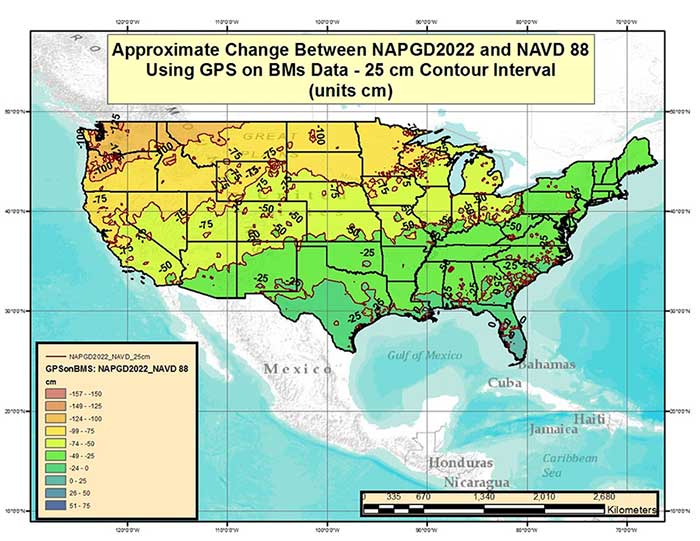
    So, what does this mean to the surveying and mapping community? First, as mentioned in my previous columns, there will be significant differences between NAPGD2022 and NAVD 88. Figure 1 depicts the approximate differences between NAPGD2022 and NAVD 88 in the conterminous United States.

    Figure 1 – Approximate Change Between NAPGD2022 and NAVD 88 Using GPS on BMs Data (units = cm). [Figure 1 is from June 2017 Survey Scene column.]

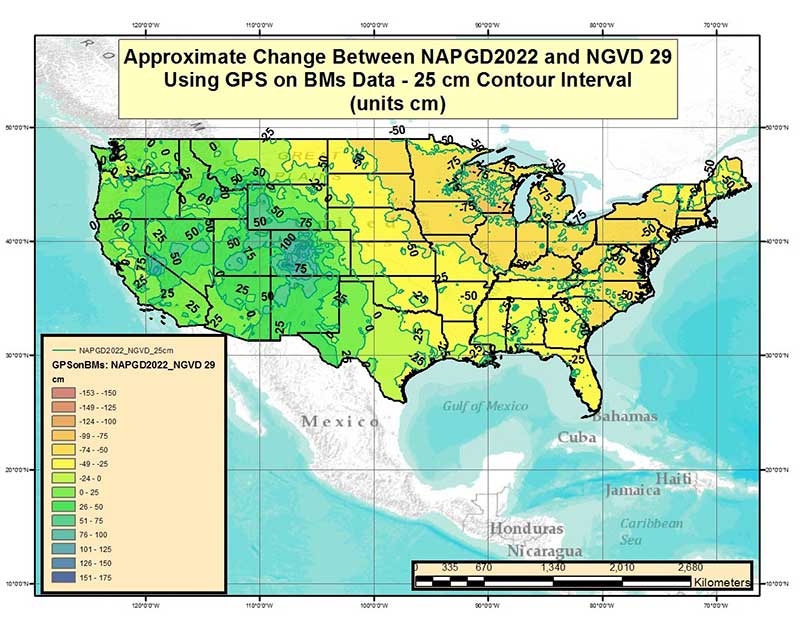
    For those still referring their products to NGVD 29, figure 2 depicts the approximate differences between NAPGD2022 and NGVD 29 in the conterminous United States.

    Figure 2 – Approximate Change Between NAPGD2022 and NGVD 29 Using GPS on BMs Data (units = cm). [Figure 2 is from the June 2017 Survey Scene column].

    My April 2017 Survey Scene column provided an estimate of the change between NAPGD2022 and NAVD 88 at bench marks with GNSS-derived ellipsoid heights in Alaska. Figure 3 is a plot of the GPS on BMs residuals computed using xGeoid16b geoid values, IGS08 ellipsoid heights, and NAVD 88 orthometric heights.

    Figure 3 – Approximate Change Between NAPGD2022 and NAVD 88 Using GPS on BMs Data (units = cm). GPS on Bench Mark Residuals Using xGeoid16b in the State of Alaska – Referenced to IGS08 (units = cm) – Green Line Represents the Leveling Lines [Figure 3 is from the April 2017 Survey Scene column.

    As outlined in NOS NGS 64 report and previously mentioned in this column, there are four interrelated products of NAPGD2022 – GM2022, GEOID2022, DEFLEC2022, and GRAV2022. What most surveyors will be using is GEOID2022 (SGEOID2022 and DGEOID2022). As explained in my last column, and part of NGS’ frequently asked questions about the new datums, users will access the NSRS using GNSS-derived ellipsoid heights and GEOID2022.

    How will accessing the National Spatial Reference System (NSRS) change with the release of the new datums?
    The NSRS will be accessed using Global Positioning System (GPS) technology that references Continuously Operating Reference Stations (CORS) and relies on a time-dependent gravimetric geoid model. This method of accessing the NSRS is a paradigm shift from accessing NAD 83 and NAVD 88 through the use of geodetic survey marks.

    It will not be necessary to connect to a geodetic monument, i.e., a bench mark, because the NATRF2022 ellipsoid height (hNATRF2022) is determined using the NGS CORS and the geoid model (NGEOID2022) is consistent with NATRF2022. In other words, GNSS ellipsoid heights (e.g., NATRF2022) combined with the geoid model (e.g., GEOID2022) will become the primary means for deriving orthometric heights on marks.

    There will be a static geoid model of 2022, denoted as SGEOID2022, which will be fixed at a specific epoch. Since the geoid model changes due to various factors, such as changes in sea level, glacial rebound, and seismic activities, there will be a dynamic aspect of the 2022 geoid model, denoted as DGEOID2022. The permanent changes to the geoid model are small and will take several years to become significant to affect the typical survey and mapping product. Saying that, it is important to understand that there is a static and a dynamic aspect of the National geoid model. NGS will provide a single GEOID2022 value which will apply the appropriate static and dynamic components of the geoid model.

    Even though, the primary access to NAPGD2022 will be using GNSS and a geoid model, users will still want to perform precise leveling observations and incorporate the results into NAPGD2022. My last column discussed incorporating leveling data into NAPGD2022. Differential leveling of high precision is used to observe elevation differences which are then used to establish precise heights of vertical control points (bench marks) above or below a reference surface, e.g., the North American Vertical Datum of 88 (NAVD 88) or North American-Pacific Geopotential Datum of 2022 (NAPGD2022). Differential leveling, conceptually a simple procedure, in practice lends itself to many types of small errors. To detect, reduce, and control these errors, specific procedures need to be adhered to and corrections must be applied. FGCS has documented the necessary procedures to be used in first-, second- and third-order geodetic leveling projects. Procedures do not always reduce error to tolerable values; therefore, additional corrections are applied by the office processing the data to remove known systematic errors.

    The box titled “Excerpt from Special Report Results of the General Adjustment of the North American Vertical Datum of 1988” provides a summary of the corrections applied to the leveling data used in NAVD 88. As you can see, gravity (highlighted in the box) plays an important role in estimating accurate orthometric heights. This is where GRAV2022 is important, it is used during the process of converting observed leveling height differences into orthometric height differences.

    Excerpt from Special Report – Results of the General Adjustment of the North American Vertical Datum of 1988

    (https://www.ngs.noaa.gov/PUBS_LIB/NAVD88/navd88report.htm)
    David B. Zilkoski, John H. Richards, and Gary M. Young
    American Congress on Surveying and Mapping Surveying and Land Information Systems, Vol. 52, No. 3, 1992, pp.133-149
    Corrections Applied to Leveling Data

    The leveling observations used in NAVD 88 were corrected for rod scale and temperature, level collimation, and astronomic, refraction, and magnetic effects (Balazs and Young 1982; Holdahl et al. 1986). All geopotential differences were generated and validated, using interpolated gravity values based on actual gravity data. Geopotential differences were used as observations in the least-squares adjustment, geopotential numbers were solved for as unknowns, and orthometric heights were computed using the well-known Helmert height reduction (Helmert 1890): H = C/(g + 0.0424H), where C is the estimated geopotential number in gpu, g is the gravity value at the benchmark in gals, and H is the orthometric height in kilometers. The weight of an observation was calculated as the inverse of the variance of the observation, where the variance of the observation is the square of the a priori standard error multiplied by the kilometers of leveling divided by the number of runnings.

    This column highlighted two components of NAPGD2022 – the geoid undulation model of GEOID2022 and gravity model of GRAV2022. It expressed that these two models will be very important to future surveyors and mappers that are incorporating geodetic data into the North American-Pacific Vertical Datum of 2022 (NAPGD2022). As previously mentioned, I would encourage everyone to download and read NGS recently published second blueprint for 2022 document, titled “Blueprint for 2022, Part 2: Geopotential Coordinates.” This column also emphasized the significant differences between NAPGD2022 and the U.S. National Vertical Datums of NAVD 88 and NGVD 29. My next column will provide the latest details of NGS’ 2018 GPS on BMs campaign which will be used to develop transformation tools for converting products and services from NAVD 88 to NAPGD2022.

  • Discussing the new North American-Pacific Geopotential Datum of 2022 — Part 2

    Discussing the new North American-Pacific Geopotential Datum of 2022 — Part 2

    My last column highlighted some of the feedback provided by guest presenters at the NGS’ 2017 Geospatial Summit held on April 24-25 in Silver Spring, Maryland. That column also provided a discussion on the approximate differences between NAPGD2022 and NAVD 88 (and NGVD 29) at a national and local level. It was mentioned that to prepare for the new datums and develop implementation plans, users should obtain an understanding of the differences between NAPGD2022 and NAVD 88. The last column provided figures that depicted the approximate absolute and relative differences between the new vertical reference frame, North American-Pacific Geopotential Datum of 2022 (NAPGD2022) and NAVD 88. This column is the second in a new series of columns addressing topics associated with transitioning to the new North American-Pacific Geopotential Datum of 2022 (NAPGD2022).

    The name of the National Geodetic Survey’s new vertical reference frame is the North American-Pacific Geopotential Datum of 2022 (NAPGD2022). So, what is a geopotential model? The following is the definition of a geopotential model from Wikipedia: “In geophysics, a geopotential model is the theoretical analysis of measuring and calculating the effects of Earth’s gravitational field.” [See the box titled “Definition of geopotential and geopotential model from Wikipedia.”]

    Definition of geopotential and geopotential model from Wikipedia

    In order for a height to a have physical meaning, the height system must have some relation to the Earth’s gravity field. Basically, for geodesists, a geopotential model is a way of measuring the effects of Earth’s gravitational field and the means to deriving a geoid model. So, what does the Earth’s gravity field look like? The box titled “Static Gravity Field – Anomalies” is a good image of the Earth’s gravity field created by the GRACE program.
    Static Gravity Field – Anomalies
    (Figure obtained from https://grace.jpl.nasa.gov/resources/28/)

    It was mentioned in the last column that stakeholders across the federal, public and private sectors provided feedback and impacts of NGS New 2022 Datums on their products and services. All of these presentations are now available on NGS’ website. [See box titled “Website that contains the NGS 2017 Geospatial Summit Presentations.“] NGS did an excellent job of recording these presentations. The website allows the user to download the video and/or slides, as well as watch the presentations on their computer.

    Website that contains the NGS 2017 Geospatial Summit Presentations
    (https://www.ngs.noaa.gov/geospatial-summit/presentations.shtml)

    Many surveyors and mappers will be providing services to Federal, state, and local agencies to assist them in their transitioning activities. I would encourage all users to watch the presentations by the partners to obtain an understanding of how these agencies’ products and services are going to be effected by a datum change. For example, the presentation by the Federal Emergency Management Agency (FEMA) can be found here.

    This column will focus on two of the presentations by NGS employees – “Modernizing the Geopotential or Vertical Datum” and Monitoring Changes in the Geoid.” These two presentations are very important to obtaining an understanding of NAPGD2022. [See box title “NGS Presentation at the 2017 Geospatial Summit – “Modernizing the Geopotential or Vertical Datum.”]

    NGS Presentation at the 2017 Geospatial Summit – “Modernizing the Geopotential or Vertical Datum”
    (https://www.ngs.noaa.gov/geospatial-summit/presentations/modernizing-geopotential-vertical-datum.shtml)

    Why is the Earth’s gravity field important to estimating GNSS-derived orthometric heights? Guidelines and procedures for estimating GNSS-derived heights were discussed in great detail in previous columns, such as Establishing Orthometric Heights Using GNSS — Part 1, Establishing Orthometric Heights Using GNSS — Part 2, Establishing Orthometric Heights Using GNSS — Part 3 and Establishing orthometric heights using GNSS — Part 4.

    Slide 33 from the presentation titled “Modernizing the Geopotential or Vertical Datum” depicts the relationship between the ellipsoid, geoid, and orthometric heights. (See box titled “Slide 33 From “Modernizing the Geopotential or Vertical Datum.”)

    Slide 33 From “Modernizing the Geopotential or Vertical Datum”
    (https://www.ngs.noaa.gov/geospatial-summit/presentations/modernizing-geopotential-vertical-datum.shtml)

    A previous column discussed how NGS developed their scientific and hybrid geoid models. The NAPGD2022 will begin with the best 3-dimension geopotential model available and derive the most accurate geoid model, e.g., GEOID2022, for establishing NAPGD2022 GNSS-derived orthometric heights. Just like NAVD 88 leveling derived heights need accurate gravity values to compute accurate orthometric heights and height differences, the geopotential model needs accurate, current gravity data to estimate local variations in the global model. The bottom line is that an accurate geopotential model is necessary for deriving an accurate geoid model that is necessary for establishing accurate GNSS-derived orthometric heights and height differences.

    In the presentation “Modernizing the Geopotential or Vertical Datum,” Monica Youngman discussed the NGS project called “Gravity for the Redefinition of the American Vertical Datum (GRAV-D).” The goal of GRAV-D is to create a gravimetric geoid accurate to 1 cm where possible using airborne gravity data. The overall target is to enable users to obtain 2-cm accuracy orthometric heights from GNSS and a geoid model. View this website for more information on GRAV-D.

    Once a geoid model is computed, e.g., GEOID2022, it will need to be validated to estimate the accuracy of the derived product. What does this mean to surveyors and mappers? In my opinion, the NAPGD2022 will help the surveying community maintain a vertical reference frame that’s reliable and traceable. Saying that, it is extremely important to know the relative accuracy of the geoid model used to establish GNSS-derived orthometric heights in NAPGD2022. As mentioned in my April column, NGS is performing geoid slope validation surveys (GSVS) to evaluate the current experimental geoid models being developed using GRAV-D data. In the presentation “Modernizing the Geopotential or Vertical Datum,” Derek Van Westrum discussed the GSVS projects. Evaluation of the experimental gravimetric geoid model is critical to the implementation of NAPGD2022 and should be part of a transition plan to the NAPGD2022. Performing a geoid slope validation project similar to NGS may be too expensive to be performed by most agencies. However, some agencies may be able to perform low budget geoid slope evaluation surveys. These surveys could include performing combined GNSS and leveling surveys to evaluate the relative accuracy of the gravimetric geoid model in areas that require accurate orthometric heights. Performing several of the gravimetric geoid evaluation surveys in major cities and/or areas that require accurate heights would help to facilitate the implementation of NAPGD2022.

    These types of geoid evaluation surveys should be performed in areas of the country that are influenced by crustal movement. For example, in southern Louisiana and other parts of the Gulf Coast of the United States that are being influenced by subsidence (https://www.ngs.noaa.gov/heightmod/NOAANOSNGSTR50.pdf, https://www.ngs.noaa.gov/PUBS_LIB/Subsidence_at_Houston_Texas_TR_NOS131_NGS44.pdf). There is no doubt that NAPGD2022 will provide a more efficient and cost-effective way to maintain consistent and accurate orthometric heights; however, evaluating the relative accuracy of the geoid model is critical to a successful implementation of NAPGD2022.

    The first phase of the GRAV-D project is the airborne gravity survey of entire country and its holdings; the second phase is the long-term monitoring of the change in the geoid. Not only is the NAVD 88 being replaced with a new datum but the geoid model, the underlying foundation of establishing GNSS-derived orthometric heights in NAPGD2022, will be constantly changing. The geoid will change but it will change very slowly. Saying that, it is still important for NGS to monitor changes in the geoid if users are going to establish and maintain GNSS-derived orthometric heights at the centimeter level. As part of the modernization of the vertical reference frame, NGS has outlined four components of a long-term monitoring plan. [See box titled “Components of a Long-Term Monitoring Plan.”]

    Components of a Long-Term Monitoring Plan
    (From presentation titled “Monitoring Changes in the Geoid” given by Dr. Theresa Damiani at the NGS 2017 Geospatial Summit)

    1. What and Where to Monitor
    2. How to Monitor in the Near-Term (next 1 to 3 decades)
    3. Which Products Need to be Available
    4. Long-Term Program Adaptation

    The two most important components of the plan, in my opinion, are “What and Where to Monitor” and “How to Monitor in the Near-Term.” There are small changes in the geoid that occur over long periods of time. [See box titled “Slide 5 from presentation titled “Monitoring Changes in the Geoid.”]

    Slide 5 from presentation titled “Monitoring Changes in the Geoid”
    (From presentation titled “Monitoring Changes in the Geoid” given by Dr. Theresa Damiani at the NGS 2017 Geospatial Summit)

    Dr. Damiani presented a slide that outlined NGS’ vision for vertical datum products as they are related to the geoid model. [See the box titled “NGS’ Vision for Vertical Datum Products, 2022 +.”] NGS will be publishing both static geoid models (S) and dynamic geoid models (D). The “S” static model will be a typical geoid model, aimed to capture the 1 cm-accurate model at a specific epoch, and the “D” dynamic model will capture the rate of change of the geoid at all places. Dr. Damiani mentioned in her presentation that NGS has initiated a program called “The Geoid Monitoring Service.” This service is a new project, initiated in January 2017, that is planned to be operational and produce NGS’ first “D” dynamic geoid by 2022.

    NGS’ Vision for Vertical Datum Products, 2022 +
    (From presentation titled “Monitoring Changes in the Geoid” given by Dr. Theresa Damiani at the NGS 2017 Geospatial Summit)

    ➢ In 2022, NGS will release “S” and “D” geoid models: static (S) and dynamic (D).

    ➢ The “S” static will be a typical geoid model, aimed to capture the 1 cm-accurate model at a TBD epoch.

    ➢ The “D” dynamic will capture the rate of change of the geoid at all places. In 2022, it will capture at least the continuous, permanent change signals such as Glacial Isostatic Adjustment (GIA).

    ➢ Both models will be integrated into OPUS, mostly invisible to users. Orthometric heights provided by OPUS will be time-sensitive, so that they are the combination of the static geoid model plus the geoid rate of change indicated by the dynamic model.

    ➢ NGS will provide separate tools to directly access both the “S” and “D” models.

    This column discussed the basic foundation parameters of the North American-Pacific Geopotential Datum of 2022 (NAPGD2022); that is, a global geopotential model, the GRAV-D project, and the GEOID2022 geoid model. It emphasized that NAPGD2022 will provide a more efficient and cost-effective way to maintain consistent orthometric heights, but evaluating the relative accuracy of the geoid model is critical to a successful implementation of NAPGD2022. Performing GNSS/Leveling evaluation surveys will help in evaluating the relative accuracy of GEOID2022. NGS is developing geodetic routines and tools to assist users in transforming heights from NAVD 88 to NAPGD2022, and enabling the incorporation of geodetic leveling data into NAPGD2022 to establish NAPGD2022 orthometric heights. Future columns will address some of these tools and routines.

  • Discussing the new North American-Pacific Geopotential Datum of 2022 — Part 1

    Discussing the new North American-Pacific Geopotential Datum of 2022 — Part 1

    On April 24-25, 2017, the National Geodetic Survey (NGS) hosted the 2017 Geospatial Summit in Silver Spring, Maryland, to discuss its plans for replacing the North American Datum of 1983 (NAD 83) and the North American Vertical Datum of 1988 (NAVD 88) in 2022.

    The summit was a day and a half long and provided an opportunity for NGS to share updates and discuss the progress of projects related to National Spatial Reference System (NSRS) Modernization. Stakeholders across the federal, public and private sectors also provided feedback and impacts of New Datums on their products and services.

    The absolute differences between the new vertical reference frame, North American-Pacific Geopotential Datum of 2022 (NAPGD2022), and NAVD 88 are going to be large but, in most regions of the country, the relative differences over small areal extents will be small.

    NGS is developing geodetic routines and tools to transform heights from NAVD 88 to NAPGD2022, and to facilitate the incorporation of geodetic leveling data into NAPGD2022 to establish NAPGD2022 heights. To prepare for the new datums and develop implementation plans, stakeholders should obtain an understanding of the differences between NAPGD2022 and NAVD 88.

    My previous columns provided figures that demonstrated the approximate differences between NAPGD2022 and NAVD 88 heights at a national level. (See figure 1.) This column will provide feedback from stakeholders that participated in the Geospatial Summit and, using NGS’ GPS on BMs dataset, a discussion on the differences between NAPGD2022 and NAVD 88 (and NGVD 29) at a local level.

    Figure 1 – Approximate Change Between NAPGD2022 and NAVD 88 Using GPS on BMs Data (units = cm). (Image: National Geodetic Survey)
    Figure 1 – Approximate Change Between NAPGD2022 and NAVD 88 Using GPS on BMs Data (units = cm). (Image: National Geodetic Survey)

    Information about the summit and Summit Documents can be downloaded here.

    Read an excerpt from website here.

    If you check on the tab titled “Summit Documents” you can download the agenda and documents provided to participates. Read excerpts from the summit here.

    The first day consisted of presentations by NGS leadership and personnel providing updates and discussing the progress of projects related to the NSRS modernization. The presentations by NGS employees can be downloaded from NGS’ presentations library at this web link. View an excerpt from NGS’ presentations library here.

    The afternoon of day 2 were presentations by partners and stakeholders. (See box titled “Excerpt from NGS 2017 Geospatial Summit Agenda – Afternoon of Day 2.”)

    Excerpt from NGS 2017 Geospatial Summit Agenda – Afternoon of Day 2
    Day 2 Afternoon Agenda from NGS’ 2017 Geospatial Summit
    Day 2: Tuesday, April 25, 20171:30 – 3:05 Impacts of New Datums on Programs and Partners (Part 1)
    Coastal Mapping Program and VDatum: Mike Aslaksen and Stephen White, NOAA/NGS
    Federal Emergency Management Agency (FEMA): Kimberly Pettit, FEMA
    U.S. Geological Survey (USGS): Kari Craun, USGS
    U.S. Army Corps of Engineers (USACE): Jim Garster, USACE
    National Geospatial-Intelligence Agency (NGA): Stephen Malys, NGA
    3:05 – 3:25 Break
    3:25 – 4:55 Impacts of New Datums on Programs and Partners (Part 2)
    Geospatial and Remote Sensing Customers: Amar Nayegandhi, Dewberry
    Geographic Information System (GIS) Customers: Kevin Kelly, Esri
    Global Navigation Satellite System (GNSS) Equipment Customers: Hamid Mahmoudabadi, Trimble Kyle Snow, Topcon
    State Government Partners: Gary Thompson, N.C. Department of Public Safety
    Local Government Partners: Vickie Anglin, Fairfax County Government, Virginia; Patrick Simon, Baltimore County Land Survey, Maryland
    4:55 – 5:00 Wrap-up and closing

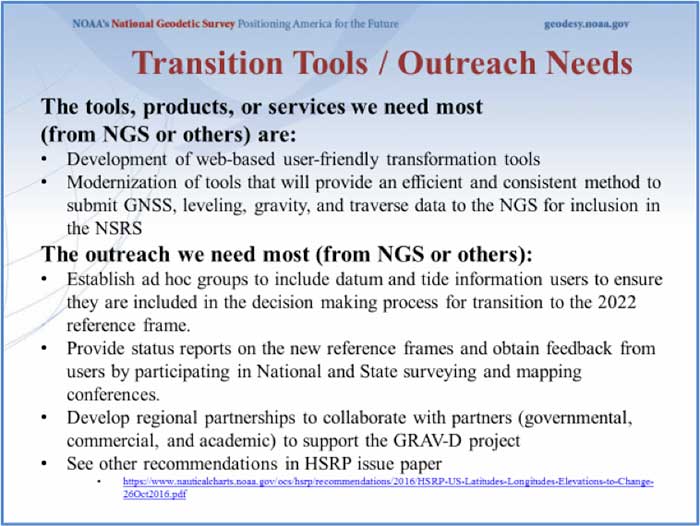
    In order for consistency, NGS provided guidance and a set of template slides for guest presenters to use. Guest presenters were allotted 10 minutes to present and limited to four slides. The presentation by the guest presenters are not on NGS’ Presentations Library but I’ve been told that they will be available on the Summit website later this year. Gary Thompson, Chief of the North Carolina Geodetic Survey (NCGS), provided me a copy of his slides and gave me permission to include them in this column. (See box titled “Power point Slides Presented by Gary Thompson, Chief of NCGS, at the NGS 2017 Geospatial Summit.”) North Carolina has been very proactive in addressing the impacts of the new datums on NC products and services. North Carolina Geodetic Survey has established a North Carolina Geodetic Survey Advisory Committee that reviews NCGS products and services, and they have established the North Carolina 2022 Reference Frame Working Group to prepare for the new datums.

    Slide: National Geodetic Survey
    Slide: National Geodetic Survey

    Powerpoint slides presented by Gary Thompson, chief of NCGS, at the NGS 2017 Geospatial Summit

    All of the presentations by the invited guest speakers were interesting, and everyone followed NGS’ guidance which helped to focus the Summit on the main issues associated with a datum change. As expected, each stakeholder had their own set of issues and concerns about transitioning to a datum. The following are some common themes that I heard from the participants:

    (1) There are a lot of products and services that will be effected by a datum change,
    (2) An official transformation model between the old and new datum(s) published by NGS is critical for a successful transition to a new datum,
    (3) Guidance documents that are “easily” understood by “non-geodesists” is required for a smooth implementation of a new datum, and
    (4) More frequent geospatial summits and webinars are needed to provide updates on the status of the projects associated with NSRS modernization and to ensure user involvement in the process.

    I contacted a couple of the guest presenters to discuss their feedback on the New Datums. As NAVD 88 Program Manager, I collaborated with many of them during the development and implementation of the NAVD 88. As in the transition from NGVD 29 to NAVD 88, it’s not the conversion of coordinates that’s a problem; a good transformation tool should meet that requirement. Saying that, it was stated that many users rely on commercial and open source software to convert their data, so they would like NGS to collaborate with others to ensure that these software suppliers are using the appropriate algorithms/information in their products. The integration with legacy data referenced to older datums may be complicated for some products and services; therefore, the process of transforming each product and service will need to be addressed individually. If all data are in digital form with the appropriate metadata, then the transformation should be relatively easy to accomplish and maps with new contour lines or new base flood elevations referenced to the new datum could be generated. However, how these new maps are integrated with old maps is a different issue. I will address some of these potential issues in future columns.

    To prepare implementation plans, users must obtain a working knowledge of the differences between the old and new datums. As previous mentioned, the absolute differences between the new vertical reference frame, NAPGD2022, and NAVD 88 are going to be large but, in most regions of the country, the relative differences over small areal extents will be small. To evaluate the relative differences at the local level, the differences between NAPGD2022 and NAVD 88 (and NGVD 29) were computed for bench marks in the NGS’ GPS on BMs dataset. The NAD 83 (2011) latitude, longitude, and ellipsoid height of each station was transformed to the IGS08 reference frame using NGS’ HTDP web tool, and then the GNSS-derived orthometric height was computed using the following formula:

    Approximate NAPGD2022 GNSS-Derived Orthometric Height
    Equals
    IGS08 Ellipsoid Height minus xGeoid16b Geoid Height (referenced to IGS08).

    Figure 1 is a plot of the difference between the approximate NAPGD2022 height and the published NAVD 88 height for bench marks that are part of the GPS on BMs dataset and have the published attribute of “Adjusted.” It should be noted that these are only estimated changes because the final NAPGD2022 reference frame will not be exactly the same as the current IGS08 reference frame, but these estimates should serve the purpose of providing approximate changes for users to develop transition plans.

    Since some users are still converting NGVD 29 heights to NAVD 88 heights, the approximate change between NAPGD2022 and NGVD 29 is provided in figure 2. VERTCON values were used to convert the NAVD 88 published heights to NGVD 29 heights, and then the difference between the approximate NAPGD2022 orthometric height and the NGVD 29 orthometric height was computed.

    Figure 2 – Approximate Change Between NAPGD2022 and NGVD 29 Using GPS on BMs Data (units = cm). (Image: National Geodetic Survey)
    Figure 2 – Approximate Change Between NAPGD2022 and NGVD 29 Using GPS on BMs Data (units = cm). (Image: National Geodetic Survey)

    As shown in figure 2, the absolute differences between the new vertical reference frame, NAPGD2022, and NGVD 29 are also going to be large but, once again, in most regions of the country, the relative differences over small areal extents will be small.

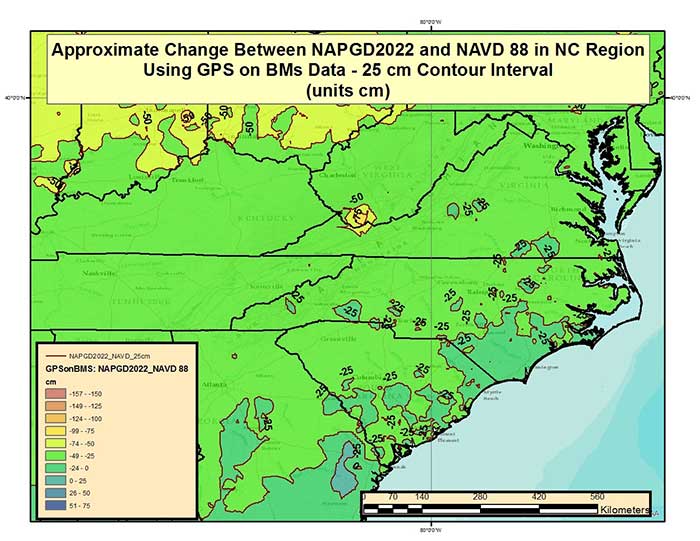
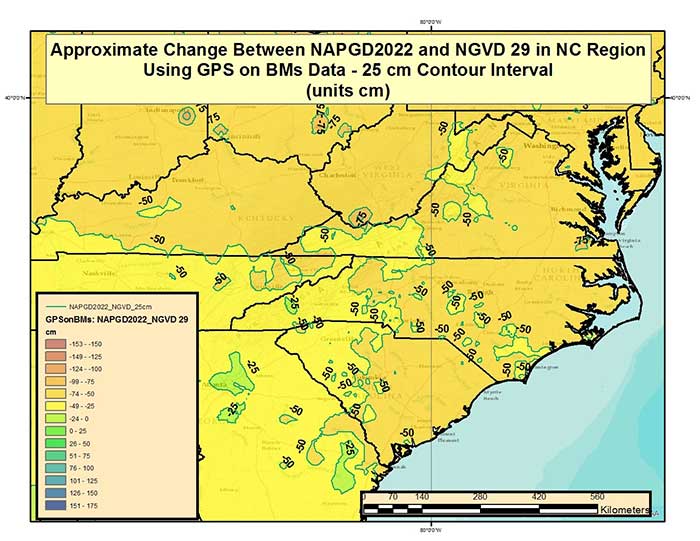
    What does this look like in a local area? Figure 3 is a plot of the approximate change between NAPGD2022 and NAVD 88 in North Carolina and surrounding states, and figure 4 is plot of the approximate change between NAPGD2022 and NGVD 29 in North Carolina and surrounding states.

    Figure 3 – Approximate Change Between NAPGD2022 and NAVD 88 in North Carolina and Surrounding States Using GPS on BMs Data (units = cm). (Image: National Geodetic Survey)
    Figure 3 – Approximate Change Between NAPGD2022 and NAVD 88 in North Carolina and Surrounding States Using GPS on BMs Data (units = cm). (Image: National Geodetic Survey)
    Figure 4 – Approximate Change Between NAPGD2022 and NGVD 29 in North Carolina and Surrounding States Using GPS on BMs Data (units = cm). (Image: National Geodetic Survey)
    Figure 4 – Approximate Change Between NAPGD2022 and NGVD 29 in North Carolina and Surrounding States Using GPS on BMs Data (units = cm). (Image: National Geodetic Survey)

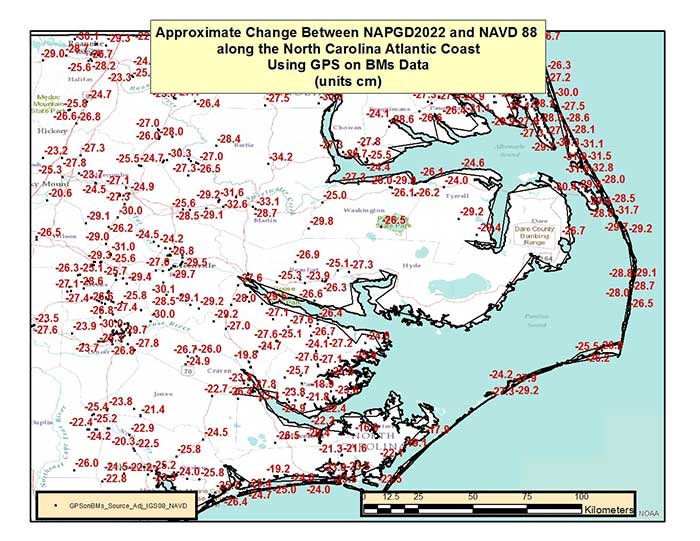
    Figure 5 provides a more detailed depiction of the change between NAPGD2022 and NAVD 88 along the North Carolina Atlantic Coast. The differences appear to vary by several centimeters but some of these differences are due to errors in published heights (both ellipsoid and orthometric). These differences can be used to develop a transformation model but the user will need to know the accuracy of the model, globally and locally.

    Figure 5 – Approximate Change Between NAPGD2022 and NAVD 88 along North Carolina Atlantic Coast Using GPS on BMs Data (units = cm). (Image: National Geodetic Survey)
    Figure 5 – Approximate Change Between NAPGD2022 and NAVD 88 along North Carolina Atlantic Coast Using GPS on BMs Data (units = cm). (Image: National Geodetic Survey)

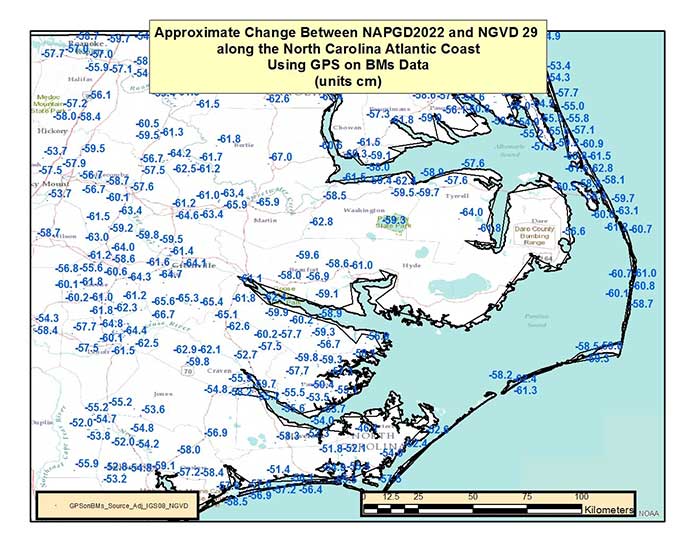
    Figure 6 is a detailed depiction of the change between NAPGD2022 and NGVD 29 in the same area as shown in figure 5. Comparing figures 5 and 6, the reader should notice that the differences between NAPGD2022 and NGVD 29 are about 30 cm larger (more negative) than the differences between NAPGD2022 and NAVD 88.

    Figure 6 – Approximate Change Between NAPGD2022 and NAVD 29 along North Carolina Atlantic Coast Using GPS on BMs Data (units = cm). (Image: National Geodetic Survey)
    Figure 6 – Approximate Change Between NAPGD2022 and NAVD 29 along North Carolina Atlantic Coast Using GPS on BMs Data (units = cm). (Image: National Geodetic Survey)

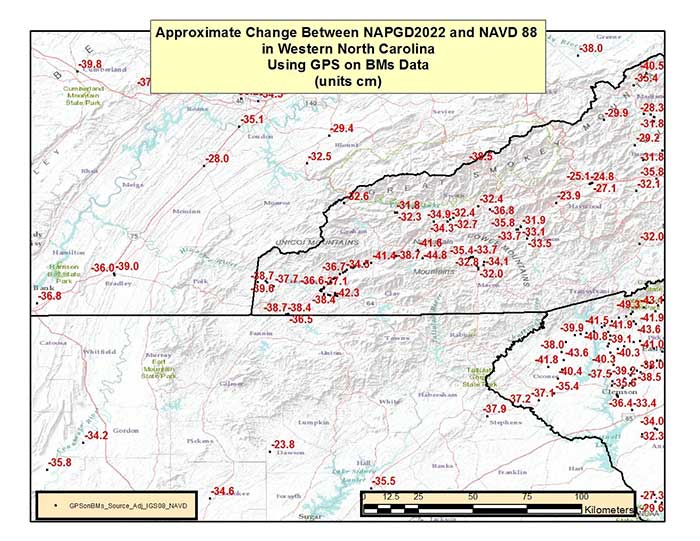
    Figure 7 is the difference between NAPGD2022 and NAVD 88 in western North Carolina. The local difference in the NC mountains is around -35 cm which is about 10 cm different from the NC Atlantic Coast. Questions that users need to address include: What is the accuracy of the transformation model? And What is the accuracy of the product or service being transformed? The transformation model will not replace the original survey results but may be useful for transforming some products and services.

    Figure 7 – Approximate Change Between NAPGD2022 and NAVD 88 in the Western North Carolina Using GPS on BMs Data (units = cm). (Image: National Geodetic Survey)
    Figure 7 – Approximate Change Between NAPGD2022 and NAVD 88 in the Western North Carolina Using GPS on BMs Data (units = cm). (Image: National Geodetic Survey)

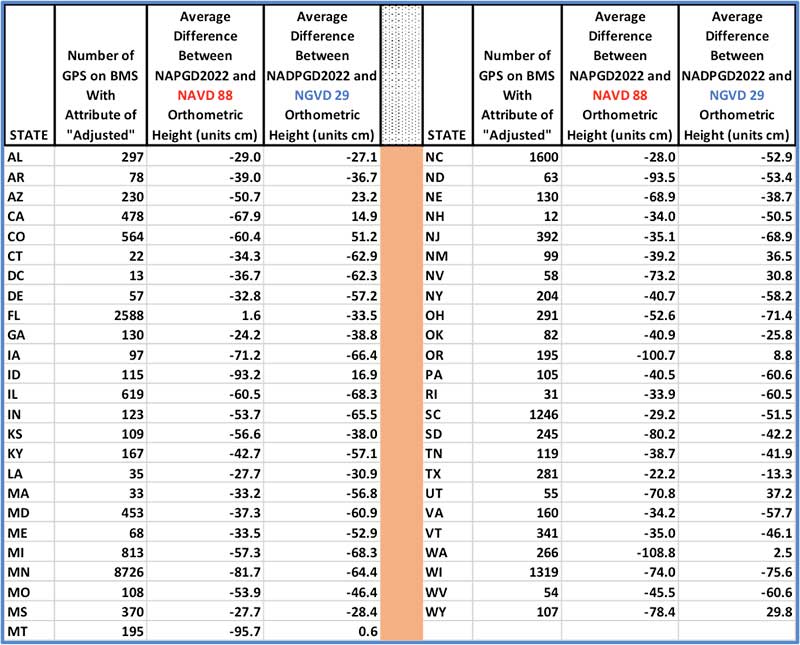
    Table 1 provides the average difference between NAPGD2022 and NAVD 88 (and NGVD 29) by State using the GPS on BMs dataset. This table shows that there are large differences between NAPGD2022 and both NGVD 29 and NAVD 88. No matter which datum the product or service is referenced to, it will probably need to be transformed to NAPGD2022.

    Table 1 – Average Difference Between NAPGD2022 and NAVD 88 (and NGVD 29) by State Using GPS on BMs Dataset (units = cm). Click to enlarge. (Date: National Geodetic Survey)
    Table 1 – Average Difference Between NAPGD2022 and NAVD 88 (and NGVD 29) by State Using GPS on BMs Dataset (units = cm). Click to enlarge. (Date: National Geodetic Survey)
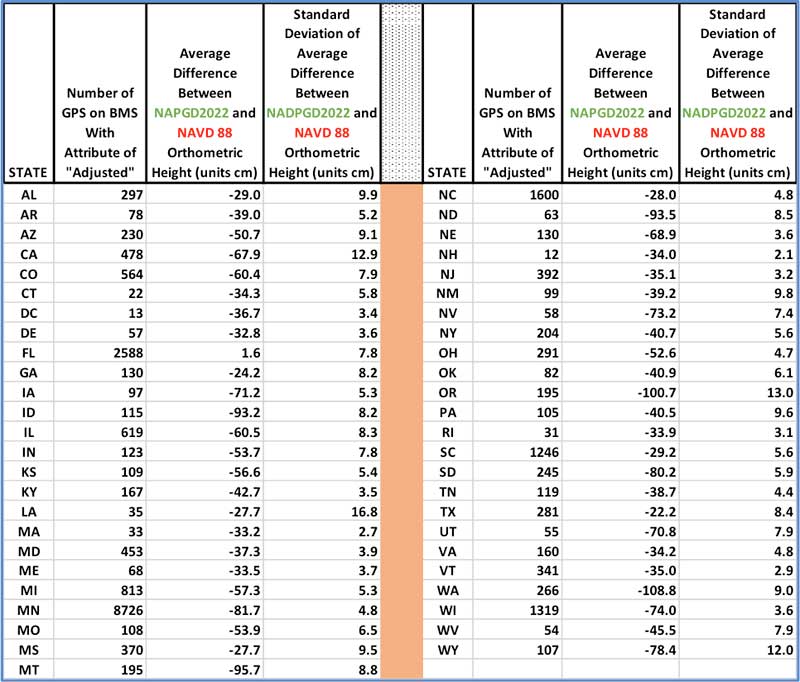
    Average Difference Between NAPGD2022 and NAVD 88 by State Using GPS on BMs Dataset (units = cm). Click to enlarge. (Date: National Geodetic Survey)
    Average Difference Between NAPGD2022 and NAVD 88 by State Using GPS on BMs Dataset (units = cm). Click to enlarge. (Date: National Geodetic Survey)

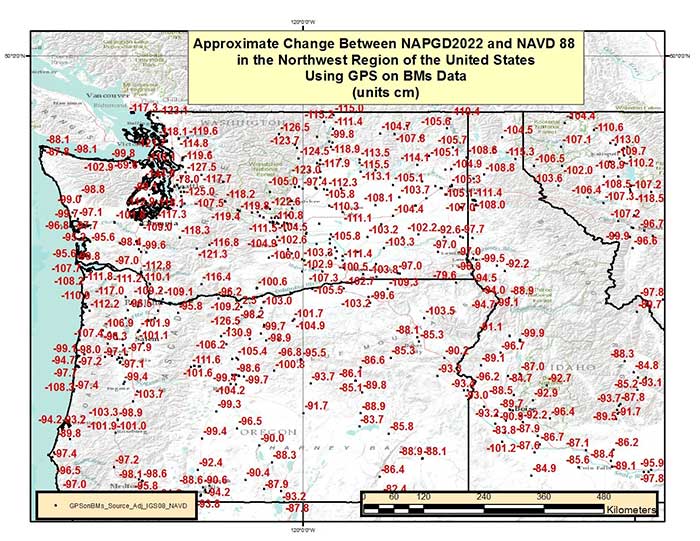
    Table 2 provides the standard deviation of the average difference between NAPGD2022 and NAVD 88 by State. For example, North Carolina has a sample size of 1600 stations and its average difference is -28 cm with a standard deviation of 4.8 cm. Looking at figures 5 and 7, there appears to be a difference of 10 cm across the State. The States in the northwestern region of the United States have a larger difference between NAPGD2022 and NAVD 88 as well as a larger standard deviation. Oregon has a sample size of 195 stations and its average difference is -100.7 cm with a standard deviation of 13.0 cm, and Washington has a sample size of 266 stations and its average difference is -108.8 cm with a standard deviation of 9.0 cm. Figure 8 is a plot of the approximate change between NAPGD2022 and NAVD 88 in the northwest region of the United States.

    As mentioned previously, these differences will vary from station to station because of a bias and trend between the two datums and due to remaining errors in published heights (both ellipsoid and orthometric). As I have noted in previous columns, many of the large relative differences between stations in a local area could be due to an invalid NAVD 88 published height because the bench mark moved since the last time the height of the bench mark was adjusted and published, and/or an undetected error in an ellipsoid height due to a weak GNSS project design. Either way, in my opinion, most of these stations with large relative differences don’t accurately represent the current NAVD 88. NGS’ modernization of the NSRS will provide a more accurate and consistent reference frame, and improve the user’s ability to obtain a current and accurate orthometric height.

    Figure 8 – Approximate Change Between NAPGD2022 and NAVD 88 in the Northwest Region of the United States Using GPS on BMs Data (units = cm). (Image: National Geodetic Survey)
    Figure 8 – Approximate Change Between NAPGD2022 and NAVD 88 in the Northwest Region of the United States Using GPS on BMs Data (units = cm). (Image: National Geodetic Survey)

    This column highlighted some of the feedback provided by guest presenters at the NGS’ 2017 Geospatial Summit held on April 24-25, 2017, in Silver Spring, Maryland. The column also provided a discussion on the approximate differences between NAPGD2022 and NAVD 88 (and NGVD 29) at a national and local level. To prepare for the new datums and develop implementation plans, users should obtain an understanding of the differences between NAPGD2022 and NAVD 88. This column is the first in a new series of columns addressing topics associated with transitioning to the new North American -Pacific Geopotential Datum of 2022 (NAPGD2022).

  • Research Online: GPS UTC anomaly, spatial reference system access

    Research Online: GPS UTC anomaly, spatial reference system access

    Click to enlarge.
    Click to enlarge.
    Click to enlarge.
    Click to enlarge.

    Impact of January 2016 GPS UTC Anomaly

    By Charles Curry / Presented at ION ITM, January 2017

    On Jan. 26, 2016 alarms occurred on GPS timing receivers around the globe. This article tells the story as experienced by the Chronos support team over a four-day period, dealing with nearly 5,000 alarm events from many different GPS timing receivers worldwide. It examines whether the alarms were service-affecting or if the equipment switched to a resilient fallback status. This event was not without precedent. The last time such an event happened to the GPS transmission was Jan. 1, 2004, and coincidentally SVN23 was also to blame then. A major network event happened to GLONASS on April 1, 2014. These qualify as “Black Swan Events” first proposed by Nassim Nicholas Taleb in his 2001 book, Fooled by Randomness. This was a unique event with unique impact across the globe. Chronos supports many thousands of GPS-based timing receivers for more than 100 clients in more than 50 countries. This article also reviews more recent work to understand what caused the event and how it manifested itself.

    National Spatial Reference System Access in 2022

    By Daniel Roman, NOAA / Presented at ION ITM, Jan 2017

    In 2022, the National Geodetic Survey will implement a new datum to replace both the North American Datum of 1983 (NAD 83) and the North American Vertical Datum of 1988 (NAVD 88). This datum will provide the primary access to the National Spatial Reference System (NSRS) through GNSS and a geopotential model. Foundation CORS sites will provide a backbone network to ensure that the U.S. contributions to the ITRF solutions remain robust. In turn, these sites will also provide the connection to the densified network of CORS stations to provide local access. RTN and RTK surveys will provide an additional layer of access for improved local resolution. Velocities will be taken into account to provide tie back to survey points. Passive control (benchmarks) will become secondary access to the NSRS with conversion models being provided to ensure backward compatibility to NAD 83 and NAVD 88.

  • NGS to replace NAVD 88 in 2022: What GNSS users need to know — Part 10

    NGS to replace NAVD 88 in 2022: What GNSS users need to know — Part 10

    Understanding the differences between the North American Vertical Datum of 1988 and the new 2022 Vertical Reference Datum

    My Survey Scene columns have focused on procedures and routines for establishing GNSS-derived orthometric heights. My last column focused on analyzing NGS’ GPS on BM data set that is used to make National Geodetic Survey’s (NGS) hybrid geoid models. It provided procedures that users could employ when analyzing the differences between the modeled geoid values and the computed geoid values using GPS/Leveling data. This GPSBM data set or one similar will be used to make the next hybrid geoid model, as well as provide input to the transformation model between the North American Vertical Datum of 1988 (NAVD 88) and the new 2022 Vertical Reference Datum. As I emphasized, all geospatial users should help develop this GPS on BMS data set to help improve the National Spatial Reference System and future hybrid geoid models.

    Large relative differences in residuals between neighboring stations provided examples of stations that should investigated based on different reasons: No. 1, a weak NAVD 88 is leveling network design in the region; No. 2, the station’s published height attribute code implies that the station was not rigorously adjusted into the NAVD 88; and No. 3, station pairs have different adjustment dates indicating a possible adjustment distribution correction issue or movement.

    It was mentioned that NGS has a program called “GPS on Bench Mark” to support users that occupy bench marks with GNSS equipment. It was also mentioned that in addition to participating in the NGS’ GPS on Bench Mark program, all geospatial users should participate in the NGS 2017 Geospatial Summit, which will be held in April 2017 in Silver Spring, Maryland. This summit is an opportunity for all users of the National Spatial Reference System (NSRS) to obtain a better understanding of NGS’ plans to modernize the NSRS. Users will be able to provide feedback directly to NGS leadership.

    This column will briefly address NGS’ plans to replace the North American Vertical Datum of 1988 in 2022; and, in my opinion, why GNSS users need to obtain a better understanding of the differences between the NAVD 88 and the new 2022 Vertical Reference Datum.

    First, NGS has a very nice website that discusses their new datums of 2022.

    The frequently asked question section provides information on the expected changes in coordinates.

    I have highlighted three FAQs that I believe users should learn more about. (See box titled “Excerpts from NGS’ New Datums FAQs, below.) Under the FAQ “Why is NGS replacing the North America of 1983 and the North America Vertical Datum of 1988 (NAVD 88)” it states that the NAVD 88 is both biased (by about one-half meter) and tilted (about 1 meter coast to coast) relative to the best global geoid models available today.

    Excerpts from NGS’ New Datums FAQs Web Page

    Why is NGS replacing the North American Datum of 1983 (NAD 83) and the North American Vertical Datum of 1988 (NAVD 88)? NAD 83 and NAVD 88, although still the official horizontal and vertical datums of the National Spatial Reference System (NSRS), have been identified as having shortcomings that are best addressed through defining new horizontal and vertical datums. Specifically, NAD 83 is non-geocentric by about 2.2 meters. Secondly, NAVD 88 is both biased (by about 0.5 meters) and tilted (about 1 meter coast to coast) relative to the best global geoid models available today. Both of these issues derive from the fact that both datums were defined primarily using terrestrial surveying techniques at passive geodetic survey marks. This network of survey marks deteriorates over time (both through unchecked physical movement and simple removal), and resources are not available to maintain them. The new reference frames (geometric and geopotential) will rely primarily Global Navigation Satellite Systems (GNSS) such as the Global Positioning System (GPS) as well as an updated and time-tracked geoid model. This paradigm will be easier and more cost-effective to maintain.

    How will accessing the National Spatial Reference System (NSRS) change with the release of the new datums? The NSRS will be accessed using Global Positioning System (GPS) technology that references Continuously Operating Reference Stations (CORS) and relies on a time-dependent gravimetric geoid model. This method of accessing the NSRS is a paradigm shift from accessing NAD 83 and NAVD 88 through the use of geodetic survey marks.

    How can I learn more about the new reference frames? NGS will participate in and host meetings to discuss the transition from NAD 83 and NAVD 88 to the new reference frames. We will continue to update our website with events, announcements and new outreach materials, as they become available.

    The “Get Prepared” section on the New Datum website explains how users can get a ready for the new datums. In this section, NGS provides a figure that depicts the approximate orthometric height change between the NAVD 88 and the 2022 Vertical Reference Datum (Figure 1).

    [FIGURE 1] New Datums: Approximate Orthometric Height Change
    [FIGURE 1] New Datums: Approximate Orthometric Height Change
    This figure may look familiar to many of you. The difference between the NAVD 88 and the National Geodetic Vertical Datum of 1929 (NGVD 29) was more than a meter from the east coast to the west coast. This difference was documented in a 1992 report titled “Special Report – Results of the General Adjustment of the North American Vertical Datum of 1988.” Figure 2 shows a plot of the differences between NAVD 88 and NGVD 29.

    [FIGURE 2]
    [FIGURE 2] NAVD 88 minus NGVD 29 Datum Shift Contours
    A similar difference was detected in 1929 when the NGVD 29 general adjustment was performed. Figures 3 and 4 depict the adjusted height differences between the NGVD 29 fully-constrained adjustment and a minimally-constrained adjustment. The heights of 26 tide stations were constrained in the fully-constrained NGVD 29 general adjustment. Four of the constrained tide stations have been labeled to show the differences between the east coast and the west coast of the U.S.

    [FIGURE 3] Coast-to-Coast Height Differences in the National Geodetic Vertical Datum of 1929 General Adjustment – Plot A
    [FIGURE 3] Coast-to-Coast Height Differences in the National Geodetic Vertical Datum of 1929 General Adjustment – Plot A
    As indicated in the plots depicting the results of the NGVD 29 General Adjustment, the difference between stations at St. Augustine, Florida, and Fort Stevens, Oregon, was 86.3 centimeters. This is similar to the trend between the NAVD 88 and NGVD 29. It should be noted that most of the original NGVD 29 leveling data were revealed, so the leveling data observed prior to 1929 were not included in the general adjustment of the NAVD 88. In 1929, the Coast and Geodetic Survey (the predecessor of the NGS) decided to constrain the heights of the 26 tide gauges and force the differences between the constraints.

    [FIGURE 4] Coast-to-Coast Height Differences in the National Geodetic Vertical Datum of 1929 General Adjustment – Plot B
    [FIGURE 4] Coast-to-Coast Height Differences in the National Geodetic Vertical Datum of 1929 General Adjustment – Plot B
    Prior to performing the NAVD 88 general adjustment a special project was performed to evaluate possible constraints including constraining heights of various tide gauges. Regardless of which datum definition scenario was chosen, i.e., the height of one tide gauge or heights of multiple tide gauges on the east and west coasts of the U.S., the results showed that large differences between NAVD 88 and NGVD 29 heights would exist. These differences were due to many factors, such as large distribution corrections (residuals) from the NGVD 29 adjustment, better estimates of corrections applied to account for systematic errors, crustal movement, and estimating geopotential differences using real gravity values instead of normal orthometric height differences. Based on the results from the special study, NGS decided to constrain the height of one tide gauge and not force the differences between constraints. This was mainly because of the uncertainty of the heights of the tide gauges representing the same equipotential surface. The new 1988 heights are much better estimates of orthometric heights than are the NGVD 29 heights.

    As part of the NAVD 88 datum definition study, NGS also compared Satellite-Derived Orthometric heights computed using the best available geoid model and ellipsoid heights with NAVD 88 leveling-derived heights. See box titled “Excerpt from 1992 report titled “Special Report – Results of the General Adjustment of the North American Vertical Datum of 1988.” As stated in the report, based on the comparison, combining VLBI-derived orthometric height difference data with leveling data in NAVD 88 would not have helped to control remaining errors in the leveling data, or significantly improved the estimates of adjusted heights in the network adjustment. The results were consistent with the accuracy statements of GEOID90. VLBI-derived orthometric heights did not show the same 1.5 m difference indicated by the LMSL (epoch 1960-78) tidal heights. Therefore, if the coast-to-coast leveling does indeed contain long-wave-length systematic errors, the errors probably are not as large as 1.5 m.

    Corrections to account for known systematic errors were applied to the leveling data involved in the NAVD 88 but it is recognized that the leveling data could still have a small systematic error remaining in the data. The leveling distance from the east coast to the west coast is over 5,000 kilometers. If we assume that the leveling crew performed a setup every 150 meters, then the number of setup across the country would be over 30,000 setups. If we assume a systematic error of 0.02 millimeters, then the accumulated error could be at least 600 millimeters (60 centimeters). Although, there also could be a small systematic error in the scientific geoid model due to an undetected and/or unmodeled long wavelength error. (Of course, this statement is from the NAVD 88 Project Manager, me, and may be a little bias). At this moment, it really doesn’t matter why the systematic difference exists, just that it does and that the new 2022 Vertical Reference Datum will be established using the same process used to generate the scientific geoid models. Therefore, it is important for all users of geospatial data to prepare for the changes.

    Excerpt from 1992 report titled “Special Report – Results of the General Adjustment of the North American Vertical Datum of 1988

    Comparison of NAVD 88 Adjusted Heights from the General Adjustment with Satellite-Derived Orthometric Heights

    In a report by Despotakis (1987), discussed in the datum definition study by Zilkoski, Balazs, and Bengston (1989), numerical computations of geoid heights using several methods were compared with satellite-derived geoid heights (ellipsoid heights minus orthometric heights) at laser tracking stations around the world. Despotakis’s report states:

    The numerical computations of the geoid undulations using all the four methods resulted in agreement with the “ellipsoidal minus orthometric” value of the undulations on the order of 60 cm or better for most of the laser stations in the eastern United States, Australia, Japan, Bermuda, and Europe. A systematic discrepancy of about 2 m for most of the western United States stations was detected and verified by using two relatively independent data sets. The cause of this discrepancy was not found.

    The results of the 1989 datum definition report provided a possible explanation for this systematic discrepancy of 2 m in the western U.S. stations (i.e., the difference between NGVD 29 and NAVD 88 in western United States was about 1.5 m). Applying NAVD 88 heights to Despotakis’s study reduced the 2 m bias to 60 cm.

    The problem with adjusting space-derived orthometric height data with leveling data is similar to the problem of using LMSL tidal heights as weighted observations in a leveling network adjustment: The uncertainties in space-derived orthometric height differences are too large to help control remaining errors in the leveling data. Space-derived ellipsoid height differences over long lines are probably more precise than leveling-derived orthometric height differences over the same distance. The uncertainties of geoid height differences used to convert ellipsoid height differences to orthometric height differences are large compared with the formal errors of leveling height differences. Several Very Long Baseline Interferometry (VLBI) stations, which were tied into NAVD 88, were included as special junction stations. The results of the final adjustment comparing NAVD 88 adjusted heights with VLBI-derived orthometric heights derived using the best available estimates of ellipsoid heights (Strange 1991) and geoid heights (Milbert 1991) are given in Figure 11.

    Figure 11 indicates that the results are consistent with the accuracy statements of GEOID90. In coast-to-coast geoid height differences, the accuracy of the underlying geopotential model OSU89B (Rapp and Pavlis 1990) dictates the accuracy of GEOID90. OSU89B is believed to have a standard error of approximately 60 cm. VLBI-derived orthometric heights do not show the same 1.5 m difference indicated by the LMSL (epoch 1960-78) tidal heights. Therefore, if the coast-to-coast leveling does indeed contain long-wave-length systematic errors, the errors probably are not as large as 1.5 m. Combining VLBI-derived orthometric height difference data with leveling data in NAVD 88 would not have helped to control remaining errors in the leveling data, or significantly improved the estimates of adjusted heights in the network adjustment. As the accuracies of geoid models continue to improve, space-derived orthometric height data will be incorporated into NAVD 88 and future adjustments.

    The “Get Prepared” section on the New Datum website has a “GPS on Bench Marks” option. This is where NGS recommends that you obtain accurate GNSS-derived ellipsoid heights on NAVD 88 bench marks. We discussed this program in my last column. In Addition to improving the transformation model from NAVD 88 to the new 2022 Vertical Reference Datum, occupying more NAVD 88 bench marks with GNSS will help to identify regions of the country where the GNSS-derived orthometric heights obtained using the 2022 Vertical Reference Datum will be more accurate than the current NAVD 88 leveling-derived orthometric heights.

    My last column used the GPS on BMs dataset to identify potential issues in the published NAVD 88 heights. Figure 5, below, shows two stations (FA1337 and FA1560) are about 20 kilometers apart, and the difference in residuals is -18.6 centimeters (-12.4 centimeters minus 6.2 centimeters). This is a large difference for only 20 kilometers. What is even more significant is that the group of stations near FA1337 are all negative residuals (around -10 centimeters) and the group of stations near FA1560 are all positive residuals (around 6 centimeters). When the two stations are only 13 kilometers apart the GPS on BMs residual is 13.6 centimeters (Figure 6). These are two examples where the 2022 Vertical Reference Datum will provide a more accurate orthometric height difference between stations less than 20 kilometers apart. These differences are significant and could easily effect the results of many construction, transportation and flood plain mapping projects.

    [FIGURE 5] Large GPS on BMS Residuals Between Stations 20 km Apart at the NC/SC Border (Note: rejections by geoid team have been removed)
    [FIGURE 5] Large GPS on BMS Residuals Between Stations 20 km Apart at the NC/SC Border (Note: rejections by geoid team have been removed)
    [FIGURE 6] Large GPS on BMS Residuals Between Stations 13 kilometers Apart in South Carolina
    [FIGURE 6] Large GPS on BMS Residuals Between Stations 13 kilometers Apart in South Carolina
    In this column, we highlighted NGS plans for the 2022 Vertical Reference Datum and provided approximate height differences that users can expect to see. We also provided a little history behind the differences between the NGVD 29 and NAVD 88, and how each replacement of the vertical reference datum is improving the user’s ability to obtain the most accurate orthometric height.

  • Synergizing smartphones’ onboard GPS capability with KML files

    By Jay Satalich, P.L.S., GISP

    At Caltrans District 7 in Los Angeles, we use the onboard GPS capability of smartphones to navigate in real time to the locations of proposed aerial targets and National Geodetic Survey (NGS) control stations.

    Keyhole markup language (KML) files are created in the office using desktop GIS, then downloaded to smartphones for use in the field. We create KML files specifically for use by our surveyors during every aerial mapping project within Los Angeles and Ventura counties.

    FIGURE 1. Highway Interchange displayed on a smartphone using Google Earth App for Android, (ground targets in blue, flight information for pilots in red and green). Airborne GPS positioning aids in controlling aerial photography as the pilot navigates from exposure to exposure. A flight management system automatically triggers the camera or sensor once it reaches the exposure station in the air.
    FIGURE 1. Highway Interchange displayed on a smartphone using Google Earth App for Android, (ground targets in blue, flight information for pilots in red and green). Airborne GPS positioning aids in controlling aerial photography as the pilot navigates from exposure to exposure. A flight management system automatically triggers the camera or sensor once it reaches the exposure station in the air.

    KML is an extensive markup language (XML) notation for expressing geographic annotation and visualization within Internet-based, two-dimensional maps and three-dimensional Earth browsers. KML was developed for use with Google Earth — originally named Keyhole Earth Viewer.

    The aerial target layer also shows the proposed locations of stereo model limits on the smartphone. A stereo model is the overlapping portion of two adjacent aerial images. Each typically has a 60 percent overlap with its adjacent image, so it can be viewed and mapped in stereo. The ground control is combined with the airborne GPS to provide the orientation of the individual exposures, and it establishes the coordinate space of that imagery for any subsequent products.

    Having the stereo model limits as a data layer becomes a handy piece of information in the event an aerial target must be relocated because of unfavorable field conditions. The heads-up capabilities of GPS aboard the smartphones and KML files can also show the easiest path to reach either target location or control stations. The NGS control station layer hyperlinks to the NGS website, so the field surveyor always has the recovery note available in an electronic format.

    The field surveyors are also given hardcopy maps of the target locations and control stations, but those are now only used as a backup to the KML files loaded onto the smartphones.

    FIGURE 2. Phone Screen with station description from NGS database (above).
    FIGURE 2. Phone Screen with station description from NGS database (above).
    FIGURE 3. The user arrives here via a hyperlink from another screen (FIGURE 2).
    FIGURE 3. The user arrives here via a hyperlink from another screen (FIGURE 2).

    We have found that leveraging the onboard GPS capability of smartphones with GIS-based data layers in the field has increased production. Using smartphones provides the surveyors with information more concisely and clearly. This information enables surveyors to make better decisions in the field.

    One example is identifying inaccessible areas. If the field surveyor sees that an aerial target can be moved to a different location that provides easier access, it can save time and guesswork.

    This information is also valuable in rugged areas because the field surveyor may need to identify the location of hiking trails or while surveying in the desert, or identify the location of aerial targets in areas that are either lightly inhabited or have few landmarks. The project surveyor can tailor datasets specifically to project needed by the field surveyors.

    Once the aerial targets have been placed and the NGS control stations recovered, the field surveyors then position the aerial targets and control stations using carrier-phase GNSS. This gives us the centimeter-level accuracy needed to control the aerial photography during our mapping projects.

  • Enhanced Sea-level Prediction System to Improve Coastal Flooding Plans

    National Geodetic Survey logoAs the Gulf Coast begins another hurricane season, researchers with the Conrad Blucher Institute for Surveying and Science (CBI) at Texas A&M University-Corpus Christi will be improving the data collection system to allow for more accurate planning and predictions for flooding and sea-level rise.

    CBI has been awarded $1.35 million to enhance the National Spatial Reference System that helps model and predict sea level rise.

    Forecasters are predicting a hurricane season with one or two major hurricanes, but flooding can still pose significant threat, especially to the vital infrastructure along the Gulf coast, which includes 10 of the 14 largest ports. The long-term stability of this region’s infrastructure is in question due to the impact of sea level rise and associated increases in risks of flooding. Growing Gulf coastal populations, up 32 percent from 1990 to 2008, compound the risks. Preparing for sea level rise, flooding and other impacts requires accurate data about what’s occurring at the water’s edge. Collection methods for this type of geospatial data will be enhanced through this project.

    The funding, from the National Geodetic Survey, a project of the National Oceanic and Atmospheric Administration, provides the foundation for modeling along the northern Gulf of Mexico through the National Spatial Reference System.

    The project focuses on an area that is most exposed to inundation from tropical storm surge and has a high risk of flooding and long-term effects of climate change and subsidence.

    “We are excited to be part of this project to provide the latest geospatial data with information from tide gauges, sea level observations, land elevation reference points, and 3D positioning,” said Gary Jeffress, director of CBI. “This system will help local and regional leaders plan for improved resilience to the impacts of sea level rise and flooding and develop long-term strategies to address impacts along the northern Gulf of Mexico.”

    The project will extend and improve monitoring stations from Texas to the Florida Keys to provide additional measurements, including more accurate data regarding elevations, 3D positioning, subsidence rates and sea level observations, that will establish ongoing monitoring of the relative sea-level change along the northern Gulf of Mexico in the coming decades.

    Jeffress, Ruizhi Chen and James Rizzo, with CBI and Texas Spatial Reference Center, will lead the project for A&M-Corpus Christi. Researchers from University of Southern Mississippi, Louisiana State University and Florida Atlantic University are also partners in the project.

  • Seven Free Alternatives to OPUS GPS Post-Processing During U.S. Federal Government Shutdown

    On October 1, 2013, the U.S. federal government shut down and furloughed 800,000 non-essential workers. While services considered essential remained active, those considered non-essential services, like the National Geodetic Survey’s Online Positioning User Service (OPUS), were shutdown. OPUS is a free, online GPS post-processing service. If you try to access www.ngs.noaa.gov, the following screen will be displayed:

    Photo: NOAA
    Photo: NOAA

    For those of you who rely on OPUS for GPS post-processing, now is a great time to try one of the other seven online post-processing services available and not subject to the U.S. federal government. Yes! I wrote seven, and the results from those seven are comparable to OPUS. The other seven, free online GPS post-processing services are:

    CSRS-PPP: Canadian Spatial Reference System, Natural Resources Canada

    AUSPOS: Geoscience Australia

    GAPS: University of New Brunswick

    APPS: Jet Propulsion Laboratory

    SCOUT: Scripps Orbit and Permanent Array Center (SOPAC), University of California, San Diego

    magicGNSS: GMV

    CenterPoint RTX: Trimble Navigation

    My colleague Mark Silver, creator of the X90-OPUS receiver I wrote about a few months ago, embarked on an effort to run test data through each of the online post-processing services to demonstrate that there are free, online GPS post-processing services available worldwide that produce results comparable to OPUS. The following report is the result of his efforts:


    A Comparison of Free GPS Online Post-Processing Services

    By Mark Silver

    You are probably familiar with the National Geodetic Survey’s OPUS suite of online post processing tools (OPUS-Static, OPUS-Rapid Static and OPUS-Projects.) These services are capable of producing centimeter-level positioning from static GPS observations. What you may not realize is there are at least six viable alternatives to OPUS.

    All are free, easy to use, provide world-wide coverage, and generate surprisingly similar results.

    Since each uses a unique baseline tool and processing strategies they form an excellent reality check against each other.

    IGS orbits and the IGS permanent CORS arrays are used by many of the services, however some use proprietary equipment arrays and orbit products that provide additional redundancy.

    How comparable are these services? Which one is the best?

    Criteria for Comparing

    Comparing results is a difficult proposition:

    • The true/correct answer for any site is unknown.
    • What grading scale should be used? Should elevation differences be weighted differently than horizontal differences?
    • Should the peak-to-peak range or the standard-deviation be prized?
    • Should comparisons be made on long 24-hour data sets or short 2-hour occupations?
    • Is a single data set sufficient for a meaningful comparison or are multiple data sets preferable?
    • Should a service be ‘thrown out’ of consideration because the solutions are substantially different from the mean?

    The answer to all of these questions is “it depends.” Your evaluation will depend on your specific application.

    For this evaluation, the following rules governed the data set selection:

    • Choose a site known to be stable with a clean EMI environment.
    • Use 24-hour observation sets to enable ‘best case’ processing.
    • Use a sufficiently large data set, 32-consecutive days, to expose trends.
    • Choose a time period, 90-days in the past, so precise orbits are available to reduce ephemeris effects.
    • Only consider GPS data.
    • Use default settings for every option on each processing service.

    Scoring

    This would not be as interesting without a little competition.

    To keep the evaluation simple, the sum of the X, Y and Height range will be the score and the services will be ranked from lowest score to highest score, with the low score being the ‘best.’

    Range was chosen as an indicator of the expected maximum error that might be encountered if only a single 24-hour file was observed.

    The combined range rewards a processing scheme that best estimates delays, interference, clock errors and other sources of change that occurred during the 32-day trial.

    Remember that the every aspect of this ‘competition’ is arbitrary: from the selection of observation sets, to the final scoring system.

    The real take-away from this evaluation is not that one service is better, but how close all of the services are to each other.

    Two services (JPS’s APPS, magicGNSS) won’t be acceptable to the average user and a third (RTX Centerpoint) may not work for some users based on receiver and antenna support. Details of these problems are presented with the service descriptions below.

    The Test Data

    SGU1 in St. George, UT USA was chosen as the observation base. The observations consist of 32 consecutive days (May 3, 2013 through June 3, 2013), 24-hour observation files, 30-second interval, GPS only data. The data files were downloaded from the NGS CORS archive.

    Each of the 32 files were submitted to each of the processing services and the results have been tabulated for X, Y and Ellipsoid Height. All data is presented in IGS08 current epoch framed coordinates. All data has been projected to UTM Meters for these comparisons.

    The Average Values

    Remember, the real story is how close each of these services produce results to one another. Let’s look at the average positions from each service and the difference from OPUS:

    Fig 1: Average Solution Difference from OPUS
    Fig 1: Average Solution Difference from OPUS

    As you can see in Figure 1 above, the services were generally within 5mm of OPUS in X, Y and Height.

    Position Tracking vs. Time

    Fig 2: Service Results X vs. Time
    Fig 2: Service Results X vs. Time


    Fig 3: Service Results X Range, Average
    Fig 3: Service Results X Range, Average


    Fig 4: Service Results vs. Time
    Fig 4: Service Results vs. Time


    5_YGrid
    Fig 5: Service Results Y Range, Average


    Fig 6: Service Results Z vs. Time
    Fig 6: Service Results Z vs. Time


    Fig 7: Service Results Z vs. Time
    Fig 7: Service Results Z vs. Time


    And the Winner Is…

    Following are the scores, based on the combination of X, Y and Height range:

    Fig 8: The Scores
    Fig 8: The Scores


    Score ranking (remember this is just for fun as the services provided remarkably similar results):

    1. AUSPOS
    2. CenterPointRTX
    3. GAPS
    4. APPS
    5. OPUS
    6. CSRS-PPP
    7. magicGNSS

    There is a significant issue in the JPL APPS’s reported output positions, which will keep it from being of any use to most users. magicGNSS’s results are significantly different than the other services. User’s should independently evaluate magicGNSS’s suitability for their purpose. SOPAC’s SCOUT could not be evaluated because it patently does not support either the receiver or antenna that was used at the test site.


    AUSPOS: Geoscience Australia

    Score: 0.023

    Submittal Page: http://www.ga.gov.au/bin/gps.pl

    AUSPOS is a free service from Geoscience Australia. Access is via a simple web interface, the antenna height and type are entered along with a email address for the returned report set. File submission is via FTP or directly from the web interface.

    The returned PDF report is the best looking of the reviewed services and includes a Processing Summary showing a map of the CORS sites that were used in the solution. SINEX files are also available.

    AUSPOS uses the Bernese GNSS Software for processing baselines, IGS orbits and IGS network stations. Solutions are available for anywhere on the earth.

    RINEX files need to be at least 1-hour in length, 6-hour files are recommended. Compact RINEX files are also accepted. Files may be compressed with UNIX, Hatanaka, ZIP, gzip or bzip compression.


    Centerpoint RTX Post Processing: Trimble Navigation Limited

    Score: 0.030

    Submittal Page: http://www.trimblertx.com/UploadForm.aspx

    CenterPoint RTX Post Processing is a free service offered by Trimble.
    It works anywhere in the world and is based on a proprietary Trimble 100+ worldwide CORS network. Accuracy is 2 cm with 1-hour of observation data; 1 cm with 24-hours. Files longer than 24-hours are not accepted.

    RTX uses GPS, GLONASS and QZSS tracked SV’s.

    The reported output frames include ITRF2008 at current epoch and a user selectable frame like NAD83/2011 2010.0. RTX is one of the few services that will directly export NAD83 framed results.
    A single page PDF and a XML result file are returned by RTX. Unfortunately, it is not possible to copy numerical results from the read-only PDF result file to the clipboard.

    RTX supports a limited number of receivers (Trimble, Ashtech, Javad, some Leica, some Topcon) and a relatively small subset of IGS modeled antennas. For this test, TEQC was used to stuff the RINEX headers with a comparable Trimble receiver to the actual Ashtech ProFlex 500 receiver that is in use at SGU1. This was all that was required to spoof an accepted device. If the antenna had not been listed, it would have been necessary to spoof the antenna and adjust the height to reflect the difference in L1 phase center offset.


    GAPS: University of New Brunswick

    Score: 0.032

    Submittal Page: http://gaps.gge.unb.ca/indexv520a.php

    GAPS is an ongoing project at the University of New Brunswick and was developed by the Department of Geodesy and Geomatics Engineering.

    File submission is by a web page and GAPS provides a large number of user inputs and potentially allows the highest level of customization of any of the reviewed services:

    • You may enter a priori coordinates, and a priori constraints
    • GAPS accepts static or kinematic files
    • You can set the elevation mask
    • The Neutral Atmosphere Delay model is selectable
    • Earth Body Tides and Ocean Tidal Loading can be applied or disabled

    GAPS only processes GPS data (no GLONASS.)

    Submitted filenames must adhere to the SSSSDDDh.YYt file format. GAPS accepts RINEX and compact RINEX files, they may optionally be gzip, unix compressed or ZIP compressed.


    APPS: Jet Propulsion Laboratory

    Score: 0.033

    Submittal Page: http://apps.gdgps.net/apps_file_upload.php

    WARNING! APPS only reports the derived position to the nearest decimeter-meter in geographic (lat/lon) coordinates, while reporting ECEF coordinates to a fraction of a millimeter. If you choose to use APPS, you will need to manually convert the ECEF XYZ to geographic coordinates.

    JPL’s APPS is based on GIPSY-OASIS (currently version 5). APPS uses NASA’s 70+ Global GPS Network plus densification from other systems (100+ total receivers distributed globally.) Solutions are typically available with 5 seconds delay from observation.

    APPS is easy to use, you just specify a file to upload and then click on ‘Upload’ it takes only 15 seconds to get a result after the file upload is complete. You can optionally register for a free account and use email or FTP for bulk uploads.

    APPS also has receiver Live Performance Monitoring: (http://www.gdgps.net/monitoring/index.html) which generates a real time graph of three receivers spread through the world.


    OPUS: U.S. National Geodetic Survey

    Score: 0.035

    Submittal Page:  http://www.ngs.noaa.gov/OPUS/

    OPUS solutions are the most common PPP Post-Processed solution in the United States. Two flavors of OPUS are available for single points:

    1. OPUS-Static: Available worldwide, requires 2-hours of data
    2. OPUS-Rapid Static: Available with sufficient nearby CORS stations, requires 15-minutes of data

    Long occupations (6+ hours) result in excellent horizontal and GPS-derived ellipsoid heights.

    The new OPUS-Projects service processes multiple receivers through multiple sessions to a final processed network adjustment.


    CSRS-PPP: Natural Resources Canada

    Score: 0.039

    Submittal Page: http://webapp.geod.nrcan.gc.ca/geod/tools-outils/ppp.php

    Before using CSRS-PPP, you will need to register for a free user account.

    CSRS has a fantastic desktop application named PPP-Direct that you can just drag and drop files onto. PPP-Direct automatically submits the file and saves all typing, greatly reducing the chance of error.

    CSRS-PPP uses both GPS and GLONASS (if available) observables. Ocean Title Loading corrections can be overridden.

    CSRS-PPP will accept single frequency files for processing. CSRS will accept RINEX and Compact RINEX, and will decode ZIP, GZIP and unix compression formats.

    CSRS-PPP has a fantastic PDF report, a .csv file detailing results epoch by epoch and a great machine readable summary file.

    The desktop submission tool, coupled with the great output reports made CSRS-PPP my favorite tool.


    magicGNSS: GMV

    Score: 0.081

    Submittal Instructions: http://magicgnss.gmv.com/ppp/

    magicGNSS Blog: http://magicgnss.gmv.com/wordpress/

    magicGNSS accepts emailed files and returns solutions by email. Turnaround time is fast and features a nice PDF report plus SINEX, receiver clock bias files, tropospheric delay, KML trajectory and RINEX CLK clock bias files.

    Static and kinematic files with observations from GPS, GLONASS are processed by magicGNSS and the service reportedly Galileo-ready.

    magicGNSS uses a subset of IGS stations to provide core coverage.


    SCOUT: Scripps Orbit and Permanent Array Center (SOPAC). University of California, San Diego

    Scout accepts RINEX and compact RINEX files, compressed (Z, gz, ZIP) submitted from an FTP site or pushed onto a provided FTP server.

    Files must be generated on a limited subset of receivers and antennas. While the IGS antenna and receiver files are the basis for acceptable devices, not all IGS-listed devices are on the allowable device list. SCOUT documentation specifically warns against spoofing devices and antennas.

    SCOUT uses the GAMIT processing engine.

    Because the test data for this article is from a unsupported receiver and the submittal process requires a FTP host server with anonymous access which most users will not bother with, the output from SCOUT was not evaluated.


    Conclusion

    The similarity of results between all of the services I processed is amazing. That they differ only by millimeters demonstrates the robustness of the algorithms and processes they use.

    The difference between AUSPOS, RTX, GAPS, OPUS and CSRS-PPP solutions are negligible. For important positioning projects, it undoubtedly makes sense to use them all.

    For locations in the United States, OPUS and RTX return NAD83-2011 framed results. Only OPUS returns derived orthometric heights using GEOID12A. While OPUS has more provenance than the other services, it is easy enough to submit important observations to multiple services as a reality check for important positions.

    ###

    As you read from Mark’s report above, even though OPUS is shut down until the U.S. Congress can resolve its differences, don’t let that stop you from processing your GPS static sessions. However, some level of due diligence on your part is needed as requirements vary for each service. For example, static sessions for the OPUS-RS service can be as short as 15 minutes while other services require two hour GPS static sessions. Furthermore, some services process GPS L1 data while others require both GPS L1 and GPS L2 observations.

    See you next month.

    Follow me on Twitter at https://twitter.com/GPSGIS_Eric


  • Call for Participation: Round 2 of NGS Kinematic GPS Challenge

    NOAA’s National Geodetic Survey (NGS) is conducting a 12-year project, called Gravity for the Redefinition of the American Vertical Datum (GRAV-D), to redefine the vertical datum of the United States by flying airborne gravity missions. The accuracy of the resulting vertical datum depends directly on the quality of the aircraft’s GNSS position solutions.

    In August 2010, NGS issued a Kinematic GPS Challenge to seek community input on the best practices for processing this large positioning data volume. Ten international groups answered the call, submitting 16 different position solutions calculated with a variety of software and techniques. However, the majority of solutions were corrupted by a characteristic “sawtooth” pattern which was tracked back to the aircraft receiver used in the initial challenge; for this challenge reissue, a second onboard GNSS receiver is used.  Also in this new call for participation, inertial measurement unit (IMU) data are made available for joint GPS+IMU processing.

    “To further facilitate our software and method development, we invite interested researchers and practitioners to compute and submit solutions from samples of actual GRAV-D data,” said Gerry Mader and Theresa Diehl, NGS, in an invitation email. “In this new call, NGS requests that all participants submit a GPS-only solution utilizing the new aircraft GPS data. For those able to process with IMU data, we request additional submission of a second IMU+GPS solution. NGS would like to receive all solutions by April 1, 2013.

    “This is a strictly voluntary exercise for those interested in such a comparison and we will share our results with the participants. We are also interested in possibly co-authoring a publication with the participants on the topic if results are significant.”

    Detailed information on the challenge is available here:

    Those interested in participating should read through the PDF (link above), then email Gerry Mader (gerald.l.mader at noaa.gov) and Theresa Diehl (theresa.diehl at noaa.gov) with any questions.

  • The Kinematic GPS Challenge: First Gravity Comparison Results

    By Theresa Diehl

    The National Geodetic Survey (NGS) has issued a “Kinematic GPS Challenge” to the community in support of NGS’ airborne gravity data collection program, called Gravity for the Redefinition of the American Vertical Datum (GRAV-D). The “Challenge” is meant to provide a unique benchmarking opportunity for the kinematic GPS community by making available two flights of data from GRAV-D’s airborne program for their processing. By comparing the gravity products that are derived from a wide variety of kinematic GPS processing products, a unique quality assessment is possible.

    GRAV-D has made available two flights over three data lines (one line was flown twice) from the Louisiana 2008 survey. For more information on the announcement of the Challenge and descriptions of the data provided, see Gerald Mader’s blog on November 29, 2011. The GRAV-D program routinely operates at long-baselines (up to 600 km), high altitudes (20,000 to 35,000 ft), and high speeds (up to 280 knots), a challenging data set from a GPS perspective. As of December 2011, ten groups of kinematic GPS processors have provided a total of sixteen position solutions for each flight. At two data lines per flight, this yielded 64 total position solutions. Only a portion of the December 2011 data is discussed here, but all test results will soon be available on when the Challenge website is completed.

    Why use the application of airborne gravity to investigate the quality of kinematic GPS processing solutions? Because the gravity measurement itself is an acceleration, which is being recorded with a sensor on a moving platform, inside a moving aircraft, in a rotating reference frame (the Earth). The gravity results are completely reliant on our ability to calculate the motion of the aircraft— position, velocity, and acceleration. These values are used in several corrections that must be applied to the raw gravimeter measurement in order to recover a gravity value (Table 1). The corrections in Table 1 are simplified to assume that the GPS antenna and gravimeter sensor are co-located horizontally and offset vertically by a constant, known distance.


    Table 1. GPS-Derived Values that are used in the Calculation of Free-Air Gravity Disturbances

    All Challenge solutions are presented anonymously here, with f## designations. For each flight of data, the software that made the f01 solution is the same as for f16, f02 the same as f17, and so on.

    Test #1: Are the solutions precise and accurate?

    The first Challenge test compares each free-air gravity result versus the unweighted average of all the results, here called the ensemble average solution (Figure 1). This comparison highlights any GPS solutions whose gravity result is significantly different from the others, and will group together solutions that are similar to each other (precise). Precision is easy to test this way, but in order to tell which gravity results are accurate calculations of the gravity field, a “truth” solution is necessary. So, the Challenge data are also plotted alongside data from a global gravity model (EGM08) that is reliable, though not perfect, in this area.

    Figure 1 shows two of the four data lines processed for the Challenge; these two data lines are actually the same planned data line, which was reflown (F15 L206, flight 15 Line 206) due to poor quality on the first pass (F06 L106, flight 6 Line 106). The 5-10 mGal amplitude spikes of medium frequency along L106 are due to turbulence experienced by the aircraft, turbulence that the GPS and gravity processing could not remove from the gravity signal.


    Figure 1.


    Figure 2.

    Data from Flight 6, Line 106 (F06 L106, top) and Flight 15, Line 206 (F15, L206, bottom) for all Challenge solutions (anonymously labeled with f## designators). Figures 1 and 2. Comparison of Challenge free-air gravity disturbances (FAD) to the ensemble average gravity disturbance (dotted black line) and comparison to a reliable global gravity model, EGM08 (dotted red line).


    Figure 3.


    Figure 4.

    Figures 3 and 4. Difference between the individual Challenge gravity disturbances and the ensemble average. The thin black lines mark the 2-standard deviation levels for the differences. For F15 L206, one solution (f23) was removed from the difference plot and statistics because it was an outlier. For both lines, the ensemble’s difference with EGM08 is not plotted because it is too large to fit easily on the plot.


    The results of test #1 are surprising in several ways:

    • The data using the PPP technique (precise point positioning, which uses no base station data) and the data using the differential technique (which uses base stations) produce equivalent gravity data results, where any differences between the methods are virtually indistinguishable.
    • There was one outlier solution (f23) that was removed from the difference plots and is still under investigation. Also, on F15 L206, solution f28 had an unusually large difference from the average though it performed predictably on the other lines. Of the remaining solutions, four solutions stand out as the most different from all the others: f03/f18, f04/f19, f05/f20, and f07/f22.
    • The solutions on the difference plots (right panels) cluster closely together, with 2-standard deviation values shown as thin horizontal lines on the plots. The Challenge solutions meet the precision requirements for the GRAV-D program: +/- 1 mGal for 2-standard deviations.
    • However, the large differences between the Challenge gravity solutions and the EGM08 “truth” gravity (left panels) mean that none of the solutions come close to meeting the GRAV-D accuracy requirement, which is the more important criterion for this exercise.

    Test #2: Does adding inertial measurements to the position solution improve results?

    NGS operates an inertial measurement unit (IMU) on the aircraft for all survey flights. The IMU records the aircraft’s orientation (pitch, roll, yaw, and heading). Including the orientation information in the calculation of the position solution should yield a better position solution than GPS-only calculations, but it was not expected to be significantly better. Figure 2 shows the NGS best loosely-coupled GPS/IMU free-air gravity result versus the Challenge GPS-only results and Table 2 shows the related statistics.


    Figure 5.


    Figure 6.

    Figures 5 and 6. F06 L105. (Figure 5) Comparison of Challenge FAD gravity solutions (ensemble=black dotted line) with EGM08 (red dotted line); (Figure 6) comparison of Challenge gravity solutions (all GPS-only; ensemble=black dotted line) with NGS’ coupled GPS/IMU gravity solution (red dotted line).


    Table 2. Statistics for Comparison of GPS-only Challenge Ensemble Gravity and NGS GPS/IMU Gravity.


    For all data lines, the GPS/IMU solution matches the EGM08 “truth” gravity solution more closely than any of the Challenge GPS-only solutions. In fact, the more motion that is experienced by the aircraft, the more that adding IMU information improves the solution. One conclusion from this test is that IMU data coupled with GPS data is a requirement, not optional, in order to obtain the best free-air gravity solutions.

    Additional Testing and Future Research

    Other testing has already been completed on the Challenge data and the results will be available on the Challenge website soon. Important results are:

    • Two Challenge participants’ solutions perform better than the rest, two perform worse, and one is a low quality outlier. The reasons for these differences are still under investigation.
    • A very small magnitude sawtooth pattern in the latitude-based gravity correction (normal gravity correction) is the result of a periodic clock reset for the Trimble GPS unit in the aircraft. This clock reset is uncorrected in the majority of Challenge solutions. The clock reset causes an instantaneous small change in apparent position, which results in a 1-2 mGal magnitude unreal spike in the gravity tilt correction at each epoch with a clock reset.
    • There are significant differences, as noted by Gerry Mader, in the ellipsoidal heights of the Challenge solutions and the differences result in unusual patterns and magnitude differences in the free-air gravity correction.

    In order to further explore these Challenge results, IMU data will be released to the GPS Challenge participants in the spring of 2012 and GPS/IMU coupled solutions solicited in return. Additionally, basic information about the Challenge participants’ software and calculation methodologies will be collected and will form the basis of the benchmarking study.

    We will still accept new Challenge participants through the end of February, when we will close participation in order to complete final analyses. Please contact Theresa Diehl and visit the Challenge website for data if you’re interested in participating.