Tag: surveying

  • Trimble and Hilti deliver integrated solutions for construction professionals

    Trimble and Hilti deliver integrated solutions for construction professionals

    Trimble  and the Hilti Group announced today that they are collaborating to deliver new software integration and data exchange solutions. These new integrated solutions provide a connected and improved digital experience for building construction professionals.

    The announcement was made at Trimble Dimensions.

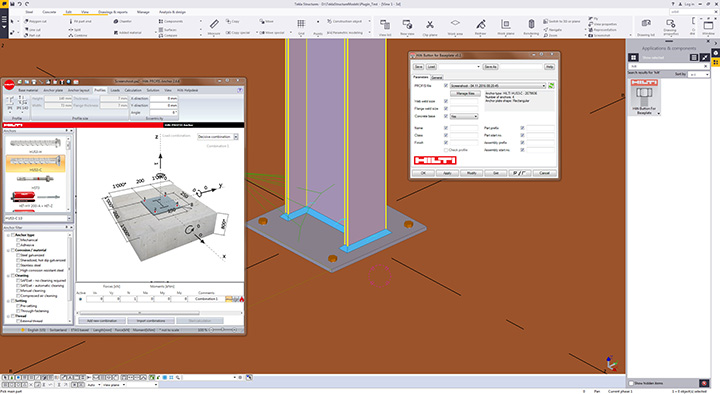
    The Hilti PROFIS Plugin for Trimbe's Tekla Structures.
    The Hilti PROFIS Plugin for Trimbe’s Tekla Structures.

    New software and data exchange solutions include:

    • Sharing design information between software applications — Hilti PROFIS Plugin for Tekla Structures allows engineers and detailers to apply PROFIS design information directly in a Tekla Structures model through the Trimble Connect collaboration platform.
    • Easy access to data in the cloud — Hilti’s total stations POS 150/180 and PROFIS Layout Office solutions, and PROFIS detection solutions are now integrated with the Trimble Connect collaboration platform, enabling data to be easily exchanged and shared with others.
    • More design content, specification information and pricing at a user’s fingertips — Hilti has significantly increased its design content in the Tekla Warehouse to include anchors and cast-in solutions as well as providing more than 7,000 items through Trimble’s TRA-SER and LuckinsLive pricing services.

    Since 2010, Trimble and Hilti’s relationship has been built upon shared values that focus on a deep understanding of customer needs and harnessing innovation to develop value-added solutions that increase customer productivity.

    Hilti Corporation supplies the worldwide construction industry with technological products, systems, software and services.


  • Data collection of WGS 84 information — or is it?

    Location, location, location. It’s not just the tagline for real estate and sales; it’s about all of us, all of the time.

    Thanks to technology, everything revolves around location these days. It is in our cars, smartphones, exercise trackers, and even our packages. GPS has revolutionized so many things in our lives, but most people do not know how it truly works. They get the general idea of satellites beaming radio signals to Earth and translated into a position on the Earth, but that’s as far as it gets for most.

    Understanding the location relationship by points on the face of the Earth is something much more involved and gets quite complicated. Thanks to sophisticated computers and programming power, this complex bundle of formulas and computations are solved behind the scenes with little effort. All we know is that when our location shows up on our phone, we can share it with friends and family, search for the closest coffee shop, or have it tell us how long until we get home.

    This also affects professional surveyors more than many of them truly understand. The introduction of GPS has allowed many to produce work products with greater efficiency, but without understanding the true geodesy, math and positional accuracies behind the technology.

    Let’s take a look back in time to understand where we have come, to better understand why knowing the basis of datums is so important:

    IN THE BEGINNING

    Until the early 1900s, surveyors only measured what they could see and didn’t allow for any curvature of the Earth, (it is round, by the way…). Only after the introduction of long-baseline survey projects was there any consideration for adjustment to survey measurements.

    Extensive surveying observations were performed nationwide to establish a network of standardized horizontal positions throughout the land. Using least-square adjustment methods originally developed by Carl Friedrich Gauss to help with estimation of orbital movement of the planets, this network was developed using the Clarke Ellipsoid of 1866 with a base point of Meade’s Ranch, Kansas.

    The observed location of the initial point was determined at 39°13’26.686” North latitude, 98°32’30.506” West longitude; from here, all latitudes and longitudes are measured using the Clarke Ellipsoid for reference.

    This datum, called the North American Datum of 1927 (NAD27), was used extensively by government surveyors and geodesists for many decades, but because of the highly involved mathematics involved in the computations, very few private surveyors were trained to work within the datum.

    More than 26,000 survey stations were used in the computation of NAD27, all being manually observed and measured. The electronic distance meter and long-range theodolite help proliferate more reference points over time, but still required heavy-duty computation to determine results for the new positions.

    THE COMPUTER AGE

    The implementation of computers, both mainframe and personal computers, allowed for further development of programming that analyzed survey data faster and more accurately than humanly possible. This technology allowed geodesists to compute positions with more reliable results, but still lacked significant involvement by professional surveyors.

    As I’ve covered in previous articles, the development of a global positioning system by the Department of Defense created the ability to establish locations nearly anywhere. Their work started in the late 1950s with the development of an inter-continental geodetic system (World Geodetic System 1960 or WGS 60) to work with other nations. Continued refinement in the WGS data allowed for the development of a new geodetic datum that would be Earth-centered rather than the fixed-station method used by NAD27.

    In addition to the measuring method, there was also a much larger number of monuments now available for implementing into the new system. Approximately 250,000 points were included in the initial database for the new datum along with additional terrestrial and Doppler satellite data to create the North American Datum of 1983 (NAD83). Improvements with NAD83 over NAD27 included the correction and improvement of data distortion from earlier observations through the increased densification of information.

    A big difference from the previous datum was the use of the Geodetic Reference System of 1980 (GRS80) instead of the previously implemented Clarke Ellipsoid. It also offered global projection rather than localized realization of data. Because of these large differences based on projection methods, use of a larger ellipsoid and basis of coordinate values, it is somewhat easy to distinguish the difference between the two datums. But like life itself, everything is subject to change.

    BUT CHANGE IS INEVITABLE

    nga-logoThe National Geospatial-Intelligence Agency (NGA) published a Standardization Document in July 2014 outlining WGS 84, its parameters and history, along with the intended relationship with local geodetic systems.

    The standards covered in the document included:

    • Coordinate Systems
    • The use of GPS in the development of the WGS84 Reference Frame
    • Ellipsoid and its defining parameters
    • Ellipsoidal Gravity formula
    • Earth Gravitational Model 2008 (EGM2008)
    • EGM2008 Geoid Model
    • The World Magnetic Model (WMM)
    • WGS 84 relationships with other Geodetic Systems
    • Accuracy of WGS 84 and its models
    • Implementation Guidelines

    NGA continues to improve and refine the WGS 84 reference frame in order to standardize all future GNSS measurement. Let’s take a look at a few more specific characteristics of our current reference frames.

    WGS 84 BASICS

    The WGS 84 Coordinate System is a Conventional Terrestrial Reference System (CTRS). It has a right-handed, Earth-fixed orthogonal coordinate format. The system origin also serves as the geometric center of the WGS 84 ellipsoid, and the Z-axis serves as the rotational axis of this ellipsoid of revolution.

    It was established in 1987 with the intent of aligning with the Bureau International de l’Heure (BIH) Terrestrial System, also known as the BTS reference frame. Initial accuracies of the reference frame were 1-2 meters; ongoing refinement was important to the NGA team and development continued.

    The WGS 84 Reference Frame has been updated six times, with revisions taking place in 1994, 1997, 2002, 2012 and 2013. These updates are intended to incorporate international conventions and to align with the International Terrestrial Reference Frame 2008 (ITRF2008).

    Environmental changes in updated models and methods have begun to make discrepancies in the relationship between the reference frames, so improvements have been made to cause these periodic changes to the WGS 84 frame. The intent and result of each revision has been to improve its accuracy and precision, so applying constraints to WGS 84 in order to align it with ITRF results in maintaining continuity with other GNSS worldwide.

    With this latest revision to the WGS 84 reference frame, WGS 84 (G1762), the transformation differences with the International GNSS Service (IGb08) is essentially zero. This means users of the latest version of WGS 84 can use the data in its original state to translate to international measurements when necessary.

    ITRF2008 was recently updated to ITRF2014, but maintains its consistent relationship with WGS 84 (G1762) with centimeter-level accuracy.

    The original WGS 84 reference frame is still used by most consumer-grade GPS devices (smartphones, vehicle navigation, etc.). It has retained the original major-axis value to eliminate the need for various updates and modifications for these devices and mapping software. This allows existing collections of geospatial data to retain its values and not be subject to transformation or additional computation.

    NAD83 BASICS

    The NAD83 coordinate reference system is a horizontal adjustment of existing data from previous surveys, Doppler and Very Long Baseline Interferometry (VLBI) data. The geocentric datum is earth-centered/Earth-fixed, utilizes the GRS80 ellipsoid, and is intended to be identical to the original WGS 84 reference frame with the origin at the center of the mass of the Earth.

    The implementation of GPS-based data collection uncovered a discrepancy with the originally calculated center of the reference frame of up to 2 meters. This revelation rendered the reference frame flawed under its original configuration with positional errors up to 1-2 meters being commonplace.

    By 1997, additional observation data was introduced along with application of high-accuracy reference network (HARN) information to greatly increase horizontal accuracy. This was followed by the addition of continuously operating reference station (CORS) data through 2002, and then by the implementation of the National Spatial Reference System (NSRS) in 2007. The last major re-adjustment occurred in 2011 with more observation and CORS data.

    It is from this framework that the State Plane Coordinate (SPC) systems were developed for localized use. Transformation parameters were created to allow smaller coordinate values for easier use in all types for mapping and data collection. This is also where most surveyors were introduced to a simplified form of geodesy, but without the complicated formulas generally associated with its use.

    Hardware and software enhancements have made the implementation of SPC systems much easier than past computations. The continued refinement of the NAD83 system through significant adjustments and equipment upgrades has given the surveyor a lot of confidence in this system, but I still caution our profession to promote QA/QC programs to verify the information being collected. GPS data acquisition techniques are not infallible and appropriate caution during use is still required.

    SYSTEM COMPARISON

    The concept of a world geodetic system is to provide a globally dedicated reference system and to minimize or eliminate the need for local systems. The usual reason for a local coordinate system was to meet the needs for an area before the implementation of a larger system was possible. So often, the worst part of having and maintaining a horizontal system separate from a world system is the means and methods of transformation/translation of data.

    In the meantime, here are a few of the main differences between WGS 84 and NAD83:

    • While both use a similar ellipsoid, they differ slightly and thus create different results.
    • The coordinate system for WGS 84 is geographic, and the NAD83 system is projected.
    • WGS 84 values are points in space, while NAD83 coordinates are physical locations on the Earth.
    • WGS 84 is based upon the NAVSTAR satellite system, and the NAD83 system is based upon a network of ground points, observation data and CORS.
    • WGS 84 ellipsoid is defined as a geocentric, equipotential frame, whereas NAD83 considers GRAV-D data collection and tectonic plate velocities.
    • While the original WGS 84 system aligns with the NAD83 (1986) adjustment, further refinement of WGS 84 has been completed to maintain similarity to ITRF realizations.


    Until there is a redevelopment of the GPS system (including hardware), we must realize the limitation of each system and work together to make sure the relationship is understood by all who work with it.

    DATA COLLECTION NOTES

    With the advances in GNSS receivers, data collectors and RTK network opportunities, GPS data has proliferated greatly in the past 20+ years. What began as simple data collection with complex computing necessary to determine positional values has now turned into a plethora of available systems at your fingertips. Surveyors are now considered an “expert” in geodesy overnight, with very little education or knowledge of what they are truly measuring and publishing for coordinate and geodetic values.


    A majority of GPS data collection happens in a real-time network (RTN) scenario: (1) with a base station on a published coordinate point or OPUS-derived value, or (2) with a cellular-based RTN. Both situations are typically constrained by built-in NAD83 parameters within the data collector software to produce localized or state plane coordinate values. For projects that rely on these coordinates, these methods are perfectly acceptable.

    google-earthWhere the fork in the road appears is when geodetic values are required for data collection of geographic information system (GIS) database creation. Many GIS users understand the difference between WGS 84 and NAD83 data, whereas the typical professional surveyor does not. The data required for GIS use (such as Esri, Google Earth and Microsoft Virtual Earth) is typically defaulted to WGS 84 because most mapping is done for use by those with the simplest needs: the consumer. Consumers are using GPS in many personal devices, and keeping the programming and mapping requirements simple is key to their success. Excessive accuracy is not necessary when it comes to these devices, so a meter or two variations is perfectly acceptable. That is why the original WGS 84 reference frame is programmed into these devices and is still utilized for most large-scale mapping needs. But what happens when the mapping needs to be more precise?

    The need for precise data collection gets us back to the surveying community. Information collected by most surveyors is assumed to be in WGS 84 because “That’s what my data collector told me it was.” Ideally, the best way to gather actual WGS 84 values is to occupy the required locations and collect satellite data using a stationary, dual-frequency GPS receiver and noting the correct epoch and associated fixed-station GPS coordinate data used. Locations derived from data collected in local coordinate systems and transformed to WGS 84 values will be subject to characteristics and distortions potentially affecting the local system. This leads your subject data down an uncertainty path that may not be acceptable to your delivered product.

    Typically, data collected in NAD83 (2011) is in the 1- to 2-meter accuracy range from WGS 84 as previous discussed. These accuracies are not usually acceptable in the surveying world and hopefully not in most GIS base-layer situations either.

    One of the best solutions for high-accuracy data collection that will be more compatible with GIS database needs is to start your data collection with ITRF-based points, if possible. This method keeps your data consistent with current WGS 84 reference frame parameters and will fit seamlessly into most systems as required. Most hardware and software systems allow for its implementation as a coordinate system option and is just as easy to use as our normal NAD83 based systems. This helps provide less headache with data correlation to the client’s requirements and keeps the playing field closer to level.

    For surveyors, here’s the bottom line: our responsibility is to provide the client data in the most accurate and precise condition possible. Our profession needs to re-educate ourselves to better understand what the data collector is truly producing rather than relying on a wing and prayer that it meets the client’s needs.

    Think back to your early math class days; we spent many hours learning trigonometry functions by hand before we were turned loose with a calculator with sin, cos, and tan buttons. Learning longhand what was being produced helped us to understand how those complex calculations were completed.

    We need to think of this GPS data collection process in the same manner, and not just hope the “ghost in the machine” spits out the right numbers for the project. The worst thing you can tell a client is that you “think” the data is correct because you’re just not sure…

    BUT THERE IS GOOD NEWS…

    The good news for geographic data users in the United States is that the National Geodetic Survey (NGS) is working on a new datum that will incorporate radical new changes in combining horizontal and vertical datums. Visit the NGS website for more information. The initial framework sounds very robust and user-friendly, so keep your eyes and ears open for more details as they develop. I’m looking forward to the new system and so should surveyors everywhere.

    The problem sometimes with technology is that it moves forward so quickly  that good innovations get passed over due to previous acceptance and reluctance to upgrade (such as Sony Betamax, Microsoft Zune, etc.). This has been true with geodetic datums and the introduction of GPS for mainstream use. It will be an age-old issue, but I look forward to better and brighter days ahead.

    Now, where did I leave my trusty Junior Geodesist Secret Decoder Ring?
  • Eos introduces photogrammetry software for drone photography

    Eos Systems Inc. has introduced new photogrammetry software optimized specifically for photographs taken with drones or unmanned aerial systems (UAS).

    The new PhotoModeler UAS 2016 creates 3D models, measurements, and maps from photographs taken with ordinary cameras built-in or mounted on drones. It has numerous features for operation with drone photos, including post processing kinematics (PPK), volume objects, full geographic coordinate systems support, multispectral image support and control point assist.

    Eos Systems will be showcasing PhotoModeler UAS Oct. 31 to Nov. 2 at the Commercial UAV Expo in Las Vegas, and will offer the new software at 35 percent off the normal price Nov. 1-30.

    eos-photogrammetry-wThe new version of PhotoModeler is suited for drone photogrammetry applications, including surveying, ground contouring, surface model creation, stockpile volume measurement, mining and mine reclamation, environmental analysis, slope analysis, forensic analysis, construction and agricultural crop analysis.

    New applications for drone photogrammetry are developed monthly. Eos PhotoModeler was introduced 23 years ago and has become one of the leading photogrammetric software platforms with a wide range of users in fields such as architecture, engineering, surveying, research, manufacturing and forensics.

    PhotoModeler UAS 2016 software includes numerous features that provide higher performance in drone photogrammetry. Camera calibration is optimized for high accuracy with UASs and GPS. Post processed kinematics (PPK) makes it possible to correct a survey with GPS data after the fact for survey grade accuracy.

    Volume objects provide easy and accurate volume data for stock piles and mining operations. Full geographic coordinate system support enables users to work in their local geographic coordinate system for better compatibility. Support is provided for multispectral images including Normalized Difference Vegetation Index (NDVI) surface models and orthomosaics for precision agriculture. An intuitive interface is provided for efficiently marking ground control points.

  • After the storm: Drone flights enable speedy cellular inspections

    After the storm: Drone flights enable speedy cellular inspections

    verizon-inspection-w
    Hurricane Matthew, which formed Sept. 28 and dissipated Oct. 10, brought torrential rains to the Carolinas, causing widespread flooding. The above is a screenshot from a drone inspection video.

    In the wake of Hurricane Matthew, Verizon used drones for cell-site inspections in North Carolina and South Carolina. The aerial survey shortened cell-site recovery to hours compared to potentially days, based on the severity of flooding.

    The quadcopter used was operated by Measure UAS, which conducted the flights with Federal Aviation Administration (FAA) authorization.

    Flights used a two-person crew that included a ground pilot for the UAS, and a visual observer of the operation for safe, legal and insured operations, Verizon said.

    While Verizon was able to access most hurricane-affected sites quickly to assess damage, some sites were not accessible because of extreme flooding. That’s where the UAS came in.

    Streaming in HD

    The UAS was able to livestream and record high-definition video and high-resolution photographs of a cell site.

    The first flight to a site surrounded by water near Elm City, North Carolina, and the Tar River Reservoir showed engineers that the base-station equipment — which was elevated on stilts — was not underwater and had not suffered visible damage.

    After determining the site was safe to access, Verizon’s Network team secured an air boat and refueled the generator, bringing the site back into service within hours.

    Verizon completed successful cell site inspection trials earlier this year in New Jersey providing valuable 3D imagery and system performance data via UAS.Now the company has several vendors to aid Verizon’s network maintenance and operations.
    airborne service

    In October, Verizon conducted the first trial with Verizon’s Airborne LTE Operations during an emergency management and disaster recovery exercise in Cape May, New Jersey.

    The exercise simulated how Verizon’s network could provide 4G LTE coverage from a 17-foot wingspan UAS operated by American Aerospace Technologies (AATI) to first responders in an area impacted by a severe weather event where no wireless service is available.

    While this is the first simulation in an emergency scenario, AATI and Verizon are conducting trials nationally testing connectivity between manned and unmanned aircraft and Verizon’s 4G LTE network, including in-flight connectivity.

  • DJI joins Propeller Aero on turnkey solutions

    DJI joins Propeller Aero on turnkey solutions

    See also Propeller Aero’s ground-control points aim for UAV accuracy.


    Drone-maker DJI has partnered with UAV software company Propeller Aero to launch an integrated solution to reduce costs, improve safety and drive operational efficiency in the construction and mining industries.

    The partnership integrates DJI’s commercial-grade aerial platform, the Matrice 100, with Propeller’s cloud-based software specifically designed for surveying and inspection.

    The solution provides enterprises and commercial UAV operators a simplified, quick and efficient way to automate operations and access data. It will enable businesses to accurately perform site measurements and volumetrics and share data seamlessly with just a few clicks, the companies said.

    Rory San Miguel (left) and Francis Vierboom, co-founders and CEOs of Propeller Aero, display the new Aeropoints product. (Photo: Propeller Aero)
    Rory San Miguel (left) and Francis Vierboom, co-founders and CEOs of Propeller Aero, display the new Aeropoints product. (Photo: Propeller Aero)

    Sydney Start-Up. Propeller Aero was founded in 2013 in Sydney, Australia, when Rory San Miguel and Francis Vierboom first got hooked on drone technology. They wanted to bring drones to industries like mining and construction, where they thought the technology was really going to “grow up.”

    They set about joining Australia’s regulated drone industry by applying for their drone pilot licenses. While waiting for the paperwork, they created an online app to share data from their trial flights.

    Figuring out the best ways to process, visualize and use UAV data ended up being more exciting to San Miguel and Vierboom than actually flying the drone.

    Propeller Aero provides cloud-based software that streamlines data processing and simplifies the way data is used and shared. The software package provides web-based geospatial data processing, analytics and instant volumetric calculations for a range of professional applications. It has been adopted by commercial drone operators and enterprise clients in 60 countries.

    Deploying UAVs for surveying and inspection can reduce costs, minimize workplace hazards and improve operations, especially for businesses that operate in quarries, construction sites and asset infrastructure.
    “Being from Australia, Propeller Aero has had the considerable advantage of developing alongside the industries that have been using commercial UAVs since 2002,” said Michael Perry, DJI’s director of strategic partnerships.

    DJI’s Matrice 100. The Matrice 100 platform has DJI’s technology built in, including GPS, the flight controller, the propulsion system, DJI Lightbridge, a dedicated remote controller and a rechargeable battery. The system automatically manages complex tasks required for flight.

  • Propeller Aero’s ground-control points aim for UAV accuracy

    Propeller Aero’s ground-control points aim for UAV accuracy

    Aeropoints are desgined for for companies across the industrial sector — including mining, construction, quarries and landfills.
    Aeropoints are desgined for for companies across the industrial sector — including mining, construction, quarries and landfills.

    Propeller Aero has introduced AeroPoints — smart ground-control points designed to make it easy to capture survey­accurate mapping using drones.

    The patent-­pending technology provides a simple solution to a major roadblock to widespread commercial drone adoption: accuracy.

    Typical ground control requires establishing precise geolocation position using surveying equipment, and then securing a visible ground marker exactly on the pre­-marked GPS point.

    AeroPoints are portable ground-control markers, visible from the air and capable of quickly capturing their own positions down to 2-centimeter absolute accuracy.

    AeroPoints work with any camera or drone, and integrate seamlessly with Propeller’s cloud­-based data platform and processing engine (see above story). They’re solar­-powered, durable and weather­ resistant, and they don’t require any on­site connection.

    To use AeroPoints, customers simply lay them down, fly their drone, and then pick them up again. They automatically connect to a wireless or mobile hotspot when back in range to upload captured positional data — and precision georeferencing is done.

    See also DJI joins Propeller Aero on turnkey solutions.

  • DJI and Datumate partner on site survey solution

    DJI and Datumate partner on site survey solution

    DJI and Datumate have begun offering a drone, software and app package that fully automates and expedites site surveys.

    Tailored for professional surveying jobs, the DJI-Datumate Site Survey Solution simplifies the surveying and mapping processes, while maintaining superior accuracy. Shenzhen-based DJI is the world’s top aerial-imaging company. Israel based Datumate is a leader in automated “field-to-plan” surveying solutions.

    dji-datumate-surveysolution-wThe DJI-Datumate Site Survey Solution is a comprehensive and professional package of imagery and mapping tools that help surveying, construction, inspection and infrastructure companies quickly generate a working model, site visualization, analytics and plan.

    The solution includes “Triple D” bundles of DJI Drone, DatuFly tablet app for an automated and expeditious aerial photography, as well as DatuGram 3D photogrammetry software that converts aerial and ground images to high-precision, geo-referenced 2D maps and 3D models.

    “New drone regulations expedite the adoption of drones in a wide range of surveying related applications,” said Paul Xu, DJI’s director of enterprise solutions. “We believe that DJI-Datumate Site Survey Solutions offer a professional and cost-effective end-to-end solution for the surveying, infrastructure-mapping and inspection markets.”

    DatuFly software generates a flight and image-taking plan for the DJI Drone, based on the best practice requirements of DatuGram 3D photogrammetry, ensuring survey-grade accuracy, high quality and quick results.

    “We are excited to partner with DJI to automate and digitize the entire field-to-plan process. Our mutual solution brings site visualization and analytics quickly to the office, keeping field and office work effortless and safe,” said Datumate CEO Tal Meirzon. “DJI-Datumate Site Survey Solutions are an important step forward in professional surveying, construction infrastructure-mapping and assets inspection.”

    DJI-Datumate Site Survey Solutions are available globally from the DJI online store, as well as through DJI and Datumate dealers.

  • Sensor integration key at InterGeo

    Last year at InterGeo 2015, UAVs ruled, for at least the second year in a row, although some of its newest-thing gloss seemed to be wearing off. This year, sensor integration in both hardware and software is a dominant theme — and one with broader implications and applications.

    GNSS positioning technology, aided in many cases by laser scanning, other imaging sensors, total stations, Lidar and camera systems, all collaborating as inputs to mobile mapping systems or machine-control systems, together form a durable platform for many present and future applications.

    NavCom booth at InterGeo.
    NavCom booth at InterGeo.

    Among the GPS/GNSS companies exhibiting here: CHC Navigation, ComNav Technology, Eos Positioning Systems, Hemisphere GNSS, Navcom Technology, NovAtel, Septentrio, and Tallysman.

    “I think it’s a must for every surveyor to participate and get updated with all the developments,” said Chryssy Potsiou, president of the International Federation of Surveyors (FIG), “to try to make the best combination of tools and software so that we can have the best output, in order to provide reliable services at affordable prices, in short time.  The world needs solutions, cheap and fast.”

    Smart Cities. Along with the roar of the four connected exhibition halls where many new products are being rolled out on this premier world stage, there is a lot of talk — a lot of talk — in the presentation auditoriums about vision, and smart cities, and connectedness in it many forms, electronic and otherwise.

    The international trade fair for geodesy, geoinformation and land management, InterGeo can be overwhelming, with roughly 550 exhibits from 33 countries, and 16,000 visitors from 92 countries. It spans everything from surveying, geoinformation, remote sensing and photogrammetry to complementary solutions and technologies, processing, using and analyzing geodata over the Internet and exploring new applications and solutions — it’s all here. Themes include mobility, energy supply, climate protection, and liveable cities and rural areas. Citizen involvement, data protection, data security and e-government all play a key role in future developments. This year, the conference published a pre-show report on geodata and what it calls Business World 4.0.

    Host city Hamburg, an economically strong, vibrant city and one of the top three shipping ports in Europe, embraced digital strategy at an early stage. Sustainable city planning, climate protection, an intelligent mobility concept and IT-controlled port management are all aspects of the city that could not work without geodata.

    Making Connections. “Our [geospatial] industry is now more and more related, more and more embedded with many other disciplines,” said Nigel Clifford, CEO of Ordnance Survey UK, who gave one of the conference keynotes. “One of the key questions we are facing is: What skills will the workforce of the future need to have, in order to flourish in this interconnected world?

    “Some of the more obvious ones are digital capability, looking at data sciences. Also we spoke about some of the softer skills: the ability to look across disciplines, the ability to work with different functions, and really importantly, the ability for our industry to explain its value and be part of the decision-making which is going on around us all the time.

    “We’re beginning to see the first fruits of the Internet of Things. There may be some inflated expectations at this point. It’s our job to test that.  I’m confident there are some brilliant use cases developing over the next five years in the fields of health, transport, and community engagement. Making a city more efficient, more livable, more secure, and more business-friendly, to draw tax dollars into the equation. What we’re able to do today is so much more data-rich, so much more connected, than we’ve ever been able to do before. ”

    He cited pilot public-private partnership projects in Manchester and another unnamed UK city going forward in this regard, with involvement from Cisco, Siemens, and British Telecomm along with Ordnance Survey. “It’s a mixed economy coming together, because there isn’t one answer.”

    Looking into the future, he said “Developing nations in particular require a fundamental geospatial fabric in order to boost themselves. I hope there will be a broadening of the focus from what we can do absolutely at the cutting edge of technology with reasonably affluent societies, to thinking about how we can take that into the less affluent societies, and raise all boats through the efforts of this great industry.”

    Gorillas Enter Room. Intel has taken a stake in the commercial drone space with its new Falcon UAV. “Predominantly, we are looking at inspections, construction, agriculture, as well as 3D modeling.” The company was joined by Oracle and Autodesk as first-time exhibitors at the show, and they did not enter timidly; big stands.

    UAV über Deutschland. In moves shadowing those in the United States, the German Minister for Transport spoke about introducing regulations to govern civil and commercial use of UAVs. The newly published draft foresees the introduction of mandatory registration for unmanned aerial systems. Pilots will need a valid license to fly drones above 100 meters.

  • Geodata key to new business world, says Intergeo report

    Geodata key to new business world, says Intergeo report

    Geodata is key to the digital future and a 4.0 business world, according to a new report released at InterGeo in Hamburg, Germany. At the heart of this business vision is the networking of sensors that must have location data in order to fulfill their value.

    ausgabeThe 116-page Intergeo Report, in parallel German and English, includes sections on smart cities, public participation, autonomous driving with live mapping, and surveying on the open seas. An eight-page GNSS Update section features CEOs answering questions market focus of their GNSS products, the role of geo-referencing in the Internet of Things, the coming-of-age of precise point positioning (PPP), and the opportunities for GNSS opened up by autonomous driving.

    Access to company-specific geodata offers managers in the automotive industry a competitive ad- vantage. Apps show today’s motorists the way to the nearest electrical charging station. Soon, the same motorists will talk to their on-board computer to find a parking space. It will guide them instantly to the nearest free space. Geoinformation will then no longer just be found in the satnav but also in the integrated sensor in the road paving infrastructure and in the status reports of other road users.

    Networking Everything. The Internet of Things is taking shape and permeating all areas of life. At its center are the tiny pieces of information that assign coordinates to a parking space, a loading berth for a container ship, a screw in the shelves of a supplier’s warehouse, or the alarm system of a family home. Degrees, minutes and seconds show people the way, answer a range of questions and help make informed decisions. Geoinformation is both an asset and an essential source of information.

    Content Is King. Key companies in the geoinformation sector have naturally taken onboard the value of geoinformation. It forms the basis of their business activities. The use of geodata as added value for their products is still very new. Esri realized early in the sector that selling software is no longer sufficient on its own. Only data enables customers to harness the value of products. Cloud solutions store the mountains of data, while platforms deliver the answers.

    Such new business leading lights as AirBnB, Uber, Facebook and Google could not survive without geoinformation. It is part of increasingly intelligent systems that make users’ lives a little easier and more comfortable, optimizing processes and enabling people to operate and participate in ways that were previously impractical or impossible.

    The examples are myriad. Consider just a few. Digitally aided planning and construction in building information modeling not only streamlines processes and reduces costs, it enables public participation in planning procedures, using digital models of planned reality. Aerial surveys and data gathering by UAV, not only for traditional survey needs but for growing requirements in natural resource planning and management, infrastructure inspection and maintenance, surveillance and security, and more. Guidance systems for the blind.

    All require location data. GNSS (satnav) is the core supplier of this data, but must be augmented by other technologies in special environments.

    Releasing Geodata Pays Dividends. Managers of geodata realize they need to release it in order for it to lead them to “more” – more value, more benefits, more transparency, more importance. Geoinformation and digitization are inextricably interlinked, and this is just the beginning.

  • Firmware update for inertial Ekinox and Apogee sensors

    SBG Systems displays their full range of MEMS-based inertial sensors at InterGeo 2016, with a major firmware update for its Ekinox and Apogee product lines. The key improvements in the update include a 15% improvement on orientation and navigation data and better robustness under harsh environments. This firmware is a complete rework of existing functionalities with the addition of new features and improved configuration interface to ease device configuration.

    Performance. Up to 15% inertial navigation system (INS) performance improvement from a reworked data fusion algorithms; and improved performance using NMEA GNSS aiding.

    Ease of use. Alignment and new status flags have been added to ensure the unit reaches optimal accuracy. The unit can now compute and output on each port a full deported navigation and ship motion data. A completely reworked web interface with 3D views eases mechanical installation. Stability and reliability improvements are reported, especially while using two GNSS at the same time

    Various input and output protocols have been added. See SBG Systems website for further information.

  • Analyzing NGS’ GPS on benchmark dataset used to make GEOID12B — Part 9

    Analyzing NGS’ GPS on benchmark dataset used to make GEOID12B — Part 9

    These columns have focused on procedures and routines for establishing GNSS-derived orthometric heights. There are many ways to analyze and investigate GNSS data and adjustment results. I have provided some basic concepts that I believe are important for users to understand.

    The selection of constraints is a very important part of establishing accurate and consistent NAVD 88 GNSS-derived orthometric heights. All of the analysis and recommendations have been based on using the National Geodetic Survey‘s latest scientific geoid model.

    I recommend first performing the analysis using the scientific geoid model because the hybrid geoid model has been warped to be consistent with the published NAVD 88 values. However, as mentioned in Part 7 (June 2016), in practice, GNSS-derived orthometric heights are incorporated into the NAVD 88 using the latest hybrid geoid model GEOID12B. This column will focus on the NGS “GPS on BMS (GPSBM)” dataset that was used to create the hybrid geoid model.

    As mentioned in Part 3 (October 2015), the hybrid geoid model is designed to fit the published NAVD 88 leveling-derived orthometric heights. Saying that, the GPSBM dataset can be used to identify potential issues in the NAVD 88 published orthometric heights. GNSS users should be familiar with this dataset and how it can be used in their analysis. This column will provide tools and routines that can be used to identify potential issues in NAVD 88 heights and/or NAD83 (2011) published ellipsoid heights.

    The National Geodetic Survey provides information on the bench marks occupied by GPS that were used to make GEOID12B.

    The write up from the NGA website is given below. I have highlighted a few sentences that I’ll address in this column.

    Write up from: GPS On Bench Marks (GPSBM) Used To Make GEOID12B

    Each of the below regions uses variants of the NAD 83 reference frame and a local vertical datum. Several versions of NAD 83 exist conforming to significant plates: Pacific, Mariana, and North America. Likewise, each region has its own vertical datum. It is not possible to level across water, so islands will have selected a tide gauge to serve as the local datum point and all leveling is tied to that site. The only exception to this is Hawaii. No tide gauge was selected in the Hawaiian Islands and no vertical datum has been established as of yet. Hence, GEOID12B in Hawaii transforms between NAD 83 (PA11) and the same geopotential (geoid) surface as the USGG2012 model ( W0 = 62636856.00 m**2/s**2).

    Items that are listed in the below table include the final GPSBM files for each region as both Excel spreadsheets and text files as well as thumbnail images linked to larger images showing the distribution of the GPSBM’s. Alaska and the island regions are more consistent, so not many points were dropped and each is provided in its own spreadsheet/text file and identified with the appropriate ellipsoidal reference frame and level datum (see below).

    The most significant work occurred in the COnterminous United States (CONUS). For CONUS, there were 24,782 points with 911 rejected leaving 23,961. These were supplemented from the OPUS-database with 737 points of which 238 were rejected leaving 499. There were also 579 points in Canada with 5 rejected leaving 574. In Mexico, there 744 of which 497 were clipped since they were too far south and another 70 were rejected leaving 177. This brings a total of 26,932 points of which 1,721 were rejected or clipped and 25,211 retained for modeling GEOID12B. The data in Canada and Mexico provide continuity up to and across the U.S. borders but do not make the GEOID12B model valid in those countries.

    Points were rejected either because the State Advisor recommended it be dropped (e.g., known subsidence region), the residual ellipsoid height errors (from the NA2011 project) indicated a point was too noisy in comparison to other points in a state/region, the orthometric height was suspect, or the residual errors during geoid modeling were too high. The corresponding error flags are ‘S’, ‘h’, ‘H’, and ‘N’ as seen on the spreadsheet and text files. These points then represent the control data that were used to define the transformation between NAD 83 and NAVD 88 for CONUS.

    The control data were much simpler in other regions due to the lack of quantity (more than two orders of magnitude less). Data in these regions follows a similar pattern where some data are rejected based on the codes given above for CONUS. The columns on the right side give the respective datums realized by GEOID12B for each region.


    REGION Excel Spreadsheets GeoPDF maps Ellipsoidal Reference Frame Vertical Datum
    CONUS (xlsx)  ,  (xls) CONUS NAD83 (2011) NAVD88
    Alaska (xlsx) ,  (xls) AK NAD83 (2011) NAVD88
    Puerto Rico (xlsx) ,  (xls) PR NAD83 (2011) PRVD02
    U.S. Virgin Islands (xlsx) ,  (xls) USVI NAD83 (2011) VIVD09
    Am. Samoa (xlsx) ,  (xls) AS NAD83 (PA11) ASVD02
    Guam (xlsx) ,  (xls) Guam NAD83 (MA11) GUVD04
    CNMI (xlsx) ,  (xls) CNMI NAD83 (MA11) NMVD03

    Table 1 is an excerpt of the excel spreadsheet for the GPSBM dataset and provides a sample of the contents. The headings of the columns are fairly self-explanatory. What’s important here is that the excel spreadsheet provides the name, latitude, longitude, NGS’ PID, the ellipsoid height and orthometric height of the stations used in making GEOID12B.

    Table 1
    Excerpt of the Excel spreadsheet for GPS on benchmarks (GPSBM) used to make GEOID12B.
    table1-excerpt-gps-bench-marks

    The “GPS On Bench Marks (GPSBM) Used To Make GEOID12B” write up states that 1,721 stations were rejected and were not used in developing the hybrid geoid model. It also states that for the conterminous United States (CONUS), there were 24,782 stations with 911 rejected leaving 23,961. This column is going to focus on CONUS but the analysis can be performed everywhere.

    As the write up states, stations were rejected for four different reasons:

    • Code S – The State Advisor (now called Regional Geodetic Advisors) recommended it be dropped,
    • Code h – The residual ellipsoid height errors from the NAD 83 (2011) project indicated that the point was too noisy,
    • Code H – The orthometric height was suspect,
    • Code N – The residual errors during geoid modeling were too high.

    These rejected stations were not used to make the hybrid geoid model but since the hybrid geoid model is distorted to fit the NAVD 88, these rejected stations as well as stations nearby the rejected stations should be re-evaluated using the latest scientific geoid model, e.g. xGeoid16b.

    So, what should the user do with the GPSBM table? I recommend that users perform the following steps when analyzing the stations in the GPSBM table.

    • Step 1: Compare the modeled GEOID12B (N12B) value to the computed GPS/Leveling (h minus H) value using the following formula: Published N12B from the NGS data sheet minus (ellipsoid height from the GPSBM table minus orthometric height from the GPSBM table). We discussed this procedure a year ago in Part 3 (October 2015). It should be noted that the orthometric height in the GPSBM table may be different than the published NAVD 88 height on the NGS data sheet if the station has been readjusted since the GPSBM table was created.
    • Step 2: Repeat the procedure in Step 1 using the latest NGS experimental geoid model, e.g. xGeoid16b. At this time, NGS only provides the experimental geoid models referenced to IGS08 so the user will have to use NGS’ xGeoid16 web tool to obtain the station’s IGS08 ellipsoid height and xGeoid16b value. The input to the tool is the station’s NAD 83 (2011) coordinates (latitude, Longitude, and ellipsoid height). [An example of using the xGeoid16 web tool is provided in the box titled “Example of Using NGS xGeoid16 Web Tool.”] As discussed in Part 3 (October 2015), the user will have to remove a bias and trend based on the differences in the region.
    • The user could also transform xGeoid16b/IGS08 geoid values to xGeoid16b/NAD 83 (2011) geoid values using their own tools, and then remove a bias and trend based on the differences. Michael Dennis, a PhD candidate at Oregon State University, created an ArcGIS raster of the xGeoid16b model, where his model has been referenced to NAD 83 (Michael L. Dennis, RLS, PE, MS Civil Eng., Geodetic Analysis, LLC, 55 Creek Rock Road, Sedona, AZ 86351). He removed a trend using the GPS/Leveling data set as input; therefore, this raster file is a form of a hybrid geoid model distorted only to remove the tilt assumed to be in the NAVD 88. I will refer to this model as Geoid16B_NAD83 to avoid confusion with NGS’ xGeoid16b model.
    Example of Using NGS xGeoid16 Web Tool
    Your input in NAD83 (2011)/GRS80 Ellipsoid:
    Latitude Longitude Ellipsoid Height Station
    38 43 54.95105 79 58 19.75931 599.253 L 275
    Your Result in IGS08/GRS80 Ellipsoid:
    Latitude Longitude Ellipsoid Height
    38 43 54.98136 79 58 19.78679 597.984
    Geoid Model Geoid Height(m) Ortho Height(m) Change in Ortho Height(m)*
    GEOID12B -32.086 630.07 -0.493
    USGG2012 -31.592 629.576 0.001
    xGEOID16A -31.594 629.578 -0.001
    xGEOID16B -31.593 629.577 0
    *Orthometric height difference between xGEOID16B to model shown
    • Step 3: Use the station’s data sheet to identify how the station’s orthometric height was determined; for example, was it rigorously adjusted into the NAVD 88 (published height attribute – Adjusted). We discussed the attributes of the NGS data sheet in Part 5 (February 2016). A summary of the attributes from the NGS data sheet DSDATA.TXT file is provided in the box titled “Extracted from NGS’ DSDATA.TXT.” I have highlighted the most common attributes of the stations involved in making GEOID12B.
    Extracted from NGS’ DSDATA.TXT
    ***************************************************************************
    * dsdata.txt *
    ***************************************************************************
    There are various Vertical Control sources, as specified below:ADJUSTED = Direct Digital Output from Least Squares Adjustment of Precise Leveling.
    (Rounded to 3 decimal places.)ADJ UNCH = Manually Entered (and NOT verified) Output of Least Squares Adjustment of Precise Leveling.
    (Rounded to 3 decimal places.)

    POSTED = Pre-1991 Precise Leveling Adjusted to the NAVD 88 Network After Completion of the NAVD 88 General Adjustment of 1991.
    (Rounded to 3 decimal places.)

    READJUST = Precise Leveling Readjusted as Required by Crustal Motion or Other Cause.
    (Rounded to 2 decimal places.)

    N HEIGHT = Computed from Precise Leveling Connected at Only One Published Bench Mark.
    (Rounded to 2 decimal places.)

    RESET = Reset Computation of Precise Leveling.
    (Rounded to 2 decimal places.)

    COMPUTED = Computed from Precise Leveling Using Non-rigorous Adjustment Technique.
    (Rounded to 2 decimal places.)

    GPSCONLV = Leveled Orthometric Height tied to GPS HT_MOD Orthometric Height.
    (Rounded to 2 decimal places.)

    LEVELING = Precise Leveling Performed by Horizontal Field Party.
    (Rounded to 2 decimal places.)

    H LEVEL = Level between control points not connected to bench mark.
    (Rounded to 1 decimal places.)

    GPS OBS = Computed from GPS Observations.
    (Rounded to 1 decimal places.)

    VERT ANG = Computed from Vertical Angle Observations.
    (Rounded to 1 decimal place; If No Check, to 0 decimal places.)

    SCALED = Scaled from a Topographic Map.
    (Rounded to 0 decimal places.)

    U HEIGHT = Unvalidated height from precise leveling connected at only one NSRS point.
    (Rounded to 2 decimal places.)

    VERTCON = The NAVD 88 height was computed by applying the VERTCON shift value to the NGVD 29 height.
    (Rounded to 0 decimal places.)

    • Step 4: Use the station’s NGS data sheet to determine the adjustment date of the station’s published NAVD 88 orthometric height. We discussed this in Part 7 (June 2016). As mentioned in Part 7, if the station has a different adjustment date than other stations nearby, there could be inconsistencies due to adjustment distribution corrections and/or movement.

    Step 1 was demonstrated in Part 3 (October 2015) so we don’t need to describe the process in this column. Comparing published GEOID12B values with computed values is the first step; the difference is an indication of how well the data fit the model and can be useful for identifying large outliers. It can be helpful in prioritizing where additional observation should be obtained when there are limited resources. Provided below is an example of where to obtain the information for comparing the modeled GEOID12B (N12B) value to the computed GPS/Leveling (h minus H) value using the following formula: Published N12B from the NGS data sheet minus (ellipsoid height from the GPSBM table minus orthometric height from the GPSBM table). The user can obtain the GEOID12B value from the NGS data sheet [see box titled “Excerpt from NGS Data Sheet For Station L 275 (HW2088)”]; for this example, the GEOID12B value for station L 275 is -30.813 m. Table 2 is an excerpt from the GPSBM file that contains the ellipsoid height (599.253 m) and the orthometric height (630.016 m) for station L 275. It should be noted that the ellipsoid and orthometric heights in the GPSBM table are given in millimeters. The first row of table 3 provides the results of the computation: [-30814 mm – (599253 mm – 630016m m) = 51 mm], or 5.1 cm.

    Table 2
    Excerpt of the Excel spreadsheet for GPS on benchmarks (GPSBM) used to make GEOID12B – Stations on plots in this column.
    table2-excerpt-gps-bench-marks

    Excerpt from NGS Data Sheet For Station L 275 (HW2088)
    PROGRAM = datasheet95, VERSION = 8.9.1
    1 National Geodetic Survey, Retrieval Date = OCTOBER 1, 2016
    HW2088 ***********************************************************************
    HW2088 CBN – This is a Cooperative Base Network Control Station.
    HW2088 DESIGNATION – L 275
    HW2088 PID – HW2088
    HW2088 STATE/COUNTY- WV/RANDOLPH
    HW2088 COUNTRY – US
    HW2088 USGS QUAD – MILL CREEK (1995)
    HW2088
    HW2088 *CURRENT SURVEY CONTROL
    HW2088 ______________________________________________________________________
    HW2088* NAD 83(2011) POSITION- 38 43 54.95105(N) 079 58 19.75931(W) ADJUSTED
    HW2088* NAD 83(2011) ELLIP HT- 599.253 (meters) (06/27/12) ADJUSTED
    HW2088* NAD 83(2011) EPOCH – 2010.00
    HW2088* NAVD 88 ORTHO HEIGHT – 630.016 (meters) 2066.98 (feet) ADJUSTED
    HW2088 ______________________________________________________________________
    HW2088 NAD 83(2011) X – 867,581.099 (meters) COMP
    HW2088 NAD 83(2011) Y – -4,906,352.726 (meters) COMP
    HW2088 NAD 83(2011) Z – 3,969,521.039 (meters) COMP
    HW2088 LAPLACE CORR – 0.13 (seconds) DEFLEC12B
    HW2088 GEOID HEIGHT – -30.814 (meters) GEOID12B
    HW2088 DYNAMIC HEIGHT – 629.553 (meters) 2065.46 (feet) COMP
    HW2088 MODELED GRAVITY – 979,873.5 (mgal) NAVD 88
    HW2088
    HW2088 VERT ORDER – FIRST CLASS II
    HW2088
    HW2088 Network accuracy estimates per FGDC Geospatial Positioning Accuracy
    HW2088 Standards:
    HW2088 FGDC (95% conf, cm) Standard deviation (cm) CorrNE
    HW2088 Horiz Ellip SD_N SD_E SD_h (unitless)
    HW2088 ——————————————————————-
    HW2088 NETWORK 1.00 1.94 0.45 0.36 0.99 -0.05669181

    Table 3 contains the comparisons between modeled geoid values and their computed geoid values for five station pairs that have large relative differences. Looking at table 3 one can see that there are several large relative differences between the published GEOID12B model and computed geoid model (see column titled “N12B minus (h-H)” in table 3). This doesn’t mean that the model is incorrect, it only means that there were large relative differences that the model had to account for. As previously mentioned, GEOID12B was created to be consistent with the NAVD 88.

    Since the experimental geoid model xGeoid16b_NAD is not distorted to conform to the NAVD 88 everywhere, it should provide better information for identifying outliers and determining which stations appear to be inconsistent with its neighbors.

    Figure 1 - All GPS on BMS Residuals Using Geoid16b_NAD model (note: rejections by geoid team have been removed).
    Figure 1 – All GPS on BMS Residuals Using Geoid16b_NAD model (note: rejections by geoid team have been removed).

    Table 3
    Table of selected stations involving large relative differences depicted in plots in this column.
    (Results are provided for GEOID12B and Geoid16B_NAD Models*)
    *Michael Dennis, a Ph.D. candidate at Oregon State University, created the xGEOID16B ArcGIS raster, where the model has been referenced to NAD 83 with a trend and bias added to account for the apparent tilt in the NAVD 88. This model is denoted as Geoid16B_NAD (N16b) in this column.

    table3-excerpt-gps-bench-marks

    Figure 1 is a plot of all of the GPSBM residuals using the Geoid16B_NAD83 model. This plot indicates that there are a lot of large residuals. First, let’s define what I’m calling residuals. The residuals on my plots are the differences between the modeled geoid height value and the computed geoid height value using the ellipsoid height (h) and orthometric height (H) from the GPSBM data set; that is, residual = modeled gravity value – (h minus H). The largest negative residual is -37.3 cm and the largest positive residual is 33.8 cm.

    image012
    Figure 2 – Positive GPS on BMS Residuals Using Geoid16b_NAD model (note: rejections by geoid team have been removed).

    Figure 2 is a plot of the positive GPS on BMS residuals using Geoid16b_NAD geoid model. There are 5957 residuals greater than 5 cm (not including the stations rejected by the NGS geoid team). As you can see, it appears that most of the positive residuals are on the eastern half of the United States.

    Figure 3 - Negative GPS on BMS Residuals Using Geoid16b_NAD model (note: rejections by geoid team have been removed).
    Figure 3 – Negative GPS on BMS Residuals Using Geoid16b_NAD model (note: rejections by geoid team have been removed).

    Figure 3 is a plot of the negative GPS on BMS residuals using Geoid16b_NAD geoid model. There are 4113 residuals less than -5 cm (not including the stations rejected by the NGS geoid team). As you can see from the plot, the negative residuals appear to be more evenly distributed across the United States than the positive residuals. It does, however, appear that there are more negative residuals greater than -5 cm along the Gulf Coast, Atlantic Coast, and the Great Lakes than there are positive residuals greater than 5 cm. In addition, there appears to be a lot of negative residuals in the northeastern United States.

    image016
    Figure 4 – GPS on BMS Residuals Using Geoid16b_NAD model in North Carolina and South Carolina (note: rejections by geoid team have been removed).

    Figure 4 is a plot of the GPS on BMS residuals using the Geoid16b_NAD geoid model in the North Carolina and South Carolina border region. What’s interesting about this plot is that South Carolina doesn’t seem to have many negative residuals where North Carolina has both negative and positive residuals. We will look at this in more detail later in this column.

    image018
    Figure 5 – GPS on BMS Residuals Using Geoid16b_NAD model in Washington and Oregon Region (note: rejections by geoid team have been removed).

    Figure 5 is a plot of the GPS on BMS residuals using Geoid16b_NAD model in the Washington and Oregon Region. This graphic shows some large grouping of negative and positive residuals, especially along the Pacific Coast in Northwestern Washington State.

    Now, let’s look at some large relative differences in residuals between stations that are spatially close together. Figure 6 is a plot of large relative differences between groups of GPS on BMS residuals (using Geoid16b_NAD model) at the North Carolina/South Carolina border. In figure 6, two stations (FA1337 and FA1560) are about 20 km apart and the difference in residuals is -18.6 cm (-12.4 cm minus 6.2 cm). This is a large difference for only 20 km. What is even more significant is that the group of stations near FA1337 are all negative residuals (around -10 cm) and the group of stations near FA1560 are all positive residuals (around 6 cm), this could be an indication of a large distribution correction due to the NAVD 88 design. We discussed the distribution correction in Part 7 (June 2016). These stations definitely needs to be investigated.

    The next step in my process is to look at the NGS data sheets for these stations to determine how the stations were adjusted.

    Step 3: Look at the station’s data sheet to identify how the station’s orthometric height was determined; for example, was it rigorously adjusted into the NAVD 88 (published height attribute is “Adjusted”) or was it determined by precise leveling performed by horizontal field party (published height attribute is “Leveling”).

    The data sheet for station FA1337 states that the NAVD 88 attribute code is “GPS OBS.” [See box titled “Excerpt from NGS Data Sheet for PID FA1337.”] The data sheet for FA1560 states that the NAVD 88 attribute code is “Adjusted.” The orthometric height on the GPSBM file is different than the current published NAVD 88 orthometric height for station FA1337 (See table 3). This station’s leveling-derived orthometric height was superseded by a GNSS-derived orthometric height. Saying that, the GPSBM file only uses leveling-derived orthometric heights; therefore, stations that have been superseded by GNSS surveys are still included in the GPSBM file but their original published leveling-derived height is used for the analysis. Table 3 provides the orthometric height for FA1337 that was used in making GEOID12B. As previously mentioned, stations may be rejected by the geoid team based on the criteria outlined in the beginning of this column. Saying that, neither of the two stations were rejected by the NGS geoid team. This implies that the stations were consistent with their neighbors as far as the geoid model was concerned. Figure 6 confirms that all the stations around FA1337 and FA1560 are consistent with each other based on the Geoid16b_NAD geoid model. The fact that the two groups differ by 18 6 cm needs to be investigated.

    Excerpt from NGS Data Sheet for PID FA1337
    PROGRAM = datasheet95, VERSION = 8.9.1
    1 National Geodetic Survey, Retrieval Date = OCTOBER 3, 2016
    FA1337 ***********************************************************************
    FA1337 HT_MOD – This is a Height Modernization Survey Station.
    FA1337 DESIGNATION – RU 36
    FA1337 PID – FA1337
    FA1337 STATE/COUNTY- NC/RUTHERFORD
    FA1337 COUNTRY – US
    FA1337 USGS QUAD – FOREST CITY (1993)
    FA1337
    FA1337 *CURRENT SURVEY CONTROL
    FA1337 ______________________________________________________________________
    FA1337* NAD 83(2011) POSITION- 35 18 08.14237(N) 081 51 17.93516(W) ADJUSTED
    FA1337* NAD 83(2011) ELLIP HT- 249.869 (meters) (06/27/12) ADJUSTED
    FA1337* NAD 83(2011) EPOCH – 2010.00
    FA1337* NAVD 88 ORTHO HEIGHT – 281.79 (meters) 924.5 (feet) GPS OBS
    FA1337 ______________________________________________________________________
    Figure 6 - GPS on BMS Residuals: Large Relative Differences Between a Group of Stations at the North Carolina/South Carolina Border (note: rejections by geoid team have been removed)
    Figure 6 – GPS on BMS Residuals: Large Relative Differences Between a Group of Stations at the North Carolina/South Carolina Border (note: rejections by geoid team have been removed)

    Figure 7 is a plot of the GPS on BMS residuals using Geoid16b_NAD that depicts a large difference between two stations only 20 km apart near the Maryland/West Virginia border. I will use this station pair to demonstrate the next step in my process.

    Step 4 is to use the station’s NGS data sheet to determine the adjustment date the of station’s published NAVD 88 orthometric height.

    The NAVD 88 attribute on the NGS data sheet states that both of these stations are coded as “Adjusted” but station JW0639 adjustment date is April 1995 (see box titled “excerpt from NGS Data Sheet for PID JW0639”) and JW1296 adjustment date was in June 1991 (the General Adjustment of NAVD 88). These large relative differences could be due to inconsistencies between adjusted heights due to the adjustment distribution corrections and/or constraints imposed in the April 1995 adjustment. Bench marks near the stations should be observed to determine if the same large relative difference exists, and the 1995 NAVD 88 adjustment project report should be reviewed to determine if a large distribution correction was applied.

    Excerpt from NGS Data Sheet for PID JW0639
    1 National Geodetic Survey, Retrieval Date = OCTOBER 3, 2016
    JW0639 ***********************************************************************
    JW0639 CBN – This is a Cooperative Base Network Control Station.
    JW0639 DESIGNATION – J 17 RESET
    JW0639 PID – JW0639
    JW0639 STATE/COUNTY- MD/GARRETT
    JW0639 COUNTRY – US
    JW0639 USGS QUAD – ACCIDENT (1994)
    JW0639
    JW0639 *CURRENT SURVEY CONTROL
    JW0639 ______________________________________________________________________
    JW0639* NAD 83(2011) POSITION- 39 37 53.59739(N) 079 18 57.44776(W) ADJUSTED
    JW0639* NAD 83(2011) ELLIP HT- 701.266 (meters) (06/27/12) ADJUSTED
    JW0639* NAD 83(2011) EPOCH – 2010.00
    JW0639* NAVD 88 ORTHO HEIGHT – 732.713 (meters) 2403.91 (feet) ADJUSTED
    JW0639 ______________________________________________________________________
    *
    *
    *
    JW0639
    JW0639.The orthometric height was determined by differential leveling and
    JW0639.adjusted by the NATIONAL GEODETIC SURVEY
    JW0639.in April 1995.
    JW0639
    Figure 7 – GPS on BMS Residuals Using Geoid16b_NAD: Large Relative Difference Between Stations About 20 km Apart Along MD/WV Border (note: rejections by geoid team have been removed).
    Figure 7 – GPS on BMS Residuals Using Geoid16b_NAD: Large Relative Difference Between Stations About 20 km Apart Along MD/WV Border (note: rejections by geoid team have been removed).
    Figure 8 – GPS on BMS Residuals Using Geoid16b_NAD: Large relative Difference Between Stations 15 km Apart in Randolph County, West Virginia (note: rejections by geoid team have been removed).
    Figure 8 – GPS on BMS Residuals Using Geoid16b_NAD: Large relative Difference Between Stations 15 km Apart in Randolph County, West Virginia (note: rejections by geoid team have been removed).

    Figure 8 is a plot of GPS on BMS residuals using Geoid16b_NAD that depicts a large relative difference between stations 15 km apart in Randolph County, West Virginia. This plot involves station HW3677 which has a published NAVD 88 attribute of “Leveling.” (See box titled “Excerpt from NGS Data Sheet for PID HW3677.”) The excerpt from the data sheet has the following statement: “The orthometric height was determined by differential leveling. The vertical network tie was performed by a horz. field party for horz. obs reductions. Reset procedures were used to establish the elevation.”

    It would be useful if stations near this station were observed by GNSS surveys to determine what is occurring in this region.

    Excerpt from NGS Data Sheet for PID HW3677
    1 National Geodetic Survey, Retrieval Date = OCTOBER 2, 2016
    HW3677 ***********************************************************************
    HW3677 DESIGNATION – GPS 1
    HW3677 PID – HW3677
    HW3677 STATE/COUNTY- WV/RANDOLPH
    HW3677 COUNTRY – US
    HW3677 USGS QUAD – MILL CREEK (1995)
    HW3677
    HW3677 *CURRENT SURVEY CONTROL
    HW3677 ______________________________________________________________________
    HW3677* NAD 83(2011) POSITION- 38 37 50.21531(N) 079 55 29.64175(W) ADJUSTED
    HW3677* NAD 83(2011) ELLIP HT- 1129.355 (meters) (06/27/12) ADJUSTED
    HW3677* NAD 83(2011) EPOCH – 2010.00
    HW3677* NAVD 88 ORTHO HEIGHT – 1159.91 (meters) 3805.5 (feet) LEVELING
    HW3677 ______________________________________________________________________
    *
    *
    *
    *
    HW3677
    HW3677.The orthometric height was determined by differential leveling.
    HW3677.The vertical network tie was performed by a horz. field party for horz.
    HW3677.obs reductions. Reset procedures were used to establish the elevation.

    HW3677

    Figure 9 is a GPS on BMS residual plot of large relative stations about 30 km apart in Wasco County, Oregon. This plot has two stations with large differences and both stations have the NAVD 88 attribute of “Adjusted.” Their NGS data sheet states that they were both established in the general adjustment of NAVD 88 in June 1991. In this particular case, the leveling in this region is very old. As described in Part 7 (June 2016), you can retrieve all project identifiers for those projects with observations to or from a station using the station’s PID. The output from the NGS Data Sheet Mark Source Routine for PID RC1228 is shown in the box titled “Output from NGS Data Sheet Mark Source Routine.”

    Output from NGS Data Sheet Mark Source Routine
    Program: mark_sources Version: 3.0 Date: May 1, 2013RC1228OR/065 J 108
    ———————————————————-
    GPS_OBS
    ———–
    GPS_OBS FORE_POINT in GPS1655
    DIR_OBS
    ———–
    DIST_OBS
    ———–
    VERT_OBS
    ———–
    LEV_OBS
    ———–
    LEVEL_OBS
    ———–
    LEVEL_OBS STAND_POINT in L3410
    LEVEL_OBS FORE_POINT in L3410***********************************************************
    Figure 9 – GPS on BMS Residuals Using Geoid16b_NAD: Large relative stations about 30 km apart in Wasco County, Oregon (note: rejections by geoid team have been removed).
    Figure 9 – GPS on BMS Residuals Using Geoid16b_NAD: Large relative stations about 30 km apart in Wasco County, Oregon (note: rejections by geoid team have been removed).

    Figure 9 is a GPS on BMS residual plot of large relative stations about 30 km apart in Wasco County, Oregon. This plot has two stations with large differences and both stations have the NAVD 88 attribute of “Adjusted.” Their NGS data sheet states that they were both established in the general adjustment of NAVD 88 in June 1991. In this particular case, the leveling in this region is very old. As described in Part 7 (June 2016), you can retrieve all project identifiers for those projects with observations to or from a station using the station’s PID. The output from the NGS Data Sheet Mark Source Routine for PID RC1228 is shown in the box titled “Output from NGS Data Sheet Mark Source Routine.”

    Excerpt from NGS Data Sheet for PID RC1228

    PROGRAM = datasheet95, VERSION = 8.9.1
    1 National Geodetic Survey, Retrieval Date = OCTOBER 2, 2016
    RC1228 ***********************************************************************
    RC1228 DESIGNATION – J 108
    RC1228 PID – RC1228
    RC1228 STATE/COUNTY- OR/WASCO
    RC1228 COUNTRY – US
    RC1228 USGS QUAD – WAPINITIA (1996)
    RC1228
    RC1228 *CURRENT SURVEY CONTROL
    RC1228 ______________________________________________________________________
    RC1228* NAD 83(2011) POSITION- 45 06 49.69715(N) 121 19 19.81396(W) ADJUSTED
    RC1228* NAD 83(2011) ELLIP HT- 624.596 (meters) (06/27/12) ADJUSTED
    RC1228* NAD 83(2011) EPOCH – 2010.00
    RC1228* NAVD 88 ORTHO HEIGHT – 646.140 (meters) 2119.88 (feet) ADJUSTED
    RC1228 ______________________________________________________________________
    *
    *
    *
    RC1228
    RC1228 HISTORY – Date Condition Report By
    RC1228 HISTORY – 1934 MONUMENTED CGS
    RC1228 HISTORY – 1985 MARK NOT FOUND USPSQD
    RC1228 HISTORY – 1985 MARK NOT FOUND USPSQD
    RC1228 HISTORY – 20001010 GOOD OR-065

    Figure 10 – GPS on BMS Residuals Using Geoid16b_NAD: Large relative Differences between Stations along the Oregon/Washington Border (note: rejections by geoid team have been removed).
    Figure 10 – GPS on BMS Residuals Using Geoid16b_NAD: Large relative Differences between Stations along the Oregon/Washington Border (note: rejections by geoid team have been removed).

    Figure 10 is a plot of GPS on BMS residuals using Geoid16b_NAD depicting large relative differences between stations along the Oregon/Washington State border. It is the near Puget Island along the Columbia River. Station SC0330 and SC1086 are only 7 km apart and the relative difference is -20 cm (-11.4 cm minus 8.6 cm). This could be an issue with the NAVD 88 network design because there doesn’t appear to be many river crossing along the river between border stations. The fact that the residuals on the Washington State side are negative and the Oregon State side are positive is an indication that the stations need to be investigated.

    Figure 11 – GPS on BMS Residuals Using Geoid16b_NAD: Large Negative Residuals North of Border between Oregon and Washington and Positive (or Small Negative) Residuals South of Border (note: rejections by geoid team have been removed).
    Figure 11 – GPS on BMS Residuals Using Geoid16b_NAD: Large Negative Residuals North of Border between Oregon and Washington and Positive (or Small Negative) Residuals South of Border (note: rejections by geoid team have been removed).

    The last figure, figure 11, is a plot of the GPS on BMS residuals using Geoid16b_NAD model that depicts large negative residuals north of the border between Oregon and Washington and positive (or small negative) residuals south of the border. This plot shows that the northern side of the river has large negative residuals all the way to the Pacific Coast. Once again, this is an indication that this portion of the NAVD 88 network should be investigated.

    This column has focused on analyzing NGS’ GPS on BM data set that is used to make NGS’ hybrid geoid models. It provided procedures that users could employ when analyzing the differences between the modeled geoid values and the computed geoid values using GPS/Leveling data. This GPSBM data set or one similar will be used to make the next hybrid geoid model, as well as provide input to the transformation model between NAVD 88 and the new 2022 Vertical Reference System. All geospatial users should help develop this GPS on BMS data set to help improve the National Spatial Reference System and future hybrid geoid models. This column provided several examples of large relative differences in residuals between neighboring stations. Each example represents stations that should investigated based on different reasons, such as a weak NAVD 88 leveling network design in the region, the station’s published height attribute code implies that the station was not rigorously adjusted into the NAVD 88, and station pairs have different adjustment dates indicating a possible adjustment distribution correction issue or movement.

    NGS has a program called “GPS on Bench Mark” to support users that occupy bench marks with GNSS equipment. This web site contains a lot of good information and provides the users with methods to recover, observe, and report information about stations in NGS’ database. The write up from the webpage is given below. I have highlighted a few sentences that the reader may find useful.


    Write up from: GPS on Bench Marks?

    What is GPS on Bench Marks?

    Improve the National Spatial Reference System (NSRS):

    Recover: Look up the description of an existing bench mark and visit the bench mark of your choice.
    Observe: Record field notes, take digital photos, and collect GPS observations or coordinates for the bench mark you visit.
    Report: Use online tools to send the information to NGS.

    Where?

    Currently there are over 400,000 bench marks across the Conterminous United States (CONUS), Alaska, Hawaii and all U.S. territories. Tidal marks and bench marks are used for determining heights. Use the maps to prioritize which bench marks to observe.

    Who can participate?

    Anyone with Global Positioning System (GPS) enabled phones, hand held devices or survey-grade GPS receivers can participate. Recommended procedures vary depending on the type of equipment used.

    When should I start?

    You can collect and share information any time. Join volunteer efforts across the United States in celebration of National Surveyors Week beginning March 20, 2016. Contact the local National Society of Professional Surveyors chapter or your NGS geodetic advisor to learn about projects being planned in your local area.

    How?

    For specific information on how to help please visit the Recover, Observe, and Report web pages that have instructions. Other resources include “Hunting for Marks!” and Geocaching Benchmark Hunting.

    Why does this matter?

    By providing GPS on benchmarks today you can help NGS improve the next hybrid geoid model, increasing access to NAVD 88, and enabling conversions to the new vertical datum in 2022.

    You can also help the local surveying community know about nearby marks by improving scaled horizontal positions and updating the mark condition or description by submitting a mark recovery.

    What happens next?

    NGS will use your data to update its databases and improve future models and tools. If you still have questions, contact the GPS on BM Team.

    In addition to participating in the NGS’ GPS on Bench Mark program, all geospatial users should participate in NGS’ 2017 geospatial summit, which will be held in April in Silver Spring, Maryland.

    This summit is an opportunity for all users of the National Spatial Reference System (NSRS) to obtain a better understanding of NGS’ plans to modernize the NSRS. Users will be able to provide feedback directly to NGS leadership. My next column will address NGS plans to replace the North American Vertical Datum of 1988 in 2022.

  • Phase One’s new aerial camera features innovative shutter design

    phaseone-ixu-rs1000-cameraphaseone-ixu-rs1000-camera-2Phase One Industrial has introduced the iXU-RS aerial camera series, featuring a breakthrough central lens shutter design, according to the company. The new shutter technology is based on an innovative direct-drive concept with electronic charging that enhances exposure speed to as fast as 1/2500s, while guaranteeing half a million exposures, an unprecedented shutter life span.

    The series’ flagship 100MP iXU-RS1000 camera system, with the advanced lens shutter, an exceptional capture rate of 0.6 seconds per frame and its CMOS sensor with superior light sensitivity of 50-6400 ISO, is uniquely designed to expand the efficiency of aerial imaging operations, including under deteriorating weather conditions or on days that were previously not conducive to image capture. This allows for faster flights and larger surface coverage.

    For a small-bodied medium format camera, the iXU-RS1000 offers a large-format-quality experience thanks to its sensor technology and high-performance optics, which can deliver 11,608 pixels cross-track coverage. Users can gain more image coverage during a flight, while maintaining the same ground sample distance (GSD), or a lower GSD, while flying at the same height. Its small form factor supports multiple uses — as a standalone camera for photogrammetric work or as part of an array (to cover a larger swath) or as part of an oblique camera system.

    Other iXU-RS series cameras include the 80MP iXU-RS180, and 60MP iXU-RS160 and 160 Achromatic systems. All iXU-RS series cameras feature accurate metric calibration, scalability to form multi-camera arrays, and easy integration with popular flight management systems and GPS/IMU receivers. There are seven available lens options, including: 32mm, 40mm, 50mm, 70mm, 90mm, 110mm and 150mm. Lenses have been designed and built for aerial photography by Rodenstock and Schneider Kreuznach, and factory calibrated for infinity focus.

    Easily integrated into existing or new set-ups, the cameras offer maximum connectivity with diverse systems and help operators execute and manage missions, such as: surveying, mapping, critical infrastructure inspection and many other applications with greater reliability, cost effectiveness and operational efficiency. The iXU-RS1000 is also suited to four band-imaging applications.