Harxon, a high-precision GNSS antenna manufacturer in China, has released a new GNSS + L-band antenna.
The GPS1000 receives GPS L1/L2/L5, BDS B1/B2/B3, GLONASS L1/L2, Galileo E1/E2/E5a/E5b and L-band frequencies, which can be used in land survey, marine survey, channel survey, seismic monitoring, bridge survey, container operation and agriculture applications. Customers can use the same antenna for GPS only or dual-constellation applications.
It has high gain and wide beam width to ensure the signal receiving performance of satellite at low elevation angle. The phase center of this antenna remains constant as the azimuth and elevation angle of the satellites change. Signal reception is unaffected by the rotation of the antenna or satellite elevation, so placement and installation of the antenna can be completed with ease.
The GPS1000 is housed in a IP67 waterproof enclosure for permanent installation, and maintains good performance in a variety of harsh environments. Plus, it can be customized by Harxon for the best solution for customers. Orders can be placed at www.harxon.com.
Tallysman, a manufacturer of high-performance GNSS antennas, has introduced two additions to its VeraPhase line of precision antennas.
The VP6300 is a triple-band antenna for reception of GPS L1/L2/L5, GLONASS G1/G2/G3, BeiDou B1/B2 and Galileo E1/E5a+b (1165MHz to 1254MHz + 1560MHz to 1610MHz).
The VP6200 is a dual-band antenna for reception of GPS L1/L2, GLONASS G1/G2, BeiDou B1/B2, Galileo E1 and the L-Band correction services (1195MHz to 1254MHz + 1525MHz to 1610MHz).
Both antennas have been calibrated by the U.S. National Geodetic Survey (NGS) and are designed for high-precision applications such as real-time kinematic (RTK), precise point positioning (PPP) and other applications where precision matters.
For OEM manufacturers, the antennas feature an available, uncommitted printed circuit board (PCB) for integration of custom electronics such as precision GNSS receivers.
According to Tallysman, these antennas fill out the VP6x00 product family with precision at a cost-effective price point. Both of these new products feature the same patented VeraPhase technology as in the VP6000 all-band reference antenna.
VeraPhase technology is proven to have the lowest axial ratios from horizon to horizon across all frequencies, very tight Phase Centre Variations (PCV), superior gain and extremely high efficiency.
The new antennas feature a highly linear LNA with robust pre-filtering to minimize desensing from high-level out-of-band signals such 700MHz LTE and other cellular band signals.
Basic procedures and tools for determining valid NAVD 88 heights for constraints
To date, the six parts of “Establishing Orthometric Heights Using GNSS” have provided the reader with basic concepts, routines and procedures for understanding, analyzing, evaluating and estimating GNSS-derived ellipsoid and orthometric heights.
In Part 5 of this series, we discussed National Geodetic Survey’s NGS 59 guidelines and methods for evaluating the results of the GNSS-derived orthometric height project. It provided methods for evaluating the results of the project and identifying stations with valid North American Vertical Datum of 1988 (NAVD 88) published heights.
In Part 6, we continued to analyze the changes in adjusted heights due to different NAVD 88 height constraints and compared the results to the published NAVD 88 orthometric heights. We demonstrated that every constraint has an influence on the final set of adjusted heights so determining valid published NAVD 88 heights is important. With that, when incorporating new geodetic data into the National Spatial Reference System (NSRS), it is important to maintain consistency between neighboring stations. If the station has moved since the last time its height was established, then not constraining the published value and superseding the height is the appropriate action to take. As it was mentioned and emphasized in Part 6, if the difference is not due to movement and is due to some other reason such as the results of a previous adjustment distribution correction then superseding the height may not be the appropriate action to take.
In this part of the series, we will look at the network design of the NAVD 88 project and estimate the potential NAVD 88 distribution correction between two benchmarks involved with the original NAVD 88 adjustment.
First, we need to address the network design in the area that was used in the General Adjustment of the North American Vertical Datum of 1988 (NAVD 88). The NAVD 88 was a major leveling network adjustment project performed by the National Geodetic Survey (NGS) that was started in the early 1970s and completed in the early 1990s. NGS provides a summary of vertical datums. The excerpt (below) from the website describes the major attributes of the NAVD 88.
North American Vertical Datum of 1988 (NAVD 88) consists of a leveling network on the North American Continent, ranging from Alaska, through Canada, across the United States, affixed to a single origin point on the continent:
Tide Station & Location = Pointe-au-Pere,Rimouski, Quebec, Canada
PID = TY5255
GSD* Designation = 54L071
Bench Mark = 1250 G
Ht above LMSL(Meters) = 6.271
* Geodetic Survey of Canada = GSD
In 1993, NAVD 88 was affirmed as the official vertical datum in the National Spatial Reference System (NSRS) for the Conterminous United States and Alaska. Although many papers on NAVD 88 exist, no single document serves as the official defining document for that datum.
Abstract from the NAVD 88 Special Report Special Report Results of the General Adjustment of the North American Vertical Datum of 1988 David B. Zilkoski, John H. Richards, and Gary M. Young
American Congress on Surveying and Mapping Surveying and Land Information Systems, Vol. 52, No. 3, 1992, pp.133-149
ABSTRACT. For the new general adjustment of the North American Vertical Datum of 1988 (NAVD 88), a minimum-constraint adjustment of Canadian-Mexican-U.S. leveling observations was performed holding fixed the height of the primary tidal benchmark, referenced to the new International Great Lakes Datum of 1985 (IGLD 85) local mean sea level height value, at Father Point/Rimouski, Quebec, Canada. IGLD 85 and NAVD 88 are now one and the same. Father Point/Rimouski is an IGLD water-level station located at the mouth of the St. Lawrence River, and is the reference station used for IGLD 85. This constraint satisfies the requirements of shifting the datum vertically to minimize the impact of NAVD 88 on U.S. Geological Survey mapping products, and provides the datum point desired by the IGLD Coordinating Committee for IGLD 85. The only difference between IGLD 85 and NAVD 88 is that IGLD 85 benchmark values are given in dynamic height units, and NAVD 88 values are given in Helmert orthometric height units. The geopotential numbers of benchmarks are the same in both systems. Preliminary analyses indicate differences for the conterminous United States between orthometric heights referred to NAVD 88 and to the National Geodetic Vertical Datum of 1929 (NGVD 29) range from -40 cm to +150 cm. In Alaska, the differences range from +94 cm to +240 cm. However, in most “stable” areas, relative height changes between adjacent benchmarks appear to be less than 1 cm. In many areas, a single bias factor, describing the difference between NGVD 29 and NAVD 88, can be estimated and used for most mapping applications. The overall differences between dynamic heights referred to IGLD 85 and to International Great Lakes Datum of 1955 will range from 1 cm to 40 cm. The use of Global Positioning System (GPS) data and a high-resolution geoid model to estimate accurate GPS-derived orthometric heights will be directly associated with the implementation of NAVD 88 and IGLD 85. It is important that users initiate a project to convert their products to NAVD 88 and IGLD 85. The conversion process is not a difficult task, but will require time and resources.
More than one million kilometers of leveling data were analyzed during the NAVD 88 project. The design of the leveling network involved in the NAVD 88 project is shown in Figure 1.
Figure 1. Leveling Network Design Used in the General Adjustment of the North American Vertical Datum of 1988 (Figure 3 from the NAVD88 report).
Not all of the leveling data depicted in Figure 1 were used in the general adjustment. Some of the older leveling data were not consistent with the newer data so these older data were not included in the adjustment. When proper procedures are followed, leveling data is very precise and accurate over short distances but the leveling network design usually does not provide a lot of redundancy. That’s why it is important to design a leveling network with many connecting loops. The loops provide the redundancy required to ensure that the leveling data does not contain any remaining significant systematic errors and/or blunders. At a minimum, the connected loops help to control and/or localize the remaining errors. Some of the older leveling data that were not included in the general adjustment were incorporated into the NAVD 88 after the general adjustment and were loaded into the NGS database. These stations are denoted as POSTed monuments on the NGS datasheet, shown in the highlighted section below in the excerpt labeled “NAVD 88 General Adjustment: What Does This Really Mean?”
NAVD 88 General Adjustment: What Does This Really Mean?
The general adjustment of NAVD 88 was completed in June 1991. All heights from the general adjustment were loaded into the NGS geodetic database in September 1991. This means that benchmarks included in the NAVD 88 Helmert blocking phase (approximately 80% of the total) have final NAVD 88 heights available for distribution to the public.
The remaining 20% of the benchmarks in “stable” areas were removed from the adjustment (denoted as “POSTed” benchmarks), because older data were inconsistent with newer data. NAVD 88 heights for these posted benchmarks will be determined from these older data during 1992-93. This task involves analyzing the data associated with the posted benchmarks to determine the best estimate of their NAVD 88 heights.
“POSTed” benchmarks in large crustal movement areas (e.g., southern Alaska, southern California, Phoenix, Houston, and southern Louisiana) will be published as special reports. This is a long-term task that started in January. It is important to note that some benchmarks in crustal-movement areas (i.e., benchmarks that were included in the NAVD 88 Helmert blocking phase) are available now. The heights of these benchmarks were usually based on the latest available data, but still may be influenced by crustal movement effects. In some areas, these benchmarks were not based on the latest available data, because this would have forced large distribution corrections into good, but older, adjacent leveling data.
In addition, there are approximately 500,000 USGS third-order benchmarks for which NGS does not yet have any data.
The NGS datasheet provides the date the station’s NAVD 88 orthometric height was adjusted so a user can determine if the station was part of the general adjustment of NAVD 88 or if the station was readjusted or incorporated in the NAVD 88 after the general adjustment. Station V 49 (PID = FA0151) is an example of a station that was involved in the general adjustment and published in 1991. The highlighted statement “The orthometric height was determined by differential leveling and adjusted by the NATIONAL GEODETIC SURVEY in June 1991” in the text portion of the datasheet indicates that this station’s adjusted height was established in the general adjustment of NAVD 88, as shown in the highlighted section in excerpt from “NGS datasheet for station V 49″ below.
Station Phaniel is an example of a station that was incorporated into NAVD 88 after the general adjustment. Phaniel’s datasheet has the following statement, highlighted below: “The orthometric height was determined by differential leveling and adjusted by the NATIONAL GEODETIC SURVEY in January 2005.”
So why is this important?
It is important to realize that just because the leveling data is newer than the rest of the leveling network around it, it doesn’t necessarily mean its absolute height value is more accurate or more reliable than the stations it was established from. The newer leveling data most likely is associated with an older leveling survey used in the general adjustment of NAVD 88. This older leveling data may have been affected by crustal movement and could be inconsistent with its neighbors 5-15 kilometers away. If proper procedures were adhered to, such as the FGCS geodetic leveling procedures, then the new leveling should have been connected to the NAVD 88 through a two- or three-mark leveling validation check leveling procedure, shown in the excerpt from “FGCS Specifications and Procedures to Incorporate Electronic Digital/Bar-Code Leveling Systems” below.
FGCS Specifications and Procedures to Incorporate Electronic Digital/Bar-Code Leveling Systems*
3.5 Geodetic Leveling
Geodetic leveling is a measurement system comprised of elevation differences observed between nearby rods. Geodetic leveling is used to extend vertical control.
Network Geometry
Order Class
First I
First II
Second I
Second II
Third
Bench mark spacing not more than (km)
3
3
3
3
3
Average bench mark spacing not more than (km)
1.6
1.6
1.6
3.0
3.0
Line length between networkcontrol points not more than (km)
300a
100a
50a
50a
25b
Minimum bench mark ties
6
6
4
4
4
aElectronic Digital/Bar-Code Leveling Systems, 25 km bElectronic Digital/Bar-Code Leveling Systems, 10 km
As specified in above table, new surveys are required to tie to existing network bench marks at the beginning and end of the leveling line. These network bench marks must have an order (and class) equivalent to or better than the intended order (and class) of the new survey.
First-order surveys are required to perform valid check connections to a minimum of six bench marks, three at each end. All other surveys require a minimum of four valid check connections, two at each end.
A valid “check connection” means that the observed elevation difference agrees with the published adjusted elevation difference within the tolerance limit of the new survey. Checking the elevation difference between two bench marks located on the same structure, or so close together that both may have been affected by the same localized disturbance, is not considered a proper check.
In addition, the survey is required to connect to any network control points within 3 km of its path. However, if the survey is run parallel to existing control, then the following table specifies the maximum spacing of extra connections between the survey and the existing control.
When using Electronic Digital/Bar-Code Leveling Systems for area projects, there must be at least 4 contiguous loops and the loop size must not exceed 25 km. (Note: This specification may be amended at a future date after sufficient data have been evaluated and it is proven that there are no significant uncorrected systematic errors remaining in Electronic Digital/Bar-Code Leveling Systems.)
* NGS’ analyses of the data will be the final determination if the data meet the desired FGCS order and class standards.
The validation check leveling procedure ensures that the new leveling is consistent with the local stations it’s connected to. However, if the local area around these monuments all moved together than the validation check leveling procedure may meet the allowable tolerances but the new heights could still be inconsistent with neighbors 5 to 15 kilometers away. Similarly, if the validation check leveling stations were involved in a large distribution correction in the NAVD 88, than, once again, the validation check leveling may meet the allowable tolerances but the new heights could still be inconsistent with neighbors 5-15 kilometers away. This is not to say that the older leveling or published heights of the stations are bad or incorrect; all it is ensuring is that the new leveling is consistent with the adjusted heights in the local area surrounding the new leveling project.
Another statement on the NGS datasheet that should be explained is “No vertical observational check was made to this station,” shown in the highlighted statement from the excerpt of Phaniel’s datasheet, below. This means that the station was determined on a leveling line that is known as a spur level line. This means that the leveling data were not involved in a loop. This is important because the lack of redundancy means that there is no check on the adjusted heights of these stations other than the checks performed during the double running procedure. The double-running procedure is very important but the procedure may not detect, reduce, and/or eliminate all systematic errors and/or blunders. The GNSS-derived values may be the first check on the published height of these stations. When performing GNSS-derived orthometric height adjustments the users should investigate all stations that seem to be inconsistent with its neighboring stations especially stations that their published datasheet contains the statement “No vertical observational check was made to this station” such as station Phaniel.
When analyzing GNSS projects, it is helpful to understand how the NAVD 88 height of the station was established and what year it was leveled. Figures 2 and 3 depict the original leveling network design used in the general adjustment of the NAVD 88 in the Rowan County, North Carolina, project area, and Figures 4 and 5 depict the current NAVD 88 leveling network design. Looking at Figures 2 and 3, it appears that the leveling network used in the general adjustment of NAVD 88 in Rowan County was fairly sparse and mostly consisted of leveling data observed in the 1930s and 1960s.
Figures 4 and 5 show the amount of leveling data incorporated into the NAVD 88 after the general adjustment. The red stars on Figure 4 are the stations that have been incorporated into the NAVD 88 since the general adjustment. Figure 5 depicts the dates of the leveling lines that were used to establish the new NAVD 88 heights. All of these new stations will have adjustment dates after June 1991. Having a different adjustment date than the general adjustment date of 1991 is not an issue, it’s just a way of informing the user that the station was incorporated into NAVD 88 and constrained to previously published NAVD 88 heights. The user should know the adjustment date of the control they are using in their GNSS project because the accumulated NAVD 88 distribution correction could be large especially between stations with different adjustment dates in areas with old leveling data and large loops.
Figure 2. Leveling Network Design Used in the General Adjustment of the North American Vertical Datum of 1988 (Green stations are stations established in the NAVD 88 and published in June 1991).Figure 3. Dates of the Original Leveling Network Design in the Vinicity of the Rowan County, North Carolina, Height Modernization Project.Figure 4. Leveling Network Design Incorporated into the General Adjustment of the North American Vertical Datum of 1988 (Red stars are stations that were incorporated in NAVD 88 after June 1991).Figure 5. Dates of the Current Leveling Network Design in the Vinicity of the Rowan County, North Carolina, Height Modernization Project.
As depicted in Figure 3, the original leveling data used in NAVD 88 in southern Rowan County, NC, was an east-west leveling line performed in 1935. It was connected at both ends of the line to leveling data performed in the 1970s. The validation check leveling procedure was performed and met the required tolerances. The loops that the 1935 leveling line was involved in are fairly large, around 175 kilometers. The leveling data involved in the loops consists of first- and second-order data. The allowable loop closure would have been based on the amount of leveling of each order and class involved in the loop. The allowable loop closure for the older second-order, class 0 leveling line would have been based on 8.4 mm times the square root of the length of loop in kilometers. In this case, a loop 175 kilometers would have an allowable closure of 111 mm. The allowable loop closure for first-order, class 2 leveling is 4 mm times the square root of the length of loop in kilometers. In this case, a loop 175 kilometers would have an allowable closure of 53 mm. Since this is based on a mixture of order and classes of leveling data, the allowable loop closure would have been somewhere in between.
For this column, I decided to estimate the NAVD 88 distribution correction between two benchmarks involved with the older leveling lines in southern Rowan County. The observed Helmert orthometric height difference between station V 49 and T 78 is -6.850 meters, and the Published NAVD 88 Helmert orthometric height difference from the NAVD 88 general adjustment is -6.891 meters. This means that the distribution correction between stations V 49 (FA0151) and T 78 (FA0295) is 0.041 meters (4.1 cm).
Figure 6 depicts the location of the stations and the leveling route used to estimate the NAVD 88 distribution correction. Since the leveling distance between these two stations is approximately 60 kilometers, the distribution correction is less than 1 mm per kilometer (0.7 mm/km). This is a very reasonable distribution correction because it only modifies each leveling section observation by about 1 mm per kilometer allowing users to check their local leveling projects. This, however, may be an issue with some GNSS surveys that extend over a large area were the leveling network consists of old leveling data with large loops. The GNSS-derived orthometric heights may be more accurate than the leveling-derived orthometric heights. As shown in Figure 6, stations V 49 and T 78 are involved in large loops and were established using older leveling data in the original NAVD 88 resulting in a distribution correction of 4.1 cm.
Figure 6. Example of an estimate of the NAVD 88 distribution correction between two stations established with old leveling data and large loops.
Station V 49 was used in this analysis because the station was occupied during the Rowan County GNSS project. The shortest leveling distance between station V 49 and T 78 was used to estimate the NAVD 88 distribution correction. Station T 78 was selected because it is the junction station for the leveling line that was used to incorporate station Buffalo 2 into the NAVD 88 in January 2005. Since T 78 was the junction station and its height changed 4.1 cm, 4.1 cm was applied to station Buffalo 2’s height to obtain its modified height. This is not the most rigorous way to estimate the effects of the distribution correction but it provides a quick method to determine an estimate of the NAVD 88 distribution correction between two stations.
Figure 7 is a plot that depicts the differences at station Buffalo 2 using the modified NAVD 88 height. The difference between the GNSS-derived orthometric adjusted height and the new NAVD 88 height decreased from 3.5 cm to -0.6 cm. This difference agrees to within 1 cm with the results of station V 49 (see Figure 7). It should be noted that one of the recommendations in the National Geodetic Survey’s NGS 59 document is to occupy valid NAVD 88 stations every 20 km. Following this procedure can help reduce the number of stations that need to be investigated due to NAVD 88 distribution corrections from the general adjustment.
Figure 7. Example of the possible effect of the NAVD 88 distribution correction on an adjusted GNSS-derived orthometric height.
Three stations were identified as potential outliers in Part 6 — Phaniel, Plaza, and Row 3. As mentioned in Part 5 (February 2016), station Phaniel has a large difference between the adjusted GNSS-derived orthometric height and the published NAVD 88 orthometric height value (-4.2 cm); indicating an issue with the ellipsoid height and/or orthometric height (see Figure 8). However, Phaniel’s published NAD 83 (2011) ellipsoid height and the Rowan County minimum-constraint adjusted height of Phaniel only differed by 0.8 cm. The comparison of adjusted ellipsoid heights and published ellipsoid heights for the Rowan County GNSS project were provided in Part 4 (December 2015). This is an indication that the GNSS-derived ellipsoid height of station Phaniel is not an issue and that the station hasn’t moved since the original GNSS survey and the 2015 Rowan County GNSS survey. It should be noted that the leveling project used to incorporate station Phaniel into NAVD 88 was performed in 2001 which was in between the two GNSS surveys.
Two other stations (Row 17 and Row 16) were leveled on the same leveling line as Phaniel and their adjusted GNSS-derived orthometric height and the published NAVD 88 orthometric height values agree to 1.6 cm and 1.7 cm respectively; this is an indication that the leveling data and GNSS data are consistent from the main level line to these two stations. Phaniel’s datasheet has the statement “No vertical observational check was made to this station,” indicating the station’s height was established on a spur leveling line and therefore has a lack of redundancy and reliability. Based on the information up to now, I would not recommend constraining station Phaniel in the final adjustment. Saying that, before it is superseded by the GNSS project, the benchmarks between Phaniel and Row 17 should be re-leveled to determine if a leveling error was made between these stations in 2001.
Figure 8. NAVD 88 leveling network design involving station Phaniel.
The geodetic data and information for station Plaza is listed below:
As described in Part 6 (April 2016), station Plaza and station Fifth have a large relative difference between the adjusted GNSS-derived orthometric height and the published NAVD 88 orthometric height value (-3.2 cm); (See Figure 9.);
Four other stations in the vicinity have small relative differences between the adjusted GNSS-derived orthometric heights and the published NAVD 88 orthometric heights values, 37 DRD (0.6 cm), Midtown (-0.1 cm), Midway (1.0 cm), and J 181 (1.1 cm) – indicating a problem with station Plaza;
Station Fifth and Plaza are only 400 meters apart, and their adjusted heights were established in two different adjustments: station Fifth was leveled in 2013 (adjustment date of March 2015) and station Plaza was leveled to in 1989 (adjustment date of September 1997) – indicating a potential inconsistency between adjustments;
Plaza’s datasheet states that “the station was recovered as described in 2012 except the area between the curb and sidewalk has been filled with concrete. Mark is now part of the sidewalk but does not appear to have been disturbed.”
Based on the available information to date, I would not recommend constraining the published height of station Plaza in the final adjustment. Once again, this station’s published height should not be superseded by the GNSS project until new leveling has been performed between station Fifth and Plaza.
Figure 9. NAVD 88 leveling network design involving station Plaza.
Figure 10 depicts the leveling network involving station Row 3. As described in Part 6 (April 2016), station Row 3 has a large difference between the adjusted GNSS-derived orthometric height and the published NAVD 88 orthometric height value, -3.8 cm (see Figure 10.). Except for station AE4540 (382 JAS), all of the differences between the adjusted GNSS-derived orthometric height and the published NAVD 88 orthometric height value at the other nearby stations are all less than 1.7 cm; as a matter of fact, most of the differences are less than +/- 0.5 cm.
I could not find any leveling data in NGS’ database involving station AE4540 (382 JAS). (See Figure 11.) As far as I could determine, this station was not leveled to by NGS and leveling data were not submitted to NGS for inclusion in the NAVD 88. You can retrieve all project identifiers for those projects with observations to or from a station using the stations’s PID. The station’s PID is provided on the NGS datasheet. The input and output for PID AE4540 is shown below. There are no identifiers listed under the sections labeled “Vert_Obs,” “Lev_Obs,” or “Level_Obs” indicating that this station does not have any leveling observations in NGS database.
Based on the available information so far, I would not recommend constraining the published heights of station Row 3 or 382 JAS (AE4540) since they will distort the adjusted heights of surrounding stations (see Part 6, Figure 10). If no supporting leveling data can be found for station 382 JAS then I would recommend superseding that station’s height with the GNSS-derived value. As for station Row 3, I wouldn’t recommend superseding the published height with the GNSS-derived height until a leveling check has been made between Row 3 (DG5673) and a nearby station such as station 384 JAS (FA0564).
I realize that by not constraining a station and not superseding the published height that an inconsistency between the leveled NAVD 88 height and the NAVD 88 GNSS-derived orthometric height may occur. This information needs to be noted in the project report with an explanation of why you made certain decisions in your final adjustment. The analysis and plots provided in these columns are the types of information that should be provided in the final report.
All of the analysis and recommendations have been based on using the latest scientific geoid model xGeoid15b. However, in practice, GNSS-derived orthometric heights are incorporated into the NAVD 88 using the latest hybrid geoid model GEOID12B. I recommend first performing the analysis using the scientific geoid model because the hybrid geoid model has been warped to be consistent with the published NAVD 88 values. This was described in detail in my Part 3 (October 2015). The analysis using the scientific geoid should be included in the report especially if the user finds significant differences between the results using the two different geoid models. Saying that, maintaining consistency between closely spaced stations is extremely important when incorporating data into an existing network. Based on the information so far and the results using GEOID12B, I would not recommend constraining the published NAVD 88 heights of stations Phaniel and Plaza in the final NAVD 88 GNSS-derived orthometric height adjustment. These two stations resulted in significant changes in relative adjusted heights when they were constrained. (See Part 6, April 2016.)
It was noted in Part 5 (February 2016) that ten of the 2015 GNSS Rowan County Height Modernization project’s stations have published NAVD 88 GNSS-derived orthometric heights. These station are important because they are on the edge of the network where there’s a void of published NAVD 88 leveling-derived orthometric heights. In the next column, we will look at these stations and the differences between their minimum-constraint least squares adjusted GNSS-derived orthometric heights and their published NAVD 88 GNSS-derived orthometric height.
These columns have provided a lot of routines and procedures for analyzing and estimating GNSS-derived orthometric heights. My intent was to provide the analyst with tools for documenting the results of the analysis and providing a basis for making recommendations associated with the GNSS project. A future column will address what information should be included in a project report.
CHC has launched its new N72 GNSS series, a high-end sensor designed for GNSS applications including offshore surveys and machine control, national geodetic networks, crustal deformation monitoring and bathymetry
CHC N72 GNSS series.
The N72 GNSS series is designed to offer all necessary technical features, making it one of the most complete and reliable GNSS receivers for scientific and surveying industries professionals.
“To meet the market requirements from geodetic survey and demanding applications such as CORS, on-board machine control and disaster monitoring, CHC research and development has designed one of the most feature-rich GNSS receivers available on the market. The N72 GNSS went through extensive validation and stringent quality process to achieve high performance and reliability,” said George Zhao, CEO of CHC. “This new-generation GNSS sensor reinforces our commitment to provide complete solutions to GNSS professionals.”
N72 features top level specifications:
Embedded battery supporting 15 working hours without external power supply
32GB internal memory integrated and 1TB+ external memory supported
8 threads of logging with circulating storage and FTP push functions
Wi-Fi, LAN, Bluetooth and serial ports for data communications
LCD display and function buttons for direct configuration
CORS station tracks China’s constellation over three frequencies.
Headquarters for the National Bank of Kuwait, a new 300-meter-tall building under construction, combines concrete, steel, glazing and glass-reinforced concrete in a unique shellfish shape. The engineering challenges behind this building led the engineers of Ahmadiah Company, the contractor, to use GNSS technology to install the core wall structure with millimeter accuracy.
They adopted the core wall control survey method developed by Joël van Cranenbroeck during construction projects in Dubai. To guarantee the precise vertical thrust of a tower during construction, complete control must be maintained of the position of each new element erected on top of the existing core walls. Such new elements, and their formwork structures, must be precisely positioned with respect to the main axis of the design reference frame, defined as the vertical positioned in the tower center. This means that the position of the formwork structures at the top of the tower must be continuously measured during erection of the building.
Core walls are constructed bit by bit, one on top of the other. Each core wall element consists of several concrete pours. The placement of the formwork structure on top of existing core walls must be done precisely, determined from the position of previously placed elements. For this purpose, control points (nails in this instance) are set in the top of the concrete. The basic task of the surveyor is to determine the coordinates of these control points and to compute and stake out the position of the formwork structure in a design reference system based on the main axis of the tower. Dual-axis inclinometers, precise leveling observations and vertical laser plummets complete the method, which is based on a sensor fusion approach.
Active Control Points
A small network of three to four GNSS receivers and antennas are installed on top of the formwork to provide control points to total station operators. As the construction stages rise, surveyor sightings of ground-based control points decrease.
An active GNSS control point consists of a 360° reflector with a GNSS antenna screwed on its top. The coordinates obtained by post-processing the GNSS observations are transformed in the local datum and are available for any total-station “free station” calculation operating on the building top.
The technique has proven to be successful in several other projects worldwide. Comparisons with resection on ground control points, when made possible by tower height, indicated differences of less than a few millimeters.
GNSS CORS Station
As GNSS can only deliver such performances in differential mode, this requires setup of a local GNSS base station.
The local GNSS CORS station receiver and a geodetic-grade GNSS antenna were placed near the construction site and connected to an Internet router to provide easy access whenever the data had to be downloaded for post-processing the GNSS receivers placed on top of the building.
To confirm that the GNSS observations by the selected reference receiver match with those of GNSS receivers used in previous similar projects, a zero baseline test was performed by connecting both sets of equipment to the same GNSS antenna. Simultaneously, a temporary GNSS base station was set up using another geodetic receiver.
All the RINEX data collected over an hour was processed using open-source RTK-LIB software. The results showed less than a millimeter variation between the receiver selected for the project and those used on previous projects.
The baseline components between the temporary base station and both receivers showed respectively 1 millimeter in X and Y (WGS-84) and 2 millimeters in Z difference.
BeiDou Role
Up to 11 BeiDou satellites are now visible in the sky over Kuwait. By setting up the selected BeiDou-capable receiver as a local CORS station — processing signals over the three constellation frequencies (B1, B2 and B3) — project operators benefit from additional GNSS signals that aid positioning where obstructions make GNSS use challenging.
The National Bank of Kuwait construction is the first GNSS CORS station tracking Beidou satellite signals deployed in the Middle East area. Surveyors on this job can access remotely via the on-board web server all the information (satellites in view, quality indicators, memory, RINEX files and so on), and can evaluate the impact of new signals and new frequencies within the context of an exceptional architectural project.
Manufacturers
The GNSS M300 Pro from ComNav Technology (Shanghai, China), a multi-purpose GNSS receiver for a range of applications, has 256 channels tracking GPS, GLONASS and BeiDou, with Galileo capability.
Joël Van Cranenbroeck established Creative Geosensing Belgium as an engineering geodesy consultancy company specialized in high-definition positioning, positioning infrastructures (CORS network) and monitoring.
Harxon has introduced an advanced, high-speed, Bluetooth-enabled wireless data link designed for GNSS/RTK (real-time kinematic) surveying and precise positioning.
The HX-DU1603D is a lightweight, ruggedized UHF receiver designed for digital radio communications between 410 and 470 MHz in either 12.5 or 25 kHz channels, which can be widely used in GNSS/RTK surveying and GNSS precise positioning systems.
ThevHX-DU1603D is equipped with a Bluetooth transceiver for cable-free communications with external devices. It features an internal, rechargeable battery for ease of use and portability that allows long operational hours.
The HX-DU1603D rover radio easy to operate and use. It is equipped with a display screen, and its buttons can be used to configuration all parameters, such as frequency, protocols, power display, serial port baud rate and air baud rate. By deploying the technology, users can instantly communicate with GNSS precise positioning receivers that share the same protocols throughout the world.
The rover radio HX-DU1603D joins the line of Harxon products that include 25W base radio HX-DU8602T with simplex and 35W base radio HX-DU8608D with Duplex.
Basic procedures and tools for ensuring GNSS-derived orthometric heights meet the project’s desired accuracy
To date, this series of columns has addressed the following topics: basic concepts of GNSS-derived heights, National Geodetic Survey’s (NGS) guidelines for establishing GNSS-derived ellipsoid heights (NGS 58), differences between hybrid and scientific geoid models, procedures and tools for detecting GNSS-derived ellipsoid height data outliers, and basic procedures for estimating GNSS-derived orthometric heights (NGS 59). These columns are meant to provide the reader with basic concepts, routines, and procedures for analyzing, evaluating, and estimating GNSS-derived heights.
As mentioned in the last column “Determining valid North American Vertical Datum of 1988 (NAVD 88) published heights is the most important process when using GNSS data and geoid models to estimate GNSS-derived orthometric heights.” In Part 5 (February 2016) of this series, we discussed NGS 59 guidelines and methods for evaluating the results of the GNSS project. It provided methods for evaluating the results of the project and identifying stations with valid NAVD 88 published heights. In this column, we will continue to analyze the changes in adjusted heights due to different height constraints and compare the results to the published NAVD 88 orthometric heights.
First, we need to discuss what should be considered an outlier when identifying valid NAVD 88 published heights to be used as constraints. According to NGS guidelines for performing GNSS adjustments, the rule of thumb for outliers are shifts greater than 2 cm horizontally and 4 cm vertically (see highlighted section in the box below). The guidelines also stated that “It is important to realize that this threshold is merely a ‘rule of thumb.’ For individual projects, unconstraining a station may be necessary if shifts are less than the ‘rule of thumb’ threshold, and in some cases it can remain constrained even if shifts slightly exceed the threshold.”
It is important to understand this concept because constraining the height of a station influences the heights of stations nearby that constraint. Also, not constraining a published height of a station will result in establishing a new height for that station which means it could be inconsistent with other published stations nearby that station. If the station had moved since the last time it was leveled to then not constraining the height is the appropriate action to take. However, if the shift is due to some other reason (such as a previous adjustment distribution correction, or ellipsoid and/or geoid issue), then constraining the height may be the appropriate action to take. Selecting constraints is not an exact science; as a matter of fact, at times, it appears to be more like an art or like solving an enigmatic puzzle.
Excerpt of NGS Adjustment Document, adjustment_guidelines.pdf, under section 5 titled Constrained Horizonal Adjustment.
As a general rule, if the adjusted values of the constrained coordinates of a station shift by more than 2 cm horizontally and/or 4 cm in height, its horizontal coordinates and/or ellipsoid height, respectively, should be unconstrained. Doing so means that the published values for the unconstrained passive control station will be updated by the adjusted values determined in the submitted survey (CORS coordinates will not be updated). This 2 cm horizontal and 4 cm vertical threshold is consistent with that used by NGS for updating published CORS coordinates, although for CORS this is done by NGS independent of individual campaign-style GPS projects. It is important to realize that this threshold is merely a “rule of thumb.” For individual projects, unconstraining a station may be necessary if shifts are less than the “rule of thumb” threshold, and in some cases it can remain constrained even if shifts slightly exceed the threshold. The decision to constrain or not constrain also depends on other factors, such as the statistics of the adjustment, residuals, shifts at other stations, and station accuracies. It requires judgment and should not simply be an automatic response to constrained station shifts.
The NGS guideline mentioned above is for horizontal coordinates and ellipsoid heights. The NGS guidelines under section 6 implies that the user should apply the same guidelines for shifts between GNSS-derived orthometric heights and published NAVD 88 orthometric heights (see highlighted section in the box below). The guidelines also recommend that the user analyze the shifts of stations near each other to determine if stations nearby each other are shifting consistently or if one of the station’s value appears to be an outlier (see underlined section in box below).
Excerpt of NGS Adjustment Document, adjustment_guidelines.pdf, under section 6 titled Vertical Adjustment (Free and Constrained).
SECTION 6, VERTICAL ADJUSTMENTS (FREE AND CONSTRAINED)
6-1. Create the vertical free Afile (Afilevf). Fix one position and one published orthometric height. They can be from the same station or different stations (e.g., good horizontal position in one CC record for a CORS, good OH in separate CC record for a bench mark). Leaving column 77 of the CC record blank indicates the record contains an orthometric height value. Standard deviations of the constrained coordinates and heights should NOT be entered (i.e., columns 15-32 of the CC record should be blank).
Include the VS record from the horizontal constrained Afile.
70-76 Height, units of millimeters (integer)
77-77 Height Code blank — orthometric height
6-2. Run Adjust with minimum constraints. Input: Bfileght, Afilevf, Gfile, Output: adjvf.out, Bfilevf
Assuming the adjustment ran to completion, the statistics of this run will be identical to those of the horizontal free adjustment. Check adjvf.out for big shifts between published and free-adjusted heights.
It would be helpful to compute the shifts between the results of the vertical free adjusted and the published heights. Additionally, plot these shifts on a project sketch to determine if several heights near each other are shifting consistently or a height appears to be an outlier and therefore should not be used as control. For inconsistent shifts use resources available such as recovery notes, photographs, and rubbings of the mark. Possible causes could include movement, an unintended mark was observed such as the underground mark instead of the surface mark, or occupying a reference mark rather than the parent station. Look for inconsistent shifts as opposed to areas where the shifts, even high shifts, are consistent. Likewise, look at the geoid heights to ensure they are consistent. If no cause for the shift can be found, the orthometric height may need to be readjusted.
6-3. Create the vertical constrained Afile (Afilevc). Constrain all previously adjusted orthometric heights as indicated above and one NAD 83 adjusted position. The same comments about CC records apply. All GPS-derived Ht Mod heights should be constrained along with bench marks. For ht mod stations the datasheet will read:
HT_MOD – This is a Height Modernization Survey Station.
Include the VS record with its appropriate values.
6- 4. Run Adjust with vertical constraints. Input: Bfilevf, Afilevc, Gfile, Output: adjvc.out, Bfilevc
Run PrePlt2 to list and sort the residuals. Investigate observations with large shifts or residuals to see if any heights should be readjusted. Apply the same rule as in the horizontal constrained adjustment: no rejections due to constraints. Free any heights in question and rerun as a test. Note the differences between the published and readjusted heights obtained from the vertical constrained adjustment. Consider the requirements of the project before deciding whether to readjust additional points. Save the output Bfile from the final constrained vertical adjustment.
In Part 5, I highlighted a potential issue at station Phaniel. I’ve included the diagrams and tables from Part 5 that depicts the differences between GNSS-derived orthometric heights from a minimum-constraint adjusyment (using GEOID12B and xGeoid15b) and the published NAVD 88 height values (see figures 1-4, and tables 1-2). Looking at figures 1 and 2, there are several large differences between closely spaced constraints when using the hybrid geoid model – Phaniel, Buffalos 2, V 49, and Row 9. As stated in Part 2, the user should compute the results using both the hybrid and the scientific geoid models. Figures 3 and 4 depict the differences using the scientific geoid model xGeoid15b. Notice that the large differences between Phaniel and Buffalo 2 decreased from 4.9 cm using GEOID12B to 0.7 cm using xGeoid15b. However, the larger relative difference between Phaniel and V 49 (3.8 cm) and ROW 9 (5.2 cm) still exists. Also, the difference between Buffalo 2 and V 49 is large (3.1 cm), and Buffalo 2 to Row 9 is large (4.5 cm), but the difference between V 49 and Row 9 is less than 2 cm. The neighbor stations of Row 9 all seem to agree within a couple of centimeters indicating that Buffalo 2 may be a station that needs further investigation.
Figure 1. [Figure 3 from Part 5] Diagram depicting differences between GNSS-derived orthometric heights from a Minimum-Constraint Adjustment (using GEOID12B) and published NAVD 88 height values (units=cm).Figure 2. [Figure 4 from Part 5] Diagram depicting differences between GNSS-derived orthometric heights from a Minimum-Constraint Adjustment (using GEOID12B) and published NAVD 88 height values (units=cm).
Figure 3. [Figure 5 from Part 5] Diagram depicting differences between GNSS-derived orthometric heights from a Minimum-Constraint Adjustment (using xGeoid15b) and published NAVD 88 height values (units=cm).Figure 4. [Figure 6 from Part 5] Diagram depicting differences between GNSS-derived orthometric heights from a Minimum-Constraint Adjustment (using xGeoid15b) and published NAVD 88 height values (units=cm).
Next we need to look at the adjusted ellipsoid heights from a minimum-constraint solution compared to the published ellipsoid heights. This procedure was decribed and demonstrated in Part 4. Figure 5 is plot of adjusted ellipsoid height minus published NAD 83 (2011) ellipsoid heights for stations near Phaniel. Figure 5 indicates that the adjusted ellipsoid heights at Buffalo 2, Phaniel, and V 49 all agree within 2 cm. As a matter of fact, Buffalo 2 and Phaniel agree to better than 1 cm from the NAD 83 (2011) published heights. This is an indication that the orthometric height of station Phaniel may be an outlier and should not be constrained. The leveling network in the area requires investigation to validate this conclusion. This will be addressed in a future column. Looking at Tables 1 and 2, two other stations, stations Plaza and Row 3, have large differences between the GNSS-derived orthometric heights from a minimum-constraint adjustment and the published NAVD 88 heights, and they should be investigated.
Figure 5. Plot of adjusted ellipsoid height minus published NAD 83 (2011) Ellipsoid Heights for Stations near Phaniel (the number is the difference for that particular station; units = cm).Table 1. Differences between GNSS-derived orthometric heights from a minimum-constraint adjustment (using GEOID12B) and published NAVD 88 heights (GEOID12B results sorted and highlighted).Table 2. Differences between GNSS-derived orthometric heights from a minimum-constraint adjustment (using xGeoid15b) and published NAVD 88 heights (xGeoid15b results sorted and highlighted).
Figure 6 is a diagram depicting differences between GNSS-derived orthometric heights from a minimum-constraint adjustment using GEOID12B and published NAVD 88 heights surrounding station Plaza. The user should notice that the relative difference in height changes between Plaza and 37 DRD is -3.8 cm (-2.5 – 1.3) and between Plaza and Fifth it is -3.2 cm (-2.5 – 0.7). This is an indication that there is a potential issue with station Plaza. Next, we need to compute the results using xGeoid15b. Figure 7 is a plot of the differences surrounding station Plaza using xGeoid15b. Figure 7 shows that station Plaza outliers relative to station 37 DRD and Fifth are exactly the same, i.e., -3.8 cm (-3.2 – 0.6) and -3.2 cm (-3.2 – 0.0) respectively. Something interesting to note is that station J 181 difference decreased from 2.1 cm using GEOID12B (see figure 6) to 1.1 cm using xGeoid15b (see figure 7). Once again, this is a reason why users should use both the hybrid geoid model and the scientific geoid model when analyzing GNSS-derived orthometric heights.
Figure 6. (More Detail at Station Plaza) Diagram depicting differences between GNSS-derived orthometric heights from a Minimum-Constraint Adjustment (using GEOID12B) and published NAVD 88 height values (units=cm).
Figure 7. (More Detail at Station Plaza) Diagram depicting differences between GNSS-derived orthometric heights from a Minimum-Constraint Adjustment (using xGeoid15b) and published NAVD 88 height values (units=cm).
The other station to investigate based on the large difference in table 2 is station Row 3. Figure 8 is a diagram depicting the differences near station Row 3 using GEOID12B. Notice that the difference at Row 3 is considerably less than the 4 cm; however, the relative difference between Row 3 (-2.7 cm) and station 384 JAS (0.2 cm) is -2.9 cm. This doesn’t seem too large but computing the results using xGeoid15b indicates something different. Figure 9 is a plot of the differences using the scientific geoid model xGeoid15b. Notice that the difference at station Row 3 increased to -3.8 cm and the relative difference between Row 3 and 384 JAS is -3.9 cm. Note, this again emphases the importance of using both the hybrid and scientific geoid models when analyzing GNSS-derived orthometric heights. This large relative difference is an indication that the height of station Row 3 may not have a valid NAVD 88 published height and should be further investigated before constraining the height in the final adjustment.
Figure 8. (More Detail at Station Row 3) Diagram depicting differences between GNSS-derived orthometric heights from a Minimum-Constraint Adjustment (using GEOID12B) and published NAVD 88 height values (units=cm).Figure 9. (More Detail at Station Row 3) Diagram depicting differences between GNSS-derived orthometric heights from a Minimum-Constraint Adjustment (using xGeoid15b) and published NAVD 88 height values (units=cm).
After analyzing the differences between GNSS-derived orthometric heights from a minimum-constraint adjustment and published NAVD 88 heights to help identify potential outliers, the user can perform a constrained adjustment holding the published height values as constraints. The user should ensure that a constraint does not significantly affect the adjusted heights of neighboring stations. To understand the effects of the constraints on the heights of stations that are not constrained, the user can plot the changes in adjusted heights between the constrained adjustment and the minimum-constraint adjusted heights (with a bias removed). As mentioned in Part 5, any constraint can be used to obtain a minimum-constraint solution so removing a bias based on the differences between the published height values and the adjusted height values obtained from a solution constraining one published height is appropriate. Figure 10 is a plot that depicts the differences between the adjusted heights from an adjustment with all published NAVD 88 height values constrained and the adjusted heights values from the minimum-constraint adjustment. Figure 10 highlights the large relative changes of closely spaced stations such as between Phaniel (-2.8 cm) and Open (-0.6 cm). This means that the constraint at station Phaniel has changed the relative height difference between station Phaniel and station Open by 2.2 cm. This is a large change when you trying to obtain 2 cm heights. Another method to see the effect of the constraints is by plotting the changes in “dU” residuals between the constrained adjustment and the minimum-constraint adjustment. Figure 11 is a plot of the differences in vector “dU” residuals between the constrained adjustment (with all published heights constrained) and the minimum-constraint adjustment.
Figure 10. Diagram depicting differences between GNSS-derived orthometric heights from a Constrained Adjustment (All Published Heights Constrained) minus Minimum-Constraint Adjustment (using GEOID12B) – units=cm.
Looking at figure 11, the user can quickly see that constraining station Phaniel has changed the three vectors associated with Phaniel by 1.9 cm, 2.1 cm, and 2.3 cm. This means that the observed vectors were changed by 2 cm to be consistent with the constraint at Phaniel. This could have an impact on a surveyor performing leveling between these two stations. The analyst should now perform an adjustment not constraining the stations identified as potential outliers. At this moment, in this study, stations Phaniel, Plaza, and Row 3 are considered questionable and their heights will not be constrained.
Figure 11. Diagram depicting differences between dU Residuals of Vectors from a Constrained Adjustment (All Published Heights Constrained) minus Minimum-Constraint Adjustment (using GEOID12B) – units=cm.
Figure 12 is a diagram depicting the differences between the GNSS-derived orthometric heights from a constrained adjustment were the height values of stations Phaniel, Plaza, and Row 3 were not constrained. Figure 13 is a diagram depicting the differences between the dU residuals of baselines from the constrained adjustment with heights of stations Phaniel, Plaza, and Row 3 not constrained and the dU residuals from the minimum-constraint adjustment. Figures 14 and 15 provide more detail of the changes in residuals near station Phaniel. Figure 14 depicts the differences when all NAVD 88 heights are constrained and figure 15 depicts the differences when the suspected stations (Phaniel, Plaza, and Row 3) are not constrained. Comparing figures 14 and 15 clearly show that by constraining station Phaniel, the relative differences between station Phaniel and its neighbors are adversely effected by the constraint. For example, the difference in dU residuals between Phaniel and Brown Az Mk decreased from 2.3 cm to -0.2 cm resulting in a 2.5 cm relative height change.
Figure 12. Diagram depicting differences between GNSS-derived orthometric heights from a Constrained Adjustment (Three Stations Unconstrained) minus Minimum-Constraint Adjustment (using GEOID12B) – units=cm.Figure 13. Diagram depicting differences between dU Residuals of Vectors from a Constrained Adjustment (Three Stations Unconstrained) minus Minimum-Constraint Adjustment (using GEOID12B) – units=cm.Figure 14. (More Detail at Station Phaniel) Diagram depicting differences between dU Residuals of Vectors from a Constrained Adjustment (All Stations Constrained) minus Minimum-Constraint Adjustment (using GEOID12B) – units=cm.Figure 15. (More Detail at Station Phaniel) Diagram depicting differences between dU Residuals of Vectors from a Constrained Adjustment (Three Stations Unconstrained) minus Minimum-Constraint Adjustment (using GEOID12B) – units=cm.
As previously mentioned, station Plaza is another station with a large difference between the adjusted height from the minimum-constraint adjustment and its published height (see tables 1 and 2). Constraining station Plaza results in very large dU residuals between station Plaza and station 37 DRD, i.e, 3.7 cm over a distance of 1.1 km (see figure 16). By not constraining the height of station Plaza the dU residuals on the vector between station Plaza and station 37 DRD changed from 3.7 cm to 0.4 cm (see figure 17). Also, the dU residuals on the vector between station College and station Hudson changed from -1.8 cm to -0.1 cm, and dU residuals on the vector between station Dorsett and station Hudson changed from -1.7 cm to 0.2 cm. The distance between Dorsett and Hudson is 1.2 km. The allowable section closure for second-order, class 2 leveling in 1.2 km is 0.88 cm. If a user wanted to check their leveling work using these two stations they may not check within the allowable because of the large distribution correction applied to the adjusted heights due to constraining the height of station Plaza.
Figure 16. (More Detail at Station Plaza) Diagram depicting differences between dU Residuals of Vectors from a Constrained Adjustment (All Stations Constrained) minus Minimum-Constraint Adjustment (using GEOID12B) – units=cm.Figure 17. (More Detail at Station Plaza) Diagram depicting differences between dU Residuals of Vectors from a Constrained Adjustment (Three Stations Unconstrained) minus Minimum-Constraint Adjustment (using GEOID12B) – units=cm.
Next, the user should look at the differences in ellipsoid heights between minimum-constraint adjustment and published NAD 83 (2011) ellipsoid heights in the area of station Plaza (see figure 18). Station Plaza did not have a published NAD 83 (2011) ellipsoid height but the closest two stations (Dorsett and Salisbury CORS ARP) both agree within 0.6 cm of the published NAD 83 (2011) ellipsoid heights. This is a good sign tht the ellipsoid heights meet the desired accuracy but doesn’t help to explain the large difference at station Plaza.
Figure 18. (More Detail at Station Plaza) Diagram depicting differences between Adjusted GNSS-Derived Ellipsoid Heights (with average bias removed) minus Published NAD 83 (2011) Ellipsoid Heights (units=cm).
The third station with a large relative difference highlighted in table 2 is station Row 3. Figures 19 and 20 provide more detail of the changes in residuals near station Row 3. Notice that the dU residual of the vector between station Railroad and Magna changed from 1.5 cm to 0.1 cm when the height of Row 3 is not constrained. The distance between the two stations is 4 km so the effect of constraining this station is not really significant. It should be noted that one of the reasons it’s being investigated is because of the large relative difference between Row 3 and station 384 JAS using xGeoid15b (-3.9 cm, see figure 9). Figure 21 is a plot of the differences in ellipsoid heights obtained from the minimum-constraint adjustment and their published NAD 83 (2011) ellipsoid heights in the vicinity of station Row 3. Station Row 3 does not have a published NAD 83 (2011) ellipsoid height but all of the stations surrounding the station are less than 2 cm. There does not appear to be any large outliers compared with the published ellipsoid heights in the area. Once again, this means that the next step in the process is to investigate the leveling network in the area.
Figure 19. (More Detail at Station Row 3) Diagram depicting differences between dU Residuals of Vectors from a Constrained Adjustment (All Stations Constrained) minus Minimum-Constraint Adjustment (using GEOID12B) – units=cm.Figure 20. More Detail at Station Row 3) Diagram depicting differences between dU Residuals of Vectors from a Constrained Adjustment (Three Stations Unconstrained) minus Minimum-Constraint Adjustment (using GEOID12B) – units=cm.Figure 21. (More Detail at Station Row 3) Diagram depicting differences between Adjusted GNSS-Derived Ellipsoid Heights (with average bias removed) minus Published NAD 83 (2011) Ellipsoid Heights (units=cm).
Up to this point we have analyzed changes in adjusted heights due to different constraints and compared the results to the published NAVD 88 GNSS-derived orthometric heights to identity stations that should be constrained in the final adjustment. As one can see, performing GNSS-derived orthometric height adjustments is more like an art than an exact science. There are a lot of variables and unknowns. Every constraint has an influence on the final set of adjusted heights. Determining this effect and the consequences of selecting an invalid constraint has been described in this column.
When incorporating new geodetic data into the National Spatial Reference System, it is important to maintain consistency between neighboring stations. If the published height of a station is not constrained, it will be superseded by the newly adjusted height. If the station has moved since the last time its height was established then superseding the height is the appropriate action to take. If the difference is due to some other reason such as the results of a previous adjustment distribution correction then superseding the height may not be the appropriate action to take.
In my next column, Part 7, we will look at the design of the NAVD 88 leveling network and published heights in the area to help determine the final set of stations to constrain.
The VN-360 OEM GPS-Compass module provides an accurate, True North heading solution for systems integrators seeking a reliable alternative to magnetic-based sensors to improve the capabilities and performance of next-generation manned and unmanned systems. Unlike digital magnetometers that can be affected by ferrous materials, the VN-360 heading solution provides a cost-effective GPS-based alternative. With two onboard GNSS receivers, the VN-360 calculates the relative position between its two GNSS antennas to derive a heading solution an order of magnitude more accurate than a magnetic compass. It supports a variety of GNSS antennas that can be mounted on the host platform with a separation distance from a few centimeters to several meters. Applications include antenna pointing, multirotor UAVs and aerostats, automated agriculture, heavy machinery, ground robots, weapons training, warfare simulation and direct surveying.
The SDX software-defined GNSS simulator is now available in version 16.2. For real-time kinematic application, it is now possible to synchronize multiple simulators using a 10-MHz reference and pulse-per-second (PPS) signal. Users can modify pseudorange from the graphical user interface or the application program interface (API) in real time. Each satellite can be controlled individually or together. Trajectories can be imported from CSV files, and raw datalogging is improved. The navigation message can be changed in real time during the simulation. There is now an alternative to python API with the C++ open source API (other programming languages, such as C#, will be supported in the future.)
Designed for hydrographic tasks from shallow to deep water
The Apogee-M motion reference unit and the Apogee-U inertial navigation system (INS) are both made of titanium and have a depth rating of 200 meters. The Apogee Series is an accurate INS based on robust micro-electro-mechanical systems (MEMS) technology with a high degree of precision — 0.008 degrees in roll and pitch in real time — while delivering a robust and accurate heading from the continuous fusion of GNSS and IMU data. Apogee-M and Apogee-U are designed to mount close to the sonar head for hydrographic tasks in shallow or deep water. They provide a real-time heave accurate to 5 centimeters, which automatically detects the wave frequency and constantly adjusts to it. When wave frequency is erratic or in case of long-period swell, the delayed heave feature can allow survey in rough conditions with a more extensive calculation, resulting in a heave accurate to 2 cm displayed in real-time with a short delay. Apogee sensors can be paired with any survey-grade GNSS receiver or with one offered by SBG Systems.
The Piksi is a high-performance GPS receiver with real-time kinematic (RTK) functionality for centimeter-level relative positioning accuracy. Designed for integration into autonomous vehicles and portable surveying equipment, it has a fast position-solution update rate and low-power consumption in a small form factor. An open-source architecture with a high-performance digital signal processor on board and a flexible correlation accelerator make it suitable for GNSS research. Features include centimeter-accurate relative positioning (carrier-phase RTK); GPS, GLONASS, Galileo and SBAS signals; 50-Hz position/velocity/time solutions; and integrated patch antenna and external antenna input.
BYOD program offers a range of configurations for a variety of jobs
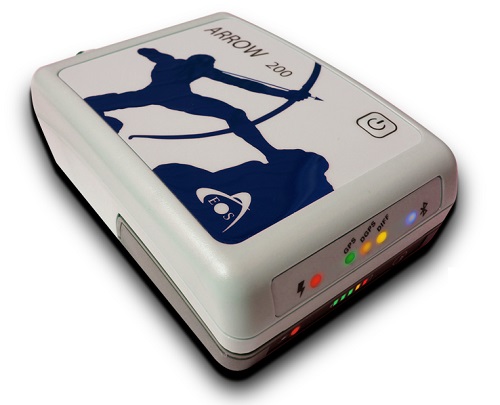
Anatum Field Solutions (AFS) has launched a nationwide Bring Your Own Device (BYOD) submeter GNSS and centimeter real-time kinematic (RTK ) GNSS receiver rental program. AFS rentals target high-accuracy users in GIS, UAV, environmental, engineering, surveying, agriculture, electric/gas/water utilities, pipeline, forestry, mining, transportation, construction, architecture and government markets. AFS offers all mobile GIS devices including Apple iOS, Android, Windows and Windows Mobile/EHH. It also stocks various GNSS receivers such as Eos Arrow (submeter and centimeter), SXBlue (submeter and centimeter), Trimble R1 (1 meter) and BadElf (1–3 meters) in a variety of configurations.
The FC-5000 field controller, with its 7-inch sunlight-readable display, is designed to provide operators a larger, more versatile and faster handheld computer for the modern construction site. The display has a capacitive touch interface — with finger, glove, small-tip stylus and water-capable options — that is optically bonded to increase visibility. With the press of a key, a user can change the orientation of the screen from portrait to landscape to increase visibility when viewing maps or drawings. The controller is compatible with all Topcon GNSS receivers and total stations, operating MAGNET Field, Site and Layout software. It has two built-in cameras: an 8-MP camera with autofocus and LED flash for field photography, and a 2-MP camera on the front for video meetings. Additional features include 64 GB of flash storage, an optional 4G LTE cellular modem, internal GPS navigation, Bluetooth and Wi-Fi, and a battery life of 10-plus hours.
Phantom 4 features obstacle avoidance, active tracking
The Phantom 4 quadcopter uses advanced computer vision and sensing technology to make professional aerial imaging easier. Its onboard intelligence makes piloting and shooting images easier through features such as its Obstacle Sensing System and ActiveTrack functionality. The Obstacle Sensing System features two forward-facing optical sensors that scan for obstacles and automatically direct the aircraft around impediments, reducing risk of collision, while ensuring flight direction remains constant. Obstacle avoidance also engages if the user triggers the drone’s “Return to Home” function to reduce the risk of collision when automatically flying back to its takeoff point. With ActiveTrack, the user can keep the camera centered on a subject. ActiveTrack allows users running the DJI Go app on iOS and Android devices to follow and keep the camera centered on the subject as it moves by tapping the subject on their smartphone or tablet.
The Pteryx UAV is a photomapping tool designed to help with photogrammetry, land property surveillance, environmental survey, search and rescue, precision agriculture, research, and in the energy sector. With a two-hour flight time, missions can be planned with the endurance reserve needed to overcome the large distances and worst-case changing weather conditions. Pteryx is designed to fly at speeds of about 50 km/h in light or medium wind speeds. The Pteryx can lift up to 1 kilogram of cargo: cameras, camcorders or other research equipment. The payload is housed in a roll-stabilized head on the front of the fuselage. The Pteryx can also accommodate a wide variety of sensors, which are installed in an easy to replace camera head. The Pteryx is delivered with a 16 MPx APS-C (crop sensor) daylight camera and wide lens, with other sensor options available.
The M2-D is a miniature stabilized gyro with electro optical (EO) and infrared imagers. The system is designed for mobile, marine and aerial unmanned applications. The M2-D is compact at 3 inches tall and 2 inches in diameter. The gimbal is fully gyro stabilized and packs sensor technologies previously only available in much larger payloads. The infrared FLIR brand pan-tilt-zoom thermal imaging camera has an optical telephoto zoom in a lightweight 160-gram payload. The high-resolution thermal imaging sensor with digital zoom integration lets users capture stable video in total darkness. For daytime operations, the gimbal has a full-color visual camera with optical 6x zoom to ~4 degrees. The optical zoom is then enhanced with digial zoom integration for stable long-range imaging.
Surveys large areas or objects to generate fast, precise data
Version 2 of the AibotX6 hexacopter features high-precision (HP) GNSS for surveyors. The system also can be installed in existing AibotX6 hexacopters. With Version 2, the precision and quality of surveying data is significantly improved with RTK technology based on the Leica Geosystems SmartNet correction data service. Post-processing is also possible. The new AibotX6 HP GNSS workflow guarantees precision of up to 2-centimeter position accuracy. Besides allowing the use of existing surveying hexacopters, continuing generation and processing of data can be done with the fully integrated software Aibotix AiProFlight. The Aibot X6 can carry a variety of sensors weighing up to 2 kilograms.
Integrates GNSS for challenging maritime positioning
The new DPS 432 combines full decimeter accuracy with high integrity and availability of GNSS data, supporting the safety and efficiency of offshore operations that rely on advanced dynamic positioning (DP) systems. It integrates signals from GPS, GLONASS, BeiDou and Galileo, and regional correction signals including SBAS and G4 services from Fugro, to ensure high flexibility for DP operations globally. Suited to complex operations, the system increases satellite availability, improves integrity monitoring and enables more precision under challenging signal tracking conditions. The DPS 432 features a sophisticated engine that runs in a safe mode protected from unintended user operations.
The aera 660 features a 5-inch capacitive touchscreen display that has been optimized for cockpits and various types of flying. It has a built-in GPS/GLONASS receiver and rich, interactive maps that can be viewed in portrait or landscape modes. Cost-effective database options along with Wi-Fi database updating capabilities allow customers to access up-to-date data, including daily U.S. fuel prices. Bluetooth supports the display of ADS-B in traffic and weather from a variety of sources, including the GDL 39/GDL 39 3D, Flight Stream and the GTX 345 ADS-B transponder. The aera 660 withstands the harshest environments, meeting stringent temperature tests and helicopter vibration standards. Depending on settings and external connections, pilots can receive up to four hours of battery life on a single charge.
cc4w is offering a new surveying app, Parcel Boundaries. With the app, a legal description, subdivision lot boundary and results of a survey can be calculated for the perimeter, area, error of closure, ratio of closure, closing course and the Northing and Easting differences.
The results can be emailed to others for review, comment and documentation.
One feature is the plotting of aliquot parts of a legal description within a typical section. With the app, users can plot a multiple aliquot part description in color to visually see the individual locations.
A legend is provided that identifies each aliquot part that has been entered.
Anatum Field Solutions (AFS) has launched a nationwide BYOD (Bring Your Own Device) submeter GNSS and centimeter (RTK) GNSS receiver rental program. With the explosion of smartphones and tablets in recent years and the availability of universal Bluetooth submeter and real-time kinematic (RTK) GNSS receivers, high-accuracy GNSS data collection is available to everyone.
AFS rentals target high-accuracy users in GIS, UAV, environmental, engineering, surveying, agriculture, electric/gas/water utilities, pipeline, forestry, mining, transportation, construction, architecture, and federal/state/local government markets.
AFS offers all mobile GIS devices including Apple iOS, Android, Windows and Windows Mobile/EHH. It also stocks various GNSS receivers such as Eos Arrow (submeter and centimeter), SXBlue (submeter and centimeter), Trimble R1 (1 meter) and BadElf (1-3 meters) in a variety of configurations.
“We intend to make centimeter and submeter accuracy GNSS receivers available to everyone, even if you only need it for a couple of days,” said Matt Alexander, Vice President at AFS. “Our full rental systems come complete with GNSS receiver, tablet with cellular data, data collection software and accessories. You can literally be collecting centimeter-accurate data within minutes of opening the box, no matter what your experience level is.”
AFS can accommodate a wide variety of mobile GIS software solutions with its systems, including Esri’s ArcGIS Collector, Survey123 and ArcPad; iCMTGIS; TerraGo; AmigoCloud; Avenza PDF Maps; Fulcrum; and tMap. AFS provides the software tools and technical support to turn mobile GIS software into centimeter or submeter-accurate data-collection systems.
AFS offers three different rental configurations:
Complete systems including GNSS receiver, tablet computer with cellular data plan, mobile GIS software and accessories. Ready to map.
GNSS receiver and tablet computer with cellular data plan (user logs into their own mobile GIS account).
GNSS receiver (centimeter or submeter) only. Ready to connect to your mobile device.
All rentals come with a return shipping label so the user can leave the box at a FedEx pick-up location, hotel counter, office counter or anywhere that Fedex picks up.
TerraGo and Eos Positioning Systems have entered a collaboration to combine the TerraGo Edge mobile GPS data-collection platform with the Eos Arrow line of sub-meter and centimeter accuracy receivers. The combination delivers a modern, cloud-based, real-time data collection capability, according to a TerraGo press release.
While the working environments and the projects are very different, customers in for water utilities, energy, survey and engineering are using TerraGo Edge and Eos Arrow receivers to replace traditional GPS handhelds for cost-savings and improved productivity.
Enmapp, a pipeline inspection company based in Canada, was able to cut hardware costs by 85 percent while capturing sub-meter data in real-time, eliminating all the costs of post-processing handheld data.
Summit Engineering, a Colorado-based engineering and land surveying firm, was able to reduce hardware costs by over 50 percent and improve productivity by more than 30 percent while surveying power lines in Minnesota for one of the country’s largest energy companies. Similar performance improvements and cost reductions are reported by joint customers in water utilities, forestry, engineering, agriculture and environmental operations, TerraGo said.
“When we talk about Eos Arrow, we’re not simply pairing their receivers via Bluetooth, there are millions of apps that do that without any meaningful integration,” said Dave Basil, VP of products and services at TerraGo. “We interoperate with their receivers at the software level to ensure our customers get the full real-time GPS data set so they can monitor, alert and capture data that meets the highest accuracy and quality standards. For customers, it’s as simple as Bluetooth pairing, but we’ve done the work to turn their phone or tablet into a survey-grade receiver.”
“TerraGo and Eos Positioning are strategic technology partners,” said Jean-Yves Lauture, chief technology officer of Eos Positioning Systems. “This means that our collaboration goes beyond simple marketing and includes sharing core technology for the benefit of our customers. For example, we have been able to share Eos software components, which TerraGo has built into the Edge app. This integration provides the full fidelity monitor and lossless capture of NMEA data from the Eos receivers, including the Arrow 200.”
Sokkia has introduced its new SHC500 field controller for construction and surveying applications. It is designed to provide operators a compact handheld option with numerous features and benefits, including a 4.3-inch touchscreen display and optional 5 MP camera with built-in LED flash.
The SHC500 is designed for the professional operating MAGNET Field, Site and Layout software. The data controller works with all Sokkia GNSS receivers and total stations, and meets or exceeds all field application requirements.
“With a sunlight-readable screen, even in bright conditions the controller is perfect for modern project sites,” said Ray Kerwin, director of global surveying products. “It is built rugged — waterproof up to one meter with an IP68 rating — securing the unit and optional built-in LED flash camera and 8GB flash storage.
“The SHC500’s optional internal cellular modem allows operators to send and receive data through the MAGNET suite of software solutions. Field crews can easily communicate when projects need to be changed or if important data is required back in the office,” Kerwin said.
Additional features include standard Bluetooth and Wi-Fi connectivity, 23 control buttons with numeric input, and a capacitive-touch interface.


![Figure 1. [Figure 3 from Part 5] - Diagram depicting differences between GNSS-derived orthometric heights from a Minimum-Constraint Adjustment (using GEOID12B) and published NAVD 88 height values (units=cm).](https://stage.globalpositioningnews.com/wp-content/uploads/2016/04/Rowan-County_Newsletter_5_3.jpg)
![Figure 2. [Figure 4 from Part 5] - Diagram depicting differences between GNSS-derived orthometric heights from a Minimum-Constraint Adjustment (using GEOID12B) and published NAVD 88 height values (units=cm).](https://stage.globalpositioningnews.com/wp-content/uploads/2016/04/Rowan-County_Newsletter_5_4.jpg)
![Figure 3. [Figure 5 from Part 5] - Diagram depicting differences between GNSS-derived orthometric heights from a Minimum-Constraint Adjustment (using xGeoid15b) and published NAVD 88 height values (units=cm).](https://stage.globalpositioningnews.com/wp-content/uploads/2016/04/Rowan-County_Newsletter_5_5.jpg)
![Figure 4. [Figure 6 from Part 5] - Diagram depicting differences between GNSS-derived orthometric heights from a Minimum-Constraint Adjustment (using xGeoid15b) and published NAVD 88 height values (units=cm).](https://stage.globalpositioningnews.com/wp-content/uploads/2016/04/Rowan-County_Newsletter_5_6.jpg)